
Kids and teens · Mindfulness for ages 5 to 12 · Updated 2026-11-04
Mindfulness activities for kids: 15 simple practices, what the research really says, and a free printable
Ready-made printable: Mindfulness Worksheets for Kids and Teens Holiday 20% off: about $9.20, was $12 (EUR 10) · instant digital download
Buy on Etsy
A class comes in from recess loud and buzzing. A child melts down before bedtime every night. A worried student cannot settle before a test. Adults often reach for mindfulness in these moments, and short, playful mindfulness activities can help children notice what is happening in their bodies and minds and choose what to do next. They are not magic, though, and the research is more mixed than many websites suggest.
This guide is for teachers, school counselors, therapists and parents of children about 5 to 12. It explains what mindfulness means in kid friendly words, what the best studies found, 15 mindfulness activities sorted by age, how to teach them step by step, and the mistakes to avoid. At the end there is a free three page printable with a Mindful Moments Menu, a Notice It! senses page and a My Mindful Week tracker.
Jump to the free mindfulness printable for kids
What is mindfulness? A definition kids can understand
Jon Kabat-Zinn, who founded the Mindfulness-Based Stress Reduction program, describes mindfulness as "paying attention in a particular way: on purpose, in the present moment, and non-judgmentally." For children, that becomes one sentence, the same one at the top of page 1 of the printable: mindfulness means noticing what is happening right now, on purpose, with kindness.
- Noticing. Sounds, smells, the breath, the feet on the floor, a tight tummy, a busy thought.
- Right now. Not yesterday's argument or tomorrow's test, just this moment.
- On purpose. Choosing where to put your attention, and bringing it back when it wanders. Wandering is normal and is part of the practice.
- With kindness. No grades for "doing it right". If a child feels wiggly or bored, that is something to notice too.
Does mindfulness work for kids? What the research says
Honest answer: it helps some children with some things, and the effects are usually small.
- The big review. Dunning and colleagues (2019) combined 33 randomized controlled trials with 3,666 children and adolescents. Compared with any control group, mindfulness programs showed small benefits for mindfulness, attention, executive function, depression, anxiety and stress, and negative behavior. When they looked only at the 17 trials that compared mindfulness with another active activity, the benefits held for mindfulness itself, depression and anxiety or stress, but not for attention, executive function or behavior.
- The largest school trial. The MYRIAD trial (Kuyken and colleagues, 2022) followed 8,376 students aged 11 to 14 in 84 UK secondary schools. Ten lessons of school based mindfulness training were no better than the schools' usual social and emotional teaching for depression risk, social, emotional and behavioral functioning, or wellbeing one year later. No harms were reported, but the authors concluded that universal school based mindfulness in that format is not recommended for young adolescents.
What this means in practice: treat mindfulness as one useful tool, not a cure. Keep practices short, invitational and fun, pair them with other skills such as breathing exercises, coping skills and emotional regulation work, and watch how each child responds. A child who has anxiety, depression or trauma symptoms that last needs more than a classroom practice, so involve a counselor or mental health professional.
15 mindfulness activities for kids, by age
Ages 5 to 7: short, physical and playful
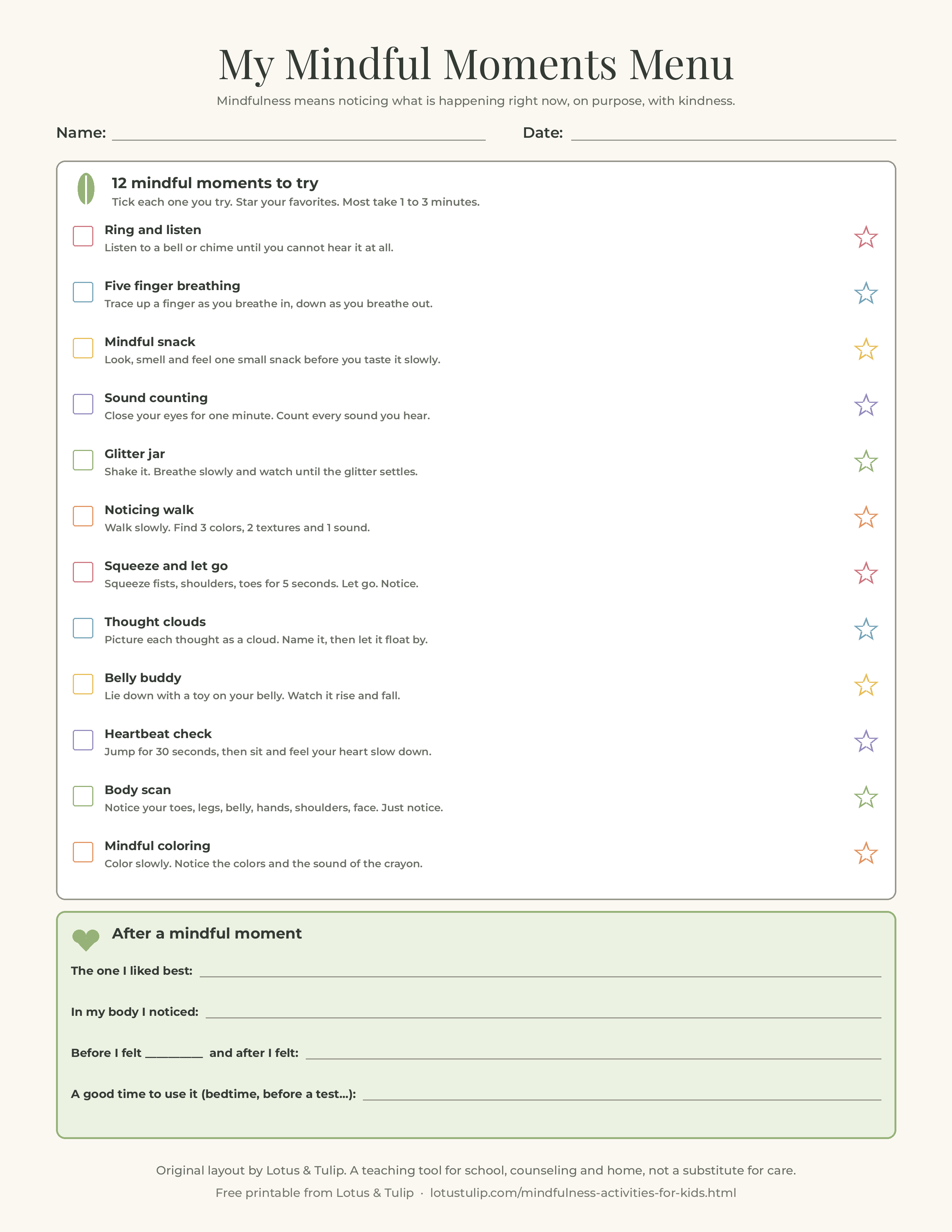
- Ring and listen. Ring a bell or chime. Children raise a hand when they can no longer hear it. This builds quiet attention in under a minute.
- Belly buddy. Children lie down with a small stuffed toy on their belly and watch it rise and fall with their breath.
- Five finger breathing. Trace up one finger while breathing in and down while breathing out, across all five fingers.
- Glitter jar. Shake a jar of water and glitter. Breathe slowly and watch until the glitter settles, the way busy feelings can settle.
- Heartbeat check. Jump in place for 30 seconds, then sit with a hand on the chest and notice the heartbeat slowing down.
Ages 7 to 10: senses and noticing
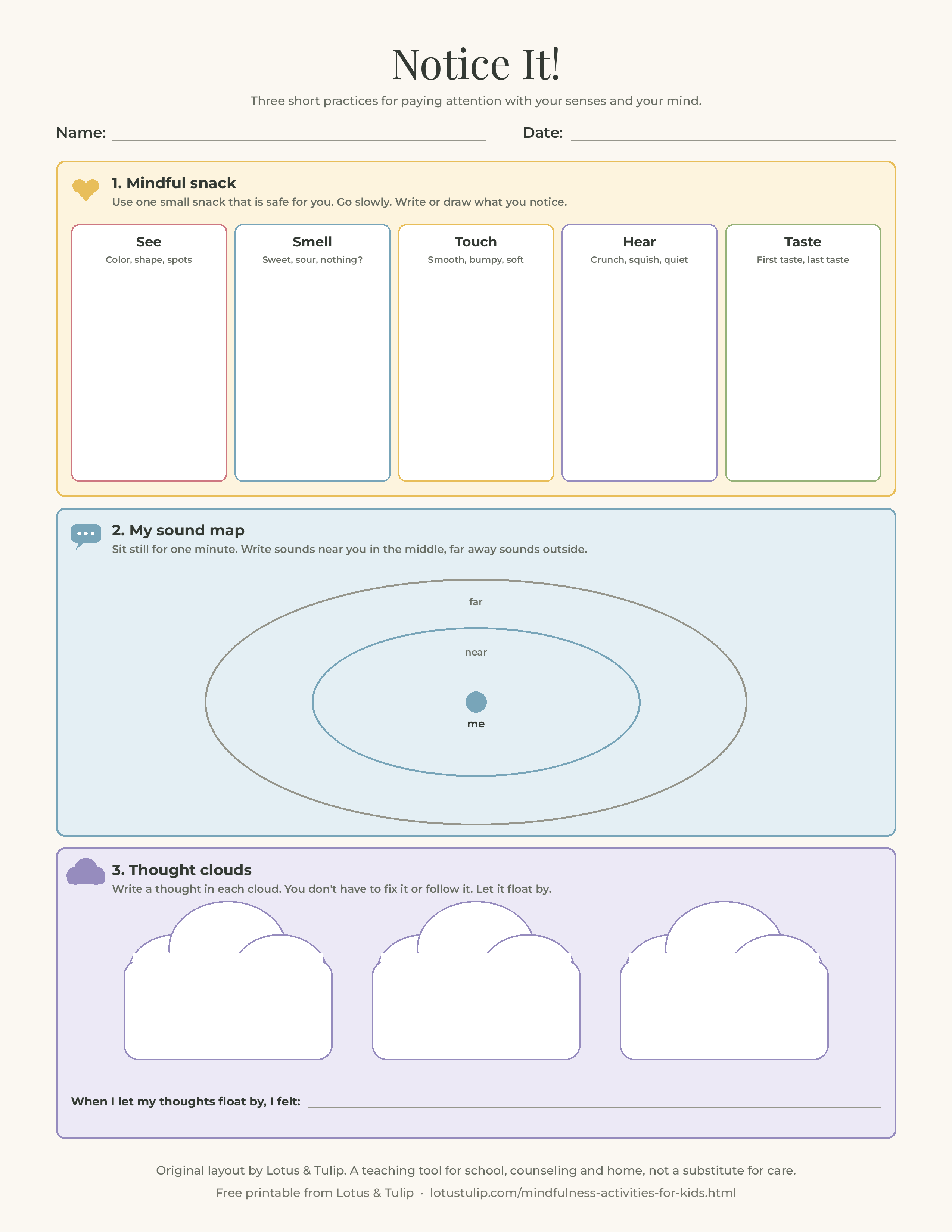
- Mindful snack. Look at, smell and feel one small snack before tasting it slowly. Use a food that is safe for every child and check allergies first. Page 2 has a five senses log for this.
- Sound map. Sit still for one minute and draw or write the sounds heard nearby and far away. Page 2 has a sound map.
- Noticing walk. Walk slowly indoors or outdoors and find 3 colors, 2 textures and 1 sound.
- Squeeze and let go. Squeeze fists, shoulders and toes for about 5 seconds, then let go and notice the difference. This is a kid sized version of progressive muscle relaxation.
- Mindful coloring. Color slowly and notice the colors, the movement of the hand and the sound of the crayon. The goal is noticing, not a perfect picture.
Ages 9 to 12: thoughts and feelings
- Thought clouds. Picture each thought as a cloud. Name it ("worry about the game", "planning") and let it float by without arguing with it. Page 2 has three clouds to fill in.
- Body scan. Guide attention slowly from toes to head, simply noticing what each part feels like. Two or three minutes is plenty.
- Name it to notice it. When a big feeling shows up, pause and name it in a few words ("I am frustrated"). Pair this with a feelings wheel for more words.
- STOP. Stop, Take a breath, Observe what you feel and think, then Proceed with a choice. Good before a test, a game or a hard conversation.
- Mindful gratitude. Notice one small good thing in detail: what it looked like, sounded like and how it felt. See the gratitude worksheet for more.
How to teach mindfulness to kids, step by step
- Practice yourself first. Try each activity on your own so you can describe it honestly and model it calmly.
- Explain it simply. Use the one sentence definition: noticing what is happening right now, on purpose, with kindness.
- Keep it short. Start with 1 to 3 minutes. Younger children may only manage 30 seconds at first, and that is fine.
- Make it invitational. Let children keep their eyes open, look at the floor or sit quietly instead. Nobody should be forced to close their eyes or lie down.
- Use the Mindful Moments Menu. Try one new practice from page 1 each day and let children tick it off and star their favorites.
- Talk about what they noticed. Ask "What did you notice?" rather than "Did you feel calm?" Any answer is a good answer, including "I felt bored".
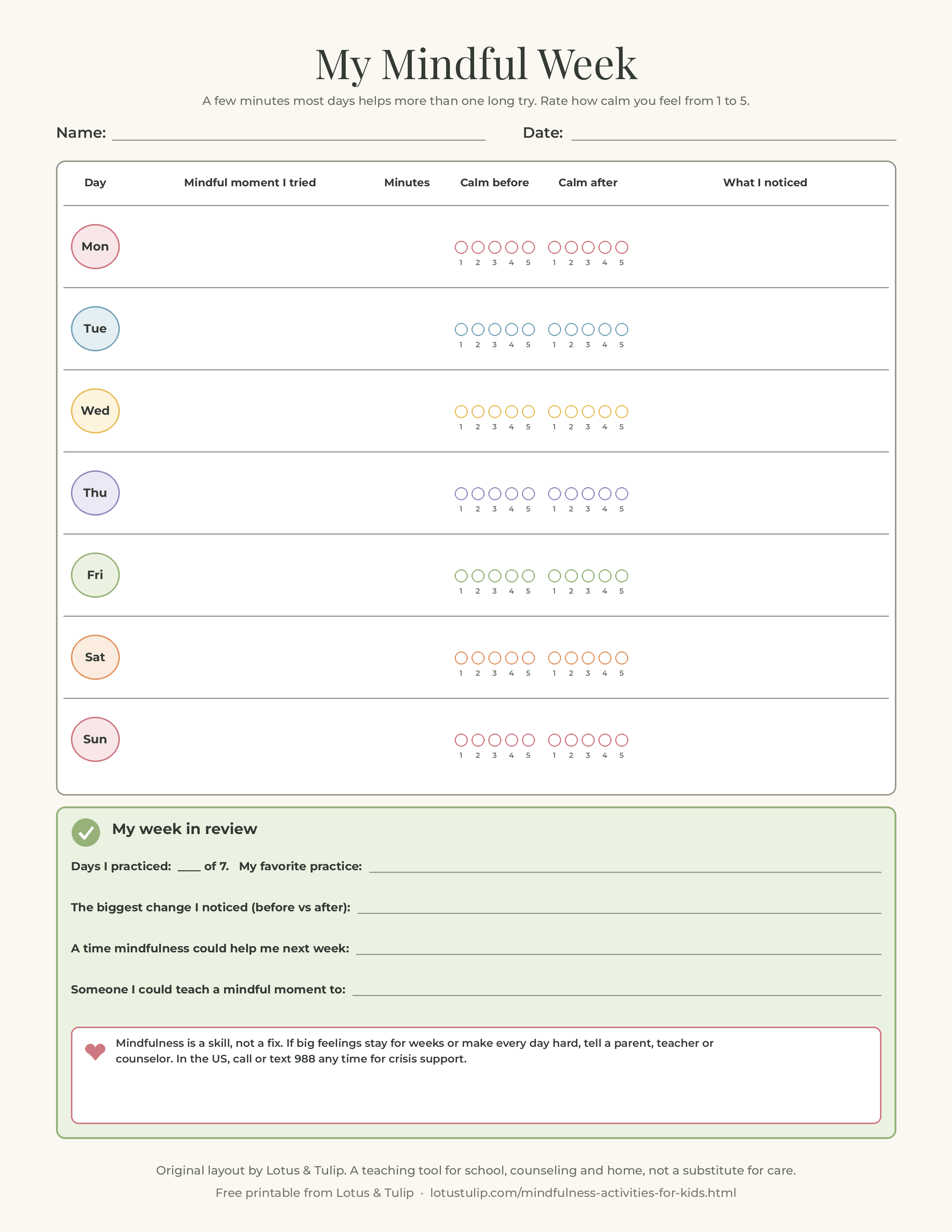
- Build a routine. Pick a regular time, such as after recess, before tests or at bedtime, and track it for a week with page 3.
- Connect it to real moments. Help each child choose one practice for a specific hard moment, such as before a test or when they feel angry.
Common mistakes when teaching kids mindfulness
- Using it as a punishment. "Go sit and be mindful" turns a skill into a consequence. Keep practice positive.
- Expecting instant calm. The aim is noticing. Calm sometimes follows, sometimes not.
- Going too long. Ten minutes of silence is hard for most adults. Short and frequent beats long and rare.
- One size fits all. Some children, especially those who have experienced trauma, can feel uneasy focusing inward or closing their eyes. Offer outward focused options such as sounds, colors or movement, and let them stop at any time.
- Replacing support. Mindfulness does not replace counseling, therapy or help with problems such as bullying or trouble at home.
Free mindfulness activities for kids printable (PDF)
This free printable is an original Lotus & Tulip design, sized for US Letter paper and written for about ages 5 to 12 (with adult support for younger children) in classrooms, counseling sessions, small groups and at home. It has three pages:
- Page 1: My Mindful Moments Menu. Twelve short mindful practices with one line instructions to tick and star, plus an After a Mindful Moment reflection: favorite practice, what I noticed in my body, how I felt before and after, and a good time to use it.
- Page 2: Notice It! Three practices on one page: a Mindful Snack log for see, smell, touch, hear and taste, a Sound Map for sounds near and far, and Thought Clouds for letting thoughts float by.
- Page 3: My Mindful Week. A Monday to Sunday tracker for the practice tried, minutes, calm before and calm after on a 1 to 5 scale, and what I noticed, plus a week in review and a help box with the 988 Lifeline.
Download the free mindfulness activities for kids printable (PDF, 3 pages, US Letter)
Prefer single images? Page 1: Mindful Moments Menu (PNG) · Page 2: Notice It! (PNG) · Page 3: My Mindful Week (PNG)
Free to print for your own use and for use with your own students, clients or children. Please link to this page rather than re-uploading the file.
Related resources
- Mindfulness worksheets for adults: a practice log, everyday anchors and a free 2 page PDF
- Breathing exercises for kids (free printable)
- 5 4 3 2 1 grounding worksheet (free printable)
- Calm down corner ideas (free printable)
- Coping skills list for kids (free printable)
- Emotional regulation worksheets for kids (free printable)
- Worry worksheet for kids (free printable)
- Feelings wheel printable (free)
- Gratitude worksheet for kids (free printable)
- Stress management worksheets for teens (free printable)
Sources
- Dunning, D. L., Griffiths, K., Kuyken, W., Crane, C., Foulkes, L., Parker, J., and Dalgleish, T. (2019). Research Review: The effects of mindfulness-based interventions on cognition and mental health in children and adolescents: a meta-analysis of randomized controlled trials. Journal of Child Psychology and Psychiatry, 60(3), 244 to 258.
- Kuyken, W., Ball, S., Crane, C., and colleagues (2022). Effectiveness and cost-effectiveness of universal school-based mindfulness training compared with normal school provision in reducing risk of mental health problems and promoting well-being in adolescence: the MYRIAD cluster randomised controlled trial. Evidence-Based Mental Health, 25(3), 99 to 109.
- Montero-Marin, J., and colleagues (2022). School-based mindfulness training in early adolescence: what works, for whom and how in the MYRIAD trial? Evidence-Based Mental Health, 25(3), 117 to 124.
- Kabat-Zinn, J. (1994). Wherever You Go, There You Are: Mindfulness Meditation in Everyday Life. Hyperion.
- 988 Suicide and Crisis Lifeline. 988lifeline.org.
Mindfulness activities for kids: FAQ
What are mindfulness activities for kids?
They are short, simple practices that help children notice what is happening right now, such as sounds, the breath, body feelings and thoughts, on purpose and with kindness. Examples include listening to a bell, belly breathing with a toy, a mindful snack, a noticing walk and a short body scan.
How do you explain mindfulness to a child?
Say: "Mindfulness means noticing what is happening right now, on purpose, with kindness." Then try a 30 second practice together, such as listening to a chime until the sound disappears, and ask what they noticed.
How long should mindfulness practice be for kids?
Start with 1 to 3 minutes, or even 30 seconds for young children. Short practice most days is more realistic than long sessions, and you can lengthen it as children get used to it.
Does mindfulness actually work for children?
The evidence shows small benefits on average. A 2019 meta-analysis of 33 trials found small improvements, and against active comparison activities the benefits held for mindfulness, depression and anxiety or stress. The large MYRIAD school trial found ten lessons of mindfulness were no better than usual social and emotional teaching after one year. Use it as one helpful tool among several.
What is the easiest mindfulness activity for young kids?
Ring and listen and belly buddy breathing are two of the easiest. Both take about a minute, need almost no explanation and give children something concrete to notice.
Is mindfulness right for every child?
Not always in the same way. Some children, especially those who have experienced trauma, feel uncomfortable closing their eyes or focusing on their body. Offer eyes open and outward focused options, let children opt out, and involve a counselor or therapist if a child seems distressed.
Is this mindfulness printable free?
Yes. The three page mindfulness activities for kids printable is free to print for your own use and for use with your own students, clients or children. Please link to this page rather than re-uploading the file.