
Kids and teens · Stress, coping and sleep for ages 12 to 18 · Updated 2026-11-04
Stress management worksheets for teens: what actually helps, coping activities, and a free printable
Ready-made printable: Middle School Stress Small Group Curriculum for Counselors Holiday 20% off: about $11.04, was $14 (EUR 12) · instant digital download
Buy on EtsyTry it free first: download session 1 free (group at a glance, lesson plan and student page, PDF, 73 KB). Run it with your group, then get all 8 sessions. No email needed.

Ask a group of high school students how stressed they are and most will laugh before they answer. Tests, homework, college applications, practice every night, a part time job, a group chat that never sleeps, and a phone that keeps them up until one in the morning. Then they get up at six and do it again. Teen stress is not a made up problem, and it is not just "kids these days" being dramatic. It is one of the most common things school counselors, teachers, therapists and parents hear about.
The good news is that stress management is a learnable set of skills, not a personality type. Teens can learn to notice their own stress signals, sort what they can change from what they cannot, use tools that calm the body, and protect the two things that make the biggest difference to how stress feels: sleep and movement. This guide is for school counselors, middle and high school teachers, therapists, youth workers and parents in the US. It covers what stress is in plain language, what the research honestly shows about teens (with caveats), how to tell normal stress from something that needs more help, coping activities for groups, sessions and home, a 9 step plan for teaching stress management, common mistakes, and a free 3 page printable.
Jump to the free stress management worksheets for teens
What is stress? A plain language definition for teens
Stress is what happens when your brain decides that something matters and that it might take more than you have to handle it. That second part is important. Psychologists Richard Lazarus and Susan Folkman, in their classic 1984 book Stress, Appraisal, and Coping, described stress as a two step judgment. First you ask, "Is this a threat or a challenge to something I care about?" Then you ask, "Do I have what I need to deal with it?" When the demand feels bigger than your resources, you feel stressed.
A simple version for teens: stress is your body and brain getting ready to deal with something that matters to you. Your heart beats faster, you breathe faster, your muscles tense and your mind focuses on the problem. In short bursts this is useful. It is the same system that helps you run the last lap, speak up in class or finish a project the night before it is due.
Problems start when stress is constant and never switches off, when it is bigger than the situation calls for, or when the main ways of coping make things worse (staying up all night scrolling, skipping meals, avoiding the work until it piles higher). Stress management is not about getting rid of stress. It is about:
- Noticing stress early, before it turns into a blowup, a shutdown or a sleepless night.
- Changing what can be changed, such as breaking a project into steps or asking for an extension.
- Calming the body and mind when the problem cannot be changed right now.
- Protecting recovery, mainly sleep, movement, food and time with people.
- Knowing when to get help, and who to go to.
Stress, anxiety and burnout: what is the difference?
These words get used as if they mean the same thing, but it helps teens to separate them:
- Stress is usually a response to a specific demand: a test on Friday, a fight with a friend, a tryout. It tends to ease when the situation ends.
- Anxiety is worry and fear that continues even without a clear current trigger, or that is far out of proportion to the situation. Anxiety that lasts for months and gets in the way of school, friendships or sleep can be an anxiety disorder, which is a health condition that deserves professional care.
- Burnout is what long, unrelieved stress can feel like: exhausted, flat, cynical about school and unable to care anymore. Teens with packed schedules and little sleep are at real risk of it.
The worksheets in this guide are built for everyday stress. They can sit alongside therapy for anxiety, but they do not replace it.
What the research says about teen stress (with honest caveats)
There is a lot of noise online about teen stress. Here is what the more solid sources actually say, along with what they do not prove.
Teens report stress levels well above what they consider healthy
The American Psychological Association's Stress in America report for 2013, titled "Are Teens Adopting Adults' Stress Habits?", surveyed 1,018 US teens ages 13 to 17 online (the survey was run by Harris Interactive in August 2013). Teens rated their stress during the school year at an average of 5.8 on a 10 point scale, while they said 3.9 would be healthy. That school year rating was higher than the 5.1 reported by adults in the same survey. Teens rated their summer stress lower, at 4.6. About 27% said they felt extreme stress (8, 9 or 10 out of 10) during the school year.
The biggest reported sources of stress were school (83%), getting into a good college or deciding what to do after high school (69%) and family financial worries (65%). In the month before the survey, 40% said stress made them irritable or angry, 36% felt nervous or anxious, 36% felt tired, 31% felt overwhelmed, and 30% felt sad or depressed. About 35% said stress caused them to lie awake at night, 23% had skipped a meal because of stress, and 28% had skipped exercise.
Two other findings matter for anyone teaching stress management. The most common ways teens coped were listening to music (67%), playing video games (46%), going online (43%), spending time with friends or family (43%) and exercising or walking (37%). And about half of the teens said stress had little or no impact on their physical health (54%) or mental health (52%). In other words, many teens underestimate what stress is doing to them, which is one reason a signals checklist like page 1 of the free printable is useful.
Caveat: this is self reported survey data from an online panel, and it was collected in 2013, before the pandemic and before the current generation of social media apps. Treat the exact numbers as a snapshot, not a current measurement. The pattern (school as the top stressor, poor sleep, many teens underrating their stress) is still a reasonable starting point for a conversation.
Many high school students are struggling more than "stress" suggests
The CDC's Youth Risk Behavior Survey (YRBS) is the largest regular survey of US high school students. In the 2023 survey of 20,103 students in grades 9 to 12 (published in MMWR Supplements in 2024), about 40% reported persistent feelings of sadness or hopelessness during the past year. That was slightly lower than 42% in 2021 but still well above the 30% reported in 2013. Female students (about 53%) were far more likely than male students (about 28%) to report it, and about two thirds of LGBQ+ students did. About 29% reported that their mental health, which the survey defines as including stress, anxiety and depression, was most of the time or always not good during the past 30 days. Twenty percent had seriously considered suicide in the past year, and about 9% had attempted it.
Caveat: these are self reported answers and do not equal diagnoses. They are still the reason this guide includes a clear "when to get more help" section. Stress worksheets are for everyday stress. Persistent sadness, hopelessness or any thought of self harm is a signal to involve a trusted adult and a professional the same day.
Sleep is the most overlooked stress tool
The American Academy of Sleep Medicine's consensus statement (Paruthi and colleagues, 2016, Journal of Clinical Sleep Medicine), developed by a 13 member expert panel that reviewed 864 published articles and endorsed by the American Academy of Pediatrics, recommends that teens ages 13 to 18 sleep 8 to 10 hours per 24 hours on a regular basis. The statement links insufficient sleep in teenagers with higher risk of self harm, suicidal thoughts and suicide attempts, along with problems in attention, behavior, learning and mood, including depression.
In the 2023 YRBS, only about 23% of US high school students reported getting 8 or more hours of sleep on an average school night, down from about 32% in 2013. Put simply, roughly three in four high school students are not getting the minimum recommended sleep on school nights. Short sleep makes almost everything feel more stressful, and stress makes it harder to fall asleep. Breaking that loop is why page 3 of the printable tracks sleep and stress side by side.
Caveat: most sleep research in teens is observational, so it shows strong links rather than proving that short sleep causes every problem it is linked with. School start times, homework loads and biology (teens naturally shift toward later sleep times) all play a part, and none of that is a teen's personal failing.
How teens think about stress can change how stress affects them
One of the more interesting research areas is stress mindset, meaning whether you believe stress is harmful or can be helpful. In a 2013 paper in the Journal of Personality and Social Psychology, Alia Crum, Peter Salovey and Shawn Achor found that adults who were shown short videos framing stress as enhancing (useful for performance and growth) reported fewer psychological symptoms and better work performance than those shown videos framing stress as debilitating. In a lab task, people with a more "stress can help" mindset had more moderate cortisol responses and were more willing to ask for feedback. Caveat: those studies were with adults, not teens.
A larger set of studies has since looked at teens. In 2022, David Yeager and colleagues published "A synergistic mindsets intervention protects adolescents from stress" in Nature. Across six double blind randomized experiments in the US with a total of 4,291 participants ages 13 to 25, a short self administered online module (about 30 minutes) combined two messages: your abilities can grow (growth mindset), and your body's stress response can help you meet a challenge (stress can be enhancing). Compared with control activities, the module improved how students appraised stress, and in different studies it was linked with healthier heart and blood vessel responses during a stressful task, lower daily cortisol, better well being, better grades in a challenging class, and less anxiety during the 2020 lockdowns. Importantly, the benefits showed up when both messages were combined, not with either one alone.
Caveat: the effects were small (for example, about a tenth of a standard deviation on stress appraisals in the largest high school study), the stressors were mostly school and social evaluation stressors, and a 30 minute module is not a treatment for clinical anxiety or depression. What it does support is a simple teaching point: telling teens "stress is bad, avoid it" is less helpful than "that racing heart is your body getting ready, and you can learn to handle hard things." That is the idea behind the Rethink the Rush box on page 2 of the free printable.
Some ways of coping are linked with better outcomes than others
Bruce Compas and colleagues published a large meta analysis in Psychological Bulletin in 2017 that pooled 212 studies with 80,850 children and teens. Coping strategies that involve working on the problem (problem solving, sometimes called primary control coping) and strategies that involve adapting to stress (acceptance, reframing the situation, healthy distraction, sometimes called secondary control coping) were both linked with fewer emotional and behavior problems. Disengagement coping, such as avoidance, denial and wishful thinking, was linked with more problems.
Caveat: these are mostly correlational studies, so they show patterns rather than proving that one strategy causes better outcomes. Still, the pattern lines up well with a two part toolkit: change the problem when you can, calm and adapt when you cannot, and avoid avoiding.
Movement helps more than most teens expect
The US Physical Activity Guidelines for Americans (2nd edition, 2018) recommend that children and teens ages 6 to 17 get 60 minutes or more of moderate to vigorous physical activity every day. In the 2023 YRBS, only about a quarter of high school students reported being active for at least 60 minutes on all seven days of the week. A 2025 umbrella review in the Journal of the American Academy of Child and Adolescent Psychiatry (Singh and colleagues), which pooled earlier meta analyses of trials, found that physical activity reduced symptoms of depression and anxiety in children and teens by a moderate amount. Caveat: the included trials varied a lot in quality and type of exercise, and exercise is a support, not a replacement for treatment when a teen is seriously struggling. For everyday stress, a 15 to 20 minute walk is one of the most reliable tools a teen has.
Common sources of stress for teens
Every teen is different, but these come up again and again in surveys, counseling offices and classrooms. Page 1 of the free printable includes all twelve as a checklist:
- Tests and grades, especially in honors, AP or classes that feel make or break.
- Homework load, often several assignments due in the same week.
- College and future plans, including applications, the SAT or ACT, and "What am I doing with my life?"
- Friends and drama, group chats, being left out, rumors and conflict.
- Family conflict, separation, illness, or tension at home.
- Social media, comparison, pressure to respond and late night scrolling.
- Sports and activities, tryouts, playing time and packed schedules.
- Money worries, family finances or the cost of college.
- Not enough sleep, both a cause and a result of stress.
- Body image and how they look.
- Dating and relationships.
- A too busy schedule with no time to recover.
Some teens also carry heavier stressors that a worksheet should never be expected to fix: bullying, discrimination, grief, unsafe homes, caring for younger siblings, food or housing insecurity, or trauma. When these show up on a triggers checklist, the right response is a conversation and, often, a referral, not just a coping skill.
Signs of stress in teens
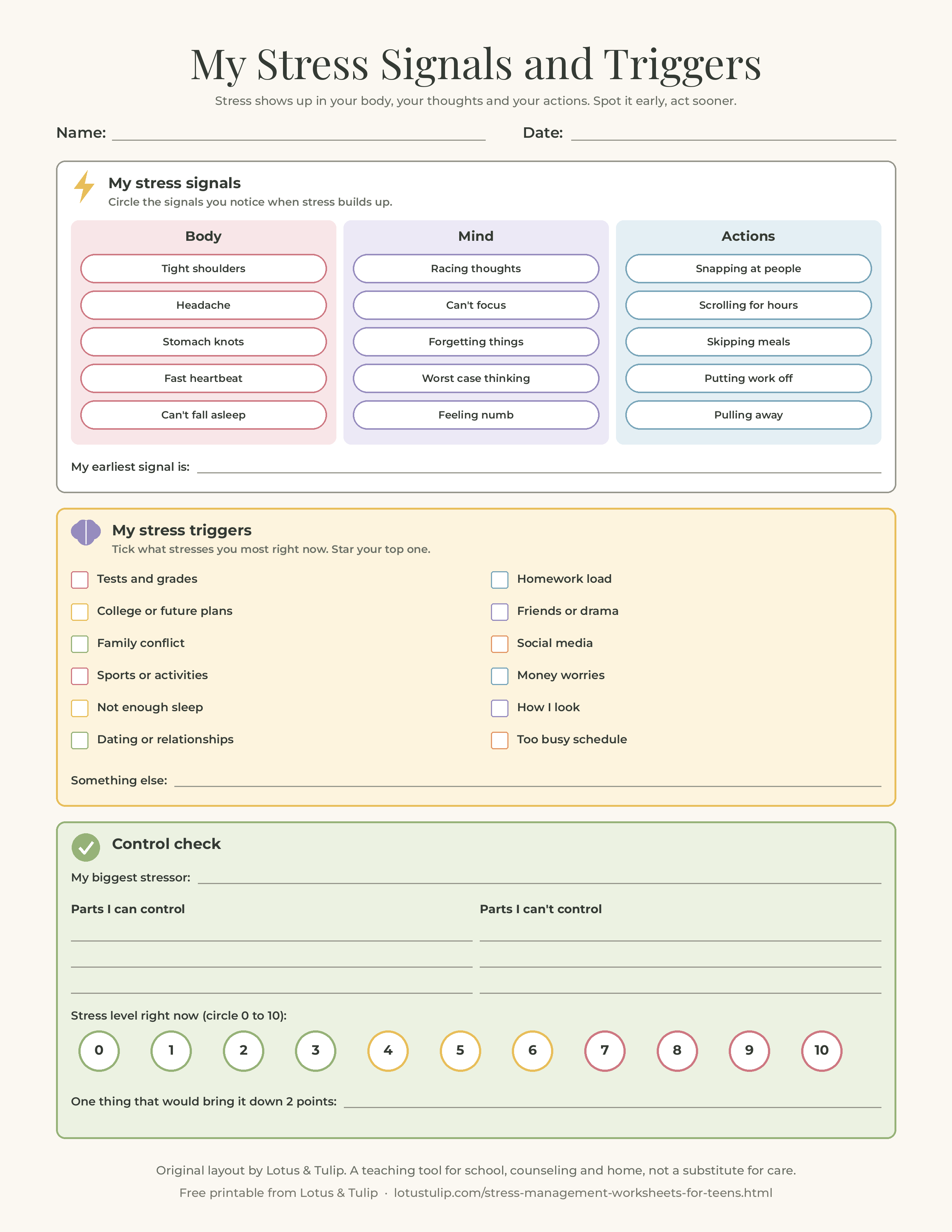
Teens often do not say "I am stressed." They show it. Page 1 of the printable groups the most common signals into three columns, which helps teens see that stress is not just a feeling.
- Body: tight shoulders or jaw, headaches, stomach aches or knots, a fast heartbeat, trouble falling asleep, feeling tired all the time.
- Mind: racing thoughts, trouble focusing, forgetting things, worst case thinking, feeling numb or checked out.
- Actions: snapping at people, scrolling for hours, skipping meals or eating more, putting work off, pulling away from friends or family.
The most useful single question you can ask a teen is: "What is the first sign that stress is building for you?" If they can name an early signal, such as clenching their jaw or reaching for their phone the moment they sit down to study, they have a cue to use a tool before stress takes over.
When stress is more than stress: when to get more help
Stress management worksheets are a good fit for everyday stress. Involve a parent or guardian, the school counselor, a pediatrician or a licensed mental health professional if a teen:
- Feels sad, hopeless, empty or irritable most days for two weeks or more.
- Has worry or panic that does not ease when the stressful event ends, or that stops them from going to school or seeing friends.
- Has big changes in sleep, eating or weight.
- Is using alcohol, vaping or other drugs to cope.
- Has stopped caring about things they used to enjoy.
- Talks about feeling like a burden, not wanting to be here, or hurting themselves, or has injured themselves.
If a teen is in crisis or talks about suicide, do not wait. In the US, they (or you) can call or text 988 to reach the 988 Suicide and Crisis Lifeline at any time, day or night. If someone is in immediate danger, call 911. The free printable includes the 988 line on the toolkit page so teens have it in writing.
Stress management activities for teens
The activities below are grouped by setting. Most take 10 to 20 minutes and can be paired with one page of the free printable.
Stress management activities for the classroom or small groups
- Stress signal sort. Write 15 stress signals on sticky notes (headache, snapping at people, racing thoughts and so on). In small groups, students sort them into Body, Mind and Actions, then each student circles their own on page 1. Discuss: which signals are easy to miss?
- Stress thermometer check in. At the start of class or group, students rate their stress from 0 to 10 privately. Over a few weeks, they see that stress rises and falls, which is a useful message for teens who feel it will never end.
- Control circles. Students pick one current stressor and split it into parts they can control (start the essay today, ask the teacher a question) and parts they cannot (the test date, what other people think). The circle of control worksheet works well for this, and page 1 of the printable has a short version.
- Rethink the rush. Explain the body's stress response in two minutes, then have students rewrite a stressful thought in "my body is getting ready" language. For example, "I am going to fail this presentation" becomes "My heart is pounding because this matters. I have practiced and I can handle a few nervous minutes."
- Tool tasting. Teach three quick calming tools in one session: slow exhale breathing (breathe in for 4, out for 6), 5 4 3 2 1 grounding, and squeeze and release muscle relaxation. Students rate each tool afterward and keep the one that worked best for them.
- Break it down race. Give groups a big, vague task ("study for the biology final") and two minutes to break it into the smallest possible first steps. The group with the most concrete steps wins. Then students do the same for their own biggest stressor.
- Sleep audit. Students estimate their average school night sleep, then compare it with the AASM recommendation of 8 to 10 hours. No shaming. The goal is curiosity: what is the one thing that most often keeps you up?
Stress management activities for counseling and therapy sessions
- Stress timeline. Draw a line across a page for the last month. The teen marks the high and low stress points and what was happening. Patterns often jump out, such as stress spikes every Sunday night or after games.
- Thought check. When stress comes with harsh or catastrophic thoughts, use a simple thought record: situation, thought, feeling, evidence for and against, a more balanced thought. The CBT thought record worksheet is built for this.
- Skills for overwhelming moments. For teens who go from 0 to 10 quickly, teach a fast body based skill such as cold water on the face or intense movement for a minute. The DBT TIPP skills worksheet walks through these, and the window of tolerance worksheet helps teens understand when they are too revved up or too shut down to think clearly.
- Values check. Ask: which of your commitments actually matter to you, and which are there because you feel you should? Stress management sometimes means dropping one thing, and teens may need an adult's permission to do that.
- Toolkit plan rehearsal. Fill in page 2 of the printable together, then role play the plan. What will you actually do on Sunday night when you notice your chest getting tight?
Stress management activities for teens at home
- Phone out of the bedroom. The single change many families report helps most with sleep. Charge phones in the kitchen overnight, and parents can do the same.
- Walk and talk. Many teens talk more easily side by side than face to face. A 20 minute walk counts as movement and connection at the same time.
- Sunday planning. Ten minutes on Sunday to look at the week, list what is due and pick start times. Planning ahead turns a vague cloud of stress into a list of steps.
- One thing that is just fun. Music, drawing, a game, cooking or time with a pet. Recovery time is not wasted time, and teens with packed schedules often need to be told that.
- Family check in. Once a week, everyone rates their stress from 0 to 10 and shares one thing that helped. Parents modeling their own stress management is more persuasive than any lecture.
How to teach stress management to teens, step by step
- Start with respect, not a lecture. Open by asking teens what stresses them and what they already do about it. Teens tune out quickly if they feel judged for being on their phones or for being "dramatic." Their stress is real, and saying so builds trust.
- Explain what stress is in two minutes. Stress is the body and brain getting ready for something that matters. Short bursts help. Constant stress without recovery wears people down. Keep it simple and avoid scare messages.
- Map stress signals. Use page 1 of the printable to circle body, mind and action signals. Ask each teen to name their earliest signal, because that is their cue to use a tool.
- Identify triggers and sort them. Tick the triggers that apply, star the biggest one, then do the control check: which parts can I control and which parts can I not control?
- Reframe the stress response. Practice the Rethink the Rush box on page 2. Teach teens to say "my body is getting ready" instead of "something is wrong with me." Pair it with "I can grow and handle hard things," since the research suggests these two messages work best together.
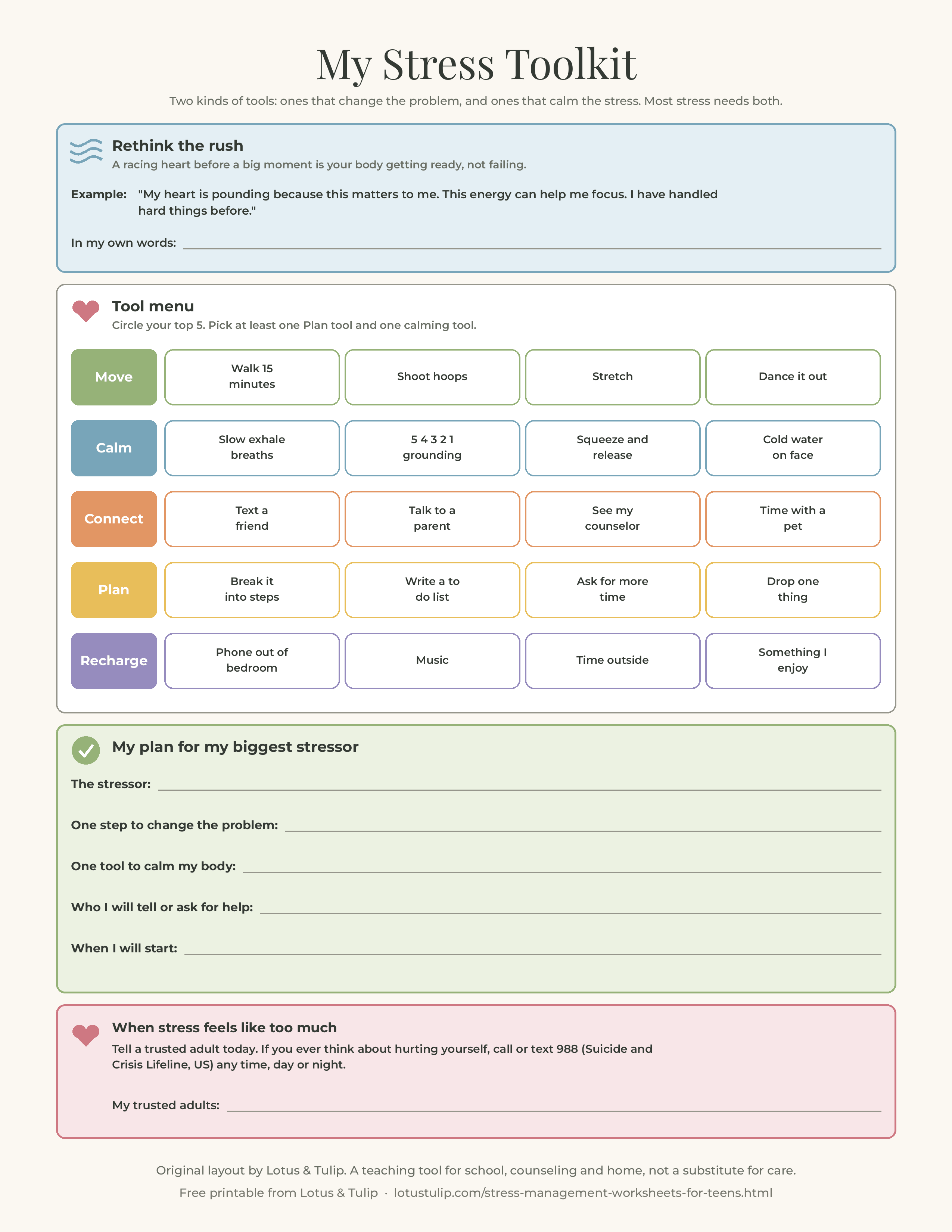
- Build a two part toolkit. From the tool menu on page 2, each teen circles five tools, including at least one Plan tool (change the problem) and one calming tool (calm the body). Practice the calming tools in the session so they are not just words on paper.
- Make a plan for the biggest stressor. Fill in the plan box: one step to change the problem, one tool to calm the body, who to tell and when to start. Keep it small and concrete. "Email my teacher on Monday at lunch" is better than "manage my time better."
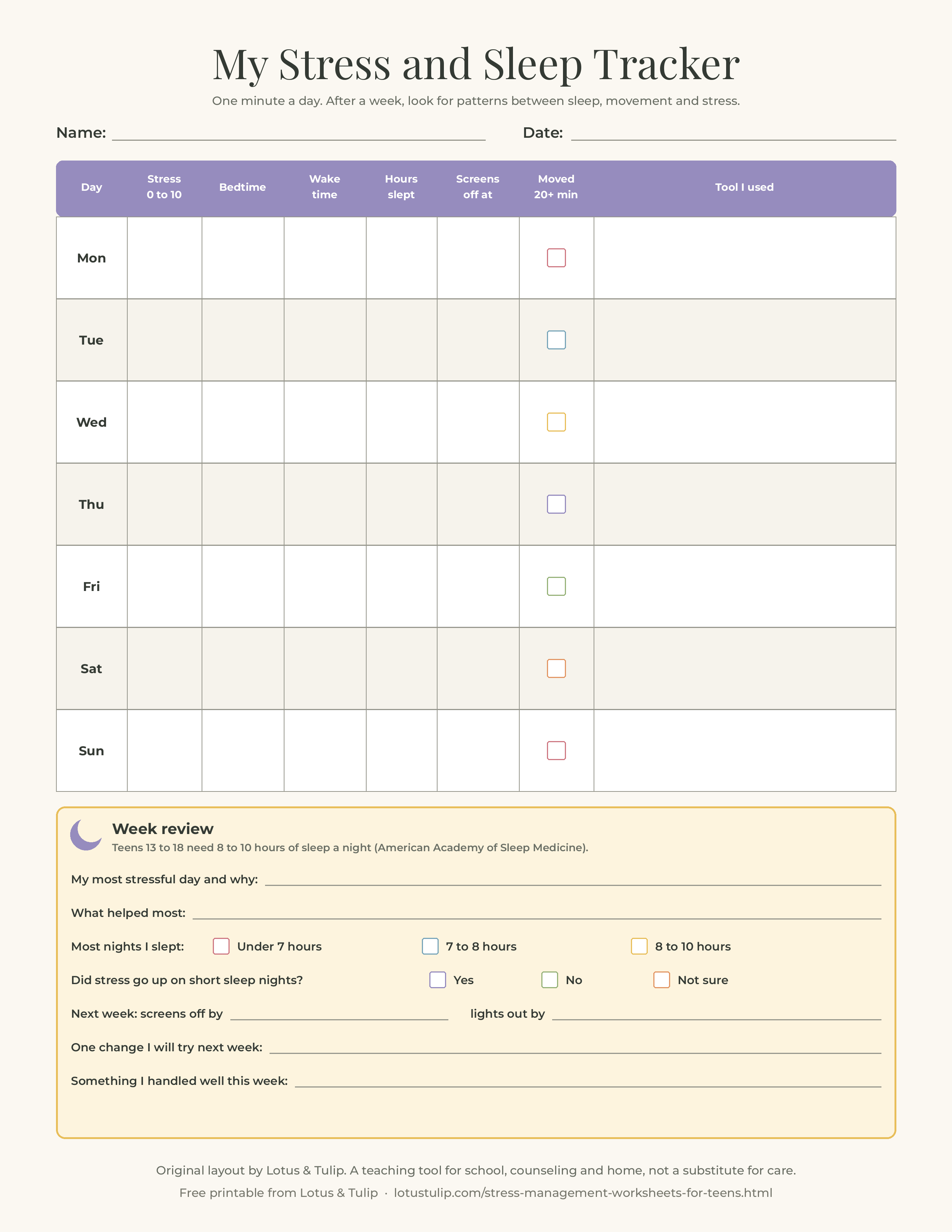
- Track stress and sleep for a week. Use page 3 to log daily stress, bedtime, wake time, hours slept, when screens went off, whether they moved for 20 minutes and which tool they used. One minute a day is enough.
- Review patterns and adjust. After a week, look at the tracker together. Did stress go up on short sleep nights? Which tool helped most? Pick one change for the next week, such as screens off 30 minutes earlier, and repeat. Celebrate what the teen handled well.
This 9 step plan works for a six to eight week small group, a series of counseling sessions or a parent working with their own teen, using the free printable at each stage.
Coping with stress for teens: a quick toolkit
If you only have five minutes with a teen, these are the tools worth teaching. They match the five rows of the tool menu on page 2.
- Move: a 15 minute walk, shooting hoops, stretching or dancing to two songs. Movement uses up the energy the stress response creates.
- Calm: slow exhale breathing, 5 4 3 2 1 grounding, squeezing and releasing muscle groups, or cold water on the face for very intense moments. See our breathing exercises guide for scripts that also work with teens.
- Connect: text a friend, talk to a parent, see the school counselor or spend time with a pet. Support is one of the strongest buffers against stress.
- Plan: break it into steps, write a to do list, ask for more time or drop one commitment. This is problem focused coping, the part that changes the stressor itself.
- Recharge: phone out of the bedroom at night, music, time outside or anything enjoyable. Recovery is part of performance, not the opposite of it.
For a longer list, our coping skills list has ideas sorted by type, and the self care plan template helps older teens build a weekly routine.
Common mistakes when teaching teens about stress
- Treating all stress as bad. Teens who believe any stress is dangerous may start avoiding challenges. Aim for "stress is normal and manageable," not "stress will hurt you."
- Only teaching relaxation. Breathing exercises help, but if the stressor is three overdue assignments, the teen also needs a plan. Teach both sides of the toolkit.
- Lecturing about phones. Teens already know phones affect sleep. A practical experiment (charge the phone outside the bedroom for one week and track sleep) works better than a lecture.
- Ignoring the environment. Some stress comes from schedules and expectations that adults control. If a teen is in four AP classes, two sports and a job, the answer may be fewer commitments, not better coping.
- Missing warning signs. A stress worksheet should never be the only response to hopelessness, self harm or thoughts of suicide. Know your school's referral process and keep 988 visible.
- Doing it once. One lesson rarely changes much. Short, repeated practice and a week of tracking build real habits.
Free stress management worksheets for teens (PDF)
This free printable is an original Lotus & Tulip design, sized for US Letter paper and written for about ages 12 to 18 (middle and high school) in classrooms, advisory periods, counseling sessions, small groups and at home. It has three pages:
- Page 1: My Stress Signals and Triggers. Fifteen stress signals to circle in three columns (Body, Mind and Actions), a line for the earliest signal, a checklist of twelve common teen stressors from tests and grades to social media and a too busy schedule, a Control Check that splits the biggest stressor into parts I can control and parts I cannot, a 0 to 10 stress meter, and a line for one thing that would bring stress down two points.
- Page 2: My Stress Toolkit. A Rethink the Rush box with an example of reframing the stress response, a tool menu of twenty tools in five groups (Move, Calm, Connect, Plan and Recharge), a plan for the biggest stressor (one step to change the problem, one tool to calm the body, who I will tell, when I will start), and a When Stress Feels Like Too Much box with the 988 Suicide and Crisis Lifeline and space to list trusted adults.
- Page 3: My Stress and Sleep Tracker. A Monday to Sunday tracker for daily stress (0 to 10), bedtime, wake time, hours slept, when screens went off, whether I moved for 20 minutes or more and which tool I used, plus a Week Review with the AASM sleep recommendation, a sleep check, a screens off and lights out goal, one change for next week and something I handled well.
Download the free stress management worksheets for teens (PDF, 3 pages, US Letter)
Prefer single images? Page 1: Stress Signals and Triggers (PNG) · Page 2: My Stress Toolkit (PNG) · Page 3: Stress and Sleep Tracker (PNG)
Free to print for your own use and for use with your own students, clients or children. Please link to this page rather than re-uploading the file.
Related resources
- Stress management worksheet for adults: the adult version for parents and staff, with a free stress map and plan
- Test anxiety worksheet (free printable)
- Sleep hygiene worksheet (free printable)
- Circle of control worksheet (free printable)
- CBT thought record worksheet (free printable)
- 5 4 3 2 1 grounding worksheet (free printable)
- DBT TIPP skills worksheet (free printable)
- Window of tolerance worksheet (free printable)
- Growth mindset worksheet (free printable)
- Goal setting worksheet for students (free printable)
- Self care plan template (free printable)
Sources
- American Psychological Association (2014). Stress in America: Are Teens Adopting Adults' Stress Habits? Survey of 1,018 US teens ages 13 to 17 conducted online by Harris Interactive, August 2013. apa.org.
- Centers for Disease Control and Prevention (2024). Youth Risk Behavior Surveillance: United States, 2023. MMWR Supplements, 73(4). Also CDC, YRBS Data Summary and Trends Report, 2013 to 2023.
- Compas, B. E., Jaser, S. S., Bettis, A. H., and colleagues (2017). Coping, emotion regulation, and psychopathology in childhood and adolescence: a meta-analysis and narrative review. Psychological Bulletin, 143(9), 939 to 991.
- Crum, A. J., Salovey, P., and Achor, S. (2013). Rethinking stress: the role of mindsets in determining the stress response. Journal of Personality and Social Psychology, 104(4), 716 to 733.
- Lazarus, R. S., and Folkman, S. (1984). Stress, Appraisal, and Coping. Springer.
- Paruthi, S., Brooks, L. J., D'Ambrosio, C., and colleagues (2016). Consensus statement of the American Academy of Sleep Medicine on the recommended amount of sleep for healthy children: methodology and discussion. Journal of Clinical Sleep Medicine, 12(11), 1549 to 1561; recommendations summary in 12(6), 785 to 786.
- Singh, B., Bennett, H., Miatke, A., and colleagues (2025). Systematic umbrella review and meta-meta-analysis: effectiveness of physical activity in improving depression and anxiety in children and adolescents. Journal of the American Academy of Child and Adolescent Psychiatry.
- US Department of Health and Human Services (2018). Physical Activity Guidelines for Americans, 2nd edition.
- Yeager, D. S., Bryan, C. J., Gross, J. J., and colleagues (2022). A synergistic mindsets intervention protects adolescents from stress. Nature, 607, 512 to 520.
- 988 Suicide and Crisis Lifeline. 988lifeline.org.
Stress management worksheets for teens: FAQ
What are stress management worksheets for teens?
They are printable pages that help teens notice their stress signals, identify what is causing stress, sort what they can and cannot control, choose coping tools and track habits such as sleep. They are used by school counselors, teachers, therapists and parents, usually alongside a conversation rather than on their own.
What are good stress management activities for teens?
Useful activities include a stress signal sort, a 0 to 10 stress check in, splitting a stressor into what you can and cannot control, reframing the stress response as the body getting ready, trying three quick calming tools, breaking a big task into small steps, and tracking sleep and stress for a week.
How can teens cope with stress in a healthy way?
Use two kinds of tools. Change the problem when you can by planning, breaking tasks into steps or asking for help. Calm the body and adapt when you cannot change it right now, with movement, slow breathing, grounding, time with people and enough sleep. Avoidance, such as scrolling for hours instead of starting the work, usually makes stress grow.
What causes the most stress for teenagers?
In the APA's 2013 survey of US teens, school was the most common source of stress (83%), followed by getting into college or deciding what to do after high school (69%) and family finances (65%). Friendships, social media, family conflict, activities and lack of sleep also come up often.
How much sleep do teens need to manage stress?
The American Academy of Sleep Medicine recommends 8 to 10 hours per 24 hours for teens ages 13 to 18. In the CDC's 2023 survey, only about 23% of US high school students got 8 or more hours on school nights, and short sleep makes stress harder to manage.
When is teen stress a sign of something more serious?
Get help from a parent, school counselor, doctor or licensed mental health professional if sadness, hopelessness or worry lasts for weeks, if sleep or eating change a lot, if a teen uses substances to cope, or if they stop enjoying things. If a teen talks about suicide or self harm, call or text 988 in the US right away, or 911 in an emergency.
Are these stress management worksheets free?
Yes. The three page stress management worksheets for teens are free to print for your own use and for use with your own students, clients or children. Please link to this page rather than re-uploading the file.