
Kids and teens · Updated 2026-11-08
Social Skills Small Group Activities for Elementary Students (with Free Printable)
Ready-made printable: Social Skills Small Group Curriculum for School Counselors, Grades 2 to 5 Holiday 20% off: about $11.04, was $14 (EUR 12) · instant digital download
Buy on Etsy
Social skills small group activities give elementary students a predictable place to notice other people, join a game or conversation, listen and take turns, use kind words and I-statements, match their energy to the moment, and repair after a miss. A good social skills group does not diagnose a child, does not promise to turn a quiet student into the life of the playground, and does not force anyone to become best friends. Social skills are teachable. The group is a practice gym, not a personality makeover.
This guide is written for US elementary school counselors, and for the school social workers, school psychologists and behavior support staff who run similar Tier 2 groups, who want a practical way to run an eight session social skills group for about grades 2 to 5, with four to six students and sessions of about 30 to 40 minutes. You will get a plain language model of what a social skills group can and cannot do, the core ideas that keep it honest, twelve activities you can actually run (with time, group size, materials, steps and a debrief), an eight session starter plan, a nine step HowTo, adaptations, tips for counselors, teachers and caregivers, mistakes, myths, three fictional examples, guidance on when not to use a group, verified research notes, eight FAQs and a free three page US Letter printable: Social Skills Group Steps, My Social Skills Plan and a Practice Log with nine pocket cards.
This page is the counselor small group how-to for elementary social skills. It sits beside, and is not a substitute for, our social skills worksheets for kids (skill checklists and role play cards, not an eight session group), social skills activities for teens (about ages 12 to 18), friendship worksheets for kids, friendship activities for teens, icebreaker activities for counseling groups, communication skills activities for teens, empathy activities for teens, empathy worksheets for kids, kindness activities for kids, the conflict resolution worksheet, conflict resolution activities for teens, the I statements worksheet, self esteem small group activities and anger management small group activities. If you work with kindergarten to grade 2, see K-2 coping skills group activities first. A comparison table further down shows which page fits which job. The matching product page is Social Skills Small Group Curriculum. Counselors running a girls friendship group can also see Girls Friendship Group Curriculum.
We draw on published research and public guidance without claiming any affiliation or endorsement, including the CASEL SEL Framework (2020) wording on social awareness and relationship skills, the ASCA Student Standards (2021), the Durlak, Weissberg, Dymnicki, Taylor and Schellinger (2011) meta-analysis of universal school-based SEL programs, the Taylor, Oberle, Durlak and Weissberg (2017) follow-up meta-analysis, and the Dishion, McCord and Poulin (1999) caution about grouping high risk peers together. Full citations are below. The printable is an original Lotus and Tulip layout, not a copy of any published program or paid curriculum.
This guide is educational. A social skills group does not diagnose a student, does not treat autism, ADHD, social anxiety, a language disorder or any other condition, and does not replace evaluation, speech language services, occupational therapy or individual counseling. The activities are skill practice aids for counselors, not a standalone trial and not a manualized protocol. They are not affiliated with ASCA, CASEL, or any named rating scale or program. If a student is thinking about suicide or self-harm, call or text 988 (Suicide and Crisis Lifeline) or text HOME to 741741 (Crisis Text Line). For immediate danger, call 911. If a student describes abuse or neglect, or threatens to seriously hurt someone, stop the activity, follow your school's threat assessment and mandated reporting procedures, and use a written safety plan where it fits.
What a social skills small group is (and is not)
Every elementary counselor knows the referral pile. The third grader who stands at the edge of four square and never asks to join. The fourth grader who joins by grabbing the ball. The second grader who talks through every share and does not notice the sighs. The fifth grader who has kind words ready in your office and none left at lunch. Teachers want the recess conflicts to stop. Families want their child to have a friend. The student often wants the same thing and does not know the next small step.
A social skills small group is a short, structured series of sessions where four to six of these students practice a few people skills together, with a caring adult, before they need them on the playground. In plain words, a good social skills group helps students:
- Notice other people. Faces, bodies, tone and the activity already happening give clues about how to enter and how to respond.
- Join and start. Students practice watching first, greeting, and asking to play or talk, instead of hovering, bursting in or giving up.
- Listen and take turns. Conversations and games work better when more than one person gets a turn.
- Use kind words and I-statements. Specific compliments, invitations and "I feel ... when ... I need ..." sentences give students language that does not attack.
- Match the moment. Recess volume and library volume are not the same. Students practice reading the setting and adjusting their energy, distance and words.
- Repair after a miss. Everyone interrupts, leaves someone out or uses a sharp tone sometimes. Repair is how you come back.
- Include without forcing friendship. Students can be kind and fair without being required to become best friends.
- Try one small step outside the room. Practice in group only counts if a student then tries one doable step at recess, lunch or in class.
What a group like this is not matters just as much, because social skills groups are easy to oversell:
- Not a diagnosis. Being referred to a social skills group does not mean a child has a disorder, is "on the spectrum," or is broken. Many children in these groups are still learning skills that peers picked up earlier, or they know the skill and freeze when it counts.
- Not a promised personality makeover for quiet kids. Quiet is not a problem to fix. A reserved student may need joining language and one trusted peer, not a push to become outgoing. Respect temperament.
- Not a friendship-clique maker. You cannot assign best friends. The group can teach how to join, listen, include and repair. It cannot guarantee a lunch table or a birthday invitation.
- Not a behavior-compliance lecture. "Be nice" and "use your manners" are speeches most of these students have already heard. They need rehearsal, feedback and a chance to try again.
- Not a pile of standalone worksheets. Worksheets can help students remember a skill. A group adds peers, live practice, coaching and repetition over eight weeks, which is where most of the change happens. Use our social skills worksheets for kids as companions, not as the whole intervention.
- Not trauma processing. Some students who struggle with peers have lived through frightening things. The group does not ask them to tell those stories. If trauma is suspected, refer to a qualified clinician.
- Not a substitute for evaluation or therapy. When a student needs a speech language evaluation, an autism or ADHD assessment, social anxiety treatment, or an individual counseling plan, the group is a supplement at most.
- Not a universal classroom SEL program. Classroom SEL lessons help everyone learn the same vocabulary. This group is Tier 2: fewer students, more practice, more feedback and more personal plans. Large studies of classroom-wide SEL are useful context, but they do not measure this four to six student pull-out. See the research notes below.
Core ideas that keep a social skills group honest
Before you plan activities, settle on a few core ideas. They will guide what you say when a student blurts "this is for babies," when a parent asks whether the group will get their child a best friend, and when a teacher wants recess conflicts to vanish by Friday.
1. Social skills are teachable
Some children seem to pick up joining, listening and repair without much formal teaching. Others need the skill broken into small, visible steps, practiced when they are calm, and prompted in the real place it is needed. That is not a moral failing. It is the same reason some students need a decoding group for reading. Say this out loud in session one: "These are skills, like soccer skills or math skills. We practice them here so they are easier out there."
2. Notice others
Before a student can join well, they need to see what is already happening. Who is playing? Is the group open or closed? Does a classmate look interested, busy, upset or ready for a break? Noticing is a skill of looking and listening, not of mind reading. Students practice naming what they can actually observe ("her arms are crossed," "he is smiling and waving me over") and holding a guess lightly ("maybe she wants space"). Our empathy worksheets for kids are a good companion when you want more feeling-vocabulary practice; the group keeps the focus on using those clues to choose a next step.
3. Joining and starting
Many referrals are really about the first ten seconds. Students who hover, students who grab, and students who walk away after one "no" all need a joining sequence they can remember: watch for a moment, greet, and ask ("Can I play?" or "What are you building?"). Starting a conversation follows a similar pattern: a greeting, a comment or question about the shared moment, and space for the other person to answer. Practice these lines until they sound like the student's own voice, not a script they recite in a robot tone.
4. Listening and turn-taking
Listening in a group looks like eyes and body turned toward the speaker, a short wait before talking, and a response that connects to what was just said. Turn-taking applies to games and to talk. Students who dominate are not always being rude on purpose; some are excited, anxious they will forget their idea, or unused to waiting. Students who never take a turn may need a structured invitation and permission to pass. Both need practice, not shame.
5. Kind words and I-statements
Kind words work better when they are specific: "I like how you waited for me" beats "good job." I-statements give students a way to name a problem without attacking: "I feel left out when the game starts without me. I would like a turn next." Our I statements worksheet has extra builders and practice cards if you want more written work. In group, keep the frames short and say them out loud until they feel usable at recess.
6. Reading the room and matching the moment
This skill is a neighbor of matching the size of a reaction to the size of a problem, which we cover on the size of the problem worksheet page. Do not copy that lesson here. In a social skills group, matching the moment means noticing the setting and adjusting volume, physical distance, energy and topic. Indoor recess in the library is not the same as kickball. Students practice asking, "What is happening here, and what would fit?"
7. Repair after a miss
Social life includes mistakes: an interruption, a joke that stung, a slammed door on a group, a snatched ball. Repair is a skill: notice what happened, own your part, make it right if you can, and plan a next try. Repair is not a forced apology and is not a demand that the other person instantly forgive. It is an invitation to reconnect. Students who never repair stay stuck in the last conflict. Students who over-apologize for existing need a different kind of coaching, closer to our self esteem small group activities.
8. Inclusion without forced friendship
You can teach students to leave space, to invite, and to refuse unkind exclusion. You cannot, and should not, require them to become close friends. "You do not have to be best friends. You do have to be safe and fair" is a sentence worth posting. This protects students who are being pressured to accept unkind treatment in the name of kindness, and it protects students who are told they must like everyone equally. Inclusion is about access and respect. Friendship is a choice.
9. Practice in the group, then try one small step
Role play in your office is the rehearsal. Recess, lunch, the hallway and the classroom are the stage. Every session should end with one small, specific try: "Tomorrow at recess I will watch the soccer game for ten seconds and ask, 'Can I play?'" Write it down. Check it next week without shaming a student who did not manage it. A missed try is information, not failure. Families and teachers need the same small step so they can prompt it in the moment.
Twelve social skills small group activities
Each activity lists time, group size, materials, steps and a debrief question. Times assume a 30 to 40 minute elementary block with four to six students in about grades 2 to 5. Activities 1 to 8 map onto the eight session plan below; 9 to 12 are swaps, warm ups and extensions. Keep every session predictable: a short check-in, a review of last week's try, a short teaching point, one activity, a closing round and a small take-home challenge.
1. Group agreements and "skills you can practice"
Time: 15 minutes. Group size: 4 to 6. Materials: chart paper, markers, printable page 1, a pass signal (a card students can turn over).
Steps: Welcome students by saying what the group is: "This is a group for practicing people skills, like noticing others, joining a game, listening and fixing things after a miss. Everybody is still learning these. We will practice them here." Ask what would help everyone feel safe. Write four to six agreements in their words, for example: we keep hands and feet to ourselves, we take turns talking, we can pass, what others share stays here, and we can take a break if we need one. Add the adult promise in plain words: "If someone is being hurt, might hurt themselves or might hurt someone else, I have to get help, because safety comes first." Then write on the board: "Social skills are teachable." Ask students to name a skill they already have (waiting in line, sharing a marker, saying hi to the bus driver) so the group starts from strength, not from shame.
Debrief: "If these are skills we can practice, what is one you would like to get better at?" Teaching point: the group is a practice gym, not a place where "kids who have no friends" are sent.
2. Notice others: faces, bodies and clues
Time: 20 minutes. Group size: 4 to 6. Materials: photo cards or simple drawings of children in everyday school scenes (playing, waiting, looking upset, waving someone over, reading alone), sticky notes labeled "I see" and "I wonder."
Steps: Show one picture at a time. First ask only what students can see: eyes, mouth, arms, who is facing whom, what the activity is. Write those under "I see." Then invite a guess under "I wonder": "I wonder if she wants to be asked to play" or "I wonder if he needs space." Make the difference clear: seeing is safer than assuming. Do four or five pictures. End with a live version: one student acts a feeling with their body (no words) and the group names what they see before they guess the feeling. Keep it light and let students pass if they do not want to act.
Debrief: "Why might it help to notice someone before you join them?" Teaching point: noticing other people is the first social skill, because it tells you what might fit.
3. The three step join
Time: 20 minutes. Group size: 4 to 6. Materials: three large signs (Watch, Greet, Ask), a few recess props (a ball, blocks, a jump rope), simple scenario cards.
Steps: Teach a three step join: 1) Watch for a few seconds to see what the game or conversation is. 2) Greet with the person's name or a friendly "hi." 3) Ask ("Can I play?" "What are you making?" "Is there room?"). Model a too fast join (grabbing the ball) and a too slow join (hovering without speaking). Students rotate through short role plays: two students play a simple game and a third practices the three steps. Include one "not now" response so students practice what to do if the answer is no: thank them, look for another group or ask an adult for a next idea.
Debrief: "Which step is hardest for you: watching, greeting or asking? What could you say if someone says not right now?" Teaching point: joining is a sequence, and a no is information, not proof that you do not belong anywhere.
4. Conversation catch: listening and turn-taking
Time: 20 minutes. Group size: 4 to 6. Materials: a soft ball or talking object, a timer, topic cards (favorite recess game, a pet, a weekend plan, a school lunch like or dislike).
Steps: Explain that a conversation is like catch: you throw the topic to someone and you wait to receive it back. The speaker holds the ball, shares one or two sentences, then tosses the ball to someone who asks a follow up or adds a connected comment. If a student changes the subject completely, pause and ask, "Was that catch, or did we drop the ball?" Keep rounds short. For students who dominate, give a two sentence limit and a job as "catch coach." For students who rarely speak, start with a yes or no or choice question. End with a silent version: students show a thumbs up when they notice they wanted to jump in and waited instead.
Debrief: "What did your body want to do while you waited? What helped you stay in the game?" Teaching point: listening is an action, not just the absence of talking.
5. Kind words that are specific
Time: 15 minutes. Group size: 4 to 6. Materials: sentence strips, sticky notes, a chart with "too general" on one side and "specific" on the other.
Steps: Contrast "You are nice" with "You waited so I could have a turn at four square." Students sort compliment cards into general and specific, then write or say one specific kind word about a moment they actually saw that week. Guard against fake praise and against comments on bodies. Practice invitations as kind words too: "Do you want to sit with us?" If students tease to connect, name that kindly: "Jokes can be fun when everyone is laughing. If only you are laughing, it may not be kind." Pair this with kindness activities for kids if you want classroom follow up.
Debrief: "How does a specific kind word feel different from a general one? Who could you give one to this week?" Teaching point: kind words are more useful when the other person can tell what they did.
6. I-statements for friendship friction
Time: 20 minutes. Group size: 4 to 6. Materials: a large sentence frame ("I feel ... when ... I need ..."), feeling word cards, short scenario cards, the I statements worksheet if you want extra builders.
Steps: Show the difference between a you-attack ("You always hog the ball") and an I-statement ("I feel frustrated when I do not get a turn. I need a turn next"). Students build I-statements for everyday frictions: being interrupted, being left out of a game, someone changing the rules. Coach tone and body, not only words. An I-statement yelled with a pointing finger is still an attack. Include one scenario where an adult should be told instead, such as repeated exclusion or a threat.
Debrief: "When would an I-statement help, and when do you need an adult?" Teaching point: I-statements are for solvable friction. Safety problems go to a trusted adult.
7. Matching the moment
Time: 20 minutes. Group size: 4 to 6. Materials: setting cards (library, cafeteria, kickball, quiet reading, indoor recess, a classmate who looks upset), volume cards (whisper, talking voice, recess voice), distance cards (arm's length, a step back, next to someone).
Steps: Name the skill: matching what you do to where you are and to what the other person seems to need. Students draw a setting card and choose a volume, a distance and an opening line that would fit. Act out a mismatch for laughs (yelling "CAN I PLAY?" in the library) and then the matched version. Add a feeling twist: the same classmate at recess may want a high energy join one day and space the next. Students practice looking first, then choosing. This is not the same lesson as sizing a problem on our size of the problem page; here the question is "what fits this setting and this person right now?"
Debrief: "What clues help you know what would fit? What is one place at school where your volume or energy is often too big or too small?" Teaching point: the same words can work in one place and miss in another.
8. Repair after a miss
Time: 20 minutes. Group size: 4 to 6. Materials: a four step repair card (Notice, Own it, Make it right, Plan next time), a fictional story, simple puppets or just voices.
Steps: Read a short story where a character interrupts a game, knocks over a block tower, or repeats a rumor. Walk through four steps: 1) Notice what happened. 2) Own your part ("I knocked over your tower"). 3) Make it right if you can (help rebuild, give space, stop the rumor). 4) Plan next time. Students practice repair lines in pairs. The other person may not be ready yet, and "sorry" without a change is thin. Students should not be pressured to repair with someone who is hurting them; that is a safety issue. Our conflict resolution worksheet can extend this work.
Debrief: "Why is repair hard? What would make it easier?" Teaching point: everyone misses sometimes. Repair is how you show who you want to be after the miss.
9. Ask, tell, ask (conversation starter)
Time: 15 minutes. Group size: 4 to 6. Materials: topic cards, a simple visual of Ask / Tell / Ask.
Steps: Teach a three beat conversation starter. Ask a question ("What are you drawing?"), tell something connected ("I like drawing soccer fields too"), and ask again ("Do you want to add a goal?"). Model a monologue that never asks, and a quiz that never tells. Students try short rounds with a partner, then switch partners. This activity pairs well with conversation catch and is a good warm up in later sessions when students need a refresher before recess practice.
Debrief: "Did you ask more, tell more, or balance them? Which feels less natural?" Teaching point: conversations need both sharing and curiosity.
10. Include without forcing friendship
Time: 20 minutes. Group size: 4 to 6. Materials: scenario cards about exclusion, open games and closed games, two signs (Invite and Insist).
Steps: An invitation leaves room for yes or no: "Do you want to play tag?" Insisting sounds like "You have to play with me or you are mean." Excluding on purpose is different from a game that is truly full. Students sort scenarios and practice two skills: how to invite, and how to hear a no without punishing the other person. Also practice what a bystander can say: "There's room" or "I'm going to get a teacher." If the pattern is repeated harm, pair this with bullying worksheets for kids and your school's reporting path.
Debrief: "What is the difference between inviting and insisting? When should you get an adult instead of handling it in the group?" Teaching point: you can be kind and fair without being required to become best friends.
11. Recess and lunch rehearsal
Time: 20 minutes. Group size: 4 to 6. Materials: a simple map of the playground or cafeteria, sticky notes, printable page 3 pocket cards.
Steps: Each student picks the place that is hardest (four square, soccer, the lunch table, the bus line) and names one small step they could try there. Walk the step: where they will stand, who they might approach, the exact words, and what they will do if it does not work. Rehearse it once. Add a backup plan so a single no does not end the recess. Keep the step small enough to finish in under a minute. "Make two new friends at lunch" is too big. "Ask Sam if I can sit at the end of the table" is the right size.
Debrief: "What would make this step feel possible? Who can remind you right before recess?" Teaching point: a small, specific try beats a vague hope to "be more social."
12. My social skills plan and teach back celebration
Time: 30 minutes. Group size: 4 to 6. Materials: printable page 2 (My Social Skills Plan), certificates, pocket cards from page 3, a small celebration snack if your school allows it.
Steps: Students complete their plan: a feeling they often have around other kids, a clue they can notice in others, a joining line, a listening goal, a kind word, an I-statement, one recess or lunch step, a repair line and their support team. Each student teaches one skill to the group as if the others were younger students. Celebrate progress with specific feedback ("You watched the game first on Tuesday and then asked to play"). Hand out certificates and pocket cards. Schedule a check-in four to six weeks later so the skills do not vanish when the group ends.
Debrief: "What skill from group will you keep using? Who will you show your plan to?" Teaching point: the group ends but the skills go with you.
An eight session starter plan (skills practice, not a certified protocol)
This table is an original skills practice starter built around public themes that many elementary social skills groups use: noticing others, listening, joining in, taking turns, reading cues, using kind words and I-statements, matching the moment and repairing after a problem. It is not the paid kit, not its session titles and not a certified or manualized protocol. Each session runs about 30 to 40 minutes for four to six students and follows the same shape: a short check-in, review of the last take-home, one teaching point, one activity, a closing round and a small take-home challenge.
| Session | Focus | Activity | Take-home |
|---|---|---|---|
| 1 | Welcome, skills are teachable | Agreements; pre check; strengths we already have | Notice one time you used a people skill this week |
| 2 | Notice others | Faces, bodies and clues | Spot one clue in a classmate and write what you saw |
| 3 | Joining and starting | Three step join (watch, greet, ask) | Try one join or one hello at recess or lunch |
| 4 | Listening and turn-taking | Conversation catch | Wait, then add one connected comment in class or at home |
| 5 | Kind words and I-statements | Specific compliments; I feel, when, I need | Give one specific kind word, or use one I-statement |
| 6 | Match the moment | Setting, volume, distance and opening line | Adjust your volume or energy once to fit the place |
| 7 | Repair and inclusion | Repair recipe; invite without insisting | Try one repair or one invitation |
| 8 | My plan and celebration | Social skills plan, teach back, post check, certificate | Show your plan to one adult at home or school |
Use a simple pre and post check in session 1 and session 8. Keep it short and student friendly, for example four statements rated with faces: "I can notice how other people might be feeling," "I know a way to join a game or conversation," "I can listen and wait my turn," and "I know how to fix things after a miss." Add teacher ratings from the referral form at the start and again two to four weeks after the group ends. Report changes honestly; small shifts are normal and worth celebrating.
If you have a short window, a six session version can merge sessions 5 and 6 and sessions 3 and 4. Do not drop joining practice or repair; they carry a lot of the skill building. If you have more time, add a booster session a month later to review the plan and rehearse the recess step again.
How to run a social skills small group, step by step
- Screen for safety and fit. Read teacher referrals and talk briefly with each student and, where possible, their family. A student who is in crisis, describes abuse, talks about suicide or self-harm, or is the target or source of serious bullying needs individual support, a safety plan and your school's reporting or threat assessment path first, not a group. Check whether the referral is really about anger, grief, language or social anxiety, and look at existing IEP or behavior goals so the group supports them.
- Get permission and set expectations. Follow your district policy on parent or guardian consent for small group counseling. Send a short, warm letter that describes the group as a skills group, not a friendship assignment and not a punishment, lists the number of sessions and times, and explains confidentiality and its limits. Talk with teachers about which class times students will miss and how you will share one simple practice step each week.
- Choose group size and mix with care. Four to six students is the usual sweet spot. Mix students who need joining language with students who need listening practice, rather than filling the room only with students who struggle most on the playground. Research with adolescents (Dishion, McCord and Poulin, 1999) found that grouping high risk youth together can sometimes increase problem behavior, so include steadier peer models when you can. Balance ages within about two grade levels, and avoid pairing a student who is being excluded with the student who is excluding them unless the team has a clear, safe reason.
- Set group agreements. Build agreements in students' words in the first session, including safety rules, turn taking, the right to pass, confidentiality and its limits, and how to take a break. Post them every session and revisit them when needed. Add your adult limit in plain words: if someone is being hurt or might hurt themselves or someone else, you will get help.
- Teach noticing, joining and listening. Use the clue pictures, the three step join and conversation catch so students can see and rehearse the first skills. Model with your own small, safe examples. Keep returning to "what do you notice?" and "what would fit?" during check-in each week.
- Practice kind words, matching the moment, repair and a real-world try. Run the I-statement builders, matching the moment sorts, repair role plays and the recess or lunch rehearsal. Practice when students are calm so the skills are ready when the playground is loud. End most sessions with one written, specific try for later that day or that week.
- Send a family letter and keep teachers in the loop. After students have a joining line and an I-statement, send families a one page letter that names the student's practice step and one way to prompt it at home ("Before the park, ask: what will you say if you want to join?"). Share the same step with teachers and recess aides so they can prompt it in the moment without calling the student out in front of peers.
- Measure with a simple pre and post check. Use the same short student check and teacher ratings at the start and end, plus a few notes from recess or lunch observations where you can gather them without hovering. Look for patterns, not perfection, and share results with families and staff in plain language.
- Know when to pause and how to close. Pause a student's participation and move to individual support if safety concerns, disclosures of abuse, threats, self-harm talk, or bullying that needs a formal response make the group unsafe or unhelpful. In the final session, celebrate growth, give certificates, send home the social skills plan and schedule a check-in four to six weeks later. Refer out to outside therapy, speech language services or evaluation when needs go beyond what a group can offer.
Adaptations
Grade 2 versus grades 4 and 5
Second graders need shorter teaching points (two to three minutes), more movement, more pictures and fewer words. Use puppets for joining and repair, a two or three step visual, and one skill per session. Keep sessions closer to 30 minutes. Kindergarten and first grade students are usually a poor fit for this social skills group. Younger children often need co-regulation, feeling names and coping tools first. Point those students toward our K-2 coping skills group activities rather than stretching this plan downward. Fourth and fifth graders can handle longer role plays, written plans and an honest talk about inclusion versus forced friendship. Use their words and give them leadership roles in teach backs.
Quiet or shy students versus students who dominate
Quiet students are not broken. Many already notice a great deal and need a smaller entry: a greeting, a parallel play join, or one trusted peer rather than a large game. Give them permission to pass, extra rehearsal before they try a line in front of the group, and a practice step that matches their temperament. Do not grade them on how talkative they become. Students who dominate need shorter turns, a listening job and specific praise when they wait. Putting only dominant students together can turn the group into a competition; putting only very quiet students together can leave no one to practice joining with.
ADHD or autistic students
Many students in social skills groups have ADHD or are autistic. The group is not treatment for either, and it should never be sold as a way to make an autistic student appear less autistic. Make it more usable with visual schedules, short activities with movement breaks, written and pictured steps, concrete language ("stand an arm's length away" rather than "give them space") and advance notice of changes. Autistic students may prefer parallel play, need longer to process a question, and find eye contact uncomfortable; do not demand it. Work with the special education team so the group supports IEP goals. If social communication needs are significant, include a speech language pathologist.
English learners
Use pictures, gestures, color coding and simple sentence frames ("Can I play?", "I feel ... when ... I need ..."). Allow students to use their home language with each other when it helps them join. Learn a few joining and feeling words in their languages if you can. Keep role plays short and model them first. Be careful not to treat a language difference as a social skill deficit. Families may appreciate letters translated into their home language through your district's services.
Classroom lesson versus pull out group
A classroom lesson about noticing others, joining and kind words works well as Tier 1 prevention: everyone hears the same language. Our social skills worksheets for kids and kindness activities for kids suit that setting. A pull out group is Tier 2: fewer students, more rehearsal, more feedback and more personal plans. If you only have time for one, start with a brief classroom lesson and then run a small group for students who need more support. Avoid naming or pointing out any student during whole class lessons.
Telehealth or video groups
Video is usually a poor fit for elementary social skills groups. Joining, distance, recess rehearsal and repair all depend on bodies in a shared space. It is also hard to read side conversations, keep students engaged and respond if someone becomes upset or unsafe at home. If you must meet virtually, keep the group very small, add a trusted adult on the student's end, stick to picture sorts and short scripts, and skip live joining role plays that need playground movement.
When the real need is bullying, grief or anger
Social trouble is sometimes the surface. A student who is being targeted needs a bullying response, not only a joining lesson: see bullying worksheets for kids and follow your school's reporting path. A student whose family is changing, or who has lost someone, may pull away from peers because they are grieving; see divorce small group activities and grief activities for kids. A student whose peer problems are mostly explosions needs anger skills first: see anger management small group activities. If you suspect abuse or neglect, follow your mandated reporting procedure.
Tips for school counselors, teachers and caregivers
- Practice when calm. The skills only show up in hard playground moments if students practice them in easier moments first. Make every session feel like rehearsal, not a trial.
- Keep the step small. "Ask one person if you can play" is a step. "Have more friends" is a wish. Write the step in the student's words.
- Prompt in the moment, quietly. Teachers and recess aides help most with a private cue ("Want to try your watch, greet, ask?") rather than a public correction.
- Model your own small misses. Briefly share a safe example ("I interrupted in a meeting yesterday, so I said I was sorry and asked them to finish"). Students learn repair by watching adults repair.
- Use specific praise. "You watched the game first and then asked" teaches more than "good job being social."
- Protect quiet students from being redesigned. Celebrate a successful greeting or a parallel play join. Do not treat outgoing behavior as the only success.
- Give students jobs. Timekeeper, materials helper, agreements reader, catch coach. Students who feel useful are more willing to risk a new skill.
- Connect with families weekly, in one or two lines. "This week we practiced a joining line: Can I play? Please ask before the park this weekend." Caregivers can rehearse the same line at home without turning it into a lecture.
- Watch who is left out of the group itself. If one student is consistently talked over or laughed at in your circle, stop and reset agreements. The group has to be a safe place to practice.
- Remember the long game. An eight week group plants seeds. Real change usually takes months of reinforcement at home, at recess and in class.
Common mistakes
- Selling the group as a way to get a best friend. That promise will break. Sell skills and support, not a social life makeover.
- Grouping only the students with the hardest peer problems. Without steadier peers, the group can become a place to compare slights or practice unkind humor.
- Treating quiet as a deficit. A reserved child may need one joining tool, not a campaign to make them louder.
- Lecturing instead of practicing. Long talks about manners lose students fast. Short teaching, lots of rehearsal.
- Using worksheets as the whole group. Pages help students remember. Peers, coaching and a real try at recess are what transfer the skill.
- Forcing apologies or forced friendships. Forced sorry and forced playdates teach compliance, not connection. Teach repair and invitation as choices.
- Ignoring bullying, language needs or anxiety. A joining lesson will not fix a student who is being targeted, a student who cannot find the words in English yet, or a student whose body freezes from social anxiety. Assess before you proceed.
- Skipping families and teachers. Skills practiced only in your office rarely transfer. Recess aides especially need the one-line plan.
- Practicing only the yes path. Students also need a plan for "not right now" so one refusal does not confirm their worst fear.
- Not planning for disclosures. Social groups sometimes surface bullying, threats, self-harm talk or abuse. Know your reporting and safety procedures before session one.
Myths about social skills groups
Myth: Worksheets alone fix friendship. A worksheet can help a student remember a joining line or an I-statement. Friendship and peer ease change through relationships, repeated practice, consistent adults and, sometimes, more intensive support. A page is a tool, not a treatment. That is why this guide is a group how-to, and why our social skills worksheets for kids sit beside it rather than replacing it.
Myth: Make them be friends. Adults cannot assign best friends, and trying often backfires. You can require safety and fairness. You can teach invitation and repair. You cannot require closeness.
Myth: Quiet kids are broken. Quiet students may be thoughtful, tired, new to the language, autistic, anxious or simply reserved. The goal is that they can join when they want to, ask for what they need and stay safe, not that they become the loudest person at lunch.
Myth: A group will stop all recess conflict. Recess conflict is normal. A group can reduce some of the joining crashes and repair misses. It will not end every argument over four square, and promising that sets teachers up for disappointment.
Myth: If they can do it in your office, they can do it everywhere. Many children use a skill with a trusted adult and lose it in a noisy cafeteria. That is common and does not mean they are faking. Plans need practice in the real setting too.
Myth: Social skills groups are the same as classroom SEL. Classroom SEL is for everyone and is often brief. This group is a targeted practice space for a few students. Large SEL studies describe the classroom-wide approach, not this pull-out. Both can matter; they are not the same intervention.
Three fictional examples
These examples are fictional composites written to show how the ideas fit together. They are not real students.
Example 1: Mateo, grade 3, the edge of the game
Mateo's teacher referred him because he spent most recesses walking the fence. In session two he was skilled at noticing: he could tell when a soccer game was already tight and when a four square line was short. What he could not do was the greeting and the ask. In session three he practiced "Hey, can I play next?" in a voice that sounded like him. His take-home step was one try at four square. He watched, said the line, and got a yes. The next day he tried soccer, heard "not this round," and walked away sure that it meant never. In group he practiced the backup plan: thank them, look for the shorter line, or ask the aide. By session eight his plan named four square as his best starting place. He was not suddenly surrounded by friends. He was no longer only walking the fence.
Example 2: Harper, grade 4, the conversation that never tossed the ball back
Harper had no trouble joining. Harper's trouble was that no one else got a turn, and classmates had started to avoid partner work. In conversation catch, the words came fast. The group gave Harper a two sentence limit and the job of catch coach, which meant noticing when someone else was waiting. Classmates in role play used an I-statement: "I feel left out when I do not get a turn. I need to finish my idea." Hearing that without shame mattered. Harper's practice step was one connected comment after a classmate finished. The teacher used a private hand signal during share time. Harper still talked more than most students, and that was allowed. The difference was that partners started to stay.
Example 3: Aisha, grade 5, a pause for safety
Aisha joined the group after several weeks of sitting alone at lunch. In session five, during the inclusion activity, she said quietly, "They don't just leave me out. They wait until I walk up and then they all move. One girl said if I tell a teacher she will make me sorry, and my dad already says I am a loser when I come home crying. Sometimes I wish I wasn't here anymore." The counselor calmly paused the activity, thanked Aisha for telling her, and moved the group to a short, quiet drawing task with a colleague's help. She spoke with Aisha privately right away, without pressing for extra details in front of peers, and told her she needed to get help to keep her safe. She followed her school's procedures for possible bullying and threats, followed mandated reporting procedures for possible emotional harm at home, created a written safety plan with Aisha about where to go and who to tell if she felt unsafe or had thoughts of being gone, and involved an administrator. Aisha moved to individual support. The peer pattern was treated as a safety and climate issue, not as a joining skill Aisha had failed to learn. This example is general information, not legal advice. Mandated reporting rules and threat assessment procedures vary by state and district; follow your local policies. If a student is in immediate danger, call 911. If a student is thinking about suicide or self-harm, call or text 988 or text HOME to 741741.
How this page compares to nearby Lotus and Tulip guides
| Page | Best for | Format |
|---|---|---|
| This page | School counselors running an eight session Tier 2 social skills group, about grades 2 to 5 | Small group activities, session plan, HowTo, safety notes |
| Small group counseling permission slip and parent letter | Getting parent permission and student assent before session 1 | Consent how-to (ASCA, FERPA, opt in vs opt out, state examples) with a free letter, filled example and permission log |
| Social skills worksheets for kids | Individual sessions, homework, classroom skill practice | Worksheets and role play cards, not a group how-to |
| Social skills activities for teens | Ages about 12 to 18 | Teen activities and plans |
| Friendship worksheets for kids | Friendship reflection with one student or a class | Worksheets, not an eight session group |
| Friendship activities for teens | Teen friendship themes | Teen activities |
| Icebreaker activities for counseling groups | Opening any counseling group | Warm ups, not a social skills curriculum |
| Communication skills activities for teens | Older students practicing talk skills | Teen communication activities |
| Empathy activities for teens / empathy worksheets for kids | Perspective taking as a single focus | Teen activities or kid worksheets |
| Kindness activities for kids | Classroom kindness lessons | Activities, not a pull-out social skills group |
| Conflict resolution worksheet / conflict resolution activities for teens | Solving a conflict after it starts | Worksheet or teen activities |
| I statements worksheet | Building I feel, when, I need sentences | Single skill worksheet |
| Self esteem small group activities | Students with low confidence | Elementary group how-to |
| Anger management small group activities | Students whose peer trouble is mostly explosions | Elementary anger group how-to |
| K-2 coping skills group activities | Kindergarten to grade 2, feeling names and calming tools | Younger coping group, usually a better fit than this plan |
| Girls Friendship Group Curriculum (paid) | Upper elementary girls friendship themes such as exclusion and repair | Eight session PDF kit |
| Social Skills Small Group Curriculum (paid) | Counselors who want ready lesson plans and student pages | Eight session PDF kit with goals, activities and student pages |
When not to use these activities
- Crisis. If a student is in active crisis, highly distressed or at risk of harming themselves or others, focus on immediate safety and crisis procedures. Use 988, HOME to 741741 and 911 as needed.
- Suspected abuse or neglect. If peer struggles seem linked to abuse, neglect or harm at home, follow mandated reporting procedures first. A group is not the right setting for disclosure or processing.
- Trauma processing. Students who need to work through traumatic experiences should see a trained trauma clinician. The group can teach skills but should not ask students to retell trauma.
- Severe symptoms needing referral. Marked social communication differences, selective mutism, severe social anxiety, or peer problems that sit inside a larger clinical picture call for evaluation and more intensive services. The group may be a supplement at most.
- A student who does not want to join. Forcing a student into a social skills group can increase shame and resistance. Offer individual support or a later group, and keep the door open.
- When the need is really schoolwide culture. If exclusion, slurs or unsafe playground patterns are common, a four student pull-out will not fix the climate. Pair any group with adult supervision, clear rules and a schoolwide response.
Free 3 page social skills small group printable (US Letter)
Download the free printable and use it in a small group, a one to one session or alongside a classroom lesson on joining and listening.
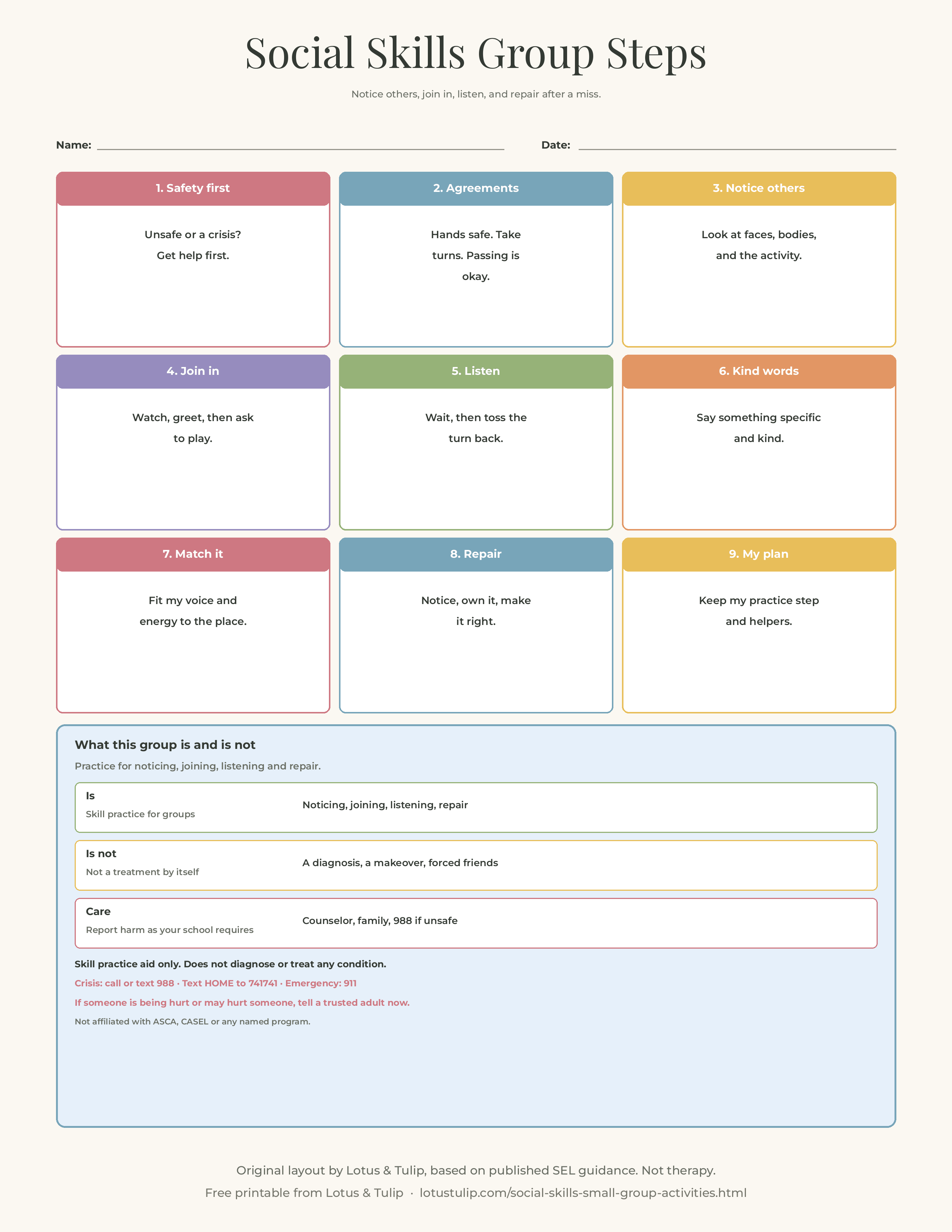
- Page 1: Social Skills Group Steps. Nine steps that match the HowTo above, what this group is and is not, and crisis resources including 988, the Crisis Text Line and 911.
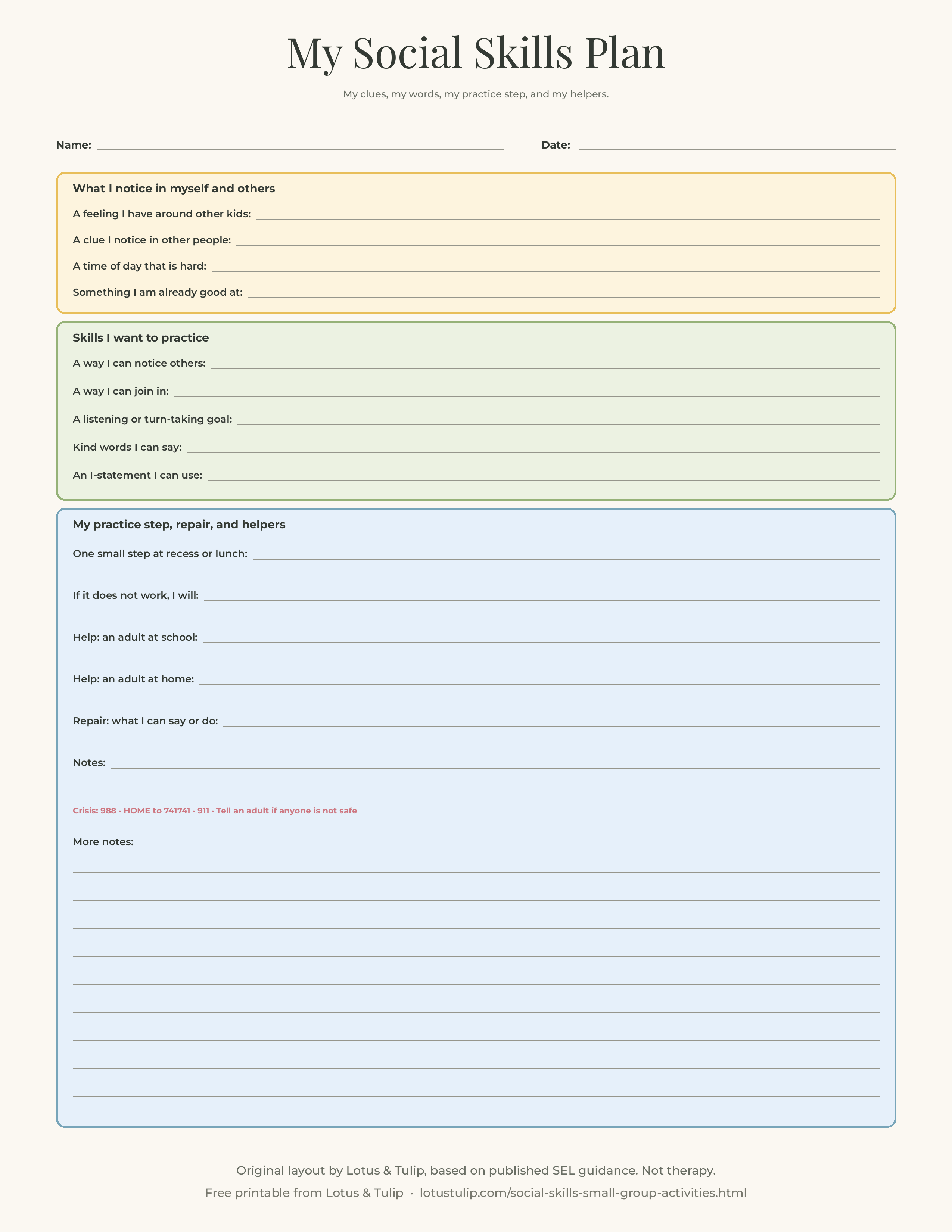
- Page 2: My Social Skills Plan. Space for a student's noticing clues, joining line, listening goal, kind words, I-statement, one recess or lunch step, a repair line and a support team.
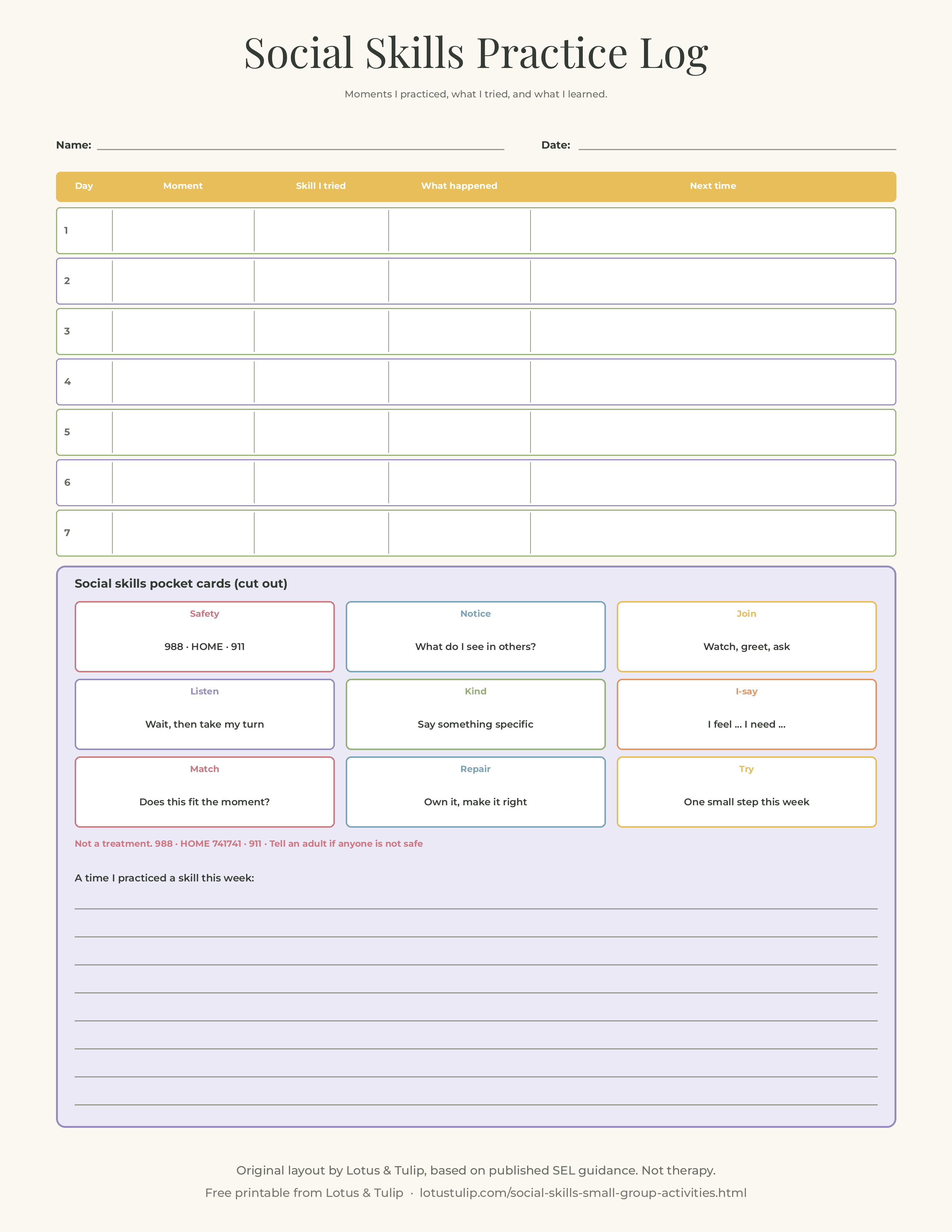
- Page 3: Practice Log. Seven rows for the moment, the skill tried, what happened and what to try next time, plus nine pocket cards to cut out.
Download free PDF · Page 1 PNG · Page 2 PNG · Page 3 PNG
Research notes (verified, with caveats)
- Collaborative for Academic, Social, and Emotional Learning. CASEL's SEL Framework (2020). The framework describes social awareness as "the abilities to understand the perspectives of and empathize with others, including those from diverse backgrounds, cultures, and contexts." It describes relationship skills as "the abilities to establish and maintain healthy and supportive relationships and to effectively navigate settings with diverse individuals and groups," including capacities "to communicate clearly, listen actively, cooperate, work collaboratively to problem solve and negotiate conflict constructively," provide leadership, "and seek or offer help when needed." A social skills group can support these competencies. No affiliation with CASEL.
- American School Counselor Association. ASCA Student Standards: Mindsets and Behaviors for Student Success (2021). Relevant standards include M 2 "Sense of acceptance, respect, support and inclusion for self and others in the school environment," B-SS 2 "Positive, respectful and supportive relationships with students who are similar to and different from them," and B-SS 8 "Advocacy skills for self and others and ability to assert self, when necessary." Related wording also includes B-SS 1 "Effective oral and written communication skills and listening skills." No affiliation with ASCA.
- Durlak JA, Weissberg RP, Dymnicki AB, Taylor RD, Schellinger KB. The impact of enhancing students' social and emotional learning: a meta-analysis of school-based universal interventions. Child Development. 2011;82(1):405-432. The authors reviewed 213 school-based, universal SEL programs involving 270,034 kindergarten through high school students. Compared with controls, participants showed improved social and emotional skills, attitudes, behavior and academic performance that reflected an 11 percentile point gain in achievement. Caveat: these were universal, classroom or schoolwide programs offered to all students, not a four to six student pull-out group like the one on this page. The finding is context, not evidence that this group produces an 11 percentile gain.
- Taylor RD, Oberle E, Durlak JA, Weissberg RP. Promoting positive youth development through school-based social and emotional learning interventions: a meta-analysis of follow-up effects. Child Development. 2017;88(4):1156-1171. This follow-up review covered 82 school-based, universal SEL interventions involving 97,406 kindergarten to high school students. Follow-up outcomes collected 6 months to 18 years after the programs showed that participants fared better than controls in social-emotional skills, attitudes and indicators of well-being. Benefits were similar regardless of students' race, socioeconomic background or school location, and postintervention social-emotional skill development was the strongest predictor of well-being at follow-up. Caveat: again, these were universal programs, not this targeted pull-out.
- Dishion TJ, McCord J, Poulin F. When interventions harm: peer groups and problem behavior. American Psychologist. 1999;54(9):755-764. Describes how grouping high risk adolescents together can sometimes increase problem behavior through peer contagion. Caveat: focused on adolescents; used here only to support careful group composition in a school skills group.
- Gresham and Elliott's Social Skills Rating System and the later Social Skills Improvement System are widely used published rating scales. Some counselors already use them to notice skill areas before or after a group. We name them only as unaffiliated neighbors. This page does not reproduce those measures, is not a protocol for them and is not affiliated with their publishers.
Our paid curriculum is a skill practice aid built around listening, joining in, taking turns, reading cues and repairing after a problem. It has not been tested in its own randomized trial and is not a manualized protocol.
Social skills small group activities: FAQ
What are social skills small group activities?
They are structured activities a school counselor runs with about four to six elementary students who need extra practice with people skills. They teach students to notice others, join a game or conversation, listen and take turns, use kind words and I-statements, match their energy to the moment and repair after a miss.
What grade levels is this social skills group for?
This guide is written for about grades 2 to 5. Second graders need shorter sessions, more pictures and more movement. Kindergarten and first grade students usually fit better in a general K-2 coping skills group, and students in grade 6 and up are better served by teen social skills or middle school friendship activities.
How many sessions should a social skills group have?
Many school counselors run six to eight weekly sessions of about 30 to 40 minutes. Eight sessions give time to teach noticing, joining, listening, kind words, matching the moment and repair, with a check-in four to six weeks after the group ends.
Do social skills groups for elementary students work?
Large reviews of classroom-wide SEL, including Durlak and colleagues (2011) and Taylor and colleagues (2017), found better social-emotional skills and other gains for universal programs. That is encouraging context, not proof that a short pull-out group will produce the same results. A school group is best seen as skill practice and support. Results vary by student, by how well adults prompt the skills at recess and by whether the real need is something else, such as bullying or anxiety.
Should I put all the students who struggle at recess in one group?
Usually not. Mix students who need joining practice with students who need listening practice, and include steadier peer models when you can. Research on adolescent peer groups (Dishion, McCord and Poulin, 1999) is one reason to be careful about grouping only the students with the hardest behavior together.
Who should not be in a social skills group?
Students in crisis, students with suspected abuse that needs reporting, students who need trauma treatment, students with severe symptoms that need evaluation and students who do not want to join should get individual support and referrals first. If the real problem is schoolwide exclusion or bullying, fix the climate rather than only pulling out four students.
What should I do if a student shares something unsafe in group?
Calmly pause the activity, thank the student and talk with them privately right away. Follow your mandated reporting procedure for suspected abuse or neglect and your threat assessment or bullying procedures as required. If a student is thinking about suicide or self-harm, call or text 988 or text HOME to 741741, and call 911 if there is immediate danger. A written safety plan can help once the student is supported individually.
Is the free printable a copy of the paid curriculum?
No. The free three page set is an original companion with group steps, a personal social skills plan and a practice log. The paid Social Skills Small Group Curriculum is an eight session pack with lesson goals, activities and student pages. The printable is not a preview of that PDF and is not material from any named program.