
School counselors · Updated 2026-11-11
RAMP Reflections: How to Write the ASCA Fifth Edition Reflections (7.1, 7.2, 5.11 and the 3.5 Alignment Statement) With Examples and a Free Planner
Ready-made printable: Complete Small Group Counseling Bundle Holiday 20% off: about $29.44, was $37 (EUR 32) · instant digital download
Buy on Etsy
The fifth edition RAMP application is mostly templates, numbers and graphs. Then, near the end, it asks you to stop and write. Item 7.1 asks for two examples of how students benefited from your program. Item 7.2 asks for two actions you will take over the next one to four years. Item 5.11 asks about inclusion in the lesson you submitted. Each has a 250 word limit, and item 3.5 adds a 100 word statement about how your program aligns with the school's vision and mission.
These short answers are easy to leave until September and easy to underestimate. They are also the only places in the application where a reviewer hears your voice rather than reads a form, and they have to agree with every number you uploaded. A reflection that says "students improved a lot" when the data report shows a 57.1 percent decrease in failing reading grades is a missed chance. A reflection that claims a result the data report does not show is worse.
This guide explains exactly what ASCA asks, using only ASCA's own current documents: the RAMP Scoring Rubric, Fifth Edition (re-downloaded today), the RAMP FAQs and Apply for RAMP pages, the fifth edition RAMP Application Timeline, the fifth edition templates and the filled examples ASCA publishes. It covers every written answer in the rubric, how much they count, what ASCA does and does not say about where and how you type them, a close reading of each question, the template reflection boxes that are not scored but feed your Section 7 answers, how to write to a word limit, a ten step method, a full worked example for one fictional school with word counts, scenarios, mistakes and a plain list of what ASCA's documents do not tell you.
At the end is a free three page printable: a reflections planner (evidence inventory and a frame for each answer), the same planner filled in for a fictional elementary school, and a word count and check sheet keyed to the rubric items.
Jump to the free reflections planner, filled example and check sheet
This is educational information for school counselors, not official ASCA guidance. ASCA National Model and RAMP are registered trademarks of the American School Counselor Association, and Lotus & Tulip is not affiliated with or endorsed by ASCA. Everything on this page was checked against ASCA's own public documents and pages, downloaded from schoolcounselor.org on November 11, 2026: the RAMP Scoring Rubric, Fifth Edition (9 pages, revision notes August 2025, September 2025 and February 2026), the RAMP FAQs page, the Apply for RAMP page, the fifth edition RAMP Application Timeline, "RAMP in the Fifth Edition," the fifth edition templates download and the "All Fifth Edition Template Examples" download, and, for comparison only, the RAMP Scoring Rubric, Fourth Edition. Quotes are exact, except that ASCA's curly apostrophes and range dashes are shown as straight apostrophes and hyphens. Anything we could not confirm is marked as such.
The short answer
- Three reflections, one short statement. The fifth edition rubric has three items with a 250 word limit (5.11, 7.1 and 7.2) and one with a 100 word limit (3.5). By our count that is 4 of the 82 points.
- 7.1: "Give two examples of how students have benefited from your school counseling program's implementation of the ASCA National Model." Two examples, about students, tied to your program's work, ideally with the numbers from your data reports.
- 7.2: "Give two examples of actions you will take to sustain or improve your school counseling program over the next one-four years." Two concrete actions, owned by you, with a time frame.
- 5.11: "Describe at least one strategy utilized in the submitted classroom lesson that facilitated inclusion and/or supported diverse learners." It must be about the lesson you uploaded in Section 5.
- 3.5: "Describe how the school counseling program aligns with the school/district vision and mission statements." 100 words, on the first-semester advisory council template.
- Rules that apply to all of them: written by members of your school counseling program only, no identifiable student information, consistent with your uploaded data, and, under ASCA's AI guidance, fact checked and in your own voice.
- What ASCA does not publish: a scoring guide for the reflections, sample answers for 7.1 and 7.2, how words are counted, what happens over the limit, or a passing score for the fifth edition. We say so wherever it matters.
Every written answer in the fifth edition rubric
We read all 82 items in the RAMP Scoring Rubric, Fifth Edition. Only four ask you to write prose with a word limit. Item 3.5 sits in Section 3 (Advisory Council), item 5.11 in Section 5 (Lesson Plan and Data Report), and items 7.1 and 7.2 in Section 7, which ASCA titles "Reflections and Signature Page" and describes as "final reflections and required acknowledgment of your school counseling program's data-collection year."
| Item | Rubric wording (exact) | Limit | Where it lives |
|---|---|---|---|
| 3.5 | "Describe how the school counseling program aligns with the school/district vision and mission statements." If there is no vision or mission statement: "briefly describe how the school counseling program aligns with school or district goals. Include this information in the vision/mission section of the template." | 100 words | First-semester advisory council template, the box ASCA labels "Describe how the school counseling program aligns with the school/district vision and mission statements." |
| 5.11 | "Describe at least one strategy utilized in the submitted classroom lesson that facilitated inclusion and/or supported diverse learners." | 250 words | Listed under the heading "Reflection" in Section 5. The Lesson Plan and Data Report template has a matching box: "What strategies facilitated inclusion and supported diverse learners?" |
| 7.1 | "Give two examples of how students have benefited from your school counseling program's implementation of the ASCA National Model." | 250 words | Section 7, under "Reflections." No template; the only Section 7 upload is the signature page. |
| 7.2 | "Give two examples of actions you will take to sustain or improve your school counseling program over the next one-four years." | 250 words | Section 7, under "Reflections." No template. |
The rubric's revision notes add one related detail: in September 2025, "Section 5.2 and Section 6.2 open-ended response changed to category selection." Those two items, the reason for the lesson and for the small group, used to be written answers and are now choices of life-readiness and academic success categories. So if you saw an older draft or a workshop slide with more short answers, that is why.
How much the reflections count
The fifth edition rubric does not print a point value next to each item. It does print a total for each section, and in every section the total equals the number of items: Section 1 has items 1.1 to 1.9 and is worth 9 points, Section 2 has 2.1 to 2.26 and is worth 26, and so on to Section 7, with three items (7.1, 7.2 and 7.3) and 3 points. Our reading, which ASCA does not state in so many words, is that each item is worth one point. On that reading the four written answers are 4 of 82 points, and the two Section 7 reflections are two of the three points in Section 7. The third is the signature page (7.3).
That is a big change from the fourth edition. The fourth edition rubric had a reflection in almost every section, each marked "(earn 1 point if descriptor met)" with "maximum 250 words." By our count there were 18 of them in a 60 point rubric: vision and mission reflections (1.B, 1.E, 1.F), annual student outcome goals (2.H), action plans (3.D, 3.E), the administrative conference and use of time (4.D, 4.E), the advisory council (5.E, 5.F), the annual calendar (6.C), lesson plans (7.G), classroom results (8.F, 8.G), small-group results (9.F, 9.G) and closing the gap (10.H, 10.I).
| Fourth edition rubric | Fifth edition rubric | |
|---|---|---|
| Total points | 60 | 82 |
| Reflection items with a word limit | 18, each "maximum 250 words" (our count) | 3 at 250 words (5.11, 7.1, 7.2) and 1 at 100 words (3.5) |
| Share of points (our count, one point per item) | 18 of 60 | 4 of 82 |
| Where reflections sit | Throughout, next to each component | One in the lesson section, one alignment statement in the advisory council section, two at the end |
| Passing score | 54 or higher out of 60 earns RAMP; 45 to 53 may resubmit eligible parts (Apply for RAMP page, "Fourth Edition Scoring") | Not published on any ASCA page we checked |
Fewer points does not mean less weight in practice. Item 7.1 is where you sum up the year for the people reading your application, and the two Section 7 answers are what your principal, advisory council and school board representative are signing next to on the signature page. Since a fifth edition passing score is not published, there is no way to know how much slack one missed point leaves you. Treat each of the four as a point worth earning.
Where you type them: what ASCA says and what we could not confirm
For each section the rubric lists what to upload. Section 7's list has one item: "Completed Signature Page (PDF)." There is no Section 7 template, so 7.1 and 7.2 are not uploaded as files. ASCA's documents point to the application portal: the timeline's last step, June to October, is a "Review of all application materials to ensure appropriate template and supporting documentation uploads, correctly entered information, reflection/short answers and completed signature page prior to submitting application," and the rubric says "Information not provided in the portal will not be reviewed and scored."
The fifth edition portal requires a login, so we could not see the screens. We therefore cannot confirm whether 7.1 and 7.2 are two separate boxes, whether the portal counts words or cuts text off at 250, or whether formatting such as bullet points survives. Plan for plain text: write in a word processor, count there, and paste.
Item 5.11 is less clear. Section 5's only upload is the Lesson Plan and Data Report PDF, and the template has a box asking "What strategies facilitated inclusion and supported diverse learners?" The rubric item, though, sits under its own "Reflection" heading with a word limit, the way the portal short answers are presented. We did not find anything that says whether the reviewer scores 5.11 from the template box, from a portal box, or both. The safe approach: write one answer of 250 words or fewer that answers the rubric's wording, put it in the template box, and paste the same text if the portal asks for it.
Item 3.5 is clearly on a template: the rubric says to include the no mission statement version "in the vision/mission section of the template," and the first-semester advisory council template has the alignment box.
Rules that apply to every reflection
- Your program writes them. The rubric's integrity statement: "Except for existing school data reports, all completed templates, graphs, reflections and other information added to the application should be created, prepared and uploaded by members of your school counseling program only." Members of your program "must affirm that the information submitted in the RAMP application is a true reflection of your work." A coach can teach and comment; the words should be yours.
- AI, if you use it, is a helper. ASCA's "Guidance on Using AI in RAMP Submissions" lists four considerations: data privacy, accuracy ("Always fact check and edit AI-generated output before submission"), ethics (possible "unintentional plagiarism or the use of copyrighted material") and "Human Touch," which ends: "When discussing your work, whether applying for RAMP, ASCA-Certified School Counselor or another ASCA program, emphasize your unique capabilities and approach." Generic, polished text that could describe any school is exactly what this guidance warns against. Never paste student data into a tool your district has not approved.
- No identifiable student information. "No identifiable student information should be included. Applications with student photos and names risk deletion." In a reflection, small numbers can identify a student as surely as a name. "The only fifth grader who uses a wheelchair" or "our one student from Ukraine" does not belong in the application. Write in totals and groups.
- Consistent with your data. Every number in a reflection should appear, identically, in a data report, the data priorities template, a use-of-time calculator or advisory council minutes you uploaded. Reviewers read the whole application.
- Answer the question asked. ASCA's timeline puts it plainly: "Revisit the rubric often to ensure you are responding to reflection questions accordingly and that you are preparing exactly what is specified in the rubric." Two examples means two. "Actions you will take" means future actions you own, not what you already did.
Item 7.1: how students benefited
Read the question one phrase at a time, because each phrase is a requirement.
- "Give two examples." Not one, not a list of six. Two clearly separate examples are easy for a reviewer to find. Labeling them "Example 1" and "Example 2" costs four words and removes all doubt.
- "how students have benefited." The subject is students, not the program. "We built a delivery plan" is about you. "Every second grader learned three calm down strategies, and 88 percent could name two on the post-assessment" is about students.
- "from your school counseling program's implementation of the ASCA National Model." The benefit should come from work that is recognizably part of the model: data informed planning, direct and indirect student services, Tier 1 lessons and Tier 2 groups, collaboration and advocacy, and assessing results. That is a gentle invitation to show the reviewer that the parts of your application connect.
Where to find your two examples
You already have the evidence. It is in the documents you are uploading. Gather it before you write a word:
| Source in your application | What it can show | Watch for |
|---|---|---|
| Achievement Gap Plan and Data Report (Section 2) | Baseline to final achievement data and percent change for a specific group; contributing-factors results such as attendance; standards pre and post | Use the adjusted baseline if students left, and say so |
| Small-Group Plan and Data Report (Section 6) | Achievement baseline and final, standards pre and post, participation | Group size is small; report counts, not just percents |
| Lesson Plan and Data Report (Section 5) | Reach (every student in a grade) and pre and post learning | The data shows what students knew or said on the day, not a lasting change; say what it shows |
| ASCA Student Standards Delivery Plan (Section 1) | Breadth: Tier 1 lessons in every grade, Tier 2 groups, family events | Breadth alone is about the program; add what students gained |
| Advisory council minutes (Section 3) | Feedback from families, teachers and community members that changed something for students | Quote the change, not the praise |
| Annual administrator conference and use of time (Section 4) | More time in direct and indirect services, duties removed | Only a benefit to students if you show what the time became |
| Systemic changes recorded in a data report | A schedule, policy or practice that changed for a group of students because you brought data | Often the most memorable example; describe it in totals, without naming staff critically |
Choose the two examples that are strongest and most different from each other. A schoolwide example and a targeted one, or a Tier 1 and a Tier 2 example, show more of the model than two small groups. Choose results you can state with a number from an uploaded document.
A four move structure for each example
- Who and why: the students, in one phrase, and the data that identified them.
- What the program did: the services, in one sentence, using ASCA's language where it fits (instruction, appraisal and advisement, counseling, collaboration, consultation, referral).
- The result, with the number: exactly as it appears in your data report, including the adjusted baseline and the direction of change.
- What it meant for students: one sentence on the benefit beyond the number: a barrier removed, a skill now used in class, a practice the school kept.
At about 110 words per example, two examples fit in 250 words with a margin.
Honest claims about cause
Most school counseling results have more than one cause. ASCA's own small-group example models careful wording in its reflection: "Although we cannot show causation for the academic success, students in the group reported that the group experience helped them transition to WPHS and helped them succeed academically." You can do the same: report the result, name the other supports students had, and add what students or teachers told you. "Contributed to" and "students who took part" are accurate; "our group raised reading scores" usually is not.
Weak and strong 7.1 sentences
| Weak | Stronger | Why |
|---|---|---|
| Students benefited greatly from our comprehensive program. | Fourth graders who were behind in reading earned fewer failing reading grades: from 14 to 6 for the students who stayed in the plan. | Names students and a number from the data report |
| We implemented all components of the ASCA National Model. | Our data priorities review identified 15 fourth graders, and our gap plan combined a group, individual conferences and teacher data meetings. | Shows the model working instead of claiming it |
| Test scores went up 43 percent. | The number of group members below benchmark fell from 7 to 4, a 42.9 percent decrease. | Matches the organizer exactly and gives the counts |
| Our group caused students to pass the interim. | We cannot show the group caused this, since all seven also had math intervention, but students said the strategies helped during the test. | Accurate about cause, still specific |
| Students loved our lessons. | On the post-assessment, 85.9 percent of grade 4 students could find the missing due date in a planner entry, up from 38.0 percent. | Evidence instead of opinion |
| A student with autism finally made a friend. | Five of the six students in the social skills group reported using the joining in steps at recess. | Totals protect identity |
| Example 1 is our attendance work and example 2 is also our attendance work. | Example 1: a Tier 2 reading gap plan. Example 2: a Tier 2 test worry group for a different grade. | Two distinct examples |
| Next year we will start groups earlier. | (Move to 7.2.) | A future action belongs in 7.2 |
Item 7.2: actions to sustain or improve the program
Again, phrase by phrase:
- "two examples of actions." Actions are things someone does. "Continue to grow" is not an action; "log two use-of-time weeks each year and bring them to the August conference" is.
- "you will take." Future, and owned by you or your team. You can include working with others, but the verb should be yours: "I will bring bus arrival data to the principal each August," not "the district will fix transportation."
- "to sustain or improve." Either is fine. Sustaining something that works is a legitimate answer, especially if it depends on one person or one grant. Improving answers a weakness the data showed.
- "over the next one-four years." Give a time frame. Naming school years ("in 2029-2030," "by 2031-2032") is clearer than "soon."
Where good 7.2 actions come from
- The improvement boxes on your own templates: the gap plan's "How can you improve your achievement gap plan?", the lesson's "What components of the lesson could be improved?" and the small group's "How can you improve your small group?" Turn the best answers into program level actions.
- The systemic focus box on the gap plan: what barriers you found and "What strategies can you use to address the barrier(s), such as leadership, advocacy, collaboration?"
- The School Counseling Program Assessment, which ASCA describes as a tool to identify "program strengths and areas for improvement." Every "not yet" is a candidate action.
- Use of time: ASCA's recommendation of at least 80 percent of time in direct and indirect student services. If your calculators show less, an action to close the gap is natural.
- Advisory council feedback recorded in your minutes, which shows you listened.
Make each action checkable
For each action, include four things: what you will do, who is involved, when (which year), and how you will know it worked. That last part ties the action back to the Assess component and makes the answer feel like a plan rather than a wish.
Weak and strong 7.2 sentences
| Weak | Stronger | Why |
|---|---|---|
| We will continue to implement the ASCA National Model with fidelity. | We will review our program assessment every June and turn each not yet into an action for the August conference. | A concrete, repeatable action |
| We hope to have more time for students. | By 2030-2031 our use-of-time average will be 80 percent or more direct and indirect services; it was 76.1 percent. | Measurable, with a baseline and a year |
| The district should hire another counselor. | I will present our ratio and use-of-time data to the school board representative each spring. | An action you control |
| We will start groups earlier. | Starting in 2029-2030, we will run the test worry group in October and November, before the winter interim. | Says what changes and when |
| We will improve family engagement. | From the first week of 2029-2030, every family letter will go home in English and Spanish, as advisory council parents asked. | Specific and grounded in feedback |
| We will use more data. | Each September the grade 4 and 5 teams and I will review the spring screener and first progress reports to start Tier 2 support in October. | Who, what, when |
Item 5.11: inclusion in the submitted lesson
Item 5.11 asks you to "Describe at least one strategy utilized in the submitted classroom lesson that facilitated inclusion and/or supported diverse learners." Three details matter:
- "the submitted classroom lesson." The strategy must be from the lesson you uploaded in Section 5, not your program in general. If you submitted one lesson from a unit, describe what happened in that unit.
- "at least one strategy." One well described strategy meets the wording. Two or three, each tied to a specific group of students, usually reads better.
- "and/or." The rubric accepts inclusion, support for diverse learners, or both. The template's question, "What strategies facilitated inclusion and supported diverse learners?", says "and." Answer both and you satisfy either reading.
ASCA's lesson example answers the template box in two sentences: "I used differentiated instruction and teaching methods with visuals, audio and technology. I encouraged students to share their personal experiences and traditions to foster cultural appreciation." That is 27 words. It names strategies but does not say which learners they helped or how. With up to 250 words available, you can be more specific.
Strategies worth describing
- Language access: items read aloud in students' home languages, visuals beside key words, partner talk before whole class sharing.
- Accommodations carried into the lesson: read aloud or extended time on the pre and post on the same terms as in class, planned with the special education or English learner teacher.
- Participation structures: assigned partner roles, response cards or think time so quieter students take part.
- Relevance: examples drawn from students' real classes, families and communities.
- Access to the lesson itself: a make up session for absent students, scheduling that avoided pulling students from core instruction.
For each strategy, say which students it was for (in totals), what you did, and what you saw. Do not list accommodations for named students, and do not describe a disability in a way that could identify a child.
Weak and strong 5.11 sentences
| Weak | Stronger |
|---|---|
| I differentiated instruction for all learners. | I read every pre and post item aloud in English and Spanish for the 12 students learning English. |
| The lesson was culturally responsive. | The planner model used each class's real assignments, so the vocabulary on the board was what students would see that night. |
| I made accommodations as needed. | Six students with IEPs or 504 plans had read aloud or extended time on the assessment, on the same terms as in class. |
| Everyone participated. | Partners had set roles, writer and checker, then switched, so every student practiced both objectives. |
Item 3.5: the 100 word alignment statement
Item 3.4 asks for the school or district vision and mission statements on the first-semester advisory council template ("Enter N/A for vision or mission only if your school or district does not have a vision and/or mission statement"). Item 3.5 then asks you to "Describe how the school counseling program aligns with the school/district vision and mission statements" in 100 words. If there is no vision or mission statement, "briefly describe how the school counseling program aligns with school or district goals."
ASCA's first-semester example fills the box in about 75 words. It begins "Our school counseling program is rooted in the ASCA Student Standards: Mindsets & Behaviors for Student Success" and closes with a commitment to helping students "reach their full potential." It also shows the item living on in the meeting: the first agenda item after the welcome is "School Counseling Program Alignment with School or District Mission/Vision," and the minutes record a parent who "was not aware of the school's vision and mission."
A strong statement does three things in 100 words: echoes a key phrase from the mission, shows two or three concrete ways the program serves it (Tier 1 lessons, data priorities drawn from the school improvement plan, a gap plan), and stays short enough to read aloud at the meeting. Avoid restating the mission in full; it is already on the template. Note that the template box itself does not print the 100 word limit (we checked the blank first-semester template); the limit is in the rubric, so it is easy to miss.
The reflection boxes on the templates
Three fifth edition templates end with reflection questions of their own. None of these questions is a numbered item in the RAMP rubric (Section 2 runs from 2.1 to 2.26 and Section 6 from 6.1 to 6.16 without them, and Section 5 scores only 5.11), but they are part of the template you upload, your advisory council sees them, and they are the raw material for 7.1 and 7.2.
| Template | Reflection questions (exact) |
|---|---|
| Achievement Gap Plan and Data Report | "Systemic Focus": "What did you learn about any systemic barriers (new or previously identified)?" and "What strategies can you use to address the barrier(s), such as leadership, advocacy, collaboration?" "Plan Improvement": "How can you improve your achievement gap plan? Consider timing, number and type of strategies, culturally sustaining practice, student access and identified barriers." |
| Lesson Plan and Data Report | "What strategies facilitated inclusion and supported diverse learners?" and "What components of the lesson could be improved?" |
| Small-Group Plan and Data Report | "How can you improve your small group? Consider timing, number and type of strategies, cultural responsiveness, student access and identified barriers." and "How do the results inform future small groups or the school counseling program?" |
No word limit is printed for these boxes in the blank templates we downloaded. ASCA's examples answer them in a short paragraph each. Write them as you finish each data report, while the details are fresh; in late summer you will thank yourself when you sit down to write Section 7. Our achievement gap plan guide, lesson plan guide and small-group plan guide each include a worked example of these boxes.
Writing to a word limit
The rubric says "250-word limit" and "100-word limit." It does not say how words are counted, and word processors do not all treat numbers, hyphenated terms and symbols the same way. Leave a margin: aim for 200 to 235 words on the 250 word items and 80 to 90 on the 100 word statement.
- Draft long, then cut. Write everything you want to say, then cut to the four moves for each example.
- Cut adjectives first. "Comprehensive," "robust," "meaningful" and "impactful" add words and no evidence.
- Use numbers as numerals. "14 to 6" is shorter and clearer than "fourteen to six."
- Drop the question. Do not restate the prompt ("Two examples of how students have benefited from...") in your answer; it can use 15 words.
- One idea per sentence. Reviewers read many applications. Short sentences survive skimming.
- Acronyms, once. If you use MTSS or PBIS, the reviewer may know it; your school board representative signing the page may not. Spell out terms the first time or avoid them.
- Read it aloud. If you run out of breath, the sentence is too long.
- Count in the tool you paste from, and recount after every edit.
How to write the RAMP reflections, step by step
- Copy the four questions word for word. Put the exact wording of 3.5, 5.11, 7.1 and 7.2 at the top of a working document with each limit beside it, so every draft is checked against ASCA's words, not your memory of them.
- Finish the data reports first. Complete the organizers, graphs and template reflection boxes for the gap plan, lesson and small group. The Section 7 reflections summarize these; they cannot come before them.
- Build an evidence inventory. List every result you could use: the number, its source document, the students it describes and the ASCA National Model work behind it. Copy numbers exactly as they appear in the uploaded documents.
- Choose two different 7.1 examples. Pick the two strongest results that come from different kinds of work (Tier 1 and Tier 2, or a group and a systemic change), each with a number you can point to.
- Choose two 7.2 actions. Draw them from your improvement boxes, systemic focus, program assessment not yets, use of time and council feedback. For each, write what, who, when and how you will know.
- Draft 5.11 from the lesson you submitted. Name the students a strategy served (in totals), what you did and what you saw. Answer both inclusion and diverse learners.
- Draft 3.5 for the fall council. Echo the mission's key phrase, give two or three concrete links, keep it to about 85 words, and present it at the first-semester meeting.
- Cut to the limit with a margin. Remove the restated question, adjectives and repetition. Aim for 200 to 235 words on the 250 word items.
- Cross-check every number and remove identifiers. Compare each figure with the uploaded document it came from, and remove names, initials and descriptions that could identify a student or staff member.
- Get a reader, then paste and recheck. Ask your principal or an advisory council member to read the answers before the signature page is signed, then paste into the portal, recount and save a copy of exactly what you submitted.
A worked example: the reflections for Maple Hollow Elementary (fictional)
Maple Hollow Elementary is a fictional public K to 5 school with one school counselor, J. Rivera, and a principal, A. Brooks. Readers of our other guides have followed it through the 2028-2029 data collection year: the data priorities from an August 2028 data meeting, the "Reading Strong" achievement gap plan for grade 4, the "Plan It, Pack It" classroom lesson for all of grade 4, the "Cool and Ready" small group for grade 5 and the graphs built in June 2029. The school plans to submit by October 1, 2029. Every name, number and date here is invented for teaching, and the examples were written as separate illustrations, so do not read them as one real application.
The evidence inventory (August 2029)
| Result | Source | Students | Model work behind it |
|---|---|---|---|
| 1s in reading 14* to 6, a 57.1 percent decrease (*adjusted from 15; one moved) | Gap plan data report | Grade 4 students with a 1 in reading who scored well below benchmark on the spring 2028 screener | Data priorities; group, data conferences, short-term counseling; teacher collaboration, family consultation, referrals |
| Absences 63* to 34, first to third trimester (46.0 percent decrease) | Gap plan, contributing factors | Same 14 | Attendance team referral; advocacy on the bus route |
| Route 6 schedule changed from February 5, 2029; reading comments and log in Spanish from second trimester | Gap plan, strategies and systemic focus | Five bus riders; Spanish speaking families | Advocacy and leadership with the principal |
| Below benchmark 7* to 4 (42.9 percent decrease); every pre and post item improved | Small-group data report | Seven grade 5 students who finished Cool and Ready | Tier 2 group selected with data; math teacher collaboration |
| Knowledge item on due dates 38.0 to 85.9 percent correct; checklist item 45.1 to 90.1 percent | Lesson data report | 71 of 74 grade 4 students | Tier 1 lesson on the delivery plan |
| Use of time 76.1 percent direct and indirect (2027-2028 average) | Use-of-time calculators, conference template | All students | Manage: use of time |
| Council asked for Spanish checklist cards and the get ready plan before every interim | Second-semester minutes, April 26, 2029 | Families | Advisory council |
Rivera chose the gap plan and the small group for 7.1. The lesson reached more students, but its data shows what students knew on the day of the lesson, and the two Tier 2 results each have achievement data. She used the lesson for 5.11, where it belongs. For 7.2 she picked the two weaknesses that ran through her own improvement boxes: time and timing.
Item 3.5 (written for the first-semester council, October 17, 2028)
The school's fictional mission: "Maple Hollow Elementary partners with families so every student reads, belongs and grows."
Our mission promises that every Maple Hollow student reads, belongs and grows. The school counseling program puts that promise into practice through the ASCA Student Standards. Every grade receives Tier 1 lessons on learning strategies and self-management, and our data priorities come straight from the school improvement plan's reading and math goals. This year's gap plan supports fourth graders behind in reading. We share results with families in English and Spanish so every family can be part of the work.
80 words, under the 100 word limit with a margin.
Item 5.11
The lesson guide showed a 111 word answer in the template box. For the application Rivera expanded it, staying well under the limit, and used the same text in the template box and in the portal.
Twelve of the 74 grade 4 students are learning English, and six have IEPs or 504 plans with read aloud or extended time. I planned the lesson with the English learner teacher and read every pre and post item aloud in English and Spanish, with extended time on the same terms as in class. The planner model used each class's real assignments, so the words on the board were the words students would see that night, and the checklist card had a picture beside each word. During practice, partners had set roles, writer and checker, then switched, so every student practiced both objectives, including students who rarely speak in whole class discussion. In the 4C class, where the lesson started late, I kept the planner practice and shortened the pack up drill, and the three students who missed the lesson had a 15 minute make up the next week.
149 words.
Item 7.1
Example 1: Fourth graders behind in reading. Our August data review found 15 fourth graders who scored well below benchmark on the spring reading screener. Our achievement gap plan paired a six session Reading Strong group, individual data conferences and short-term counseling with monthly teacher data meetings, family conferences with an interpreter and attendance referrals. The number of 1s in reading on the report card fell from 14 to 6 for the students who stayed (one moved), a 57.1 percent decrease, and their absences fell from 63 in the first trimester to 34 in the third. The data also exposed two barriers: a bus that arrived after the reading block began and reading reports families could not read. After we took the numbers to the principal, the route changed in February and reading comments now go home in Spanish and English.
Example 2: Fifth graders who worried about tests. Crossing winter math interim results with our needs assessment identified eight students for a six session Cool and Ready group. The seven who finished improved on every pre and post item, and three of them moved from below to at or above benchmark on the spring interim. We cannot show the group caused this, since all seven also had math intervention, but students told us the stuck strategies helped during the test The grade 5 team now plans with us for the four still below.
234 words. Every number matches the gap plan and small-group data reports; "the students who stayed (one moved)" mirrors the asterisk on the adjusted baseline.
Item 7.2
Action 1: Protect time for students. Our 2027-2028 use-of-time average was 76.1 percent direct and indirect services. In 2029-2030 I will log one week each semester on the fifth edition calculator, bring both weeks to the August administrator conference, and follow up on my August 2028 request to move testing coordination to the district testing team, so that by 2030-2031 our average is 80 percent or more. I will report the result to the advisory council each fall and keep using the time to run groups, not duties.
Action 2: Start support earlier. This year our gap plan began after December report cards and our test worry group met after the winter interim, which left little time to move the numbers. Starting in 2029-2030, the grade 4 and 5 teams and I will review the spring screener and first progress reports in September, begin the gap plan strategies in October and run Cool and Ready in October and November, before the winter interim. Each August through 2032-2033 I will also bring bus arrival times and the intervention schedule to the principal so no Tier 2 support starts before students can be there, and send every family letter in Spanish and English from the first week. We will judge the change by whether more students are at benchmark by the second trimester, not only by the end of the year.
229 words. The 76.1 percent figure matches the 2027-2028 calculators uploaded in Section 4; the timing changes come straight from the gap plan and small-group improvement boxes, and the Spanish letters from the advisory council minutes.
Her final check
Rivera printed the four answers and checked each number against the uploaded document with a highlighter: 14, 6, 57.1, 63, 34, eight, seven, three, four, 12, 74, six and 76.1. She searched the text for any first name or initial (none), and removed one phrase from an early 5.11 draft that mentioned "the student who uses a communication device," because in a grade of 74 that could identify a child. Principal Brooks read all four answers before the signature page was finalized and asked for one change: "district testing team" instead of a staff member's name.
A reflection checklist before you submit
- Each answer responds to the exact rubric wording (copy it above your draft).
- 7.1 has two clearly separate examples, each about students.
- Each 7.1 example has a number that appears identically in an uploaded document.
- Adjusted baselines and the direction of change (increase or decrease) are stated as in the data report.
- Claims about cause are honest; other supports are named where relevant.
- 7.2 has two actions, each with what, who, when and how you will know.
- 7.2 actions are future and owned by you or your team.
- 5.11 is about the lesson you uploaded in Section 5 and names at least one strategy.
- 3.5 is on the first-semester template, under 100 words, and the alignment was on the meeting agenda.
- Each 250 word answer is 235 words or fewer, counted in the tool you paste from.
- No names, initials, photos or descriptions that could identify a student.
- No staff member is named or criticized.
- Written by members of your school counseling program; any AI help was fact checked and rewritten in your voice.
- Your principal or a council member has read the answers before signing the signature page.
- A copy of exactly what you pasted into the portal is saved with your application files.
Six real world scenarios
"Our results went down." The data reports ask for actual results, and the rubric's achievement items ask for "Actual final achievement data" and the percent change, not a positive one. In 7.1 you can choose a different example where students did benefit, and there usually is one. Use the disappointing result in 7.2: what you learned and the action you will take. That is exactly what "sustain or improve" invites.
"This is our first year with the National Model." Then 7.1 is about the first visible benefits: a delivery plan that gave every grade Tier 1 lessons for the first time, or a gap plan that found students nobody had been tracking. Keep the claims modest and specific.
"We are a department of four. Who writes?" Any member of the program can write, and the integrity statement covers all of you. One person drafting and the team editing gives one voice. Make sure each counselor's work shows up somewhere in the evidence inventory, and that every counselor has read the final text.
"The counselor who ran the group has left." The program's results are still the program's results. Write in the first person plural ("our small group"), use the data report as uploaded, and do not invent details you cannot confirm.
"High school, and our best result is graduation." Fine for 7.1 if it is in a data report: for example, credits recovered by a group of ninth graders who failed a semester course. Describe the students by the data that identified them and give counts, not just rates.
"Our district has no mission statement." The rubric covers this: enter N/A in 3.4 only if there is no vision or mission statement, and for 3.5 "briefly describe how the school counseling program aligns with school or district goals." Use the goals in the school improvement plan, the same ones behind your data priorities.
Common mistakes
- One example in 7.1, or one action in 7.2. Both ask for two.
- Describing the program instead of students in 7.1. "We implemented a delivery plan" does not say how students benefited.
- Past actions in 7.2. What you already did belongs in 7.1 or a data report; 7.2 is what you will do.
- Numbers that do not match the uploads. A rounded or remembered figure that differs from the organizer undermines both.
- A 5.11 answer about the program, not the submitted lesson. The wording says "the submitted classroom lesson."
- Going over the limit, or right up to it. ASCA does not say how it counts; leave a margin.
- Restating the question. It spends words and says nothing.
- Identifying details. A disability, nationality or family situation that singles out one student in a small group.
- Overclaiming cause. Say "students who took part," and mention other supports.
- Leaving it all to September. The timeline already lists June to October as review time for "reflection/short answers." Draft the template boxes as each report is finished, and Section 7 in early summer.
What ASCA's documents do not tell you
We looked for each of these in the RAMP Scoring Rubric, Fifth Edition, the RAMP FAQs, the Apply for RAMP page, the fifth edition timeline, "RAMP in the Fifth Edition," the fifth edition templates and the filled examples, and did not find them:
- A passing score for the fifth edition. The Apply for RAMP page publishes only "Fourth Edition Scoring" (54 or higher out of 60).
- How reflections are scored: what a reviewer looks for to mark 7.1, 7.2, 5.11 or 3.5 as met, and whether partial credit exists. The fifth edition rubric has no descriptors beyond the item wording.
- Sample answers for 7.1 and 7.2. ASCA's examples download includes filled templates only, and Section 7 has no template.
- How words are counted, and what happens to an answer over the limit (cut off, not scored or accepted).
- The portal screens: whether 7.1 and 7.2 are separate fields, whether formatting is kept, whether there is a live word counter. The portal requires a login.
- Whether 5.11 is scored from the template box or a portal field.
- Whether the template reflection boxes (systemic focus, plan improvement, lesson improvement, small-group improvement and results) are read in scoring. They are not numbered rubric items.
- A definition of "diverse learners" or "inclusion" for 5.11.
One more practical note: the RAMP FAQs suggest "RAMP office hours to help you better understand the scoring rubric," but the office hours page linked from the FAQs returned a "Not Found" page when we checked on November 11, 2026. The FAQs also give a contact for general help questions; questions about scoring are best put to ASCA directly.
Free printable: RAMP reflections planner, filled example and check sheet
The free printable has three US Letter pages. Page 1 is a blank reflections planner: school, data year and submission date at the top; an evidence inventory table with room for six results (the number exactly as uploaded, the source document, the students and the National Model work behind it); a 7.1 frame for two examples using the four moves (who and why, what the program did, the result with its number, what it meant for students); a 7.2 frame for two actions (what, who, when, how you will know); and short frames for 5.11 and 3.5. Page 2 is the same planner filled in for the fictional Maple Hollow Elementary application described above. Page 3 is a word count and check sheet: the exact wording and limit of all four items with target ranges and boxes for draft and final counts, a 12 point quality check with a column for each item, a number cross-check table (figure, where it appears in the reflection, where it appears in the upload), a list of cuts that save words, and space for the reader's comments.
The printable is a planning and checking tool. It does not write the reflections for you, and the rubric expects them to be written by members of your school counseling program.
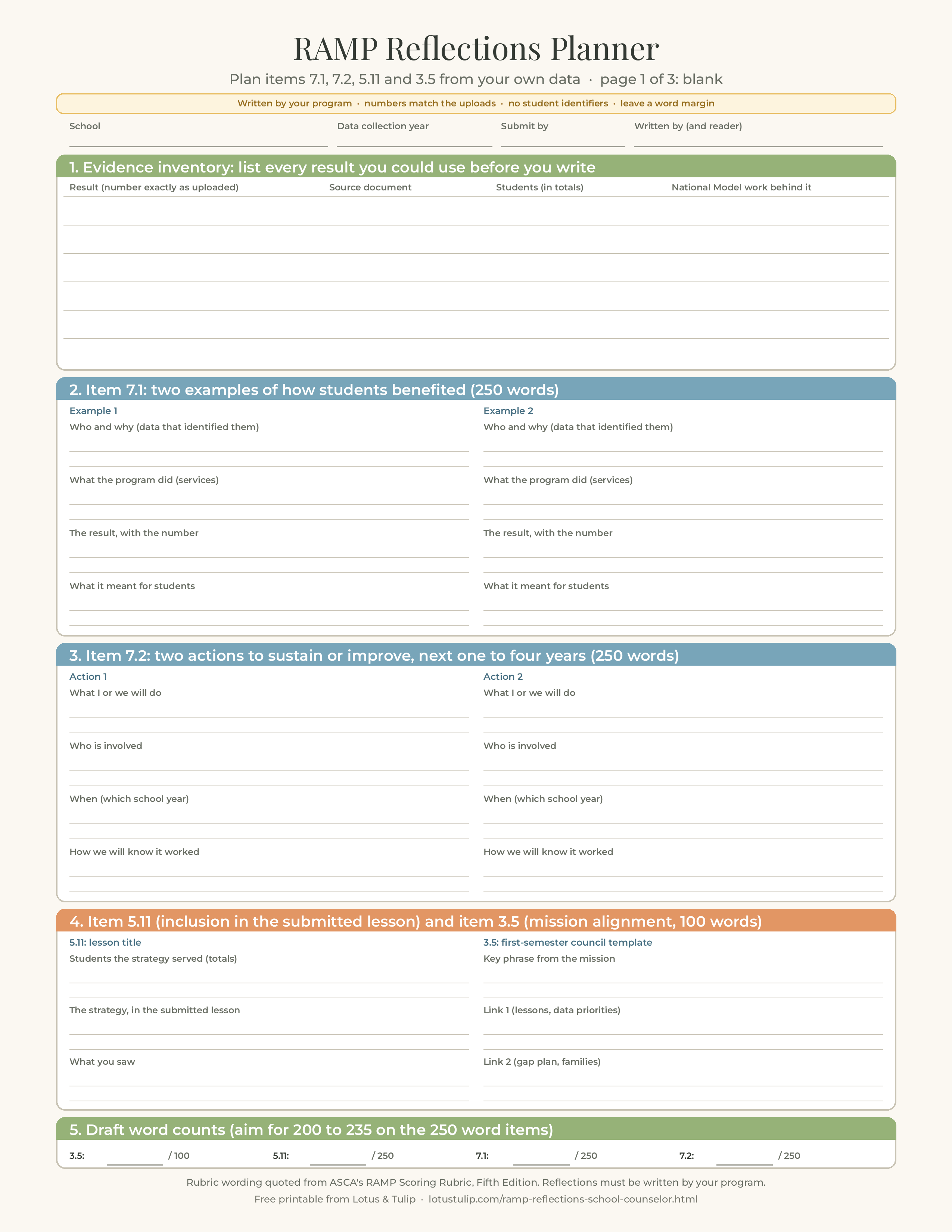
Download the free reflections planner, example and check sheet (PDF, 3 pages)
Or download single pages: Page 1: blank reflections planner (PNG) · Page 2: filled example (PNG) · Page 3: word count and check sheet (PNG)
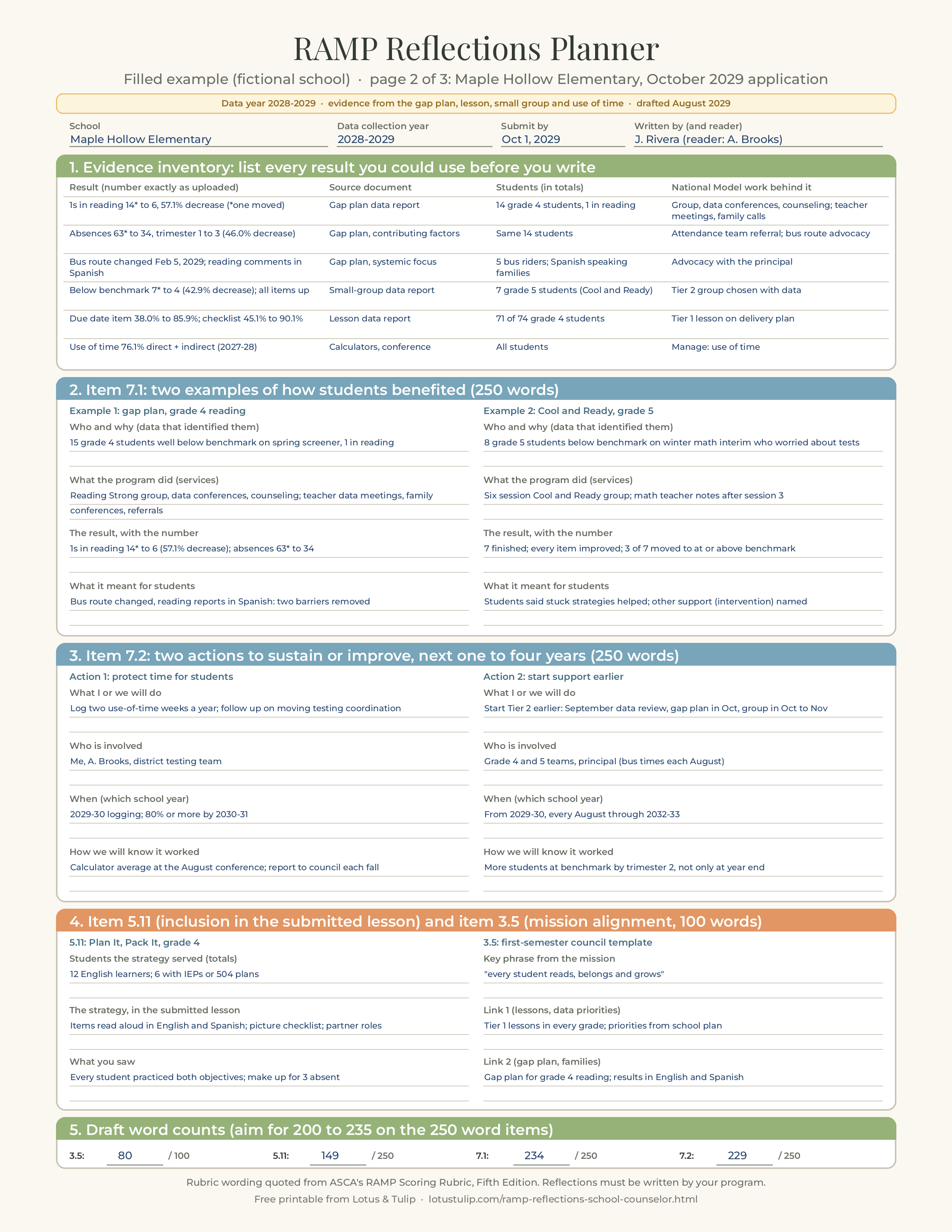
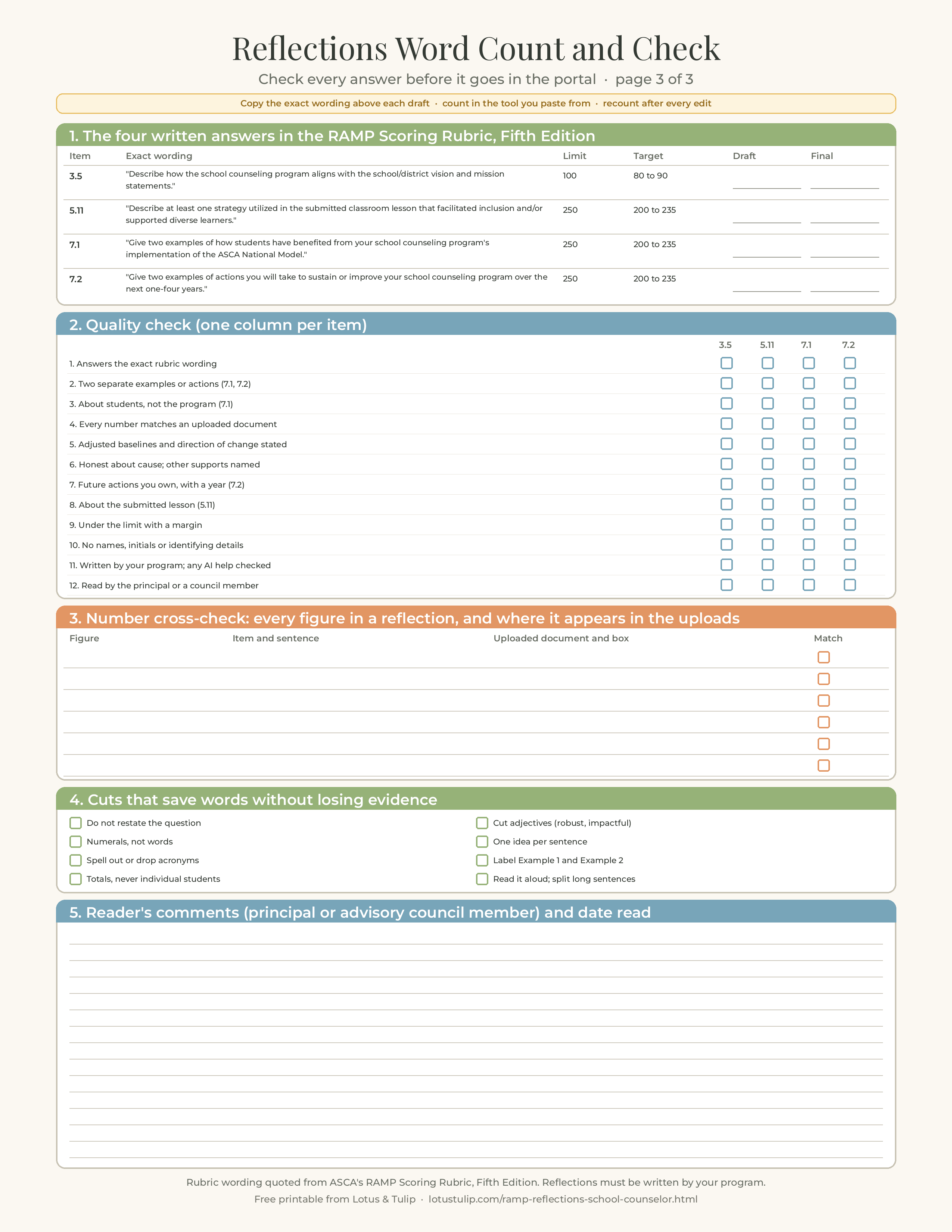
Free to print and use in your own school. Please link to this page rather than re-uploading the file. This is a planning tool, not an ASCA publication, and it does not replace the RAMP Scoring Rubric or ASCA's templates. Keep student names off any copy you share or upload.
Related resources
- RAMP application checklist: every fifth edition rubric item, upload and deadline
- ASCA school counseling program assessment: all 25 benchmarks
- School counseling data graphs for ASCA data reports and RAMP
- Closing the gap action plan: the ASCA achievement gap plan and data report (RAMP Section 2)
- Classroom lesson plan: the ASCA lesson plan and data report (RAMP Section 5)
- Small-group action plan: the ASCA small-group plan and data report (RAMP Section 6)
- School counselor advisory council agenda and minutes
- School counseling data priorities
- School counselor use-of-time calculator
- All school counselor small group curriculums
Sources: American School Counselor Association, RAMP Scoring Rubric, Fifth Edition (revision notes August 2025, September 2025, February 2026); ASCA, RAMP FAQs and Apply for RAMP pages, schoolcounselor.org/RAMP; ASCA, RAMP Application Timeline, ASCA National Model Fifth Edition; ASCA, RAMP in the Fifth Edition; ASCA, fifth edition templates download (Achievement Gap Plan, Lesson Plan, Small-Group Plan and Advisory Council First-Semester templates); ASCA, All Fifth Edition Template Examples download (achievement gap plan, lesson plan, small-group plan and first-semester advisory council examples); ASCA, RAMP Scoring Rubric, Fourth Edition (for comparison). All checked November 11, 2026. The checklists, frames, worked example and printable are original to Lotus & Tulip and are not ASCA publications.
FAQ
What are the RAMP reflections in the fifth edition?
Three items with a 250 word limit: 5.11 (at least one strategy in the submitted classroom lesson that facilitated inclusion and/or supported diverse learners), 7.1 (two examples of how students benefited from your program's implementation of the ASCA National Model) and 7.2 (two actions you will take to sustain or improve your program over the next one to four years). Item 3.5, a 100 word statement on how the program aligns with the school or district vision and mission, is the fourth written answer.
How long can a RAMP reflection be?
The fifth edition rubric gives a "250-word limit" for 5.11, 7.1 and 7.2 and a "100-word limit" for 3.5. ASCA does not say how words are counted or what happens over the limit, so aim for 200 to 235 words on the 250 word items.
How many points are the RAMP reflections worth?
The rubric prints section totals, not item values, but every section total equals its number of items, so each item appears to be worth one point. On that reading the four written answers are 4 of 82 points. The fourth edition had 18 reflections in a 60 point rubric.
Where do I enter the Section 7 reflections?
Section 7's only upload is the signature page PDF, so 7.1 and 7.2 are not on a template. ASCA's timeline refers to "correctly entered information, reflection/short answers" in the application, and the rubric says information not provided in the portal will not be scored. We could not view the login only portal to confirm the field layout.
Can I use AI to write my RAMP reflections?
ASCA's guidance says AI can "augment human capabilities, not replace them," to fact check and edit any AI output, to protect student data, and to "emphasize your unique capabilities and approach." The rubric also says reflections should be created by members of your school counseling program. Write them yourself, from your own data.
What is the passing score for fifth edition RAMP?
We did not find one on any ASCA page we checked on November 11, 2026. ASCA publishes only the fourth edition scoring: 54 or higher out of 60 earns RAMP, and 45 to 53 may resubmit eligible parts.