
School counselors · Updated 2026-11-11
Small-Group Action Plan for School Counselors: How to Write the ASCA Small-Group Plan and Data Report (Filled Example, Free Planner)
Ready-made printable: Complete Small Group Counseling Bundle Holiday 20% off: about $29.44, was $37 (EUR 32) · instant digital download
Buy on Etsy
Every school counselor runs small groups. Fewer of us enjoy writing them up. The group itself is the easy part: eight fifth graders, six Wednesdays, a calm room and a plan for each session. The hard part comes in May, when you need to show what the group did on paper: which standard each session taught, what students could do before and after, and whether anything changed in their grades or test scores. If you are applying for RAMP, a reviewer will check all of that against sixteen rubric items, and the plan has to be on ASCA's own template, unaltered.
A naming note first. Many counselors still search for a "small-group action plan" or a "small group results report." Those are fourth edition habits. In the fourth edition of the ASCA National Model, small group work was spread across several documents: a lesson plan for each session, a data collection plan inside those lesson plans, and a "Classroom and Small-Group Results Report" at the end. The fifth edition (2025) replaced them with one document, the Small-Group Plan and Data Report, that holds the whole group from first session to final data. This guide uses the old search terms where they help, but everything below follows the fifth edition template, ASCA's fifth edition example and the fifth edition RAMP rubric, because those are what count now.
This guide is for elementary, middle and high school counselors in the United States. It covers what the plan is and what changed from the fourth edition; every field on the fifth edition template, in order; the 16 items in Section 6 of the fifth edition RAMP rubric and the other sections that touch your groups; choosing and screening the group; one behavior standard per session, learning objectives and pre and post items; the session focus boxes; pre and post scoring rules; achievement data, the adjusted baseline and the percent change formula; graphs; the two reflection questions; what ASCA's own example shows, including a few inconsistencies worth avoiding; a realistic calendar; a ten step process; a fully worked fictional example; six scenarios; common mistakes; and a free three page printable: a blank planner, the same planner filled in for a fictional elementary school, and a data report worksheet with a percent change calculator, a graph checklist and a RAMP Section 6 checklist.
Jump to the free small-group plan planner, filled example and data report worksheet
This is educational information for school counselors in the US, not legal advice or official ASCA guidance. Your district, your state's school counseling framework and your evaluation system may set their own expectations. The ASCA documents quoted here were downloaded from schoolcounselor.org and checked on November 10 and 11, 2026: the fifth edition Small-Group Plan and Data Report template (Word template, footer "ASCA National Model Fifth Edition 8/25 v2"), ASCA's completed fifth edition examples (including the small-group plan example for a fictional high school, marked "8/25 v2"), the "RAMP Scoring Rubric, Fifth Edition" (revision notes through February 2026), "The ASCA National Model: A Framework for School Counseling Programs, Fifth Edition," "Changes in the ASCA National Model Fifth Edition," the fifth edition "RAMP Application Timeline," ASCA's "Graph Development Tips" (Rev. 9/25), the ASCA Student Standards: Mindsets & Behaviors for Student Success, the ASCA Ethical Standards for School Counselors (2022), the position statement "The School Counselor and Group Counseling" (reviewed 2026), and, for comparison, the fourth edition Lesson Plan and Classroom and Small-Group Results Report templates and the fourth edition RAMP rubric. Anything we could not confirm in those documents is marked as such below.
The short answer
- Purpose, in ASCA's words: the plan "provides details of small-group sessions that enhance life-readiness skills and academic success and defines: 1. What will be delivered in group sessions 2. To whom it will be delivered 3. How it will be delivered 4. How student attainment of the session's learning objectives will be assessed in small-group activities."
- Size and length: "There is a minimum of four sessions with three-12 students." RAMP Section 6 repeats the same rule.
- One document for the whole group. ASCA's changes document describes it as "One document for all group sessions" that "Monitors data for: 1. Participation 2. ASCA Student Standards 3. Achievement," with space for attendance and discipline data when appropriate.
- Why this group: check at least one Life-Readiness category (learning strategies, self-management skills, social skills) and at least one Academic Success category (failing grades, meeting benchmarks, meeting promotion or graduation requirements, low test scores), then give baseline achievement data for the students.
- Per session: one behavior standard from the ASCA Student Standards (a standard may repeat across sessions), one learning objective beginning "Students will," one or two pre and post items for that objective, then a description of what you will teach and how students will practice it.
- Data report: students at the beginning and end (with an explanation if the number changed), pre and post results for every item, baseline and final achievement data, percent change, bar graphs, and two reflection questions.
- For RAMP: Section 6 of the fifth edition rubric, 16 of 82 points. The "optional" data organizer is "Required for RAMP," and the group "cannot be the same small group included in the Achievement Gap Plan, if one was included."
- Percent change = (final minus baseline) divided by baseline, times 100. A negative result is a decrease.
What the small-group plan is, and where it fits
The fifth edition framework describes four things school counselors do in the Manage component. The first is to plan how each and every student will learn the ASCA Student Standards, and the description lists three tools: "identifying specific standards in the ASCA Student Standards delivery plan that will be delivered in Tier 1 and 2 settings," "planning how the standards will be delivered using lesson plans and small-group sessions plan" and "using these standards to provide focus for individual sessions with students." So the small-group plan sits right next to the lesson plan. The delivery plan lists every lesson and group for the year; the lesson plan details one Tier 1 lesson; the small-group plan details one Tier 2 group.
The framework's tier table describes Tier 2 as "Interventions for some students": "Provide small-group and individual counseling for students, referrals, and consultation and collaboration with education partners." Its definitions of direct student services list small groups as a setting for all three kinds of direct service: instruction, appraisal and advisement, and counseling, which ASCA defines as providing "students with short-term assistance and support based on counseling theories and techniques during times of transition, heightened stress, critical change or other situations impeding academic, career and social/emotional development."
The plan also uses all three categories of school counseling data from the Assess component:
- Participation data: "How many students access the school counseling program, how often they participate and for what length of time."
- ASCA Student Standards data: "The knowledge and skills students need for life-readiness as defined by the behavior standards from the ASCA Student Standards and measured through pre-/post-assessments."
- Achievement data: traditional grades, standards-based grades, benchmark assessments, promotion rates, graduation rates and test scores, with contributing factors such as attendance rates, discipline rates, systemic barriers, student perspectives and education partner perspectives.
That third category is what separates the small-group plan from the lesson plan. ASCA's changes document says the fifth edition Lesson Plan and Data Report "No longer collects achievement data. A single lesson is not likely to have a significant impact on achievement data." A small group of four or more sessions with the same students is a different matter, so the small-group plan keeps achievement data and asks you to show it on a graph.
Fourth edition vs fifth edition: what changed
If you trained under the fourth edition (2019), you may remember writing a "small group action plan." The fourth edition did not have a template by that exact name. Small groups appeared in three places: the "Classroom and Group Mindsets & Behaviors Action Plan" (the year's overview, now the delivery plan), the Lesson Plan template (with a "Small-Group Session Lessons: Lesson ___ of ___" checkbox and a data collection plan) and the "Classroom and Small-Group Results Report." ASCA's "Changes in the ASCA National Model Fifth Edition" puts it in one row: "Lesson Plans (included classroom and small group)" became the Lesson Plan and Data Report, and a new "Small Group Plan and Data Report" became "One document for all group sessions."
| Topic | Fourth edition | Fifth edition |
|---|---|---|
| Documents | A lesson plan for each session, a data collection plan, and a separate Classroom and Small-Group Results Report | One Small-Group Plan and Data Report for all sessions |
| Standards | one or two "mindsets or behaviors per lesson" on the results report; one standard per session for RAMP (7.D2) | One behavior standard per session (template shows "B#"); a standard may repeat |
| Reason for the group | Target audience and an outcome data plan | Checkboxes: at least one Life-Readiness and one Academic Success category (RAMP 6.2) |
| Outcome data | "Achievement, Attendance and/or Discipline Data": baseline, final, percent change | Achievement data required; attendance and discipline only as contributing factors "when applicable" |
| Participation | Number of students, length of sessions, number of sessions | Students at beginning and end, with an explanation of any change; number of sessions at the top |
| Session details | Introduce, communicate objective, teach, practice, summarize, plus follow up plans | Two boxes per session: teaching content and how students practice |
| Reflections | How the group helped students attain the standards; how it could be improved | How can you improve your small group; how do the results inform future groups or the program |
| RAMP | Section 7 (lesson plans, classroom OR small group, 4 points) plus Section 9, Small-Group Results Report (7 points), required for every applicant | Section 6, Small-Group Plan and Data Report, 16 points; cannot be the achievement gap plan group |
The biggest practical change is the outcome data. In the fourth edition you could report attendance or discipline as the result of a group. The fifth edition template asks for baseline achievement data for the group, and RAMP items 6.3, 6.11 and 6.14 to 6.16 are all about achievement data. Attendance and discipline still have boxes, but they are contributing factors, reported "when applicable." If your group is about attendance, you still need an achievement measure for the same students. Our guide to attendance groups covers that situation.
The fifth edition template, field by field
The blank template we downloaded (footer "ASCA National Model Fifth Edition 8/25 v2") is a Word template that prints to about eight pages. It does not print the purpose and implementation notes; those appear in ASCA's completed example, together with red directions in each section. Here is every field, in order.
1. Plan details
School Name, School Counselor Name, School Year, Small Group Title or Focus and Number of Sessions. RAMP item 6.1 checks the title or focus and the number of sessions. A title that says what the group is for ("New Student Support Group" in ASCA's example) saves a reviewer from guessing. If you co-facilitate, list both counselors, as ASCA's example does.
2. Reason for this group
"Students in group need support with: (check all that apply)." Two columns of checkboxes:
- Life-Readiness: Learning Strategies, Self-Management Skills, Social Skills. These are the three subcategories of behavior standards in the ASCA Student Standards.
- Academic Success: Failing grades, Meeting benchmarks, Meeting promotion/graduation requirements, Low test scores.
RAMP item 6.2 reads: "At least one Life-Readiness category and at least one Academic Success category are identified as the reason for the small-group." The rubric's revision notes say this item changed in September 2025 from an "open-ended response" to "category selection" and was edited "for clarity" in February 2026. So check boxes, and make sure the Life-Readiness boxes you check match the standards you choose later. ASCA's example checks Learning Strategies, Failing grades and Meeting graduation requirements, then uses social skills and self-management standards in five of its six sessions. That works because the Life-Readiness rule is "at least one," but matching the boxes to your standards is cleaner.
3. Baseline achievement data
"For the issues checked above, indicate the baseline achievement data for students in the small group." A small table with four rows and a "Number of Students" column: Failing grades, Low test scores, Not meeting graduation requirements, Not meeting benchmarks. RAMP 6.3: "Achievement data provided for students in small group." Write a number for each issue you checked, and say exactly what the number counts (which assessment, which grading period, which threshold) somewhere a reviewer can see it.
4. Attendance, discipline and other data
Three boxes, each with the instruction "Use 'NA' if no data applies.": Attendance Data, Discipline Data and Other Data. ASCA's example writes a sentence instead of a bare NA: "Attendance data for these nine students did not indicate excessive absences." That is a good habit, because it shows you looked. "Other data" is where screener results, referral counts or nurse visit counts can go, in totals only.
5. Session plans
A table with one row per session: Session, Behavior Standard(s) from the ASCA Student Standards (with a "B#" code field), Learning Objectives (pre-filled "Students will") and Pre-/Post-Assessment Statements (numbered 1 and 2). The blank template has six rows. ASCA's example adds the red directions:
- "Add or remove sessions as needed." and, in the margin, the reminder "Minimum of four sessions" with three to 12 students.
- Standard column: "Identify one behavior standard per session. A standard may be repeated in multiple sessions."
- Objective column: "Limit of one objective aligned with the selected standard per session." "Learning objective may be used more than once." "Begin each example with 'Students will…'"
- Assessment column: "Write one-two assessment items aligned with each learning objective." "Administer pre-assessment for entire small group before or during session one."
RAMP items 6.4 to 6.6 score this table: one behavior standard per session, each objective aligned with that standard, and each objective aligned with at least one assessment item.
6. Session focus
For each session: "Session [n] Focus:" with two boxes, "Describe the teaching content for this session." and "Describe how students will practice the content." Above the boxes, ASCA's example repeats: "Administer pre-assessment for entire small group before or during session one" and "Record pre-assessment data. Optional Data Organizer on the last page of the plan can be used for this information (Life-Readiness baseline data)." The plan section ends with the words "END OF PLAN." RAMP items 6.7 and 6.8 check that both descriptions support "the attainment of stated learning objective."
7. Small-Group Data Report
- Participation Data Results: "Number of students at beginning of plan," "Number of students at end of plan," and "If number of students changes from beginning to ending of plan, provide an explanation for the change."
- Graphs: "If needed, use organizer on the final page to organize the data." Then "ASCA Students Standard(s) Data Results" with a "Behavior Standards Addressed" list and a space to "Insert graph(s) for data from the ASCA Student Standards pre- and post-assessment results for this plan"; "Achievement Data Results" with a space to "Insert graph for data reported in the baseline and final achievement data results for this plan"; and "Contributing-Factors Results Graphs (if applicable)": "When appropriate, insert graph(s) of baseline and final data such as attendance and discipline."
- Two reflection questions: "How can you improve your small group? Consider timing, number and type of strategies, cultural responsiveness, student access and identified barriers." and "How do the results inform future small groups or the school counseling program?"
8. Optional Data Organizer (Required for RAMP)
The last page pairs baseline and final boxes:
- "Baseline Participation Data: Number of students expected to participate in the small group" and "Final Participation Data: Number of students who actually participated in the small group."
- "Baseline ASCA Student Standards Data" and "Final ASCA Student Standards Data," with numbered lines for pre and post results. The example's direction: "Calculate the average student response for each Likert-scale item, or percent correct for each knowledge-based item."
- "Baseline Achievement Data: This data matches baseline achievement data in small group." and "Final Achievement Data: Report actual final achievement data," with "Percent Change from Baseline to Final Data: ___ %."
- "Baseline Attendance Data (when applicable)" and "Final Attendance Data (when applicable)," and the same pair for discipline.
The word "optional" refers to ordinary use. For RAMP, the organizer is where reviewers find the data for items 6.9 and 6.12 to 6.16, so fill in every box.
RAMP Section 6: all 16 items in one place
The fifth edition RAMP Scoring Rubric describes Section 6 like this: "This section requires evidence of a small group with a minimum of four sessions for three-12 students that enhance life-readiness skills and academic success that includes what will be delivered in group sessions, to whom it will be delivered, how it will be delivered and how students' attainment of the lesson's learning objective will be assessed. The small group submitted in this section cannot be the same small group included in the Achievement Gap Plan, if one was included. Data results and graphs are required." The upload is listed as "Small-Group Lesson Plan and Data Report template (PDF)."
| Item | What the rubric says (abridged where marked) | What it means in practice |
|---|---|---|
| 6.1 | Small group title or focus, and number of sessions identified. | Fill in both boxes at the top. |
| 6.2 | At least one Life-Readiness category and at least one Academic Success category are identified as the reason for the small-group. | At least one checkbox in each column. |
| 6.3 | Achievement data provided for students in small group. | A number for each checked academic issue. |
| 6.4 | Limit of one behavior standard from the ASCA Student Standards identified for each session plan. (A standard may be repeated in multiple sessions.) | One "B" code per row, never two. |
| 6.5 | Each learning objective aligns with the selected behavior standard. | The objective teaches the skill named in that row's standard. |
| 6.6 | Each learning objective aligns with at least one assessment item. | Every row has an item that measures its objective. |
| 6.7 | Description of teaching content for each session supports the attainment of stated learning objective. | What you teach leads to the objective. |
| 6.8 | Description of student practice for each session supports the attainment of stated learning objective. | Students actually do the skill in the session. |
| 6.9 | Number of students expected to participate and the number who actually participated are included; explanation provided if they differ. | Organizer and participation boxes match, with one sentence of explanation. |
| 6.10 | Uploaded template includes life-readiness graph(s) that accurately reflects the ASCA Student Standards data. | Pre and post bar graph(s) that match the organizer. |
| 6.11 | Uploaded template includes academic success graph that accurately reflects the achievement data. | Baseline and final achievement graph that matches the organizer. |
| 6.12 | Data calculates average student responses for Likert items or percent correct for knowledge-based items. | Averages for Likert, percents for knowledge, never raw totals. |
| 6.13 | Results provided for each assessment item in plan. | One pre and one post result for every item in the session table. |
| 6.14 | Achievement data matches baseline achievement data described for small group. | Same number, same measure as section 3 of the plan. |
| 6.15 | Actual final achievement data reported. | The real final number. (Projected final data was removed in September 2025.) |
| 6.16 | Percent change from baseline to final data reported. | A percent, with direction (increase or decrease). |
Three general rules from the front of the rubric apply too. "Only completed fifth edition ASCA templates in their original form may be used," and "Using the wrong templates or altering templates may lead to rubric not being met." Everything except the delivery plan and use-of-time calculators is uploaded "as a PDF." And "No identifiable student information should be included." The rubric also says the application "should cover one complete school year prior to the submission date," and the current rubric names a deadline of "Oct. 1, 2027, at 11:59 p.m. ET." We did not find a published passing score for the fifth edition application in ASCA's documents.
For context, the seven sections total 82 points: Section 1, ASCA Student Standards delivery plan, 9; Section 2, achievement gap plan and data report, 26; Section 3, advisory council, 11; Section 4, annual administrator conference, 6; Section 5, lesson plan and data report, 11; Section 6, small-group plan and data report, 16; and Section 7, reflections and signature page, 3. Section 6 is the second largest.
Other rubric items that touch your groups
- Delivery plan (Section 1): 1.6 "At least two Tier 2 small groups for students are included." 1.7 "Each Tier 2 small group session is connected to one behavior standard. The same standard can be repeated for multiple/all sessions." 1.9 asks for a start month for each Tier 2 small group session. Your Section 6 group should appear on your delivery plan with the same standards.
- Advisory council (Section 3): 3.9 says the second-semester agenda includes, at a minimum, a "Small-Group Plan and Data Report update," and 3.11 asks for a summary of discussion and feedback on at least two of three updates, one of which is the small-group update. Plan to have at least preliminary data by your spring meeting. Our advisory council guide has sample agendas.
- Achievement gap plan (Section 2): a gap plan often uses a small group as a direct strategy. That group cannot be your Section 6 group. See our achievement gap plan guide.
Choosing the group: data first, then screening and consent
The implementation notes in ASCA's example are short and worth taking literally: "Sessions are delivered to students with identified needs" and "Sessions are based on data that identifies student needs." The Ethical Standards say the same thing in A.7: school counselors "Offer culturally sustaining small-group counseling services based on individual student, school and community needs; student data; a referral process; and/or other relevant data" (A.7.a) and "Use data to inform group topics, establish well-defined expectations and measure the outcomes of group participation" (A.7.f).
For this template, "data that identifies student needs" has to include an academic measure, because the plan asks for baseline achievement data and RAMP scores it. A practical way to build the list:
- Start with a need you already see. Teacher referrals, a needs assessment, a screener, nurse visit patterns, new enrollments.
- Cross it with one achievement measure. Which of those students are failing a course, below benchmark on an interim assessment, off track for promotion or graduation, or scoring low on a state or district test? Pick one measure and one window, such as "below benchmark on the winter math interim."
- Check the size. Three to 12 students. If the overlap is larger, split it into two groups or narrow it (one grade, one measure). If it is smaller than three, it is individual work, not a group.
- Screen. A.7.c: "Assess student needs to determine if participating in the group is appropriate for the student." The position statement "The School Counselor and Group Counseling" (reviewed 2026) adds: "School counselors have a responsibility to screen potential group members and obtain informed consent."
- Inform families and get consent as your district requires. A.7.d: "Inform parents/guardians of student participation in and the purpose of the small group." The position statement says informed consent "should include the group's purpose and goals, limits to confidentiality and information regarding voluntary participation." Some states, such as Texas, require written consent for many counseling services; see our Texas SB 12 guide and our permission slip guide.
- Remove access barriers. A.7.b: "Provide equitable access to participation in groups, including alleviating physical, language and other obstacles." Think about schedule (which class students miss), language of the consent letter and transportation.
The position statement also describes the kind of group this template is built for: sessions that "Help students overcome issues impeding achievement or success," that help students "identify problems, causes, alternatives and possible consequences," and that "Are planned, goal-focused, evidence-based and short-term in nature."
How many sessions, how long?
The minimum is four sessions. The blank template has six session rows, and ASCA's example uses six. We did not find a required session length in the fifth edition template, example or rubric. The fourth edition asked for "Length of lessons/sessions" in the results report; the fifth edition template does not have that box. Choose a length that fits your schedule (30 minutes is common in elementary school, a class period in secondary) and mention it in the session focus or the participation explanation if it matters for your story.
Which group to submit for RAMP
Choose a group that (1) is not part of your achievement gap plan, (2) has a clear academic measure you can get for the same students before and after, (3) will finish in time for post data and the achievement measure (the RAMP timeline puts data reports in February to March and "completed and analyzed, graphs created" by April to May), and (4) is on your delivery plan. A group that is easy to run but has no academic link (a lunch bunch with no achievement data) is a poor fit for Section 6.
Session plans: one standard, one objective, one or two items
Picking a behavior standard for each session
The template's standard column shows "B#," and the rubric says "one behavior standard from the ASCA Student Standards." The ASCA Student Standards have 36 standards: six mindset standards and 30 behavior standards in three groups of ten (Learning Strategies B-LS 1 to 10, Self-Management Skills B-SMS 1 to 10 and Social Skills B-SS 1 to 10). Use behavior standards here. ASCA's example writes the code without the "B-" prefix in the code box (for example "SMS 10.") and the standard's words beside it.
For session items, our ASCA mindsets and behaviors pre and post survey item bank lists Likert and knowledge items with answer keys for every behavior standard, so each session can start with a measure that fits its objective.
Standards that fit common Tier 2 groups (codes and wording from the ASCA Student Standards):
- Worry or test anxiety: B-SMS 7 "Effective coping skills"; B-SMS 2 "Self-discipline and self-control"; B-LS 3 "Time-management, organizational and study skills."
- Organization and work completion: B-LS 3; B-SMS 3 "Independent work"; B-LS 7 "Long- and short-term academic, career and social/emotional goals."
- Friendship and social skills: B-SS 2 "Positive, respectful and supportive relationships with students who are similar to and different from them"; B-SS 1 "Effective oral and written communication skills and listening skills"; B-SS 6 "Effective collaboration and cooperation skills."
- Anger and self regulation: B-SMS 2; B-SMS 7; B-SS 9 "Social maturity and behaviors appropriate to the situation and environment."
- New students and transitions: B-SMS 10 "Ability to manage transitions and adapt to change"; B-SS 3 "Positive relationships with adults to support success."
- Grief or family change: B-SMS 7; B-SMS 10; B-SS 3.
- Motivation and goal setting: B-LS 4 "Self-motivation and self- direction for learning"; B-SMS 5 "Perseverance to achieve long- and short-term goals"; B-LS 7.
Two or three standards across six sessions is usually enough. Repeating a standard is explicitly allowed, and it makes the delivery plan simpler: each standard becomes one Tier 2 row there.
Writing the learning objective
One objective per session, starting "Students will," aligned with that session's standard. A good objective names something students can show by the end of the session: "Students will name two signs their body gives them when they feel worried about a test" is measurable; "Students will understand anxiety" is not. ASCA's example uses objectives like "Students will identify three adults they can go to for help at school" and "Students will identify and explain phases of transition." The same objective may be used more than once, which helps when two sessions practice the same skill.
Writing pre and post items
One or two items per objective, so a six session group has six to twelve items. There are two kinds, and ASCA scores them differently:
- Likert items are statements students rate, for example from 1 (strongly disagree) to 4 (strongly agree): "I can use a breathing tool to calm my body during a test." You report the average.
- Knowledge items are questions with a right answer: "Name two things you can do when you get stuck on a test question." You report the percent of students who answered correctly. Decide in advance what counts as correct (for example, two acceptable strategies, not one).
Our pre and post assessment guide goes deeper on wording, scales and reading levels. Four rules matter most for this template: the item measures that row's objective; the wording, order and scale are identical before and after; students do not see the "right" answers between pre and post; and young students get items read aloud.
Number items once, everywhere
The template numbers items 1 and 2 inside each session row, and the organizer has its own numbered lines. Give every item a single running number (1, 2, 3 and so on across all sessions) and use those numbers in the session table, the organizer and the graph labels. It makes item 6.13, "Results provided for each assessment item in plan," easy for a reviewer to confirm.
Session focus: teaching content and practice
Each session gets two short descriptions. Reviewers check whether both support the objective (6.7 and 6.8), so write them as a pair:
- Teaching content: what students will learn, in one to three sentences. Name the skill, the steps or the facts. ASCA's example for its transition session lists the three phases it will present.
- Practice: what students will do with it in the session. Role play, a sort, a timed practice task, a plan they write, coaching a partner. ASCA's example: students draw a slip from a "change jar," share how they might feel "and names a skill they will need to respond to the change," then role play the skill with the school counselor.
Avoid describing only the activity ("students make a worry monster"). Say why the activity teaches the objective ("students draw where they feel worry in their body, then choose and practice one calming tool for that signal"). If the session includes the pre or post assessment, a check in, or a certificate, mention it briefly; the main space is for teaching and practice.
Pre and post: rules and math
When to give it
ASCA's direction is to "Administer pre-assessment for entire small group before or during session one." Give the post-assessment at or after the last session, with the same items in the same order. If a student misses session one, give the pre-assessment before they join any session.
How to score it
- Likert item: add every student's rating for that item and divide by the number of students who answered. Seven students rating 2, 2, 1, 3, 2, 2, 2 gives 14 / 7 = 2.0.
- Knowledge item: students who answered correctly divided by students assessed, times 100. Two of seven correct is 28.6 percent.
RAMP 6.12 checks exactly this: "Data calculates average student responses for Likert items or percent correct for knowledge-based items." Report one decimal for Likert averages and one decimal or whole percents for knowledge items, and be consistent.
When a student leaves
ASCA's template asks you to explain any change in participation, but it does not say whether to recalculate pre-assessment results for only the students who finished, and we did not find guidance on that in the rubric or example. We recommend reporting pre and post results for the same students, the ones who completed both, and saying so in the participation explanation ("one student moved after session 3; pre and post results are for the seven students who completed both"). That way a change in the numbers reflects learning, not a change in who was counted. The same logic applies to achievement data (see the adjusted baseline below).
Keep the data private
The plan reports totals only. Keep individual answer sheets in your own files under your district's records rules, and never put student names, initials or photos in the template. Our progress notes guide covers FERPA and sole possession notes.
Achievement data, the adjusted baseline and percent change
Choosing the measure
The achievement measure is the academic number you will report at baseline and final for the same students. It should match the Academic Success box you checked and come from the school's own data: report card grades, interim or benchmark assessments, course failures, credits toward graduation, promotion status or test scores. Good measures are counted the same way twice within the year: "number of students with one or more F on the report card," "number of students below benchmark on the math interim," "number of students on track in credits."
Pick a final data point that comes after the group ends and is close enough to plausibly reflect it. A group that ends in February and a spring interim in April is a reasonable pairing; a group that ends in October measured against the next fall's state test is not. ASCA's own example reflection is careful here: "Although we cannot show causation for the academic success, students in the group reported that the group experience helped them transition... and helped them succeed academically." You can say the same.
Baseline must match
RAMP 6.14: "Achievement data matches baseline achievement data described for small group." In practice, the baseline number in the organizer should be the same number, for the same measure, that you wrote in the baseline achievement table at the top of the plan, and the academic success graph should show that same measure (6.11). It sounds obvious, but ASCA's own example mixes measures, as described below.
The adjusted baseline
If a student leaves, the final count is for fewer students than the baseline. ASCA's example handles it on the graph with an asterisk ("2*" and "*One student transferred to another school"). The same idea, used in ASCA's achievement gap plan example, is to adjust the baseline to the students still in the group and mark it with an asterisk. For example, eight students below benchmark at baseline, one moves away, so the adjusted baseline is seven*. Compare the final number to the seven.
The percent change formula
Percent change = (final minus baseline) / baseline x 100.
- Seven* students below benchmark at baseline, four at final: (4 minus 7) / 7 x 100 = minus 42.9, a 42.9 percent decrease in students below benchmark.
- Five students with a GPA of 3.0 or higher at baseline, six at final: (6 minus 5) / 5 x 100 = 20, a 20 percent increase. This is ASCA's own example result.
Write the counts next to the percent ("from 7* to 4, a 42.9 percent decrease"). With small groups, one student changes the percent a lot, and counts keep the story honest. RAMP 6.16 only asks that percent change be reported; we did not find any minimum change that a group must show.
Attendance and discipline
Report them only when they are relevant. If attendance is part of why the group exists, use the same length window before and after (for example, absences in the six weeks before and the six weeks after the group). Our attendance group guide has a worked example.
Graphs
ASCA's example prints the graph rules twice, once for each kind of graph. For ASCA Student Standards results: "Match data reported in the results section," "Data represented side by side" and "Graph aggregate data, not individual student data." Then: "All graphs are bar charts and include: 1. Primary title: ASCA Student Standards Data Results 2. Subtitle with specific details about the students or data represented on graph 3. Y-axis label: describes data being graphed; if Likert scale is used, defines the scale 4. X-axis label: defines what is being compared 5. Data points included for each bar on graph." For achievement results, the primary title is "Achievement Data Results" and the X-axis label "defines what is being compared and when data was collected."
ASCA's Graph Development Tips (Rev. 9/25) give step by step directions for Excel ("CLUSTERED COLUMN"), Google Sheets ("COLUMN CHART"), PowerPoint and Canva, and note that the primary title and ASCA Student Standards are provided on the templates. The fourth edition rubric said to make "one graph for Likert-scale results and one graph for knowledge-based results"; ASCA's fifth edition example does the same, with a knowledge graph ("Percent of Students Who Answered Correctly," 0 to 100) and a separate Likert graph ("Average Likert Scale Response (1=Strongly Disagree - 4=Strongly Agree)"). Keep them separate; a 0 to 100 scale and a 1 to 4 scale on one axis makes the Likert bars unreadable.
A quick checklist that covers 6.10 and 6.11:
- Bar charts, pre and post (or baseline and final) side by side, with a legend.
- A subtitle naming the group and the students ("Cool and Ready group, grade 5, seven students who completed pre and post").
- Item wording (or a short version) under each pair of bars, in the same order as the organizer.
- A data label on every bar, including zeros.
- Numbers that match the organizer exactly, including rounding.
- For achievement: when each value was collected ("Winter interim, Dec 2028" and "Spring interim, Apr 2029"), and the asterisk note if the baseline was adjusted.
For subtitle and axis label examples, the percent change math, tool by tool steps and the details in ASCA's own small-group example not to copy, see our guide to school counseling data graphs.
The two reflection questions
Neither reflection is a numbered RAMP item in Section 6, but they are on the template, your advisory council will read them, and they are where you show professional judgment.
- "How can you improve your small group?" The template prompts "timing, number and type of strategies, cultural responsiveness, student access and identified barriers." Write one or two concrete changes and why. ASCA's example: students came from nine different schools, it "took longer for them to feel comfortable sharing," and next time the counselor will give "more attention to building group rapport in the first few sessions."
- "How do the results inform future small groups or the school counseling program?" Say what you will keep, what you will change and what the data tells the program. If some students did not improve, say what happens for them next (a referral, an intervention team, a second round). ASCA's example: "We plan to run a new group in second semester with slight adjustments."
What ASCA's own example shows (and three things not to copy)
ASCA's fifth edition example is a "New Student Support Group" at a fictional Washington Park High School, run by two school counselors in 2025 to 2026: six sessions, nine students at the beginning and eight at the end ("One student returned to her previous school after the third session"). It is the best single picture of what a finished plan looks like, and it is worth reading closely.
- Reason: Learning Strategies; Failing grades and Meeting graduation requirements. Baseline table: failing grades 9, low test scores 4, not meeting graduation requirements 9, not meeting benchmarks 9. Attendance and discipline: a sentence each saying the data did not indicate problems.
- Standards by session: SMS 10 (transitions), SS 3 (relationships with adults), LS 8 (engagement in challenging coursework), SMS 10 again, SS 7 (leadership and teamwork) twice. One standard per session, with repeats.
- Items: five knowledge items (for example, "Explain each of the three phases of transition.") and one Likert statement ("I pay attention and take notes in class."). Only item 1 is filled in each row; the "2." lines are blank, which is fine, because the rule is one or two items.
- Results: knowledge items from 22 to 78 percent, 11 to 89, 0 to 50, 33 to 67 and 22 to 78; the Likert item from 2.2 to 3.8. Two graphs: one for the knowledge items and one for the Likert item.
- Achievement: the graph shows students "with one or more F on their report card," 9 at the previous school and "2*" at the end of the first semester, with "*One student transferred to another school." The organizer reports "Five of nine students had a cumulative GPA of 3.0 or higher at their previous school" and "Six of eight students had a cumulative GPA of 3.0 or higher at the end of the first semester," with "20% increase."
Three details we would not copy into a RAMP application, because each one makes a rubric item harder for a reviewer to confirm:
- Two different achievement measures. The baseline table and the graph count failing grades; the organizer counts students with a GPA of 3.0 or higher. Items 6.11 and 6.14 ask that the graph "accurately reflects the achievement data" and that the organizer "matches baseline achievement data described for small group." Use one measure in all three places.
- Counts compared across different group sizes. Five of nine is 55.6 percent of the group; six of eight is 75 percent. The 20 percent increase compares counts (5 to 6) while the group shrank. Either adjust the baseline to the students who stayed or say clearly that the percent compares counts.
- Item order and denominators. The organizer lists the Likert item last (as item 6) although it belongs to session 3 in the plan, and several post percentages (78, 89, 67) are ninths although eight students finished. Number items once and use the same students for pre and post.
The example also has a small typo on the Likert graph ("Strongrly Disagree"). None of this makes it a bad example; it is a sample, not a scored application. It simply shows how easy it is for numbers to drift between the table, the organizer and the graphs, which is the most common way to lose points in this section.
When to write it: a realistic calendar
ASCA's fifth edition RAMP Application Timeline lays out the year of data collection. The small group lines read: September to October, "Small group finalized (choose one small group with a plan for at least four sessions)"; October to December, January and February to March, "Small group delivery"; February to March, "Data reports (lesson, small group, achievement gap plan)"; and April to May, "Data reports (completed and analyzed, graphs created)," alongside the second semester advisory council meeting. In a typical school year that becomes:
| When | What to do |
|---|---|
| August to September | Finish the delivery plan with at least two Tier 2 groups. Review needs assessment results, referrals and the first achievement data. |
| September to October | Choose the group you will document. Draft the plan on paper (the free planner below), then type it into ASCA's template. Pick the achievement measure and confirm when final data will be available. |
| Two to three weeks before the group | Screen students, send parent letters and consent as your district requires, schedule with teachers, print the pre-assessment. |
| Session 1 | Pre-assessment before or during the session. Record results right away. |
| Each session | Attendance, a short note, any make up plans. Keep the session focus boxes honest; update them if you changed the plan. |
| Last session | Post-assessment, same items, same order. |
| Within a week | Score pre and post, fill in participation and the ASCA Student Standards part of the organizer, build the life-readiness graph(s). |
| When the final achievement data arrives | Enter final data, adjust the baseline if needed, calculate percent change, build the achievement graph, write both reflections. |
| Second semester advisory council | Share the small-group plan and data report update in totals; record feedback in the minutes. |
| Before submission | Check every number against the organizer, save the template as a PDF, scan for names and identifying details. |
How to write an ASCA small-group plan and data report, step by step
- Choose the group from data. Combine a Life-Readiness need (referrals, needs assessment, screener) with one academic measure for the same students, and keep the group to three to 12 students who are not in your achievement gap plan group.
- Fill in the plan details and reason boxes. Enter school, counselor, year, a title that says what the group is for and the number of sessions (at least four), then check at least one Life-Readiness category and at least one Academic Success category.
- Record baseline achievement data. Write the number of students for each checked academic issue, name the exact measure and date, and complete the attendance, discipline and other data boxes (or write NA with a short reason).
- Choose one behavior standard per session. Pick behavior standards from the ASCA Student Standards that match the need; repeat a standard across sessions where it makes sense, and make sure the group appears on your delivery plan with the same standards.
- Write one learning objective per session. Begin each with "Students will," make it observable by the end of the session, and align it with that session's standard.
- Write one or two pre and post items per objective. Decide whether each is a Likert or a knowledge item, fix the scale and the answer key now, and number all items in one running sequence.
- Describe each session's teaching content and practice. Write what you will teach and what students will do to practice it, so both clearly lead to the objective.
- Deliver the group and give the assessments. Give the pre-assessment before or during session one and the post-assessment at the last session, track attendance, and note any student who leaves and why.
- Complete the data organizer and graphs. Enter expected and actual participation, the average or percent correct for every item, baseline (adjusted if needed) and final achievement data and the percent change, then build bar graphs that match the organizer exactly.
- Write the reflections and check against Section 6. Answer both reflection questions with specific changes and next steps, check every number against the organizer, confirm items 6.1 to 6.16, remove any identifying information and save ASCA's template as a PDF.
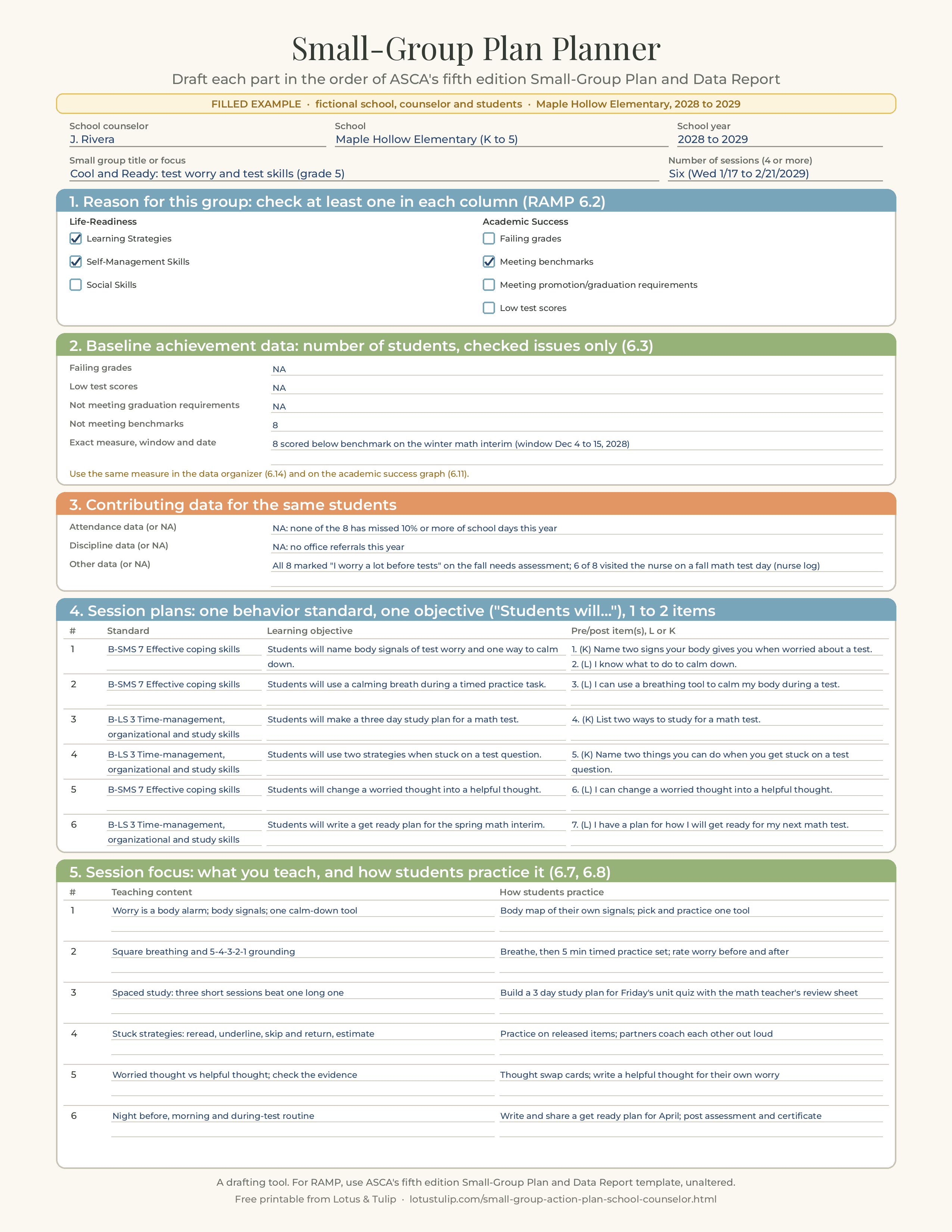
A worked example (fictional): the Cool and Ready group at Maple Hollow Elementary
Maple Hollow Elementary is a fictional public elementary school with kindergarten to grade 5. J. Rivera is the only school counselor. Our other school counselor guides follow the same school, including the delivery plan (where "Cool and Ready: test anxiety small group" first appeared as a Tier 2 row), the use-of-time calculator and the 2028 to 2029 achievement gap plan for grade 4 reading. The school plans to apply for RAMP in October 2029, so 2028 to 2029 is the data collection year. Every name, number and date below is invented for illustration.
Choosing the group
The fall 2028 needs assessment and teacher referrals pointed to test worry in grade 5, and the nurse's log showed visits clustering on math test days. The school improvement plan named math in grades 3 to 5 as a priority. In December 2028, J. Rivera crossed the two lists: of the grade 5 students who scored below benchmark on the winter math interim (testing window December 4 to 15, 2028), eight had also marked "I worry a lot before tests" on the needs assessment and were referred by a teacher. None of them was in the grade 4 reading group in the achievement gap plan, so this group could be the Section 6 submission.
She screened each student in a short individual meeting, sent the parent letter with a consent slip on Monday, January 8, 2029 (in English and Spanish, with the family liaison's number), and had all eight slips back by Friday, January 12. The group would meet on six Wednesdays, January 17 to February 21, 2029, for 30 minutes during the grade 5 enrichment block, so students did not miss math or reading instruction.
Plan details and reason
- Small Group Title or Focus: Cool and Ready: test worry and test skills (grade 5)
- Number of Sessions: Six
- Reason: Life-Readiness: Learning Strategies, Self-Management Skills. Academic Success: Meeting benchmarks.
- Baseline achievement data: Not meeting benchmarks: 8 (below benchmark on the winter math interim, December 2028). Failing grades, low test scores and graduation requirements: NA.
- Attendance data: None of the eight has missed 10 percent or more of school days this year.
- Discipline data: No office referrals this year.
- Other data: All eight marked "I worry a lot before tests" on the fall needs assessment; six of eight visited the nurse on a fall math test day (nurse log, counts only).
Session plans
| Session | Behavior standard | Learning objective | Pre and post items |
|---|---|---|---|
| 1 (Jan 17) | B-SMS 7 Effective coping skills | Students will name body signals of test worry and one way to calm down. | 1. (K) Name two signs your body gives you when you feel worried about a test. 2. (L) When I feel worried during a test, I know what to do to calm down. |
| 2 (Jan 24) | B-SMS 7 Effective coping skills | Students will use a calming breath during a timed practice task. | 3. (L) I can use a breathing tool to calm my body during a test. |
| 3 (Jan 31) | B-LS 3 Time-management, organizational and study skills | Students will make a three day study plan for a math test. | 4. (K) List two ways to study for a math test. |
| 4 (Feb 7) | B-LS 3 Time-management, organizational and study skills | Students will use two strategies when stuck on a test question. | 5. (K) Name two things you can do when you get stuck on a test question. |
| 5 (Feb 14) | B-SMS 7 Effective coping skills | Students will change a worried thought into a helpful thought. | 6. (L) I can change a worried thought into a helpful thought. |
| 6 (Feb 21) | B-LS 3 Time-management, organizational and study skills | Students will write a get ready plan for the spring math interim. | 7. (L) I have a plan for how I will get ready for my next math test. |
Likert items use 1 = strongly disagree to 4 = strongly agree, read aloud. For knowledge items, a student counts as correct only with two acceptable answers. On the 2028 to 2029 delivery plan the group appears on two Tier 2 rows, one for B-SMS 7 (three sessions) and one for B-LS 3 (three sessions), both with a January start month.
Session focus (abridged)
- Worry is a body alarm. Teach: worry as the body's alarm system, common body signals and one calm-down tool. Practice: each student marks their own signals on a body map, chooses one tool and practices it with a partner.
- Calm body, steady mind. Teach: square breathing and 5-4-3-2-1 grounding. Practice: students breathe, then do a five minute timed practice set from the math teacher, rating their worry from 1 to 5 before and after.
- Study smarter. Teach: three short study sessions work better than one long one; what to study from a review sheet. Practice: each student builds a three day study plan for Friday's unit quiz using the math teacher's review sheet.
- Unstuck. Teach: four stuck strategies (reread, underline the question, skip and return, estimate and check). Practice: partners work through released practice items and coach each other out loud.
- Thought swap. Teach: the difference between a worried thought and a helpful thought, and checking the evidence. Practice: thought swap cards, then each student writes a helpful thought for their own test worry.
- Ready for April. Teach: a night before, morning and during the test routine. Practice: each student writes and shares a get ready plan for the spring interim. Post-assessment and certificate.
Along the way
One student moved out of the district on Friday, February 2, 2029, after session 3. Another missed session 4 for a dentist appointment; J. Rivera met with her for ten minutes the next morning to cover the stuck strategies. She sent each math teacher a short note after session 3 so the study plan would match the next unit quiz, and gave every student a copy of their get ready plan to take home.
The data report
Participation: eight at the beginning, seven at the end. "One student moved out of the district after session 3. Pre and post results below are for the seven students who completed both."
| Item | Type | Pre | Post |
|---|---|---|---|
| 1. Name two signs your body gives you when you feel worried about a test. | K | 28.6% (2 of 7) | 85.7% (6 of 7) |
| 2. When I feel worried during a test, I know what to do to calm down. | L | 1.9 | 3.3 |
| 3. I can use a breathing tool to calm my body during a test. | L | 2.0 | 3.4 |
| 4. List two ways to study for a math test. | K | 14.3% (1 of 7) | 71.4% (5 of 7) |
| 5. Name two things you can do when you get stuck on a test question. | K | 42.9% (3 of 7) | 100% (7 of 7) |
| 6. I can change a worried thought into a helpful thought. | L | 2.1 | 3.0 |
| 7. I have a plan for how I will get ready for my next math test. | L | 1.7 | 3.4 |
The Likert averages come from rating totals of 13, 14, 15 and 12 before the group and 23, 24, 21 and 24 after, each divided by seven (13 / 7 = 1.86, shown as 1.9).
Achievement data: baseline 8 students below benchmark on the winter math interim (December 2028); adjusted baseline 7* (*one student moved out of the district). Final: 4 of the 7 below benchmark on the spring math interim (testing window April 9 to 13, 2029). Percent change: (4 minus 7) / 7 x 100 = 42.9 percent decrease.
Graphs: a knowledge graph ("ASCA Student Standards Data Results," subtitle "Cool and Ready group, grade 5, 7 students who completed pre and post," Y-axis "Percent of students who answered correctly," items 1, 4 and 5 side by side); a Likert graph (Y-axis "Average response (1 = strongly disagree, 4 = strongly agree)," items 2, 3, 6 and 7); and an achievement graph ("Achievement Data Results," Y-axis "Number of students below benchmark," X-axis "Winter interim, Dec 2028" and "Spring interim, Apr 2029," bars 7* and 4, with the asterisk note).
She shared the update in totals at the second semester advisory council meeting on Thursday, April 26, 2029, and recorded two pieces of feedback in the minutes: a parent member asked for the get ready plan to go home before every interim, and the principal asked whether the group could run before the winter interim next year.
Reflections
How can you improve your small group? "Students learned the calming and stuck strategies quickly, but the study plan session needed the math teachers' review sheets earlier; next year I will collect them a week ahead. The group ran in January and February, after the winter interim. Running it in October and November would let students use the skills before the winter interim and give two data points. I will also send the get ready plan home in Spanish and English before each interim, as families on the advisory council suggested."
How do the results inform future small groups or the school counseling program? "Three of seven students moved from below to at or above benchmark on the spring interim. We cannot show the group caused this, since all seven also had math intervention, but every item improved and students said the stuck strategies helped during the interim. The four students still below benchmark were discussed with the grade 5 team and the math interventionist in May. We will run Cool and Ready again in the fall for grades 4 and 5, and the grade 3 classroom unit on calm tools before tests will add a study plan lesson."
The free printable below shows this plan on page 2, in the same order as ASCA's template.
Six real world scenarios
- "My best group is part of my achievement gap plan." Then it cannot be your Section 6 group. Submit a different group of at least four sessions for three to 12 students, and keep the gap group in Section 2 where it already earns points.
- "My group is about friendships. Where is the achievement data?" Look for an academic measure that is plausibly connected and available for the same students: course failures, a benchmark, work completion grades that count on the report card. If there is none, the group may still be valuable, but it is a weaker choice for RAMP Section 6, which scores achievement data in four items.
- "Two students joined after session 2." Give them the pre-assessment before they join any session, list them in participation, and explain the change ("expected 6, actually participated 8: two students joined before session 3 after teacher referral"). Report pre and post for students who completed both.
- "Half my students left mid-year." Report what happened honestly, adjust the achievement baseline to the students who stayed and mark it with an asterisk. If fewer than three students finish, consider documenting a different group for RAMP, because the template and rubric describe groups of three to 12; we did not find ASCA guidance on how many must finish.
- "My middle school groups have eight sessions, but the template has six rows." ASCA's example says "Add or remove sessions as needed." Add rows in the session table and session focus pages using the template's own structure. Do not redesign the template or remove sections; the rubric warns that altered templates may not be scored as met.
- "The achievement data got worse." Report it. RAMP 6.16 asks for the percent change, not a positive one, and we found no minimum. Use the reflections to explain what you learned and what you will change: timing, number of sessions, a different academic measure, more work with teachers. Honest reflection is part of what the template asks for.
Common mistakes
- Two standards in one session row. RAMP 6.4 allows one. Repeat a standard across sessions instead.
- Mindset standards in the standard column. The template asks for behavior standards ("B#"). Use a B-LS, B-SMS or B-SS code.
- Objectives that cannot be measured. "Students will learn about anxiety" has no item that can measure it. Name something students can say, list, show or do.
- Items that do not match the objective. If session 3 is about study plans, its item should be about study plans, not general confidence.
- Raw totals in the organizer. Report the Likert average or the percent correct, not "23 points" or "5 students."
- A missing item. Every item in the session table needs a pre and a post result (6.13). Count them before you submit.
- Different achievement measures in different places. The table at the top, the organizer and the graph must show the same measure for the same students (6.11, 6.14).
- No explanation when the numbers change. 6.9 asks for one. One plain sentence, no names.
- Graphs without labels. Primary title, subtitle, both axis labels, a scale definition for Likert, data points on every bar, pre and post side by side.
- Student details in the PDF. No names, initials, photos or tiny subgroups that identify a student. The rubric warns that applications with student photos and names "risk deletion."
Free printable: small-group plan planner, filled example and data report worksheet
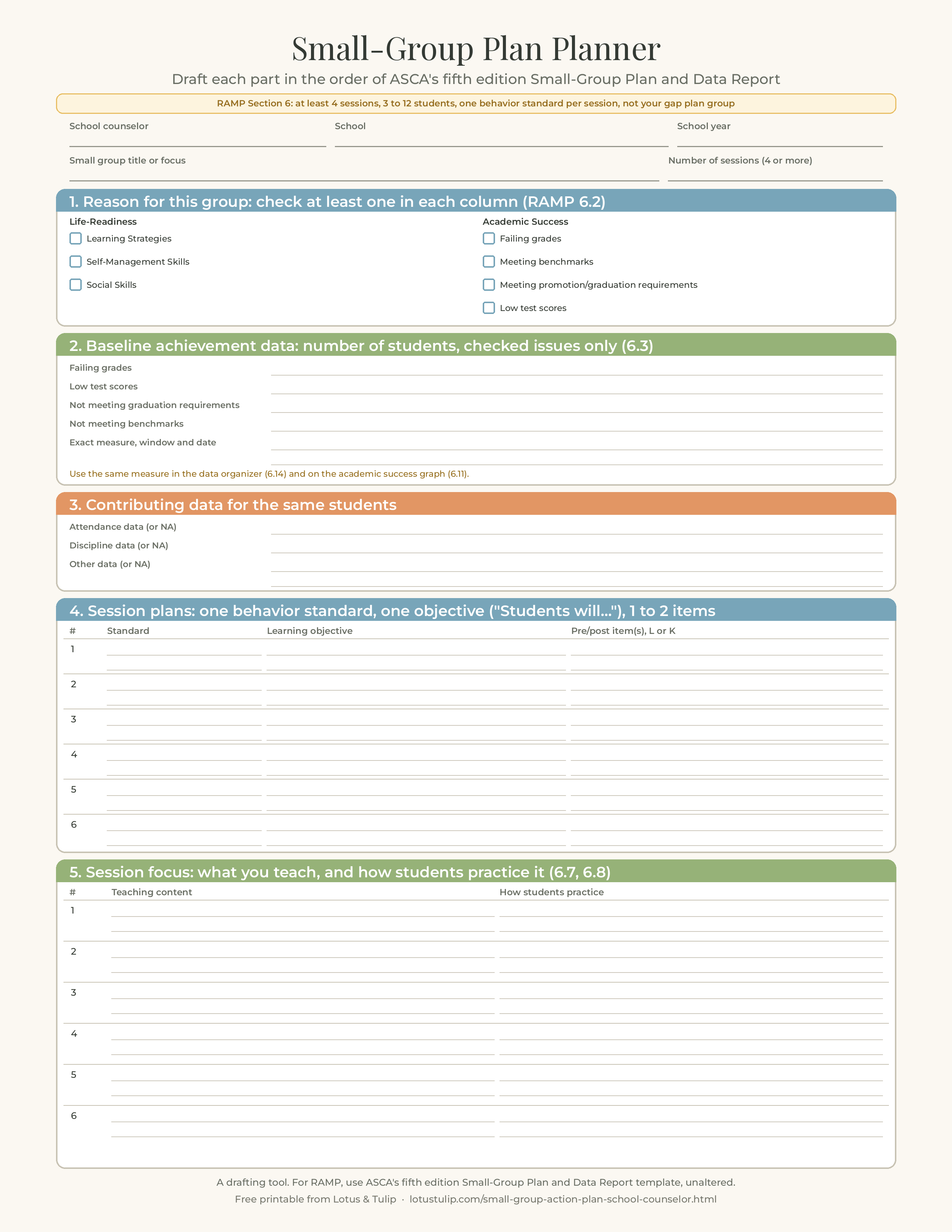
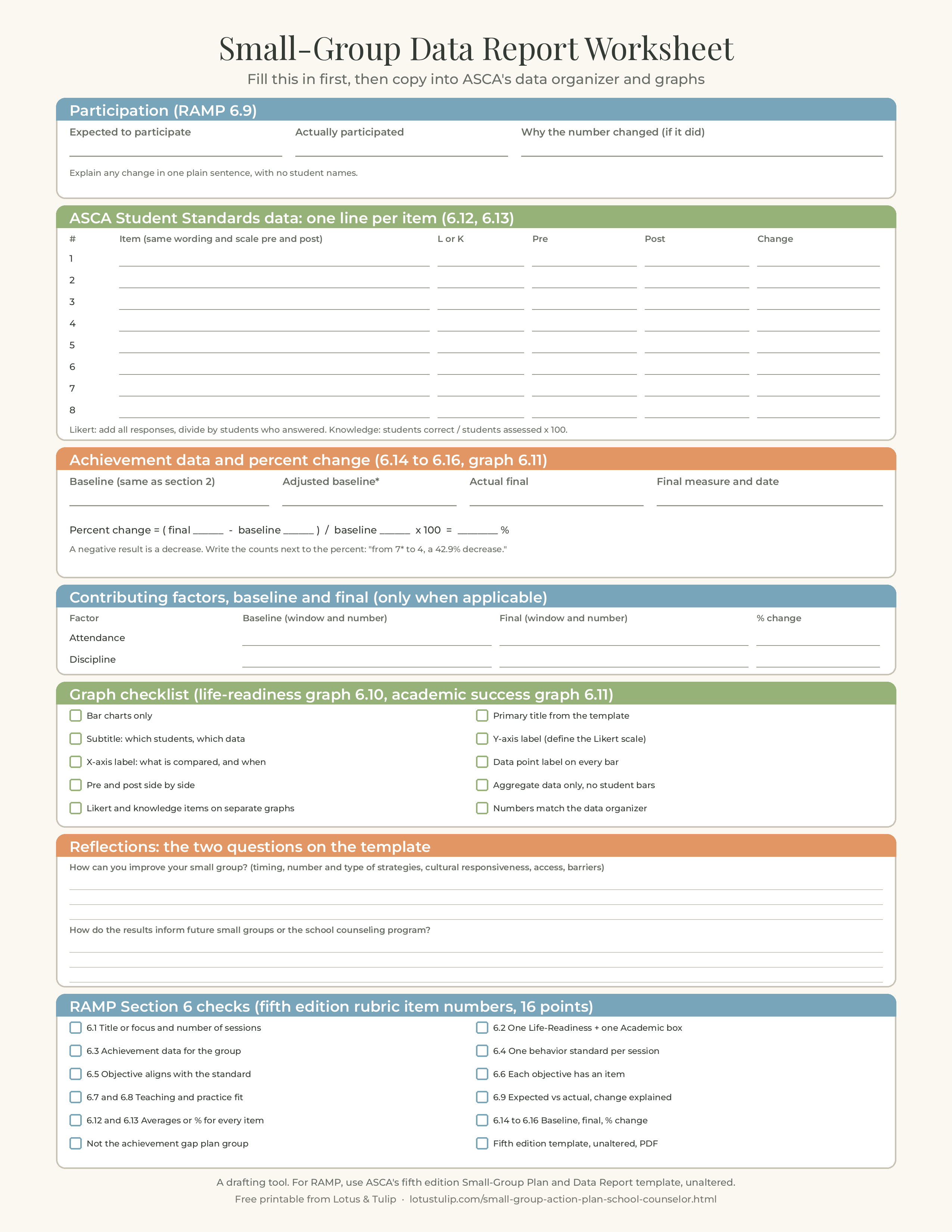
The free printable has three US Letter pages. Page 1 is a blank planner in the order of ASCA's fifth edition template: plan details and number of sessions; the reason checkboxes (Life-Readiness and Academic Success); a baseline achievement table with a line for the exact measure and date; attendance, discipline and other data; a six row session table (behavior standard, learning objective, pre and post items marked L or K); and six session focus rows for teaching content and practice. Page 2 is the same planner filled in for the fictional Cool and Ready group above. Page 3 is a data report worksheet: participation with an explanation line; an eight line pre and post table with a scoring reminder; baseline, adjusted baseline, final and a percent change calculator; contributing factors; a graph checklist; the two reflection questions; and a RAMP Section 6 checklist keyed to items 6.1 to 6.16.
The printable is a drafting and planning tool. It does not replace ASCA's fifth edition Small-Group Plan and Data Report template, which the RAMP rubric says must be used in its original form.
Download the free planner, example and data report worksheet (PDF, 3 pages)
Or download single pages: Page 1: blank planner (PNG) · Page 2: filled fictional example (PNG) · Page 3: data report worksheet (PNG)
Free to print and use in your own school. Please link to this page rather than re-uploading the file. This is a planning tool. It does not replace ASCA's official templates, your district's data policies or legal advice. Keep student names off any copy you share or upload.
Related resources
- School counseling data graphs: how to graph pre and post, achievement and attendance results for ASCA data reports, with a free graph planner
- ASCA mindsets and behaviors pre and post survey questions: item bank for all 36 standards and free survey builder
- ASCA classroom lesson plan and data report: RAMP Section 5, filled example and free planner
- All school counselor small group curriculums
- Closing the gap action plan: the ASCA achievement gap plan, filled example and free planner
- ASCA Student Standards delivery plan: filled example and free planner
- Small group counseling pre and post assessment: items, scoring and averages
- Small group counseling lesson plan template: one session, filled example and planning map
- School counselor use-of-time calculator: filled example and free 5-day log
- School counselor advisory council agenda, minutes and a filled example
- Small group counseling progress notes and attendance tracker
- Small group counseling referral form
- Small group counseling permission slip
- School counselor needs assessment for small groups
Sources: American School Counselor Association, Small-Group Plan and Data Report template, ASCA National Model Fifth Edition (Word template, 8/25 v2), from the ASCA Templates and Resources page; American School Counselor Association, All Fifth Edition Examples (Small-Group Plan and Data Report example, 8/25 v2, and Achievement Gap Plan and Data Report example); American School Counselor Association, RAMP Scoring Rubric, Fifth Edition (August 2025, revised September 2025 and February 2026), general instructions and Sections 1, 2, 3 and 6; American School Counselor Association (2025), The ASCA National Model: A Framework for School Counseling Programs, Fifth Edition (Manage component, MTSS tiers, direct student services and school counseling data categories); American School Counselor Association, Changes in the ASCA National Model Fifth Edition (Manage); American School Counselor Association, RAMP Application Timeline, Fifth Edition; American School Counselor Association, Graph Development Tips, Fifth Edition (Rev. 9/25); American School Counselor Association (2021), ASCA Student Standards: Mindsets & Behaviors for Student Success; American School Counselor Association (2022), ASCA Ethical Standards for School Counselors, A.7 Group Work; American School Counselor Association, The School Counselor and Group Counseling (position statement, adopted 1989, reviewed 2026); American School Counselor Association, Lesson Plan template and Classroom and Small-Group Results Report template, fourth edition, and RAMP Rubric, Fourth Edition, Sections 7 and 9, for comparison. All checked November 10 and 11, 2026.
FAQ
What is a small-group action plan for school counselors?
It is the plan a school counselor writes for a Tier 2 small group: why the group exists, which students it serves, what each session teaches and how learning will be measured, followed by a report of the results. In the fifth edition of the ASCA National Model (2025) it is a single document called the Small-Group Plan and Data Report. In the fourth edition the same work was spread across session lesson plans and a Classroom and Small-Group Results Report.
How many students and sessions does an ASCA small group need?
ASCA's fifth edition example says "There is a minimum of four sessions with three-12 students," and Section 6 of the fifth edition RAMP rubric uses the same rule. The blank template has six session rows, and ASCA's example tells counselors to add or remove sessions as needed. We did not find a required session length.
Can each session have more than one ASCA standard?
No, not for RAMP. Item 6.4 of the fifth edition rubric allows one behavior standard from the ASCA Student Standards for each session plan, and adds that a standard may be repeated in multiple sessions. Each session also has one learning objective aligned with that standard and one or two pre and post items for the objective.
Does the small-group plan need achievement data?
Yes. The fifth edition template asks for baseline achievement data for students in the group (failing grades, low test scores, not meeting graduation requirements or not meeting benchmarks), and the data report asks for final achievement data, the percent change and an academic success graph. Attendance and discipline are reported only as contributing factors when applicable. This is a change from the fourth edition, where outcome data could be achievement, attendance or discipline.
How do you calculate percent change for a small group?
Subtract the baseline from the final number, divide by the baseline and multiply by 100. A negative result is a decrease. For example, seven students below benchmark at baseline and four at final is (4 minus 7) / 7 x 100, a 42.9 percent decrease. If a student leaves, adjust the baseline to the students who stayed and mark it with an asterisk.
Can my RAMP small group be the same group as in my achievement gap plan?
No. Section 6 of the fifth edition RAMP rubric says the small group submitted there cannot be the same small group included in the Achievement Gap Plan, if one was included. Section 6 is worth 16 of the 82 total points. We did not find a published passing score for the fifth edition application.