
School counselors · Updated 2026-11-11
RAMP Application Checklist for School Counselors: Every Fifth Edition Rubric Item, Upload and Deadline (Free Printable)
Ready-made printable: Complete Small Group Counseling Bundle Holiday 20% off: about $29.44, was $37 (EUR 32) · instant digital download
Buy on Etsy
A RAMP application is not one document. It is nine ASCA templates, a signature page, a handful of reflections with word limits, and a year of data that all has to agree with itself. The data point you check on the data priorities template in August has to be the one your achievement gap plan addresses. The baseline in your gap goal has to match the baseline in your data organizer. The use of time you report at the administrator conference has to be the average of two calculators from the year before. A reviewer reads the whole thing against a rubric with 82 points, and a section uploaded in the wrong template or format cannot be scored at all.
This page is the checklist that sits above all of that. It walks through the fifth edition RAMP Scoring Rubric section by section, lists every upload and its file format, shortens every numbered rubric item into a checkbox, and links each section to the detailed template guide on this site (data priorities, achievement gap plan, delivery plan, lesson plan, small-group plan, advisory council, administrator conference, use of time and pre and post items). It also covers which edition you can use and when, the deadline, the fee, who signs the signature page, ASCA's suggested month by month timeline, what changes if you are reading this in the middle of a school year, the cross-checks that catch most problems, and what ASCA's public pages do not tell you, such as the fifth edition passing score.
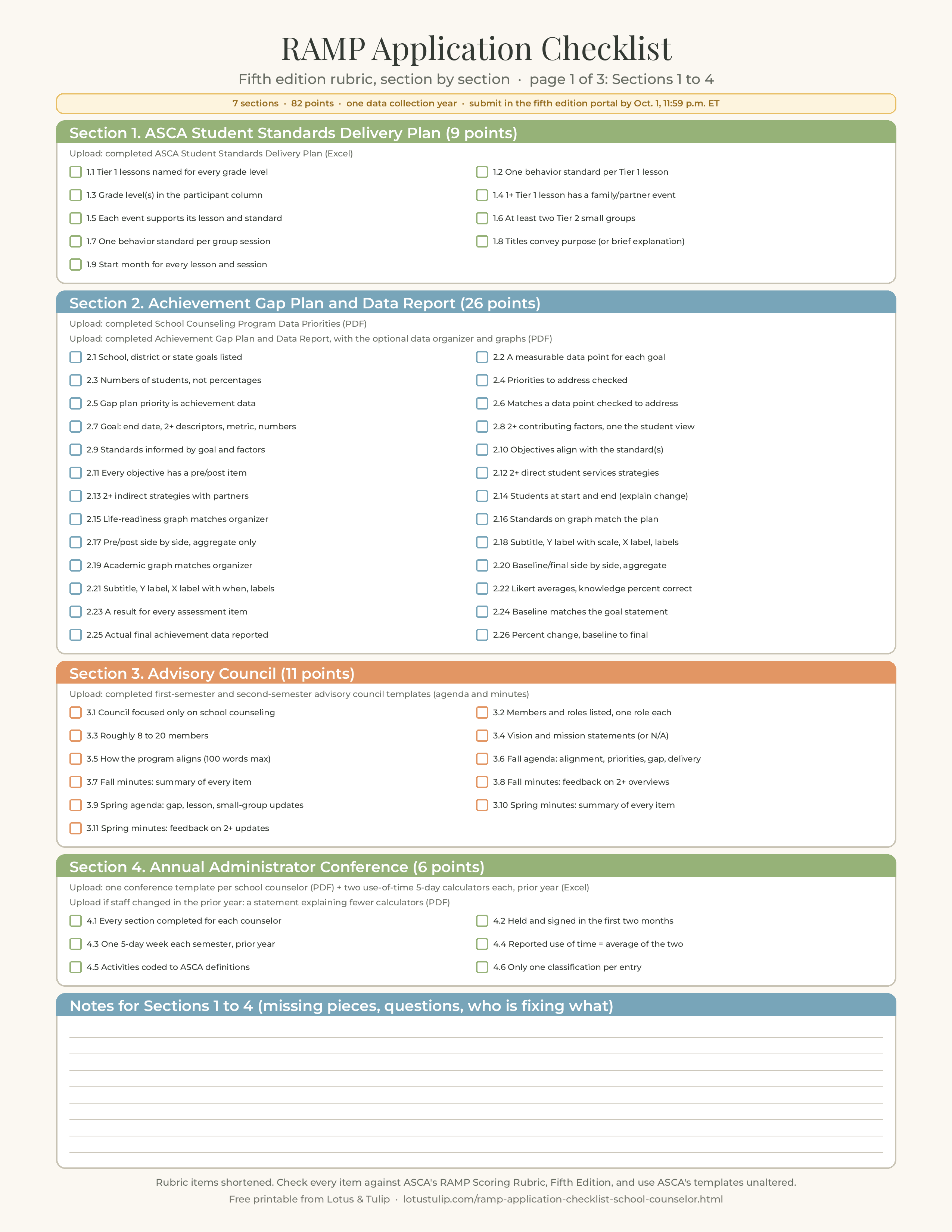
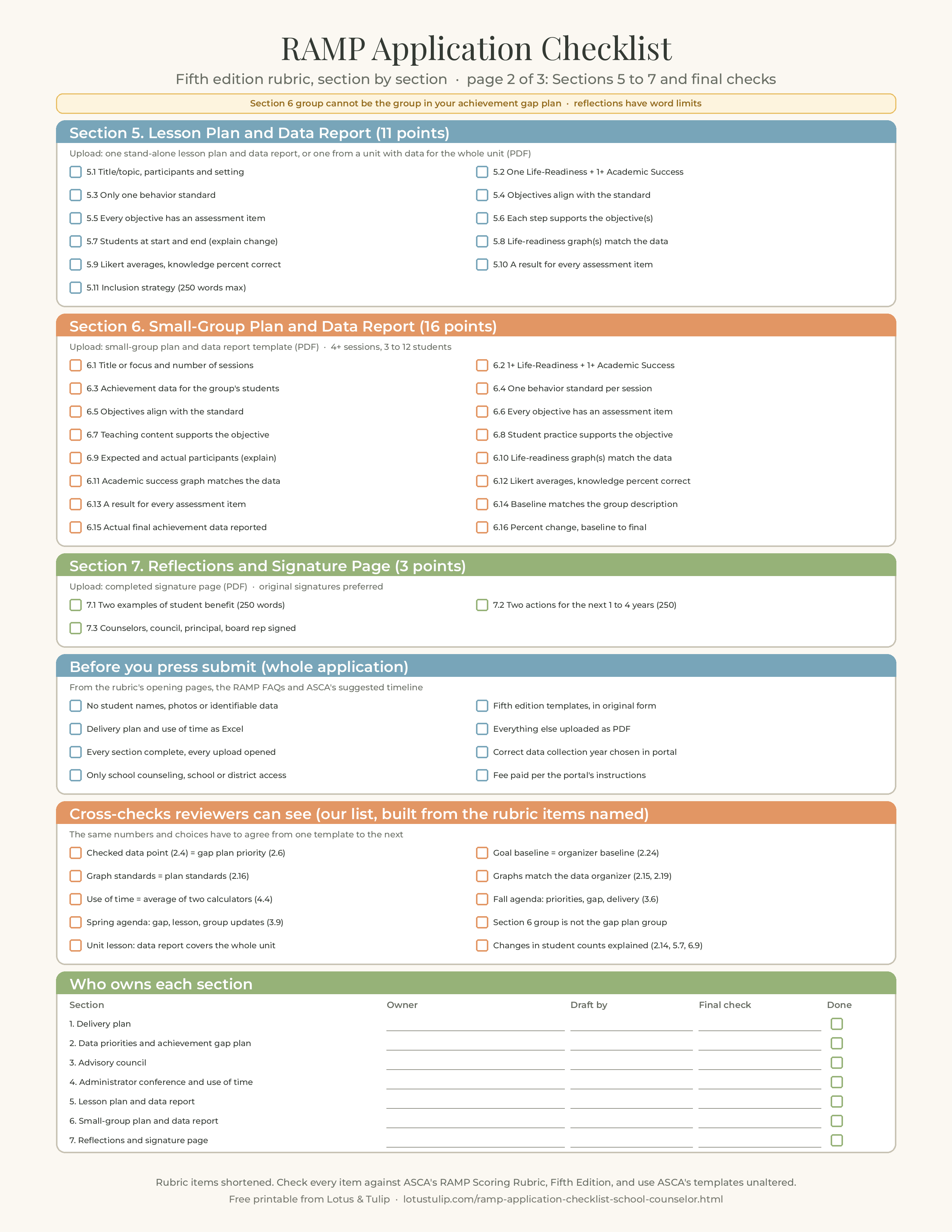
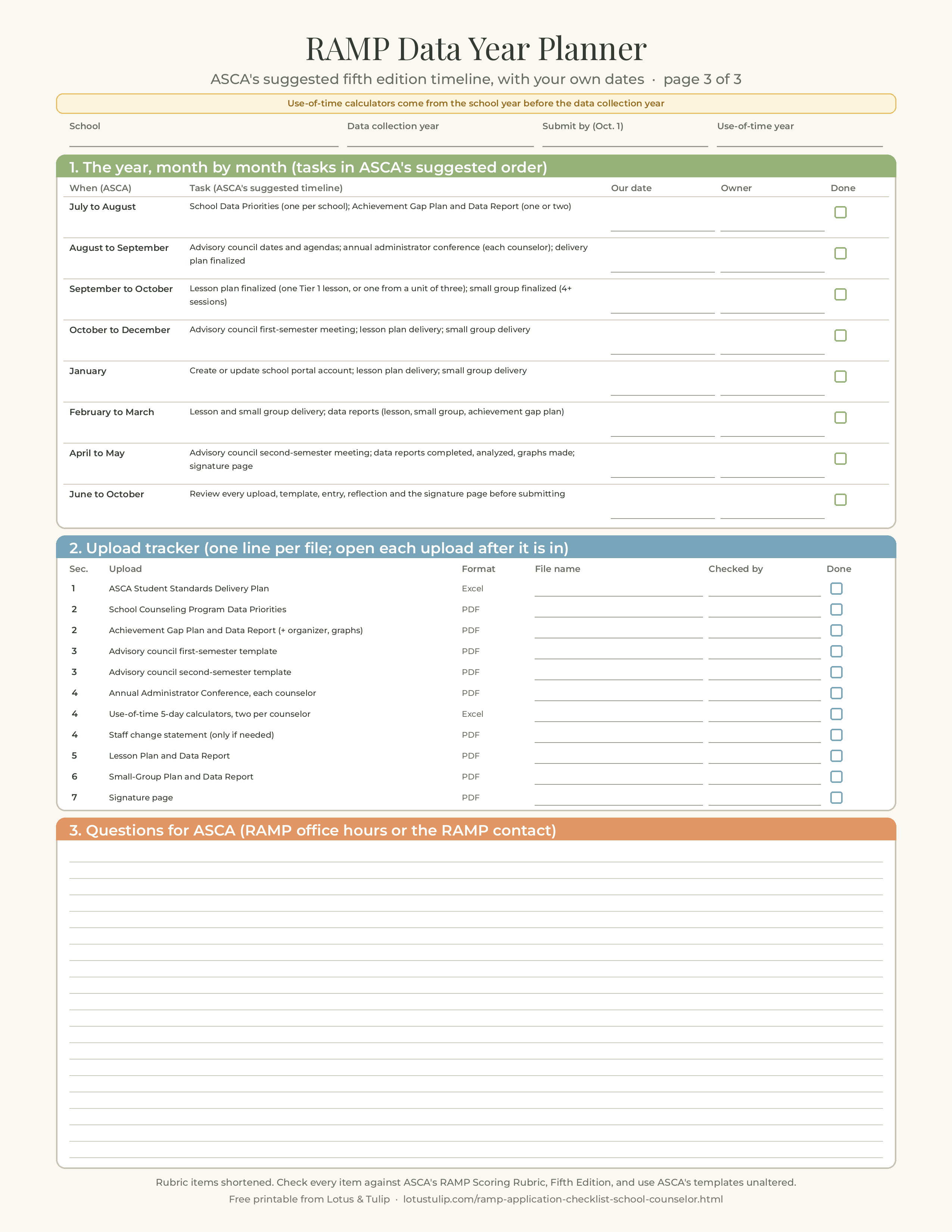
At the end is a free three page printable: the full fifth edition checklist (Sections 1 to 4 on page 1, Sections 5 to 7 and the final checks on page 2) and a data year planner with an upload tracker on page 3.
Jump to the free RAMP checklist and data year planner
This is educational information for school counselors, not official ASCA guidance. RAMP is a registered trademark of the American School Counselor Association, and Lotus & Tulip is not affiliated with or endorsed by ASCA. Everything on this page was checked against ASCA's own public pages and documents, downloaded from schoolcounselor.org on November 11, 2026: the "RAMP Scoring Rubric, Fifth Edition" (revision notes dated August 2025, September 2025 and February 2026), the Recognized ASCA Model Program, Apply for RAMP, RAMP FAQs, Templates and Tools and Fifth Edition Application Portal pages, "RAMP in the Fifth Edition," the "RAMP Application Timeline, ASCA National Model Fifth Edition," the RAMP Application Signature Page, the School Counseling Program Assessment, the fifth edition templates download, and the November 2025 ASCA newsletter article "Manage: Approaching the Work and Using Templates." Rubric items on this page are shortened. ASCA can update its rubric and pages at any time, so always read the current rubric before you submit, and anything we could not confirm is marked as such.
The short answer
- Seven sections, 82 points. The fifth edition rubric has Section 1 ASCA Student Standards Delivery Plan (9 points), Section 2 Achievement Gap Plan and Data Report (26), Section 3 Advisory Council (11), Section 4 Annual Administrator Conference (6), Section 5 Lesson Plan and Data Report (11), Section 6 Small-Group Plan and Data Report (16) and Section 7 Reflections and Signature Page (3). Each section has exactly as many numbered items as points.
- Fifth edition only from October 2027. October 2026 was the last year a fourth edition application was accepted. From October 2027, ASCA says schools must use the fifth edition rubric, and fifth edition applications must use fifth edition templates only.
- One data collection year, plus the year before for use of time. The application covers one complete school year before the submission date. The use-of-time 5-day calculators come from the school year before that.
- Due October 1. The rubric says fifth edition applications are submitted in the fifth edition ASCA portal "no later than Oct. 1, 2027, at 11:59 p.m. ET."
- Fee: $250 for schools with an ASCA member on staff and $500 without, according to the RAMP FAQs.
- Templates in their original form. The delivery plan and the use-of-time calculators are uploaded as Excel files, everything else as PDF, and "Sections without the correct completed document uploaded are unable to be scored."
- Passing score: ASCA's Apply for RAMP page publishes cut scores for the fourth edition (54 or higher out of 60). We did not find a published passing score for the fifth edition on any ASCA page we checked.
Which edition, and which year, applies to you
ASCA's "RAMP in the Fifth Edition" sheet sets out the switch in one table. October 2025 submissions could use only the fourth edition. October 2026 submissions could use either, as the final fourth edition year and the first fifth edition year. October 2027 submissions are fifth edition only. The Apply for RAMP page adds a rule that trips people up: "applicants must use only fourth edition templates for the fourth edition applications and fifth edition templates for the fifth edition application." You cannot mix them.
The use-of-time calculator has its own line in that table. Because the calculators come from the year before the data collection year, fifth edition submissions in October 2026 were allowed to include the fourth edition version of the calculator. ASCA's sheet then says: "Beginning with October 2027 RAMP® submissions, all applications must include the fifth edition version of the use-of-time calculator."
| Submission | Data collection year | Use-of-time calculators from | Edition |
|---|---|---|---|
| October 1, 2027 | 2026-2027 | 2025-2026 (fifth edition version) | Fifth edition only |
| October 1, 2028 | 2027-2028 | 2026-2027 (fifth edition version) | Fifth edition (no change announced) |
The first row is ASCA's own example from the rubric ("an application submitted in October 2027 includes data collection year during the 2026-2027 school year and use-of-time 5-day calculators from the 2025-2026 school year," written here with a hyphen). The second row applies the same rule one year later; ASCA has not announced any change for 2028 that we found.
If you are reading this partway through a school year
Two rubric items are tied to the calendar, and they decide which October is realistic for you.
- Item 4.2: the annual administrator conference is "held and template signed by the school counselor and administrator in charge of the school counseling program within the first two months of the school year." If the data collection year is already more than two months old and no conference was held and signed on the fifth edition template, that item is hard to meet for this year.
- Item 4.3: you need one five consecutive day use-of-time week from the first semester and one from the second semester of the year before the data collection year, on the fifth edition calculator for October 2027 and later. If you did not log those weeks last year, you cannot log them retroactively in any honest way.
If either piece is missing, the practical move is usually to treat this year as the use-of-time year for the following application: log a fall week and a spring week now on the fifth edition calculator, and plan your data collection year for next school year. We did not find any ASCA guidance on exceptions to these timing rules; if your situation is unusual, ask ASCA directly (the RAMP pages point to RAMP office hours and a named RAMP contact).
Is your program ready? What ASCA tells you to do first
ASCA's Apply for RAMP page says the first step "is to use the program assessment tool to determine whether your program is ready to seek the RAMP® designation." The School Counseling Program Assessment is a short Word document with yes/comment benchmarks under Deliver (direct and indirect student services), Manage (planning for each and every student to learn the standards, identifying and addressing achievement gaps, planning and monitoring time, and educating about and advocating for the program) and Assess (data reports completed and shared, the program assessment, the professional standards and competencies assessment and an annual performance appraisal). If you cannot honestly answer yes to most of the Manage benchmarks, you are not ready to start a data collection year yet.
Our school counseling program assessment guide walks through all 25 benchmarks on the current form, what evidence backs a Yes, and which rubric section each one maps to, with a free worksheet, a filled example and an action plan sheet.
Other facts from ASCA's RAMP pages worth knowing before you commit:
- Eligibility: elementary, middle, high, pre-K to 8, pre-K to 12, public, private and charter schools may apply, as well as virtual, alternative and career academy schools that meet the staffing requirements. Schools should have a school counseling program, a state or regional school identification number and a principal. Adult schools are typically not eligible. Schools outside the United States may apply.
- Years of implementation: "a specific number of years implementing the ASCA National Model® framework is not required."
- Time: "Schools will need at least one entire academic year to collect the data and information needed."
- Ratio: a low student-to-counselor ratio is not required. The FAQs report that the 2025 RAMP designees averaged 362:1, with a low of 77:1 and a high of 902:1.
- Length of the designation: five years. ASCA encourages schools to keep it by submitting a successful Re-RAMP application at the end of the fourth year.
- Scale: ASCA says more than 1,600 schools have earned the designation.
- Help: ASCA lists RAMP office hours, ASCA coaches, on-site training with ASCA-Certified Trainers, webinars and three books ("The ASCA National Model, fifth edition," which is a free download, "The ASCA National Model: A Step-by-Step Guide" and "Making Data Work, fifth edition").
The application at a glance
| Section | Points | Upload (format) | Our template guide |
|---|---|---|---|
| 1. ASCA Student Standards Delivery Plan | 9 | Delivery plan (Excel) | Delivery plan guide |
| 2. Achievement Gap Plan and Data Report | 26 | School Counseling Program Data Priorities (PDF); Achievement Gap Plan and Data Report with the optional data organizer and graphs (PDF) | Data priorities guide, achievement gap plan guide |
| 3. Advisory Council | 11 | First-semester and second-semester advisory council templates (PDF, per the general upload rule) | Advisory council guide |
| 4. Annual Administrator Conference | 6 | One conference template per school counselor (PDF); two use-of-time 5-day calculators per counselor from the prior year (Excel); a staff change statement if needed (PDF) | Administrator conference guide, use-of-time guide |
| 5. Lesson Plan and Data Report | 11 | One stand-alone lesson plan and data report, or one from a unit (PDF) | Lesson plan guide |
| 6. Small-Group Plan and Data Report | 16 | Small-group plan and data report (PDF) | Small-group plan guide |
| 7. Reflections and Signature Page | 3 | Completed signature page (PDF) | Covered below |
Pre and post assessment items show up in Sections 2, 5 and 6 (items 2.11, 5.5 and 6.6 require an item for every learning objective). Our item bank for all 36 ASCA Student Standards and the general pre and post assessment guide cover how to write and score them.
Rules that apply to the whole application
The first page of the rubric carries rules that are not tied to any one section but can sink all of them.
- FERPA and student privacy. "No identifiable student information should be included. Applications with student photos and names risk deletion." Check every template, graph, minutes page and reflection for names, photos and small group counts that could identify a student.
- ASCA templates only, unaltered. "Only completed fifth edition ASCA templates in their original form may be used in the fifth edition RAMP® application. These templates should not be altered. Using the wrong templates or altering templates may lead to rubric not being met." That includes not retyping a template into your own layout, and not using a planner (including ours) in place of the template.
- File formats. "Upload the ASCA Student Standards Delivery Plan Template and Use-of-Time 5-Day Calculator Template as Excel documents and all others as a PDF." And: "Sections without the correct completed document uploaded are unable to be scored."
- Completeness. "All sections of the RAMP® application must be completed. Any missing sections may nullify the RAMP® application." Information not provided in the portal is not reviewed or scored.
- Integrity. Except for existing school data reports, all completed templates, graphs, reflections and other information "should be created, prepared and uploaded by members of your school counseling program only," and your counselors must agree to abide by the ASCA Ethical Standards for School Counselors and the ASCA Professional Standards and Competencies (our self-assessment guide walks through all 30 standards). ASCA reserves the right to revoke the designation for integrity violations.
- Access. Access to the application must be limited to members of your school counseling program or school or district staff, and "Applications containing non-school or non-school district employee access may be considered ineligible for review." If you work with an outside coach or consultant, keep them out of the portal account.
- AI. The rubric has its own guidance on using AI: handle student data responsibly and lawfully, "Always fact check and edit AI-generated output before submission," be aware of unintentional plagiarism or copyrighted material, and keep your own voice in the work.
- Four day and part-time schedules. Counselors at five day schools submit five day calculators. Counselors at schools operating only four days a week throughout the year "should also submit a statement," part-time counselors "should still complete the calculator and provide a note," and staff changes in the prior year that leave you with fewer calculators need a statement explaining the change.
The checklist, section by section
Each section below starts with ASCA's own purpose statement from the rubric, then lists the uploads, then every numbered item in shortened form. The bracketed notes are ours. For the full wording, keep ASCA's rubric open next to this page.
Section 1: ASCA Student Standards Delivery Plan (9 points)
Purpose, in the rubric's words: "evidence of how the behavior standards from the ASCA Student Standards are delivered by the school counselor directly to students to enhance life-readiness skills." Upload: the completed ASCA Student Standards Delivery Plan, in Excel format.
- 1.1 Specific Tier 1 lessons identified for each grade level in the school.
- 1.2 Each Tier 1 lesson (classroom, large group, small group or individual setting) is connected to one behavior standard.
- 1.3 Each Tier 1 lesson specifies grade level(s) in the participant column.
- 1.4 At least one Tier 1 lesson has a program or event provided for families, students and/or education partners. [ASCA's November 2025 newsletter calls these "reinforcing events," a column new to the fifth edition template.]
- 1.5 Each reported program or event supports the Tier 1 activity and standard it is attached to.
- 1.6 At least two Tier 2 small groups are included.
- 1.7 Each Tier 2 small group session is connected to one behavior standard; the same standard can repeat across sessions.
- 1.8 Each lesson or session title conveys its purpose, or a brief explanation is included for unique titles.
- 1.9 A start month for each Tier 1 lesson and each Tier 2 small group session.
The delivery plan replaced two fourth edition documents. The newsletter describes it as combining "the former classroom and group Mindsets & Behaviors action plan and the annual calendar template into one document," with dropdowns for behavior standards and for Tier 1 or Tier 2. Note "behavior standard" in items 1.2 and 1.7: the fifth edition focuses data collection on the behavior standards, and the same newsletter describes the mindsets as "best understood as byproducts of students attaining the behavior standards." Full walkthrough, filled example and free planner: ASCA Student Standards delivery plan.
Section 2: Achievement Gap Plan and Data Report (26 points)
Purpose: this section "establishes the annual school counseling program priorities, informs your achievement gap goal(s) and addresses the needs of students who are not reaching achievement goals or benchmarks." It is worth almost a third of the total. Uploads: the completed School Counseling Program Data Priorities (PDF) and the completed Achievement Gap Plan and Data Report, "including completed optional data organizer and graphs" (PDF). ASCA's timeline says one or two gap plans may be submitted.
Data priorities (2.1 to 2.4)
- 2.1 School, district or state achievement goals or priorities provided.
- 2.2 At least one measurable achievement data point for each goal or priority listed.
- 2.3 Precise number of students, not percentages, in each data point.
- 2.4 The priorities the program will address are identified by checkbox.
The plan (2.5 to 2.13)
- 2.5 The data priority must be achievement data as defined by ASCA.
- 2.6 It must align with a data point selected to be addressed on the data priorities template.
- 2.7 The achievement gap goal includes, and includes nothing beyond: an end date; two or more student descriptors, at least one of them an achievement metric; the exact metric to be increased or decreased; and precise numbers for baseline and projected final data.
- 2.8 A summary of at least two contributing factors, one of which must be the student perspective.
- 2.9 Behavior standard(s) informed by the goal, contributing factors and student and education partner perspectives.
- 2.10 Learning objectives align with the selected behavior standard(s).
- 2.11 Each learning objective aligns with at least one pre/post assessment item.
- 2.12 At least two direct student services strategies that meet ASCA's definition of instruction, appraisal and advisement and/or counseling.
- 2.13 At least two strategies with education partners that meet ASCA's definition of collaboration, consultation or referral.
The data report (2.14 to 2.26)
- 2.14 Number of students at the beginning and end of the plan, with an explanation if it changed.
- 2.15 The life-readiness graph(s) match the ASCA Student Standards data in the data organizer. [The rubric notes the "optional" data organizer is required for RAMP.]
- 2.16 The behavior standards on the graph are identified and match the plan.
- 2.17 Pre and post data side by side, aggregate data only, not individual students.
- 2.18 The graph has a subtitle with specific details about the students or data, a Y-axis label describing the data (defining the scale if Likert), an X-axis label defining what is compared, and a data point on every bar.
- 2.19 The academic success graph matches the achievement data in the data organizer.
- 2.20 Baseline and final data side by side, aggregate only.
- 2.21 Subtitle, Y-axis label, an X-axis label that defines what is compared and when the data was collected, and a data point on every bar.
- 2.22 Averages for Likert items, percent correct for knowledge-based items.
- 2.23 Results for each assessment item in the plan.
- 2.24 Achievement data matches the baseline in the goal statement.
- 2.25 Actual final achievement data is reported (it may differ from the projected final).
- 2.26 Percent change from baseline to final data is reported.
Two details in Section 2 cost points more than any others in our reading of the rubric. Item 2.3 wants numbers of students, so "38 grade 4 students" rather than "22 percent." And item 2.7 says "no additional information," so a goal sentence with strategies or reasons tucked into it no longer fits the rule. The newsletter explains the bigger shift: the fifth edition "combines the former annual student outcome goal and closing-the-gap plan and report" into this one plan, and "outcome" data is now called achievement data, with attendance and discipline treated as contributing factors. Guides: data priorities, achievement gap plan and data report, and for the student perspective in item 2.8, the needs assessment guide. ASCA also publishes "Graph Development Tips" for Excel, Google Sheets, PowerPoint and Canva on its Templates and Tools page.
Section 3: Advisory Council (11 points)
Purpose: "evidence of a school counseling specific advisory council that is a representative group of education partners selected to provide feedback about issues relevant to the school counseling program." Uploads: the completed first-semester and second-semester advisory council templates.
- 3.1 The council is solely focused on the applicant's school counseling program. [A schoolwide committee with a counseling agenda item is not the same thing.]
- 3.2 A list of all members with their roles, at a minimum parents or guardians, teachers, school counselors, administrators, community members and students (if applicable, with identity protected). Each member has a single role.
- 3.3 The council approximates the recommended size of eight to 20 members.
- 3.4 School or district vision and mission statements provided (N/A only if they do not exist).
- 3.5 How the program aligns with them, in 100 words or fewer (or with school or district goals, if there is no vision or mission).
- 3.6 First-semester agenda includes at least: program alignment with the vision and mission, a data priorities overview, an achievement gap plan overview and a delivery plan overview.
- 3.7 First-semester minutes summarize what the school counselor presented for each agenda item.
- 3.8 First-semester minutes summarize discussion and feedback on at least two of the three overviews.
- 3.9 Second-semester agenda includes at least: achievement gap plan and data report update, lesson plan and data report update, small-group plan and data report update.
- 3.10 Second-semester minutes summarize what the counselor presented for each item.
- 3.11 Second-semester minutes summarize discussion and feedback on at least two of the three updates.
The newsletter says there are "no significant changes beyond improved alignment between the agenda and the minutes." The practical point is that the minutes need two kinds of summary: what you presented, and what members said back. Guide with sample agendas, minutes and a filled example: advisory council agenda.
Section 4: Annual Administrator Conference (6 points)
Purpose: "evidence of a formal discussion between school counselors and the principal and/or the administrator in charge of the school counseling program about the goals, activities and benefits of the school counseling program." Uploads: a completed conference template for each school counselor (PDF); two completed use-of-time 5-day calculators from the year before the data collection year for each counselor employed during both years (Excel); and, if staffing changed in that prior year, a statement explaining why there are fewer calculators (PDF).
- 4.1 Every section of every counselor's conference template completed, or N/A explained.
- 4.2 Conference held and template signed by the counselor and the administrator in charge of the program within the first two months of the school year.
- 4.3 One five consecutive day calculator from the first semester and one from the second, for each counselor, from the year before the data collection year.
- 4.4 The prior year use of time on each conference template is the average of that counselor's two calculators.
- 4.5 Activities are classified using the ASCA National Model definitions of direct and indirect services, program planning and school support, or non-school-counseling tasks.
- 4.6 Each entry has only one classification.
The fifth edition renamed the "annual administrative conference" to make clear it is held with the administrator who oversees the program. The newsletter adds that it is "always good to include the principal," but the template "does not require the principal's signature if there's a different supervising administrator," and that the conference now includes the delivery plan and the achievement gap goal. The calculator itself recommends at least 80 percent of time in direct and indirect services and 20 percent or less in program planning, school support and fair-share tasks, and warns not to alter any part of it because it contains formulas. The fifth edition template download includes an alternate calculator file with the note "If you see 'FALSE' repeatedly in the Use of Time document, use this alternate version." Guides: annual administrator conference and use-of-time calculator.
Section 5: Lesson Plan and Data Report (11 points)
Purpose: one lesson that "shows evidence of the development of life-readiness skills for each and every student," including what will be delivered, to whom, how, and how attainment of the learning objectives will be assessed. "Data results and graphs are required." Upload: one stand-alone Lesson Plan and Data Report, or one from a unit (PDF). If you submit a lesson from a unit, "the data report should reflect the results for the entire unit."
- 5.1 Lesson title or topic, participants and setting identified.
- 5.2 One Life-Readiness category and at least one Academic Success category identified as the reason for the lesson.
- 5.3 A limit of one behavior standard for the lesson plan.
- 5.4 Each learning objective aligns with that standard.
- 5.5 Each learning objective aligns with at least one assessment item.
- 5.6 The description of each step supports the learning objective(s).
- 5.7 Number of students at the beginning and end, with an explanation if it changed.
- 5.8 Life-readiness graph(s) that accurately reflect the ASCA Student Standards data.
- 5.9 Averages for Likert items, percent correct for knowledge-based items.
- 5.10 Results for each assessment item.
- 5.11 At least one strategy used in the lesson that facilitated inclusion or supported diverse learners, in 250 words or fewer.
The lesson template no longer tracks achievement data, "as a single lesson is unlikely to have a significant impact on achievement data," in the newsletter's words. ASCA's timeline asks you to choose "one independent Tier 1 lesson or one Tier 1 lesson from a unit of three lessons." Guide, filled example and free planner: classroom lesson plan and data report.
Section 6: Small-Group Plan and Data Report (16 points)
Purpose: "a small group with a minimum of four sessions for three-12 students" that enhances life-readiness skills and academic success, with data results and graphs. The rubric adds: "The small group submitted in this section cannot be the same small group included in the Achievement Gap Plan, if one was included." Upload: the Small-Group Lesson Plan and Data Report template (PDF).
- 6.1 Small group title or focus and number of sessions identified.
- 6.2 At least one Life-Readiness category and at least one Academic Success category identified as the reason for the group.
- 6.3 Achievement data provided for the students in the group.
- 6.4 A limit of one behavior standard per session plan (a standard may repeat across sessions).
- 6.5 Each learning objective aligns with the selected standard.
- 6.6 Each learning objective aligns with at least one assessment item.
- 6.7 The teaching content for each session supports the objective.
- 6.8 The student practice for each session supports the objective.
- 6.9 Number of students expected and number who actually participated, with an explanation if they differ.
- 6.10 Life-readiness graph(s) that accurately reflect the ASCA Student Standards data.
- 6.11 An academic success graph that accurately reflects the achievement data.
- 6.12 Averages for Likert items, percent correct for knowledge-based items.
- 6.13 Results for each assessment item.
- 6.14 Achievement data matches the baseline described for the group.
- 6.15 Actual final achievement data reported.
- 6.16 Percent change from baseline to final data reported.
Unlike the lesson, the small group does track achievement data (items 6.3 and 6.14 to 6.16). The rubric's revision notes record that projected final data was removed from item 6.15 in September 2025, and that the wording of item 6.2 was edited "for clarity" in February 2026, so check you are reading the current version. Guide, filled example and free planner: small-group plan and data report. For the group sessions themselves, see the small group session plan template, referral form and permission slip guides.
Section 7: Reflections and Signature Page (3 points)
Purpose: "final reflections and required acknowledgment of your school counseling program's data-collection year." Upload: the completed signature page (PDF).
- 7.1 Two examples of how students benefited from your program's implementation of the ASCA National Model (250 words or fewer).
- 7.2 Two examples of actions you will take to sustain or improve the program over the next one to four years (250 words or fewer).
- 7.3 A completed signature page with signatures from school counselors, advisory council members, the principal and a school board representative.
The two Section 7 reflections, item 5.11 and the 100 word alignment statement in item 3.5 are the only written answers in the rubric. Our RAMP reflections guide reads each question phrase by phrase, with weak and strong sentences, a worked example with word counts and a free reflections planner.
ASCA's signature page form adds details the rubric does not. The school board representative "should be the elected official," and although the superintendent's signature can be included, "it does not replace the school board representative's signature." Original handwritten signatures are preferred; electronic signatures "can be used to resolve unique situations," using an app with an electronic handwriting feature (the form gives Adobe Acrobat and DocuSign as examples). Its best practices: secure signatures during the second-semester advisory council meeting, contact the board representative well before the October deadline, and ask your principal for help if there are rules about contacting board members. One small inconsistency to know about: the RAMP FAQs say to upload the signature page "in the Finalize section of the application portal," while the form itself says Section 7 of the fifth edition portal. Follow what the portal shows you.
The ASCA template set you will actually upload
ASCA's Templates and Tools page offers the fifth edition templates as one download. The copy we downloaded on November 11, 2026 contained ten files, numbered in roughly the order you complete them:
- School Counseling Program Data Priorities (Word template)
- Achievement Gap Plan (and Data Report) (Word template)
- ASCA Student Standards Delivery Plan (Excel workbook)
- Lesson Plan (and Data Report) (Word template)
- Small-Group Plan (and Data Report) (Word template)
- Annual Administrator Conference (Word template)
- Use-of-Time 5-Day Calculator (Excel template), plus an alternate version marked 7x for when the original shows "FALSE" repeatedly
- Advisory Council First Semester (Word template)
- Advisory Council Second Semester (Word template)
That is nine templates plus the alternate calculator. The RAMP Application Signature Page is a separate download on the same page, and the RAMP FAQs say it can also be downloaded inside the portal. Weekly and annual calendars are still part of the National Model, but the newsletter says "There is no specific template for weekly or annual calendars," and they are not a RAMP upload in the fifth edition rubric.
Because templates must be used "in their original form," download a fresh set at the start of your data collection year and again before you submit, and compare the footer dates. ASCA's own timeline puts it this way: some templates from previous years "may only need editing for the current year," but "Be sure each is updated to the most current template."
ASCA's suggested timeline, month by month
ASCA publishes a one page "RAMP Application Timeline" for the fifth edition. It says plainly that "It takes an entire school year to gather data, complete templates, prepare graphs, write reflections and ensure they are all uploaded correctly," and to "Plan for interruptions. They will happen." Here is its suggested order for the data collection year, which you should adjust to your own calendar:
| When | ASCA's suggested tasks | Guide |
|---|---|---|
| July to August | School data priorities (one per school); achievement gap plan and data report (one or two may be submitted) | Data priorities, gap plan |
| August to September | Advisory council meeting dates and agendas; annual administrator conference (one per counselor, each with two use-of-time calculators from the previous year); delivery plan finalized | Council, conference, delivery plan |
| September to October | Lesson plan finalized (one independent Tier 1 lesson or one from a unit of three); small group finalized (at least four sessions) | Lesson plan, small-group plan |
| October to December | Advisory council first-semester meeting; lesson plan delivery; small group delivery | Pre and post items |
| January | Create or update the school portal account; lesson and small group delivery | |
| February to March | Lesson and small group delivery; data reports (lesson, small group, achievement gap plan) | |
| April to May | Advisory council second-semester meeting; data reports completed and analyzed, graphs created; signature page | |
| June to October | Review all materials: correct templates and uploads, correctly entered information, reflections and short answers, and the completed signature page |
The same sheet reminds you to use the fifth edition portal and choose the correct application year, which is the data collection year: "if submitting in October 2026, you are choosing year 2025-2026 in the portal" (by the same rule, an October 2027 application chooses 2026-2027). Note how tight the start of the year is. Item 4.2 needs the conference held and signed within the first two months, and the conference covers the delivery plan and the achievement gap goal, so the data priorities and gap plan realistically need to be drafted before school starts.
Cross-checks: where one section has to agree with another
Reviewers score each item, but many items only pass if two documents agree. This is our list of the agreements written into the rubric, and it is the fastest final check we know.
- Data priorities to gap plan. The data point you checked "Will Address" (2.4) is the data priority in the gap plan (2.6), and it is achievement data (2.5).
- Goal to data organizer. The baseline number in the goal (2.7) is the baseline in the organizer (2.24), and the graphs show the same numbers as the organizer (2.15, 2.19).
- Plan to graph. The behavior standards named on the life-readiness graph are the ones in the plan (2.16).
- Calculators to conference. The prior year use of time on each counselor's conference template is the average of that counselor's two calculators (4.4).
- Plans to council agendas. The fall agenda covers the data priorities, gap plan and delivery plan (3.6); the spring agenda updates the gap plan, lesson plan and small-group plan (3.9).
- Gap plan group to Section 6 group. If your gap plan includes a small group, Section 6 must use a different group.
- Unit to data report. If your lesson comes from a unit, the data report covers the whole unit.
- Counts. Wherever the number of students changes between the start and end, the change is explained (2.14, 5.7, 6.9).
- Objectives to items. Every learning objective has at least one assessment item (2.11, 5.5, 6.6), and every item has a result (2.23, 5.10, 6.13).
One more check that is not a rubric item but makes reviewers' lives easier: the lesson and small group you submit should be recognizable in your delivery plan. We did not find a rubric item that requires this, so treat it as good practice, not a rule.
How RAMP is scored, and what we could not find
Each application "is judged by a peer review team, which is facilitated by a lead RAMP reviewer," according to the Apply for RAMP page. The cut scores on that page are under the heading "Fourth Edition Scoring": "Schools that earn scores of 54 or higher out of a possible 60 are awarded RAMP status." Schools scoring 45 to 53 are invited to resubmit eligible parts, schools that are unsuccessful in resubmission are invited to become Programs of Promise with mentoring, and schools below 45 need a brand new application.
For the fifth edition, the section totals add up to 82 points, but we did not find a published fifth edition passing score on the RAMP, Apply for RAMP, RAMP FAQs or Templates and Tools pages, or in the rubric itself. Some search tools summarize these pages with a fifth edition cut score; we could not trace any such number to an ASCA document, so we are not repeating one. Ask ASCA if you need it.
Other things we looked for and did not find on ASCA's public pages:
- Whether the fourth edition resubmission and Programs of Promise process carries over unchanged to the fifth edition.
- Any exception process for a missed administrator conference window (item 4.2) or missing prior year calculators.
- A required file naming convention or file size limit for uploads.
- Whether the lesson and small group in Sections 5 and 6 must appear on the delivery plan.
- When results are announced. (The FAQs refer to the RAMP Class of 2027 as "successful RAMP® applications submitted October 2026," and list benefits for that class: a year of complimentary ASCA membership, discounted membership after that, recognition and two event tickets at the ASCA Annual Conference, a plaque, a template press release and a digital toolkit.)
How to prepare a fifth edition RAMP application, step by step
- Run the program assessment. Complete ASCA's School Counseling Program Assessment honestly and fix the biggest gaps before you commit to a data collection year.
- Pick your October and confirm the years. Write down the submission date, the data collection year and the use-of-time year, and check that both use-of-time weeks were or will be logged on the fifth edition calculator.
- Download the current materials. Get the fifth edition rubric, the template set, the timeline and the signature page from ASCA, and note the footer dates.
- Draft data priorities and the gap plan in summer. List every achievement goal with a data point in numbers of students, check the one or two you will address, and write the goal with nothing extra in it.
- Hold the administrator conference early. Meet with the administrator in charge of the program, cover the delivery plan, gap goal and use of time, and sign the template within the first two months.
- Finalize the delivery plan, lesson and small group. One behavior standard per lesson and session, at least two Tier 2 groups, start months, and a Section 6 group that is not your gap plan group.
- Run the fall advisory council. Use the first-semester template, present the alignment, data priorities, gap plan and delivery plan, and record both your summary and members' feedback.
- Deliver and collect data. Give the same pre and post items the same way, keep matched counts, and record achievement data for the gap plan and small group at the dates you named.
- Write the data reports and graphs. Fill in the data organizers, average Likert items, compute percent correct and percent change, and build graphs with subtitles, axis labels and a data label on every bar.
- Run the spring council, collect signatures, review, submit. Present the three updates, collect signatures at that meeting, write the 250 word reflections, then check every upload, format and cross-check before October 1.
A sample year at a glance (fictional)
The worked examples in our template guides use a fictional school, Maple Hollow Elementary, and a fictional counselor. They were written as separate illustrations and span two school years, so do not read them as one application. Here is how a single Maple Hollow application would line up if the data collection year were 2028-2029:
- Submission: by October 1, 2029, choosing 2028-2029 in the portal.
- Use of time: two weeks from 2027-2028, one each semester, on the fifth edition calculator (the use-of-time example logs October 4 to 8, 2027 and February 7 to 11, 2028).
- Summer 2028: data priorities, with one data point checked (the data priorities example works from an August 8, 2028 data meeting), and an achievement gap plan for a grade 4 reading group.
- Late August 2028: the administrator conference, held and signed (the data priorities example has it on Thursday, August 24, 2028), and the delivery plan finalized.
- October 2028: the first-semester advisory council (Tuesday, October 17, 2028 in the same example).
- Fall and winter: the Section 5 lesson for all of grade 4 and a Section 6 test anxiety group for grade 5, a different group from the gap plan's reading group, as the rubric requires.
- Spring 2029: data reports, graphs, the second-semester council and signatures collected at that meeting.
- Summer 2029: reflections, a full review against this checklist and submission well before October 1.
Six real world scenarios
- "I am the only counselor." You still complete every section. Section 4 needs one conference template and two calculators, all yours. The advisory council, signature page and reflections are the same as for a team.
- "A counselor joined us this year." Item 4.3 asks for calculators from the prior year for each counselor employed during both years. If staffing changed during that prior year, the rubric asks for a statement explaining why there are fewer calculators. Each counselor still needs a conference template (4.1).
- "I work part time in this building." The rubric says part-time counselors "should still complete the calculator and provide a note to explain the less than five day documentation."
- "Our school runs four days a week." Counselors at schools operating only four days per week throughout the year "should also submit a statement."
- "Our gap plan uses a small group." That is allowed, but the Section 6 small group must be a different group.
- "We applied under the fourth edition before." For October 2027 and later, start from the fifth edition rubric and templates. Several fourth edition documents were combined or renamed (the School Data Summary became the data priorities template; the annual student outcome goal and closing-the-gap plan became the achievement gap plan; the classroom and group action plans and the annual calendar became the delivery plan), so recycled fourth edition files will not pass the "original form" rule.
Common mistakes
- Uploading a fourth edition template, or a fifth edition template retyped or rearranged.
- Uploading the delivery plan or a use-of-time calculator as a PDF instead of Excel, or any other template in a format other than PDF.
- Percentages instead of numbers of students in the data points (2.3).
- A gap goal with strategies, reasons or extra clauses in it (2.7 says "no additional information").
- Only one contributing factor, or none from the student perspective (2.8).
- A mindset standard, or two behavior standards, on a single lesson (5.3) or session (6.4).
- Graphs without a subtitle, without a Likert scale defined on the Y-axis, without data labels, or showing individual students.
- A use-of-time figure on the conference template that is not the average of the two calculators (4.4).
- An administrator conference held, or signed, after the first two months of school (4.2).
- Student names or photos anywhere, or an outside consultant with access to the portal account.
Free printable: RAMP application checklist and data year planner
The free printable has three US Letter pages. Page 1 is the checklist for Sections 1 to 4: each section's points and uploads, every numbered rubric item as a short checkbox, and a notes box. Page 2 covers Sections 5 to 7 the same way, followed by a "before you press submit" box for the whole application rules (privacy, original templates, Excel and PDF formats, completeness, portal year, access and fee), a box of cross-checks between sections, and a table for who owns each section, with draft and final check dates. Page 3 is a data year planner in the order of ASCA's suggested timeline, with your own dates and owners, an upload tracker with one line per file and its format, and space for questions to take to ASCA.
The rubric items on the printable are shortened to fit. It is a tracking tool, not a substitute for the rubric or the templates, which must be used in their original form.
Download the free RAMP checklist and planner (PDF, 3 pages)
Or download single pages: Page 1: Sections 1 to 4 (PNG) · Page 2: Sections 5 to 7 and final checks (PNG) · Page 3: data year planner and upload tracker (PNG)
Free to print and use in your own school. Please link to this page rather than re-uploading the file. This is a planning tool, not an ASCA publication. It does not replace ASCA's rubric, templates or instructions in the portal. Keep student names off any copy you share.
Related resources
- ASCA professional standards and competencies self-assessment: how to rate yourself, pick 2 or 3 growth areas and write a PD plan, with a free printable
- RAMP reflections: how to write items 7.1, 7.2 and 5.11 and the 3.5 alignment statement, with examples, word counts and a free reflections planner
- School counseling program assessment: all 25 ASCA fifth edition benchmarks, filled example and free worksheet (the RAMP readiness check)
- All school counselor small group curriculums
- ASCA Student Standards delivery plan: filled example and free planner (Section 1)
- School counseling data priorities: worksheet, filled example and selection sheet (Section 2)
- Closing the gap action plan: the ASCA achievement gap plan and data report (Section 2)
- School counselor advisory council agenda, minutes and a filled example (Section 3)
- School counselor annual administrator conference (Section 4)
- School counselor use-of-time 5-day calculator (Section 4)
- Classroom lesson plan: the ASCA lesson plan and data report (Section 5)
- Small-group action plan: the ASCA small-group plan and data report (Section 6)
- ASCA mindsets and behaviors pre and post survey questions: an item bank for all 36 standards
- Small group counseling pre and post assessment
- School counselor needs assessment
- Texas SB 12 and school counselor parental consent
Sources: American School Counselor Association, RAMP Scoring Rubric, Fifth Edition (revision notes August 2025, September 2025, February 2026); ASCA, Recognized ASCA Model Program (RAMP), Apply for RAMP, RAMP FAQs, Templates and Tools, RAMP Professional Development and Fifth Edition Application Portal pages, schoolcounselor.org/RAMP; ASCA, RAMP in the Fifth Edition; ASCA, RAMP Application Timeline, ASCA National Model Fifth Edition; ASCA, RAMP Application Signature Page; ASCA, School Counseling Program Assessment; ASCA, fifth edition templates download (files 1 to 9 and 7x, including the Use-of-Time 5-Day Calculator overview); Eric Sparks, "Manage: Approaching the Work and Using Templates," ASCA newsletter, November 2025. All checked November 11, 2026. The checklist wording, cross-checks and printable are original to Lotus & Tulip and are not ASCA publications.
FAQ
How many points is the fifth edition RAMP application worth?
82 points across seven sections: delivery plan 9, achievement gap plan and data report 26, advisory council 11, annual administrator conference 6, lesson plan and data report 11, small-group plan and data report 16, and reflections and signature page 3. Each section has as many numbered rubric items as points.
What score do you need to earn RAMP under the fifth edition?
We did not find a published fifth edition passing score on ASCA's RAMP pages or in the rubric. ASCA's published cut scores are for the fourth edition: 54 or higher out of 60 earns RAMP, 45 to 53 may resubmit eligible parts, and below 45 needs a new application. Ask ASCA for the fifth edition figure.
When is the RAMP application due?
October 1. The fifth edition rubric says applications are submitted in the fifth edition ASCA portal no later than Oct. 1, 2027, at 11:59 p.m. ET. The application covers the school year before that date, and the use-of-time calculators come from the year before the data collection year.
How much does it cost to apply for RAMP?
According to ASCA's RAMP FAQs, $250 for schools with an ASCA member on staff and $500 for schools without one. Payment instructions are at the end of the application in the portal.
Can I still use the fourth edition templates?
Not for October 2027 or later. October 2026 was the final fourth edition year. Fifth edition applications must use fifth edition templates only, in their original form, and from October 2027 the use-of-time calculators must be the fifth edition version.
Who signs the RAMP signature page?
The school counselors, advisory council members, the principal and a school board representative, who ASCA says should be the elected official; a superintendent's signature does not replace it. Original handwritten signatures are preferred, and ASCA suggests collecting them at the second-semester advisory council meeting.