
School counselors · Updated 2026-11-11
School Counseling Data Priorities: How to Complete the ASCA Data Priorities Template (Filled Example, Free Worksheet)
Ready-made printable: Complete Small Group Counseling Bundle Holiday 20% off: about $29.44, was $37 (EUR 32) · instant digital download
Buy on Etsy
Every ASCA achievement gap plan starts with a short, easily overlooked document. It is one page long, it has three columns and four rows, and it takes most counselors less than an hour to type up. It is also the page that decides what your school counseling program will try to move all year. If the data points on it are vague, the achievement gap goal built from them will be vague too. If the wrong one is checked, you can spend a year working on a problem your strategies were never likely to reach. And if you apply for RAMP, a reviewer scores it item by item before reading a word of your achievement gap plan.
That document is the School Counseling Program Data Priorities template, the first template in the fifth edition of the ASCA National Model (2025). Many counselors still search for a "school data summary," a "data profile" or "how to choose a school counseling goal." Those are fourth edition habits. In the fourth edition, the first step was a School Data Summary, a page of reflection questions about your school's data story that ended with a short list of "specific data priorities." The fifth edition replaced it with a tighter template that asks for three things only: the achievement goals in your school's plans, a measurable data point with a precise number of students for each goal, and a checkbox for the ones the school counseling program will address.
This guide is for elementary, middle and high school counselors in the United States. It covers what the data priorities template is and where it fits in the fifth edition; what changed from the fourth edition School Data Summary; every part of the template, including the directions that appear on ASCA's completed example but not on the blank template; what counts as achievement data and what does not; the RAMP rubric items that score it (2.1 to 2.4) and the items that depend on it (2.5, 2.6, 3.6 and 3.8); where to find the goals and the numbers; how to turn a school goal into a data point that passes; how to choose what to check; equity, disaggregation and privacy; the timing problem every counselor runs into in August; how to present your data priorities to your administrator and advisory council; what ASCA's own example shows, including a few details worth not copying; sample rows for every school level; a ten step process; a fully worked fictional example; six scenarios; common mistakes; and a free three page printable: a blank data priorities worksheet, the same worksheet filled in for a fictional elementary school, and a data review and selection sheet with a data source inventory, a scoring grid for choosing what to check, and a RAMP checklist.
Jump to the free data priorities worksheet, filled example and selection sheet
This is educational information for school counselors in the US, not legal advice or official ASCA guidance. Your district, your state's school counseling framework and your evaluation system may set their own expectations. The ASCA documents quoted here were downloaded from schoolcounselor.org and checked on November 10 and 11, 2026 (the template and the examples file were downloaded again on November 11 and were byte for byte identical to the copies checked the day before): the fifth edition School Counseling Program Data Priorities template (Word template, footer "ASCA National Model Fifth Edition 8/25"), ASCA's completed fifth edition examples (the data priorities example, the achievement gap plan example, the annual administrator conference example and the first semester advisory council example, all marked "8/25"), the "RAMP Scoring Rubric, Fifth Edition," "The ASCA National Model: A Framework for School Counseling Programs, Fifth Edition," "Changes in the ASCA National Model Fifth Edition," the fifth edition "RAMP Application Timeline," the fifth edition "Phased Implementation Plan," the ASCA Ethical Standards for School Counselors (2022), and, for comparison, the fourth edition School Data Summary template and the fourth edition RAMP rubric. Anything we could not confirm in those documents is marked as such below.
The short answer
- Purpose, in ASCA's words: "This template will establish annual school counseling program priorities and inform your achievement gap goal(s). The template guides school counselors' review of school data to identify achievement issues."
- Column A: list all student achievement goals or priorities from the school improvement plan, strategic plan, or district and state initiatives. District and state goals "may be included if there are no goals specific to the school." "Do not list school climate/SEL priorities in this document."
- Column B: for each goal, "List at least one measurable data point" and "Include the precise number of students (not percentages) in the data point."
- Column C: check "Will Address" for the data point or points the school counseling program will work on. Then, in ASCA's words: "Develop an achievement gap plan for each data point the school counseling program will address."
- Achievement data only. The data point you take into your achievement gap plan "Must be achievement data as defined by ASCA" (RAMP item 2.5): traditional grades, standards-based grades, benchmark assessments, promotion rates, graduation rates or test scores. Attendance and discipline are contributing-factors data.
- One per school, every year. The RAMP timeline lists "School Data Priorities (one per school)" in July to August of the data collection year, and the Phased Implementation Plan lists data priorities among the templates to "Complete annually."
- For RAMP: uploaded as a PDF in Section 2 and scored by items 2.1 to 2.4. Item 2.6 then checks that the achievement gap plan's data priority "align[s] with a data point selected to be addressed" on this template, and the first semester advisory council agenda must include a "School Counseling Data Priorities overview" (item 3.6).
What the data priorities template is, and where it fits
The fifth edition framework organizes the Manage component around four things school counselors do. One of them is to "identify and address achievement gaps," and the framework describes it in one sentence: "School counselors identify school counseling data priorities that align with the school improvement plan and create achievement gap plans to address the needs of students who are not reaching achievement goals or benchmarks." The benefit to students, according to the same table, is that it "Focuses attention on achievement gaps for students not meeting achievement benchmarks and connects the gaps to contributing factors, such as attendance, discipline and policies/procedures (e.g., patterns in course enrollment or discipline policies)."
That sentence describes a sequence, and the templates follow it:
- Data priorities. Read the school's plans, list the achievement goals, attach a precise data point to each and check the one or two your program will address. This is the template this guide covers.
- Achievement gap plan. For each checked data point, write an Achievement Gap Plan and Data Report. Its first implementation note reads: "Choose one data priority from the School Counseling Data Priority Template and complete this plan." Its first field asks you to "Copy and paste a school counseling data priority from the School Counseling Data Priorities Template that the school counseling program will address."
- Communication. Present the priorities and the plan to your administrator at the annual administrator conference and to your advisory council in the fall.
- Delivery and data. Run the strategies in the plan, collect the data and report results in the spring.
ASCA's fifth edition Phased Implementation Plan puts the same order on paper. Phase 1 builds the foundations. Phase 2, "Using Data," starts with "1. Develop: School counseling data priorities, Achievement gap plan(s)" and then "2. Implement: Achievement gap plan, Lesson plans, Small-group sessions." The same document lists "School counseling data priorities" first in its list of things to "Complete annually," ahead of the achievement gap plans, the use-of-time calculator, the annual administrator conference and the advisory council.
The word "annual" matters. The template sets this year's priorities from this year's plans and this year's data. ASCA's achievement gap plan example says it directly in its second implementation note: "The goals and activities in this plan change from year to year based on student needs as indicated in the school counseling program data priorities." If you copy last year's data priorities forward with new dates, you skip the step that makes the whole cycle data informed.
The framework also explains why the template asks for achievement data and nothing else. It defines three categories of school counseling data: participation data ("How many students access the school counseling program, how often they participate and for what length of time"), ASCA Student Standards data ("measured through pre-/post-assessments") and achievement data, "The impact of the school counseling program on student data including: Traditional grades, Standards-based grades, Benchmark assessments, Promotion rates, Graduation rates, Test scores." Contributing-factors data, which "includes attendance rates, discipline rates, systemic barriers, and student and education partner perspectives," is something counselors analyze "along with" achievement data to inform strategies. The data priorities template is where you pick the achievement result. The achievement gap plan is where you look at the contributing factors behind it.
Fourth edition vs fifth edition: from School Data Summary to Data Priorities
ASCA's "Changes in the ASCA National Model Fifth Edition" lists the change in the Manage section: the fourth edition "School Data Summary" became "School Counseling Data Priorities," used to identify "1. School/district/state achievement goals and priorities 2. Achievement data points 3. Data priorities the school counseling program will address." Two rows further down, the fourth edition "Annual Student Outcome Goal and Closing-the-Gap Goal" were "combined into a single goal in the achievement gap plan and data report," and fourth edition "Supplemental Data" was "Renamed to make clearer" as contributing-factors data.
The fourth edition School Data Summary (we checked the copy in ASCA's archived fourth edition templates file) was a guided reflection. It asked counselors to "Understand your school's data story by reviewing the school improvement plan, school data reports and other data resources"; to identify "Who is your data expert; who can help you interpret the data?"; to list "two-three school improvement plan goals relevant to the school counseling program and link to student outcomes (achievement, attendance, discipline)"; to review achievement, attendance and discipline reports "for previous years to identify trends"; to review "student behavior surveys, climate surveys, school engagement surveys, etc." from the previous two to three years; to compare the school with similar schools, district averages and state averages; and finally to "Identify and prioritize data points you will address through your school counseling program." Its examples of specific data priorities were "26 students leaving first grade reading below expectations," "38 first-time ninth-graders failing algebra 1," "Seventh-grade students with four or more absences in the first four weeks of school" and "12 11th-grade students suspended three or more days from school for noncompliance first quarter."
| Topic | Fourth edition: School Data Summary | Fifth edition: Data Priorities |
|---|---|---|
| Format | Reflection questions with blank lines | A three column table with four numbered rows and a checkbox column |
| Which goals | Two to three school improvement plan goals relevant to the program | "All student achievement goals/priorities" in the school's plans; district and state goals if the school has none |
| Kinds of data | Achievement, attendance and discipline; climate and engagement surveys reviewed | Achievement data only; "Do not list school climate/SEL priorities" |
| Numbers | Examples used counts, but one example ("Seventh-grade students with four or more absences") had no number | "Precise number of students (not percentages)" in every data point |
| Comparisons | Similar schools, district and state averages | Not asked |
| Selection | "Identify and prioritize data points" (up to three lines) | A "Will Address" checkbox for each data point; one achievement gap plan per checked point |
| What it feeds | Annual student outcome goals (achievement, attendance or discipline) | The achievement gap plan, whose goal must be achievement data (RAMP 2.5) |
| RAMP scoring | Item 2.A (one point): template "submitted with all sections completed" and "identifies specific data points that led to the development of goal(s)" | Items 2.1 to 2.4, scored separately, plus the alignment check in 2.6 |
The practical effect is that the fifth edition template is shorter but less forgiving. The fourth edition let you reflect broadly and then pick an attendance or discipline target. The fifth edition asks you to stay inside achievement data from the start, to cover every achievement goal in the school's plans rather than two or three, and to put a count of students in every data point. Nothing stops you from doing the wider data review the fourth edition described, and it is still good practice. It just no longer goes on the template.
The fifth edition template, part by part
One thing surprises counselors when they open the blank template. It is shorter than ASCA's completed example. The blank Word template (footer "ASCA National Model Fifth Edition 8/25") has the title, School Name and School Year boxes, the "Achievement Priorities and Data Points" table and the closing "Next" line. The purpose statement, the four implementation notes and the red bullet directions under each column heading appear on ASCA's completed example, not on the blank template. So read the example before you fill in the template, because the rules are written there.
1. School Name and School Year
Two boxes. There is no box for the school counselor's name, which fits the RAMP timeline's note that the data priorities are "one per school." If your school has three counselors, you write one set of data priorities together, not three. The achievement gap plan, by contrast, has a "School Counselor Name" field, and the timeline says "one or two" gap plans may be submitted.
Use the data collection year in the School Year box, the year in which you will carry out the achievement gap plan. ASCA's example is dated "2025-2026," and its data points mix last year's results ("during the 2024-2025 school year") with current ones ("the first quarter of 2025-2026").
2. The purpose and implementation notes (on ASCA's example)
The purpose: "This template will establish annual school counseling program priorities and inform your achievement gap goal(s). The template guides school counselors' review of school data to identify achievement issues."
The implementation notes:
- "Identify achievement goals/priorities found in the school improvement plan, strategic plan or district and state initiatives."
- "Create data points for each achievement goal/priority identified."
- "Indicate which data point(s) the school counseling program will address."
- "Directions are in red text below."
Read note 2 carefully: data points for each goal, not only for the one you plan to address. The template is a picture of every achievement goal in the school and where students stand on each, and only then a choice.
3. The table heading
The table is titled "Achievement Priorities and Data Points," with one line of direction under it. The blank template says: "Review goals/priorities found in the school improvement plan, strategic plan, district and state initiatives." The example says the same with "or" before "district."
4. Column A: the goals
On the blank template, column A is headed "A. List all student achievement goals/priorities in school/district/state plan(s)." The example's heading says "in school plan(s)" and adds two red bullets:
- "District and state goals/priorities may be included if there are no goals specific to the school."
- "Do not list school climate/SEL priorities in this document."
The placeholder text in each row of the blank template is "Achievement Goal." Copy the goal as the plan states it. ASCA's example does exactly that, and its goals read like real school improvement plan language: "Close the student achievement gap in math," "90% of students will meet or exceed grade level proficiency" and "Accelerate higher levels of student performance." Notice that the second goal uses a percentage. That is fine in column A, because it is the school's goal, quoted. The precise number rule applies to column B.
5. Column B: the data points
Column B is headed "B. Achievement Data Point(s)," with two red bullets on the example:
- "List at least one measurable data point for the goal/priority."
- "Include the precise number of students (not percentages) in the data point."
The placeholder text is "Achievement Data." "At least one" means you may write more than one data point under a goal. That is useful when a school wide goal hides two very different groups (for example, a reading goal that covers both third graders who are below benchmark and seventh graders who are failing English language arts). If you write two, make each a complete sentence with its own number, so that either one could be copied into an achievement gap plan on its own.
ASCA's three example data points show the pattern:
- "14 current seventh-grade students scored in the lowest quartile on PM3 during the 2024-2025 school year and have an F in math the first quarter of 2025-2026."
- "18 repeat ninth graders failed English I in 2024-2025."
- "15 current fifth-grade students did not meet projected growth on the reading assessment in 2024-2025."
Each starts with a number of students, names who they are (grade, and sometimes a status such as "repeat"), names an achievement result (a quartile on a progress monitoring assessment, an F, a failed course, growth on a reading assessment) and says when.
6. Column C: Will Address
Column C is a checkbox headed "C. Will Address." The red line under the table on the example says: "Click the check box in the right column for those priorities the school counseling program will address." In ASCA's example only the first row, the math data point, is checked. That checked data point is the one that appears, nearly word for word, at the top of ASCA's achievement gap plan example.
7. The "Next" line
The template ends: "Next: Develop an achievement gap plan for each data point the school counseling program will address." So the checkbox is a commitment. Every checked data point should have an achievement gap plan behind it. If you check four, you owe four plans, which is why most programs check one or two.
8. Four rows
The table has four numbered rows. We did not find any ASCA statement about schools with more than four achievement goals. The RAMP rubric says that "Only completed fifth edition ASCA templates in their original form may be used" and that "These templates should not be altered," and we could not confirm whether adding a row counts as altering the template. If your school plan has more than four achievement goals, the cautious options are to list the goals that are closest to the school counseling program's work in a separate working document first, or to ask ASCA's RAMP staff before you add rows. We have not seen ASCA address it either way.
What counts as achievement data (and what does not)
Column A asks for "achievement goals," column B for "achievement data points," and RAMP item 2.5 says the data priority used in the achievement gap plan "Must be achievement data as defined by ASCA." ASCA's definition is in the framework's table of data categories, and the list is short: traditional grades, standards-based grades, benchmark assessments, promotion rates, graduation rates and test scores.
| Data | Achievement data by ASCA's list? | Where it belongs in the fifth edition |
|---|---|---|
| Course grades, failing grades, GPA from grades | Yes (traditional grades) | Data priorities and achievement gap goal |
| Report card marks on a 1 to 4 scale | Yes (standards-based grades) | Data priorities and achievement gap goal |
| Universal screeners, interim and benchmark assessments, progress monitoring tests | Yes (benchmark assessments) | Data priorities and achievement gap goal |
| Retention, promotion, credits toward promotion | Yes (promotion rates) | Data priorities and achievement gap goal |
| On track to graduate, graduation | Yes (graduation rates) | Data priorities and achievement gap goal |
| State tests, AP, SAT, ACT and other test scores | Yes (test scores) | Data priorities and achievement gap goal |
| Absences, chronic absence, tardies | No (contributing factor) | Contributing-factors section of the achievement gap plan; attendance boxes on the small-group plan |
| Office referrals, suspensions | No (contributing factor) | Contributing-factors section; discipline boxes |
| Climate, belonging and SEL survey results | No; the template says not to list climate/SEL priorities | Your needs assessment, delivery plan and student perspectives |
| Pre and post results on ASCA Student Standards items | No (ASCA Student Standards data) | Lesson, small-group and gap plan data reports |
| FAFSA completion, college applications, course enrollment patterns | Not on ASCA's list | We did not find ASCA guidance treating these as achievement data for the data priority. The framework lists "patterns in course enrollment" as an example of policies and procedures connected to gaps, which suggests contributing factors or systemic barriers. If one is central to your school, ask ASCA before you build a RAMP plan on it. |
Two judgment calls come up often. First, graduation as a goal, credits as the data point. Many high school plans have a graduation goal, and the most useful data point is a count of students who are off track in credits. That counts as promotion or graduation data in our reading of ASCA's list. Second, attendance goals in the school improvement plan. Many schools have a chronic absence goal. The template's explicit exclusion is climate and SEL, not attendance, but column A asks for achievement goals and item 2.5 rules out attendance for the data priority you take into a gap plan. We would leave an attendance goal off the data priorities template and use the attendance data inside your achievement gap plan's contributing factors, which is where ASCA's framework places it. That is our reading, not an ASCA statement.
RAMP: the items that score the template, and the items that depend on it
The fifth edition RAMP Scoring Rubric titles Section 2 "Achievement Gap Plan and Data Report" (26 points) and opens it with the same idea as the template's purpose: the section "establishes the annual school counseling program priorities, informs your achievement gap goal(s) and addresses the needs of students who are not reaching achievement goals or benchmarks." It asks for two uploads, the "Completed School Counseling Program Data Priorities (PDF)" and the "Completed Achievement Gap Plan and Data Report (including completed optional data organizer and graphs) (PDF)." The first four items score the data priorities template.
| Item | Rubric wording (fifth edition) | What a reviewer can check |
|---|---|---|
| 2.1 | "School, district or state achievement goals/priorities provided." | Column A has real achievement goals from a school, district or state plan, not invented ones and not climate or SEL goals. |
| 2.2 | "At least one measurable achievement data point is included for each achievement goal/priority listed." | Every goal in column A has a data point in column B, not only the checked one, and each data point is measurable achievement data. |
| 2.3 | "Precise number of students (not percentages) included in the data point." | Every data point starts with (or contains) a count such as "18 repeat ninth graders," not "22% of ninth graders." |
| 2.4 | "Achievement goals/priority(ies) that will be addressed by the school counseling program are identified by checkbox." | At least one box in column C is checked. |
How much are these worth? The rubric does not print a point value next to each item, but it is consistent: Section 1 has nine items and is worth nine points, and Section 2 has 26 items (2.1 to 2.26) and is worth 26 points. So the data priorities template appears to carry four of the 82 points, one per item. We did not find a published passing score for the fifth edition application.
Three more items depend on the template directly:
- 2.5: the data priority in the achievement gap plan "Must be achievement data as defined by ASCA."
- 2.6: it "Must align with a data point selected to be addressed on School Counseling Program Data Priorities Template." In other words, the data priority at the top of your gap plan should be one of the data points you checked.
- 3.6 and 3.8: the first semester advisory council agenda must include, at a minimum, a "School Counseling Data Priorities overview," and the first semester minutes must summarize discussion and feedback on at least two of three items, one of which is the "Summary of School Counseling Data Priorities overview."
The rubric's general instructions add three rules that apply here as everywhere: use only fifth edition templates "in their original form"; upload this one as a PDF; and include "No identifiable student information." A data priorities template with only counts and grade levels is usually safe, but a very small group described by several descriptors can identify students in a small school. More on that below.
One rule from item 2.7 is worth knowing at this stage, because it shapes how you write the data point. The achievement gap goal must include an end date, "Two or more student descriptors" with at least one achievement metric, the "Exact achievement metric to be decreased/increased," and "Precise numbers for baseline and projected final achievement data." A data point that already names a grade, an achievement result and a number gives you most of that goal for free.
Where to find the goals
Implementation note 1 names three sources: "the school improvement plan, strategic plan or district and state initiatives." In practice:
- The school improvement plan. Most US public schools have one, under various names: school improvement plan, campus improvement plan, continuous improvement plan, school action plan, or a plan written as part of the state's accountability system (schools identified for comprehensive or targeted support have their own improvement plans under the Every Student Succeeds Act). Ask your principal for the current year's version, not last year's, and look for the goal statements and the measures attached to them.
- The district strategic plan. Usually on the district website, with three to six goals. Use these if the school has no achievement goals of its own, as the red direction says.
- State initiatives. A state literacy initiative, a graduation or college and career readiness goal, a state math plan. Again, these belong on the template mainly if the school has no goals of its own.
The fourth edition School Data Summary had a practical question that still helps: "Who is your data expert; who can help you interpret the data?" In most schools that is an assistant principal, an instructional coach, a data coach, the testing coordinator or a district assessment office. Book a 30 minute meeting with that person before you write a single data point. Bring the school's goals and ask three questions for each: which report measures this goal, what are the most recent numbers, and when will the next numbers come out?
Goals you should not list
- Climate and SEL goals, such as belonging, safety, connectedness or SEL competency survey targets. The template says so directly.
- Attendance and discipline goals. Our reading, explained above: they are contributing factors in ASCA's fifth edition, and the gap plan's data priority must be achievement data.
- Adult practice goals, such as "all teachers will implement PLCs" or "increase family engagement events." They are not student achievement goals.
- Goals you made up for the counseling program. Column A is for goals in the school's (or district's or state's) plans. Your own program goals come later, in the achievement gap plan.
How to turn a goal into a data point
A good data point is one sentence with five parts. You can test any draft against them:
- A precise number of students. "15," not "15%" and not "several."
- Who they are now. "Current fourth-grade students," "repeat ninth graders," "juniors." Use the grade they are in this year.
- An achievement result. Below benchmark, in the lowest quartile, an F, a 1 on a standards-based report card, failed a course, off track in credits, did not meet growth.
- The measure. Which screener, test, report card or course.
- The time. Which administration or grading period, and which school year.
Some weak and strong versions:
| Weak data point | Problem | Stronger data point |
|---|---|---|
| "62% of third graders are reading on grade level." | A percentage, and it describes the students who are fine | "29 current fourth-grade students scored below benchmark on the spring 2028 reading screener in grade 3." |
| "Students struggling in math." | No number, no measure, no time | "23 current fifth-grade students did not meet their typical growth target on the spring 2028 math diagnostic." |
| "Improve ninth grade success." | A goal, not a data point | "41 current ninth graders earned one or more F's in core courses in the first semester of 2028 to 2029." |
| "Chronic absence is 18%." | Attendance, not achievement; a percentage | Move to the gap plan's contributing factors. For the data point, pick the academic result the absences are hurting. |
| "Seniors not on track." | No number, no definition of on track | "27 current seniors were short two or more credits required for graduation at the end of 2027 to 2028." |
| "English learners scored lower on the state test." | A comparison with no count | "34 current seventh-grade English learners scored at level 1 on the spring 2028 state ELA test." |
| "Students failing." | No grade, no subject, no time | "19 current eighth graders had an F in math at the end of the first quarter of 2028 to 2029." |
| "Kindergarten readiness." | No measure; readiness screeners vary | "21 current first-grade students scored well below benchmark on the end of year 2028 kindergarten literacy screener." |
Converting a percentage into a number
School reports often give percentages. Ask your data contact for the count, or calculate it from the tested population: 38 percent of 76 tested students is 28.88, so the count is 29 if the report rounded. Do not round a computed count without checking the source, because the count must be precise and will become the baseline in your gap goal. When in doubt, pull the student level list and count the rows.
Current students, not last year's cohort
A spring test result describes students who have since moved up a grade, and some have left. ASCA's example handles this by naming the students as they are now ("14 current seventh-grade students scored in the lowest quartile on PM3 during the 2024-2025 school year"). Count only the students who are enrolled this year, so the number in the data point is the number of students you can actually serve.
How narrow should the data point be?
There is no ASCA rule. Its examples name groups of 14, 18 and 15 students, and its achievement gap plan template asks for descriptors that identify "a specific and manageable group of students to focus on." The data priorities template is wider than the gap plan, since it describes every achievement goal, so a data point with 40 or 60 students is not wrong. But the data point you check will be copied into the gap plan, and RAMP item 2.6 asks the two to align. If you check a data point with 60 students and then narrow the gap plan to 15, the alignment is weaker. Either write the checked data point at the size you will serve, or write a second, narrower data point under the same goal and check that one.
Choosing what to check
The template gives you a checkbox and no criteria. ASCA's first semester advisory council example gives a hint about how one fictional counselor described the choice to the council: he "walked through the process used to identify the data priorities for the school counseling program" and "highlighted the review of the school improvement plans and the focus on positive academic achievement as the determining factor for the priorities determined." That tells you what to emphasize, but not how to choose between three good candidates. These six questions do that job. Page 3 of the free printable turns them into a scoring grid.
- Is it achievement data as ASCA defines it? If not, it cannot be the data priority for a RAMP gap plan (item 2.5).
- Can school counseling strategies plausibly reach the causes? A counselor cannot teach fractions, but can address attendance, avoidance, motivation, organization, worry about tests, a schedule that keeps a student out of intervention, or a family that does not know how to help. Look for gaps where student behavior, beliefs, access or systems are part of the story.
- Is the group manageable? Can you deliver direct services (instruction, appraisal and advisement, counseling) to every student in the group, plus indirect services through teachers and families, within your use of time?
- Will final data exist in time? If the measure is a spring state test with results in July, you will not have final data by the spring advisory council meeting. Benchmark assessments, report cards and course grades usually come back in time.
- Does someone else already own it? If the math coach runs an intervention for the same students, your plan can still add value, but write strategies that complement theirs and say so.
- Does it connect to the school's top priority? Principals notice. ASCA's annual administrator conference example records the principal's "excitement that the achievement gap goal was directly connected to one of the school improvement plan goals."
How many to check
We did not find a maximum in ASCA's documents. The template says to develop an achievement gap plan for each checked data point, and the RAMP timeline says "one or two" achievement gap plans may be submitted. For most programs that means checking one or two. A department with three or four counselors sometimes checks two, with each counselor taking part in both plans. Checking every row is a common beginner's move, and it tells a reviewer and a principal that nothing was actually prioritized.
What about the small-group plan?
Your RAMP small-group plan cannot simply reuse the gap plan group. Section 6 of the fifth edition rubric says the small group "submitted in this section cannot be the same small group included in the Achievement Gap Plan, if one was included." So a group you run for the students in your checked data point counts toward the gap plan, and you need a different group for the small-group plan. The unchecked data points on your template are a good source of ideas for that second group.
Equity, disaggregation and privacy
The data priorities template has no column for student groups, but ASCA's Ethical Standards for School Counselors (2022) expect counselors to look. Standard A.3.d says school counselors "Review and use school and student data to assess and address needs, including but not limited to data on strengths and disparities that may exist related to gender, race, ethnicity, socioeconomic status, disability and/or other relevant classifications." A.3.b asks counselors to "Collaborate with administration, teachers, staff and stakeholders for equitable school improvement goals," A.3.e to "Deliver research-based interventions to help close achievement, attainment, information, attendance, discipline, resource and opportunity gaps," and A.3.g to "Share data outcomes with stakeholders." The glossary defines "data informed" as "accessing data, applying meaning to it and using data to have an impact on student success" and "data dialogues" as "inquiry with others around student information to uncover inequities, promote informed investigations and assist in understanding the meaning of data and the next steps to have an impact on data."
In practice:
- Disaggregate before you write. For each goal, ask your data contact to break the result down by the groups your school reports (race and ethnicity, gender, economically disadvantaged status, students with disabilities, English learners, and any local groups such as students new to the school). If one group is much further behind, a data point that names it ("34 current seventh-grade English learners scored at level 1") can focus your strategies where the gap is largest.
- Do not name a group just to sound equitable. If the disaggregated numbers show no meaningful difference, a grade level data point is more honest.
- Watch small numbers. In a small school, "3 current sixth-grade students with IEPs who were retained" may identify the students to anyone reading the advisory council minutes. RAMP requires that "No identifiable student information should be included." Use a broader description, or leave the subgroup out of the public version and keep it in your working notes.
- Keep the student list private. The data point is a count. The list of names behind it is a student record. Store it where your district stores student records, follow the Ethical Standards on confidentiality (A.2) and on student records (A.13), and keep it out of the template, the agenda and any RAMP upload.
The fifth edition framework also asks you to connect gaps to "policies/procedures (e.g., patterns in course enrollment or discipline policies)." That analysis lives in the achievement gap plan's systemic barriers section, but it often starts here. If the disaggregated data shows a group concentrated below benchmark, ask why before you choose: is it a schedule, a placement rule, a language barrier in family communication, or a pattern of absences tied to transportation? Those questions shape which data point you check.
When to write it: the August problem
ASCA's fifth edition RAMP Application Timeline puts "School Data Priorities (one per school)" and "Achievement Gap Plan and Data Report (one or two may be submitted)" first, in July to August of the data collection year. Then come advisory council dates, the annual administrator conference and the delivery plan in August to September, the first semester advisory council in October to December, data reports in February to March and April to May, and "Review of all application materials" in June to October before the October 1 deadline. (The current rubric gives "Oct. 1, 2027, at 11:59 p.m. ET" as the submission deadline for applications whose data collection year is 2026 to 2027.)
The difficulty is visible in ASCA's own example. Its checked data point uses "an F in math the first quarter of 2025-2026," a number that does not exist in July or August. Many schools also receive spring state test results over the summer, sometimes after school starts. So a data priorities template written strictly in August can only use last year's results.
A workable approach that respects both the timeline and the data:
- July to August: draft from last year's data. List the goals, write data points from spring benchmark, screener, course grade and state test results, count current students only, and check one or two. Draft the achievement gap plan around the checked data point.
- First weeks of school: confirm the counts. Students move. Recount the checked data point against current enrollment once the roster settles, usually after the first two or three weeks.
- After the first grading period: add the current descriptor if you need one. If you want a current grade or benchmark in the data point (as ASCA's example does), update the data point once that data is in, and make the same change to the gap plan.
- Keep the two documents in step. Whatever version of the data point you end up with, the checked row on the data priorities template and the data priority at the top of the gap plan should say the same thing (item 2.6). Save the final version of both as PDFs together.
A note on how exact "the same thing" needs to be. ASCA's two examples are not word for word identical: the data priorities example says "have an F in math the first quarter of 2025-2026," and the achievement gap plan example says "have an F in math in the first quarter of 2025-2026," with no final period. The rubric asks for alignment, not identical punctuation. Still, the safest habit is to copy and paste, as the gap plan template instructs.
| When | Data priorities task |
|---|---|
| May to June (prior year) | Ask for next year's school improvement plan draft; note which spring results will arrive when |
| July to August | Meet the data contact; list all achievement goals; write data points with precise counts of current students; disaggregate; check one or two; draft the gap plan |
| Within two months of the first day of school | Share the priorities and gap goal at the annual administrator conference (the template's two month window is covered in our administrator conference guide) |
| September | Recount against current enrollment; finalize the student list privately |
| October to December | First semester advisory council: data priorities overview, discussion and feedback in the minutes; update the data point after the first grading period if needed |
| February to May | Data reports; second semester council gets the gap plan update |
| June to October | Final check that the checked data point and the gap plan's data priority align; save both as PDFs on the unaltered fifth edition templates |
Sharing your data priorities
With your administrator
The fifth edition annual administrator conference template asks for the achievement gap goal or goals, "from Achievement Gap Plan," and ASCA's completed example describes the conference as a "conversation around achievement gap goal(s) and the connection to the school's goals." The data priorities template is the natural handout for that part of the meeting: one page that shows every achievement goal, the numbers behind each, and which one the counseling program chose. It turns "I'd like to run a group for kids who are struggling" into "Of the four achievement goals in our plan, this is where counseling can move the numbers, and this is how many students we are talking about." Our annual administrator conference guide covers the rest of that meeting.
With your advisory council
For RAMP, the first semester advisory council agenda must include a "School Counseling Data Priorities overview" (item 3.6), and the minutes must summarize the counselor's presentation for each agenda item (3.7) and discussion and feedback on at least two of the data priorities, delivery plan and achievement gap plan overviews (3.8). ASCA's first semester minutes example shows what that can look like. The counselor "walked through the process used to identify the data priorities," two teachers said they "were previously unaware of how deliberate the school counseling department is about selecting what to address in the building," and one member "questioned the focus on academic achievement, wondering about addressing school safety." The counselor answered by explaining "how contributing factors affect academic achievement."
That last exchange is worth preparing for. Someone on your council will ask why the program is not focusing on attendance, behavior, safety or mental health. A short honest answer: the data priority is an academic result because that is what the school's plan measures and what ASCA's model asks the gap plan to move, and attendance, behavior, wellbeing and systemic barriers are exactly what the plan will work on to move it. Our advisory council agenda guide has a filled agenda and minutes.
A simple five minute presentation:
- Show the school's achievement goals (column A), in the school's own words.
- Show the data point for each (column B), counts only.
- Explain the choice in two or three sentences, using the six questions above.
- Name what the program will do next: the achievement gap plan and its strategies.
- Ask one specific question, such as "What do you see from your seat that might explain these numbers?" Record the answers; they count as discussion and feedback, and they are useful perspectives for the gap plan.
What ASCA's own example shows (and a few details not to copy)
ASCA's completed data priorities example is set at "Ferris Worley Academy" for 2025 to 2026. It lists three goals, a data point for each, an empty fourth row, and one checked box. It is a good model in most ways:
- Goals in the school's own language. All three read like real improvement plan goals, including one written as a percentage.
- Every goal has a data point, not only the checked one (item 2.2).
- Every data point starts with a count of students (item 2.3).
- Three different measures: a progress monitoring assessment plus a quarter grade, a course failure, and reading growth.
- One box checked. Not all three.
- An empty row is left empty. There is no filler goal to make the table look complete.
A few details are worth noticing rather than copying:
- The first goal says "Close the student achievement gap in math," but its data point is not a comparison between groups. It describes 14 students who are behind. That is fine for the template, but it shows that "gap" in ASCA's fifth edition language usually means students not reaching a benchmark, not only a difference between groups.
- "PM3" is not explained in the data priorities example. The achievement gap plan example spells it out as "the Math FAST progress monitoring assessment #3." Spell out your measure on the data priorities template too; your advisory council and a RAMP reviewer will not know your district's abbreviations.
- The checked data point uses first quarter grades, which do not exist in July or August, when the timeline places this template. Plan for an update, as described above.
- The examples come from different fictional schools. The data priorities example is "Ferris Worley Academy," while the achievement gap plan example is "Best Middle School," with the same data point at the top. In your application, the school name, the year and the data point must match across documents.
- Small production details: implementation note 3 runs two words together ("data point(s)the"), and the example PDF ends with a blank second page that has only the header and footer. They do not matter, except as a reminder that the blank template, filled in, is the document you submit, not the example.
Sample data points by school level (fictional)
These rows are invented to show the pattern. They are not from real schools, and the measures are generic; use the names of the assessments your school actually gives.
| Level | Goal (column A) | Data point (column B) |
|---|---|---|
| Elementary | Increase the percentage of students reading on grade level by the end of grade 3 | "26 current third-grade students scored well below benchmark on the fall 2028 reading screener." |
| Elementary | All students will meet their annual math growth target | "23 current fifth-grade students did not meet their typical growth target on the spring 2028 math diagnostic in grade 4." |
| Elementary | Reduce the number of students retained in grade | "9 current second-grade students earned a 1 (beginning) in both reading and math on the first trimester 2028 to 2029 report card." |
| Middle | Increase math proficiency on the state assessment | "19 current eighth graders had an F in math at the end of the first quarter of 2028 to 2029 and scored at level 1 on the spring 2028 state math test." |
| Middle | Close the reading gap for English learners | "34 current seventh-grade English learners scored at level 1 on the spring 2028 state ELA test." |
| Middle | Increase the number of students passing all core courses | "28 current sixth graders failed one or more core courses in the first quarter of 2028 to 2029." |
| High | Increase the four year graduation rate to 92% | "27 current seniors were short two or more credits required for graduation at the end of 2027 to 2028." |
| High | Increase the percentage of ninth graders on track | "41 current ninth graders earned one or more F's in core courses in the first semester of 2028 to 2029." |
| High | Increase AP exam pass rates | "22 current juniors taking their first AP course earned a D or F at the end of the first quarter of 2028 to 2029." |
Notice what the goals and data points do differently. The goals are the school's, written however the school wrote them, often with percentages. The data points are counts of current students, each a sentence you could paste into the top of an achievement gap plan.
How to complete the ASCA data priorities template, step by step
- Get this year's plans. Ask your principal for the current school improvement plan, and download the district strategic plan and any state initiative your school reports on.
- Find your data contact. Book 30 minutes with the person who knows the school's assessment data, and bring the list of goals.
- List every student achievement goal in column A. Copy each goal in the plan's own words. Leave out climate and SEL goals, adult practice goals and attendance or discipline targets, and add district or state goals only if the school has none of its own.
- Pick the measure for each goal. For every goal, decide which report measures it (a screener, benchmark, report card, course grades, credits or a state test) and when the latest results came out.
- Count current students. For each measure, count the students enrolled this year who are below the bar, using a student level list rather than a percentage.
- Disaggregate and check privacy. Break each count down by the groups your school reports, decide whether a group belongs in the data point, and make sure no data point is small or specific enough to identify a student.
- Write one data point per goal in column B. One sentence each: a precise number, who the students are now, the achievement result, the measure and the time.
- Choose and check one or two in column C. Score the candidates on whether counseling can reach the causes, group size, timing of final data, overlap with other interventions and link to the school's top priority, then check the one or two you will build achievement gap plans for.
- Copy the checked data point into the achievement gap plan. Paste it into the data priority box at the top of ASCA's Achievement Gap Plan and Data Report template, and keep the two documents in step if you update the data point after the first grading period.
- Share it and save it. Present it at the annual administrator conference and the first semester advisory council, record the feedback in the minutes, and save the final version on ASCA's unaltered fifth edition template as a PDF.
A worked example (fictional): data priorities at Maple Hollow Elementary
Maple Hollow Elementary is a fictional public elementary school with kindergarten to grade 5 and three classroom teachers per grade. J. Rivera is the only school counselor, and A. Brooks is the principal. Readers of our other school counselor guides have met them: the achievement gap plan guide follows Rivera's 2028 to 2029 plan for grade 4 reading, the classroom lesson plan guide follows a grade 4 lesson in October 2028, and the small-group plan guide follows a grade 5 group. The school plans to apply for RAMP in October 2029, so 2028 to 2029 is the data collection year. This section shows how Rivera got to the data priority at the top of that achievement gap plan. Every name, number and date is invented for illustration.
The plans (July 2028)
The 2028 to 2029 school improvement plan had five goals. Three were academic: increase the number of students reading on grade level by the end of grade 3 and beyond; increase the number of students meeting their math growth targets; and increase the number of grade 5 students proficient on the state science test. The other two were "reduce chronic absence from 14 percent to 10 percent of students" and "increase the percentage of students who agree 'I belong at this school' on the spring climate survey."
Rivera listed the three academic goals in column A. She left out the belonging goal, because the template says not to list climate or SEL priorities, and the chronic absence goal, because attendance is contributing-factors data in the fifth edition and RAMP item 2.5 requires an achievement data priority. Both stayed in her notes: attendance would come back as a contributing factor in the gap plan, and the belonging goal informed her classroom lessons. The district strategic plan had a K to 3 literacy goal, but since the school had achievement goals of its own, she did not add district goals to the table, and row 4 stayed empty.
The data meeting (Tuesday, August 8, 2028)
Rivera met the school's instructional coach for 40 minutes, a week before the first day of school on Monday, August 14. They pulled three student level reports and counted only students enrolled for 2028 to 2029:
- Reading: 15 of the 74 current fourth graders scored well below benchmark on the spring 2028 reading screener in grade 3.
- Math: 23 of the 72 current fifth graders did not meet their typical growth target on the spring 2028 math diagnostic in grade 4.
- Science: the state science test is given in grade 5, so there was no state score yet for current fifth graders. The closest measure was the district's grade 4 science benchmark: 28 current fifth graders scored at the lowest of its four levels in spring 2028.
They also broke each count down. Of the 15 fourth graders in the reading data point, seven were English learners (out of 12 English learners in the grade), which was far above their share of the grade. Rivera did not add "English learners" to the data point: with 15 students in one grade, a smaller subgroup description in the advisory council minutes could identify children. She wrote the finding in her private notes and planned to address it through the gap plan's systemic barriers section (reading progress reports and the take-home reading log went home only in English).
The template (August 2028 version)
| # | A. Achievement goal (school improvement plan) | B. Achievement data point | C. Will address |
|---|---|---|---|
| 1 | Increase the number of students reading on grade level by the end of grade 3 and beyond. | 15 current fourth-grade students scored well below benchmark on the spring 2028 reading screener in grade 3. | Checked |
| 2 | Increase the number of students meeting their math growth targets. | 23 current fifth-grade students did not meet their typical growth target on the spring 2028 math diagnostic in grade 4. | Not checked |
| 3 | Increase the number of grade 5 students proficient on the state science test. | 28 current fifth-grade students scored at the lowest level on the spring 2028 district grade 4 science benchmark. | Not checked |
| 4 | (empty) | (empty) | Not checked |
Why reading
Rivera scored the three data points on page 3 of the free printable, 0 to 3 on each question after confirming that all three were achievement data:
| Question | Reading (15) | Math (23) | Science (28) |
|---|---|---|---|
| Can counseling reach the causes? | 3: last year's attendance work and teacher reports pointed to absences, late arrival and avoidance | 1: the gaps looked mostly instructional | 1: same |
| Is the group manageable? | 3 | 2 | 1 |
| Will final data come in time? | 2: second trimester report card in March for the spring council, third trimester in June | 3: winter and spring diagnostic | 1: state results arrive in summer |
| Does it complement, not duplicate, other work? | 2: the reading interventionist teaches; counseling would work on attendance, confidence and family support | 1: the math coach already runs an intervention block for the same students | 2 |
| Link to the school's top priority? | 3: the first goal in the plan | 3 | 2 |
| Total (of 15) | 13 | 10 | 7 |
She checked reading only. One plan done well seemed more realistic than two for a school with one counselor, and the math and science data points gave her useful context for classroom lessons and for her conversation with the principal.
The annual administrator conference (Thursday, August 24, 2028)
Rivera brought the one page template to the conference, ten days after the first day of school. A. Brooks agreed with the choice, and liked that the data point used the plan's first goal. Brooks asked Rivera to bring the math growth numbers back at the January check in, in case the math coach wanted counseling support with motivation and organization for the 23 fifth graders. That request went into the conference notes, not onto the template.
The first semester advisory council (Tuesday, October 17, 2028)
Item 3 on the agenda was "School Counseling Data Priorities overview." Rivera showed the three goals and three counts, explained the scoring in two sentences, and asked the council what they saw that might explain the reading numbers. The minutes recorded her summary and three pieces of feedback: a parent member asked why the program was not focusing on attendance, given the school's chronic absence goal (Rivera explained that attendance would be part of the plan as a contributing factor); the reading interventionist noted that several students in the group often missed the start of the morning intervention block; and a teacher member asked whether reading progress reports could go home in Spanish. The second and third comments became contributing factors and systemic barriers in the gap plan.
The update (Tuesday, December 5, 2028)
First trimester report cards came out on Friday, December 1. All 15 students in the data point had earned a 1 (beginning) in reading. Rivera wanted that current, standards-based result in the goal, so she updated row 1 of the data priorities template to read: "15 current fourth-grade students scored well below benchmark on the spring 2028 reading screener and earned a 1 (beginning) in reading on the first trimester 2028 to 2029 report card." She then pasted the same sentence into the data priority box of the achievement gap plan, so the two documents aligned for item 2.6, and saved both as PDFs in her RAMP folder with the date.
The rest of the story, the goal ("from 15 1s to seven 1s"), the contributing factors and the results, is in the achievement gap plan guide. The free printable below shows the August version on page 2.
Six real world scenarios
- "Our school improvement plan has no achievement goals, only climate and attendance." That is exactly the case the red direction covers: "District and state goals/priorities may be included if there are no goals specific to the school." List the district's academic goals (or the state's), write data points for your school's students under each, and check one.
- "We are a brand new school with no prior data." Use the first data you can get: a fall screener or benchmark, or first quarter grades. Write the template as soon as those arrive, and note the reason for the later date in your own records. The timeline is a suggestion ("Personalize and adjust the timeline based on your school calendar and other factors"), not a rule.
- "There are four of us in a 9 to 12 department." One data priorities template for the school. Write it together, check one or two data points, and decide who leads each gap plan. If the department divides students by alphabet, every counselor will usually have some students in the checked data point.
- "The district says every counselor must work on chronic absence this year." You can do that work, and it can be central to your achievement gap plan as contributing factors and strategies. For a RAMP plan, the data priority itself still has to be an achievement result. Pick the academic result the absences are hurting most, such as failing grades among chronically absent ninth graders, and make attendance the lever.
- "My principal wants me to check the science goal, and I do not think counseling can move it." Say what you see, using the six questions, and offer an alternative. If the principal still wants it, consider checking two data points and writing two gap plans, one led by you and one in which counseling supports a teacher led effort. Keep the conversation in your conference notes.
- "Six students in my checked data point moved away in October." Do not rewrite history on the template. The data point describes the students when you wrote it. Your achievement gap plan handles the change in its data report; our achievement gap plan guide explains the adjusted baseline. If you update the data point after the first grading period anyway, use the current count and change the gap plan to match.
Common mistakes
- Percentages in column B. Item 2.3 asks for a precise number of students. "22%" fails even if it is accurate.
- A data point only for the checked goal. Item 2.2 asks for at least one data point for each goal listed.
- Climate, SEL, attendance or discipline goals in column A. The template excludes climate and SEL, and the checked data point must be achievement data.
- Goals that are not in any plan. Column A is for school, district or state goals (2.1), not goals the counseling program invented.
- No measure or no date. "15 students below grade level" leaves the reader asking which test and when.
- Last year's grade level. "15 third graders" in September means students who are now in grade 4. Name them as they are now.
- Every box checked. Each check means a gap plan. Check one or two.
- A gap plan that does not match. The data priority at the top of the gap plan should be one of the checked data points (2.6). Update both or neither.
- Identifiable descriptions. A data point that narrows a small school to three or four students may identify them. RAMP allows no identifiable student information.
- A retyped or rebuilt template. Use ASCA's fifth edition template in its original form. A beautiful custom table can cost you the section.
Free printable: data priorities worksheet, filled example and selection sheet
The free printable has three US Letter pages. Page 1 is a blank data priorities worksheet in the order of ASCA's fifth edition template: school, school year and your data contact; the sources you checked (school improvement plan, strategic plan, and district or state initiatives only if the school has no goals of its own); a goals and data points table with five rows (one more than the four on ASCA's template, so you can draft before you narrow), a column for the measure and the date the results came out, and a "Will address" box for each row; a box for the goals you left off and where they go instead; a data point builder that walks through the five parts (number, who, result, measure, time) and ends with the full sentence to paste into your gap plan; a six point sentence check; and space for private notes for the gap plan. Page 2 is the same worksheet filled in for the fictional Maple Hollow Elementary example above (August 2028 version). Page 3 is a data review and selection sheet: a data source inventory (which report, who owns it, when results arrive), a disaggregation and privacy check, the scoring grid for choosing what to check with a short scoring guide, a "what happens next" box linking the checked data point to the gap plan, the administrator conference and the advisory council, lines for the two or three sentences that explain your choice, and a RAMP checklist keyed to items 2.1 to 2.6, 3.6 and 3.8.
The printable is a drafting and planning tool. It does not replace ASCA's fifth edition School Counseling Program Data Priorities template, which the RAMP rubric says must be used in its original form.
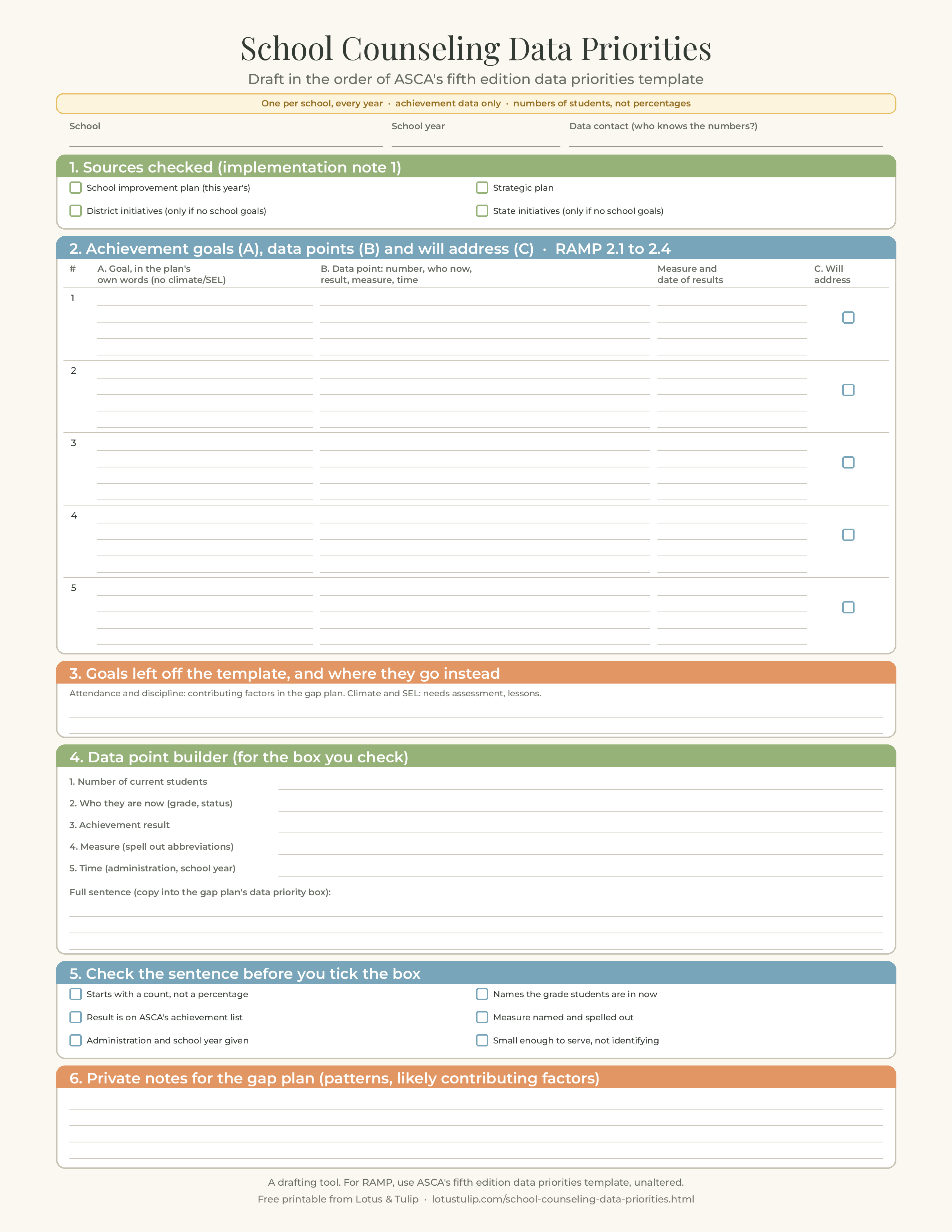
Download the free worksheet, example and selection sheet (PDF, 3 pages)
Or download single pages: Page 1: blank worksheet (PNG) · Page 2: filled fictional example (PNG) · Page 3: data review and selection sheet (PNG)
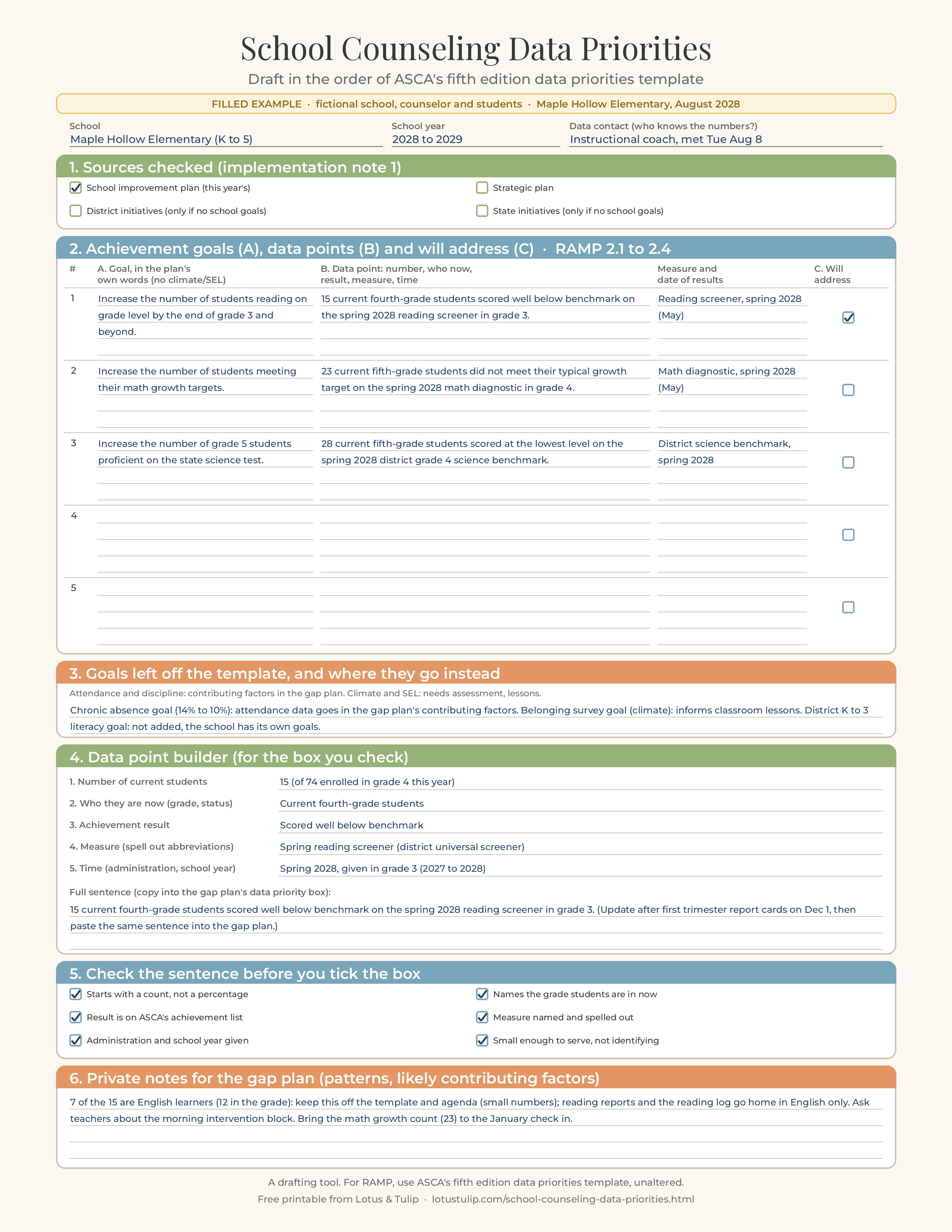
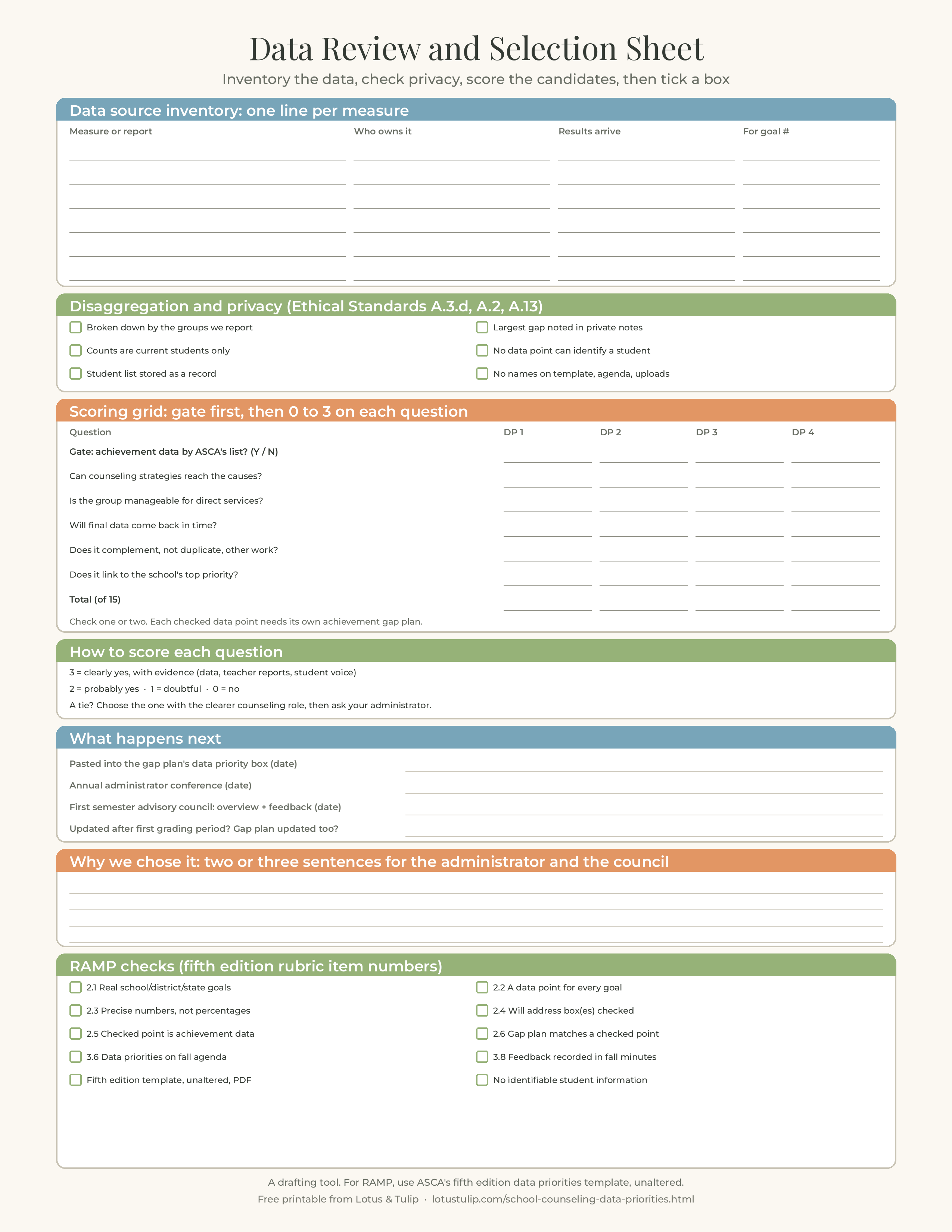
Free to print and use in your own school. Please link to this page rather than re-uploading the file. This is a planning tool. It does not replace ASCA's official templates, your district's data policies or legal advice. Keep student names and student level lists off any copy you share or upload.
The data priorities template is the first upload in Section 2 of the fifth edition RAMP application, the largest section at 26 points. For every other section, upload and cross-check, see the RAMP application checklist.
Related resources
- RAMP application checklist: every fifth edition rubric item, upload and deadline, with a free checklist and data year planner
- All school counselor small group curriculums
- Closing the gap action plan: the ASCA achievement gap plan, filled example and free planner
- Small-group action plan: the ASCA small-group plan and data report, filled example and free planner
- Classroom lesson plan: the ASCA lesson plan and data report, filled example and free planner
- ASCA Student Standards delivery plan: filled example and free planner
- Annual administrator conference: planner, filled example and notes log
- School counselor advisory council agenda, minutes and a filled example
- School counselor use-of-time calculator: filled example and free 5-day log
- School counselor needs assessment
- Small group counseling for attendance
Sources: American School Counselor Association, School Counseling Program Data Priorities template, ASCA National Model Fifth Edition (Word template, 8/25), from the ASCA Templates and Resources page; American School Counselor Association, All Fifth Edition Examples (School Counseling Program Data Priorities example, Achievement Gap Plan and Data Report example, Annual Administrator Conference example and Advisory Council First-Semester example, all 8/25); American School Counselor Association, RAMP Scoring Rubric, Fifth Edition, general instructions and Sections 1, 2, 3 and 6; American School Counselor Association (2025), The ASCA National Model: A Framework for School Counseling Programs, Fifth Edition (data categories, contributing-factors data and the Manage component); American School Counselor Association, Changes in the ASCA National Model Fifth Edition (Manage); American School Counselor Association, RAMP Application Timeline, Fifth Edition; American School Counselor Association, ASCA National Model Fifth Edition Phased Implementation Plan; American School Counselor Association (2022), ASCA Ethical Standards for School Counselors, A.2, A.3.b, A.3.d, A.3.e, A.3.g, A.13 and glossary; American School Counselor Association, School Data Summary template, fourth edition, and RAMP Rubric, Fourth Edition, Section 2, for comparison. Checked November 10 and 11, 2026.
FAQ
What are school counseling data priorities?
They are the achievement data points a school counseling program chooses to address in a given year, recorded on ASCA's fifth edition School Counseling Program Data Priorities template. The template lists all student achievement goals from the school's plans, gives at least one data point with a precise number of students for each goal, and uses a checkbox to show which data point or points the program will address with an achievement gap plan.
What replaced the ASCA School Data Summary?
The School Counseling Program Data Priorities template. ASCA's changes document lists the fourth edition School Data Summary as becoming School Counseling Data Priorities in the fifth edition, used to identify school, district and state achievement goals, achievement data points, and the data priorities the program will address. The fourth edition summary was a set of reflection questions and allowed attendance and discipline data points; the fifth edition template is a three column table limited to achievement data.
Can attendance or discipline be a data priority?
Not for the data priority you take into a fifth edition RAMP achievement gap plan. RAMP item 2.5 says it "Must be achievement data as defined by ASCA": traditional grades, standards-based grades, benchmark assessments, promotion rates, graduation rates or test scores. Attendance and discipline are contributing-factors data, which the achievement gap plan tracks in its own section. The template itself says not to list school climate or SEL priorities.
Why does the data point need a number and not a percentage?
RAMP item 2.3 requires a "Precise number of students (not percentages)" in the data point, and the template's direction says the same. The number becomes the baseline of your achievement gap goal, which item 2.7 says must use precise numbers for baseline and projected final data, so a count of current students keeps the whole chain consistent.
How many data priorities should I check?
One or two for most programs. We did not find a maximum in ASCA's documents, but the template says to develop an achievement gap plan for each data point you check, and the fifth edition RAMP timeline says one or two achievement gap plans may be submitted. The data priorities template is one per school, even when several counselors share the work.
How many RAMP points is the data priorities template worth?
It is scored by items 2.1 to 2.4 in Section 2 of the fifth edition RAMP rubric, which has 26 items and is worth 26 of the 82 points, so the template appears to carry four points. Item 2.6 also checks that the gap plan's data priority aligns with a checked data point, and item 3.6 requires a data priorities overview on the first semester advisory council agenda. We did not find a published passing score for the fifth edition application.