
Therapist worksheets · Updated 2026-11-06
Scaling Questions Worksheet: SFBT Therapy Tool with a Free Printable
Ready-made printable: CBT Worksheets for Therapists Fillable PDF, 20 pages: thought record, exposure ladder, activity logs, coping cards and 0 to 10 rating scales
Holiday 20% off: about $11.04, was $14 (EUR 12) · instant digital download
Try it free first: download a fillable sample (thought record and evidence for and against, PDF, 105 KB). Type into it on screen, then get the full pack. No email needed.

Scaling questions are a core Solution Focused Brief Therapy (SFBT) skill. The therapist invites a client to place a preferred future, a problem, confidence, motivation, or hope on a simple 0 to 10 (or 1 to 10) map, then asks what already puts them at that number, what a half point higher would look like, and who would notice. The scale is not a grade. It is a shared language for position, evidence, and a tiny next step.
Steve de Shazer, Insoo Kim Berg, and colleagues at the Brief Family Therapy Center in Milwaukee taught scaling questions as a sibling to the miracle question, exception finding, coping questions, and relationship questions. Credit that lineage honestly. This Lotus and Tulip page and printable are an original educational layout. We are not affiliated with the Brief Family Therapy Center, the Solution Focused Brief Therapy Association, or any textbook publisher, and this is not a copy of any copyrighted worksheet.
This guide covers what SFBT scaling is, how to set anchors for a 10 and a 0 or 1, classic follow ups (what puts you at N not N minus 1, half a point higher, who would notice), miracle scales, confidence and motivation and hope scales, relationship questions on the scale, adult, teen, and school counselor adaptations, fictional worked examples, comparisons with the miracle question, exception finding, SUDS, feelings thermometers, SMART goals, and circle of control, common mistakes, therapist tips, when not to use it, an honest research section with caveats, a nine step how to, seven FAQs, and a free three page US Letter printable.
This guide is educational. It is not therapy, not medical advice, and not a diagnosis. If thoughts of ending your life, plans to harm yourself or someone else, or a medical emergency show up, stop the worksheet and get help now: in the US, call or text 988, text HOME to 741741, or call 911. Our safety plan worksheet is a better first tool in that moment. For nearby SFBT style tools, see the miracle question worksheet, the exception finding worksheet, and the goal setting worksheet for students.
Jump to the free scaling questions worksheet (PDF) · How to use scaling questions, step by step · Worked examples · Comparisons
What SFBT scaling questions are
In SFBT, therapists spend more time on what the client wants and what already works than on a long autopsy of the problem. Scaling questions turn a preferred future, a complaint, or a readiness state into a shared number. A typical stem is: "On a scale from 0 to 10, where 10 is the morning after your preferred future is fully present and 0 is the worst this problem has been, where are you today?" The number alone is not the therapy. The follow ups are.
Core idea: a scale becomes useful when anchors are clear, evidence for the current number is gathered, and a half point next step is concrete enough to try. A lonely "I am a 4" without detail does not steer a session. "I am a 4 because I answered one email before noon and texted a friend back" does.
SFBT grew from brief family therapy work associated with de Shazer, Berg, Eve Lipchik, and others. Scaling sits beside other SFBT staples: the miracle question (preferred future), exception finding (when better already happened), relationship questions (who would notice?), coping questions, and compliments. Treat scaling as a technique inside a larger SFBT conversation, not as a standalone treatment brand.
A scaling questions worksheet on paper is a practice aid. It can help a client track position between sessions, help a trainee rehearse follow ups, or help a school counselor adapt the idea for a student who needs a gentler "where are you today from 0 to 10" prompt. It is not a substitute for training, supervision, or a living therapeutic relationship.
How to set anchors and ask scaling questions well
Choose a direction. Decide what 10 means before you ask for a number. Common frames: preferred future fully present, problem resolved enough to live well, or "the best this has been recently." Decide what 0 (or 1) means: worst it has been, or a clear low anchor the client recognizes. Without anchors, numbers drift across sessions.
Ask for today's number without judgment. Accept the number as the client's report. Do not argue them up. Curiosity beats cheerleading.
Classic follow ups that stay concrete:
- What already puts you at N: "What already puts you at a 4 rather than a 3 or a 0?"
- Half a point higher: "What would a half point higher look like: what would you notice, what would others notice?"
- Who would notice: "Who would be the first to notice you moved up half a point? What would they see or hear?"
- How did you get here: "How did you get to this number instead of a lower one?"
- What keeps it from dropping: "What are you already doing that keeps you from sliding lower?"
Pacing. Slow down after the number. Clients often rush to explain why they are not higher. Your job includes noticing what already accounts for the current place on the scale. Ask for more detail before you jump to advice.
Keep language concrete. Prefer verbs and observable signs over labels. "I would feel better" becomes "I would leave my phone in the kitchen for fifteen minutes after dinner" or "I would say hi to one safe peer before lunch."
Miracle scales, confidence, motivation, hope, and relationship questions on the scale
Miracle or preferred future scale. After a miracle question, ask where the client is today relative to that preferred morning. The scale bridges vivid future talk and present evidence. Pair with exception finding: exceptions often explain why the number is not zero.
Confidence / motivation / hope scales. Separate the progress scale from readiness. A client can be at a 3 on progress and a 7 on willingness to try a tiny step. Ask what already supports that confidence number, and what would raise it half a point. Do not collapse progress and motivation into one confusing rating.
Relationship questions on the scale. "On the same scale, where would your partner / parent / teacher place you today?" and "What would they need to see to rate you half a point higher?" make change social and observable. Use gently. Do not weaponize others' opinions.
In short: progress scale = where you are toward preferred future or better days; confidence scale = how ready you feel to try; relationship scale = how others might see it. Use the right scale for the stuck point in front of you.
Scaling questions vs miracle question, exception finding, SUDS, feelings thermometer, SMART goals, and circle of control
| SFBT scaling | Miracle question | Exception finding | SUDS / thermometer | SMART goals / circle of control | |
|---|---|---|---|---|---|
| Main job | Map position 0 to 10, gather evidence, design a half point next step | Describe a preferred future in observable detail | Find times the problem was less or absent | Rate distress intensity in the moment | Set specific goals or sort controllable vs not |
| Best early use | When the client needs a shared map and a tiny next step | When the client needs a vivid "toward" picture | When the client says nothing ever works | When tracking anxiety or exposure intensity | When planning action or reducing overwhelm |
| Output | Number, anchors, evidence, half point step, who notices | Signs, who notices, then often a scale | Exception details and how to do more | 0 to 100 (or faces) distress rating | Goal plan or two circle sort |
| Cross link | This page | Miracle question | Exception finding | Feelings thermometer / exposure SUDS | Goal setting · Circle of control |
These tools cooperate. A miracle picture can define the 10. Exceptions explain why today's number is not zero. A feelings thermometer or SUDS scale measures distress intensity, which is related but not the same as an SFBT progress scale. SMART goals can hold the half point step in measurable form. Circle of control can keep the next step inside what the person can influence. Teach one tool clearly before stacking three on day one. Related neighbors: self care plan template and therapy treatment plan template.
How to use scaling questions, step by step
- Check safety and fit. If acute crisis, psychosis that blocks shared reality testing, or the person cannot engage solution talk safely, pause. Use crisis pathways first: 988, HOME to 741741, or 911 when needed. Prefer a safety plan in that moment.
- Name what the scale is about. Preferred future, problem intensity, confidence, motivation, or hope. One plain sentence. Write the anchors for 10 and for 0 or 1.
- Ask for today's number. Accept it without arguing. Stay curious if the number surprises you.
- Gather what already puts them at that number. Place, people, actions, exceptions. Stay concrete. Link to exception finding when useful.
- Ask what keeps them from a lower number. Coping and contribution often live here.
- Ask what a half point higher would look like. Observable signs. Who would notice first?
- Optional: relationship or confidence scale. Separate progress from willingness if that clarifies the stuck point.
- Choose one tiny next step. One experiment that could create half a point of movement. Write when and where.
- Review next time. Re scale. What changed? What did they learn? Adjust. Use the free practice log for short reps.
Practice on ordinary days. Scaling skill grows with clear anchors and tiny experiments, not with one perfect speech.
Worked fictional examples
Adult example (fictional): Jordan comes to therapy for evening doom scrolling and work dread. Preferred future 10: evenings with phone in the kitchen after dinner, one real reply to a friend, sleep by 11. Today on the progress scale: 3. What already puts Jordan at 3: Wednesday phone stayed away for twenty five minutes while dishes got done. Partner might notice Jordan at the table instead of hunched on the couch. Half a point higher: fifteen phone free minutes after dinner tomorrow, then re rate. Confidence to try that step: 6. That is SFBT style scaling, not a life overhaul speech.
Teen example (fictional): Riley, age 15, feels stuck after social conflict. Scale 0 to 10 for "showing up at school without the group chat running the day": today a 4. What already puts Riley at 4: Thursday walked into first period without checking five times, said hi to one safe peer. Teacher might notice head up and one question asked. Half a point higher: one hello before lunch tomorrow, phone in bag until lunch. Confidence: 5. Small next step written on the free mini card.
School counselor note (fictional): In a short meeting, a counselor uses "where are you from 0 to 10 today on feeling ready for class" for a student who rolls their eyes at therapy jargon. Same structure: anchors, number, what already helps, half point, one step. Session stays under fifteen minutes.
Pre-session and between-session scaling homework
Some clients benefit from a short between-session check: rate the same progress scale once a day, note what already put them at that number, and bring one half point idea to the next meeting. The free practice log is built for that. Keep the ask tiny. One rating per day is enough. If homework feels like another demand, shrink it to a sticky note: "Number today? What already helps? Half point?" and stop there.
For groups, a round robin ("one number and one thing that already helps") can normalize noticing without forcing deep disclosure. For school settings, keep examples low stakes and optional. Never require students to share private family detail in front of peers.
Recording tips for clinicians. In notes, capture the scale used, anchors, the client's number, evidence for that number, and the agreed half point experiment. That keeps the next session from restarting at zero. Pair with your usual outcome measure when your setting uses one. Scaling supports the conversation; it does not replace measurement or safety documentation.
Adult, teen, and school counselor adaptations
Adults. Work, money, relationships, health, and parenting often appear on the scale. Keep signs behavioral. Watch for perfectionist filters ("I cannot be above a 2 until everything is fixed") and gently ask what already accounts for even a small number.
Teens. Prefer concrete school and peer signs. Let them reject jargon. Offer "stuck to ready" language if 0 to 10 feels cold. Keep the next step tiny and within their real control. Pair with goal setting for students when a measurable homework step helps.
School counselors. Short meetings favor a compressed sequence: name the scale, number, what already helps, half point, one step. Groups can practice with low stakes "ready for advisory" prompts. Follow district crisis protocol if risk appears. Optional practice, never forced disclosure.
Therapist tips
- Stay in the client's language. Reflect their verbs and metaphors. Do not overwrite their 10 with your favorite outcome.
- Detail before advice. Collect what already puts them at N first. Solutions that ignore the client's picture often bounce off.
- Half points beat leaps. A half point experiment is more honest than a demand to jump to 8 this week.
- Do not argue the number up. Invite curiosity: "Even at a 2, what keeps it from a 1?"
- Separate progress from confidence when willingness and outcome diverge.
- Bridge to the plan. Scales should eventually touch a treatment plan, homework, or values based action. See the treatment plan template and self care plan when structure helps.
- Coordinate with other modalities. CBT, ACT, and DBT can sit beside SFBT questions when the formulation calls for it. Do not force one brand of purity if integration serves the client.
- Measure function. Ask what changed: clearer anchors, more exceptions noticed, half point steps completed, less stuck problem talk.
Common mistakes
- Asking for a number with no anchors, so ratings drift and cannot be compared across weeks.
- Treating the scale like a grade or arguing the client into a higher number.
- Skipping what already puts them at N, jumping straight to "how do we get to 10."
- Choosing a giant next step instead of a half point experiment.
- Confusing SFBT progress scales with SUDS or a feelings thermometer without saying so.
- Using it in acute crisis instead of safety first.
- Treating the worksheet as therapy. Paper supports practice. It does not replace a clinician when problems are severe or lasting.
When not to use scaling questions
- Acute safety risk or medical emergency: stabilize and get help (988, HOME to 741741, 911).
- When psychosis or severe dissociation makes solution talk confusing or unsafe in the moment; follow clinical judgment and stabilize first.
- When the client cannot or will not use numbers today: switch to coping, validation, exception talk without numbers, or another modality rather than pushing the frame.
- When grief needs witnessing first and scaling feels like pressure to "improve": pace carefully; sometimes later is kinder.
What the research says (honestly)
SFBT as a package has a growing outcome literature. Scaling questions are a technique inside SFBT, not a standalone intervention with its own large RCT literature. Do not claim this free printable remits diagnoses.
SFBT outcome reviews. Gingerich and Peterson (2013), in Research on Social Work Practice, reviewed controlled outcome studies of SFBT and reported that the majority of studies found significant positive outcomes, with SFBT comparable to established treatments in several comparisons and with a notable share of studies in medical and behavioral health settings. Treat that as package level encouragement for SFBT informed practice, not as proof that asking scaling questions alone is a complete therapy.
Broader SFBT evidence notes. Later reviews and practice summaries (including work associated with Franklin, Trepper, Gingerich, McCollum, and Kim's meta analytic work on SFBT) generally support SFBT as a promising brief approach across some populations, with the usual caveats: study quality varies, effects differ by problem and setting, and more rigorous trials are still needed in many areas. Exact effect sizes depend on the review and inclusion rules. Read primary sources rather than marketing blurbs.
Honest caveat. Technique level evidence for scaling questions alone is limited compared with package level SFBT findings. Use scaling as a conversation tool inside a coherent plan. For severe depression, trauma, psychosis, OCD, or acute risk, use disorder appropriate care and crisis pathways.
Free scaling questions worksheet (PDF)
The free scaling questions printable has three pages in US Letter size:
- Page 1: Scaling Questions Steps card. Anchors, today's number, what already helps, half point higher, who notices, tiny next step, with safety reminders.
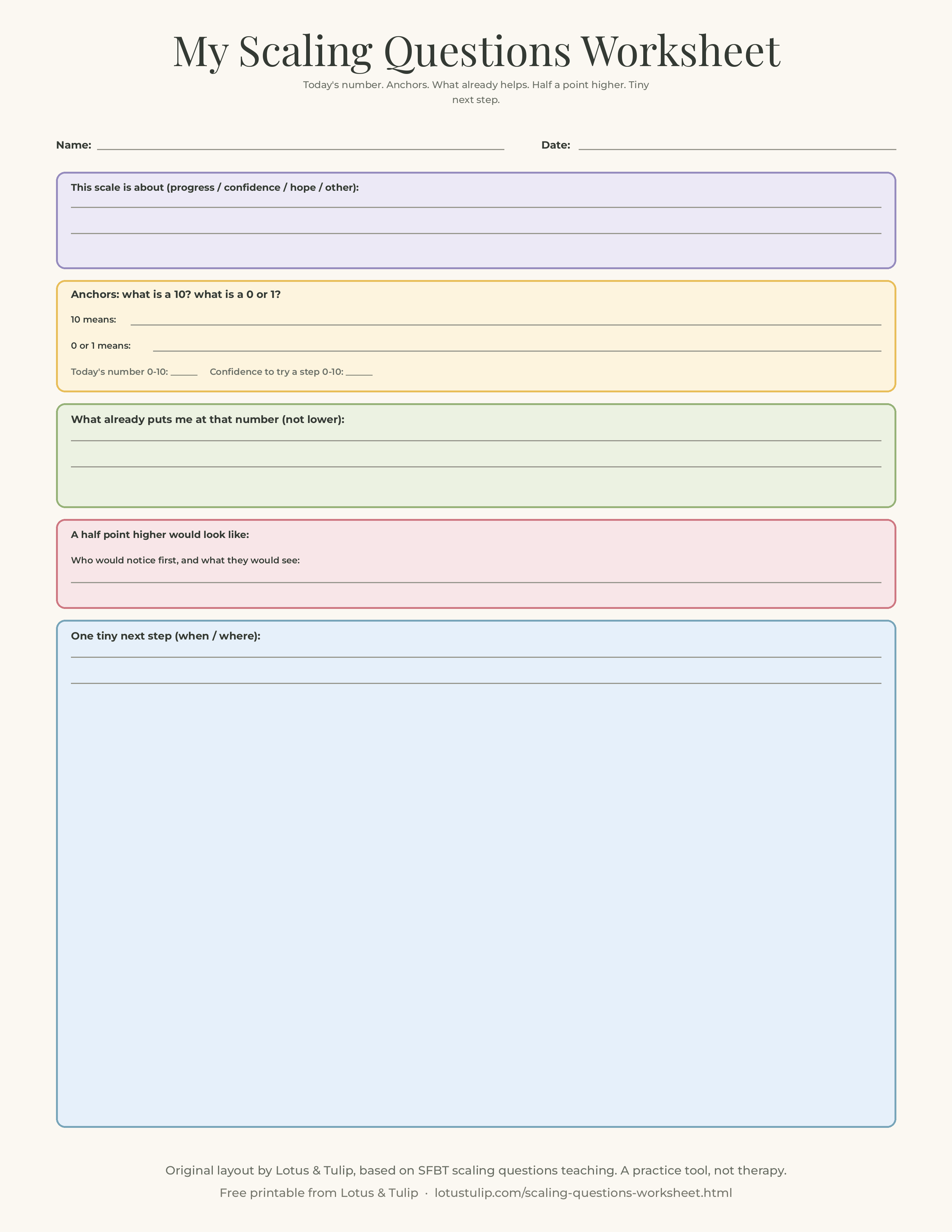
- Page 2: My Scaling Questions Worksheet. Fill in today's number, anchors, what already puts you there, half a point higher, who notices, and one small next step.
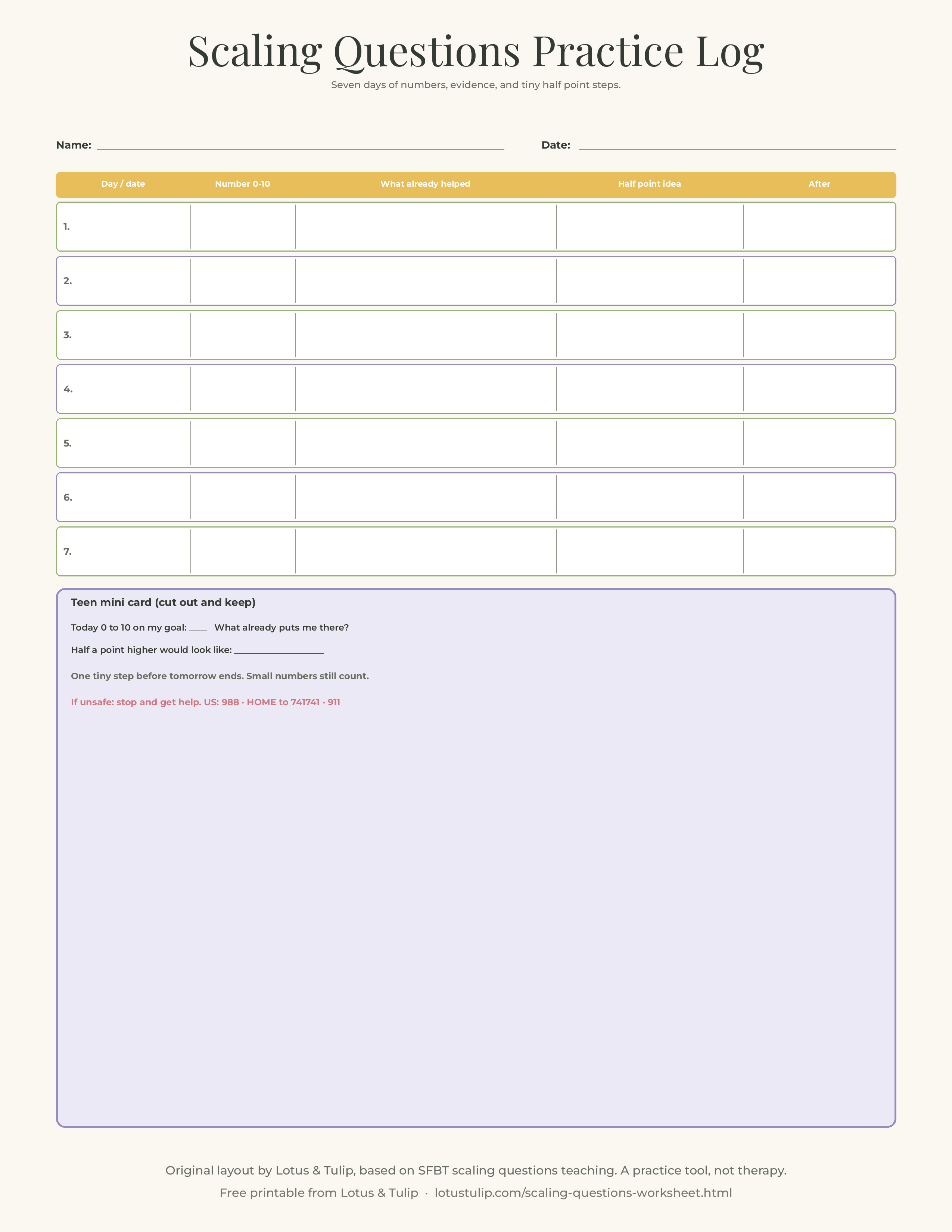
- Page 3: Practice Log + teen mini card. Seven day rows plus a cut out reminder for number, evidence, and a tiny next step.
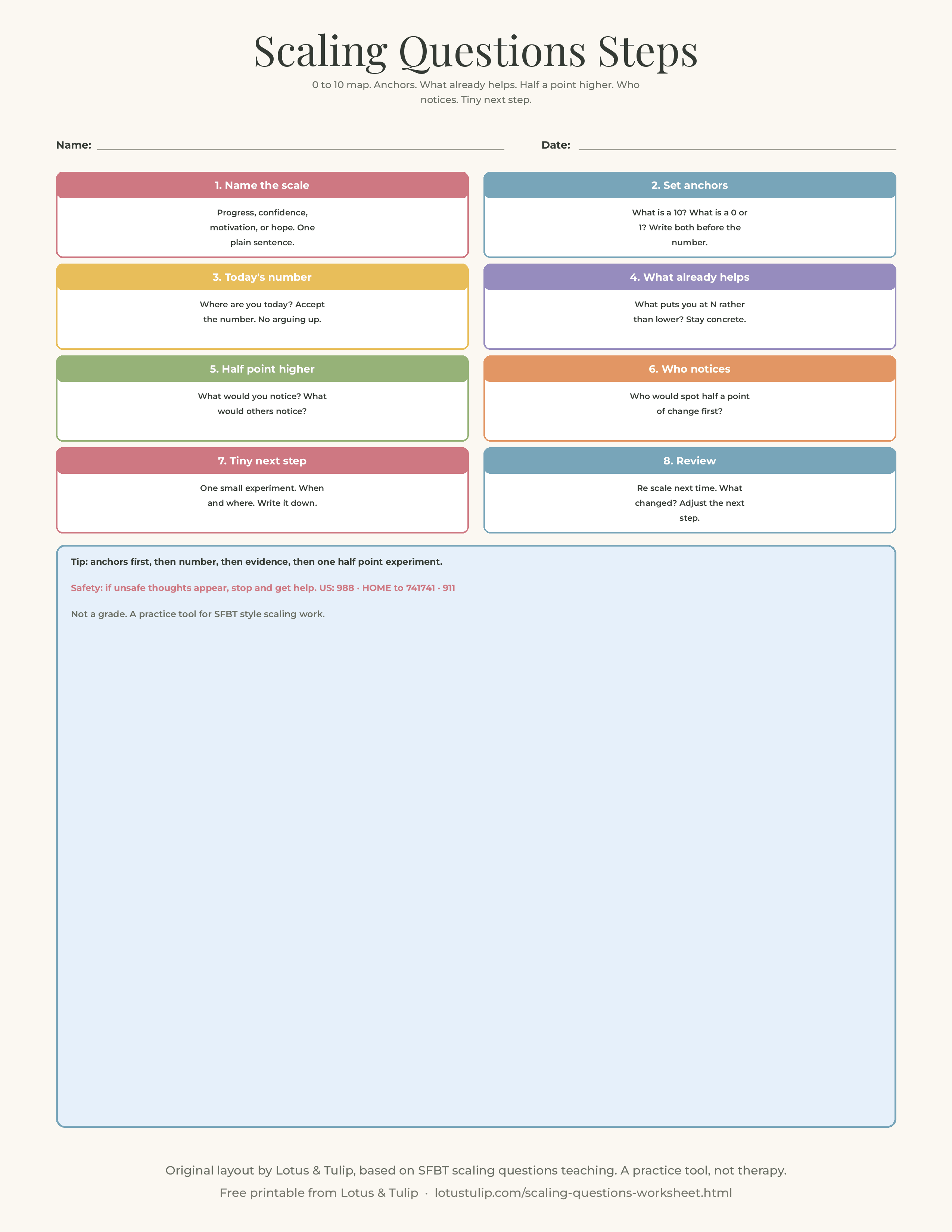
Download the free scaling questions worksheet (PDF, 3 pages, US Letter)
Prefer single images? Page 1: Scaling Questions Steps (PNG) · Page 2: My Scaling Questions fill in (PNG) · Page 3: Practice Log (PNG)
Free to print for your own use and for use with your own clients, students, or groups. This is an original layout by Lotus & Tulip, based on Solution Focused Brief Therapy scaling questions teaching associated with Steve de Shazer, Insoo Kim Berg, and colleagues. It is not affiliated with those authors, the Brief Family Therapy Center, or any specific treatment package, and is not a substitute for therapy. Please link to this page rather than re-uploading the file.
Related resources
- Miracle question worksheet: SFBT preferred future companion tool.
- Exception finding worksheet: when the problem was less or absent.
- ACT values worksheet: valued directions and committed action.
- Decisional balance worksheet: pros and cons of change.
- Goal setting worksheet for students: SMART style student goals.
- Circle of control worksheet: what I can influence vs not.
- Feelings thermometer printable: distress intensity (different from SFBT progress scales).
- Behavioral activation worksheet: schedule mood lifting action.
- Therapy treatment plan template: goals, objectives, interventions.
- Self care plan template: six area plan and weekly tracker.
- Safety plan worksheet: when the moment is about staying alive.
Sources
- de Shazer, S., Berg, I. K., and colleagues. Solution Focused Brief Therapy teaching tradition including scaling questions as a preferred change tool. Credit the lineage; wording varies by source and edition. Not affiliated.
- Gingerich, W. J., and Peterson, L. T. (2013). Effectiveness of Solution Focused Brief Therapy: A systematic qualitative review of controlled outcome studies. Research on Social Work Practice, 23(3), 266 to 283. Package level SFBT outcome review; majority of included studies reported significant positive outcomes. Not evidence for this printable alone.
- Franklin, C., Trepper, T. S., Gingerich, W. J., and McCollum, E. E. (Eds.). Solution focused brief therapy handbooks and related practice summaries. Broader SFBT practice context. Credit only.
- Kim, J. S., and related SFBT meta analytic / review literature. Summary finding that SFBT shows promise across some populations, with heterogeneity and quality caveats. Read primary reviews for exact estimates.
- Honest caveat: scaling questions are a technique inside SFBT. Package level reviews are not the same as technique only RCTs, and no study tests this three page Lotus and Tulip printable alone.
Scaling questions worksheet: FAQ
What are scaling questions in SFBT?
Scaling questions invite a client to place a preferred future, a problem, confidence, motivation, or hope on a 0 to 10 (or 1 to 10) map, then ask what already puts them at that number, what a half point higher would look like, and who would notice. They are a core Solution Focused Brief Therapy skill, not a standalone treatment brand.
How is scaling different from the miracle question and exception finding?
The miracle question describes a preferred future. Exception finding looks for times a piece of better already happened. Scaling maps where you are now relative to that preferred future or better days, gathers evidence for the current number, and designs a half point next step. They often work together. See our miracle question and exception finding worksheets for the companion tools.
How do you ask scaling questions step by step?
Check safety and fit, name what the scale is about and set anchors, ask for today's number, gather what already puts them there, ask what a half point higher would look like and who would notice, optionally separate confidence from progress, then pick one tiny next step. The nine step section and free printable follow the same arc.
Is an SFBT scale the same as SUDS or a feelings thermometer?
Related idea, different job. SUDS and feelings thermometers usually rate distress intensity in the moment. SFBT scaling usually maps progress toward a preferred future or better days, plus follow ups about evidence and next steps. Say which scale you are using so clients are not confused.
Can teens and school counselors use it?
Yes, often with plain "0 to 10, where are you today" language instead of jargon. Keep steps tiny, optional, and school safe. Follow crisis protocol when risk appears.
Does a scaling questions worksheet work on its own?
A worksheet is a practice aid, not a standalone treatment. SFBT package reviews (including Gingerich and Peterson 2013) speak to SFBT as an approach, not to this free page alone. Use it inside counseling or therapy, and get licensed care for persistent or severe problems.
When should I not use scaling questions?
Do not use them as the first move in acute safety risk, medical emergency, or when solution talk is unsafe or impossible for the person today. Stabilize and get help first when needed: 988, HOME to 741741, or 911. Use a safety plan when staying alive is the job.