
Therapist practice · Updated 2026-11-03
Therapy treatment plan template: how to write SMART goals and objectives, with a free printable
Ready-made printable: Therapy Progress Notes and Intake Templates Fillable PDF: includes a treatment plan page with measurable objectives, plus intake, notes and safety plan pages (20 pages)
Holiday 20% off: about $7.36, was $9 (EUR 8) · instant digital download
Try it free first: download a fillable treatment plan sample (treatment plan and treatment plan review pages, PDF, 227 KB). Type into it on screen, then get the full pack. No email needed.

A mental health treatment plan is the page that connects everything else in the record. The intake and assessment explain why the client is here, the plan says what you are working toward and how you will know it is working, and every progress note after that shows movement against it. Plans are often written in a hurry after a long intake and then forgotten, which is a shame, because a clear plan makes sessions more focused and reviews much easier. This guide is for counselors, therapists, social workers and psychologists in private practice, group practices and clinics in the US. It covers what a treatment plan includes, the difference between problems, goals, objectives and interventions, how to write SMART objectives, a full fictional example, how to measure progress, when to review, and common mistakes. It ends with a free printable treatment plan template plus a filled example.
Jump to the free treatment plan template
This is educational information for licensed clinicians and trainees, not legal, billing or clinical advice. Documentation rules differ by state, license, setting and payer, so check your state board, your agency policy and each payer's current requirements, and follow your supervisor's guidance if you are pre-licensed.
What a treatment plan is
A treatment plan (also called a service plan, care plan or counseling plan) is a written, shared agreement between the client and the clinician. It names the problems you are working on, what the client wants their life to look like when those problems are better, the small measurable steps along the way, what you as the clinician will do to help, and when you will check progress together.
Three reasons it matters:
- It keeps therapy pointed somewhere. Without a plan, sessions drift toward whatever happened that week. A plan does not stop you responding to the week, it just gives you something to come back to.
- It is an ethical expectation. The ACA Code of Ethics (2014), standard A.1.c, says counselors and clients "work jointly in devising counseling plans that offer reasonable promise of success" and "regularly review and revise counseling plans to assess their continued viability and effectiveness, respecting clients' freedom of choice." Other professions' codes and state rules say similar things in their own words.
- Payers often expect it. For example, the Medicare Local Coverage Determination for Psychiatry and Psychology Services (L34616) says the record should document "the target symptoms; goals of therapy and methods of monitoring outcomes," and that "a periodic summary of goals, progress toward goals, and an updated treatment plan must be included in the medical record." Commercial payers and Medicaid programs set their own rules, so treat that as one example, not a universal standard.
What to include in a treatment plan
Formats vary by agency and electronic record, but most plans cover the same ground. The free template on this page follows this order:
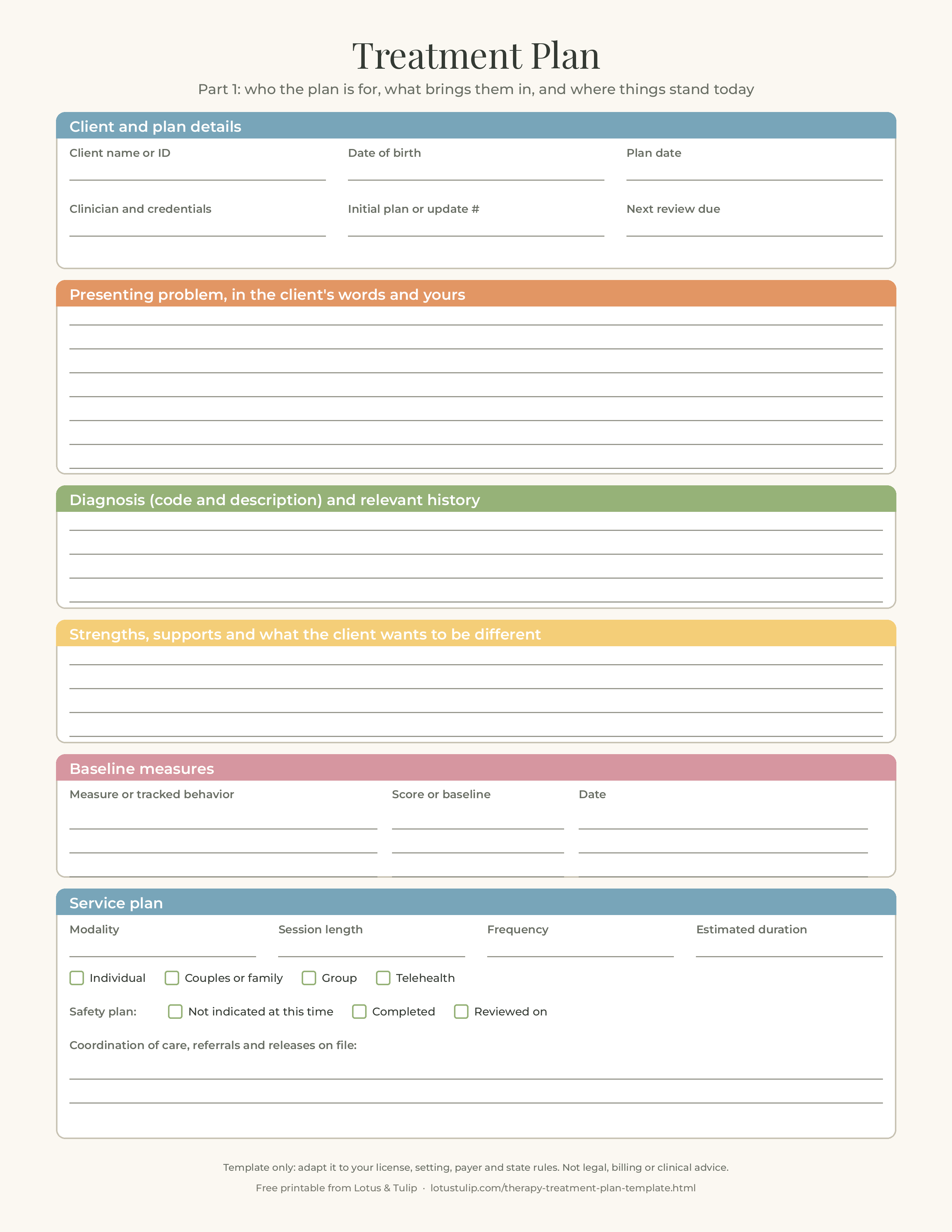
- Client name or ID, date of birth, plan date, clinician and credentials, and whether this is the initial plan or an update.
- Presenting problem, ideally with a short quote in the client's own words plus your clinical summary.
- Diagnosis with code and description, if your setting uses one, and relevant history.
- Strengths and supports, and what the client wants to be different.
- Baseline measures: scores on any standardized measures you use and simple counts of the behavior you are targeting.
- Service plan: modality, session length, frequency and estimated duration.
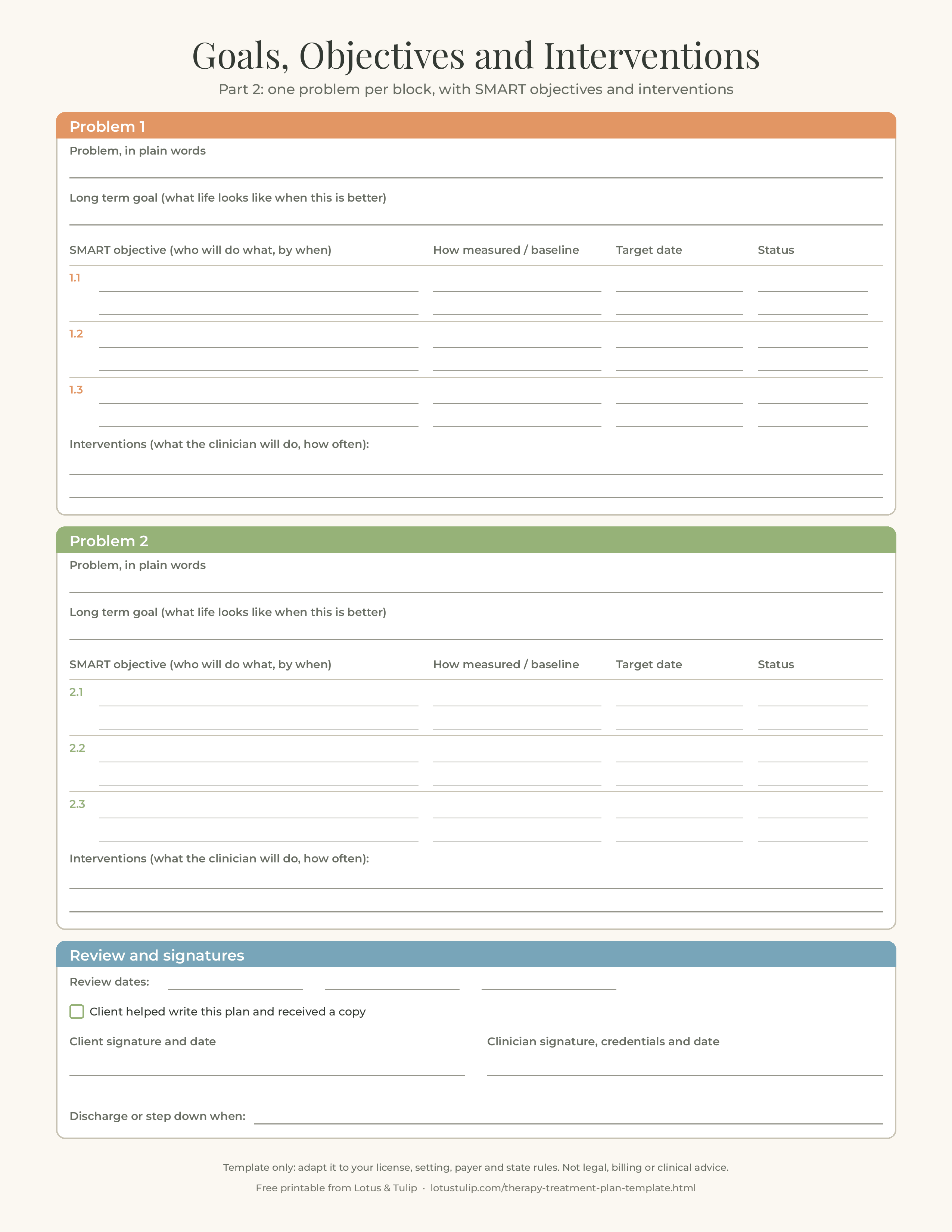
- For each problem: a long term goal, two or three SMART objectives and the interventions you will use.
- Safety planning status, coordination of care and releases on file.
- Review dates, discharge or step down criteria, and signatures from the client and clinician.
Problems, goals, objectives and interventions
Most US treatment planning uses a four level structure, popularized by the Wiley PracticePlanners series (for example The Complete Adult Psychotherapy Treatment Planner by Arthur E. Jongsma Jr., L. Mark Peterson and Timothy J. Bruce), which organizes each problem into behavioral definitions, long term goals, short term objectives and therapeutic interventions. The words get mixed up a lot, so here is how they fit together:
| Level | What it is | Example |
|---|---|---|
| Problem | What is getting in the way, described in observable terms | Panic attacks about 4 times a week; avoids highway driving |
| Long term goal | What life looks like when the problem is better; broad and hopeful, not measured directly | Panic attacks are rare and no longer control daily plans |
| Objective | A specific, measurable step the client takes toward the goal, with a target date | Client reports 1 or fewer panic attacks a week for 4 weeks in a row by 02/15/2027 (baseline 4 a week) |
| Intervention | What the clinician will do to help the client meet the objective, and how often | Weekly CBT for panic: psychoeducation, interoceptive exposure, cognitive restructuring |
A useful test: goals and objectives describe the client, interventions describe you. "Client will attend weekly therapy" is not an objective, because attendance is not the change you are hoping for. "Clinician will teach diaphragmatic breathing" is an intervention, not an objective.
How to write SMART goals and objectives for therapy
SMART comes from a 1981 article by George T. Doran, a management consultant, in Management Review titled "There's a S.M.A.R.T. way to write management's goals and objectives." His original letters were Specific, Measurable, Assignable (specify who will do it), Realistic and Time-related. Many people now use Achievable for the A, and Relevant is often added in later versions. Doran himself wrote that not every objective will meet all five criteria, and that the objective and its action plan matter together. That fits therapy well: the objective is the client's step, the interventions are the action plan.
Applied to a treatment plan, each objective should answer:
- Specific: what exactly will change? Name a behavior, symptom or skill, not a feeling state like "be less anxious".
- Measurable: how will you both know? A score on a standardized measure, a count from a log, days per week, a rating out of 10.
- Assignable: who will do it? Usually the client ("J. will..."), sometimes the client and clinician together ("J. and clinician will build a 10 step exposure ladder").
- Realistic: is it possible given the client's life, resources and starting point? A client who has 0 good sleep nights does not need a target of 7.
- Time bound: by when? A date or a session number, which also tells you when to review.
Here is the same idea written weakly and then as a SMART objective:
| Vague | SMART objective |
|---|---|
| Client will reduce anxiety. | Client's GAD-7 score will drop from 14 to 9 or below by 02/15/2027, measured every 4 weeks. |
| Client will feel less depressed. | Client will schedule and complete 3 valued activities a week for 6 weeks, recorded on an activity log (baseline 0 to 1 a week). |
| Client will improve communication with partner. | Client will use a planned DEAR MAN request in at least 2 difficult conversations a week for 4 weeks, reviewed in session. |
| Client will stop self harm. | Client will use a coping skill from their safety plan before acting on urges, tracked daily on a diary card, with urges and actions reviewed each session. |
| Teen will do better at school. | Teen will attend all classes 4 or more days a week for 6 weeks, confirmed by attendance records shared with consent (baseline 2 days a week). |
| Client will grieve. | Client will spend 15 minutes on a planned grief activity, such as an unsent letter, 2 times a week for 4 weeks, and rate daily functioning 0 to 10 each week. |
Two cautions. First, measurable does not have to mean a questionnaire. A simple count the client keeps on paper is often more meaningful than a score. Second, keep objectives in the client's language where you can. Clients are more likely to work toward "drive to work on the highway again" than toward "reduce avoidance behaviors".
How to write a treatment plan, step by step
- Finish the assessment first. Use the intake and assessment to understand the presenting problem, history, risk, strengths and diagnosis. A plan written before you understand the problem tends to be generic.
- Ask what the client wants to be different. Write one or two sentences in their own words. This becomes the anchor for every goal and keeps the plan collaborative.
- Pick two or three problems. Choose the problems that matter most to the client and that drive the most distress or impairment. A plan with eight problems is rarely followed.
- Write a long term goal for each problem. Describe what life looks like when this problem is better, in plain words.
- Record a baseline. Give any standardized measure you use and count the target behavior for a week if you can. Without a baseline, a later number means little.
- Write two or three SMART objectives per goal. Start with an early, easy objective (such as keeping a log) so the client gets a quick win, then build toward the outcome you both want.
- Match interventions to each objective. Name the approach and the specific techniques, who delivers them and how often, so another clinician could pick up the plan and understand it.
- Set the service plan and review dates. Write the modality, frequency, session length and estimated duration, and put the first review on the calendar.
- Review it together and sign. Read the plan with the client, change anything that does not sound like them, get both signatures if your setting uses them, and offer the client a copy.
A worked example (fictional client)
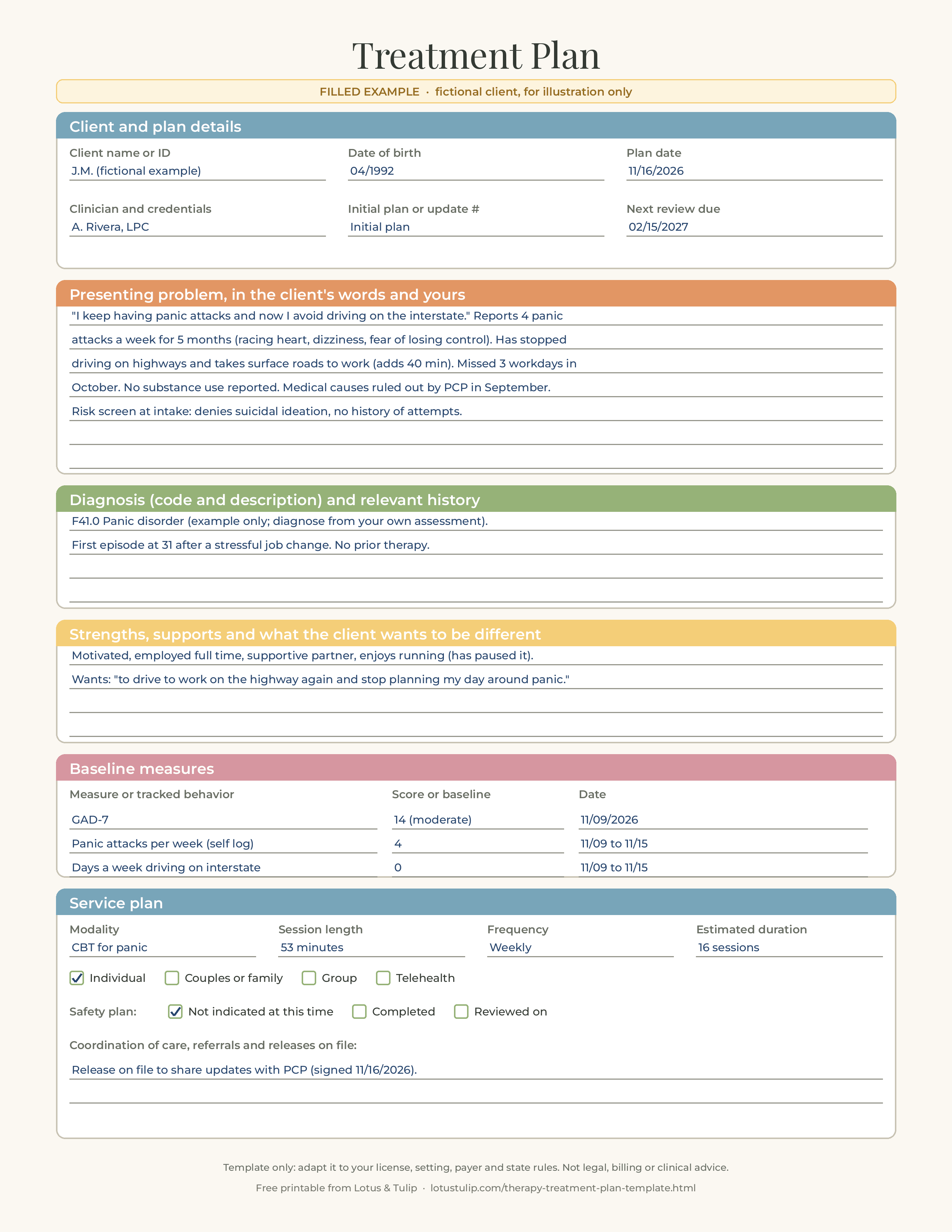
The filled pages in the free printable use this fictional adult client. It is an illustration of format, not a model of the right treatment for any real person.
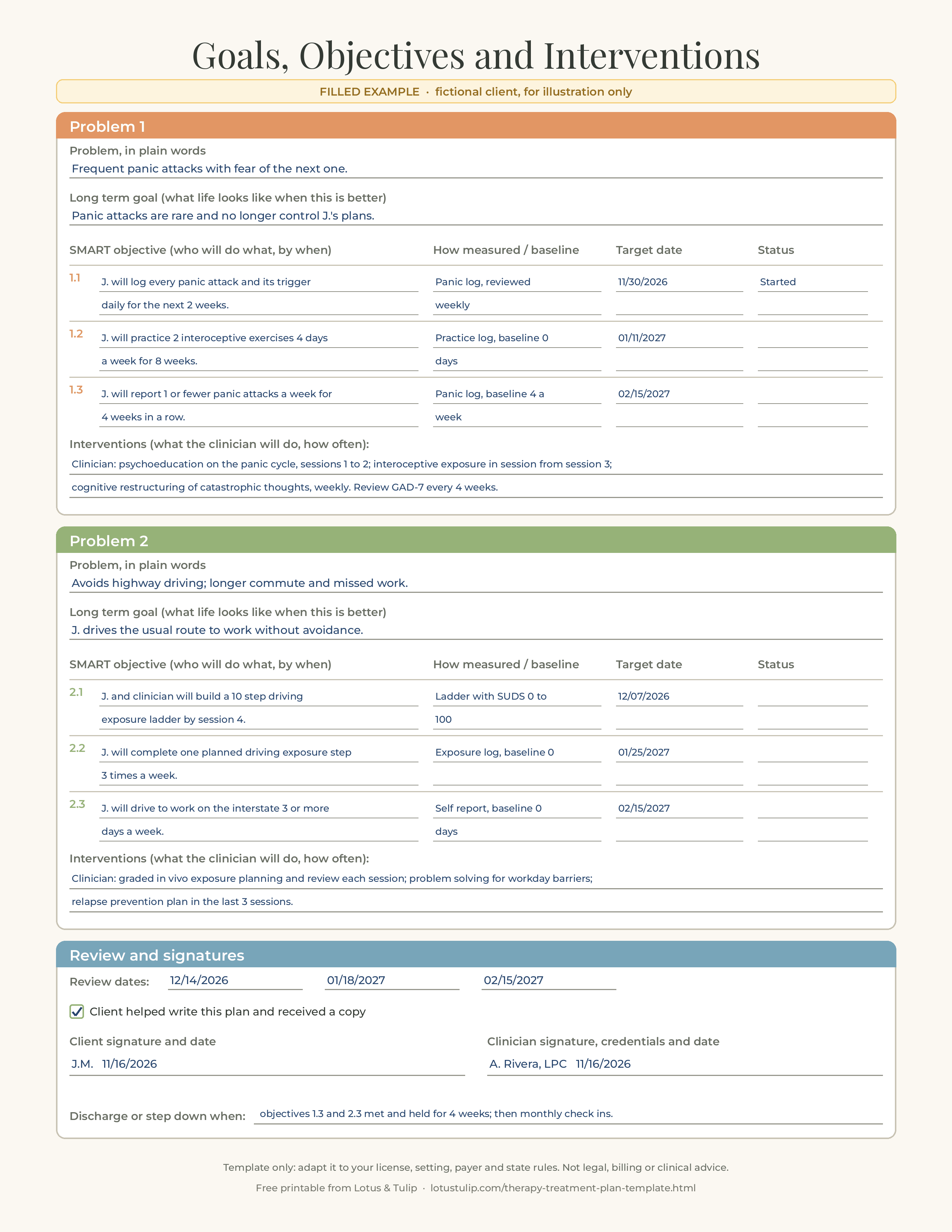
- Presenting problem: "I keep having panic attacks and now I avoid driving on the interstate." About 4 panic attacks a week for 5 months, takes surface roads to work, missed 3 workdays in October. Medical causes ruled out by the client's primary care provider.
- Baseline: GAD-7 score 14; 4 panic attacks a week on a self log; 0 days a week driving on the interstate.
- Service plan: individual CBT for panic, weekly, 53 minute sessions, estimated 16 sessions.
- Problem 1, goal: panic attacks are rare and no longer control daily plans. Objectives: log every panic attack and its trigger daily for 2 weeks; practice 2 interoceptive exercises 4 days a week for 8 weeks; report 1 or fewer panic attacks a week for 4 weeks in a row by the target date.
- Problem 2, goal: drives the usual route to work without avoidance. Objectives: build a 10 step driving exposure ladder with the clinician by session 4; complete one planned exposure step 3 times a week; drive to work on the interstate 3 or more days a week by the target date.
- Interventions: psychoeducation on the panic cycle, interoceptive and graded in vivo exposure, cognitive restructuring, problem solving for workday barriers, relapse prevention in the last 3 sessions.
- Reviews: monthly, with the GAD-7 repeated every 4 weeks. Discharge or step down when the final objectives are met and held for 4 weeks.
Notice that every objective has a number the client can track and a date, and that the early objectives are things the client can succeed at in the first two weeks.
Measuring progress
Measurement based care means repeating a brief measure on a regular schedule and using the results in session, not just filing them. Two widely used free measures for adults:
- PHQ-9 for depression (Kroenke, Spitzer and Williams, 2001): scores of 5, 10, 15 and 20 mark mild, moderate, moderately severe and severe depression.
- GAD-7 for anxiety (Spitzer, Kroenke, Williams and Löwe, 2006): scores of 5, 10 and 15 mark mild, moderate and severe anxiety.
Use the measures that fit your clients and your training, and pair them with behavior counts that match each objective: panic attacks a week, nights with 7 hours of sleep, days at school, conversations where a skill was used. Write the baseline on the plan and the latest number on each review, so progress (or the lack of it) is visible at a glance. If the numbers are not moving after a fair trial, that is information: revisit the formulation, the interventions or the objectives with the client.
Reviewing and updating the plan
A treatment plan is a living document. Review it on the schedule you set, whenever something big changes (a crisis, a new diagnosis, a move to a different level of care), and before discharge. At each review, record the current measures, the status of each objective (met, progressing, not progressing, revised or discontinued), and any changes, then have the client sign again if your setting requires it. How often you must review depends on your payer, agency and state, so check those rather than relying on a rule of thumb.
Treatment plans, progress notes and psychotherapy notes
The plan sets the direction, and progress notes show each session's work against it. A good SOAP or DAP note or BIRP note names the objective it addressed and what moved. Under HIPAA, the treatment plan belongs in the clinical record: the definition of psychotherapy notes in 45 CFR 164.501 specifically excludes "any summary of the following items: Diagnosis, functional status, the treatment plan, symptoms, prognosis, and progress to date." In practice that means the plan does not get the extra privacy protection that separate process notes can have, and clients generally have a right to see it, so write it in language you would be comfortable reading together.
Common mistakes
- Objectives that describe the clinician. "Attend weekly sessions" or "therapist will provide CBT" belong in the service plan or interventions.
- No baseline. "Reduce panic attacks" means nothing without a starting number.
- Too many problems. Two or three well chosen problems beat a long list nobody reads.
- Copy and paste plans. Identical plans across clients look like a template was filled in without thought, and they do not help anyone in session.
- Writing it alone. A plan the client never saw is not a shared plan. Collaboration is also what the ACA standard asks for.
- Never reviewing it. Plans that are not updated stop matching the work, and they make the record harder to follow.
- Jargon. Write so the client, a covering clinician and a reviewer can all understand it.
- Forgetting risk and safety. If risk was identified at intake, the plan should show how it is being addressed, such as a completed and reviewed safety plan.
Free printable: treatment plan template with a filled example
The free PDF has four US Letter pages: a blank Part 1 (client and plan details, presenting problem, diagnosis, strengths, baseline measures, service plan, safety plan status and coordination of care), a blank Part 2 (two problem blocks, each with a long term goal, three SMART objective rows with measure, baseline, target date and status, and interventions, plus review dates, discharge criteria and signatures), and both pages filled in for the fictional client above.
Download the free treatment plan template (PDF, 4 pages, US Letter)
Rather type than handwrite? The free PDF above is for printing. Therapy Progress Notes and Intake Templates comes as a fillable PDF you type straight into (604 fields in Adobe Acrobat Reader), plus the printable version: SOAP, DAP and BIRP notes, intake, treatment plan and safety plan, 20 pages. Try the fillable treatment plan and review pages free first (PDF). Holiday 20% off: about $7.36, was $9 (EUR 8) · instant digital download
Buy on EtsyPrefer single images? Page 1: blank client details and service plan (PNG) · Page 2: blank goals, objectives and interventions (PNG) · Page 3: filled example, part 1 (PNG) · Page 4: filled example, goals (PNG)
Free to print and use in your own practice. Please link to this page rather than re-uploading the file. The template is a starting point: adapt it to your license, setting, payer and state rules. Using it does not guarantee that any payer, auditor or board will accept your documentation.
Related resources
- Closing a therapy private practice: checklist, timeline, client letters, records plan and free printable
- HIPAA risk assessment for therapists: security risk analysis, filled example and free worksheet
- Business associate agreement for therapists: which vendors need a BAA, breach duties, filled vendor log and free printable
- Professional will for therapists: clinical executor, records custodian, client notification scripts, filled example and free printable
- Couples therapy informed consent form: no secrets policy, individual sessions, records access, safety screening, filled example and free printable
- Treatment summary template for therapists: how to write a treatment summary letter, transfer records under HIPAA, filled example and free printable
- Notice of privacy practices for therapists: HIPAA 164.520 elements, 2026 Part 2 update, filled example and free printable
- Parental consent form for therapy of a minor: who can consent, custody orders, state minor consent laws, HIPAA, filled example and free printable
- Credit card authorization form for therapists: card on file consent, PCI DSS rules, filled example and free printable
- Sliding scale fee policy for therapists: 2026 poverty guideline tiers, copay waiver rules, filled example and free printable
- Therapy cancellation policy template: late cancellation and no show fees, Medicare and Medicaid rules, filled example and free printable
- Release of information form for therapists: HIPAA authorization elements, psychotherapy notes, Part 2, filled example and free printable
- Superbill template for therapists: every field insurers need, CPT and POS codes, filled example and free printable
- Good Faith Estimate template for therapists: No Surprises Act rules, filled example and free printable
- Psychotherapy notes vs progress notes: what HIPAA says, what goes where and free printable
- Therapy termination letter template: how to end therapy ethically, sample letters and free printable
- Informed consent for therapy template: what to include, sample consent and free printable
- SOAP vs DAP notes for therapists, with examples
- BIRP notes for therapists: template, examples and checklist
- What to include in a therapy intake form (checklist)
- Behavioral activation worksheet (free printable)
- CBT thought record worksheet (free printable)
- DEAR MAN worksheet (free printable)
FAQ
What should a mental health treatment plan include?
Client details, the presenting problem, diagnosis if used, strengths, baseline measures, the service plan (modality, frequency, session length and estimated duration), a long term goal and two or three measurable objectives for each problem, the interventions the clinician will use, safety planning status, review dates and signatures. Your payer, agency or state may require more.
What is the difference between a goal and an objective in a treatment plan?
A goal is the broad outcome the client wants, such as panic no longer controlling daily plans. An objective is a specific, measurable step toward that goal with a target date, such as reporting 1 or fewer panic attacks a week for 4 weeks in a row by a set date. Interventions are what the clinician does to help.
How do you write a SMART goal for therapy?
Name a specific behavior or symptom, say how it will be measured and from what baseline, state who will do it (usually the client), keep it realistic for their starting point, and give a target date. For example: client's GAD-7 score will drop from 14 to 9 or below by a set date, measured every 4 weeks.
Who came up with SMART goals?
The SMART acronym was published by George T. Doran in the November 1981 issue of Management Review. His letters stood for Specific, Measurable, Assignable, Realistic and Time-related. Later versions often use Achievable and Relevant.
How often should a treatment plan be reviewed?
On the schedule you set in the plan, whenever something important changes, and before discharge. Many payers and agencies set their own review intervals, so check your payer contracts, agency policy and state rules rather than relying on a single rule of thumb.
Is a treatment plan part of psychotherapy notes under HIPAA?
No. The HIPAA definition of psychotherapy notes (45 CFR 164.501) excludes any summary of the diagnosis, functional status, treatment plan, symptoms, prognosis and progress to date. The treatment plan belongs in the regular clinical record.
Is this treatment plan template free?
Yes. It is free to print and use in your own practice. Please link to this page rather than re-uploading the file, and adapt it to your own setting and payer requirements.