
Kids and teens · School refusal and school avoidance in teens 12 to 18 · Updated 2026-11-14
School refusal worksheets for teens: why teens avoid school, what research shows and a free step back to school plan

Ages 12 to 18: CBT Worksheets for Teens, incl. a thought check, 12 thinking traps, a behavior experiment and coping cards Holiday 20% off: about $11.04, was $14 (EUR 12) · instant digital download
Buy on EtsyFear of being judged: Social Anxiety Worksheets for Teens: thoughts, experiments and small steps Holiday 20% off: about $9.20, was $12 (EUR 10) · instant digital download
Buy on EtsyKids and teens bundle: Kids and Teens Worksheets Bundle (feelings, anger, self esteem, social anxiety) Holiday 20% off: about $22.08, was $28 (EUR 24) · 80 pages, instant digital download
Buy on EtsyThe alarm goes off and the stomach ache starts. By 7:30 there are tears, a slammed door or a teen who simply will not get out of bed. By 8:15 everyone is exhausted, and staying home feels like the only way to end the fight. If this happens in your house a few times a week, you are not a bad parent and your teen is not simply lazy. School refusal is a recognized and treatable problem, and the earlier it is tackled, the easier the way back usually is.
This guide is for parents, school counselors, teachers and therapists supporting teens about 12 to 18. It explains what school refusal is and how it differs from truancy, the four common reasons teens avoid school, what research shows (including its limits), why long breaks backfire, what worksheets can and cannot do, eight kinds of worksheets, nine steps to use them, age adaptations, the school side, common mistakes and three short examples. It ends with a free 2 page printable: My School Avoidance Map and My Step Back to School Plan.
Safety first: if a teen talks, writes or posts about wanting to die, hurting themselves or not being around, call or text 988 (the 988 Suicide and Crisis Lifeline) and stay with them. If anyone is in immediate danger, call 911. School refusal often comes with anxiety or depression, so take low mood seriously. Book a doctor visit for frequent stomach aches, headaches or other physical symptoms, to check for a medical cause and to agree on a plan for school days.
Download the free school refusal worksheets for teens (PDF, 2 pages, US Letter)
Direct download, no email or sign up. See the pages first. Running a school attendance group? See small group counseling for attendance. Working with a younger child? See the separation anxiety worksheet for kids.
What school refusal is, in plain words
School refusal means a young person has real difficulty going to school or staying there, usually because of strong distress such as fear, anxiety, panic or low mood. Parents typically know about the absences, and the teen often says they want to go but cannot face it. It can look like refusing to get up, physical complaints on school mornings, leaving at lunch, hiding in the bathroom or nurse's office, or begging to stay home.
It is different from truancy, where a teen skips school without the parents knowing and usually without strong distress about school itself, and from school withdrawal, where a parent keeps a child home. The lines can blur. In a large North Carolina community study of 9 to 16 year olds, the 3 month prevalence was 2.0% for anxious school refusal and 6.2% for truancy, and about a quarter of anxious school refusers were also truant (Egger, Costello and Angold, 2003). School refusal is not a diagnosis by itself. It is a pattern of behavior that can sit alongside anxiety, depression, social difficulties, bullying, learning problems or family stress.
Why teens avoid school: the four common reasons
A widely used way to think about school refusal asks what avoiding school does for the young person. Researchers describe four main functions (Kearney and Albano, 2004):
- Getting away from bad feelings linked to school, such as dread, panic, stomach aches or a general sense of misery that the teen may not be able to explain.
- Escaping social or evaluative situations, such as being called on in class, presentations, tests, changing for PE, lunch or a specific group of peers.
- Getting attention or closeness at home, such as wanting to stay with a parent, which is more common in younger children but can appear in teens, especially after a loss or a family change.
- Getting things outside school, such as sleep, gaming, a phone or time with friends who are also out of school.
Many teens have more than one reason, and reasons can change over time. In a study of 143 young people with school refusal behavior, anxiety diagnoses were linked more often with the first two reasons, separation anxiety with attention seeking, and oppositional or conduct problems with pursuing things outside school (Kearney and Albano, 2004). That is why the first page of the free printable asks, honestly, what staying home does for the teen.
Signs to watch for
- Morning physical complaints such as stomach aches, nausea, headaches or feeling faint that ease once the teen is allowed to stay home, and often return on Sunday evening.
- Arriving late, leaving early or spending long periods in the nurse's office, counselor's office or bathroom.
- Pleading, crying, anger or shutting down on school mornings, or begging to switch to online school.
- A gradual rise in absences, often after a holiday, an illness, a move, a new school or a stressful event.
- Trouble sleeping, worry at night or dread about the next day.
- Low mood, withdrawal from friends or loss of interest in things the teen used to enjoy.
Missing a day after a bad night is not school refusal. A pattern that lasts more than a week or two, or a fast rise in missed days, is worth acting on now. Attendance Works counts a student as chronically absent when they miss 10 percent or more of school days for any reason, which is about 18 days in a 180 day year, or two days a month.
What the research shows, honestly
- It is linked with real distress. In the Great Smoky Mountains Study, anxious school refusal on its own was strongly associated with depression (odds ratio 13) and separation anxiety disorder (odds ratio 8.7). Of young people who showed both anxious school refusal and truancy, 88.2% had a psychiatric disorder (Egger, Costello and Angold, 2003). Treat school refusal as a reason to look more closely, not as a discipline problem only.
- Cognitive behavioral therapy helps teens get back to school. In an Australian trial, 34 school refusing children and teens aged 5 to 15 were randomly assigned to 4 weeks of CBT (child sessions plus parent and teacher training) or a waiting list. The CBT group attended school much more, felt less fear and anxiety, and kept their gains at 3 months (King and colleagues, 1998).
- Parents and teachers matter as much as therapy for the young person. In a trial with 61 school refusing children aged 7 to 14, child therapy alone, parent and teacher training alone and the combination all led to clear improvement. By the 4.5 month follow up, the three groups were about equal, and combining both did not add extra benefit (Heyne and colleagues, 2002).
- Structure helps, but it may not be magic. In a US trial with 56 children with school phobia, 12 weeks of CBT and an educational support treatment both returned children to school and reduced anxiety and depression, with no difference between them (Last, Hansen and Franco, 1998).
- Attendance improves more clearly than anxiety. A systematic review and meta-analysis of 8 studies with 435 young people found that psychosocial treatment, mostly CBT, significantly improved attendance, but the effect on anxiety was not significant at post test (Maynard and colleagues, 2018). The Campbell Collaboration version of this review estimates that school refusal affects about 1% to 2% of young people and warns that risks of bias mean the effects should be treated with caution (Maynard and colleagues, 2015).
- Teens can be harder to help, and it can take time. Researchers note that the poorest treatment response is seen among older school refusers (Heyne and colleagues, 2014). In a Dutch trial of a CBT program designed for adolescents, 20 teens with anxiety based school refusal improved in attendance, school related fear and anxiety, and half were free of any anxiety disorder 2 months later; social anxiety was the most common remaining problem. The study was not randomized, so it is promising rather than proven (Heyne and colleagues, 2011). In an Australian trial with 62 anxious school refusing teens aged 11 to 16.5, CBT alone, CBT plus fluoxetine and CBT plus placebo all helped about equally, but school attendance settled at around 54% during follow up, which shows how stubborn the problem can be (Melvin and colleagues, 2017).
- Waiting it out rarely works. In a Japanese study of 62 teens with school refusal who were also refusing therapy, 28 of the 39 whose parents used a school based rapid return approach (72%) went back to their own school. None of the 23 whose parents chose to wait for the teen to return on their own were back in regular attendance within 9 months (Maeda and Heyne, 2019). This was not a randomized trial, and the authors stress that pushing a teen back quickly is ethically complex and suited only to specific situations. A Norwegian interview study of young people with a history of attendance problems found that many described the help they got as "too little, too late" (Hamadi, Havik and Holen, 2025).
- The limits. A practitioner review concluded that since 2000 there has been little substantial advance, with few rigorous randomized trials and many open questions (Elliott and Place, 2019). We found no trials of school refusal worksheets on their own. Worksheets are tools inside the approaches with evidence: understanding the reasons, gradual return, coping skills, and parents and school staff working together.
Why long breaks and "wait until they are ready" backfire
When a teen is in real distress, keeping them home feels kind. It also brings fast relief to everyone. The problem is what happens next.
- Avoidance teaches the brain that school is dangerous. Each day at home brings relief, and relief makes the next morning harder, the same loop seen in other kinds of anxiety.
- The gap grows. Missed work, questions from classmates and lost friendships make school more stressful the longer a teen is away.
- Home can become more rewarding than school. Sleep, games and a phone are easier than a hard morning, which can add the fourth reason to the first ones.
- What helps instead: warmth plus a clear, shared expectation that school is the goal, a plan with small daily steps, supports at school and, when needed, help from a therapist. A CBT program for teens with school refusal gives special attention to parents combining a warm but firm (authoritative) approach with respect for the teen's growing independence (Heyne and colleagues, 2014).
What school refusal worksheets can and cannot do
They can: help a teen notice and name what makes school hard; separate the reasons for avoidance; spot early warning signs; build a step by step return ladder; plan mornings; track progress; and give the teen, parents, school counselor and therapist one shared plan to work from.
They cannot: diagnose anxiety or depression, replace a doctor or therapist, fix bullying or a learning problem on their own, or make the school change its supports. If a teen has been out for weeks, is very low or is refusing all help, worksheets are a supplement to professional care, not a substitute.
8 kinds of school refusal worksheets for teens
- School avoidance map. What makes school hard right now, from mornings at home to tests, lunch or one class.
- Reasons check. An honest look at what staying home does: fewer bad feelings, not being judged, time at home, or sleep and screens. It is based on the functional model above, but it is not the School Refusal Assessment Scale and gives no score.
- Morning warning signs. Body and mind signals such as a stomach ache, poor sleep or dread at night, so the teen and parents can plan for them.
- Thought check. Write the school thought ("Everyone will stare at me"), the evidence for and against, and a more balanced thought. This is standard CBT work.
- Return ladder. Five or more steps from easiest to hardest, such as going in for first period, staying through lunch or a full day. A gradual ladder follows the same logic as an exposure hierarchy.
- Morning plan. Phone off at bedtime, the same wake up time, breakfast, a packed bag, a planned ride and a safe person at school.
- Coping card. Two or three skills to use in the car or at the school gate, such as slow breathing, grounding or a brave self talk line.
- Weekly tracker. Up at my time, did my step, used a skill. Tracking effort, not perfect attendance, keeps motivation up.
How to use school refusal worksheets for teens, step by step
- Act early and get the right people involved. Contact the school counselor as soon as absences start to rise, and book a doctor visit for any physical symptoms. If the teen has missed more than a couple of weeks or seems very low, ask about a referral to a therapist who uses CBT.
- Open the conversation at a calm time. Not at 7:30 in the morning. Try: "Mornings have been really hard. I'm not angry. I want to understand what makes school so tough right now, and work out a plan together."
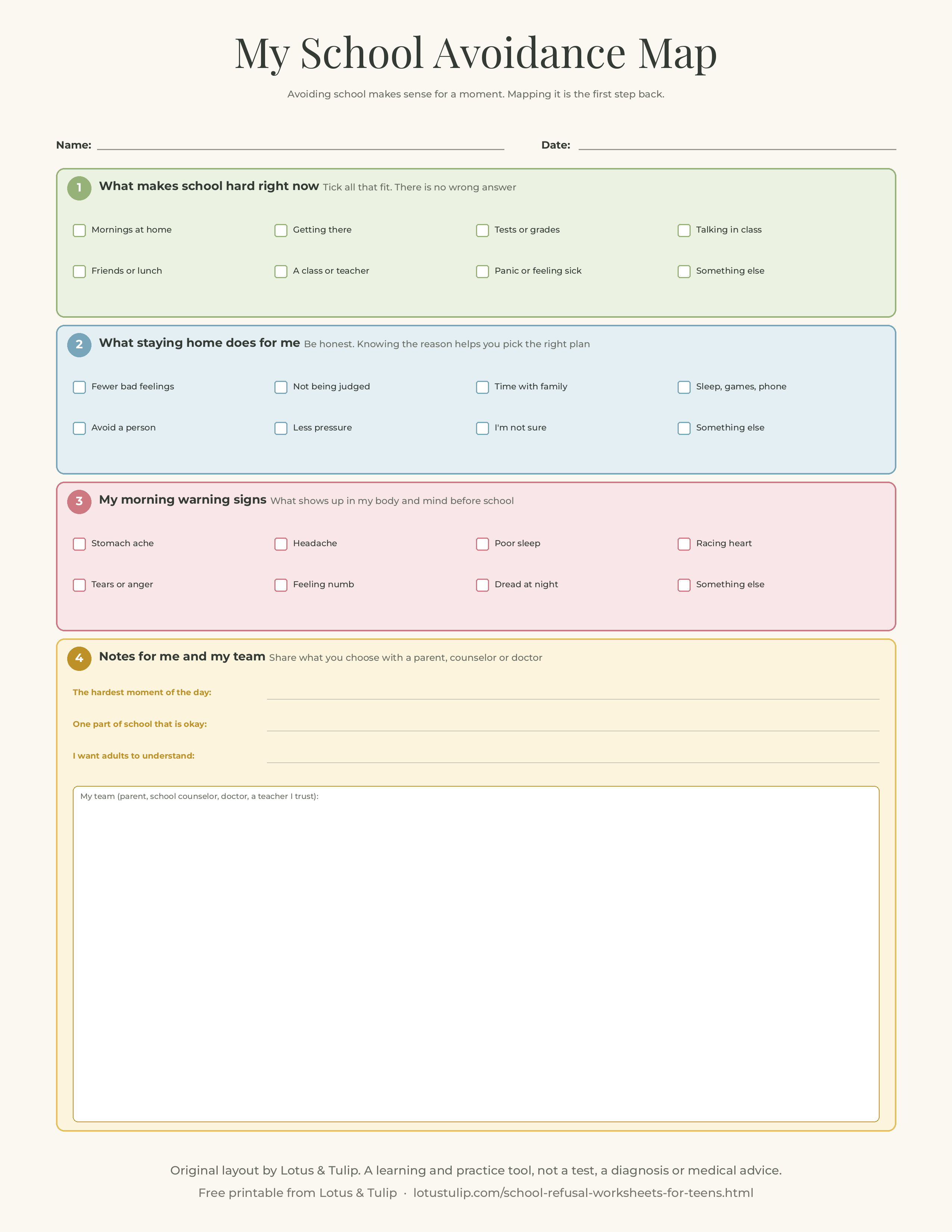
- Fill in My School Avoidance Map together. Let the teen tick what makes school hard, what staying home does for them and their morning warning signs. Listen more than you talk, and do not argue with what they tick.
- Look for the main reason. Fear or misery points to coping skills and gradual steps; fear of being judged points to social anxiety work; wanting to be at home points to a calm, consistent goodbye routine; screens and sleep point to clear house rules on school days.
- Check for problems that adults must fix. Bullying, a learning difficulty, an unsafe situation or a conflict with a teacher needs action from the school, not only coping skills from the teen.
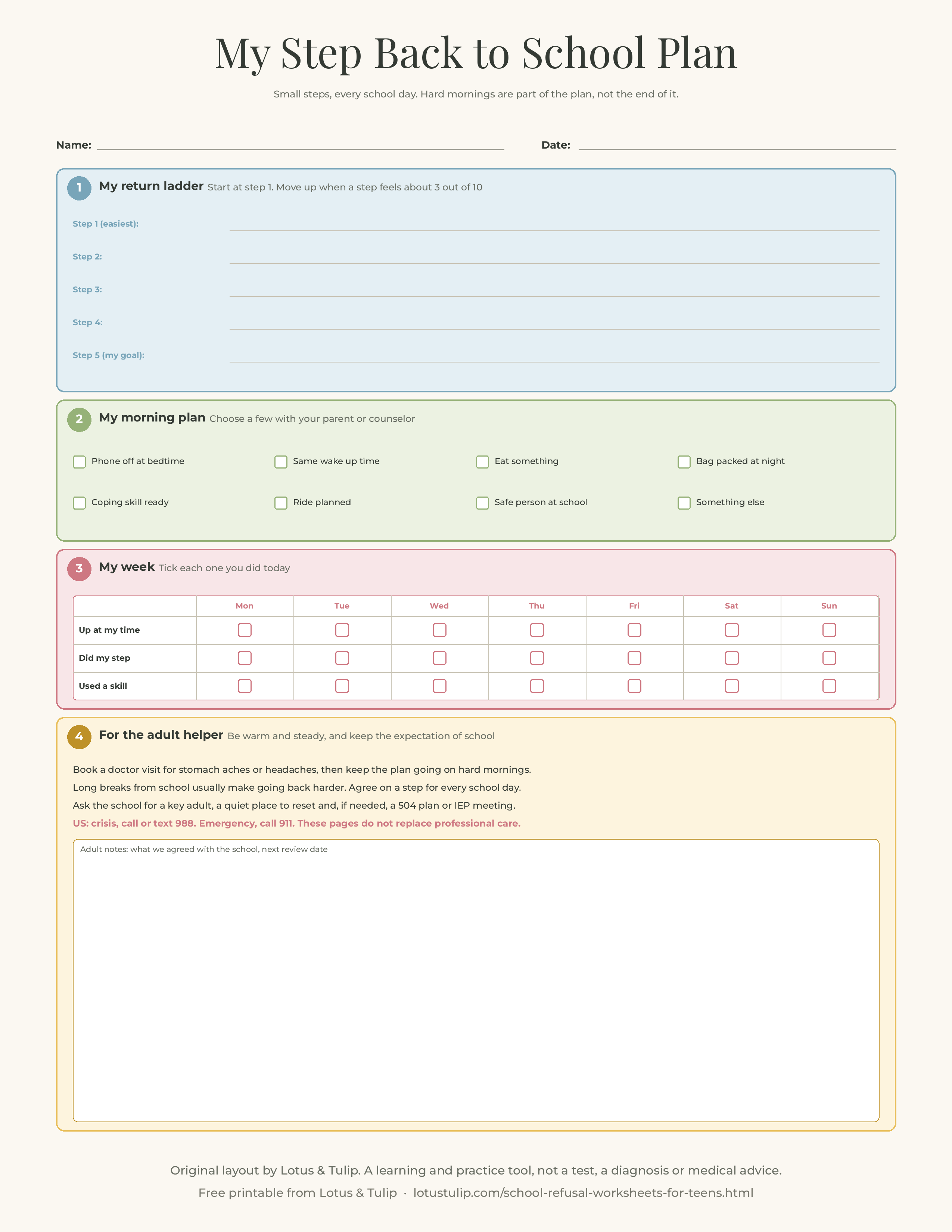
- Build the return ladder. On My Step Back to School Plan, write five steps, starting with one the teen rates about 3 out of 10 in difficulty. Agree on a step for every school day. Staying home all day is not a step.
- Plan the mornings. Choose a few items from the morning plan. Decide in advance who drives, what happens if the teen says they feel sick, and who meets them at school.
- Use the weekly tracker and praise effort. Tick "up at my time," "did my step" and "used a skill" each day. Notice the effort out loud, even on days that went badly.
- Review every week and move up. When a step feels manageable, move up one rung. If there is no progress after two to three weeks, if mood drops, or if the teen talks about hopelessness or self harm, get professional help right away, and call or text 988 in a crisis.
How to adapt it by age
- Ages 12 to 14: parents usually lead the plan with the school counselor. Middle school transitions, friendship changes and puberty are common triggers. Keep steps small and concrete, and use a consistent morning routine. For more on the move up, see middle school transition activities.
- Ages 15 to 16: invite the teen to lead more of the plan. Talk about what they want for the future, such as a sport, a friend group or a course, and link the ladder to that. Social anxiety, academic pressure and low mood are often central at this age.
- Ages 17 to 18: respect their independence and treat them as a partner. Discuss credits, graduation and options such as a modified schedule or a different program. Teens this age are close to adulthood, so the goal is a plan they choose, with adults in a support role.
Supporting a teen with school refusal at school
- Name one key adult. A counselor, teacher or staff member who greets the teen on arrival and checks in during the day.
- Agree on a safe place and a short break plan. A quiet room where the teen can reset for a few minutes and then return to class, rather than going home.
- Reduce the hardest triggers at first. For example, let the teen skip presenting in front of the class for a few weeks or arrive before the crowds, then fade the adjustment as part of the ladder.
- Make catching up manageable. A short, prioritized list of missed work is far less overwhelming than every assignment at once.
- Consider formal supports. If anxiety or depression is affecting learning, families can ask about a Section 504 plan or an IEP evaluation. Write down the agreed supports.
- Address bullying directly. If peers are part of the problem, the school needs to act, not only the teen. See bullying activities for teens.
- Look at attendance data early. School counselors can use attendance data to find students whose absences are starting to climb, and group work can help some of them. See small group counseling for attendance.
Free to print for your own teen, students, clients or groups. Please link to this page rather than re-uploading the file. A learning and practice tool that does not replace professional advice. In a mental health crisis, call or text 988. In an emergency, call 911.
Buy the CBT worksheets for teens on Etsy
Common mistakes
- Waiting until the teen "feels ready." Readiness usually follows small steps, not the other way round. Long breaks make return harder.
- Only pushing, or only protecting. Shouting and threats raise anxiety, and letting the teen stay home whenever they ask keeps the loop going. Aim for warm and firm at the same time.
- Treating it only as a discipline problem. Punishments and attendance letters on their own rarely fix anxiety based refusal. Look for the reasons first.
- Making home days fun. If a day at home means sleeping in and gaming, school cannot compete. Keep school hours quiet and low on screens.
- Jumping straight to a full day. Going from zero to a full timetable often ends in a bad day and a bigger setback. Start where the teen can succeed.
- Ignoring low mood. School refusal often comes with depression. Ask directly about hopelessness and self harm, and get help if you are worried.
Examples
- Ava, 13: started missing Mondays after moving up to middle school, with stomach aches every Sunday night. Her doctor found no medical cause. With the school counselor she filled in the avoidance map and saw that lunch and changing for PE were the hardest parts. Her ladder started with arriving at school before the crowds and eating lunch in the library with one friend. Within a month she was attending every day.
- Marcus, 15: had missed three weeks after a panic attack in math class. His reasons check showed fear of panicking again and of classmates noticing. His therapist used CBT and a return ladder that began with one class next to the counselor's office. His teachers agreed on a short break pass. He reached full days after about two months, with a few setbacks.
- Jordan, 17: was low, sleeping late and gaming most nights, and had stopped going to school. A doctor and therapist assessed him for depression. Together with Jordan, his parents set phone off times, and he chose a modified schedule focused on the credits he needed to graduate. Tracking "up at my time" was the first step he could manage.
Free printable: school refusal worksheets for teens
This printable is an original Lotus & Tulip layout. It is not a screening questionnaire, not the School Refusal Assessment Scale and gives no score. Page 1, My School Avoidance Map, has ticks for what makes school hard right now, what staying home does for me and my morning warning signs, plus notes lines and a box for my support team. Page 2, My Step Back to School Plan, has a five step return ladder, a morning plan, a 7 day tracker and notes for the adult helper, including the doctor check, school supports and the 988 and 911 numbers.
Download the free school refusal worksheets for teens (PDF, 2 pages, US Letter)
Prefer single images? Page 1: My School Avoidance Map (PNG) · Page 2: My Step Back to School Plan (PNG)
Related resources
- Anxiety activities for teens: body cues, worry skills and gentle facing
- Social anxiety activities for teens: when the fear is about being judged at school
- Exposure hierarchy worksheet: how to build a step by step fear ladder
- Small group counseling for attendance: an 8 session group plan for school counselors
- Depression activities for teens: when low mood is part of the picture
- Safety plan worksheet: when the moment is about staying safe
- All counseling resources for kids and teens
FAQ
What is the difference between school refusal and truancy?
School refusal usually involves strong distress such as anxiety or low mood about going to school, and parents generally know about the absences. Truancy usually means skipping school without the parents knowing and without that kind of distress. In a large US community study, anxious school refusal affected 2.0% and truancy 6.2% of 9 to 16 year olds over 3 months, and some young people showed both.
What causes school refusal in teens?
Usually several things together: anxiety, panic or low mood, fear of being judged, bullying or friendship problems, academic pressure, a learning difficulty, a transition to a new school, or family stress. A helpful question is what avoiding school does for the teen: escaping bad feelings, escaping social situations, being at home, or getting sleep and screens.
Should I let my teen stay home when they are anxious?
Occasional days off for illness are fine, but repeated days at home usually make anxiety and the return harder. Research on treatment focuses on gradual, planned return with support at school. Agree on a small step for every school day, check physical symptoms with a doctor, and get professional help if the pattern continues.
Does therapy help school refusal?
Yes. Trials of cognitive behavioral therapy, often with parent and teacher involvement, show improved attendance, and a meta-analysis of 8 studies with 435 young people found a significant effect on attendance. Effects on anxiety were less clear, and older teens can take longer to respond, so stick with it and review progress regularly.
Is medication used for school refusal?
Sometimes, when an anxiety disorder or depression is diagnosed, a doctor may discuss medication. In one trial with 62 teens, adding fluoxetine to CBT did not improve attendance more than CBT alone or CBT with placebo. Decisions about medication belong with your teen's doctor.
How can schools help with school refusal?
Name a key adult, agree on a safe place and a short break plan, reduce the hardest triggers at first, make catching up manageable, act on bullying, and consider a Section 504 plan or IEP evaluation when anxiety or depression affects learning. Work with the family on one shared plan.
When is school refusal an emergency?
If a teen talks about wanting to die, hurting themselves or not being around, call or text 988 and stay with them. If anyone is in immediate danger, call 911. Also get help quickly if your teen has stopped eating, sleeping or leaving their room, or seems very hopeless.
Sources
- Attendance Works and the Everyone Graduates Center at Johns Hopkins University (2026). Chronic absence analysis of 2024 to 2025 state data. attendanceworks.org.
- Egger, H. L., Costello, E. J., and Angold, A. (2003). School refusal and psychiatric disorders: a community study. Journal of the American Academy of Child and Adolescent Psychiatry, 42(7), 797 to 807.
- Elliott, J. G., and Place, M. (2019). Practitioner review: school refusal: developments in conceptualisation and treatment since 2000. Journal of Child Psychology and Psychiatry, 60(1), 4 to 15.
- Hamadi, S. E., Havik, T., and Holen, S. (2025). "Too little, too late": youth retrospectives on school attendance problems and professional support received. Frontiers in Child and Adolescent Psychiatry, 4, 1595289.
- Heyne, D., King, N. J., Tonge, B. J., Rollings, S., Young, D., Pritchard, M., and Ollendick, T. H. (2002). Evaluation of child therapy and caregiver training in the treatment of school refusal. Journal of the American Academy of Child and Adolescent Psychiatry, 41(6), 687 to 695.
- Heyne, D., Sauter, F. M., Van Widenfelt, B. M., Vermeiren, R., and Westenberg, P. M. (2011). School refusal and anxiety in adolescence: non-randomized trial of a developmentally sensitive cognitive behavioral therapy. Journal of Anxiety Disorders, 25(7), 870 to 878.
- Heyne, D., Sauter, F. M., Ollendick, T. H., Van Widenfelt, B. M., and Westenberg, P. M. (2014). Developmentally sensitive cognitive behavioral therapy for adolescent school refusal: rationale and case illustration. Clinical Child and Family Psychology Review, 17(2), 191 to 215.
- Kearney, C. A., and Albano, A. M. (2004). The functional profiles of school refusal behavior: diagnostic aspects. Behavior Modification, 28(1), 147 to 161.
- King, N. J., Tonge, B. J., Heyne, D., Pritchard, M., Rollings, S., Young, D., Myerson, N., and Ollendick, T. H. (1998). Cognitive-behavioral treatment of school-refusing children: a controlled evaluation. Journal of the American Academy of Child and Adolescent Psychiatry, 37(4), 395 to 403.
- Last, C. G., Hansen, C., and Franco, N. (1998). Cognitive-behavioral treatment of school phobia. Journal of the American Academy of Child and Adolescent Psychiatry, 37(4), 404 to 411.
- Maeda, N., and Heyne, D. (2019). Rapid return for school refusal: a school-based approach applied with Japanese adolescents. Frontiers in Psychology, 10, 2862.
- Maynard, B. R., Brendel, K. E., Bulanda, J. J., Heyne, D., Thompson, A. M., and Pigott, T. D. (2015). Psychosocial interventions for school refusal with primary and secondary school students: a systematic review. Campbell Systematic Reviews, 2015:12.
- Maynard, B. R., Heyne, D., Brendel, K. E., Bulanda, J. J., Thompson, A. M., and Pigott, T. D. (2018). Treatment for school refusal among children and adolescents: a systematic review and meta-analysis. Research on Social Work Practice, 28(1), 56 to 67.
- Melvin, G. A., Dudley, A. L., Gordon, M. S., Klimkeit, E., Gullone, E., Taffe, J., and Tonge, B. J. (2017). Augmenting cognitive behavior therapy for school refusal with fluoxetine: a randomized controlled trial. Child Psychiatry and Human Development, 48(3), 485 to 497.
Lotus & Tulip is not affiliated with the researchers, agencies or organizations named on this page. Names in the examples are invented. This page is educational and does not replace professional advice, diagnosis or treatment.