
Kids and teens · Updated 2026-11-06
Depression Activities for Teens (with Free Printable)
Ready-made printable: Depression and Behavioral Activation Worksheets for Therapists Holiday 20% off: about $9.20, was $12 (EUR 10) · instant digital download
Buy on Etsy
Depression activities for teens are practice tools that help middle and high school students name low mood without collapsing into self-blame, rate intensity, take small behavioral activation steps when avoidance shrinks life, schedule pleasure and mastery activities, check sticky thoughts briefly, protect sleep and daily routines a little, reconnect socially in low-pressure ways, log what helps, and know when to pause for safety. Teen depression work is not a longer version of a kids feelings page. Grades, friendships, identity, sports, jobs, and future talk raise the stakes. So does honesty that a hard week is common, while stuck flatness, anhedonia, withdrawal, and lasting hopelessness deserve skill practice and, when severe or lasting, adult backup.
This Lotus and Tulip page is a teen-focused depression activities guide with an original free three page US Letter printable. It targets searches families and helpers actually use: depression activities for teens, depression worksheets for teenagers, teen depression counseling activities, behavioral activation for teens, and depression group activities for teens. It is distinct from our behavioral activation worksheet (BA deep dive for adults and helpers), from mood tracker printable (tracking alone), from self compassion worksheet (kind self talk as the whole page), from sleep hygiene worksheet (sleep as the whole page), from anxiety activities for teens (fear, worry, and facing), from emotional regulation activities for teens (cool body then choose), from coping skills worksheets for teens (broad skill menu), from stress management worksheets for teens (workload and screens), from grief activities for teens (loss and continuing bonds), from self esteem activities for teens (strengths and values), and from cognitive restructuring worksheet (full thought change page). Those neighbors help. This page centers adolescent depression skill practice: low mood vs clinical depression (educational), brief BA basics with a cross-link, activity scheduling and pleasure-mastery, brief thought checks, sleep and routines, social connection, and school and home supports.
We credit research lineages associated with behavioral activation (including Lewinsohn-style pleasant event and activity scheduling traditions, Martell and Dimidjian BA treatment manuals as neighbors, and Cuijpers-style BA meta-analysis summaries) and CBT for adolescent depression review neighbors. We credit those lineages with clear non-affiliation. We are not affiliated with those authors, any scale publisher, or any branded depression curriculum. This printable is an original educational layout, not a copy of any copyrighted worksheet and not a diagnosis or treatment.
This guide is educational. It is not therapy, not medical advice, and not a diagnosis. If thoughts of ending your life, plans to harm yourself or someone else, or a medical emergency show up, stop the worksheet and get help now: in the US, call or text 988, text HOME to 741741, or call 911. Our safety plan worksheet is a better first tool in that moment. Nearby tools: behavioral activation, mood tracker, anxiety for teens, emotion regulation for teens, coping for teens, grief for teens, self compassion, sleep hygiene, and self esteem for teens.
Jump to the free depression activities printable (PDF) · How to use depression activities for teens, step by step · Worked examples · Comparisons
Low mood vs clinical depression (educational, not diagnostic)
Low mood is a common human dip: a rough week after a breakup, a failed test, or a lonely stretch. Energy drops. Fun feels flatter. Sleep can wobble. Clinical depression (including major depressive disorder as discussed in clinical settings) is a lasting pattern of depressed mood or loss of interest plus other symptoms that impair school, friendships, or daily function for weeks, not just a bad afternoon. Educational sorting helps choose tools and know when to escalate. It does not diagnose depression from a printable.
Teens also meet grief, burnout from overload, anxiety that looks like withdrawal, and medical contributors (sleep debt, illness, medication side effects). Those overlap. Use this page for a general teen depression practice loop focused on naming mood, activating behavior, scheduling, brief thought work, sleep, and connection. Prefer neighbors when the scene is mostly loss (grief for teens), mostly fear and avoidance of danger cues (anxiety for teens), mostly flooding (emotion regulation for teens), or mostly sleep as the only lever (sleep hygiene).
Teen depression response skills include:
- Safety sort first when crisis risk, self-harm talk, or acute danger is present.
- Name and rate mood without treating every dip as proof of permanent failure.
- Behavioral activation basics: action can come before motivation; avoidance shrinks life.
- Pleasure and mastery scheduling: one enjoyable and one accomplishment move, written and timed.
- Brief thought check for sticky hopeless or self-attack loops (cross-link, do not rehash whole CBT pages).
- Sleep and routine bricks that shrink next-day flatness fuel.
- Social connection that is low pressure, not forced performance.
- Knowing when not to force practice: optional skill work, never shame for a hard day.
Behavioral activation basics, pleasure-mastery, and scheduling
Behavioral activation (BA) is a simple idea with a strong research neighborhood: when mood drops, people often withdraw from activities that once gave pleasure or structure. Withdrawal removes the feedback that life can still move. Small, planned activities can interrupt that loop. Motivation often rises after a short move, not before. This page gives a teen-sized BA loop. For a deeper BA worksheet (activity monitoring, values, graded tasks), use behavioral activation worksheet.
Pleasure and mastery. Pleasure activities feel enjoyable or soothing (music, a short walk with a friend, a favorite show with limits). Mastery activities give a sense of accomplishment (one homework paragraph, laundry started, a text sent). Teens stuck in low mood often need both. Waiting to "feel like it" can stall both.
Scheduling. Vague plans ("be more active") fail. Written plans with when, where, and how long are more doable. Start tiny: ten minutes, not a perfect gym week. Pair with mood tracker if seeing patterns across days helps, and with goal setting for students when school tasks need chunking.
How to use depression activities for teens, step by step
- Safety sort. If acute crisis, self-harm plans, or imminent harm, pause. Use crisis pathways first: 988, HOME to 741741, or 911 when needed. Prefer a safety plan in that moment. Do not force public depression talk.
- Name mood and rate. Low, flat, heavy, numb, empty, hopeless-tinged. Rate 0 to 10. Keep it specific to this day or scene. Pair with mood tracker if multi-day patterns help.
- BA basics. Notice what you have been avoiding. Remind yourself that a small move can come before motivation. Cross-link to behavioral activation for a full BA page.
- Pleasure and mastery picks. Choose one enjoyable activity and one small accomplishment. Both should be doable today or tomorrow, not a perfect life overhaul.
- Schedule it. Write when, where, and how long. Put it on paper or a phone reminder. Tiny and specific beats grand and vague.
- Thought check (brief). What is the sticky thought ("nothing helps," "I am useless")? What is evidence for and against? What would I tell a friend? Cross-link to CBT thought record, cognitive distortions, and cognitive restructuring when you need a full page. Add self compassion when self-attack is loud.
- Sleep and routine bricks. Pick one: fixed wake time, wind-down start, or one morning brick (shower, breakfast, short walk). Pair with sleep hygiene when sleep is the main fuel.
- Social connect. One low-pressure reach-out: text a friend, sit near someone at lunch, ask a trusted adult for ten minutes. Not forced public sharing. Bridge to friendship for teens when peer repair is the job.
- Log and bridge. Record practice on the log page. Bridge to safety plan, coping skills for teens, emotion regulation for teens, anxiety for teens, grief for teens, self esteem for teens, or stress for teens when those scenes fit better.
Practice naming and scheduling on lower-stakes weeks first when possible, then rely on the full sequence when dips deepen. Skill grows with reps and with adults who coach without shaming.
Thought checks, sleep, routines, and social connection
Thought checks for low mood often target hopeless predictions and harsh self-labels. A short check asks: what am I saying to myself, how sure am I, what else could be true, what is a fair next step. Do not argue a teen out of a feeling. Change the behavior and the evidence base together. Full pages live at thought record and cognitive restructuring.
Sleep and routines. Late nights, inconsistent wake times, and all-day bed loops feed next-day flatness. One guardrail beats a perfect routine nobody keeps. Pair with sleep hygiene and stress for teens when overload and screens are the main load.
Social connection. Depression often whispers that friends do not care. Isolation then "proves" the whisper. Low-pressure contact rebuilds data. Respect introversion. Do not force performances. Prefer optional group activities with clear exit ramps.
School counselor tips. Short meetings favor: safety sort, mood name and rate, one BA or schedule step, one sleep or routine ask, one social connect plan. Groups can practice optional naming and tiny activity planning with low-stakes prompts. Never force public "share your darkest thought." Follow district crisis protocols if risk appears.
Therapist tips. Stay in the client's language. Separate grief, anxiety, burnout, and medical contributors out loud without diagnosing from a printable. Protect before perform. Measure function: fewer skipped classes, earlier asks for help, sleep slightly better, one completed schedule row.
Parent tips. Validate the feeling, coach the skill, do not remove every hard thing or lecture away the mood. Ask the school what flexibility exists on hard days. Do not turn the worksheet into a new weapon ("fill this or else"). Watch for safety risk and escalate early when needed.
Worked fictional examples
Teen example, flat after a failed test (fictional): Riley, age 15, scored poorly on a history exam and has stayed in bed most of Saturday. Mood: flat and heavy, rated 7. Safety sort: no crisis plan. BA: noticed avoidance of studying and friends. Pleasure: twenty minutes of favorite music. Mastery: rewrite three flashcards. Schedule: 4 p.m. desk, phone in another room. Sleep ask: wake by 9 Sunday. Social: text one friend about hanging Monday. Plan on the free depression plan page.
Teen example, withdrawal from lunch table (fictional): Casey, age 16, has skipped lunch for a week because energy feels gone and the table feels loud. Mood: numb, rated 6. Safety sort: no self-harm plan, but mood has lasted. BA: sit for ten minutes with one trusted peer, then leave if needed. Pleasure: short walk after school. Mastery: turn in one late assignment paragraph. Bridge to friendship for teens and behavioral activation for a fuller graded plan.
Teen example, late-night hopeless loop (fictional): Morgan, age 14, scrolls until 2 a.m. replaying "I am behind forever." Mood: hopeless-tinged, rated 8. Safety sort: fleeting thoughts of not wanting to wake up, no plan. Pause skill practice for a safety check with a trusted adult and crisis numbers nearby. Prefer safety plan. Later, when safer: sleep guardrail (phone charges outside room), one morning brick, one tiny mastery task.
School counselor note (fictional): In a twelve minute meeting, a counselor helps a student fill mood name and rate, one BA or schedule step, one sleep or routine ask, and one social connect plan. Optional practice, never forced public sharing. Follow district crisis protocols if risk appears. For multi-session groups, pair with coping or stress curricula rather than stacking every worksheet in one period.
Teen depression vs BA page, mood tracker, anxiety teens, ER teens, coping teens, grief teens, self compassion
| Teen depression (this page) | BA worksheet | Mood tracker | Anxiety teens | ER teens | Coping teens | Grief teens | Self compassion | |
|---|---|---|---|---|---|---|---|---|
| Main job | Name mood, BA basics, pleasure-mastery schedule, brief thought, sleep, connect, log | Deep BA monitoring and graded tasks | Track mood over time | Name, fork, calm, face fear | Cool body then choose | Broad skill menu | Loss, bonds, dual process | Kind self talk |
| Best early use | When teens face low mood with adult support | When BA is the full focus | When patterns across days help | When fear and worry dominate | When flooding blocks thinking | When building a menu | When loss is the scene | When self-attack is loud |
| Output | Mood rating, BA step, schedule, thought note, sleep ask, connect plan, log | BA plan and monitoring | Mood chart | Anxiety plan | Regulation plan | Coping menu | Grief plan | Compassion practice |
| Cross link | This page | BA worksheet | Mood tracker | Anxiety teens | ER teens | Coping teens | Grief teens | Self compassion |
These tools cooperate. Teen depression builds the name-activate-schedule-connect loop. The BA page goes deeper on monitoring. Mood tracker shows patterns. Anxiety teens face fear. Emotion regulation cools the body. Coping teens stock the menu. Grief teens hold loss. Self compassion softens self-attack. Teach one tool clearly before stacking four on day one.
What helps vs common myths
What often helps: naming mood without shame, small scheduled moves before motivation returns, pleasure and mastery pairs, fair thought checks, sleep and routine bricks, low-pressure social contact, optional counseling, peer support that does not force performance, and skill printables used as practice aids.
Myths to drop:
- "You must feel motivated before you move." Motivation often follows a short action. Waiting for the feeling can deepen withdrawal.
- "Depression means you are lazy." Low energy and anhedonia are common in low mood. Skill practice is strength work, not proof of failure.
- "Just think positive." Forced positivity without behavior change often backfires. Pair thought checks with scheduled moves.
- "If you ignore it, it goes away." Mild dips sometimes pass. Stuck withdrawal usually grows.
- "More scrolling will lift the mood." Short rest helps some teens. All-day isolation on a phone often feeds flatness.
- "Only medication or only worksheets work." Care is individual. This page is a practice aid, not a treatment plan.
Common mistakes
- Waiting for perfect motivation so no schedule ever starts.
- Setting huge goals (full gym week, perfect sleep overhaul) that collapse by day two.
- Calling every sad day major depression from a printable alone.
- Ignoring safety risk while only talking activities.
- Forcing public sharing of darkest thoughts in class or group.
- Using anxiety exposure tools as the first response when the load is flat mood and withdrawal, not fear of specific danger.
- Using it in acute crisis instead of safety first.
- Treating the worksheet as therapy. Paper supports practice. It does not replace a clinician, school policy, or crisis care when problems are severe or lasting.
When not to use this worksheet
Good early uses: a teen who can name mood and a scene, mild to moderate low mood with adult support available, homework between counseling sessions, school counseling check-ins, and building a name-activate-schedule sequence.
Prefer another tool first when:
- Acute safety risk or medical emergency: stabilize and get help (988, HOME to 741741, 911). Prefer a safety plan.
- When the teen is too flooded to engage: co-regulate first, then return to plan work. See emotion regulation for teens.
- When fear and worry are the whole load: prefer anxiety activities for teens.
- When loss is the whole load: prefer grief activities for teens.
- When BA needs a full clinical worksheet: prefer behavioral activation worksheet.
- When sleep is the only lever left: prefer sleep hygiene first, then return here.
What the research says (honestly)
Depression activities and worksheets are a skill practice aid, not a standalone RCT treatment. Do not claim this free printable remits major depressive disorder, dysthymia, bipolar depression, or any diagnosis.
Behavioral activation lineage. Traditions associated with Lewinsohn-style pleasant event and activity scheduling work, Martell and Dimidjian BA treatment manuals as neighbors, and Cuijpers-style BA meta-analysis summaries commonly find that BA approaches help many people with depression compared with waitlist or control conditions, with important caveats about study quality, heterogeneity, and access. Credit with clear non-affiliation. This is a map for helpers, not proof that this three page sheet remits clinical depression.
CBT for adolescent depression. Review neighbors on CBT for youth depression commonly find that structured CBT approaches help many young people compared with waitlist or control conditions, again with caveats. Credit with clear non-affiliation. Not a claim that this printable is an RCT treatment.
Honest limits. These reviews are not technique-only RCTs of this printable. Adult support, sleep, school policy, medical evaluation when indicated, and clinical care matter. No study tests this three page Lotus and Tulip printable alone.
Free depression activities printable for teens (PDF)
The free depression activities printable has three pages in US Letter size:
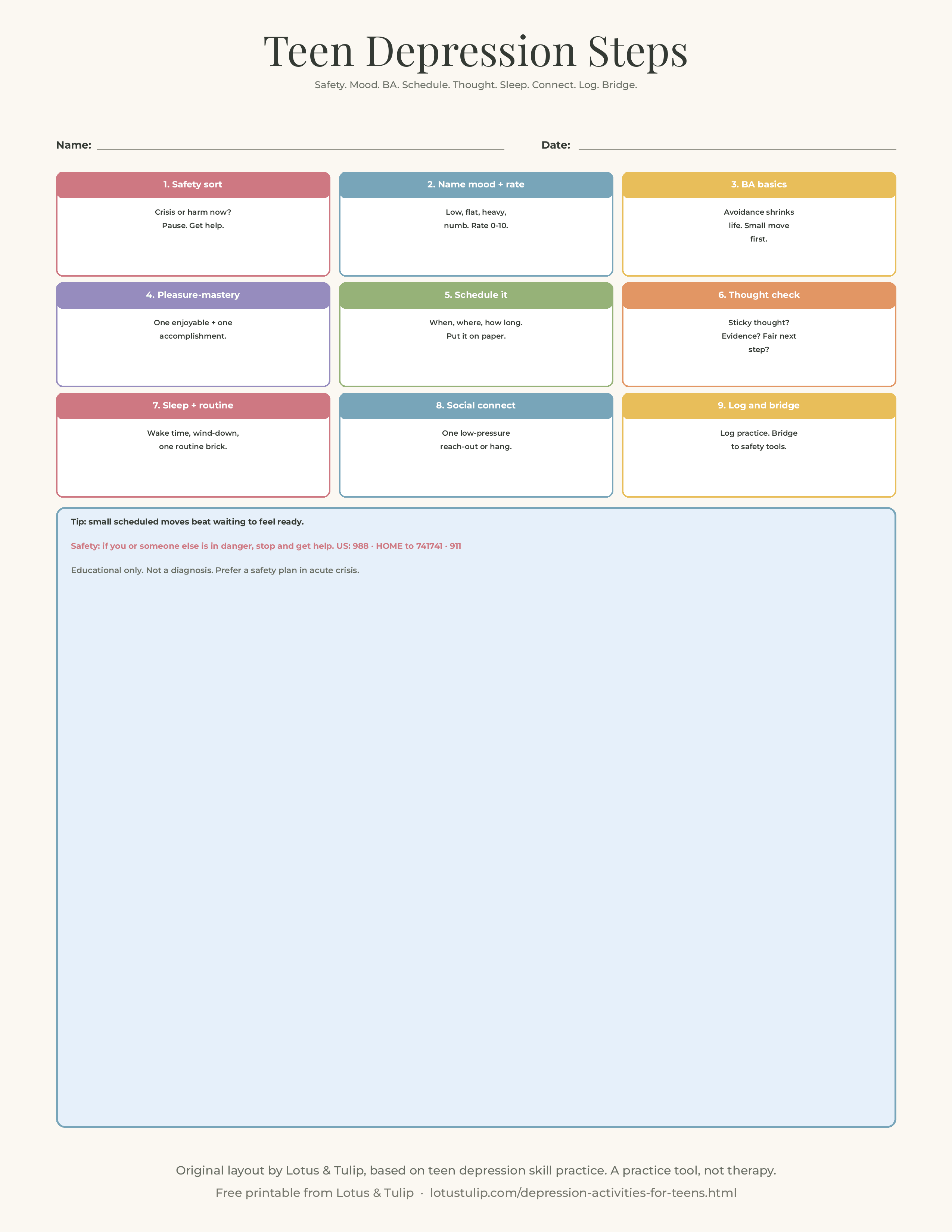
- Page 1: Teen Depression Steps card. Sequence matching the HowTo: safety sort, name mood and rate, BA basics, pleasure-mastery, schedule, thought check, sleep and routine, social connect, log and bridge, plus safety reminders.
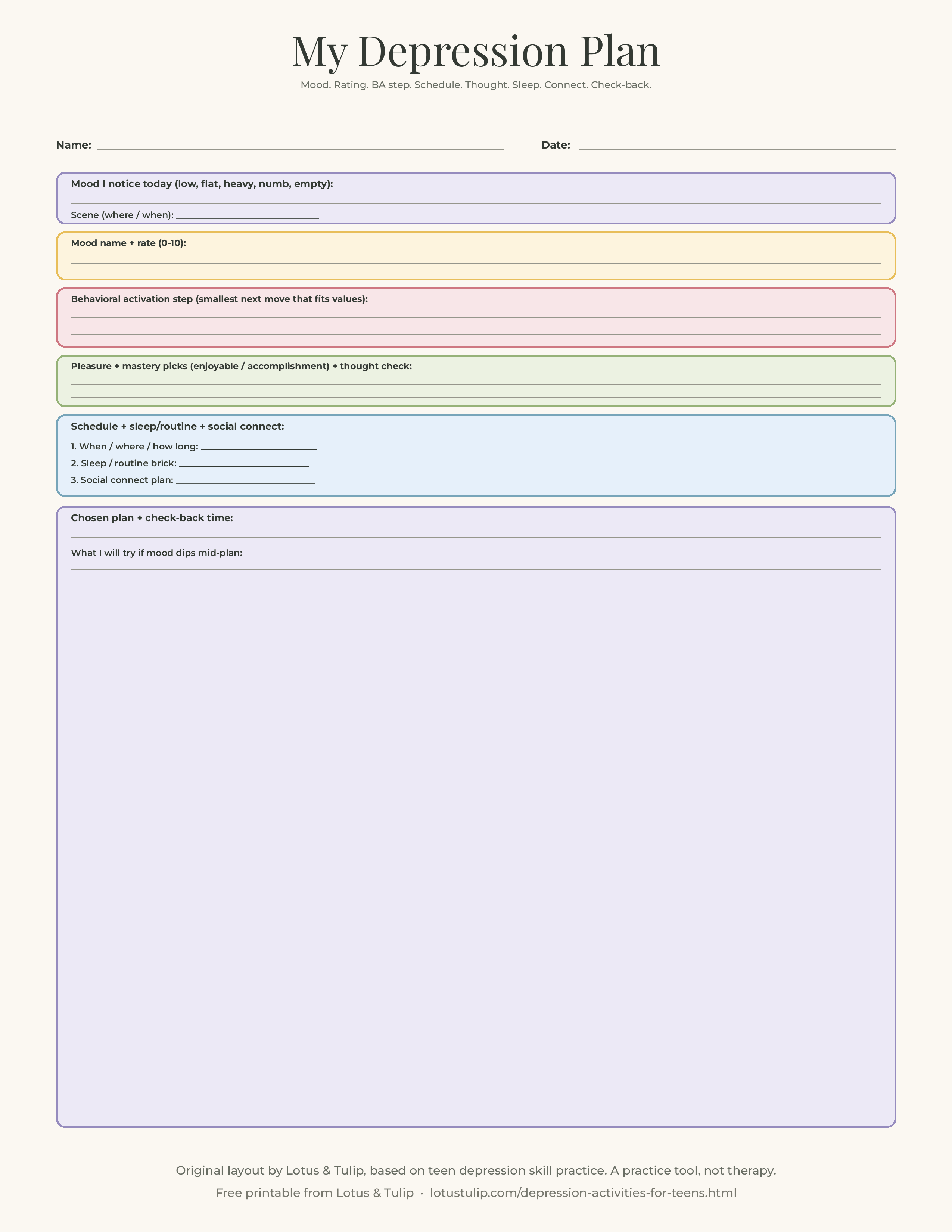
- Page 2: My Depression Plan. Fill in mood, rating, BA step, pleasure and mastery, schedule, thought check, sleep/routine ask, social connect, and check-back.
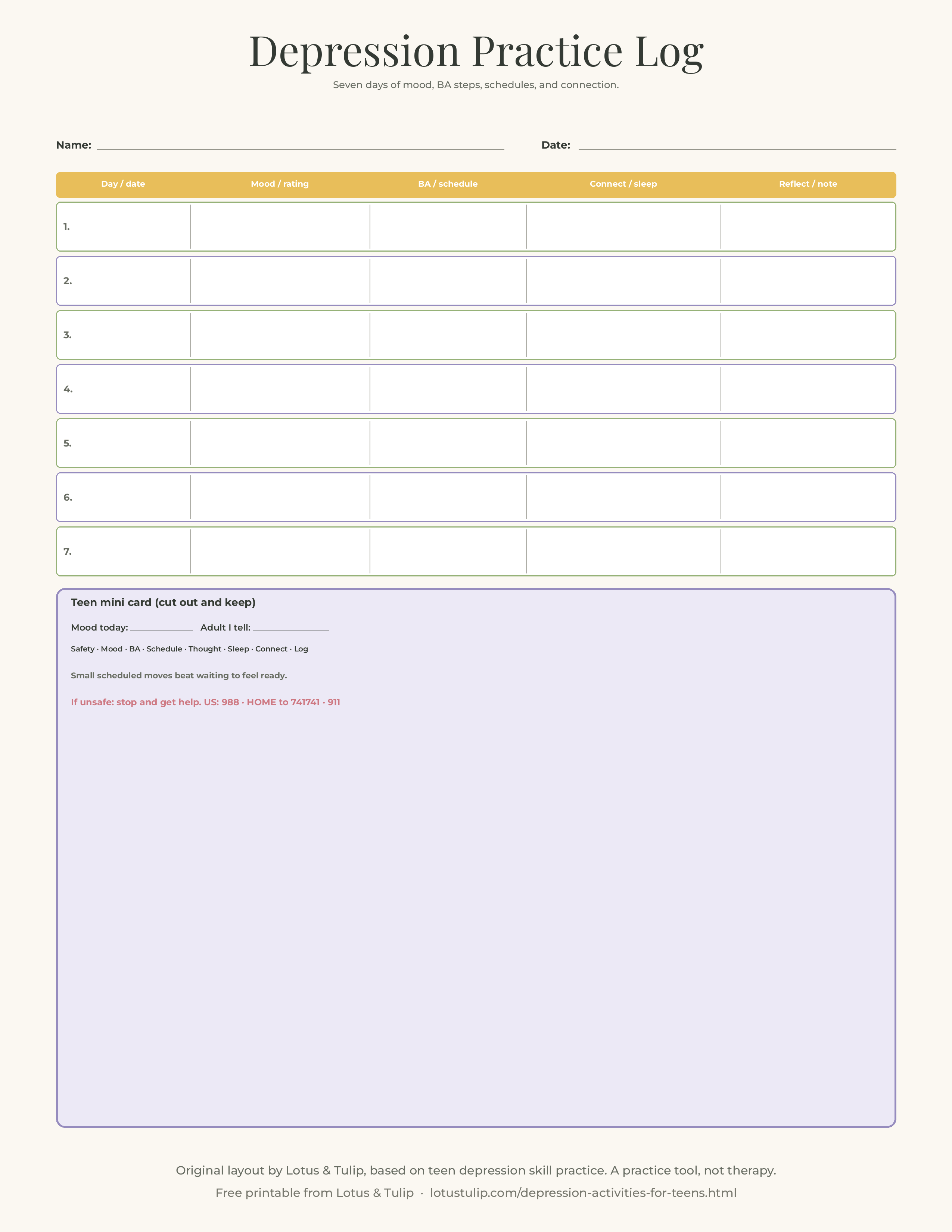
- Page 3: Practice Log + teen mini card. Seven day rows plus a cut out reminder for safety, mood, BA, schedule, thought, sleep, connect, log.
Download the free depression activities printable for teens (PDF, 3 pages, US Letter)
Prefer single images? Page 1: Teen Depression Steps (PNG) · Page 2: My Depression Plan (PNG) · Page 3: Practice Log (PNG)
Free to print for your own use and for use with your own clients, students, or groups. This is an original layout by Lotus & Tulip, based on teen depression skill practice associated with Lewinsohn / Martell Dimidjian / Cuijpers BA meta-analysis lineage neighbors and CBT for adolescent depression review neighbors, with clear non-affiliation. It is not affiliated with those authors, any scale publisher, or any specific treatment or curriculum package, and is not a substitute for therapy. Please link to this page rather than re-uploading the file.
Related resources
- Depression worksheets for kids: feelings weather check and little lifts plan for ages 5 to 12
- Behavioral activation worksheet: deeper BA monitoring and graded tasks.
- Mood tracker printable: track mood across days.
- Anxiety activities for teens: fear, worry, and facing.
- Emotional regulation activities for teens: cool body then choose.
- Coping skills worksheets for teens: broad coping menu.
- Stress management worksheets for teens: workload, sleep, screens.
- Grief activities for teens: loss and continuing bonds.
- Self esteem activities for teens: strengths and values.
- Self compassion worksheet: kind self talk.
- Sleep hygiene worksheet: sleep as the main lever.
- Cognitive restructuring worksheet: full thought change page.
- Safety plan worksheet: when the moment is about staying safe and alive.
Sources
- Lewinsohn-style pleasant event and activity scheduling traditions in behavioral approaches to depression. Educational credit with clear non-affiliation. Not a claim that this printable remits clinical depression or diagnoses anything.
- Martell and Dimidjian behavioral activation treatment manuals and related BA clinical traditions as neighbors. Educational credit with clear non-affiliation.
- Cuijpers-style behavioral activation meta-analysis summaries on BA for depression. Educational credit with clear non-affiliation.
- CBT for adolescent depression review neighbors. Educational credit with clear non-affiliation.
- Honest caveat: teen depression drills are a skill practice aid. Reviews are not the same as RCTs of this Lotus and Tulip printable. Adult support and clinical care when indicated matter.
Free depression starter pack: Want more real pages? The free depression worksheets for therapists starter pack adds the low mood cycle, a daily activity and mood log, an activity menu, break it into small steps, a weekly activity plan and a support and safety page from our paid depression and behavioral activation set (8 pages, client use license, no email).
Depression activities for teens: FAQ
What are depression activities for teens?
They are practice tools for naming and rating low mood, taking small behavioral activation steps, scheduling pleasure and mastery activities, checking sticky thoughts briefly, guarding sleep and routines a little, reconnecting socially in low-pressure ways, and logging what helps. They are educational skill aids, not therapy.
Is this the same as the behavioral activation worksheet?
No. The BA worksheet is a deeper dive into activity monitoring and graded tasks. This teens page centers adolescent depression skill practice with a brief BA loop, scheduling, thought checks, sleep, connection, and school and home supports.
How is this different from anxiety or coping pages for teens?
Anxiety pages focus on fear, worry, and gentle facing. Coping pages stock a broad skill menu. This page centers the depression loop: mood, activate, schedule, connect, log.
Can school counselors use it with teens?
Yes, often in short meetings with safety sort, mood name and rate, one BA or schedule step, one sleep or routine ask, and one social connect plan. Keep practice optional and school safe. Follow crisis protocols when risk appears. Do not use the page as a diagnosis.
Does behavioral activation replace therapy?
No. BA is a practice approach with a strong research neighborhood. This printable is a skill aid. Severe or lasting depression needs clinical care. Do not claim this sheet remits MDD.
When should I not use this worksheet?
Do not use it as the first move in acute safety risk, medical emergency, or when the teen is too flooded to engage. Stabilize and get help when needed: 988, HOME to 741741, or 911. Prefer a safety plan in crisis.
Is this affiliated with Lewinsohn, Martell, Dimidjian, Cuijpers, or any CBT manual?
No. This is an original Lotus and Tulip educational layout. We credit research lineages with clear non-affiliation and do not reproduce copyrighted manual worksheets.