
School counselors · Updated 2026-11-10
Small Group Counseling for Attendance: An 8 Session Chronic Absenteeism Group, Activities, Data, and a Filled Example (Free Printable)
Ready-made printable: Complete Small Group Counseling Bundle Holiday 20% off: about $29.44, was $37 (EUR 32) · instant digital download
Buy on Etsy
Every school counselor has seen the list. Twenty, forty, sometimes a hundred names of students who have already missed 10 percent of the school year, sent over by the attendance clerk or the assistant principal with a note that says "Can you do a group?" It is a fair question and a hard one. Some of those students miss school because a younger sibling has to be dropped off first, or because the bus comes before seven, or because of asthma. Others stay home because their stomach hurts every Monday, because they feel lost in math, because lunch is lonely, or because nobody at home thinks two days a month matters. A small group can help some of those students a great deal. It cannot fix a bus route.
That is the honest starting point for an attendance group, and it is what most of the "attendance group activities" you find online skip. A group that works starts with the reasons, invites the students whose reasons a group can actually reach, meets at a time that gives them a reason to come in, never feels like punishment, and is measured with absence data that is counted the same way before, during and after. The rest, the bus, the housing, the medical care, belongs to the family liaison, the nurse, the attendance team and community partners, working alongside the group.
This guide is for elementary, middle and high school counselors in the United States. It covers what chronic absence means and how it is counted; how big the problem is now, using the most recent national analysis; where a small group fits in a tiered attendance system and in your role as ASCA describes it; how to find out why students are missing school before you invite anyone; who to invite and who needs something else; how to schedule a group for students who, by definition, are often not there; an eight session plan with activities for each session; more attendance group activities by grade band; daily check ins between sessions; working with families without blame; recognition that does not backfire; how to measure results honestly; confidentiality; a ten step process; a fully worked fictional example; six scenarios; common mistakes; and a free three page printable: a blank attendance small group plan, the same plan filled in for a fictional group, and a group attendance and data log.
Jump to the free attendance group plan, filled example and data log
This is educational information for school counselors in the US, not legal or medical advice. States and districts have their own attendance laws, definitions, truancy procedures and consent rules for counseling groups. Check your state's definition, your district's policies and your supervisor's expectations before you start. The sources quoted here were checked on November 10, 2026: Attendance Works, "The Problem," "3 Tiers of Intervention," "Identify the root causes of absence," the Identifying Root Causes Worksheet, "Introducing the Updated DATTs and SATTs" (September 2025), "Reducing Chronic Absence Requires Problem Solving and Support, Not Blame and Punishment," and "Reducing elevated school-levels of chronic absence: Urgent and still within our reach" (June 2, 2026); FutureEd and Attendance Works, "Attendance Playbook: Evidence-Based Strategies for Reducing Student Absenteeism" (October 2026); ASCA's "Appropriate and Inappropriate Activities for School Counselors," the ASCA Student Standards: Mindsets & Behaviors for Student Success, the ASCA Ethical Standards for School Counselors (2022), and the ASCA position statements "The School Counselor and Group Counseling" (reviewed 2026) and "The School Counselor and the Identification, Prevention and Intervention of Behaviors That Are Harmful and Place Students At-Risk"; Maryland regulation COMAR 13A.08.01.05; and the FERPA regulations at 34 CFR 99.3 (current eCFR text).
The short answer
- Chronic absence means missing 10 percent or more of school days for any reason. Attendance Works counts "excused, unexcused absences and suspensions." That is about 18 days in a 180 day year, or two days a month.
- It is still common. In the 31 states with 2024 to 2025 data, Attendance Works and the Everyone Graduates Center at Johns Hopkins found more than 20 percent of students chronically absent, down from 29 percent in 2021 to 2022 but above 15 percent before the pandemic.
- A group is a Tier 2 support. The 2026 Attendance Playbook describes Tier 2 for students "missing 10 to 19 percent of school days" and notes that Tier 2 can be offered "to groups of students in similar circumstances." Students missing 20 percent or more usually need Tier 3 case management first.
- It is squarely your role. ASCA lists "Providing counseling to students who are frequently tardy or absent" as appropriate and "Signing excuses for students who are tardy or absent" as inappropriate.
- Find the reason before you invite. Attendance Works sorts reasons into barriers, aversion, disengagement and misconceptions. A group helps most with the last three. Barriers like illness, transportation and housing need adults to act.
- Four to six students in elementary school, six to eight in secondary, with similar reasons, informed families and screening for each student.
- Meet at the start of the day, keep sessions short, plan for absences, and give every student a daily check in adult between sessions.
- Never make the group feel like a punishment. Use a student facing name, talk about days in school, not days missed, and recognize improvement rather than only perfect attendance.
- Measure with same length windows. Count absences and late arrivals for the same number of school weeks before, during and after the group, and report totals only.
- Expect year to date rates to move slowly. A student who missed 12 days by January can attend almost every day after the group and still be listed as chronically absent in May. Report both the rate and the change.
What chronic absence means, and how it is counted
Attendance Works, the national nonprofit that has done more than anyone to make chronic absence a familiar term in schools, defines it as "missing 10 percent or more of school days due to absence for any reason, excused, unexcused absences and suspensions." Three parts of that definition matter for a counselor planning a group.
Any reason. Chronic absence is not truancy. Truancy is a legal idea about unexcused absences, defined state by state. Chronic absence counts every day a student is not in class, including days with a parent's note and days of suspension. As Attendance Works puts it, "many of these absences, especially among our youngest students, are excused." A student with a perfect set of notes can still be chronically absent, and still be falling behind.
A percentage, not a number of days. Ten percent of the days a student has been enrolled. That makes the measure fair to students who enroll midyear and lets you spot problems early: a student who missed 3 of the first 20 days of school is already at 15 percent, long before the total looks alarming.
Definitions vary in the details. Federal EDFacts reporting, as Attendance Works describes it, counts students who "were enrolled at least 10 days and missed 10%," with a day counted as absent when the student misses half or more of it. Earlier federal Civil Rights Data Collections used a cutoff of 15 or more school days. States set their own rules on enrollment minimums, partial days and what counts as present. Maryland's regulation is a typical example: "'Chronic absence' means a student has been enrolled in a school for at least 10 days and has missed 10 percent or more of the school days for any lawful or unlawful reason while enrolled at that school." Use your state's definition for your data, and say which one you used in any report.
Attendance bands
Attendance Works groups students into bands, which are more useful for planning a group than the single 10 percent line. Its updated District and School Attendance Tracking Tools (September 2025) use five:
| Band | Share of school days missed | What it usually calls for |
|---|---|---|
| Satisfactory attendance | Less than 5 percent | Tier 1: schoolwide engagement and prevention |
| At risk attendance | 5 to 9.99 percent | Tier 1, plus early, personal outreach; a possible group candidate if the reason fits |
| Moderate chronic absence | 10 to 19.99 percent | Tier 2: personalized support, including groups |
| Severe chronic absence | 20 to 49.99 percent | Tier 3: intensive, coordinated support, sometimes with other agencies |
| Acute chronic absence | 50 percent or more | Tier 3, often interagency; a group is rarely the first step |
Attendance Works explains the at risk band this way: "Research shows that this level of absence is associated with a decline in academic performance so it merits attention." It is candid about the severe band too: "Although there is no research to support this cut point, experience suggests that this level of absence requires a more intensified and specialized approach." That candor is a good model for how you talk about your own data.
How big the problem is now
The most recent national picture comes from a June 2, 2026 analysis by Hedy Chang of Attendance Works and Robert Balfanz and Vaughan Byrnes of the Everyone Graduates Center at Johns Hopkins University, using 2024 to 2025 data from the 31 states that had published school level figures. Their summary: "more than 20% of students are still chronically absent, meaning they miss 10% or nearly a month of school." Across those states the overall rate fell from 29 percent in 2021 to 2022 to 21 percent in 2024 to 2025, still above the 15 percent seen in 2017 to 2018, before the pandemic.
The school level numbers are what should shape your expectations. Nearly half (46 percent) of schools in those states still had "high (20-29%) or extreme (30% +) rates of chronic absence," although the share with extreme rates had "almost been cut in half from 41% in 2021-22 to 23% in 2024-25." The same analysis warns that "very high numbers of chronically absent students are beyond the capacity of a single social worker or counselor to address, which is a call for schools to consider their entire system."
That sentence is worth printing and taping to your door. If a quarter of your school is chronically absent, a counseling group for six students is a useful piece of the response, but it is not the response. Use the group, and the data you collect from it, to show what works for a specific set of students, and keep advocating for the schoolwide pieces that only the whole school can do.
Where a small group fits
In a tiered attendance system
Attendance Works recommends "a tiered approach that starts with foundational supports for the whole school." Foundational supports are the conditions that make students want to be at school. Tier 1 strategies "are aimed at encouraging better attendance for all students." Tier 2 interventions "are designed to remove barriers to attendance for students at greater risk of chronic absenteeism," and Tier 3 provides "intensive support to students missing the most school, often involving not just schools but other agencies such as health, housing and social services."
The October 2026 Attendance Playbook from FutureEd and Attendance Works makes the group explicit. Tier 2 interventions are for students "missing 10 to 19 percent of school days at any time during the school year," and "Tier II interventions can be offered to individuals or to groups of students in similar circumstances." The Playbook's Tier 2 section includes early warning systems, home visits, mentors and tutors, help with asthma, mental health interventions and supports for students with disabilities and students from immigrant families. A counseling group sits comfortably next to those, especially next to mentoring: the Playbook notes that a relationship with a trusted adult at school, "whether with a teacher, counselor, tutor, mentor, or another student," can "enhance a student's sense of belonging and reduce absenteeism."
In your role
ASCA's "Appropriate and Inappropriate Activities for School Counselors" is direct. Appropriate: "Providing counseling to students who are frequently tardy or absent" and "Advocating for students at individual education plan and 504 meetings, student study teams and school attendance review boards, as necessary." Inappropriate: "Signing excuses for students who are tardy or absent" and "Coordinating schoolwide individual education plans, 504 plans, student study teams, response to intervention plans, MTSS and school attendance review boards."
In practice, that means you run the group, consult on the team, and advocate for students at attendance meetings, but you do not become the attendance clerk, the excuse note checker or the person who sends truancy letters. If you are asked to do those things, the ASCA document is a calm, professional way to start the conversation with your principal.
ASCA's ethical standards point the same way. Standard A.3.e asks school counselors to "deliver research-based interventions to help close achievement, attainment, information, attendance, discipline, resource and opportunity gaps," and ASCA's position statement on harmful and at risk behaviors names "absenteeism" among the behaviors counselors identify and address, describing the counselor's role as advocating for "systemic, trauma-informed and culturally inclusive, school-based means of identification, multitiered interventions and, when necessary, behavioral and mental health referrals."
The group counseling position statement (reviewed 2026) adds the expectations that apply to every group: sessions that "are planned, goal-focused, evidence-based and short-term in nature," and a "responsibility to screen potential group members and obtain informed consent," with informed consent that includes "the group's purpose and goals, limits to confidentiality and information regarding voluntary participation."
Start with the reasons: barriers, aversion, disengagement and misconceptions
Attendance Works sorts the reasons students miss school into four categories: "Barriers to attendance, aversion to school, disengagement from school and misconceptions about the impact of absences." Its Identifying Root Causes Worksheet lists the common reasons under each. Here is how they map to what a counseling group can and cannot do.
| Category | Examples from the Attendance Works worksheet | Can a group help? | What else is needed |
|---|---|---|---|
| Barriers | Chronic and acute illness; family responsibilities or home situation; poor transportation; housing and food insecurity; lack of access to needed services; impact of trauma; violence in the community | A little: problem solving, knowing who to tell, coping. The barrier itself stays. | Nurse, family liaison, transportation, McKinney-Vento liaison, community partners, health care |
| Aversion | Struggling academically and/or behaviorally; unwelcoming school climate; social and peer challenges; anxiety; unfair disciplinary and suspension practices; undiagnosed disability; caregivers had negative educational experiences | Often, yes: coping skills, belonging, friendship, a trusted adult, a plan for hard moments | Tutoring, teacher consultation, a 504 or special education referral if a disability is suspected, a mental health referral if anxiety is significant |
| Disengagement | Lack of challenging, engaging instruction; bored; no meaningful relationships to adults or peers in school; lack of enrichment opportunities | Yes: connection, goals, a reason to come, links to clubs and activities | Engaging instruction, enrichment and extracurricular access, mentoring |
| Misconceptions | "Absences are only a problem if they are unexcused"; "Missing two days per month doesn't affect learning"; "Lose track and underestimate TOTAL absences"; "Assume students must stay home for any symptom of illness"; "Attendance only matters in the older grades"; "Suspensions don't count as absence" | Yes, for students old enough to act on it: counting days, routines, "sick or ready" questions | Clear, friendly messages to families; the nurse's guidance on when to stay home |
Most students who miss a lot of school have more than one reason, and the categories overlap. A student with asthma (a barrier) may also have fallen behind and now dreads math (aversion). The point is not to label students but to decide whether a group is the right tool, and what has to happen alongside it.
How to find out
Attendance Works is blunt about what works: "efforts to address root causes have increased attendance, while punitive practices have not. Simply put, effective approaches are those that treat student absenteeism as a problem to be solved, not a behavior to be punished." Its guidance on qualitative data says to "listen carefully for reasons why students attend or do not attend school." The June 2026 analysis adds a striking detail from a national principal survey: doing "a deep dive through surveys, focus groups or interviews into why students are not attending" was "the strategy least employed by principals." You can fix that for your group with three simple steps.
- Look at the pattern. Mondays and Fridays? Mornings only, shown as late arrivals? One long absence for an illness, or many single days? Days after a test or on days with a particular class? Patterns hint at reasons.
- Call the family first, in their language, with a warm opening: "I'm calling because we miss Jordan when he's not here, and I'd like to help make mornings easier. What gets in the way?" Ask what helps on the days the student does come.
- Ask the student, privately and without blame: "What's the hardest part of coming to school? What's the best part? If you could change one thing about mornings or about school, what would it be?"
Write a one line summary and a code (B, A, D or M) for each student on page 1 of the free printable. If the main reason is a barrier the group cannot touch, the next step is a person, not a group.
Who to invite, and who needs something else
Good candidates
- Students in the at risk or moderate chronic bands (5 to 19.99 percent) whose main reasons fall under aversion, disengagement or misconceptions.
- Students who arrive late often enough to lose a lot of first period, if your district counts that as absence or partial absence, or if it is heading that way.
- Students returning after a long absence for a reason that is now resolved, who need help reconnecting.
- Students who say they feel disconnected, have no friend at lunch or no adult they would talk to.
Usually not, or not yet
- Students missing 20 percent or more. They need Tier 3: case management, a home visit, coordinated support. A group may come later.
- Students whose absences are mostly about a barrier: a chronic health condition, housing instability, transportation, caring for a family member. Connect the family with the nurse, the family liaison or your district's McKinney-Vento liaison. A group that tells these students "every day counts" can feel like blame for something they cannot control.
- Students with significant anxiety or school refusal. The Playbook describes students who "may miss school entirely, struggle to get to school in the morning, or have difficulty remaining at school throughout the day," and notes that cognitive behavioral therapy "is the most frequently studied intervention for school refusal." These students need an individual plan and often a mental health referral. A worry or coping group may be a good later step, with input from their therapist if they have one.
- Students who would be exposed by the group. If the only thing your group members have in common is "has a lot of absences," students may feel singled out. Frame the group around something students can say out loud with pride: "a group for students who want mornings to go better" or "a group about feeling at home at school."
Size, grades and consent
Four to six students works well in elementary school, six to eight in middle and high school, as with most counseling groups. Keep grades within one or two years so the content fits. Screening matters for every group: ASCA's ethical standard A.7.c asks counselors to "assess student needs to determine if participating in the group is appropriate for the student," and A.7.b to "provide equitable access to participation in groups, including alleviating physical, language and other obstacles."
Standard A.7.d asks counselors to "inform parents/guardians of student participation in and the purpose of the small group." Some states and districts require written consent for small group counseling; follow your district's process. For an attendance group the family letter matters more than usual. It should say what the group is for in positive terms, when it meets, that it is voluntary, and how families can reach you, and it should never read like a truancy notice. Send it after you have spoken with the family, not instead of speaking with them.
Scheduling a group for students who are often not there
An attendance group has a built in problem: its members are, by definition, the students most likely to miss the session. Plan for it.
- Meet at the start of the day, during arrival, morning meeting or advisory, if your schedule allows. It gives students a reason to arrive on time and avoids pulling them from core instruction they already miss too often. Ask teachers first; morning meeting may be the one part of the day a student enjoys.
- Keep sessions short. Twenty five to thirty minutes in elementary school, a class period or advisory block in secondary.
- Pick a midweek day if Monday and Friday absences are part of the pattern.
- Have a two minute catch up for anyone who missed the session: the key idea, their goal for the week and a hello. Use the daily check in for it.
- Never use group as a reward for attendance or removal from group as a consequence. If the group is one of the things that pulls a student in, taking it away is the opposite of what you want.
- Count group attendance separately from school attendance, with simple codes (P present, A absent, L late or left early, X no school), as on page 3 of the printable.
An eight session attendance group plan
This plan is written for grades 3 to 6, with notes for younger and older students below. Each session follows the same shape: a two minute welcome and weekly goal check, a short skill or idea, an activity, and a close where each student sets or adjusts a goal for the week. The ASCA Student Standards listed are the ones the sessions most directly support; choose one or two per session for your lesson plans and pre and post check.
| # | Session | Key idea | Activity | ASCA Student Standards |
|---|---|---|---|---|
| 1 | Welcome, agreements, my mornings | This group is about making school days go better. Everyone here is welcome and nobody is in trouble. | Group agreements, including privacy; "My mornings" map: draw or list a morning from wake up to the classroom door, marking the easy and hard parts. | M 2 (sense of acceptance, respect, support and inclusion); B-SS 1 (communication and listening skills) |
| 2 | Every day counts | A day here, a day there adds up. Two days a month is about 18 days a year. | "Days add up" calendar: shade two days a month for a school year and count. Then shade what one great week of attendance looks like. Students count their own days privately. | M 3 (positive attitude toward work and learning); B-LS 7 (long and short term goals) |
| 3 | My morning routine plan | Mornings start the night before. | Build a five step morning plan with pictures or words: bedtime, alarm, clothes and backpack ready the night before, breakfast, out the door. Practice it in role play. Make a copy for home. | B-LS 3 (time management, organizational and study skills); B-SMS 1 (responsibility for self and actions) |
| 4 | Sick or ready? and Sunday night worries | Some days you need to stay home. Many mornings, the body is worried, not sick. | The school nurse joins for ten minutes on when to stay home and when to come and see the nurse. Then a "worry or sick?" body map and one calm tool to practice (slow breathing, a coping card). | M 1 (whole self, including mental, social/emotional and physical well-being); B-SMS 7 (effective coping skills) |
| 5 | What I can and cannot control | Some things that get in the way are mine to change; some need an adult's help. | Sort cards into "I can," "An adult can help," and "Not in my control." Students name one thing to try and one adult to tell. Follow up with families on the second pile. | B-SMS 6 (ability to identify and overcome barriers); B-SS 8 (advocacy skills for self) |
| 6 | My people at school | Knowing someone is glad to see you makes the door easier to walk through. | "My people" map: adults and friends at school, and one place in school I like. Write a two line note to one adult; deliver it with the counselor. | B-SS 3 (positive relationships with adults to support success); B-SS 2 (positive, respectful and supportive relationships with students) |
| 7 | Coming back after an absence | Coming back is easier with a plan. | Practice a short script ("I was out yesterday. What did I miss?") with the teacher and a buddy. Make a "back to school" checklist: who to see, where to find missed work, who to ask for help. | B-SS 8 (advocacy skills for self); B-SMS 10 (ability to manage transitions and adapt to change) |
| 8 | My here and ready plan | You have a plan, people, and proof that it works. | Post check. Each student writes or draws a one page plan with their morning steps, their people, their calm tool and their goal. Celebration with a certificate for effort and improvement, and a positive note home. | B-SMS 5 (perseverance to achieve long and short term goals); B-LS 7 (goals) |
Session details and scripts
Session 1. Start with what students have in common that they can say with pride: "Everyone here has things that make mornings or school hard sometimes. We're going to work on making school days go better, together." Avoid saying "you're here because you've missed too much school." Agree on four or five group agreements, including "What we say here stays here, except when someone might be unsafe," and explain that limit in student language. The "My mornings" map tells you more about reasons in ten minutes than any form. Close with the first weekly goal: say good morning to your check in adult every day this week.
Session 2. The math is the lesson. In a 180 day year, two days a month is 18 days, about 10 percent, or nearly a month of school. Let students shade it on a year calendar. Older students can calculate their own percentage privately on a card you prepare with their days enrolled and days absent; younger students can count stickers for days in school this month. Keep every student's numbers private. The tone is "look how much a few days matter," never "look how much you've missed."
Session 3. Morning routines are concrete and students can own them. Ask: "What's one thing you could do the night before so the morning is easier?" Students choose their own steps. For students whose mornings depend on adults, include a step they control ("put my shoes by the door") and note on your plan which family follow up might help ("Does the family have an alarm clock? Could the before school program help?").
Session 4. This session addresses the misconception Attendance Works lists as "Assume students must stay home for any symptom of illness," without giving medical advice. Invite your nurse, who can explain the school's guidance and, if your district has one, a family guide on when a child should stay home. Then separate worried bodies from sick bodies: stomachaches and headaches that come on Sunday nights or before a test, and fade once the school day gets going, are common in worried children, and the nurse can help sort which is which. Teach one calm tool and practice it. If a student describes worry that keeps them home often, follow up individually; that may be a referral, not a group topic.
Session 5. Sorting cards ("My alarm didn't go off," "The bus came early," "I didn't finish my homework," "I had a fight with my brother," "Someone is mean to me at lunch," "I was really sick") into what I can change, what an adult can help with, and what is not in my control helps students stop blaming themselves for barriers and start acting on what they can change. The middle pile is your follow up list for families, teachers and the attendance team, shared in general terms and with the student's knowledge.
Session 6. Belonging is one of the strongest pulls toward school. The Playbook cites a 2022 research review that found "higher levels of school connectedness were associated with lower levels of depression and fewer symptoms of anxiety." A "My people" map shows you which students have no adult they would go to; those students are your priority for a check in adult or mentor. Delivering a note to an adult is a small, brave act that builds a relationship.
Session 7. Many students stay home a second day because the first day back feels awkward: missed work, questions, catching up. Practice the return. Ask teachers ahead of time to greet returning students warmly and privately ("Glad you're back. Here's what you missed.") and to avoid public comments about absences.
Session 8. Give the post check before the celebration so the party does not inflate the results. Each student leaves with a one page "Here and ready" plan and a positive note or call home that names a specific improvement. Recognize effort and improvement, not perfect attendance. Tell students how the check in will continue.
Adapting for younger and older students
- Kindergarten to grade 2: at this age, attendance is mostly in adults' hands. Focus the group on belonging, feelings about school and a picture morning routine, and put most of your energy into family partnership. A short family session or workshop often does more than a student group.
- Middle school: students can track their own data, set goals and plan for specific classes or times that are hard. Add sessions on catching up on missed work, talking to teachers and handling peer conflict.
- High school: link attendance to credits and goals students care about: graduation, a job, a sport, a program. Add problem solving for work schedules and family responsibilities; Attendance Works lists "Need to work conflicts with being in high school" among the reasons students miss school. Give students a voice in what would make school worth coming to, and pass it on.
More attendance group activities, by grade band
Use these to swap into the eight session plan, to extend it, or for a booster session after the group ends.
Elementary
- Good morning photo walk. Take pictures (no faces of other students) of the friendly places on the way into school: the crossing guard, the library, the classroom door. Make a picture strip students can look at on hard mornings.
- Morning routine picture cards. Students order cards (wake up, wash, dress, eat, backpack, shoes, out the door) and make a copy for home.
- Days in school paper chain. Add a link for every day in school, kept privately in the counseling office, or a class chain with a link for every student present each day, so nobody is singled out.
- Worry or sick body map. Color where the body feels worry; talk about what helps.
- "Why I come to school" collage. Friends, lunch, art, a favorite teacher, the book corner.
- Brave morning puppet show. Puppets act out a hard morning and a plan that works.
- Welcome back card. Students design a card the class can give anyone returning after an absence.
Middle school
- Attendance math challenge. Calculate how many days 10 percent is in your school's calendar, what one missed day a week adds up to by June, and how many days a made up student could still miss and stay under 10 percent. Students do their own numbers privately.
- Hard part of the day graph. Students rate each period of the day from 1 to 5 and plan for the lowest one: who to sit with, who to ask, what to bring.
- Catch up plan. Practice finding missed work in the learning platform, emailing a teacher, and using a study buddy.
- If, then plans. "If my alarm doesn't go off, then I will..." "If I feel sick on the bus, then I will..." Students write three.
- My people and places map. Adults, peers, clubs and spaces where they feel comfortable, with one new club or activity to try.
- Two week goal sprint. Students set a small, measurable goal (on time three days this week) and check it with their check in adult daily.
High school
- Credits and days. Map how absences connect to grades and credits in the courses each student cares about.
- Future me letter. Write a letter from yourself on graduation day explaining what got you there.
- Week planner with work and family. Plan a realistic week around jobs, siblings and transport, and identify one change an adult could help with.
- Student voice round. "What would make school worth getting up for?" Collect anonymous ideas to share with the principal or the school counseling advisory council, in totals.
- Peer support pairs. Pair group members to send a "you coming?" reminder, with families' agreement and clear limits.
- Reentry rehearsal. Practice the conversation with a teacher after several days out, including asking for a plan to catch up.
- Exit plan to clubs and activities. Every student leaves the group with one activity, team, club or job related program to try.
Daily check ins between sessions
One session a week is not enough contact for students whose problem is daily. Give every group member a check in adult they see each morning: the office manager, the nurse, a coach, a teacher who is not their classroom teacher, or you. The check in takes a minute: a greeting by name, "glad you're here," a look at the week's goal, and, if the student was out, "we missed you, what happened, what can help?"
This borrows from what the Playbook describes for mentoring. In the success mentor research it summarizes, "mentors from the community or school staff were successful when they worked with students at least three days a week for a total of at least 15 hours, managed a reasonable caseload, had access to attendance data, and participated in weekly student success meetings led by the principal." Researchers at Johns Hopkins "found that students who had been chronically absent gained nine additional days of learning after working with success mentors, when compared to students who didn't." A brief daily check in is lighter than a full mentoring program, and you should not expect the same results from it, but it uses the same ingredients: frequency, a relationship and data.
Tell check in adults what they can and cannot say. They should know the student's goal and that the student is in a group about making school days go better. They do not need to know the family's circumstances.
Working with families, without blame
- Call before you send anything in writing. A warm call first, then the group letter, in the family's language.
- Lead with the child. "We love having Maya here. On the days she comes, she lights up art class."
- Ask, then listen. "What makes mornings hard?" "What helps on good days?"
- Share the math, kindly. Many families do not know that a few days a month adds up to about 10 percent. Attendance Works lists "Missing two days per month doesn't affect learning" as a common misconception, not a failing.
- Offer something concrete. An alarm clock, a before school program, the nurse's guide on when to stay home, a bus stop or route request, a family workshop.
- Send good news. A call or note when attendance improves may be the first positive school contact a family has had in months.
- Keep your role clear. If a family is already receiving formal truancy letters, explain that the group is support, separate from that process, and that you are on the student's side.
Recognition that does not backfire
Perfect attendance awards are popular and well meant, but they reward students who were never at risk, and they are out of reach for a student with asthma or one who missed the first two weeks. In a group, recognize what students can control: effort, improvement, a week of on time arrivals, coming back the day after an absence, helping a friend. Keep it private or group based rather than public lists of names, and never single out a student's numbers in front of others. Small, immediate recognition (a positive note home, lunch with the counselor, a turn to choose the group's opening activity) usually means more to students than a big prize at the end of the year.
Measuring results honestly
ASCA's ethical standard A.7.f asks counselors to "use data to inform group topics, establish well-defined expectations and measure the outcomes of group participation," and A.7.g to "reflect on group outcomes and determine adjustments that may improve future group interventions." For an attendance group, the most important data is attendance itself, but how you count it decides whether the result means anything.
Use same length windows
Count absences and late arrivals for each student for the same number of school weeks before the group, during the group, and after it. For an eight week group, that is the eight school weeks before the first session, the eight weeks from the first session to the last, and the eight weeks after. Leave out weeks with no school in all three windows. Report group totals and the number of students whose absences went down.
Report the year to date rate, and explain it
Your principal will ask how many students are still chronically absent. Answer, then explain. A student who missed 12 of the first 88 days (13.6 percent) and then misses only 5 of the next 72 days will still be at 10.6 percent (17 of 160). That student has changed a great deal; the year to date rate has not caught up. Show both numbers side by side, and start groups early in the year when you can.
Add a short pre and post check
Six to eight items on a four point scale, given in the first and last sessions, tied to the ASCA Student Standards your sessions targeted. Examples:
- "I know what I will do the night before to make my morning easier." (B-LS 3)
- "I know two adults at school I can go to." (B-SS 3)
- "When my body feels worried in the morning, I have a way to calm down." (B-SMS 7)
- "I know what to say to my teacher when I come back after being absent." (B-SS 8)
- "I feel like I belong at this school." (M 2)
- "Coming to school every day helps me learn." (M 3)
The pre and post assessment guide linked below has more on writing items and scoring. Be modest in what you claim: a small group with a self report check and no comparison group is a useful signal, not proof. Saying so plainly is part of good practice.
Confidentiality and records
Attendance records are part of students' education records under FERPA, which defines education records as records that are "directly related to a student" and "maintained by an educational agency or institution or by a party acting for the agency or institution" (34 CFR 99.3). Share individual attendance data only with school officials who have a legitimate educational interest, under your district's policy, and use totals in any wider report.
Inside the group, privacy needs extra care because attendance is something students can see about each other. ASCA's standard A.7.h asks counselors to "communicate the aspiration of confidentiality as a group norm, while recognizing and working from the protective posture that confidentiality for students in small groups cannot be guaranteed."
- No charts of named students' attendance on the wall or in group.
- Students count their own days privately; group activities use made up students or group totals.
- Do not discuss a student's family circumstances in the group.
- Use student codes on any copy of your plan or log that leaves your office, as the free printable does.
- Store your plan, notes and log according to your district's records policy.
How to run a small group for attendance, step by step
- Pull the data and choose the band. List students in the at risk and moderate chronic bands using your state's definition, and note grade, percent missed and the pattern of absences.
- Find the reasons. Call each family in their language, talk with each student, and code the likely reasons as barriers, aversion, disengagement or misconceptions.
- Send barriers to the right adults. Connect illness, transportation, housing and caregiving needs to the nurse, family liaison, transportation office, McKinney-Vento liaison or community partners, and move students missing 20 percent or more to a Tier 3 plan.
- Screen and invite. Choose four to eight students whose reasons a group can reach, check each student's fit, give the group a positive name, and inform parents or guardians under your district's process.
- Schedule for absences. Pick a start of day, midweek time if possible, keep sessions short, and plan a two minute catch up for anyone who misses a session.
- Set up daily check ins. Give each student an adult to greet them every morning and share only the student's goal.
- Collect baseline data. Record absences and late arrivals for the same number of school weeks before the group, the percent missed at the start, and the pre check in session 1.
- Run the eight sessions. Welcome and goal check, one key idea, an activity and a weekly goal each time, with privacy norms and no public numbers.
- Close well. Give the post check before the celebration, send a positive note home naming each student's improvement, and keep the check ins going.
- Measure, report and adjust. Compare same length windows before, during and after, report totals and the year to date rate with an honest note on limits, and change what did not work for the next group.
A worked example (fictional): the "Here and Ready" group at Maple Hollow Elementary
Maple Hollow Elementary is a fictional public elementary school with kindergarten to grade 5 and three classroom teachers per grade. J. Rivera is the school counselor. The needs assessment guide, the referral form guide, the permission slip guide, the pre and post assessment guide, the lesson plan template guide, the progress notes guide, the termination guide and the advisory council guide follow the same school through the 2027 to 2028 school year. In the advisory council guide, the school's achievement gap plan focused on kindergarten and grade 1 attendance through arrival check ins and family outreach. This example shows a separate Tier 2 group for older students that J. Rivera ran in the second half of the year. Every name, number and date is invented for illustration.
Finding the students
At the attendance team's data review on Friday, January 14, 2028, eleven students in grades 4 and 5 were in the moderate chronic band. None were above 20 percent. J. Rivera and the family liaison called every family between January 18 and January 20, in English or Spanish. Five of the eleven had reasons the group could not reach: two students with ongoing medical conditions, now followed by the nurse with a health plan; one family in temporary housing, connected with the district's McKinney-Vento liaison; and two students whose absences were mostly a long family trip in December, whose families got a friendly call about the school calendar instead.
That left six students, coded S1 to S6 in her plan, all missing between 10.2 and 14.8 percent of the days they had been enrolled. Their likely reasons, from the calls and student conversations: dread of mornings and stomachaches before school (aversion) for three students; feeling bored or without a friend at lunch (disengagement) for three; and, for three families, the belief that a day or two here and there did not matter (misconceptions). One student, S4, also had a barrier: younger siblings who had to be dropped at another school first. The family liaison helped that family enroll the student in the before school program, which opened at 7:15.
Families received a letter on Tuesday, January 18, after the calls, describing "Here and Ready," a group "for students who want school mornings to go better," on Tuesdays from 8:10 to 8:40 for eight weeks, with the district's consent slip. All six families returned it.
The plan
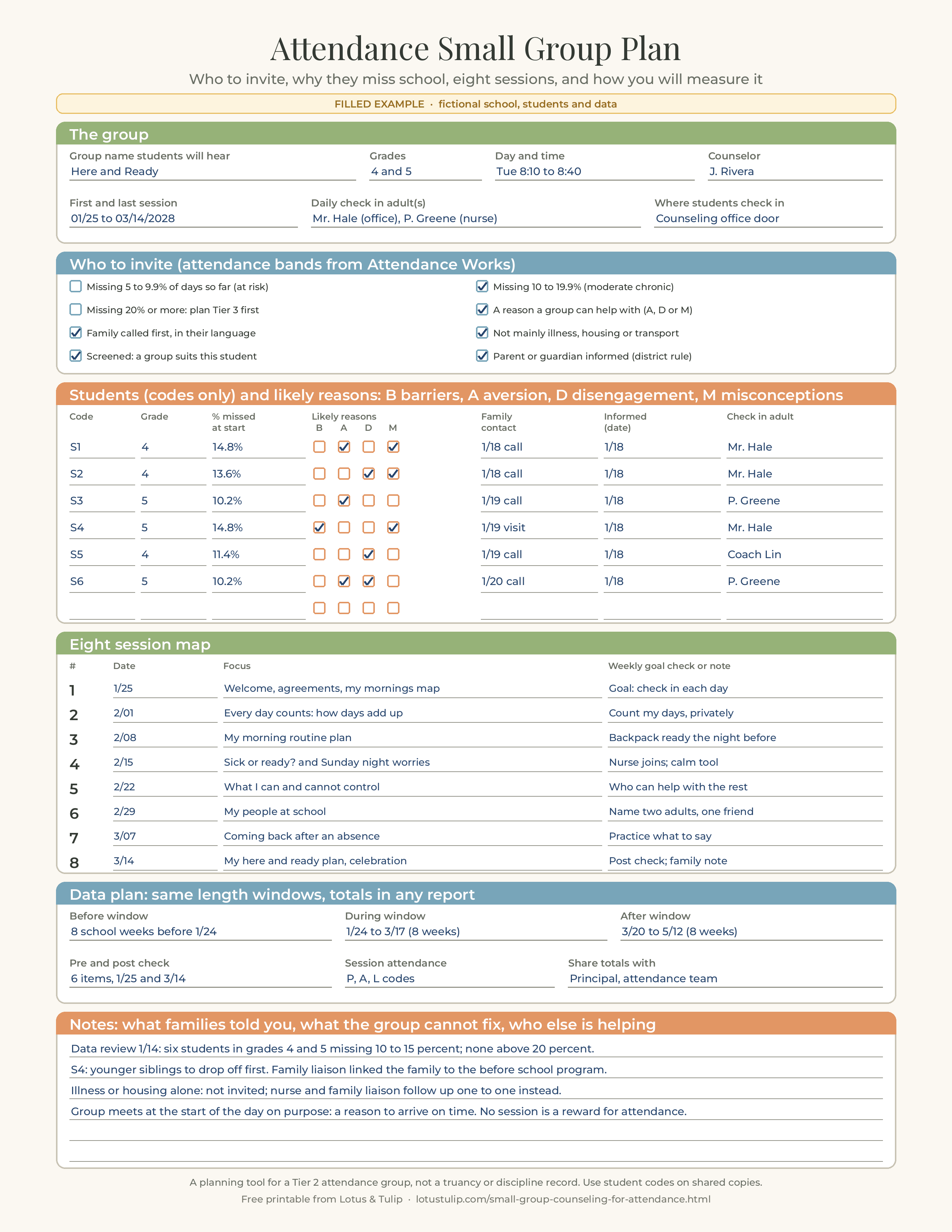
Page 2 of the free printable shows the plan J. Rivera filled in. The group met in the counseling office during the morning meeting block, with the classroom teachers' agreement, on eight Tuesdays: January 25, February 1, 8, 15, 22 and 29, and March 7 and 14, 2028. Each student had a daily check in adult: Mr. Hale in the front office for three students, the nurse, P. Greene, for two, and Coach Lin for one. Check ins happened at the counseling office door on arrival.
The data plan used three windows of eight school weeks each: before (the eight school weeks before January 24, not counting winter break), during (January 24 to March 17) and after (March 20 to May 12). The pre and post check had six items like the examples above, scored 1 to 4, for a total out of 24.
What happened
Students attended 44 of 48 possible group sessions; three of the four missed sessions were school absences on a Tuesday, and each of those students got a two minute catch up the next morning with their check in adult. In session 2, two students said they had not known that "a couple of days a month" added up to almost a month of school. In session 4, P. Greene explained the school's guidance on when to stay home, and the group practiced "balloon breathing" for morning stomachaches. In session 5, the "an adult can help" pile included "my alarm is my mom's phone and she leaves early" and "the walk is long when it rains"; J. Rivera followed up with those families, and the family resource center provided two alarm clocks. In session 6, one student could not name any adult at school she would go to; Coach Lin became her check in adult and invited her to the spring running club.
Results, in totals
| Measure | Before (8 weeks) | During (8 weeks) | After (8 weeks) |
|---|---|---|---|
| Days absent, six students combined | 29 | 14 | 13 |
| Late arrivals, six students combined | 31 | 12 | Not tracked |
| Students with fewer absences than in the before window | Not applicable | 6 of 6 | 6 of 6 |
- Group sessions attended: 44 of 48 possible.
- Pre and post check: the group average rose from 13.5 to 18.3 out of 24. The item that rose most was "I know two adults at school I can go to."
- Year to date: in January, all six students were between 10.2 and 14.8 percent. On May 12, 2028, four of the six were below 10 percent for the year to date. The other two were still above 10 percent, though lower than in January, and stayed on the attendance team's list for a fall check in.
J. Rivera reported these numbers to the principal and the attendance team as totals, with one sentence on limits: "This is a small group with no comparison group, and the results are a promising signal, not proof." For next year, she wrote three changes on page 3 of her log: start the group in October rather than January so year to date rates have time to recover, invite families to a short session 8 celebration, and keep the daily check ins going for at least four weeks after the group.
Six real world scenarios
1. "Can you run a group for all 40 chronically absent students?" An administrator hands you a long list. Thank them, then sort it: band, pattern and likely reason. Offer two or three groups for students whose reasons a group can reach, name the barriers that need other adults, and show the list of students who need Tier 3. A high number is a schoolwide issue; the Attendance Works analysis says plainly that very high numbers are "beyond the capacity of a single social worker or counselor to address."
2. A student misses most of the group sessions. Do not drop them, and do not make it a consequence. Move them to a brief individual check in, ask what gets in the way of that morning in particular, and consider whether they need a Tier 3 plan. A group they cannot attend is not the right support right now.
3. A parent is angry about attendance letters. A family has received a formal truancy letter and arrives upset. Listen first. Explain that you are not part of the legal process, that the group is support, and that you want to help solve what makes mornings hard. Bring in the administrator for questions about the letter itself.
4. The real reason is anxiety. During session 4 a student says she feels sick every school morning and cries in the car. That is more than a group topic. Talk with her privately, call the family, consult your school psychologist or social worker, and consider a referral for a mental health assessment. She may still benefit from the group, or from a worry group later, alongside an individual plan.
5. A student tells the group about a problem at home. A student says he stays home to look after his little sister when his mom works. Thank him, steer the group back gently ("That sounds like a lot to handle; let's talk more after group"), and follow up privately. If the information raises a safety concern, follow your district's reporting procedures.
6. The data did not improve. Absences in the during window were about the same as before. Report it anyway, and look for why: were the reasons right? Did students actually attend the sessions? Were daily check ins happening? Was a barrier missed? A group that shows no change is useful information for the attendance team, and A.7.g asks you to reflect on it and adjust.
Common mistakes
- Calling it "the attendance group" to students. Give it a positive name and a purpose students can say out loud.
- Inviting students whose absences are mostly barriers. A group cannot fix a bus route or a health condition, and it can feel like blame.
- Skipping the family call. The letter is not the conversation. Most of what you need to know comes from the call.
- Meeting at a time students are least likely to be there. Monday mornings and Friday afternoons are hard for this group.
- Public charts with names. Students compare, and some will feel shamed. Keep individual numbers private.
- Using the group as a reward or its removal as a consequence. If it pulls students in, keep it available.
- No daily contact. A weekly session alone is a thin thread for a daily problem.
- Different length windows. Comparing eight weeks before with four weeks after makes any result look good or bad by accident.
- Reporting only the year to date rate. It hides real improvement. Show the change too.
- Taking on attendance clerk duties. Signing excuses and coordinating attendance review boards are on ASCA's inappropriate list. Advocate, consult and counsel instead.
Free printable: attendance small group plan, filled example and data log
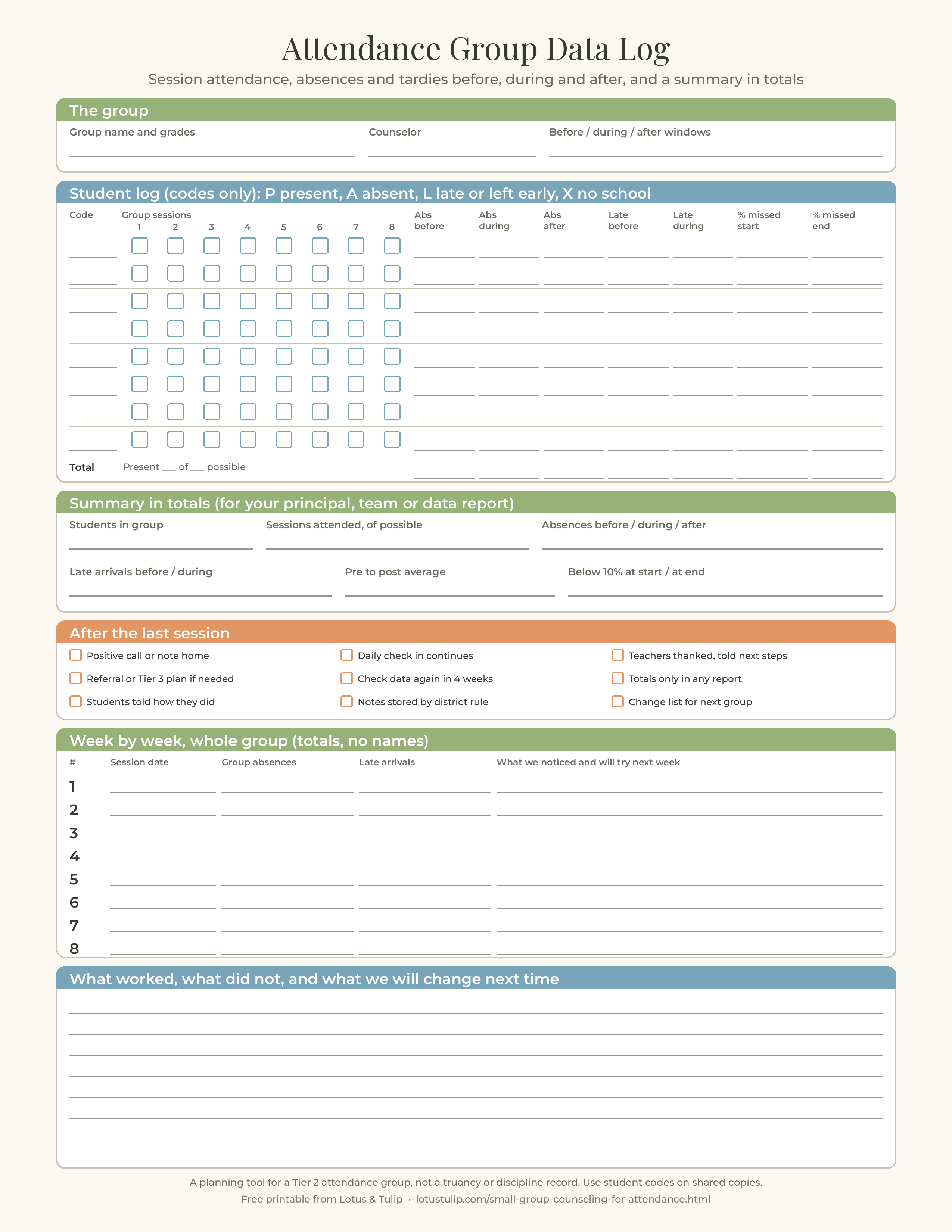
The free printable has three US Letter pages. Page 1 is a blank attendance small group plan: the group (the name students will hear, grades, day and time, counselor, first and last session, daily check in adults and where students check in); who to invite, as eight tick boxes built on the Attendance Works bands (at risk, moderate chronic, 20 percent or more as a "plan Tier 3 first" flag, a reason a group can help with, family called first in their language, not mainly illness, housing or transport, screened, and parent or guardian informed); a students table for seven students by code, with grade, percent missed at the start, boxes for the likely reasons (B barriers, A aversion, D disengagement, M misconceptions), family contact, date informed and check in adult; an eight session map with dates, focus and a weekly goal check; a data plan with before, during and after windows, the pre and post check, how you will code session attendance and who you will share totals with; and lines for what families told you, what the group cannot fix and who else is helping. Page 2 is the same plan filled in for the fictional Maple Hollow Elementary "Here and Ready" group described above. Page 3 is a blank group attendance and data log: a student log for eight students by code with boxes for sessions 1 to 8 (P, A, L or X), absences before, during and after, late arrivals before and during, and percent missed at the start and end, with a total row; a summary in totals for your principal, team or data report; nine after the last session checks; a week by week whole group log; and space for what worked and what you will change.
The printable is a planning and tracking tool. It is not a truancy record, a discipline form or a replacement for your district's attendance system.
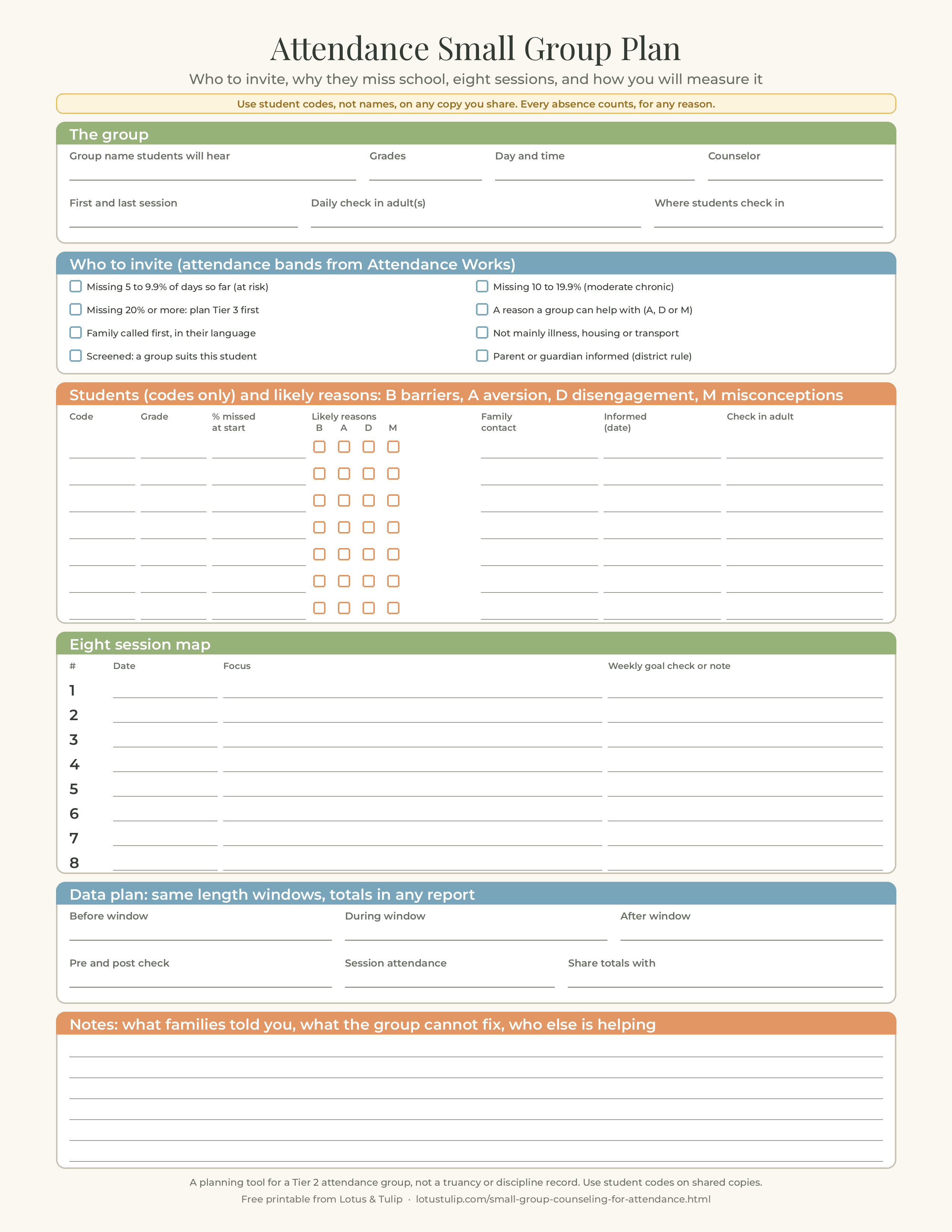
Download the free attendance group plan, example and data log (PDF, 3 pages)
Or download single pages: Page 1: blank attendance group plan (PNG) · Page 2: filled fictional example (PNG) · Page 3: group attendance and data log (PNG)
Free to print and use in your own school. Please link to this page rather than re-uploading the file. This is a planning tool. It does not replace your state's attendance definitions, your district's policies on attendance, records and group consent, or legal advice.
Related resources
- School refusal worksheets for teens: anxiety based school avoidance, what research shows and a free step back to school plan
- All school counselor small group curriculums
- School counselor annual administrator conference: what to bring, sample agenda, talking points and a free planner
- School counselor needs assessment for small groups
- Small group counseling progress notes and attendance tracker
- Small group counseling pre and post assessment
- School counseling advisory council agenda, example and minutes
- Small group counseling lesson plan template and planning map
- Small group counseling permission slip and parent letter
- Small group counseling referral form and referral log
- Small group counseling termination activities and follow up log
- Small group counseling curriculum for anxiety: an 8 session plan
Sources: Attendance Works, "The Problem" (definition of chronic absence; excused absences among young students), "3 Tiers of Intervention" (updated September 2022), "Identify the root causes of absence," the Identifying Root Causes Worksheet (2025), the Qualitative Data resource page, "Introducing the Updated DATTs and SATTs" (September 2, 2025; attendance bands), and "Reducing Chronic Absence Requires Problem Solving and Support, Not Blame and Punishment"; Hedy Chang, Robert Balfanz and Vaughan Byrnes, "Reducing elevated school-levels of chronic absence: Urgent and still within our reach," Attendance Works and the Everyone Graduates Center, Johns Hopkins University (June 2, 2026; 2024 to 2025 data from 31 states, principal survey and methodology); Maureen Tracey-Mooney, Tara Moon, Phyllis Jordan, Hedy Chang, Elizabeth Cook, Helen Duffy and Cecelia Leong, "Attendance Playbook: Evidence-Based Strategies for Reducing Student Absenteeism," FutureEd and Attendance Works (October 2026; tier definitions, mentors and tutors, mental health interventions, school refusal); American School Counselor Association, "Appropriate and Inappropriate Activities for School Counselors"; ASCA Student Standards: Mindsets & Behaviors for Student Success (standards M 1 to M 3, B-LS 3, B-LS 7, B-SMS 1, B-SMS 5 to B-SMS 7, B-SMS 10, B-SS 1 to B-SS 3 and B-SS 8); ASCA Ethical Standards for School Counselors (2022), standards A.3.e and A.7.b, c, d, f, g and h; ASCA position statements "The School Counselor and Group Counseling" (adopted 1989, reviewed 2026) and "The School Counselor and the Identification, Prevention and Intervention of Behaviors That Are Harmful and Place Students At-Risk"; Code of Maryland Regulations 13A.08.01.05 (definition of chronic absence); Family Educational Rights and Privacy Act regulations, 34 CFR 99.3 (education records), current eCFR text checked November 10, 2026.
FAQ
What is chronic absenteeism?
Chronic absenteeism, or chronic absence, means missing 10 percent or more of the school days a student is enrolled, for any reason: excused absences, unexcused absences and suspensions. In a 180 day year that is about 18 days, or two days a month. States set the details, such as the minimum days enrolled and how partial days count, so check your state's definition.
Can a school counselor run a small group for attendance?
Yes. ASCA lists providing counseling to students who are frequently tardy or absent as an appropriate activity for school counselors, and the 2026 Attendance Playbook notes that Tier 2 attendance supports can be offered to groups of students in similar circumstances. What ASCA lists as inappropriate is signing excuses for students who are tardy or absent and coordinating school attendance review boards.
Which students should be in an attendance group?
Students in the at risk or moderate chronic bands (missing about 5 to 19.99 percent of days) whose main reasons are ones a group can reach: dread of school, worry, peer problems, feeling disconnected, or not knowing that a few days a month add up. Students missing 20 percent or more, or whose absences are mostly about illness, transportation, housing or caregiving, usually need individual and family support first.
What activities work in an attendance small group?
Activities that build a reason to come and a plan to get there: a morning routine plan, counting how days add up (privately), sorting what students can and cannot control, a map of trusted adults and friends at school, practicing what to say when coming back after an absence, and a calm tool for worried mornings. Pair the group with a daily check in with an adult.
How do you measure whether an attendance group worked?
Count absences and late arrivals for the same number of school weeks before, during and after the group, and report group totals and the number of students whose absences went down. Add a short pre and post check tied to the ASCA Student Standards you targeted, and report the year to date chronic absence rate alongside the change, since the rate moves slowly.
Should attendance groups use rewards or perfect attendance awards?
Recognize effort and improvement rather than only perfect attendance, which rewards students who were never at risk and is out of reach for students with health conditions. Keep recognition private or group based, never use the group itself as a reward, and never remove a student from the group as a consequence for absences.