
Kids and teens · Updated 2026-11-06
Bullying Activities for Teens (with Free Printable)
Ready-made printable: Bullying Small Group Curriculum Holiday 20% off: about $11.04, was $14 (EUR 12) · instant digital download
Buy on EtsyTry it free first: download session 1 free (group at a glance, lesson plan and student page, PDF, 74 KB). Run it with your group, then get all 8 sessions. No email needed.

Bullying activities for teens are practice tools that help middle and high school students sort bullying from drama and ordinary conflict, name what happened, check for power imbalance and repetition, document evidence, tell a trusted adult, choose upstander or self-care moves, handle digital harm with stop-block-report habits, follow school reporting processes, and log what they tried. Teen bullying is not the same as elementary playground teasing. Group chats, screenshots, exclusion from friend groups, dating and identity pressure, hallway status, and school reporting systems raise the stakes. Disagreement is normal. Unwanted aggressive behavior with a power imbalance that repeats, or could repeat, is bullying. Belonging still matters. So does knowing when not to force a peace talk with the person who is harming you.
This Lotus and Tulip page is a teen-focused bullying activities guide with an original free three page US Letter printable. It targets searches families and helpers actually use: bullying activities for teens, bullying worksheets for teenagers, cyberbullying activities for middle school or high school, upstander skills for teens, and how to respond to bullying at school. It is distinct from our bullying worksheets for kids (ages roughly 6 to 13, rude versus mean versus bullying language, younger upstander cards), from conflict resolution activities for teens (cool body, I-statements, listen, options, fair compromise: the wrong first tool when power imbalance is the real problem), from peer pressure worksheets for teens, from friendship activities for teens, from assertiveness, from social skills worksheets for kids, from self esteem activities for teens, and from safety plan worksheet. Those neighbors help. This page centers adolescent bullying response: power and repeat checks, documentation, reporting, digital scenes, upstander skills, and clear guidance on when not to mediate.
We credit the CDC and U.S. Department of Education 2014 uniform definition of bullying and StopBullying.gov core guidance (unwanted aggressive behavior, observed or perceived power imbalance, and behavior that is repeated or has the potential to be repeated) with clear non-affiliation. We also cite CDC Youth Risk Behavior Survey (YRBS) 2023 prevalence figures and school-based anti-bullying program meta-analyses associated with Gaffney, Ttofi, and Farrington (2019) as research context, not as proof that this free printable remits harm or diagnoses bullying. We are not affiliated with CDC, the U.S. Department of Education, StopBullying.gov, those authors, or any branded bullying curriculum. This printable is an original educational layout, not a copy of any copyrighted worksheet and not a diagnosis or treatment.
This guide is educational. It is not therapy, not medical advice, and not a diagnosis. If thoughts of ending your life, plans to harm yourself or someone else, or a medical emergency show up, stop the worksheet and get help now: in the US, call or text 988, text HOME to 741741, or call 911. Our safety plan worksheet is a better first tool in that moment. Nearby tools: bullying for kids, conflict resolution for teens, friendship for teens, peer pressure, assertiveness, self esteem for teens, social skills for kids, and emotion regulation for teens.
Jump to the free bullying activities printable (PDF) · How to use bullying activities for teens, step by step · Worked examples · Comparisons
What teen bullying is (and how it differs from kids bullying pages)
Kids bullying pages often teach rude versus mean versus bullying, simple upstander cards, and adult-coached classroom language. Teen bullying activities keep those bones and add autonomy, digital complexity, exclusion from shifting friend groups, dating and identity pressure, school reporting pathways, and a sharper line between ordinary conflict mediation and adult-led protection.
Teen bullying response skills include:
- Safety sort first when harm, threats, or crisis risk is present.
- Naming facts without turning the story into a character attack that adults can dismiss.
- Power and repeat checks that separate drama and mutual conflict from bullying.
- Documentation of dates, places, screenshots, and witnesses.
- Telling a trusted adult and following the real school process.
- Upstander moves that support a target without becoming a second target.
- Digital stop-block-report habits that preserve evidence and reduce contact.
- Knowing when not to mediate: do not force a peace talk between a target and the person who bullies them.
Teens also weigh status, identity groups, sports and arts scenes, dating, and online audiences. A skill that worked with a teacher nearby (two chairs and a win-win planner) may be the wrong tool when the problem is repeated humiliation with a power gap. Conflict skills still matter for peer friction. They are not a substitute for protection when someone is being targeted.
Bullying vs drama vs conflict
Not every hard social moment is bullying. Mixing labels wastes skills and can harm targets.
Drama is often messy, loud, and mutual: gossip, short-lived fights, shifting alliances. Skills: cool down, clearer asks, friendship repair, boundaries. Drama can still hurt. It is not automatically bullying.
Conflict is a clash of needs, goals, or resources where both sides have a stake and roughly comparable power to speak. Skills: cool, talk, listen, brainstorm, choose a fair plan, repair. That is the job of our conflict resolution activities for teens page.
Bullying, in the CDC and U.S. Department of Education 2014 uniform definition tradition summarized by StopBullying.gov, involves unwanted aggressive behavior, an observed or perceived power imbalance, and behavior that is repeated or has the potential to be repeated. Putting a targeted teen in a forced mediation room with the person who bullies them can make things worse. School guidance in the StopBullying.gov tradition advises against using conflict resolution or peer mediation as the response to bullying. Use documentation, reporting pathways, adult protection, and upstander support instead.
Teach teens a quick sort: Is this a one-time clash between equals, messy mutual drama, or unwanted aggression with a power gap that repeats or could repeat? If unsure and fear is high, get an adult first.
Types of teen bullying: verbal, social, physical, cyber
Verbal. Name-calling, threats, cruel jokes, identity-based insults. Skills: document language and context, tell an adult, set digital and hallway distance when safe.
Social or relational. Exclusion, rumor campaigns, turning a friend group against someone, silent treatments designed to control. Teens often minimize this as "just drama." Repeated exclusion with a power gap is still bullying. Skills: name the pattern, document who was involved, get adult help for group-level harm.
Physical. Hitting, shoving, trapping, damaging belongings. Skills: safety first, report promptly, preserve evidence, do not treat as a mediate-it-out moment.
Cyber. Texts, group chats, stories, fake accounts, screenshot pile-ons, DMs that follow a teen home. Skills: stop-block-report, save evidence before deleting when safe to do so, tell an adult, follow platform and school reporting paths. Cyber harm does not need to happen "only online" to count; many teens face hybrid scenes.
How to use bullying activities for teens, step by step
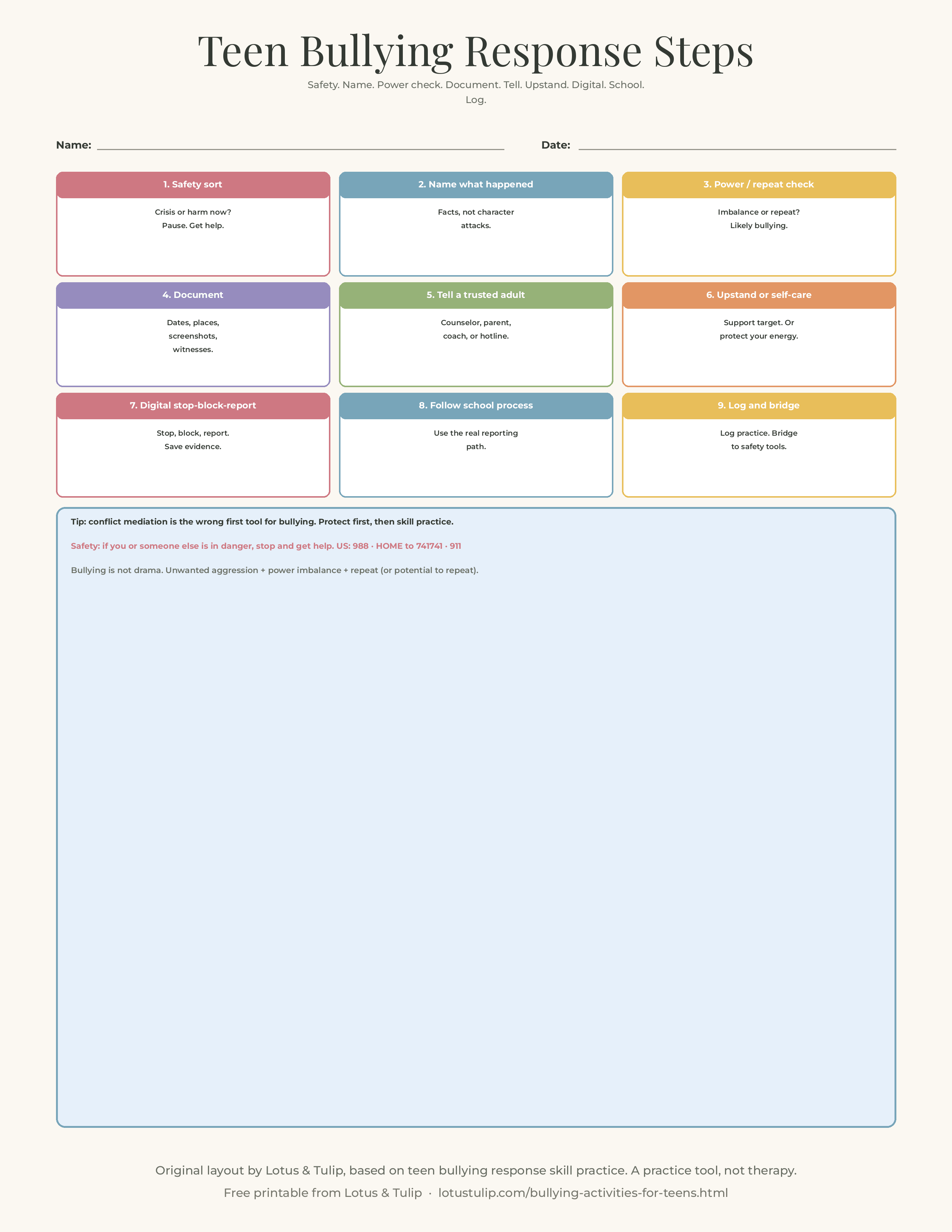
- Safety sort. If acute crisis, threats, stalking, violence, or imminent harm, pause. Use crisis pathways first: 988, HOME to 741741, or 911 when needed. Prefer a safety plan in that moment. Do not force a peace talk with a target of bullying.
- Name what happened. Write facts in one or two fair sentences on the free plan page: who, what, where, when. Keep it specific. Avoid character attacks that adults can dismiss as "teen drama."
- Power and repeat check. Is there an observed or perceived power imbalance? Has it happened more than once, or could it easily repeat? If yes or maybe, treat it as bullying response, not conflict mediation.
- Document. Dates, places, exact words when possible, screenshots, usernames, witnesses. Save copies in a safe place. Documentation helps adults act and helps the teen feel less gaslit by "prove it" pushback.
- Tell a trusted adult. Counselor, parent or caregiver, coach, teacher, or another safe adult. Practice the ask out loud if needed. If the first adult minimizes, tell another. Pair with school reporting when the scene is school-linked.
- Choose an upstander or self-care move. If you are a bystander, support the target (private check-in, refuse to pile on, report). If you are the target, prioritize safety and self-care over performing bravery. Upstander work should not require becoming a second target.
- Digital stop-block-report. Stop engaging while flooded, block when that increases safety, report on the platform, and keep evidence. Move hard talks off public threads. Exit chats that are mostly cruelty.
- Follow the school process. Use the real reporting path your school publishes. Ask what happens next and when you will hear back. Adults should not send a target back into unsupervised mediation with the person who bullies them.
- Log and bridge. Record the practice on the log page. Bridge to safety plan, friendship for teens, self esteem for teens, assertiveness, peer pressure, or conflict resolution for teens when those are the real neighboring loads.
Practice the sort and documentation steps on lower-stakes scenes first when possible, then rely on the full sequence when fear or power imbalance is high. Skill grows with reps and with adults who take reports seriously.
Digital scenes: group chats, screenshots, exclusion, and public pile-ons
Phones are part of teen bullying, not a side quest. Moralizing ("just delete the app") often shuts teens down. Teach workable habits instead.
Group chats. Chats escalate fast and can lock a target out or pile on in public. Skills: refuse to forward cruelty, exit when safe, screenshot and save before leaving if evidence matters, tell an adult when a chat becomes organized harm.
Screenshots. Ask before sharing private messages. Repair if a screenshot spread without consent. When a screenshot is used to humiliate, document it and report rather than starting a screenshot war.
Exclusion. Being left out once can be awkward. Repeated, coordinated exclusion with a power gap is social bullying. Name the pattern. Do not force the target to "just join another group" as the only plan.
Public pile-ons. Do not force a teen to "talk it out" in a hostile audience. Cool, get an adult, and repair or report in a safer channel. Repeated public humiliation with power imbalance is bullying, not ordinary conflict.
Upstander skills (and what upstanding is not)
Upstanders notice harm and take a safe action that supports the target or interrupts the pattern. Upstanding is not a demand that every teen confront every aggressor in public. Safe options include a private check-in with the target, refusing to laugh or forward, documenting and reporting, sitting with someone who was excluded, and getting an adult when fear is high.
Upstanding is also not mediating a target into a room with the person who bullies them. It is not blaming the target for "not standing up for themselves." It is not requiring a teen to sacrifice their own safety for a viral bravery story. Pair upstander practice with friendship for teens when belonging is tangled with the scene, and with assertiveness when wording a clear no or report ask is the hard part.
Worked fictional examples
Teen example, group chat exclusion (fictional): Maya, age 14, was removed from a class group chat after refusing to share a private screenshot. Cue: stomach drop, urge to beg to be added back. Safety sort: no crisis, but clear social power move. Name: "I was removed after I said no to forwarding a private message." Power and repeat check: the same students have iced her out twice this month. Document: save the removal notice and prior mean texts. Tell: school counselor and parent. Digital: do not rejoin if the price is participating in cruelty. Plan written on the free bullying plan page.
Teen example, hallway verbal bullying (fictional): Jordan, age 16, hears the same slur from a senior three times a week near lockers. Cue: anger and shame. Safety sort: no weapon, but repeated identity-based verbal harm. Document: dates and exact words. Tell: trusted teacher and counselor the same day. School process: follow the published reporting path; ask what supervision changes next. Self-care: walk a different route with a friend for a week while adults act. Reflect: "Conflict mediation with that senior alone is not the plan."
Teen example, upstander (fictional): Sam, age 15, sees a classmate get roasted in a story that tags them. Cue: urge to ignore so they are not next. Upstander move: screenshot for the target if asked, refuse to share, send a private "You did not deserve that" message, and tell a counselor that the story is circulating. Not chosen: a public clapback at a 8 that would escalate. Bridge to friendship and assertiveness tools for wording.
School counselor note (fictional): In a twelve minute meeting, a counselor helps a student fill what happened, power and repeat check, evidence list, trusted adult names, digital stop-block-report steps, and the school reporting next step. Optional practice, never forced mediation with the person who bullies them. Follow district bullying and crisis protocols when risk appears. For multi-session groups, pair with a bullying or social skills curriculum rather than stacking every worksheet in one period.
Teen bullying vs kids bullying, conflict teens, peer pressure, friendship teens, and assertiveness
| Teen bullying (this page) | Kids bullying | Conflict for teens | Peer pressure | Friendship for teens | Assertiveness | |
|---|---|---|---|---|---|---|
| Main job | Power and repeat check, document, tell, upstand, digital stop-block-report, school process | Rude vs mean vs bullying and younger upstander cards | Cool, I-statement, listen, options, fair plan, repair | Refusal skills and dare scripts | Belonging, healthy vs unhealthy patterns, digital repair | Clear asks and no without aggression |
| Best early use | When teens face unwanted aggression with power imbalance or cyber harm | Younger kids with adult coaching | When the load is mutual peer conflict, not bullying | When the scene is a dare or pressure to break values | When the load is friendship quality and belonging | When the teen needs clearer wording for asks, no, and reports |
| Output | Facts, power check, evidence, adult ask, digital moves, school next step, practice log | Definition sort and upstander plan for kids | Conflict name, cool plan, I-statement, paraphrase, options, check-back | Refusal plan and scripts | Goal, signals, script, repair or boundary plan | Ask and no scripts with practice log |
| Cross link | This page | Kids bullying | Conflict teens | Peer pressure teens | Friendship teens | Assertiveness |
These tools cooperate. Teen bullying builds the protect-document-report-upstand loop. Kids bullying keeps younger language. Conflict teens solves mutual friction. Peer pressure specializes refusal. Friendship teens centers belonging. Assertiveness sharpens wording. Self esteem supports worth after harm. Safety plans cover acute risk. Teach one tool clearly before stacking four on day one.
School counselor, therapist, and parent tips
Teens. Prefer concrete scenes over lectures about "bullying as a construct." Let them reject babyish cartoons. "Name it, check power, document, tell, stop-block-report" often lands better than a long theory talk. Keep experiments within their real control. Pair with friendship for teens when belonging is tangled with the harm, and with self esteem for teens when worth collapsed after targeting.
School counselors. Short meetings favor a compressed sequence: safety sort, facts, power and repeat check, evidence list, trusted adult, digital moves, school reporting next step. Groups can practice upstander options with low-stakes role plays. Never force mediation between a bullying target and the person who bullies them. Follow district bullying and crisis protocols if risk appears. Optional practice, never forced disclosure of peer names beyond what reporting requires. Avoid shaming "drama kids"; target the skill gap and the load (sleep, ADHD supports, exclusion, trauma, identity-based harm), not the teen's worth. Whole-school anti-bullying programs matter more than any single worksheet. Skill printables support practice. They do not replace policy, supervision, and adult follow-through.
Therapist tips:
- Stay in the client's language. Reflect their scenes and values. Do not overwrite with your favorite curriculum label on day one.
- Separate drama, conflict, and bullying out loud, repeatedly, without excusing harm.
- Protect before mediate. Do not run conflict scripts as the first response to clear bullying.
- Treat digital scenes as real bullying scenes. Screenshots, stories, and pile-ons belong in the plan.
- Bridge to neighbors. Safety plan for acute risk, friendship for belonging repair, self esteem for worth after harm, assertiveness for report asks, peer pressure for dares, conflict tools only when power is comparable.
- Measure function. Ask what changed: earlier documentation, adults told sooner, fewer pile-on forwards, safer digital exits, clearer school follow-up, less self-blame.
Parents. Take reports seriously the first time. Model documentation and calm advocacy out loud. Do not force teens to stay in every social scene to look polite. After a bullying incident, prioritize safety and adult action, then skill practice when everyone is regulated. Do not turn the bullying plan into a new weapon ("fill this out or else") that makes the worksheet feel like punishment. Conflict resolution is the wrong first tool for bullying. Ask the school what supervision and consequences change next, and follow up.
Common mistakes
- Calling everything drama so real bullying never gets documented or reported.
- Using conflict mediation for bullying or putting a target in a forced peace talk.
- Skipping documentation and then facing "we need proof" with nothing saved.
- Deleting evidence too fast before an adult or platform report can use it.
- Moralizing phones instead of teaching stop-block-report and exit skills.
- Requiring public confrontation as the only valid upstander move.
- Blaming the target's confidence alone while ignoring power, supervision, and group dynamics.
- Ignoring sleep, ADHD supports, trauma load, or identity-based harm while blaming "social skills" alone.
- Using it in acute crisis instead of safety first.
- Treating the worksheet as therapy. Paper supports practice. It does not replace a clinician, school policy, or crisis care when problems are severe or lasting.
When not to use this worksheet
Good early uses: a teen who can name a bullying or possible-bullying scene, mild to moderate ongoing harm with adult support available, homework between counseling sessions, school counseling check-ins, and building a document-tell-report sequence.
Prefer another tool first when:
- Acute safety risk or medical emergency: stabilize and get help (988, HOME to 741741, 911). Prefer a safety plan.
- Active violence, stalking, or imminent harm: prioritize safety, supervision, and emergency protocols over worksheets.
- Mutual peer conflict without power imbalance: use conflict resolution activities for teens.
- Dare and refusal scenes: use peer pressure worksheets for teens.
- When younger language fits better: use bullying worksheets for kids.
- When the teen is too flooded to engage: co-regulate first, then return to plan work. See emotion regulation for teens.
What the research says (honestly)
Bullying activities and worksheets are a skill practice aid, not a standalone RCT treatment. Do not claim this free printable remits bullying victimization, anxiety, trauma symptoms, or any diagnosis.
Uniform definition and StopBullying.gov core. The CDC and U.S. Department of Education 2014 uniform definition, reflected in StopBullying.gov guidance, frames bullying as unwanted aggressive behavior involving a power imbalance that is repeated or has the potential to be repeated. Credit that definition with clear non-affiliation. This page is not a CDC or StopBullying.gov product and does not diagnose bullying.
CDC YRBS 2023. In the 2023 Youth Risk Behavior Survey, about 19% of U.S. high school students reported being bullied on school property in the past year, and about 16% reported being electronically bullied. School connectedness and related belonging supports have been associated with lower odds of some violence-related experiences in YRBS analyses. Treat belonging as a protective correlate with an honest caveat: correlation is not proof that this printable creates belonging or prevents bullying by itself.
Gaffney, Ttofi, and Farrington 2019 meta-analyses. Updated school-based anti-bullying program meta-analyses associated with Gaffney, Ttofi, and Farrington (2019) estimate roughly 19% to 20% reductions in perpetration and roughly 15% to 16% reductions in victimization across included evaluations. Separate cyberbullying program evidence in related work suggests smaller average reductions than many whole-school offline programs. Credit those reviews with non-affiliation. They evaluate programs, not this three page sheet.
Honest caveat. Whole-school programs, adult supervision, clear policy, and follow-through matter. A skill printable is not a standalone RCT treatment and is not a substitute for reporting pathways or crisis care. For severe aggression, trauma, psychosis, or acute risk, use disorder-appropriate care and crisis pathways. No study tests this three page Lotus and Tulip printable alone.
Free bullying activities printable for teens (PDF)
The free bullying activities printable has three pages in US Letter size:
- Page 1: Teen Bullying Response Steps card. Sequence matching the HowTo: safety sort, name what happened, power and repeat check, document, tell a trusted adult, upstander or self-care move, digital stop-block-report, follow school process, log and bridge, plus safety reminders.
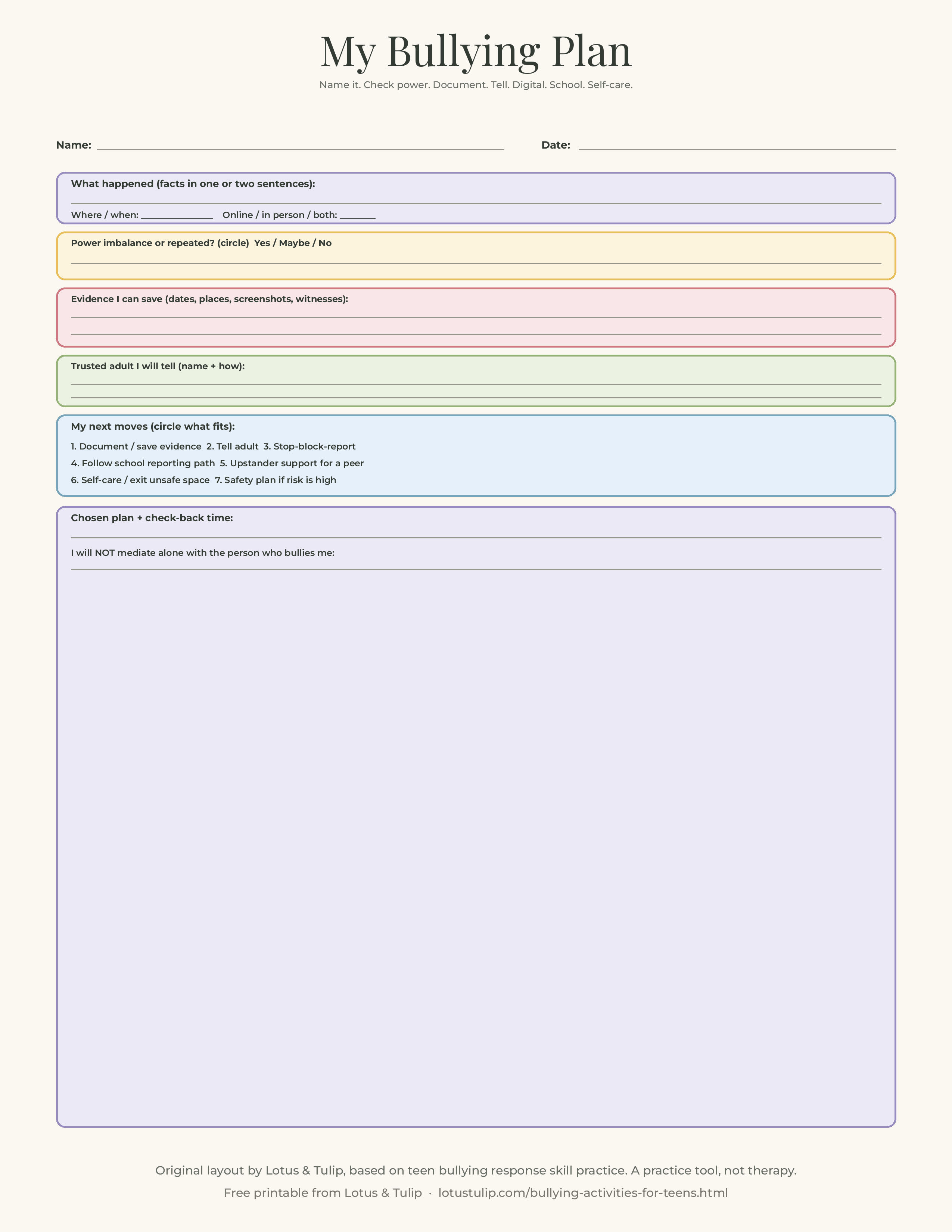
- Page 2: My Bullying Plan. Fill in what happened, power check, evidence, trusted adult, next moves, chosen plan, and a clear note not to mediate alone with the person who bullies you.
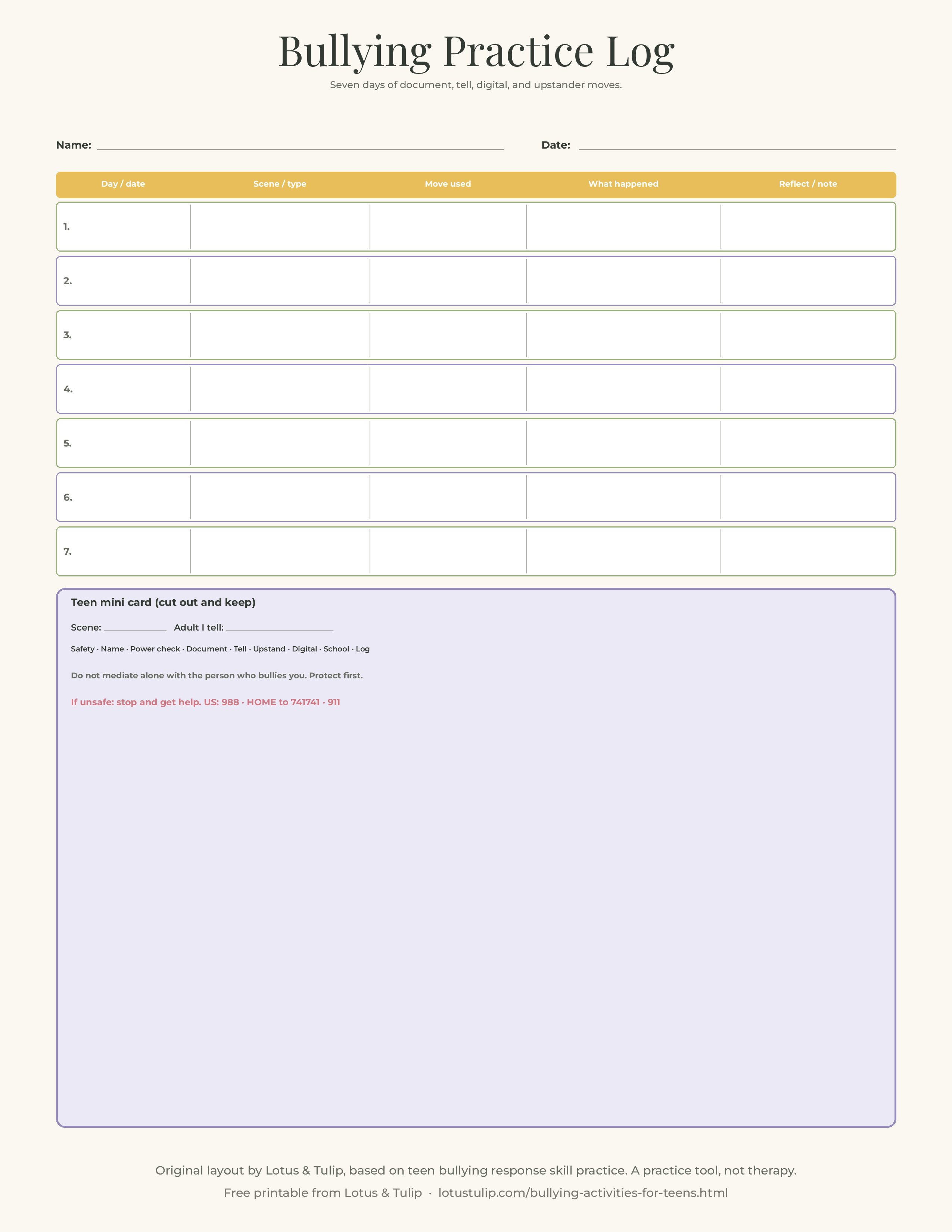
- Page 3: Practice Log + teen mini card. Seven day rows plus a cut out reminder for safety, name, power check, document, tell, upstand, digital, school, log.
Download the free bullying activities printable for teens (PDF, 3 pages, US Letter)
Prefer single images? Page 1: Teen Bullying Response Steps (PNG) · Page 2: My Bullying Plan (PNG) · Page 3: Practice Log (PNG)
Free to print for your own use and for use with your own clients, students, or groups. This is an original layout by Lotus & Tulip, based on teen bullying response skill practice associated with the CDC and ED 2014 uniform definition and StopBullying.gov core guidance, with CDC YRBS 2023 prevalence context and Gaffney, Ttofi, and Farrington 2019 program-level meta-analysis neighbors. It is not affiliated with CDC, ED, StopBullying.gov, those authors, any scale publisher, or any specific treatment or curriculum package, and is not a substitute for therapy. Please link to this page rather than re-uploading the file.
Related resources
- Bullying worksheets for kids: rude vs mean vs bullying, younger upstander plans.
- Conflict resolution activities for teens: cool, speak, listen, fair plan for mutual conflict.
- Friendship activities for teens: belonging, signals, digital repair.
- Peer pressure worksheets for teens: refusal skills and scripts.
- Assertiveness worksheet: clear asks without aggression.
- Self esteem activities for teens: worth after social harm.
- Social skills worksheets for kids: foundational social steps.
- Emotional regulation activities for teens: cool body then choose.
- Safety plan worksheet: when the moment is about staying safe and alive.
- Icebreaker activities for counseling groups: group openers.
Sources
- Centers for Disease Control and Prevention and U.S. Department of Education (2014). Uniform definition of bullying (unwanted aggressive behavior, power imbalance, repeated or potential to repeat), as reflected in StopBullying.gov educational materials. Definition credit with clear non-affiliation. Not a claim that this printable diagnoses bullying.
- StopBullying.gov style school guidance distinguishing bullying from conflict and advising against peer mediation as the response to bullying. Educational safety credit with clear non-affiliation.
- Centers for Disease Control and Prevention. Youth Risk Behavior Survey, 2023. About 19% of high school students reported being bullied on school property; about 16% reported electronic bullying. Belonging and school connectedness correlates appear in related YRBS analyses with caveats. Prevalence and correlate context only.
- Gaffney, H., Ttofi, M. M., and Farrington, D. P. (2019). Evaluating the effectiveness of school-bullying prevention programs: an updated meta-analytical review. Aggression and Violent Behavior, 45, 111 to 133. Approximate 19% to 20% perpetration and 15% to 16% victimization reductions across included programs. Program-level evidence; not proof that this free sheet remits harm.
- Related cyberbullying intervention meta-analytic work associated with the same research group suggesting smaller average reductions than many whole-school offline programs. Credit with non-affiliation and caveats.
- Honest caveat: teen bullying drills are a skill practice aid. Uniform definitions, YRBS prevalence, and program meta-analyses are not the same as technique-only RCTs of this Lotus and Tulip printable. Whole-school programs matter.
Bullying activities for teens: FAQ
What are bullying activities for teens?
They are practice tools for sorting bullying from drama and conflict, naming facts, checking power and repetition, documenting evidence, telling a trusted adult, choosing upstander or self-care moves, handling digital harm, and following school reporting processes. They are educational skill aids, not therapy.
Is this the same as the kids bullying page?
No. The kids page uses younger language, rude versus mean versus bullying sorts, and elementary upstander cards. This teens page centers adolescent bullying with cyber scenes, documentation, school reporting, and clear guidance against forced mediation.
How is bullying different from conflict?
Conflict is a clash of needs with more comparable power. Bullying involves unwanted aggression, a power imbalance, and repetition or potential to repeat. Do not use peer mediation as the first response to bullying. Use documentation, reporting, and adult protection.
Can school counselors use it with teens?
Yes, often in short meetings with safety sort, facts, power check, evidence, adult ask, digital moves, and school next steps. Keep practice optional and school safe. Follow bullying and crisis protocols when risk appears. Do not use the page as a diagnosis or as forced mediation.
What should teens do about cyberbullying in group chats?
Stop engaging while flooded, save evidence when safe, block and report, exit chats that are mostly cruelty, and tell a trusted adult. Public pile-ons are poor places for repair. Get help when fear or power imbalance is high.
When should I not use this worksheet?
Do not use it as the first move in acute safety risk, medical emergency, active violence, or when the real need is a safety plan. Stabilize and get help when needed: 988, HOME to 741741, or 911. For mutual conflict without power imbalance, use the conflict teens page instead.
Is this affiliated with CDC, StopBullying.gov, or Gaffney, Ttofi, and Farrington?
No. This is an original Lotus and Tulip educational layout. We credit research lineages and public definitions with clear non-affiliation and do not reproduce copyrighted manual worksheets.