
Kids and teens · Updated 2026-11-06
Anxiety Activities for Teens (with Free Printable)
Ready-made printable: Worry Group Curriculum Holiday 20% off: about $11.04, was $14 (EUR 12) · instant digital download
Buy on Etsy
Anxiety activities for teens are practice tools that help middle and high school students name fear, worry, and body cues without collapsing into self-blame, rate intensity, fork worry from solvable problems, use brief breathing and grounding when flooded, check anxious thoughts and run small behavioral experiments, face avoided situations gently with a ladder when that fits, protect sleep and phone habits a little, log what helps, and know when to pause for safety. Teen anxiety work is not a longer version of anxiety worksheets for kids. Identity, grades, dating, sports, group chats, and college talk raise the stakes. So does honesty that occasional nerves are normal, while stuck avoidance and panic-like spikes deserve skill practice and, when lasting or severe, adult backup.
This Lotus and Tulip page is a teen-focused anxiety activities guide with an original free three page US Letter printable. It targets searches families and helpers actually use: anxiety activities for teens, anxiety worksheets for teenagers, coping with anxiety high school, teen anxiety counseling activities, and anxiety group activities for teens. It is distinct from our anxiety worksheets for kids (younger alarm and brave ladder language), from stress management worksheets for teens (workload, sleep, and screens as the main load), from coping skills worksheets for teens (broad skill menu), from test anxiety worksheet (exams and pre-test routines), from social anxiety worksheets for teens (social evaluation and experiments as the product focus), from worry tree worksheet (plan vs cope fork as the whole page), from exposure hierarchy worksheet (fear ladder builder alone), from emotional regulation activities for teens, from peer pressure worksheets for teens, and from perfectionism worksheet for teens. Those neighbors help. This page centers adolescent anxiety: body cues, naming and rating, worry vs problem-solving, brief calm skills, CBT-informed thought checks and experiments, gentle facing of avoided situations, sleep and phone habits, and school and home supports.
We credit research lineages associated with cognitive behavioral therapy for adolescent anxiety (including James and Cochrane-style review traditions and related CBT for youth anxiety work), exposure as an active ingredient note in anxiety treatment summaries, and school SEL programs used as neighbors rather than proof. We credit those lineages with clear non-affiliation. We are not affiliated with those authors, any scale publisher, or any branded anxiety curriculum. This printable is an original educational layout, not a copy of any copyrighted worksheet and not a diagnosis or treatment.
This guide is educational. It is not therapy, not medical advice, and not a diagnosis. If thoughts of ending your life, plans to harm yourself or someone else, or a medical emergency show up, stop the worksheet and get help now: in the US, call or text 988, text HOME to 741741, or call 911. Our safety plan worksheet is a better first tool in that moment. Nearby tools: anxiety for kids, stress for teens, coping for teens, emotion regulation for teens, worry tree, exposure hierarchy, 5 4 3 2 1 grounding, and breathing exercises.
Jump to the free anxiety activities printable (PDF) · How to use anxiety activities for teens, step by step · Worked examples · Comparisons
Anxiety vs fear vs stress (educational, not diagnostic)
Fear is a fast response to a clear present threat (a car swerving, a dog lunging). Anxiety is often future-oriented: what if, spiral thoughts, body alarm without a clear danger in the room. Stress is the load of demands (tests, jobs, sports, family). Stress can feed anxiety. Anxiety can make stress feel unbearable. Educational sorting helps choose tools. It does not diagnose an anxiety disorder.
Teens also meet panic-like spikes, social evaluation fear, perfectionism loops, and test-week dread. Those overlap. Use this page for a general teen anxiety practice loop. Prefer neighbors when the scene is mostly exams (test anxiety), mostly social evaluation (social anxiety for teens), mostly workload and sleep (stress for teens), or mostly emotion naming and cool-down (emotion regulation for teens).
Teen anxiety response skills include:
- Safety sort first when crisis risk, self-harm talk, or acute danger is present.
- Body cue notice without treating every sensation as proof of catastrophe.
- Name and rate the feeling and intensity on a 0 to 10 scale.
- Worry vs problem-solving fork: is there a next action now, or is this a loop to park and cope?
- Brief breathing and grounding when flooded, then return to the plan.
- Thought check and small experiments for sticky predictions (cross-link, do not rehash whole CBT pages).
- Gentle facing of avoided situations with a ladder when avoidance is the main trap.
- Sleep and phone habits that shrink the fuel for next-day alarm.
- Knowing when not to force practice: optional skill work, never forced public exposure in class.
Body cues, naming, rating, and the worry fork
Body cues for teens often include racing heart, tight chest, stomach drop, shaky hands, hot face, restless legs, and brain fog. Teaching "notice, name, do not instantly obey" reduces the habit of treating every cue as an emergency. Pair with emotion regulation for teens when the body is too hot to think.
Naming and rating. "Anxious about the presentation, about a 7" is more usable than "I am dying." Rating helps track change after practice. It is not a clinical scale.
Worry vs problem-solving fork. Ask: is there a concrete next step I can take in the next day (email a teacher, start one paragraph, ask a friend to walk in together)? If yes, write the step and a when. If no (pure what-if loops about things outside control), park the worry, use a cope skill, and return later. The worry tree worksheet drills this fork in more depth. Circle of control helps sort controllable actions from rumination fuel.
How to use anxiety activities for teens, step by step
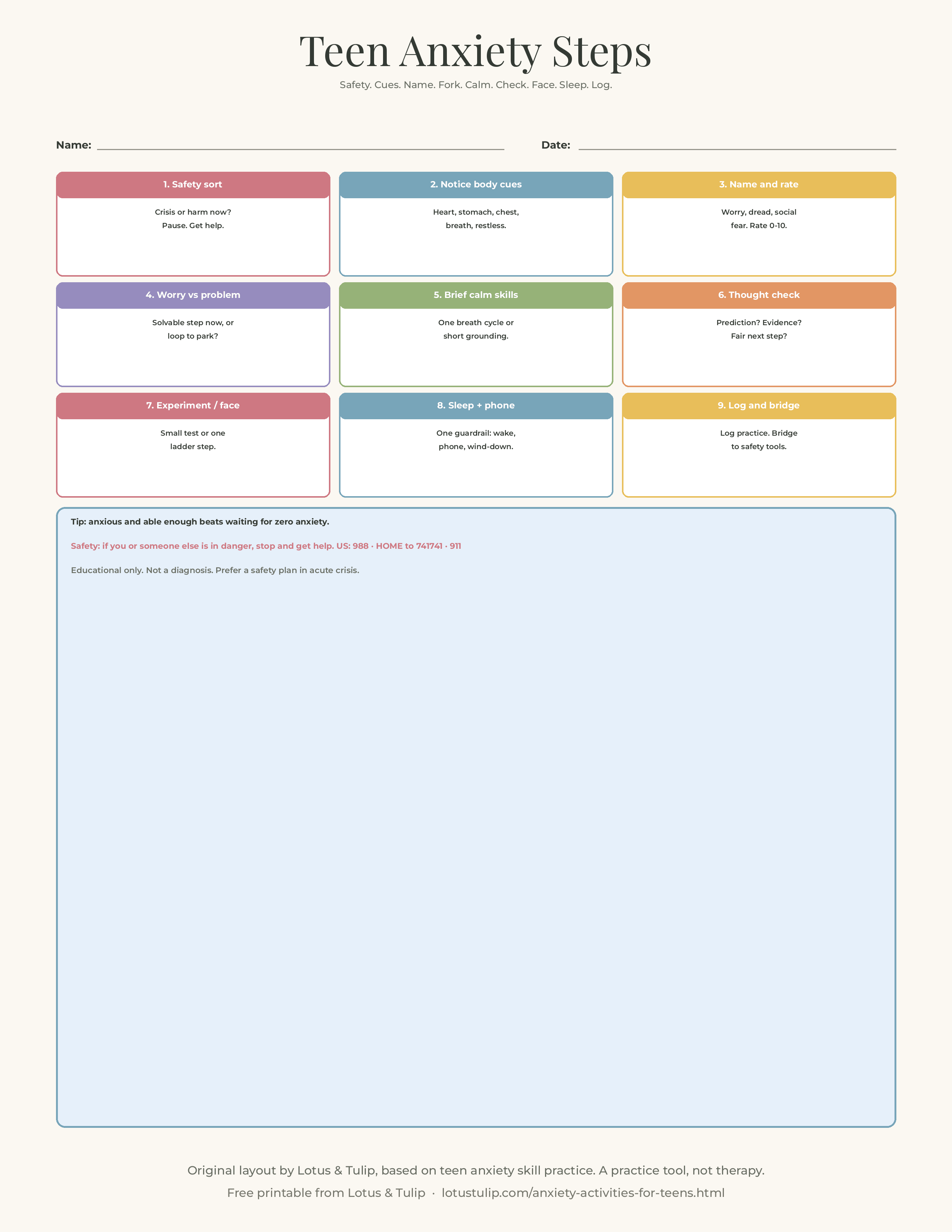
- Safety sort. If acute crisis, self-harm plans, or imminent harm, pause. Use crisis pathways first: 988, HOME to 741741, or 911 when needed. Prefer a safety plan in that moment. Do not force public anxiety talk.
- Notice body cues. Heart, stomach, chest, breath, restless energy. Write two cues on the free plan page without judging them as "weak."
- Name and rate. Name the feeling (worry, dread, panic-like, social fear). Rate 0 to 10. Keep it specific to this scene.
- Worry vs problem fork. Solvable next step now, or loop to park? If solvable, write one action and a when. If loop, choose a cope skill and a later recheck time. See worry tree.
- Brief calm skills. One slow breath cycle or a short 5 4 3 2 1 grounding pass. Do not turn this into an hour of "fixing" that becomes avoidance.
- Thought check (brief). What is the sticky prediction? What is evidence for and against? What would I tell a friend? Cross-link to CBT thought record, cognitive distortions, and cognitive restructuring when you need a full page.
- Small experiment or gentle face. Test one prediction in a small way, or take one step on an avoidance ladder. Prefer planned steps over white-knuckle plunges. Use behavioral experiment and exposure hierarchy when that is the job.
- Sleep and phone guardrails. Pick one: fixed wake time, phone out of bed, or a wind-down start time. Pair with sleep hygiene when sleep is the fuel.
- Log and bridge. Record practice on the log page. Bridge to safety plan, coping skills for teens, stress for teens, social anxiety for teens, test anxiety, emotion regulation for teens, or anxiety for kids when a younger sibling needs the kids page.
Practice naming and forking on lower-stakes weeks first when possible, then rely on the full sequence when spikes hit. Skill grows with reps and with adults who coach without shaming.
Breathing, grounding, thought checks, experiments, and gentle exposure
Breathing and grounding are brief tools to bring the body down enough to choose. They are not a way to erase all anxiety before living. Cross-link to breathing exercises and 5 4 3 2 1 grounding. If someone is dizzy or has a medical breathing limit, keep practice gentle and check with a clinician.
CBT-informed thought check. Anxious brains overpredict danger and underpredict coping. A short check asks: what am I predicting, how sure am I, what else could be true, what is a fair next step. Do not argue a teen out of a feeling. Change the behavior and the evidence base. Full pages live at thought record and cognitive restructuring.
Behavioral experiments. "If I ask one question in class, everyone will laugh" becomes a testable prediction with a small ask and a written outcome. See behavioral experiment worksheet. Experiments are not forced humiliation.
Gentle exposure / facing avoided situations. Avoidance shrinks life and teaches the brain that the only safety is escape. Planned facing, from easier to harder, is a common active ingredient note in anxiety treatment summaries. Caveats: do not force public exposure as a classroom stunt; do not use trauma flooding; stop for safety; prefer a written ladder with adult support. Full builder: exposure hierarchy worksheet. For OCD-like compulsions, prefer clinician-led ERP rather than DIY rituals.
Sleep, phones, school, and home supports
Sleep and phones. Late scrolling, inconsistent wake times, and all-night "just one more" feeds next-day alarm. One guardrail beats a perfect routine nobody keeps. Pair with sleep hygiene and stress for teens when workload and screens are the main load.
School counselor tips. Short meetings favor: safety sort, body cues, name and rate, worry fork, one calm skill, one next step or experiment, sleep/phone ask. Groups can practice optional naming and fork skills with low-stakes prompts. Never force public "share your biggest fear." Follow district crisis protocols if risk appears.
Therapist tips. Stay in the client's language. Separate panic-like spikes, social evaluation, perfectionism, and trauma load out loud without diagnosing from a printable. Protect before perform. Measure function: fewer avoided classes, earlier asks for help, sleep slightly better, shorter spiral time.
Parent tips. Validate the feeling, coach the skill, do not remove every hard thing. Accommodation that removes all anxiety also removes practice. Ask the school what flexibility exists on hard days. Do not turn the worksheet into a new weapon ("fill this or else").
Worked fictional examples
Teen example, presentation dread (fictional): Jordan, age 15, has a history presentation Monday. Cue: stomach drop Sunday night, rated 8. Safety sort: no crisis. Name: "Dread about blanking in front of the class." Fork: solvable (outline three talking points tonight) plus cope (grounding before sleep). Thought check: "I will blank and everyone will laugh" vs evidence of past recoveries. Small face: practice once with a sibling. Sleep guardrail: phone out of bed. Plan on the free anxiety plan page.
Teen example, social avoidance (fictional): Sam, age 16, skips lunch because the cafeteria feels loud and watched. Cue: hot face at the door, rated 7. Safety sort: no self-harm. Name: social evaluation fear. Fork: not a pure problem to solve overnight. Calm skill: one grounding pass. Experiment: sit with one friend for ten minutes, then leave if needed. Bridge to social anxiety for teens and a short ladder on exposure hierarchy.
Teen example, late-night worry loop (fictional): Avery, age 14, replays a group chat slight until 1 a.m. Cue: restless legs, rated 6. Safety sort: no plan to die, but mood dips. Name: worry loop about belonging. Fork: no solvable step at 1 a.m.; park and cope. Sleep guardrail: charge phone outside the room. Bridge to friendship for teens for daytime repair, and emotion regulation for teens when flooded.
School counselor note (fictional): In a twelve minute meeting, a counselor helps a student fill body cues, name and rate, worry fork, one calm skill, one next step or experiment, and a sleep/phone ask. Optional practice, never forced public sharing. Follow district crisis protocols if risk appears. For multi-session groups, pair with a worry or stress curriculum rather than stacking every worksheet in one period.
Teen anxiety vs kids anxiety, stress teens, coping teens, test anxiety, social anxiety, emotion regulation, worry tree
| Teen anxiety (this page) | Kids anxiety | Stress teens | Coping teens | Test anxiety | Social anxiety | Emotion regulation teens | Worry tree | |
|---|---|---|---|---|---|---|---|---|
| Main job | Name, rate, fork, calm, check, experiment or gentle face, sleep/phone, log | Younger alarm and brave steps | Workload, sleep, screens | Broad skill menu | Exams and pre-test routines | Social evaluation and experiments | Cool body then choose | Plan vs cope fork |
| Best early use | When teens face general anxiety with adult support | Younger kids with adult coaching | When load is the scene | When building a menu | When exams dominate | When social fear dominates | When flooding blocks thinking | When the fork is the whole lesson |
| Output | Cues, rating, fork, calm, check, experiment or step, sleep ask, log | Alarm, thought, brave plan | Stress plan | Coping menu and plan | Test routine | Social experiments | Regulation plan | Worry tree decision |
| Cross link | This page | Kids anxiety | Stress teens | Coping teens | Test anxiety | Social anxiety teens | ER teens | Worry tree |
These tools cooperate. Teen anxiety builds the name-fork-calm-check-face loop. Kids anxiety keeps younger language. Stress teens cover load. Coping teens stock the menu. Test and social pages go deep on those scenes. Emotion regulation cools the body. Worry tree drills the fork. Teach one tool clearly before stacking four on day one.
What helps vs common myths
What often helps: naming cues without shame, a worry vs problem fork, brief calm skills used as a bridge not a cage, fair thought checks, small experiments, planned gentle facing of avoided situations, sleep and phone guardrails, optional counseling, peer support that does not force performance, and skill printables used as practice aids.
Myths to drop:
- "Anxiety means you are weak." Anxiety is a common human alarm. Skill practice is strength work, not proof of failure.
- "You must feel zero anxiety before you try." Waiting for zero often becomes avoidance. Aim for "anxious and able enough."
- "More deep breathing always fixes it." Breathing helps many teens briefly. Used alone for months without facing or problem-solving, it can stall progress.
- "If you ignore it, it goes away." Mild spikes sometimes pass. Stuck avoidance usually grows.
- "Pushing through every fear at full blast builds character." Flooding without a plan can backfire. Prefer graded steps with consent.
- "Only medication or only worksheets work." Care is individual. This page is a practice aid, not a treatment plan.
Common mistakes
- Forcing calm before living so breathing becomes a new avoidance ritual.
- Calling every sensation a panic disorder from a printable alone.
- Removing every hard situation so the teen never practices facing.
- White-knuckle plunges without a ladder, consent, or aftercare.
- Ignoring sleep and phones while only talking thoughts.
- Using test or social tools as the first response when the load is general anxiety and avoidance across scenes.
- Using it in acute crisis instead of safety first.
- Treating the worksheet as therapy. Paper supports practice. It does not replace a clinician, school policy, or crisis care when problems are severe or lasting.
When not to use this worksheet
Good early uses: a teen who can name cues and a scene, mild to moderate anxiety with adult support available, homework between counseling sessions, school counseling check-ins, and building a name-fork-calm-check sequence.
Prefer another tool first when:
- Acute safety risk or medical emergency: stabilize and get help (988, HOME to 741741, 911). Prefer a safety plan.
- When younger language fits better: use anxiety worksheets for kids.
- When the teen is too flooded to engage: co-regulate first, then return to plan work. See emotion regulation for teens.
- When exams or social evaluation are the whole load: prefer test anxiety or social anxiety for teens.
- When trauma flooding or OCD rituals dominate: prefer clinician-led care rather than DIY exposure.
What the research says (honestly)
Anxiety activities and worksheets are a skill practice aid, not a standalone RCT treatment. Do not claim this free printable remits anxiety disorders, panic, OCD, PTSD, or any diagnosis.
CBT for adolescent anxiety. Review traditions associated with James and Cochrane-style summaries, and related CBT for youth anxiety work, commonly find that CBT approaches help many young people with anxiety compared with waitlist or control conditions, with important caveats about study quality, heterogeneity, and access. Credit with clear non-affiliation. This is a map for helpers, not proof that this three page sheet remits clinical anxiety.
Exposure as an active ingredient note. Anxiety treatment summaries often highlight facing avoided situations (in careful, planned ways) as a key change mechanism alongside cognitive work. Credit with non-affiliation. Not a license for forced public exposure or trauma flooding.
School SEL caveats. School social and emotional learning can support skills and climate. Effects vary by program, dosage, and implementation. A printable is not an SEL curriculum RCT.
Honest limits. These reviews are not technique-only RCTs of this printable. Adult support, sleep, school policy, and clinical care when indicated matter. No study tests this three page Lotus and Tulip printable alone.
Free anxiety activities printable for teens (PDF)
The free anxiety activities printable has three pages in US Letter size:
- Page 1: Teen Anxiety Steps card. Sequence matching the HowTo: safety sort, notice body cues, name and rate, worry vs problem fork, brief calm skills, thought check, small experiment or gentle face, sleep and phone guardrails, log and bridge, plus safety reminders.
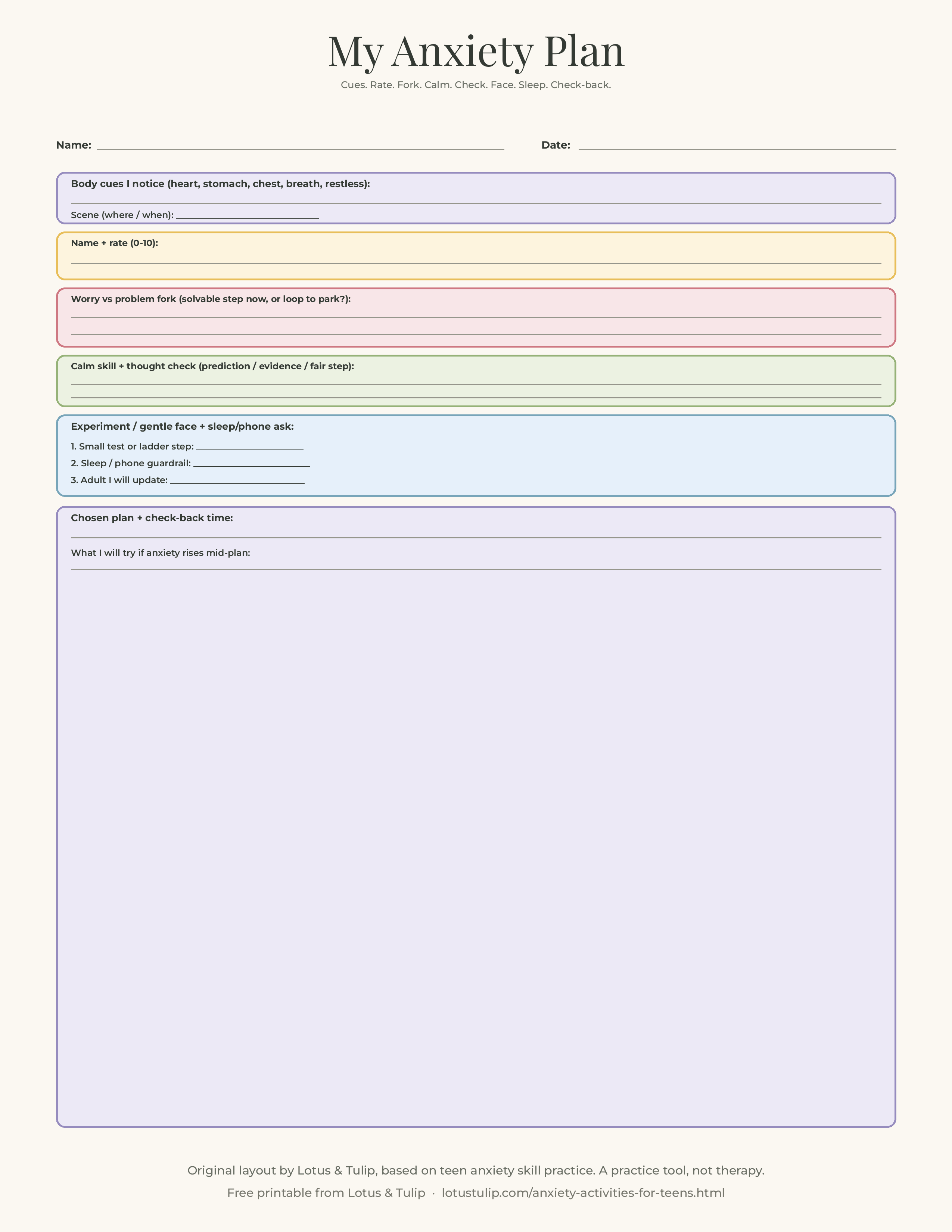
- Page 2: My Anxiety Plan. Fill in cues, rating, fork, calm skill, thought check, experiment or step, sleep/phone ask, and check-back.
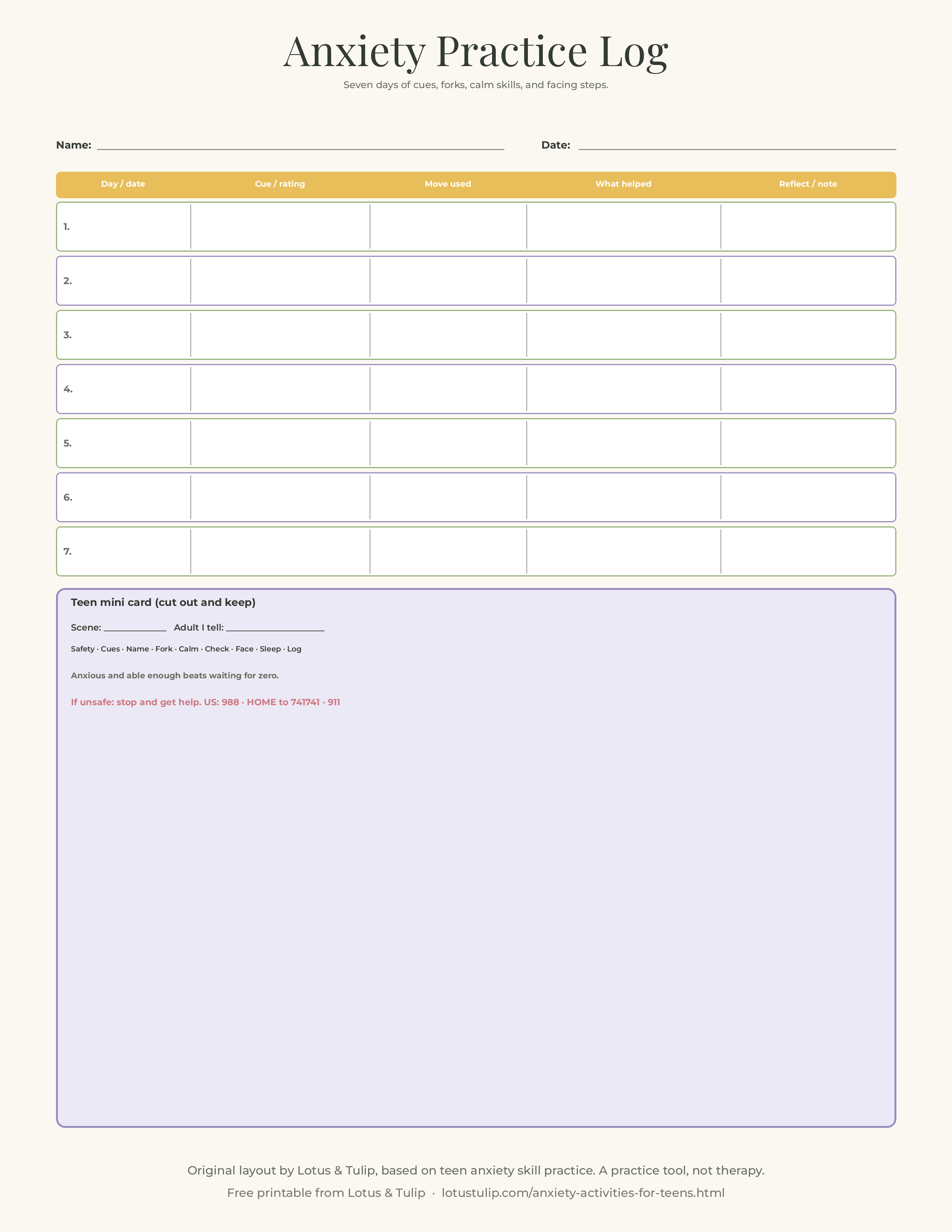
- Page 3: Practice Log + teen mini card. Seven day rows plus a cut out reminder for safety, cues, name, fork, calm, check, face, sleep, log.
Download the free anxiety activities printable for teens (PDF, 3 pages, US Letter)
Prefer single images? Page 1: Teen Anxiety Steps (PNG) · Page 2: My Anxiety Plan (PNG) · Page 3: Practice Log (PNG)
Free anxiety starter pack: Working with older teens? The free anxiety worksheets starter pack has six real pages for adult and older teen clients: the anxiety cycle, a worry log, probability and catastrophe, a fear ladder, grounding and a support and safety page.
Free to print for your own use and for use with your own clients, students, or groups. This is an original layout by Lotus & Tulip, based on teen anxiety skill practice associated with CBT for adolescent anxiety review neighbors and exposure-as-ingredient notes, with clear non-affiliation. It is not affiliated with those authors, any scale publisher, or any specific treatment or curriculum package, and is not a substitute for therapy. Please link to this page rather than re-uploading the file.
Related resources
- School refusal worksheets for teens: when anxiety keeps a teen home from school, a free step back to school plan.
- Anxiety worksheets for kids: younger alarm and brave steps.
- Stress management worksheets for teens: workload, sleep, screens.
- Coping skills worksheets for teens: broad coping menu.
- Test anxiety worksheet: exams and pre-test routines.
- Social anxiety worksheets for teens: social evaluation focus.
- Worry tree worksheet: plan vs cope fork.
- Exposure hierarchy worksheet: fear ladder builder.
- Emotional regulation activities for teens: cool body then choose.
- Peer pressure worksheets for teens: group pressure neighbors.
- Perfectionism worksheet for teens: healthy striving vs perfectionism.
- Safety plan worksheet: when the moment is about staying safe and alive.
Sources
- James, A. C., and related Cochrane-style and CBT-for-youth-anxiety review traditions on psychological treatments for anxiety in children and adolescents. Educational credit with clear non-affiliation. Not a claim that this printable remits clinical anxiety or diagnoses anything.
- Anxiety treatment summaries that note exposure (planned facing of avoided situations) as an active ingredient alongside cognitive work. Educational credit with clear non-affiliation.
- School SEL program research as a neighbor for skill and climate supports, with implementation caveats. Educational credit with clear non-affiliation.
- Honest caveat: teen anxiety drills are a skill practice aid. Reviews are not the same as RCTs of this Lotus and Tulip printable. Adult support and clinical care when indicated matter.
Anxiety activities for teens: FAQ
What are anxiety activities for teens?
They are practice tools for noticing body cues, naming and rating anxiety, forking worry from solvable problems, using brief calm skills, checking sticky thoughts, running small experiments or gentle facing steps, guarding sleep and phones a little, and logging what helps. They are educational skill aids, not therapy.
Is this the same as the kids anxiety page?
No. The kids page uses younger alarm and brave ladder language. This teens page centers adolescent anxiety with rating, worry forks, thought checks, experiments, gentle exposure caveats, sleep and phone habits, and school and home supports.
How is this different from stress or coping pages for teens?
Stress pages focus on workload, sleep, and screens as the main load. Coping pages stock a broad skill menu. This page centers the anxiety loop: cues, name, fork, calm, check, face, log.
Can school counselors use it with teens?
Yes, often in short meetings with safety sort, cues, name and rate, worry fork, one calm skill, and one next step or experiment. Keep practice optional and school safe. Follow crisis protocols when risk appears. Do not use the page as a diagnosis.
Should teens do exposure alone?
Gentle facing works best as planned steps with consent and adult support. Do not force public exposure. Prefer a written ladder. For trauma or OCD-like rituals, prefer clinician-led care.
When should I not use this worksheet?
Do not use it as the first move in acute safety risk, medical emergency, or when the teen is too flooded to engage. Stabilize and get help when needed: 988, HOME to 741741, or 911. Prefer a safety plan in crisis.
Is this affiliated with James, Cochrane, or any CBT manual?
No. This is an original Lotus and Tulip educational layout. We credit research lineages with clear non-affiliation and do not reproduce copyrighted manual worksheets.