
Kids and teens · Therapists and school counselors · Updated 2026-11-08
Social Anxiety Activities for Teens: Predictions, Brave Steps, and a Free Printable
Ready-made printable: Social Anxiety Worksheets for Teens Holiday 20% off: about $9.20, was $12 (EUR 10) · instant digital download
Buy on Etsy
Social anxiety activities for teens help a young person who dreads being judged do something braver than avoiding: write down the prediction ("everyone will stare," "I will say something stupid," "they will screenshot it"), take one small social step, and compare what they feared with what actually happened. Done well, these activities shrink the spotlight, cut back on hiding habits and build a ladder of brave steps a teen chose. This guide is written for US school counselors, adolescent therapists, school psychologists and social workers, and for parents who want to understand what good practice looks like.
You will get a plain language model of how social anxiety keeps itself going, twelve worksheet backed activities, a six session starter plan for individual or small group work, a nine step HowTo, adaptations for middle school, high school, online life, selective mutism concerns and neurodivergent teens, tips, common mistakes, myths, three fictional examples, guidance on when to refer, verified research notes, eight FAQs and a free three page US Letter printable: Social Anxiety Care Steps, My Brave Step Plan and a Brave Step Log with nine pocket cards.
This page is the social anxiety focused guide in our teen series. For general worry, panic and test stress, start with anxiety activities for teens or the test anxiety worksheet. For skill building when the main gap is know-how rather than fear, see social skills activities for teens and communication skills activities for teens. For the adult version of the same exposure tools, see anxiety worksheets for adults, the behavioral experiment worksheet and the exposure hierarchy worksheet.
We draw on published research and clinical guidance without claiming any affiliation or endorsement, including the cognitive model of Clark and Wells (1995), Leigh and Clark (2018), NIMH prevalence data from the National Comorbidity Survey Adolescent Supplement, NICE guideline CG159, the 2020 AACAP clinical practice guideline, the 2020 Cochrane review of CBT for childhood and adolescent anxiety, Ingul, Aune and Nordahl (2014) and Mayo-Wilson and colleagues (2014). Full citations are in the research notes below. The printable is an original Lotus and Tulip layout.
This guide is educational. Activities and worksheets do not diagnose social anxiety disorder, do not cure it by themselves and do not replace assessment, therapy, medication or crisis care. They are skill practice aids, not a manualized treatment protocol. If a teen is thinking about suicide or self harm, call or text 988 (Suicide and Crisis Lifeline) or text HOME to 741741 (Crisis Text Line). For immediate danger, call 911.
What social anxiety activities for teens are (and are not)
Most teens feel self conscious some of the time. Adolescence is a period of heightened attention to how peers see you, and a burst of nerves before a class presentation or a first day at a new school is normal. Social anxiety becomes a clinical concern when the fear of being judged, embarrassed or rejected is intense, lasts for months, leads the teen to avoid or barely endure ordinary situations, and gets in the way of school, friendships, activities or family life.
In DSM-5 terms, social anxiety disorder involves marked fear or anxiety about social situations where a person might be scrutinized, a fear of acting in a way that will be negatively evaluated, and avoidance or endurance with intense distress, typically lasting six months or more. For children and teens, the anxiety must show up in peer settings, not only with adults. Only a qualified clinician can make that diagnosis. These activities are useful both for teens with a diagnosis and for teens with milder, subclinical shyness and social worry.
Social anxiety activities for teens are:
- Structured ways to notice the anxiety loop: situation, prediction, body alarm, self focus, safety behavior, avoidance and replay.
- Small, chosen, graded social steps (often called exposures or behavioral experiments) that test a specific prediction.
- Practice in shifting attention outward, dropping hiding habits and handling the after-event replay.
- Collaborative tools for a counselor or therapist and a teen, sometimes with parents or teachers in a supporting role.
They are not:
- A diagnosis or a screening test.
- A personality makeover. Being quiet or introverted is not a disorder, and the goal is not to turn a reflective teen into the loudest person in the room.
- Forcing a teen into a feared situation without consent, a plan or a chance to say "not yet."
- A substitute for an evaluation when there is school refusal, depression, self harm, bullying, substance use or a possible neurodevelopmental difference.
- Only a social skills class. Many socially anxious teens have adequate skills that fear keeps them from using.
Core ideas that shape good social anxiety activities
Good teen social anxiety work rests on a handful of ideas from the cognitive model of Clark and Wells and from exposure based CBT. You do not need to teach the full theory. You do need these ideas to choose the right activity at the right moment.
- Predictions drive the fear. Socially anxious teens tend to predict that something embarrassing will happen, that others will notice and that the result will be lasting rejection. Activities work best when they target a specific, testable prediction instead of vague reassurance.
- Self focused attention feeds the alarm. When a teen turns attention inward, monitoring blushing, voice and every word, they feel more anxious and actually notice less about how others are responding. Shifting attention outward is a skill that can be practiced.
- The inside view is not the outside view. Many anxious teens carry a vivid image of how they look, usually worse than reality. The spotlight effect describes our general tendency to overestimate how much others notice us. Video feedback or simple surveys can help a teen compare the inside view with what others saw.
- Safety behaviors keep the fear alive. Rehearsing every sentence, avoiding eye contact, hiding behind a phone, wearing a hood to cover blushing, letting a friend do all the talking or only messaging instead of calling can feel protective. They also stop the teen from learning that they would have been fine, and some (like going silent) can make interactions more awkward.
- Avoidance shrinks life. Each skipped lunch, unanswered group chat or missed tryout brings relief now and makes the next step harder. The cost is often largest at school: participation grades, presentations, clubs and attendance.
- The replay can be worse than the event. Clark and Wells describe anticipatory worry before an event and post-event processing afterward, where the teen replays every awkward moment. Activities can include a "stop the replay" plan.
- Brave steps are graded and chosen. A brave ladder lists situations from easier to harder. The teen chooses where to start, and the step should be hard enough to test a prediction but not so hard that it ends in escape.
- Online life is social life. Read receipts, group chats, posting, comments and video calls are real social situations for teens, with their own predictions and safety behaviors.
Twelve worksheet backed social anxiety activities for teens
Pick one to three activities per session. Each lists the goal, what to do and a tip. Use the free printable for the core plan and log, and the full Etsy set when you want separate pages for each activity.
1. Map my social anxiety loop
Goal: help the teen see the pattern instead of feeling it as one big wave.
How: choose one recent situation (answering a question in class, walking into the cafeteria, a group chat that went quiet). Draw five boxes: situation, prediction, body alarm, what I did to stay safe, what happened after. Ask what the safety move cost in the long run.
Tip: keep the language casual. "What did your brain tell you would happen?" lands better with many teens than "What was your automatic thought?"
2. Fear and avoidance ratings
Goal: build a shared list of hard situations with numbers you can track.
How: list 10 to 15 situations: ordering food, asking a teacher for help, eating in front of others, joining a table, speaking in a group project, calling to make an appointment, posting a photo, replying in the group chat. Rate fear from 0 to 10 and avoidance from 0 to 10.
Tip: include online and in-person situations. Repeat the ratings every few weeks so the teen can see change.
3. Prediction check
Goal: turn a vague dread into a specific prediction that can be tested.
How: write the feared outcome as concretely as possible. "If I ask a question in chemistry, at least three people will laugh and someone will mention it at lunch." Rate how strongly the teen believes it from 0 to 100. Plan what you would need to observe to know whether it came true.
Tip: precise predictions are easier to check. "People will think I am weird" can become "Someone will say something mean or look away from me when I sit down."
4. Spotlight mini experiment
Goal: test how much others really notice.
How: in session or with a trusted group, the teen does something mildly noticeable (wears a sticker, says a word slightly wrong, pauses for five seconds while speaking) and then asks a few people what they noticed. Compare the inside rating ("How obvious was it, 0 to 10?") with what people report.
Tip: this works well in groups, where peers can answer honestly. Keep it light and fully voluntary.
5. Thinking traps in social situations
Goal: name common social thinking traps.
How: introduce mind reading ("they think I am boring"), fortune telling ("I will freeze"), the spotlight ("everyone is watching"), catastrophizing ("this will ruin everything"), discounting the positive ("they were only being nice") and labeling ("I am awkward"). The teen circles the traps in one recent prediction. Our cognitive distortions worksheet has a longer list.
Tip: naming a trap is not the same as proving the thought wrong. Experiments do most of the convincing.
6. Safety behavior audit
Goal: find the hiding habits that keep fear going.
How: use a checklist for school, in person and online: rehearsing sentences, avoiding eye contact, keeping hands in pockets, hiding behind hair or a hood, staying on the phone, letting a friend talk, leaving early, typing and deleting messages, never posting, only joining calls with the camera off. The teen marks which ones they use and picks one to drop during the next brave step.
Tip: run an experiment with and without the safety behavior and compare both the anxiety and the outcome. Teens are often surprised that conversations go better when they stop rehearsing.
7. Attention out practice
Goal: move attention from inner monitoring to the conversation and the room.
How: practice a two minute conversation twice. First, focus inward on how you look and sound. Second, focus outward: what the other person is saying, their face, the details of the room, one question to ask. Rate anxiety and how well the conversation went after each round.
Tip: a quick 5 4 3 2 1 grounding check can help a teen come back to the room, but keep the purpose clear: you are shifting attention, not trying to make anxiety vanish.
8. Build my brave ladder
Goal: organize brave steps from easier to harder.
How: choose one goal that matters to the teen (eating lunch with others, joining a club, speaking in class). Break it into 6 to 10 steps. For lunch, steps might be: sit at the edge of a table with a known friend, say hello to one other person, ask one question, stay until the bell, join a table where you only know one person. Rate each step's fear from 0 to 10.
Tip: the ladder belongs to the teen. Adults can suggest steps, but the teen decides where to begin. See our exposure hierarchy worksheet for a general version.
9. Brave step planner
Goal: turn one ladder step into a specific plan with a testable prediction.
How: write the step, when and where it will happen, the prediction, how strongly the teen believes it, the safety behavior to drop and the coping thought to bring. After the step, record what actually happened, the new belief rating and what was learned.
Tip: the most useful question afterward is "What did you learn?" rather than "How anxious were you?" Anxiety may stay high for the first few steps; the learning is what changes.
10. Conversation toolkit
Goal: give the teen simple scripts for starting, keeping and ending conversations.
How: practice openers tied to the moment ("Did you finish the lab?"), follow-up questions, simple self disclosure, and polite exits ("I need to head to class, see you later"). Role play in session, then use one script during a brave step.
Tip: scripts are a starting point, not a safety behavior. Over time the goal is less rehearsal, not more. For deeper skills work, see social skills activities for teens.
11. Stop the replay
Goal: reduce post-event rumination.
How: after a social event, the teen notices the replay starting, writes one sentence about what happened ("I talked to Maya for two minutes and my voice shook a little"), names one thing that went fine, and then turns to an absorbing activity. Set a limit: "I can think about this for five minutes, then I move on."
Tip: pair this with self compassion activities for teens. A kind sentence to yourself often helps more than arguing with every thought.
12. Online and group chat worries
Goal: apply the same tools to digital social life.
How: list online fears (posting, being left on read, replying in a big group chat, voice notes, video calls with camera on). Identify online safety behaviors (drafting messages for an hour, deleting posts, lurking without replying). Build a small online ladder, such as replying with one emoji, then one sentence, then a question.
Tip: keep digital safety separate from social anxiety. Real cyberbullying, threats, sextortion or exploitation are safety issues for adults to address, not brave steps. See bullying activities for teens.
A six session starter plan (individual or small group)
This outline is a practical sequence for a first block of social anxiety work with a teen or a small group of teens. It is not a manualized protocol, not a claim that this order has been tested in a trial and not a substitute for training in CBT for social anxiety. NICE guidance for children and young people describes 8 to 12 sessions that include psychoeducation, exposure, social skills training and rehearsal, so many teens will need more than six. In groups, keep members within a similar age range and agree on confidentiality rules.
| Session | Focus | Activities | Between sessions |
|---|---|---|---|
| 1 | Safety, goals and the anxiety loop | Map my social anxiety loop, fear and avoidance ratings | Notice one moment the loop showed up |
| 2 | Predictions and thinking traps | Prediction check, thinking traps | Write one specific prediction before a social moment |
| 3 | The spotlight and safety behaviors | Spotlight mini experiment, safety behavior audit | Drop one small safety behavior once |
| 4 | Attention and the brave ladder | Attention out practice, build my brave ladder | Try the lowest step on the ladder |
| 5 | Brave steps in real life | Brave step planner, conversation toolkit | Two planned brave steps, logged |
| 6 | Replay, online life and next steps | Stop the replay, online worries, review ratings | Keep climbing one step per week; book follow-up |
Repeat the fear and avoidance ratings in session 6 and, where your setting allows, use a validated measure. NICE lists measures such as the LSAS child version, the SPAI-C and the SPIN for young people. A teen who goes to lunch more often, answers in class or replies in the group chat has made real progress even if anxiety has not dropped to zero.
How to use social anxiety activities for teens, step by step
- Check safety and whether these activities fit. Ask about self harm, suicidal thoughts, bullying, substance use and school refusal. If risk is present, use crisis resources and a safety plan first. Brave steps wait when safety is in question.
- Learn the teen's story and goals. Ask what situations are hardest, what they avoid and what they would do if fear were a bit smaller. Agree on one goal that matters to the teen, not only to adults.
- Map the anxiety loop together. Use one recent situation to trace prediction, body alarm, safety behaviors, avoidance and replay. Normalize: this is a common pattern, not a character flaw.
- Rate fear and avoidance. List 10 to 15 social situations, in person and online, and rate each from 0 to 10. This becomes the raw material for the ladder and a way to track change.
- Turn worries into testable predictions. Write specific predictions and belief ratings. Name thinking traps, without arguing the teen out of their fear.
- Spot and drop safety behaviors. Audit hiding habits and choose one to drop during the next step. Explain why: safety behaviors keep the brain from learning that the situation is survivable.
- Build the brave ladder and choose a first step. Order 6 to 10 steps from easier to harder. The teen picks a first step that is challenging but doable, usually in the 3 to 5 out of 10 range.
- Take the step and compare prediction with reality. Do the step in session or in real life, with attention turned outward. Afterward, record what actually happened, the new belief rating and what was learned.
- Review, handle the replay and plan the next step. Use the stop the replay plan, praise effort rather than performance, and choose the next step. Involve parents or teachers where helpful, and refer for further care if progress stalls.
Print the free three page set and keep a stack in your office, or share the PDF for telehealth. Page two works well as a phone photo, so the teen has the plan ready right before the brave step.
Adaptations
- Middle school (about ages 11 to 14). Keep steps concrete and short. Use visual ladders, stickers or points for completed steps, and involve parents more actively. Common targets: lunch, lockers, asking a teacher a question, PE, group projects and transitions. Our middle school transition activities pair well with this page for incoming sixth graders.
- High school (about ages 14 to 18). Older teens can often use more adult style cognitive work. NICE notes that interventions developed for adults may suit young people, typically aged 15 and older, who have the cognitive and emotional capacity. Targets include presentations, jobs, driving lessons, dating, college interviews and phone calls.
- School counselors. Brave steps can be built into the school day: delivering a note to the office, asking a librarian for a book, joining a club meeting for ten minutes. Coordinate with teachers on gentle participation goals, such as a planned question the teen knows is coming, rather than surprise cold calls.
- Small groups. Groups give natural practice partners and honest feedback for spotlight experiments. Keep groups small, set clear rules about teasing and confidentiality, and pair group work with individual check-ins. NICE does not prefer group over individual CBT for young people; both are options.
- Online and telehealth. Use camera on and off as a ladder in itself. Practice voice notes, short video replies and joining a call on time. Screen share the printable for planning.
- Possible selective mutism. A child or teen who speaks freely at home but consistently does not speak at school or with peers may have selective mutism rather than, or alongside, social anxiety. This needs a careful assessment and specialized, very gradual approaches, often with a speech language pathologist. Do not pressure speech.
- Autistic and ADHD teens. Social difficulty may come from different processing, sensory load or unclear social rules rather than fear of judgment. Ask what is hard and why. Respect different ways of socializing, build in sensory supports and avoid treating masking as a goal. See social skills activities for teens for skills work.
- Depression alongside social anxiety. Withdrawal, low energy and hopelessness can look like social anxiety. If low mood is significant, address it directly and screen for suicide risk. See depression activities for teens.
- Perfectionism and test anxiety. Fear of being judged often overlaps with high standards. See our perfectionism worksheet for teens and test anxiety worksheet.
Tips for counselors and therapists
- Lead with curiosity. "What would you do this week if this fear were a little smaller?" opens more doors than "You need to talk more in class."
- Do steps in session. Walking with a teen to the front office or making a practice phone call together often teaches more than a week of planning.
- Use the teen's words. If they call it "the cringe" or "my brain being dramatic," put that on the worksheet.
- Celebrate attempts. A teen who tries a step and leaves early has still gathered data. Ask what they learned and plan a slightly smaller next step.
- Coach parents to support, not rescue. Parents can praise brave behavior and gently stop speaking for the teen, ordering for them or excusing them from everything. Explain why accommodation keeps fear going.
- Coordinate with school. A 504 plan or classroom supports can help, but aim for accommodations that make participation possible, not ones that make avoidance permanent.
- Keep notes on predictions. Over weeks, a list of "what I feared versus what happened" becomes the teen's own evidence.
Common mistakes
- Skipping the prediction. Without a specific prediction, a brave step is just a hard experience. The learning comes from comparing fear with reality.
- Starting too high on the ladder. A first step at 9 out of 10 often ends in escape and confirms the fear.
- Keeping every safety behavior. A teen who gives a presentation while reading word for word and never looking up may finish but learn little.
- Reassuring instead of testing. "Nobody thinks that about you" rarely helps for long. An experiment that shows it does.
- Treating shyness as a disorder. If a quiet teen has friends, participates when needed and is not distressed, there may be nothing to fix.
- Ignoring bullying or real exclusion. If peers are actually cruel, the problem is not only in the teen's head. Address safety and school climate first.
- Making it all about talking. Eating in front of others, walking into a room, being looked at and online posting are also common targets.
Myths about teen social anxiety
- "They will grow out of it." Some teens do, but social anxiety often persists into adulthood without help, and avoidance can cost years of school and friendship opportunities. Effective help exists.
- "It is just shyness." Shyness is a temperament. Social anxiety disorder involves intense fear and avoidance that interfere with life. They can overlap, but they are not the same.
- "Forcing them to do it will fix it." Pushing a teen into a feared situation without consent or preparation can backfire. Graded, chosen, planned steps work better.
- "Phones caused it." Online life can add new pressures and new safety behaviors, but social anxiety existed long before smartphones. Treat online situations as part of the ladder rather than blaming one cause.
- "Medication is the only real treatment." CBT focused on social anxiety is a first line psychological approach, and the AACAP guideline also recommends SSRIs for social anxiety in youth. Medication decisions belong with a prescriber and the family.
Three fictional examples
Jordan, 13, cafeteria fear. Jordan ate lunch in the library every day, predicting that "everyone will see I have no one to sit with." Fear rating: 8. With the counselor, Jordan built a lunch ladder. Step one was sitting at the end of a table with one friend from band for ten minutes. Prediction: "people will stare," belief 70. What happened: nobody seemed to notice, and the friend talked about a video game. New belief: 30. Over five weeks Jordan moved to staying for the full lunch twice a week.
Priya, 16, class participation. Priya had strong grades but lost participation points because she never spoke in English class. Her safety behaviors were writing a full script and reading it with her head down. Her experiment: answer one question with only three bullet points written down. Prediction: "my voice will shake and someone will laugh," belief 80. Her voice shook a little; nobody laughed, and the teacher built on her point. She rated the replay as worse than the event and added a stop the replay plan.
Marcus, 15, group chat and low mood. Marcus stopped replying in his friends' group chat and said he felt "like nobody would care if I disappeared." The counselor paused the social anxiety plan, asked directly about suicidal thoughts and completed a safety plan with Marcus and his parents, with 988 and the Crisis Text Line written on it. After a referral for depression treatment, the counselor and Marcus returned to small online steps alongside that care.
How this page compares to nearby Lotus and Tulip guides
| Guide | Best for | How it differs |
|---|---|---|
| Anxiety activities for teens | General worry, body cues, calm skills | Broad teen anxiety skills; this page focuses on fear of judgment and brave social steps |
| Social skills activities for teens | Learning conversation and friendship skills | Teaches skills; this page targets fear that blocks skills a teen may already have |
| Behavioral experiment worksheet | Testing any belief | General adult experiment format; here experiments are tailored to teen social predictions |
| Exposure hierarchy worksheet | Building any fear ladder | General ladder; this page adds safety behaviors, attention out and the replay |
| Test anxiety worksheet | Exam stress | Performance on tests rather than fear of peer judgment |
| Anxiety worksheets for adults | Adult worry, panic and exposure | Adult language and targets; this page is written for teens and school settings |
| Self compassion activities for teens | Harsh self talk | Pairs well with the stop the replay activity |
When not to use these activities (or when to refer)
- Suicidal thoughts, self harm or a crisis. Use crisis care first: call or text 988, text HOME to 741741, call 911 for immediate danger, and complete a written safety plan.
- Bullying, harassment or online exploitation. If peers are threatening, excluding or exploiting the teen, address safety with the school and family. Do not frame real danger as a brave step.
- School refusal or long absences. When a teen has stopped attending, coordinate a fuller plan with the school, family and a clinician.
- Possible selective mutism, autism or other developmental differences. Refer for assessment and adapt the approach. Do not pressure speech or eye contact.
- Significant depression, substance use, eating concerns or panic attacks. These need their own assessment and treatment, and may need attention before or alongside social anxiety work.
- No progress after a fair trial. If a teen remains stuck after consistent practice, refer to a clinician trained in CBT for anxiety, and discuss whether a medication evaluation might help.
- Outside your scope. Teachers, coaches and youth workers can encourage brave steps, but moderate or severe social anxiety should be guided by a licensed clinician.
Free 3 page social anxiety activities printable (US Letter)
Download the free printable, print on US Letter and use it in session, in a small group or between sessions.
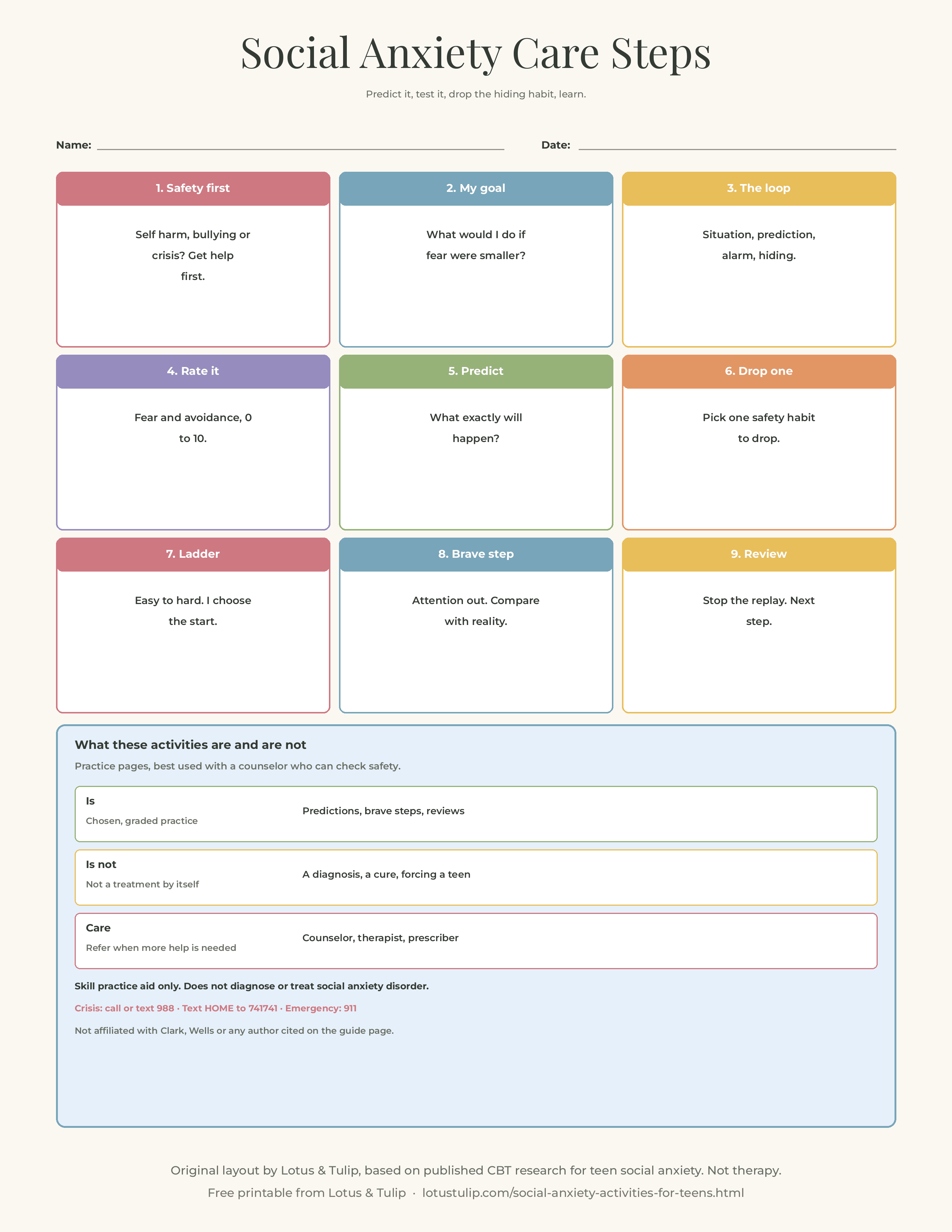
- Page 1: Social Anxiety Care Steps. Nine steps that match the HowTo above, what these activities are and are not, and crisis resources.
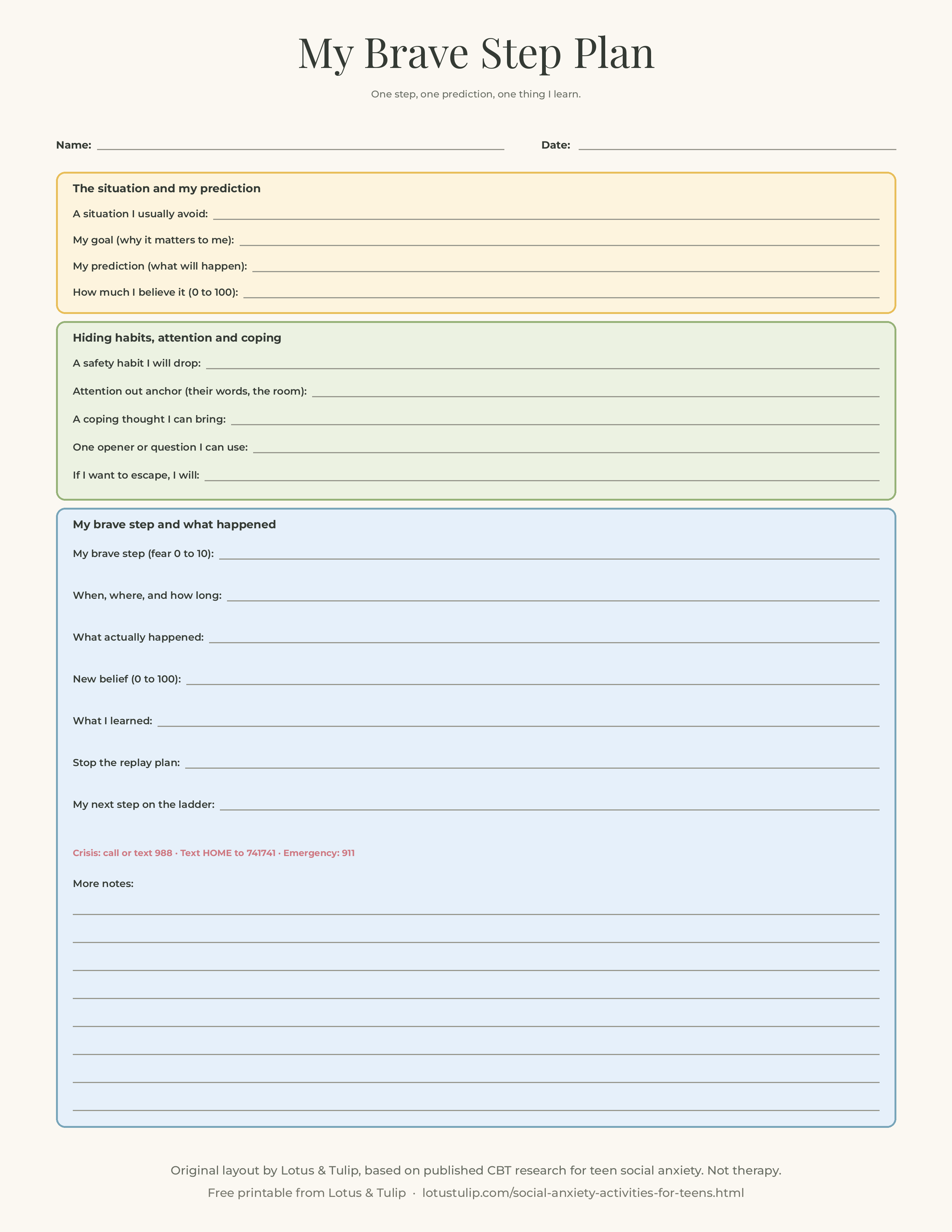
- Page 2: My Brave Step Plan. The situation, the prediction and belief rating, the safety behavior to drop, an attention out anchor, the brave step, and what actually happened.
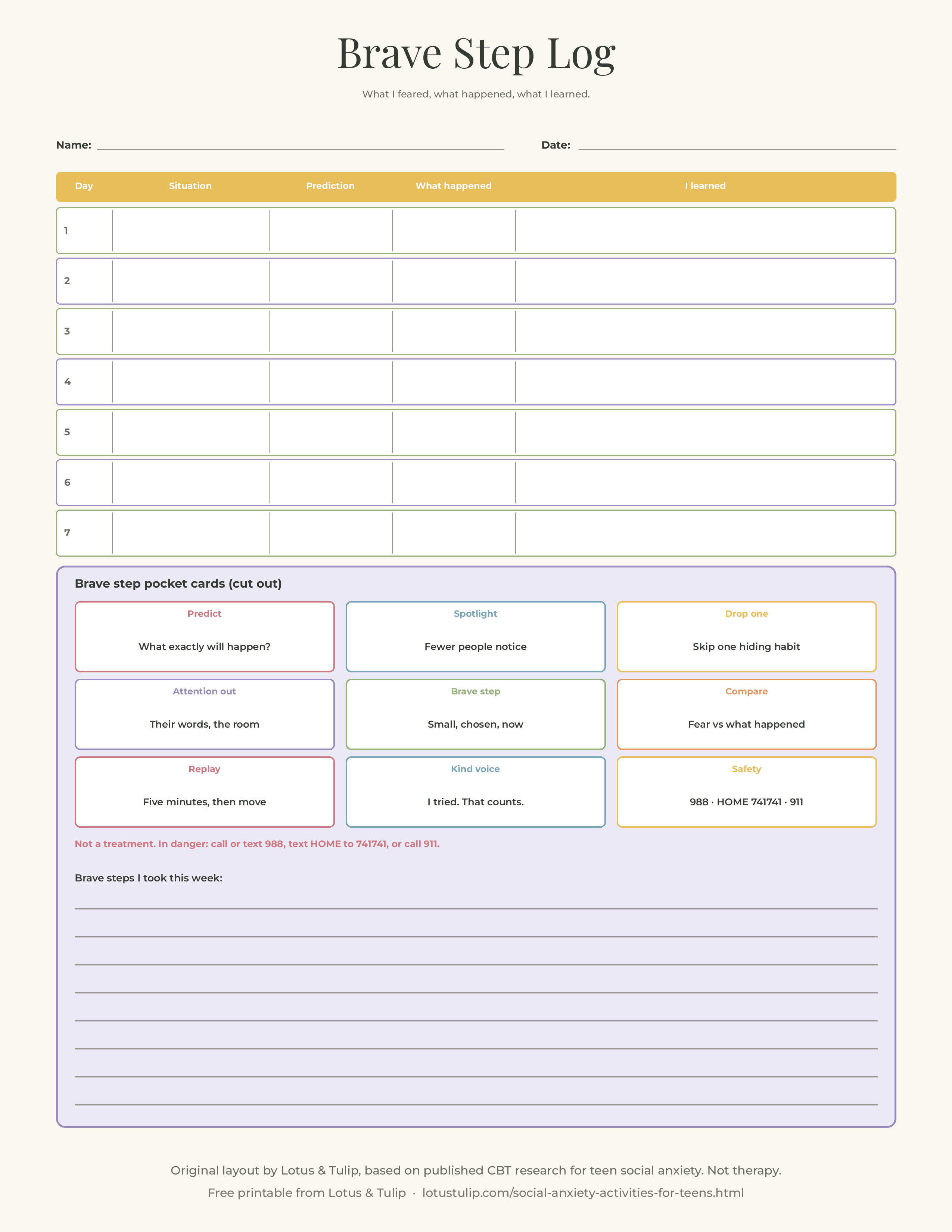
- Page 3: Brave Step Log. Seven rows for day, situation, prediction, what happened and what I learned, plus nine pocket cards.
Download free PDF · Page 1 PNG · Page 2 PNG · Page 3 PNG
Research notes (verified, with caveats)
- Clark DM, Wells A. A cognitive model of social phobia. In: Heimberg RG, Liebowitz MR, Hope DA, Schneier FR, eds. Social Phobia: Diagnosis, Assessment, and Treatment. Guilford Press; 1995. The model describes how negative social predictions, self focused attention, a distorted self image, safety behaviors and anticipatory and post-event processing maintain social anxiety. It is the source for several activity targets on this page. We describe it without claiming affiliation or endorsement.
- Leigh E, Clark DM. Understanding social anxiety disorder in adolescents and improving treatment outcomes: applying the cognitive model of Clark and Wells (1995). Clin Child Fam Psychol Rev. 2018;21:388-414. The authors reviewed evidence that the model's processes (self focused attention, safety behaviors, negative self imagery and pre and post-event processing) apply to adolescents, noted that much of the evidence is correlational or from non-clinical samples, and recommended adapting cognitive therapy to adolescent factors such as heightened self consciousness and sensitivity to peer rejection.
- National Institute of Mental Health, Social Anxiety Disorder statistics, based on Merikangas KR and colleagues. Lifetime prevalence of mental disorders in US adolescents: results from the National Comorbidity Survey Replication Adolescent Supplement (NCS-A). J Am Acad Child Adolesc Psychiatry. 2010;49(10):980-989. In this survey of 10,123 US adolescents aged 13 to 18 (fielded 2001 to 2004, DSM-IV criteria), an estimated 9.1 percent had lifetime social anxiety disorder and 1.3 percent had severe impairment. Prevalence was higher in females (11.2 percent) than males (7.0 percent). These are older data and current rates may differ.
- National Institute for Health and Care Excellence. Social anxiety disorder: recognition, assessment and treatment (CG159). 2013. Recommendation 1.5.3: offer individual or group CBT focused on social anxiety to children and young people with social anxiety disorder, and consider involving parents or carers. Recommendations 1.5.4 and 1.5.5 describe 8 to 12 sessions including psychoeducation, exposure to feared or avoided social situations, social skills training and rehearsal. Recommendation 1.5.6: consider adult interventions for young people, typically 15 and older, who have the capacity. This is UK guidance offered as context, not a US practice standard.
- Walter HJ, Bukstein OG, Abright AR and colleagues. Clinical practice guideline for the assessment and treatment of children and adolescents with anxiety disorders. J Am Acad Child Adolesc Psychiatry. 2020;59(10):1107-1124. The AACAP guideline recommends CBT for youth aged 6 to 18 with social anxiety, generalized anxiety, separation anxiety, specific phobia or panic disorder, and recommends SSRIs for social, generalized, separation and panic anxiety. It also notes that combined CBT and an SSRI may be offered for some anxiety disorders, including social anxiety. Medication decisions belong with a prescriber.
- James AC, Reardon T, Soler A, James G, Creswell C. Cognitive behavioural therapy for anxiety disorders in children and adolescents. Cochrane Database Syst Rev. 2020;(11):CD013162. 87 randomized studies with 5,964 participants. CBT probably increased remission of the primary anxiety diagnosis at post-treatment compared with waitlist or no treatment (about 49 percent versus 18 percent). Evidence that CBT is better than treatment as usual or other active treatments was less clear. The review covered anxiety disorders broadly, not only social anxiety.
- Ingul JM, Aune T, Nordahl HM. A randomized controlled trial of individual cognitive therapy, group cognitive behaviour therapy and attentional placebo for adolescent social phobia. Psychother Psychosom. 2014;83(1):54-61. In adolescents aged 13 to 16 with social phobia, individual cognitive therapy based on an adult cognitive model, adapted for teens, outperformed both group CBT and an attentional placebo. This is one trial in one country and does not mean group work is unhelpful.
- Mayo-Wilson E, Dias S, Mavranezouli I and colleagues. Psychological and pharmacological interventions for social anxiety disorder in adults: a systematic review and network meta-analysis. Lancet Psychiatry. 2014. 101 trials with 13,164 participants. Individual CBT had the largest effect among psychological treatments compared with waitlist. This review is about adults and is included as context for why cognitive and exposure work forms the core of adolescent approaches.
We do not invent effect sizes. The trials and reviews above tested structured treatments, usually delivered by trained clinicians over many sessions, not standalone worksheets. The free printable is a skill practice aid inspired by the same targets and has not been tested in a randomized trial.
Social anxiety activities for teens: FAQ
What are social anxiety activities for teens?
They are short, structured exercises that help teens who fear being judged notice their predictions, drop hiding habits, shift attention outward and take small, graded social steps. Counselors and therapists use them in session, in small groups and as practice between sessions.
How is social anxiety different from shyness?
Shyness is a common temperament, and many shy teens have friends and get through school without major distress. Social anxiety disorder involves intense fear of judgment and avoidance that lasts for months and gets in the way of school, friendships or activities. Only a qualified clinician can diagnose it.
What is a brave ladder?
A brave ladder (also called a fear ladder or exposure hierarchy) is a list of social situations ordered from easier to harder. The teen chooses a first step that feels challenging but doable, practices it until it gets easier, and then moves up. Each step includes a prediction to test.
What are safety behaviors in social anxiety?
They are habits that feel protective, such as rehearsing sentences, avoiding eye contact, hiding behind a phone, letting a friend do the talking or leaving early. They reduce anxiety in the moment but stop the teen from learning that the situation would have been fine, so activities usually involve dropping them gradually.
Can school counselors use these activities?
Yes. School counselors can use them for psychoeducation, small groups and brave steps built into the school day. Teens with severe impairment, school refusal, depression or safety concerns should also be referred to a licensed clinician for assessment and treatment.
Is medication used for social anxiety in teens?
Sometimes. The 2020 AACAP guideline recommends CBT and also recommends SSRIs for social anxiety in youth, and some teens receive both. Medication questions belong with a prescriber, the teen and the family. Worksheets do not replace that conversation.
Can teens use the free printable on their own?
Yes, many teens can use the brave step plan and log on their own or with a parent. If fear keeps a teen from school, friends or activities for weeks, or comes with thoughts of self harm or suicide, please reach out to a counselor or clinician. Call or text 988, text HOME to 741741, or call 911 in an emergency.
Do these activities work for younger kids?
This set is written for teens, roughly ages 11 to 18. Younger children usually need more parent involvement, simpler language and more concrete rewards. See our anxiety worksheets for kids and social skills worksheets for kids for younger clients.