
Kids and teens · Anger management for ages 5 to 12 · Updated 2026-11-04
Anger management activities for kids: 30 calm down ideas that actually work, and a free printable
Ready-made printable: Anger Management Worksheets for Kids and Teens Holiday 20% off: about $9.20, was $12 (EUR 10) · instant digital download
Buy on Etsy
Every child gets angry. Anger is a normal, useful feeling: it tells a child that something feels unfair, blocked or threatening. The problem is rarely the feeling itself. It is what happens next: the hitting, throwing, screaming, slammed doors or the meltdown that leaves everyone shaken.
This guide is for school counselors, therapists, teachers and parents of kids about 5 to 12. It explains what the research says about anger management for children, why some popular advice (like punching a pillow) tends to backfire, 30 anger management activities sorted by type, a simple four step cool down routine, how to repair after a blow up, an 8 step teaching plan and when to get more help. At the end there is a free three page printable: My Anger Warning Signs, My Cool Down Menu and My Anger Plan.
Jump to the free anger management activities printable
What anger management means for kids
For children, anger management is not about never getting mad. It is a small set of skills a child can learn and practice:
- Noticing anger early. Spotting the body clues (hot face, tight fists, fast heart) before the feeling gets too big to think through.
- Calming the body down. Using a skill that lowers the physical arousal of anger, such as slow breathing or relaxing muscles.
- Thinking about the problem. Asking "what happened?" and "how big is this problem?" once the body is calmer.
- Choosing a response. Using words, asking for help, taking a break or solving the problem fairly.
- Repairing afterward. Making things right when anger did hurt someone or something.
A sentence that works with kids, and the one at the top of page 1 of the printable: anger is an okay feeling, and spotting it early gives me time to choose what I do next. Separating the feeling (always allowed) from the behavior (not always okay) is the foundation of everything else.
What the research says about anger management for children
Two research findings are worth knowing before choosing activities.
Skills based programs help
A meta-analysis by Denis Sukhodolsky, Howard Kassinove and Bernard Gorman (2004) pooled 40 studies of cognitive behavioral therapy (CBT) for anger related problems in children and adolescents, with 1,953 participants in total. The average effect was in the medium range (d = 0.67), similar to child psychotherapy in general. Skills training and multimodal programs were the most effective at reducing aggressive behavior and improving social skills, while problem solving approaches did better at reducing how angry kids felt. Programs that used modeling, feedback and homework tended to have larger effects.
The practical takeaway: kids learn anger skills best when an adult shows the skill, the child practices it, gets feedback, and then uses it between sessions. A worksheet alone is a starting point, not the whole intervention.
Calming down beats "letting it out"
Many people still believe anger is like steam in a pressure cooker that needs to be released by hitting a pillow, screaming into a cushion or running it off. The research does not support this.
- In a classic experiment, Brad Bushman (2002) found that people who hit a punching bag while thinking about the person who had angered them ended up angrier and more aggressive afterward than people who simply sat quietly.
- A 2024 meta-analysis by Sophie Kjærvik and Brad Bushman in Clinical Psychology Review combined 154 studies with 10,189 participants. Activities that decrease physical arousal, such as deep breathing, relaxation, mindfulness and yoga, reduced anger and aggression (g = -0.63), across ages, settings and delivery formats. Activities that increase arousal, such as venting or hitting a bag, were ineffective overall (g = -0.02).
Two honest caveats. Most studies in that meta-analysis were not specifically about young children, and exercise is still very good for kids in general. The point is narrower: when a child is angry right now, the most reliable first move is to help the body slow down, not rev it up. That is why the cool down menu in this guide is built around breathing, muscle relaxation, quiet breaks and calming the senses.
Why kids blow up: what is under the anger
Anger is often called a secondary feeling because it frequently sits on top of something else: embarrassment, hurt, fear, jealousy, disappointment or simply being exhausted. The anger iceberg worksheet is a good way to explore this with kids aged about 8 and up.
Common triggers for children include:
- Losing a game or making a mistake.
- Being told no, or having to stop a fun activity.
- Feeling that something is unfair, or being blamed.
- Being teased, left out or having belongings taken.
- Schoolwork that feels too hard.
- Being hungry, tired, sick or overstimulated by noise and crowds.
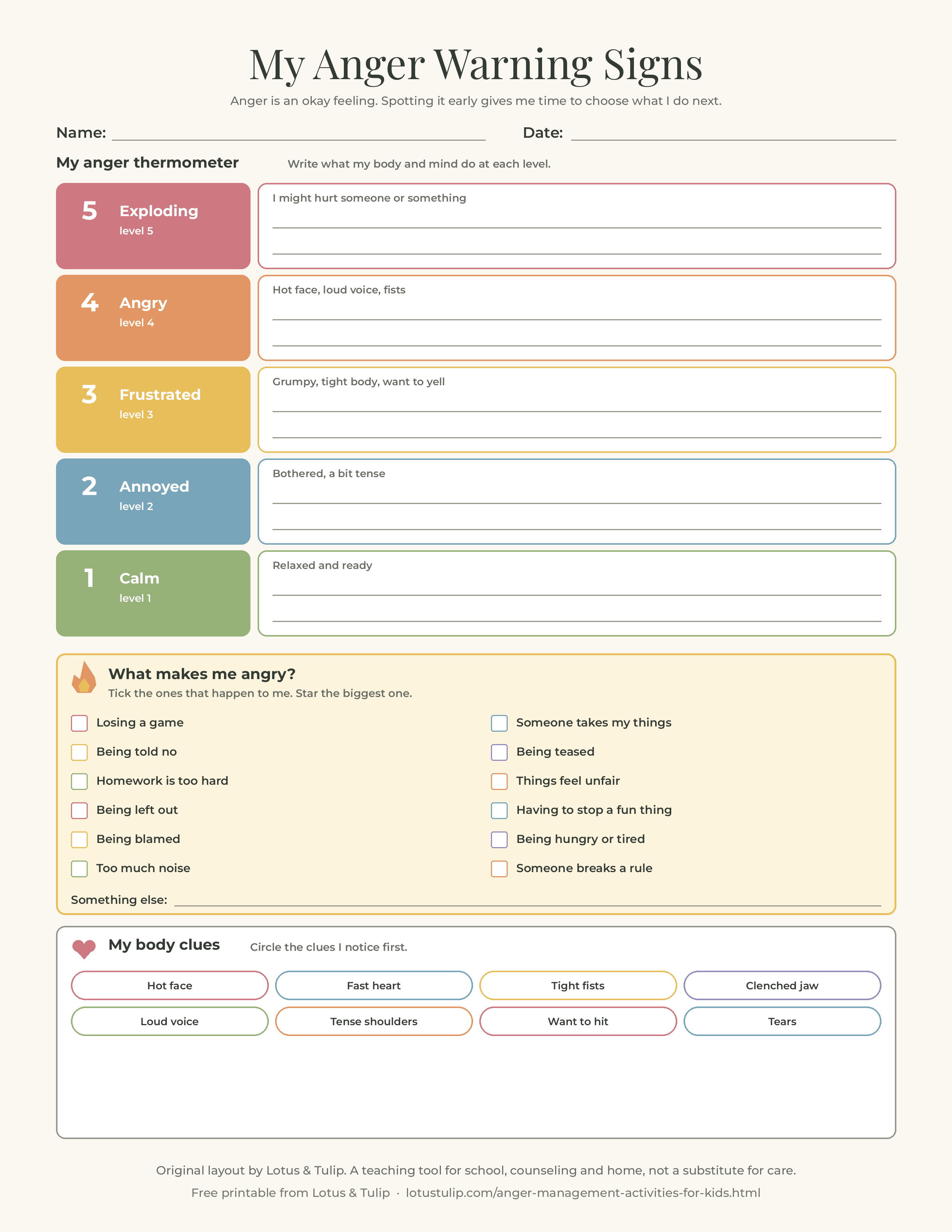
Page 1 of the printable has a 12 item trigger checklist. Ask the child to tick what applies and star the biggest one. Knowing the top two or three triggers lets adults prevent some blow ups (a snack before homework, a five minute warning before screens go off) and lets the child prepare for others.
Anger management activities for kids: 30 ideas in 6 groups
Use these to build a personal cool down menu rather than trying them all. Practice when the child is calm, then use the favorites when anger is rising. Page 2 of the printable has 20 of these as a menu to circle and star.
1. Notice it (spot anger early)
- Anger thermometer. Rate anger from 1 (calm) to 5 (exploding) and describe what each level looks and feels like for this child. See also the feelings thermometer printable.
- Body clue map. Have the child color where anger shows up in their body: face, chest, fists, stomach, jaw.
- Anger detective. After a calm day, look back at a recent moment of anger and find the first clue that appeared.
- Weather report. Kids describe their mood as weather (sunny, cloudy, stormy) during a morning check in. The daily check in sheet works well here.
- Trigger sort. Write common triggers on cards and sort them into "really bothers me", "bothers me a bit" and "does not bother me".
2. Breathe slow
- Balloon breath. Breathe in slowly to fill a pretend balloon in the belly, then let the air out even more slowly.
- Smell the flower, blow out the candle. In through the nose, long gentle breath out through the mouth.
- Count 4 in, 6 out. A longer out breath than in breath is the core of most calming breathing.
- Hand trace breathing. Trace up a finger while breathing in and down while breathing out, for all five fingers.
- Bubble breaths. Blow real or pretend bubbles slowly. Big bubbles need slow, steady breath.
More ideas are in breathing exercises for kids.
3. Relax the muscles
- Squeeze and let go. Squeeze fists tight for five seconds, then let go and notice the difference. Repeat with shoulders, face and feet.
- Turtle in its shell. Pull arms and head in like a turtle, take three slow breaths, then come out when calmer (more on this below).
- Push the wall. Push hard against a wall for ten seconds, then relax. This gives a strong feeling of effort followed by release, without hitting anything.
- Melt like ice cream. Start stiff as a frozen ice cream cone, then slowly melt into a puddle on the floor.
- Spaghetti body. Go from stiff uncooked spaghetti to floppy cooked spaghetti, one body part at a time.
4. Take a calm break
- Calm down spot. A quiet, comfortable place the child chooses to go to, not a punishment. See calm down corner ideas.
- Drink of water. Walking to get water is a built in pause, and drinking slowly helps the breath slow down.
- Blanket wrap. Wrapping up tightly in a blanket gives calming pressure for many kids.
- Hug a soft toy or pet. Simple, physical comfort.
- Slow walk. A slow walk with an adult, noticing five things on the way, is different from running it off.
5. Calm the senses
- Stress ball or putty. Something to squeeze that is allowed.
- Calm music. A short calm playlist chosen in advance by the child.
- 5 4 3 2 1 senses. Name 5 things you see, 4 you can touch, 3 you hear, 2 you smell and 1 you taste. See the 5 4 3 2 1 grounding worksheet.
- Slow coloring or drawing. Coloring slowly within lines, or drawing the anger and then scribbling it smaller.
- Glitter jar. Shake a jar of water and glitter and watch it settle while breathing slowly, like a busy mind settling down.
6. Use words and thinking
- "I feel mad because..." Practice the sentence "I feel mad because ___ and I need ___." Older kids can try I statements.
- Ask for a break. Teach the exact words: "I need a break, please."
- Count backward from 20. Counting backward takes more concentration than counting up, which helps shift attention.
- Size of the problem. Ask "Is this a big, medium or small problem?" and match the reaction to the size. See the size of the problem worksheet.
- Calm self talk. Practice phrases like "I can handle this", "I can fix this later" or "I am getting calmer."
The four step cool down: Stop, Breathe, Think, Choose
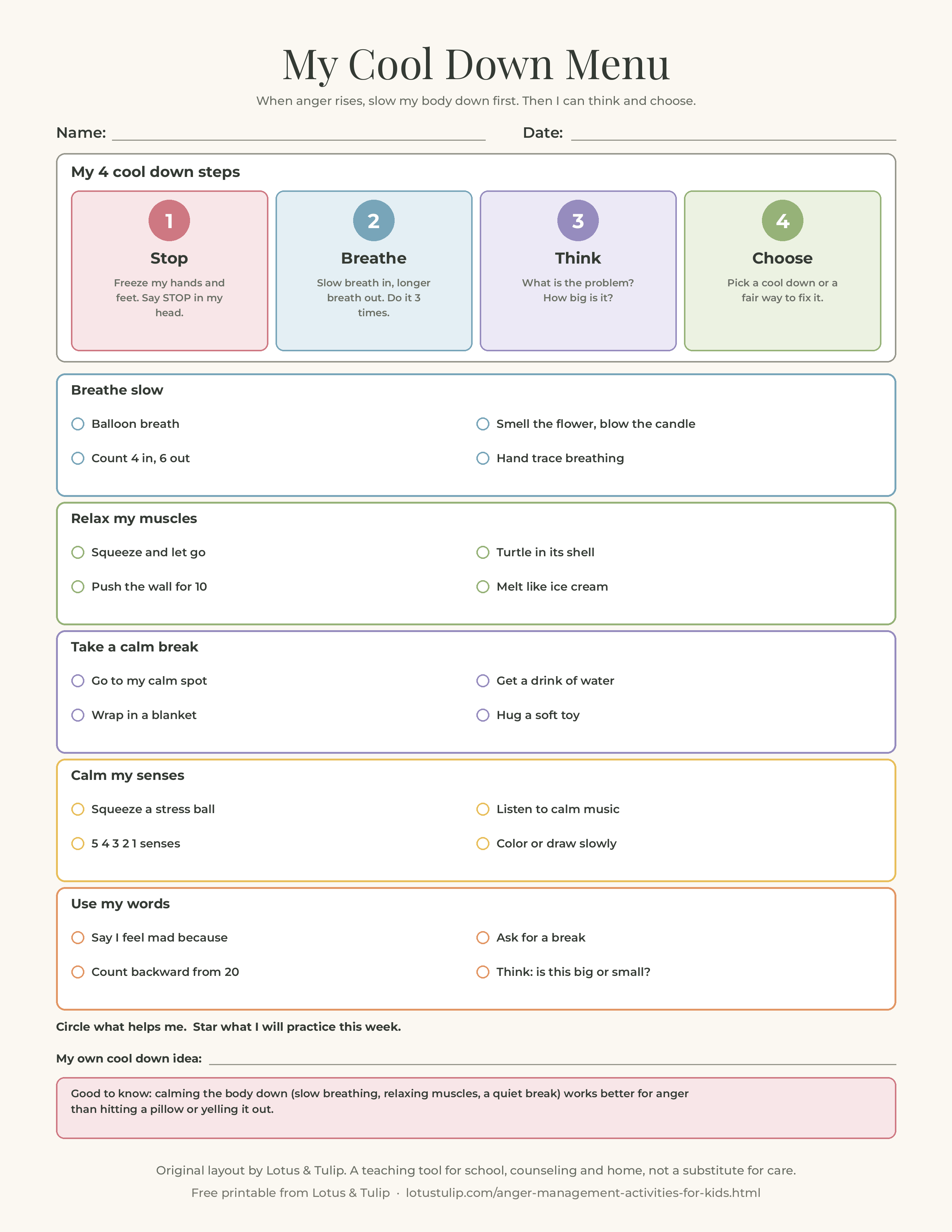
A short, memorable routine helps kids use skills under pressure. The one on page 2 of the printable has four steps:
- Stop. Freeze hands and feet and say "stop" in your head.
- Breathe. Take three slow breaths, with the out breath longer than the in breath.
- Think. What is the problem? How big is it?
- Choose. Pick a cool down from your menu, or a fair way to fix the problem.
This is similar in spirit to the Turtle Technique, first described by Arthur Robin, Marlene Schneider and Michelle Dolnick in 1976 as a classroom self control method, and later adapted for preschool and early elementary children in materials such as "Tucker Turtle" from the Pyramid Model for early childhood social emotional development. Children learn to "go into their shell" (stop and pull in), take deep breaths, think of a solution and come out when calm. Younger kids often love acting out the turtle, which makes it easier to remember in the moment.
Anger management activities by age
Ages 5 to 7
- Keep it physical and playful: turtle, balloon breath, melt like ice cream, glitter jar.
- Use pictures and very short words. A three level thermometer (calm, a bit mad, very mad) may work better than five levels.
- Practice with puppets or stuffed animals acting out angry moments.
- Expect adults to do most of the calming at first. Co-regulation, where a calm adult helps the child calm down, comes before self regulation.
Ages 8 to 10
- Introduce the full five level thermometer and personal body clues.
- Teach the anger iceberg: what feeling is hiding under the anger?
- Practice "I feel mad because" and size of the problem with real scenarios from school.
- Start simple tracking, like coloring a star each day a cool down skill was used.
Ages 11 to 12
- Use more mature language and real situations: group chats, sports, siblings, unfair grades.
- Add thinking skills: spotting "hot thoughts" such as "he did that on purpose" and finding a calmer alternative.
- Talk about the cost of blow ups for friendships and trust, and practice repair.
- For teens, the coping skills worksheets for teens and DBT TIPP skills may fit better than kid style activities.
After the storm: how to help a child repair
Even with great skills, kids will still lose their cool sometimes. What happens afterward matters as much as prevention.
- Wait until everyone is calm. Talking through a blow up while the child (or adult) is still at level 4 or 5 rarely works.
- Stay curious, not shaming. "What happened?" and "What were you feeling?" open the door. "Why would you do that?" usually closes it.
- Name the impact. Help the child notice who was hurt or upset, without a long lecture.
- Make it right. Repair can be an apology, helping clean up, fixing what was broken or doing something kind. Let the child suggest the repair when possible.
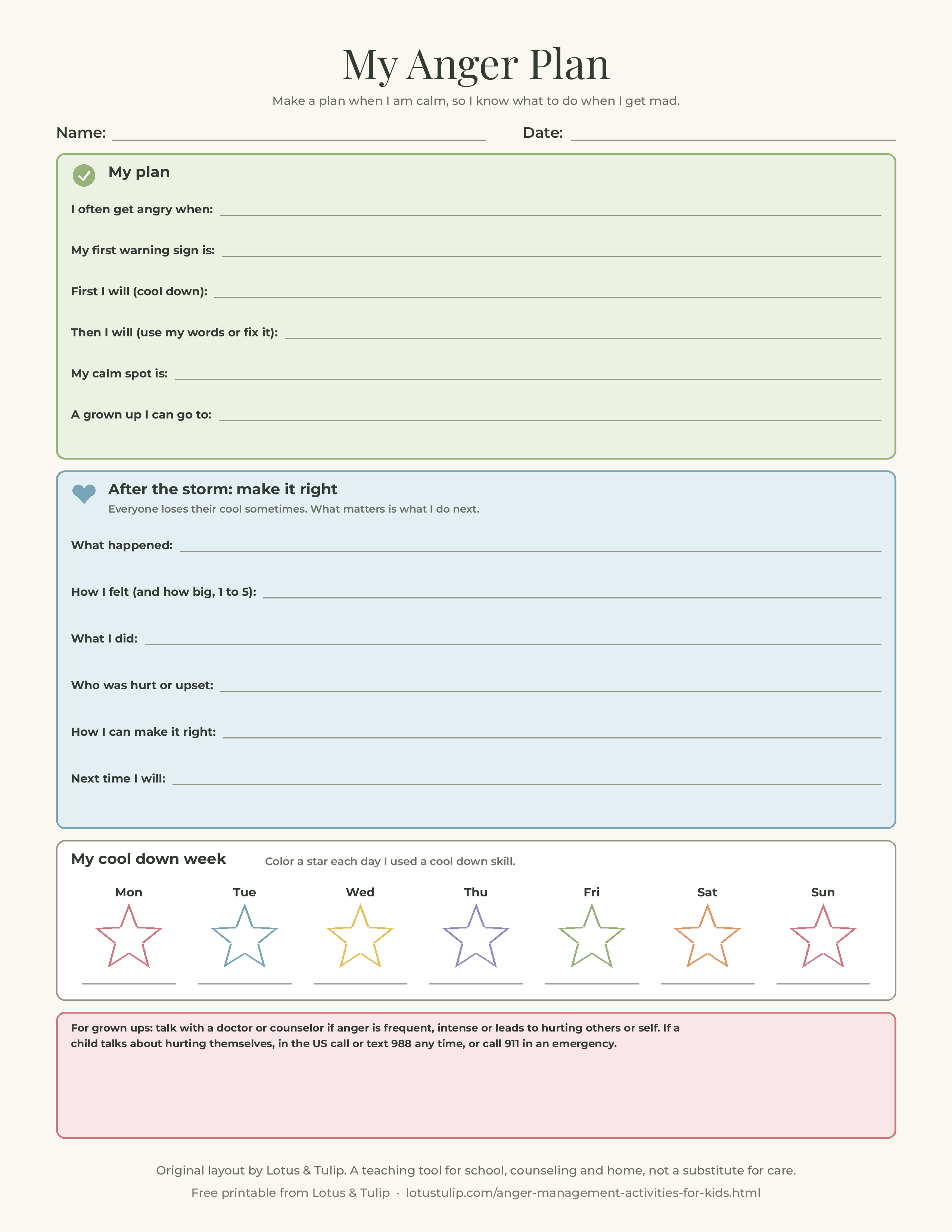
- Plan for next time. "Next time you feel that clue, what will you try?" This is the bottom section of page 3.
How to teach anger management to kids, step by step
- Normalize the feeling. Tell the child that everyone gets angry and anger is okay, but hurting people or things is not.
- Find the body clues. Use page 1 to fill in the anger thermometer and circle the first body clues the child notices.
- Identify triggers. Tick the common triggers on page 1 and star the biggest one, then look for patterns such as time of day, hunger or transitions.
- Model the skills. Show the cool down skills yourself, including saying out loud when you are frustrated and what you are doing to calm down.
- Practice when calm. Try three or four skills from the cool down menu on page 2 and let the child circle the ones that help and star the ones to practice.
- Teach Stop, Breathe, Think, Choose. Rehearse the four steps with role plays and pretend scenarios until the child can say them without help.
- Make a written plan. Use page 3 to write the child's plan: their trigger, first warning sign, cool down, words, calm spot and a grown up to go to.
- Track, praise and repair. Color a star each day a skill is used, give specific praise ("you went to your calm spot when you got mad, that was hard"), and use the make it right section after blow ups.
Common mistakes to avoid
- Teaching skills in the middle of a meltdown. A child at level 5 cannot learn. Teach and practice when calm, then prompt in the moment.
- Encouraging hitting pillows or punching bags. The research above suggests this tends to keep anger going rather than releasing it.
- Using the calm down spot as punishment. If the calm spot feels like time out, children will resist going there.
- Too many words. In the moment, use short prompts: "Turtle." "Breathe with me." "Calm spot?"
- Ignoring basics. Hunger, tiredness and overstimulation make every child more likely to blow up.
- Adults losing their own cool. Kids learn regulation by watching adults. Modeling a calm response is part of the intervention.
When anger needs more support
Most childhood anger is normal and improves with practice and support. Talk with a pediatrician, school counselor or mental health professional if a child:
- Has intense outbursts several times a week, or outbursts that are much bigger than expected for their age.
- Is irritable or angry most of the day, most days.
- Hurts people or animals, or destroys property.
- Has anger that is causing serious problems at school, at home or with friends.
- Has had a big change in behavior, or has experienced trauma, loss or bullying.
Persistent irritability with frequent severe temper outbursts can sometimes be part of a condition such as disruptive mood dysregulation disorder (DMDD), ADHD, anxiety or depression, and these need a professional assessment. The National Institute of Mental Health has a plain language overview of DMDD.
If a child talks about hurting themselves or others, act now. In the United States, call or text 988 (the 988 Suicide and Crisis Lifeline) any time, or call 911 if someone is in immediate danger.
Free anger management activities for kids (PDF)
The free printable has three pages in US Letter size, written for kids about 5 to 12:
- Page 1: My Anger Warning Signs. A five level anger thermometer (calm, annoyed, frustrated, angry, exploding) with space to describe each level, a 12 item trigger checklist and body clue chips to circle.
- Page 2: My Cool Down Menu. The four cool down steps (Stop, Breathe, Think, Choose) and 20 calm down activities in five groups to circle and star, plus space for the child's own idea.
- Page 3: My Anger Plan. A personal plan for hard moments, an "after the storm: make it right" repair section, a Monday to Sunday cool down star tracker and a note for grown ups with 988.
Download the free anger management activities for kids (PDF, 3 pages, US Letter)
Prefer single images? Page 1: Anger Warning Signs (PNG) · Page 2: Cool Down Menu (PNG) · Page 3: Anger Plan (PNG)
Free anger management starter pack: Want real worksheets too? The free anger management worksheets starter pack adds an anger thermometer, the anger iceberg, stop, think, choose, a cool-off menu, a cool-down plan and a support and safety page from our paid anger set for kids and teens.
Free to print for your own use and for use with your own students, clients or children. Please link to this page rather than re-uploading the file.
Related resources
- Sibling rivalry worksheets for kids: when the blow ups are with a brother or sister, free fair play plan
- Frustration tolerance worksheets for kids: a frustration meter and try again plan for kids who melt down when stuck
- Anger iceberg worksheet (free printable)
- Feelings thermometer printable (free)
- Calm down corner ideas (free printable)
- Breathing exercises for kids (free printable)
- Emotional regulation worksheets for kids (free printable)
- Impulse control worksheets for kids (free printable)
- Size of the problem worksheet (free printable)
- Coping skills list for kids (free printable)
Sources
- Sukhodolsky, D. G., Kassinove, H., and Gorman, B. S. (2004). Cognitive-behavioral therapy for anger in children and adolescents: a meta-analysis. Aggression and Violent Behavior, 9(3), 247 to 269.
- Kjærvik, S. L., and Bushman, B. J. (2024). A meta-analytic review of anger management activities that increase or decrease arousal: What fuels or douses rage? Clinical Psychology Review, 109, 102414.
- Bushman, B. J. (2002). Does venting anger feed or extinguish the flame? Catharsis, rumination, distraction, anger, and aggressive responding. Personality and Social Psychology Bulletin, 28(6), 724 to 731.
- Robin, A., Schneider, M., and Dolnick, M. (1976). The turtle technique: an extended case study of self-control in the classroom. Psychology in the Schools, 13(4), 449 to 453.
- National Center for Pyramid Model Innovations. Tucker Turtle Takes Time to Tuck and Think (scripted story).
- National Institute of Mental Health. Disruptive Mood Dysregulation Disorder, nimh.nih.gov.
- 988 Suicide and Crisis Lifeline, 988lifeline.org.
Anger management activities for kids: FAQ
What are good anger management activities for kids?
Good anger management activities for kids slow the body down and build skills to use later: balloon breathing, smell the flower and blow the candle, squeeze and let go muscle relaxation, the turtle technique, a calm down spot, a stress ball, a glitter jar, 5 4 3 2 1 senses, counting backward and using words like "I feel mad because". Practice them when the child is calm so they are ready when anger rises.
How do I teach my child to control anger?
Start by saying anger is okay but hurting is not. Help your child notice body clues, identify triggers, and practice a few cool down skills when calm. Teach a short routine such as Stop, Breathe, Think, Choose, make a written plan, model calm responses yourself, praise specific efforts and help your child repair after a blow up.
Is it good for kids to hit a pillow when angry?
The research suggests not. In experiments, hitting a punching bag while thinking about a provocation left people angrier and more aggressive, and a 2024 meta-analysis of 154 studies found that arousal increasing activities did not reduce anger, while calming activities such as slow breathing and relaxation did. Pushing against a wall and then relaxing, or squeezing and releasing muscles, are better physical options.
What is the turtle technique for anger?
The turtle technique teaches children to stop, pull into their "shell" by tucking arms and head in, take three deep breaths, think of a solution and come out when calm. It was first described in 1976 as a classroom self control method and is widely used with preschool and early elementary children.
What is an anger thermometer?
An anger thermometer is a scale, often 1 to 5, that helps a child rate how angry they feel, from calm to exploding, and describe what each level feels like in their body. It helps kids notice anger early and choose a skill that fits the size of the feeling. Page 1 of the free printable includes one.
When should I worry about my child's anger?
Talk with a pediatrician, school counselor or mental health professional if outbursts are frequent or intense for the child's age, if the child is irritable most of the day, hurts people or animals, destroys property, or if anger causes serious problems at school or home. In the US, call or text 988 if a child talks about hurting themselves, or 911 in an emergency.
Are these anger management worksheets for kids free?
Yes. The three page anger management activities for kids printable is free to print for your own use and for use with your own students, clients or children. Please link to this page rather than re-uploading the file.