
Kids and teens · Frustration tolerance for children ages 5 to 12 · Updated 2026-11-14
Frustration tolerance worksheets for kids: why some kids blow up, what research shows and a free stuck to unstuck plan

Ages 5 to 11: Kids Feelings and Social Skills Worksheets, incl. feelings detective, body clues, a feelings thermometer, a coping skills menu and a calm down plan Holiday 20% off: about $11.04, was $14 (EUR 12) · fillable PDF, instant digital download
Buy on EtsyTry it free first: download a fillable sample (feelings thermometer and calm-down plan, PDF, 240 KB). Type into it on screen, then get the full pack. No email needed.
For big blow ups: Anger Management Worksheets for Kids and Teens Holiday 20% off: about $9.20, was $12 (EUR 10) · instant digital download
Buy on EtsyKids and teens bundle: Kids and Teens Worksheets Bundle (feelings, anger, self esteem, social anxiety) Holiday 20% off: about $22.08, was $28 (EUR 24) · 80 pages, instant digital download
Buy on EtsyThe puzzle piece will not fit, the tower falls over, the math answer is wrong for the third time, the game is over and it is time for bed. For some children that is a sigh and a second try. For others it is a scream, a ripped page, a thrown controller or a flat "I'm stupid, I quit." Frustration tolerance is the skill that sits between those two reactions: being able to feel annoyed, stuck or disappointed and still stay safe, keep thinking and try again or ask for help.
This guide is for parents, teachers, school counselors and child therapists supporting children about 5 to 12. It explains what frustration tolerance is, how normal frustration differs from a bigger problem, how it shows up at different ages, what research shows (including its limits), why giving in and lecturing both backfire, what frustration tolerance worksheets can and cannot do, eight kinds of worksheets and activities, nine steps to use them, age adaptations, the classroom side, common mistakes and three short examples. It ends with a free 2 page printable: My Frustration Meter and My Try Again Plan.
Safety first: if a child talks about wanting to die or hurting themselves, call or text 988 (the 988 Suicide and Crisis Lifeline). If anyone is in immediate danger, call 911. If outbursts are frequent, severe, getting worse or come with low mood most days, talk to your pediatrician.
Download the free frustration tolerance worksheets for kids (PDF, 2 pages, US Letter)
Direct download, no email or sign up. See the pages first. Looking for anger tools? See anger management activities for kids and emotional regulation worksheets for kids.
What frustration tolerance is, in plain words
Frustration is the feeling we get when something we want is blocked: a goal, a turn, a toy, a right answer, a plan. It is a normal, useful feeling. It tells us something is not working. Frustration tolerance is how much of that feeling a child can handle before it spills over into a meltdown, giving up or lashing out, and how quickly they can get back to thinking.
It is not the same as never getting upset. A child with good frustration tolerance still feels frustrated. The difference is what happens next: they can notice the feeling, take a breath or a short break, and choose a next step such as trying another way, asking for help or coming back later. Those are learnable skills, which is why worksheets and practice can help.
Frustration tolerance overlaps with three things you may already be working on: emotional regulation (calming the body and feelings), impulse control (pausing before acting) and problem solving (finding another way). This page focuses on the moment of being stuck and on building the habit of trying again.
Normal frustration vs a bigger problem
Young children lose their temper. A study of 1,490 preschoolers (Wakschlag and colleagues, 2012) found that 83.7% had tantrums sometimes, but only 8.6% had tantrums every day. The researchers found that milder temper loss tended to happen in expectable situations, such as being tired or told no, while the more worrying patterns were unpredictable, long lasting or destructive. Signs that it may be more than ordinary frustration:
- Size: the reaction is far bigger than the problem, for example a long screaming outburst over a small change of plan.
- Frequency: big outbursts happen most days or several times a week, at an age when most peers have outgrown them.
- Length and recovery: outbursts last a long time, or the child stays irritable for hours afterward.
- Safety: hitting, kicking, breaking things or hurting themselves.
- Places: it happens at home, at school and with friends, not just in one setting.
- Mood in between: the child seems angry, grumpy or down most of the day, nearly every day.
Very low frustration tolerance can be part of ADHD, anxiety, autism, learning difficulties, sleep problems, depression and disruptive mood dysregulation disorder (DMDD). NIMH describes DMDD as severe temper outbursts on average three or more times a week, plus irritable or angry mood most of the day, nearly every day, for at least 12 months, in more than one place. Only a qualified professional can make any of these diagnoses. The lists on this page are for noticing, not labeling.
How low frustration tolerance shows up, by age
- Ages 5 to 7: crying, yelling, dropping to the floor, throwing things, "I can't do it!" within seconds of a hard task, trouble losing games and trouble with transitions such as stopping screen time. Words for feelings are still developing, so the body does the talking.
- Ages 8 to 10: quitting quickly, erasing until the paper rips, refusing homework, blaming others ("This is a dumb game"), arguing about rules and melting down when work is harder than expected. Some children hide frustration at school and let it out at home.
- Ages 11 to 12: eye rolling, slammed doors, "Whatever," avoiding anything they might not be good at, harsh self talk ("I'm so stupid") and refusing to try new things in front of peers.
- Quiet frustration: not every child explodes. Some shut down, go silent, freeze, procrastinate or say they do not care. That is frustration too, and these pages work for it.
What the research shows, honestly
- Tantrums are common, daily tantrums are not. In the Wakschlag 2012 study above, almost all preschoolers had tantrums sometimes, but fewer than 1 in 10 had them daily. A later study by the same group followed 497 preschoolers and found that even mildly elevated temper loss scores were linked with a higher risk of later emotional and behavior symptoms (Wakschlag and colleagues, 2015). Frequency and severity matter more than whether tantrums happen at all.
- Severe irritability is less common. Across three US community studies with 3,258 children and teens aged 2 to 17, Copeland and colleagues (2013) found three month rates of DMDD between 0.8% and 3.3%, highest in preschoolers. Most children who struggle with frustration do not have DMDD, but those who do usually need professional care.
- Frustration and ADHD often travel together. A 2014 review in the American Journal of Psychiatry (Shaw, Stringaris, Nigg and Leibenluft) concluded that emotion dysregulation is common in ADHD across the lifespan and is a major contributor to impairment, and that current ADHD treatments often help with it too. If a child with ADHD melts down often, mention it to the prescriber or therapist.
- Anger and irritability are among the most common reasons children are referred for mental health care. A 2016 review from the Yale Child Study Center (Sukhodolsky and colleagues) says so directly, and notes that parent management training and cognitive behavioral therapy (CBT) have both received extensive support in randomized controlled trials.
- Skills practice works better than talk alone. A meta-analysis of 40 studies with 1,953 children and teens (Sukhodolsky, Kassinove and Gorman, 2004) found a medium overall effect of CBT for anger related problems (d = 0.67). Skills training (d = 0.79) and multimodal programs (d = 0.74) did better than affective education alone (d = 0.36). Modeling, feedback and homework were all linked with bigger effects. In plain words: show the skill, practice it, give feedback and practice between sessions.
- NIMH is studying frustration tolerance directly. NIMH notes that its researchers are using CBT to help children increase their ability to tolerate frustration without having an outburst, and that parent training teaches caregivers to anticipate triggers, respond predictably and consistently and reward positive behavior.
- Parents' responses to feelings matter. In the Tuning in to Kids trial (Havighurst and colleagues, 2010), 216 parents of children aged 4 to 5 were randomized to a six session emotion coaching program or a waitlist. Parents in the program increased emotion coaching and reduced emotion dismissing, children's emotional knowledge improved, and parents and teachers reported fewer behavior problems.
- Combining child skills and parent support helps most. In a trial of 97 children aged 7 to 13 with serious behavior problems (Kazdin, Siegel and Bass, 1992), problem solving skills training plus parent management training led to larger and more lasting changes than either alone.
- Self control matters, but one test is not destiny. In a New Zealand cohort of 1,000 children followed to age 32, childhood self control predicted adult health, finances and criminal records, even after accounting for intelligence and social class (Moffitt and colleagues, 2011). But a large replication of the famous marshmallow test found links about half the size of the original reports, and two thirds smaller again after accounting for family background and early abilities (Watts, Duncan and Quan, 2018). Waiting skills are worth teaching, and they are shaped by environment, not fixed at age 4.
- The limits. We found no large trials of frustration tolerance worksheets on their own. Worksheets are tools inside the approaches that do have evidence: skills practice, CBT, emotion coaching and consistent parenting. Most studies above were run by trained clinicians or in structured programs.
Why giving in and lecturing both backfire
When a child melts down, adults usually do one of two things. Both are understandable, and both can make frustration tolerance worse over time.
- Giving in or rescuing: finishing the puzzle, ending the game, removing every hard thing. The child calms down fast, but learns that frustration is unbearable and that a big reaction makes the hard thing disappear. Next time the reaction comes sooner.
- Lecturing or punishing in the moment: "Stop crying, it's just a game." A child at the top of the frustration meter cannot think, listen or learn. Talk adds fuel. Teach the skill when everyone is calm, and keep words short during the storm.
- What helps instead: stay calm and close, name the feeling ("That is so frustrating, the tower keeps falling"), keep everyone safe, wait for the wave to drop, then help the child choose one next step. Keep the expectation (the homework still gets done) but adjust the size of the step (one problem, then a break).
This matches what NIMH describes for parent training: anticipate the hard moments, plan ahead, respond the same way each time and notice the good tries.
What frustration tolerance worksheets for kids can and cannot do
They can: give a child words and a picture for the feeling, help them spot early body clues, make a plan before the hard moment, rehearse "stuck to unstuck" steps when calm, track practice so progress is visible, and give adults one shared language at home and school.
They cannot: diagnose ADHD, anxiety, DMDD or anything else, replace therapy for a child with severe or frequent outbursts, or be used in the middle of a meltdown. A worksheet handed to a screaming child is just another frustrating thing. Fill them in when the child is calm, practice them often and keep them short.
8 kinds of frustration tolerance worksheets and activities for kids
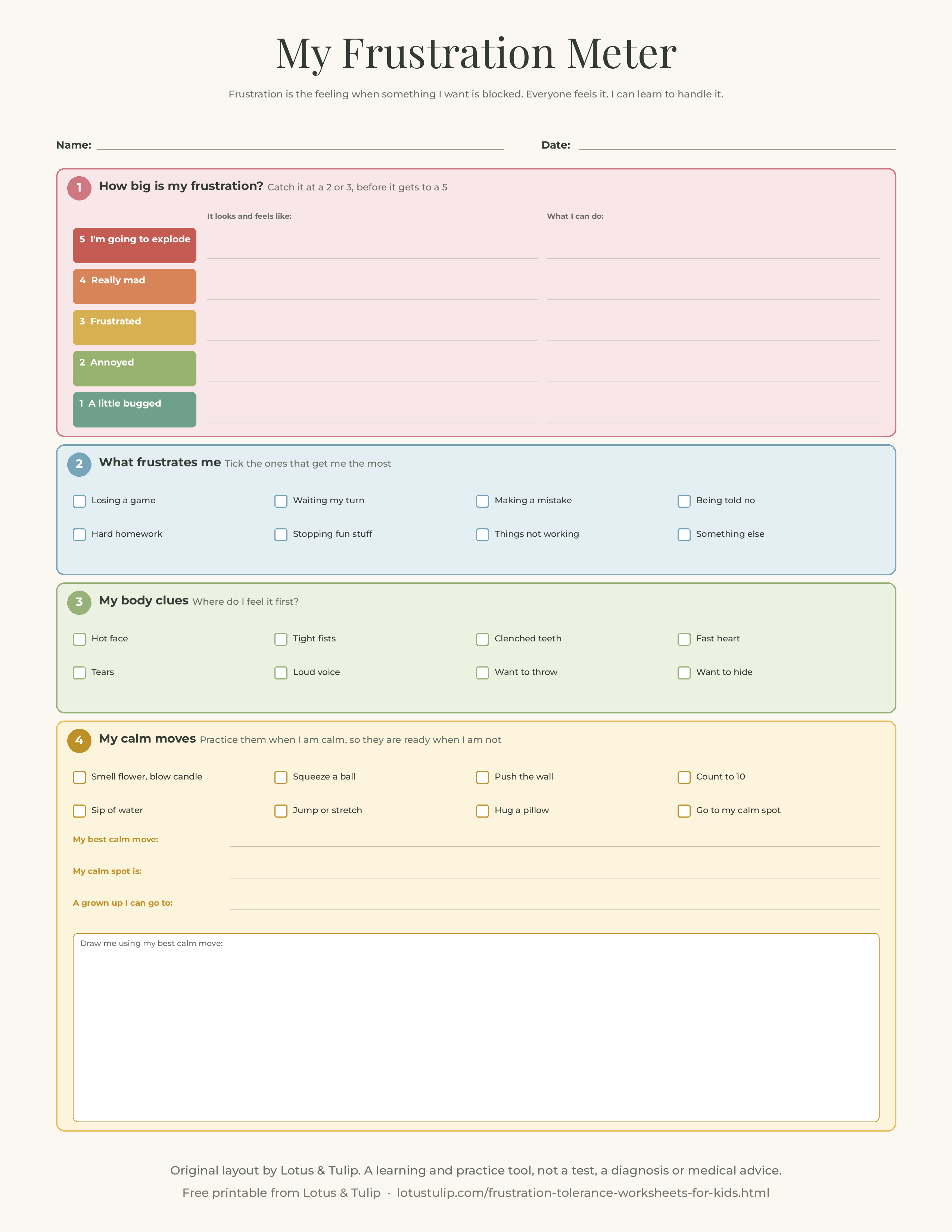
- Frustration meter. A 1 to 5 scale from "a little annoyed" to "I'm going to explode," with what each level looks and feels like for this child and what to do at each level. Similar to a feelings thermometer, but focused on being stuck.
- My frustration triggers. Ticks for common triggers (losing, waiting, mistakes, being told no, hard homework, things not going my way) so the child and adults can plan ahead.
- Body clues. Where frustration shows up first: hot face, tight fists, clenched teeth, fast heart, tears. Early clues are the best time to use a calm move.
- Calm moves menu. Short, body based tools the child picks and practices when calm: slow breaths, squeezing a ball, a wall push, a sip of water, counting to 10, a short movement break. See breathing exercises for kids.
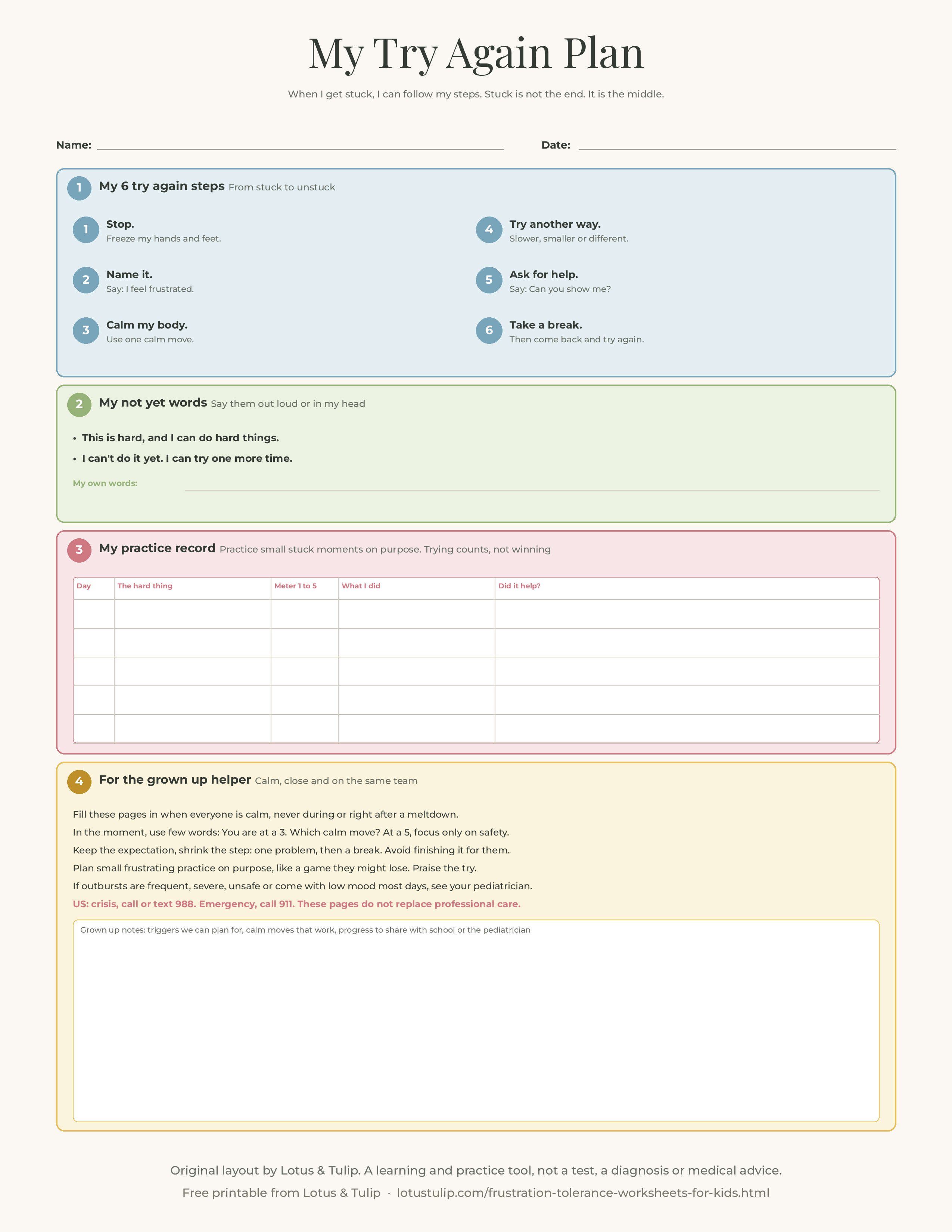
- Stuck to unstuck steps. A simple sequence: stop, name it, calm my body, try another way, ask for help, or take a break and come back. This is the core skill.
- Size of the problem. Matching the size of the reaction to the size of the problem. Our size of the problem worksheet goes deeper.
- Not yet self talk. Swapping "I can't" for "I can't yet" and "This is hard, and I can do hard things." Effort words, not talent words. Our growth mindset worksheet has more.
- Practice record. Planned "small stuck" practice with a reward for trying, not for winning: a game the child might lose, a slightly hard puzzle, waiting 2 minutes. Track what happened and what worked.
How to use frustration tolerance worksheets for kids, step by step
- Pick a calm time. Never introduce the worksheet during or right after a meltdown. Choose a relaxed moment, 10 minutes, with a snack nearby. Say: "Everyone gets frustrated. Let's make a plan for those stuck moments."
- Name the feeling. Explain frustration as the feeling when something we want is blocked. Share one of your own frustrating moments and what you did. Children learn this skill mostly by watching adults.
- Find the triggers. On My Frustration Meter, tick the situations that are hardest. Add the child's own. Notice patterns: tired, hungry, end of the day, transitions, losing.
- Build the meter together. For each level, ask: "What does a 2 look like for you? What about a 5?" Write or draw the child's words. Add body clues. The goal is to catch it at a 2 or 3, not a 5.
- Choose calm moves. Pick two or three moves for the low levels and one safe move for the top level, such as going to a calm spot. Practice each move when calm, several times, so it is ready when needed.
- Learn the try again steps. On My Try Again Plan, walk through stop, name it, calm my body, try another way, ask for help, take a break and come back. Role play a few easy situations first, such as a tower that falls.
- Practice small stuck moments. Plan short, slightly frustrating practice on purpose: play a game the child might lose, try a tricky puzzle, wait two minutes for a turn. Praise the try and the calm move, not the result.
- Coach in the real moment. When frustration rises, use few words: "You're at a 3. Which calm move?" At a 5, focus only on safety and staying close. Once calm, come back to the task in a smaller step.
- Review and adjust weekly. Look at the practice record together. What worked? Which trigger was hardest? Celebrate progress, and if outbursts are not improving after several weeks, or are severe, talk to your pediatrician or a child therapist.
How to adapt it by age
- Ages 5 to 7: use pictures and colors for the meter (green, yellow, red), act out the steps with toys, keep practice very short and reward with stickers or a high five. Drawing counts as an answer.
- Ages 8 to 10: let the child write their own words for each level, add a "try another way" brainstorm, and use the practice record for a small weekly reward chosen together.
- Ages 11 to 12: talk about frustration in sports, gaming and schoolwork, let them design their own plan, keep it private if they prefer, and focus on self talk and choosing when to take a break.
Using these worksheets in the classroom
- Teach it to everyone. A whole class lesson on the frustration meter avoids singling anyone out and gives the class a shared language: "I'm at a 3, I need a calm move."
- Plan the hard moments. Tests, group work, losing at recess games and transitions are predictable triggers. Pre-teach the plan before them.
- Offer a break option. A break card or calm corner lets a child step away before an outburst, with a clear plan to come back.
- Chunk the work. For a child who melts down at long tasks, one problem at a time with a check in is often enough.
- Coordinate with home. Share the child's meter and calm moves with parents so the same words are used in both places. If a child has an IEP or 504 plan, frustration supports can be written into it.
Common mistakes
- Teaching in the storm. Skills are learned when calm and used when upset, not the other way around.
- Removing every hard thing. A frustration free life does not build frustration tolerance. Lower the step, keep the expectation.
- Too many tools. Two or three practiced calm moves beat a list of twenty the child has never tried.
- Praising only success. Praise trying again, asking for help and using a calm move, even if the puzzle never got finished.
- Using the worksheet as a punishment. "Go fill in your frustration sheet" after a meltdown turns a helpful tool into a consequence.
- Waiting too long for help. Frequent, severe or unsafe outbursts deserve a professional assessment, not just more worksheets.
Examples
- Maya, 6: screamed and threw pieces whenever a puzzle piece would not fit. Her mom made a color meter with her, practiced "squeeze and breathe" with a stress ball and played a short "oops, try another piece" game daily. After three weeks Maya started saying "I'm at yellow" and asking for help instead of throwing.
- Jayden, 9: ripped his math worksheets and said he was stupid. His teacher split assignments into strips of three problems, taught the class the frustration meter and gave Jayden a break card. Jayden added "I can't do it yet" to his try again plan and used two breaks a day instead of tearing pages.
- Sofia, 11: quit soccer and video games whenever she lost. With her school counselor she listed her triggers, wrote her own self talk and planned practice losing at board games with her family. She still hates losing, but now she stays to finish the game.
Free printable: frustration tolerance worksheets for kids
This printable is an original Lotus & Tulip layout. It is not a screening questionnaire or a diagnostic tool and gives no score. Page 1, My Frustration Meter, explains frustration in kid words and has a 5 level meter with what each level looks like and what to do, ticks for my triggers and body clues, my calm moves and a box to draw myself using my best calm move. Page 2, My Try Again Plan, has the six stuck to unstuck steps, my not yet words, a practice record (the hard thing, my meter number, what I did, did it help) and notes for the grown up helper on calm coaching, practice, when to get help and US crisis lines.
Download the free frustration tolerance worksheets for kids (PDF, 2 pages, US Letter)
Prefer single images? Page 1: My Frustration Meter (PNG) · Page 2: My Try Again Plan (PNG)
Free to print for your own child, students, clients or groups. Please link to this page rather than re-uploading the file. A learning and practice tool that does not replace professional advice. In a mental health crisis, call or text 988. In an emergency, call 911.
Buy the kids feelings worksheets on Etsy
Related resources
- Anger management activities for kids: when frustration turns into anger
- Emotional regulation worksheets for kids: co-regulation and self regulation strategies
- Impulse control worksheets for kids: pausing before acting
- Size of the problem worksheet: matching the reaction to the problem
- Problem solving worksheet for kids: finding another way
- Resilience activities for kids: building bounce back
- Growth mindset worksheet: the power of not yet
- All counseling resources for kids and teens
FAQ
What is frustration tolerance in kids?
Frustration tolerance is a child's ability to feel annoyed, stuck or disappointed and still stay safe, keep thinking and try again or ask for help. Children with low frustration tolerance tend to melt down, give up or lash out quickly when something is hard or does not go their way. It is a skill that can be taught and practiced.
What are frustration tolerance worksheets for kids?
They are printable pages that help children name frustration, rate it on a meter, spot their triggers and body clues, choose calm moves and practice stuck to unstuck steps such as trying another way, asking for help or taking a break and coming back. They work best when filled in during calm times and practiced often.
Is it normal for my child to have meltdowns when frustrated?
Some meltdowns are normal, especially in young children. In a study of 1,490 preschoolers, 83.7% had tantrums sometimes but only 8.6% had them daily. Talk to your pediatrician if outbursts are frequent, very intense, long lasting, unsafe, happen in more than one setting, or come with an irritable or low mood most days.
How do I teach my child to handle frustration?
Teach skills when your child is calm: name the feeling, build a frustration meter, pick two or three calm moves and practice try again steps. Then practice on purpose with small frustrating moments, like a game they might lose. During a meltdown, use few words, keep everyone safe and come back to the task in a smaller step once calm. Praise effort, not results.
Should I help my child when they get frustrated?
Help with the feeling, not by removing every hard thing. Stay close, name the feeling and help your child calm down, then guide them to choose one next step. Lower the size of the step if needed, for example one math problem then a break, but avoid finishing the task for them or ending it every time they get upset.
Can low frustration tolerance be a sign of ADHD or another condition?
It can be. Trouble handling frustration is common in ADHD, anxiety, autism, learning difficulties, depression and disruptive mood dysregulation disorder, and also with poor sleep or stress. It can also simply be a skill a child has not learned yet. Only a qualified professional can diagnose a condition, so ask your pediatrician if you are concerned.
How can teachers help a student with low frustration tolerance?
Teach the frustration meter to the whole class, pre-teach plans before predictable triggers like tests and group work, chunk long tasks into small steps, offer a break card with a clear return plan, praise effort and coordinate language with parents. Supports can be added to an IEP or 504 plan when needed.
Sources
- Copeland, W. E., Angold, A., Costello, E. J., and Egger, H. (2013). Prevalence, comorbidity, and correlates of DSM-5 proposed disruptive mood dysregulation disorder. American Journal of Psychiatry, 170(2), 173 to 179.
- Havighurst, S. S., Wilson, K. R., Harley, A. E., Prior, M. R., and Kehoe, C. (2010). Tuning in to Kids: improving emotion socialization practices in parents of preschool children, findings from a community trial. Journal of Child Psychology and Psychiatry, 51(12), 1342 to 1350.
- Kazdin, A. E., Siegel, T. C., and Bass, D. (1992). Cognitive problem-solving skills training and parent management training in the treatment of antisocial behavior in children. Journal of Consulting and Clinical Psychology, 60(5), 733 to 747.
- Moffitt, T. E., Arseneault, L., Belsky, D., and colleagues (2011). A gradient of childhood self-control predicts health, wealth, and public safety. Proceedings of the National Academy of Sciences, 108(7), 2693 to 2698.
- National Institute of Mental Health. Disruptive mood dysregulation disorder: the basics (NIH Publication No. 23-MH-8119, revised 2023). nimh.nih.gov.
- Shaw, P., Stringaris, A., Nigg, J., and Leibenluft, E. (2014). Emotion dysregulation in attention deficit hyperactivity disorder. American Journal of Psychiatry, 171(3), 276 to 293.
- Sukhodolsky, D. G., Kassinove, H., and Gorman, B. S. (2004). Cognitive-behavioral therapy for anger in children and adolescents: a meta-analysis. Aggression and Violent Behavior, 9(3), 247 to 269.
- Sukhodolsky, D. G., Smith, S. D., McCauley, S. A., Ibrahim, K., and Piasecka, J. B. (2016). Behavioral interventions for anger, irritability, and aggression in children and adolescents. Journal of Child and Adolescent Psychopharmacology, 26(1), 58 to 64.
- Wakschlag, L. S., Choi, S. W., Carter, A. S., and colleagues (2012). Defining the developmental parameters of temper loss in early childhood: implications for developmental psychopathology. Journal of Child Psychology and Psychiatry, 53(11), 1099 to 1108.
- Wakschlag, L. S., Estabrook, R., Petitclerc, A., and colleagues (2015). Clinical implications of a dimensional approach: the normal:abnormal spectrum of early irritability. Journal of the American Academy of Child and Adolescent Psychiatry, 54(8), 626 to 634.
- Watts, T. W., Duncan, G. J., and Quan, H. (2018). Revisiting the marshmallow test: a conceptual replication investigating links between early delay of gratification and later outcomes. Psychological Science, 29(7), 1159 to 1177.
Lotus & Tulip is not affiliated with the researchers, agencies or organizations named on this page. This page is educational and does not replace professional advice, diagnosis or treatment.