
School counselors · Updated 2026-11-10
Texas SB 12 and School Counselors: Parental Consent for Small Groups, Surveys and Check Ins (2026 Guide, Free Consent Planner)
Ready-made printable: Complete Small Group Counseling Bundle Holiday 20% off: about $29.44, was $37 (EUR 32) · instant digital download
Buy on Etsy
If you are a school counselor in Texas, the first weeks of the 2025 to 2026 school year probably felt like a paperwork earthquake. New annual forms went home. Some districts told counselors to stop every small group until signed consent came back. Others pulled the feelings check in out of morning meeting, or asked whether a pre and post survey now needed its own form. Counselors in neighboring districts got different answers to the same question, and a year later many of those questions are still open.
The cause was Senate Bill 12 of the 89th Texas Legislature, a parental rights law that, among many other things, rewrote Texas Education Code section 26.009, the rule on when a school needs a parent's written consent, and added section 26.0083, a new set of rules on telling parents about their child's mental, emotional and physical health. For a school counselor, those two sections decide whether a student may join a group, whether you may give a survey, what you must tell parents and when, and where the paperwork has to live.
This guide reads the law the way a counselor needs to read it. It quotes the enrolled bill and the current statute text, explains the Texas Education Agency's guidance and its proposed rule, gives the exact status of the federal lawsuit as of November 10, 2026, and then turns all of it into a practical plan for one small group: what to classify, what to send, what to wait for, what to log and what to say to students in the first session. It ends with a fully worked fictional example, six scenarios, common mistakes and a free three page printable: a blank SB 12 consent and communication planner, the same planner filled in, and a consent and parent communication tracking log.
Jump to the free SB 12 consent and communication planner, filled example and tracking log
This is educational information for school counselors, not legal advice. Texas districts have adopted different forms and classifications under SB 12, the Texas Education Agency's rule on parent notification was still listed as a proposed rule when this was written, and a federal lawsuit about other parts of the law is ongoing. Follow your district's written procedures and ask your district's counsel about specific situations. Every legal fact here was checked against primary sources fetched on November 10, 2026: the enrolled text of S.B. 12, 89th Legislature, Regular Session (Texas Legislature Online), and its bill history; the current text of Texas Education Code chapters 26 and 33 and Texas Family Code section 32.004 (Texas Constitution and Statutes); the Texas Education Agency's "89th Legislature Updates" page, "SB 12 Frequently Asked Questions" (September 2025), "89th Legislature Frequently Asked Questions" (June 2026), "Model Language to Comply with Senate Bill (SB) 12 and Texas Education Code (TEC), §§26.0083 and 26.009" (updated June 18, 2026), the draft rule text for 19 TAC §103.1105 (updated June 18, 2026), the September 11, 2025 To the Administrator Addressed letter "Updated SB 12 Guidance," and TEA's Proposed Commissioner of Education Rules page; the proposed rule as published in the Texas Register on June 26, 2026; the ACLU of Texas case page for GSA Network v. Morath and the court's February 20, 2026 opinion and order; the ASCA Ethical Standards for School Counselors (2022); and Northside ISD's published parental consent page as one district example.
The short answer
- SB 12 is in force. It was signed on June 20, 2025, took effect on September 1, 2025, and applies beginning with the 2025 to 2026 school year. Its consent and notice rules for counselors are in Texas Education Code sections 26.009 and 26.0083.
- Written, signed, returned. A district employee or contractor must have a parent's written consent before conducting "a psychological or psychiatric examination or test, or psychological or psychiatric treatment," and that consent "must be signed by the parent and returned to the district." No signed form back, no participation.
- The definitions are wide. A test includes any method that elicits an "attitude, habit, trait, opinion, belief, feeling," including one "presented or characterized as a survey, check-in, or screening or is embedded in an academic lesson." Treatment is "the planned, systematic use of a method or technique that is designed to affect behavioral, emotional, or attitudinal characteristics of an individual or group."
- Treat a multi session counseling group as opt in unless your district has classified it otherwise in writing. Its plain words fit the treatment definition, TEA's proposed rule says a health related service can become one that needs consent "based on the nature, frequency, or ongoing provision of the service," and districts such as Northside ISD list short term small group counseling among services that need consent.
- Name the survey. A pre and post self check is very likely a "test" under the law, and section 26.0083(h) says that before a student well-being questionnaire is given, the district must give the parent a copy and get consent. Attach the actual survey to the consent request.
- Asking how a student is doing is still fine. The law does not require written consent "before verbally asking the child about the child's general well-being," and TEA calls calming a crying student or defusing an angry one "general caretaking," which needs no consent.
- Parents get told about changes. TEA's proposed procedure asks schools to tell parents before a change in health related services or monitoring, or within three school days if that is not possible, and to tell parents within one school day, or as soon as feasible, about disclosures of behaviors that represent an adverse change, such as suicidal ideation.
- Your limits of confidentiality talk changes. A district may not adopt a procedure that encourages a student to keep well-being information from a parent. Tell group members plainly, in session 1, what you will share with families.
- Keep the form in the education record. The law says the district "shall retain the written informed consent" as part of "the child's education records," and parents already have a right to see counseling records.
- The lawsuit does not touch the consent rules. In GSA Network v. Morath, a federal court on February 20, 2026 blocked four other SB 12 provisions (on DEI duties, social transitioning, instruction about sexual orientation and gender identity, and student clubs) in only three districts: Houston, Katy and Plano ISDs. Sections 26.009 and 26.0083 were not part of that order.
What SB 12 is, with dates
S.B. 12 is a long bill. Its caption describes it as relating "to parental rights in public education, to certain public school requirements and prohibitions regarding instruction, diversity, equity, and inclusion duties, and social transitioning, and to student clubs at public schools." Most of the news coverage was about the DEI, social transitioning and club provisions. For counselors, the most important parts are quieter: sections 11 to 20 of the bill, which amend Chapter 26 of the Education Code, the chapter on parental rights.
| Date | What happened | Source |
|---|---|---|
| March 19, 2025 | Passed the Senate, 20 to 11 | Enrolled bill certification |
| May 25, 2025 | Passed the House with amendments, 88 to 47 | Enrolled bill certification |
| May 31, 2025 | Conference committee report adopted: Senate 20 to 11, House 77 to 40 | Enrolled bill certification |
| June 20, 2025 | Signed by the Governor | Texas Legislature Online bill history |
| August 28, 2025 | GSA Network v. Morath filed in federal court in Houston, challenging four provisions | ACLU of Texas case page |
| September 1, 2025 | Effective date; the Act "applies beginning with the 2025-2026 school year" | Bill sections 30 and 31; bill history |
| September 11, 2025 | TEA updated its guidance, separating "health-related" from "health-care" services, and asked districts with blanket opt in forms to update them | TEA To the Administrator Addressed letter |
| February 20, 2026 | Preliminary injunction for Houston, Katy and Plano ISDs on bill sections 3, 7, 24 and 27; TEA Commissioner dismissed as a defendant | Court opinion and order; ACLU of Texas |
| June 18, 2026 | TEA updated its model notice language and draft rule text | TEA 89th Legislature Updates page |
| June 26, 2026 | Proposed 19 TAC §103.1105 published in the Texas Register; comments June 26 to July 27 and again August 14 to 28, 2026 | Texas Register; TEA Proposed Commissioner of Education Rules page |
| June 29, 2026 | The State of Texas, having intervened to defend SB 12, moved to dismiss the lawsuit | ACLU of Texas case page |
| November 2, 2026 | Hearing set on the State's motion to dismiss | ACLU of Texas case page |
Neither chamber passed the bill by two thirds of all members, so it did not take immediate effect. Section 31 provided for September 1, 2025 in that case, and the bill history records "Effective on 9/1/25."
Where the law stands in November 2026
Here is exactly what is known as of November 10, 2026, and what is not.
The statute
Sections 26.009 and 26.0083 are in force statewide. The current text of Education Code Chapter 26 on the Texas Constitution and Statutes site matches the enrolled bill for both sections. We did not find any later amendment to either section.
TEA's rule
Section 26.0083(a) tells TEA to "adopt a procedure for school districts to notify the parent" about "any change in services provided to or monitoring of the student related to the student's mental, emotional, or physical health or well-being." TEA is doing this through a commissioner's rule, new 19 Texas Administrative Code §103.1105. TEA posted draft text in August 2025, updated it in September 2025 and again on June 18, 2026, and published it as a proposed rule in the Texas Register on June 26, 2026 (filed June 15, earliest possible adoption date July 26, 2026). TEA's Proposed Commissioner of Education Rules page lists a public comment period of June 26 to July 27, 2026, an additional comment period of August 14 to 28, 2026 (because the web address printed in the preamble was wrong), and a proposed effective date of October 18, 2026.
As of November 10, 2026, that TEA page still lists §103.1105 among proposed rules, and we could not confirm from a primary source that a final rule has been adopted or has taken effect. Treat the rule text quoted in this guide as TEA's published proposal and current guidance, not as settled law. TEA itself says the draft "is subject to change until it is adopted."
The lawsuit
GSA Network, et al. v. Morath, et al. was filed on August 28, 2025 in the Houston Division of the U.S. District Court for the Southern District of Texas. The plaintiffs, including youth organizations, the Texas American Federation of Teachers, a teacher and two students, challenge four provisions under the First Amendment, and the club provision also under the federal Equal Access Act. On February 20, 2026, Judge Charles Eskridge granted a preliminary injunction, unopposed by the three district defendants, ordering that Houston, Katy and Plano ISDs are "enjoined from implementing policies pursuant to Sections 3, 7, 24, and 27 of S.B. 12, or otherwise enforcing those provisions, during the pendency of this litigation." Those bill sections are the DEI duties provision (Education Code 11.005), the social transitioning provision (11.401 and 11.402), the restriction on instruction, guidance, activities or programming about sexual orientation and gender identity (28.0043), and the student club provision (33.0815). The court dismissed the TEA Commissioner as a defendant, so the injunction "cannot extend statewide."
According to the ACLU of Texas case page, the State of Texas then intervened to defend the law and filed a motion to dismiss on June 29, 2026, and that motion was set for a hearing on November 2, 2026 as the case entered discovery. We could not find a ruling on that motion in a primary source as of November 10, 2026. Check the court docket or your district's counsel for anything newer.
What matters for this guide: the lawsuit does not challenge sections 26.009 or 26.0083. The consent and notice rules apply in every Texas school district, including Houston, Katy and Plano.
The consent rule, phrase by phrase
Here is the core of section 26.009 as SB 12 rewrote it. Subsection (a): "An employee or contractor of a school district must obtain the written consent of a child's parent in the manner required by Subsection (a-2) before the employee or contractor may: (1) conduct a psychological or psychiatric examination or test, or psychological or psychiatric treatment, unless the examination, test, or treatment is required under Section 38.004 or state or federal law regarding requirements for special education."
The rest of subsection (a) covers recording a child's voice or video, disclosing health information or biometric identifiers, and providing "health care services or medication or conduct a medical procedure." Subsection (a-1) defines the terms, and (a-2) sets the form of consent.
| Phrase in the law | What it means for a counselor's group |
|---|---|
| "An employee or contractor" | Covers you, and community providers who run groups on campus under contract. TEA's proposed rule defines "personnel" to include "all employees, as well as volunteers and contractors, who interact with students on a regular basis." |
| "written consent of a child's parent" | Not verbal and not a phone call. Ask your district whether it accepts electronic signatures. |
| "must be signed by the parent and returned to the district" (a-2) | A form in a backpack is not consent. Consent exists when the signed form is back. |
| "A child may not participate in the activity unless the district receives the parent's signed written consent to that activity" (a-2) | Consent is tied to an activity. A form for a friendship group does not cover a separate worry group or an extra survey. |
| "psychological or psychiatric examination or test" | Defined as "a method designed to elicit information regarding an attitude, habit, trait, opinion, belief, feeling, or mental disorder or a condition thought to lead to a mental disorder, regardless of the manner in which the method is presented or characterized, including a method that is presented or characterized as a survey, check-in, or screening or is embedded in an academic lesson." A pre and post self check, a feelings scale or a written worry rating fits these words. |
| "psychological or psychiatric treatment" | Defined as "the planned, systematic use of a method or technique that is designed to affect behavioral, emotional, or attitudinal characteristics of an individual or group." A planned eight session group with lesson plans and goals fits these words, whatever you call it. |
| "unless ... required under Section 38.004 or state or federal law regarding requirements for special education" | Child abuse reporting and required special education evaluations and services follow their own rules. TEA's proposed rule says IEP services and eligibility evaluations "will adhere to informed consent, consent revocation, and consent expiration provisions under IDEA." |
| "retain the written informed consent ... as part of the child's education records" (e) | The signed form belongs in the student's education record, not only in your desk file. |
| "verbally asking the child about the child's general well-being" (f)(1) | No written consent is needed to ask "How are you doing today?" |
What SB 12 changed
Texas already required written parental consent before a school employee conducted "a psychological examination, test, or treatment." Comparing the enrolled bill's added and struck text shows what SB 12 added: contractors, the word "psychiatric," the two definitions that bring surveys, check ins, screenings and lessons into the rule, the requirement that consent be "signed by the parent and returned," the new categories on health information, biometrics and health care services, an option for annual consent for routine care, retention in the education record, and the general well-being exception. In short, the old rule was about psychological testing and treatment in the clinical sense; the new definitions reach ordinary counseling tools.
Annual consent for routine care
Subsection (a-3) lets a district get consent for routine care "at the beginning of the school year or at the time of the child's enrollment," effective "until the end of the school year in which the consent was obtained." Read it carefully: (a-3) refers to the actions in (a)(4), which are health care services, medication and medical procedures that the district has determined to be routine care by a person authorized to provide "physical or mental health-related services." Many districts built an annual form on that basis, and TEA's proposed rule says consent "remains effective until the end of the school year in which the consent was obtained or assumed." Whether an annual "yes" covers a specific group in your district depends on your district's form and procedures, which is one more reason to send a group specific request.
The parent notice rules in section 26.0083
Section 26.0083, "Right to information regarding mental, emotional, and physical health and health-related services," is new. The parts that matter most for counselors:
- (b) Encourage the conversation. TEA's procedure must require personnel to "encourage a student to discuss issues relating to the student's well-being with the student's parent" or "facilitate" that discussion.
- (c) No hidden channels. A district may not adopt a procedure that prohibits an employee from telling a parent about the student's well-being or a change in services, that "encourages or has the effect of encouraging a student to withhold from the student's parent" that information, or that keeps parents from education or health records.
- (d) Abuse exception. Disclosure is not required "if a reasonably prudent person would believe the disclosure is likely to result in the student suffering abuse or neglect," as defined in Family Code 261.001.
- (e) Critical decisions. An employee "may not discourage or prohibit parental knowledge of or involvement in critical decisions affecting a student's mental, emotional, or physical health or well-being."
- (g) Annual notice. Before the first instructional day, each district gives parents written notice of "each health-related service offered" at the campus, with "a statement of the parent's right to withhold consent for or decline a health-related service."
- (h) Questionnaires. "Before administering a student well-being questionnaire or health screening form to a student enrolled in prekindergarten through 12th grade, a school district must provide a copy of the questionnaire or form to the student's parent and obtain the parent's consent to administer the questionnaire or form in the manner provided by Section 26.009(a-2)."
- (i) Not a gag on caring. The section may not be construed to "limit a school district employee's ability to inquire about a student's daily well-being without parental consent."
- (j) Frameworks. By June 30, 2026, TEA, the State Board of Education and the State Board for Educator Certification were to "review and revise as necessary" school counseling frameworks and standards and educator conduct principles to comply with the section. Subsection (j) expires September 1, 2027. Ask your district whether any revised framework or training has reached your campus.
Health related services and health care services
TEA's guidance draws the line that most district forms now follow. In its September 11, 2025 letter, TEA explained: "Health-related services require notification (either before or after service delivery), but consent is assumed to be provided absent a parent submitting notification of their withholding of consent. Health-care services, on the other hand, require parents to opt-in by providing active, informed consent before the service can be administered, absent emergency care situations."
The proposed rule defines both. "Health-care services" means services that "would meet the definition of either a psychological or psychiatric examination or test, including mental-health screenings, or a psychological or psychiatric treatment," along with medical treatment, procedures, medication and "therapy of a clinical or physically, mentally, or emotionally therapeutic nature or the kind provided by a licensed professional." "Health-related services" are "typically short-term, noninvasive activities designed to promote a student's mental, emotional, or physical health or well-being but are not considered a health-care service," and the examples include "school counseling services related to mental or emotional health that do not rise to the level of therapy," first aid, and "specialized health-related instruction outside the scope of instruction in the Texas Essential Knowledge and Skills on social skills, stress management, nutrition, wellness promotion, substance abuse prevention, or suicide prevention."
Then comes the sentence that matters most for groups, subsection (o): "Not all health-related services are health-care services. But a health-related service may become a health-care service based on the nature, frequency, or ongoing provision of the service. If the service becomes a health-care service, parental consent must be obtained prior to a student's participation in the effort or activity."
TEA also says a district may not run everything as opt in or everything as opt out. Its June 2026 FAQ answers "No" to whether a school system may "establish an all opt-out (assumed or passive consent) or all opt-in (active informed consent) process," and the proposed rule says a district "should not impose an opt-in process on health-related services that a reasonably prudent person would expect a school to provide for the majority of students."
Notification timelines in the proposed rule
| Situation | Proposed rule (19 TAC §103.1105, as proposed) |
|---|---|
| Change in health related services | "should be shared with the parent prior to initiating the change"; if that is not possible, or when students seek immediate services, within three school days. Regular, recurring services need notice "only when services are first delivered within a school year"; sporadic services of the same type need notice "for each occurrence (e.g., occasional but irregular health-related services by a counselor with a student)." |
| Health care services | "A school district must notify parents when a student is identified as needing or possibly needing health-care services. Health-care services may not be provided without prior consent except in emergencies." |
| Change in monitoring | "Monitoring" means "planned and recurring observations of a student." Notify before the change, or within three school days if prior notice is not possible. |
| Student disclosures of adverse behaviors | "within one school day or as soon as feasible," including disclosures related to "any sexual behaviors, behaviors involving unlawful use of substances, behaviors related to tattoos or permanent physical or body modifications, violence or suicidal ideation, or other harmful behaviors." |
| When telling a parent could lead to abuse or neglect | Not required, but campus personnel "must report it to the principal," district personnel to the superintendent or designee, and "the decision must be documented." |
| Behavioral threat assessments | Notifications follow Education Code 37.115 and Texas School Safety Center protocols. |
So does a small group need opt in consent?
This is the question every Texas counselor asks, and the honest answer has two parts.
The text of the statute points to yes for a typical counseling group. A small group with a planned sequence of sessions, goals and activities designed to change how students handle worry, anger, friendship or self talk is, in plain words, "the planned, systematic use of a method or technique that is designed to affect behavioral, emotional, or attitudinal characteristics of an individual or group." The words "or group" are in the definition itself.
TEA's proposal leaves room for some services to be opt out. It lists "school counseling services related to mental or emotional health that do not rise to the level of therapy" and specialized instruction on "social skills" and "stress management" as health related services, which need notice and allow parents to decline. But it also says a service may become a health care service "based on the nature, frequency, or ongoing provision of the service." An eight session group is planned, recurring and ongoing by design.
Districts have read this differently. Northside ISD in San Antonio, for example, lists "Short-term individual counseling," "Short-term small group counseling," "Behavioral observation" and "Referral to community providers, if needed (with additional consent)" among the mental health services provided by school counselors or mental health staff that need parental consent. Other districts use an annual form with a counseling line a parent can mark, or classify brief skills groups as health related and rely on the annual notice.
The practical rule this guide recommends: treat any multi session counseling group as needing signed, returned, group specific consent, unless your district has classified that kind of group differently in writing. That approach satisfies the statute under any reading, matches what many districts already require, and fits the ASCA ethical standard to "Inform parents/guardians of student participation in and the purpose of the small group" (A.7.d). The cost is a few days of waiting. The risk of guessing wrong is a student in a group without the consent the law requires.
If your district does classify a group as health related, you still owe the parent notice when the service starts (before it, or within three school days under the proposed rule), and the parent may decline. Write down the district's classification and where it came from, and keep it with your group plan.
Surveys, check ins, feelings charts and screenings
The definition of a test is what changed counselors' daily routines. A method designed to elicit "an attitude, habit, trait, opinion, belief, feeling" is a test "regardless of the manner in which the method is presented or characterized," including "a survey, check-in, or screening" or something "embedded in an academic lesson." Section 26.0083(h) adds that a "student well-being questionnaire" needs a copy to the parent and consent before it is given.
That has four practical consequences.
- Your pre and post self check needs to be named in the consent. Attach the exact questions. If you change a question, the parent has not seen the new version.
- A written feelings check in at the start of each group session is a method that elicits feelings. If it is part of the group, put it in the consent description: "Each session starts with a short feelings check in on a 1 to 5 face scale."
- Asking out loud is different. Subsection (f)(1) protects "verbally asking the child about the child's general well-being," section 26.0083(i)(2) protects inquiring about "daily well-being," and TEA calls in the moment comforting "general caretaking." A hallway "How was your weekend?" or "You look upset, do you want to talk?" needs no form.
- Schoolwide screeners and classroom check ins are a district decision. Universal social emotional screeners, morning meeting mood meters and lesson embedded reflection prompts can all fall within the test definition. Most districts now handle them centrally. Do not add one on your own.
| What you want to do | Likely treatment under SB 12 (confirm with your district) |
|---|---|
| Ask a student in the hallway how they are doing | No written consent: verbal general well-being, section 26.009(f)(1) |
| Calm a crying student, step in when a student is angry | No consent: general caretaking (TEA FAQ and proposed rule) |
| Run an eight session small group | Signed, returned consent before session 1, unless your district has classified it as a health related service with notice and opt out |
| Give a pre and post self check in the group | Copy to parent and signed consent first: sections 26.009(a-1)(2) and 26.0083(h) |
| Use a written feelings scale at the start of each session | Treat as within the test definition; name it in the group consent |
| Record a session for training or supervision | Signed consent: section 26.009(a)(2); the exceptions in (b) do not list counseling |
| Respond to a suicide risk disclosure | Follow your district's suicide protocol and notification rules; an emergency response does not wait for a form |
| Refer a student to a community provider | Talk with the parent; many districts, Northside ISD among them, require additional consent |
What does not need written consent
The law and TEA's guidance name several things that do not wait for a signed form.
- Abuse and neglect reporting. Section 26.009(f)(2) says nothing in the section affects "the duty to report child abuse or neglect under Chapter 261, Family Code." The exception in (a)(1) also covers anything "required under Section 38.004," the abuse reporting policy section.
- Required special education evaluations and services, which follow IDEA's consent rules.
- Verbal questions about general or daily well-being (26.009(f)(1); 26.0083(i)(2)).
- General caretaking. TEA's FAQ: "Responding to in-the-moment emotional behavioral challenges by actions such as inquiring about a child's well-being, attempting to calm a student if they are crying, or diffusing a situation where a student is observably angry would also be considered general caretaking. General caretaking is not considered a health-related or health-care service. School districts must provide general caretaking to students."
- Emergencies. The proposed rule says health care services "may not be provided without prior consent except in emergencies," with notice to the parent "as soon as possible."
- Behavioral threat assessments, which follow Education Code 37.115.
Texas Family Code section 32.004 also says "A child may consent to counseling for: (1) suicide prevention; (2) chemical addiction or dependency; or (3) sexual, physical, or emotional abuse," and lets a licensed or certified counselor with reasonable grounds counsel the child "without the consent of the child's parents." SB 12 did not amend 32.004, and section 26.009 does not mention it. Some districts, Northside ISD among them, tell parents that a child may consent to their own counseling in those cases. How 32.004 fits with 26.009 and 26.0083 in a school setting is exactly the kind of question to put to your district's counsel before you face it, not during a crisis. Either way, protecting the student comes first, and so does your district's notification procedure.
Telling students and parents: confidentiality under SB 12
School counselors have always explained the limits of confidentiality at the start of a group. ASCA's ethical standards ask counselors to "Inform students of the purposes, goals, techniques, rules and procedures under which they may receive counseling," adding that "Disclosure includes informed consent and clarification of the limits of confidentiality" (A.2.b), and to "Recognize, honor and respect the importance of parents/guardians when providing services to students in a school setting" (B.1.a). In Texas, the limits now reach beyond safety.
Under section 26.0083(c), your district cannot have a procedure that encourages students to keep well-being information from parents. Under the proposed rule, personnel must tell a parent within one school day, or as soon as feasible, about disclosures of behaviors that represent an adverse change in the student's well-being. And under section 26.008(b), as amended by SB 12, an attempt by a district employee "to encourage or coerce a child to withhold information from the child's parent is grounds for discipline."
So the session 1 confidentiality talk needs to be honest about that. A version for upper elementary students:
"What we say in group stays in group, with some exceptions. If someone could get hurt, I have to get help. And your families are part of your team. If something you share is important to how you are feeling or staying safe, I may talk with your grown up about it, and I will tell you first when I can. You can always ask me before you share something, and I will tell you what I would need to do."
For secondary students, be more concrete about the kinds of disclosures the proposed rule names. Do not promise privacy you cannot keep. Students who know the limits can decide what to share, which is the point of informed consent in the first place.
Two more details change how you talk with families. Section 26.0083(b) asks you to encourage the student to talk with the parent or to facilitate that conversation, which can be a real counseling skill rather than a formality: "Would you like to tell your mom yourself, with me there, or would you like me to call her first and then you two can talk tonight?" And when you believe telling a parent would likely lead to abuse or neglect, section 26.0083(d) and the proposed rule do not mean you simply stay silent: you report to the principal, the decision is made and documented, and your abuse reporting duty under Family Code Chapter 261 applies as always.
Records parents can see
Section 26.004(b) gives a parent access "to all written records of a school district concerning the parent's child," and the list includes "counseling records," "psychological records," "teacher and school counselor evaluations," "reports of behavioral patterns" and "records relating to assistance provided for learning difficulties, including information collected regarding any intervention strategies used with the child." SB 12 added library records to that list. Section 26.0083(c)(3) says no district procedure may prevent a parent from accessing education or health records.
For group work, the practical rules are simple. Write group notes as if the parent will read them, because they may. Keep other students' names out of each student's record by using codes. Store the signed consent in the education record as section 26.009(e) requires. And keep pre and post survey results with the group data in a form that a parent could see for their own child without seeing anyone else's.
Student clubs, contractors and grievances
If you sponsor a club
New section 33.0815(c) requires "the written consent of the parent of or person standing in parental relation to a student" before the student may participate in a student club the district authorizes or sponsors. If you sponsor a kindness club, a peer mediation club or a lunch bunch that runs as a club, that consent applies. Section 33.0815 is bill section 27, one of the four provisions covered by the injunction in Houston, Katy and Plano ISDs only, so those three districts follow the court's order while the case continues; everywhere else, the club consent rule applies as written.
Community partners and interns
Because section 26.009 now says "employee or contractor," a community mental health agency that runs a group on your campus under contract needs the same signed consent before a student participates. Interns, volunteers and partners who interact with students regularly are "personnel" under the proposed rule. Put the partner's name on the consent form so the parent knows who will be in the room.
When a parent disagrees
SB 12 renamed complaints "grievances" in section 26.011 and added Chapter 26A, which requires a grievance policy with review by the principal or a designee, appeal to the superintendent or a designee, and appeal to the board, and which prohibits retaliation against a student or parent who files a grievance. If a parent says their rights were not respected, point them to the district's grievance process, tell your principal, and keep your consent records ready. A clean log is the best protection you have.
A consent and communication plan for one group
Here is the planning sequence the free printable on this page follows. It works for any group, any grade level, in any Texas district.
1. Find your district's classification first
Before you plan a group, find the district documents that answer three questions. Which counseling services does the district treat as opt in, and which as opt out with notice? What form does the district use for opt in consent, and does an annual form count for small groups? Who receives returned forms and files them in the student record? Write the answers, with the document name and date, on the planner. If you cannot find written answers, ask your lead counselor or the district office in writing and keep the reply.
2. List every element of the group
Do not think only about "the group." List each element that might fall into a separate category: the sessions, the pre and post survey, any check in at the start of sessions, any worksheet that asks students to rate feelings, any recording, any referral, any data or notes you will share. Each element gets a classification: opt in, notice with opt out, no consent needed, or ask the district.
3. Write the consent request in plain language
Use the district's form. Where it allows a description, write one a parent can understand in a minute: the group's name and purpose, number of sessions, day and time and the class time students will miss, the counselor's name and any co leader or partner, the survey with a copy attached, what students will do, what you will share with families and when, how to ask questions, and how to withdraw consent at any time. ASCA's group counseling position statement asks counselors to include "the group's purpose and goals, limits to confidentiality and information regarding voluntary participation" in informed consent, and SB 12 makes the written, signed part non negotiable.
4. Send, remind, wait
Send the request in the family's language, with a return date. Remind once or twice by the method the family prefers. Do not add a student to session 1 until the signed form is back; if it arrives after session 1, the student can join at session 2 with a short catch up. A phone call does not replace the signed form, but it often gets the form back.
5. Check before every first session
The morning of session 1, check the log: signed and returned for each student, survey copy sent, consent covers each element you plan to use, no conflicting opt outs on the annual notice, and the form filed in the education record.
6. Tell students the limits
Use a version of the session 1 script above and build it into your group agreements.
7. Log every parent communication
Each time you notify a parent about a change in services or monitoring, a disclosure, a referral or the end of the group, log the date, the student code, what was shared, how, and whether it met the timeline. If you decide not to notify because of an abuse risk, log that it went to the principal and how the decision was made.
8. Close and file
At the end of the group, send a closing note home, log it, store the post survey with the consent and group data, and note when consent expires: unless the parent says otherwise, it ends with the school year.
How to plan SB 12 consent for a small group, step by step
- Find the district rules in writing. Locate your district's SB 12 annual notice, consent form and procedure, and write down how it classifies small groups, surveys and check ins, with the document name and date.
- List every element of the group. Sessions, pre and post survey, any written check ins or rating scales, recordings, referrals and the data you will share each get their own line.
- Classify each element. Mark each as opt in, notice with opt out, no consent needed, or ask the district, using section 26.009, section 26.0083 and your district's form.
- Check the annual notice. Look up whether any invited student's parent declined counseling services on the annual form, and talk with that parent before sending a group request.
- Prepare the consent request. Use the district's form, describe the group in plain language, attach a copy of the survey, name any partner or co leader, and explain how to withdraw.
- Send, remind and log. Send in the family's language with a return date, remind by the family's preferred method, and log each step by student code.
- Start only with signed forms. On the day of session 1, include only students whose signed consent has been returned to the district, and add late returns at the next session.
- Explain the limits of confidentiality. In session 1, tell students what stays in group, what you must act on, and what you may share with families and how.
- Notify on time and log it. Tell parents about changes in services or monitoring and about concerning disclosures within your district's timelines, and record what was shared, when and how.
- Close and file the records. Send the closing note, store the signed consent in the education record, keep survey results with the group data by code, and note when consent expires.
A worked example (fictional): Maple Hollow, moved to Texas
Readers of the earlier guides on this site know Maple Hollow Elementary, a fictional public elementary school where J. Rivera is the school counselor and P. Greene is the school nurse. In those guides, Maple Hollow sat in a district that allowed either opt in or opt out for skills groups. For this example, imagine the same school in a fictional Texas district, Maple Hollow ISD, in the 2027 to 2028 school year, to see what SB 12 changes. The district, names, codes and dates are invented.
The district's rules
Maple Hollow ISD's annual notice went home before the first instructional day, on Monday, 08/16/2027. It lists first aid, classroom counseling lessons and brief check ins with the counselor as health related services that parents may decline, and lists individual counseling, small group counseling and any counseling questionnaire or screener as health care services that need opt in consent. The district procedure says each small group needs a group specific consent form, with the survey attached, signed and returned to the front office, which scans it into the student record. The district's notification procedure follows TEA's proposed timelines. J. Rivera writes the document names and dates on her planner.
The group
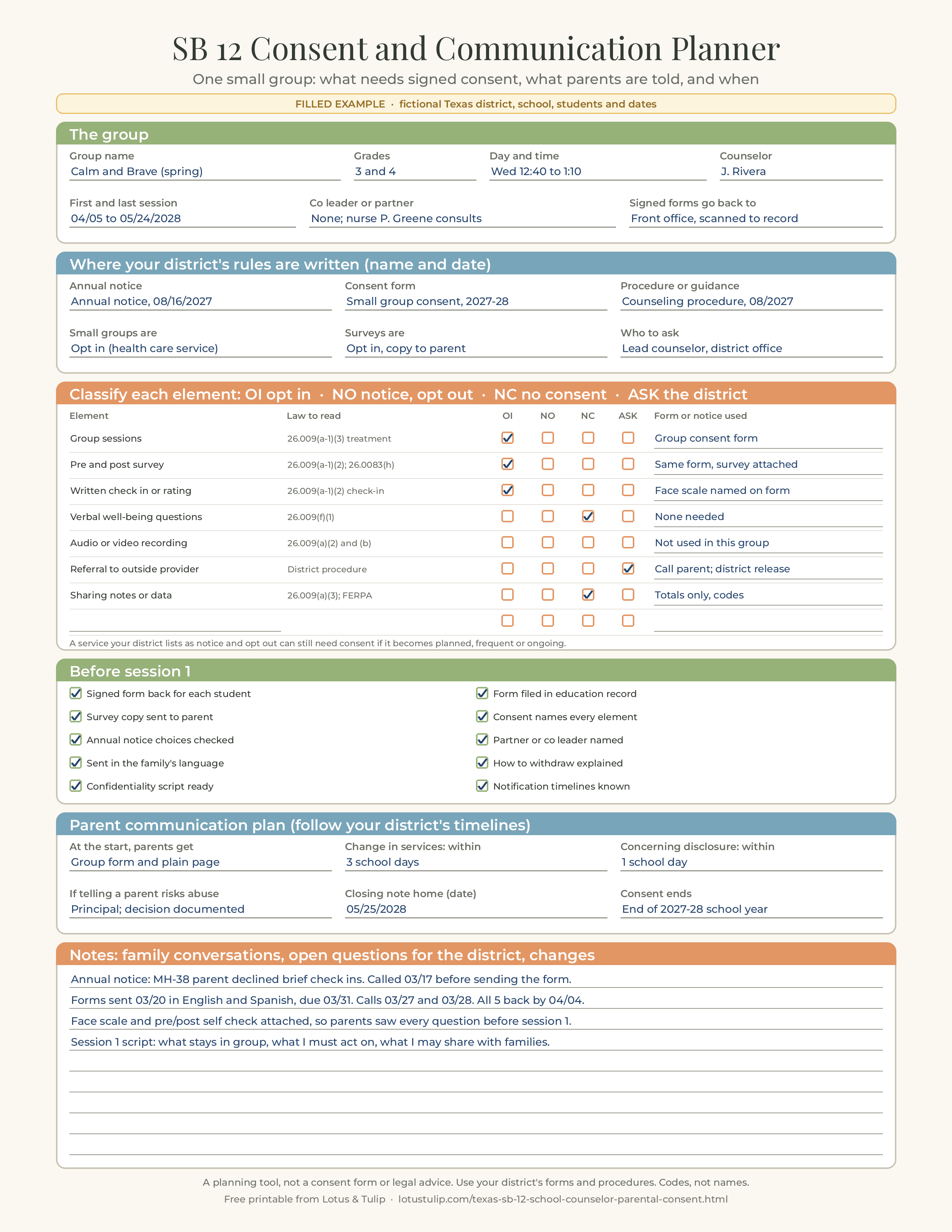
After the spring referral round, J. Rivera plans a second "Calm and Brave" worry group for five students in grades 3 and 4, coded MH-31, MH-33, MH-36, MH-38 and MH-40. It meets on Wednesdays from 12:40 to 1:10 for eight sessions, from 04/05/2028 to 05/24/2028. She lists its elements: eight sessions (opt in), the pre and post self check with faces (opt in, copy attached), a 1 to 5 face scale at the start of each session (named in the consent), group agreements and worksheets (part of the group), no recording, and possible referrals (a separate conversation, and the district's release if needed). Before sending anything, she checks the annual notice responses: MH-38's parent declined "brief check ins with the counselor." J. Rivera calls that parent first, on Friday, 03/17/2028, rather than sending a form cold.
Sending and waiting
She sends the district consent form with a one page plain language description and a copy of the self check on Monday, 03/20/2028, in English and Spanish, with a return date of Friday, 03/31/2028. By 03/27, three forms are back. She calls the other two families on 03/27 and 03/28. MH-38's parent, after a second conversation about what the group does and what will be shared, signs and returns the form on 03/29. MH-40's form comes back on 04/04. All five are signed and in the office by the day before session 1, and the office confirms each was scanned into the student record.
During the group
In session 1 on 04/05, J. Rivera gives the pre survey, which every parent has seen, and uses the confidentiality script. On 04/19, during the face scale, MH-33 says she has been "too scared to sleep" since a storm damaged her family's roof. J. Rivera talks with her after group, encourages her to tell her dad, and with her agreement calls him that afternoon to share what she said and offer support. She logs the call. On 05/03, MH-36's teacher asks whether J. Rivera can also see him individually. That would be a new service, so J. Rivera calls the parent, and the district's individual counseling consent is signed and returned on 05/05, before any individual session.
Closing
On 05/24, she gives the post survey before the celebration, sends a closing note to each family on 05/25, logs each note, and files the post survey results with the group data. On the tracking log she notes that each consent ends with the school year. Her filled planner is page 2 of the free printable.
| Element | Maple Hollow ISD classification | What J. Rivera did |
|---|---|---|
| Eight group sessions | Opt in (health care service) | Group specific form, signed and returned before 04/05 |
| Pre and post self check | Opt in; copy to parent | Attached the exact survey to the request |
| Face scale at start of sessions | Part of the group; named | Described it on the plain language page |
| Hallway check ins | Verbal well-being; no form | Continued as usual |
| Annual notice choice (MH-38) | Parent declined brief check ins | Called the parent before sending the group request |
| Disclosure on 04/19 (MH-33) | Notify within one school day | Encouraged the student, called the parent the same day, logged it |
| New individual counseling (MH-36) | Separate opt in | Signed and returned before the first individual session |
Six real world scenarios
1. "The parent said yes on the phone." A parent tells you on the phone that their son can join. Thank them, explain that Texas law requires the form to be signed and returned, and offer an easy way to do it: a copy sent home, a paper copy at pick up, or the district's electronic signature if it accepts one. The student starts when the form is back.
2. The annual form says yes to counseling. A parent marked "yes" to counseling services on the annual form in August. Does that cover your March group? Check your district's procedure. If the annual form names small group counseling and your district says it is sufficient, follow it, and still notify the parent before session 1. If not, send the group form. When in doubt, send it; a second yes costs a few days.
3. You want to add a survey mid group. Halfway through, you want to add a short coping skills rating to see what is working. That is a new method designed to elicit feelings or habits that parents have not seen. Send it home and get consent first, or wait and include it from the start of the next group.
4. A student asks you not to tell. A seventh grader in your stress group says she has been cutting and begs you not to tell her mother. Follow your district's suicide and self harm protocol, which comes first. Tell her you cannot keep it secret and why, offer to help her tell her mother, and make the notification within your district's timeline. If you believe telling the parent would likely lead to abuse, report to your principal under the district procedure and make your Chapter 261 report as required; do not decide alone.
5. A teacher wants a mood meter in every class. A teacher asks you to run a daily written mood check in for the whole class. Under SB 12, a written method to elicit feelings, whether or not it is "embedded in an academic lesson," falls within the test definition. Explain that schoolwide and classroom check ins are a district decision in Texas and take the request to the campus administrator. Meanwhile, the teacher can always ask students out loud how they are doing.
6. You work in Katy ISD. A colleague says the court blocked SB 12 in your district. It blocked four specific provisions in Houston, Katy and Plano ISDs: DEI duties, social transitioning, the restriction on instruction about sexual orientation and gender identity, and student clubs. The consent and notification rules in sections 26.009 and 26.0083 were not part of the order and still apply to your groups.
Common mistakes
- Starting with forms "on the way." The law says a child "may not participate in the activity unless the district receives the parent's signed written consent."
- Leaving the survey off the consent. The survey is its own regulated item. Attach it.
- Assuming last year's consent still counts. Unless the parent says otherwise, consent ends with the school year.
- Keeping the signed form only in your office. It belongs in the education record.
- Stopping all hallway care. Asking how a student is doing and calming an upset student are protected. Students still need adults who notice them.
- Promising complete confidentiality. Texas procedures may not encourage students to withhold well-being information from parents. Say what you will share.
- Reading the injunction as a statewide pause. It covers four provisions in three districts and does not include the consent rules.
- Treating the proposed rule as final. As of November 10, 2026, §103.1105 was still listed as proposed. Follow your district's adopted procedure and watch for TEA updates.
- Running every service as opt in. TEA has said a district may not require an all opt in approach, and first aid and general caretaking must not wait for a form. Opt in belongs where the law requires it.
- Using a downloaded form instead of the district's. Plain language templates help you plan and explain. The legal form is your district's.
Free printable: SB 12 consent and communication planner, filled example and tracking log
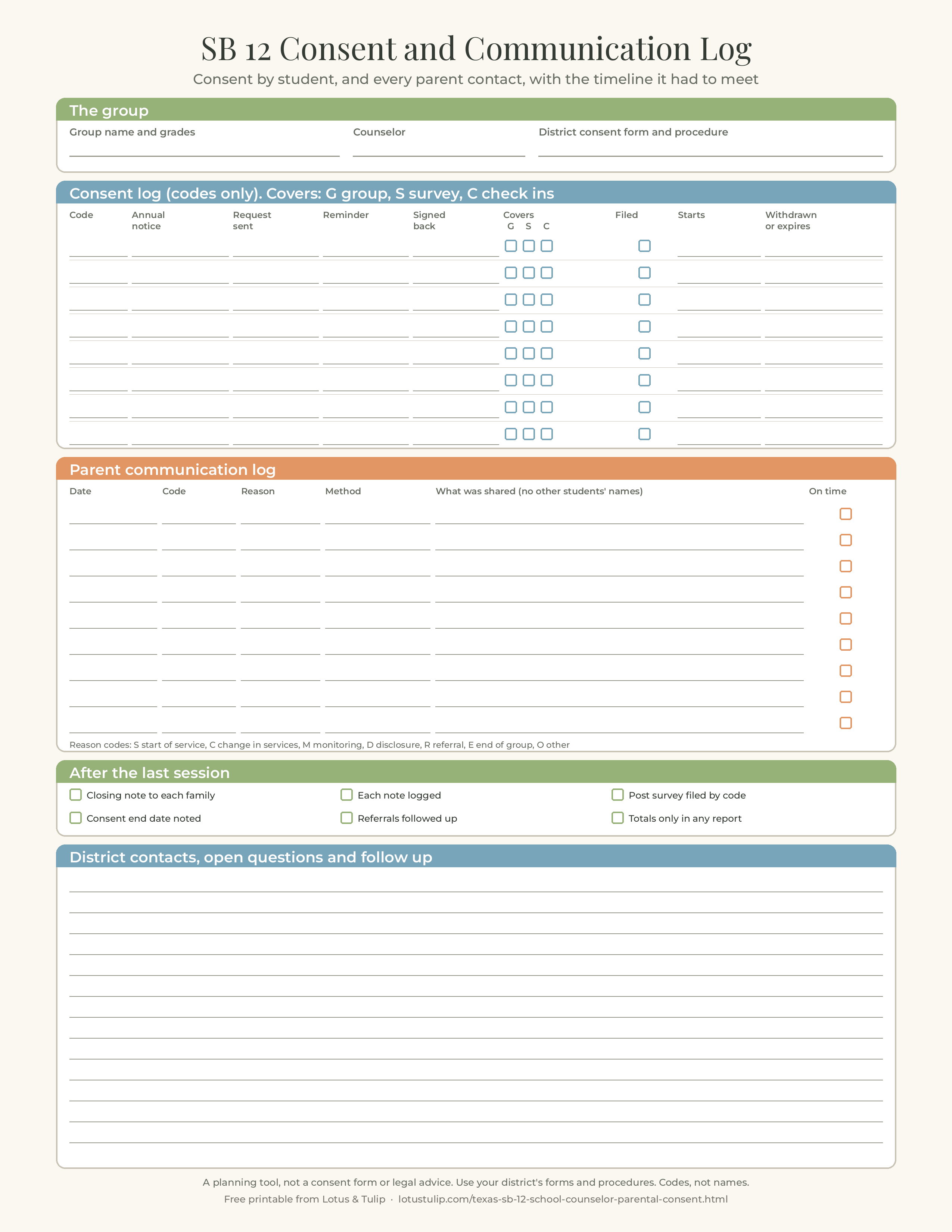
The free printable has three US Letter pages. Page 1 is a blank SB 12 consent and communication planner for one small group: the group (name, grades, day and time, counselor, first and last session, co leader or partner); where your district's rules are written (annual notice, consent form, procedure, with dates); a classification table for eight elements (group sessions, pre and post survey, written check ins or rating scales, verbal well-being questions, recordings, referrals to outside providers, sharing notes or data, and a blank row), each with the part of the law to read, boxes for opt in, notice and opt out, no consent or ask the district, and the form or notice used; ten before session 1 checks; a parent communication plan; and lines for notes. Page 2 is the same planner filled in for the fictional Maple Hollow ISD "Calm and Brave" spring group described above. Page 3 is a blank consent and parent communication tracking log: a consent log for eight students by code (annual notice choice, request sent, reminder, signed form back, elements covered, filed in record, start date, withdrawn or expires), a parent communication log with the reason, method and whether it met the timeline, six after the last session checks, and space for district contacts and follow up.
The printable is a planning and tracking tool. It is not a consent form, it is not legal advice, and it does not replace your district's forms or procedures.
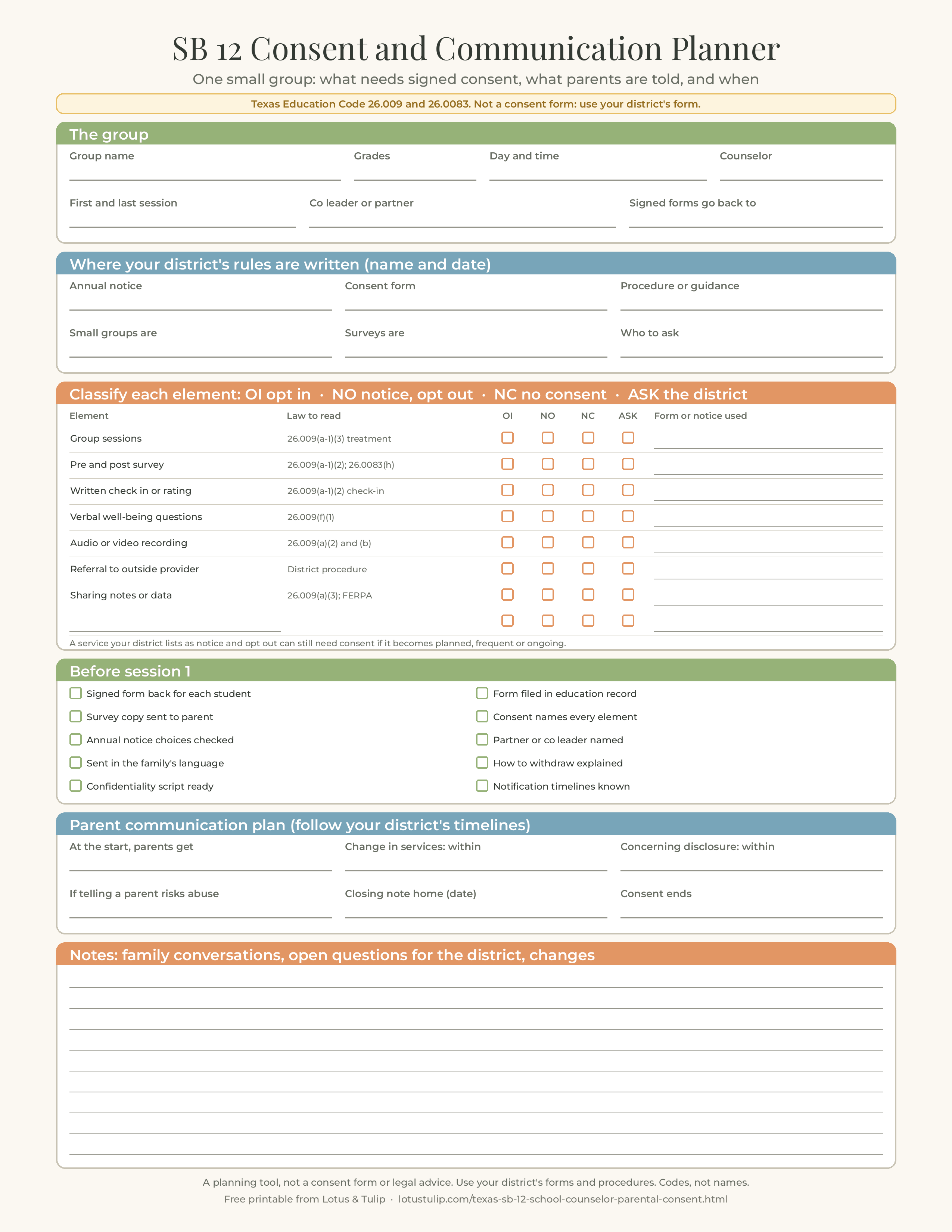
Download the free SB 12 consent planner, example and tracking log (PDF, 3 pages)
Or download single pages: Page 1: blank consent and communication planner (PNG) · Page 2: filled fictional example (PNG) · Page 3: consent and parent communication log (PNG)
Free to print and use in your own school. Please link to this page rather than re-uploading the file. This is a planning tool, not a consent form or legal advice; use your district's forms and procedures.
Related resources
- Small group counseling permission slip and parent letter, with a state by state consent section
- Small group counseling pre and post assessment
- Small group counseling referral form and referral log
- Small group counseling progress notes and attendance tracker
- All school counselor small group curriculums
- Small group counseling lesson plan template and planning map
- School counselor needs assessment for small groups
- Small group counseling for attendance: an 8 session plan
- Small group counseling termination activities and follow up log
- Small group counseling curriculum for anxiety: an 8 session plan
Sources (all fetched November 10, 2026): S.B. 12, 89th Legislature, Regular Session (2025), enrolled version, sections 11 to 20, 27, 30 and 31 and the Senate and House certifications, and the bill history, Texas Legislature Online; Texas Education Code sections 26.004, 26.008, 26.0083, 26.009 and 26.011, Chapter 26A, and sections 33.005, 33.006 and 33.0815, and Texas Family Code section 32.004, current text on Texas Constitution and Statutes; Texas Education Agency, "89th Legislature Updates," "SB 12 Frequently Asked Questions" (September 2025), "89th Legislature Frequently Asked Questions" (June 2026), "Model Language to Comply with Senate Bill (SB) 12 and Texas Education Code (TEC), §§26.0083 and 26.009" (updated June 18, 2026), "Draft Rule Text to Provide Guidance for Senate Bill (SB) 12 and the Texas Education Agency's (TEAs) adopted procedure for Texas Education Code (TEC), §26.0083" (updated June 18, 2026), "Updated SB 12 Guidance: Required Parental Rights Form and Right to Health-Related Services Information" (To the Administrator Addressed, September 11, 2025), and Proposed Commissioner of Education Rules (listing for 19 TAC §103.1105); Texas Register, June 26, 2026, Proposed Rules, 19 TAC §103.1105 (filed June 15, 2026); GSA Network, et al. v. Morath, et al. (S.D. Tex., Houston Division), Opinion and Order of February 20, 2026, and the ACLU of Texas case page; American School Counselor Association, ASCA Ethical Standards for School Counselors (2022), standards A.2.b, A.7.d and B.1.a, and the position statement "The School Counselor and Group Counseling"; Northside Independent School District, "New Parental Consent Forms" (district example).
FAQ
What is Texas SB 12 for school counselors?
Senate Bill 12 of the 89th Texas Legislature (2025) is a parental rights law that took effect on September 1, 2025. For school counselors, its key parts are Texas Education Code section 26.009, which requires a parent's written consent, signed and returned to the district, before a psychological examination, test or treatment, with broad definitions that include surveys and check ins, and section 26.0083, which sets rules for telling parents about their child's mental, emotional and physical health and related services.
Do Texas school counselors need parental consent for small group counseling?
In most cases, yes. A planned, multi session counseling group fits the law's definition of psychological treatment, and many districts list small group counseling as needing opt in consent. TEA's proposed rule treats some brief counseling services as health related services with notice and opt out, but says a service can need consent based on its nature, frequency or ongoing provision. Use signed, group specific consent unless your district has classified the group differently in writing.
Does a pre and post survey need separate consent under SB 12?
It needs to be covered by consent. The law defines a psychological test to include any method that elicits feelings, attitudes or habits, including a survey or check in, and section 26.0083(h) requires a district to give the parent a copy of a student well-being questionnaire and get consent before giving it. Attach the exact survey to the group consent request, or use a separate form if your district requires one.
Can a Texas school counselor ask a student how they are doing without consent?
Yes. Section 26.009(f)(1) says the law does not require written consent before verbally asking a child about their general well-being, and section 26.0083(i)(2) protects asking about daily well-being. TEA also treats calming a crying student or defusing an angry one as general caretaking, which needs no consent and which schools must provide.
Is SB 12 blocked by a court?
Only in part, and only in three districts. On February 20, 2026, a federal court in GSA Network v. Morath enjoined Houston, Katy and Plano ISDs from enforcing four provisions: DEI duties, social transitioning, instruction about sexual orientation and gender identity, and student clubs. The parental consent and notification rules in sections 26.009 and 26.0083 were not part of that order and apply statewide. As of November 10, 2026, a motion to dismiss filed by the State of Texas had been set for a hearing on November 2, 2026, and we found no ruling on it.
How long does SB 12 parental consent last?
Unless the parent says otherwise, consent obtained for routine care under section 26.009(a-3) lasts until the end of the school year, and TEA's proposed rule says the same for consent to health related and health care services. A parent can change or withdraw consent at any time. Keep the signed form in the student's education record, as section 26.009(e) requires.