
School counselors · Updated 2026-11-10
Small Group Counseling Lesson Plan Template: What to Include, ASCA Alignment, a Filled Example and an 8 Session Planning Map (Free Printable)
Ready-made printable: Complete Small Group Counseling Bundle Holiday 20% off: about $29.44, was $37 (EUR 32) · instant digital download
Buy on Etsy
You have the referrals, the permission slips are back and the group starts Thursday. Then the questions arrive. What exactly will happen in session 3? Which ASCA standard does it serve? How will you know if students learned anything, beyond "they seemed to enjoy it"? What do you do when one student is absent, another shares something heavy in the opening circle and the bell rings ten minutes early? And when your principal, your district coordinator or a RAMP reviewer asks to see your small group plan, what do you hand them?
A good small group counseling lesson plan answers all of that on one page. It names one behavior standard and one learning objective for the session, describes what you will teach and what students will practice, says how you will check for learning in a minute or two, and leaves room for what you noticed and what you will change next time. Put eight of those together with a one page planning map and you have a group that is easier to teach, easier to defend and easier to measure.
This guide is for elementary, middle and high school counselors in the United States, and for school social workers and school psychologists who run counseling groups. It covers the difference between a lesson plan, a session plan, a group plan and a curriculum; what the ASCA National Model, fifth edition (2025), the ASCA Student Standards, the ASCA Ethical Standards for School Counselors (2022) and the fifth edition RAMP scoring rubric actually ask for, quoted where the wording matters; what to put on a lesson plan, field by field; how to pick one behavior standard and write a learning objective you can check; a session structure with timing for kindergarten to grade 2, grades 3 to 5, and middle and high school; how session 1 and the last session differ from the rest; how to map six or eight sessions so they build on each other; access, safety and privacy in the plan itself; a ten step process; a fully worked fictional example; six scenarios; common mistakes; and a free three page printable: a blank one session lesson plan template, the same plan filled in for a fictional worry group, and an eight session group planning map.
Jump to the free lesson plan template, filled example and planning map
This is educational information for school counselors in the US. A lesson plan is a planning and teaching tool, not a treatment plan, and nothing here replaces your district's curriculum review, consent, records or safety procedures. The standards and documents quoted here were checked on November 10, 2026 against "The ASCA National Model: A Framework for School Counseling Programs, Fifth Edition" (2025), the ASCA Student Standards: Mindsets & Behaviors for Student Success, the ASCA Ethical Standards for School Counselors (2022), the ASCA "RAMP Scoring Rubric, Fifth Edition" and ASCA's Templates and Tools and ASCA Portals pages.
The short answer
- Plan one session at a time, on one page. Group, session number, date, time and minutes; one standard; one objective; materials; the session flow; support and safety; and a short after the session box.
- Choose one ASCA behavior standard per session. The fifth edition RAMP rubric asks for a "limit of one behavior standard from the ASCA Student Standards identified for each session plan," and says the same standard may be repeated across sessions.
- Write the objective as something students will do. "Students will show two calm body tools and name one time to use each" can be checked. "Students will understand coping" cannot.
- Match every objective to a check. The rubric asks that "each learning objective aligns with at least one assessment item." In the session that can be a quick show me; across the group it is an item on your pre and post survey.
- Use a steady routine. Opener, teach, practice, wrap up and a take home idea, with minutes for each. The teach part is short; practice is the longest.
- Make session 1 and the last session different on purpose. Session 1 builds agreements, explains privacy and its limits, and gives the pre survey. The last session reviews, celebrates, gives the post survey and plans follow up.
- Map the whole group before you start. A one page map with a date, focus, standard, objective, practice and check for each session shows whether the sessions build on each other and whether you will run out of weeks.
- Plan for access and safety in advance. Picture supports, read aloud, language help, movement, a pass option, accommodations, and a plan for what to do if a student discloses harm.
- Keep the plan free of student details. Use codes on anything shared. Your notes about individual students belong in your own records, not on a lesson plan a colleague might borrow.
- Write two lines after every session. What you noticed and what you will change. ASCA Ethical Standard A.7.g asks counselors to "reflect on group outcomes and determine adjustments that may improve future group interventions."
Lesson plan, session plan, group plan and curriculum: what each one is
School counselors use these words loosely, and so do the templates. Sorting them out saves time, especially if you plan to apply for RAMP or your district asks for documentation.
| Term | What it covers | Who usually sees it |
|---|---|---|
| Lesson plan or session plan | One meeting of the group: standard, objective, materials, steps, timing, check for learning, notes | You, a co leader or a substitute counselor |
| Group planning map or group at a glance | All sessions of one group on one page: dates, focus, standard, objective and check for each | You, your administrator, your advisory council |
| Group curriculum | The full set of lesson plans, student pages and forms for one topic | You and anyone who will run the same group |
| ASCA Small-Group Plan and Data Report | ASCA's own template for one group: details, session plans, participation and results data, graphs | Your administrator, advisory council and RAMP reviewers |
| ASCA Student Standards Delivery Plan | ASCA's program level template listing Tier 1 lessons and Tier 2 small groups across the year, each tied to a behavior standard | Your administrator, advisory council and RAMP reviewers |
The fifth edition of the ASCA National Model describes this planning in its Manage component. School counselors plan what students will learn by "identifying specific standards in the ASCA Student Standards delivery plan that will be delivered in Tier 1 and 2 settings" and by "planning how the standards will be delivered using lesson plans and small-group sessions plan." In other words, the delivery plan says which standards your program teaches and where; the lesson plans and small group session plans say how.
ASCA publishes its own templates for these documents, free, on its Templates and Tools page, and its National Model portal lists a "Lesson Plan and Data Report" and a "Small-Group Plan and Data Report" among its components. (For a Tier 1 classroom lesson, see our ASCA classroom lesson plan and data report guide.) If you are applying for RAMP, use them: the fifth edition RAMP rubric says "only completed fifth edition ASCA templates in their original form may be used" and that "using the wrong templates or altering templates may lead to rubric not being met." A printable template like the one on this page is for planning and teaching. It is the working draft you scribble on, carry into the room and write notes on afterward. The ASCA template is where the finished plan and the data go.
What ASCA expects from a small group plan
Four ASCA documents shape what a small group lesson plan should contain. None of them gives you a lesson plan format to copy, but together they are clear about what a plan needs to show.
The ASCA Ethical Standards for School Counselors (2022)
Section A.7, Group Work, sets the frame. School counselors:
- "Facilitate short-term groups to address students' academic achievement, postsecondary and career exploration, and social/emotional well-being" (A.7.e).
- "Use data to inform group topics, establish well-defined expectations and measure the outcomes of group participation" (A.7.f).
- "Reflect on group outcomes and determine adjustments that may improve future group interventions" (A.7.g).
- "Communicate the aspiration of confidentiality as a group norm, while recognizing and working from the protective posture that confidentiality for students in small groups cannot be guaranteed" (A.7.h).
- "Facilitate culturally sustaining groups from the framework of evidence-based or research-based practices" (A.7.j).
- "Practice within their competence level and develop professional competence through training and supervision" (A.7.k).
Each of those turns into something on the page. "Short-term" means a planned number of sessions with an end date. "Well-defined expectations" means a stated objective for each session. "Measure the outcomes" means a check for learning and a pre and post survey. "Reflect" means notes after every session. The confidentiality standard belongs in session 1, in words students understand. And "evidence-based or research-based practices" means the activities in your teach and practice sections should come from an approach you can name, not just a worksheet that looked fun.
The ASCA Student Standards: Mindsets & Behaviors for Student Success
The ASCA Student Standards are the 36 standards your lessons point to: six mindset standards and thirty behavior standards in three groups, learning strategies (B-LS 1 to 10), self-management skills (B-SMS 1 to 10) and social skills (B-SS 1 to 10). The fifth edition of the National Model puts the focus of planning and data on the behavior standards.
The Student Standards document also lays out ten steps for putting a standard into practice, and they read like the outline of a small group plan: identify need; collect supplemental data; select a student standard; "write learning objectives aligned with the student standard" by "selecting or writing a measurable student learning objective(s)"; create a pre and post assessment "based on the student learning objectives and selected student standard"; select or develop strategies that "facilitate attainment of the learning objectives"; administer the pre-test; deliver the strategies; administer the post-test; and "reflect on the process, identifying what might be improved when next delivered." Your lesson plans are step 6 and step 8 on paper.
The ASCA National Model, fifth edition (2025)
The fifth edition lists counseling, including small group counseling, as a direct student service: school counselors "provide students with short-term assistance and support based on counseling theories and techniques during times of transition, heightened stress, critical change or other situations impeding academic, career and social/emotional development." Instruction, delivering the ASCA Student Standards, can also happen in a small group. In the MTSS graphic, Tier 2 "interventions for some students" include small group and individual counseling. A small group lesson plan sits in that Tier 2 space: more targeted than a classroom lesson, and still short term.
The RAMP scoring rubric, fifth edition
Even if you never apply for RAMP, its rubric is the most concrete public description of what ASCA reviewers look for in a small group plan. Section 6, Small-Group Plan and Data Report, "requires evidence of a small group with a minimum of four sessions for three-12 students," and asks for "what will be delivered in group sessions, to whom it will be delivered, how it will be delivered and how students' attainment of the lesson's learning objective will be assessed." Among the scored items:
- Small group title or focus, and number of sessions identified (6.1).
- At least one Life-Readiness category and at least one Academic Success category identified as the reason for the group (6.2), and achievement data provided for the students in the group (6.3).
- "Limit of one behavior standard from the ASCA Student Standards identified for each session plan. (A standard may be repeated in multiple sessions.)" (6.4)
- "Each learning objective aligns with the selected behavior standard" (6.5) and "each learning objective aligns with at least one assessment item" (6.6).
- "Description of teaching content for each session supports the attainment of stated learning objective" (6.7) and "description of student practice for each session supports the attainment of stated learning objective" (6.8).
- Number of students expected to participate and the number who actually did, with an explanation if they differ (6.9), then graphs and results: average responses for Likert items or percent correct for knowledge items, results for each assessment item, final achievement data and percent change from baseline (6.10 to 6.16).
The rubric also asks that the Student Standards Delivery Plan include "at least two Tier 2 small groups," each session "connected to one behavior standard," with a title that "conveys purpose/focus" and a start month (1.6 to 1.9). And its opening note on FERPA is worth taping above your desk: "No identifiable student information should be included."
Read together, the rubric items give you the skeleton of every session plan on this page: a focus, one standard, one objective, teaching content, student practice and an assessment item that all line up.
What to include in a small group counseling lesson plan
Every field on a lesson plan should either help you teach the session or help you show what happened. These are the ones that earn their space, in the order they appear on the free template.
| Field | Why it is there | Tip |
|---|---|---|
| Group name and topic | Keeps plans for different groups apart | Use the name families see, such as "Calm and Brave," plus a plain topic |
| Session number of total | Shows where you are in the arc, and that the group is short term | "3 of 8" |
| Date, time and minutes | Lets you check rotating times and actual length | Write the real minutes, not the scheduled ones, after the session |
| Grades and number of students | Tells a reader who the plan is for | Number only; names stay off the plan |
| Counselor and room | Useful for co leaders, substitutes and room booking | Note any access needs for the space |
| ASCA behavior standard | Ties the session to your program and to RAMP item 6.4 | One per session; repeating it across sessions is fine |
| Session focus or title | Says in a few words what the session is about | A title that "conveys purpose/focus," in the rubric's words |
| Learning objective | Defines what success looks like today | "Students will..." plus an observable verb |
| Check for learning | Shows whether the objective was met | Something you can do in one or two minutes during the wrap up |
| Pre and post item it links to | Connects today's objective to your group data | Item number and wording from your survey |
| Materials | So nothing is missing when students arrive | Include timers, pencils and any cards you read aloud |
| Room setup and access needs | Lets every student take part | Seating, picture steps, space to move, quiet corner |
| Session flow with minutes | The plan itself: what you do and what students do | Two columns, "what I will do and say" and "what students will do" |
| Take home idea | Practice between sessions, and a link to families | One small action, not homework |
| Support, access and safety checks | A short reminder list you can tick before you start | Agreements, pass option, visuals, read aloud, movement, language, accommodations, privacy limits |
| Attendance | Participation data for your report | Codes, present and absent |
| Check for learning result | Today's evidence, in one line | "4 of 4 present showed a tool and named a time" |
| Students to check in with, teacher or family follow up | Catches students who were absent, upset or stuck | Say what you will share, not why |
| What I noticed, change for next time | Your reflection (A.7.g) and your plan to adjust | Skills you saw, not clinical observations |
Leave off what you will not use. A lesson plan does not need a diagnosis line, a list of students' problems or a long "background" box. Those belong, if anywhere, in your screening notes and counseling records, which have different access rules.
Choosing one behavior standard per session
Start with the need you saw in referrals and data, then pick the behavior standard that best describes the skill students need. One standard per session keeps the objective focused and makes the check for learning simple. You can use the same standard for every session of a group, or move between two or three closely related ones as the group builds.
The standard numbers and wording below are quoted from the ASCA Student Standards.
| Group topic | A behavior standard that often fits | Sample session objective (students will...) |
|---|---|---|
| Worry or stress | B-SMS 7. Effective coping skills | Show two calm body tools and name one time to use each |
| Anger and self regulation | B-SMS 2. Self-discipline and self-control | Name two early anger signals and choose a cool down tool for each |
| Social skills | B-SS 2. Positive, respectful and supportive relationships with students who are similar to and different from them | Use a three step joining in script in a role play |
| Listening and conversation | B-SS 1. Effective oral and written communication skills and listening skills | Repeat back what a partner said before answering |
| Self esteem and mistakes | B-SMS 5. Perseverance to achieve long- and short-term goals | Use a kind self talk phrase after a practice mistake |
| Changing families or new school | B-SMS 10. Ability to manage transitions and adapt to change | Name two adults to talk to when things change |
| Empathy and friendship repair | B-SS 4. Empathy | Name how another person might feel in three scenarios |
| Speaking up | B-SS 8. Advocacy skills for self and others and ability to assert self, when necessary | Say an I statement in a practice conflict |
| Study skills or executive function | B-LS 3. Time-management, organizational and study skills | Break a project into three steps with dates |
| Problem solving | B-LS 1. Critical-thinking skills to make informed decisions | Use a problem solving wheel to choose between two options |
| Facing a hard step | B-SMS 6. Ability to identify and overcome barriers | Name one thing in the way and one small step around it |
| Help seeking | B-SS 3. Positive relationships with adults to support success | Name an adult at school they can go to, and how to ask |
Two cautions. First, the standards describe broad skills, so almost any activity can be stretched to fit almost any standard. Resist that. Pick the standard first, from the need, then choose activities that build that skill. Second, do not stack three or four standards on one session to look thorough. A plan with one standard and one clear objective is easier to teach and easier to measure, and it is what the RAMP rubric asks for.
Writing a learning objective you can check
The objective is the hinge of the plan. The standard says what skill area you are working in; the objective says what students will do today that shows they are building it. The Student Standards call it "a measurable student learning objective" that identifies "the specific knowledge and/or skills students need to attain that stated standard."
A simple formula works for most sessions: Students will + an action you can see or hear + what + in what situation or how well. "Students will name three body clues of worry on a body map." "Students will use an I statement in a role play with a partner." "Students will break a science project into three steps with due dates."
- Use verbs you can observe. Name, show, practice, sort, choose, say, write, draw, role play, demonstrate, list, plan.
- Avoid verbs you cannot. Understand, know, learn about, appreciate, become aware of, feel better about.
- Keep it to one session. "Students will manage their anger" is a group goal, maybe a year goal. "Students will name two early anger signals" fits in thirty minutes.
- Match the age. Kindergartners can point, show, act out and choose a picture. Middle schoolers can explain, compare and plan.
- One objective is usually enough. Two at most. If you need three, the session is trying to do too much.
| Weak objective | Problem | Better objective |
|---|---|---|
| Students will understand worry | Cannot be seen or checked | Students will name three places they feel worry in their body |
| Students will learn coping skills | Too broad for one session; no action | Students will show two calm body tools and name one time to use each |
| Students will feel more confident | A feeling, not a skill; better as a pre and post item | Students will say one kind self talk phrase after a practice mistake |
| Students will be nicer to classmates | Vague and judgmental | Students will give a specific compliment to the person on their right |
| Students will complete the worksheet | Describes an activity, not learning | Students will sort six thoughts into facts and guesses |
| Students will manage anger, use I statements and solve problems | Three objectives, three sessions' worth | Students will use an I statement in a practice conflict |
Checking for learning in two minutes
The check for learning is how you know, today, whether the objective was met. It is not a test, and it should not feel like one. It fits inside the wrap up and takes a minute or two.
- Show me. "Show me your favorite calm tool." Each student demonstrates. You tick who did it.
- Name it. "Tell me one body clue for worry." A quick go around.
- Sort it. Students hold up a fact card or a guess card as you read three thoughts.
- Act it out. A ten second role play of joining in or an I statement.
- Exit card. One sentence or a drawing on a sticky note. For older students, "One thing I will try this week is..."
- Thumbs or faces. Useful for how students feel about a skill, less useful for whether they can do it. Pair it with a show me.
Write the result on the plan in one line: "4 of 4 present showed a tool and named a time." Over eight sessions those lines tell you which objectives landed and which need another try.
The session check is different from your pre and post survey, but they should point the same way. If the objective for session 3 is about calm tools, one item on the pre and post survey should be too, such as "I can use a calm tool when I feel worried." Writing the item number on the lesson plan keeps that link visible. ASCA's Student Standards document suggests keeping measures short: "No more than three to five questions or prompts are needed for any one measure." The small group counseling pre and post assessment guide covers how to write, give, score and report those items.
A session structure that works
Most small group sessions follow the same five part rhythm. The routine itself helps students: they know what is coming, transitions are faster and anxious students settle sooner.
- Opener. A short check in and a warm up that gets everyone talking or moving: a feelings rating on fingers, a would you rather question, a quick game. Review last week's take home idea here.
- Teach. The new idea, in a few minutes and plain words, with a model or example. This is the part counselors most often let run too long.
- Practice. Students use the skill: role plays, games, sorting cards, drawing, a student page. This should be the longest part of the session, because practice is where skills grow.
- Wrap up. Each student shows or says something, which doubles as your check for learning. Close with a calm routine so students return to class ready to learn.
- Take home. One small thing to try before next time, and a way to tell a family member about it.
Timing depends on age, schedule and attention span. These ranges are common starting points; adjust them to your students and your bell schedule.
| Kindergarten to grade 2 | Grades 3 to 5 | Middle and high school | |
|---|---|---|---|
| Typical session length | About 20 to 30 minutes | About 30 to 40 minutes | One class period, an advisory or a lunch period |
| Group size | 3 to 5 students | 4 to 6 students | 5 to 8 students |
| Opener | 5 min, with movement | 5 min | 5 to 8 min |
| Teach | 5 to 8 min, with pictures or a puppet | 8 to 10 min | 10 to 12 min |
| Practice | 10 to 12 min, mostly hands on | 12 to 15 min | 15 to 20 min |
| Wrap up | 5 min, show me rather than tell me | 5 min | 5 to 8 min |
| Writing | Little or none; draw, point, circle | Short answers | Short reflections, planning pages |
If your groups meet at lunch, plan for eating time and a shorter teach section. If your middle school group rotates through class periods, the session length may change from week to week; plan to the shortest slot and keep an extra practice activity ready for longer ones.
Session 1 is different
The first session sets the tone for the whole group, and it has jobs the others do not.
- Welcome and names. A low pressure game so every student speaks once in the first five minutes.
- Purpose in kid friendly words. "This group is a place to learn tricks for when worry shows up," not "this is an anxiety intervention."
- Group agreements. Build them together: listen, be kind, it is okay to pass, what we share stays here. Have students sign or add a handprint.
- Privacy and its limits. ASCA A.7.h asks you to communicate confidentiality as an "aspiration," while recognizing it "cannot be guaranteed." Say it simply: "We keep what others share in the group. I will keep it private too, unless someone might be unsafe. Then I have to get help." Repeat it in later sessions.
- The pre survey. Give it in session 1, before you teach anything, or in a short meeting before the group starts.
- A small first skill. End with one thing students can use right away, so session 1 is not all rules.
The last session is different too
- Review. A quick game or toolkit page that brings back every skill from the group.
- The post survey. Same items, same format, same way of giving it as the pre survey.
- A plan for after. Each student names the tool or skill they will keep using and an adult they can go to.
- Celebration and goodbye. A certificate, a compliment circle or a small ritual. Ending a group is a transition, and some students find it hard. The small group termination activities guide has 20 closing activities and a free last session plan.
- Follow up. Plan a check in a few weeks later. ASCA A.7.l asks counselors to "provide necessary follow-up and/or referrals to additional resources for group members." Note on the plan which students need more support.
Planning the whole group: six or eight sessions on one page
Before you write session 1 in detail, sketch all of them. A planning map shows at a glance whether sessions build on each other, whether you have enough weeks before winter break, and whether every session has a standard, an objective and a check.
A common arc for a skills group has four parts:
- Getting started (session 1): welcome, agreements, purpose, pre survey.
- Understanding (sessions 2 and 3): what the feeling or skill is, how it shows up, first tools.
- Building and practicing (sessions 4 to 6 or 7): new skills each week, each one used in practice and reviewed the next week.
- Using it and closing (the last one or two sessions): applying the skills to real situations, a personal plan, the post survey and celebration.
Six sessions or eight?
Both work. Eight sessions give more room for practice and for the inevitable missed week. Six fit more easily into a grading period and let you run more groups a year. ASCA's RAMP rubric sets a floor, not a target: at least four sessions for a small group in the Small-Group Plan and Data Report. To shrink an eight session plan to six, combine the two "understanding" sessions and the last two "using it" sessions, and keep every building session.
Dates, rotation and no school days
- Put real dates on the map, and mark holidays, testing windows, early release days and field trips before you send the permission letter.
- Rotate the time so no student misses the same class every week, if your school allows it. Write the rotation on the map.
- Plan one buffer week. Assemblies and snow days happen. A group that is meant to end before winter break should start with a week to spare.
- Plan makeups. Decide in advance how you will catch up a student who misses a session: a five minute check in, the student page to take back to class, or a buddy recap at the next opener.
Tie the map to your data plan
At the top of the map, write the need you saw (from your referrals and, ideally, a needs assessment) and the data you will watch: for example, referrals for worry before tests, nurse visits, absences. ASCA's fifth edition names three types of data for this: participation data, ASCA Student Standards data (what students know and can do, measured by pre and post assessments) and achievement data, with attendance and discipline grouped as contributing factors data. Decide which ones you will report before session 1, so you collect the baseline while you still can.
Access, differentiation and culturally sustaining groups
ASCA A.7.b asks counselors to "provide equitable access to participation in groups, including alleviating physical, language and other obstacles," and A.7.a and A.7.j ask for "culturally sustaining" groups. On a lesson plan, that becomes a short list of supports you plan before the session, not fixes you improvise during it.
- Picture and visual supports. Picture steps for each tool, a visual schedule of the session, and faces or icons for ratings. They help young students, English learners and anxious students alike.
- Read aloud. Any written prompt should also be spoken. Never make reading the barrier to a counseling skill.
- Language. Use your district's interpreter services for family communication, and let students use their home language in pairs when it helps them practice.
- Movement. A movement opener or a stand up practice helps students who struggle to sit still and is good for everyone.
- A pass option. Students can always say "pass" in a sharing round. Plan another way to take part, such as pointing or drawing.
- Accommodations. Check IEP and 504 plans for students in the group, such as extra time, seating, breaks or communication supports, and apply them in the group too.
- Examples that fit your students. Scenarios, names, foods, games and family structures should reflect the students in the room. Keep family examples neutral and never assume a two parent home.
- Choice. Letting students choose which tool to practice, or which brave step to try, respects differences and keeps no one pushed past what they are ready for.
Safety and privacy in the lesson plan
A lesson plan is not where safety procedures live, but it should remind you of them, because the moment you need them is usually unplanned.
- Topic fit. ASCA A.7.i asks counselors to "select topics for groups with the clear understanding that some topics are not suitable for groups in schools (e.g., incest survivorship, eating disorders, dating violence)." Build activities that teach skills without asking students to tell their story.
- Plan for disclosure. Decide in advance what you will say if a student shares something about harm in the middle of a session: thank them, stop the topic gently ("I want to hear more about that with just you, right after group"), continue the activity, and follow your district's procedures the same day. ASCA A.9.a and A.12.a cover serious and foreseeable harm and suspected abuse or neglect.
- Privacy reminders. A one line reminder in the opener of every few sessions keeps the group agreement alive.
- Codes, not names. If a lesson plan might be shared with a co leader, administrator or reviewer, write codes in the attendance line, and keep your notes about individual students in your own records. The RAMP rubric reminds applicants to "protect student identity" and that "no identifiable student information should be included."
- Skills, not clinical notes. "MH-07 chose five finger breathing and used it without a prompt" is a useful lesson plan note. Observations about a student's mental health, family or history belong in your counseling notes, if anywhere, under your district's records rules.
After the session: two lines that make the next one better
The after the session box takes three minutes and is where most of your learning as a group leader happens. Fill it in before you walk students back or before the next student arrives, while you still remember.
- Attendance. Codes present and absent. This is your participation data.
- Check for learning result. One line, with numbers if you can.
- Students to check in with. Who was absent, upset, stuck or quiet.
- Teacher or family follow up. What you will share and with whom. Share the skill, not the story: "Ask Sam to try his calm tool before tests" rather than anything he said in group.
- What I noticed. Which part worked, which skill students used, who might be a peer model next week.
- Change for next time. One adjustment. Shorter teach. More movement. A different practice game. A review at the next opener.
Over a group, these lines are the evidence behind A.7.g: you reflected and adjusted. Over a year, they tell you which sessions to rewrite before you run the group again.
How to write a small group counseling lesson plan, step by step
- Start from the need. Look at your referrals and school data and write, in one line, what students need to be able to do. Many school counselors keep this at the top of the planning map.
- Pick one behavior standard. Choose the ASCA Student Standard that best describes that skill. Use it for every session or for most of them.
- Sketch the whole group on a planning map. Six or eight sessions with dates, a focus for each, and the standard. Mark no school days and a buffer week.
- Write the pre and post items. Before you plan the details, write five to eight short items that match the skills you will teach, so the sessions and the survey line up.
- Write one objective for the session. "Students will" plus an observable action, sized to fit one session.
- Choose the check for learning. A show me, sort, act out or exit card you can do in the wrap up, and note which survey item it links to.
- Plan the flow with minutes. Opener, teach, practice, wrap up and take home. Make practice the longest part and keep teach short.
- Plan supports and safety. Visuals, read aloud, language, movement, pass option, accommodations and your disclosure plan. Tick the reminders on the template.
- Gather materials and set up the room. Print student pages, set out picture steps, find the timer.
- Teach, then reflect. After the session, write attendance, the check result, who needs a check in, follow up, what you noticed and one change for next time.
A worked example (fictional): session 3 of the Calm and Brave worry group
Maple Hollow Elementary is a fictional public elementary school. J. Rivera is the school counselor. After a fall referral round, she formed a worry group, "Calm and Brave," for five students in grades 3 and 4, coded MH-07, MH-11, MH-14, MH-19 and MH-22. The group meets for eight sessions on Thursdays, 30 minutes each, at a rotating time (9:10, 10:40 and 1:15) so no one always misses the same class. Signed parent consent is on file for all five. She teaches from the eight session Calm and Brave worry group curriculum and uses the free lesson plan template as a cover sheet for each session, to add the standard, objective, check for learning and her notes. The referral form guide follows one of these students, MH-07, from his teacher's referral to the group, and the permission slip guide shows the letter his family signed.
The need and the standard. Six referrals that fall had worry as the main concern, several mentioning stomachaches and nurse visits before tests. J. Rivera chose B-SMS 7, effective coping skills, as the main standard. For three sessions she chose a closer fit: B-LS 1, critical-thinking skills, for telling worry thoughts from facts; B-SMS 6, the ability to identify and overcome barriers, for the brave ladder; and B-SS 3, positive relationships with adults, for the closing session, where students name an adult they can go to. Each session still has only one standard.
The planning map. She put real dates on it in September and checked them against the district calendar. Thursday, November 11, 2027 is Veterans Day and the district is closed, so session 6 moved to Wednesday, November 10, at 1:15, a time she cleared with the grade 3 and 4 teachers. Thursday, November 25, 2027 is Thanksgiving, so session 8 moved to December 2.
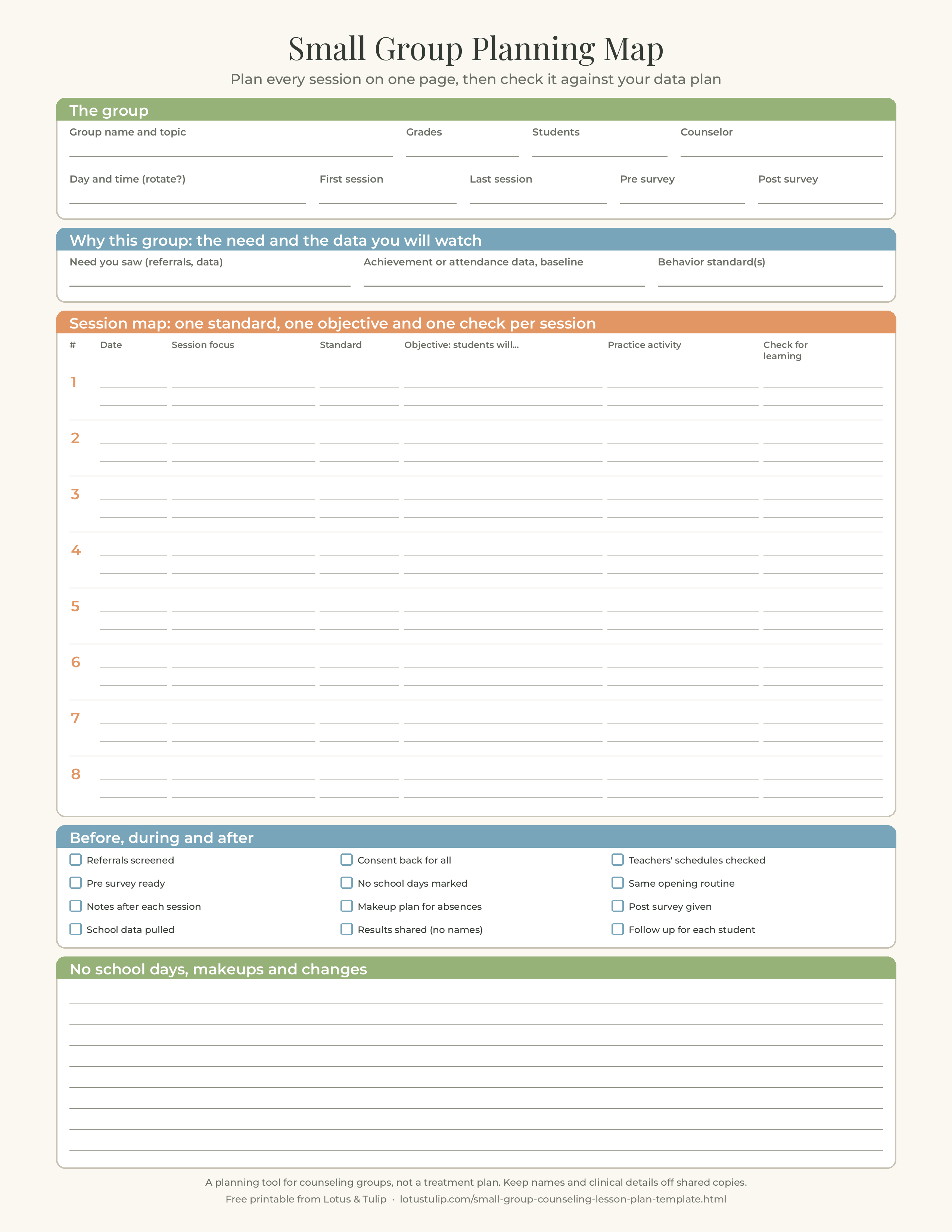
| # | Date and time | Focus | Standard | Objective: students will... | Check for learning |
|---|---|---|---|---|---|
| 1 | 10/07, 9:10 | Welcome, what is worry? | B-SMS 7 | Say in their own words that worry is a normal alarm everyone has | Each student finishes "Worry is..."; pre survey given |
| 2 | 10/14, 10:40 | My worry alarm | B-SMS 7 | Name three places they feel worry in their body | Points to three spots on a body map |
| 3 | 10/21, 1:15 | Calm body tools | B-SMS 7 | Show two calm body tools and name one time to use each | Shows a tool and names a time |
| 4 | 10/28, 9:10 | Catch it and check it | B-LS 1 | Sort worry thoughts into facts and guesses | Holds up fact or guess for three thoughts |
| 5 | 11/04, 10:40 | Brave self talk | B-SMS 7 | Change a worried sentence into a brave, kind one | Says one brave swap aloud |
| 6 | 11/10 (Wed), 1:15 | What I can control | B-SMS 7 | Sort worries into can control and cannot control | Places two worries on the circle |
| 7 | 11/18, 9:10 | Facing fears step by step | B-SMS 6 | Choose a first small brave step on their own ladder | Names step 1 and when they will try it |
| 8 | 12/02, 10:40 | My calm and brave toolkit | B-SS 3 | Name two tools they will keep using and an adult they can go to | Toolkit page finished; post survey given |
Each objective links to one of the eight items on the group's pre and post survey; session 3's objective links to item 3, "I can use a calm tool when I feel worried." The pre and post assessment guide shows how she scored and reported those items for this same fictional group.
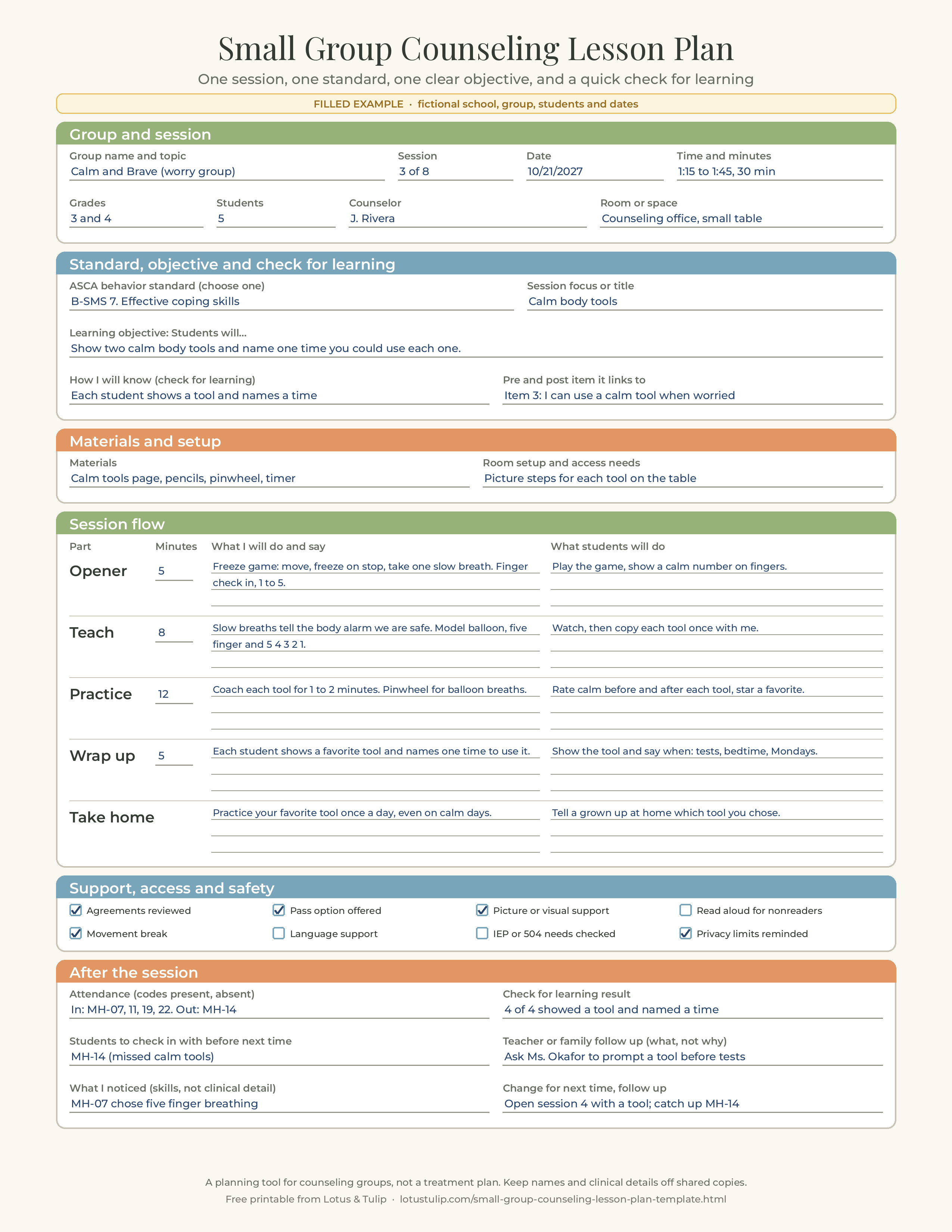
The session 3 plan. Thursday, October 21, 2027, 1:15 to 1:45, in the counseling office at a small table. Objective: students will show two calm body tools and name one time they could use each one. Check for learning: each student shows a tool and names a time. Materials: the calm tools student page, pencils, a pinwheel and a one minute timer, with picture steps for each tool on the table.
- Opener, 5 minutes. A freeze game: students move, freeze when she says stop, and take one slow breath before moving again. Then a finger check in, 1 for calm to 5 for very worried, and a quick review of last week's body clues.
- Teach, 8 minutes. Slow breathing tells the body alarm that we are safe. She models three tools: balloon breathing, five finger breathing (trace your hand, breathe in going up, out going down) and 5 4 3 2 1 grounding (notice five things you see, four you can touch, three you hear, two you smell, one you taste). Students copy each tool once.
- Practice, 12 minutes. She coaches each tool for one to two minutes, with the pinwheel for balloon breaths. Students rate how calm they feel before and after each tool on the student page and star a favorite.
- Wrap up, 5 minutes. Each student shows a favorite tool and names one time to use it: before a test, at bedtime, on Monday mornings. This is the check for learning.
- Take home. Practice the favorite tool once a day, even on calm days, and tell a grown up at home which tool you chose.
The curriculum's session plans are written for 30 to 40 minutes, with ten minutes to teach and fifteen to practice. Because her slot is exactly 30 minutes, she trimmed teach to eight and practice to twelve, and wrote the actual minutes on the plan.
Supports she ticked. Agreements reviewed, pass option offered, picture steps on the table, a movement opener, and a privacy reminder. No student in the group has an IEP or 504 accommodation that applies, and none needs language support for this session, so those boxes stay empty.
After the session. Present: MH-07, MH-11, MH-19 and MH-22; MH-14 was absent. Check result: 4 of 4 present showed a tool and named a time. Check in: MH-14, to catch up on the calm tools before session 4. Follow up: ask Ms. Okafor, MH-07's teacher, to prompt a calm tool before tests. Noticed: MH-07 chose five finger breathing and used it again without a prompt during the wrap up. Change for next time: open session 4 with one calm tool, so the skill gets practiced every week, and give MH-14 a five minute catch up.
At the end. MH-14 missed one more session in November and attended six of eight; the other four attended all eight. Her attendance and session notes tracker shows both absences and the catch up. That number goes straight into the participation line of her Small-Group Plan and Data Report, with a one line explanation, as RAMP item 6.9 asks.
Six real world scenarios
1. You only have 20 minutes at lunch. Cut the teach section to three or four minutes and keep a full practice block. Let students eat during the opener and the teach, and do the practice once trays are put away. One objective, one check. If the skill needs more time, split it across two sessions.
2. A kindergarten and first grade group. Plan for 20 to 30 minutes, three to five students, lots of movement and almost no writing. Use a puppet or picture book for the teach section and show me checks ("Show me your flower breath"). The pre and post survey should be read aloud with faces or pictures. Objectives stay simple: "Students will name three feelings from picture cards."
3. Your middle school group rotates periods. Some weeks you have 45 minutes, some weeks 30. Plan to 30, and keep a second practice activity and a short discussion question ready for longer sessions. Write the actual minutes on each plan so your participation data is accurate.
4. A student shares something serious in the opener. Thank the student, say you would like to talk more with just them right after group, and move the group gently to the next activity. See the student immediately after, follow your district's safety and reporting procedures, and note on the lesson plan only that a follow up was needed. The details go in your counseling records.
5. Your principal asks for your small group plans for the advisory council. Share the planning map, with codes, not names, and summarize what you will report: participation, ASCA Student Standards data from the pre and post survey, and the achievement or attendance data you are watching. If your school is preparing for RAMP, transfer the plan into ASCA's Small-Group Plan and Data Report template, which the rubric requires in its original form.
6. You are running a purchased curriculum. A ready made curriculum gives you the activities. You still need to decide the standard, write or confirm the objective for each session, choose a check for learning and fit the timing to your schedule. Many counselors keep the curriculum's plan in front of them and use a template like the one on this page as a cover sheet with those fields and the after the session notes.
Common lesson plan mistakes
- Activities without an objective. A fun game is not a plan. Every activity should serve the session objective.
- Objectives you cannot see. "Understand," "learn about" and "feel better" give you nothing to check.
- Too many standards. One per session. Stacking four standards does not make a session stronger.
- Teaching too long. If students listen for 15 minutes and practice for 5, swap the numbers.
- No check for learning. Without it you are guessing whether the session worked.
- No link to the pre and post survey. If the survey asks about skills you never taught, the data will not show growth even if students grew.
- Planning one week at a time. Without a map, groups drift, skip skills and run into winter break.
- Treating session 1 like the others. Agreements, privacy limits and the pre survey need their own time.
- Student details on shared plans. Names, diagnoses and family details do not belong on a document a colleague or reviewer will see.
- Skipping the notes. The two lines after each session are your reflection, your follow up list and your improvement plan for next year.
Free printable: small group counseling lesson plan template, filled example and planning map
The free printable has three US Letter pages. Page 1 is a blank one session lesson plan: group name and topic, session number, date, time and minutes, grades, number of students, counselor and room; the ASCA behavior standard, session focus, a "Students will..." objective, how you will check for learning and the pre and post item it links to; materials and room setup; a session flow table with opener, teach, practice, wrap up and take home, each with minutes, what you will do and say, and what students will do; eight support, access and safety reminders to tick; and an after the session box for attendance by code, the check for learning result, students to check in with, teacher or family follow up, what you noticed and what to change next time. Page 2 is the same plan filled in for session 3 of the fictional Calm and Brave worry group at Maple Hollow Elementary. Page 3 is a group planning map: group details, first and last session, pre and post survey dates, the need and the data you will watch, an eight row session map (date, focus, standard, objective, practice activity and check for learning), a twelve point before, during and after checklist, and space for no school days, makeups and changes.
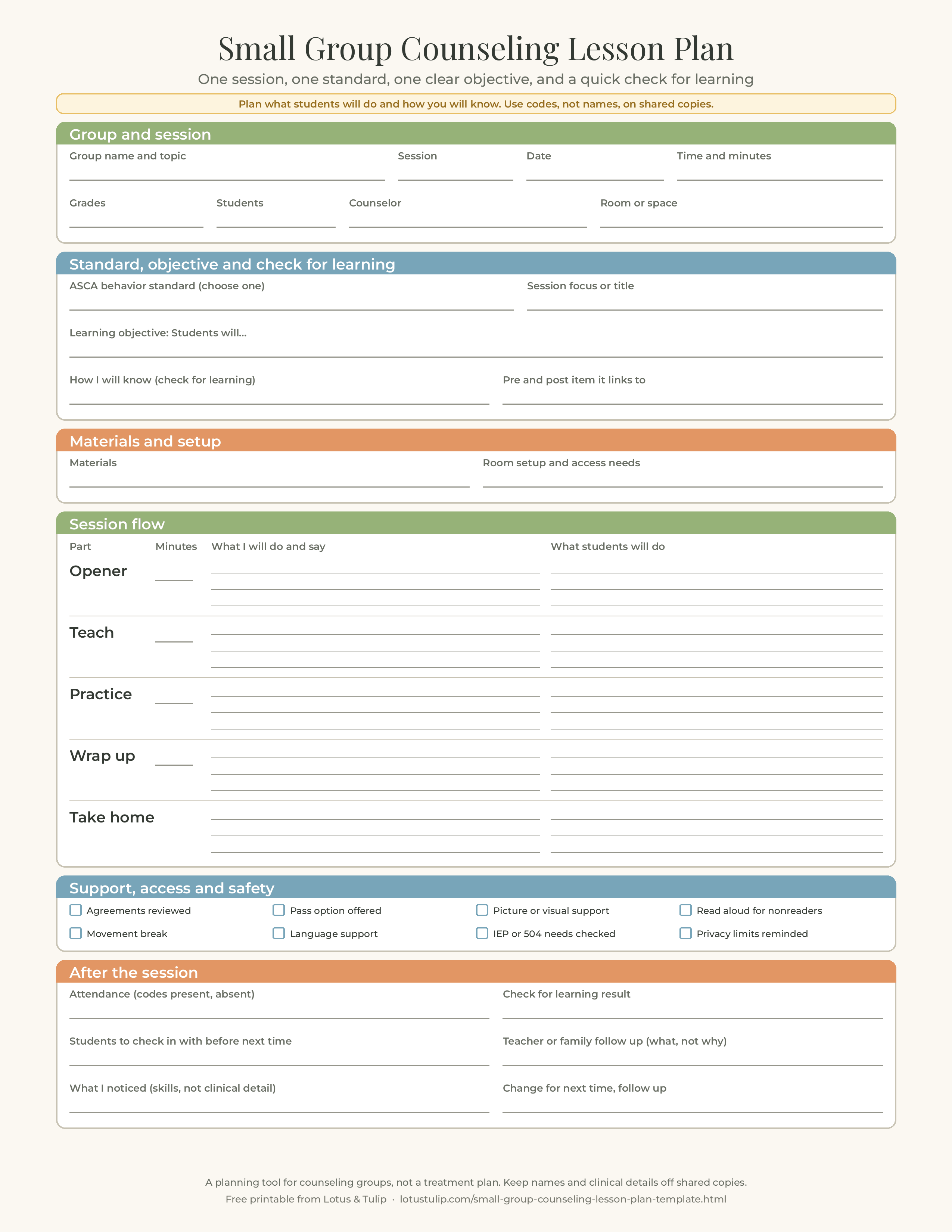
Download the free lesson plan template, example and planning map (PDF, 3 pages)
Free starter kit: See a finished plan: the free small group counseling starter kit includes a complete session 1 lesson plan and student page from our eight session worry group, with a referral form, permission letter, agreements and a pre and post check (8 pages, no email).
Prefer single images? Page 1: blank lesson plan template (PNG) · Page 2: filled fictional example (PNG) · Page 3: 8 session group planning map (PNG)
Free to print and use in your own school. Please link to this page rather than re-uploading the file. This is a planning and teaching tool. It is not ASCA's Small-Group Plan and Data Report template, which RAMP applicants must use in its original form, and it does not replace your district's policies on curriculum, consent, records, safety and mandated reporting.
Related resources
- ASCA classroom lesson plan and data report: RAMP Section 5, filled example and free planner
- ASCA small-group plan and data report: RAMP Section 6, filled example and free planner
- ASCA Student Standards delivery plan: map a year of lessons and groups, with a free planner
- Small group counseling termination activities: last session plan and follow up log
- Small group counseling progress notes and attendance tracker
- School counselor needs assessment for small groups: teacher survey and tally sheet
- All school counselor small group curriculums
- Small group counseling referral form and referral log
- Small group counseling permission slip and parent letter
- Small group counseling pre and post assessment
- Full year elementary small group counseling: plan the year
- Small group counseling curriculum for anxiety: an 8 session plan
- Icebreaker activities for counseling groups
- Group therapy note template and examples
- Social skills small group activities
- Anger management small group activities
- Self esteem small group activities
- K-2 coping skills group activities
Sources: American School Counselor Association (2025), The ASCA National Model: A Framework for School Counseling Programs, Fifth Edition (Manage component: ASCA Student Standards delivery plan, "lesson plans and small-group sessions plan"; Deliver component: direct student services, counseling, MTSS tiers; data types); ASCA Student Standards: Mindsets & Behaviors for Student Success (36 standards, behavior standards B-LS, B-SMS and B-SS, ten implementation steps, "no more than three to five questions or prompts"); ASCA Ethical Standards for School Counselors (2022), standards A.7.a, A.7.b, A.7.e to A.7.l, A.9.a and A.12.a; ASCA, RAMP Scoring Rubric, Fifth Edition (FERPA adherence and template notes, items 1.6 to 1.9 and Section 6, items 6.1 to 6.16); ASCA Templates and Tools page and ASCA Portals page (Lesson Plan and Data Report, Small-Group Plan and Data Report). All checked on November 10, 2026. Timing and group size ranges are common practice starting points, not ASCA requirements. The worked example and all names, codes, dates and numbers in it are fictional.
FAQ
What should a small group counseling lesson plan include?
The group name, session number, date, time and minutes; one ASCA behavior standard; a session focus; a learning objective written as what students will do; a quick check for learning linked to a pre and post survey item; materials and setup; a session flow with an opener, teach, practice, wrap up and take home idea, with minutes for each; access and safety reminders; and an after the session box for attendance, the check result, follow up and what to change next time.
How many ASCA standards should a small group session have?
One behavior standard per session. The fifth edition RAMP scoring rubric asks for a "limit of one behavior standard from the ASCA Student Standards identified for each session plan" and notes that a standard may be repeated in multiple sessions, so a worry group can use B-SMS 7, effective coping skills, for most or all of its sessions.
How many sessions should a school counseling small group have?
Most school counseling groups run six to eight weekly sessions, which fits ASCA's expectation that groups are short term. The RAMP rubric's Small-Group Plan and Data Report requires a minimum of four sessions for three to twelve students. Eight sessions leave room for practice and missed weeks; six fit more easily into a grading period.
How long should a small group counseling session be?
Common starting points are about 20 to 30 minutes for kindergarten to grade 2, about 30 to 40 minutes for grades 3 to 5, and one class period, advisory or lunch period for middle and high school. Plan to the time you actually have and make practice the longest part of the session.
How do I write a learning objective for a counseling group?
Use "Students will" plus an action you can see or hear, sized to one session: "Students will show two calm body tools and name one time to use each." Avoid verbs like understand or learn about. Then choose a one or two minute check, such as a show me or a sort, that tells you whether the objective was met, and link it to an item on your pre and post survey.
Can I use this template for a RAMP application?
Use it to plan and teach, then transfer the finished plan into ASCA's own Small-Group Plan and Data Report template. The fifth edition RAMP rubric says only completed fifth edition ASCA templates in their original form may be used, and that altered or wrong templates may lead to a rubric item not being met.