
School counselors · Updated 2026-11-10
Small Group Counseling Progress Notes and Attendance Tracker: What to Write, FERPA and Sole Possession Notes, Examples, and a Free Printable
Ready-made printable: Complete Small Group Counseling Bundle Holiday 20% off: about $29.44, was $37 (EUR 32) · instant digital download
Buy on Etsy
Ask ten school counselors how they keep notes on their small groups and you will get ten answers. One keeps a spiral notebook in a locked drawer. One types everything into the district's student information system. One writes nothing at all because a colleague once had notes subpoenaed. One keeps a beautiful color coded spreadsheet that the whole counseling team can open. Most of them, if you ask a second question, are not sure their system would hold up if a parent asked to see it, a principal asked for the group's results, or a RAMP reviewer asked how many students actually took part.
Group records do not have to be complicated. A good system for a school counseling group has two parts: an attendance tracker that tells you who came to each session, and short session notes that tell you what you taught, whether students learned it, and what you will do next. Together they give you participation data for your program, a running picture of each student's progress, a reason to follow up with the right students, and a defensible record if anyone asks. What they should not become is a diary of what students said about their families.
This guide is for elementary, middle and high school counselors in the United States who run short term, Tier 2 small groups. It covers why attendance and notes matter; what the ASCA Ethical Standards for School Counselors (2022), the ASCA National Model, fifth edition (2025), the fifth edition RAMP rubric and the federal FERPA regulations actually say, quoted where the wording matters; the difference between sole possession notes and education records, and why that line is harder to hold for group notes than most counselors think; what to put on an attendance tracker, with attendance codes and how to count; what to write in a group session note, with examples of what to write and what to leave out; how to monitor progress across sessions; safety notes; where to store notes and who can see them; what to do about patterns of absence; how to report participation at the end; a ten step process; a fully worked fictional example; six scenarios; common mistakes; and a free three page printable: a blank attendance and session notes tracker, the same tracker filled in for a fictional worry group, and a group attendance and progress summary.
Jump to the free attendance and session notes tracker, filled example and summary
This is educational information for school counselors in the US, not legal advice. Records rules depend on federal law, state law and your district's policies, and several states have changed their rules on parental access to counseling records in recent years. Check your district's board policy and ask your supervisor or district counsel before you change how you keep records. The documents quoted here were checked on November 10, 2026 against the ASCA Ethical Standards for School Counselors (2022), "The ASCA National Model: A Framework for School Counseling Programs, Fifth Edition" (2025), the ASCA "RAMP Scoring Rubric, Fifth Edition," the FERPA regulations at 34 CFR Part 99 (sections 99.3, 99.10, 99.12 and 99.31, current eCFR text), the HIPAA definition of protected health information at 45 CFR 160.103, and the ASCA School Counselor magazine article "Parental Rights and Information Sharing" (March 2023).
The short answer
- Keep two things for every group: an attendance tracker (who came to each session) and a short session note (what you taught, whether students learned it, what comes next).
- Attendance is program data, not just housekeeping. The ASCA National Model lists participation data as one of three data categories, and the RAMP rubric asks for the number of students expected to take part and the number who actually did, with an explanation if they differ.
- Use codes, not names, on anything that is shared, emailed, projected or kept where others can see it.
- Write the group note about the group, not about each child's private story. Record skills taught, the check for learning result, what you observed in behavioral terms, and follow up.
- Keep individual details out of other students' records. Under FERPA, a parent may see only the part of a record that is about their own child, so a note that mixes five students' details creates work and risk.
- Do not assume your notes are sole possession records. FERPA exempts records "kept in the sole possession of the maker" and "used only as a personal memory aid." Notes you share with a co-leader, store on a shared drive or enter into the district system are very likely education records.
- Parents generally have the right to see education records, and schools must respond within 45 days. Write every note as if the parent, the student and a judge may one day read it.
- Safety concerns get their own documentation, made under your district's procedures, not a line squeezed into the group log.
- Track absences as you go, plan catch ups, and look for patterns, such as a student who always misses the same class time. For a group built around school attendance itself, see small group counseling for attendance.
- Close the loop. At the end, total attendance, score the pre and post survey, write a one page summary without names, file notes under your district's policy, and set a date to purge memory aids.
Why attendance and session notes matter for school counseling groups
A group that meets eight times for thirty minutes is four hours of a student's school year, usually taken from class. If you cannot say who came, what they learned and what changed, you cannot show that those four hours were worth it, and you cannot fix the group next time. Notes and attendance are the cheapest evaluation tool you have.
They also serve students directly. A tracker shows you, at a glance, that one student has missed two of the last three sessions. A session note reminds you that three students could not yet tell a worry thought from a fact, so next week's opener reviews it. A follow up column reminds you to check in with the student whose help seeking answer went down. Without written records, these small signals disappear by Friday.
And they protect you. If a parent asks what their child did in group, a principal asks why a student keeps missing math, or a teacher asks whether the group is working, a clear tracker and plain, factual notes let you answer calmly. Vague memories and a sticky note do not.
Finally, groups are one of the few places where school counselors can show measurable outcomes. ASCA's ethical standard on group work asks counselors to "use data to inform group topics, establish well-defined expectations and measure the outcomes of group participation" (A.7.f) and to "reflect on group outcomes and determine adjustments that may improve future group interventions" (A.7.g). You cannot measure outcomes of participation without first recording participation.
What ASCA, RAMP and federal law say
No ASCA document prescribes a specific group note format or attendance form. What the professional and legal documents do is set expectations and limits your records must meet. Here is what they say, quoted where the exact wording matters, and what each means for your group tracker.
| Source | What it says | What it means for your tracker and notes |
|---|---|---|
| ASCA National Model, fifth edition (2025) | School counselors "use three categories of data to plan for and report results": participation data ("how many students access the school counseling program, how often they participate and for what length of time"), ASCA Student Standards data (measured through pre and post assessments) and achievement data (including contributing factors such as attendance and discipline rates) | Your attendance tracker is your participation data. Your check for learning results and pre and post survey are your Student Standards data. |
| ASCA Ethical Standards (2022), A.7.f | "Use data to inform group topics, establish well-defined expectations and measure the outcomes of group participation" | Record attendance and a learning check each session so you can connect outcomes to participation. |
| A.7.g | "Reflect on group outcomes and determine adjustments that may improve future group interventions" | Each session note needs a "next time" line, and the summary needs a "what I will change" section. |
| A.7.h | "Communicate the aspiration of confidentiality as a group norm, while recognizing and working from the protective posture that confidentiality for students in small groups cannot be guaranteed" | Do not record what one member disclosed about another, and do not write group notes that assume nobody else will ever read them. |
| A.13.a | "Abide by the Family Educational Rights and Privacy Act (FERPA), which defines who has access to students' educational records and allows parents/guardians the right to review the records and challenge perceived inaccuracies in their child's records" | Write accurate, factual notes you could defend line by line. |
| A.13.c and A.13.d | "Recognize the difficulty in adhering to FERPA's definition of sole-possession records" and "recognize that sole-possession records and case notes can be subpoenaed unless there is a specific state statute for privileged communication expressly protecting student/school counselor communication" | Even private memory aids are not secret. Keep them brief and factual. |
| A.13.e | "Recognize that electronic communications with school officials regarding individual students, even without using student names, are likely to create student records" | An email to a teacher about how a student is doing in group is probably a record. Keep it short and factual. |
| A.13.f | "Establish a reasonable timeline for purging sole-possession records or case notes," suggesting shredding or deleting them "when a student transitions to the next level, transfers to another school or graduates," but not destroying notes "that may be needed by a court of law, such as notes on child abuse, suicide, sexual harassment or violence, without prior review and approval by school district legal counsel" | Write a purge date on your memory aids, and keep safety documentation separately under district procedure. |
| RAMP Scoring Rubric, fifth edition, item 6.9 | "Number of students expected to participate in the small group and the number who actually participated in the small group are included. Explanation provided if final participation data is different from baseline participation data." | Track expected and actual participation from the start, and note why a student left or joined late. |
| FERPA, 34 CFR 99.3 (education records) | Education records are records "directly related to a student" and "maintained by an educational agency or institution." The term does not include "records that are kept in the sole possession of the maker, are used only as a personal memory aid, and are not accessible or revealed to any other person except a temporary substitute for the maker of the record." | The sole possession exception is narrow. Shared, filed or system notes do not qualify. |
| FERPA, 34 CFR 99.10 | Parents (or eligible students) "must be given the opportunity to inspect and review the student's education records," and the school must comply "within a reasonable period of time, but not more than 45 days after it has received the request" | Assume a parent may read your group tracker and notes about their child. |
| FERPA, 34 CFR 99.12(a) | "If the education records of a student contain information on more than one student, the parent or eligible student may inspect and review or be informed of only the specific information about that student" | A group log that mixes students means someone may have to redact it. Keep individual details on individual lines, by code. |
| FERPA, 34 CFR 99.31(a)(1) | Records may be shared without consent with "other school officials, including teachers, within the agency or institution whom the agency or institution has determined to have legitimate educational interests" | Teachers may receive what they need to support the student, not the group's whole story. |
| HIPAA, 45 CFR 160.103 | Protected health information "excludes individually identifiable health information" in "education records covered by the Family Educational Rights and Privacy Act" | For most public school counselors, FERPA, state law and district policy govern group records, not HIPAA. |
Two practical points come out of that table. First, the professional expectation (measure participation and outcomes) and the legal reality (most notes are reviewable records) point the same way: keep records that are factual, skill focused and brief. Second, the part of a group record most likely to cause trouble is not the attendance grid. It is the free text, where one student's story ends up next to another's.
Sole possession notes and education records: where group notes fall
Many counselors were taught that their counseling notes are "sole possession" and therefore private. The exception is real, but it is narrower than its reputation. Under 34 CFR 99.3, a record is outside the definition of education records only if it is kept in the sole possession of the person who made it, used only as a personal memory aid, and not accessible or revealed to anyone else except a temporary substitute. The glossary of the ASCA Ethical Standards adds that sole possession records "provide only professional opinion or personal observations," and standard A.13.c openly acknowledges "the difficulty in adhering to FERPA's definition."
In its March 2023 School Counselor magazine article "Parental Rights and Information Sharing," ASCA Ethics Committee member Richard McCoy draws the line by level of detail. Sole possession notes "are normally the barest of information that will help jog the school counselor's memory." A note with a student's name, the date and time of a meeting, "two sentences about what you discussed and the recommendations you gave," on the other hand, is given as an example of an education record, as is an entry in a district's required electronic record keeping program. He adds that "proving your notes are sole-possession can be difficult."
Group work makes the line harder to hold, for three reasons:
- Groups are often co-led. If a school psychologist, social worker or intern co-leads and reads or adds to your notes, the notes are no longer in your sole possession.
- Group records get shared. Attendance goes to teachers, results go to the principal, and a summary goes into a program report. Anything you share has left the exception.
- Group notes are about several students at once. A session note that describes what four students did is directly related to four students. That does not make it secret; it makes it a record that may need redaction before a parent sees it (34 CFR 99.12(a)).
The practical answer is not to stop writing notes. It is to separate three kinds of paper and treat each one honestly.
| What it is | Example in a group | Likely status (check district policy) | How to keep it |
|---|---|---|---|
| Attendance tracker | Grid of student codes and P or A for each session; present counts | Usually an education record once shared or filed; also program data | Codes on shared copies; key linking codes to names kept separately and securely |
| Group session log | Date, focus, check for learning result, skills observed, follow up | Usually an education record, especially if a co-leader reads it or it is filed | Write about the group's learning; individual details only as brief, coded, factual lines |
| Personal memory aid | A sticky note: "check in with MH-14 re ladder Mon" | May be a sole possession record if truly private and used only as a memory aid | Bare facts only; not shared, not copied, purged on a set date |
| Safety or report documentation | A student disclosed harm in group; you made a report | Governed by district procedure and state law; may be needed in court | Separate documentation as your district requires; never purge without legal review (A.13.f) |
| Group summary for the principal or report | Participation, averages, change, teacher ratings, no names | De-identified program data if no student is identifiable | Mask small numbers; check that nobody could work out who is who |
| Email to a teacher about a student | "MH-07 is practicing a calm tool before tests; please prompt it" | Likely a student record (A.13.e), even without the name | Short, factual, only what the teacher needs |
One more caution about de-identified data. FERPA's definition of personally identifiable information includes information "that, alone or in combination, is linked or linkable to a specific student that would allow a reasonable person in the school community... to identify the student with reasonable certainty." In a five student group, "the only fourth grader" or "the student who moved here in October" is identifying even without a name. When you share results, report the group as a whole and avoid any detail that points to one child.
What to put on a small group attendance tracker
An attendance tracker should take less than a minute to fill in at the end of each session. Keep it on one page per group, and keep the same page for the whole group so patterns are visible.
| Field | Why it is there | Tips |
|---|---|---|
| Group name and topic | Links the tracker to the group plan and the pre and post survey | Use the same name on every document for the group |
| Grades and counselor | Context for reports; who to ask about the record | Add the co-leader if there is one |
| Day and time (rotating?) | Shows whether students miss the same class each week | If you rotate times, write each session's time under its date |
| Student code | Identifies students without names on shared copies | Keep the key (code to name) in one secure place, not on the tracker |
| A column per session, with the date | The heart of participation data | Write the real date, including any moved session |
| Attendance code in each cell | More useful than a tick: absent, late, no school | Use a short, consistent code list (see below) |
| Total attended, of possible | Per student participation, for the summary and RAMP 6.9 | Count only sessions the student was enrolled for |
| Makeup or catch up | Shows how you handled missed content | A five minute catch up is not a session; do not count it as attendance |
| Present row | Group participation per session; spots a bad time slot | Total of the present row equals the sum of student totals |
Attendance codes that work
Keep codes short enough to write in a small box and few enough to remember. This set covers almost every situation in a school group:
| Code | Meaning | Counts as attended? | Example |
|---|---|---|---|
| P | Present for the whole session | Yes | On time, stayed to the end |
| L | Late or left early | Yes, with a note if it was more than half the session | Arrived 10 minutes late from a test |
| A | Absent (out of school or not released) | No | Home sick; teacher kept the student for a test |
| X | No school or schoolwide event; group did not meet | Not counted as possible | Holiday, assembly, fire drill that ended the session |
| W | Withdrew from the group | Not counted as possible from that date | Family withdrew consent; student moved |
| N | Not yet joined | Not counted as possible before that date | Student joined at session 3 in a rolling group |
If your district's student information system has its own codes for counseling services, use those instead. What matters is that you use one set consistently and write it on the page so anyone reading the tracker can interpret it.
How to count attendance for reports
Count possible attendances as the number of sessions each student was enrolled for. Five students in an eight session group give 40 possible attendances. If one student attends six of eight and the others attend all eight, attendance is 38 of 40, or 95 percent. If a student withdraws after session 4, that student's possible count is 4, and you explain the withdrawal in one line. If you cancel a session for a schoolwide event and do not reschedule it, the group had seven sessions, not eight, and your report says so.
The RAMP rubric (item 6.9) asks for two participation numbers: how many students you expected to take part and how many actually did, with an explanation if they differ. Your tracker gives you both if you list every student who was enrolled at the start, even if one never attended.
What to write in a small group counseling session note
A school counseling group note is not a therapy progress note. You are not documenting a diagnosis, billing a code or tracking a treatment plan. You are recording a lesson delivered to a group, whether students learned it, and what you will do next. Three to six short lines per session are enough for most groups.
| Part of the note | What to write | Example |
|---|---|---|
| Date and session number | The actual date, and which session of how many | 11/04, session 5 of 8 |
| Focus and objective | The skill taught, and the standard if you use one | Brave self talk; students will change a worried sentence into a brave, kind one |
| Attendance | Count present, codes of absent students | 5 of 5 present |
| Check for learning result | How many students showed the objective | 4 of 5 said a brave swap aloud |
| What you saw | Observable skills and group process, in plain behavioral words | Swaps got kinder as the session went on; one student wrote a swap but chose not to share |
| Follow up | Who you will check in with, any teacher or family contact | Offer a written option next week; remind teachers that session 6 is on Wednesday |
| Next time | One change to the plan | Open with a quick review of fact or guess |
If you already write a lesson plan for each session, the note can live on the same page. Many counselors keep a one line log on the attendance tracker and add a fuller note on the lesson plan's "after the session" box. Either works, as long as you can find the record later and it is consistent from week to week.
Write this, not this
The codes in these examples (AB-07 and so on) are made up for illustration. The most useful habit in group notes is to describe what you saw, not what you think it means, and to describe skills, not stories. Here are common examples.
| Instead of this | Write this | Why |
|---|---|---|
| "AB-11 was anxious and clingy today." | "AB-11 sat next to me and asked twice when group would end; joined the breathing practice after the first round." | Observable behavior, no label |
| "AB-22 told the group her parents are divorcing and her dad drinks." | "AB-22 shared a family change during check in; I reminded the group about privacy and will check in with her individually." | Keeps family details out of a record other students' parents might see; the follow up is what matters |
| "Group was great." | "5 of 5 placed two worries on the control circle; lots of laughter during the sort." | Gives a result you can report |
| "AB-07 has ADHD and couldn't sit still." | "AB-07 stood for most of the session and participated fully; offer the standing spot next week." | No diagnosis in a group note; describe the support that worked |
| "Bad session. Kids were awful." | "Two students talked over others during practice; reviewed agreement 2; shortened practice to 8 minutes." | Factual, shows your response, no blame |
| "AB-19 is the best one in group." | "AB-19 coached a peer through balloon breathing without a prompt." | Specific skill, no ranking |
| "AB-14 doesn't care about group." | "AB-14 absent for the second time (S3, S7); ask about the time slot and plan a catch up." | Facts and a plan, not a judgment |
| Quoting a student's disclosure word for word in the group log | A separate safety record made under district procedure, with only "see separate documentation per procedure, date" in the log if your district advises it | Safety documentation follows different rules and must not be purged with memory aids |
What to leave out of group notes
- Other students' details in one student's line. If AB-07 and AB-11 argued, note what each did on their own line, by code, or describe it at group level: "a disagreement between two members during the game; we used the repair steps."
- Family stories and private disclosures. Record that you will follow up, not what was said, unless it is a safety issue, which belongs in separate documentation.
- Diagnoses, medication and clinical labels. They are rarely needed to teach a skill group, and they create sensitive records.
- Guesses about motives. "Seeking attention" or "manipulative" are interpretations. Write what happened.
- Anything you would not want read aloud at a parent meeting with the student present.
Group note, or a note for each student?
Most school counseling groups need one group note per session plus brief individual lines only for students who need follow up. A separate full note for each student every week is more than a school counselor's caseload allows and more than the purpose of a skills group requires. Individual notes make sense when a student needs a different plan, when something happened that you may need to explain later, or when your district requires service logs for each student. In that case, write each student's note so it stands alone, without other students' names, so it could be shown to that student's parent without redaction.
If your district uses an electronic service log, check whether it records group sessions per student. Some systems let you enter one group session and attach it to every student present, which is fast but means every student's record shows the same text. Keep that shared text generic: the topic and skill, not anything about one student.
Tracking progress across sessions
Attendance tells you whether students were there. Progress monitoring tells you whether the group is working while there is still time to change it. You do not need a separate measurement system. Use three things you already have.
- The check for learning in each session. If each lesson plan has one objective and one quick check, the result ("4 of 5 showed a calm tool") is your weekly data point. Write it in the same column every week. A dip tells you which skill to review.
- The pre and post survey. Give the same items at the start and end. Link each session's objective to a survey item, so the weekly checks and the final change tell the same story. The pre and post assessment guide covers this in detail.
- A teacher rating or school data. A short teacher rating before and after, or school data such as attendance, nurse visits or office referrals, gives an outside view. ASCA's National Model includes attendance and discipline rates among the contributing factors in achievement data.
Look at the tracker every two or three sessions and ask four questions. Is any student missing sessions? Is any skill check stuck below half the group? Is anyone's behavior in group changing in a way that worries you? Does anyone need something the group cannot give? Each "yes" becomes a line in the follow up column.
| What you see on the tracker | What it might mean | What to do |
|---|---|---|
| One check result well below the rest (3 of 5 when others are 5 of 5) | The skill is harder, or the lesson moved too fast | Review it in the next opener; add a concrete example |
| The same student fails the check twice | Missed content, a learning need, or the skill does not fit them yet | Short individual check in; adapt the practice |
| Present counts drop at one time slot | A class or test the teacher will not release students from | Talk to the teacher; move or rotate the time |
| A student attends but does not take part for several weeks | Not ready for group, a peer conflict, or something else going on | Private check in; consider individual support instead |
| Steady checks but teachers see no change | Skills learned in group are not used in class yet | Ask the teacher to prompt one skill; add a take home practice |
Safety concerns and mandated reports in group
Sometimes a student says something in group that you must act on: a disclosure of abuse, a statement about hurting themselves or someone else, or a report of harassment. When that happens, your group notes are the wrong place for the details.
- Follow your district's procedures first. Make the report or safety referral the law and your district require, within the required time.
- Document separately, in the format your district requires for reports and risk assessments, with the facts, the time, who you notified and what happened next.
- Keep the group log neutral. If your district advises it, a line such as "individual follow up per procedure, see separate documentation" is enough. Do not paste the disclosure into a log that other students' parents might one day see in redacted form.
- Do not purge it. ASCA Standard A.13.f says school counselors do not destroy notes "that may be needed by a court of law, such as notes on child abuse, suicide, sexual harassment or violence, without prior review and approval by school district legal counsel."
- Look after the group. If others heard the disclosure, plan how you will close the session safely and remind the group about privacy and its limits, as you did in session 1.
Where to keep group notes, and who can see them
Storage is where good notes often go wrong. A careful counselor writes factual, coded notes, then saves them to a shared drive folder that half the staff can open. Before you choose a place, ask who can access it, whether it will follow the student, and how you will purge it.
| Where | Upsides | Watch out for |
|---|---|---|
| Paper tracker in a locked cabinet | Simple; you control access | Notes left on the desk or table during group; taking it home |
| District student information system or counseling module | Secure login, backed up, the official record | Entries are education records; group text may appear on every student's record |
| District approved document or spreadsheet in your own account | Easy to total; can make charts | Sharing settings; downloads to personal devices; do not use personal accounts |
| Shared counseling team folder | Continuity if you are absent | Anyone in the folder can read it, so the sole possession exception is gone |
| Personal notebook or phone notes | Fast | Lost devices, personal cloud backups, and notes that leave school when you do |
Whatever you choose, keep the key that links codes to names separate from the tracker, use the same storage for every group, and write down your purge timeline. ASCA suggests purging sole possession records or case notes when a student moves to the next level, transfers or graduates, with the safety exception above. Your district may have a records retention schedule that sets its own rules for education records; follow it.
Sharing with teachers, families and administrators
- Teachers need to know that a student is in group, when the student will be out of class, and one thing they can prompt or encourage. They do not need what other students said or the content of a student's check in. FERPA allows sharing with teachers who have a legitimate educational interest; your ethics ask you to share only what helps the student.
- Families may ask what their child is doing in group. Share the skills, the child's attendance and the progress you have seen. If a parent asks to inspect records, follow your district's process; FERPA gives the school up to 45 days, and only information about their own child may be shown.
- Administrators usually need participation and results, not individual stories. A one page summary with no names is the right document for most requests. If an administrator needs information about a specific student for safety or discipline, share what is necessary and follow district policy.
- Co-leaders and interns should see the tracker and the session notes they help write. Agree on codes, wording and storage before the group starts, and remember that shared notes are not sole possession.
State laws on parental access to counseling records and on counseling consent have changed in several states in recent years, so check current state guidance or your district's policy each school year rather than relying on what was true when you were trained.
Absences, late joiners and students who stop coming
Absences are the most common problem a group tracker reveals, and the easiest to fix if you catch them early.
- One absence: plan a short catch up before the next session, so the student is not lost when the group builds on the skill. Note it in the makeup column. A five minute catch up is not a session, so do not count it as attendance.
- Two absences close together: check the time slot first. If a student always misses at 9:10 because of reading intervention, rotate the time or talk to the teacher. Then check in with the student privately.
- A student who stops coming: ask privately and kindly. Some students do not like the group, some have a conflict with another member, and some are embarrassed to be pulled out. Offer another option, such as individual check ins. If the student leaves, mark W, tell the family as your district requires, and write a one line explanation for your report.
- Late joiners: in a closed group, avoid adding students after session 2 or 3; the group's trust and skills build on early sessions. If you must, mark N for sessions before they joined and do not count them as possible.
- Schoolwide interruptions: mark X when the group could not meet, move the session if you can, and write the moved date on the tracker. If you cannot reschedule, report the real number of sessions held.
Also notice who never got to start. A student with signed consent who never attends is part of your "expected to participate" number. Write down why, because RAMP item 6.9 asks you to explain differences between expected and actual participation.
Reporting attendance and progress at the end of the group
When the group ends, the tracker and notes become a one page summary. Do this within a week, while you still remember what the numbers mean.
- Total participation: students expected, students who started, students who finished, and attendances present of possible, with a percentage.
- Explain differences: one line for each student who left, joined late or missed several sessions, without private details ("moved schools in November," "schedule conflict with intervention block").
- Score the pre and post survey: group averages per item and overall, and any item that went down.
- Add the outside view: teacher ratings and school data before and after, if you collected them.
- State the limits: a five student group and self report surveys cannot prove cause and effect. Saying so makes your report more credible, not less.
- Write what you will change: from your session notes' "next time" lines.
- Remove identifiers: no names, no codes in shared reports, and no detail that points to one child.
- File and purge: file the tracker and notes per district policy, and set a purge date for memory aids.
If your school is applying for RAMP, transfer these numbers into ASCA's Small-Group Plan and Data Report template, which the fifth edition rubric requires in its original form. The rubric's section on this report covers a small group "with a minimum of four sessions for three-12 students," and its Access item (6.9) is exactly the expected and actual participation numbers your tracker produces.
How to set up group progress notes and attendance tracking, step by step
- Check your district's records policy before the group starts. Find out where counseling records must be kept, whether there is an electronic service log, what the retention schedule is, and how parent requests are handled.
- Assign student codes and keep the key separate. Use a simple school prefix and number, and store the list that links codes to names in one secure place, not on the tracker.
- Set up one tracker page per group. Fill in the group name, grades, counselor and real session dates, including moved sessions, and list every student with consent, even if one has not started.
- Agree on codes and wording with any co-leader. Decide who writes the note, where it lives and what you will not record.
- Take attendance in the first minute of each session. Mark P, L, A, X, W or N, and fill in the present count.
- Write the session note within the day. Focus and objective, check for learning result, what you saw in behavioral terms, follow up and one change for next time.
- Plan a catch up for every absence. Write it in the makeup column, and look at the time slot if absences repeat.
- Review the tracker every two or three sessions. Look for missed sessions, stuck skill checks and students who need something different, and add them to the follow up list.
- Keep safety documentation separate. Follow district procedures for any disclosure, document it as required, and keep the group log neutral.
- Close with a summary and a purge date. Total participation, explain differences, add results and limits, share without names, file per policy and set a date to purge memory aids.
A worked example (fictional): tracking the Calm and Brave worry group
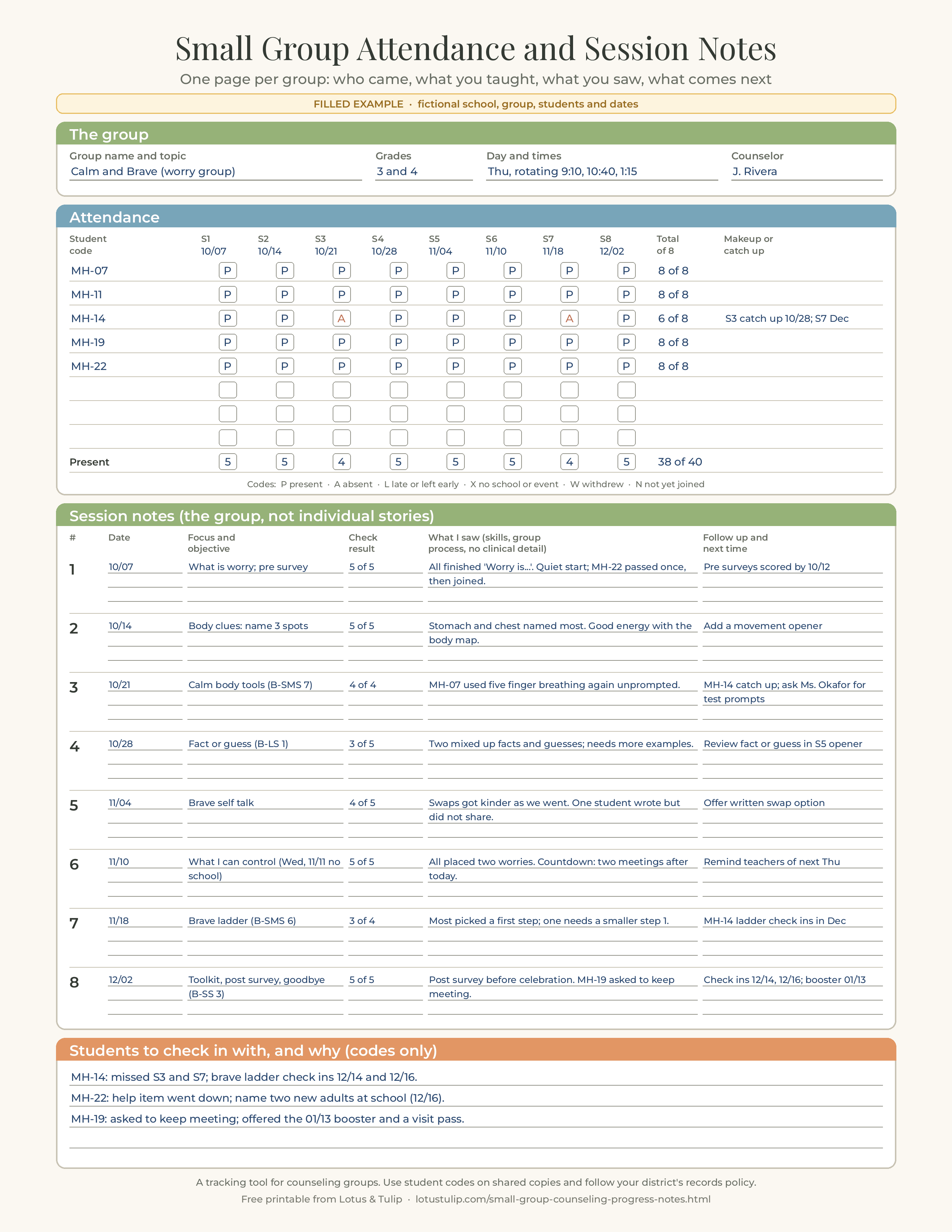
Maple Hollow Elementary is a fictional public elementary school. J. Rivera, the school counselor, runs an eight session worry group, "Calm and Brave," for five students in grades 3 and 4, coded MH-07, MH-11, MH-14, MH-19 and MH-22, 30 minutes a session, on Thursdays at a rotating time (9:10, 10:40 and 1:15) so no one always misses the same class. The group grew out of the fall needs assessment, the referral form guide follows MH-07 from his teacher's referral into the group, and the lesson plan guide shows the planning map. Signed parent consent is on file for all five. Codes are written on every page she shares; the key linking codes to names is kept in a locked drawer, separate from the tracker.
The calendar. Two sessions could not fall on a Thursday. Thursday, November 11, 2027 is Veterans Day and the district is closed, so session 6 moved to Wednesday, November 10, at 1:15. Thursday, November 25 is Thanksgiving, so session 8 moved to Thursday, December 2. Both moved dates are written on the tracker, so nobody reading it later wonders why the group skipped a week or met on a Wednesday.
Attendance.
| Code | S1 10/07 | S2 10/14 | S3 10/21 | S4 10/28 | S5 11/04 | S6 11/10 | S7 11/18 | S8 12/02 | Total |
|---|---|---|---|---|---|---|---|---|---|
| MH-07 | P | P | P | P | P | P | P | P | 8 of 8 |
| MH-11 | P | P | P | P | P | P | P | P | 8 of 8 |
| MH-14 | P | P | A | P | P | P | A | P | 6 of 8 |
| MH-19 | P | P | P | P | P | P | P | P | 8 of 8 |
| MH-22 | P | P | P | P | P | P | P | P | 8 of 8 |
| Present | 5 | 5 | 4 | 5 | 5 | 5 | 4 | 5 | 38 of 40 |
MH-14 missed session 3 (calm body tools) and session 7 (facing fears step by step). After session 3, J. Rivera gave him a five minute catch up before session 4, which she wrote in the makeup column, not as attendance. Session 7 was the last session before the closing, so the brave ladder catch up went into his follow up plan instead: two short check ins in December.
Session notes. She wrote one line per session on the tracker, within the same day. Each check for learning comes from that session's lesson plan objective.
| # | Date | Focus | Check result | What she saw | Follow up and next time |
|---|---|---|---|---|---|
| 1 | 10/07 | What is worry; pre survey | 5 of 5 | All finished "Worry is..."; quiet start; MH-22 passed once, then joined | Pre surveys scored by 10/12 |
| 2 | 10/14 | Body clues | 5 of 5 | Stomach and chest named most; good energy with the body map | Add a movement opener |
| 3 | 10/21 | Calm body tools (B-SMS 7) | 4 of 4 | MH-07 used five finger breathing again without a prompt | MH-14 catch up; ask Ms. Okafor to prompt a calm tool before tests |
| 4 | 10/28 | Fact or guess (B-LS 1) | 3 of 5 | Two students mixed up facts and guesses; need more examples | Review fact or guess in the session 5 opener |
| 5 | 11/04 | Brave self talk | 4 of 5 | Swaps got kinder as the session went on; one student wrote a swap but did not share | Offer a written swap option |
| 6 | 11/10 (Wed) | What I can control | 5 of 5 | All placed two worries on the circle; countdown: "two more meetings after today" | Remind teachers the group is back on Thursday |
| 7 | 11/18 | Brave ladder (B-SMS 6) | 3 of 4 | Most picked a first step; one needs a smaller step 1 | MH-14 ladder check ins in December |
| 8 | 12/02 | Toolkit, post survey, goodbye (B-SS 3) | 5 of 5 | Post survey before the celebration; MH-19 asked to keep meeting | Check ins 12/14 and 12/16; booster 01/13 |
Notice what the notes do not contain. When MH-22 said during a check in that a grown up she liked had left the school, the log says nothing about who it was; J. Rivera checked in with her individually that week, and nothing she heard raised a safety concern. No diagnosis, no family details and no student's words about another student appear anywhere on the tracker.
What the tracker told her during the group. The session 4 result, 3 of 5, was the lowest of the group, so she opened session 5 with a two minute fact or guess review. That matches what the pre and post survey later showed: "I can tell a worry thought from a fact" was one of the items that grew least (from 1.8 to 2.2 out of 3). MH-14's two absences, both on skills sessions, explained why his total rose less than the others' and why his follow up plan focuses on the brave ladder.
The summary. As the pre and post guide reports in detail, participation was 38 of 40 possible attendances (95 percent): five students expected, five started and five finished. Student totals rose for all five (group average 13.0 to 18.6 out of 24), and teacher ratings rose from an average of 7.4 to 10.4 out of 16. One item, "I know an adult at school I can go to for help," went slightly down, driven by MH-22. Her one page summary to the principal lists those figures, the attendance and nurse visit data, and a sentence on the limits of a five student, self report comparison, with no names or codes. The termination guide shows the follow up log she used after the last session.
Filing and purging. She filed the tracker and summary under her district's policy for counseling records, kept the code key separately, and wrote a purge date of the end of the school year on her personal sticky note memory aids, which hold nothing beyond a code and a reminder.
The free printable on this page shows her tracker filled in, plus a blank tracker and a blank summary page for your own group.
Six real world scenarios
1. The parent who asks to see "everything you wrote about my son." A father hears from his son that the group talked about divorce and asks for all your notes. Do not panic and do not refuse on the spot. Tell him you will follow the district's process for records requests, then involve your administrator as your district requires. Because your group log is coded and skill focused, and other students' details are kept off his son's lines, the review is simple: he sees his son's attendance, skill checks and follow up, and nothing about anyone else. If you had written another child's story in the same note, it would need to be redacted under 34 CFR 99.12(a).
2. The co-leader who wants a shared spreadsheet. A school psychology intern co-leads your group and suggests a shared online spreadsheet for notes. That is reasonable, but the notes are no longer sole possession records, and anyone with the link can read them. Use a district approved account, restrict sharing to the two of you and your supervisor, use codes, and agree on wording before the first session.
3. The teacher who keeps a student back. Your tracker shows that a student coded AB-03 has missed three of five sessions, always on Tuesdays at 10:00. The pattern points to a schedule problem, not a motivation problem. Talk to the teacher about what the student misses, and either rotate the time or move the group. Write the reason in your summary if it changed the student's attendance.
4. A disclosure in the middle of group. A middle school student mentions that an adult at home hurts her. You pause the activity, follow your safety plan for the group, and speak to her privately right after the session. You make the report your state and district require, and document it in the separate format your district uses. The group log says only "individual follow up per procedure," if your district advises a cross reference at all.
5. The principal who wants names. Your principal asks for a list of "which kids are in the anxiety group" for a staff meeting. Ask what decision the list will support. Teachers who need to release students already know. A staff meeting usually needs participation numbers and results, not names. Share the one page summary, and if a specific student's information is needed, share only what the purpose requires.
6. The end of the year purge. In June you have a folder of group trackers, notes and sticky notes. Check your district's retention schedule for the education records (tracker, filed notes, summaries) and follow it. Purge only the true memory aids on your own timeline, and keep anything connected to a safety report until district counsel has reviewed it, as ASCA Standard A.13.f says.
Common mistakes
- Using names on shared trackers. Codes take seconds and protect students when a page is left on a copier.
- Assuming notes are sole possession. If anyone else can read them, they are not.
- Writing other students into one student's note. It makes records harder to share with a parent and may require redaction.
- Recording stories instead of skills. The group note is about what was taught and learned, not what students confided.
- Labels and diagnoses. Describe behavior and the support that worked.
- Counting catch ups as sessions. A five minute review is not thirty minutes of group, and counting it inflates participation data.
- Not recording moved or cancelled sessions. Your report should reflect the sessions that actually happened.
- Letting the tracker go unread. Attendance and skill checks are only useful if you look at them during the group, not just at the end.
- Mixing safety documentation into the group log. It belongs in separate documentation under district procedure, and it has different retention rules.
- No purge plan. Memory aids that pile up for years stop being memory aids and become a risk.
Free printable: small group attendance and session notes tracker, filled example and group summary
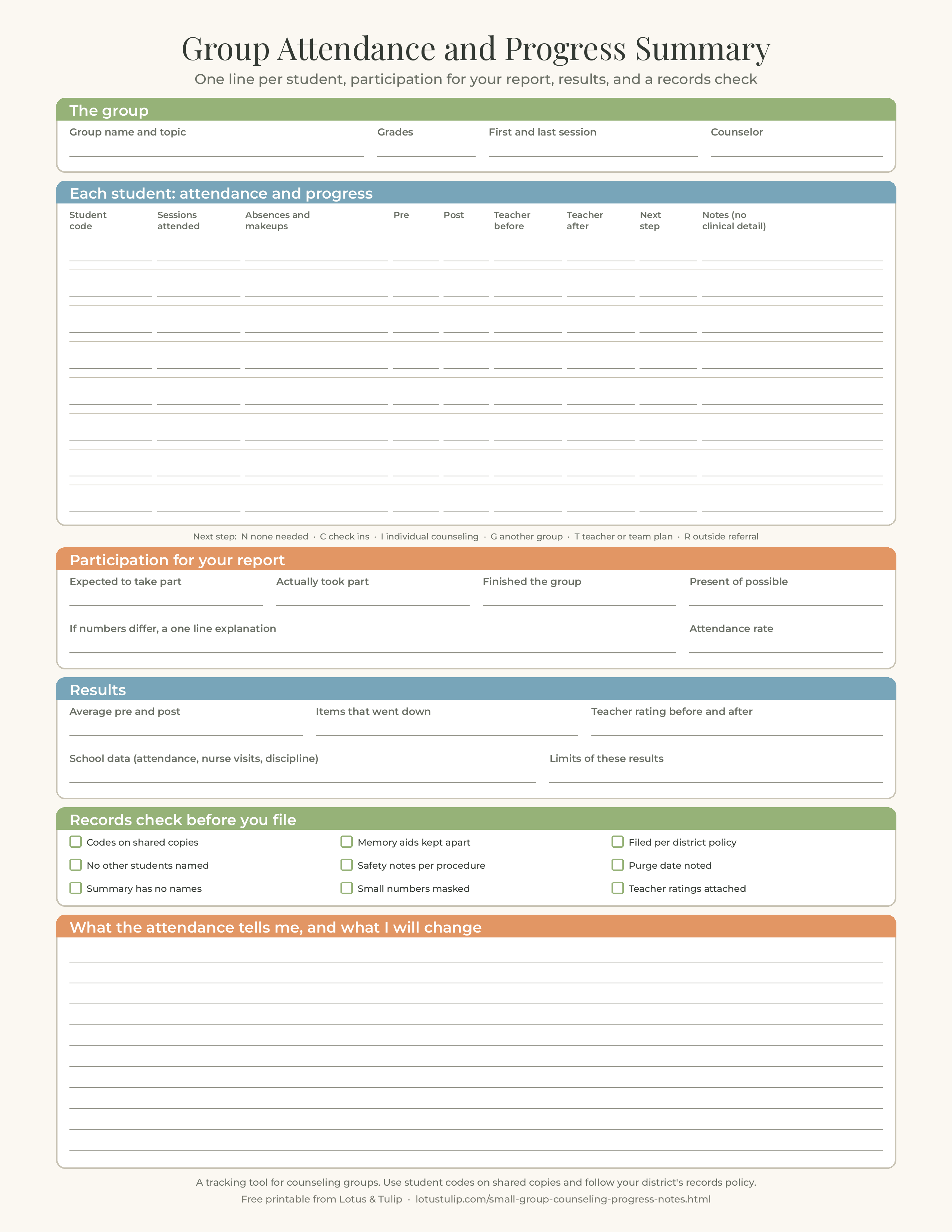
The free printable has three US Letter pages. Page 1 is a blank attendance and session notes tracker: group details (group name and topic, grades, day and times, counselor); an attendance grid for up to eight students and eight sessions, with a date line for each session, a box for each attendance code, a total of eight column, a makeup or catch up column and a present row; the code legend (P present, A absent, L late or left early, X no school or event, W withdrew, N not yet joined); a session notes log with one row per session for the date, focus and objective, check result, what you saw (skills and group process, no clinical detail) and follow up and next time; and a section for students to check in with, by code only. Page 2 is the same tracker filled in for the fictional Maple Hollow "Calm and Brave" worry group described above, with session 6 on Wednesday, November 10 and 38 of 40 attendances. Page 3 is a blank group attendance and progress summary: one line per student for sessions attended, absences and makeups, pre and post scores, teacher ratings before and after, a next step code and notes; participation for your report (expected, actually took part, finished, present of possible, an explanation if the numbers differ and the attendance rate); results (pre and post averages, items that went down, teacher ratings, school data and the limits of your results); a nine item records check (codes on shared copies, memory aids kept apart, filed per district policy, no other students named, safety notes per procedure, purge date noted, summary has no names, small numbers masked, teacher ratings attached); and lines for what the attendance tells you and what you will change.
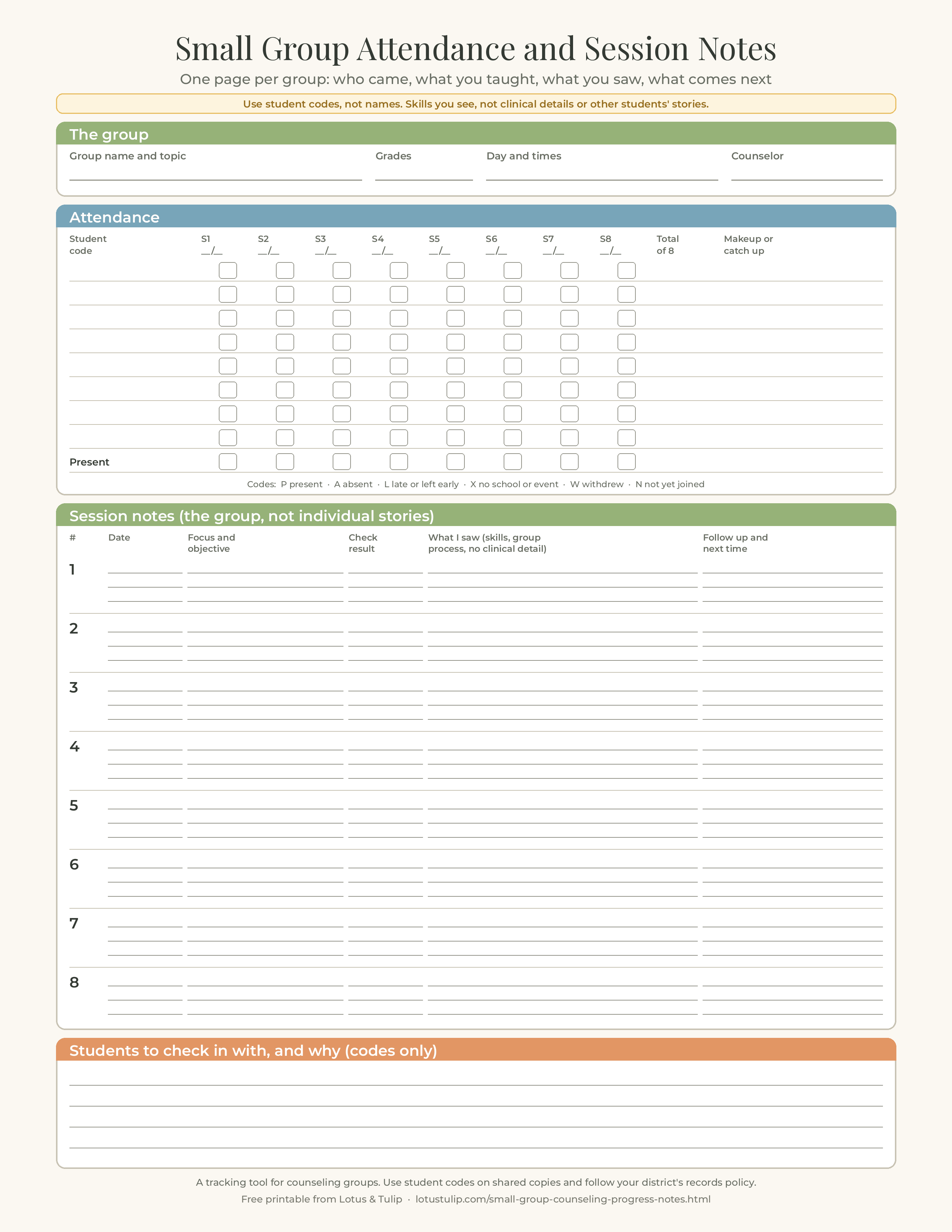
Download the free tracker, example and summary (PDF, 3 pages)
Or download single pages: Page 1: blank attendance and session notes tracker (PNG) · Page 2: filled fictional example (PNG) · Page 3: group attendance and progress summary (PNG)
Free to print and use in your own school. Please link to this page rather than re-uploading the file. This is a tracking tool for counseling groups. It does not replace your district's policies on records, retention, parent access, consent and student safety, and it is not legal advice.
Related resources
- School counselor annual administrator conference: what to bring, sample agenda, talking points and a free planner
- Texas SB 12 and school counselors: parental consent for small groups, surveys and check ins, with a free consent planner
- Small group counseling for attendance: 8 session plan, activities and data log
- School counselor advisory council agenda, minutes and filled example
- All school counselor small group curriculums
- Small group counseling pre and post assessment
- Small group counseling lesson plan template and planning map
- Small group counseling termination activities and follow up log
- School counselor needs assessment for small groups
- Small group counseling referral form and referral log
- Small group counseling permission slip and parent letter
- Icebreaker activities for counseling groups
- Small group counseling curriculum for anxiety: an 8 session plan
- Full year elementary small group counseling: plan the year
- Group therapy progress notes for clinicians (template and examples)
- Psychotherapy notes vs progress notes (clinical settings)
Sources: American School Counselor Association (2022), ASCA Ethical Standards for School Counselors, standards A.7.f, A.7.g, A.7.h, A.13.a, A.13.c, A.13.d, A.13.e and A.13.f, and the glossary entry for sole-possession records; American School Counselor Association (2025), The ASCA National Model: A Framework for School Counseling Programs, Fifth Edition (participation data, ASCA Student Standards data and achievement data); American School Counselor Association, RAMP Scoring Rubric, Fifth Edition, Section 6, Small-Group Plan and Data Report (including item 6.9); Family Educational Rights and Privacy Act regulations, 34 CFR 99.3 (definitions of education records and personally identifiable information), 99.10, 99.12(a) and 99.31(a)(1), current eCFR text checked November 10, 2026; HIPAA definitions, 45 CFR 160.103 (protected health information); McCoy, R. (2023, March 1), Parental Rights and Information Sharing, ASCA School Counselor magazine.
FAQ
Do school counselors need to keep notes on small groups?
No federal law requires a specific group note, but ASCA's ethical standards ask counselors to measure the outcomes of group participation and reflect on results (A.7.f and A.7.g), and the ASCA National Model treats participation as program data. In practice, an attendance tracker and a short note for each session are the simplest way to meet those expectations. Your district may also require service logs.
What should a small group counseling progress note include?
The date and session number, the focus and objective, attendance, the check for learning result, what you observed in behavioral terms, follow up, and one change for next time. Leave out family stories, diagnoses, other students' details and guesses about motives.
Are school counselor group notes sole possession records under FERPA?
Only if they are kept in your sole possession, used only as a personal memory aid and not accessible or revealed to anyone except a temporary substitute (34 CFR 99.3). Notes shared with a co-leader, stored in a shared folder or entered into a district system almost certainly do not qualify, and ASCA notes that even sole possession notes can be subpoenaed unless a state privilege law protects them.
Can parents see my small group notes?
If the notes are education records, parents generally have the right to inspect and review them, and the school must respond within 45 days of a request (34 CFR 99.10). If a record contains information on more than one student, a parent may see only the information about their own child (34 CFR 99.12(a)). State law and district policy may add rules, so follow your district's process.
How do I track attendance for a counseling group?
Use one page per group with a column for each session and its date, a row for each student code, and a short code in each cell (P present, A absent, L late or left early, X no school, W withdrew, N not yet joined). Total each student's sessions of possible and the group's present count, note catch ups separately, and explain any difference between expected and actual participation.
Does HIPAA apply to school counseling group notes?
For most public school counselors, no. HIPAA's definition of protected health information excludes health information in education records covered by FERPA (45 CFR 160.103). FERPA, state law and district policy govern school counseling records. If you work for an outside agency providing services in a school, ask that agency which rules apply.