
School counselors · Updated 2026-11-10
School Counselor Needs Assessment for Small Groups: Teacher, Student and Family Surveys, What ASCA and PPRA Expect, a Tally Sheet and a Filled Example (Free Printable)
Ready-made printable: Complete Small Group Counseling Bundle Holiday 20% off: about $29.44, was $37 (EUR 32) · instant digital download
Buy on Etsy
Every fall the same question lands on a school counselor's desk: which small groups should I run this year? You could repeat last year's list. You could run whatever the loudest teacher asked for in the hallway. Or you could ask, in a structured way, what your teachers, students and families are seeing, put that next to your school's attendance, discipline and achievement data, and choose groups you can explain to your principal, your advisory council and yourself in May.
That structured asking is a needs assessment. Done well, it takes a teacher five minutes, takes you an afternoon to tally, and gives you a defensible reason for every group on your calendar. Done badly, it becomes a long survey nobody returns, a pile of student names that should never have been written down, or a student questionnaire about feelings that your district needed parents to see first.
This guide is for elementary, middle and high school counselors in the United States who want to use a needs assessment to plan Tier 2 small groups. It covers what a needs assessment is and how it differs from a referral form, a universal screener and a pre and post survey; what the ASCA National Model, fifth edition (2025), the ASCA Student Standards, the ASCA Ethical Standards for School Counselors (2022) and ASCA's position statement on group counseling say, quoted where the wording matters; the federal Protection of Pupil Rights Amendment (PPRA) and state rules such as Texas Senate Bill 12; who to ask and what to ask each group; how to write survey items that give you usable answers; when to give it; how to tally and read the results without fooling yourself; how to compare the survey with school data; how to turn results into a group plan; equity checks; sharing results; a ten step process; a fully worked fictional example; six scenarios; common mistakes; and a free three page printable: a blank teacher needs assessment survey for small groups, the same survey filled in by a fictional grade 3 teacher, and a summary and tally sheet.
Jump to the free teacher needs assessment survey, filled example and tally sheet
This is educational information for school counselors in the US, not legal advice. Survey, consent and records rules vary by state and district, so check your district's survey policy before you give any survey to students. The documents quoted here were checked on November 10, 2026 against "The ASCA National Model: A Framework for School Counseling Programs, Fifth Edition" (2025), the ASCA Student Standards: Mindsets & Behaviors for Student Success, the ASCA Ethical Standards for School Counselors (2022), the ASCA position statement "The School Counselor and Group Counseling" (reviewed 2026), the text of 20 U.S.C. 1232h (PPRA) and the enrolled text of Texas S.B. 12 (89th Legislature).
The short answer
- A needs assessment asks what groups your school needs, not which students need a group. It is about topics and patterns. Individual students come later, through referrals and screening.
- ASCA expects data to drive group topics. Ethical Standard A.7.f asks school counselors to "use data to inform group topics," and the group counseling position statement says "data should be used to determine group topics and outcomes of group participation."
- Survey answers are one kind of data, not the only one. The fifth edition of the National Model counts "student and education partner perspectives" as contributing-factors data, next to attendance rates, discipline rates and systemic barriers. Put the survey next to those numbers before you decide.
- Start with teachers. A one page teacher survey about how many students in their class could benefit from each topic is quick, low risk and usually returns well.
- Keep student names off the survey. If a teacher wants to refer a specific student, that is what your referral form is for.
- Be careful with student surveys. PPRA protects eight areas, including "mental or psychological problems of the student or the student's family," and ASCA Standard B.1.e asks you to inform parents before using "universal screeners, surveys or needs assessments." Some states, such as Texas, require parent consent before a student well-being questionnaire.
- Ask about topics, frequency and timing. How many students could benefit, the teacher's top three, and when students can and cannot leave class. That last question saves weeks of scheduling.
- Tally simply. Count teachers who marked three or more students for each topic, by grade, and count top three votes. Avoid adding up guesses as if they were real student counts.
- Decide in four buckets. Groups to run this term, groups for later, needs better served by a classroom lesson, and needs that call for individual, team or outside support.
- Close the loop. Share a short summary without names with your principal, advisory council and teachers, and set the date for the next survey.
Needs assessment, referral form, screener and pre and post survey: what each one is
These four tools all involve questions on paper, and they often get mixed together. Keeping them apart protects students and makes each one more useful.
| Tool | What it asks | Names on it? | When | What you do with it |
|---|---|---|---|---|
| Needs assessment | Which topics, grades and times matter most this year | No student names | Start of the year, sometimes again midyear | Choose group topics, grade bands and timing; plan classroom lessons |
| Referral form | What one adult sees in one student | Yes, one student | Any time | Start a conversation and screening for that student |
| Universal screener | Brief items given to every student to flag who may need support | Yes, every student | On a district schedule | Identify students for follow up, often through an MTSS team |
| Pre and post survey | What group members know and can do before and after the group | Codes, usually | Session 1 and the last session | Measure ASCA Student Standards data for the group |
The difference that matters most is the "names" column. A needs assessment is about the school, the grade or the class. As soon as a survey asks a teacher to list the names of students who seem anxious, it is no longer a needs assessment: it is a referral list, it carries private information about named children, and it should be handled under your referral and records procedures, not left in a stack of surveys on the copy room table.
A needs assessment is also not a universal screener. Screeners are usually district decisions, with specific tools, consent procedures and follow up plans. If your district uses one, its results are a valuable data source for your needs assessment, summarized without names. The small group counseling referral form guide covers referrals and screening for individual students, and the pre and post assessment guide covers measuring what students learned in a group.
What ASCA says about needs and data for small groups
No ASCA document hands you a needs assessment form. But four of them, read together, are clear that group topics should come from data and that the perspectives of teachers, families and students are part of that data.
The ASCA Ethical Standards for School Counselors (2022)
Section A.7, Group Work, opens with how groups are chosen. School counselors:
- "Offer culturally sustaining small-group counseling services based on individual student, school and community needs; student data; a referral process; and/or other relevant data" (A.7.a).
- "Provide equitable access to participation in groups, including alleviating physical, language and other obstacles" (A.7.b).
- "Assess student needs to determine if participating in the group is appropriate for the student" (A.7.c).
- "Use data to inform group topics, establish well-defined expectations and measure the outcomes of group participation" (A.7.f).
A.7.a lists school and community needs, student data and a referral process side by side. A needs assessment covers the first, your school data covers the second, and your referral form covers the third. A.7.c is a different step: it is about each student, after you have chosen the group.
Two standards in section B, about responsibilities to parents and guardians, apply directly to surveys. School counselors:
- "Adhere to the Protection of Pupil Rights Amendment when using universal screeners, surveys or needs assessments by informing parents/guardians prior to their use in accordance with school district policies and local, state and federal law" (B.1.e).
- "Engage a diverse sample of parents/guardians and caregivers to provide opportunities for meaningful contributions to the school counseling program" (B.1.f).
B.1.e names needs assessments explicitly. If any version of your needs assessment goes to students, parents should know about it first, in the way your district's policy describes. B.1.f is a reminder that a family survey only helps if it reaches families beyond the ones who already answer everything.
ASCA's position statement: The School Counselor and Group Counseling
The position statement (adopted 1989, reviewed most recently in 2026) says group counseling "should be accessible to all students in a pre-K-12 setting, and data should be used to determine group topics and outcomes of group participation." It describes school counseling groups as "planned, goal-focused, evidence-based and short-term in nature," and adds that when students "require long-term counseling or services requiring family therapy, school counselors make referrals to appropriate community resources." That last line matters when you read your survey: some needs it reveals are not group needs at all.
The ASCA National Model, fifth edition (2025)
The fifth edition describes "a continued focus on school counselors' use of data to identify student needs and measure student success." It asks counselors to analyze achievement data "along with contributing-factors data," and defines contributing-factors data as including "attendance rates, discipline rates, systemic barriers, and student and education partner perspectives." Education partners "may include families, staff, administrators, decision-makers, and any other school or community organizations/individuals."
That definition is the cleanest place to file a needs assessment. A teacher survey is education partner perspectives. A student survey is student perspectives. Both sit beside attendance and discipline as factors that help explain achievement, and none of them is enough alone.
The model also lists what data helps school counselors do, including "identify students who are having difficulties with mindsets and behaviors for success" and "identify achievement and opportunity gaps." In its Manage component, school counselors "identify school counseling data priorities that align with the school improvement plan." A needs assessment that ignores your school improvement plan can point you toward groups your principal will not protect time for. A needs assessment read next to that plan usually finds overlap: the school wants better attendance in kindergarten, and three kindergarten teachers marked attendance as a need.
The ASCA Student Standards: Mindsets & Behaviors for Student Success
The Student Standards document lists ten steps for putting a standard into practice. The first two are a needs assessment in all but name:
- "Identify need." School counselors "identify a specific student challenge found in the school's student outcomes (achievement, attendance, discipline)," such as underperformance in achievement, overrepresentation in discipline or higher absenteeism. "Specific developmental stages or differences may also serve as the basis for school counselor interventions," and if an issue "is related to underlying systemic issues, the school counselor advocates to change policies, guidelines and practices."
- "Collect supplemental data." School counselors "collect supplemental data, soliciting opinions, beliefs and insights from stakeholders who are directly involved with students experiencing the identified challenge. These stakeholders include but are not limited to parents, teachers, administrators and students."
Then comes step 3, "select student standard," a mindset or behavior "that best aligns with the data and the factors suggested in the supplemental data." In other words, ASCA's own sequence runs: outcome data first, perspectives second, standard third. A good needs assessment follows the same order. You look at the numbers, you ask the people closest to students what they see, and only then do you pick a group topic and a standard.
PPRA, state law and district policy: what applies to a needs assessment
Most of the legal questions about needs assessments are about student surveys. A teacher survey about group topics, with no student names, rarely raises them. A student survey that asks about worry, sadness or home life can.
The federal Protection of Pupil Rights Amendment
PPRA (20 U.S.C. 1232h) has two parts that matter here.
- Consent for required surveys in covered programs. Section 1232h(b) says no student shall be required, "as part of any applicable program," to submit to a survey, analysis or evaluation that reveals information about eight protected areas without prior written consent of the parent (or of the student, if an adult or emancipated minor). The eight areas are: political affiliations or beliefs of the student or parent; "mental or psychological problems of the student or the student's family"; sex behavior or attitudes; "illegal, anti-social, self-incriminating, or demeaning behavior"; "critical appraisals of other individuals with whom respondents have close family relationships"; legally recognized privileged or analogous relationships; religious practices, affiliations or beliefs of the student or parent; and income, other than as required by law for program eligibility.
- Local policies, notice and opt out. Section 1232h(c) requires a local educational agency that receives funds under any applicable program to adopt policies, in consultation with parents, including a parent's right to inspect "a survey created by a third party before the survey is administered," and "arrangements to protect student privacy" when a survey contains any of the eight protected items. Parents must get notice of those policies at least annually, and districts must "directly notify the parent" of the specific or approximate dates of activities that include "the administration of any survey containing one or more" of the protected items, with an opportunity to opt the student out.
What that means in practice: whether the consent rule in 1232h(b) applies depends on the federal program involved, and that is a question for your district, not for a counselor at a copier. The notice and opt out rules in 1232h(c) are broader. So the safest design for a student needs survey is one that does not ask students about mental or psychological problems or about their family at all, and instead asks about skills they want to learn. "I would like to learn ways to calm down when I am upset" is a skills item. "Do you feel anxious a lot?" or "Is there a lot of fighting at home?" are protected area items.
State law: Texas as an example
Some states go further than PPRA. In Texas, Senate Bill 12 of the 89th Legislature, which applies beginning with the 2025-2026 school year, added Education Code section 26.0083. Subsection (h) says: "Before administering a student well-being questionnaire or health screening form to a student enrolled in prekindergarten through 12th grade, a school district must provide a copy of the questionnaire or form to the student's parent and obtain the parent's consent to administer the questionnaire or form in the manner provided by Section 26.009(a-2)." A student needs survey about feelings, stress or coping is very likely a well-being questionnaire in a Texas district, so it needs a copy to parents and consent first. Other states have their own survey and consent statutes; your district's policy is where they show up.
District policy
Many districts require that any survey given to students be approved in advance, sometimes by a central office committee. Some also review staff surveys. Ask before you print. It is a short message that can save you from a survey you have to withdraw.
| Survey | Typical risk | What to check first |
|---|---|---|
| Teacher survey about group topics, no student names | Low | Whether your district reviews staff surveys; keep names off |
| Family survey about topics they would like offered | Low to moderate | Translation, how it is distributed, no questions about family problems |
| Student survey about skills they want to learn | Moderate | District survey approval, parent notice (ASCA B.1.e), state law |
| Student survey about feelings, mental health or home life | High | PPRA protected areas, state consent laws such as Texas 26.0083(h), district approval; often better as a district screener with a follow up plan |
One more point. If a student survey asks anything that might reveal a student at risk, you need a plan to act on it the same day, with names. An anonymous survey that tells you "one student in grade 7 says they do not feel safe" gives you a worry and no way to help. Keep needs surveys about topics and skills, and leave risk questions to procedures built for them.
Who to ask, and what each source is good for
The ASCA Student Standards list "parents, teachers, administrators and students" as stakeholders. Each sees something different, and each misses something.
| Source | Good at seeing | Tends to miss or skew | Format that works |
|---|---|---|---|
| Classroom teachers | Patterns across a whole class; behavior in class; academic struggles | Quiet, internalizing students; what happens at recess and at home; tends to overweight disruptive behavior | One page paper or online form, five minutes, at a faculty or grade level meeting |
| Specials teachers, aides, lunch and recess staff | Friendship problems, conflict and isolation outside class | Academic needs | The same short survey, or a two minute conversation |
| Nurse | Stomachaches, headaches and visits before tests | Causes | A summary of the log, counts by grade, no names |
| Administrators | Discipline patterns, school improvement priorities | Students who never come to the office | A short meeting with the data |
| Families | Worries at home, transitions, what families want offered | Response bias toward families already engaged | Short survey in home languages, on paper, by phone and online, at conferences or in the newsletter |
| Students | What they want to learn; what feels hard; what adults do not see | Young children may not understand items; privacy and consent limits | Short skills based items, read aloud, following parent notice and district rules |
| School data | Attendance, discipline, grades, course failures, benchmark scores | Why the numbers look the way they do | Pulled by grade and student group, without names in anything you share |
For most elementary counselors, a strong first needs assessment is a teacher survey plus three data pulls: attendance, discipline and a summary from the nurse. Add a family survey and a student survey when you have time to do them well, not as an afterthought.
The teacher needs assessment survey: what to ask
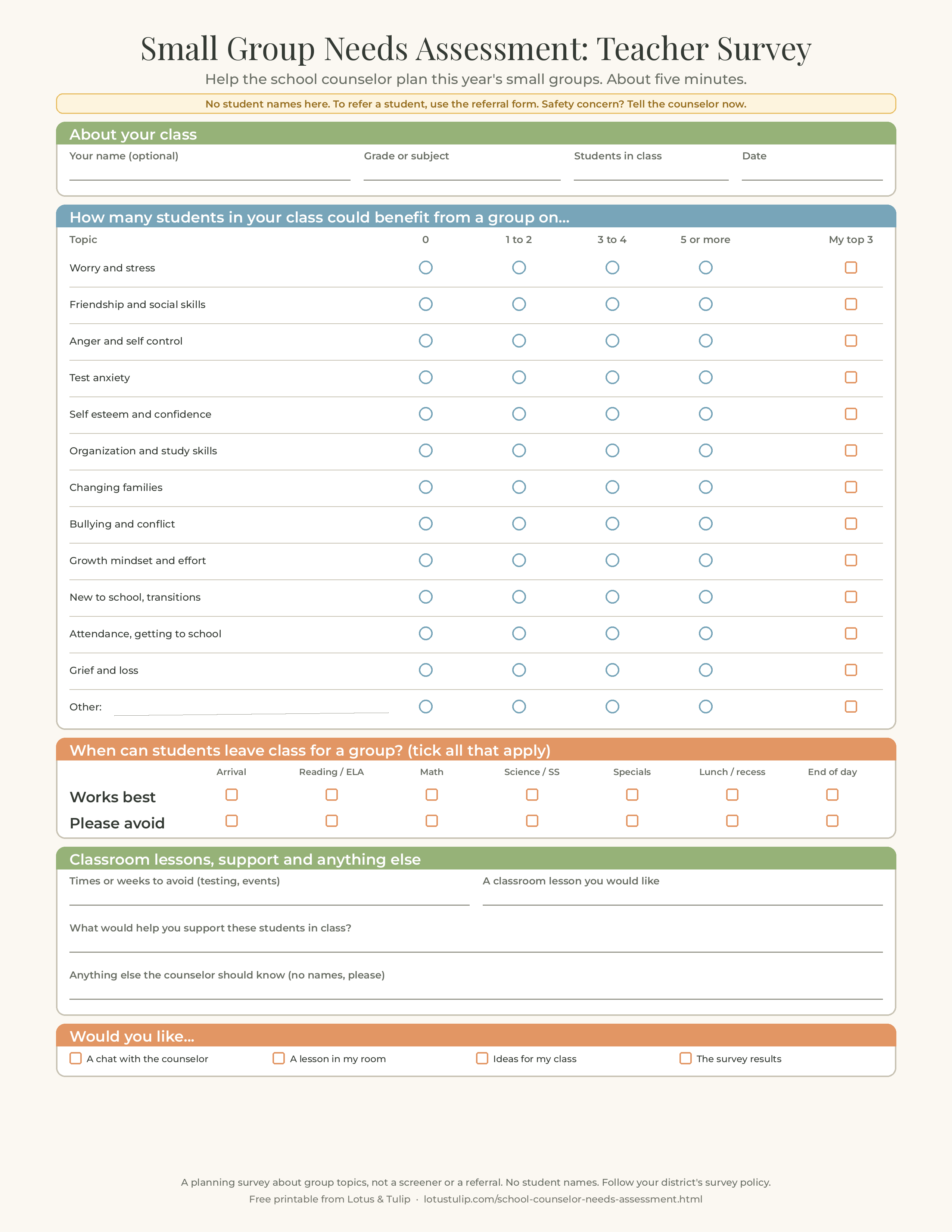
A teacher survey only works if teachers finish it. That means one page, mostly ticks and circles, a few short lines, and no student names. The free survey on this page has six parts.
| Part | What it asks | Why |
|---|---|---|
| About your class | Name (optional), grade or subject, number of students, date | Lets you tally by grade; the name is optional so teachers can be candid |
| Topics | For each of twelve topics, how many students could benefit: 0, 1 to 2, 3 to 4, 5 or more | Shows how widespread each need is in each class |
| Top three | A star next to the teacher's three most important topics | Separates "a few students" from "this is what my class needs most" |
| When students can leave | Time blocks that work best and blocks to avoid | Scheduling is the hidden cost of groups; this answers it in advance |
| Lessons, support and anything else | Weeks to avoid, a classroom lesson they would like, what would help them, comments without names | Catches Tier 1 needs and teacher support needs |
| Would you like... | A chat, a lesson in their room, ideas for the class, the results | Turns the survey into a conversation and a follow up list |
Why ranges and not exact numbers
Asking "how many students?" with a blank invites guesses that look precise and are not. Ranges (0, 1 to 2, 3 to 4, 5 or more) are faster to answer and more honest. They also match what you actually need to know: whether a class has enough students with a shared need to make a group from one or two classrooms. Three or more is a useful line, because elementary groups often have four to six students, and a need that shows up at three or more in several classrooms of the same grade is a group waiting to happen.
Choosing the topics
List the topics you can actually offer, plus an "other" line. A list of forty topics looks thorough and produces noise. The free survey uses twelve that cover most elementary and middle school groups: worry and stress, friendship and social skills, anger and self control, test anxiety, self esteem and confidence, organization and study skills, changing families, bullying and conflict, growth mindset and effort, new to school and transitions, attendance and getting to school, and grief and loss.
Two topics on that list deserve a note. Attendance is rarely a group topic by itself, but asking about it often surfaces a need your data confirms and your teachers have been worried about. Grief and loss is a topic where you should expect small numbers and where many students need individual support before, or instead of, a group. Listing it tells teachers you want to know.
Wording that gets usable answers
| Weak item | Problem | Better item |
|---|---|---|
| Which students need counseling? | Asks for names; mixes groups with individual counseling | How many students in your class could benefit from a group on each topic? |
| Do your students have anxiety? | A clinical label; teachers are not diagnosing | Worry and stress |
| Rate the importance of social emotional learning, 1 to 10 | Everyone says 9; tells you nothing | Star your top three topics |
| Any comments? | Gets blank lines | What would help you support these students in class? |
| Which behaviors are a problem? | Frames students as problems | Which skills would help your students most? |
| When are you free? | Answers about the teacher, not student schedules | When can students leave class for a group? When should they not? |
No names, and what to do when a teacher writes one anyway
Some teachers will write a student's name in the comments box. It is a sign they care, and it is also a referral in the wrong place. Thank them, follow up with your referral process, and keep that survey in your own records, not in a shared folder. Then, in the next round, say it again in the instructions: "No names here. To refer a student, use the referral form." The free survey prints that line at the top.
Student needs surveys: when and how
Students often see what adults miss. A seventh grader may tell you the friendship drama happens online, at night, not in class. A fourth grader may mark "I would like help with test worries" when her teacher sees only a calm, quiet student. Asking students directly can be the most valuable part of a needs assessment, and it is the part with the most rules.
Ask about skills, not problems
The ASCA Student Standards suggest brainstorming measures with stems such as "I believe...," "I know..." and "I can...". For a needs survey, a fourth stem works well: "I would like to learn..." It keeps items positive, skills based and away from PPRA's protected areas.
- "I would like to learn ways to calm down when I feel worried or upset."
- "I would like to learn how to make and keep friends."
- "I would like help getting organized and keeping track of homework."
- "I would like help feeling less nervous before tests."
- "I would like to learn what to do when someone is unkind to me."
- "I would like help with changes, like moving or a new school."
Avoid items that ask students to report symptoms, family conflict or anything that sounds like a screener: "I feel sad most days," "My parents fight," "I have thought about hurting myself." Those belong, if anywhere, in a district screening process with consent, trained staff and a same day follow up plan.
By grade band
| Kindergarten to grade 2 | Grades 3 to 5 | Middle and high school | |
|---|---|---|---|
| Format | Usually skip the written survey; use teacher and family surveys | Read aloud, picture or yes, maybe, no answers | Short paper or online survey, about six to ten items |
| Items | If used, three or four picture items, read aloud one at a time | "I would like to learn..." items, with simple words | Skills items plus a short "what is hard at school" open question |
| Names | Not needed | Usually anonymous | Anonymous, or an optional name with a "talk to me" box handled as a referral |
| Where | Not applicable | During a classroom lesson | Advisory, homeroom or a classroom lesson |
A "Do you want to talk to the counselor?" box is popular on middle school surveys. If you include it, the survey can no longer be anonymous for those students, and you must follow up with every one of them promptly. That is a good thing, but plan the time for it.
Notice and consent
Under ASCA B.1.e, parents should be informed before a student survey, "in accordance with school district policies and local, state and federal law." In practice that usually means a notice in the newsletter or a letter home with the survey attached and a way to opt out, and in some states, such as Texas for well-being questionnaires, consent. Give families the actual items, not a description. A parent who reads "I would like to learn how to make and keep friends" rarely objects.
The family survey
Families see sleep, mornings, sibling fights, screen time and worry about school that never shows up in class. A family needs survey is also an outreach tool: it tells families what the school counselor does.
- Keep it short. Six to ten topics with a tick for "I would like this offered for my child's grade," one open question, and an optional line for families who would like a call.
- Ask about topics, not family problems. "Helping children through changes in the family" is a topic. "Is your family going through a divorce?" is a protected area question and a private one.
- Reach every family. ASCA B.1.f asks counselors to "engage a diverse sample of parents/guardians and caregivers." Translate the survey into your families' languages and offer it on paper at conferences and pickup, by phone with an interpreter, and online.
- Do not count it like a vote. Family responses lean toward families who already engage with the school. Treat the results as a direction, not a ranking.
- Say what happens next. "Results will help the counselor plan small groups and family nights this year" tells families why to bother.
Do not skip the school data
Surveys tell you what people notice. Data tells you what is happening, including to students nobody noticed. ASCA's step 1, "identify need," starts with "the school's student outcomes (achievement, attendance, discipline)." Pull these before you tally the surveys, so you read the surveys against them and not the other way round.
| Data | What to look for | Group it might point to |
|---|---|---|
| Attendance | Grades or student groups with more absences, late arrivals, early departures; students on an early warning list | Often not a group first: family outreach and an attendance team, with a group for students who avoid school because of worry (see the attendance small group guide) |
| Discipline | Offense types by grade and location; repeat referrals; differences between student groups | Anger and self control, conflict resolution, social skills; or a systemic change if one group is overrepresented |
| Grades and benchmarks | Course failures, missing work, drops between grading periods | Organization and study skills, test anxiety, growth mindset |
| Nurse log summary | Visits by grade and time of day, clusters before tests | Worry and stress, test anxiety |
| Counselor referrals so far | Main concern by grade | Whichever topic is clustering |
| Last year's group results | Which groups improved, which did not, who did not finish | Repeat, revise or retire a group |
| Transitions | New enrollments, students moving up a level, military families | New student and transition groups |
Look at the data by student group, not only school wide. ASCA's Student Standards warn that "without careful and thoughtful implementation, standards such as these can reinforce the status quo, including gaps in achievement, opportunity and attainment, and disproportionate rates of discipline and suspension for students of color." If one student group is overrepresented in discipline, the response is not only an anger group for those students. It may also be a conversation about the policy or practice producing the referrals, which is what ASCA means when it says the counselor "advocates to change policies, guidelines and practices."
When to run a needs assessment
- Early in the year, but not the first week. Teachers need a few weeks with their class before they can answer well. Many counselors hand the survey out at a September faculty or grade level meeting and collect it the following week.
- Before your annual calendar is final. The National Model asks counselors to publicize an annual calendar that includes all major school counseling activities. Groups are easier to protect if they are on it.
- Again at midyear, shorter. In January, a half page check, "which needs have grown or appeared since fall?", keeps spring groups current. New students, new family situations and testing season change the picture.
- Not during testing windows or report card week. Response rates drop and answers get rushed.
- With a due date. About a week is enough. Remind once, in person if you can.
Tallying and reading the results
The tally is where a needs assessment either becomes useful or becomes a chart nobody trusts. Keep it simple and honest.
Count teachers, not imaginary students
It is tempting to convert ranges into numbers ("3 to 4 means 3.5 students") and add them up to say "41 students need a worry group." Do not. Those are guesses from different people with different thresholds, and the same student may be counted by two teachers. Instead, count for each topic and grade how many teachers marked three or more students. That tells you how widespread the need is. Then count top three votes across the school, which tells you how urgent teachers feel it is.
Report the response rate
Sixteen of eighteen teachers is a strong picture. Six of eighteen is a picture of six classrooms. Write the response rate at the top of every summary, by grade if it varies, so nobody reads more into the results than they hold.
Look for clusters, not just totals
A topic marked by eight teachers spread thinly across six grades may be a good classroom lesson topic. A topic marked by five of six teachers in two adjacent grades is a group. Grade bands matter because a group of kindergartners and fifth graders rarely works.
Separate Tier 1 from Tier 2
If most teachers in a grade marked five or more students for the same topic, that is usually a whole class need, better met by classroom lessons for everyone, with a small group later for students who need more. In the fifth edition's MTSS graphic, Tier 2 is "interventions for some students," including small group and individual counseling. A need that covers half the grade belongs in Tier 1 first.
Protect small numbers
In a summary, a grade with one teacher, or a topic marked by one person, can identify a classroom and sometimes a student. Combine small cells ("grades 4 and 5," "two teachers") and keep comments paraphrased and general. The fifth edition RAMP scoring rubric's reminder for documents you submit applies just as well here: "No identifiable student information should be included."
Write down what surprised you
The last box on the free tally sheet asks what surprised you and what the survey missed. It is the most useful line on the page. If teachers did not mark attendance but your data shows a kindergarten attendance problem, that gap is itself a finding: teachers may not know, or may assume it is not the counselor's business. Both are worth a conversation.
From results to a group plan
Use four buckets. Every topic on your tally ends up in one of them, and that sorting is your plan.
| Bucket | Signs | Next step |
|---|---|---|
| Group this term | Several teachers in adjacent grades marked 3 or more; top three votes; data agrees; you have a curriculum and the time | Open referrals for that topic and grade band; plan consent, the pre and post survey and the session map |
| Group later in the year | Real need but smaller, or the timing is better later (study skills before spring testing, transition groups before the move up) | Put it on the calendar now; recheck at midyear |
| Classroom lesson (Tier 1) | Most of a grade or class shares the need | Plan lessons for the whole class; start a group afterward for students who need more |
| Individual, team or outside support | Few students, sensitive topics, or needs beyond a short skills group | Individual check ins, the MTSS or student support team, community referrals, family outreach |
Once you know the group, the rest of the ASCA sequence follows. Pick the behavior standard that best fits the need (step 3), write learning objectives (step 4), write the pre and post survey items (step 5), choose your curriculum or activities (step 6), and decide the achievement or attendance data you will watch, using the same data you pulled for the needs assessment as your baseline. The small group lesson plan template guide walks through standards, objectives and an eight session planning map.
Capacity is part of the decision. Count your weeks, your groups and your other duties honestly. Two well run groups with good data beat five groups that lose sessions to testing and end without a post survey.
Equity checks before you decide
ASCA A.7.b asks for "equitable access to participation in groups." A needs assessment can widen access or narrow it, depending on how you read it.
- Who did the survey miss? Students in classrooms that did not return surveys, English learners, students who receive most of their instruction outside a general classroom, and students who are quiet rather than disruptive.
- Who does the data overrepresent? If discipline data points to an anger group made up mostly of one student group, look at the referrals and the policies behind them before you run the group.
- Do all families have a way in? Translations, paper copies, phone options and an interpreter at conferences.
- Does the schedule exclude anyone? A group that always meets during a student's only English language support, or during special education services, is not equally open.
- Are the topics culturally sustaining? ASCA A.7.a and A.7.j ask for "culturally sustaining" groups. A topic list written in only one cultural frame, or examples that assume one kind of family, will under count some needs.
Sharing the results
A needs assessment that disappears into a folder teaches teachers not to bother next year. A half page summary keeps the loop closed.
- Principal. A short meeting: response rate, top needs by grade band, what the data showed, the groups you will run and when, and anything that needs an administrative decision, such as protected time or a policy question. The National Model's annual administrator conference is a natural place for it.
- Advisory council. The same summary, and a chance for members to add what they see. The fifth edition asks counselors to "hold fall and spring advisory council meetings," and a fall needs assessment gives the fall meeting real content.
- Teachers. A thank you with the top three needs, the groups coming and when referrals open. Teachers who see their answers used will answer again.
- Families. A line in the newsletter: "Thank you to the families who answered our survey. This year the school counselor will offer..."
In every version: no student names, no identifying comments, small numbers combined, and the response rate stated.
How to run a small group needs assessment, step by step
- Check your district's survey rules. Find out whether staff, family and student surveys need approval, what parent notice is required, and whether your state requires consent for student well-being questionnaires.
- Pull your school data first. Attendance, discipline, grades or benchmarks, a nurse log summary and last year's group results, by grade and student group, without names in anything you share.
- Read the school improvement plan. Note the goals your groups could support, so the needs assessment and your principal's priorities can meet.
- Choose your topics. List the ten to twelve topics you can actually offer, plus "other."
- Prepare the teacher survey. One page: class details, topic ranges, top three, time blocks, weeks to avoid, a lesson request, support needs and a no names line.
- Add family and student surveys if you can do them well. Skills based items only, translated, with notice or consent as required.
- Give the survey with a due date. At a faculty or grade level meeting, a few weeks into the year, due about a week later, with one reminder.
- Tally by grade. Count teachers marking three or more students for each topic, count top three votes, and record the response rate.
- Compare and decide. Read the tally next to your data, then sort each topic into a group this term, a group later, a classroom lesson, or individual, team or outside support.
- Share and set the next date. Send a short summary without names to your principal, advisory council and teachers, open referrals for the first groups, and put the midyear check on the calendar.
A worked example (fictional): the fall needs assessment at Maple Hollow Elementary
Maple Hollow Elementary is a fictional public elementary school with kindergarten to grade 5 and three classroom teachers per grade, eighteen in all. J. Rivera is the school counselor. School started on Monday, August 16, 2027, and in the first week she explained the referral process at a faculty meeting. The referral form guide, the permission slip guide, the pre and post assessment guide and the lesson plan template guide follow the same school and the same worry group. This example shows where that group came from.
Rules first. J. Rivera checked the district's survey procedure. Staff surveys for program planning did not need approval; student surveys did, with parent notice. She decided to run a teacher survey and a family survey this fall and to wait on a student survey until she had approval and time to follow up.
Data first. Before the survey, she pulled three summaries without names: last spring's office referrals, which were highest in grade 5 and mostly for conflict at recess; the nurse's log for the first two weeks, which showed visits clustering on the mornings of grade 3 and 4 math quizzes; and the attendance team's early warning list, which already had several kindergarten and grade 1 students on it. The school improvement plan named attendance in kindergarten and grade 1, and math in grades 3 to 5, as goals.
The survey. She handed out the one page teacher survey at the faculty meeting on Wednesday, September 1, 2027, due Friday, September 10, and reminded grade levels in person on Wednesday, September 8. Sixteen of eighteen teachers returned it, a response rate of 89 percent: all three teachers in kindergarten, grade 1, grade 3 and grade 4, and two of three in grade 2 and grade 5.
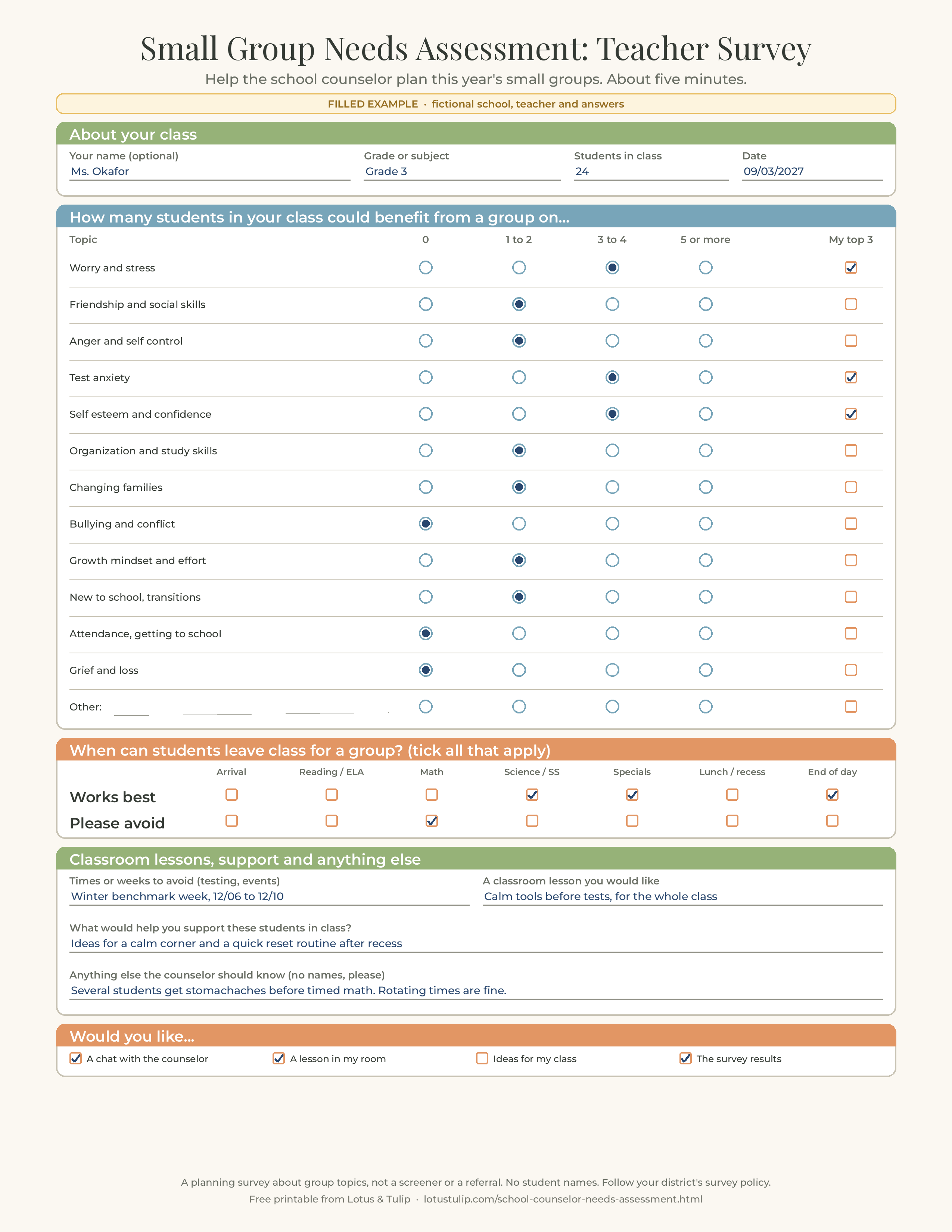
One teacher's answers. Ms. Okafor, who teaches grade 3 and has 24 students, filled hers in on September 3. She marked three to four students for worry and stress, test anxiety, and self esteem and confidence, and starred those three as her top topics. She marked one to two students for friendship, anger, organization, changing families, growth mindset and transitions, and none for bullying, attendance or grief. Works best: science and social studies, specials and the end of the day. Please avoid: math. Weeks to avoid: the winter benchmark week, December 6 to 10. She asked for a classroom lesson on calm tools before tests and for ideas for a calm corner and a quick reset routine after recess, and wrote, without names: "Several students get stomachaches before timed math. Rotating times are fine." She ticked that she would like a chat with the counselor, a lesson in her room and the survey results. Page 2 of the free printable shows her survey.
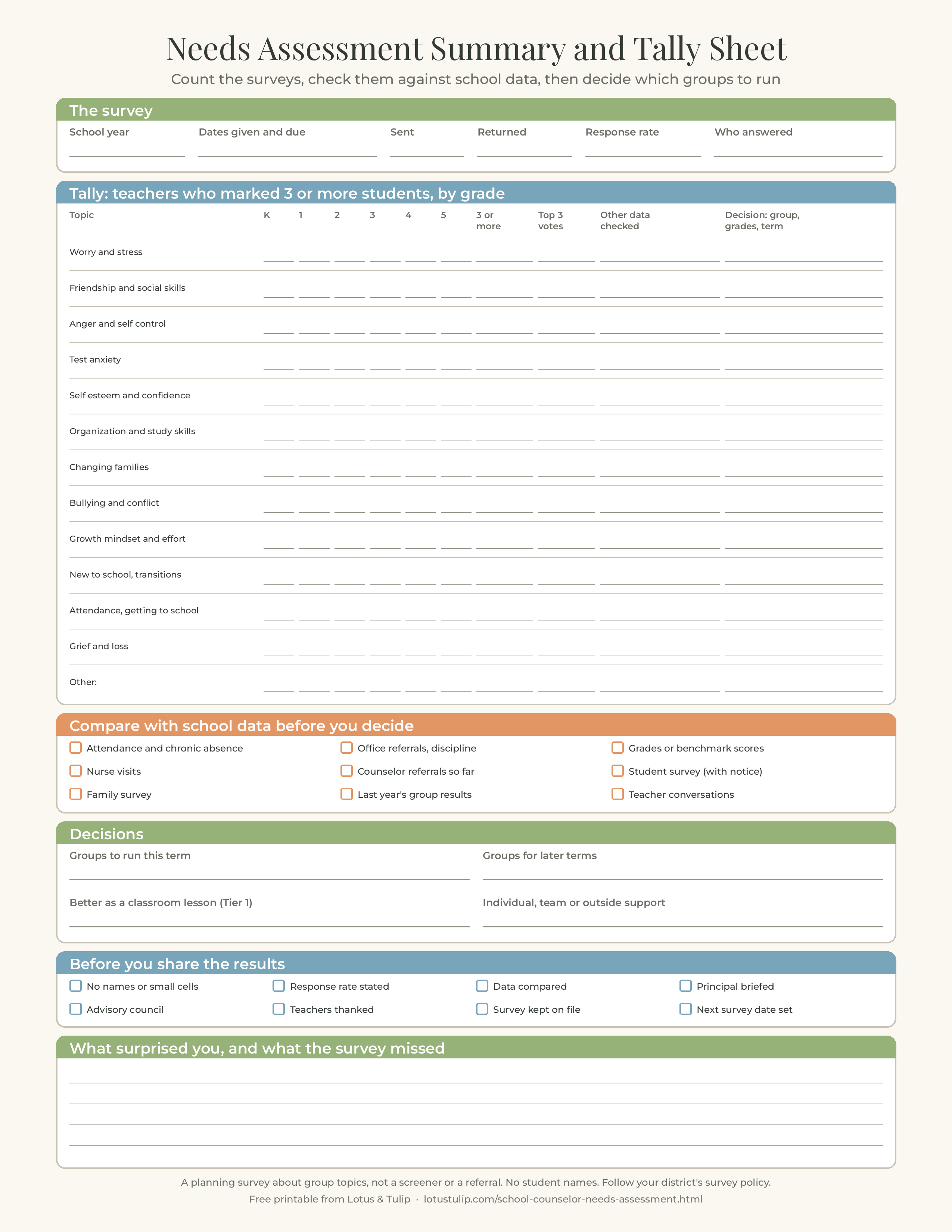
The tally. On Monday, September 13, J. Rivera tallied the sixteen surveys. Each grade cell is the number of teachers in that grade who marked three or more students for the topic. Top three votes are totals across the school: sixteen teachers with three stars each make 48 votes.
| Topic | K | 1 | 2 | 3 | 4 | 5 | 3 or more | Top 3 votes | Decision |
|---|---|---|---|---|---|---|---|---|---|
| Worry and stress | 0 | 1 | 1 | 3 | 2 | 1 | 8 | 11 | Fall group, grades 3 and 4 |
| Friendship and social skills | 2 | 3 | 1 | 1 | 0 | 0 | 7 | 9 | Fall group, grades 1 and 2 |
| Anger and self control | 1 | 1 | 1 | 0 | 1 | 2 | 6 | 7 | Winter group, grade 5 |
| Test anxiety | 0 | 0 | 0 | 2 | 2 | 1 | 5 | 3 | Folded into the worry group; grade 3 classroom lessons |
| Self esteem and confidence | 0 | 1 | 0 | 1 | 1 | 1 | 4 | 5 | Spring group, grades 3 to 5 |
| Organization and study skills | 0 | 0 | 0 | 0 | 1 | 2 | 3 | 4 | Spring group, grade 5, before the move to middle school |
| Bullying and conflict | 0 | 0 | 0 | 0 | 2 | 0 | 2 | 2 | Classroom lessons in grade 4 |
| Growth mindset and effort | 0 | 1 | 0 | 0 | 0 | 1 | 2 | 2 | Classroom lessons as time allows |
| New to school, transitions | 1 | 0 | 1 | 0 | 0 | 0 | 2 | 1 | New student lunch bunch |
| Changing families | 0 | 0 | 0 | 1 | 0 | 0 | 1 | 2 | Individual support; a group if referrals cluster |
| Attendance, getting to school | 1 | 0 | 0 | 0 | 0 | 0 | 1 | 1 | Attendance team and family outreach |
| Grief and loss | 0 | 0 | 0 | 0 | 0 | 0 | 0 | 1 | Individual support as needed |
What she read in it. Worry was the clearest Tier 2 need: all three grade 3 teachers and two of three grade 4 teachers marked three or more students, and it had the most top three votes. The nurse's log pointed the same way. Test anxiety overlapped with worry in the same grades, so rather than run a separate group she planned to fold test worries into the worry group and to teach calm tools before tests to every grade 3 class before winter benchmarks. Friendship clustered in kindergarten to grade 2, most strongly in grade 1. Anger was spread thinly across grades, except grade 5, where both teachers who returned the survey marked it and last spring's office referrals agreed.
What surprised her. Only one teacher marked attendance, yet the early warning list already included several kindergarten and grade 1 students. She wrote that down as a finding, took it to the attendance team rather than starting a group, and raised it with the kindergarten teachers. Bullying and conflict came from two grade 4 teachers who both described it as a whole class issue, so it went to classroom lessons, not a group.
The family survey. A short topic survey in English and Spanish went out in the September newsletter and on paper at the open house, with an option to answer by phone with an interpreter. Family answers leaned toward friendships and worry, the same direction as the teachers. She treated them as confirmation, not a ranking.
Decisions. This term: the Calm and Brave worry group for grades 3 and 4, and a friendship group for grades 1 and 2. Later: an anger and self control group for grade 5 in January, then a self esteem group for grades 3 to 5 and a study skills and transition group for grade 5 in spring. Tier 1: calm tools before tests for grade 3, and conflict lessons for grade 4. Individual and team support: attendance through the attendance team, and changing families and grief through individual check ins.
What happened next. Referrals for the worry group opened the week of September 13. By the end of September she had six referrals in grades 3 and 4 with worry as the main concern, including one from Ms. Okafor for a student coded MH-07. After screening, five students formed the group; the sixth needed individual support and a community referral first. Permission letters went home on September 21, and the group started on Thursday, October 7, at rotating times so no one always missed the same class. Because Ms. Okafor had asked to avoid math, J. Rivera checked the rotation against her schedule. The group's last session is December 2, before the winter benchmark week Ms. Okafor had flagged.
Closing the loop. On Friday, September 17, she gave the principal a half page summary: the response rate, the tally with small cells combined, what the data showed, the groups and lessons planned, and the attendance finding. She shared the same summary, without the comments, at the fall advisory council meeting, thanked teachers with the top three needs and the referral dates, and put a half page midyear check on the calendar for the week of January 10, 2028.
Six real world scenarios
1. You are the only counselor for 600 students. You cannot run a group for every topic. Use the tally to pick two or three groups where the need is clustered and the data agrees, and send the rest to classroom lessons and the student support team. Say so in your summary: a needs assessment also documents need you could not meet, which is useful in a conversation about staffing.
2. A teacher returns the survey with eight student names. Thank them, treat the names as referrals, and follow your referral process for each student. File that survey in your own records. In the next round, repeat the "no names" line in person.
3. Your middle school wants a student survey. Get district approval, send the items home with notice and an opt out (or consent, if your state requires it), and keep the items skills based: "I would like to learn..." If you include a "talk to me" box, plan the time to meet every student who ticks it within a few days.
4. Every teacher marks every topic at 5 or more. The survey is not discriminating. Lean on the top three stars and the data. Next time, add a sentence to the instructions: "Mark 3 or more only if those students would benefit from a small group, not just a classroom lesson."
5. Your principal wants a group you did not find need for. Show the tally and the data, and ask what the principal is seeing that the survey missed. Sometimes the principal knows about a pattern from parent calls or discipline that the survey did not capture. Sometimes the request is better met by a classroom lesson. Either way, the needs assessment turns a preference into a shared look at the evidence.
6. Only five of eighteen teachers return the survey. Report what you have with the response rate, lean more heavily on school data, and change how you ask next time: hand it out at a meeting and collect it before people leave, cut it to one side of one page, or ask grade level leads to collect it. Do not plan a year of groups on five surveys alone.
Common needs assessment mistakes
- Asking for student names. It turns a planning survey into a referral list with privacy risks.
- Making it too long. A three page survey gets a handful of returns. One page gets most of the staff.
- Using clinical labels. "Anxiety" and "ADHD" invite diagnosis by teacher. Use topics and skills.
- Surveying students about mental health without notice or consent. PPRA, ASCA B.1.e and state laws such as Texas 26.0083(h) exist for exactly this.
- Adding up guesses as if they were counts. Count teachers who marked three or more, not imaginary students.
- Skipping the data. Surveys show what adults notice. Data shows what is happening, including to students nobody noticed.
- Treating every need as a group need. Whole class needs are Tier 1; sensitive or long term needs go to individual, team or community support.
- Ignoring the response rate. Results from a third of classrooms are not results for the school.
- Not asking about schedules. The group you choose still has to fit the bell schedule and teachers' tolerance for pull out.
- Never sharing the results. Teachers who do not see their answers used stop answering.
Free printable: teacher needs assessment survey for small groups, filled example and tally sheet
The free printable has three US Letter pages. Page 1 is a blank teacher needs assessment survey: a no names and safety line at the top; your name (optional), grade or subject, number of students and date; twelve group topics plus "other," each with circles for 0, 1 to 2, 3 to 4 or 5 or more students who could benefit, and a box to mark your top three; a grid of seven time blocks (arrival, reading or ELA, math, science or social studies, specials, lunch or recess, end of day) with works best and please avoid rows; lines for weeks to avoid, a classroom lesson you would like, what would help you support these students and anything else, without names; and four "would you like..." ticks. Page 2 is the same survey filled in by Ms. Okafor, a fictional grade 3 teacher at Maple Hollow Elementary. Page 3 is a summary and tally sheet: survey details and response rate; a tally table with a row for each topic and columns for kindergarten to grade 5, teachers who marked three or more, top three votes, other data checked and the decision; nine school data checks; four decision boxes (groups this term, groups later, classroom lessons, and individual, team or outside support); eight checks before you share the results; and lines for what surprised you and what the survey missed.
Download the free needs assessment survey, example and tally sheet (PDF, 3 pages)
Prefer single images? Page 1: blank teacher survey (PNG) · Page 2: filled fictional example (PNG) · Page 3: summary and tally sheet (PNG)
Free to print and use in your own school. Please link to this page rather than re-uploading the file. This is a planning survey about group topics for teachers. It is not a screener, a referral form or a student survey, and it does not replace your district's policies on surveys, parent notice and consent, records and safety.
Related resources
- School counselor use-of-time calculator: 5-day log, percentages and a filled example
- School counselor annual administrator conference: what to bring, sample agenda, talking points and a free planner
- Small group counseling for attendance: 8 session plan, activities and data log
- School counselor advisory council agenda, minutes and filled example
- Small group counseling termination activities: last session plan and follow up log
- All school counselor small group curriculums
- Small group counseling referral form and referral log
- Small group counseling permission slip and parent letter
- Small group counseling pre and post assessment
- Small group counseling lesson plan template and planning map
- Full year elementary small group counseling: plan the year
- Small group counseling curriculum for anxiety: an 8 session plan
- Social skills small group activities
- Anger management small group activities
- Self esteem small group activities
- Divorce small group activities
- K-2 coping skills group activities
Sources: American School Counselor Association (2025), The ASCA National Model: A Framework for School Counseling Programs, Fifth Edition (use of data to identify student needs; achievement and contributing-factors data, including "student and education partner perspectives"; uses of data; Manage component: data priorities aligned with the school improvement plan, annual calendar, annual administrator conference, fall and spring advisory council meetings; MTSS tiers); ASCA Student Standards: Mindsets & Behaviors for Student Success (implementation steps 1 to 3, "I believe..., I know... and I can..." stems, equity cautions); ASCA Ethical Standards for School Counselors (2022), standards A.7.a, A.7.b, A.7.c, A.7.f, A.7.j, B.1.e and B.1.f; ASCA position statement "The School Counselor and Group Counseling" (adopted 1989; revised 1993, 2002, 2008; reviewed 1999, 2008, 2014, 2020, 2026); ASCA, RAMP Scoring Rubric, Fifth Edition (FERPA note); 20 U.S.C. 1232h(b) and (c) (Protection of Pupil Rights Amendment); Texas S.B. 12, 89th Legislature, enrolled text, Education Code 26.0083(h) and section 30 (applies beginning with the 2025-2026 school year). All checked on November 10, 2026. The topic list, ranges, the "three or more" line and the timing advice are practical suggestions, not ASCA requirements. The worked example and all names, codes, dates and numbers in it are fictional.
FAQ
What is a school counselor needs assessment?
A short survey, usually of teachers and sometimes of families and students, that asks which topics and skills students need help with, so the school counselor can choose small groups and classroom lessons. It asks about topics and patterns, not individual students, and it is read next to school data such as attendance, discipline and grades.
What should a teacher needs assessment survey for small groups include?
Class details, a list of ten to twelve group topics with how many students in the class could benefit from each (for example 0, 1 to 2, 3 to 4, 5 or more), a way to mark the teacher's top three, the times students can and cannot leave class, weeks to avoid, a classroom lesson request, what would help the teacher, a comments box without names, and a clear line that student referrals go on the referral form.
Does ASCA require a needs assessment?
ASCA does not prescribe a needs assessment form, but its Ethical Standards ask school counselors to "use data to inform group topics" (A.7.f) and to offer groups based on "individual student, school and community needs; student data; a referral process; and/or other relevant data" (A.7.a). The ASCA Student Standards list collecting supplemental data from parents, teachers, administrators and students as a step, and the fifth edition of the National Model counts student and education partner perspectives as contributing-factors data.
Do I need parent permission for a student needs assessment survey?
It depends on what the survey asks and on your state and district. ASCA Standard B.1.e asks counselors to inform parents before using surveys or needs assessments. Federal PPRA protects eight areas, including mental or psychological problems of the student or family, with consent rules in covered programs and notice and opt out rules for surveys with those items. Some states, such as Texas, require parent consent before a student well-being questionnaire. Skills based items and your district's approval process are the safest route.
When should school counselors give a needs assessment?
A few weeks into the school year, once teachers know their classes, with a due date about a week later, and before the annual calendar is final. A shorter midyear check in January helps plan spring groups. Avoid testing windows and report card weeks.
How do I analyze needs assessment results?
Record the response rate, then for each topic count, by grade, how many teachers marked three or more students, and count top three votes across the school. Look for clusters in adjacent grades, compare with attendance, discipline, grades and nurse data, and sort each topic into a group this term, a group later, a classroom lesson, or individual, team or outside support. Share a summary without names.