
School counselors · Updated 2026-11-10
Small Group Counseling Termination Activities: How to End a School Counseling Group Well, 20 Closing Activities for the Last Session, and a Follow Up Plan (Free Printable)
Ready-made printable: Complete Small Group Counseling Bundle Holiday 20% off: about $29.44, was $37 (EUR 32) · instant digital download
Buy on Etsy
Most small group curricula spend seven sessions teaching skills and one session saying goodbye. That last session often gets squeezed: the post survey runs long, a fire drill eats ten minutes, a student is absent, and the group that took two months to build simply stops. Students walk back to class with a certificate and no clear idea of what happens next. A week later, one of them is in your doorway asking when group starts again.
Ending a group well is a skill of its own. In group work it is called termination, and it is not only the final session. It starts with the number of sessions you put in the family letter, continues with reminders as the end approaches, peaks in a last session that reviews, measures and celebrates, and finishes with follow up for each student weeks later. Done well, it helps students keep what they learned, lets them leave on a warm note, and gives you the data you need to show the group worked.
This guide is for elementary, middle and high school counselors in the United States who run short term, Tier 2 small groups. It covers what the termination stage is and why it matters; what the ASCA Ethical Standards for School Counselors (2022), ASCA's position statement on group counseling, the ASCA National Model, fifth edition (2025) and the Association for Specialists in Group Work (ASGW) Best Practice Guidelines say about the end of a group, quoted where the wording matters; how to prepare students for the ending from session 1; a structure for the last session with timing by grade band; 20 small group counseling termination activities sorted by purpose and grade; how to handle sadness, anger and students who want the group to go on; what to do for students who need more; giving the post survey without spoiling the celebration; telling families and teachers; follow up and booster sessions; closing your records and reporting results; a ten step process; a fully worked fictional example; six scenarios; common mistakes; and a free three page printable: a blank last session plan, the same plan filled in for a fictional worry group, and a group closing summary and follow up log.
Jump to the free last session plan, filled example and follow up log
This is educational information for school counselors in the US, not legal or clinical advice. Follow your district's policies on records, family communication and student safety. The documents quoted here were checked on November 10, 2026 against the ASCA Ethical Standards for School Counselors (2022), the ASCA position statement "The School Counselor and Group Counseling" (reviewed 2026), "The ASCA National Model: A Framework for School Counseling Programs, Fifth Edition" (2025), the ASCA Student Standards: Mindsets & Behaviors for Student Success, the ASGW Best Practice Guidelines 2007 Revisions (Thomas and Pender, Journal for Specialists in Group Work, 2008) and Tuckman and Jensen, "Stages of Small-Group Development Revisited" (Group & Organization Studies, 1977).
The short answer
- Termination is the planned ending of a group, and it starts on day one. Put the number of sessions and the end date in the family letter and tell students in session 1 how many times the group will meet.
- Give a countdown. Remind students when two sessions are left and again when one is left, so the ending is never a surprise.
- Use the last session for four jobs: look back, review the skills, give the post survey, and celebrate and say goodbye.
- Give the post survey before the celebration, in the same words and order as the pre survey, so the party mood does not inflate the answers.
- Every student leaves with something concrete: a toolkit or plan page, one skill they will keep using, and the name of an adult at school they can go to.
- Celebrate specifically. A certificate is nice; "I saw you take a brave step when you read aloud in week 6" is what students remember.
- Expect feelings about the ending. Sadness, silliness, anger or a sudden slide back into old habits are common. Name them, normalize them, and tell students exactly how they can still see you.
- Do not let the group just stop for students who need more. ASCA Ethical Standard A.7.l asks school counselors to "provide necessary follow-up and/or referrals to additional resources for group members."
- Follow up. Check in with each student a week or two later, schedule a booster session or reunion if you can, and tell families and teachers the group has ended and what to encourage at home and in class.
- Close the loop with data. Score the post survey, collect teacher ratings, compare school data, write down what you will change, and share results without names. ASCA Standard A.7.g asks counselors to "reflect on group outcomes and determine adjustments that may improve future group interventions."
What termination means in a school counseling group
In group counseling, termination is the final stage of a group: members consolidate what they learned, make sense of the experience, say goodbye and plan how to carry the skills forward. In a school, almost every group is time limited. ASCA's position statement on group counseling says school counseling groups "are planned, goal-focused, evidence-based and short-term in nature," and ASCA Ethical Standard A.7.e asks school counselors to "facilitate short-term groups to address students' academic achievement, postsecondary and career exploration, and social/emotional well-being." So every group you run has a planned ending, and the only question is whether you plan it well.
The idea that groups have a distinct final stage is old and well known. Bruce Tuckman's 1965 model described four stages, forming, storming, norming and performing. In 1977, Tuckman and Mary Ann Jensen reviewed the research that followed and concluded that recent research "posits the existence of a final discernible and significant stage of group development," termination, adding a fifth stage they named adjourning. They noted that in groups where strong interpersonal feelings develop, the end of the group becomes "an extremely important issue to many of the group members." Stage models are a simplification, and real groups do not move in a straight line, but the point holds for a group of eight year olds as well as for adults: the ending is something members experience, not just a date on the calendar.
In practice, termination in a school group has three parts:
- Preparing for the ending (from session 1, and especially the last two or three sessions): students know how many sessions there are, see the countdown, and start pulling skills together.
- The last session: review, measure, celebrate and say goodbye, with a concrete plan for each student.
- After the group: follow up with students, families and teachers, a booster session if possible, and a written look at the results.
Termination in a group is also different from ending individual counseling. In individual work, the counselor and student usually decide together when goals are met. In a school group, the ending date is fixed in advance for everyone, some students will have grown more than others, and the end of the group is not the end of your relationship with any of them. You will see them in the hallway tomorrow. That makes the school version gentler in some ways (nobody is really saying goodbye) and trickier in others (students may not believe the group is really over, and those who still need help can feel dropped).
What ASCA and ASGW say about ending a group
No ASCA document prescribes a termination activity or a last session format. What the professional documents do is set expectations you can meet in your last session and follow up. Here is what they say, quoted where the exact wording matters, and what each means for your ending.
| Source | What it says | What it means for your last session and follow up |
|---|---|---|
| ASCA Ethical Standards for School Counselors (2022), A.7.e | School counselors "facilitate short-term groups" | The ending is planned. Tell families and students the number of sessions at the start. |
| ASCA Ethical Standards, A.7.f | "Use data to inform group topics, establish well-defined expectations and measure the outcomes of group participation" | Give the post survey, collect teacher ratings and look at school data at the end. |
| ASCA Ethical Standards, A.7.g | "Reflect on group outcomes and determine adjustments that may improve future group interventions" | Write down what worked and what you will change, while it is fresh. |
| ASCA Ethical Standards, A.7.h | "Communicate the aspiration of confidentiality as a group norm, while recognizing and working from the protective posture that confidentiality for students in small groups cannot be guaranteed" | Remind students at the end that what others shared stays in the group, even after it ends. |
| ASCA Ethical Standards, A.7.l | "Provide necessary follow-up and/or referrals to additional resources for group members" | Plan a next step for every student, including those who need more than the group gave them. |
| ASCA position statement, The School Counselor and Group Counseling (reviewed 2026) | "Data should be used to determine group topics and outcomes of group participation"; groups are "short-term in nature"; "When students require long-term counseling or services requiring family therapy, school counselors make referrals to appropriate community resources" | Measure outcomes at the end, and refer students who need long term help instead of extending the group indefinitely. |
| ASCA National Model, fifth edition (2025) | Three categories of data "to plan for and report results": participation data, ASCA Student Standards data ("measured through pre-/post-assessments") and achievement data (including attendance and discipline rates) | Your closing summary reports attendance, pre and post results and school data. |
| ASGW Best Practice Guidelines (2007 revisions), B.5 and B.7 | "Group Workers assist members in generating meaning from the group experience"; "Group Workers include evaluation (both formal and informal) between sessions and at the conclusion of the group" | Use closing activities that help students say what the group meant and what they learned, and evaluate at the end. |
| ASGW Best Practice Guidelines, C.1 | Processing "may occur both within sessions and before and after each session, at time of termination, and later follow up, as appropriate" | Build reflection into the last session and into a later follow up. |
| ASGW Best Practice Guidelines, C.3 | "Group Workers evaluate process and outcomes. Results are used for ongoing program planning, improvement and revisions of current group"; "Group Workers conduct follow-up contact with group members, as appropriate, to assess outcomes or when requested by a group member(s)" | Schedule follow up contact with each student and use results to plan the next group. |
ASGW is a division of the American Counseling Association, and its guidelines are written for group workers in every setting, not only schools. They are still the most direct professional statement about the end of a group, and they fit school practice well: evaluate at the conclusion, process the ending, follow up later.
Prepare for the ending from session 1
The single best termination activity happens before the last session: making sure no one is surprised. Children and teens handle endings far better when they can see them coming.
Put the length in writing
Your parent or guardian letter should say how many sessions the group will have, roughly when it starts and ends, and what happens afterward (for example, "I will check in with your child after the group ends"). ASCA Ethical Standard A.7.d asks school counselors to "inform parents/guardians of student participation in and the purpose of the small group," and the length is part of that picture. The permission slip guide has a sample letter.
Tell students in session 1
When you go over group agreements, say how many times you will meet and show them on a simple visual: eight boxes on the board, a paper chain with eight links, or eight stickers on the group folder. For younger students, "We will meet eight Thursdays, and then we will have a celebration" is enough.
Keep a visible countdown
Cross off a box or remove a link at the end of each session. It takes ten seconds and keeps the ending concrete. When a student asks "Is group over?" you can point at the chart.
Name the ending two sessions out
Two sessions before the end, say so in the opening: "We have two more meetings after today. In our last meeting we will look back at everything you learned and celebrate." Ask students what they want to make sure you do before the group ends. This is the point where some students start to react, so give them a session to process it rather than springing it on them at the last minute.
Start pulling skills together
In the second to last session, begin the work that the last session will finish: a draft of the toolkit, a list of the skills from each week, or a first page of a memory book. That way the last session is not all new material, and students who are absent for it still have something.
Plan for absences now
Look at your calendar. If the last session lands near a field trip, testing window or assembly, move it or have a backup date. Decide now how you will hold a short closing meeting for any student who misses the last session, so no one gets a certificate in their cubby and nothing else.
A structure for the last session
The last session has more to do than any other, so give it a tight plan. This five part structure fits a 30 minute elementary group and stretches to a full class period in middle or high school.
| Part | Purpose | K to 2 (20 to 25 min) | Grades 3 to 5 (30 min) | Middle and high school (40 to 50 min) |
|---|---|---|---|---|
| Look back | Remember the group and what it was for | 3 to 4 min: picture cards of each session | 5 min: group timeline | 5 to 8 min: timeline or "then and now" |
| Skills review | Pull the skills together into something each student keeps | 5 min: choose favorite calm or friendship pictures | 6 to 8 min: toolkit or plan page | 10 to 12 min: personal plan with "if this happens, I will..." |
| Post survey | Measure growth, before the celebration | 4 to 5 min: read aloud, picture faces | 5 to 6 min: read aloud as needed | 5 to 8 min |
| Closing activity | Celebrate each other and make meaning | 5 min: compliment circle with a talking object | 6 to 8 min: compliment circle or strengths web | 10 to 12 min: letter to future self, gratitude notes, strengths web |
| Goodbye | A clear ending and a clear way back to you | 3 to 4 min: certificates, how to find you | 4 to 5 min: certificates, follow up dates, how to ask for a visit | 5 to 8 min: one word round, how to reach you, follow up plan |
The timings are practical suggestions, not a standard. If something has to give, keep the post survey and the goodbye and shorten the look back. If you can, keep the same opening routine you used all group long (a feelings check in, a breathing round), because the familiar ritual makes the different ending feel safer.
One structural choice matters more than the rest: give the post survey before the celebration. The pre and post assessment guide explains why in detail. Same items, same order, same instructions as session 1, read aloud as needed, collected by you. Students who have just heard five compliments rate themselves differently.
20 small group counseling termination activities
These closing activities are sorted by what they do: looking back, reviewing skills, celebrating each other, looking ahead and saying goodbye. A good last session usually uses one from the skills or looking ahead group (so students leave with something concrete) and one from the celebrating group. Each activity lists grades, time and materials, how to run it, and what to watch for. They are general group work activities described in our own words, and you should adapt them to your students, their ages and your setting.
Looking back
1. Group timeline. Grades K to 12. 5 minutes. One card per session with a picture or a word for what you did (a balloon for breathing, a ladder for brave steps). Lay them in order on the table. Each student picks the card for the session they remember most and says one thing they learned or did that day. Why it works: it turns eight separate meetings into one story with a beginning and an end. Watch for: students who missed sessions; let them pick any card and say what they would like to try.
2. Then and now. Grades 3 to 12. 5 to 8 minutes. Return the "about me" page or first session drawing each student made in session 1 (keep them in the group folder). Students look at it and finish two sentences: "In session 1, I..." and "Now I...". Why it works: growth is easier to see side by side. Watch for: keep it about skills and confidence, not about problems; a student whose first page described something painful should not be asked to share it aloud.
3. Best moment cards. Grades 2 to 12. 5 minutes. Each student writes or draws the best moment of the group on an index card, then reads it or passes. Collect the cards and read a few aloud without saying who wrote them. Why it works: it surfaces the moments that mattered to students, which are often not the ones you planned. Watch for: a card that names a peer unkindly; read only the ones that are safe.
4. Group highlight reel. Grades 3 to 8. 8 to 10 minutes. In pairs, students choose one skill from the group and act out a ten second "before" and "after" scene (before: yelling when you lose a game; after: a cool down breath and "good game"). Why it works: it is active, funny and it rehearses the skill one more time. Watch for: keep scenes generic so no one acts out a real incident involving a classmate.
Reviewing skills
5. Toolkit or plan page. Grades 1 to 12. 6 to 12 minutes. A page with three boxes such as "for my body," "for my mind" and "getting help," or for older students, "warning signs," "what I will do," "who I will tell." Students circle or write the tools that worked best for them and add a plan for one situation they expect to face. Why it works: students leave with a concrete, personal reminder of the skills. This is the single most useful termination activity, and the closing session of each group in the curricula below is built around a page like this. Watch for: students copying a neighbor's choices; ask each one "which one have you actually used?"
6. Skills charades. Grades K to 5. 5 minutes. Students take turns acting out a skill from the group (balloon breathing, a cool down walk, joining a game) while others guess. Why it works: young children remember what they do with their bodies. Watch for: shy students; let them act with a partner or pick from a hat.
7. Teach it back. Grades 3 to 12. 6 to 10 minutes. Each student teaches one skill to the group as if the group were new students: what it is, when to use it, and a quick demonstration. Why it works: teaching a skill is a strong test of whether you know it, and it builds confidence. Watch for: give younger students a script card ("This is ____. You use it when ____. Watch me.").
8. What would you do now? Grades 2 to 12. 6 to 8 minutes. Scenario cards that match the group topic ("You have a spelling test in five minutes and your stomach hurts"; "A friend says you can't sit with them at lunch"). Students answer with a skill from the group. Read one card you used in an early session and compare answers. Why it works: it checks transfer, not memory. Watch for: scenarios too close to a real student's situation.
9. Skills review bingo. Grades 2 to 6. 8 minutes. Bingo cards with the group's skills and key words; you read a short description and students mark the matching square. Why it works: quick, familiar and fun, and it leaves time for the rest of the session. Watch for: make every card a winner by the end, or use "fill the whole card" so nobody loses on the last day.
Celebrating each other
10. Compliment circle. Grades K to 12. 5 to 8 minutes. Each student gives the person on their left one specific compliment about something they saw in the group ("You took a brave step when you read aloud"). Use a talking object for younger students. Model first, and give sentence starters: "I noticed you..." "You helped me when..." Why it works: specific, peer to peer recognition is powerful, and the structure guarantees every student gets one. Watch for: generic or teasing compliments; you can coach in the moment ("Can you tell her one thing she did?"). You go last and give one to everyone.
11. Strengths web. Grades 2 to 12. 6 to 8 minutes. Sit in a circle with a ball of yarn. The first person holds the end, names a strength of someone across the circle and tosses the ball to them while holding on to the strand. Continue until everyone has been named at least once. The web shows how the group is connected; you can cut a piece for each student to take. Why it works: it is visual and memorable. Watch for: make sure everyone is chosen; you can toss to the student who has not been named.
12. Affirmation pages. Grades 3 to 12. 8 to 10 minutes. Each student has a page with their first name at the top. Pages rotate around the table and everyone writes one kind, specific sentence. Read each page yourself before returning it. Why it works: students keep a page of compliments, and many keep it for years. Watch for: this is the activity most likely to go wrong, so collect and check pages before students see them, and replace or remove anything unkind or vague.
13. Gratitude notes. Grades 2 to 12. 6 to 8 minutes. Students write a short thank you note to someone who helped them during the group: a group member, their teacher, a family member, or you. Notes to people outside the group go home with the student. Why it works: it practices a social skill and widens the support circle. Watch for: students who cannot think of anyone; "someone who made one day easier" is enough.
14. Certificates with one specific strength. Grades K to 12. 4 to 5 minutes. Hand each student a certificate and say, aloud, one specific thing you saw them do. Why it works: the sentence is what students remember. Watch for: certificate titles that reveal the group topic to anyone who sees them in a backpack. "Calm and Brave Champion" is fine; "Anxiety Group Graduate" is not. Ask older students whether they want a certificate at all.
Looking ahead
15. Letter to my future self. Grades 3 to 12. 8 to 10 minutes. Students write a short letter to themselves to read in six weeks: what they learned, which tool helps most, and what they want to remember on a hard day. Seal it in an envelope with their name. Return it at the booster session or a follow up check in. Why it works: it creates a natural follow up and a reminder in their own words. Watch for: tell students you will not read the letter unless they want you to, and keep that promise unless there is a safety concern; say so before they write.
16. My support map. Grades 2 to 12. 6 to 8 minutes. A page with the student in the middle and rings for people at home, at school and in the community they can go to. Every student names at least one adult at school. Why it works: it addresses the moment after the group ends, when the student needs someone. It also matches ASCA Student Standard B-SS 3, "positive relationships with adults to support success." Watch for: a student who cannot name a school adult is important information; follow up individually.
17. If, then plan. Grades 4 to 12. 6 to 10 minutes. Students write two or three plans in the form "If ____ happens, then I will ____." For example: "If I start to feel sick before a test, then I will do five finger breathing and tell myself 'I studied, I can try.'" Why it works: specific plans are easier to use under stress than general intentions. Watch for: plans that rely on something the student cannot control.
18. My next step. Grades 3 to 12. 5 minutes. Each student names one small step to keep practicing over the next two weeks and writes it on a sticky note for their folder or planner. You check on it at the follow up. Why it works: it gives the follow up conversation a starting point. Watch for: steps that are too big; shrink them together.
Saying goodbye
19. One word round. Grades K to 12. 2 to 3 minutes. Each student says one word that describes how they feel about the group ending, or one word they take away. You go last. Why it works: it lets students name feelings about the ending in a safe, quick way. Watch for: "sad" or "mad" are fine answers; acknowledge them ("It makes sense to feel sad when something good ends").
20. Take and leave. Grades 4 to 12. 4 to 5 minutes. Each student finishes two sentences: "One thing I take with me is..." and "One thing I leave behind is..." (a worry, an old habit, a belief like "I'm bad at math"). Younger students can draw the thing they leave behind and drop it in a box. Why it works: it frames the ending as a transition, not a loss. Watch for: keep "leave behind" about habits and thoughts, not people.
Which activities fit which grade band
| Grade band | Good fits | Use with care |
|---|---|---|
| K to 2 | Group timeline with pictures, skills charades, compliment circle with a talking object, toolkit with pictures to circle, certificates with one strength, one word round | Anything that depends on writing; long reflection; letters to future self |
| 3 to 5 | Toolkit or plan page, compliment circle, strengths web, then and now, what would you do now, support map, certificates | Affirmation pages (check every page first) |
| Middle school | If, then plan, teach it back, take and leave, gratitude notes, letter to future self, support map | Certificates (ask first), anything that feels babyish, activities that put a student on the spot |
| High school | If, then plan, letter to future self, take and leave, then and now, a short written reflection with a choice to share | Public compliments to peers who are not close; certificates |
Handling feelings about the ending
Students react to endings in different ways, and the reaction is not always sadness. Here is what you are likely to see and what helps.
| What you see | What it often means | What helps |
|---|---|---|
| Sadness, tears, "I don't want group to end" | The group mattered; the student may have few other places that feel this safe | Name it ("It makes sense to feel sad when something good ends"), point to what stays (the skills, the people, you), and give a concrete way to see you |
| Silliness, goofing off, unusual energy | Discomfort with the ending, or excitement about the celebration | Keep the routine and structure; use a movement activity; gently name it ("Endings can feel strange") |
| Anger, "This group was stupid anyway" | Pulling away first so the ending hurts less | Do not argue; acknowledge, and give the student a role in the closing activity |
| Sliding back: old behaviors return in the last week or two | Worry about losing support; testing whether help will continue | Reassure that skills do not disappear when the group ends; plan an individual check in |
| Withdrawal, silence, absence on the last day | Avoiding the goodbye | Hold a short individual closing meeting; give the certificate and plan in person |
| A new disclosure in the last session | The student waited until the end, or the review stirred something up | Follow your district's safety and reporting procedures exactly as you would on any other day; meet individually; never hold it for "after group" |
Two things not to do. First, do not promise the group will continue or restart unless you have actually scheduled it. Students remember promises. Second, do not end with "you don't need me anymore." Students who still struggle hear that as "you failed." Say instead: "You learned a lot of skills in group. You can keep using them, and you can still come see me."
Tell students exactly how to find you
"My door is always open" is kind but vague. Make it concrete: how a student asks for a visit (a request box, a slip from the teacher, a note in the planner), when you are usually in your office, and what to do if it is urgent. Younger students may need you to walk them to where the request box is. Every student should leave the last session knowing at least one adult at school they can go to, and how.
Students who need more than the group
Some students finish a group and are doing well. Others made progress but still struggle, missed sessions, or showed needs the group was never designed to meet. ASCA Ethical Standard A.7.l asks school counselors to "provide necessary follow-up and/or referrals to additional resources for group members," and the group counseling position statement says that "when students require long-term counseling or services requiring family therapy, school counselors make referrals to appropriate community resources." So the end of the group is a decision point for every student.
| Next step | When it fits |
|---|---|
| None needed (a routine follow up check only) | Post survey and teacher rating improved; student uses the skills; no concerns |
| Check ins | Good progress but a skill is not solid yet, or the student was anxious about the ending |
| Short term individual counseling | Little progress, missed several sessions, or a concern that is better handled one to one |
| Another group | A different need surfaced (for example a friendship issue inside a worry group), or the student would benefit from a later group on a related skill |
| Teacher or team plan | The skill needs prompting in class; a student support or MTSS team should look at the student's needs |
| Outside referral | The student needs long term counseling, therapy, or services beyond the school counselor's role; follow your district's referral process and give families more than one option where you can |
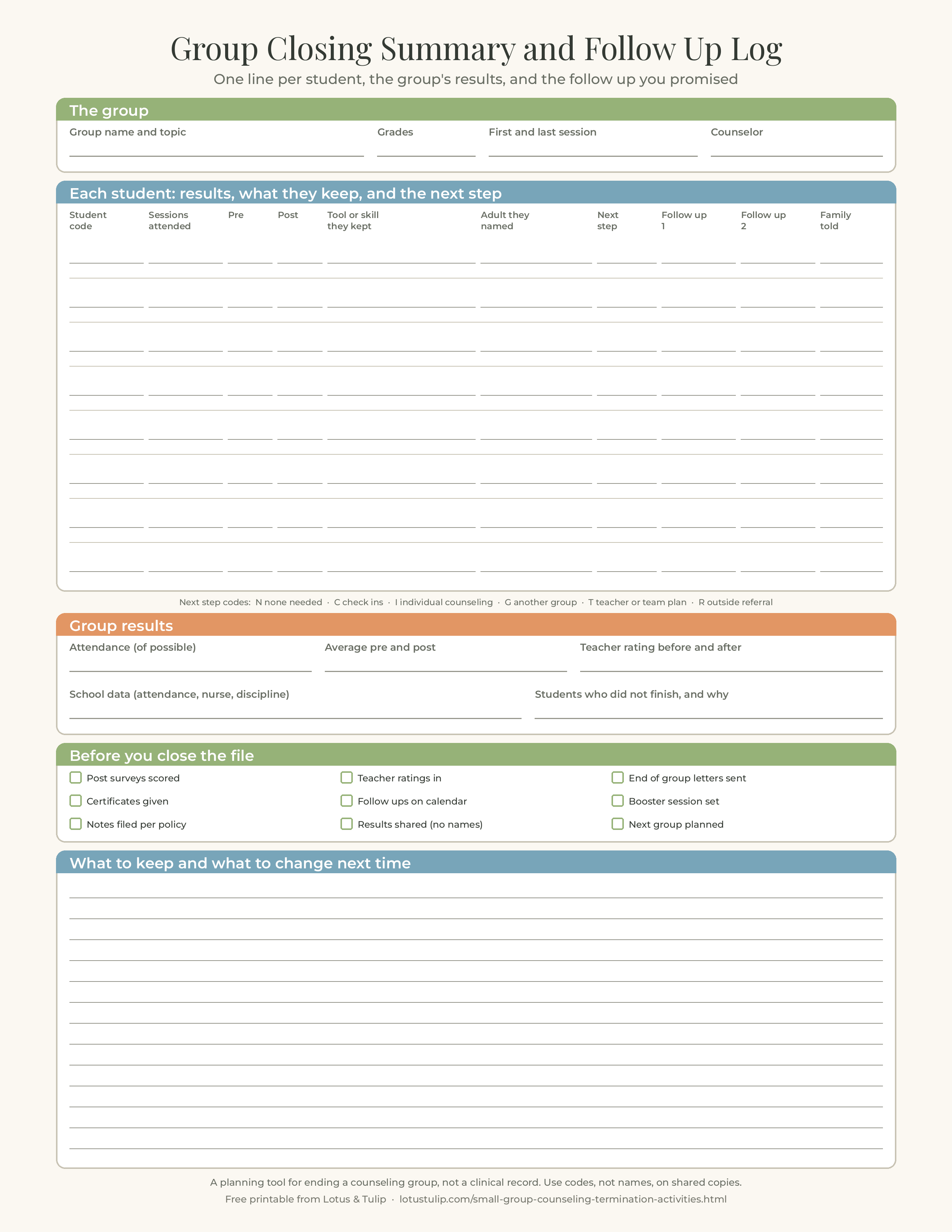
The free follow up log uses single letter codes for these next steps (N, C, I, G, T, R) so you can see the whole group on one page. Decide the next step for each student before you file the group away, and put the follow up dates on your calendar the same day.
Be careful about one pattern: a student who "repeats" the same group again and again. If a student needed a second round of the same eight sessions, it may help. If they need a third, the group is probably not the right intervention, and that is a sign to look at individual support, a team plan or an outside referral.
The post survey in the last session
The last session is usually when you give the post survey, because that is when all students are together and the group content is complete. A few rules make the results trustworthy:
- Before the celebration, not after. Give it after the look back and skills review and before compliments and certificates.
- Same items, same order, same words, same instructions as the pre survey. Read it aloud for younger students or anyone who needs it.
- Collect it yourself, face down, and do not score it in front of students.
- Absent students take it at their individual closing meeting, within a few days.
- Ask the teacher for the post rating within a week, using the same behavior items as the referral.
The ASCA National Model, fifth edition, describes ASCA Student Standards data as "the knowledge and skills students need for life-readiness as defined by the behavior standards from the ASCA Student Standards and measured through pre-/post-assessments." Your post survey is that data. The pre and post assessment guide has a full worked example, a scoring method and a free results summary sheet.
Telling families and teachers the group has ended
An end of group note to families
A short note home closes the loop you opened with the permission letter. It tells families the group has ended, what their child practiced, how they can support the skills at home, and how to reach you. It does not report what the student or other students said in group, and it does not include scores or clinical language. Use your school's usual communication channel and follow district policy. A sample, in plain language:
Dear family of ____,
Our Calm and Brave group ended this week. Over eight sessions, your child practiced noticing worry in the body, calm breathing tools, telling a worry thought from a fact, brave self talk and taking small brave steps. Your child is bringing home a toolkit page with the tools that helped most.
At home, you can help by asking your child to teach you one calm tool, and by praising small brave steps. I will check in with your child at school over the next few weeks. If you have questions or notice your child is still having a hard time, please call the counseling office at the school number, extension ____.
Thank you for letting your child be part of the group.
____, School Counselor
If a student's next step is an outside referral, that conversation happens by phone or in person, not in a group note.
A quick word with each teacher
Teachers often do not know the group has ended. A two minute conversation or a short note covers three things: the group has ended, which one or two skills to prompt in class (for example "remind her to use five finger breathing before tests"), and the request for the post rating. Share skills and next steps, not what students said in group.
Follow up after the group
ASGW's Best Practice Guidelines say group workers "conduct follow-up contact with group members, as appropriate, to assess outcomes or when requested by a group member(s)," and that processing may happen "at time of termination, and later follow up." In a school, follow up is easy to plan and easy to forget, so schedule it before the last session.
- Check ins one to two weeks after the group. Five minutes with each student, or a quick hallway or lunch check for those doing well. Ask: Which tool have you used since group? When? Did it help? Is there anything that has been hard?
- A booster session or reunion four to six weeks later. One 20 to 30 minute meeting with the whole group to review the skills, return letters to future selves and celebrate progress. It is also a natural point to give a short follow up version of the survey if you want to see whether gains held.
- A teacher check at the same time: has the student kept using the skill in class?
- School data for the weeks after the group, such as attendance, nurse visits or office referrals, if those were part of your data plan.
Write the follow up dates on the last session plan and the follow up log, and put them on your calendar. Avoid testing windows and the days just before a long break.
Closing the records and reporting results
After the follow up, close the group on paper:
- Score the post surveys and compare with the pre surveys, student by student and item by item.
- Record attendance as participation data: sessions held, students who started and finished, attendance out of possible. The progress notes and attendance tracker guide covers attendance codes, counting and a group summary page.
- Add teacher ratings and school data for the same length of time before and during the group.
- Note each student's next step and follow up dates.
- Write what worked and what you will change. ASCA Ethical Standard A.7.g asks for exactly this reflection.
- File notes according to your district's records policy. Keep personal notes separate from education records if that is your district's practice, and keep shared summaries free of names.
- Share a short results summary with your principal and, where appropriate, your advisory council: participation, the pre and post change, teacher and school data, and the limits of a small self report comparison.
The fifth edition National Model groups these into the three data categories school counselors use "to plan for and report results": participation data, ASCA Student Standards data and achievement data, with attendance and discipline counted among the factors that contribute to achievement. A one page summary in that shape is easy to read and easy to compare across groups.
Confidentiality at the end of a group
Endings create new privacy risks. Students may want to talk about the group with friends now that it is over, and memory items can travel. In the last session:
- Remind students that the agreement about privacy does not end with the group: "What others shared in our group stays in our group, even now that we are finished." ASCA Standard A.7.h asks counselors to communicate confidentiality as an aspiration and group norm while recognizing that it "cannot be guaranteed" in small groups.
- Check what goes home. Certificates, toolkits and affirmation pages should not name the group topic in a way that would embarrass a student if a classmate saw it.
- Keep group photos out of it unless your district's media policy and families' permissions clearly allow it, and even then think twice.
- Shared summaries use codes or totals, not names.
Absences, early endings and other complications
A student misses the last session
Hold a short individual closing meeting within a few days: the post survey, the toolkit or plan, the certificate and one specific strength, and the follow up date. Do not skip it; the student who misses the goodbye is often the one who most needs it.
A student leaves the group early
If a student moves, changes schedules or stops attending, close with them individually if you can, even briefly. Tell the group in a neutral way ("Jordan has a new schedule and won't be in group anymore; we wish Jordan well") without sharing reasons.
The group has to end early
Schedules change. If you lose sessions, tell students as soon as you know, combine the planned content, and keep a real last session rather than letting the group fade out. A shorter group with a proper ending is better than a longer one that just stops.
Rolling or open groups
If your group runs all year with students joining and leaving, mark each student's ending individually: a short goodbye round in their last session, a certificate, and a follow up date.
How to end a small counseling group, step by step
- Set the length and end date before the group starts. Put the number of sessions and approximate dates in the family letter and on your calendar, and mark no school days and testing windows.
- Tell students in session 1 and keep a visible countdown. Show the number of sessions on a chart and cross one off each week.
- Name the ending two sessions out. Say how many sessions are left, ask what students want to do before the group ends, and watch for reactions.
- Prepare the last session the week before. Print post surveys, sign certificates, prepare the toolkit or plan page, write the end of group note and plan for absences.
- Open the last session with a look back. Use a timeline or "then and now" so students see the whole group.
- Review the skills and give each student a plan. Toolkit, support map or if, then plan, with at least one adult at school named.
- Give the post survey before the celebration. Same items, same order, same instructions as the pre survey.
- Celebrate and say goodbye. A compliment circle or strengths web, certificates with one specific strength, a privacy reminder and clear directions for how to find you.
- Tell families and teachers. Send the end of group note, ask teachers for the post rating, and share one or two skills to prompt in class.
- Follow up and close the file. Check in with each student in one to two weeks, hold a booster session if you can, score and summarize results, note what you will change, and share a summary without names.
A worked example (fictional): ending the Calm and Brave worry group
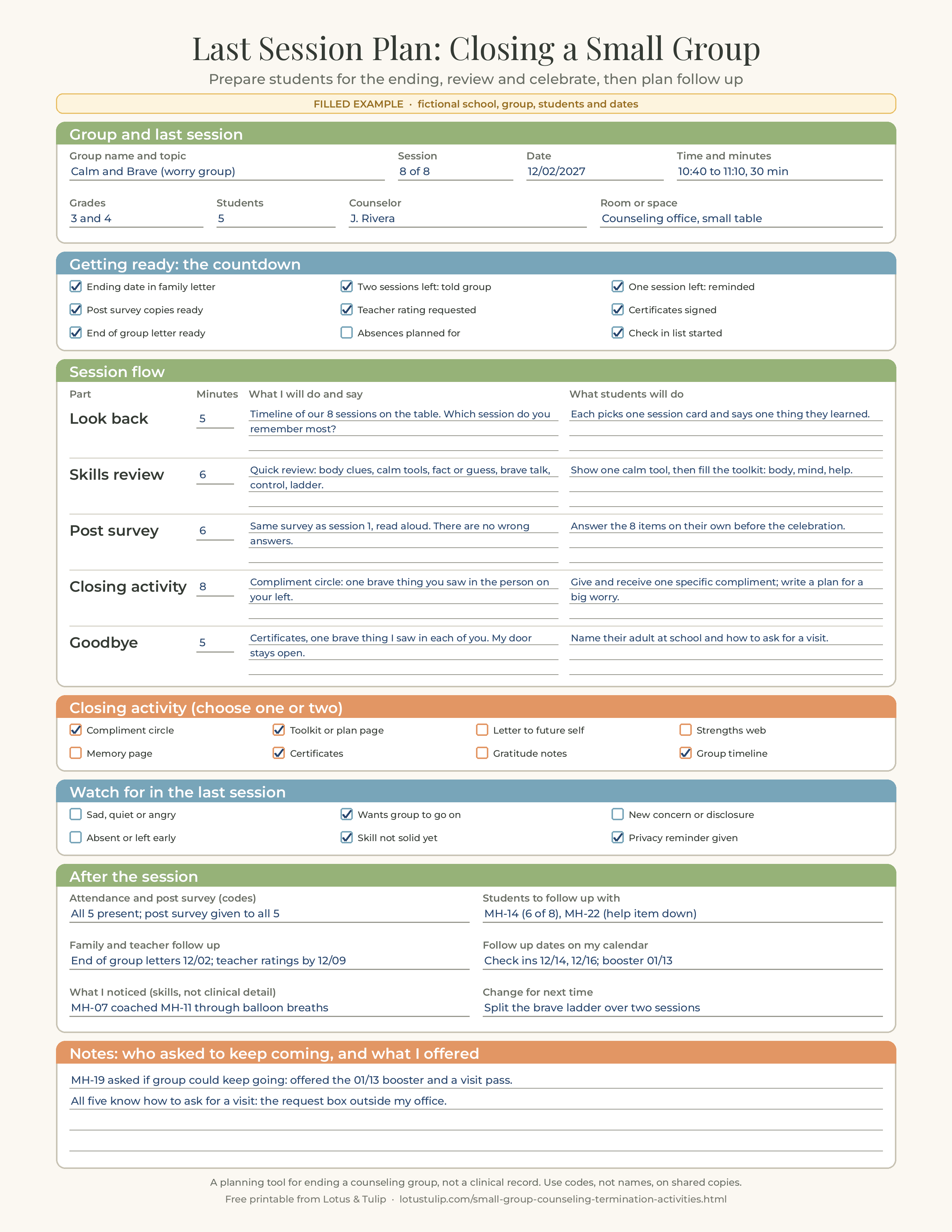
Maple Hollow Elementary is a fictional public elementary school. J. Rivera, the school counselor, runs an eight session worry group, "Calm and Brave," for five students in grades 3 and 4, coded MH-07, MH-11, MH-14, MH-19 and MH-22, 30 minutes on Thursdays. The group grew out of the fall needs assessment, in which worry came out on top, and the referral form guide follows MH-07 from Ms. Okafor's grade 3 referral into the group. The lesson plan guide shows the planning map: session 1 on October 7, 2027, and session 8 moved to Thursday, December 2, because Thursday, November 25 is Thanksgiving.
Preparing. The family letter in September listed eight sessions ending in early December and said J. Rivera would check in after the group. In session 1, she drew eight boxes on the group's whiteboard and crossed one off each week. In session 6 she said, "Two more meetings after today," and asked what students wanted to do before the end. MH-19 asked if they could "do the breathing game again," so it went into the last session. In session 7 (November 18), she reminded them that next time was the last meeting and the celebration, and students started their toolkit page.
The week before. She printed the post surveys (the same eight items as session 1), signed the "Calm and Brave Champion" certificates, wrote one specific strength for each student on a sticky note, prepared the end of group notes, asked Ms. Okafor and the grade 4 teacher for post ratings by December 9, and put follow up check ins on her calendar for December 14 and 16 and a booster session on January 13, 2028.
The last session, Thursday, December 2, 2027, 10:40 to 11:10.
| Part | Minutes | What happened |
|---|---|---|
| Look back | 5 | Eight session cards on the table, one picture each. Each student picked the session they remembered most. Three picked "calm body tools." |
| Skills review | 6 | A fast review of the eight sessions, then each student showed one calm tool and finished the toolkit page: tools for my body, my mind and getting help. |
| Post survey | 6 | The same eight items, read aloud, collected face down. All five present. |
| Closing activity | 8 | Compliment circle ("one brave thing you saw in the person on your left"), then a short plan for each student's biggest worry on the toolkit page. |
| Goodbye | 5 | Certificates with one strength said aloud, a reminder that what others shared stays in the group, and how to ask for a visit: the request box outside the counseling office. Each student named an adult at school. |
MH-19 asked whether group could keep going. J. Rivera did not promise a new group. She told MH-19 about the January booster session and showed her how to use the request box. MH-07 coached MH-11 through balloon breathing without a prompt, which she noted as a skill she saw.
Results. As the pre and post guide reports in detail, participation was 38 of 40 possible attendances (MH-14 attended 6 of 8). Student totals rose for all five (group average 13.0 to 18.6 out of 24), and teacher ratings rose from an average of 7.4 to 10.4 out of 16. One item, "I know an adult at school I can go to for help," went slightly down, driven by MH-22.
Next steps on the follow up log.
| Student | Sessions | Pre to post | Next step | Follow up |
|---|---|---|---|---|
| MH-07 | 8 of 8 | 12 to 19 | T: Ms. Okafor prompts a calm tool before tests | Check in 12/14; booster 01/13 |
| MH-11 | 8 of 8 | 14 to 20 | N | Booster 01/13 |
| MH-14 | 6 of 8 | 11 to 15 | C: three short check ins to practice the brave ladder | Check ins 12/14 and 12/16; booster 01/13 |
| MH-19 | 8 of 8 | 15 to 21 | N (asked about more group; offered booster and visit pass) | Booster 01/13 |
| MH-22 | 8 of 8 | 13 to 18 | C: help seeking item went down; her favorite aide moved schools; name two new adults | Check in 12/16; booster 01/13 |
What she changes next time. Split the brave ladder across two sessions, add a short "my safe adults" activity in session 2, and start the toolkit page in session 7 so the last session has more time for the celebration. Her one page summary to the principal lists participation, the pre and post change, the teacher ratings and attendance and nurse visit figures, and a sentence on the limits of a five student, self report comparison. No names appear in it.
The free printable on this page shows J. Rivera's last session plan filled in, and a blank closing summary and follow up log for your own group.
Six real world scenarios
1. The group that does not want to stop. Your fourth grade friendship group begs to keep meeting. The group clearly worked, and you are tempted. Before extending it, ask what the extra sessions would be for. If several students still need a specific skill, a short follow up group with a new goal is reasonable. If the group has simply become a fun lunch club, end as planned, hold a booster session, and point students toward other places to connect, such as clubs, recess games or a lunch bunch you already run for everyone.
2. The student who says "I'll just get worse again." A sixth grader in a stress group tells you that without group he will "go back to how it was." Take it seriously and stay concrete: review his plan, name the adult he will go to, and schedule an individual check in for the next week. If the worry persists or you hear anything about safety, follow your district's procedures.
3. Last session, new concern. During the compliment circle, a student says something that suggests she may be unsafe at home. The celebration stops being the priority. Finish the session briefly and safely, then follow your district's reporting and safety procedures exactly as you would on any other day. The group ending does not change your obligations.
4. The fire drill. A drill takes 15 minutes of your 30 minute last session. Give the post survey first when you return, then a two minute goodbye with certificates, and schedule a 15 minute "part two" for the toolkit and compliment circle within the week. Do not drop the post survey and do not rush the goodbye into the hallway.
5. The high school group that finds certificates embarrassing. Your tenth grade grief group rolls its eyes at the idea of certificates. Skip them. Use a written "take and leave" reflection and a short letter to future self, and offer each student an individual follow up. Ask older students what kind of ending they want; it is part of respecting them.
6. A rolling group where students leave one at a time. In a year long new student group, students graduate when they feel settled. Mark each ending: a one word round in their last session, a "welcome tip" they leave for future members, and a follow up check two weeks later.
Common mistakes
- Letting the group just stop. No last session, no goodbye, a certificate in a cubby. Plan the ending like any other session.
- Surprising students with the end. Without a countdown, the last session becomes a shock and the review gets lost.
- Giving the post survey after the party. Answers drift upward. Survey first, celebrate second.
- Introducing a new skill in the last session. The last session is for review and consolidation. New content belongs earlier.
- Vague goodbyes. "My door is always open" without telling students how to ask for a visit.
- Generic praise. "Great job, everyone" is forgettable. One specific strength per student is not.
- Promising a new group you have not scheduled. If it does not happen, students remember.
- No plan for students who need more. A.7.l expects follow up or referral, not a hope that things work out.
- Forgetting families and teachers. They opened the door to the group; tell them it has ended and how to help.
- Skipping the reflection. If you do not write down what you will change the day the group ends, you will run the same group the same way next year.
Free printable: last session plan, filled example and group closing summary and follow up log
The free printable has three US Letter pages. Page 1 is a blank last session plan: group and session details (group name and topic, session number, date, time and minutes, grades, students, counselor, room); a nine item countdown checklist (ending date in the family letter, two sessions left told to the group, one session left reminder, post survey copies ready, teacher rating requested, certificates signed, end of group letter ready, absences planned for, check in list started); a session flow table for the look back, skills review, post survey, closing activity and goodbye, with minutes, what you will do and say and what students will do; eight closing activity choices; six things to watch for in the last session (sad, quiet or angry; wants the group to go on; a new concern or disclosure; absent or left early; a skill not solid yet; privacy reminder given); an after the session section (attendance and post survey, students to follow up with, family and teacher follow up, follow up dates, what you noticed and what you will change); and lines for who asked to keep coming and what you offered. Page 2 is the same plan filled in for session 8 of the fictional Calm and Brave worry group at Maple Hollow Elementary on December 2, 2027. Page 3 is a group closing summary and follow up log: group details; a row for each of up to eight students with sessions attended, pre and post totals, the tool or skill they kept, the adult they named, a next step code (N none needed, C check ins, I individual counseling, G another group, T teacher or team plan, R outside referral), two follow up dates and whether the family was told; group results (attendance out of possible, average pre and post, teacher ratings before and after, school data, students who did not finish and why); nine checks before you close the file; and lines for what to keep and what to change next time.
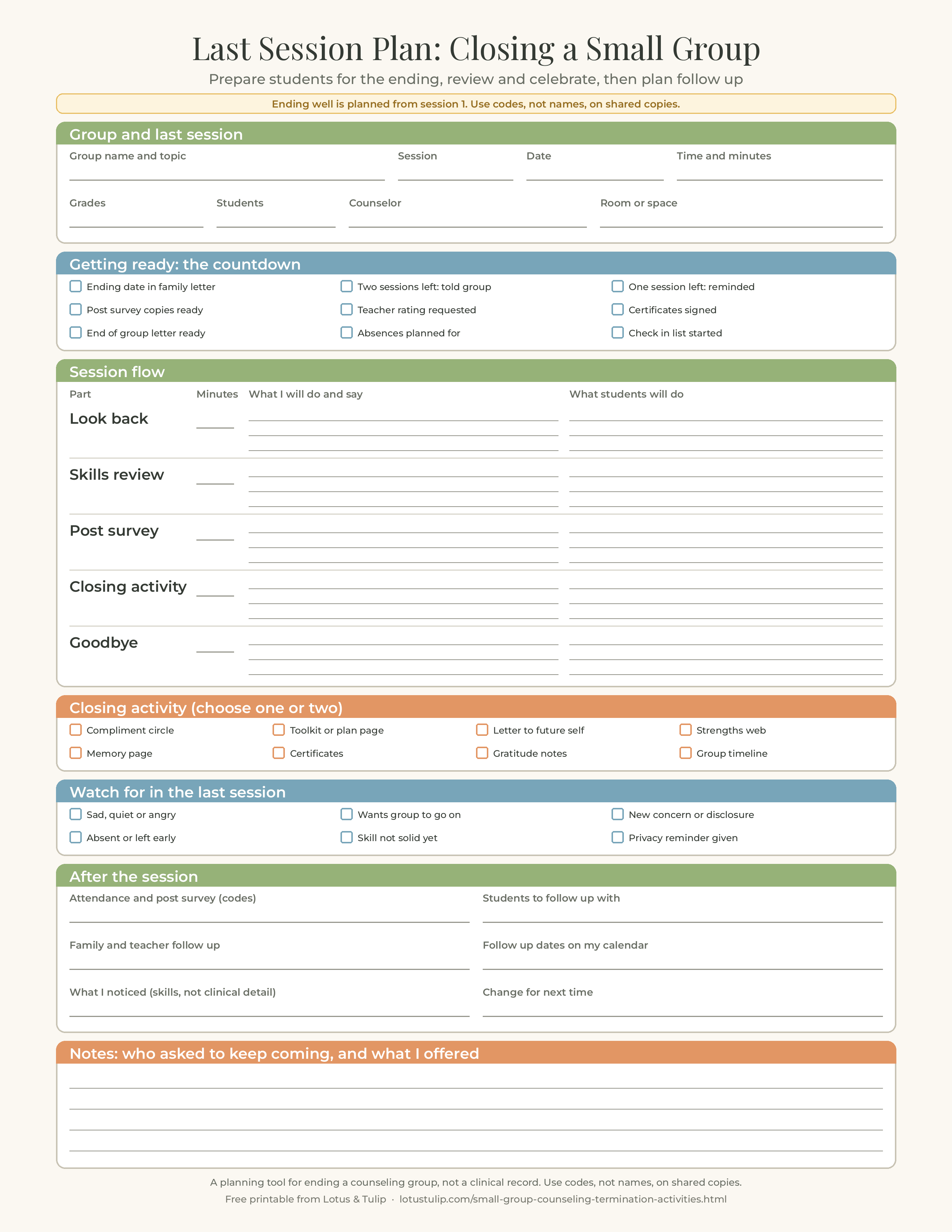
Download the free last session plan, example and follow up log (PDF, 3 pages)
Or download single pages: Page 1: blank last session plan (PNG) · Page 2: filled fictional example (PNG) · Page 3: closing summary and follow up log (PNG)
Free to print and use in your own school. Please link to this page rather than re-uploading the file. This is a planning tool for ending a counseling group. It is not a clinical record, and it does not replace your district's policies on records, family communication, consent and student safety.
Related resources
- All school counselor small group curriculums
- Small group counseling progress notes and attendance tracker
- Small group counseling pre and post assessment
- Small group counseling lesson plan template and planning map
- School counselor needs assessment for small groups
- Small group counseling referral form and referral log
- Small group counseling permission slip and parent letter
- Icebreaker activities for counseling groups
- Small group counseling curriculum for anxiety: an 8 session plan
- Full year elementary small group counseling: plan the year
- Social skills small group activities
- Anger management small group activities
- Group therapy note template and examples
Sources: American School Counselor Association (2022), ASCA Ethical Standards for School Counselors, standards A.7.d, A.7.e, A.7.f, A.7.g, A.7.h and A.7.l; ASCA position statement "The School Counselor and Group Counseling" (adopted 1989; revised 1993, 2002, 2008; reviewed 1999, 2008, 2014, 2020, 2026); American School Counselor Association (2025), The ASCA National Model: A Framework for School Counseling Programs, Fifth Edition (participation data, ASCA Student Standards data and achievement data); ASCA Student Standards: Mindsets & Behaviors for Student Success (B-SS 3); Thomas, R. V., and Pender, D. A. (2008), Association for Specialists in Group Work: Best Practice Guidelines 2007 Revisions, Journal for Specialists in Group Work, 33(2), 111 to 117 (B.5, B.7, C.1, C.3); Tuckman, B. W., and Jensen, M. A. C. (1977), Stages of small-group development revisited, Group & Organization Studies, 2(4), 419 to 427. All checked on November 10, 2026. The activities, the last session structure, the timings and the follow up schedule are practical suggestions, not ASCA or ASGW requirements. The worked example and all names, codes, dates and numbers in it are fictional.
FAQ
What is termination in small group counseling?
Termination is the planned ending of a counseling group. Members review what they learned, make sense of the experience, say goodbye and plan how to keep using the skills. In schools it starts at the beginning, when students and families learn how many sessions there will be, and continues after the last session with follow up.
What should the last session of a small counseling group include?
A look back at the group, a review of the skills with a personal toolkit or plan for each student, the post survey (before the celebration), a closing activity such as a compliment circle, and a clear goodbye: certificates with one specific strength, a privacy reminder, how to ask for a visit and the follow up date.
What are good closing activities for school counseling groups?
A toolkit or plan page, a group timeline, a compliment circle, a strengths web with yarn, gratitude notes, a letter to your future self, a support map that names an adult at school, an if, then plan, a one word round and "one thing I take, one thing I leave." Pick one that leaves students with something concrete and one that celebrates.
How do I prepare students for the end of a group?
Tell them the number of sessions in session 1, keep a visible countdown, name the ending two sessions before the last one and ask what they want to do before it ends, remind them again in the second to last session, and start the review or toolkit then so the last session is not all new.
What if a student does not want the group to end?
Acknowledge the feeling, point to what stays (the skills, the people and you), give the student a concrete way to ask for a visit, and offer a check in or booster session. Do not promise a new group you have not scheduled. If the student still needs support, plan individual check ins, another group, or a referral.
Do school counselors have to follow up after a group ends?
ASCA Ethical Standard A.7.l asks school counselors to "provide necessary follow-up and/or referrals to additional resources for group members," and the ASGW Best Practice Guidelines call for follow up contact with group members as appropriate. A check in one to two weeks after the group and a booster session four to six weeks later are common, practical ways to do it.