
Therapist worksheets · Relapse prevention · Updated 2026-11-05
Relapse Prevention Plan Worksheet: How to Write One That Works, with a Free Printable
Ready-made printable: Relapse Prevention Worksheets Holiday 20% off: about $9.20, was $12 (EUR 10) · instant digital download
Buy on Etsy
A relapse prevention plan is a short, personal document that answers four questions before they become urgent: What situations put me at risk? What are my early warning signs? What will I do instead? Who will I call? It is one of the most widely used tools in substance use treatment, and the same structure works for preventing a return of depression, anxiety and other recurring problems.
This guide explains the model most relapse prevention worksheets are built on (Marlatt and Gordon's cognitive behavioral model), the difference between a lapse and a relapse, why the first slip is a turning point, and how to write a plan step by step. It covers warning signs, triggers, coping strategies and support contacts, with adaptations for depression, anxiety and teens, plus therapist tips, common mistakes and what the research honestly shows. You also get a free three page US Letter printable.
This page is educational. It is not a substitute for assessment or treatment by a licensed clinician. Stopping alcohol, benzodiazepines, opioids or some prescribed medicines suddenly can be dangerous, so any change in use should be planned with a medical provider.
Jump to the free relapse prevention plan worksheet (PDF) · How to write the plan, step by step · Lapse vs relapse
What a relapse prevention plan is
Relapse prevention (RP) is a cognitive behavioral approach that treats recovery as a set of learnable skills rather than a test of willpower. Instead of hoping that motivation holds, the person and their clinician identify the specific situations where a return to old patterns is most likely, rehearse ways of coping with them, and decide in advance how to respond if a slip happens.
A relapse prevention plan worksheet turns that work into something a person can carry with them. A good plan usually includes:
- High risk situations and triggers: the people, places, feelings, times and events that make use, or a return of symptoms, more likely.
- Early warning signs: changes in thinking, feeling and behavior that show up days or weeks before a relapse.
- Coping strategies: specific, practiced responses for each high risk situation, written as "if this happens, then I will" statements.
- A lapse plan: what to do in the first hour and the first day after a slip, so it stays a slip.
- Support contacts: names and numbers of people, groups and professionals, plus crisis lines.
- Reasons and values: why recovery matters, in the person's own words.
The plan is not a contract or a promise of perfection. It is a map for the hard moments, written while the person is calm enough to think clearly.
The Marlatt and Gordon model, in plain language
Most relapse prevention worksheets trace back to psychologists G. Alan Marlatt and Judith Gordon, whose 1985 book Relapse Prevention: Maintenance Strategies in the Treatment of Addictive Behaviors laid out a cognitive behavioral model of how relapse happens. A clear summary by Larimer, Palmer and Marlatt (1999) describes two groups of factors.
Immediate determinants
- High risk situations. Any situation that threatens a person's sense of control and raises the chance of use. In Marlatt's research, negative emotional states (anger, anxiety, depression, frustration, boredom) were linked with the highest rate of relapse. Negative emotional states and interpersonal conflict together served as triggers for more than half of relapse episodes in Marlatt's 1996 analysis, and social pressure, direct or indirect, contributed to more than 20 percent. Positive emotions such as celebrations, cues like passing a favorite bar, and "testing" personal control also appear on the list.
- Coping response. If the person has an effective coping response, their confidence (self efficacy) rises and the chance of relapse falls. If they do not, confidence drops.
- Outcome expectancies. Low confidence combined with a belief that using will help ("one drink will calm me down") makes a first use, a lapse, more likely.
- The abstinence violation effect. After a lapse, many people feel guilt and a sense of total failure. That reaction, together with positive expectancies, raises the risk that one slip becomes a full relapse.
Covert antecedents
Some relapses seem to come out of nowhere. Marlatt described less obvious factors that quietly set them up:
- Lifestyle imbalance. Too many "shoulds" and too few things the person enjoys can build a sense of deprivation and a desire for relief or reward.
- Urges and cravings. Conditioned responses to cues, often stronger than expected.
- Rationalization and denial. "I deserve it," "it was a hard week," "I can handle one."
- Apparently irrelevant decisions. Small choices that each seem harmless but together walk the person toward a high risk situation. The classic example is an abstinent drinker buying a bottle of liquor "in case guests drop by." Taking the route past the old dealer's street or keeping a contact "just in case" are others.
A more dynamic view
In 2004, Katie Witkiewitz and Marlatt published a reworked version of the model in American Psychologist. It keeps the same ingredients but describes relapse as a dynamic, nonlinear process: background risk factors (such as family history, severity of dependence and ongoing stress) interact with in the moment factors (such as a craving, a mood dip or a coping slip), and small changes can sometimes tip a person suddenly from coping well to using again. For a worksheet, the practical lesson is that a plan should cover both long term stressors and the moment by moment triggers, and should be updated as life changes.
Lapse vs relapse, and why the difference matters
A lapse is a single slip: one drink, one use, one night of old behavior. A relapse is a return to the previous pattern. Relapse prevention treats a lapse as a moment of choice rather than proof that everything is lost.
The abstinence violation effect is what turns one into the other. People who blame a lapse on stable, global, internal causes ("I have no willpower," "I am a failure," "I have already blown it") tend to feel worse and give up. People who see it as a specific, changeable mistake ("I went to that party without a plan and I was exhausted") are more likely to stop and learn from it. Larimer and colleagues describe cognitive restructuring that helps clients reframe a lapse as a mistake or a learning opportunity rather than a sign of weak willpower.
This is why every plan needs a lapse section. Deciding in advance to stop, get safe, reach out within a set time and review what happened is far easier than inventing that response in the middle of shame.
One important safety note: after a period of not using, tolerance drops. The National Institute on Drug Abuse (NIDA) warns that with drugs such as opioids, using the previous amount after a break can cause an overdose. A lapse plan for anyone who has used opioids should include not using alone, having naloxone available and calling 911 for any suspected overdose.
It also helps to normalize the numbers. NIDA reports that relapse rates for substance use disorders are estimated at 40 to 60 percent, comparable to rates for other chronic illnesses such as hypertension and asthma. A return to use signals that treatment should be resumed, adjusted or changed, not that the person or the treatment has failed.
Warning signs: relapse is usually a process
Relapse rarely starts with the first drink or the first day in bed. Clinicians often describe it as a gradual process. Physician Steven Melemis (2015) summarizes it as three stages, a useful frame for warning signs even though it is a clinical model rather than a tested scale:
- Emotional relapse: the person is not thinking about using yet, but self care slips. Bottled up feelings, isolating, skipping meetings or sessions, poor sleep and eating, focusing on other people's problems.
- Mental relapse: part of the person wants to use and part does not. Cravings, thinking about people and places from the past, glamorizing past use, bargaining ("only on weekends"), lying, and planning a relapse around other people's schedules.
- Physical relapse: actual use. By this point, it is much harder to stop.
Common personal warning signs to look for when filling in the worksheet:
- Sleep changes, skipped meals, more caffeine or sugar.
- Pulling away from supportive people, skipping appointments, not answering texts.
- Irritability, restlessness, feeling numb or bored.
- Romanticizing the past, telling "good old days" stories.
- Thoughts like "I have this under control now," "nobody would know" or "what is the point."
- Keeping secrets, small lies, or apparently irrelevant decisions such as changing routes or keeping old contacts.
A practical worksheet trick is to sort warning signs into three levels, like a traffic light: early signs (time to use the plan more actively), serious signs (time to tell someone and add support) and crisis signs (time to call a clinician, 988 or 911). Page 1 of the free printable uses this layout.
Triggers and high risk situations
A trigger is anything that raises craving or vulnerability. A high risk situation is a specific moment where that trigger meets a chance to use. A worksheet works best when it gets concrete. Prompt the person with categories:
- Feelings: stress after work, loneliness on Sunday evenings, anger after a call with an ex, boredom, shame, and also excitement or celebration.
- People: old using friends, a family member who criticizes, a coworker who always suggests happy hour.
- Places: a particular bar, a gas station that sells the vape, a friend's apartment, home alone.
- Times and events: payday, holidays, anniversaries, sports games, the hour after a hard therapy session.
- Body states: pain, hunger, fatigue, withdrawal symptoms, illness. The familiar HALT check (hungry, angry, lonely, tired) is a quick reminder.
- Thoughts: "I deserve it," "just one," "I have already messed up today."
Past lapses are the best data source. Walking through the last two or three slips, or using a behavior chain analysis worksheet, usually reveals a pattern the person did not notice.
Building the coping plan
Each high risk situation needs at least one practiced response. Write responses as if then plans, because a specific plan ("If I get paid on Friday, then I will go straight to the grocery store with my sister and leave my card at home") is easier to follow under stress than a general intention ("I will be careful").
Useful categories of coping strategies, most drawn from the original RP model:
- Avoid or leave: stimulus control, such as not keeping alcohol at home, deleting a dealer's number, changing routes, leaving a party early with a planned exit line.
- Delay and ride out the urge: cravings rise, peak and fall. Marlatt's "urge surfing" asks the person to picture the urge as a wave and watch it crest and pass without acting on it. Setting a 20 minute timer before deciding anything is a simple version.
- Refusal skills: a short, rehearsed script ("No thanks, I am driving," "I do not drink anymore") and a plan for what to do with your hands and your time.
- Change the thought: challenge expectancies ("one will not relax me, it will start a weekend I regret"), and play the tape forward to the next morning. A CBT thought record helps here.
- Manage the feeling: distress tolerance skills such as paced breathing, cold water or intense exercise, and grounding. See our distress tolerance worksheets.
- Reach out: call or text a support person before deciding, go to a meeting, sit with someone.
- Lifestyle balance: regular sleep, meals, movement, and enjoyable activities that are not just duties. Marlatt called healthy habits with long term benefits, such as exercise or meditation, "positive addictions." A self care plan template fits here.
- Medication and treatment: for many people, medications for alcohol or opioid use disorder, or for depression, are part of relapse prevention. Changes should always be discussed with a prescriber.
Support contacts
A plan without names is a plan that stays in a folder. List at least three people, with phone numbers, and note when to call each one: a friend for a quick distraction, a sponsor or peer support worker for a strong craving, a clinician or prescriber for warning signs that keep building. Add groups (for example SMART Recovery, AA, NA, Refuge Recovery, or a depression support group), and the times they meet. Ask permission first, so each person knows they are on the plan and what you might ask of them.
For US readers, useful numbers to write on the plan:
- 988 Suicide and Crisis Lifeline: call or text 988 any time for thoughts of suicide, emotional crisis or substance use crisis.
- Crisis Text Line: text HOME to 741741.
- SAMHSA National Helpline: 1-800-662-4357 (1-800-662-HELP), a free, confidential treatment referral and information service, open 24 hours a day, 365 days a year, in English and Spanish. It does not provide counseling, but it connects people with local treatment and support.
- 911: for any suspected overdose or immediate danger.
How to write a relapse prevention plan, step by step
- Pick a calm moment and name the goal. Write the plan when the person is stable, not in the middle of a craving or a low. Define the goal in their words: abstinence from alcohol, no cannabis on weekdays, staying well after a depressive episode, keeping up exposure practice after anxiety treatment.
- Write down the reasons. List the top three reasons recovery matters right now, and what life looks like when things are going well. These lines are what the person rereads on a hard day.
- Review past lapses. For each of the last few slips or episodes, ask what was happening before, where, with whom, what the person was feeling and thinking, and what happened next. Look for patterns.
- List high risk situations and triggers. Use the categories above (feelings, people, places, times, body states, thoughts) and be specific. Rate each one for risk, for example low, medium or high.
- Sort warning signs into three levels. Early signs, serious signs and crisis signs, each with what the person, and the people around them, might notice. Include the apparently irrelevant decisions this person tends to make.
- Match each risk with an if then plan. For every high risk situation, write at least one coping response. Rehearse the hardest ones in session, out loud, including refusal lines.
- Plan for a lapse. Decide the first steps: stop, get to a safe place, do not use alone, contact a named person within a set time, and review what happened without self attack. Write a compassionate sentence to read after a slip.
- Add the support team and crisis numbers. Names, numbers, when to call each one, meeting times, the clinician's contact, and 988, HOME to 741741, the SAMHSA helpline and 911.
- Keep it handy and review it. A photo on the phone, a copy in the wallet, one on the fridge. Set a date to update the plan, for example monthly in early recovery and after any lapse, move, new job or loss.
A worked example (fictional)
Jordan, 29, has been alcohol free for 90 days after an outpatient program. Looking back at past lapses, Jordan and the counselor notice three patterns: Friday paydays, arguments with Jordan's father, and Sunday evenings alone.
- Early warning signs: skipping the gym, staying up past 1 am, not texting the peer support group.
- Serious signs: thinking "I could handle a beer at the game," driving past the old bar "just to see."
- Crisis signs: buying alcohol, thinking "what is the point."
- If then plans: If it is payday, then I go to dinner with my sister and leave my card at home. If I argue with my dad, then I leave, walk for 20 minutes and text my sponsor before doing anything else. If it is Sunday night, then I go to the 7 pm online meeting and call one person.
- Lapse plan: pour it out, leave the place, text my sponsor within an hour, tell my counselor at the next session, and read "One drink is information, not a verdict."
Six weeks later, Jordan has one beer at a wedding. Because the lapse plan exists, Jordan leaves early, texts the sponsor, and the next session becomes a review of what made the wedding harder than expected. The plan gets a new line: weddings and family events need a sober buddy and an exit time.
Relapse prevention for depression and anxiety
The same structure works beyond substance use. Depression is often recurrent, and relapse prevention is a standard final phase of CBT, behavioral activation and mindfulness based cognitive therapy (MBCT).
- Depression warning signs: sleeping much more or less, withdrawing from people, dropping enjoyable activities, harsh self talk, ruminating, feeling hopeless, missing medication. A plan might say: if I cancel plans two weekends in a row, then I schedule one small activity a day from my behavioral activation worksheet and book a check in with my therapist.
- Anxiety warning signs: avoidance creeping back, more reassurance seeking, safety behaviors returning, more checking or googling symptoms. A plan might say: if I start avoiding the grocery store again, then I return to my exposure practice and do the next step on the ladder.
- What has kept me well: list what worked in treatment (skills, routines, medication, people) so it is easy to restart rather than reinvent.
- Safety first: if warning signs include thoughts of suicide, the plan should include a separate safety plan and crisis numbers, and the clinician should be involved.
In an individual patient data meta-analysis of nine randomized trials (1,258 participants), Kuyken and colleagues (2016) found that people who received MBCT had a lower risk of depressive relapse over 60 weeks than those who did not (hazard ratio 0.69), and the benefit held when compared only with active treatments (hazard ratio 0.79). That is a moderate effect, not a guarantee, and it applies to MBCT as a full program, not to a worksheet on its own.
Adapting the plan for teens
Teens face many of the same triggers as adults, plus a few of their own: peer pressure, social media, family conflict, school stress, and limited control over where they live and who they see. Some adjustments make the plan more useful:
- Keep it short and in their words. One page, plain language, their own labels for triggers and coping skills. A plan in a teen's handwriting gets used more than one in yours.
- Make it phone friendly. A photo of the plan, contacts saved under clear names, and a pre written text ("Can you call me? Having a rough night") lower the effort of reaching out.
- Practice refusal lines. Role play the exact words for saying no at a party or in a group chat. Our peer pressure worksheets for teens have scripts to adapt.
- Include a trusted adult. Name at least one adult (a parent, school counselor, coach or relative), and agree what they will be told and when.
- Be clear about confidentiality. Explain up front what stays private and what you must share for safety.
- Reduce shame about lapses. Teens can be especially harsh with themselves. Emphasize that a slip is information to learn from.
For coping skill ideas, see our coping skills worksheets for teens and stress management worksheets for teens.
Therapist tips
- Start relapse prevention early. Do not wait for the last session. Begin identifying triggers in the first weeks and build the plan over time.
- Use the client's own data. Past lapses, a craving log, mood tracking and chain analyses make the plan specific and believable.
- Rehearse, do not just write. Role play the hardest situations, practice urge surfing in session, and assign real world practice.
- Talk about the abstinence violation effect directly. Naming it before it happens takes away some of its power. Ask, "If you slip, what will you say to yourself?"
- Balance the lifestyle, not just the risks. Ask what the person does for joy, rest and connection. A plan that only lists dangers can feel like a cage.
- Coordinate care. With consent, share the plan with a prescriber, case manager or family, especially when medication or safety is involved.
- Review after every lapse. Treat each slip as a chance to update the plan, not to start over.
- Respect the person's goal. Some clients aim for abstinence, others for reduced or safer use. A plan built on the person's actual goal is more likely to be used.
Common mistakes
- Vague triggers. "Stress" is not a trigger anyone can plan for. "Tuesday nights after my supervisor's meeting" is.
- Coping plans that were never practiced. A strategy that only exists on paper rarely works in a craving.
- No lapse plan. Plans that only cover "never using again" leave the person with nothing to do after a slip except feel like a failure.
- Too long. Ten pages of goals will not be read on a bad night. Keep the core plan to a page or two.
- Support contacts who do not know. Ask permission and tell people what role they play.
- Writing it once. Triggers change with new jobs, relationships, moves and seasons. Schedule reviews.
- Ignoring medical risk. Withdrawal from alcohol or benzodiazepines can be dangerous, and reduced tolerance raises overdose risk. A plan is not a replacement for medical care.
What the research says (honestly)
- Relapse prevention works, with modest effects. A meta-analysis by Irvin and colleagues (1999) of 26 studies with 9,504 participants found RP generally effective, especially for alcohol problems, with effects that varied by outcome, substance and study design.
- The model's core pieces have support. Reviews describe evidence for the role of negative emotional states, coping and the abstinence violation effect, while also noting that the original way of classifying relapse situations has had mixed reliability and that relapse is more complex than any single path (Witkiewitz and Marlatt, 2004).
- Mindfulness based relapse prevention (MBRP) combines RP with mindfulness practice. In a randomized trial of 286 adults finishing initial substance use treatment, Bowen and colleagues (2014) found that both MBRP and standard RP reduced relapse risk compared with treatment as usual at 6 months, and at 12 months MBRP participants reported fewer days of drug use and less heavy drinking than those in RP or treatment as usual. It was a single trial, so the results need replication.
- For depression, MBCT reduced relapse risk over 60 weeks in pooled trial data (Kuyken et al., 2016), with a stronger effect in people with more severe symptoms before treatment.
- Worksheets on their own have not been tested as stand alone treatments. They are tools within a broader plan of care, which may include counseling, peer support and medication.
When to get extra help
Contact a licensed clinician or medical provider if warning signs keep building, if a lapse is turning into regular use, if withdrawal symptoms appear, or if depression or anxiety is coming back. Get urgent help for any thoughts of suicide, overdose, or danger to yourself or someone else.
- In the US, call or text 988 (988 Suicide and Crisis Lifeline) any time.
- Text HOME to 741741 to reach the Crisis Text Line.
- Call the SAMHSA National Helpline at 1-800-662-4357 for free, confidential treatment referrals, 24/7, in English and Spanish.
- Call 911 for a suspected overdose or if someone is in immediate danger.
Free relapse prevention plan worksheet (PDF)
The free relapse prevention plan worksheet has three pages in US Letter size, for adults and older teens, and works for substance use as well as depression or anxiety relapse:
- Page 1: My Triggers and Warning Signs. Six trigger categories (feelings, people, places, times and events, body states, thoughts) plus a three level warning sign ladder: early signs, serious signs and crisis signs, each with an action.
- Page 2: My Coping Plan. Five if then plans, an urge surfing reminder, a refusal line, a lifestyle balance box and my top reasons.
- Page 3: If I Slip and My Support Team. A five step lapse plan that counters the abstinence violation effect, a compassionate sentence to read after a slip, support contacts with when to call each one, and a US help box with 988, text HOME to 741741, the SAMHSA National Helpline 1-800-662-4357 and 911.
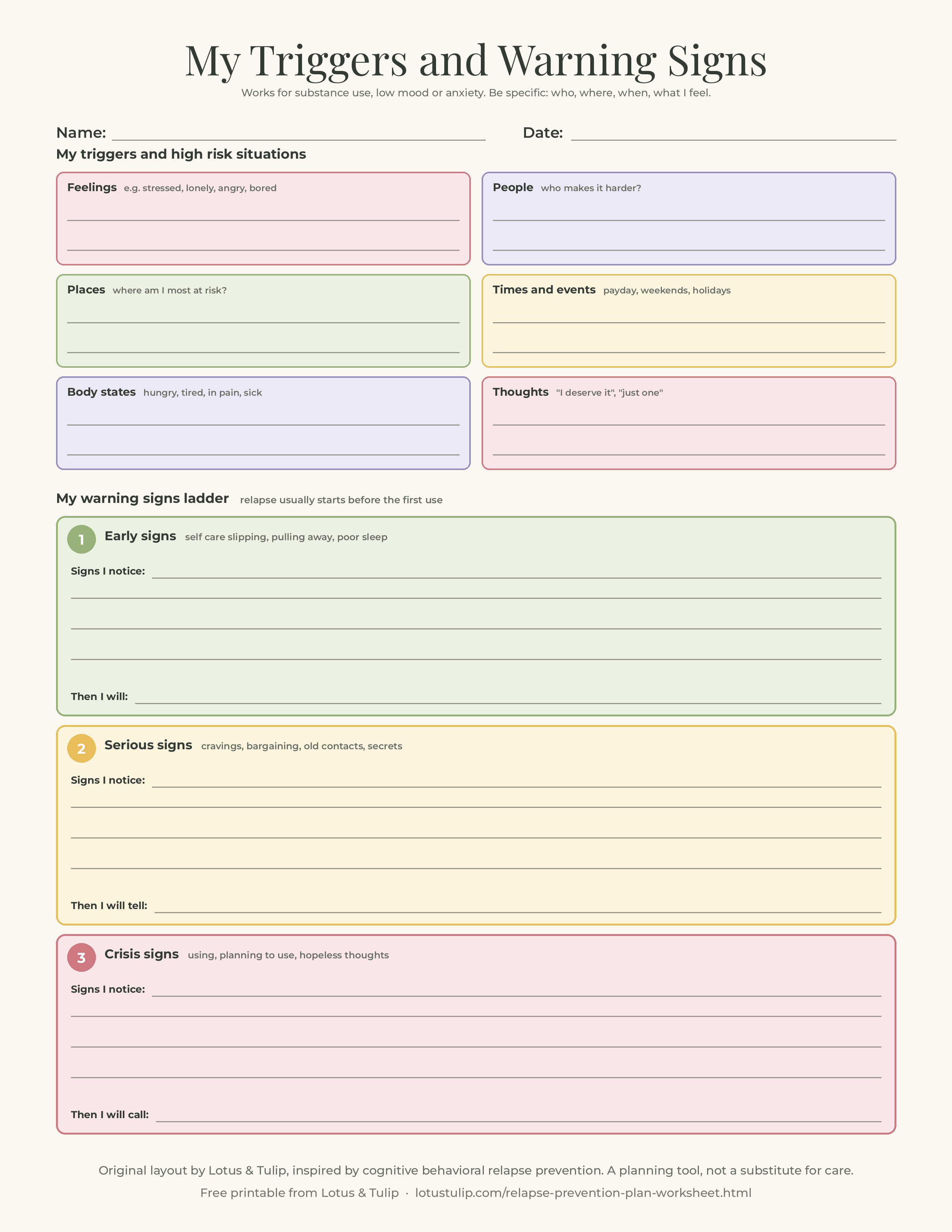
Download the free relapse prevention plan worksheet (PDF, 3 pages, US Letter)
Prefer single images? Page 1: My Triggers and Warning Signs (PNG) · Page 2: My Coping Plan (PNG) · Page 3: If I Slip and My Support Team (PNG)
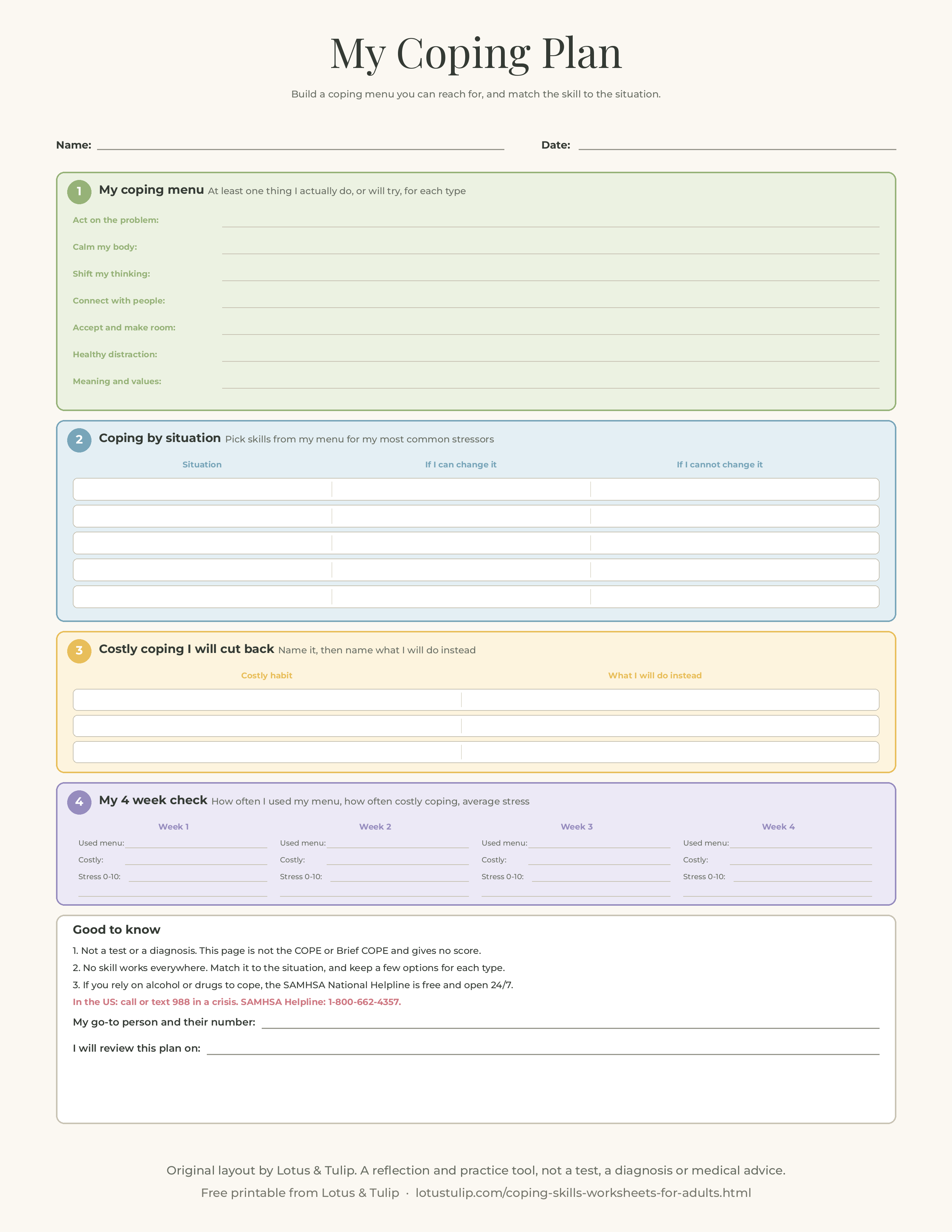
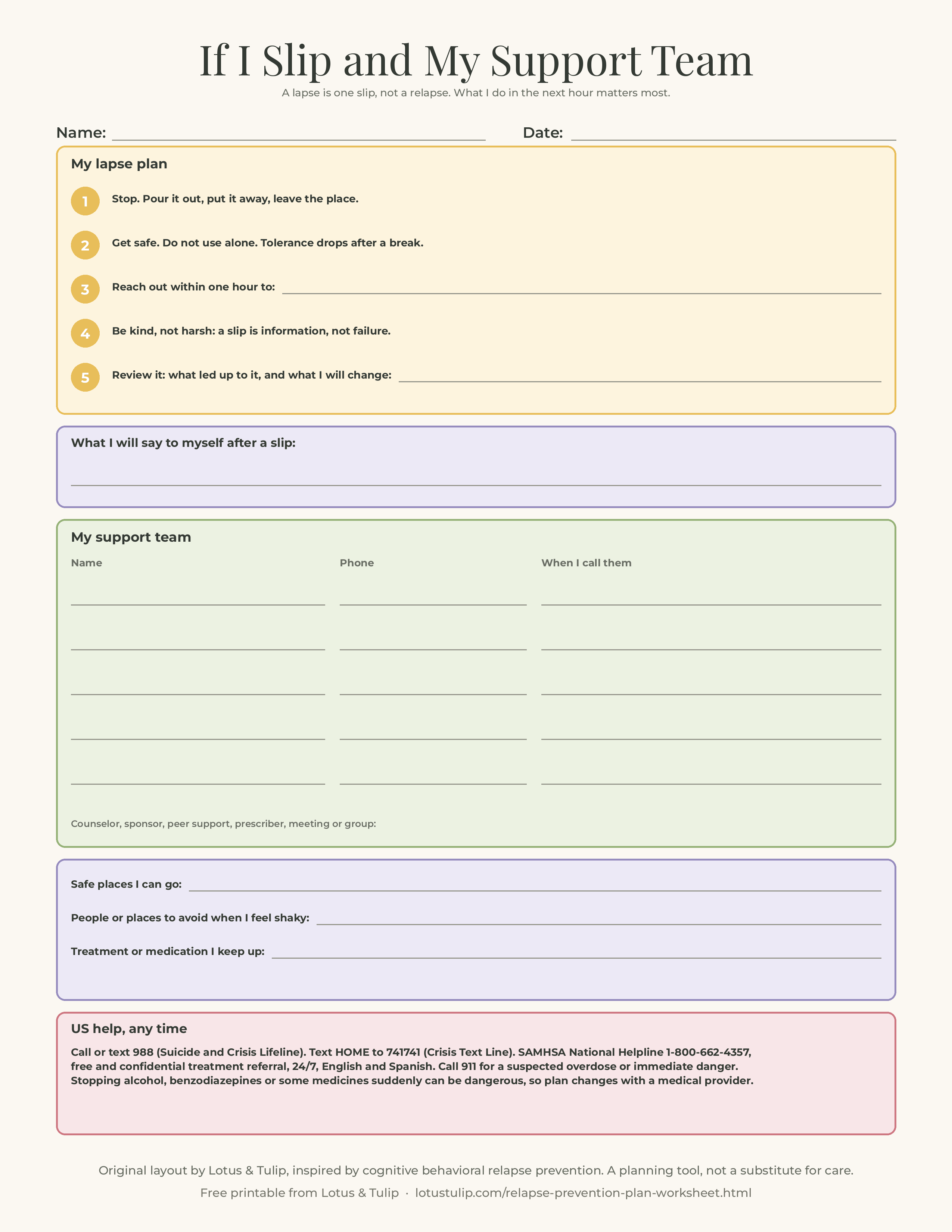
Free to print for your own use and for use with your own clients, students, or groups. This is an original layout by Lotus & Tulip, not an official relapse prevention or MBRP form, and not affiliated with the authors or organizations cited. Please link to this page rather than re-uploading the file.
Related resources
- Decisional balance worksheet: firm up commitment once a change is decided.
- Behavior chain analysis worksheet: map what led to a lapse and where to step in next time.
- Distress tolerance worksheets: crisis survival skills for strong urges.
- Window of tolerance worksheet: notice when stress pushes you out of your coping zone.
- ACT values worksheet: write the reasons recovery matters.
- Self care plan template: build the lifestyle balance that protects recovery.
Sources
- Marlatt, G. A., and Gordon, J. R. (Eds.) (1985). Relapse Prevention: Maintenance Strategies in the Treatment of Addictive Behaviors. Guilford Press.
- Larimer, M. E., Palmer, R. S., and Marlatt, G. A. (1999). Relapse prevention: An overview of Marlatt's cognitive-behavioral model. Alcohol Research and Health, 23(2), 151 to 160.
- Witkiewitz, K., and Marlatt, G. A. (2004). Relapse prevention for alcohol and drug problems: That was Zen, this is Tao. American Psychologist, 59(4), 224 to 235.
- Irvin, J. E., Bowers, C. A., Dunn, M. E., and Wang, M. C. (1999). Efficacy of relapse prevention: A meta-analytic review. Journal of Consulting and Clinical Psychology, 67(4), 563 to 570.
- Bowen, S., Witkiewitz, K., Clifasefi, S. L., et al. (2014). Relative efficacy of mindfulness-based relapse prevention, standard relapse prevention, and treatment as usual for substance use disorders: A randomized clinical trial. JAMA Psychiatry, 71(5), 547 to 556.
- Kuyken, W., Warren, F. C., Taylor, R. S., et al. (2016). Efficacy of mindfulness-based cognitive therapy in prevention of depressive relapse: An individual patient data meta-analysis from randomized trials. JAMA Psychiatry, 73(6), 565 to 574.
- Melemis, S. M. (2015). Relapse prevention and the five rules of recovery. Yale Journal of Biology and Medicine, 88(3), 325 to 332.
- National Institute on Drug Abuse. Drugs, Brains, and Behavior: The Science of Addiction, Treatment and Recovery. nida.nih.gov.
- SAMHSA National Helpline, samhsa.gov. 988 Suicide and Crisis Lifeline, 988lifeline.org. Crisis Text Line, crisistextline.org.
Relapse prevention plan worksheet: FAQ
What should be included in a relapse prevention plan?
A relapse prevention plan usually lists high risk situations and triggers, early warning signs, specific coping strategies written as if then plans, a plan for what to do after a lapse, support contacts with phone numbers, crisis lines, and the person's reasons for recovery. Keep the core plan to a page or two so it is actually used.
What is the difference between a lapse and a relapse?
A lapse is a single slip, such as one drink or one use after a period of change. A relapse is a return to the old pattern. In the Marlatt and Gordon model, how a person reacts to a lapse, especially guilt and a sense of total failure called the abstinence violation effect, strongly influences whether it becomes a relapse.
What is the abstinence violation effect?
The abstinence violation effect is the reaction many people have after breaking a commitment not to use: guilt, shame and the belief that they have blown it, so they might as well keep going. Relapse prevention teaches people to see a lapse as a specific, fixable mistake and a chance to learn, which lowers the risk of a full relapse.
What are the three stages of relapse?
A commonly used clinical description (Melemis, 2015) divides relapse into emotional relapse, where self care slips; mental relapse, where cravings and bargaining start; and physical relapse, which is actual use. It is a helpful way to sort warning signs, though it is a clinical model rather than a formally tested scale.
Can a relapse prevention plan be used for depression or anxiety?
Yes. The same structure of warning signs, triggers, coping steps and support contacts is a standard part of finishing CBT, behavioral activation and mindfulness based cognitive therapy. Warning signs for depression often include sleep changes, withdrawal and hopeless thinking; for anxiety, a return of avoidance and safety behaviors.
How often should a relapse prevention plan be updated?
Review it regularly, for example monthly in early recovery, and always after a lapse, a major life change such as a move, new job, breakup or loss, or a change in treatment or medication. Triggers and supports change over time, so the plan should too.
Can I print the free relapse prevention plan worksheet for clients?
Yes. The free PDF is an original Lotus & Tulip layout that you can print for your own use and for your own clients, students or groups. Please link to this page instead of re-uploading the file.