
Kids and teens · Updated 2026-11-06
Conflict Resolution Activities for Teens (with Free Printable)
Ready-made printable: Social Skills Small Group Curriculum for School Counselors, Grades 2 to 5 Holiday 20% off: about $11.04, was $14 (EUR 12) · instant digital download
Buy on Etsy
Conflict resolution for teens is the set of skills that help middle and high school students cool their bodies, speak clearly, listen and paraphrase, brainstorm options, choose a fair compromise or win-win, and repair after a fight without making the problem bigger. Teen conflict is not the same as elementary playground disputes. Phones, group chats, screenshots, dating, identity, sports teams, and hallway status raise the stakes. Disagreement is normal. Harm is not. Belonging still matters, and so does knowing when a conflict is really bullying that needs adult action instead of a peace talk.
This Lotus and Tulip page is a teen-focused conflict resolution activities guide with an original free three page US Letter printable. It targets searches families and helpers actually use: conflict resolution activities for teens, conflict resolution worksheets for teenagers, teen conflict resolution skills, and how to teach conflict resolution to teens, middle school, or high school. It is distinct from our conflict resolution worksheet (kids focused, six-step cool down, talk, brainstorm, win-win), from friendship activities for teens (repair is a neighbor skill inside belonging), from peer pressure worksheets for teens, from anger management activities for teens, from assertiveness, I statements, and healthy boundaries, from bullying worksheets for kids (conflict is not the same as bullying; we explain the difference below), from icebreaker activities for counseling groups, from social skills worksheets for kids, and from emotional regulation activities for teens. Those neighbors help. This page centers adolescent conflict: cool body first, I-statements, listen and paraphrase, options, fair compromise, repair, and digital conflict scenes teens actually face.
We credit research lineages honestly: social problem-solving and conflict resolution models associated with Thomas D'Zurilla and Marvin Goldfried and later social problem-solving reviews; school social and emotional learning reviews such as Durlak and colleagues (2011) as program-level context, not proof that this printable remits diagnoses; peer conflict versus bullying distinctions used in school guidance (including StopBullying.gov style advice that peer mediation is the wrong tool for bullying); and perspective-taking / theory-of-mind developmental work as a neighbor skill for hearing another side. We are not affiliated with those authors, any textbook publisher, StopBullying.gov, or any branded conflict curriculum. This printable is an original educational layout, not a copy of any copyrighted worksheet and not a diagnosis or treatment.
This guide is educational. It is not therapy, not medical advice, and not a diagnosis. If thoughts of ending your life, plans to harm yourself or someone else, or a medical emergency show up, stop the worksheet and get help now: in the US, call or text 988, text HOME to 741741, or call 911. Our safety plan worksheet is a better first tool in that moment. Nearby tools: conflict resolution for kids, friendship for teens, anger for teens, emotion regulation for teens, peer pressure, assertiveness, I statements, healthy boundaries, bullying, icebreakers, and social skills for kids.
Jump to the free conflict resolution printable (PDF) · How to use conflict resolution activities for teens, step by step · Worked examples · Comparisons
What teen conflict resolution is (and how it differs from kids conflict)
Kids conflict pages often teach a six-step cool down, talk it out, name the problem, brainstorm, pick a win-win, and check back, with adult coaching and classroom cards. Teen conflict resolution keeps those bones and adds autonomy, digital complexity, dating and friend-group politics, and a clearer line between ordinary disagreement and bullying or safety risk.
Teen conflict resolution skills include:
- Cool body first before words, because flooded teens escalate chat fights and hallway scenes.
- Clear I-statements that name feeling, situation, and ask without a character attack.
- Listen and paraphrase so the other person feels heard before you push your fix.
- Options brainstorm with at least three ideas before locking one plan.
- Win-win or fair compromise that protects dignity, safety, and follow-through.
- Repair after when trust cracked, including public chat messes and screenshot harm.
- Knowing when not to mediate: bullying, threats, stalking, or imminent harm need adult action, not a peace talk.
Teens also weigh status, identity groups, sports and arts scenes, dating, and online audiences. A skill that worked with a teacher nearby (two chairs, a win-win planner) may need a teen version: cool on your own, text a repair line, refuse a public pile-on, and bring an adult when power imbalance is the real problem.
Conflict vs disagreement vs bullying
Not every hard moment is the same problem. Mixing them up wastes skills and can harm targets.
Disagreement is a difference of preference, opinion, or plan. Two people can both care and still want different things. Skills: clarify, compromise, or agree to disagree without contempt.
Conflict is a clash of needs, goals, or resources where both sides have a stake and roughly comparable power to speak. Skills: cool, talk, listen, brainstorm, choose a fair plan, repair. That is this page's main job.
Bullying is repeated harm or a clear power imbalance with intent to hurt, humiliate, or control. Putting a targeted teen in a "win-win" room with the person who bullies them can make things worse. School guidance in the StopBullying.gov tradition advises against using conflict resolution or peer mediation as the response to bullying. Use bullying worksheets, reporting pathways, and adult protection instead. Conflict skills are for peer friction. They are not a substitute for safety when someone is being targeted.
Teach teens a quick sort: Is this a one-time clash between equals, or repeated harm with power imbalance? If unsure and fear is high, get an adult first.
How to use conflict resolution activities for teens, step by step
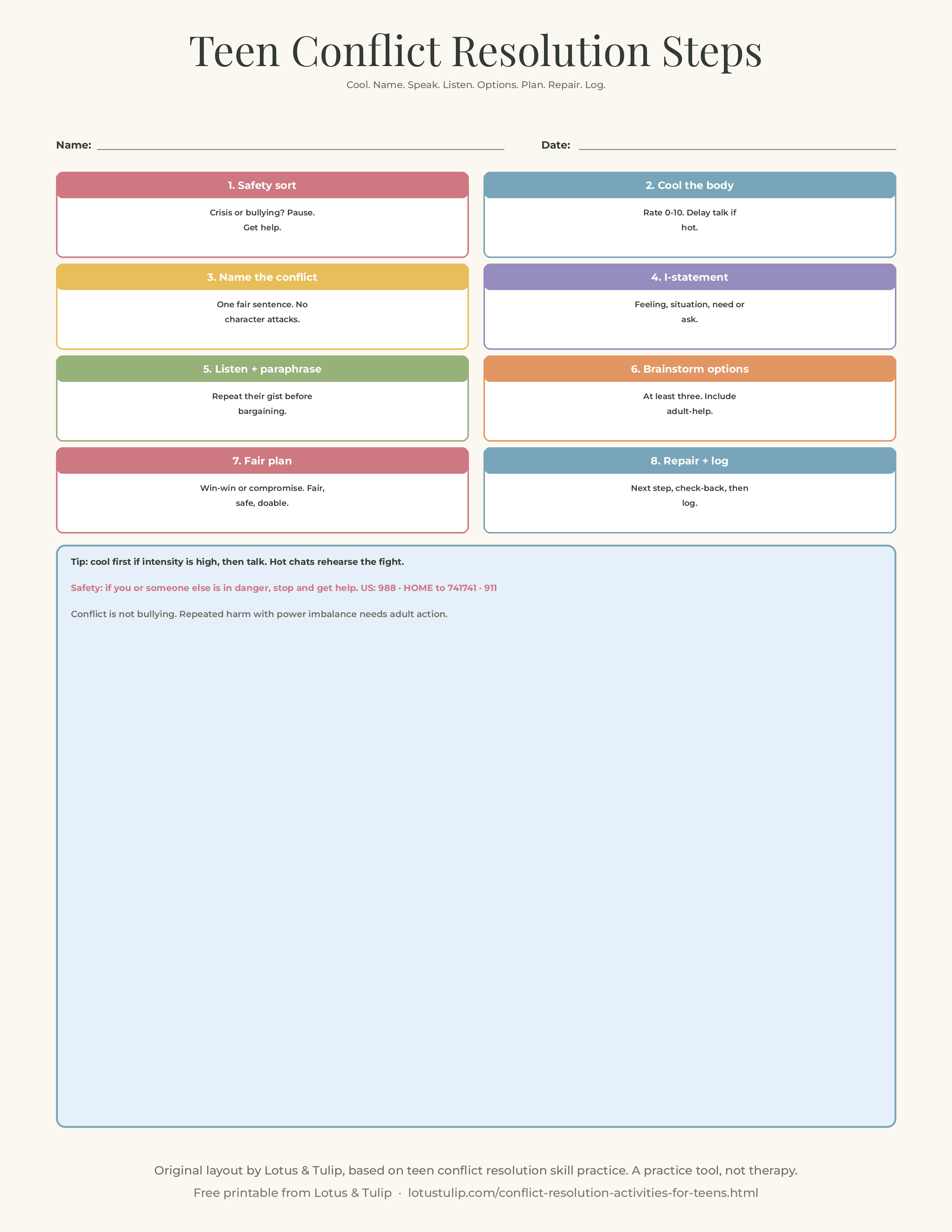
- Check safety and fit. If acute crisis, threats, stalking, violence, or bullying with imminent harm, pause. Use crisis pathways first: 988, HOME to 741741, or 911 when needed. Prefer a safety plan in that moment. For bullying response, use the bullying page and school reporting. Do not force a peace talk with a target of bullying.
- Cool the body first. Rate intensity 0 to 10. If you are at a 7 or higher, delay the talk. Walk, breathe, put the phone face down, or use a short cool-down from emotion regulation for teens or anger management for teens. Hot chats usually rehearse the fight, not the fix.
- Name the conflict in one fair sentence. What is the clash of needs without character attacks? Write it on the free plan page. Keep it specific: "We both want different things about the group project deadline," not "You are lazy."
- Use an I-statement. Feeling, situation, need or ask. Pair with I statements and assertiveness when the first draft sounds like a lecture. Avoid "you always" openers.
- Listen and paraphrase. Ask for their side. Repeat back the gist before you argue. Perspective-taking is a skill, not a personality trait. If you cannot paraphrase yet, you are not ready to bargain.
- Brainstorm at least three options. Quantity before quality. Include fair compromises and one "ask an adult" option when the conflict is bigger than either of you.
- Choose a win-win or fair compromise. Check fair, safe, and doable. Perfect wins are rare. A plan both can live with beats a speech neither follows.
- Repair and follow through. Agree on the next step, who does what, and when you will check back. Repair without change becomes a loop. For friendship-specific repair inside belonging, also see friendship activities for teens.
- Log and bridge. Record the practice on the log page. Bridge to boundaries, peer pressure, anger tools, emotion regulation, or bullying tools when those are the real load.
Practice on ordinary friction first (a missed invite, a shared project snag, a short chat snub) before relying on skills in a public pile-on or a friendship ending. Skill grows with reps.
Cool body first: why flooded talks fail
When the body is loud, the brain narrows. Teens know this as "I said stuff I regret" or "I typed the paragraph I cannot unsend." Cool-down is not avoiding forever. It is buying enough regulation to use words that match your values.
Quick cool moves: phone face down, leave the group chat for ten minutes, walk a hallway loop, water, three slow breaths, name the feeling and rate it, ask for a later talk time. Pair with emotion regulation when the cue is flooding, and with anger for teens when the cue is heat and urge to strike back. Venting into a larger chat while hot usually spreads the conflict, not the repair.
I-statements, listen, and paraphrase
I-statements reduce character attacks: "I feel frustrated when the plan changes last minute. I need a heads-up so I can adjust. Can we agree to text by 6?" That is clearer than "You never care." See I statements.
Listening is not agreeing. Paraphrase proves you heard: "So you are saying you felt left out when I posted without you, and you want a check-in first next time. Did I get that?" Then share your side. Teens often skip this step and jump to defense. Teach it as a required turn, not a niceness contest.
Assertiveness sits next door: clear asks without aggression or collapse. See assertiveness. Boundaries protect time, body, privacy, and values when the conflict is about a line, not only a one-time plan. See healthy boundaries.
Options, win-win, and fair compromise
Social problem-solving lineages associated with D'Zurilla and Goldfried emphasize defining the problem, generating alternatives, and deciding with criteria, not freezing on the first angry idea. Credit that lineage with non-affiliation. This page is not a D'Zurilla protocol and does not reproduce copyrighted manual worksheets.
Brainstorm rules that help teens: list at least three options before judging; include a pause option and an adult-help option; check fair, safe, and doable; pick one trial plan with a check-back time. Win-win means both needs get air. Fair compromise means both give something. Either beats silent resentment or a public roast.
For younger language and classroom scenario cards, keep using the kids conflict resolution worksheet. For teens, prefer dignity-respecting language, digital scenes, and optional adult coaching rather than babyish cartoons.
Repair after conflict
Conflict is normal. Repair is the skill. A repair sequence teens can use: cool body, own your part without a fake apology that blames them, use an I-statement, listen for their side, agree on one next step, follow through. Screenshot and group-chat repairs may need a public correction plus a private apology. Friendship repair inside belonging is covered more fully on the friendship for teens page. This page keeps repair as the last stage of a conflict plan.
Digital conflict: group chats, screenshots, and public pile-ons
Phones are part of teen conflict, not a side quest. Moralizing ("just delete the app") often shuts teens down. Teach workable habits instead.
Group chats. Chats escalate fast. Skills: wait while hot, cool first, move hard talks to private when safe, refuse pile-ons, exit chats that are mostly cruelty.
Screenshots. Ask before sharing private messages. Repair if a screenshot spread without consent. Pair with values talk, not only rules talk.
Public pile-ons. Do not force a teen to "talk it out" in a hostile audience. Cool, get an adult when needed, and repair in a safer channel. Repeated public humiliation with power imbalance is closer to bullying than to ordinary conflict.
Ghosting after a fight. Sudden silence can mean overwhelm, avoidance, or safety. Teach one clear check-in, then protect dignity. Do not force contact that feels unsafe.
Worked fictional examples
Teen example, group project (fictional): Alex, age 14, and a partner both missed parts of a shared slide deck. Cue: blame texts at a 6. Cool: phones down, ten minute walk. I-statement: "I feel stressed when deadlines change without a text. I need us to confirm roles by Sunday." Paraphrase the partner's side about a family event. Options: split remaining slides, ask the teacher for a short extension together, or meet at lunch. Plan: lunch meet, check back Wednesday. Written on the free conflict plan.
Teen example, group chat pile-on (fictional): Riley, age 16, sees a joke about them spreading. Cue: face heat, urge to fire back. Cool body: phone face down, walk, three breaths. Choose: private message to one trusted friend, then a clear request to take the screenshot down. Reflect: "Public clapbacks at a 7 make it worse." Bridge to emotion regulation and, if repeated with power imbalance, to bullying pathways.
Teen example, friend conflict after a boundary (fictional): Jordan, age 15, told a friend they cannot vent every night after 11. The friend called them selfish in the chat. Script after cool-down: "I care about you. I still need no texts after 11 on school nights. I felt hurt by the selfish comment. Can we talk after school?" If the friend punishes every boundary, that is data. Pair with boundaries and adult support.
School counselor note (fictional): In a twelve minute meeting, a counselor helps a student fill conflict name, intensity rating, one I-statement, a paraphrase of the other side, three options, and one check-back plan. Optional practice, never forced mediation with a bullying target. Follow district crisis and bullying protocols when risk appears. For multi-session groups, pair with a social skills or friendship curriculum rather than stacking every worksheet in one period.
Teen conflict vs kids conflict, friendship teens, anger teens, peer pressure, and assertiveness
| Teen conflict (this page) | Kids conflict | Friendship for teens | Anger for teens | Peer pressure | Assertiveness | |
|---|---|---|---|---|---|---|
| Main job | Cool, I-statement, listen, options, fair plan, repair, digital conflict | Six-step solve and win-win with younger language | Belonging, healthy vs unhealthy patterns, digital repair, boundaries | Cool-down, body cues, anger-specific skills | Refusal skills and dare scripts | Clear asks and no without aggression |
| Best early use | When teens need structured peer conflict skills with digital complexity | Younger kids with adult coaching | When the load is friendship quality and belonging | When anger intensity is the main barrier | When the scene is a dare or pressure to break values | When the teen needs clearer wording for asks and no |
| Output | Conflict name, cool plan, I-statement, paraphrase, options, check-back, practice log | Problem solve page and scenario cards | Goal, signals, script, repair or boundary plan | Anger plan and cool-down steps | Refusal plan and scripts | Ask and no scripts with practice log |
| Cross link | This page | Kids conflict | Friendship teens | Anger teens | Peer pressure teens | Assertiveness |
These tools cooperate. Teen conflict builds the adolescent solve-and-repair loop. Kids conflict keeps younger language. Friendship teens centers belonging. Anger teens specializes cool-down for heat. Peer pressure specializes refusal. Assertiveness and I-statements sharpen wording. Boundaries protect lines. Bullying tools protect targets. Emotion regulation supports the cool body underneath. Teach one tool clearly before stacking four on day one.
School counselor, therapist, and parent tips
Teens. Prefer concrete scenes over lectures about "conflict as a construct." Let them reject babyish cartoons. "Cool, name it, I-statement, paraphrase, three options, one plan" often lands better than a long theory talk. Keep experiments tiny and within their real control. Pair with friendship for teens when belonging is tangled with the fight, and with anger for teens when intensity blocks talking.
School counselors. Short meetings favor a compressed sequence: safety sort, intensity rating, conflict name, one I-statement, one paraphrase, three options, one check-back. Groups can practice with low-stakes role plays. Never force mediation between a bullying target and the person who bullies them. Follow district bullying and crisis protocols if risk appears. Optional practice, never forced disclosure of peer names. Avoid shaming "drama kids"; target the skill gap and the load (sleep, ADHD supports, exclusion, trauma), not the teen's worth. SEL programs (including findings summarized in school-based reviews such as Durlak and colleagues) can support social-emotional skill building at a program level. They do not prove that this free three page printable remits diagnoses.
Therapist tips:
- Stay in the client's language. Reflect their conflict scenes and values. Do not overwrite with your favorite curriculum label on day one.
- Separate ordinary conflict from bullying and safety risk out loud, repeatedly, without excusing harm.
- Lower arousal before solve-talk. Flooded teens cannot use fancy worksheets well.
- Treat digital scenes as real conflict scenes. Screenshots, stories, and pile-ons belong in the plan.
- Bridge to neighbors. Anger and emotion regulation for cool-downs, I-statements and assertiveness for wording, boundaries for lines, friendship for belonging repair, peer pressure for dares, bullying tools for power-imbalance harm.
- Measure function. Ask what changed: cooler starts, clearer asks, earlier exits from cruel chats, better repair, fewer all-night guilt spirals, more adults told when safety is the issue.
Parents. Model conflict repair out loud ("I apologized to my coworker today and we agreed on a new plan"). Do not force teens to stay in every conflict to look polite. After a blow-up, prioritize safety, then cool-down, then skill practice when everyone is regulated. Do not turn the conflict plan into a new weapon ("fill this out or else") that makes the worksheet feel like punishment. Take bullying reports seriously and follow school procedures. Conflict resolution is the wrong first tool for bullying.
Common mistakes
- Skipping the cool-down and starting talks (or chat replies) while flooded.
- Using conflict mediation for bullying or putting a target in a forced peace talk.
- Character attacks instead of I-statements ("you always," "you never").
- Skipping paraphrase and jumping straight to bargaining or punishment.
- Locking the first angry idea instead of brainstorming three options.
- Moralizing phones instead of teaching digital cool-down, private repair, and exit skills.
- Ignoring sleep, ADHD supports, trauma load, or substance pressure while blaming "conflict skills" alone.
- Using it in acute crisis instead of safety first.
- Treating the worksheet as therapy. Paper supports practice. It does not replace a clinician when problems are severe or lasting.
When not to use this worksheet
Good early uses: a teen who can name a peer conflict, mild to moderate friction, homework between counseling sessions, school counseling check-ins, and building a cool-down plus fair-plan sequence.
Prefer another tool first when:
- Acute safety risk or medical emergency: stabilize and get help (988, HOME to 741741, 911). Prefer a safety plan.
- Active violence, stalking, or imminent harm: prioritize safety, supervision, and emergency protocols over worksheets.
- Clear bullying with power imbalance: use bullying worksheets and school reporting pathways. Do not mediate.
- Dare and refusal scenes: use peer pressure worksheets for teens.
- When younger language fits better: use the kids conflict resolution worksheet.
- When the teen is too flooded to engage: co-regulate first, then return to plan work. See emotion regulation for teens and anger for teens.
What the research says (honestly)
Conflict resolution activities and worksheets are a skill practice aid, not a standalone RCT treatment. Do not claim this free printable remits conduct problems, anxiety, trauma symptoms, or any diagnosis.
Social problem-solving lineage. Models associated with Thomas D'Zurilla and Marvin Goldfried, and later social problem-solving reviews, treat problem definition, generation of alternatives, decision making, and solution implementation as trainable steps for interpersonal problems. Credit that lineage with clear non-affiliation. This page is not a D'Zurilla and Goldfried protocol and does not reproduce copyrighted measures or manual worksheets.
Peer conflict versus bullying. School guidance in the StopBullying.gov tradition distinguishes conflict (mutual stakes, more comparable power) from bullying (power imbalance, repetition, intent to harm) and advises against peer mediation as the response to bullying. Use that distinction as safety guidance, not as a claim that this printable diagnoses bullying.
Perspective-taking as a neighbor skill. Developmental work on perspective-taking and related social cognition describes hearing another person's view as a capacity that grows with age and practice. Treat it as a neighbor skill for the paraphrase step, not as proof that this sheet creates empathy by itself.
School SEL caveats (including Durlak and colleagues 2011). School-based social and emotional learning reviews report average benefits for social-emotional skills and related outcomes at a program level. Those reviews are not proof that this free printable remits diagnoses or replaces counseling.
Honest caveat. Use teen conflict practice inside a coherent plan with adult support, bullying response, sleep and school supports, and neighboring emotion regulation, anger, friendship, assertiveness, and boundaries tools when needed. For severe aggression, trauma, psychosis, or acute risk, use disorder-appropriate care and crisis pathways. No study tests this three page Lotus and Tulip printable alone.
Free conflict resolution printable for teens (PDF)
The free conflict resolution printable has three pages in US Letter size:
- Page 1: Teen Conflict Resolution Steps card. Sequence matching the HowTo: safety sort, cool body, name the conflict, I-statement, listen and paraphrase, brainstorm options, choose a fair plan, repair and follow through, log and bridge, plus safety reminders.
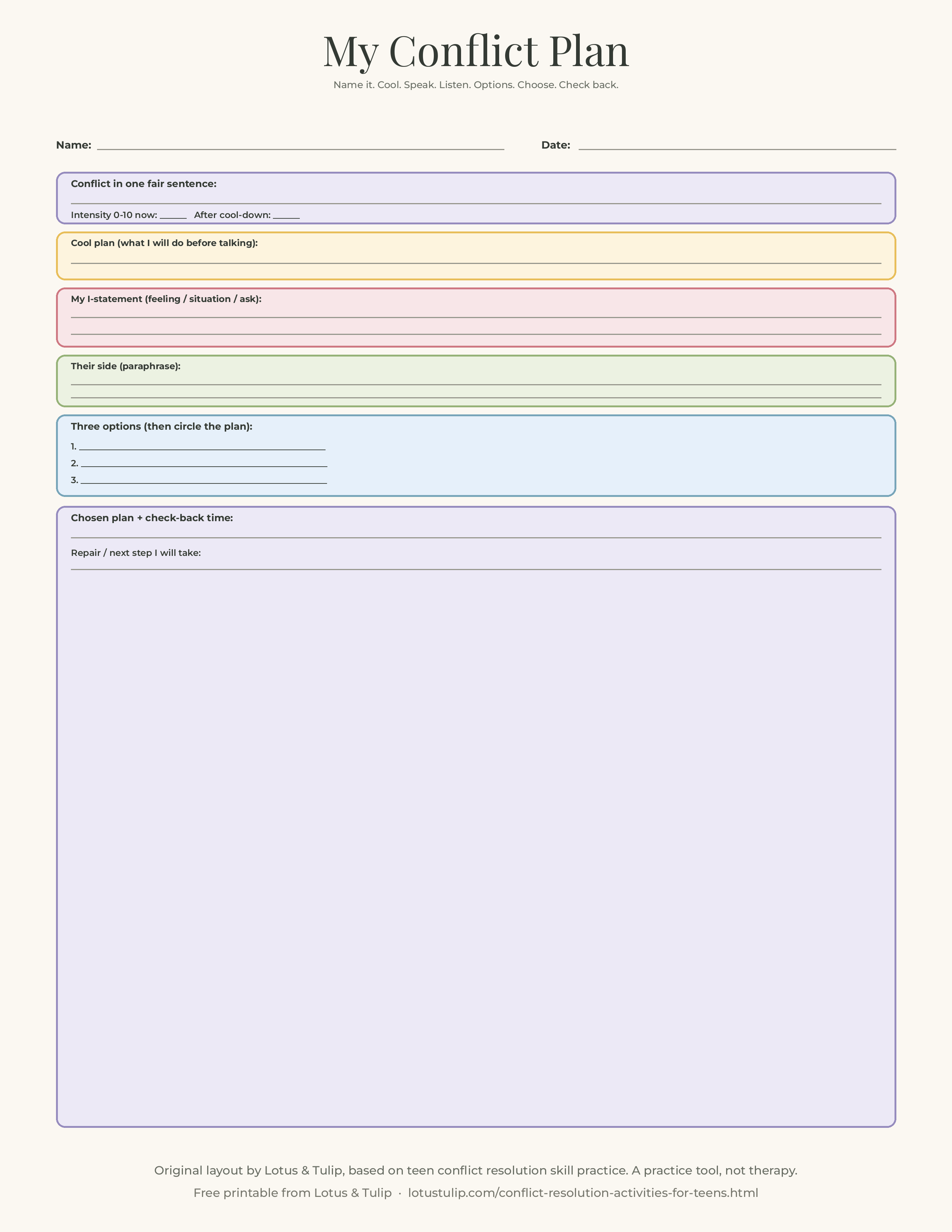
- Page 2: My Conflict Plan. Fill in conflict name, intensity, cool plan, I-statement, their side paraphrase, three options, chosen plan, and check-back.
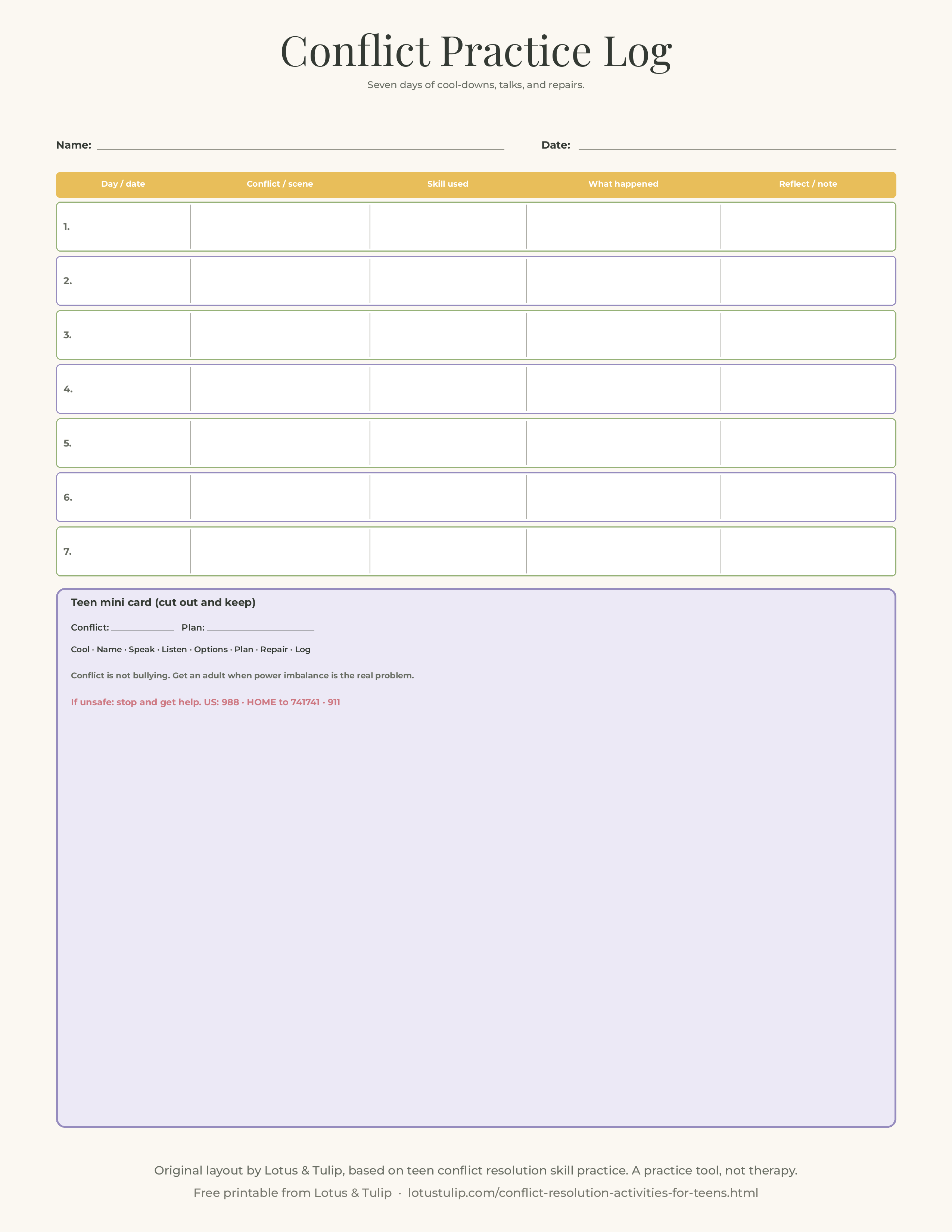
- Page 3: Practice Log + teen mini card. Seven day rows plus a cut out reminder for cool, name, speak, listen, options, plan, repair.
Download the free conflict resolution printable for teens (PDF, 3 pages, US Letter)
Prefer single images? Page 1: Teen Conflict Resolution Steps (PNG) · Page 2: My Conflict Plan (PNG) · Page 3: Practice Log (PNG)
Free to print for your own use and for use with your own clients, students, or groups. This is an original layout by Lotus & Tulip, based on teen conflict resolution skill practice associated with social problem-solving research lineages (including D'Zurilla and Goldfried), with peer conflict versus bullying guidance as safety context, and with school SEL reviews such as Durlak and colleagues as program-level neighbors. It is not affiliated with those authors, StopBullying.gov, any scale publisher, or any specific treatment or curriculum package, and is not a substitute for therapy. Please link to this page rather than re-uploading the file.
Related resources
- Conflict resolution worksheet: kids six-step solve and win-win plans.
- Friendship activities for teens: belonging, signals, digital repair.
- Anger management activities for teens: cool-down and repair for anger.
- Emotional regulation activities for teens: cool body then choose.
- Peer pressure worksheets for teens: refusal skills and scripts.
- Assertiveness worksheet: clear asks without aggression.
- I statements worksheet: feeling, situation, ask.
- Healthy boundaries worksheet: lines and scripts.
- Bullying worksheets for kids: rude vs mean vs bullying, upstander plans.
- Icebreaker activities for counseling groups: group openers.
- Social skills worksheets for kids: foundational social steps.
- Safety plan worksheet: when the moment is about staying safe and alive.
Sources
- D'Zurilla, T. J., and Goldfried, M. R. (1971). Problem solving and behavior modification. Journal of Abnormal Psychology, 78(1), 107 to 126. Social problem-solving lineage. Educational credit with clear non-affiliation. Not a claim that this printable is a D'Zurilla and Goldfried protocol.
- Later social problem-solving reviews and training models building on that lineage (problem definition, alternatives, decision, implementation). Research lineage with caveats; not technique-only proof of this printable.
- StopBullying.gov style school guidance distinguishing conflict from bullying and advising against peer mediation as the response to bullying. Educational safety credit with clear non-affiliation. Guidance is not a diagnosis tool and is not proof that this free sheet remits harm.
- Perspective-taking / social cognition developmental research as a neighbor skill for paraphrase and hearing another side. Credit with non-affiliation; not proof that this sheet creates empathy alone.
- Durlak, J. A., Weissberg, R. P., Dymnicki, A. B., Taylor, R. D., and Schellinger, K. B. (2011). The impact of enhancing students' social and emotional learning: a meta-analysis of school-based universal interventions. Child Development, 82(1), 405 to 432. Program-level SEL context; not proof that this free sheet remits diagnoses.
- Honest caveat: teen conflict resolution drills are a skill practice aid. Social problem-solving reviews, bullying-versus-conflict guidance, perspective-taking research, and school SEL reviews are not the same as technique-only RCTs of this Lotus and Tulip printable.
Conflict resolution activities for teens: FAQ
What are conflict resolution activities for teens?
They are practice tools for cooling the body, using I-statements, listening and paraphrasing, brainstorming options, choosing a fair plan, and repairing after peer conflict, including digital scenes. They are educational skill aids, not therapy.
Is this the same as the kids conflict resolution page?
No. The kids page uses younger language, six steps, scenario cards, and a win-win planner for elementary ages. This teens page centers adolescent conflict with digital life, bullying-versus-conflict sorting, and autonomy-respecting plans.
How is conflict different from bullying?
Conflict is a clash of needs with more comparable power. Bullying involves power imbalance, repetition, or intent to harm. Do not use peer mediation as the first response to bullying. Use bullying tools, reporting, and adult protection.
Can school counselors use it with teens?
Yes, often in short meetings with safety sort, one I-statement, one paraphrase, three options, and one check-back. Keep practice optional and school safe. Follow bullying and crisis protocols when risk appears. Do not use the page as a diagnosis.
What should teens do about group chat fights?
Cool first when hot, move hard talks to private when safe, set screenshot and respect boundaries, and exit chats that are mostly cruelty. Public pile-ons are poor places for repair. Get an adult when fear or power imbalance is high.
When should I not use this worksheet?
Do not use it as the first move in acute safety risk, medical emergency, active violence, or clear bullying that needs reporting and safety plans first. Stabilize and get help when needed: 988, HOME to 741741, or 911.
Is this affiliated with D'Zurilla and Goldfried, StopBullying.gov, or SEL manuals?
No. This is an original Lotus and Tulip educational layout. We credit research lineages with clear non-affiliation and do not reproduce copyrighted manual worksheets.