
Therapist practice · Updated 2026-11-10
Clinical Supervision Agreement for Therapists: What to Include, State Board Rules, Telesupervision and a Supervision Log (Free Template)
Ready-made printable: Therapy Progress Notes and Intake Templates Fillable PDF, 20 pages: SOAP, DAP and BIRP notes, intake, treatment plan and safety plan
Holiday 20% off: about $7.36, was $9 (EUR 8) · instant digital download
Try it free first: download a fillable sample (SOAP note and DAP note, PDF, 226 KB). Type into it on screen, then get the full pack. No email needed.

Most supervision problems that end up in front of a licensing board did not start with a dramatic ethics violation. They started with something nobody wrote down. The associate thought video supervision counted; the board did not. The supervisor thought the associate would call before making a child abuse report; the associate thought the opposite. The evaluation said "needs improvement" for the first time in month fourteen, and nobody could find the document that said what "satisfactory" meant. The supervisor's license lapsed for six weeks and three months of hours quietly stopped counting. A written supervision agreement is the cheapest protection against all of this, for the supervisee, the supervisor and, above all, the clients.
This guide is written for counselors, marriage and family therapists, social workers and psychologists in training, and for the licensed clinicians who supervise them, in the United States. It explains what a clinical supervision agreement is and how it differs from a board form, a supervisory plan and a professional disclosure statement; what the ACA Code of Ethics (Section F), the ACES Best Practices in Clinical Supervision, the NASW Code of Ethics and the NASW and ASWB supervision standards, the AAMFT Code of Ethics and Approved Supervisor handbook, and the APA Ethics Code and the APA's 2025 revised Guidelines for Clinical Supervision actually say; fourteen sections every agreement should cover, with sample wording; three verified examples of state board rules (California, Texas and Florida, including Florida's July 2026 rule change); telesupervision; how to tell clients they are seeing a supervisee; direct and vicarious liability; what to document after every supervision session; evaluation, remediation and due process; how supervision should end; a ten step process; a filled example for a fictional practice; and a free three page printable with a blank agreement outline, the same outline filled in, and a first session checklist with a supervision session log.
Jump to the free supervision agreement template and session log
This is educational information for clinicians and trainees in the US. It is not legal advice, and it does not tell you whether any hours will count toward your license. Supervision rules differ by state, by profession and by license level, and boards change them often; before you sign anything, read your own board's current statutes, rules and required forms. The sources below were checked on November 10, 2026: the 2014 ACA Code of Ethics (counseling.org); the ACES Best Practices in Clinical Supervision, adopted April 22, 2011 (acesonline.net); the NASW and ASWB Best Practice Standards in Social Work Supervision (2013) and the NASW Code of Ethics; the AAMFT Approved Supervisor Designation Standards Handbook dated September 2026 (aamft.org); the APA Ethical Principles of Psychologists and Code of Conduct (2017) and the APA Guidelines for Clinical Supervision in Health Service Psychology approved in August 2025 (apa.org); the California Board of Behavioral Sciences Supervision Agreement (form 37M-300, revised 05/2026), its Index of Legal Citations and Business and Professions Code sections 4980.43 and 4980.43.2; the Texas Behavioral Health Executive Council's LPC Associate Supervisory Agreement Form and Supervised Experience Documentation Form (revised October 12, 2026) and 22 Texas Administrative Code 681.92 and 681.93; and Florida Administrative Code rule 64B4-2.002 as amended effective July 6, 2026 (flrules.org).
The short answer
- A clinical supervision agreement is a written document, signed by the supervisor and the supervisee, that says how supervision will work. It covers who is responsible for what, when and how you meet, what methods are used, how risk and emergencies are handled, how clients are told, what is documented, how the supervisee is evaluated, what happens if there is a problem and how supervision ends.
- The professional standards all expect one. The ACES Best Practices say the supervisor provides "a written contract (or syllabus)" in the first session. ACA standard F.4.a requires informed consent for supervision. The NASW and ASWB standards say supervisors and supervisees "should also sign a written contract." The APA's 2025 guidelines recommend "a written supervisory contract or agreement" and list eleven elements it may include. The AAMFT handbook publishes a sample contract and a contract checklist.
- Some states require a specific form, and it is not the whole agreement. California's Board of Behavioral Sciences requires the supervisor and supervisee to sign its Supervision Agreement, including a supervisory plan, within 60 days of starting supervision. Texas requires its Supervisory Agreement Form with an LPC Associate application, and that form says plainly: "This is not a contract between supervisee and supervisor."
- Board rules decide whether hours count. Amounts, formats, video, group size, who may supervise and how hours are signed all come from your state's statutes and rules. Get them wrong and hours can be lost, whatever your agreement says.
- Clients must be told. ACA standard F.5.c and APA standard 10.01(c) require supervisees to disclose that they are in training and supervised, and APA requires giving the supervisor's name.
- Write it down every time. Keep the signed agreement, a note of every supervision session, the hours log and every evaluation, separate from client records.
What a clinical supervision agreement is, and what it is not
Clinical supervision, in the sense that matters for licensure, is not a friendly chat with a senior colleague. The APA's 2025 guidelines define it as "a distinct professional practice employing a collaborative relationship that has both facilitative and evaluative components," whose goals are to "enhance the professional competence and science-informed practice of the supervisee, monitor the quality of services provided, protect the public, and provide a gatekeeping function for entry into the profession." California's supervision agreement puts the legal side more bluntly: "supervision" means "responsibility for, and control of, the quality of mental health and related services provided by the supervisee."
That combination of teaching, oversight and evaluation, with real power on one side, is exactly why a written agreement matters. The APA guidelines note that a supervision contract "has been defined as an informed consent document" and that omitting one "may lead to misunderstandings and pose the potential of harm to the supervisee and clients."
Supervision is not consultation
The APA guidelines distinguish supervision from consultation, personal psychotherapy and mentoring by four things: professional responsibility and liability, the purpose of the activity, the relative power of the parties, and the presence or absence of evaluation. "In consultation, the consultant does not evaluate the referring provider, does not bear case responsibility, and the consultee makes the decision whether to accept and implement the consultation guidance." Boards draw the same line. California's agreement has the supervisor initial that "consultation or peer discussion shall not be considered supervision and shall not qualify as supervised experience." If a fully licensed clinician pays a colleague for case consultation, a consultation agreement is a good idea, but it is a different document with different terms; this guide is about supervision.
Four documents people confuse
Depending on your state and setting, you may need several documents, and it helps to keep them apart:
- The board's required form. Some boards require a specific supervision agreement, supervisor statement or registration of the supervisor before hours count. These forms mainly confirm that the supervisor qualifies and that both of you understand the board's rules. California's Supervision Agreement is eleven pages of initialed statements plus a supervisory plan. Texas's Supervisory Agreement Form is two pages of acknowledgments. Neither covers everything you need to agree.
- The supervision agreement or contract. The document this guide and the free printable are about: the working agreement between the two of you, covering logistics, methods, emergencies, evaluation, due process and ending. Professional standards expect it whether or not a board does.
- The supervisory plan or learning plan. The goals and objectives for the period. California requires one as part of its form; ACES, NASW and AAMFT all include goal setting. It can sit inside the agreement or be attached to it.
- The supervisor's professional disclosure statement. The ACES Best Practices say the supervisor provides "a professional disclosure statement regarding his/her academic background in both counseling and supervision, experience as a counselor and supervisor, and supervision style," with limits of confidentiality "explicitly delineated." Many supervisors attach a one page statement to the agreement.
If the supervisor works for a different employer than the supervisee, there may be a fifth: a written agreement between the supervisor and the supervisee's employer. California calls this a written oversight agreement and requires it before supervision starts when the supervisor is not employed by the supervisee's employer or is a volunteer.
What the professional standards say
Each profession has its own code, but on supervision they converge. Here is what each one says, in its own words where it matters.
Counselors: the ACA Code of Ethics, Section F
Section F of the 2014 ACA Code of Ethics, "Supervision, Training, and Teaching," opens by saying supervisors "aspire to foster meaningful and respectful professional relationships and to maintain appropriate boundaries with supervisees and students in both face-to-face and electronic formats." The supervision standards that bear on an agreement are F.1 to F.6:
- F.1, Counselor Supervision and Client Welfare. F.1.a: "A primary obligation of counseling supervisors is to monitor the services provided by supervisees," and supervisors "meet regularly with supervisees to review the supervisees' work." F.1.b: supervisors "work to ensure that supervisees communicate their qualifications to render services to their clients." F.1.c: supervisees "inform them of how the supervision process influences the limits of confidentiality" and make clients aware "of who will have access to records of the counseling relationship and how these records will be stored, transmitted, or otherwise reviewed."
- F.2, Counselor Supervision Competence. F.2.a: "Prior to offering supervision services, counselors are trained in supervision methods and techniques," and they "regularly pursue continuing education activities, including both counseling and supervision topics and skills." F.2.b covers multicultural issues and diversity in supervision. F.2.c, Online Supervision: supervisors using technology "are competent in the use of those technologies" and "take the necessary precautions to protect the confidentiality of all information transmitted through any electronic means."
- F.3, Supervisory Relationship. Supervisors "clearly define and maintain ethical professional, personal, and social relationships with their supervisees" (F.3.a); sexual or romantic relationships with current supervisees are prohibited, in person or electronic (F.3.b); supervisors do not condone or subject supervisees to sexual harassment (F.3.c); and supervisors "are prohibited from engaging in supervisory relationships with individuals with whom they have an inability to remain objective" (F.3.d).
- F.4, Supervisor Responsibilities. This is the heart of the agreement. F.4.a, Informed Consent for Supervision: "Supervisors are responsible for incorporating into their supervision the principles of informed consent and participation. Supervisors inform supervisees of the policies and procedures to which supervisors are to adhere and the mechanisms for due process appeal of individual supervisor actions. The issues unique to the use of distance supervision are to be included in the documentation as necessary." F.4.b, Emergencies and Absences: supervisors "establish and communicate to supervisees procedures for contacting supervisors or, in their absence, alternative on-call supervisors to assist in handling crises." F.4.c: supervisors make supervisees aware of "professional and ethical standards and legal responsibilities." F.4.d, Termination: either party may end supervision "with adequate notice," reasons are discussed, and when termination is warranted "supervisors make appropriate referrals to possible alternative supervisors."
- F.5, Student and Supervisee Responsibilities. Supervisees "have the same obligation to clients as those required of professional counselors" (F.5.a); they monitor themselves for impairment and notify their supervisors (F.5.b); and, under F.5.c, Professional Disclosure, "Before providing counseling services, students and supervisees disclose their status as supervisees and explain how this status affects the limits of confidentiality," and they "obtain client permission before they use any information concerning the counseling relationship in the training process."
- F.6, Counseling Supervision Evaluation, Remediation, and Endorsement. F.6.a: "Supervisors document and provide supervisees with ongoing feedback regarding their performance and schedule periodic formal evaluative sessions throughout the supervisory relationship." F.6.b, Gatekeeping and Remediation: supervisors help supervisees secure remedial assistance, "seek consultation and document their decisions to dismiss or refer supervisees for assistance," and ensure supervisees "are aware of options available to them to address such decisions." F.6.c: "Supervisors do not provide counseling services to supervisees." F.6.d: supervisors endorse supervisees for licensure "only when they believe that supervisees are qualified."
Read together, F.4.a, F.4.b, F.4.d, F.5.c and F.6.a describe most of an agreement: policies and procedures, due process, distance supervision, emergency contacts and a backup, ending with notice, client disclosure and scheduled formal evaluations.
Counselors: the ACES Best Practices in Clinical Supervision
The Association for Counselor Education and Supervision adopted its Best Practices in Clinical Supervision on April 22, 2011. They are organized in twelve sections: initiating supervision, goal setting, giving feedback, conducting supervision, the supervisory relationship, diversity and advocacy considerations, ethical considerations, documentation, evaluation, supervision format, the supervisor, and supervisor preparation. The first section is the most specific guidance on a supervision agreement in any of these documents. In the initial session, the supervisor "verbally describes and provides the supervisee with a written contract (or syllabus) that outlines expectations of the supervisor and supervisee; criteria for evaluation; consequences of underperformance; tasks, functions, and goals of supervision; and ethical and legal considerations (e.g., confidentiality in counseling and supervision sessions)." The specifics may be negotiated "to meet the needs of the particular supervisee."
The same section asks the supervisor and supervisee to "agree on time, place, and duration of supervision sessions," on how the supervisee will prepare, on "cancellation and rescheduling procedures," and on "payment for supervision (as appropriate and permitted by state law)." The supervisor provides "his/her emergency contact information, parameters for contacting the supervisor in emergency situations, and specific instructions for emergency protocols," and "clearly delineates his/her responsibility and authority to ensure client safety and effective treatment." If the supervisor is a supervisor in training, that status goes in the disclosure document along with the name and contact details of the supervisor's own supervisor.
The documentation section is equally concrete. At a minimum the supervisor keeps "the supervision contract (signed by supervisor, supervisee, and, as appropriate, the site supervisor or others involved in the supervisory experience), supervision session case notes, and formative and summative evaluations of the supervisee." Session notes include "supervisee and client informed consent, content of what was discussed (e.g., counseling session reviewed, client updates provided, site issues), review method used (e.g., recorded session, live observation), goals developed for counseling sessions, and recommendations and/or directives regarding counseling session and/or client care." Supervision records are kept so they protect the supervisee's privacy, "in a locked file cabinet or on a secure server," and "separate from any client files." When supervision is for licensure, the supervisor keeps documentation "until the supervisee submits such documentation for credentialing."
Social workers: the NASW Code of Ethics and the NASW and ASWB supervision standards
Standard 3.01 of the NASW Code of Ethics, Supervision and Consultation, says social workers who supervise should have the necessary knowledge and skill and supervise only within their areas of competence; are responsible for setting clear, appropriate and culturally sensitive boundaries; should not engage in dual or multiple relationships with supervisees where there is a risk of exploitation or harm, including through social networking sites or other electronic media; and should evaluate supervisees' performance in a manner that is fair and respectful.
The Best Practice Standards in Social Work Supervision, published jointly by NASW and the Association of Social Work Boards in 2013, are organized in five standards: context in supervision, conduct of supervision, legal and regulatory issues, ethical issues, and technology. To maintain objectivity, they recommend that supervisors "negotiate a supervision contract with mutually agreeable goals, responsibilities, and time frames." Where a social worker contracts for supervision outside the agency, "Development of a contractual agreement among the social worker, the supervisor, and the employing agency is essential in preventing problems in the supervisory relationship," and "Supervisors and supervisees should also sign a written contract that outlines the parameters of the supervisory relationship." When someone is supervised by more than one person, best practice is "a contractual agreement or memorandum of understanding delineating the role of each supervisor."
The legal standard is unusually direct about risk. "Liability of supervisors has been determined by the courts and includes direct liability related to negligent or inadequate supervision and vicarious liability related to negligent conduct by supervisees. Supervisors and supervisees should both have professional liability insurance." On documentation: "Each supervisory session should be documented separately by the supervisor and the supervisee," and documentation "should be provided to the supervisee within a reasonable time after each session." The standards also note that "An increasing number of jurisdictions are requesting supervision contracts and plans prior to the commencement of supervision." For technology, "When using or providing supervision by technological means, supervisors and supervisees should follow standards applied to a face-to-face supervisory relationship," and when supervision is for licensure both parties must learn their board's definitions and requirements for technology.
Marriage and family therapists: AAMFT
Standard IV of the AAMFT Code of Ethics, Responsibility to Students and Supervisees, covers exploitation, therapy with supervisees, sexual intimacy, oversight of supervisee competence and professionalism, existing relationships, confidentiality with supervisees and payment for supervision. AAMFT also runs the Approved Supervisor designation. Under the regular track in the September 2026 handbook, candidates need Clinical Fellow status, a 30 hour AAMFT provided or pre-approved Fundamentals of MFT Supervision course, at least 180 hours of supervising MFTs or MFT trainees under an Approved Supervisor mentor, at least 36 hours of mentoring, and at least eighteen months of supervision training, with at least 90 hours of supervising and 18 hours of mentoring in the two years before applying. Approved Supervisors renew with a refresher course every five years. The designation is not required by every state, but some boards recognize it; California, for example, exempts supervisors who hold an approved supervisor designation from its initial supervisor training and continuing education requirement.
The handbook's "Supervision Contract Tips" are a useful checklist in their own right: logistics; preferred therapy and supervision philosophies; roles and responsibilities; roles of multiple supervisors and "under what conditions may the supervisors discuss the progress of the supervisee"; goals and whether hours will count toward licensure; methods ("notes, videotape, etc."); evaluation procedures and criteria; agency rules "about videotaping, removing case notes from the premises"; "Reporting requirements and emergency procedures for high risk or abusive clients"; how to reach the supervisor in an emergency; which code of ethics the supervisee agrees to follow; confidentiality of the supervisory relationship and its limits; record keeping "both session notes and the log of supervision"; "Notification of clients that the therapy is being supervised and by whom"; payment; how disagreements are raised and resolved; and when the relationship ends.
Psychologists: the APA Ethics Code and the 2025 Guidelines for Clinical Supervision
Three enforceable standards in the APA Ethics Code shape supervision. Standard 7.06(a): "In academic and supervisory relationships, psychologists establish a timely and specific process for providing feedback to students and supervisees. Information regarding the process is provided to the student at the beginning of supervision." Standard 7.07 prohibits sexual relationships with supervisees over whom the psychologist has or is likely to have evaluative authority. And standard 10.01(c): "When the therapist is a trainee and the legal responsibility for the treatment provided resides with the supervisor, the client/patient, as part of the informed consent procedure, is informed that the therapist is in training and is being supervised and is given the name of the supervisor." Standard 2.05 adds that psychologists who delegate work to supervisees authorize only what they can be expected to perform competently "with the level of supervision being provided."
The APA Council approved revised Guidelines for Clinical Supervision in Health Service Psychology in August 2025, replacing the 2014 version. They are organized in six domains: supervisor competence; multicultural orientation; supervisory relationship; teaching and learning strategies; problems of professional competence; and ethical, legal and regulatory considerations. They are aspirational, not mandatory, but Domain F is explicit: supervisors "attempt to provide clear information about the expectations for and parameters of the specifics of supervision (including group supervision) to supervisees, preferably in the form of a written supervisory contract or agreement." The elements it lists are a good table of contents for any profession's agreement:
- Content, method and context of supervision: logistics, roles, responsibilities and processes.
- Roles and expectations of supervisee and supervisor, and defined supervisee goals and tasks, including protecting clients and assessing the supervisee's suitability to enter the field.
- Criteria for successful completion and processes of evaluation, "with sample evaluation instruments and competency documents."
- Processes and procedures when the supervisee does not meet performance criteria.
- Expectations for preparation (video review, case notes, agenda).
- That the supervisee informs the supervisor of risk situations as well as clinical work.
- Limits of confidentiality of supervisee disclosures, and how the supervisor communicates with training programs about performance.
- Expectations for supervisee disclosures, including personal factors, emotional reactivity and worldviews.
- The relationship, including how differences are handled within the power differential.
- Legal and ethical parameters: informed consent, multiple relationships, limits of confidentiality, duty to protect and warn, risk assessment and emergencies.
- Processes for ethical problem solving.
The guidelines also say a supervision contract "provides prior written notice of the competencies required for satisfactory performance," the evaluation process, what happens if criteria are not met and "procedures available to the supervisee to clarify or contest the evaluation." They point to the sample contract in the Association of State and Provincial Psychology Boards' Supervision Guidelines (Appendix IV) and cite ASPPB data that "Improper or inadequate supervision is the ninth most reported reason for disciplinary actions by licensing boards."
Where the standards agree
| Topic | ACA / ACES | NASW / ASWB | AAMFT | APA |
|---|---|---|---|---|
| Written agreement | ACES 1.a: written contract in first session; ACA F.4.a informed consent | Sign a written contract | Sample contract and checklist | Preferably a written contract or agreement (Domain F) |
| Emergency contact and backup | F.4.b on-call alternative; ACES 1.b.vi | Safety and crisis response | How to reach supervisor; emergency procedures | Risk and emergent situation procedures |
| Clients told | F.5.c status disclosed | Client notification | Clients told who supervises | 10.01(c): status and supervisor's name |
| Evaluation | F.6.a ongoing feedback, formal sessions | Fair and respectful; periodic written reports | Evaluation procedures and criteria | 7.06: process given at the start |
| Due process | F.4.a appeal; F.6.b options | Conflict resolution procedures | Due process; disagreements | Procedures to clarify or contest |
| Technology | F.2.c competence and confidentiality | Standard 5 | Code applies to electronic work | Competence in technology (Domains A and F) |
| Documentation | ACES 8: contract, notes, evaluations | Each session documented | Session notes and log | Accurate, timely documentation |
What to include in a clinical supervision agreement: 14 sections
The list below combines the standards above with what state boards actually check. Not every agreement needs every line, and a group practice or agency may already cover some items in its policies; in that case, reference the policy by name and date rather than leaving the item out. Sample wording is in italics; replace everything in square brackets.
1. The parties and their credentials
Names, license or registration types and numbers, issuing state, expiration dates, and the date each of you verified the other's status on the board's website. Note the supervisor's supervision qualifications: board approved supervisor status where your state has it (Texas LPC-S, for example), required supervision training and continuing education, or a designation such as AAMFT Approved Supervisor. "Both parties verified each other's license and registration status on the [board] website on [date] and will recheck it at every formal evaluation. The supervisor will tell the supervisee immediately of any discipline, lapse or change that affects the right to supervise." California's form requires exactly that notice, and Texas requires a supervisor whose license expires to "immediately inform all LPC Associates under his or her supervision."
2. Purpose and authority
Why this supervision exists (licensure hours, a practicum or internship, a new specialty, a board order), what the supervisor is responsible for, and what authority comes with it. ACES asks the supervisor to state "his/her responsibility and authority to ensure client safety and effective treatment." "This supervision is for the supervisee's [associate / intern / provisional] hours toward [license] in [state]. The supervisor is responsible for oversight of the supervisee's clinical work with all clients seen under this registration and may direct changes in care where client welfare requires it."
3. Setting and other people involved
Where the supervisee works, who employs them, whether the supervisor works for the same employer, any written oversight or employer agreement, and the roles of any other supervisors (site, university, administrative, secondary). AAMFT's tips ask how cases are divided and "under what conditions may the supervisors discuss the progress of the supervisee." NASW and ASWB recommend a memorandum of understanding where there is dual supervision.
4. Schedule, amount and format
Day, time, length and place; individual, triadic or group; in person or video; and the board's minimum, written as a number. "We will meet [weekly, Tuesday 9:00 to 10:00] for individual supervision. The board requires [minimum]. If a session is canceled, we will reschedule within the same [week / month] so the minimum is met." Many boards count supervision only in the week or month it happens; California's statute says direct supervisor contact "shall occur within the same week as the hours claimed."
5. Methods and preparation
How the supervisor will see the work: case presentations, review of progress notes and treatment plans, audio or video recordings with client consent, live observation, co-therapy, role play. Several standards prefer direct observation; Florida's rule says supervision "shall focus on the raw data from the intern's face-to-face psychotherapy with clients." Say what the supervisee brings (an agenda, two cases, a recording clip, any risk updates) and how recordings are stored and deleted.
6. Goals and learning plan
Three to five specific goals for the period, tied to the competencies that will be evaluated. California requires a supervisory plan that "describes the goals and objectives of supervision," developed collaboratively within 60 days. "Goals for [period]: 1. [Complete structured risk assessments with adolescents independently]. 2. [Conduct couples assessments using (model)]. 3. [Complete and sign notes within (time)]."
7. Risk, emergencies and a backup supervisor
How and when to reach the supervisor, a named backup for absences, and exactly which situations must be reported and how fast. This is the section boards and courts look at after something goes wrong. "For any client at risk of suicide or violence, the supervisee contacts the supervisor the same day, and before the client leaves if the supervisee is unsure of the plan. For suspected abuse or neglect, the supervisee makes the legally required report without delay and informs the supervisor the same day. For subpoenas, record requests from attorneys, complaints or errors, the supervisee informs the supervisor before responding and within [24 hours]. If the supervisor cannot be reached, contact [backup name, license, phone]." A supervision agreement should never make a mandated reporter wait for permission to report; consultation is good practice, but the legal duty sits with the person who has the reasonable suspicion.
8. Clients: disclosure and consent
How clients are told the supervisee is in training, who the supervisor is, what is shared in supervision and whether sessions may be recorded. See the sample wording in telling clients they are seeing a supervisee below.
9. Confidentiality in supervision
Two kinds: protecting client information discussed in supervision, and the limits on the supervisee's own disclosures. ACES says the supervisor explains "how evaluations of the supervisee may be shared with concurrent and/or future supervisors." The APA list includes "Limits of confidentiality of supervisee disclosures" and communication with training programs. "What the supervisee shares about personal reactions is used only for supervision. The supervisor may share information about performance with [the university program, the employer, the board on its forms] and will act on any information that shows a risk to clients."
10. Records and documentation
What each of you keeps, where, for how long and who can see it: the signed agreement, session notes, the hours log, evaluations and any remediation plan. Keep supervision records separate from client files, as ACES recommends, and keep them at least until the supervisee is licensed; your board, employer or insurer may expect longer. Texas spells out what the supervisor's file must contain (see below).
11. Evaluation
When formal evaluations happen, what form is used and that the supervisee sees it now, not later. ACES: summative evaluation "occurs at regular, stated intervals" and "includes a written statement of supervisee performance"; the supervisor presents "in writing, the evaluation plan (including the document/rating form and the timeline for providing formal, written evaluations)." California requires an assessment of strengths and limitations "at least once a year and at the completion or termination of supervision," with a copy to the supervisee. Add how the supervisee gives feedback on the supervision itself.
12. Concerns, remediation and due process
The steps when there is a problem, in order: raise it in supervision, write it down, agree a remediation plan with dates, review it, and the route to appeal or a second opinion. ACA F.4.a requires informing supervisees of "the mechanisms for due process appeal of individual supervisor actions." The detail is in evaluation, remediation and due process below.
13. Fees and payment
If supervision is paid, the fee, who pays, when, what happens with missed sessions and how payment is recorded. ACES notes payment is "as appropriate and permitted by state law," and some states restrict arrangements; California, for example, does not allow an associate to "pay for the obligations of the supervisee's employer." Texas requires the supervisor's file to include "fees and record of payment," and a supervisor whose status lapses must refund fees for supervision after that date.
14. Ending, notice and what happens to the hours
How much notice either side gives, how hours are signed off up to the last day, how records are handed over, and what happens if the supervisor becomes unavailable. California requires "at least (1) one week's prior written notice to a supervisee of my intent not to sign for any further hours of experience." End with signatures, dates and a date to review the agreement.
State board rules: three verified examples
Professional codes tell you what good supervision looks like. Your board decides whether the hours count. The three examples below show how different the rules are; they are not a summary of your state's law, and they cover only the license types named.
California: the BBS Supervision Agreement for LMFT, LCSW and LPCC hours
For any new supervisory relationship that began on or after January 1, 2022, California's Board of Behavioral Sciences requires the supervisor and the supervisee to complete its Supervision Agreement (form 37M-300, revised 05/2026) "within 60 days of the commencement of supervision." The supervisee keeps all signed pages, including the supervisory plan, and submits the originals with the licensure application. The board warns that failure to comply "may result in a supervisee losing hours of experience." The agreement replaced the older Supervisor Responsibility Statement and Supervisory Plan. Key points the supervisor initials include:
- A current, active California license in good standing, held for at least two of the past five years, with at least two years of practicing psychotherapy or supervising within that five year period.
- Completion of the initial supervisor training and six hours of supervision continuing professional development in each later renewal period (psychologists, psychiatrists and holders of an approved supervisor designation such as AAMFT, CAMFT, ABECSW or CCE are exempt from these two items), and a one time Supervisor Self-Assessment Report to the board within 60 days of first supervising.
- No prior therapeutic, family or other relationship that "undermines the authority or effectiveness of supervision."
- The supervisee is a W-2 employee or a volunteer, "not as an independent contractor," may not be paid by clients, and only works where the employer permits. A written oversight agreement is required when the supervisor is not employed by the same employer.
- In a nonexempt setting, no more than six individual or triadic supervisees who are not fully licensed; group supervision of no more than eight.
- Within 60 days of starting supervision via videoconferencing, a meeting to "assess the appropriateness" of video supervision, documented, and no video supervision if the assessment finds it is not appropriate.
- Weekly signature of the supervisee's experience log, and verification of completed hours at the end.
- "Written procedures to the supervisee for contacting myself and an alternative on-call supervisor to assist in handling crises and emergencies."
- At least one week's written notice before refusing to sign for further hours.
The supervisory plan page also lists what the supervisor must do: assess strengths and limitations at least yearly and at the end; ensure the work is consistent with the supervisee's training; monitor and evaluate assessment, diagnosis and treatment decisions; monitor clinical dynamics such as countertransference; "Review progress notes, process notes, and other treatment records"; and "Directly observe therapy, or review audio or video recordings of therapy, in an amount I deem appropriate, with the client's written consent." In a private practice, an associate's supervisor who does not provide services for the employer needs a written contract giving access to clinical records, and the associate's clients must authorize release of their records to that supervisor.
The amounts for marriage and family therapy are in Business and Professions Code section 4980.43 and 4980.43.2: at least 3,000 hours over at least 104 weeks, including at least 1,750 hours of direct clinical counseling. Supervision "shall include at least one hour of direct supervisor contact in each week for which experience is credited in each work setting"; an associate who performs more than 10 hours of direct clinical counseling in a week needs at least one additional hour; no more than six hours of supervision count in any single week; and 52 of the 104 weeks must be individual or triadic supervision. One hour of contact means one hour of individual or triadic supervision or two hours of group supervision, and "face-to-face contact" means "in-person contact, contact via two-way, real-time videoconferencing, or some combination of these." LCSW and LPCC requirements are in their own sections and differ in detail.
Texas: LPC Associates and the LPC-S
Texas licenses counselors through the Texas Behavioral Health Executive Council. An LPC Associate needs a Council approved supervisor (LPC-S) and must complete 3,000 clock hours of supervised experience, including at least 1,500 hours of direct client counseling, in no less than 18 months (22 TAC 681.92). The associate "must receive direct supervision consisting of a minimum of four (4) hours per month of supervision in individual (up to two Associates) or group (three or more) settings while the Associate is engaged in counseling," and "No more than 50% of the total hours of supervision may be received in group supervision."
The board's Supervisory Agreement Form is uploaded with the LPC Associate application. It is short, and it says at the top: "This is not a contract between supervisee and supervisor." Among the acknowledgments, the associate agrees to meet the supervisor four times per month and to get an Associate/Supervisor Change Form approved in advance before changing or adding a supervisor; the supervisor acknowledges "full professional responsibility for services provided by the applicant" and that "the supervisory arrangement must be reflected on all billing documents."
Rule 681.93 tells the supervisor what the file must contain: a signed and dated copy of the supervisory agreement form for each supervisor; the associate's online license verification showing issue and expiration dates; "fees and record of payment"; "the date of each supervisory session"; a record of any leave of a month or more, signed by both; "a record of any concerns the supervisor discussed with the LPC Associate, including a written remediation plan"; and an acknowledgment if the supervisee is self-employed. "Both the LPC-Associate and the supervising LPC-S are fully responsible for the professional counseling activities of the LPC-Associate," and the supervisor may be disciplined for violations it "knew about or due to the oversight nature of the supervisory relationship should have known about." The supervisor may not be related to the associate within the degrees listed in the rule or be the associate's employee, and must submit documentation of the supervised experience within 30 days of the end of supervision or completion of the hours. The current Supervised Experience Documentation Form (revised October 12, 2026) asks the supervisor whether they recommend the associate for independent licensure and, if not, to attach the written record of concerns, the written remediation plan and relevant supervision notes. We did not find a provision on supervision by video in the rule sections we read; ask the board before relying on video supervision for Texas hours.
Florida: registered interns, and the July 2026 change
Florida's Board of Clinical Social Work, Marriage and Family Therapy and Mental Health Counseling defines supervision in rule 64B4-2.002, Florida Administrative Code, last amended effective July 6, 2026. An intern is credited if they received "at least 100 hours of supervision in no less than 100 weeks," provided "at least 1500 hours of face-to-face psychotherapy with clients," and received "at least 1 hour of supervision every two weeks." Supervision "shall focus on the raw data from the intern's face-to-face psychotherapy," made available through "written clinical materials, direct observation and video and audio recordings." Individual supervision means one qualified supervisor with no more than two interns; group means three to six; each hour of group must alternate with an hour of individual supervision, and group supervision "must be conducted with all participants present in-person." A qualified supervisor may supervise no more than 25 registered interns at once.
On technology, the rule allows electronic supervision, but "the supervisor and intern must have in-person face-to-face contact for at least 50% of all of the interactions," and they must have "at least one in-person face-to-face meeting" before using online methods. Subsection (7) lets a qualified supervisor conduct all supervision electronically, including by telephone, only if the supervisor determines "that such methods are not detrimental to the registered intern's clients and are necessary to protect the health, safety, or welfare of the qualified supervisor, the registered intern, or both." Interns may count psychotherapy by electronic methods if they have "a written telehealth protocol and safety plan in place with their current qualified supervisor" that requires the supervisor to be "readily available during the electronic therapy session." The July 2026 amendment added two things: in private practice, that protocol must also provide that "a licensed mental health professional is available to the intern via telehealth or other synchronous electronic means," and a new subsection (8) says "on the premises" in section 491.005 "includes a licensed mental health professional being present and available to the registered intern via telehealth or other synchronous electronic means provided that the telehealth protocol and safety plan in place between the intern and their qualified supervisor addresses same." In practice, that makes the written telehealth protocol a core part of a Florida intern's supervision paperwork; put it in the agreement or attach it.
What the three examples have in common
- Each sets a minimum amount of supervision and a time frame, and the units differ: per week in California, per month in Texas, every two weeks and in total in Florida.
- Each limits group supervision and defines it differently: up to eight in California, three or more in Texas (with a 50% cap), three to six in Florida (alternating with individual and in person).
- Each treats technology differently: video counts in California after a documented assessment; Florida requires at least half in person unless the subsection (7) conditions are met; for Texas, check with the board.
- Each puts documentation duties on the supervisor, and each lets hours be lost if the paperwork or the supervisor's status is wrong.
To find your own rules, start at your board's website, look for "supervision," "supervisor requirements," "associate," "intern" or "experience verification," download every supervision form, and read the statute and rule sections the forms cite. If you are supervised by someone in another state, or you supervise a supervisee who will apply in another state, the board where the supervisee will apply sets the rules for those hours.
Telesupervision: what to put in the agreement
Every standard above allows some supervision by technology, and none treats it as a lesser version of in person work. ACES asks that it "clearly approximates face-to-face synchronous contact (e.g., formats that allow supervisors and supervisees to attend to non-verbal as well as verbal behavior)," that confidentiality is protected with measures "such as password protection and encryption," and that the technology complies with the rules of "accreditation, certification, and licensure bodies." ACA F.4.a says "The issues unique to the use of distance supervision are to be included in the documentation as necessary." NASW and ASWB say to follow the standards for face to face supervision. The APA guidelines ask supervisors to be competent with the technology and current on "relevant laws specific to technology and supervision."
A telesupervision clause should say:
- Whether the board counts it, and how much. Quote the rule. California: two way, real time video counts as face to face after a documented appropriateness assessment within 60 days. Florida: at least half in person and one in person meeting first, unless the subsection (7) conditions are documented.
- The platform and its safeguards. A platform your practice uses for clinical work, with a business associate agreement where one is needed, waiting rooms or passwords on, and no recording unless agreed. See business associate agreements for therapists.
- Privacy at both ends. A closed room, headphones, no one else present, screens not visible, and what happens if privacy breaks during a session.
- Case material. Use client codes rather than names where you can, share recordings through secure storage rather than email, and delete copies on a set schedule.
- A fallback. What you do if the connection fails, and whether a phone call counts (often it does not).
- Location. If the supervisor and supervisee are in different states, which board's rules apply to the hours, and whether the supervisor needs to be licensed in the supervisee's state. Boards differ; ask the board where the supervisee will apply. For client sessions across state lines, see telehealth across state lines for therapists.
Telling clients they are seeing a supervisee
Clients have a right to know. ACA F.5.c requires supervisees to "disclose their status as supervisees and explain how this status affects the limits of confidentiality" before providing services, and F.1.c requires telling clients "who will have access to records." APA 10.01(c) requires that the client "is informed that the therapist is in training and is being supervised and is given the name of the supervisor." AAMFT's contract tips include "Notification of clients that the therapy is being supervised and by whom." Some boards add their own rules on titles, advertising and disclosures; follow yours.
Put it in the informed consent form, say it out loud in the first session, and record that you did. Sample wording for a consent form (adapt it to your setting and board):
Supervision. I am a [Associate Marriage and Family Therapist, registration number (number)], practicing under the clinical supervision of [supervisor name, license type and number] at [practice]. I discuss my work with my supervisor to make sure you receive good care. My supervisor may review my notes and, only with your written permission, recordings of our sessions. My supervisor is bound by the same confidentiality rules I am, and has access to your record as part of this supervision. You may ask to speak with my supervisor at any time by calling [number].
If sessions will be recorded for supervision, get a separate written consent that says who will see the recording, where it is stored, when it is deleted, and that the client can refuse or withdraw without losing services. ACA F.5.c requires client permission before supervisees "use any information concerning the counseling relationship in the training process," and California's plan refers to recordings "with the client's written consent."
A note on HIPAA, if your practice is a covered entity: the Privacy Rule's definition of health care operations includes "conducting training programs in which students, trainees, or practitioners in areas of health care learn under supervision to practice or improve their skills as health care providers" (45 CFR 164.501), so sharing information within supervision is generally a permitted use. That does not remove your board's rules, your state's confidentiality law or the minimum necessary standard. If your supervisor is outside your practice, decide with your compliance lead whether the supervisor is treated as part of your workforce or as a business associate, and share only what supervision needs.
Liability: direct and vicarious
Supervision carries legal risk on both sides, which is one more reason to put responsibilities in writing. The NASW and ASWB standards describe two kinds of supervisor liability. Direct liability arises "when inappropriate recommendations carried out by a supervisee are to a client's detriment," or "when a supervisor assigns duties to a supervisee who is inadequately prepared to perform them." Vicarious liability "involves incorrect acts or omissions committed by the supervisee that can also be attributed to the supervisor." Texas puts it in its rule: both the associate and the LPC-S "are fully responsible," and the supervisor can be disciplined for what it "should have known about."
For risk management, NASW and ASWB list five things supervisors should do: ensure services "meet or exceed standards" of practice, "maintain documentation of supervision," "monitor supervisee's professional work activities," identify dangers to clients and take "prompt and appropriate remedial measures," and identify and address any condition that may impair the supervisee. They also recommend that "Supervisors and supervisees should both have professional liability insurance." The agreement should therefore say who carries which policy, that both of you will tell your carriers about the supervisory relationship if the policy requires it, and that the supervisee reports any complaint, subpoena or error promptly.
A written agreement does not shift legal responsibility away from either of you, and a clause that tries to (for example, "the supervisor is not responsible for the supervisee's clinical decisions") will not hold up where a board rule or statute says otherwise. What the agreement does is show what you both agreed to do, and the supervision notes show that you did it.
Documentation: the supervision record and the session log
Three records do most of the work: the hours log, the supervision note for each session, and the evaluations. Keep them separate from client records and use client codes.
The hours log
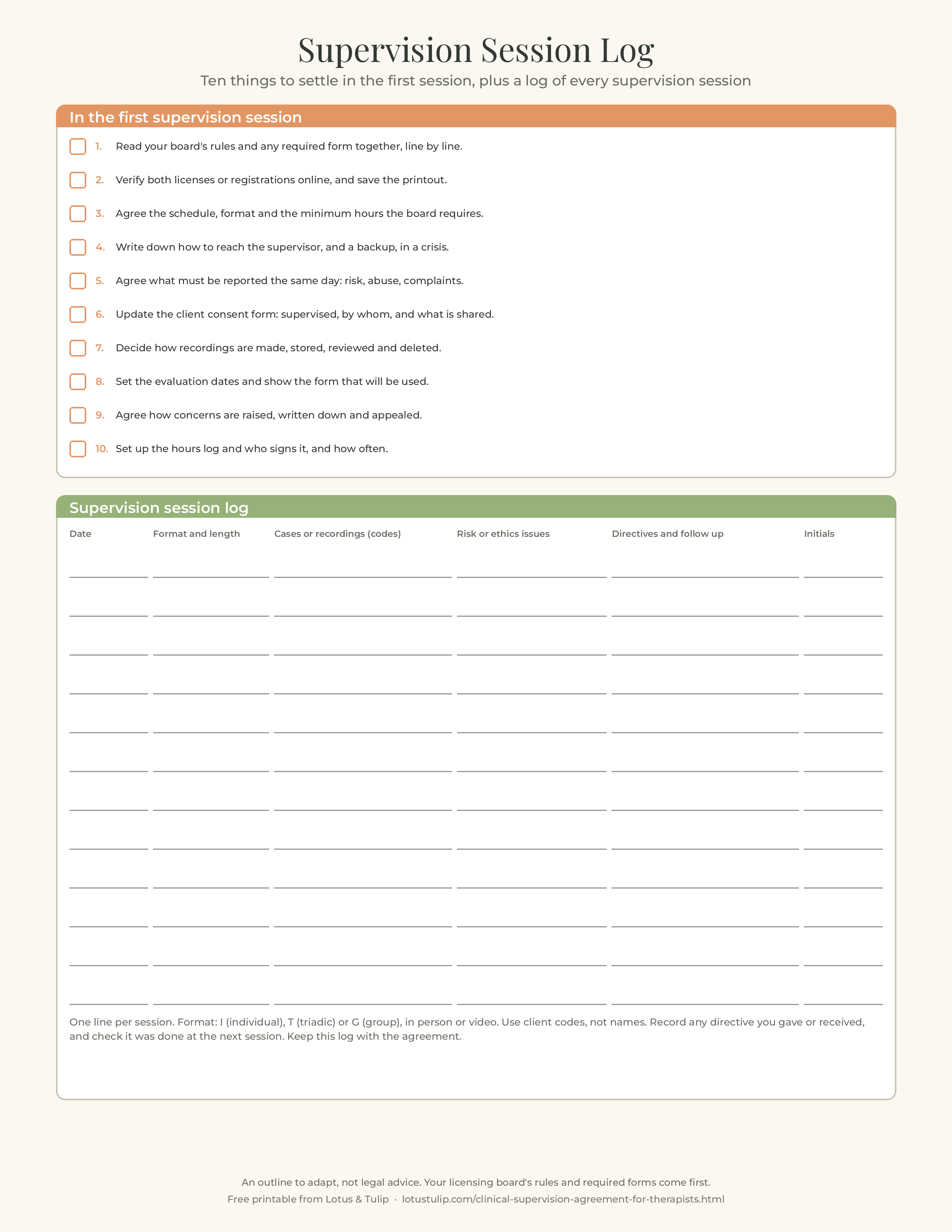
Your board's experience log or verification form comes first; use its categories exactly. California requires the supervisor to sign the supervisee's experience log weekly. Texas has its own Supervision Hours Log and the Supervised Experience Documentation Form. A personal log, like page 3 of the free printable, is a backup and a running record of what was discussed, not a substitute for the board's form.
The supervision session note
The ACES list is a good template: who was present and the format, what was reviewed and by what method, client consent where recordings were used, the content discussed, risk or ethics issues, recommendations or directives, and any decisions, problems or remediation. Leave out "unprofessional remarks about the supervisee or client, sensitive supervisee personal history information, or unsupported opinions." The NASW and ASWB standards suggest each of you documents the session and that the supervisor provides documentation to the supervisee "within a reasonable time." A fictional example:
Supervision note, 03/16/2027, individual, video (assessment on file), 60 minutes. Supervisee J. Park, AMFT; supervisor M. Castillo, LMFT. Reviewed: case S-12 (adolescent, recording clip, written consent on file) and case S-07 (couple, progress notes). Risk: S-12 reported passive suicidal thoughts at session on 03/14; supervisee completed structured risk assessment and safety plan with guardian present; reviewed plan, agreed it is adequate, directive: recheck at next session and document. Ethics: S-07 partner asked to text supervisee privately; discussed practice policy on individual contact in couples work. Goals: progress on goal 1 (adolescent risk assessment) noted. Next: bring S-12 follow up and one new intake. Hours log signed for week of 03/15.
That note takes four minutes to write and answers the questions a board or a court would ask: what did the supervisor know, when, and what did they do.
Evaluations and any remediation plan
Keep a signed copy of every formal evaluation and any remediation plan, with the supervisee's comments. Texas requires the remediation plan to be "reviewed and signed by the LPC Associate and maintained as part of the LPC Associate's file," and California requires giving the supervisee a copy of each assessment.
Evaluation, remediation and due process
Evaluation is where supervision relationships most often break down, and it is almost always because expectations were never written. Every standard asks for the same thing: tell the supervisee at the start how they will be evaluated, give feedback all the time, and make formal evaluations a summary of what they have already heard. APA 7.06 requires "a timely and specific process for providing feedback" explained "at the beginning of supervision." The APA guidelines want feedback that is "direct, clear, and timely, behaviorally anchored," with "both positive and corrective feedback in each supervision session so that evaluation is not a surprise when it occurs."
What to write into the agreement
- The form. Attach the rating form or name it, and say which competencies it covers. If a university program or the board has its own form, use it.
- The dates. For example, a written evaluation every six months and at the end. California requires at least yearly and at completion or termination.
- The evidence. Evaluations based on direct observation or recordings as well as case discussion. ACES says evaluations are based "on direct observation of counselor performance."
- Self evaluation. ACES asks supervisors to require "self-evaluations, formative and summative."
- Feedback on the supervisor. A regular, low stakes way for the supervisee to say what is and is not helping. ACES suggests "anonymous feedback when possible."
When there is a problem: a remediation plan
The APA guidelines describe what a remediation plan should contain: "the areas of the supervisee's competence deficits, performance expectations, steps required to address deficits, responsibilities for each party, performance monitoring processes, and applicable timelines." Supervisors should "document, in writing, with dates and specific behaviors." A simple structure:
- The concern, described as observed behavior with dates, not as a personality judgment.
- The expected standard, linked to the competency in the evaluation form.
- The steps: extra supervision, observation, training, reduced caseload, specific readings.
- Who does what: the supervisee's actions and the supervisor's.
- How progress will be measured, and when it will be reviewed.
- What happens next if the standard is met, partly met or not met.
- Signatures, and space for the supervisee's written response.
Due process
ACA F.4.a requires telling supervisees about "the mechanisms for due process appeal of individual supervisor actions," and F.6.b requires supervisors to "seek consultation and document their decisions to dismiss or refer supervisees for assistance" and make sure supervisees know their options. In an agency or training program, the due process policy usually exists already; name it in the agreement. In private practice, write a simple path: discuss in supervision, put the concern and response in writing, a meeting with a named third party (the clinical director, the university liaison, or an agreed independent licensed colleague), and the board's own complaint process. Also say what the supervisor will and will not do while a disagreement is open, such as continuing to sign for hours earned in good faith. California's form says the supervisor "shall sign for hours of experience obtained in good faith where required supervision was provided" unless the one week notice was given.
Recommendations and endorsements
The supervisor will eventually be asked whether the supervisee is ready for independent licensure. ACA F.6.d: supervisors endorse supervisees "only when they believe that supervisees are qualified." The Texas documentation form now asks the question directly, and says recommendations "should be based on professional competence, ethical conduct, and readiness for independent practice." If you are a supervisee, the time to learn whether your supervisor has concerns is month three, in writing, not the week you apply.
Ending supervision well
Supervision ends for ordinary reasons (the hours are done, a job changes, a supervisor retires) and for hard ones (a rupture, a complaint, a supervisor's license problem). The agreement should handle both:
- Notice. ACA F.4.d gives either party "the right to terminate the supervisory relationship with adequate notice." Name the period, for example 30 days, with a shorter period for serious ethical or safety concerns. California's one week written notice before refusing to sign for further hours is a minimum for California, not a recommendation.
- Hours and forms. Who completes the board's verification forms, by when (Texas: within 30 days of the end of supervision or completion of hours), and that hours earned in good faith will be signed.
- Clients. Who is responsible for clients during the gap, and how clients are told if their clinician's supervisor changes or the clinician cannot continue seeing them. If a supervisee has to stop seeing clients, see therapy termination letters.
- Referral. ACA F.4.d: when termination is warranted, "supervisors make appropriate referrals to possible alternative supervisors."
- Board notice. Some boards require notice of a change; Texas requires an approved change form before a new supervisor starts, and the associate agrees to notify the board if the arrangement is terminated.
- If the supervisor becomes unavailable. A backup supervisor for short absences, and a plan for a long one. A supervisor whose license lapses stops being a supervisor that day in most states; Texas hours after expiration "may not count." A supervisor's professional will can name who will contact supervisees.
- A final evaluation and a short written summary, which California requires at completion or termination.
Paid and outside supervision
Many supervisees, especially in private practice, pay an outside supervisor. That is allowed in many states and restricted in others, so check before you sign. The NASW and ASWB standards say supervisees "should contact the regulatory board in their jurisdictions in advance of contracting to confirm whether such a practice is permitted and confirm the documentation required." California requires a written oversight agreement with the employer when the supervisor is not employed by the same employer, and in private practice the supervisor must be employed by, contracted by or an owner of the practice, with access to records. When supervision is paid, the agreement should cover the fee, how it is paid and receipted, cancellations, what the fee does and does not include (signing forms, reading notes between sessions, phone consultation in a crisis), and refunds if the supervisor's status lapses.
A paid relationship does not change the supervisor's duties. The supervisor is still responsible for oversight, still evaluates honestly and still may decline to recommend licensure. Put that in writing, so that neither of you mistakes a paid service for a guaranteed outcome.
How to write a clinical supervision agreement, step by step
- Read your board's rules and forms first. Download every supervision form your board uses, read the statute and rule sections they cite, and note the minimum amounts, formats, group limits, technology rules and deadlines in writing.
- Verify both credentials. Check both licenses or registrations on the board's website, confirm the supervisor's supervisor status and training, and save the printouts with the date.
- Clarify the setting. Confirm who employs the supervisee, whether the supervisor works for the same employer, and whether an oversight or employer agreement is required before supervision starts.
- Agree the schedule and format. Day, time, length, individual or group, in person or video, and how canceled sessions are made up so the board minimum is still met.
- Agree methods and preparation. Case presentations, note review, recordings with client consent, observation, and what the supervisee brings to each session.
- Write the emergency section. How to reach the supervisor, a named backup, and exactly what must be reported the same day, without delaying any legally required report.
- Update client consent. Add the supervisee's status, the supervisor's name and how to reach them, what is shared in supervision, and a separate recording consent if recordings are used.
- Set goals and the evaluation plan. Three to five goals, the form that will be used, the dates of formal evaluations, and how the supervisee gives feedback on supervision.
- Write the concerns and ending sections. Steps for raising concerns, a remediation plan format, an appeal route, notice periods, signing of hours, and what happens to records and clients when supervision ends.
- Sign, file and review. Sign and date the agreement and any board form within the board's deadline, give each other copies, start the session log, and review the agreement at every formal evaluation and whenever the setting, license or supervisor changes.
Filled example: a fictional associate MFT in California
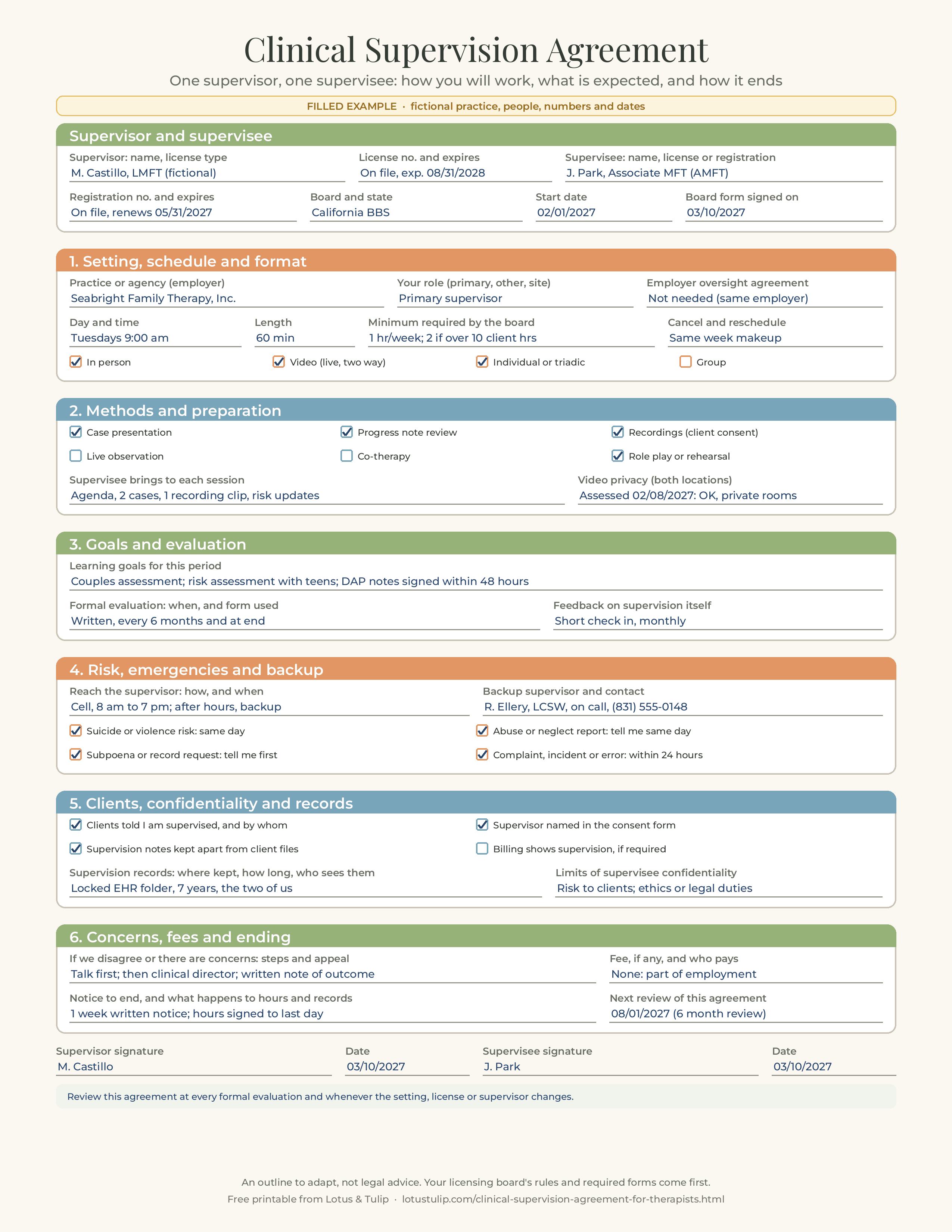
Seabright Family Therapy, Inc. is a fictional family therapy corporation in Santa Cruz, California. M. Castillo, LMFT, is an owner and the primary supervisor of J. Park, an Associate Marriage and Family Therapist employed by the practice as a W-2 employee. Supervision started on February 1, 2027. Everything here is invented for illustration; it is not legal advice and it does not cover every California requirement.
- Board form: both signed the BBS Supervision Agreement, with a collaborative supervisory plan, on March 10, 2027, inside the 60 day window. J. Park keeps the originals for the licensure application. No written oversight agreement is needed because both work for the same employer.
- Schedule: individual supervision every Tuesday, 9:00 to 10:00. In any week J. Park performs more than 10 hours of direct clinical counseling, they add a second hour of direct supervisor contact, either another individual hour or a two hour group with other associates (two hours of group supervision count as one hour of contact). Missed sessions are made up in the same week.
- Video: M. Castillo met with J. Park on February 8 to assess video supervision, considering J. Park's abilities, both preferences and the privacy of both locations, documented the result, and they use video for some sessions from private offices.
- Methods: case presentations, progress note review, recording clips with written client consent, and role play. J. Park brings an agenda, two cases, one clip and any risk updates.
- Goals: couples assessment; structured risk assessment with teens; DAP notes completed and signed within 48 hours.
- Emergencies: M. Castillo by cell from 8 am to 7 pm; R. Ellery, LCSW, a fictional colleague, is the written on-call backup. Suicide or violence risk, abuse reports, subpoenas and complaints are reported the same day; abuse reports are made without waiting for consultation.
- Clients: the consent form states J. Park's AMFT status and registration number, names M. Castillo and how to reach her, and explains what is shared in supervision; a separate recording consent is used.
- Records: supervision notes in a restricted folder in the practice's record system, separate from client charts, kept seven years; the weekly experience log signed every week.
- Evaluation: a written evaluation every six months and at the end (more often than California's yearly minimum), with a copy to J. Park, and a short monthly check in on how supervision is going.
- Concerns and ending: concerns raised in supervision first, then with the practice's clinical director, with a written note of the outcome; one week's written notice before any refusal to sign further hours, and hours signed to the last day.
Page 2 of the free printable shows this agreement filled in.
Six short scenarios
1. "Can my weekly peer consultation group count?" An associate in California joins a peer consultation group led by licensed colleagues who are not her supervisors. It is good for her practice, but California's form is explicit that "consultation or peer discussion shall not be considered supervision." It does not count as supervised experience, and the agreement should not suggest it does.
2. The supervisor goes on medical leave. A Texas LPC-S expects to be out for six weeks. The associate still needs four hours a month of supervision from a Council approved supervisor. The board requires an approved change form before supervision with a new or additional supervisor begins, so the time to name and register a backup is before the leave, not during it.
3. Fully remote supervision in Florida. A Florida registered intern and her qualified supervisor live three hours apart and want to meet only by video. The rule requires at least 50% in person and one in person meeting before any online supervision, unless the supervisor determines, under subsection (7), that electronic methods "are not detrimental to the registered intern's clients and are necessary to protect the health, safety, or welfare" of the supervisor or intern. If they rely on (7), the supervisor should document the reasons and review them, and the agreement should say so.
4. A client asks who the supervisor is. A client seeing a psychology postdoctoral fellow asks, in session eight, whether anyone else knows what she says. If consent was done properly, she was told at intake that the fellow is supervised and given the supervisor's name, as APA 10.01(c) requires. The fellow reminds her, explains what is shared and why, and notes the conversation.
5. The first critical evaluation arrives in month fourteen. A supervisee is shocked by a "below expectations" rating in an area never raised before. Under APA 7.06 and ACES, this should not happen: feedback was due all along, and the evaluation plan was due at the start. The fix is a meeting, a written remediation plan with specific behaviors and dates, and the due process steps in the agreement, starting with the supervisee's written response.
6. An outside supervisor for a private practice associate. A California associate in a small group practice wants a paid outside supervisor. The supervisor must be employed by or contracted by the practice, or be an owner, and if the supervisor does not provide services for the practice, needs a written contract giving the same access to clinical records as employees, and the associate's clients must authorize release of their records to that supervisor. The agreement, the employer contract and the client authorization all need to be in place before the hours start.
Common mistakes
- Treating the board form as the whole agreement. Board forms confirm eligibility. Texas's says it "is not a contract." Write the rest down.
- Starting before the paperwork. In California the agreement is due within 60 days; in Texas a new supervisor must be approved before supervision starts. Hours earned outside the rules may not count.
- Not checking the supervisor's status. Verify both licenses at the start and at every evaluation. Lapsed status can cost hours.
- Assuming video counts. Read your board's technology rule, and document any assessment it requires.
- Vague emergency rules. "Call me if anything comes up" is not a protocol. Name the situations, the time frame and the backup.
- Making mandated reports wait for the supervisor. Consult, but never delay a legally required report.
- Forgetting the client. No disclosure of supervisee status or the supervisor's name, or recordings without written consent.
- No supervision notes. Without notes there is no record of what the supervisor knew and did.
- Surprise evaluations. Evaluation criteria and the form belong in the first session.
- Never reviewing the agreement. Settings, caseloads and rules change. Review it at every formal evaluation.
Free printable: clinical supervision agreement outline, filled example and session log
The free printable has three US Letter pages. Page 1 is a blank clinical supervision agreement outline: the supervisor and supervisee with license or registration numbers and expiration dates, the board and state, the start date and when any board form was signed; setting, schedule and format (practice or employer, the supervisor's role, any employer oversight agreement, day and time, length, the board's minimum, the cancel and reschedule rule, and tick boxes for in person, live two way video, individual or triadic and group); methods and preparation (case presentation, progress note review, recordings with client consent, live observation, co-therapy, role play, what the supervisee brings, and video privacy at both locations); goals and evaluation; risk, emergencies and a backup supervisor with four same day reporting rules; clients, confidentiality and records (clients told and the supervisor named in consent, supervision notes kept apart from client files, billing that shows supervision where required, where records are kept and for how long, and the limits of supervisee confidentiality); concerns, fees and ending; and signature lines. Page 2 is the same outline filled in for the fictional Seabright Family Therapy example above. Page 3 is a ten point checklist for the first supervision session and a twelve row supervision session log with columns for date, format and length, cases or recordings reviewed (by code), risk or ethics issues, directives and follow up, and initials.
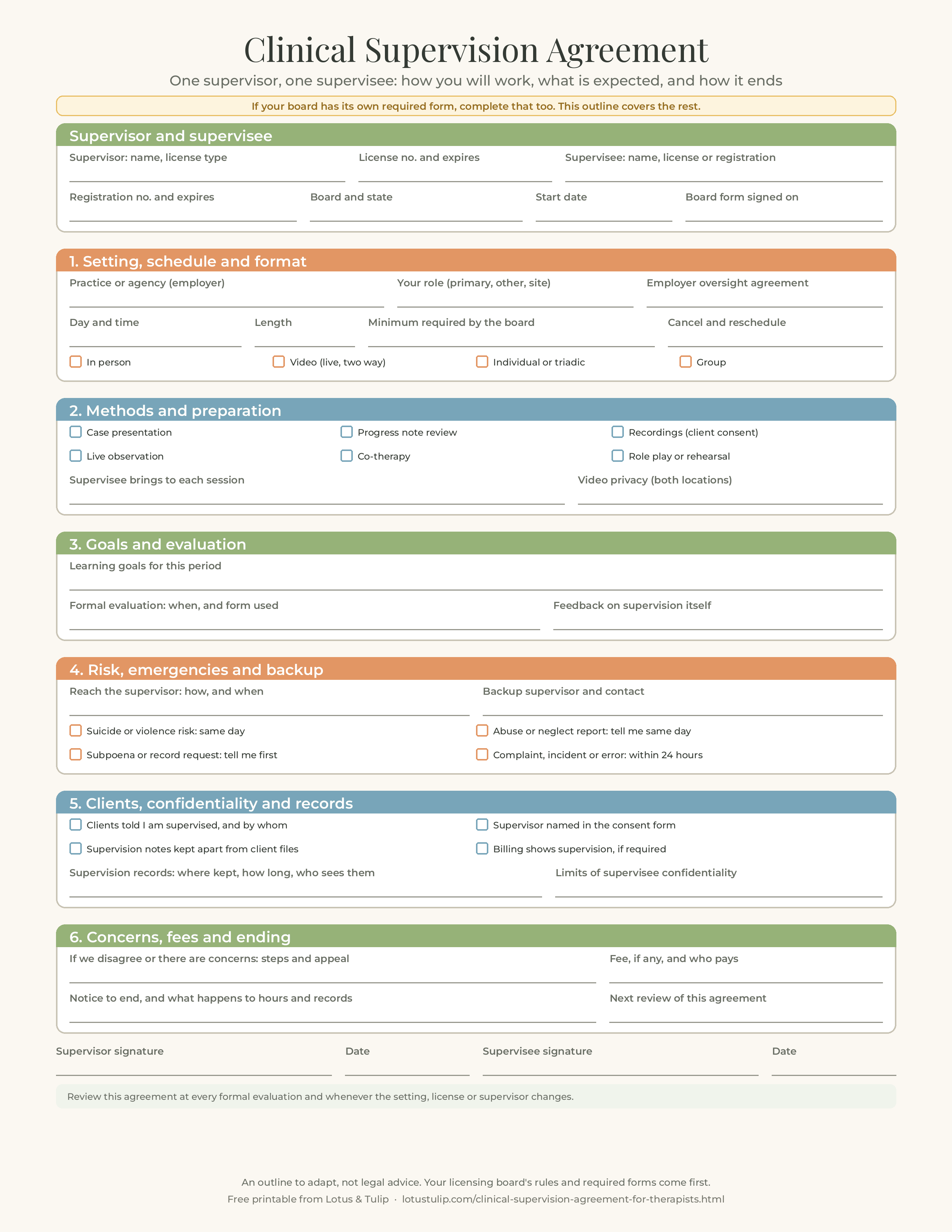
Download the free clinical supervision agreement template (PDF, 3 pages)
Rather type than handwrite? The free PDF above is for printing. Therapy Progress Notes and Intake Templates comes as a fillable PDF you type straight into (604 fields in Adobe Acrobat Reader), plus the printable version: SOAP, DAP and BIRP notes, intake, treatment plan and safety plan, 20 pages. Holiday 20% off: about $7.36, was $9 (EUR 8) · instant digital download
Buy on EtsyPrefer single images? Page 1: blank agreement outline (PNG) · Page 2: filled fictional example (PNG) · Page 3: first session checklist and session log (PNG)
Free to print and use in your own practice or training program. Please link to this page rather than re-uploading the file. This outline organizes what you agree; it is not legal advice and it does not replace any form your licensing board requires. Your board decides whether supervised hours count. Keep the signed agreement and the log with your supervision records, separate from client files, and use client codes on the log.
Related resources
- Informed consent for therapy template
- Telehealth across state lines for therapists
- Duty to warn for therapists, by state
- BIRP notes for therapists, with examples
- Telehealth progress note template and examples
- Psychotherapy notes vs progress notes
- Business associate agreements for therapists
- Professional will for therapists
- Therapy termination letter template
- Closing a therapy private practice
Sources: American Counseling Association, 2014 ACA Code of Ethics, Section F (standards F.1 to F.6); Association for Counselor Education and Supervision, Best Practices in Clinical Supervision (adopted April 22, 2011), sections 1, 4, 7, 8, 9 and 10; National Association of Social Workers, Code of Ethics, standard 3.01; NASW and Association of Social Work Boards, Best Practice Standards in Social Work Supervision (2013), Standards 1 to 5; American Association for Marriage and Family Therapy, Code of Ethics, Standard IV, and AAMFT Approved Supervisor Designation Standards Handbook (September 2026), including Supervision Contract Tips and Sample Contract Checklist; American Psychological Association, Ethical Principles of Psychologists and Code of Conduct (2017), standards 2.05, 7.06, 7.07 and 10.01(c), and APA Guidelines for Clinical Supervision in Health Service Psychology (approved August 2025), Domains A to F; California Board of Behavioral Sciences, Supervision Agreement (DCA BBS 37M-300, revised 05/2026), Supervision Agreement Index of Legal Citations, and Supervision-Related Regulation Changes effective January 1, 2022; California Business and Professions Code sections 4980.43 and 4980.43.2; Texas Behavioral Health Executive Council, LPC Associate page, Supervisory Agreement Form and Supervised Experience Documentation Form (revised October 12, 2026); 22 Texas Administrative Code sections 681.92 and 681.93; Florida Administrative Code rule 64B4-2.002 (amended effective July 6, 2026) and the Florida Board of Clinical Social Work, Marriage and Family Therapy and Mental Health Counseling telehealth page; 45 CFR 164.501 (definition of health care operations).
FAQ
What should a clinical supervision agreement include?
At minimum: the parties and their license or registration details; the purpose and the supervisor's authority; the setting and any other supervisors; schedule, amount and format, including the board's minimum; methods such as note review and recordings; goals; emergency contacts, a backup supervisor and what must be reported the same day; how clients are told; confidentiality in supervision; records; the evaluation plan and form; steps for concerns, remediation and appeal; fees; and notice and procedures for ending. ACES, NASW and ASWB, AAMFT and the APA all describe similar elements.
Is a supervision agreement legally required?
It depends on your state and license. Some boards require a specific form: California's Board of Behavioral Sciences requires its Supervision Agreement within 60 days of starting supervision for LMFT, LCSW and LPCC hours, and Texas requires a Supervisory Agreement Form with an LPC Associate application. Professional standards expect a written agreement either way: ACA F.4.a requires informed consent for supervision, ACES calls for a written contract in the first session, and NASW, ASWB and the APA recommend one.
Does supervision by video count toward licensure hours?
Only as your board allows. California counts two way, real time videoconferencing as face to face contact after the supervisor documents an assessment of its appropriateness within 60 days. Florida requires at least 50% of supervision in person and one in person meeting before online supervision, unless the supervisor documents that electronic methods are not detrimental to clients and are necessary to protect health, safety or welfare. Check your own board's rule before relying on video.
Do clients have to be told their therapist is supervised?
Yes, under the ethics codes. ACA F.5.c requires supervisees to disclose their status and explain how it affects confidentiality before providing services, and APA 10.01(c) requires telling the client that the therapist is in training and supervised and giving the supervisor's name. Put it in the informed consent form, say it in the first session and document it. Get separate written consent for any recordings used in supervision.
What should a supervision log or supervision note record?
The date, format and length; who was present; which cases or recordings were reviewed, by client code; the review method; risk and ethics issues; recommendations or directives and whether earlier directives were followed; progress on goals; and any problems or remediation. Keep notes separate from client records, avoid personal remarks about the supervisee, and complete your board's own hours log in addition.
Who is liable for a supervisee's mistakes?
Often both. The NASW and ASWB standards describe direct liability for negligent supervision and vicarious liability for a supervisee's negligent acts, and recommend that both carry professional liability insurance. Texas rule 681.93 says both the LPC Associate and the LPC-S "are fully responsible" for the associate's counseling and that the supervisor may be disciplined for violations it knew or should have known about. A written agreement and good supervision notes do not remove liability, but they show what each of you agreed to and did.