
Therapist practice · Updated 2026-11-10
Professional Will for Therapists: How to Name a Clinical Executor, Protect Client Records and Plan for Your Death or Incapacity (Free Printable)
Ready-made printable: Therapy Progress Notes and Intake Templates Fillable PDF, 20 pages: SOAP, DAP and BIRP notes, intake, treatment plan and safety plan
Holiday 20% off: about $7.36, was $9 (EUR 8) · instant digital download
Try it free first: download a fillable sample (SOAP note and DAP note, PDF, 226 KB). Type into it on screen, then get the full pack. No email needed.

Picture a Tuesday morning in your practice without you. Your first client is sitting in the waiting room, or waiting in a video room that nobody opens. Your voicemail fills up. Your calendar, your client list and every note you have written sit behind a password only you know. Your spouse or your adult child knows that you are in the hospital, or that you have died, but has no idea who your clients are, has no right to read their files, and has no clinical training to tell a frightened client what happens next. This is what happens by default when a therapist has no plan.
A professional will is that plan. This guide is for counselors, marriage and family therapists, clinical social workers, psychologists and other licensed clinicians in US private practice, especially solo and small group practices. It explains what a professional will is and is not, what the ACA, APA, NASW and AAMFT codes expect, what HIPAA does and does not say about records when a practice closes, how to choose a clinical executor, what the document should cover, how clients are told, and how to connect it to your personal estate plan. It includes sample wording, a full fictional professional will, short scenarios and a free three page printable: a blank professional will and clinical executor designation, the same form filled for a fictional practice, and a first steps checklist with a key contacts and records location log.
Jump to the free professional will template
This is educational information for licensed clinicians and trainees in the US. It is not legal advice and does not create any professional relationship. The federal rules quoted here were checked against the current eCFR text of 45 CFR parts 160 and 164 and against HHS guidance. The ethics standards were checked against the published codes: the ACA Code of Ethics (2014), the APA Ethical Principles of Psychologists and Code of Conduct (2002, amended 2010 and 2016), the NASW Code of Ethics and the AAMFT Code of Ethics (revised code effective January 1, 2026). State laws on record retention, estates, powers of attorney and licensee duties vary. A professional will touches estate law, contract law, privacy law and your licensing rules at the same time, so have an attorney who knows your state review yours, ideally together with your personal will. Every practice, clinician, attorney and detail in the examples on this page is fictional.
The short answer
A professional will for therapists is a written plan that names a trusted, licensed colleague, usually called a clinical executor, and gives them the instructions and access they need to protect your clients and your records if you die, become incapacitated or suddenly cannot practice. It is not a will in the probate sense. It works alongside your personal estate plan.
- Every major code expects a plan. The ACA code asks counselors to "prepare a plan for the transfer of clients and the dissemination of records to an identified colleague or records custodian" in case of incapacitation, death, retirement or termination of practice (C.2.h). The APA code asks psychologists to "make plans in advance" for the transfer and confidentiality of records (6.02(c)) and to plan for interruptions such as their own "illness, death, unavailability, relocation, or retirement" (3.12). NASW and AAMFT standards say the same in their own words (NASW 1.07(t) and 1.15, AAMFT 2.7).
- Name a clinical executor and a backup. Both should be licensed mental health professionals, in good standing, who can practice where your clients are, and who have agreed in writing.
- Say when the plan starts: death, incapacity, being unreachable for a set number of days, or your own written request for help.
- List what the executor may do: access your calendar and records, contact clients, cancel sessions, offer referrals, secure and transfer records, answer records requests, and notify your board, insurers and payers.
- Make access possible without writing down passwords. Keep sealed access instructions with your attorney or use a password manager's emergency access feature, and record only where those instructions are.
- Plan the records: where they are, how long your state requires you to keep them, who becomes the records custodian, and how they are eventually destroyed. HIPAA itself sets no retention period for clinical records; state law does.
- Put the confidentiality terms in writing. If your practice is a HIPAA covered entity, the executor arrangement may meet the definition of a business associate, which calls for a written business associate agreement.
- Tell clients the plan exists in your informed consent (the ACA code lists "continuation of services upon the incapacitation or death of the counselor" among the things clients should be told, A.2.b).
- Connect it to your estate plan through your attorney, give copies to the right people, and review it every year.
What a professional will is, and what it is not
The phrase "professional will" causes confusion because it sounds like a legal will. It is better to think of it as an emergency plan for your caseload with a named person in charge. Your personal will deals with your property after death and generally has no effect until then. A professional will has to work on the day you are rushed to hospital, and it has to work for confidential client information that your family and your estate's executor generally should not be reading.
| Document | What it does | When it applies | Who acts |
|---|---|---|---|
| Professional will | Names a clinical executor and backup; gives instructions for clients, records, communications, billing and closing or pausing the practice | Death, incapacity, sudden unavailability, or when you ask for help | A licensed colleague (the clinical executor) |
| Personal will or trust | Deals with your property, which may include the practice as a business, its equipment, accounts and receivables | Death (a trust can also work during incapacity, depending on how it is drafted) | Your estate executor, administrator or trustee under state law |
| Durable power of attorney | Lets someone handle your financial and legal affairs if you cannot | Usually while you are alive and incapacitated, as the document and state law provide | Your agent under the power of attorney |
| Practice closing plan | A planned retirement, move or sale: notice to clients, referrals, records custody | A date you choose | You |
| Coverage agreement | A colleague covers emergencies while you are on vacation or a short leave | Planned absences | A covering clinician |
The professional will sits between these. It needs the estate documents to recognize it, because the person who legally controls your business after death (your estate's executor) or during incapacity (your agent) may need to authorize the clinical executor to act, pay them, and keep the practice accounts open long enough to refund clients and pay bills. Ask your attorney how your personal will, trust or power of attorney should refer to it. That conversation is the single most useful step in this whole guide, and it is the one most easily put off.
A professional will is also not only for older clinicians. Sudden illness, accidents and family emergencies happen at every age. The plan protects clients first, but it also protects your family, who would otherwise inherit a confidential caseload they cannot legally or practically manage.
What the ethics codes require
None of the four major codes uses the phrase "professional will." All of them require the substance: a plan, made in advance, for clients and records if you can no longer practice. The wording below is quoted from the current codes.
| Code | Standards | What they ask |
|---|---|---|
| ACA (counselors) | C.2.h, B.6.i, B.6.h, A.2.b, A.12, A.11.d, C.2.g | A plan for the transfer of clients and records to "an identified colleague or records custodian" in case of incapacitation, death, retirement or termination of practice (C.2.h); reasonable precautions to protect confidentiality in those events and appointing "a records custodian when identified as appropriate" (B.6.i); storing records for reasonable future access and in line with federal and state law (B.6.h); telling clients about "continuation of services upon the incapacitation or death of the counselor" (A.2.b); no abandonment during interruptions such as illness (A.12) |
| APA (psychologists) | 3.12, 6.02(c), 10.09, 6.01, 2.06(b), 6.03, 10.10(c) | Reasonable efforts to plan for interrupted services due to "the psychologist's illness, death, unavailability, relocation, or retirement" (3.12); plans made "in advance" for the transfer and confidentiality of records if you withdraw from practice (6.02(c)); orderly resolution of client care when an employment or contractual relationship ends (10.09); keeping records so others can provide services later (6.01) |
| NASW (social workers) | 1.07(s), 1.07(t), 1.15, 1.16(b), 1.17(b), 3.04(d), 4.05(b) | Reasonable precautions to protect confidentiality "in the event of the social worker's termination of practice, incapacitation, or death" (1.07(t)); reasonable efforts to ensure continuity of services interrupted by factors such as unavailability, relocation, illness, "mental or physical ability, or death" (1.15); orderly transfer on referral (1.16(b)); storing records for reasonable future access, for the years required by law, policy and contracts (3.04(d)) |
| AAMFT (MFTs) | 2.7, 2.5, 1.10, 1.9, 3.3 | "In preparation for moving, selling, or closing a practice, incapacitation, or death," arranging for the storage, transfer or disposal of client records in compliance with applicable laws and professional standards (2.7); storing, safeguarding and disposing of records lawfully (2.5); no ending treatment without reasonable efforts to arrange continuation of care (1.10) |
ACA: the clearest requirement
The ACA code is the most explicit. Standard C.2.h, titled Counselor Incapacitation, Death, Retirement, or Termination of Practice, reads: "Counselors prepare a plan for the transfer of clients and the dissemination of records to an identified colleague or records custodian in the case of the counselor's incapacitation, death, retirement, or termination of practice." Standard B.6.i adds that counselors "take reasonable precautions to protect client confidentiality in the event of the counselor's termination of practice, incapacity, or death and appoint a records custodian when identified as appropriate." The code's glossary defines a records custodian as "a professional colleague who agrees to serve as the caretaker of client records for another mental health professional," and defines incapacitation as "an inability to perform professional functions."
Notice the words "identified colleague." A general intention to "have someone handle it" does not meet that standard. You need a name, and the person needs to have agreed.
The ACA code also puts the plan into informed consent. Standard A.2.b lists the information clients need, including "continuation of services upon the incapacitation or death of the counselor." So a counselor's consent form should tell clients that a plan exists and, in general terms, what happens. Our informed consent for therapy template includes a sample sentence.
APA: plan in advance for interruptions and records
Standard 3.12, Interruption of Psychological Services, says: "Unless otherwise covered by contract, psychologists make reasonable efforts to plan for facilitating services in the event that psychological services are interrupted by factors such as the psychologist's illness, death, unavailability, relocation, or retirement or by the client's/patient's relocation or financial limitations." Standard 6.02(c) adds: "Psychologists make plans in advance to facilitate the appropriate transfer and to protect the confidentiality of records and data in the event of psychologists' withdrawal from positions or practice."
Standard 10.09 covers clinicians who work under employment or contracts: "When entering into employment or contractual relationships, psychologists make reasonable efforts to provide for orderly and appropriate resolution of responsibility for client/patient care in the event that the employment or contractual relationship ends, with paramount consideration given to the welfare of the client/patient." If you work in a group practice or contract with one, read your agreement: it may already say who takes over your caseload, and your professional will should not contradict it.
Standard 2.06(b) is the uncomfortable companion: when psychologists become aware of personal problems that may interfere with their work, they "take appropriate measures, such as obtaining professional consultation or assistance, and determine whether they should limit, suspend, or terminate their work-related duties." A professional will makes that decision easier for you and for the people around you, before the moment comes.
NASW: confidentiality and continuity
The NASW code asks social workers to "take reasonable precautions to protect client confidentiality in the event of the social worker's termination of practice, incapacitation, or death" (1.07(t)) and to "transfer or dispose of clients' records in a manner that protects clients' confidentiality and is consistent with applicable laws governing records and social work licensure" (1.07(s)). Standard 1.15, Interruption of Services, asks for "reasonable efforts to ensure continuity of services in the event that services are interrupted by factors such as unavailability, disruptions in electronic communication, relocation, illness, mental or physical ability, or death." Standard 3.04(d) says records should be stored "to ensure reasonable future access" and "maintained for the number of years required by relevant laws, agency policies, and contracts." Standard 4.05(b) asks social workers whose personal problems interfere with their work to take steps such as "making adjustments in workload, terminating practice, or taking any other steps necessary to protect clients and others."
AAMFT: records when a practice changes
The revised AAMFT code, effective January 1, 2026, has a standard titled Preparation for Practice Changes (2.7): "In preparation for moving, selling, or closing a practice, incapacitation, or death, marriage and family therapists arrange for the storage, transfer, or disposal of client records in compliance with applicable laws and professional standards." Standard 1.10 forbids ending treatment "without making reasonable efforts to provide appropriate arrangements for the continuation of care," and 3.3 asks MFTs not to provide services "when those services are compromised due to impairments to their clinical competence."
If you hold more than one license, follow the strictest standard that applies to you, and check your state licensing board's rules too. Some boards have their own rules about records when a licensee closes a practice, becomes incapacitated or dies. We have not listed them here because they vary and change; your board's website and your attorney are the place to check.
What HIPAA says, and what it does not
Many clinicians assume HIPAA tells them how long to keep records and what to do with them when they close. It mostly does not. Here is what the federal rules actually say for a practice that is a HIPAA covered entity. Many practices that bill insurance electronically are covered entities; some cash only practices are not, but state privacy law and the ethics codes still apply to them.
No federal retention period for clinical records
HHS answers this directly in its HIPAA FAQ: "No, the HIPAA Privacy Rule does not include medical record retention requirements. Rather, State laws generally govern how long medical records are to be retained." HHS goes on to say that covered entities must still apply "appropriate administrative, technical, and physical safeguards to protect the privacy of medical records and other protected health information (PHI) for whatever period such information is maintained by a covered entity, including through disposal" (citing 45 CFR 164.530(c)).
The six year period you may have heard about applies to something else. Under 164.530(j)(2), a covered entity must keep its required HIPAA documentation (policies and procedures, required written communications and documented actions) "for six years from the date of its creation or the date when it last was in effect, whichever is later." That is a rule about compliance paperwork, not about how long you keep a client's clinical record.
HHS guidance on disposal also notes that a covered entity winding up a business "may wish to consider giving patients the opportunity to pick up their records prior to any disposition," and that many states impose requirements to retain and make records available after a business dissolves. Your professional will should therefore point to your state's actual retention rule.
State retention examples
Retention rules differ by state, license and sometimes by the client's age. Two verified examples from California show the pattern. California Business and Professions Code section 2919 says a licensed psychologist "shall retain a patient's health service records for a minimum of seven years from the patient's discharge date," and for a minor, "a minimum of seven years from the date the patient reaches 18 years of age." Section 4980.49 says a marriage and family therapist "shall retain a client's or patient's health service records for a minimum of seven years from the date therapy is terminated," with the same rule for minors, for records of clients whose therapy ended on or after January 1, 2015. Do not copy these numbers into your plan unless you practice in California under those licenses. Look up your own state and license, and remember that payer contracts and other laws can require longer.
The practical consequence is important: your records will outlive your practice, often by many years. Whoever holds them (your clinical executor, a records custodian, or a records storage company) needs authority, a secure place to keep them, a way for former clients to ask for copies, and a plan for destroying them when the retention period ends.
Is your clinical executor a business associate?
HIPAA defines a business associate as a person who, on behalf of a covered entity and other than as a member of its workforce, "creates, receives, maintains, or transmits protected health information" for a regulated function or activity, including "practice management," or who provides services such as legal, consulting, management or administrative services that involve disclosure of PHI (45 CFR 160.103). A clinical executor who signs in to your records system, contacts your clients, answers records requests and stores records on behalf of your practice looks very much like that.
When a business associate relationship exists, a covered entity may disclose PHI to the business associate only if it obtains "satisfactory assurance that the business associate will appropriately safeguard the information" (164.502(e)(1)(i)), documented "through a written contract or other written agreement" (164.502(e)(2)) that meets the requirements of 164.504(e). One of those requirements is that, at the end of the contract, the business associate will "if feasible, return or destroy all protected health information" or, if that is not feasible, extend the contract's protections to the information (164.504(e)(2)(ii)(J)).
Whether your particular arrangement is a business associate relationship, a workforce arrangement or something else depends on the facts and on how your attorney structures it. Signing a business associate agreement with your clinical executor and backup is a simple way to put the confidentiality terms in writing either way. Your EHR company and any records storage vendor probably already have one with you; check what it says about access if you die or close.
Transferring the practice or its records
HIPAA's definition of health care operations includes "the sale, transfer, merger, or consolidation of all or part of the covered entity with another covered entity, or an entity that following such activity will become a covered entity and due diligence related to such activity" (164.501). That matters if a colleague or group will take over the practice or its records. It does not replace the ethics codes' requirements to tell clients, respect their choices and protect confidentiality, and state law may add requirements.
Psychotherapy notes and other separately kept material
If you keep psychotherapy notes as defined in 164.501, separate from the rest of the record, your executor needs to know where they are and how you want them handled under your state's law and your retention policy. They are still confidential information that must be secured and eventually destroyed. Our psychotherapy notes vs progress notes guide explains the difference.
How to choose a clinical executor
The clinical executor is the most important decision in the plan. This person may be the first to tell your clients that you have died, may sit with a client who is in crisis because of it, and may spend many hours over months answering records requests. Choose someone who can do all of that well.
- Licensed, in good standing, and able to practice where your clients are. If you see clients by telehealth in more than one state, the executor may need to be able to talk with clients in those states, or you may need a second executor for some clients. Ask your boards or your attorney what contact by an out of state clinician is allowed.
- Clinically experienced with your population. If you see children, couples, groups, clients with serious mental illness or clients at high risk, choose someone who can recognize and respond to that risk during transition calls.
- Organized and reachable. They will need to act within days, sometimes within hours.
- Not your spouse, partner or close family member, even if they are a clinician. Grief and conflicts of interest make the role much harder, and family members are often also involved in your estate.
- Not someone with a conflicting interest in your clients, such as a colleague who expects to take them on as their own clients. Clients should be offered choices, not handed over. If the executor will also offer to see some clients, say how choice will be protected.
- Willing, in writing. They sign the professional will or a separate acceptance, and the confidentiality agreement or business associate agreement.
- Backed up. Name a second person in case the first is unavailable, ill, on leave or has died.
- Insured for the role. Ask the executor to check with their own professional liability carrier whether acting as a clinical executor is covered, and check your own policy too.
Many clinicians set up a reciprocal arrangement with a trusted peer: each is the other's clinical executor. Consultation groups are another natural source of executors, and some professional associations publish their own guidance on professional wills that is worth reading alongside this guide.
Paying your clinical executor
A solo practice with an active caseload can take many hours in the first two weeks alone, and records requests may continue for years. Say in writing how the executor will be paid (an hourly rate is common), from what funds (the practice account first, then your estate), and how expenses such as records storage, mailing and secure destruction will be covered. Make sure your estate documents allow it, because the money will come from accounts that your estate or your agent controls.
What to put in a professional will
| Section | What it covers | Why |
|---|---|---|
| 1. Your practice | Practice name, your license types and numbers, every state where you are licensed, office and telehealth details | Identifies the practice and which boards to notify |
| 2. Clinical executor and backup | Names, licenses, contact details, signed acceptance | ACA C.2.h "identified colleague"; APA 3.12; NASW 1.15 |
| 3. Trigger events | Death, incapacity, unreachable for a set number of days, your written request; who may confirm incapacity | So the executor knows when they may act |
| 4. Authority | What the executor may do: access records and calendar, contact clients, cancel sessions, refer, notify, transfer records | A clear scope protects clients and the executor |
| 5. Client notification | Order of contact, who is called first, scripts, letters, voicemail and website notices | Continuity of care and avoiding abandonment (ACA A.12, AAMFT 1.10, NASW 1.17(b)) |
| 6. Referrals | Where your referral list is; how client choice is protected | NASW 1.16(b); ACA A.11.d |
| 7. Records location and access | EHR, paper records, backups, psychotherapy notes; where sealed access instructions are kept | APA 6.02(c); AAMFT 2.7; NASW 1.07(s) and (t) |
| 8. Records custodian and retention | Who keeps the records, for how long under your state law, and how they are destroyed | ACA B.6.h and B.6.i; NASW 3.04(d); state law |
| 9. Records requests | How former clients ask for copies after you are gone; fees; timelines | HIPAA right of access (164.524) if you are a covered entity; state law |
| 10. Confidentiality agreement | Business associate agreement or confidentiality agreement with the executor and backup | 164.502(e) and 164.504(e) where applicable |
| 11. Notifications | Licensing boards, malpractice carrier, insurers and payers, EHR vendor, professional associations, landlord, colleagues | Administrative closure and claims |
| 12. Money | Outstanding claims, prepaid sessions and refunds, stopping automatic charges, executor fees and expenses | Fair dealing with clients; estate coordination |
| 13. Communications | Practice phone, voicemail, email auto reply, website, directory listings | So clients and referrers are not left guessing |
| 14. Personal message | An optional short letter from you to clients | Some clients find it helps; keep it brief and general |
| 15. Estate coordination | Your estate executor or attorney, where your personal will is kept, how the documents refer to each other | The executor needs legal authority and funds |
| 16. Signatures and review | You, the executor, the backup, and any witness or notary your attorney advises; annual review date | A plan that is out of date can mislead the people relying on it |
Death, incapacity and "unreachable": defining when the plan starts
Death is the easy trigger to define. Incapacity is the hard one, and it covers many situations: a stroke, a serious accident, a sudden psychiatric or medical crisis, a long hospital stay. The professional will needs to work while you are alive but cannot practice, and it needs to stop working when you recover.
- Incapacity. Define it in plain words, for example "unable to perform professional functions," which is the ACA code's own definition of incapacitation. Say who may confirm it: your physician, your agent under a health care or financial power of attorney, or the clinical executor together with a named family member.
- Unreachable. Many plans add a trigger for when nobody can reach you for a set number of business days and client sessions are being missed. This covers the situation where your family is overwhelmed and nobody thinks to call your colleague.
- Your own request. You may need help without being incapacitated: a family crisis, a serious diagnosis, burnout that needs immediate leave. Let yourself start the plan in writing, even by text or email.
- How long the executor acts. Until you return in writing, until the files are closed and records transferred, or until a point your attorney defines. For a temporary incapacity, the executor usually covers and refers rather than closing the practice.
Tell the people around you that the plan exists. A professional will is useless if your spouse, partner, adult child or office manager does not know to call your clinical executor. Give a short card or note to the person most likely to be with you in an emergency: "If I cannot work, call J. Tran, LCSW, at this number. She has my professional will." The clinical executor should not have to find out from a news story or a client's voicemail.
Telling clients: notification scripts, letters and messages
This is the part clinicians worry about most, and it is where a written plan helps the most. The clinical executor should not have to improvise what to say to a client who is about to learn that their therapist has died.
Who to contact, and in what order
- Clients you have flagged as needing a call first: clients at higher risk, clients in a crisis period, children and families with active safety plans. Flag them in the EHR rather than listing names in the professional will, so the will itself holds as little client information as possible.
- All active clients, starting with those scheduled in the next few days.
- Groups, ideally together by phone or video, followed by individual offers of referrals.
- Recently ended clients within a period you choose, such as the last 90 days, if you think they would want to know and be offered support.
- Former clients generally do not need to be contacted, but they need to be able to find the records custodian, so update your voicemail, website and directory listings.
What the executor can say
Give the executor permission, in the plan, to share the minimum needed: that you are unable to continue practice (or have died), who they are, what the client's options are, how records will be handled, and how to reach crisis support. They do not need to share your medical details, and you can say in the plan what, if anything, you are comfortable having shared.
Sample phone script (death): "Hello, this is J. Tran. I am a licensed clinical social worker and a colleague of M. Halvorsen. I am calling with some difficult news. M. Halvorsen died unexpectedly this week. I know this may be a shock, and I am sorry. M. Halvorsen asked me to contact clients if this ever happened, to make sure you have support and that your records are safe. Can we talk for a few minutes about how you are doing and what would help next? I can offer you a short meeting to talk about this, and I can give you the names of therapists who could continue your care. Your records are secure, and I can arrange for a copy to go to your new therapist with your written permission. If you ever feel unsafe, you can call or text 988 at any time, or call 911 in an emergency."
Sample phone script (temporary incapacity): "Hello, this is J. Tran, a licensed clinical social worker and colleague of M. Halvorsen. M. Halvorsen is unable to work for a while because of a health matter and asked me to contact clients if this happened. Your session on Thursday is canceled and you will not be charged. I can offer a brief check in with me, help you find someone to see in the meantime, or keep in touch until M. Halvorsen is able to let you know their plans. How are you doing with this news?"
Sample letter: "Dear [client name], I am writing on behalf of Larkspur Lane Counseling with difficult news. [M. Halvorsen died on (date) / is unable to continue practicing because of a health matter.] Before this happened, M. Halvorsen named me, J. Tran, LCSW, to make sure clients are supported and that client records are protected. I would be glad to speak with you about next steps and to help you find a therapist to continue your care. Your records are held securely by [name], and you can ask for a copy, or ask us to send one to a new provider, by contacting [contact]. If you are in crisis, call or text 988, or call 911 in an emergency. With care, J. Tran, LCSW, Clinical executor for Larkspur Lane Counseling."
Send letters by the communication method each client agreed to. If a client asked not to receive mail at home, respect that. Our therapy termination letter template has more on letters when a practice closes.
Voicemail and email auto reply: "You have reached Larkspur Lane Counseling. M. Halvorsen is not currently able to see clients. If you are a current client, a colleague, J. Tran, is contacting clients directly. Former clients who need records can call [number]. If you are in crisis, call or text 988, or call 911."
Website notice: keep it short, similar to the voicemail, with the records contact. Do not list client names, and do not ask clients to email clinical information.
Grief, for clients and for the executor
The death of a therapist is a real loss for many clients, sometimes a complicated one. Allow the executor to offer a small number of transition sessions or calls at a set fee or at no cost, and say who pays. Allow them to refer on rather than see clients themselves. And think about your executor's own support: the role is heavy, and a consultation group or their own therapist matters.
Records: location, access and the long tail
Records are the part of a professional will that lasts longest. Your clinical executor may hand off clients within a month, but someone will hold your records for years.
Write down where everything is
- Electronic records: the EHR or practice management system, the account owner, the support line, and whether the vendor allows a second administrator. Some systems let you add a trusted user ahead of time; check what yours allows and what its business associate agreement says about access after an account holder dies.
- Paper records: the cabinet or storage location, keys or codes, and any off site storage company.
- Psychotherapy notes, test data and other separately kept material, with your instructions for each.
- Calendar and scheduling: where current and future appointments are, and any automated reminders or charges to stop.
- Communications: practice phone, voicemail, practice email, secure messaging, website, directory profiles.
- Billing: billing service or clearinghouse, payer portals, card processor, the practice bank account.
- Backups and old systems: any old EHR you left, exported archives, encrypted drives.
Access without writing passwords in the plan
A professional will gets copied, filed and read by several people. It should never contain passwords. Instead, record where access instructions are kept. Two common approaches are a sealed letter with your attorney that the executor may open when the plan starts, and a password manager's emergency access feature (some password managers offer one) set up for your executor. Whatever you choose, test it once: can your executor actually get into the records system with what you left?
Two factor authentication can lock everyone out. If your EHR or email sends codes to your phone, your executor may not have your phone. Ask your vendors how they handle access when an account holder dies or is incapacitated, and plan around the answer.
Who becomes the records custodian
The records custodian is the person or organization that keeps the records after the practice closes, for as long as your state requires. It can be your clinical executor, another colleague, a group practice, or a professional records storage company with a business associate agreement. Name them in the plan, tell clients who they are, and put the custodian's contact details on your website and voicemail once the practice closes.
Record in the plan: your state's retention rule for your license, any longer contractual requirements, how former clients ask for copies, what fees may be charged under your state's law (and, for covered entities, HIPAA's limits on fees for the right of access), and how records are destroyed securely at the end. HHS's disposal guidance gives examples such as shredding paper records so they cannot be reconstructed, and clearing, purging or destroying electronic media.
Answering records requests after you are gone
Former clients will keep asking for records: for a new therapist, a disability claim, a court case, a background check. If your practice is a covered entity, clients keep their federal right of access, with action required within 30 days and one possible 30 day extension (164.524(b)(2)). The custodian should log each request and response. Our treatment summary template and right of access guide covers the 30 day clock, and our release of information form covers authorizations for sending records to others.
Money, insurance and closing the business side
The clinical side of the plan cannot work if the business side collapses. Bank accounts may be frozen, the EHR subscription may lapse, the phone line may be cut off, and the office lease may end. Work with your attorney so that someone has authority to keep the essentials running long enough.
- Keep systems paid. Note which subscriptions must continue (EHR, phone, secure email, website, records storage) and for how long. Losing the EHR subscription can mean losing access to records.
- Outstanding claims and payments. Who will finish billing for sessions already provided, and under whose authority. Ask your billing service and your attorney how this works after a provider's death.
- Prepaid sessions and refunds. Clients who prepaid or bought packages should be refunded. Say how, and from what account.
- Stop automatic charges. Card on file billing, payment plans and client subscriptions should stop. Our credit card authorization form guide covers card on file agreements.
- Professional liability insurance. Ask your carrier what happens to your coverage at death or retirement, whether you need extended reporting ("tail") coverage if your policy is claims made, and whether the carrier has guidance for clinical executors.
- Notifications. Your licensing board or boards, insurers and payers you are paneled with, the malpractice carrier, professional associations, your EHR and billing vendors, your landlord, and colleagues who refer to you.
- Lease and equipment. Who can clear the office, with the instruction that client files leave only with the clinical executor or custodian, never in a box with personal belongings.
Tell clients in your informed consent
A professional will that clients do not know about still protects them, but telling them is better practice and, for counselors, part of informed consent (ACA A.2.b). It also means that when a colleague calls, the client already knows that this was planned. A short clause is enough:
"If I become unable to practice because of illness, injury or death, a licensed colleague I have named in advance will contact you, help you find continuing care if you want it, and make sure your records stay confidential. That colleague will see only the information needed to do this. My records will be kept by a named records custodian for the period required by [State] law."
Whether to mention the arrangement in your notice of privacy practices is a question for your attorney; the federal list of required notice elements does not name professional wills.
How to write a professional will, step by step
- Map your practice. List every place client information lives (EHR, paper, email, phone, backups), every system that bills or contacts clients, and every board, payer and vendor you would need to notify.
- Choose a clinical executor and a backup, ask them in person, and give them time to say no. Agree on fees, expenses and their insurance.
- Fill in the professional will: practice details, trigger events, the executor's authority, client notification, referrals, records, money and review date. The free printable below is a starting worksheet.
- Prepare the client materials: flag clients who need a call first in your EHR, write short notification scripts, a letter template and a voicemail message, and keep a current referral list.
- Set up access without passwords in the plan: a sealed access letter with your attorney or password manager emergency access, then test it once with your executor.
- Sign the confidentiality terms: a business associate agreement or confidentiality agreement with your executor and backup, as your attorney advises.
- Connect it to your estate plan. Ask your attorney to reference the professional will in your personal will, trust and power of attorney so the executor has authority and can be paid.
- Distribute copies to your executor, your backup and your attorney, and tell the person most likely to be with you in an emergency who to call. Add a continuation of care sentence to your informed consent.
- Review it every year and whenever you change systems, offices, states, executors or your caseload changes significantly. Update the key contacts log and retest access.
Professional will example (fictional, full)
This is a complete sample professional will for a fictional solo counseling practice. Adapt every sentence to your license, your state and your practice, and have an attorney review it with your estate documents.
Professional Will of M. Halvorsen, LPC · Larkspur Lane Counseling · License no. 000000 (fictional), [State] · Signed 11/10/2026
1. Purpose. This document sets out my instructions for the care of my clients and the protection of my clinical records if I die, become incapacitated, or am otherwise unable to practice. It is intended to work together with my personal will, trust and durable power of attorney, which my attorney, K. Whitfield, Esq. (fictional), has drafted to refer to it.
2. Clinical executor. I appoint J. Tran, LCSW, License no. 000000 (fictional), (555) 010-0148, as my clinical executor. If J. Tran is unable or unwilling to act, I appoint S. Abernathy, PsyD, License no. 000000 (fictional), (555) 010-0193, as backup clinical executor. Each has agreed in writing to act and has signed a business associate agreement with my practice.
3. When this plan starts. This plan takes effect on my death; on my incapacity, meaning that I am unable to perform professional functions, as confirmed by my physician or by my clinical executor together with my spouse; if I cannot be reached for five business days while client sessions are being missed; or when I ask my clinical executor in writing (including by text or email) to act. If I recover, I may end the executor's authority in writing.
4. Authority. My clinical executor may access my calendar, my electronic health record and my paper records; contact current and recent clients; cancel or reschedule sessions; offer brief transition sessions and referrals; respond to records requests; notify my licensing board, malpractice carrier, insurers and payers; update my voicemail, email auto reply and website; and transfer records to the records custodian. My clinical executor uses client information only as needed to carry out this plan and keeps it confidential.
5. Notifying clients. My clinical executor will first call the clients flagged "call first" in my EHR, then all active clients, starting with those scheduled soonest. My Thursday group will be told together by phone, then offered individual referrals. Clients whose therapy ended in the last 90 days will receive a letter. Contact will follow each client's recorded communication preferences. Scripts, a letter template and voicemail wording are in the binder in my office safe and in a document in my EHR. My clinical executor may tell clients that I have died or am unable to practice, but not details of my health.
6. Referrals and client choice. My current referral list is the EHR document "Referrals 2026." Clients choose where to continue. My clinical executor may offer to see clients but will always offer other options as well.
7. Records. My records are in my EHR (since 2019) and in a locked cabinet in my office safe (2014 to 2019). I keep no separate psychotherapy notes. Access instructions are in a sealed letter held by K. Whitfield, Esq., to be released to my clinical executor when this plan starts. J. Tran will act as records custodian and will keep records for the period required by [State] law for my license, which my attorney has confirmed is currently seven years after the last session (with a longer period for minors), then destroy them securely. Former clients may request copies through J. Tran at the contact on my website and voicemail.
8. Money. My clinical executor will be paid $120 per hour, plus expenses for records storage, postage and secure destruction, from my practice account and then from my estate. Prepaid sessions will be refunded within 30 days. Automatic card charges will stop. My billing service will complete claims for sessions already provided, as my estate executor directs.
9. Notifications. My clinical executor will notify the [State] licensing board, my malpractice carrier, the insurers and payers listed in my key contacts log, my EHR and billing vendors, and my landlord.
10. A message to my clients. A short letter from me is in the binder. My clinical executor may share it with clients who would find it helpful.
11. Review. I will review this plan by 11/10/2027 and whenever my systems, office, states of practice or executors change.
Signatures. M. Halvorsen, LPC ____________ Date 11/10/2026 · J. Tran, LCSW, clinical executor ____________ Date 11/10/2026 · S. Abernathy, PsyD, backup ____________ Date 11/10/2026 · Witnessed or notarized as advised by K. Whitfield, Esq., 11/12/2026
Copies: clinical executor, backup clinical executor, estate attorney.
Three short scenarios
1. A sudden death, with a plan in place. A solo counselor dies in an accident on a weekend. Her spouse finds the card in her wallet and calls the clinical executor on Sunday evening. The executor collects the sealed access letter from the attorney's office on Monday morning, signs in to the EHR, and calls the four clients flagged "call first" before noon, then works through the active list over two days. Two clients accept transition sessions, most accept referrals, and one asks for a copy of their record to be sent to their new therapist, which the executor sends with the client's signed authorization. The executor logs every contact and sends the estate attorney a weekly summary.
2. A stroke, then recovery. A psychologist has a stroke and is hospitalized. His adult son does not know about the professional will. The practice voicemail fills up and, after five business days, the clinical executor, who has been trying to reach him about their monthly consultation, learns what happened from a mutual colleague. The executor starts the plan under the "unreachable" trigger, cancels sessions, contacts clients and offers interim referrals. Three months later the psychologist returns in writing, ends the executor's authority, and gives his son a card saying who to call next time.
3. No plan at all. A marriage and family therapist dies unexpectedly. Her family cannot get into her laptop or her EHR, and the EHR vendor will not give them access. Clients keep arriving at a locked office. Weeks later, a colleague the family reaches through her phone contacts helps them ask the licensing board for guidance. Records requests go unanswered for months. None of this was the family's fault: there was simply no one with authority, access or a client list. This is the outcome a professional will exists to prevent.
Common professional will mistakes
- Having a professional will that nobody knows about, so nobody calls the executor.
- Naming a spouse or family member, or a colleague who has not agreed in writing.
- No backup executor.
- Writing passwords into the document, or leaving no way to get access at all.
- Listing client names and diagnoses in the professional will itself, which gets copied to several people.
- No connection to the personal will, trust or power of attorney, so the executor has no authority and cannot be paid.
- Covering death but not incapacity or being unreachable.
- No plan for the records after the first few weeks: no custodian, no retention period, no way for former clients to ask for copies.
- Letting the EHR subscription or phone line lapse, so records and client contact details are lost.
- Never reviewing it: the executor has moved, the EHR has changed, the referral list is five years old.
Free printable: professional will template, filled example and contacts log
The free printable has three US Letter pages. Page 1 is a blank professional will and clinical executor designation worksheet: practice and licenses, clinical executor and backup, estate executor or attorney and where your personal will is kept, when the plan starts (death, incapacity, unreachable, your written request) and who may confirm incapacity, twelve tick box duties for the executor with a minimum necessary statement, how clients are told and where scripts and referrals are kept, records location, retention period and custodian, the business associate agreement date, where access instructions are kept (never passwords), executor fee, coverage check and review date, special instructions, and signature lines for you, the executor, the backup and any witness or notary. Page 2 is the same page filled for the fictional Larkspur Lane Counseling example. Page 3 is a ten step first actions checklist for the clinical executor and a key contacts and records location log.
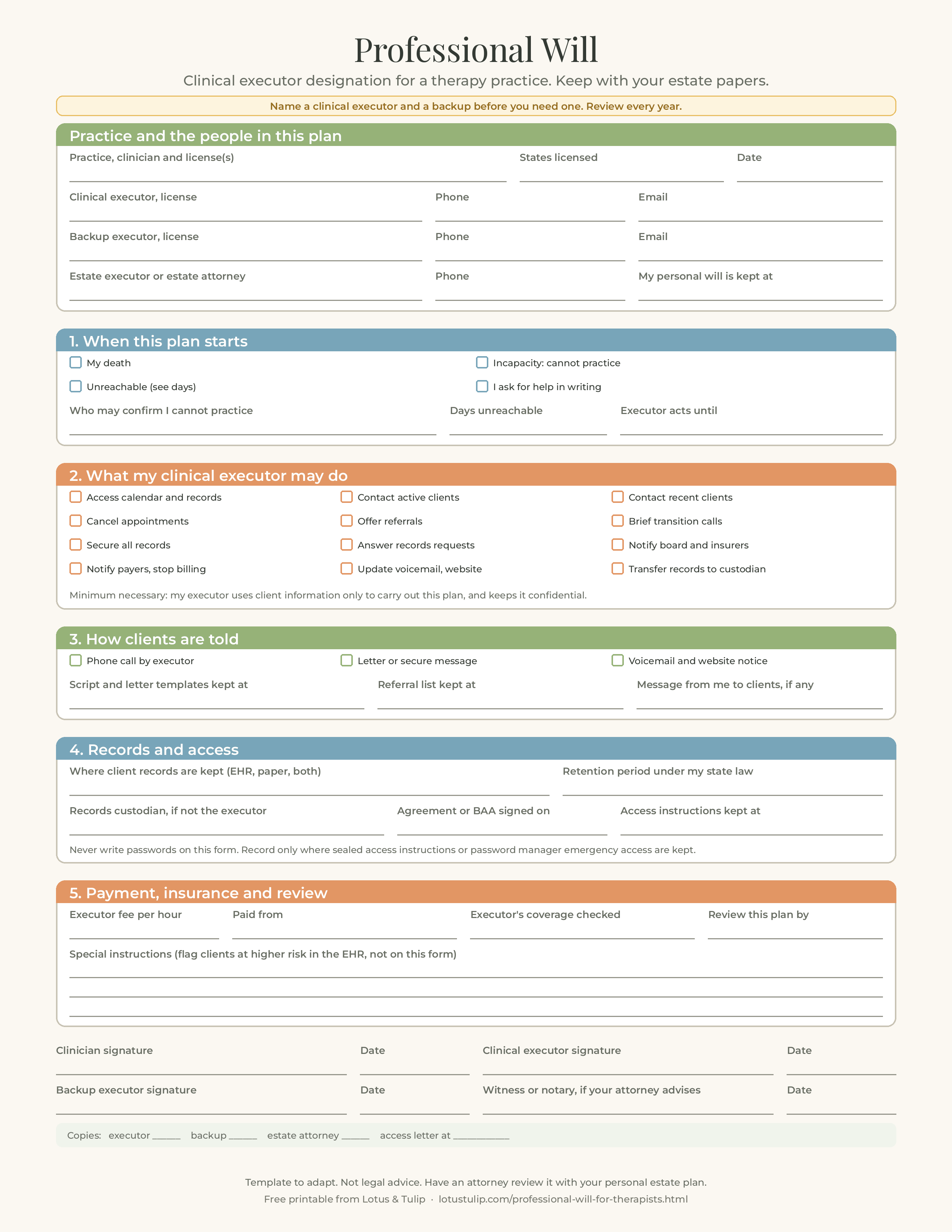
Download the free professional will template (PDF, 3 pages)
Rather type than handwrite? The free PDF above is for printing. Therapy Progress Notes and Intake Templates comes as a fillable PDF you type straight into (604 fields in Adobe Acrobat Reader), plus the printable version: SOAP, DAP and BIRP notes, intake, treatment plan and safety plan, 20 pages. Holiday 20% off: about $7.36, was $9 (EUR 8) · instant digital download
Buy on EtsyPrefer single images? Page 1: blank professional will (PNG) · Page 2: filled fictional example (PNG) · Page 3: checklist and key contacts log (PNG)
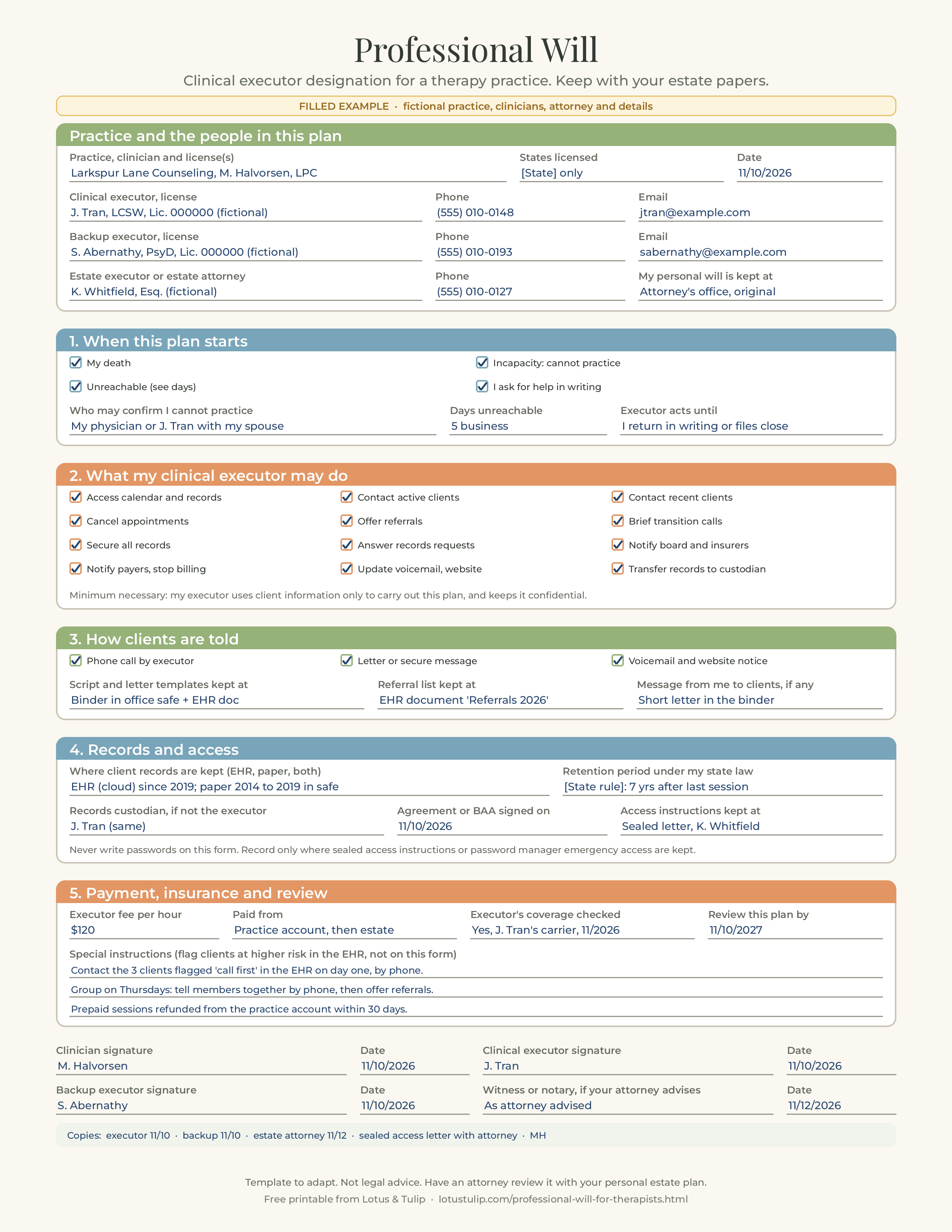

Free to print and use in your own practice. Please link to this page rather than re-uploading the file. The worksheet helps you plan and document a professional will; it is not legal advice and is not a substitute for an attorney's review. Check your state's record retention rules, your licensing board's rules and your estate documents.
Related resources
- Clinical supervision agreement for therapists: template, board rules and a supervision log
- Telehealth across state lines for therapists
- Closing a therapy private practice: checklist, timeline, client letters, records plan and free printable
- HIPAA risk assessment for therapists: security risk analysis, filled example and free worksheet
- Business associate agreement for therapists: which vendors need a BAA, breach duties, filled vendor log and free printable
- Informed consent for therapy template, with a sample consent and free printable
- Therapy termination letter template, including practice closure
- Treatment summary template for therapists and the HIPAA right of access
- Release of information form for therapists, with a filled example
- Notice of privacy practices for therapists
- Therapy discharge summary template
- Psychotherapy notes vs progress notes
- Couples therapy informed consent form
- Credit card authorization form for therapists
Sources: ACA Code of Ethics (2014), standards A.2.b, A.11.d, A.12, B.6.h, B.6.i, C.2.g and C.2.h and the glossary definitions of incapacitation and records custodian; APA Ethical Principles of Psychologists and Code of Conduct (2002, amended 2010 and 2016), standards 2.06(b), 3.12, 6.01, 6.02(c), 6.03, 10.09 and 10.10(c); NASW Code of Ethics, standards 1.07(s) and (t), 1.15, 1.16(b), 1.17(b), 3.04(d) and 4.05(b); AAMFT Code of Ethics (revised, effective January 1, 2026), standards 1.9, 1.10, 2.5, 2.7 and 3.3; 45 CFR 160.103 (business associate), 164.501 (health care operations, psychotherapy notes), 164.502(e), 164.504(e)(2)(ii)(J), 164.524(b)(2) and 164.530(c) and (j)(2), eCFR text current as of November 2026; HHS HIPAA FAQ on medical record retention and HHS guidance on disposal of protected health information; California Business and Professions Code sections 2919 and 4980.49. Rules and codes change; check the current versions.
FAQ
What is a professional will for therapists?
A professional will is a written plan in which a therapist names a licensed colleague, the clinical executor, and a backup to contact clients, offer referrals, protect and transfer records and close or pause the practice if the therapist dies, becomes incapacitated or suddenly cannot practice. It is not a will in the probate sense and works best when the therapist's personal estate documents refer to it.
Is a professional will required for therapists?
The ethics codes require the substance even though they do not use the phrase. The ACA code asks counselors to prepare a plan for transferring clients and records to an identified colleague or records custodian (C.2.h); the APA code asks psychologists to plan in advance for interruptions and for the transfer of records (3.12, 6.02(c)); the NASW code (1.07(t), 1.15) and the AAMFT code (2.7) have similar standards. Some state boards have their own rules, so check yours.
Who should be my clinical executor?
A licensed mental health professional in good standing who can practice where your clients are, has experience with your client population, is organized and reachable, has no conflicting interest, and has agreed in writing. Avoid naming a spouse or family member, and always name a backup.
How long do I have to keep therapy records after I close or die?
HIPAA does not set a retention period for clinical records; state law does, and it varies by state and license. For example, California requires psychologists and marriage and family therapists to keep records for at least seven years after discharge or the end of therapy, and for minors at least seven years after they turn 18. Check your own state's rules and any payer contracts, and name a records custodian in your plan.
Is this professional will template free?
Yes. The three page printable (a blank professional will and clinical executor designation worksheet, a filled fictional example, and a first steps checklist with a key contacts and records location log) is free to print and use in your own practice. Please link to this page rather than re-uploading it.