
Therapist practice · Updated 2026-11-09
BIRP Notes for Therapists: Template, Examples and Checklist (Free Printable)
Ready-made printable: Therapy Progress Notes and Intake Templates Fillable PDF: includes SOAP, DAP and BIRP progress note pages, plus intake, notes and safety plan pages (20 pages)
Holiday 20% off: about $7.36, was $9 (EUR 8) · instant digital download
Try it free first: download a fillable sample (SOAP note and DAP note, PDF, 226 KB). Type into it on screen, then get the full pack. No email needed.

A BIRP note is one of the most practical ways to write a therapy progress note, because its four headings follow the order a session actually happens in: what the client brought, what you did, how they responded, and what happens next. Many agencies, community mental health centers and substance use programs in the US ask for BIRP, and plenty of private practice clinicians choose it on their own because the Intervention and Response sections make the clinical work visible to anyone who reads the record later, including an auditor, a covering clinician or the client.
This guide is for counselors, therapists, social workers, psychologists, school counselors and trainees in the US. It explains what each part of a BIRP note should contain, how BIRP compares with SOAP, DAP and GIRP, how to write one step by step, and then shows five complete fictional examples: adult anxiety, depression with a risk screen, a couples session, a school counselor check in with a teen, and a substance use group. After that come the words worth swapping out, how a BIRP note supports medical necessity and links back to the treatment plan, the privacy basics under HIPAA, Part 2 and FERPA, the most common mistakes, and a free three page printable: a blank BIRP template, a filled example and a before you sign checklist.
Jump to the free BIRP note template
This is educational information for licensed clinicians and trainees, not legal, billing or clinical advice. Documentation rules differ by state, license, setting and payer. Check your state board, your agency policy, your payer contracts and your supervisor's guidance if you are pre-licensed. Every client, clinician and session on this page is fictional.
What BIRP stands for
BIRP stands for Behavior, Intervention, Response, Plan. Each letter is a section of the note, and each section answers one question.
| Section | Question it answers | What usually goes in it |
|---|---|---|
| B: Behavior | What did the client bring today, and what did you see? | Presenting concerns in the client's own words, relevant events since the last session, observable behavior and mental status (appearance, mood and affect, engagement), scores from any measure given today, and the treatment plan goal the session focused on. |
| I: Intervention | What did you do? | The techniques, skills, modality and activities you used, written concretely enough that another clinician could picture the session, and tied to the goal or objective each one served. |
| R: Response | How did the client respond? | Engagement, insight, emotion, skill use, willingness, ratings before and after an exercise, and progress (or lack of it) toward the objective. |
| P: Plan | What happens next? | Homework, focus for the next session, the next appointment date and frequency, referrals, releases, coordination of care, and any safety steps. |
Some settings write the B section as "Behavior / presentation" or split it into what the client reported and what you observed. That is fine. The point of the format is the chain: a clear starting picture, a specific intervention, an honest response, and a plan that follows from the response.
BIRP vs SOAP vs DAP vs GIRP: which format to use
All four are structured progress note formats. They overlap a lot, and a well written note in any of them will usually contain the same facts. The differences are about emphasis.
| Format | Sections | Strength | Watch out for |
|---|---|---|---|
| BIRP | Behavior, Intervention, Response, Plan | Makes your interventions and the client's response explicit, which is what reviewers look for when they ask whether therapy is doing something. | There is no separate Assessment heading, so your clinical interpretation has to live in Response (progress toward the objective) or Plan. |
| SOAP | Subjective, Objective, Assessment, Plan | The most widely recognized format in health care; good when you share records with medical providers. | Therapists often struggle with what counts as "objective" in a talk therapy session, and interventions can get lost. |
| DAP | Data, Assessment, Plan | Short and flexible; popular in private practice. | "Data" can turn into a session transcript, and interventions may not be named. |
| GIRP | Goal, Intervention, Response, Plan | Starts from the treatment plan goal, so medical necessity is visible from the first line. | Can underplay what the client actually brought that day if the goal heading takes over. |
SOAP comes from medicine: it grew out of the problem oriented medical record that physician Lawrence Weed described in his 1968 New England Journal of Medicine article "Medical Records That Guide and Teach." BIRP, DAP and GIRP are later adaptations used widely in behavioral health. For GIRP in depth, see GIRP notes for therapists. We compare SOAP and DAP side by side, with one fictional session written both ways, in SOAP vs DAP notes for therapists.
How to choose. If your agency, electronic record or payer requires a format, use that one. If you choose for yourself, BIRP suits you when:
- you deliver skills based or structured treatment (CBT, DBT skills, exposure, motivational interviewing, relapse prevention) where the intervention is easy to name;
- you work in community mental health, substance use treatment or with Medicaid, where reviewers often focus on what service was delivered and how the client responded;
- you want a format that a covering clinician can pick up quickly.
DAP may suit you better if your sessions are less structured and your clinical reasoning (the Assessment) is the most important thing to capture. Whatever you pick, use one format consistently for a client so the record reads as a story.
How to write a BIRP note, step by step
- Fill in the session details first. Client name or ID, date of service, start and stop times or total minutes, format (in person, telehealth video or phone), session type (individual, couple or family, group) and who attended. Many payers expect time on time based psychotherapy codes, so record it while it is fresh.
- Name the treatment plan goal or objective. Write which problem and objective the session addressed, for example "Problem 1, objective 1.2." This one line does a lot of work for medical necessity.
- Write Behavior from facts. Start with what the client reported, using a short quote where it captures their view, then what you observed: appearance, mood and affect, engagement, and any measure you gave today with its score and the previous score.
- Write Intervention as actions. Use verbs: reviewed, taught, modeled, rehearsed, guided, challenged, explored, reflected, assigned. Say what the technique was applied to and link it to the objective.
- Write Response honestly. Describe how the client engaged and what changed during the session: ratings before and after, a new insight in their words, a skill they practiced, or resistance described as behavior. Add one line on progress toward the objective: met, progressing, no change, or worse.
- Record the risk check. Note whether risk was screened and the result, or why it was not screened today. If there is any concern, the Plan should say what you did about it.
- Write a Plan that follows from the Response. Homework, focus for next time, the next appointment and frequency, referrals, releases, coordination of care and any safety follow up. If the Response showed no progress for several sessions, the Plan should say what changes.
- Read it as an outsider would. Would the client be comfortable reading it? Could a covering clinician continue the work from it? Could a reviewer see why the session was needed? Remove process thoughts and hypotheses that belong in separate psychotherapy notes.
- Sign and close it on time. Sign with your credentials and the date, within the timeframe your agency or payer sets. If you add something later, write a dated addendum rather than changing the original note.
What goes in each section, with weak and strong lines
B: Behavior
Behavior is where you set the scene. A reader should finish it knowing how the client was doing coming into the session, in terms that could be checked. Good B sections mix three kinds of information:
- Client report: what happened since the last session, in summary, with one short quote if it adds something ("I went, but I sat by the door the whole time").
- Your observations: appearance, orientation if relevant, speech, mood (the client's word) and affect (what you saw), engagement, and anything notable such as tearfulness or agitation.
- Data: scores on any measure given today (PHQ-9, GAD-7, a craving scale, a self log), with the comparison score.
Weak: "Client came in and talked about work. Seemed anxious."
Strong: "Client reported 4 days of worry about a performance review, 2 to 3 hours a day (self log), and difficulty falling asleep 3 nights. Stated: 'I keep rehearsing what my boss will say.' GAD-7 = 13 (was 16 on 10/20). Fidgeting early in session, settled after 10 minutes; mood 'on edge,' affect anxious, congruent."
I: Intervention
Intervention is the section that most often goes wrong, usually by naming a model instead of describing an action. "CBT" tells a reader very little. "Taught the worry postponement technique and set a 20 minute daily worry time" tells them exactly what you did.
Weak: "Used CBT and provided support."
Strong: "Reviewed worry log. Taught worry postponement and scheduled a 20 minute worry window at 6 p.m. Used Socratic questioning on the prediction 'I will be fired' (objective 1.1, reduce time spent worrying)."
R: Response
Response shows whether the intervention landed. It is the place for movement during the session (ratings, insight, a practiced skill) and for progress toward the objective across sessions. It is also where you describe non engagement fairly: what the client said or did, not a label.
Weak: "Client responded well."
Strong: "Client rated belief in 'I will be fired' at 85% before and 50% after reviewing evidence, and named two facts against it (recent positive feedback, no warnings). Agreed to try the worry window but doubted it would work. Progress on objective 1.1: partial; worry down from 3+ hours to 2 to 3 hours a day."
P: Plan
Plan should be specific enough that the next session can start from it. Include homework, the next appointment and frequency, anything you will review next time, referrals or releases, and any safety follow up.
Weak: "Continue therapy."
Strong: "Homework: worry window daily at 6 p.m., log minutes. Next session 11/17, in person, weekly. Review worry log and practice postponement in session. GAD-7 again at the 12/1 plan review."
BIRP note examples (all fictional)
Each example below is invented for illustration. Names are initials, details are made up, and none of them describes a real person. Adapt the content and length to your setting; many real notes are shorter than these.
Example 1: Adult with generalized anxiety (individual, in person)
Fictional. Client "D.K.," 34, individual session, in person, 2:00 to 2:52 p.m. (52 minutes). Plan: Problem 1, objective 1.1, reduce daily worry from 3+ hours to under 1 hour.
B: Client reported worrying about an upcoming performance review "most of the day" on 5 of 7 days (worry log averaged about 3 hours a day) and taking over an hour to fall asleep on 3 nights. Stated: "I keep rehearsing what my boss will say." GAD-7 = 13 (was 16 on 10/20). Arrived on time, casually dressed, fidgeting with keys for the first 10 minutes, then settled. Speech normal rate and volume. Mood "on edge," affect anxious and congruent. Engaged throughout.
I: Reviewed worry log with client. Psychoeducation on the difference between productive and unproductive worry. Taught worry postponement and scheduled a 20 minute daily worry window at 6 p.m. Used Socratic questioning on the prediction "I will be fired." Rehearsed one opening line for the review meeting (objective 1.1).
R: Client sorted 3 of 5 logged worries as unproductive without prompting. Belief in "I will be fired" moved from 85% to 50% after listing evidence for and against (recent positive feedback, no formal warnings). Said the rehearsal "made it feel less huge." Agreed to try the worry window but said, "I doubt I can hold it until six." Progress on objective 1.1: partial.
P: Homework: worry window daily at 6 p.m.; log minutes worried and whether postponement worked. Next session 11/17, in person, weekly per plan. Review log, troubleshoot postponement, introduce a brief evening wind down routine for sleep onset. Repeat GAD-7 at the 12/1 plan review.
Example 2: Depression with a risk screen (telehealth)
Fictional. Client "L.T.," 47, individual session, telehealth video, 9:00 to 9:54 a.m. (54 minutes). Client confirmed she was at home, alone in a private room, and gave a callback number at the start of the session. Plan: Problem 1, objective 1.2, complete 3 planned activities a week.
B: Client reported staying in bed until about noon on 5 of 7 days since being laid off 6 weeks ago and completing 1 of 3 planned activities. Stated: "What's the point of getting up, there's nothing to get up for." PHQ-9 = 18 (was 16 on 10/30); item 9 scored 1 ("several days"). Appeared tired, hair unwashed, camera angled low. Speech slow, low volume. Mood "flat," affect constricted. Answered questions but rarely added detail.
I: Followed up on PHQ-9 item 9 with a direct suicide risk inquiry using the agency's screening protocol. Reviewed and updated the client's existing safety plan, including warning signs, coping steps, people to contact, professional contacts and the 988 Suicide and Crisis Lifeline (call or text 988). Behavioral activation: reviewed the activity log and scheduled 3 small, specific activities for the coming week with the client (objective 1.2).
R: Client described passive thoughts ("it would be easier not to wake up") on several days, denied any intent or plan, denied access to firearms, and identified her sister and her dog as reasons for living. Named two warning signs (skipping meals, not answering texts) and agreed to text her sister if they appear. Chose a 15 minute walk with the dog, one job application, and lunch with her sister. Brightened slightly when talking about the dog. Progress on objective 1.2: no change this week.
P: Updated safety plan sent to client via the secure portal; client confirmed she can open it. Homework: the 3 scheduled activities; mark each on the log. Next session moved up to 11/12 (telehealth) to check in on mood and safety; weekly frequency continues. Consult with clinical supervisor today regarding increased PHQ-9 and item 9 (completed, see consult note). With client's signed release on file, coordinate with primary care provider about the PHQ-9 trend before the next session.
Your agency's risk assessment procedure, documentation standards and state law govern what you must do and record when a client reports suicidal thoughts. This example shows how a BIRP note can record the screen and the response, not a protocol to follow.
Example 3: Couples session
Fictional. Clients "R.S." and "J.S.," married 9 years, conjoint session, in person, 5:00 to 5:58 p.m. (58 minutes). Plan: Problem 1, objective 1.1, partners use a structured time out and return to the topic within 24 hours in 3 of 4 conflicts.
B: Partners reported 2 arguments since last session, both about household tasks. They used the agreed time out once and returned to the topic the next morning; the second argument escalated to raised voices and J. left the house for the evening. R. stated: "I feel like I'm the only one who notices what needs doing." J. stated: "Nothing I do counts." Both denied any physical aggression, threats or fear of the other when asked separately at the start of session per practice protocol. Both engaged; R. tearful when describing the second argument; J. looked away and gave short answers for the first 15 minutes.
I: Reviewed the successful time out and what made it work. Mapped the second argument as a cycle (criticism, defensiveness, withdrawal) on the whiteboard. Coached each partner to restate the other's point before responding, rehearsed twice in session with the household task topic. Introduced a weekly 20 minute "household meeting" structure (objective 1.1).
R: Both partners identified their own step in the cycle without blaming the other. On the second rehearsal, J. restated R.'s point accurately and R. said, "that's exactly it." J.'s engagement increased once the cycle was on the board. Both agreed to one household meeting this week; R. skeptical it would happen. Progress on objective 1.1: time out used and returned to in 1 of 2 conflicts.
P: Homework: one 20 minute household meeting by Sunday, using restating; each partner notes one time the other contributed. Next conjoint session 11/19, weekly. If either partner reports fear, threats or physical aggression, follow the practice protocol for individual check ins before continuing conjoint work.
Whether a couples note sits in one shared record or in each partner's record, and who can access it, depends on your setting, state law and the consent you agreed at the start. Write it so that either partner could read it without being blamed by it.
Example 4: School counselor check in with a teen
Fictional. Student "A.G.," grade 10, individual counseling check in at school, 11:10 to 11:35 a.m. (25 minutes), self referred after a teacher suggested it. Counseling goal from the student's plan: attend all of first period on 4 of 5 school days.
B: Student reported arriving late to first period on 3 of 5 days this week (attendance record shows 3 tardies) because of staying up late on her phone and "dreading" a presentation in that class. Stated: "I'd rather get a tardy than stand up there." Appeared tired, made good eye contact, spoke openly. Denied thoughts of harming herself or others when asked directly per school protocol.
I: Normalized presentation anxiety and taught one 4 count breathing exercise, practiced twice. Helped the student break the presentation into three small steps and plan the first step for Thursday. Set a phone off time with the student and discussed one way to remind herself.
R: Student practiced the breathing exercise and said it "kind of helped." Chose 10:30 p.m. as a phone off time and to charge her phone in the kitchen. Agreed to ask the teacher about presenting first so she would not wait. Progress toward the attendance goal: not yet, 2 of 5 days on time this week.
P: Student will talk to the teacher by Wednesday; counselor will check in briefly on Thursday after first period. Follow up session next Tuesday, 11:10 a.m. If tardies continue, with the student's agreement, invite a parent or guardian to a planning meeting.
For a counselor employed by a school that receives US Department of Education funds, records like this are generally education records under FERPA rather than HIPAA records, according to the joint HHS and Department of Education guidance (2019). Your district's policy and state law decide how they are kept and who may see them.
Example 5: Substance use group (intensive outpatient)
Fictional. Relapse prevention group in an intensive outpatient program, 6 members, 6:00 to 7:30 p.m. (90 minutes). This example shows only one member's individual section; the shared part of a group note should not name other members. For the full two part format, confidentiality wording and billing notes, see our group therapy progress notes guide with a free template.
B: Client "T.B." reported 12 days without alcohol (self report, matches the program's breath test today) and one strong craving on Saturday at a family barbecue, rated 8 out of 10. Arrived on time, well groomed, participated without prompting. Mood "pretty good," affect bright.
I: Group topic: high risk situations and urge surfing. Facilitator led a 5 minute urge surfing exercise and a role play of refusing a drink, and asked each member to map one upcoming high risk situation (T.B.'s plan objective 2.1: identify and plan for 3 high risk situations).
R: T.B. described leaving the barbecue early after texting his sponsor and said, "I didn't know I could just go." Practiced the refusal line in the role play and rated craving at 4 out of 10 after the urge surfing exercise. Identified his brother's birthday dinner on 11/22 as the next high risk situation. Gave supportive feedback to another member. Progress on objective 2.1: 2 of 3 situations identified and planned.
P: Write a coping plan for 11/22 and bring it to the next group on 11/12. Continue IOP 3 evenings a week per plan. Individual session with primary counselor on 11/13 to review the coping plan and the 30 day treatment plan review.
If your program is a federally assisted substance use disorder program, its records are also protected by 42 CFR Part 2, which has its own consent and disclosure rules on top of HIPAA. See the privacy section below.
Words to watch in BIRP notes
Progress notes are read by people who were not in the room, and more and more often by clients themselves. A few habits make notes vaguer, more judgmental or less useful than they need to be.
| Instead of | Try | Why |
|---|---|---|
| "Client is doing better." | "Panic attacks down from 4 to 1 a week (self log)." | Shows the change and how you know. |
| "Discussed feelings." | "Explored grief about the job loss; client named anger and relief." | Says what the work was. |
| "Client was resistant / noncompliant." | "Client declined the exposure task and said, 'not this week.'" | Describes behavior instead of labeling the person. |
| "Client is manipulative / attention seeking." | "Client asked twice to end early; reviewed the session agreement." | Labels like these follow clients across providers. |
| "Good session." | "Completed 3 exposure trials; SUDS fell from 70 to 35." | Shows the response, not your impression. |
| "Supportive therapy provided." | "Validated, reflected, then problem solved one workday barrier." | Names the actual interventions. |
| "Seems depressed." | "PHQ-9 = 17; flat affect; reports sleeping 11 hours a day." | Gives the evidence behind the impression. |
| "Continue treatment." | "Weekly CBT per objective 1.2; repeat GAD-7 at session 8." | Shows why more sessions are needed and how progress is tracked. |
| "Client admitted drinking." | "Client reported drinking 4 beers on Friday." | "Admitted" and "denied" can imply wrongdoing; "reported" is neutral. (Use "denied" for risk screening answers where your protocol expects it.) |
| Long quotes of what the client said about other people | A short summary of what matters for care | Other people's private details rarely belong in the client's record. |
Also watch for copy and paste notes. If ten notes in a row have the same Intervention and Response text, a reviewer may conclude that nothing individual happened in those sessions, and a covering clinician cannot tell what changed.
Medical necessity: how a BIRP note links to the treatment plan
For insurance funded therapy, each note helps show that the service was needed and that treatment is working, or being changed when it is not. Medicare only pays for services that are "reasonable and necessary for the diagnosis or treatment of illness or injury" (Social Security Act, section 1862(a)(1)(A)), and commercial plans and Medicaid programs use their own medical necessity definitions. The treatment plan is the anchor: it names the problems, goals, measurable objectives and interventions. Each BIRP note then shows one session's work against that plan.
Medicare contractors publish documentation expectations for psychotherapy. One billing and coding article (A56937, Psychiatry and Psychology Services) lists items that "must be included in all psychiatric medical record documentation and made available upon request," including:
- the name of the beneficiary and date of service;
- the type of service (individual, group, family, interactive and so on);
- the time element, where face to face time determines the code;
- the modalities and frequency of treatment furnished;
- "a clinical note for each encounter, where in the aggregate, summarizes" diagnosis, symptoms, functional status, focused mental status examination, treatment plan, prognosis and progress to date;
- the identity and professional credentials of the person performing the service.
Another contractor article (A57065, Outpatient Psychiatry and Psychology Services) adds that "the medical record should document the target symptoms, goals of therapy and methods of monitoring outcome," and that "there should be documentation in the medical record of how the treatment is expected to improve the health status or function of the patient." It also says that when services are frequent or long, "the plan of treatment, progress notes, and condition of the patient should justify the intensity of the services rendered."
Time. Individual psychotherapy codes are time based. Medicare billing article A57520 says start and stop times or total times must be documented for 90832, 90834 and 90837, and to choose the code closest to the actual time: 16 to 37 minutes for 90832, 38 to 52 minutes for 90834, and 53 or more minutes for 90837, with no psychotherapy code for under 16 minutes. Commercial payers may apply the same CPT time rules or add their own requirements, so check your contracts.
Putting it together in a BIRP note:
- Session details: time, format, type of service and who attended.
- Goal line: the problem and objective from the plan.
- Behavior: current symptoms and functional impact, with a measure where you use one. This shows the need is still there.
- Intervention: the modality and techniques, tied to the objective. This shows skilled treatment was delivered.
- Response: progress toward the objective. This shows whether treatment is working.
- Plan: frequency and next steps, and changes to the approach when progress stalls. This justifies continuing care.
If you do not have a plan with measurable objectives yet, start there: our therapy treatment plan template walks through problems, goals, SMART objectives and interventions with a filled example, and its objectives are numbered so your BIRP notes can point to them.
Privacy basics: progress notes, psychotherapy notes, Part 2 and FERPA
Under HIPAA, a BIRP note is a progress note, not a psychotherapy note
HIPAA gives extra protection to one narrow category called "psychotherapy notes." The definition in 45 CFR 164.501 is: notes "recorded (in any medium) by a health care provider who is a mental health professional documenting or analyzing the contents of conversation during a private counseling session or a group, joint, or family counseling session and that are separated from the rest of the individual's medical record." The same definition excludes "medication prescription and monitoring, counseling session start and stop times, the modalities and frequencies of treatment furnished, results of clinical tests, and any summary of the following items: Diagnosis, functional status, the treatment plan, symptoms, prognosis, and progress to date."
Almost everything a BIRP note contains (times, modality, symptoms, measure scores, progress toward the plan) is on that excluded list. So a BIRP note is part of the clinical record, not a psychotherapy note, whatever your software calls it.
Why it matters in practice:
- Client access. Under 45 CFR 164.524, individuals have a right to inspect and get a copy of their information in the designated record set, with an exception for psychotherapy notes. Clients can generally ask to see their BIRP notes.
- Authorization. Under 45 CFR 164.508(a)(2), a covered entity must obtain the client's authorization for most uses and disclosures of psychotherapy notes, with narrow exceptions such as use by the clinician who wrote them for treatment. Progress notes follow the general HIPAA rules for treatment, payment and health care operations.
- Minimum necessary. Under 45 CFR 164.502(b), covered entities must make reasonable efforts to limit uses and disclosures to the minimum necessary for the purpose (with some exceptions, such as disclosures to a provider for treatment). In a note, that means describing what matters for care, not everything that was said.
- Keep process notes separate, if you keep them. If you write personal process notes (hypotheses, your own reactions, verbatim content), they only get psychotherapy note protection if they are kept separate from the rest of the record. Do not put that material in the BIRP note.
Minors. HHS explains that parents are generally the personal representatives of their minor children under HIPAA, that state law sets when a minor can consent to their own care and who can see related records, and that a provider may use professional judgment to decline to treat someone as a personal representative if doing so could endanger the client. Check your state's minor consent rules before you write for a teen client in private practice.
HIPAA applies to covered entities, which include health care providers who transmit health information electronically in connection with standard transactions such as claims. A self pay therapist who never bills electronically may not be a covered entity, but state law, licensing board rules and professional ethics codes still govern records, and most clinicians follow HIPAA practices anyway.
Substance use disorder records: 42 CFR Part 2
Records from federally assisted programs that provide substance use disorder diagnosis, treatment or referral for treatment are also covered by 42 CFR Part 2. HHS updated Part 2 in a 2024 final rule that aligns parts of it with HIPAA, including allowing a single patient consent for all future uses and disclosures for treatment, payment and health care operations. HHS states that compliance with the updated rule was required by February 16, 2026, and that Part 2 records still cannot be used to investigate or prosecute the patient without written patient consent or a court order. If you work in a Part 2 program, follow your program's consent forms and disclosure procedures, and keep BIRP notes factual and free of detail that is not needed for care.
School counselors: FERPA
The 2019 joint guidance from HHS and the US Department of Education explains that the HIPAA Privacy Rule excludes records protected by FERPA from the definition of protected health information, and that in most cases HIPAA does not apply to an elementary or secondary school's student health records because they are education records under FERPA. FERPA's definition of education records (34 CFR 99.3) excludes "records that are kept in the sole possession of the maker, are used only as a personal memory aid, and are not accessible or revealed to any other person except a temporary substitute for the maker of the record." A BIRP style counseling note that is shared, filed or used for planning will usually not meet that exception. Follow your district's records policy and your state's rules.
Sources for this section: eCFR (45 CFR 164.501, 164.502, 164.508, 164.524; 34 CFR 99.3), HHS Office for Civil Rights mental health and personal representative guidance, HHS 42 CFR Part 2 final rule fact sheet and Part 2 overview, and the HHS and Department of Education joint guidance on HIPAA and FERPA (2019 update). Rules change; check the current versions.
Common BIRP note mistakes
- Naming the model instead of the intervention. "CBT" or "DBT" is a model; "practiced the TIPP paced breathing skill and planned when to use it" is an intervention.
- A Response that just repeats the Intervention. "Client participated in CBT" is not a response. Say what changed, what the client said or did, or that nothing changed.
- No link to the plan. A note that never mentions a goal or objective makes medical necessity hard to see.
- Labels instead of behavior. "Resistant," "manipulative," "noncompliant" and "attention seeking" judge the person and tell a reader little. Describe what happened.
- Transcript notes. Long verbatim passages make notes slow to read and can expose private details that are not needed for care.
- Missing or vague time. Time based codes need start and stop times or total time.
- A risk concern without a plan. If the Behavior or Response mentions risk, the Plan should show what you did.
- Identical notes week after week. Copy forward is fine for session details, not for B, I, R and P.
- Late notes. Notes written days later are less accurate. Close them within your agency's or payer's timeframe, and use a dated addendum for later additions.
- Process material in the record. Your hypotheses and reactions belong in supervision or in separate psychotherapy notes, not in the BIRP note.
Free printable: BIRP note template, filled example and checklist
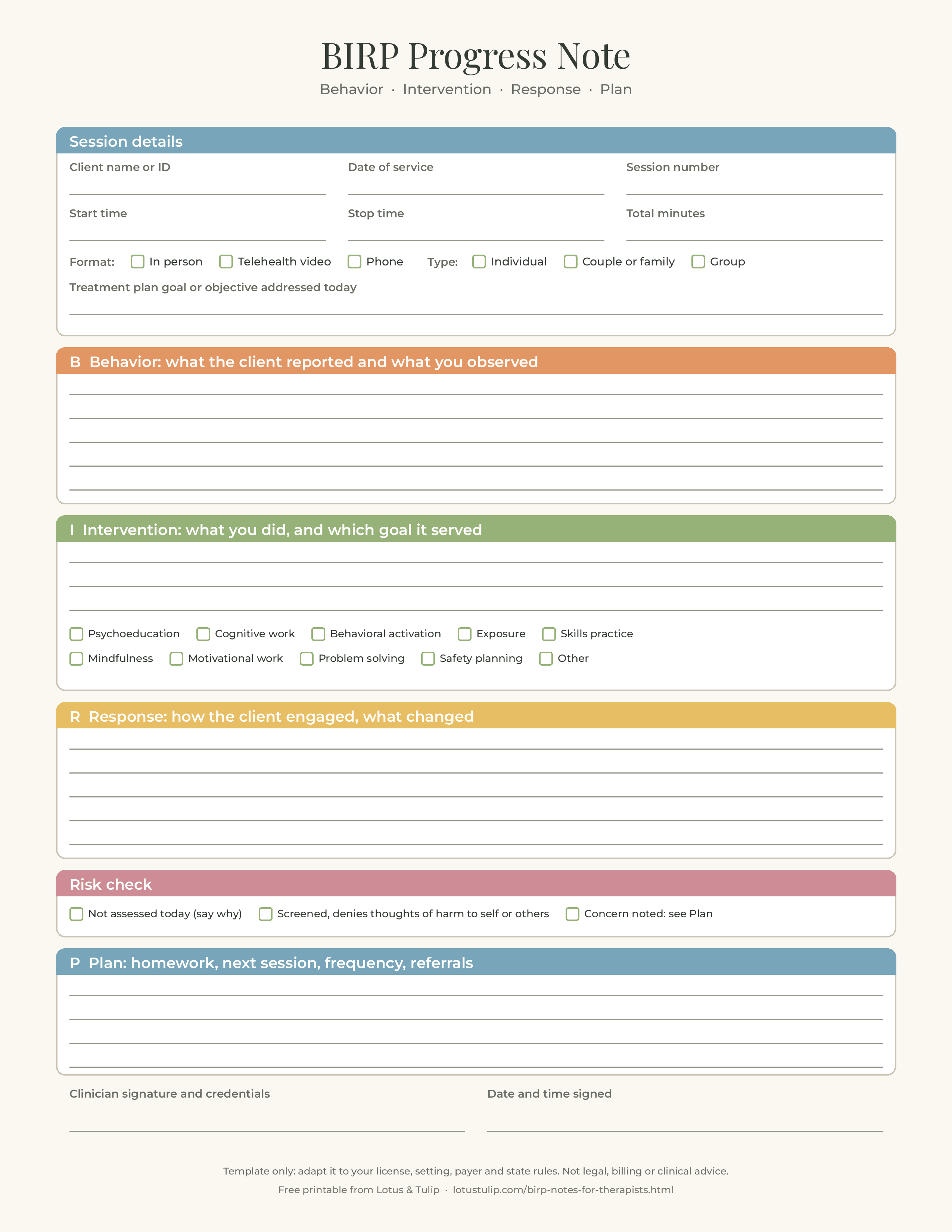
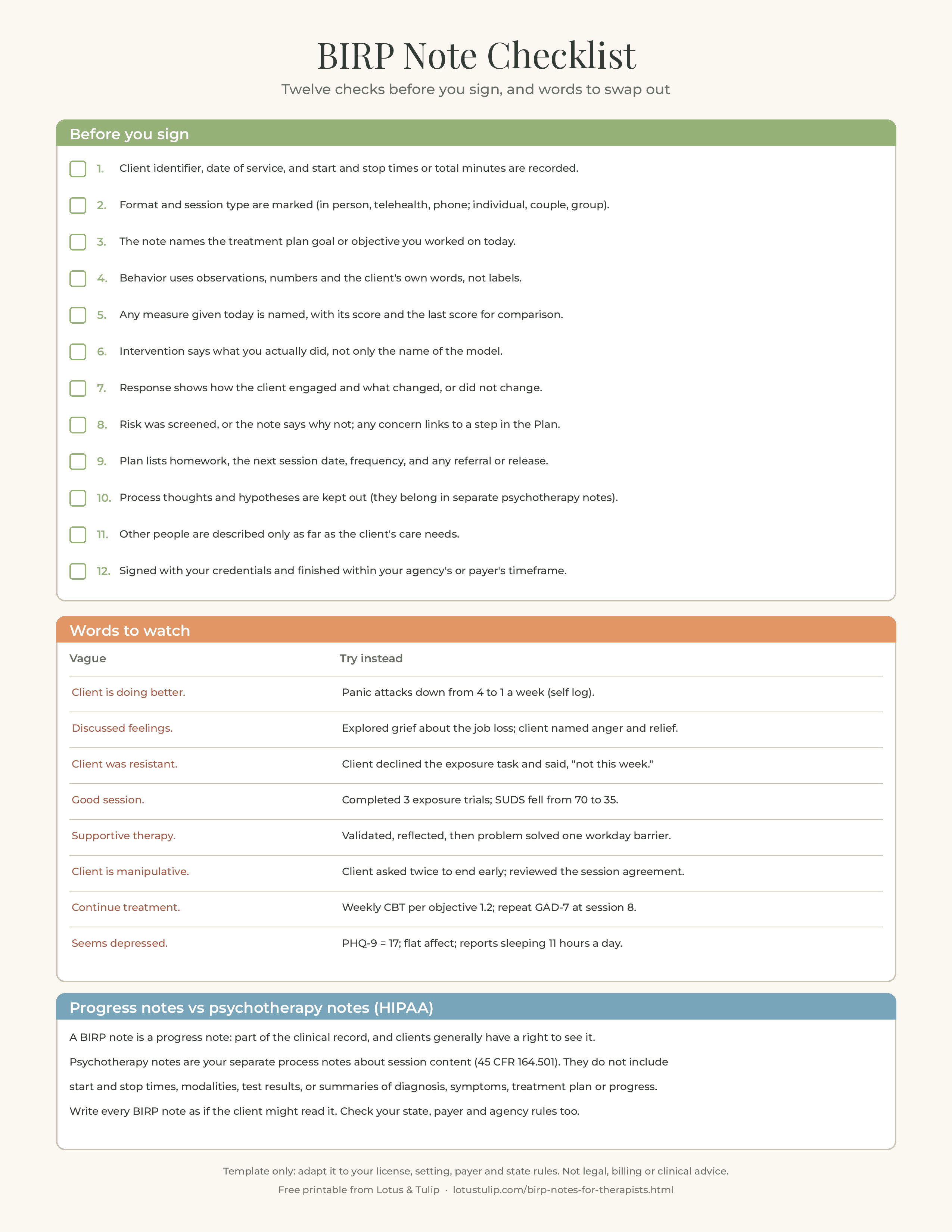
The free printable has three US Letter pages: a blank BIRP note with session details, a treatment plan goal line, B, I, R and P sections, an interventions checklist, a risk check and a signature line; a filled example for a fictional adult client with panic, written for telehealth; and a one page checklist with twelve checks before you sign, a words to watch table and a short reminder about progress notes and psychotherapy notes.
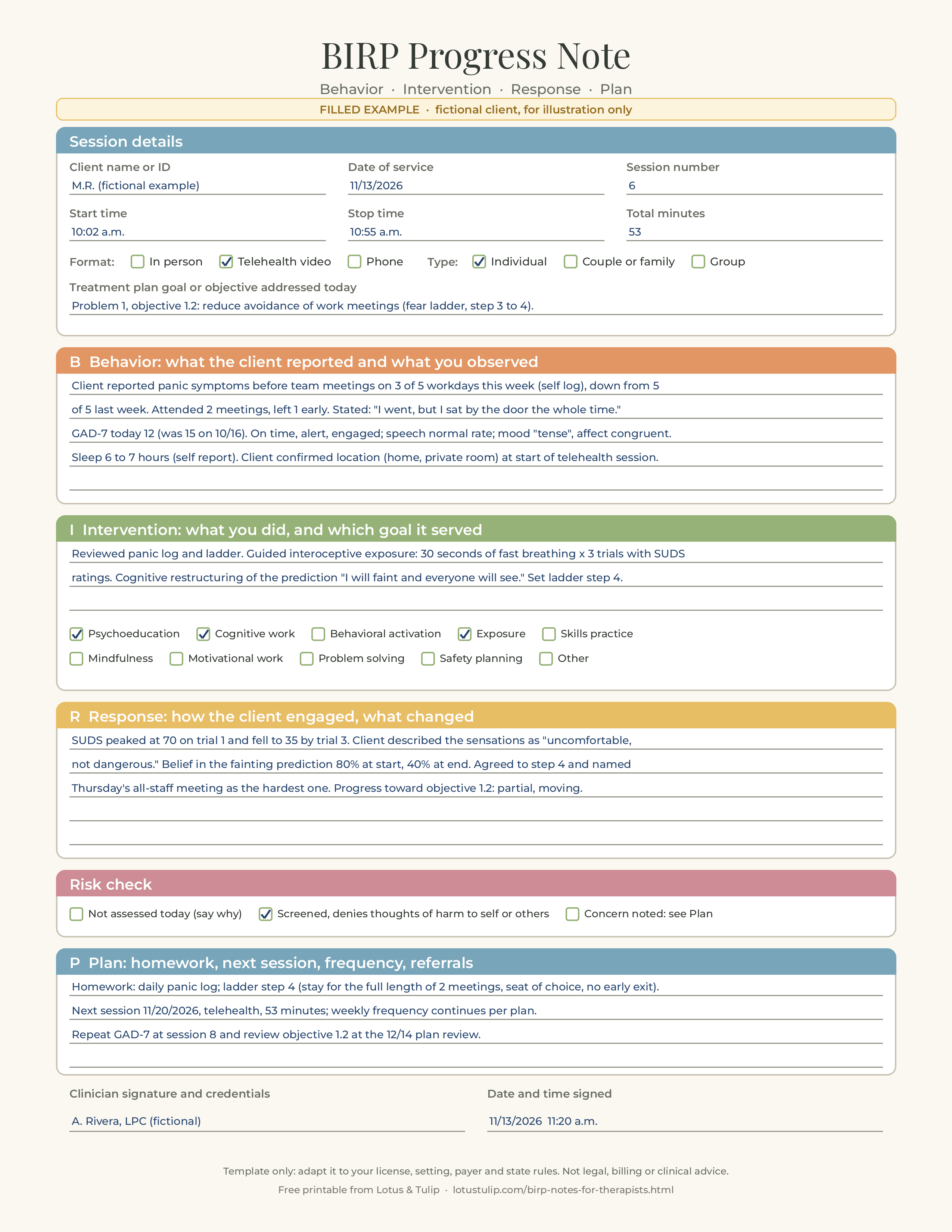
Download the free BIRP note template (PDF, 3 pages)
Rather type than handwrite? The free PDF above is for printing. Therapy Progress Notes and Intake Templates comes as a fillable PDF you type straight into (604 fields in Adobe Acrobat Reader), plus the printable version: SOAP, DAP and BIRP notes, intake, treatment plan and safety plan, 20 pages. Holiday 20% off: about $7.36, was $9 (EUR 8) · instant digital download
Buy on EtsyPrefer single images? Page 1: blank BIRP note template (PNG) · Page 2: filled BIRP note example (PNG) · Page 3: before you sign checklist and words to watch (PNG)
Free to print and use in your own practice. Please link to this page rather than re-uploading the file. The template is a starting point: adapt it to your license, setting, payer and state rules. Using it does not guarantee that any payer, auditor or board will accept your documentation.
Related resources
- Clinical supervision agreement for therapists: template, board rules and a supervision log
- Closing a therapy private practice: checklist, timeline, client letters, records plan and free printable
- HIPAA risk assessment for therapists: security risk analysis, filled example and free worksheet
- Business associate agreement for therapists: which vendors need a BAA, breach duties, filled vendor log and free printable
- Professional will for therapists: clinical executor, records custodian, client notification scripts, filled example and free printable
- Couples therapy informed consent form: no secrets policy, individual sessions, records access, safety screening, filled example and free printable
- Treatment summary template for therapists: how to write a treatment summary letter, transfer records under HIPAA, filled example and free printable
- Notice of privacy practices for therapists: HIPAA 164.520 elements, 2026 Part 2 update, filled example and free printable
- Parental consent form for therapy of a minor: who can consent, custody orders, state minor consent laws, HIPAA, filled example and free printable
- Credit card authorization form for therapists: card on file consent, PCI DSS rules, filled example and free printable
- Sliding scale fee policy for therapists: 2026 poverty guideline tiers, copay waiver rules, filled example and free printable
- Therapy cancellation policy template: late cancellation and no show fees, Medicare and Medicaid rules, filled example and free printable
- Release of information form for therapists: HIPAA authorization elements, psychotherapy notes, Part 2, filled example and free printable
- Superbill template for therapists: every field insurers need, CPT and POS codes, filled example and free printable
- Good Faith Estimate template for therapists: No Surprises Act rules, filled example and free printable
- Psychotherapy notes vs progress notes: what HIPAA says, what goes where and free printable
- Therapy termination letter template: how to end therapy ethically, sample letters and free printable
- Informed consent for therapy template: what to include, sample consent and free printable
- Biopsychosocial assessment template: example, 4 Ps formulation and free printable
- GIRP notes for therapists: template, examples and free printable
- Group therapy progress notes: template, examples and free printable
- Therapy discharge summary template: example and free printable
- Telehealth progress note template: examples, checklist and free printable
- Mental status exam template: examples, word bank and free printable
- SOAP vs DAP notes for therapists, with examples
- Therapy treatment plan template with SMART objectives (free printable)
- What to include in a therapy intake form (checklist)
- Therapy progress notes and intake templates
- Safety plan worksheet (free printable)
- Relapse prevention plan worksheet (free printable)
FAQ
What does BIRP stand for in a progress note?
BIRP stands for Behavior, Intervention, Response and Plan. Behavior records what the client reported and what you observed, Intervention records what you did, Response records how the client responded and their progress toward the treatment plan objective, and Plan records homework, the next session and any referrals or safety steps.
What is the difference between BIRP and SOAP notes?
SOAP uses Subjective, Objective, Assessment and Plan and comes from the problem oriented medical record in medicine. BIRP replaces the Subjective and Objective split with a single Behavior section and adds explicit Intervention and Response sections, which makes the therapy work and the client's response easy to see. Both can contain the same facts.
What is the difference between BIRP and DAP notes?
DAP uses Data, Assessment and Plan. It is shorter and puts weight on your clinical assessment. BIRP separates what you did (Intervention) from how the client responded (Response), which many agencies and payers prefer because it shows that a skilled service was delivered.
What is a GIRP note?
GIRP stands for Goal, Intervention, Response and Plan. It is like BIRP but starts with the treatment plan goal instead of the client's presentation. If you use BIRP, you can get the same benefit by writing the goal or objective on a line at the top of the note. Our GIRP notes guide has five fictional examples and a free GIRP template.
How long should a BIRP note be?
Long enough that another clinician could continue the work and a reviewer could see why the session was needed, which is often a short paragraph or a few lines per section. There is no single required length; follow your agency and payer requirements.
Are BIRP notes psychotherapy notes under HIPAA?
No. The HIPAA definition of psychotherapy notes in 45 CFR 164.501 covers notes about the contents of counseling conversations that are kept separate from the medical record, and it excludes session start and stop times, modalities, test results and summaries of diagnosis, symptoms, functional status, the treatment plan, prognosis and progress. A BIRP note contains those items, so it is part of the clinical record, which clients generally have a right to see.
Can clients read their BIRP notes?
Generally yes. Under HIPAA, individuals have a right to inspect and get a copy of their records in the designated record set, with an exception for separately kept psychotherapy notes. State law and narrow exceptions can apply, so check your rules, and write every note as if the client may read it.
Is this BIRP note template free?
Yes. The three page printable (blank BIRP note, filled example and checklist) is free to print and use in your own practice. Please link to this page rather than re-uploading the file, and adapt it to your setting and payer requirements.