
Therapist practice · Updated 2026-11-10
Closing a Therapy Private Practice: A Checklist, Timeline, Client Letters and Records Plan (Free Printable)
Ready-made printable: Therapy Progress Notes and Intake Templates Fillable PDF: includes a discharge summary page, plus intake, notes and safety plan pages (20 pages)
Holiday 20% off: about $7.36, was $9 (EUR 8) · instant digital download
Try it free first: download a fillable sample (SOAP note and DAP note, PDF, 226 KB). Type into it on screen, then get the full pack. No email needed.

Most therapists spend years building a private practice and almost no time planning how it ends. Then the ending arrives, sometimes on a schedule (retirement, a move across the country, a full time job offer, joining a group) and sometimes not (a diagnosis, a family crisis, burnout that will not wait). Either way, the questions are the same and they are surprisingly specific. How much notice do clients need? What goes in the letter? Who keeps the records, for how long, and how does a former client get them in five years? What happens to the EHR subscription, the insurance contracts, the NPI, the malpractice policy and the phone number printed on a hundred old business cards?
This guide is for counselors, marriage and family therapists, clinical social workers, psychologists and other licensed clinicians in US private practice who are planning to close, or want to know what closing would involve before they have to. It covers what the APA, ACA and NASW ethics codes actually say about ending a practice, what HIPAA does and does not require, how state rules set record retention (with examples from California, New York and Texas taken from the official texts), a realistic timeline that works backward from your last day, how to tell clients in session and in writing, sample letters, a records custody plan, the insurance and credentialing wind down (payers, Medicare, CAQH, NPI), malpractice tail coverage, a full fictional example and a free three page printable closure plan with a client notification and records transfer log.
Jump to the free practice closure plan and checklist
This is educational information for licensed clinicians and trainees in the US. It is not legal, tax or insurance advice and does not create any professional relationship. Ethics code text was checked against the APA Ethical Principles of Psychologists and Code of Conduct (2002, amended 2010 and 2016), the ACA Code of Ethics (2014) and the NASW Code of Ethics as published on each association's website. Federal rules were checked against the eCFR text as in effect on November 1, 2026. State examples were checked against the California Legislative Information site, the New York State Education Department's Office of the Professions and the Texas Behavioral Health Executive Council's published guidance. Your state board, your payer contracts and your malpractice carrier have the final word for your situation; before you close, talk to a health care attorney and an accountant who know your state.
The short answer
Closing a practice well comes down to three duties that every major ethics code shares, plus a pile of administrative tasks that are easy once they are on a list.
- Do not abandon clients. Give as much notice as you reasonably can, tell clients yourself before they get a letter, offer referrals and pretermination counseling, and give clients who are in crisis or at higher risk a documented transition plan and, where possible, a direct handoff to a named clinician. The ACA Code says counselors "do not abandon or neglect clients" (A.12); the NASW Code asks social workers who anticipate termination to "notify clients promptly and seek the transfer, referral, or continuation of services" (1.17(e)); the APA Code requires pretermination counseling and suggested alternative providers "as appropriate" (10.10(c)).
- Keep records safe and reachable for the full retention period. HIPAA does not set a retention period for clinical records; HHS says "State laws generally govern how long medical records are to be retained." Those periods are often seven years after services end, and longer for minors. Your duty to protect confidentiality, and each client's right to a copy, continue after your last session.
- Plan the transfer of records in advance. The ACA Code requires "a plan for the transfer of clients and the dissemination of records to an identified colleague or records custodian" for retirement or termination of practice (C.2.h); the APA Code requires psychologists to "make plans in advance to facilitate the appropriate transfer and to protect the confidentiality of records" (6.02(c)).
- Notice period: no national rule sets one. Texas's behavioral health board, in its October 2026 closing guidance, calls 30 to 60 days "reasonable" for a planned closure, with more individualized notice for clients in active, higher risk treatment. Many clinicians who can plan ahead give 60 to 90 days.
- Then the wind down: final claims and refunds, payer contract terminations, Medicare enrollment (if you have one), CAQH, your NPI, your license status, malpractice tail coverage, the EHR and telehealth subscriptions, the phone line, the website and directory listings, the lease and the business entity.
- Keep your HIPAA paperwork too. Policies, procedures and other required HIPAA documentation must be kept six years "from the date of its creation or the date when it last was in effect, whichever is later" (45 CFR 164.316(b)(2)(i) and 164.530(j)(2)).
What the ethics codes say about closing a practice
None of the major codes has a standard titled "closing your practice," but several standards apply directly. Here is what they say, in their own words, and what each one means in practice.
| Code and standard | What it says | What it means when you close |
|---|---|---|
| APA 3.12 Interruption of Psychological Services | "Unless otherwise covered by contract, psychologists make reasonable efforts to plan for facilitating services in the event that psychological services are interrupted by factors such as the psychologist's illness, death, unavailability, relocation, or retirement." | Retirement and relocation are named. Planning is expected before they happen. |
| APA 6.02(c) Maintenance, Dissemination, and Disposal of Confidential Records | "Psychologists make plans in advance to facilitate the appropriate transfer and to protect the confidentiality of records and data in the event of psychologists' withdrawal from positions or practice." | A written records plan: who holds them, where, and how clients get copies. |
| APA 10.09 Interruption of Therapy | "When entering into employment or contractual relationships, psychologists make reasonable efforts to provide for orderly and appropriate resolution of responsibility for client/patient care in the event that the employment or contractual relationship ends, with paramount consideration given to the welfare of the client/patient." | Matters most when you leave a group or agency: settle in advance whose clients and records they are. |
| APA 10.10(c) Terminating Therapy | "Except where precluded by the actions of clients/patients or third-party payors, prior to termination psychologists provide pretermination counseling and suggest alternative service providers as appropriate." | Talk it through in session and offer referrals. A letter alone is not pretermination counseling. |
| ACA A.11.c Appropriate Termination | "Counselors provide pretermination counseling and recommend other service providers when necessary." | Same idea as APA 10.10(c). |
| ACA A.11.d Appropriate Transfer of Services | "When counselors transfer or refer clients to other practitioners, they ensure that appropriate clinical and administrative processes are completed and open communication is maintained with both clients and practitioners." | Releases signed, records or summaries sent, the receiving clinician actually reached. |
| ACA A.12 Abandonment and Client Neglect | "Counselors do not abandon or neglect clients in counseling. Counselors assist in making appropriate arrangements for the continuation of treatment, when necessary, during interruptions such as vacations, illness, and following termination." | Closing is allowed. Leaving clients with nowhere to go is not. |
| ACA B.6.h Storage and Disposal After Termination | Counselors "store records following termination of services to ensure reasonable future access, maintain records in accordance with federal and state laws and statutes such as licensure laws and policies governing records, and dispose of client records and other sensitive materials in a manner that protects client confidentiality." | Storage has to allow future access, for the period your state requires. |
| ACA B.6.i Reasonable Precautions | "Counselors take reasonable precautions to protect client confidentiality in the event of the counselor's termination of practice, incapacity, or death and appoint a records custodian when identified as appropriate." | Name a custodian if you will not hold the records yourself. |
| ACA C.2.h Counselor Incapacitation, Death, Retirement, or Termination of Practice | "Counselors prepare a plan for the transfer of clients and the dissemination of records to an identified colleague or records custodian in the case of the counselor's incapacitation, death, retirement, or termination of practice." | The closest thing to a "closing your practice" standard in any of the codes. |
| NASW 1.07(s) and (t) Privacy and Confidentiality | "Social workers should transfer or dispose of clients' records in a manner that protects clients' confidentiality and is consistent with applicable laws governing records and social work licensure." And: "Social workers should take reasonable precautions to protect client confidentiality in the event of the social worker's termination of practice, incapacitation, or death." | Secure transfer and disposal, and a plan for confidentiality after you stop practicing. |
| NASW 1.15 Interruption of Services | "Social workers should make reasonable efforts to ensure continuity of services in the event that services are interrupted by factors such as unavailability, disruptions in electronic communication, relocation, illness, mental or physical ability, or death." | Continuity is the goal, even when you are the one leaving. |
| NASW 1.16(b) Referral for Services | Social workers who refer clients "should take appropriate steps to facilitate an orderly transfer of responsibility" and "should disclose, with clients' consent, all pertinent information to the new service providers." | Get consent, then send what the new clinician needs. |
| NASW 1.17(b) and (e) Termination of Services | "Social workers should take reasonable steps to avoid abandoning clients who are still in need of services." And: "Social workers who anticipate the termination or interruption of services to clients should notify clients promptly and seek the transfer, referral, or continuation of services in relation to the clients' needs and preferences." | Tell clients as soon as the decision is firm, and match referrals to what each client needs and wants. |
Marriage and family therapists should read the AAMFT Code of Ethics as revised effective January 1, 2026, alongside their state board rules; it addresses continuity of care, records and abandonment in its own wording. Whatever your discipline, your licensing board's rules are binding on you and can be stricter than your association's code.
Two practical conclusions follow from these standards. First, the ethical risk in closing is not the closing itself; it is doing it suddenly, silently or without a records plan. Second, "notice" in the codes means more than a letter. Every code above expects a conversation, referrals that fit the client, and some follow through to make sure the transfer actually happened.
Three kinds of closing, and which one this guide covers
The Texas Behavioral Health Executive Council (BHEC), which regulates psychologists, licensed professional counselors, marriage and family therapists and social workers in Texas, published a detailed guidance document in October 2026 titled "Closing Your Practice." It sorts closures into three scenarios that are useful well beyond Texas:
- Temporary closure: medical leave, parental leave, a sabbatical or extended travel, after which you expect to resume. You still need client notice and coverage, but not the full wind down.
- Permanent closure: retirement, relocation, a career change, or closing one practice to join another "where the license holder will not retain the existing client records." This needs the full sequence: client notification, records disposition and administrative wind down.
- Closure due to incapacity or death: someone else has to act, quickly, often without knowing your clients or your systems. That is what a professional will is for.
This guide is about the second scenario, a planned permanent closure that you carry out yourself. If you are planning for the third, see our professional will for therapists guide, which covers naming a clinical executor and records custodian. The two plans overlap: the records custody arrangements you set up to close a practice are the same ones a professional will relies on, and many clinicians write both at once.
A realistic timeline: work backward from your last day
The single most useful thing you can do is pick a firm last day of sessions and work backward. Everything else, from the notice letter to the date you cancel your EHR, hangs off that date. The timeline below is a sensible default for a solo outpatient practice with a mixed caseload. It is not a legal requirement; adjust it for your caseload, your state rules and your contracts.
| When | What to do | Why then |
|---|---|---|
| About 6 months out (or as soon as you know) | Pick the last day. Read your payer contracts' termination clauses, your lease, your EHR and telehealth terms and your malpractice policy. Talk to a health care attorney and an accountant. Decide who will hold the records. Stop taking new clients you cannot see through, or tell new clients at intake that the practice is closing on a set date. | Contract notice periods, lease terms and tail coverage decisions often need months, and the records plan determines what your letters say. |
| About 90 days out | Start telling active clients in session, one at a time. Build and check your referral list. Identify clients who will need a warm handoff and start planning those transitions. | Clients deserve to hear it from you first, with time to process it in therapy. |
| 60 to 90 days out | Send written notice to every current client, by letter, client portal or secure email. Send payer termination notices if your contracts require advance notice. Tell supervisees, referral sources and colleagues who cover for you. | Written notice creates a record and gives clients the details they will not remember from the session. |
| About 60 days out | Notify former clients whose records you hold, by mail to the last known address or, where individual notice is not practical, by a notice on your website, voicemail greeting or a published notice. Update directory listings to say you are not accepting new clients. | Former clients need to know where their records will be. |
| 30 to 60 days out | Complete warm handoffs for higher risk clients. Confirm that receiving clinicians actually have openings. Send records or treatment summaries where clients have authorized it. | Transfers take longer than anyone expects. |
| Final weeks | Final sessions. Write discharge or transfer summaries. Answer every pending records request. Finish the client notification log. | Your last chance to close each chart properly. |
| Last day to about 90 days after | Submit final claims, work denials, issue refunds and final superbills. Keep the business bank account open for late payments and refunds. Move records to the custodian or archive, test access, then cancel or downgrade systems. Forward the phone and set an email autoreply. | Claims and payments trail the last session by weeks or months. |
| After claims are finished | Update or end CAQH and Medicare enrollment, deactivate your NPI if you are fully retiring, change license status, confirm tail coverage, close the entity and file final tax returns with your accountant. | Credentialing identifiers are still needed while claims are open. |
| For years after | Records stay secure and reachable for the longest retention period that applies, then are destroyed securely and the destruction logged. | Clients can ask for records long after you close. |
If you do not have six months, compress the front of the timeline but keep the order: decide, tell clients in person, put it in writing, transfer, then wind down. The step that should never be squeezed is the one with clients who need a careful transition.
Telling clients: in session first, then in writing
For most clients, the news that their therapist is leaving is clinically significant. It can stir up old losses, anger, relief, guilt or worry about starting over. That is why the ethics codes talk about pretermination counseling rather than notification alone. A good sequence looks like this:
- Prepare a short, honest script. Decide how much you will share about why. "I'm retiring at the end of March" or "I'm moving out of state and won't be able to keep seeing clients here" is usually enough. You do not owe clients your medical history or your family situation, and too much detail can shift the focus to you.
- Tell each active client in session. Early in the session, not in the last two minutes. Leave time for reactions. Some clients will want to talk about it for several sessions; others will want to move straight to logistics.
- Talk about what comes next. Does the client want a referral? To finish a piece of work before the last day? To take a break from therapy? Some clients will decide therapy has done its job; that is a legitimate ending and can be planned as one.
- Follow up in writing within a few days. The letter repeats the date, the records plan, the referral offer and who to contact for urgent needs.
- Document it. Note in each chart when the client was told, how they responded, what referral or plan was agreed, and when the letter went out. The log on page 3 of the free printable keeps the whole caseload on one page.
Clients you see infrequently, clients on a break, and clients who cancel the session where you planned to tell them still need to hear from you directly where possible. A phone call followed by the letter is better than a letter arriving out of nowhere.
What the written notice should include
The Texas BHEC guidance lists what closure notice "should generally include," and the list works in any state:
- "The date services will end (or the date services ended)"
- "How the client can obtain copies of their records, and any applicable fee for doing so"
- "Where records will be stored going forward and who to contact about them"
- "Referral information or a list of alternative providers, particularly for clients in active treatment"
- "Instructions for clients in crisis or with urgent needs"
- "A deadline by which the client should respond if they want their records sent to a specific alternative provider rather than transferred by default"
The same guidance says written notice "by letter, secure email, or client portal message" is "preferable to a verbal-only notification," that a published notice can reach former clients when individual notice is impracticable, and that keeping the office phone line active with a recorded message and setting an email autoreply are useful additional methods. It also suggests getting an acknowledgment of receipt when feasible and keeping proof of notification, such as copies of letters and mailing lists.
Sample letter to a current client
Adapt this to your voice, your state and your actual records arrangements. It is written for the fictional practice used in the filled example below.
Dear [Client name],
As we discussed in our session on [date], I am retiring from clinical practice, and my last day of sessions at Willow Bend Counseling will be March 31, 2027. I want to thank you for the work we have done together, and to make sure the next steps are clear.
Continuing care. If you would like to continue therapy, I am glad to help you find a good fit. I have enclosed a list of colleagues who are currently accepting new clients, with notes on their specialties, locations and whether they take your insurance. If you would like me to contact one of them for you, or to send them a summary of our work, please let me know and sign the enclosed authorization.
Your records. After March 31, your records will be kept securely by Kim Ibarra, LPC, who has agreed to act as records custodian for my practice, for at least the period required by Texas rules. You can request a copy of your records at any time by writing to [custodian address or secure email]. You can also ask that a copy be sent directly to a new provider. Written requests will be answered promptly and within the time limits set by law, and any copy fee will be limited to what the law allows.
If you do not reply. If I do not hear from you by March 1, 2027, your records will stay with the custodian in secure storage, and you can request them whenever you need them.
Urgent needs. If you are in crisis before or after March 31, call or text 988, the Suicide and Crisis Lifeline, call 911, or go to the nearest emergency room. Between now and March 31 you can also reach me at [phone], and I will return calls within one business day.
It has been a privilege to work with you.
[Clinician name, credentials, license number]
Two cautions. Do not promise a records custodian, a successor or a referral you have not confirmed. And do not overstate the law: if your state requires more (or less) than seven years, or allows a fee, say what actually applies.
Sample letter to a former client
Dear [Former client name],
You received counseling services at Willow Bend Counseling in the past. I am writing to let you know that the practice will close on March 31, 2027, because I am retiring.
Your records will remain confidential and will be kept securely by my records custodian, Kim Ibarra, LPC, for at least the period required by Texas rules. If you would like a copy, or would like a copy sent to a provider you choose, please write to [custodian address or secure email]. If you are looking for a therapist now, please contact [phone or email] before March 31 and I will send you a list of colleagues who are accepting new clients.
[Clinician name, credentials, license number]
Mail former client letters in plain envelopes with only a street address in the return address, not the practice name, unless the client has told you that is fine. The envelope itself can disclose that someone was in therapy.
Short public notice, voicemail and email autoreply
For former clients you cannot reach individually, a short public notice on your website or in a local newspaper does the job. Say only what a stranger needs to know. The Texas BHEC guidance includes a template for exactly this purpose and reminds clinicians that a published notice "is public and should say only what a stranger reading it would need to know."
Notice of practice closure. D. Marsh, LPC, of Willow Bend Counseling, PLLC, [city], Texas, is closing the practice effective March 31, 2027. Current and former clients who would like a copy of their records, or would like records sent to another provider, may contact Kim Ibarra, LPC, records custodian, at [mailing address], [phone]. Records will continue to be kept confidential as required by Texas law.
Voicemail greeting, for after the last day: "You have reached the former office of Willow Bend Counseling. The practice closed on March 31, 2027. For a copy of your records, please call Kim Ibarra at [number]. If this is an emergency, hang up and call 911, or call or text 988." Use the same text for an email autoreply, and keep both active for months, not days. A disconnected number with no message is one of the most common ways clients get stranded.
Clients who need more than a letter
Some clients need a carefully planned transition: clients who are actively suicidal or recently hospitalized, clients in the middle of trauma processing, clients with severe eating disorders or substance use, children in custody disputes, clients with court or agency mandates, and clients with few other supports. The Texas BHEC guidance says these clients "need more than a form letter" and describes good practice as "a documented individualized transition plan, a direct handoff to a specific receiving clinician where possible."
In practice, that means:
- Start earlier. Tell these clients first and give them the longest runway you can.
- Find a specific clinician, not a list. Call the receiving clinician yourself, confirm they have an opening, the right level of care and the right fees or insurance.
- Get authorization and share what matters. With the client's signed release, send a treatment summary, the current safety plan and anything the new clinician needs to start well. See our treatment summary template for what to include and leave out.
- Consider a joint or overlap session where your state rules, the new clinician and the client agree, for example a short handoff call with all three of you.
- Update the safety plan so that it names the new clinician and current crisis resources, not you.
- Document the plan and what happened, including if the client declined a referral.
If a client refuses every referral, you can still close. Document the offer, the client's choice, the crisis resources you gave, and that they know how to get their records later.
Building a referral list that actually helps
A photocopied list of names from a directory is better than nothing, but not much. A useful referral list has been checked within the last few weeks and says, for each clinician: specialties and populations, location and telehealth availability, whether they are currently accepting new clients, insurance panels or fee range, and how to contact them. Call or email colleagues before you put them on the list. Give clients three or four options where possible, so the choice is theirs.
Two ethics points apply. Do not accept payment for referrals: the NASW Code says "social workers are prohibited from giving or receiving payment for a referral when no professional service is provided by the referring social worker" (1.16(c)), and the APA Code says that when psychologists divide fees with another professional, "the payment to each is based on the services provided ... and is not based on the referral itself" (6.07). And if you are selling the practice or passing clients to a successor, tell clients clearly that they are free to choose a different provider.
Records: what HIPAA requires, and what it leaves to your state
Records are where most closing questions end up, and where the rules are most often misremembered. Here is what federal law actually says, and what it does not.
| Question | What the rule says | Source |
|---|---|---|
| Does HIPAA say how long to keep client records? | No. HHS: "the HIPAA Privacy Rule does not include medical record retention requirements. Rather, State laws generally govern how long medical records are to be retained." | HHS FAQ 580 |
| Do I still have to protect records after I close? | Yes. Covered entities must apply appropriate safeguards "for whatever period such information is maintained by a covered entity, including through disposal." | HHS FAQ 580; 45 CFR 164.530(c) |
| How fast must I answer a client's request for a copy? | "No later than 30 days after receipt of the request," with one extension of "no more than 30 days" if you give the client a written statement of the reasons and the expected date. State law may set a shorter limit. | 45 CFR 164.524(b)(2) |
| What can I charge? | For a copy, a "reasonable, cost-based fee" limited to labor for copying, supplies, postage, and preparing a summary if the client agreed to one. | 45 CFR 164.524(c)(4) |
| Can I hold records back until a client pays a balance? | No. HHS says a provider may not deny access because the individual has not paid for health care services. Texas BHEC: "Access to records may not be conditioned on an outstanding balance, though a reasonable copying fee may apply." | HHS FAQ 2065; BHEC guidance |
| Do psychotherapy notes have to be released? | Psychotherapy notes are excluded from the HIPAA right of access, and disclosing them generally requires a specific authorization. | 45 CFR 164.524(a)(1)(i); 164.508(a)(2) |
| Can I send records to the client's new therapist? | HIPAA permits disclosure "for treatment activities of a health care provider." Many states and your ethics code expect client consent for mental health records, so a signed release is the usual practice. | 45 CFR 164.506(c)(2); NASW 1.16(b) |
| Can I sell or transfer records with the practice? | The definition of health care operations includes "the sale, transfer, merger, or consolidation of all or part of the covered entity with another covered entity," so a transfer to a successor covered entity can be permitted. Your state may add notice requirements. | 45 CFR 164.501 |
| How long do I keep HIPAA policies and documentation? | Six years "from the date of its creation or the date when it last was in effect, whichever is later." | 45 CFR 164.316(b)(2)(i); 164.530(j)(2) |
| How do I dispose of records at the end? | So that PHI is "rendered essentially unreadable, indecipherable, and otherwise cannot be reconstructed." HHS lists shredding, burning, pulping or pulverizing paper, and clearing, purging or destroying electronic media, and points to NIST SP 800-88 for media sanitization. The Security Rule also requires policies on "final disposition" of ePHI and the hardware it is stored on. | HHS disposal FAQs; 45 CFR 164.310(d)(2)(i) |
HHS's disposal FAQs add a point that matters for closing practices: when "winding up a business, the covered entity may wish to consider giving patients the opportunity to pick up their records prior to any disposition," and many states "may impose requirements on covered entities to retain and make available for a limited time, as appropriate, medical records after dissolution of a business."
If your practice is not a HIPAA covered entity (for example, a cash only practice that never conducts electronic insurance transactions), your state law, your board rules and your ethics code still require you to keep and protect records. In practice, most clinicians follow the HIPAA access and disposal rules anyway.
State retention rules: three examples from the official texts
Retention periods vary by state and sometimes by license type within a state, and minors' records usually run longer. These examples were checked against official state sources. They are examples, not a 50 state survey; look up your own board's rule.
| State and license | Rule | Source |
|---|---|---|
| California, marriage and family therapists | Retain health service records "for a minimum of seven years from the date therapy is terminated." For a minor, "a minimum of seven years from the date the client or the patient reaches 18 years of age." Applies to therapy terminated on or after January 1, 2015. | Business and Professions Code 4980.49 |
| California, psychologists | Retain health service records "for a minimum of seven years from the patient's discharge date." For a minor, "a minimum of seven years from the date the patient reaches 18 years of age." | Business and Professions Code 2919 |
| New York, health professions including psychology, social work, mental health counseling, marriage and family therapy, creative arts therapy and psychoanalysis | "Unless otherwise provided by law, all patient records must be retained for at least six years." Records of minor patients "must be retained for at least six years, and until one year after the minor patient reaches the age of 21 years." | Rules of the Board of Regents, 8 NYCRR 29.2(a)(3) |
| Texas, psychologists, LPCs, LMFTs and social workers | Seven years after termination of services, or five years after the client reaches the age of majority (for social workers, age 18), whichever is greater. | 22 TAC 465.22(d)(2), 681.36(b), 801.48(e), 781.309(4), as summarized in BHEC's October 2026 closing guidance |
The Texas guidance adds a caution that applies everywhere: "These are minimum periods under BHEC rules. Other laws may require longer retention," for example records involving a minor, a legal proceeding, or certain insurance or Medicare and Medicaid billing. Payer contracts often have their own record retention clauses too. The practical rule is simple: find every period that applies, then keep each record for the longest one.
To work out the "keep until" date for your whole practice, find the client whose clock ends last. That is usually your youngest minor client or your most recent adult client. The filled example below does exactly this.
Who holds the records after you close
You have four realistic options. Each one can work; what matters is that it is decided, written down, and told to clients.
| Option | How it works | Watch for |
|---|---|---|
| You keep them | You remain the custodian after retiring: paper in secure storage, electronic records in an archived EHR account or encrypted export. | You must stay reachable for years, and you need a backup plan (usually a professional will) in case you die or become incapacitated before the retention period ends. |
| A colleague as records custodian | A trusted clinician agrees in writing to hold the records, answer requests and destroy records at the end of the period. | Put the agreement in writing: duties, fees, how long, access, what happens if the custodian retires. If the custodian is acting on your behalf with your records, ask your attorney whether a business associate agreement is needed. |
| A successor practice | Records go to the clinician or group taking over the practice or your clients. | Tell clients in advance and give them time to choose otherwise. In Texas, psychology rules require notice with "a reasonable time ... to make suitable responses and arrangements" before records transfer to a buyer (22 TAC 465.32, as quoted in the BHEC guidance). |
| A records storage or EHR archive service | A vendor stores paper or electronic records and handles release requests or gives you access. | The vendor will hold PHI on your behalf, so you need a business associate agreement; see our business associate agreement guide. Check retrieval fees and what happens when the contract ends. |
Electronic records need extra care. BHEC's guidance warns that electronic records "need to remain in a format and system the custodian can actually access years later," and suggests testing "that old software, logins, or encryption keys still work before relying on them." Before you cancel an EHR subscription, find out exactly what happens to your data: whether there is a read only archive plan, how long the vendor keeps data after cancellation, and what a full export looks like. Export everything (notes, intake forms, treatment plans, scanned documents, billing ledgers and messages), open the export on a different computer to make sure it is readable, and store it encrypted with the keys documented in your records plan. If you used a telehealth platform, a secure messaging app or a separate billing service, check each one for records that are not in the EHR.
Then add the records plan to your HIPAA documentation and your risk analysis. Closing is a big operational change, and our HIPAA risk assessment guide lists it as a reason to update the analysis: an archived laptop, a box of paper charts in a home closet and an export on a USB drive are all new places client information lives.
Insurance, billing and credentialing wind down
Insurance work trails your last session by months. Plan for it and keep the systems you need running until it is done.
Payers and final billing
- Read each payer contract's termination clause. Most network agreements require written notice before termination; the required period and the method (portal, letter, specific address) vary by contract. Send notices early enough that your network status ends on or after your last day of sessions.
- Submit final claims promptly and keep your clearinghouse or billing service until denials and appeals are resolved. Note each payer's timely filing limit.
- Reconcile every client ledger. Issue refunds for credits and prepayments, final statements, and superbills for out of network clients; see our superbill template. Do not run cards on file after the last session without a clear agreement; see our card authorization guide.
- Keep the business bank account open for a few months for late payments, recoupments and refunds.
Medicare
Medicare now enrolls several types of mental health clinicians, including marriage and family therapists and mental health counselors since 2024, alongside psychologists and clinical social workers. If you are enrolled, ending your practice is a reportable change. The CMS-855I enrollment form is used by "an individual practitioner voluntarily terminating your Medicare enrollment, including all reassignment of benefits," and changes can also be made online through PECOS. Under 42 CFR 424.516(d), physicians and nonphysician practitioners must report "a change, addition, or deletion of a practice location" within 30 days, and "all other changes in enrollment" within 90 days. If you reassigned benefits to a group, coordinate with the group. If you opted out of Medicare instead of enrolling, ask your Medicare contractor what, if anything, you need to file.
CAQH
Many commercial payers pull credentialing data from CAQH (its provider portal was formerly called CAQH ProView). CAQH's quick reference guide asks providers to re attest that their profile is correct every 120 days (180 days in Illinois). When you close, update your practice locations and status, and tell payers directly; an unattested CAQH profile is not the same as giving a payer notice. If you are fully retiring and will never credential again, contact CAQH about the profile rather than simply letting it lapse.
Your NPI
Your National Provider Identifier is separate from your license and your payer contracts. HIPAA's NPI rules require covered providers to "communicate to the NPS any changes in its required data elements in the NPS within 30 days of the change" (45 CFR 162.410(a)(4)), so update your practice address and contact details when you close. If you are fully retiring, you can deactivate the NPI. The NPPES help pages describe online deactivation: log in to NPPES, choose Manage NPIs, select the NPI, choose Deactivate, give a reason and confirm. A paper CMS-10114 form also works. Under 45 CFR 162.408, the system can reactivate a deactivated NPI "upon receipt of appropriate information," and a deactivated NPI is never assigned to anyone else; NPPES says reactivation requests must be sent by mail. For a clinician who has died, the CMS-10114 instructions say deactivation must be signed by the power of attorney or executor and accompanied by a copy of the death certificate or obituary.
Timing matters. Claims carry your NPI, so many clinicians wait until final claims, appeals and any payer audits they know about are finished before deactivating. If you might return to practice, or will keep providing occasional services, keep the NPI and simply update it.
Malpractice tail coverage
Professional liability policies come in two main forms. An occurrence policy covers incidents that happen while the policy is in force, even if the claim is filed years later. A claims made policy covers claims that are made, and reported, while the policy is in force. If you have a claims made policy and simply cancel it when you close, a complaint or lawsuit filed after the policy ends may not be covered, even though it concerns work you did while insured. That is the gap "tail" coverage, formally an extended reporting period endorsement, is designed to fill. The Texas BHEC guidance describes tail coverage as protection "against claims made after the policy ends for services rendered while it was active" and lists notifying your carrier and evaluating tail coverage as a standard wind down step.
Call your carrier early. Ask which type of policy you have, whether tail coverage is needed, what it costs, whether your policy includes a free or reduced cost tail at retirement after a minimum number of years, how licensing board complaints are handled after the policy ends, and how long you have to decide. Get the answer in writing and keep it with your closure file.
Your license, supervisees and professional memberships
Closing a practice does not automatically change your license. Decide what you want: keep an active license (for consulting, teaching, occasional coverage, or a later return), move to inactive or retired status if your board offers it, or let it lapse. Each choice has different rules for continuing education, fees, title use and returning to practice, so read your board's rules before you decide. The Texas BHEC guidance, for example, tells license holders to update "license status with BHEC (retirement/inactive status, as applicable to your license type)." If you hold licenses in more than one state, or practice under an interstate compact privilege, each one needs its own decision.
If you supervise associates or trainees, they need a plan early. Their path to licensure may depend on supervision continuing without a gap, and BHEC's guidance flags supervisory relationships specifically. Help them find a new supervisor, complete and sign any hours verification forms before you close, and keep copies of supervision records for as long as your board requires.
Tell your professional associations, your referral sources, local hospitals or programs you work with, and any panels or networks where you are listed. Update or remove your directory profiles, your website and your search listings. Leave a short closure notice on your website for months, with the records contact, rather than taking the site down on your last day.
The business side: lease, systems, money and the entity
The Texas BHEC guidance notes that administrative wind down steps "are a matter of sound practice management, not BHEC rule, but they directly affect whether the confidentiality and continuity-of-care obligations above can actually be met," and gives the example that "a canceled answering service with no forwarding message leaves clients with nowhere to turn." A workable order:
- Lease and office: read the termination and notice clause; plan the move out; take every paper record, device and backup drive with you; shred what you are not keeping, securely.
- Phone: keep the number with a closure message, or forward it to the records custodian, for at least several months. Port it rather than cancel it if you can.
- Email and website: keep the domain and an autoreply running. Letting a practice domain expire can allow someone else to buy it and receive email sent to your old address.
- EHR, telehealth, messaging and cloud storage: export, verify, then downgrade to an archive plan or cancel, in that order. Confirm in writing what each vendor does with your data after cancellation.
- Devices: wipe or destroy drives in old laptops, phones, tablets, copiers and external drives using methods like the ones HHS describes, and keep a short log.
- Money: final claims, refunds, payroll for any staff, final payments to contractors, and a business account that stays open long enough to catch late items.
- Entity and taxes: work with your accountant on final returns and with your attorney on dissolving a PLLC or corporation, canceling local business licenses and any sales or payroll tax accounts.
- Insurance: malpractice tail decision, general liability and cyber policies, and any office or equipment coverage.
How to close a therapy private practice, step by step
- Set the last day of sessions. Choose a firm date, ideally three to six months away, and write it at the top of your closure plan. Every other deadline works backward from it.
- Read your contracts and get advice. Check payer contracts, your lease, EHR and telehealth terms and your malpractice policy for notice periods and post termination terms, and talk to a health care attorney and an accountant about your state's rules and the business entity.
- Decide who holds the records. Choose yourself, a colleague as records custodian, a successor practice or a storage vendor; confirm it in writing; sign a business associate agreement where a vendor or custodian will hold records on your behalf; and work out the latest "keep until" date across your caseload.
- Build a checked referral list. Contact colleagues, confirm who is accepting new clients, and note specialties, locations, telehealth, insurance and fees.
- Tell each active client in session. Explain the date, offer referrals and time to process the ending, identify clients who need a warm handoff, and note the conversation in each chart.
- Send written notice. Mail or securely message every current client with the end date, referral offer, records location and contact, how to request copies, a reply deadline and crisis resources; then notify former clients by mail, website, voicemail or a public notice.
- Complete transitions for higher risk clients. Call receiving clinicians, get signed releases, send treatment summaries and safety plans, update safety plans with new contacts, and document each handoff.
- Close every chart properly. Hold final sessions, write discharge or transfer summaries, answer all pending records requests, and finish the client notification and records transfer log.
- Finish billing, then move and test the records. Submit final claims and appeals, issue refunds and superbills, export and verify all electronic records, move records to the custodian or archive, test access, and only then cancel or downgrade systems.
- Wind down credentials, insurance and the business. Notify payers and Medicare if enrolled, update CAQH, decide on tail coverage, update your license status, deactivate your NPI after claims if you are fully retiring, keep the phone and email messages running, and close the entity with your accountant.
Filled example: a fictional solo practice closes
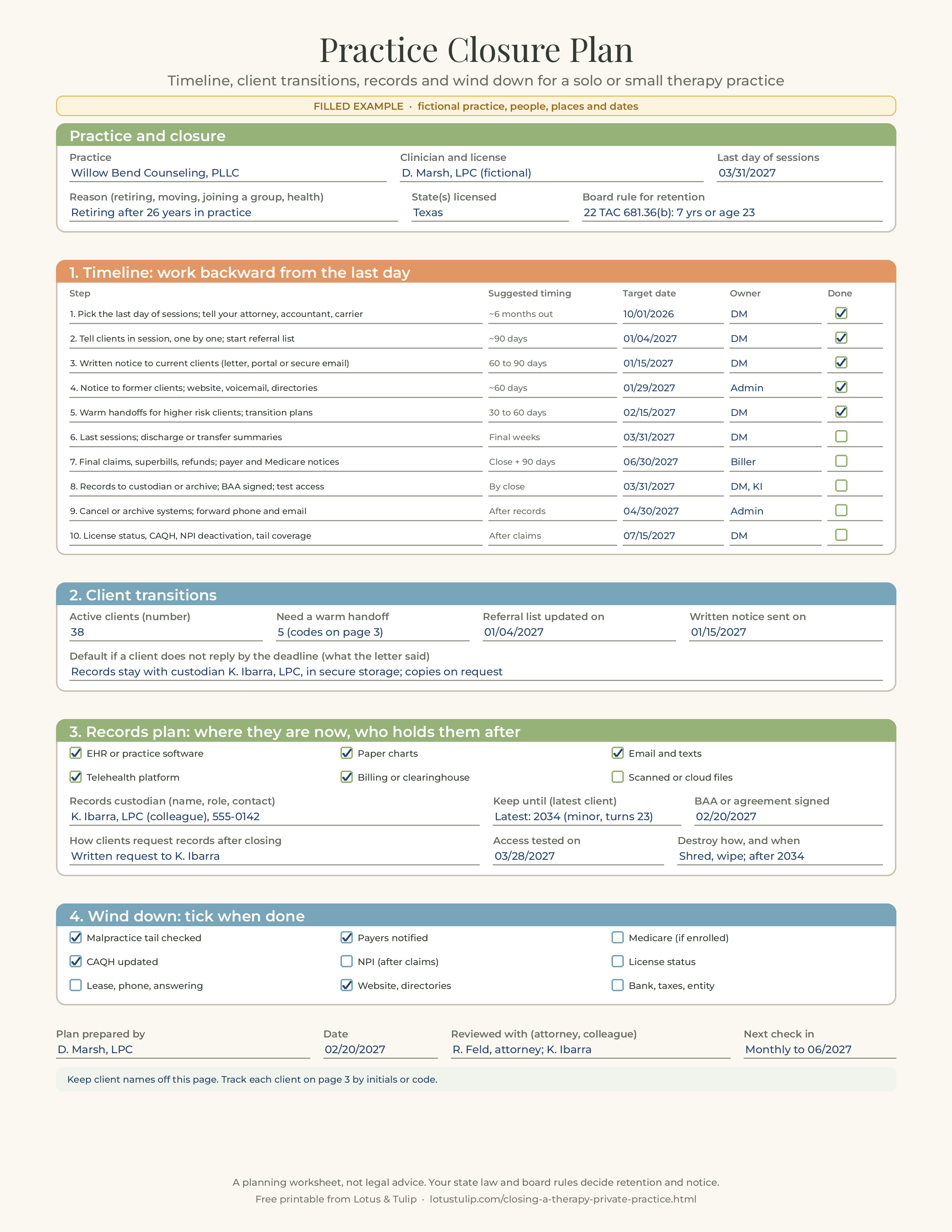
Everything in this example is invented: the practice, the people, the clients, the dates and the phone number. It shows how the pieces fit together, and it matches page 2 of the free printable.
The practice. Willow Bend Counseling, PLLC is a solo practice in Texas owned by D. Marsh, LPC, who has practiced for 26 years and decides in September 2026 to retire. The practice has 38 active clients, about 400 former clients whose records are still within the retention period, an EHR with a built in telehealth platform, paper charts from the early years in a locked file room, and in network contracts with three commercial payers. D. Marsh is not enrolled in Medicare.
Setting the date. On October 1, 2026, D. Marsh sets March 31, 2027 as the last day of sessions and tells the practice's attorney, accountant and malpractice carrier. The carrier confirms the policy is claims made and offers a retirement tail; the written answer goes into the closure file. Intake for new clients stops, except for short term work that will finish well before March.
Records plan. A longtime colleague, K. Ibarra, LPC, agrees to act as records custodian. They sign a written custodian agreement, reviewed by the attorney, that covers access, how requests are answered, fees, storage, what happens if K. Ibarra retires, and destruction at the end of the period; the attorney advises a business associate agreement as well, and it is signed on February 20, 2027. Under 22 TAC 681.36(b), Texas LPC records must be kept seven years after termination of services or five years after the client reaches the age of majority, whichever is greater. The latest date across the caseload belongs to a 16 year old client, whose records must be kept until the client turns 23, in 2034. Adult clients whose services end on March 31, 2027 also run to 2034. So the plan says "keep until 2034 at the latest," with destruction by date logged after that.
Clients. Starting January 4, 2027, D. Marsh tells each active client in session and starts the client log on page 3, using codes, not names. Written notice goes out on January 15 through the client portal, with paper letters for two clients who prefer mail. Five clients are flagged for warm handoffs: two with recent suicidal ideation, one in the middle of trauma work, one adolescent whose parents are separating, and one client with a court mandate. Each gets a named receiving clinician, a release, a treatment summary and a final joint planning session. Former clients get a mailed letter in a plain envelope on January 29, the website gets a closure notice, and directory profiles change to "not accepting new clients."
Billing and systems. Payer termination notices go out in January according to each contract's terms. The last claims are submitted in early April; the biller works denials through June. In late March, D. Marsh exports the full EHR record set, opens it on a separate laptop to confirm it is readable, hands encrypted copies and the paper charts to K. Ibarra, tests that K. Ibarra can open the export, and moves the EHR account to the vendor's read only archive plan instead of canceling it. The office phone number is ported to a low cost line with a voicemail greeting pointing to K. Ibarra.
Wind down. After the last appeals are resolved in July 2027, D. Marsh updates CAQH, moves the Texas license to the status the board offers for retirees, deactivates the NPI in NPPES, closes the business bank account, and files final returns with the accountant. The tail endorsement is bought within the window the carrier set.
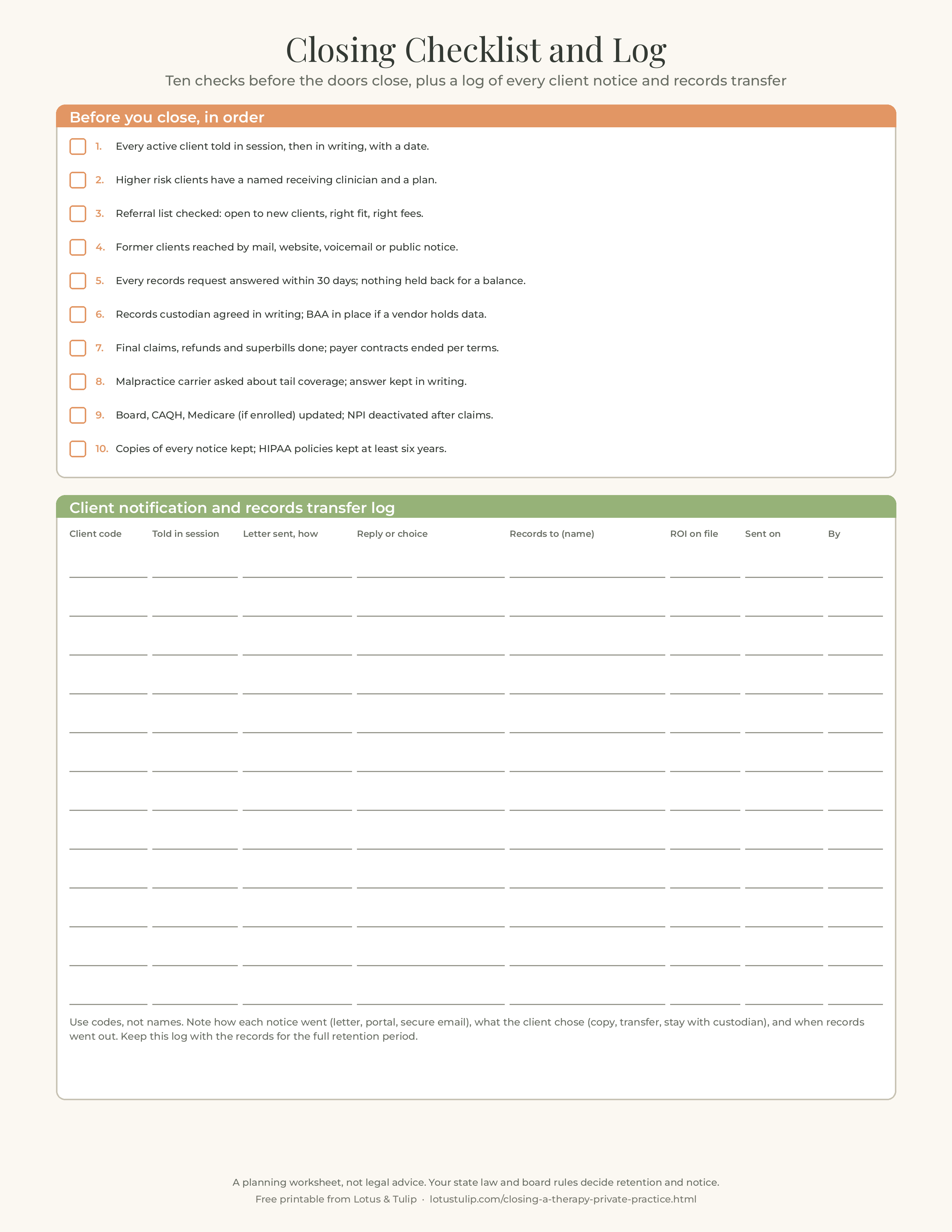
What the log looks like. A few lines from page 3, in code:
| Client code | Told in session | Letter sent, how | Reply or choice | Records to | ROI on file | Sent on |
|---|---|---|---|---|---|---|
| WB-07 | 01/05/2027 | 01/15, portal | Wants referral; chose clinician A | Clinician A (summary + safety plan) | Yes, 01/19 | 01/22/2027 |
| WB-12 | 01/06/2027 | 01/15, portal | Ending therapy; wants own copy | Client (portal download) | Not needed | 02/03/2027 |
| WB-19 | 01/08/2027 | 01/15, mail | No reply by 03/01 | Stays with custodian | n/a | n/a |
| WB-23 | 01/04/2027 | 01/15, portal | Warm handoff; joint session 02/12 | Clinician B (summary) | Yes, 01/26 | 02/01/2027 |
The client letter. The current client letter shown earlier is the one D. Marsh sent, with the referral list and a release form enclosed.
Three short scenarios
Moving to another state. A psychologist licensed only in Oregon is moving to Colorado. Unless she is licensed in Colorado or practicing under an interstate arrangement that covers her and her clients, she generally cannot keep seeing Oregon clients by telehealth once they are in Oregon and she is not licensed there; licensure follows where the client is located. She treats the move as a closure for her Oregon caseload: same notice, same referrals, same records plan. If she will keep the records herself in Colorado, her letters say so and give a way to reach her for years.
Closing to join a group practice. An LMFT is folding her solo practice into a group, and some clients want to follow her. She tells every client that they can move with her to the group, choose a different clinician, or take a break, and that their choice is theirs. Clients who move sign the group's intake and consent forms; with their written authorization, she sends what the group needs. The records of clients who do not move stay in her solo practice's custody, under her records plan. Under APA 10.09 and the general principle behind it, she settles in writing with the group, before she starts, whose records are created there and what happens if she leaves.
Closing on short notice for health reasons. A clinical social worker learns in January that treatment will keep him out of practice for at least six months. He has three weeks. He calls every client, sends a short written notice the same week, arranges two warm handoffs for his highest risk clients through a colleague who had already agreed to cover for him, and names that colleague as records custodian in a one page signed note. He finishes the fuller wind down, including claims and his NPI, over the following months with his biller's help. A professional will written years earlier would have made those three weeks far easier, and he writes one once he is well.
Common mistakes when closing a practice
- Letting clients learn it from a letter. Tell active clients in session first. The letter confirms; it does not replace the conversation.
- Not giving enough notice. Texas's guidance calls 30 to 60 days reasonable for a planned closure; longer is kinder when you can manage it.
- A referral list nobody checked. Clients who call five clinicians who are full will often give up.
- No named records custodian. "Contact my office" is not a plan if the office will not exist.
- Canceling the EHR before exporting and testing records. Some vendors delete data on a schedule after cancellation. Export, verify, then cancel or archive.
- Forgetting minors' records. The latest retention date in the practice is often a child's, and it can be many years out.
- Holding records hostage for a balance. HHS says access cannot be denied because a client has not paid for services.
- Deactivating the NPI or dropping payer contracts too early, before final claims and appeals are finished.
- Skipping the tail coverage question on a claims made malpractice policy.
- Disconnecting the phone or letting the domain lapse, so former clients reach nothing, or reach someone else.
Free printable: practice closure plan, filled example and client log
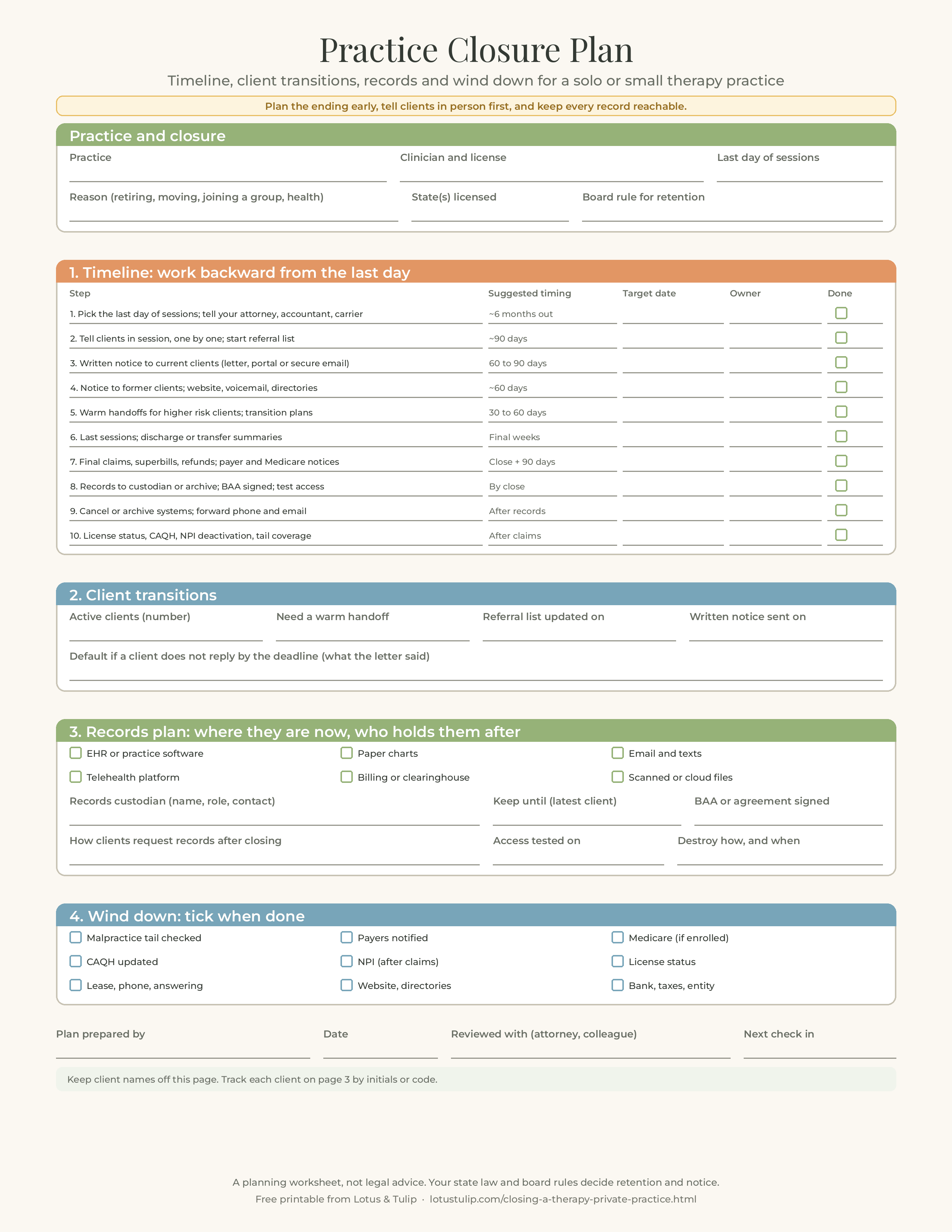
The free printable has three US Letter pages. Page 1 is a blank practice closure plan: practice, clinician and license, last day of sessions, reason, states licensed and the board rule for retention; a ten step timeline with suggested timing and columns for target date, owner and done; client transition fields (active clients, number needing a warm handoff, date the referral list was updated, date written notice was sent, and the default if a client does not reply); a records plan with tick boxes for where records live (EHR, paper charts, email and texts, telehealth, billing, scanned or cloud files), the records custodian, the "keep until" date, the date a BAA or agreement was signed, how clients request records after closing, the date access was tested and how records will be destroyed; nine wind down tick boxes (malpractice tail, payers, Medicare if enrolled, CAQH, NPI after claims, license status, lease and phone, website and directories, bank, taxes and entity); and a sign off line. Page 2 is the same plan filled for the fictional Willow Bend Counseling, PLLC. Page 3 is a ten point checklist for the weeks before you close and a twelve row client notification and records transfer log.
Download the free practice closure plan (PDF, 3 pages)
Rather type than handwrite? The free PDF above is for printing. Therapy Progress Notes and Intake Templates comes as a fillable PDF you type straight into (604 fields in Adobe Acrobat Reader), plus the printable version: SOAP, DAP and BIRP notes, intake, treatment plan and safety plan, 20 pages. Holiday 20% off: about $7.36, was $9 (EUR 8) · instant digital download
Buy on EtsyPrefer single images? Page 1: blank closure plan and timeline (PNG) · Page 2: filled fictional example (PNG) · Page 3: checklist and client log (PNG)
Free to print and use in your own practice. Please link to this page rather than re-uploading the file. This plan helps you organize a practice closure. It is not legal, tax or insurance advice, and your state law, board rules, payer contracts and malpractice policy decide the actual requirements. Keep client names off pages 1 and 2 and use codes on page 3.
Related resources
- Clinical supervision agreement for therapists: template, board rules and a supervision log
- Telehealth across state lines for therapists, with a client location checklist
- Duty to warn for therapists: Tarasoff, state laws, HIPAA and a free documentation worksheet
- Professional will for therapists: clinical executor, records custodian and a free printable
- Therapy termination letter template and samples
- Therapy discharge summary, template and example
- Treatment summary template and the HIPAA right of access
- Release of information form for therapists
- Informed consent for therapy template
- Business associate agreements for therapists, with a filled vendor log
- HIPAA risk assessment for therapists, with a filled example
- Psychotherapy notes vs progress notes
- Superbill template for therapists
Sources: American Psychological Association, Ethical Principles of Psychologists and Code of Conduct (2002, amended 2010 and 2016), standards 3.12, 6.02(c), 6.07, 10.09 and 10.10; American Counseling Association, 2014 ACA Code of Ethics, standards A.11.c, A.11.d, A.12, B.6.h, B.6.i and C.2.h; National Association of Social Workers, Code of Ethics, standards 1.07(s) and (t), 1.15, 1.16(b) and (c), and 1.17(b) and (e); 45 CFR 162.408 and 162.410(a)(4); 45 CFR 164.310(d)(2)(i), 164.316(b)(2), 164.501 (health care operations), 164.506(c)(2), 164.508(a)(2), 164.524(a)(1), (b)(2) and (c)(4), and 164.530(c) and (j), eCFR text as in effect on November 1, 2026; HHS, HIPAA FAQs 580 (record retention) and 2065 (access and unpaid bills), and Frequently Asked Questions About the Disposal of Protected Health Information; 42 CFR 424.516(d); CMS-855I Medicare enrollment application; CMS NPPES help pages and CMS-10114 NPI application/update form instructions; CAQH quick reference guide; California Business and Professions Code sections 2919 and 4980.49; New York Rules of the Board of Regents, 8 NYCRR 29.2(a)(3); Texas Behavioral Health Executive Council, Closing Your Practice: Guidance for BHEC License Holders (October 2026), citing 22 TAC 465.22, 465.32, 681.36, 781.309 and 801.48.
FAQ
How much notice should a therapist give clients before closing a practice?
No federal rule or ethics code sets a number of days. The ethics codes require reasonable efforts to avoid abandonment, pretermination counseling and referrals. Texas's Behavioral Health Executive Council, in its October 2026 closing guidance, says 30 to 60 days of notice is reasonable for a planned closure, with more individualized notice and a documented transition plan for clients in active, higher risk treatment. Many clinicians who can plan ahead start telling clients about 90 days before the last session. Check your own board's rules.
How long do I have to keep therapy records after closing my practice?
HIPAA does not set a retention period for clinical records; HHS says state laws generally govern it. Examples: California MFTs and psychologists keep records at least seven years after therapy ends, and for minors at least seven years after age 18; New York health professions keep records at least six years, and minors' records until at least one year after age 21; Texas psychologists, LPCs, LMFTs and social workers keep records seven years after services end or five years after the client reaches majority, whichever is greater. Payer contracts and other laws can require longer. Keep each record for the longest period that applies.
What should a letter to clients about closing my practice include?
The date services end, an offer of referrals (with a checked list enclosed), where records will be kept and who to contact, how to request a copy or a transfer to a new provider and any fee, a deadline to reply if the client wants records sent somewhere specific and what happens by default, and crisis resources such as 988 and 911. Tell active clients in session before the letter arrives.
Who can keep my client records after I close?
You can keep them yourself, ask a colleague to serve as records custodian under a written agreement, transfer them to a successor practice with notice to clients, or use a records storage or EHR archive vendor under a business associate agreement. The ACA Code requires a plan to transfer records "to an identified colleague or records custodian" on retirement or termination of practice, and the APA Code requires plans made in advance. Whatever you choose, tell clients in your closure letters and test that the records can actually be accessed.
Should I deactivate my NPI when I close my practice?
If you are fully retiring, you can deactivate it in NPPES online or with the CMS-10114 form, and it can be reactivated later by mail if you return. Many clinicians wait until final claims and appeals are finished, because claims carry the NPI. If you will keep practicing elsewhere, keep the NPI and update your practice information within 30 days of the change, as 45 CFR 162.410(a)(4) requires.
Do I need malpractice tail coverage when I close my practice?
If your professional liability policy is claims made, a claim filed after the policy ends may not be covered even if it concerns work you did while insured. Tail coverage, an extended reporting period endorsement, fills that gap. Occurrence policies generally do not need a tail. Ask your carrier which type you have, whether a retirement tail is included, what it costs and the deadline to buy it, and keep the answer in writing.