
Therapist practice · Updated 2026-11-09
Psychotherapy Notes vs Progress Notes: What HIPAA Says, What Goes Where, with Examples (Free Printable)
Ready-made printable: Therapy Progress Notes and Intake Templates Fillable PDF: includes SOAP, DAP and BIRP progress note pages, plus intake, notes and safety plan pages (20 pages)
Holiday 20% off: about $7.36, was $9 (EUR 8) · instant digital download
Try it free first: download a fillable sample (SOAP note and DAP note, PDF, 226 KB). Type into it on screen, then get the full pack. No email needed.

Ask ten therapists whether they keep "psychotherapy notes" and you will get ten different answers. Some mean their progress notes. Some mean the scribbles on a legal pad during session. Some mean a private section of their EHR they believe nobody can ever see. HIPAA uses the phrase in a narrow, technical way, and the difference matters: psychotherapy notes in the HIPAA sense get extra protection that progress notes do not, while a note that only looks private can end up in an insurer's audit, a records request or a client portal.
This guide is for counselors, therapists, clinical social workers, marriage and family therapists, psychologists and associates or trainees in the US. It explains the HIPAA definition of psychotherapy notes at 45 CFR 164.501 word by word, what is excluded from it, how psychotherapy notes differ from progress notes in content, storage, access and disclosure, what the authorization rule at 164.508(a)(2) and the right of access exception at 164.524(a)(1)(i) actually say, how insurers, portals and information blocking rules fit in, how to keep the two kinds of notes apart on paper and in an EHR, and what to do with a subpoena. It includes a sorting table, a fictional session written up both ways, a step by step process, common mistakes and an FAQ. At the end you can download a free three page printable: a separate psychotherapy notes page with a storage reminder, a progress note vs psychotherapy notes sorting guide with a filled example, and a before you file checklist.
Jump to the free psychotherapy notes vs progress notes printable
This is educational information for licensed clinicians and trainees. It is not legal, compliance or clinical advice, and it does not create any professional relationship. HIPAA sets a federal floor; state law, your licensing board, your employer, payer contracts and, for substance use disorder programs, 42 CFR Part 2 can add stricter rules. Rules change. Check current law, your board's rules and your ethics code, and talk to your malpractice carrier's risk management line, your professional association or an attorney who knows mental health law in your state before you rely on any of this for a specific record or request. Every client, clinician and practice on this page is fictional.
The short answer
Progress notes are the official clinical record of each session: date, start and stop times, type of service, symptoms and functioning, interventions, risk, progress toward goals, diagnosis and the plan. They are part of the client's designated record set, so the client has a right to see them, insurers can review them for payment, and they can be shared for treatment without a special authorization.
Psychotherapy notes, in the HIPAA sense, are a mental health professional's separate notes documenting or analyzing the contents of a counseling conversation, such as hypotheses, impressions, process observations and reminders for the clinician's own use. If they are kept separate from the rest of the record and contain none of the excluded items, they get special protection: with few exceptions they cannot be used or disclosed without a specific written authorization, and clients do not have a right of access to them.
Everything a payer, a covering clinician or the client would need to understand the care belongs in the progress note. Psychotherapy notes are optional; HIPAA does not require you to keep them at all.
Psychotherapy notes vs progress notes at a glance
| Progress notes | Psychotherapy notes (HIPAA) | |
|---|---|---|
| Purpose | The official record of the service: supports continuity of care, billing, audits and legal defense | The clinician's own working notes on the conversation, to think about the case and prepare for future sessions |
| Required? | Yes, in practice: licensing boards, ethics codes, payers and employers expect a record of each service | No. HIPAA does not require them, and many clinicians keep none |
| Typical content | Date, start and stop times, CPT or service type, modality, symptoms, mental status, risk, interventions, response, progress on goals, diagnosis, plan | Analysis of the session content: hypotheses, process and transference observations, the clinician's reactions, sensitive details not needed for care, questions for supervision |
| Must not contain | Speculation and detail that is not needed for care or billing (best practice, not a HIPAA rule) | Medication prescription and monitoring, session start and stop times, modalities and frequencies, test results, and any summary of diagnosis, functional status, treatment plan, symptoms, prognosis and progress to date (45 CFR 164.501) |
| Where kept | In the client's chart or EHR record | Separated from the rest of the record: a separate file, or a separately secured part of the EHR |
| Client's right of access | Yes, under 45 CFR 164.524, within 30 days (one 30 day extension allowed) | No right of access (164.524(a)(1)(i)); you may choose to share them, subject to state law |
| Sharing for treatment, payment, operations | Permitted without authorization, subject to the minimum necessary rule for payment and operations | Needs a specific authorization, with narrow exceptions (164.508(a)(2)) |
| Insurers | May review them to decide payment and medical necessity | A health plan cannot make treatment, payment, enrollment or eligibility depend on an authorization for them (164.508(b)(4)) |
| Parents of minors | Parents who are personal representatives can generally access the record, subject to state law and HIPAA's exceptions | No right of access for parents either (HHS FAQ 2094) |
| Information blocking (Cures Act rules) | Generally electronic health information that must not be blocked without an exception | Excluded from the definition of electronic health information (45 CFR 171.102) |
What HIPAA actually says: the definition, word by word
The definition sits in the HIPAA Privacy Rule at 45 CFR 164.501. It reads:
"Psychotherapy notes means notes recorded (in any medium) by a health care provider who is a mental health professional documenting or analyzing the contents of conversation during a private counseling session or a group, joint, or family counseling session and that are separated from the rest of the individual's medical record. Psychotherapy notes excludes medication prescription and monitoring, counseling session start and stop times, the modalities and frequencies of treatment furnished, results of clinical tests, and any summary of the following items: Diagnosis, functional status, the treatment plan, symptoms, prognosis, and progress to date."
Taken apart, that gives five tests. A note is a psychotherapy note only if all five are true:
- Written by a mental health professional. The author is a health care provider who is a mental health professional. Notes by front desk staff or a billing service are not psychotherapy notes.
- About a counseling conversation. It documents or analyzes the contents of the conversation in a private session or a group, joint or family session. Phone calls with a payer, emails about scheduling and notes on a case conference are not.
- In any medium. Paper, a typed file, a separate EHR note type: the medium does not matter. Audio or video recordings are a separate question; check your state law and your consent forms.
- Separated from the rest of the record. If the notes sit in the general chart, or are mixed into the progress note, they are ordinary health information. HHS adds that psychotherapy notes "also do not include any information that is maintained in a patient's medical record" (HHS FAQ 2088).
- Free of the excluded items. Medication prescription and monitoring, session start and stop times, modalities and frequencies, clinical test results, and any summary of diagnosis, functional status, treatment plan, symptoms, prognosis and progress to date. Those belong in the record, and writing them into a "private" note does not move them out of it.
The label you give a note does not decide its status. A note titled "psychotherapy note" that holds the diagnosis, the symptoms and the plan is a progress note with a misleading title. And a note can be private in your mind without meeting the definition: if it is filed in the chart, it is part of the record.
What belongs in a progress note
Whatever format you use (SOAP, DAP, BIRP, GIRP or a narrative), the progress note is where the facts of care live. A useful progress note usually covers:
- Identifying and service details: client name or ID, date, session start and stop times (needed for time based codes), service type or CPT code, modality (individual, family, group), location or telehealth platform and participants present.
- Presenting concerns and symptoms: what the client reported, in brief and in their words where useful, and any change since last time.
- Observations and mental status: appearance, mood and affect, thought process, orientation, notable behavior.
- Risk: what you asked about (suicide, self harm, harm to others, abuse or neglect), what you found, what you did and the follow up plan.
- Interventions: the techniques you used, linked to treatment plan goals (for example cognitive restructuring for goal 1).
- Response and progress: how the client responded and progress toward measurable objectives, including scores from any measures.
- Diagnosis and medical necessity: current diagnosis and why the service is needed, where your setting or payer requires it.
- Medication information: if you prescribe or monitor medication, or the client reports changes, this goes here, never in psychotherapy notes.
- Plan: homework, next session, referrals, coordination and any changes to the treatment plan.
- Signature and credentials, and co-signature where supervision rules require it.
For format walkthroughs, see SOAP vs DAP notes, BIRP notes, GIRP notes and the telehealth progress note template.
What can go in psychotherapy notes
Psychotherapy notes are for material that helps you think and do the work, but that nobody else needs to understand or pay for the care. Typical content:
- Working hypotheses: "Wonder if the anger at the manager is grief about the father's illness displaced; test gently."
- Process observations: shifts in the relationship, ruptures and repairs, transference and countertransference, moments when the client changed the subject.
- Your own reactions: "Felt pulled to rescue when S. described the argument; notice this next time."
- Sensitive details of the conversation that are not needed for treatment by others, payment or risk: the content of a dream, a fantasy, details about third parties, specific memories.
- Questions for supervision or consultation, and ideas you want to try or avoid.
- Reminders for next time: a phrase the client used, a thread to return to.
What psychotherapy notes should not hold:
- Anything on the excluded list in 164.501: medication, session times, modality and frequency, test results, and any summary of diagnosis, functioning, plan, symptoms, prognosis or progress.
- Risk assessments and safety actions. Not on the excluded list by name, but a summary of risk is a summary of symptoms, and anyone who covers for you needs it. Put it in the progress note.
- Anything you would need to justify the service to a payer or a board. If a fact is the reason the session was medically necessary, it belongs in the record.
- Anything you would be uncomfortable defending if the notes were ever disclosed. The protection is strong but not absolute; see the exceptions below.
Sorting guide: progress note or psychotherapy notes?
| Item | Where it goes | Why |
|---|---|---|
| Session start 2:02 pm, end 2:55 pm | Progress note | Start and stop times are excluded from psychotherapy notes and support time based codes |
| Individual psychotherapy, weekly, via video | Progress note | Modality and frequency are excluded |
| PHQ-9 score 14, down from 19 | Progress note | Clinical test results and progress to date are excluded |
| "Started sertraline last week; mild nausea" | Progress note | Medication prescription and monitoring is excluded |
| Diagnosis F43.23 adjustment disorder with mixed anxiety and depressed mood | Progress note | Any summary of diagnosis is excluded |
| "Sleeping 5 hours, missed 2 days of work" | Progress note | Symptoms and functional status are excluded |
| Denied suicidal ideation, plan or intent; safety plan reviewed | Progress note | Risk is part of care that others need to see |
| Used cognitive restructuring for goal 1; homework thought record | Progress note | Interventions and plan link the session to the treatment plan |
| "Hypothesis: perfectionism may protect against fear of the father's criticism" | Psychotherapy notes, if kept separate | Analysis of the conversation, for the clinician's own use |
| Detailed content of a dream the client told you | Psychotherapy notes, if kept separate | Sensitive conversation detail not needed by others |
| "I felt irritated when S. joked about missing sessions" | Psychotherapy notes, if kept separate | Countertransference is the clinician's working material |
| Question to bring to consultation group | Psychotherapy notes, if kept separate | Clinician's own reflection; remove identifiers before you consult |
| Disclosure of child abuse and the report you made | Progress note | Risk, mandated report and actions taken belong in the record |
| Client's account of an affair, in detail | Usually a brief, neutral summary in the progress note if relevant to symptoms or goals; details, if kept at all, in psychotherapy notes | Record what care needs; keep details minimal either way |
A useful test: if a clinician covering for you next week would need it to treat the client safely, or a reviewer would need it to see why the session happened and what it did, it goes in the progress note.
Who can see what: access, authorization and disclosure
The client's right of access
Under 45 CFR 164.524, clients have a right to inspect and get a copy of the health information in their designated record set, which includes progress notes, treatment plans, assessments and billing records. You must act on a request within 30 days, with one 30 day extension if you tell the client in writing why. Progress notes are not exempt because they are about mental health: HHS lists "clinical case notes or SOAP notes" among the records clients can access (HHS FAQ 2042).
Psychotherapy notes are the first item excluded from the right of access, at 164.524(a)(1)(i). Because the exclusion is in paragraph (a)(1), a denial on that ground is one of the "unreviewable grounds for denial" in 164.524(a)(2): the client does not get a review by another professional. HHS also notes that a provider may choose to share psychotherapy notes with the client; it is permitted, not required, so check state law, which in some states gives clients broader access to their records.
Authorization for psychotherapy notes
Under 164.508(a)(2), a covered entity must get the client's written authorization for any use or disclosure of psychotherapy notes, with these exceptions (for the elements every valid authorization needs, see the release of information form for therapists):
| Exception in 164.508(a)(2) | What it means in practice |
|---|---|
| (i)(A) Use by the originator for treatment | You, the clinician who wrote them, may use your own notes to treat the client. Sharing them with another treating provider still needs authorization (HHS FAQ 2088). |
| (i)(B) The covered entity's own supervised training programs | Use in your own organization's training programs where students, trainees or practitioners learn under supervision to practice or improve their counseling skills. |
| (i)(C) Defense in a legal action brought by the individual | Use or disclosure by the covered entity to defend itself in a legal action or other proceeding brought by the client. |
| (ii) 164.502(a)(2)(ii) | Disclosures to HHS when it is investigating or reviewing your HIPAA compliance. |
| (ii) 164.512(a) | Uses and disclosures required by law, such as mandatory abuse reporting. HIPAA's definition of "required by law" includes court orders and some subpoenas (45 CFR 164.103). |
| (ii) 164.512(d) | Health oversight of the originator of the notes, such as a licensing board investigation of you. |
| (ii) 164.512(g)(1) | Disclosures to coroners and medical examiners. |
| (ii) 164.512(j)(1)(i) | Disclosures to prevent or lessen a serious and imminent threat to health or safety, under that section's conditions. HHS notes that state laws vary on whether a duty to warn is mandatory or permissive. |
Three more rules follow from 164.508:
- No compound authorizations. An authorization for psychotherapy notes may only be combined with another authorization for psychotherapy notes (164.508(b)(3)(ii)). A general release that lists "all records including psychotherapy notes" alongside other items is not the right tool. Use a separate form.
- No conditioning. A covered entity may not condition treatment, payment, enrollment or eligibility for benefits on an authorization, and the health plan enrollment exception does not apply to psychotherapy notes (164.508(b)(4)).
- Revocable. The client may revoke an authorization in writing at any time, except to the extent you have already acted on it (164.508(b)(5)).
Your Notice of Privacy Practices must describe the kinds of uses and disclosures that need an authorization under 164.508(a)(2) to (a)(4), which covers psychotherapy notes (45 CFR 164.520(b)(1)(ii)(E)). If you keep psychotherapy notes, check that your notice says so in plain words. See our informed consent for therapy template for how the notice fits with consent.
Parents of minors
Parents are generally the personal representatives of their minor child under HIPAA and can usually get the child's mental health information in the record, including diagnosis, symptoms and treatment plans, subject to state law and HIPAA's exceptions. They have no right of access to psychotherapy notes, the same as the client (HHS FAQ 2094). State laws on minor consent and parental access vary widely, so check yours.
Insurers, audits and medical necessity
Payers review progress notes, not psychotherapy notes. When an insurer requests records to decide payment or audit claims, what they need (and what supports your claim) is the progress note: times, service, diagnosis, symptoms, interventions, progress and plan. A health plan cannot make payment depend on getting your psychotherapy notes (164.508(b)(4)), and if you keep the two kinds of notes apart, you can send the record without sending the private notes.
The flip side: if your progress notes are thin because "the real notes are private," the claim may not be supported. A progress note that says only "client discussed family issues, continue plan" does not show medical necessity. Keep the facts of care in the record, and keep psychotherapy notes for analysis.
Payment and health care operations disclosures of progress notes are subject to HIPAA's minimum necessary standard: send what the request needs, not the whole chart, unless the request legitimately covers it.
Open notes, portals and information blocking
The 21st Century Cures Act information blocking rules, enforced through ONC regulations at 45 CFR Part 171, generally prohibit practices likely to interfere with access to, exchange of, or use of electronic health information. The definition of electronic health information (EHI) in 45 CFR 171.102 expressly excludes psychotherapy notes as defined in 164.501, along with information compiled for legal proceedings.
Progress notes in an EHR are generally EHI. In practice, many clients can now read their notes through a portal, often soon after you sign them. If a specific note could cause harm, the information blocking rules have exceptions, such as the preventing harm exception in 45 CFR 171.201, with detailed conditions. Do not assume a progress note is private; write it as if the client may read it, because they may.
Check how your EHR handles both kinds of notes: whether progress notes are released to the portal automatically, whether there is a separate psychotherapy notes field that is excluded from the portal, record exports and "release all" requests, and who in your practice can open it.
Process notes, personal notes and shadow records
Clinicians use several overlapping terms:
- Process notes usually means notes on the process of a session (the interaction, themes, transference). In training programs, a "process recording" is often a detailed write up for supervision. Process notes can qualify as psychotherapy notes if they meet the definition and are kept separate.
- Personal notes or private notes are informal names; they have no special legal meaning beyond whether they meet the HIPAA definition.
- Shadow records are a second, informal copy of the chart kept outside the official record. These are a risk: they are usually still part of the record for access and subpoena purposes, and they make it easy to lose track of what you hold.
The APA Record Keeping Guidelines suggest psychologists may divide client files into sections, noting that "psychotherapy notes, as defined by HIPAA, are necessarily kept apart from other parts of the record," and that in multidisciplinary settings, where records may be more widely accessed, the psychologist may keep more sensitive information in a separate file if institutional and legal rules allow. APA's Ethics Rounds column (2005) also points out that HIPAA does not require psychologists to keep psychotherapy notes, and treats keeping them as a choice to make deliberately.
For trainees, the supervised training exception in 164.508(a)(2)(i)(B) covers use within your own organization's training program. A process recording you hand to a school based faculty supervisor outside the agency may need different handling; follow your program and agency policy and remove identifiers where you can.
Keeping psychotherapy notes separate, on paper and in an EHR
Separation is the condition that turns private notes into protected notes, and also what lets staff send the record without the notes. Practical ways to do it:
- Paper: a separate folder or binder for psychotherapy notes, in a separate locked drawer from the chart, labeled with a client code rather than a full name where possible.
- EHR: a dedicated psychotherapy notes note type or section that is excluded from the standard chart view, portal release, record exports and claims attachments, with access limited to the author. Ask your vendor in writing how it works; do not rely on the name of the field.
- Separate system: some solo clinicians keep psychotherapy notes in a separate encrypted document system. It must still meet HIPAA security requirements, including access controls, backups and a business associate agreement with any vendor that stores it.
- Not in email, texts or a personal notes app that syncs to an unsecured cloud.
Whatever you choose, write it down in your privacy and record keeping policy: what you keep, where, who can open it, how long you keep it and how you destroy it.
Do you need psychotherapy notes at all?
Many clinicians keep none, and that is a legitimate choice. Points to weigh:
| Reasons some clinicians keep them | Reasons some clinicians do not |
|---|---|
| Space to think: hypotheses, process and countertransference that would be out of place in the record | One record is simpler to manage, secure and produce |
| Keeps the progress note lean and factual, which can protect the client in portals and payer reviews | Protection is not absolute: authorization, court orders, oversight and safety exceptions still apply |
| Useful for supervision, consultation and depth oriented work | Extra time each session, and two places to look when something matters |
| Federal law shields them from routine access and payer requests | State law, Part 2 or employer policy may change the picture; some agencies forbid separate notes |
If you do keep them, keep them short. Anything you would need to defend the care should be in the progress note anyway.
State law, licensing boards and Part 2
HIPAA preempts contrary state law unless the state law is more stringent in protecting privacy, or falls under another exception. In practice that means:
- Some states give clients broader access to their own records, or set their own mental health record rules. Check your state's mental health confidentiality and patient access laws before you refuse or grant access.
- Licensing boards set record keeping content and retention requirements. A board rule that your records must include certain elements is met by the progress note, not by psychotherapy notes.
- If you work in a federally assisted substance use disorder program covered by 42 CFR Part 2, the 2024 Part 2 final rule (compliance date February 16, 2026) adds a parallel category of SUD counseling notes, defined almost exactly like psychotherapy notes, which need separate written consent for most uses and disclosures and cannot be shared under a general treatment, payment and operations consent.
- Employers and agencies can forbid separate notes, own the records, or set their own rules. Follow your setting's policy.
How to handle psychotherapy notes and progress notes, step by step
- Decide whether you will keep psychotherapy notes at all. If not, write every session in the progress note and keep the progress note factual and concise. If yes, write that decision into your record keeping policy.
- Set up separate storage before the first note. A separate locked folder, or an EHR psychotherapy notes section excluded from the chart view, portal and exports, with access limited to you. Confirm in writing how your EHR treats it.
- Update your Notice of Privacy Practices and consent. Make sure the notice says psychotherapy notes need authorization, and that your informed consent explains what you keep and who can see it.
- Write the progress note first. Times, service, modality, symptoms, mental status, risk, interventions, response, progress, diagnosis where needed and plan. Ask: would a covering clinician or reviewer understand the care from this alone?
- Write psychotherapy notes only for what is left. Hypotheses, process, your reactions, sensitive detail not needed for care, questions for supervision. No times, medication, test results, diagnosis, symptoms summary, functioning, plan, prognosis or progress.
- File them apart. Never paste psychotherapy notes into the chart, a claim, a letter or a treatment summary. Label each page so it can be found and kept apart.
- Handle requests separately. For a records request, send the designated record set. Release psychotherapy notes only with a separate, specific authorization, or under one of the narrow exceptions after checking with counsel or risk management.
- Review on a schedule. Spot check a few charts each quarter: no excluded items in psychotherapy notes, no thin progress notes, and storage still separate.
- Plan retention and destruction. Apply your state's retention rules and your policy to both sets, and include psychotherapy notes in your professional will so a records custodian knows they exist and how to handle them.
Example: one session, written up both ways (fictional)
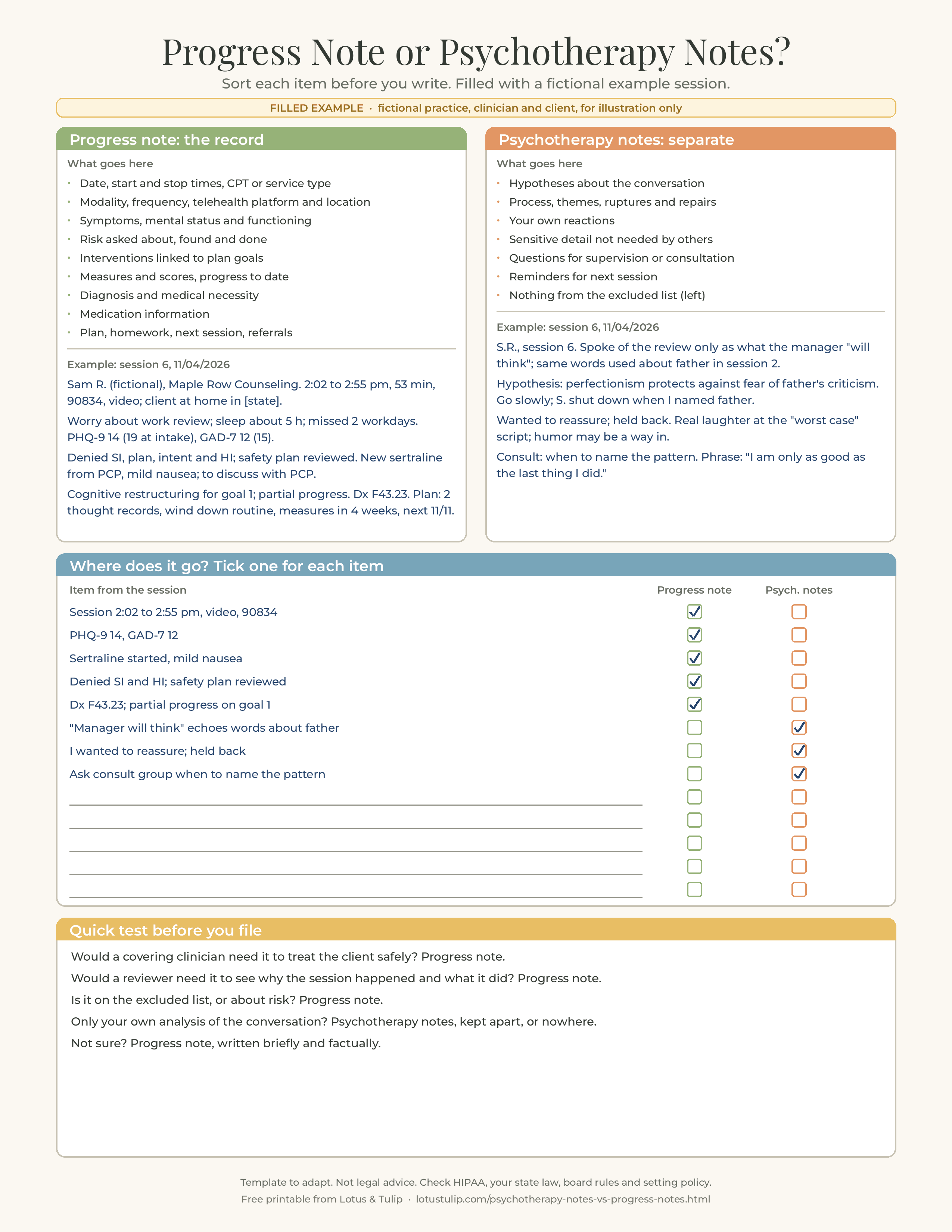
The fictional clinician A. Brooks, LCSW, of Maple Row Counseling sees the fictional client Sam R., 34, for session 6 of individual psychotherapy by video. Here is the session written up as a DAP progress note and as separate psychotherapy notes.
Progress note (goes in the record)
Client: Sam R. (fictional). Date: 11/04/2026. Time: 2:02 pm to 2:55 pm (53 minutes). Service: individual psychotherapy, 90834. Modality: telehealth, video; client at home in [state], clinician in office. Diagnosis: F43.23 adjustment disorder with mixed anxiety and depressed mood.
Data: Client reported increased worry about a performance review at work, sleep about 5 hours a night, and two missed workdays this week. PHQ-9 14 (19 at intake); GAD-7 12 (15 at intake). Affect anxious, congruent; thought process logical; oriented. Denied suicidal ideation, plan or intent and thoughts of harming others; safety plan reviewed and current. Reported starting sertraline prescribed by PCP last week with mild nausea; encouraged to discuss side effects with PCP.
Assessment: Symptoms improving since intake per measures, with work stress driving a short term rise in worry and sleep loss. Client used thought record between sessions and identified all or nothing thinking about the review. Progress toward goal 1 (reduce worry to GAD-7 below 10) partial. Continued services medically necessary given ongoing impairment at work.
Plan: Continue weekly individual psychotherapy per treatment plan. Cognitive restructuring for review related thoughts; client to complete two thought records and one wind down routine nightly. Re-administer PHQ-9 and GAD-7 in 4 weeks. Next session 11/11/2026. A. Brooks, LCSW (fictional).
Psychotherapy notes (kept separately, for the clinician only)
11/04, S.R., session 6. Talked about the review almost entirely in terms of what the manager "will think." Same phrasing S. used about father in session 2. Hypothesis: perfectionism is protective against fear of the father's criticism; go slowly, S. shut down last time I named the father directly. Noticed I wanted to reassure; held back. Moment of real laughter when S. described the "worst case" script; humor may be a way in. Bring to consultation: when to name the pattern. Remember the phrase "I am only as good as the last thing I did."
Notice what is not in the psychotherapy notes: no time, no codes, no score, no medication, no diagnosis, no symptom summary, no plan. All of that is in the progress note, which a covering clinician, an auditor or Sam can read and understand on its own.
Four more short sorting examples
Couples session with a disclosed secret. Progress note: "Joint session, both partners present, 55 minutes. Focus on communication pattern during conflict; practiced speaker listener exercise. Partner A requested an individual check in; discussed the practice's secrets policy." Psychotherapy notes, if kept: your hypotheses about the secret and the alliance with each partner. Check your secrets policy and state law before you write anything about the secret.
Group session. Progress note for each member: their participation, symptoms, response and plan, without naming other members. Psychotherapy notes, if kept: group process themes and your reactions. See group therapy progress notes for confidentiality in group documentation.
Disclosure of abuse. Everything about the disclosure that matters for safety goes in the progress note: what was disclosed, risk assessment, the report made, to whom, when and the reference number. Do not put it only in psychotherapy notes; required reports are an exception to the authorization rule anyway, and a covering clinician must know.
Trainee process recording. The agency progress note is written as usual and signed by the supervisor where required. The detailed process recording for supervision is kept per the training program and agency policy, de-identified where possible, and destroyed when no longer needed for training.
Subpoenas, court orders and records requests
A request for "all records" puts the difference between the two kinds of notes to the test.
- Do not panic and do not send everything. Read the request, note the deadline and call your malpractice carrier's risk management line or an attorney.
- A court order is different from a subpoena. HIPAA's definition of "required by law" includes court orders and subpoenas issued by a court, grand jury or authorized administrative body; disclosures for judicial and administrative proceedings also have their own rules at 164.512(e). An attorney's subpoena without a court order often requires additional steps before you can respond, and state law and psychotherapist privilege may apply. Get advice before you disclose.
- Send only what is required. If psychotherapy notes are not clearly covered, or no valid authorization or court order covers them, they are not sent with the record. If they are ordered, discuss with counsel whether to ask the court to review them privately or limit their use.
- Document what was requested, what you sent, on what authority, and when.
Retention and destruction
HIPAA does not set a retention period for clinical records; state law does, and records for minors are often kept longer (HHS HIPAA FAQ on record retention). HIPAA does require you to keep its own required documentation, such as policies and signed authorizations, for six years (164.530(j)). Where no stricter rule applies, the APA Record Keeping Guidelines suggest keeping full records for seven years after the last service for adults, or three years after a minor reaches the age of majority, whichever is later.
Psychotherapy notes are not a separate retention category under HIPAA. Some clinicians destroy them sooner than the progress notes, once they are no longer useful for treatment; others keep them on the same schedule. Check your state law and board rules first, follow a written policy rather than deciding case by case, and never destroy records after you know of a request, complaint, audit or lawsuit. Destroy securely (cross cut shredding, certified destruction or secure deletion).
Common psychotherapy notes mistakes
- Putting the clinical record in psychotherapy notes. Diagnosis, symptoms, progress or the plan in a private note makes the progress note incomplete and does not protect those facts.
- Thin progress notes. "Discussed issues, continue plan" does not support medical necessity or continuity of care.
- Keeping "private" notes in the chart. Without separation there is no special protection.
- Trusting an EHR field name. A field called psychotherapy notes may still be visible in the portal, exports or claims attachments. Check.
- Using a general release for psychotherapy notes. They need their own authorization, combined only with another psychotherapy notes authorization.
- Thinking another treating provider can have them without authorization. Only the originator may use them for treatment without one.
- Thinking protection is absolute. Required by law, oversight, coroner, serious threat and HHS compliance exceptions still apply.
- Recording risk only in psychotherapy notes. Risk and safety actions belong in the record.
- Writing what you would not want read aloud. Write psychotherapy notes as if they may one day be disclosed: respectful, brief, professional.
- Forgetting state law and Part 2. Stricter state rules or SUD counseling notes rules may apply.
- Shadow records. Duplicate informal charts are hard to secure and usually not protected.
- No written policy. If you keep psychotherapy notes, your policy, Notice of Privacy Practices and consent should say so.
Free printable: psychotherapy notes page, sorting guide and before you file checklist
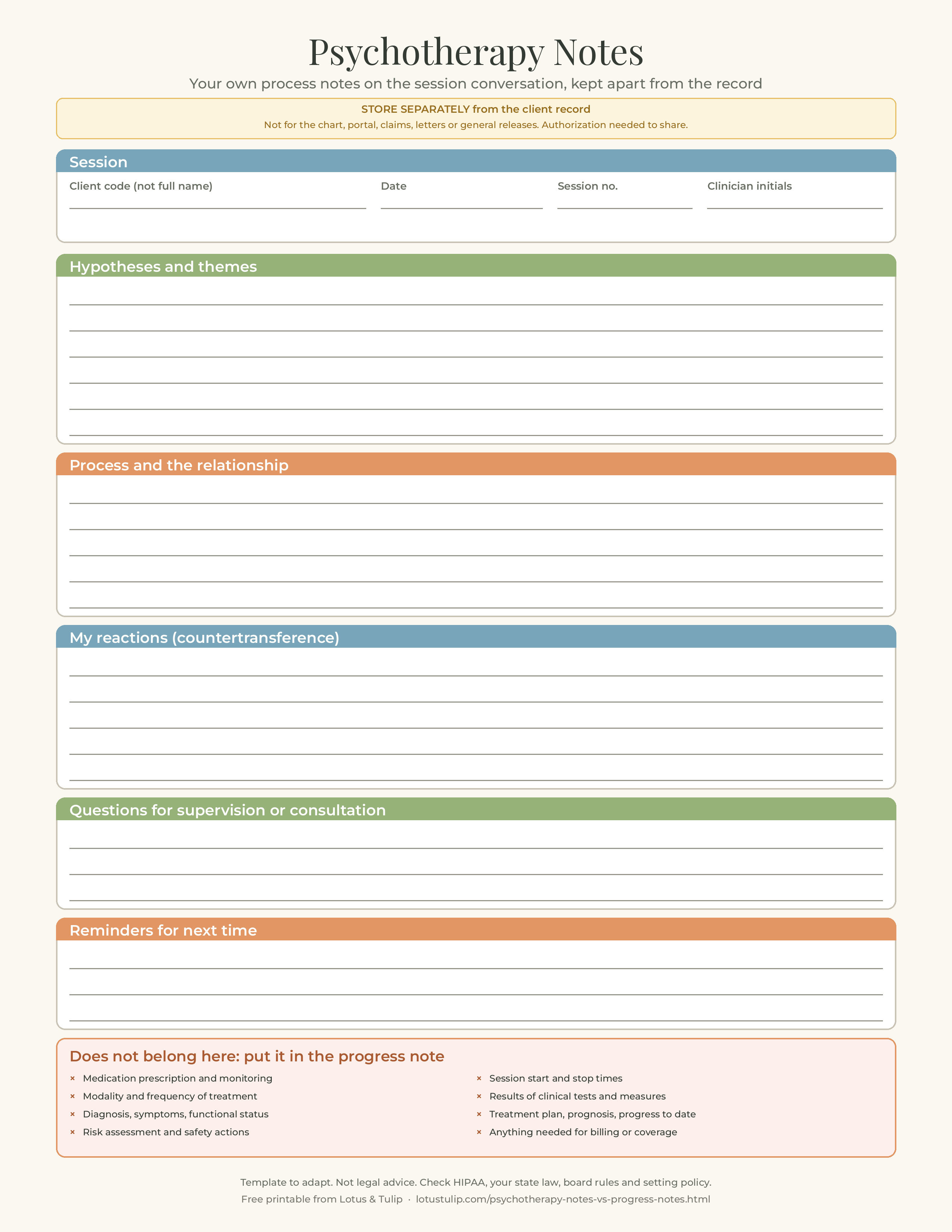
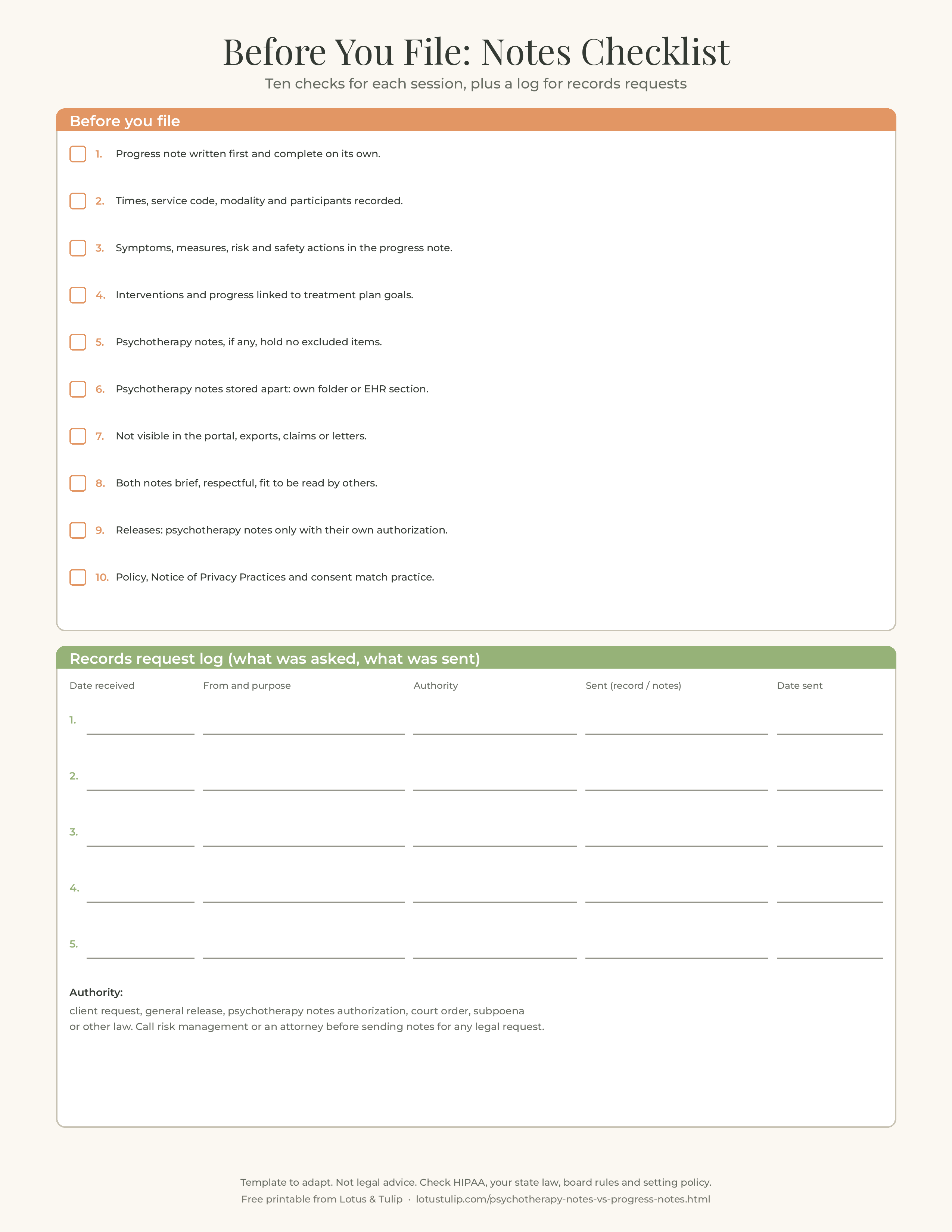
The free printable has three US Letter pages. Page 1 is a separate psychotherapy notes page with a header that reminds you to store it apart from the record and keep the excluded items out: client code, date, session number, then open sections for hypotheses and themes, process and the relationship, your reactions, questions for supervision or consultation, and reminders for next time, plus a strip listing what does not belong on the page. Page 2 is a side by side sorting guide: what goes in the progress note and what may go in psychotherapy notes, with a filled fictional example from this page (Maple Row Counseling, client Sam R.). Page 3 is a ten point before you file checklist plus a short records request log.
Download the free psychotherapy notes vs progress notes printable (PDF, 3 pages)
Rather type than handwrite? The free PDF above is for printing. Therapy Progress Notes and Intake Templates comes as a fillable PDF you type straight into (604 fields in Adobe Acrobat Reader), plus the printable version: SOAP, DAP and BIRP notes, intake, treatment plan and safety plan, 20 pages. Holiday 20% off: about $7.36, was $9 (EUR 8) · instant digital download
Buy on EtsyPrefer single images? Page 1: separate psychotherapy notes page (PNG) · Page 2: sorting guide with example (PNG) · Page 3: before you file checklist (PNG)
Free to print and use in your own practice or program. Please link to this page rather than re-uploading the file. Using the page does not by itself make notes psychotherapy notes under HIPAA: content and separate storage decide that. Check your state law, board rules and setting's policy. Using it does not guarantee compliance with any law, board rule or payer policy.
Related resources
- Family therapy informed consent form: who the client is, secrets policy, minors and custody, records and court, with a free printable
- HIPAA breach notification for therapists: the four factor risk assessment, 60 day deadlines and a free incident log
- Clinical supervision agreement for therapists: template, board rules and a supervision log
- Duty to warn for therapists: Tarasoff, state laws, HIPAA and a free documentation worksheet
- Closing a therapy private practice: checklist, timeline, client letters, records plan and free printable
- HIPAA risk assessment for therapists: security risk analysis, filled example and free worksheet
- Business associate agreement for therapists: which vendors need a BAA, breach duties, filled vendor log and free printable
- Professional will for therapists: clinical executor, records custodian, client notification scripts, filled example and free printable
- Couples therapy informed consent form: no secrets policy, individual sessions, records access, safety screening, filled example and free printable
- Treatment summary template for therapists: how to write a treatment summary letter, transfer records under HIPAA, filled example and free printable
- Notice of privacy practices for therapists: HIPAA 164.520 elements, 2026 Part 2 update, filled example and free printable
- Parental consent form for therapy of a minor: who can consent, custody orders, state minor consent laws, HIPAA, filled example and free printable
- Credit card authorization form for therapists: card on file consent, PCI DSS rules, filled example and free printable
- Sliding scale fee policy for therapists: 2026 poverty guideline tiers, copay waiver rules, filled example and free printable
- Therapy cancellation policy template: late cancellation and no show fees, Medicare and Medicaid rules, filled example and free printable
- Release of information form for therapists: HIPAA authorization elements, psychotherapy notes, Part 2, filled example and free printable
- Superbill template for therapists: every field insurers need, CPT and POS codes, filled example and free printable
- Good Faith Estimate template for therapists: No Surprises Act rules, filled example and free printable
- SOAP vs DAP notes for therapists, with examples
- BIRP notes for therapists: template, 5 examples and free printable
- GIRP notes for therapists: template, 5 examples and free printable
- Group therapy progress notes: template, examples and free printable
- Telehealth progress note template: examples, checklist and free printable
- Mental status exam template: examples, word bank and free printable
- Biopsychosocial assessment template: example and free printable
- Informed consent for therapy template: what to include, sample consent and free printable
- Therapy discharge summary template: example and free printable
- Therapy termination letter template: sample letters and free printable
- Therapy treatment plan template with SMART objectives (free printable)
- What to include in a therapy intake form (checklist)
- Therapy progress notes and intake templates
Sources: 45 CFR 164.501 (definitions of psychotherapy notes and designated record set); 45 CFR 164.508(a)(2), (b)(3)(ii), (b)(4) and (b)(5); 45 CFR 164.524(a)(1) and (a)(2) (right of access and unreviewable denials); 45 CFR 164.520(b)(1)(ii)(E) (Notice of Privacy Practices); 45 CFR 164.103 (required by law); 45 CFR 164.530(j); 45 CFR 171.102 (definition of electronic health information) and 171.201 (preventing harm exception); HHS HIPAA FAQs 2088, 2042, 2094 and 546 and the HHS mental and behavioral health guidance page; HHS fact sheet on the 42 CFR Part 2 final rule (2024) and 42 CFR Part 2 (SUD counseling notes); American Psychological Association, Record Keeping Guidelines (2007); APA Monitor, Ethics Rounds, "Record keeping under the new Ethics Code" (2005). Rules change; check the current versions and your state's laws and board rules.
FAQ
What is the difference between psychotherapy notes and progress notes?
Progress notes are the official record of each session: times, service, symptoms, mental status, risk, interventions, progress, diagnosis and plan. They are part of the designated record set, so clients can access them and they can be shared for treatment and payment. Psychotherapy notes under HIPAA are a mental health professional's separate notes analyzing the session conversation, kept apart from the record and free of the excluded items. They need a specific authorization for most uses and disclosures, and clients have no right of access to them.
Do therapists have to keep psychotherapy notes?
No. HIPAA does not require psychotherapy notes, and many clinicians keep none. What you do need is a progress note or equivalent record for each service that meets your board, payer and setting requirements.
Can clients see their psychotherapy notes?
Clients have no right of access to psychotherapy notes under 45 CFR 164.524(a)(1)(i), and that denial is not reviewable. HIPAA lets you choose to share them, subject to state law, and some states give broader access. Clients do have a right of access to their progress notes and the rest of the designated record set.
Can insurance companies get psychotherapy notes?
Not routinely. Disclosure for payment needs the client's specific authorization, and a health plan cannot condition payment, enrollment or eligibility on that authorization (45 CFR 164.508(b)(4)). Insurers can review progress notes to decide payment, which is why progress notes need to show medical necessity on their own.
What is excluded from psychotherapy notes under HIPAA?
Medication prescription and monitoring, counseling session start and stop times, the modalities and frequencies of treatment furnished, results of clinical tests, and any summary of diagnosis, functional status, the treatment plan, symptoms, prognosis and progress to date (45 CFR 164.501). Information kept in the medical record is not psychotherapy notes either.
Can psychotherapy notes be kept in an EHR?
Yes. The definition covers notes in any medium, as long as they are separated from the rest of the record. In an EHR that usually means a separate note type or section excluded from the chart view, portal, exports and claims attachments, with access limited to the author. Confirm with your vendor how it actually works.
Are process notes the same as psychotherapy notes?
Not automatically. Process notes on the content and dynamics of a session can qualify as psychotherapy notes if a mental health professional writes them, they analyze the counseling conversation, they are kept separate from the record and they contain none of the excluded items. If they sit in the chart or include diagnosis, symptoms or progress, they are part of the regular record.
Is this psychotherapy notes printable free?
Yes. The three page printable (a separate psychotherapy notes page, a progress note vs psychotherapy notes sorting guide with a fictional example, and a before you file checklist) is free to print and use in your own practice. Please link to this page rather than re-uploading the file, and check your state and board rules before use.