
Therapist practice · Updated 2026-11-09
Therapy Termination Letter Template: How to End Therapy Ethically, with Sample Letters (Free Printable)
Ready-made printable: Therapy Progress Notes and Intake Templates Fillable PDF: includes a discharge summary page, plus intake, notes and safety plan pages (20 pages)
Holiday 20% off: about $7.36, was $9 (EUR 8) · instant digital download
Try it free first: download a fillable sample (SOAP note and DAP note, PDF, 226 KB). Type into it on screen, then get the full pack. No email needed.

Most therapy endings do not need a letter at all. The client reaches their goals, you plan the last few sessions together, you say goodbye in the room and you write a discharge summary. The letter matters in the other cases: the client who stopped coming three months ago and never answered your messages, the client whose balance has been unpaid since spring, the client who needs a specialist you are not, the couple you can no longer see together, or the whole caseload you have to transfer because you are moving, retiring or changing jobs. In those cases, a clear and kind termination letter is the step that turns "the client drifted away" into "therapy ended properly, with referrals, and the file is closed."
This guide is for counselors, therapists, clinical social workers, marriage and family therapists, psychologists and associates or trainees in the US. It covers what the ACA, APA, NASW and AAMFT codes say about ending therapy, what abandonment means and how to avoid it, pre-termination counseling, the main kinds of termination letters (planned completion, lost contact and file closing, and clinician initiated endings for non-payment, scope, conflict, safety and the clinician leaving or relocating), what to include, what to leave out, a step by step process, six fictional sample letters, how to document the ending, records and retention, words to watch and common mistakes. At the end you can download a free three page printable: a blank fill-in termination and closing letter, a filled fictional example, and a ten point before you send checklist with a referral list box.
Jump to the free therapy termination letter template
This is educational information for licensed clinicians and trainees. It is not legal, ethical, clinical or compliance advice, and it does not create any professional relationship. Rules on ending services, abandonment, records and notice differ by state, license, setting, employer and payer contract, and they change. Check your state licensing board's rules and your ethics code, and talk to your malpractice carrier's risk management line, your professional association or an attorney who knows mental health law in your state before ending services in a difficult situation. Every client, clinician and practice on this page is fictional.
What a therapy termination letter is (and when you need one)
A termination letter is a short written notice that the professional relationship has ended or will end on a certain date, with the reason stated briefly, the options for continued care, crisis resources, and what happens to the record. Some clinicians call it a closing letter, a discharge letter or an ending letter. It is usually one page, written in plain language, and sent by a secure method the client has agreed to.
The letter is not the termination. Ethically, the ending is a process: you notice that therapy should end, talk about it with the client where you can, offer referrals, plan the last sessions, then confirm it in writing and document it in the record. The letter is evidence of that process, and for clients you cannot reach, it is often the only part of the process that is possible.
You usually need a letter when:
- The client stopped attending and you cannot reach them. A closing letter confirms the file is closed, gives crisis resources and referrals, and invites them to get in touch if they want to return. Without it, the client may still believe they have a therapist.
- You are ending services for a reason the client did not choose. Non-payment, a need outside your competence, a conflict of interest, a safety concern, a change in your practice, or a client who is not benefiting.
- You are leaving the practice, retiring, relocating or closing. Each client needs notice, options and information about their records.
- Your setting requires one. Many agencies, group practices, programs and payers require a written discharge notice for every closed case.
- The ending was planned, and you want to give the client a written summary. Optional, but many clients value a short letter that recaps what they achieved and how to return.
You usually do not need a letter when a client tells you in session that they want to finish, you have a closing session, and you document it. A letter can still be a kindness, but the session note and the discharge summary carry the record. For the record side of the ending, see our therapy discharge summary template and example; the letter goes to the client, the summary stays in the file.
What the ethics codes say about ending therapy
All four of the major US codes for psychotherapists say much the same thing: end therapy when it is no longer helping, do not abandon a client who still needs care, prepare the client for the ending where you can, and help with referrals. The wording matters, so here are the standards in brief:
| Code | Standard | What it says, in short |
|---|---|---|
| ACA (counselors), 2014 | A.11.a Competence within termination and referral | If you lack the competence to help, avoid entering or continuing the relationship; know culturally and clinically appropriate referral resources and suggest them; if the client declines the referrals, discontinue the relationship. |
| ACA | A.11.b Values within termination and referral | Do not refer prospective or current clients based solely on your personally held values, attitudes, beliefs and behaviors; seek training where you risk imposing your values. |
| ACA | A.11.c Appropriate termination | Terminate when it becomes reasonably apparent the client no longer needs help, is not likely to benefit or is being harmed. You may terminate when in jeopardy of harm by the client or someone the client has a relationship with, or when clients do not pay fees as agreed. Provide pretermination counseling and recommend other providers when necessary. |
| ACA | A.11.d Appropriate transfer of services; A.12 Abandonment and client neglect | When transferring or referring, complete the clinical and administrative processes and keep communication open with client and new provider. Do not abandon or neglect clients; arrange continuation of treatment when necessary during interruptions such as vacations, illness and following termination. |
| APA (psychologists) | 10.10 Terminating therapy | (a) Terminate when it becomes reasonably clear the client no longer needs the service, is not likely to benefit, or is being harmed. (b) You may terminate when threatened or otherwise endangered by the client or by another person with whom the client has a relationship. (c) Except where precluded by the actions of clients or third party payors, provide pretermination counseling and suggest alternative service providers as appropriate. |
| APA | 3.12, 10.09, 6.04(d) and (e), 6.02(c), 6.03 | Plan for interruption of services (your illness, death, relocation or retirement, or the client's relocation or financial limits); provide for orderly transfer if an employment or contract relationship ends; discuss financial limits on services as early as feasible; before using collections, tell the client and give a chance to pay; plan the transfer of records if you leave practice; never withhold records needed for emergency treatment solely because of nonpayment. |
| NASW (social workers) | 1.17 Termination of services | (a) Terminate when services are no longer required or no longer serve the client. (b) Take reasonable steps to avoid abandoning clients still in need of services; withdraw precipitously only under unusual circumstances; help arrange continuation of services when necessary. (c) In fee for service settings you may terminate for an overdue balance if the financial arrangements were made clear, the client is not an imminent danger to self or others, and the clinical and other consequences of nonpayment have been discussed. (d) Do not terminate to pursue a social, financial or sexual relationship. (e) Notify clients promptly when you anticipate termination or interruption and seek transfer, referral or continuation. (f) When leaving an employment setting, inform clients of options and their benefits and risks. |
| AAMFT (marriage and family therapists), 2015 | 1.9, 1.10 Referrals, 1.11 Non-abandonment | Continue therapy only while it is reasonably clear clients are benefiting; respectfully assist people in obtaining appropriate services if you are unable or unwilling to help; do not abandon or neglect clients in treatment without reasonable arrangements for continuation of treatment. |
A note on timing: the ACA is revising its code. As of November 2026, ACA says the revised code will be published in fall 2026 and that the 2014 code remains in effect until the new one is adopted. If you are a counselor reading this after the new code is out, check the termination and referral section for changes in numbering or wording.
Your licensing board's rules sit on top of these codes, and many state boards adopt an ethics code by reference or write their own termination rules. Some boards spell out what must be offered when a licensee closes a practice or what happens to records. If you hold more than one license, follow the strictest of the rules that apply to you.
Abandonment: what it means and how to avoid it
Abandonment is the risk that makes clinicians nervous about termination letters, and with good reason: it is a common basis for ethics complaints and, in some cases, malpractice claims. In plain terms, abandonment means ending care for a client who still needs it, without reasonable notice, without help finding other care, or at a time when ending puts them at risk. Ending therapy is not abandonment. Ending therapy badly can be.
The protections are consistent across the codes:
- Notice. Give enough time for the client to find other care. There is no single number of days in the ethics codes; many clinicians and risk managers think in terms of several weeks for a clinician initiated ending when there is no safety concern, and longer for clients with complex needs. Check your board rules, your employer's policy and any payer contract.
- Pretermination counseling. Talk with the client about the ending, the reasons, their reactions and their options, in session if at all possible (APA 10.10c, ACA A.11.c).
- Referrals. Give at least two or three specific, realistic options (accepting new clients, in their network or fee range, in their state, offering what they need), plus general directories and crisis resources.
- Timing. Avoid ending services in the middle of a crisis. If the client is at acute risk, address the risk first: crisis assessment, safety planning, a higher level of care if needed. NASW 1.17(c) explicitly limits termination for non-payment to clients who do not pose an imminent danger to self or others.
- Bridge care if needed. Where it is reasonable, offer to keep seeing the client, at a reduced frequency if needed, until the new provider starts, or arrange coverage.
- Records. Tell the client how to get copies or have records sent to a new provider with their authorization (see the release of information form for therapists), and do it promptly.
- Documentation. Record the reasons, the discussion, the referrals, the notice, the letter and any response. If you are ever asked to show the ending was reasonable, the record is what you have.
Abandonment can also happen without any decision to end therapy: long unplanned absences without coverage, an emergency with no one to call, or a clinician who dies or is incapacitated with no plan for the records and the caseload. That is why APA 3.12 and ACA A.2.b ask you to plan for interruption of services, and why many clinicians keep a professional will naming a colleague who will contact clients and manage records if something happens to them.
Pre-termination counseling: the conversation before the letter
Pretermination counseling is the conversation in which you and the client talk about the ending before it happens. For a planned ending it is simply good therapy: review progress, consolidate gains, name the feelings that endings bring up, plan for setbacks and say goodbye. For a clinician initiated ending it is the main protection against harm, because the client hears the reason from you in person and has a chance to ask questions, express disagreement and plan next steps.
What to cover in the conversation:
- The reason, plainly and briefly. "I want to talk about our work together. I think you need a specialist in eating disorders, and that is not my training."
- What the client thinks and feels. Leave room for surprise, hurt or relief. Clients with histories of loss or rejection may experience the ending as another rejection; name that possibility gently.
- Progress so far. What has changed, what the client has learned, what still matters.
- Options and referrals. Specific names, how to contact them, what to expect, cost and insurance. Offer to coordinate with the new provider with written authorization.
- The plan for the remaining sessions. How many, how often, and what you will focus on.
- Safety and crisis resources. Review the safety plan if there is one; give 988 and local crisis options.
- Records. How to get copies or have them sent.
- Whether and how they can return. For some endings the door stays open; for others (a conflict of interest, a safety issue, a board order) it does not, and the client needs to hear that clearly.
Where pretermination counseling is not possible, because the client has stopped coming, will not respond or has made it unsafe to meet, the letter does as much of this work as it can: it states the reason briefly, gives referrals and crisis resources, explains records, and offers a final session or call if that is appropriate. APA 10.10(c) recognizes this with its "except where precluded by the actions of clients/patients or third-party payors."
Kinds of termination letters
The structure of a termination letter barely changes; what changes is the reason, the tone, the notice period and whether the door stays open. The most common types:
| Type | When | Key points in the letter |
|---|---|---|
| Planned or mutual completion | Goals met, client chose to finish, you agreed together | Warm recap of the work, gains in the client's words, relapse signs, how to return, crisis resources. Optional; often a kindness. |
| Lost contact or no-show (closing the file) | Client stopped attending and has not responded to outreach | Neutral and non-blaming; dates of last session and outreach; file closed as of a date; invitation to call to reopen or for referrals; crisis resources; records. |
| Non-payment | Balance overdue despite reminders and a chance to pay or set a plan | Matches the financial policy the client signed; offers a payment plan or sliding scale referral; does not withhold records needed for care; notice and referrals; collections only after the client was told (APA 6.04e, ACA A.10.d). |
| Scope of competence or level of care | Client needs a specialty, a higher level of care or a different modality | Framed around the client's needs; specific referrals; offer to coordinate; bridge sessions until the new provider starts if appropriate. |
| Conflict of interest or multiple relationship | A relationship or role conflict makes continuing unwise | Very brief reason without confidential detail about the conflict; referrals; door usually closed. |
| Safety or threats | Client or someone connected to them threatened or endangered you | Short, factual, no argument; ending may be immediate; crisis resources and referrals still given; consult risk management first. |
| Not benefiting | Therapy is not helping despite adjustments | Honest and collaborative; what was tried; a different approach or provider may help; referrals. |
| Clinician leaving, relocating, retiring or closing | Your practice changes | Generous notice; options (transfer within the group, referrals, telehealth if licensed where the client is); records custodian and how to request copies. |
| Payer or program limits | Authorized sessions or program eligibility end | What ended and why; appeal or self pay options if any; referrals to in network or low cost care. |
One type to avoid entirely: ending therapy because of the client's values, identity or beliefs when your competence is not the issue. ACA A.11.b says referral must not be based solely on your personal values, and APA 3.01 and the NASW code prohibit unfair discrimination. If you think your values are interfering, get consultation and training rather than ending the relationship.
What to include in a termination letter
A good termination letter is short, specific and kind. Most fit on one page. Include:
- Date and secure delivery. The date the letter was written, and how it was sent (secure portal, encrypted email, or mail marked "Personal and Confidential"). Use the contact method the client agreed to.
- Client name and your practice details. Your name, credentials, license type, practice name and contact information.
- A clear statement that therapy has ended or will end. With the effective date. Avoid vague wording such as "we may want to consider pausing."
- The reason, in one or two neutral sentences. Enough for the client to understand, without clinical detail, judgment or blame.
- What you already discussed. If you talked about the ending in session, say so briefly ("as we discussed on November 3").
- Remaining sessions or a final session offer. How many sessions remain before the end date, or an offer of a closing session or call.
- Referrals. Two or three specific options with contact details, plus a directory or the client's insurer's member services number.
- Crisis resources. 988 (call or text), 911 and the nearest emergency room, and any local crisis line or mobile crisis team.
- Records. How to request a copy or have records sent to a new provider, and that you will keep records as required by law in your state.
- Whether the client can return. And how, if they can.
- Any open money matters, stated factually. Only for non-payment letters, or if a final invoice is due. Keep it separate from the clinical content where you can.
- A respectful close and your signature. A line of good wishes is appropriate in almost every case.
What not to put in a termination letter
A termination letter may be read by the client, by family members who open their mail, by a new therapist, by an attorney, by a licensing board or in a court record. Write it so you would be comfortable with any of them reading it.
- No diagnosis or detailed clinical content. The letter is not a clinical summary. If a new provider needs clinical information, send a summary with the client's authorization.
- No blame, sarcasm or emotional language. "Because you repeatedly failed to show up" reads very differently to a board than "Because we have not met since August 14."
- No threats. Do not threaten collections, legal action or a report as a way to force payment or attendance. If you will use collections, say so factually, after the client has been told and given a chance to pay, as your policy states.
- No confidential details about third parties. For a conflict of interest, do not explain the conflict ("I recently learned your new partner is my neighbor"). "A professional conflict has arisen that means I cannot continue as your therapist" is enough.
- No promises you cannot keep. Do not promise a referral will accept the client, that insurance will pay or that you will "always be available."
- No surprise. Except for lost contact, safety situations or emergencies, the letter should not be the first time the client hears about the ending.
- No identifying details on the envelope or in the subject line. Use your practice name, not "Therapy Termination," on mailing labels and email subjects.
- No legal conclusions. Avoid "you have breached our contract" or "you have waived your right to." State the facts and your policy.
How to write a therapy termination letter, step by step
- Check your rules first. Review your licensing board's rules, your ethics code standard on termination, your employer or group policy, any payer contract terms and the informed consent the client signed. Note any required notice period or wording, and whether your consent describes how files are closed after lost contact.
- Assess risk before you decide. Review the client's current risk, safety plan and support. If there is acute risk, address it first and consider a higher level of care; do not use a termination letter in place of a crisis response.
- Consult when the ending is not routine. For non-payment, safety, conflict, complaints or a client likely to experience the ending as harmful, talk to a supervisor, a trusted colleague or your malpractice carrier's risk management line, and note that you did.
- Have the conversation where you can. Discuss the ending in session, explain the reason, listen, offer referrals and agree on the remaining sessions. If the client cannot be reached, document your outreach attempts (dates, methods) before you write.
- Prepare specific referrals. Check that two or three options are accepting new clients, take the client's insurance or fit their budget, are licensed in the client's state and offer what they need. Add a directory, the insurer's member services number and crisis resources.
- Write the letter. One page, plain language, with the end date, a brief neutral reason, referrals, crisis resources, records information and whether the client can return. Use a template and adapt every bracketed field.
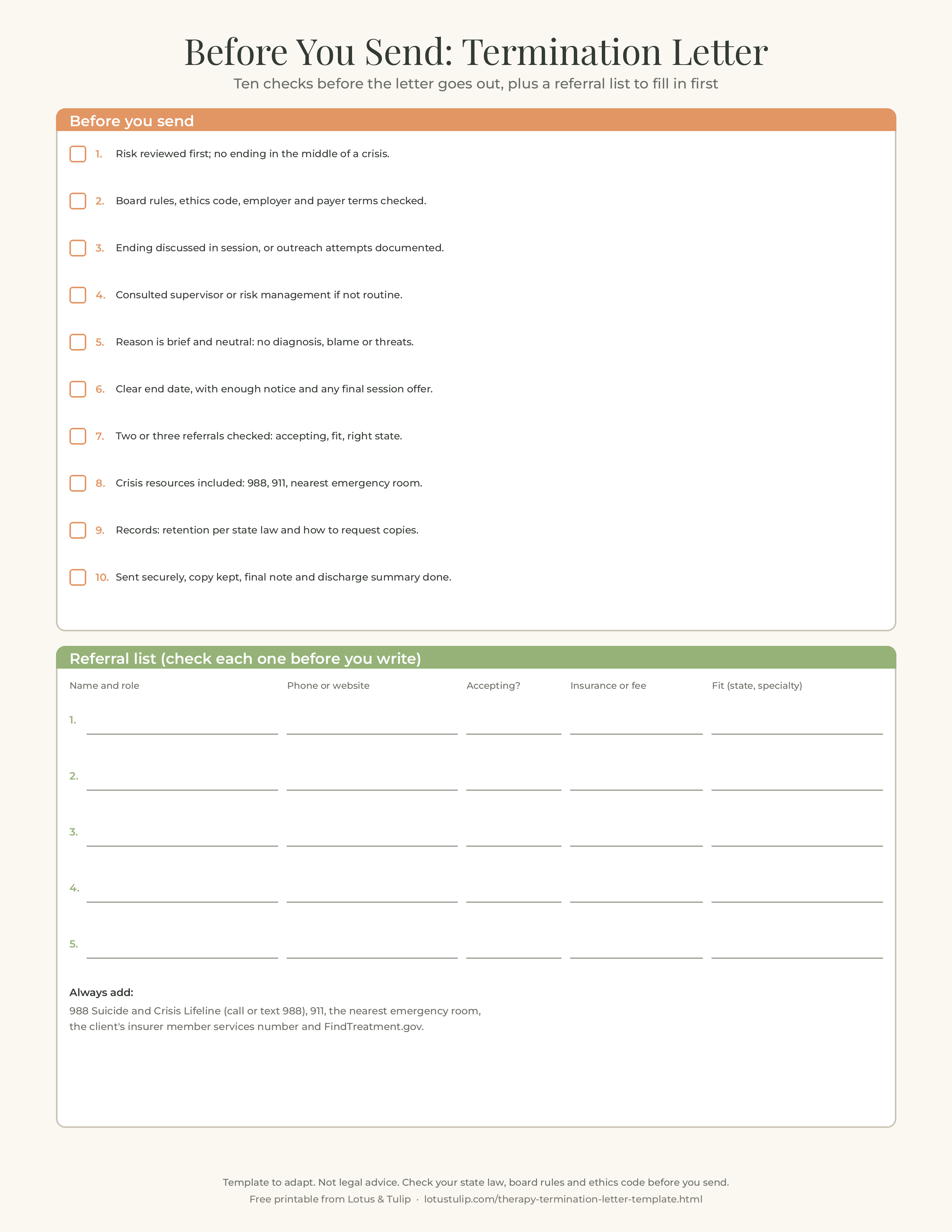
- Review it before you send. Read it as the client, then as a board investigator. Remove clinical detail, blame and identifying third party information. Check names, dates and contact details. Run the before you send checklist on page 3 of the free printable.
- Send it securely and keep a copy. Send through the portal, encrypted email or mail marked confidential, using the client's preferred contact method. Keep a copy, and the proof of sending, in the record.
- Close the record. Write the final note or discharge summary: reason for ending, the discussion, referrals given, risk status at last contact, the letter and how it was sent, and the date the file was closed. Process any records requests promptly.
Therapy termination letter example (fictional, full)
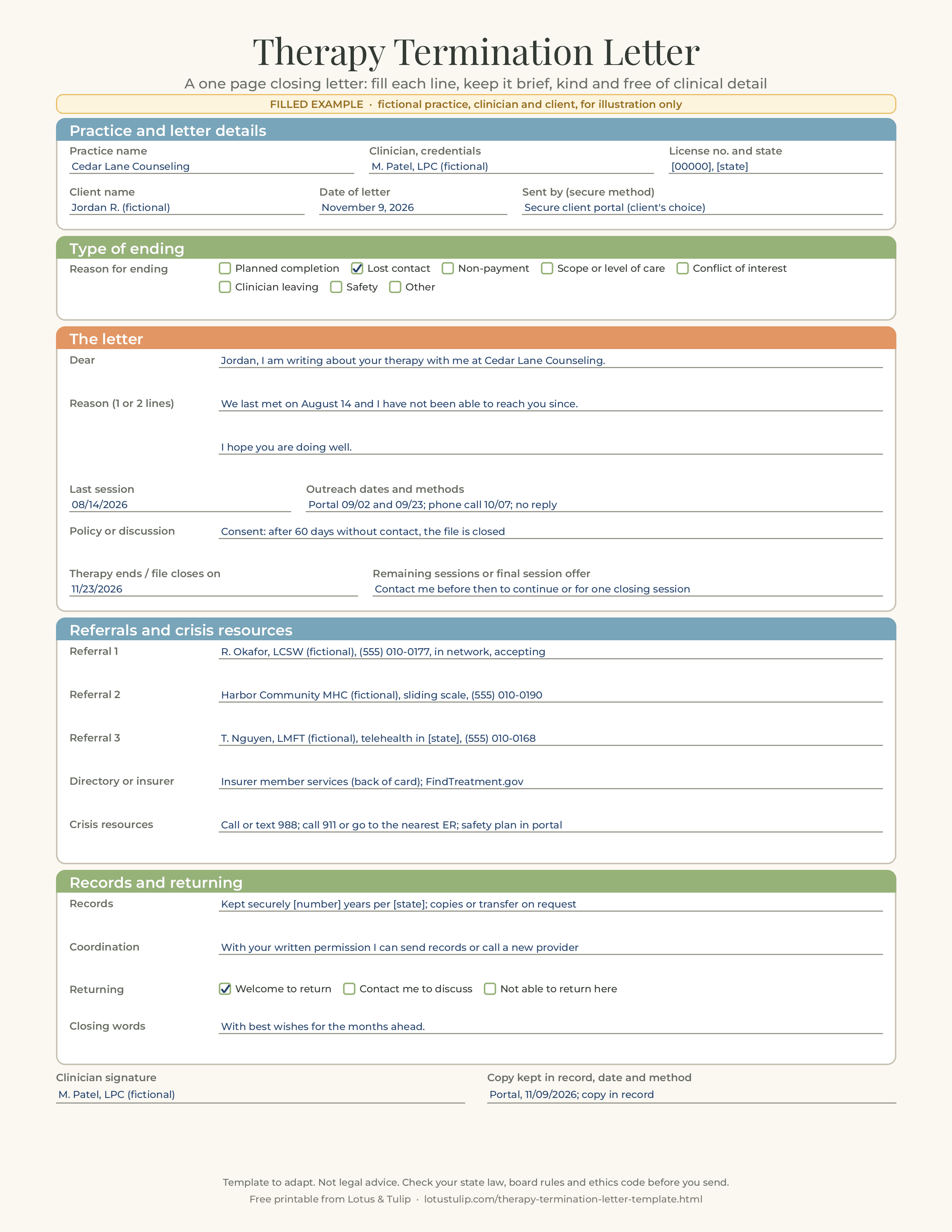
This is the full letter shown on page 2 of the free printable. It is a lost contact and file closing letter, which is the most common kind clinicians write. The practice, clinician and client are fictional.
Cedar Lane Counseling (fictional) · 120 Main Street, Suite 4, [City, State] · (555) 010-0142 · secure portal
November 9, 2026
Sent by secure client portal, as you requested on your intake form
Dear Jordan,
I am writing about your therapy with me at Cedar Lane Counseling. We last met on August 14, 2026. Since then I have reached out by portal message on September 2 and September 23 and by phone on October 7, and I have not heard back. I hope you are doing well.
As described in the consent you signed when we started, when we have not been in contact for 60 days I close the file so that you are not left thinking you have an active therapist when you may not. I am closing your file as of November 23, 2026. If you would like to continue, or to have one closing session, please contact me before then and I will gladly find a time.
If you would prefer to see someone else, these options may help:
- R. Okafor, LCSW (fictional), Riverbend Therapy, (555) 010-0177, accepting new clients, in network with your plan
- Harbor Community Mental Health Center (fictional), sliding scale, (555) 010-0190
- Your insurer's member services number on the back of your card, or the Psychology Today and SAMHSA FindTreatment.gov directories
If you are ever in crisis, call or text 988 (Suicide and Crisis Lifeline), call 911, or go to the nearest emergency room. Your safety plan from June is in the portal under Documents.
Your records will be kept securely for at least [number] years, as required in [state]. You can ask for a copy, or ask me to send records to a new provider with your written permission, at any time.
You are welcome to come back in the future. Just call or message the practice.
With best wishes,
M. Patel, LPC (fictional), License [00000], [State]
Why this works: it states facts, not judgments; it shows the outreach; it ties the closing to a policy the client agreed to; it gives a date and a chance to respond; it lists specific and general referrals and crisis resources; it explains records; and it leaves the door open.
Six short termination letter examples
Each example shows the body of a letter. Add your letterhead, the date and delivery method, crisis resources, records information and your signature, as in the full example above. All are fictional.
1. Planned completion (goals met)
"Dear Sam, as we agreed in our session on October 29, our work together is finishing, and our final session is November 12. Over these six months you have moved from panic attacks most days to using your breathing and grounding plan whenever anxiety rises, and you returned to driving on the highway, which was your main goal. You know your early warning signs: poor sleep, skipping meals and avoiding plans. If they return for more than two weeks, that is a good time to reach out. You are welcome back any time; please call the practice to schedule. If you ever need urgent help, call or text 988 or call 911. It has been a privilege to work with you."
2. Non-payment (after reminders and a payment plan offer)
"Dear Taylor, as we discussed on October 20, your account has an unpaid balance of $450 for sessions from July through September, and the payment plan we set up in August has not been followed. Under the financial policy you signed when we began, I am not able to schedule further sessions until the balance is resolved, so our last session will be November 17, 2026. I would still like to help you continue care: Harbor Community Mental Health Center (fictional, (555) 010-0190) offers a sliding fee scale, and your county's behavioral health line is [number]. If you would like to set up a new payment plan, please contact me by November 30. If I do not hear from you, the balance will be referred to a collection service as described in the policy. This does not affect your right to your records; I will send copies to a new provider at your written request."
3. Scope of competence or level of care
"Dear Alex, thank you for talking with me so openly in our last two sessions. As we discussed, the concerns you described with eating and weight are best treated by a team that specializes in eating disorders, which is outside my training. I recommend Lakeside Eating Disorder Program (fictional, (555) 010-0123), which offers intensive outpatient care and takes your insurance, and Dr. L. Moreno (fictional, (555) 010-0145), a psychologist who specializes in this area. With your written permission I will call them to share what will help them get started. I will keep seeing you weekly until your first appointment there, and no later than December 15, 2026, so that you are not without support in between."
4. Conflict of interest
"Dear Morgan, a professional conflict has come up that means I cannot continue as your therapist. This is not about anything you have done, and I am sorry for the disruption. I would like to offer a final session to talk about this and plan your next steps; I have held November 16 at 4 pm, or we can find another time this week. Here are three therapists who are accepting new clients and work with the concerns we have focused on: [names and numbers]. With your written permission, I can send a summary of our work to whoever you choose."
5. Clinician relocating or leaving the practice
"Dear Casey, I am writing to let you know that I will be leaving Cedar Lane Counseling on January 30, 2027, because I am relocating out of state. We will talk about this together in our next session, and we have up to eight sessions before I leave. You have three options: continue at Cedar Lane with another clinician, who I can introduce you to in a joint session; transfer to a therapist outside the practice, from the list I will give you; or finish therapy before I leave if that fits your goals. Because I will not be licensed in [state] after the move, I will not be able to continue by telehealth. Your records will stay with Cedar Lane Counseling, the records custodian, and you can request copies at (555) 010-0142."
6. Safety (immediate ending after a threat)
"Dear Jamie, because of the threats made during the phone call on November 6, I am ending our professional relationship as of today, November 9, 2026, and will not schedule further sessions. I want you to have continued care. Here are options that can see you soon: [names and numbers], and your insurer's member services line. If you are in crisis, call or text 988, call 911 or go to the nearest emergency room. You can request copies of your records in writing at the address above, and I will send them, or send them to a new provider with your permission."
Before sending a safety letter, consult your risk management service or an attorney, follow any duty to warn or protect law that applies in your state, and consider whether the threat needs to be reported. Do not meet alone with a client who has threatened you.
Lost contact: when and how to close the file
The no-show or lost contact closing letter is the one most clinicians put off. The client stops coming, outreach goes unanswered, and the file sits "open" for months. That creates two problems. The client may believe they still have a therapist and may not seek care elsewhere in a crisis. And you may still carry clinical responsibility for a client you have not seen.
A clear lost contact policy fixes both. Put it in your informed consent (see our informed consent for therapy template), apply it the same way for every client, and document each step:
- First missed session or gap: a check in message within a day or two using the client's preferred method.
- No response: a second outreach one to two weeks later, by a different method if the client agreed to it.
- Still no response: a third outreach, often a phone call, noting that the file will close on a date unless you hear from them.
- Closing letter: sent at the time stated in your policy (30, 45, 60 or 90 days are common choices), with a closing date a week or two later, referrals, crisis resources, records information and an invitation to return.
- Close the record: a final note or discharge summary with the outreach dates, the letter, risk status at last contact, and the date the file closed.
Adjust for risk. If the client's last session involved suicidal thoughts, a recent crisis, or another safety concern, a missed appointment is not a routine no-show. Reach out promptly, use the emergency contact if your consent allows it and your judgment says it is needed, and consider a welfare check where the risk is serious. Document your reasoning either way.
Records, retention and requests after termination
Ending therapy does not end your obligations for the record. Three points to cover in the letter and in your practice:
- Retention is set mainly by state law. HHS says the HIPAA Privacy Rule does not include medical record retention requirements; state laws generally govern how long records are kept, while HIPAA requires you to protect records for as long as you keep them, through disposal. Required periods vary widely by state and by license, and records of minors are often kept longer (commonly until a set number of years after the client turns 18). The APA Record Keeping Guidelines (2007) suggest, where no stricter rule applies, keeping full records for seven years after the last date of service for adults, or three years after a minor reaches the age of majority, whichever is later. Check your state's rule and your board's rules, and follow the longest that applies.
- HIPAA documentation is separate. HIPAA requires covered entities to keep their required compliance documentation (such as policies, signed authorizations and Notice of Privacy Practices acknowledgments) for six years under 45 CFR 164.530(j). That is not the same as a clinical record retention period.
- Former clients keep their right of access. Under 45 CFR 164.524, an individual has the right to inspect or get a copy of their records in the designated record set for as long as you keep them, with exceptions including psychotherapy notes. You must act on a request within 30 calendar days, with one 30 day extension if you give written reasons in time. Some states require faster access. Do not withhold records needed for emergency treatment because of an unpaid balance (APA 6.03). If the client is moving to a new therapist, see the treatment summary template for what to send and how.
If you are closing or leaving a practice, name a records custodian, tell clients who it is and how to reach them, and make sure the arrangement survives you. A professional will, a written plan for a trusted colleague to manage records and contact clients if you die or become incapacitated, is the most reliable way to do that.
Documenting the ending
The record is where you show the ending was thoughtful. Your final documentation should include:
- The reason for ending, stated factually.
- The pretermination discussion (date, what was discussed, the client's response), or the outreach attempts if the client could not be reached.
- Risk status at last contact and any safety steps.
- Referrals given, by name, and any coordination with the new provider (with authorization).
- Consultation you sought, if any.
- The letter (a copy), the date sent and the delivery method.
- Any response from the client.
- The date the file closed and the discharge summary.
A short closing note line, written the day the file closes, might read:
"File closed per lost contact policy (consent version 2026-01). Last session 08/14/2026; outreach by portal 09/02 and 09/23, phone 10/07, no response. No risk indicators at last session (denied SI, safety plan on file). Closing letter sent via portal 11/09/2026 with three referrals, 988 and 911, records information and invitation to return. No response by 11/23/2026. Discharge summary completed."
For the full structure of the closing record, see the therapy discharge summary template. If the client was seen by telehealth, note the modality of the last session as described in the telehealth progress note guide.
Special situations
Minors
For a minor, the letter usually goes to the parent or guardian who consented to treatment, and in some states also to a minor who consented to their own care. Who receives it, and what it can say, depends on your state's minor consent and access laws and any custody orders. Explain the ending to the young person in an age appropriate way, ideally in a session, and give them crisis resources they can use themselves.
Couples and families
When the couple or family is the client, send the letter to each adult participant, using each person's agreed contact method, and do not reveal anything one person shared privately. If one partner leaves couples therapy and the other wants to continue individually, think carefully before switching roles; many clinicians refer the individual work elsewhere to avoid a conflict.
Groups
For a group member who stops attending, send an individual letter, not a message to the group. If the whole group is ending, a group letter is fine, but individual follow up for members at risk is still needed. See the group therapy progress notes guide for how to document without naming other members.
Mandated and court referred clients
If a court, probation or program is receiving reports, check what the release allows you to tell them about the ending, and tell the client what will be shared. Ending services may have legal consequences for the client, so give generous notice where you can and make the reason clear.
Telehealth and clients in other states
If a client moves to a state where you are not licensed, you may not be able to keep seeing them by telehealth. Check both states' rules and any interstate compact you participate in. Give notice, referrals in the new state, and a plan for the gap.
Agency and group practice clinicians
If you are leaving an employer, follow NASW 1.17(f) and APA 10.09: clients should be told about their options, including staying with the organization. Your employment contract may restrict what you can say or whom you can contact after you leave. Ask the organization how client notice will be handled, and put the client's welfare first.
Words to watch in a termination letter
| Instead of | Try |
|---|---|
| "Because you keep missing sessions..." | "We last met on August 14, and I have not been able to reach you since." |
| "You are being discharged for non-compliance." | "I am closing your file as of November 23." |
| "Your diagnosis of major depressive disorder..." | Leave diagnosis out of the letter. |
| "If you do not pay, I will take legal action." | "If I do not hear from you by November 30, the balance will be referred to a collection service, as described in the financial policy you signed." |
| "I can no longer work with someone like you." | "I believe you would be better served by a clinician who specializes in this area." |
| "Feel free to call me any time." | "If you are in crisis, call or text 988 or call 911." |
| "Your records will be destroyed." | "Your records will be kept securely for at least [number] years, as required in [state]." |
| "Re: Therapy termination" (email subject) | "A message from Cedar Lane Counseling" |
Common termination letter mistakes
- Using the letter instead of a conversation when a conversation was possible.
- Ending during a crisis or without reviewing risk first.
- No referrals, or only "search online for a therapist."
- Referrals that do not fit: not accepting clients, out of network, wrong state or wrong specialty.
- Too little notice for a clinician initiated ending without a safety reason.
- Clinical detail or diagnosis in a letter that may be read by others.
- Blame, threats or emotional language, especially in non-payment letters.
- Leaving lost contact files open for months with no outreach and no closing letter.
- No crisis resources in the letter.
- No records information, or withholding records because of a balance.
- Sending insecurely or with an identifying envelope or subject line.
- Not documenting the discussion, outreach, letter and file closing.
Free printable: therapy termination letter template, filled example and checklist
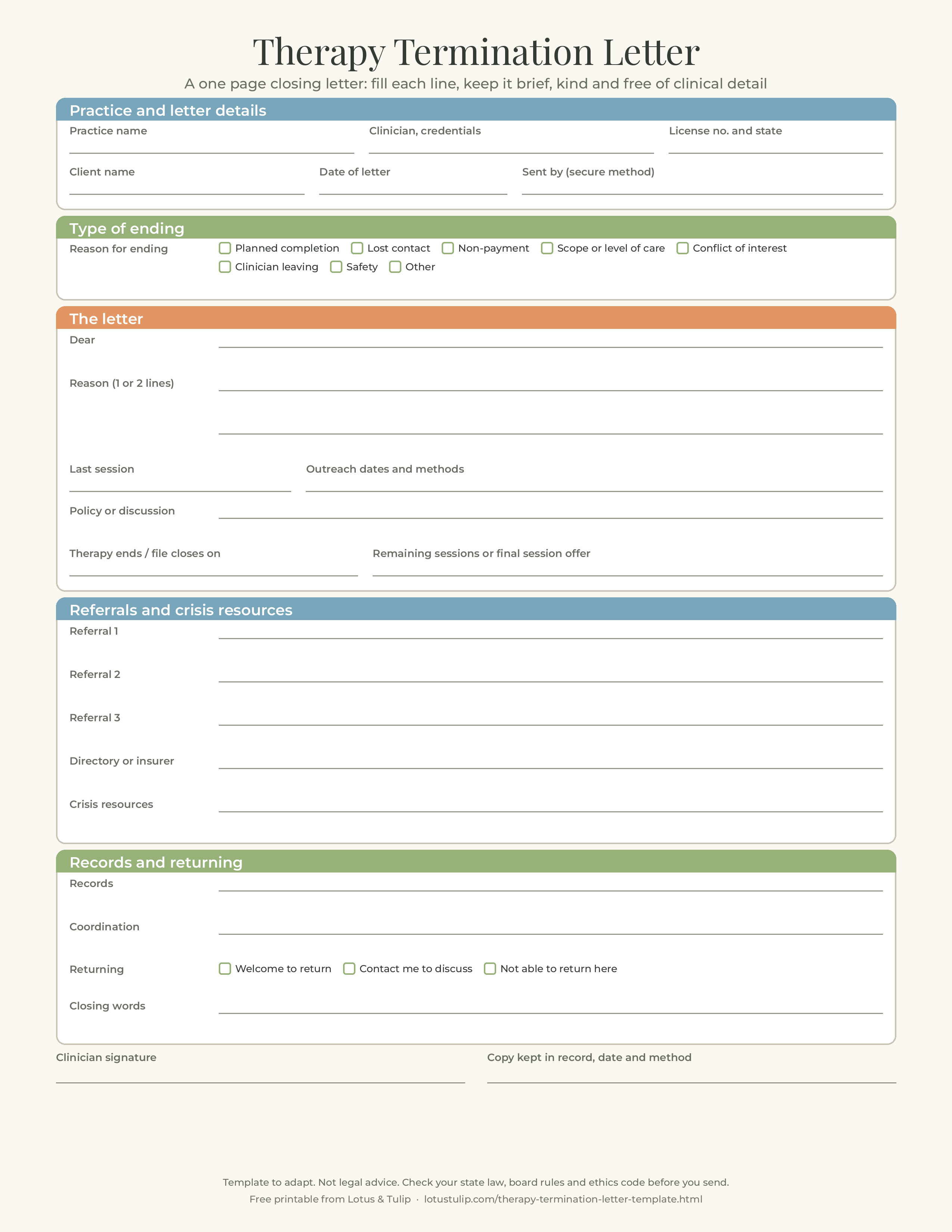
The free printable has three US Letter pages. Page 1 is a blank fill-in termination and closing letter: practice and clinician details, date and delivery method, a tick box for the type of ending (planned completion, lost contact, non-payment, scope or level of care, conflict of interest, clinician leaving, safety, other), lines for the reason, last session and outreach dates, the policy or discussion behind the ending, the end or file closing date, remaining or final session offer, three referral lines plus a directory or insurer line, crisis resources, records, coordination with permission, whether the client can return, closing words, and signature and record copy lines. Page 2 is the filled lost contact example from this page, for the fictional Cedar Lane Counseling. Page 3 is a ten point before you send checklist plus a referral list box to fill in before you write.
Download the free therapy termination letter template (PDF, 3 pages)
Rather type than handwrite? The free PDF above is for printing. Therapy Progress Notes and Intake Templates comes as a fillable PDF you type straight into (604 fields in Adobe Acrobat Reader), plus the printable version: SOAP, DAP and BIRP notes, intake, treatment plan and safety plan, 20 pages. Holiday 20% off: about $7.36, was $9 (EUR 8) · instant digital download
Buy on EtsyPrefer single images? Page 1: blank termination letter (PNG) · Page 2: filled termination letter example (PNG) · Page 3: before you send checklist and referral list (PNG)
Free to print and use in your own practice or program. Please link to this page rather than re-uploading the file. The letter is a starting point: adapt it to your license, state, setting and the client, and check your board's rules before you send it. Using it does not guarantee compliance with any law, board rule or payer policy.
Related resources
- Closing a therapy private practice: checklist, timeline, client letters, records plan and free printable
- HIPAA risk assessment for therapists: security risk analysis, filled example and free worksheet
- Business associate agreement for therapists: which vendors need a BAA, breach duties, filled vendor log and free printable
- Professional will for therapists: clinical executor, records custodian, client notification scripts, filled example and free printable
- Couples therapy informed consent form: no secrets policy, individual sessions, records access, safety screening, filled example and free printable
- Treatment summary template for therapists: how to write a treatment summary letter, transfer records under HIPAA, filled example and free printable
- Notice of privacy practices for therapists: HIPAA 164.520 elements, 2026 Part 2 update, filled example and free printable
- Parental consent form for therapy of a minor: who can consent, custody orders, state minor consent laws, HIPAA, filled example and free printable
- Credit card authorization form for therapists: card on file consent, PCI DSS rules, filled example and free printable
- Sliding scale fee policy for therapists: 2026 poverty guideline tiers, copay waiver rules, filled example and free printable
- Therapy cancellation policy template: late cancellation and no show fees, Medicare and Medicaid rules, filled example and free printable
- Release of information form for therapists: HIPAA authorization elements, psychotherapy notes, Part 2, filled example and free printable
- Superbill template for therapists: every field insurers need, CPT and POS codes, filled example and free printable
- Good Faith Estimate template for therapists: No Surprises Act rules, filled example and free printable
- Psychotherapy notes vs progress notes: what HIPAA says, what goes where and free printable
- Therapy discharge summary template: example and free printable
- Informed consent for therapy template: what to include, sample consent and free printable
- Biopsychosocial assessment template: example and free printable
- Telehealth progress note template: examples, checklist and free printable
- Mental status exam template: examples, word bank and free printable
- BIRP notes for therapists: template, 5 examples and free printable
- GIRP notes for therapists: template, 5 examples and free printable
- Group therapy progress notes: template, examples and free printable
- SOAP vs DAP notes for therapists, with examples
- What to include in a therapy intake form (checklist)
- Therapy treatment plan template with SMART objectives (free printable)
- Safety plan worksheet (free printable)
- Relapse prevention plan worksheet (free printable)
- Therapy progress notes and intake templates
Sources: American Counseling Association, 2014 ACA Code of Ethics, standards A.10.d, A.11.a to A.11.d and A.12, and ACA notices on the code revision (final revised code expected fall 2026; 2014 code in effect until adopted); American Psychological Association, Ethical Principles of Psychologists and Code of Conduct (2002, amended 2010 and 2016), standards 3.01, 3.12, 6.02(c), 6.03, 6.04(d) and (e), 10.09 and 10.10; National Association of Social Workers, Code of Ethics, standard 1.17; American Association for Marriage and Family Therapy, Code of Ethics (2015), standards 1.9, 1.10 and 1.11; HHS, HIPAA FAQ on medical record retention; 45 CFR 164.524 (right of access) and HHS access guidance; 45 CFR 164.530(j) (documentation retention); American Psychological Association, Record Keeping Guidelines (2007); 988 Suicide and Crisis Lifeline. Rules change; check the current versions and your state's laws and board rules.
FAQ
What should a therapy termination letter include?
The date and secure delivery method; your name, credentials and practice details; a clear statement that therapy has ended or will end, with the date; a brief, neutral reason; any remaining or final session offer; two or three specific referrals; crisis resources such as 988 and 911; how to get records; whether the client can return; and your signature. Keep it to one page and leave out diagnosis and clinical detail.
How much notice should a therapist give before ending therapy?
The ethics codes do not set a number of days. They ask for reasonable steps to avoid abandonment, pretermination counseling and help with referrals. For a clinician initiated ending without a safety issue, many clinicians allow several weeks and more for clients with complex needs. Check your licensing board rules, your employer's policy and any payer contract, and consult your risk management service in difficult cases.
Can a therapist end therapy for non-payment?
Generally yes, if it is handled properly. ACA A.11.c allows termination when clients do not pay fees as agreed, and NASW 1.17(c) allows it in fee for service settings if the financial arrangements were made clear, the client is not an imminent danger to self or others, and the consequences of nonpayment were discussed. Give notice and referrals, offer a payment plan or lower cost options, tell the client before using collections, and never withhold records needed for emergency care because of the balance.
What is client abandonment in therapy?
Abandonment is ending or neglecting care for a client who still needs it without reasonable notice, preparation or help finding other care, or at a time when it puts them at risk. ACA A.12, NASW 1.17(b) and AAMFT 1.11 all prohibit it. Planned endings with pretermination counseling, referrals, crisis resources and documentation are not abandonment.
How do I close a file when a client stops coming to therapy?
Follow the lost contact policy in your informed consent. Reach out two or three times by the client's agreed contact methods, then send a closing letter that gives the last session and outreach dates, a closing date, referrals, crisis resources, records information and an invitation to return. Document each step and complete a discharge summary. If the client was at risk at the last contact, reach out sooner and more actively.
Should a termination letter include the client's diagnosis?
No. Keep the letter free of diagnosis and clinical detail, because it may be read by family members, new providers or others. If a new provider needs clinical information, send a treatment summary separately with the client's written authorization.
How long do I keep records after therapy ends?
It depends on your state and license. HIPAA does not set a retention period for clinical records; state law generally does, and records of minors are often kept longer. Where no stricter rule applies, the APA Record Keeping Guidelines suggest seven years after the last service for adults, or three years after a minor reaches the age of majority, whichever is later. Clients keep their right to request copies for as long as you hold the records.
Is this therapy termination letter template free?
Yes. The three page printable (a blank fill-in termination and closing letter, a filled fictional example and a before you send checklist with a referral list box) is free to print and use in your own practice. Please link to this page rather than re-uploading the file, and adapt it to your state and board rules before use.