
Therapist practice · Updated 2026-11-10
Telehealth Across State Lines for Therapists: Licensure, PSYPACT, the Counseling Compact, Temporary Practice and a Client Location Checklist (Free Printable)
Ready-made printable: Therapy Progress Notes and Intake Templates Fillable PDF, 20 pages: SOAP, DAP and BIRP notes, intake, treatment plan and safety plan
Holiday 20% off: about $7.36, was $9 (EUR 8) · instant digital download
Try it free first: download a fillable sample (SOAP note and DAP note, PDF, 226 KB). Type into it on screen, then get the full pack. No email needed.

A client emails on a Sunday night: she is spending three weeks with her parents in another state, and can you keep the Tuesday session on video? Another client starts college in the fall, two states away, and wants to keep working with you. A third is a snowbird who lives half the year in Florida. And you may be the one moving, or working from a cabin over the summer. Telehealth makes all of this feel easy, and technically it is. Legally, it is one of the most common ways careful clinicians end up practicing without authority, because the question is not where you are licensed or where the client lives. It is where the client is physically sitting when the session happens.
This guide is written for licensed counselors, marriage and family therapists, clinical social workers and psychologists in US private practice. It explains the client location rule and where it comes from, your four realistic options when a client is in another state (a license there, a compact, a temporary practice provision or a pause), exactly where PSYPACT, the Counseling Compact and the Social Work Licensure Compact stand in November 2026, what marriage and family therapists can use instead of a compact, three verified examples of temporary practice and telehealth registration rules (California, Florida and Arizona), how to build an emergency plan around the client's actual location, including how 988 and 911 calls are routed, what to check with your malpractice carrier and payers, sample consent wording, a ten step process, a filled example for a fictional practice, and a free three page printable: a blank interstate telehealth check, the same check filled in, and a session location checklist and log.
Jump to the free interstate telehealth checklist and location log
This is educational information for licensed clinicians and trainees in the US. It is not legal advice and it does not tell you whether you personally may practice in any state. Licensing rules, compact status and temporary practice provisions change often; before you see a client located in another state, check that state's licensing board and, for compacts, the commission's own website on the day you rely on it. Compact status below was checked on November 10, 2026 on counselingcompact.gov, swcompact.org and psypact.gov (and, where psypact.gov's interactive map could not be read directly, against the commission's announcements, the Louisiana board's notice and published reviews of the map). The PSYPACT model text was read in the Kansas statutes (K.S.A. 74-5352); Florida section 456.47 on the Florida Senate's 2026 statutes site; Arizona section 36-3606 on the Arizona Legislature's site; the California Board of Behavioral Sciences' temporary practice allowance notice on bbs.ca.gov; 988 routing on the FCC's 988 page; ethics language in the 2014 ACA Code of Ethics and the NASW Code of Ethics as published by each association.
The short answer
- The client's physical location at the time of the session decides which state's rules apply. Not where the client lives, not where their insurance is issued, not where you are licensed. If the client is sitting in Colorado, you are practicing in Colorado, and you need authority to practice there.
- You have four realistic options: hold a license in that state; use a compact privilege or authorization if your profession has one that is operating in both states; use a temporary practice or telehealth registration provision if that state has one and you qualify; or pause sessions (or refer) until the client is back in a state where you are authorized.
- PSYPACT works today for psychologists in most states, through an Authority to Practice Interjurisdictional Telepsychology (APIT) that requires an ASPPB E.Passport, and a separate Temporary Authorization to Practice for limited in person work. It does not cover California, Hawaii, Massachusetts, New Mexico, New York or Oregon, and Iowa and Louisiana are enacted but not yet effective.
- The Counseling Compact is issuing privileges in 11 states as of November 2026 (Arizona, Arkansas, Georgia, Indiana, Louisiana, Minnesota, Missouri, Ohio, Oklahoma, Tennessee and Wyoming). Many more states have passed it but cannot issue or accept privileges yet.
- The Social Work Licensure Compact is not issuing multistate licenses yet, although 35 states had enacted it by July 2026. Marriage and family therapists have no compact; licensure by endorsement is the route.
- Plan emergencies around where the client is. Calling 911 from your own phone reaches your local dispatch center, not the client's. Record the client's address at the start of every telehealth session and know the local emergency number and nearest emergency room for that address.
- Check the rest of the stack: your malpractice policy, your payers, your employer or platform, and the other state's rules on duty to warn, mandated reporting and minors, which follow the client's location too. A free checklist and log for all of this is below.
The rule that decides everything: where the client is during the session
Licensing boards, compacts and telehealth statutes use slightly different words, but they keep landing on the same idea: a telehealth session takes place where the client is physically located. Here is the rule in the primary sources themselves.
- PSYPACT. The model compact text defines the "receiving state" as "a compact state where the client/patient is physically located when the telepsychological services are delivered." The psychologist's home state, where the psychologist must be licensed, is a separate concept.
- The Counseling Compact. The commission's FAQ puts it in one line: "Counselors must have a license or a privilege to practice in the state where the client is located."
- The Social Work Licensure Compact. The commission's FAQ says social workers "must abide by the scope of practice, laws, and rules of the remote state where the client is located at the time care is rendered."
- Florida. Section 456.47(5) of the Florida Statutes says that "any act that constitutes the delivery of health care services is deemed to occur at the place where the patient is located at the time the act is performed or in the patient's county of residence."
- Arizona. Section 36-3606 of the Arizona Revised Statutes regulates a provider who is not licensed in Arizona and who provides "telehealth services to a person located in this state."
The ethics codes say the same thing from the clinician's side. The 2014 ACA Code of Ethics, standard H.1.b, says counselors who use distance counseling "understand that they may be subject to laws and regulations of both the counselor's practicing location and the client's place of residence," and that counselors "ensure that their clients are aware of pertinent legal rights and limitations governing the practice of counseling across state lines or international boundaries." NASW standard 1.04(e) says social workers who use technology "should comply with the laws governing technology and social work practice in the jurisdiction in which they are regulated and located and, as applicable, in the jurisdiction in which the client is located." Notice that the ACA standard says "place of residence" while the licensing rules say "located." When the two differ (a student who lives in one state and studies in another, a client traveling for work), the licensing question is answered by where the client is during the session, and the cautious reading is that the laws of both your location and the client's can matter.
Location, not residence
This is the part that catches people out. A client who lives in your state but joins from a hotel two states away is, for that session, in the other state. A client who lives in another state but drives across the border to sit in a parking lot in your state (yes, clinicians suggest this, and clients do it) is, for that session, in your state. Where the client's insurance is issued, where they vote and where they pay taxes do not change the answer for licensure purposes, although they may matter for billing.
Your own location matters too
Your location is not irrelevant. Your own license is issued by your state and you remain bound by its rules wherever you work from. Some authorizations depend on where you are: PSYPACT's telepsychology authority applies, under Article VI of the compact, when "the psychologist initiates a client/patient contact in a home state," and if a psychologist holds licenses in more than one compact state, the home state for telepsychology is "the compact state where the psychologist is physically present when the telepsychological services are delivered." The Counseling Compact and the Social Work Compact are built on your home state, meaning the state where you primarily live. If you plan to work from outside your licensed state for a period, ask your own board, and read the authorization you rely on, before you go.
Clients outside the United States
US state licenses and US compacts stop at the border. A client who is abroad is outside every US board's authority, and the country they are in may have its own rules about who may provide psychological services there. Few US boards give clear guidance about this, and many malpractice policies limit coverage to claims brought in the US or to services provided to clients in the US. Before you continue with a client who is traveling or living abroad, ask your board and your carrier, tell the client in writing what you can and cannot offer, and make the emergency plan local to where they actually are.
Common situations, and the question to ask
| Situation | Where you are practicing | The question to ask |
|---|---|---|
| Client on a two week vacation or work trip in another state | The state the client is visiting | Do I have a license, compact privilege or temporary practice allowance there? If not, can we pause or reschedule for when they are home? |
| College student who lives with parents in your state but studies elsewhere | The state where the student is during each session | Which sessions happen at school and which happen at home? Is there a compact route or license for the school state, and a campus or local counseling option for crises? |
| Snowbird or seasonal worker with two homes | Whichever state they are in that day | Is a second license, a compact privilege or a telehealth registration worth it given how long they spend there? |
| Client moving permanently to another state | Your state until the move; the new state after it | Can I get authority in the new state quickly, or should we plan a warm handoff to a clinician licensed there? |
| You are moving, or working from another state for a while | Each client's state (and your own new state matters too) | Does my home state license, compact authorization or board rule still cover my practice when I am physically elsewhere? Has my compact home state changed? |
| Client joins from a car or a parking lot across the state line | The state where the car is parked | Is this a workaround I can justify? (Usually not as a routine.) Is the client safe and in a private place? |
| Client traveling outside the US | The other country, outside US licensing | What do my board and my malpractice carrier say, what does the other country allow, and what is the emergency plan there? |
Your four options when a client is in another state
Once you know where the client will be, there are only four honest answers. The rest of this guide goes through each one.
- Hold a license in that state. Slow to set up, but the most durable answer for states you see clients in regularly. Many boards offer licensure by endorsement or another faster route for experienced out of state licensees.
- Use a compact, if your profession has one and it is operating in both your home state and the client's state: PSYPACT for psychologists, the Counseling Compact for professional counselors and, once it starts issuing licenses, the Social Work Licensure Compact.
- Use a temporary practice allowance or telehealth registration, if the client's state has one and you meet its conditions. These are state specific, often narrow, and sometimes come with notice, registration or insurance requirements.
- Pause, reschedule or refer. Hold sessions until the client is back, offer care coordination support that does not amount to practice (check your board's view), help the client find a local clinician, and make sure they have local crisis resources in the meantime.
What is not on the list: hoping no one notices, treating a short trip as too small to matter, or deciding that a session is "just a check in." Boards generally treat any clinical service delivered to a person located in their state as practice in their state.
Option 1: a license in the client's state
If you see clients in a neighboring state every week, a full license there is usually the cleanest answer. It covers telehealth and in person work, it does not depend on a compact's implementation timetable, and it lets you advertise in that state on the same footing as local clinicians. The costs are application fees, a jurisprudence or law exam in many states, continuing education that may differ from your home state's, and another renewal cycle.
Look for a faster route before you assume you have to start from scratch. Many boards have licensure by endorsement for clinicians who have been licensed elsewhere for a number of years, and some states have broader universal license recognition laws; the Counseling Compact's own home page notes that it "works together with universal license recognition laws to increase license portability." California's Board of Behavioral Sciences, for example, mentions a streamlined process for out of state LMFTs, LPCCs and LCSWs who have been actively licensed for at least two years. Each board defines its own requirements, so read the board's current application guide rather than a summary.
Marriage and family therapists: no compact, portability instead
There is no interstate compact for marriage and family therapists. The Counseling Compact's FAQ says so directly ("Marriage and Family Therapists do not have a compact"), and it notes that someone licensed as an LMFT or LCSW "typically is not eligible for the counseling compact." AAMFT has explained publicly that it studied a compact and decided not to pursue one, citing, among other things, that California and New York, two of the states with the most MFTs, have not joined healthcare compacts, and that development alone was estimated to cost more than $1,000,000. Instead AAMFT adopted a model portability law in 2018 and runs an effort called Access MFTs to get states to adopt streamlined licensure by endorsement. If you are an MFT, the practical routes are a license by endorsement in each state where you regularly see clients, any temporary practice provision that covers MFTs (California's, below, does), or a pause. Check AAMFT's portability pages for the current list of states with Access MFTs style laws.
Option 2: compacts, profession by profession
An interstate compact is a contract among states, enacted as identical legislation in each one, that lets a clinician licensed in one member state practice in another member state without a separate full license. Passing the law is only the first step. Each compact also needs a commission, rules, background check authority, a shared data system and each state's board to connect to that system. That is why "my state passed the compact" and "I can use the compact today" are very different statements.
| Compact | Who it covers | Status on November 10, 2026 | What you get | Where to verify |
|---|---|---|---|---|
| PSYPACT | Licensed psychologists | Operating since July 1, 2020. In effect in most states; not in effect in Iowa (enacted, effective July 1, 2027) or Louisiana (enacted, effective January 1, 2028); not enacted in California, Hawaii, Massachusetts, New Mexico, New York or Oregon | APIT for telepsychology (requires an ASPPB E.Passport); TAP for temporary in person practice, 30 days per calendar year per state (requires an ASPPB Interjurisdictional Practice Certificate) | psypact.gov map and PSYPRO |
| Counseling Compact | Professional counselors licensed for independent practice (LPC, LPCC, LMHC, LPC-MHSP and similar titles) | Issuing privileges in 11 states: Arizona, Arkansas, Georgia, Indiana, Louisiana, Minnesota, Missouri, Ohio, Oklahoma, Tennessee and Wyoming. Many other member states and the District of Columbia are still completing implementation | A privilege to practice in each remote state you apply for, equivalent to a license there | counselingcompact.gov and CompactConnect |
| Social Work Licensure Compact | Licensed social workers at bachelor's, master's and clinical levels | Enacted in 35 states as of July 2026; not yet issuing multistate licenses; data system development estimated for completion in spring 2027 | Once operating: one multistate license, issued by your home state, that authorizes practice in all member states | swcompact.org |
| None for MFTs | Marriage and family therapists | No compact; AAMFT is pursuing state portability laws instead | Licensure by endorsement, state by state | Each state board; AAMFT portability pages |
PSYPACT for psychologists
The Psychology Interjurisdictional Compact is the most mature of the behavioral health compacts. The commission's FAQ says it became operational once seven states enacted it (by April 2019) and that "As of July 1, 2020, applications to practice under PSYPACT are now open." It creates two separate authorizations, and it is worth being precise about both.
The Authority to Practice Interjurisdictional Telepsychology (APIT)
The APIT is what lets a psychologist licensed in one PSYPACT state provide telepsychology to clients located in other PSYPACT states. Under Article IV of the model text (as enacted, for example, in Kansas at K.S.A. 74-5352), a psychologist exercising the APIT must, among other things, hold a qualifying graduate degree in psychology, "possess a current, full and unrestricted license to practice psychology in a home state that is a compact state," have no history of adverse action or criminal record that violates the commission's rules, "possess a current, active e.passport" and "provide attestations in regard to areas of intended practice, conformity with standards of practice, competence in telepsychology technology, criminal background and knowledge and adherence to legal requirements in the home and receiving states."
The E.Passport is a certificate issued by the Association of State and Provincial Psychology Boards (ASPPB). The commission's application FAQ calls it "a prerequisite for obtaining an Authorization to Practice Interjurisdictional Telepsychology" and points to ASPPB for its requirements and fee. The same FAQ says the APIT itself costs $40 initially with a $40 annual renewal (and a $25 late fee), that a primary source verified transcript is required, and that processing is "approximately 3 to 4 weeks" from submission. Applications for both certificates and authorizations run through ASPPB's PSYPRO system.
Where you must be when you use the APIT
This is the PSYPACT rule most often missed. The commission's FAQ says that "when practicing under an Authority to Practice Interjurisdictional Telepsychology (APIT), providers must be physically located in the PSYPACT participating state they have declared as their Home State at the time telepsychological services are provided. Telepsychological services provided while physically located outside the declared Home State are not authorized under PSYPACT." You may declare only one home state at a time, though you may change it. In other words, a psychologist licensed in Pennsylvania with an APIT can see a client located in Ohio from an office in Pennsylvania, but not from a vacation rental in a state that is not their declared home state.
The receiving state's rules still apply
The compact text says that a psychologist practicing into a receiving state "shall be subject to the receiving state's scope of practice," and that the receiving state may limit or revoke the APIT in that state and "take any other necessary actions under the receiving state's applicable law to protect the health and safety of the receiving state's citizens." Your home state keeps authority over your license. So under PSYPACT you are working under two sets of rules at once: your home state's license and the receiving state's scope of practice and laws. The attestation you sign about "knowledge and adherence to legal requirements in the home and receiving states" is not a formality.
The Temporary Authorization to Practice (TAP)
The TAP covers in person work in another compact state. The compact defines temporary in person, face to face practice as being "physically present, not through the use of telecommunications technologies, in the distant state to provide for the practice of psychology for 30 days within a calendar year and based on notification to the distant state." The commission's FAQ describes the TAP as allowing practice "while physically located in a PSYPACT participating state that the Authorization holder does not hold a license in, for 30 calendar days per year, per state." It requires an ASPPB Interjurisdictional Practice Certificate (IPC), and the TAP fee is also $40 with a $40 annual renewal. The TAP is for situations like a forensic evaluation or a short in person intensive, not for setting up a second office; the compact "does not apply to permanent in-person, face-to-face practice."
Which states participate
PSYPACT's official map is the only authoritative list, and it changes. As of early November 2026, the commission's map and published reviews of it list PSYPACT as in effect in 42 states, the District of Columbia and the Commonwealth of the Northern Mariana Islands, with Alaska the most recent state to join (through HB 110 of 2026, which also enacted the Social Work Licensure Compact). Two states have enacted PSYPACT but cannot be used yet: Iowa, with an effective date of July 1, 2027, and Louisiana, where Act 302 of 2026 (HB 486) takes effect on January 1, 2028. The Louisiana State Board of Examiners of Psychologists states plainly that until then "psychologists licensed in other jurisdictions are not authorized to practice psychology in Louisiana through PSYPACT," and Louisiana psychologists cannot use PSYPACT to practice elsewhere either. States that have not enacted PSYPACT include California, Hawaii, Massachusetts, New Mexico, New York and Oregon. If you or your client is in one of those states, PSYPACT does not help, and you need a license (or that state's own temporary practice provision, if it has one).
Two final points. PSYPACT covers licensed psychologists only. It does not help counselors, social workers or MFTs, and other psychology credentials (such as psychological associate or school psychology specialist licenses in some states) may not qualify; check the eligibility rules in PSYPRO. And if you already hold a full license in both states, PSYPACT does not apply to you; the commission's FAQ explains that "by already being licensed in the Home State and Receiving/Distant States, an individual has already established full rights to practice in these states."
The Counseling Compact for professional counselors
The Counseling Compact lets a professional counselor licensed in their home state apply for a privilege to practice in another member state. The commission describes the privilege as "equivalent to a license to practice counseling in another state." Applications for the first states opened on September 30, 2025, between Arizona and Minnesota, and the compact has been adding states since.
Where it stands in November 2026
On counselingcompact.gov the commission lists the compact as live for licensees in eleven states: Arizona, Arkansas, Georgia, Indiana, Louisiana, Minnesota, Missouri, Ohio, Oklahoma, Tennessee and Wyoming, with Missouri the most recent, going live on October 19, 2026. "Live" means two things at once: counselors whose home state is one of these can apply for privileges, and privileges can be issued to practice in these states. The home page describes the arrangement state by state, for example that LPCCs "licensed by Ohio and who live in Ohio will be able to apply for the privilege to practice in Arkansas, Arizona, Georgia, Indiana, Louisiana, Minnesota, Missouri, Oklahoma, Tennessee, and Wyoming."
Many more states have joined on paper. The commission's member list names 39 states and the District of Columbia, and its home page says "29 additional states and the District of Columbia are actively completing the steps needed to begin issuing and receiving privileges," such as adopting rules and fees, setting up FBI background checks, preparing IT systems and testing data uploads. Until a state goes live, the compact does nothing for you there. The FAQ is blunt about it: if your state has passed the compact, that "does not automatically approve your license for use in other states."
Who is eligible
- Independent licensure only. You must be "a professional counselor licensed by a Member State, regardless of the title used by that State, to independently assess, diagnose, and treat behavioral health conditions." Associates, interns and anyone practicing under supervision are not eligible, even if the title says LPC.
- Your home state is where you live. The FAQ defines home state as "the state in which they primarily reside," and you must hold a license there. A license from a state where you do not live cannot be used to join the compact.
- Your home state must be live, and so must the state you want to practice in.
- Other professions: LMFTs and LCSWs typically are not eligible, because they have not completed the compact's education and exam requirements for counselors.
Costs and paperwork
You apply separately for each state, through the commission's CompactConnect system, and you must complete the application yourself: "Employers, third-party affiliates, or other representatives may not legally complete or submit the application on behalf of a licensee." Each privilege carries a $30 commission administrative fee plus that state's own fee, and some states require their own jurisprudence exam. The home page uses Ohio's current privilege fees as an example: a $55 initial privilege fee. A privilege expires on the same date as your home state license at the time it is issued, and it does not update automatically when you renew; you renew the privilege in CompactConnect once your home state has reported the new expiration date. The commission suggests renewing your home license first if you are close to renewal, so you do not pay twice. Continuing education is only required for your home state license.
Using the privilege
According to the FAQ, "As soon as your privilege number appears on your dashboard, you can start practicing in the remote state," and others can verify your privilege through the CompactConnect search at app.compactconnect.org/Search. No wall certificate is issued; you can print a verification document from your dashboard. The commission also says it "does not regulate advertising in the member states," so check each state's rules before you list it on your website or directory profile. And it adds a caution worth repeating: "Before applying for a privilege, you should check with your employer, your online platform, and insurance company to ensure you can use the privilege under their policies."
Once you practice under a privilege, you practice under the remote state's laws and rules for that client. That includes its scope of practice and, as discussed below, its rules on things like mandated reporting and duty to warn.
The Social Work Licensure Compact for social workers
The Social Work Licensure Compact works differently from the Counseling Compact. Instead of buying a privilege for each state, an eligible social worker will apply to their home state for a single multistate license, which the compact describes as authorizing practice "in all other compact member states." Eligibility will depend on the category of licensure (bachelor's, master's or clinical), passing the qualifying national exam that matches the category, an accredited degree, and, for clinical licensure, supervised clinical practice, plus a background check in the home state.
The status, as the commission itself puts it on swcompact.org: the compact "has reached activation status, however multistate licenses are not yet being issued." In a July 2026 update the commission reported that the compact "has now passed in 35 states," including Wisconsin, West Virginia and Alaska in the 2026 sessions, and that implementation "will take approximately 18-24 months before social workers are able begin applying for multistate licenses." In May 2026 the commission announced a partnership to build its data system, with development "estimated to take approximately nine months." No date for the first multistate licenses had been announced when this guide was checked. Until then, a social worker who wants to see a client located in another state needs a license there or a temporary provision that covers social workers.
When it does start, two rules from the commission's FAQ will matter. First, the multistate license comes from your home state, the state where you live; you cannot use a license from another state. Second, "Social workers must abide by the scope of practice, laws, and rules of the remote state where the client is located at the time care is rendered."
Option 3: temporary practice and telehealth registration, three verified examples
Some states give out of state clinicians a narrow, defined way to see clients located there without a full license. These provisions are very different from one another, and many states have none at all. The three below were checked against official sources in November 2026. They are examples to show how varied the rules are, not a list of every option, and you should read the current text before relying on any of them.
California: a 30 day temporary practice allowance for existing clients
California is outside PSYPACT and the Counseling Compact, which makes its Board of Behavioral Sciences allowance especially useful. According to the board's notice, it offers "a one-time per calendar year, 30-day temporary practice allowance" for marriage and family therapists, professional clinical counselors and clinical social workers licensed in another US jurisdiction "to provide therapy services to an existing client while the client is travelling in California." The conditions include:
- A current, active, unrestricted license in another jurisdiction that permits practice "at the highest level for independent clinical practice" (associates and interns do not qualify).
- Never having held a California license that was suspended or revoked by the board.
- The client "must be located in California" during the period, must be a current client, and you must "already have an established, ongoing client-provider relationship" with that person.
- You must tell the client that you are not licensed in California and that the services are for a limited time, give them the board's website address (www.bbs.ca.gov), and tell them where you are licensed, the license type and your license number.
- You must give the board your details, your license information and the start date, through its Breeze online system.
The allowance is free, is valid for 30 consecutive days from the start date you choose, cannot be moved once granted, and can be granted only once per calendar year. If you have several qualifying clients in California during those 30 days, you may see each of them. And if it is granted, "you are deemed to have agreed to be practicing under the Board's jurisdiction, and are bound by the laws of the State of California." The board's examples include a client vacationing or working temporarily in California, or a client in the process of moving there while they find a California licensed therapist. Psychologists are licensed by a different California board and should check that board's rules separately.
Florida: out of state telehealth provider registration
Florida lets health care professionals who are not licensed in Florida provide telehealth to patients located in Florida if they register. Section 456.47(4)(a) says such a professional "may provide health care services to a patient located in this state using telehealth if the health care professional registers with the applicable board." The definition of "telehealth provider" in 456.47(1)(b) includes professions licensed under chapter 490 (psychology) and chapter 491 (clinical social work, marriage and family therapy and mental health counseling), so the registration route is open to the out of state equivalents of those licenses. Under 456.47(4)(b) the board registers you if you:
- complete the application;
- hold an active, unencumbered license from another state or US jurisdiction that is "substantially similar" to the Florida license;
- have not been the subject of disciplinary action relating to that license in the five years before you apply;
- designate a registered agent for service of process in Florida; and
- maintain professional liability coverage that "includes coverage or financial responsibility for telehealth services provided to patients not located in the provider's home state," in the amount Florida requires.
Registrants "may not open an office in this state and may not provide in-person health care services to patients located in this state," must report license restrictions or discipline within five business days, and must display on their website a link to the Department of Health's page about them. The department publishes a list of registrants that includes, among other things, the out of state license number, five year disciplinary history, and the malpractice insurer and policy limits, "including whether the policy covers claims that arise in this state." Section 456.47(6) exempts telehealth provided "in response to an emergency medical condition" or "in consultation with a health care professional licensed in this state who has ultimate authority over the diagnosis and care of the patient." Note that registration is not a compact privilege: you are still bound by Florida's standards, and the statute's venue rule places the service where the patient is.
Arizona: interstate telehealth registration
Arizona has a similar registration path in section 36-3606. A provider not licensed in Arizona "may provide telehealth services to a person located in this state" if they register with the Arizona board that licenses comparable providers, giving their name, proof of licensure in all US jurisdictions with license numbers, contact details "including information if the provider needs to be contacted urgently," evidence of professional liability insurance, and a statutory agent for service of process. They must pay the board's fee, hold a "current, valid and unrestricted license" in another state that is substantially similar to the Arizona license with no past or pending discipline, report new restrictions or discipline within five days, follow Arizona's laws, scope of practice and standards of care, carry liability coverage that includes telehealth provided in Arizona, consent to Arizona's jurisdiction, and file an annual update reporting how many Arizona patients they served and how many encounters they had. Registered providers may not provide in person services in Arizona without a license, and may not open an Arizona office except as part of a multistate group that includes at least one Arizona licensed provider. Like Florida, Arizona exempts telehealth provided in response to an emergency or in consultation with an Arizona licensed provider who has ultimate authority over the patient's care.
Arizona is also a live Counseling Compact state and a PSYPACT state, so an eligible counselor or psychologist from another live member state may find the compact route simpler. A clinical social worker or MFT from another state has no compact route to Arizona today, which is when a registration like this matters.
What these examples have in common
- They are tied to where the client is located.
- They require you to tell the board before you start, and often to tell the client about your license status.
- They put you under the visiting state's laws and jurisdiction.
- They usually exclude associates and anyone with discipline.
- Some are limited to existing clients or to a set number of days; others are limited to telehealth only.
- They often involve liability insurance that explicitly covers the other state.
Pandemic era emergency waivers that let many clinicians see out of state clients have largely ended. If a colleague tells you a state "allows" out of state telehealth, ask which provision, read it on the board's or legislature's site, and keep a copy with the date you read it.
Option 4: pause, reschedule or refer, without abandoning the client
Sometimes the honest answer is that you cannot see the client while they are where they are. That is a legitimate clinical and legal decision, and it is handled well when it is planned rather than sprung on the client.
- Raise it early. Ask about travel, school and moves at intake and whenever the client mentions plans. Most problems come from finding out on the day of the session.
- Offer what you can. Reschedule around the trip, move to more frequent sessions before and after, or arrange to meet when the client is back in a state where you are authorized.
- Make a crisis plan for the gap. The client should leave with local crisis resources for where they will be, a copy of their safety plan if they have one, and a clear statement of how you will and will not be available.
- Refer when the change is permanent. If the client is moving and you cannot get authority in the new state, plan a warm handoff with an overlap period if the law allows it, a treatment summary with the client's authorization and a documented referral. See the termination letter guide and the treatment summary template.
- Ask your board before you offer "non clinical" contact. Whether a scheduling call or a brief check in counts as practice is a question for the client's state board, not a judgment to make on the fly.
Write the decision down: where the client will be, what you checked, what you offered and what the client chose. That note protects the client's continuity of care and shows a board that you did not simply stop responding.
Emergency planning by client location
The most practical reason to know where the client is has nothing to do with licensing. If a client becomes acutely suicidal, has a medical emergency or is in danger during a video session, you need to get help to the address where they are right now, and your own phone will not do that for you.
Why calling 911 from your phone may not work
A 911 call is answered by the public safety answering point (dispatch center) that serves the location of the phone that places the call. If you are in Ohio and your client is in Georgia, dialing 911 from your desk reaches Ohio dispatch, which then has to find and transfer to the right center in Georgia while you try to give an address you may not have. Build the plan around the client's location instead:
- Get the address at the start of every telehealth session, and confirm it if it is new. "Same as usual" is fine to record when it is true.
- Keep a local emergency number for each address you use, such as the 10 digit number for the dispatch center or police department that covers the client's usual location, and look one up when the client is somewhere new. Many dispatch centers publish one; check before you need it.
- Have a backup phone number for the client and an agreement about what happens if the video drops in the middle of a crisis.
- Know the nearest emergency room and, where available, the local mobile crisis team for the client's location.
- Have an emergency contact who is near the client, with the client's written consent to contact them in an emergency.
How 988 routes calls and texts
The 988 Suicide and Crisis Lifeline is a national number, but it is answered by a network of local crisis centers, and which one answers depends on routing. According to the FCC, two major wireless providers began "georouting" 988 calls in September 2024, routing them based on the caller's approximate location rather than their area code, and in October 2024 the FCC adopted rules requiring all US wireless providers to georoute 988 calls: nationwide providers by January 13, 2025, and non nationwide providers by December 14, 2026. Georouting uses general location, not a precise "pinpoint" location. Where georouting is not active, calls are routed by the area code and prefix of the caller's number "regardless of the actual location of the caller." For texts, the FCC adopted georouting rules in July 2025 with compliance due 18 months after the rules took effect for nationwide providers and 36 months for others. In practice, that means 988 is a good resource to give every client, but a client who texts 988 from out of state may still reach a center in their home area code region. Veterans can press 1 after dialing 988 to reach the Veterans Crisis Line, and Spanish speakers can press 2. 988 is not a substitute for 911 when someone is in immediate danger.
Put it in the safety plan
For clients at elevated risk, the safety plan should list crisis resources that work where the client actually is, including when they travel. Update it before a trip. And remember that if you ever have to act on a threat to someone else, the duty to warn or protect rules you work under may be those of the state where the client is located, which is one more reason to record that location every time.
Other rules that follow the client
Getting authority to practice in the client's state is only the first step. When you practice there, the receiving state's rules about the substance of practice generally come with it. The compacts say so expressly: PSYPACT subjects psychologists to "the receiving state's scope of practice," and the social work compact requires compliance with "the scope of practice, laws, and rules of the remote state where the client is located." Areas where state laws commonly differ, and where you should know the client's state's rule before the first session, include:
- Duty to warn or protect. Mandatory in some states, permissive in others, reported to an agency in others. See the duty to warn guide for verified examples.
- Mandated reporting of child abuse, elder abuse and abuse of dependent adults, including who must report, to whom and how quickly.
- Minors' consent to treatment and parents' access to records. The age at which a minor can consent to outpatient mental health care differs by state. See the parental consent guide.
- Telehealth specific rules, such as written or verbal consent to telehealth, identity verification, or requirements about the client's location being documented.
- Record keeping and retention rules set by the board or by statute.
- Involuntary evaluation and commitment procedures, which are local and depend on the county where the client is.
HIPAA, by contrast, is federal and does not change at the state line; your notice of privacy practices, business associate agreements and risk analysis stay the same. A more protective state privacy law in the client's state may still apply on top of it.
Malpractice insurance, payers, platforms and advertising
Malpractice coverage
Call your carrier before you practice into a new state, and get the answer in writing. Ask: Does my policy cover services to clients located in states other than the one listed on my policy? Does it cover services under a compact privilege, a PSYPACT authorization or a temporary practice allowance? Does it cover licensing board complaints in another state, and is there a separate limit for board defense? Is there any territory limit, including for clients outside the US? Florida's registration statute makes the point concrete: it requires coverage that "includes coverage or financial responsibility for telehealth services provided to patients not located in the provider's home state," and Florida publishes whether a registrant's policy "covers claims that arise in this state." Arizona's statute requires liability coverage "including coverage for telehealth services provided in this state."
Insurance and other payers
Authority to practice and authority to bill are different things. Commercial plans, Medicaid programs and Medicare each have their own rules about where the clinician must be licensed or enrolled, and in-network status in one state does not make you in-network in another. The Counseling Compact's FAQ notes that "the exact policies of individual insurance companies are not yet known to the Compact," and links to a CMS statement about compacts and Medicare. If you bill insurance, check with each payer before you see a client located in another state, and keep the answer. For self pay clients, make sure your Good Faith Estimate and superbills do not suggest coverage the client will not get.
Employers and platforms
Group practices, telehealth platforms and hospital systems often have their own rules: some do not allow compact privileges, some require approval before you see a client in a new state, and some restrict which states you may list. The Counseling Compact explicitly suggests checking "with your employer, your online platform, and insurance company" before you apply.
Advertising and directory profiles
List only the states where you can actually practice today, and say how (for example, "Licensed in Ohio; Counseling Compact privilege in Minnesota and Indiana"). Do not list a state because it "passed the compact." The Counseling Compact does not regulate advertising, so each state's rules apply, and Florida registrants must link to the Department of Health's page about them from their website.
Verifying a license or privilege
Whether you are checking your own status before a session, a supervisee's, or a colleague's before you refer, verify at the source:
- State licenses: the license lookup on the licensing board's website, which is usually the primary source.
- Counseling Compact privileges: the CompactConnect search at app.compactconnect.org/Search, which the commission says entities can use to verify a privilege.
- PSYPACT authorizations: PSYPACT's website and the psychologist's PSYPRO record; ask the psychologist for their APIT or TAP details and check them against the commission's information.
- Temporary allowances and registrations: the board's notice to you (California sends an email with the start and end dates) or the state's published list of registrants (Florida publishes one).
Record what you checked, where and when. A screenshot or printout with the date, filed with your practice records, is enough. The free log below has a column for it.
Informed consent: set expectations before the first trip
ACA standard H.2.a lists issues that are "unique to the use of distance counseling" and belong in informed consent, including "distance counseling credentials, physical location of practice, and contact information," the "possibility of technology failure and alternate methods of service delivery," "emergency procedures to follow when the counselor is not available" and "time zone differences." ACA H.1.b adds that counselors make sure clients know the "legal rights and limitations governing the practice of counseling across state lines." A short, plain section in your telehealth consent does most of this work. A sample, to adapt with your attorney, board guidance or professional association:
"I am licensed as a [license type] in [state(s)] [and hold (compact privilege or authorization) in (states)]. Licensing laws are based on where you are physically located during each session, not where you live. At the start of every telehealth session I will ask where you are, and I can only meet with you when you are in a place where I am allowed to practice. If you plan to travel, study or move, please tell me as early as you can so we can plan; sometimes that will mean rescheduling, meeting less often, or helping you find a clinician where you will be. If we lose the connection, I will call you at the backup number you gave me. If I believe you are in danger, I may contact your emergency contact or emergency services where you are, using the address you gave me at the start of the session."
Revisit it when anything changes: a new privilege, a lapsed authorization, a move on either side. Note in the record that you did.
Documentation: what to record at every telehealth session
None of this works unless it is written down, and the easiest place is the top of every telehealth note. Record:
- Modality: video or phone, and the platform if your policies require it.
- Client location: at least city and state, and the full address if it is new or if your emergency plan relies on it. "Client confirmed location: home address on file, Columbus, OH" is enough when nothing has changed.
- Your location: especially if you work from more than one place, or if you rely on PSYPACT, where your declared home state matters.
- Your authority for that location: your license, the compact privilege, the PSYPACT APIT or the temporary allowance, with its number or dates.
- Emergency details confirmed: backup phone, emergency contact and the local emergency number for that address.
- Who else is present on the client's side, and whether the client confirmed privacy.
The telehealth progress note template covers the rest of the note. A fictional example of the location block:
Telehealth: video (practice platform). Client H-07 located at university residence hall, Minneapolis, MN (address on file, confirmed). Clinician located at practice office, Columbus, OH. Authority: Ohio LPCC license; Counseling Compact privilege to practice in Minnesota, number on file, expires with Ohio license. Backup phone and emergency contact confirmed; local emergency number for campus area on file. Client alone in room, confirmed privacy.
How to set up telehealth across state lines, step by step
- List where your clients actually are. Go through your caseload and note each client's usual session location and any known travel, school terms, seasonal homes or planned moves.
- Write down your own authority. List every license you hold with its number and expiration date, any compact privileges or PSYPACT authorizations, your compact home state, and where you physically work from.
- Check the compact for your profession. Confirm on the commission's own website (psypact.gov, counselingcompact.gov or swcompact.org) whether your home state and the client's state are both operating today, not just enacted.
- Check the client's state board for other routes. Look for licensure by endorsement, a temporary practice allowance or an out of state telehealth registration, and read the conditions (existing clients only, days per year, notice to the board, telehealth only, insurance).
- Get the authorization before the session. Apply for the privilege, authorization, allowance or registration, wait until it is actually issued or appears in the system, and save proof with the date.
- Confirm coverage and permissions. Ask your malpractice carrier in writing, check each payer if you bill insurance, and check your employer's or platform's policy.
- Learn the client's state rules that matter. Duty to warn or protect, mandated reporting, minors' consent, telehealth consent and record keeping, and note where they differ from your home state's.
- Update consent and tell the client. Add the location rule, your license status and any disclosures the state requires (California's allowance, for example, requires telling the client you are not licensed there and giving the board's website), and get the client's agreement.
- Build the emergency plan for that location. Record the address, a local emergency number, the nearest emergency room, a local crisis resource, a backup phone and an emergency contact, and update the safety plan for higher risk clients.
- Confirm location at every session and keep a log. Record the client's location, your location and your authority in every telehealth note, track expiration dates and day limits, and recheck compact status and board rules before each renewal.
Filled example: a fictional counseling practice handles four out of state requests
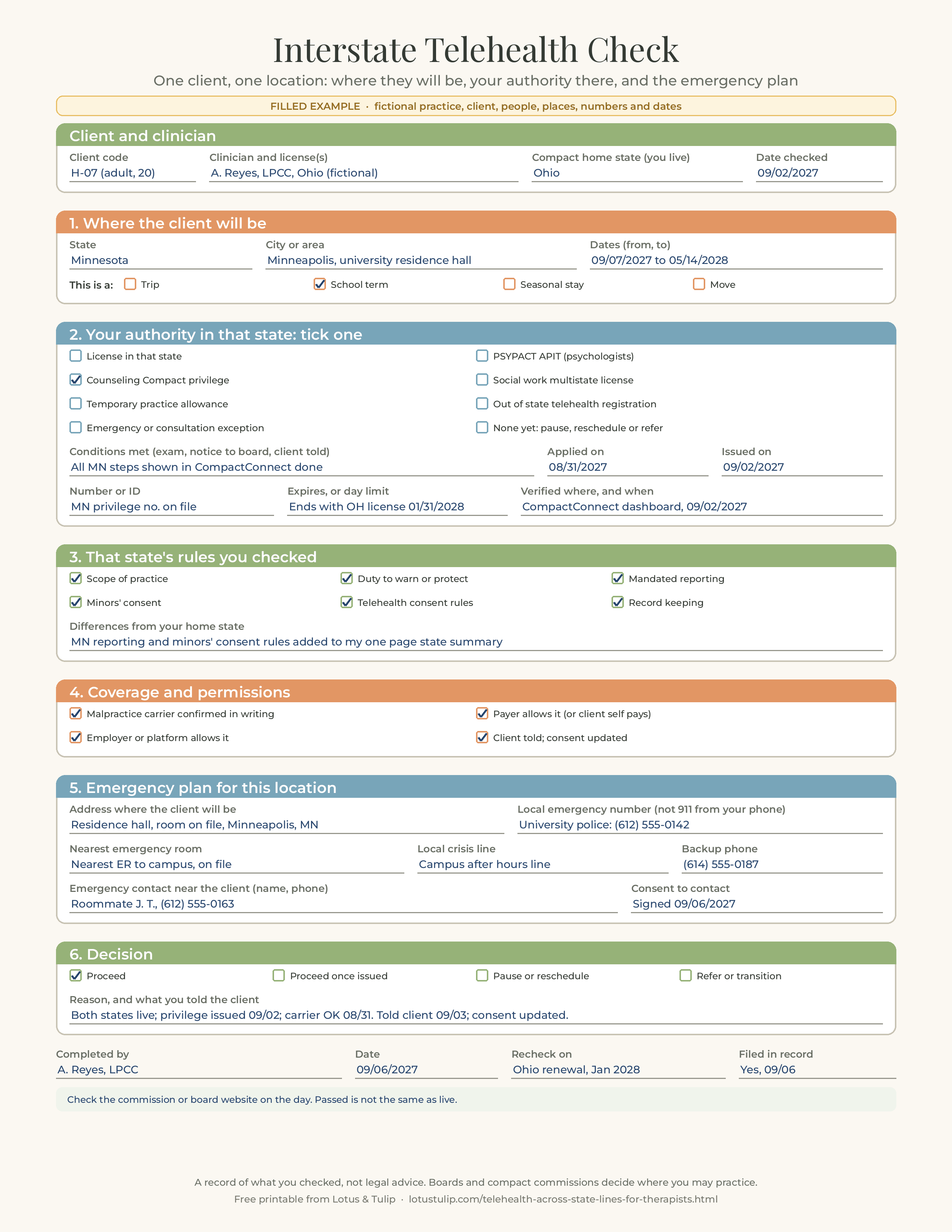
Everything in this example is invented: the practice, the clinician, the clients, the dates and the numbers. It matches page 2 of the free printable. It assumes the compact status and state rules described above as of November 2026; your situation, and those rules, may differ.
The practice. Harbor Pine Counseling, PLLC is a solo practice in Columbus, Ohio. A. Reyes is an LPCC licensed in Ohio, lives in Ohio and works from the Columbus office. Ohio is a live Counseling Compact state, so Ohio is A. Reyes's compact home state. In late August, four clients raise out of state plans in the same week.
Client H-07: a college student moving to Minnesota. H-07, 20, is starting a two semester program at a university in Minneapolis and wants to keep weekly video sessions. Minnesota is a live Counseling Compact state. A. Reyes confirms on counselingcompact.gov that Ohio LPCCs who live in Ohio can apply for a Minnesota privilege, applies through CompactConnect herself, completes the requirements shown for Minnesota, pays the fees and sees the privilege number appear on her dashboard on September 2. Because her Ohio license renews next year, she notes that the privilege will expire with the current Ohio license and must be renewed in CompactConnect after the Ohio renewal is reported. Her malpractice carrier confirms by email that services under a compact privilege to clients located in Minnesota are covered. H-07 pays out of network, so A. Reyes gives an updated Good Faith Estimate. She checks Minnesota's rules on mandated reporting and duty to warn or protect, adds them to her one page state summary, updates H-07's telehealth consent and builds an emergency plan for the residence hall: the hall address, the university police non-emergency number, the nearest emergency room, the campus counseling center's after hours line, a backup phone number and a roommate as a local emergency contact, with written consent. This is the client on page 2 of the printable.
Client H-12: three weeks in California. H-12, an established client, will be caring for a parent in Sacramento for three weeks in October. California is not in the Counseling Compact. A. Reyes checks the Board of Behavioral Sciences temporary practice allowance: she holds an independent clinical counseling license in another state, has never held a California license, and H-12 is a current client with an ongoing relationship. She applies through Breeze with a start date of October 5, tells H-12 in writing that she is not licensed in California, that services there are for a limited time, gives the board's website and her Ohio license type and number, and waits for the board's email confirming the dates. She notes that this uses her one allowance for the calendar year.
Client H-03: a winter in Florida. H-03 spends January to March in Florida every year. Florida has passed the Counseling Compact but is not yet live, so there is no compact route this winter. A. Reyes reads section 456.47 and decides to apply for Florida's out of state telehealth provider registration, which requires a registered agent in Florida and liability coverage that includes telehealth to patients outside her home state. Her carrier confirms the coverage. She tells H-03 that sessions while in Florida will start only once her registration appears on the Florida Department of Health's list, and they plan two sessions in late December and an in person session in April in case it is not ready.
Client H-15: a week in New York. H-15 will be in New York City for a week for work. New York is not in the Counseling Compact or PSYPACT and A. Reyes has found no provision she can use, so they agree to skip that week's session and meet the day after H-15 returns. A. Reyes gives H-15 the 988 Lifeline, the nearest emergency room to the hotel and a reminder of the safety plan steps they built, and documents the decision.
The record. For each client, A. Reyes completes an interstate telehealth check (page 1 of the printable), files it with the client's record, and adds a line to her session location log (page 3) at every telehealth session. What makes this defensible is not that every request was granted. It is that each decision was based on the client's actual location, checked against current official sources, confirmed with the carrier, explained to the client and written down.
Six short scenarios
1. "I'm just at my sister's for the weekend." A client mentions at the start of a session that she is in another state. You are not authorized there. Pause before you start: confirm where she is, explain the rule briefly, check that she is safe, offer to reschedule for when she is home, give local crisis resources and document the conversation. If she is in crisis right now, treat it as an emergency and get her help where she is; the emergency exceptions in some states, such as Florida's and Arizona's registration statutes, exist for exactly that situation, and your first duty is safety.
2. A psychologist working from a summer house. A psychologist licensed in Virginia, with an APIT and Virginia declared as home state, spends July at a family house in Maine and plans to keep seeing Virginia clients by video. PSYPACT's FAQ says APIT holders must be "physically located in the PSYPACT participating state they have declared as their Home State" when providing telepsychology. Maine is a PSYPACT state, but declaring it as home state requires a Maine license, because the home state must be a compact state where the psychologist is licensed. Seeing Virginia clients from Maine under the APIT is therefore not authorized, and whether it is allowed at all under Virginia's and Maine's own rules is a question for both boards. Ask them before you go.
3. A counselor whose home state is not live yet. An LPC licensed and living in a member state that has passed the Counseling Compact but is not yet live wants to see a client in Ohio. The compact cannot be used until the counselor's home state goes live, even though Ohio is live. The options are an Ohio license or a pause.
4. A social worker with a client moving across the river. An LCSW's client is moving to the neighboring state. Both states have enacted the Social Work Licensure Compact, but no multistate licenses are being issued yet. The LCSW can apply for a license in the new state, check whether it has a temporary or telehealth provision for social workers, or plan a transition to a local clinician.
5. An MFT and a California vacation. An LMFT licensed in Texas has a couple who will spend two weeks in California. There is no MFT compact, but the California BBS temporary practice allowance covers out of state MFTs licensed at the highest independent level, for existing clients, for 30 consecutive days once per calendar year, with notice to the board and disclosures to the clients.
6. A client abroad. A long term client is posted overseas for six months. No US license or compact covers a client outside the US. Ask your board and your carrier, check whether the other country regulates who may provide therapy there, decide whether you can continue, and if you do, build the emergency plan around local services in that country and record the client's consent to the limits.
Common mistakes
- Going by where the client lives. Licensing follows where the client is during the session.
- Treating "passed the compact" as "can use the compact." Check that both states are operating on the commission's website.
- Not asking where the client is. Make it the first line of every telehealth session and every note.
- Forgetting your own location. PSYPACT's telepsychology authority depends on being in your declared home state, and compacts depend on where you live.
- Using a compact privilege that has expired. Counseling Compact privileges expire with the home license as it stood when issued and must be renewed separately.
- Counting on a temporary allowance you have already used. California's is once per calendar year, 30 consecutive days, with fixed dates.
- Assuming your malpractice policy follows you. Ask in writing, including about board complaints in the other state.
- Calling 911 from your own phone and expecting it to reach the client's area. Keep the client's address and a local emergency number.
- Applying your home state's rules to everything. Duty to warn, mandated reporting and minors' consent may follow the client's state.
- Advertising states you cannot practice in. List only current authorizations, and say what they are.
Free printable: interstate telehealth checklist, filled example and location log
The free printable has three US Letter pages. Page 1 is a blank interstate telehealth check for one client and one location: client code, clinician and license, your compact home state (where you live), the date checked; where the client will be (state, city, dates, why, and whether this is a trip, a term, a seasonal stay or a move); your authority there, with tick boxes for a license in that state, a PSYPACT APIT, a Counseling Compact privilege, a social work multistate license (once available), a temporary practice allowance, an out of state telehealth registration, an emergency or consultation exception, or none yet, plus the number, expiration or day limit and where and when you verified it; the client's state rules you checked (scope of practice, duty to warn or protect, mandated reporting, minors' consent, telehealth consent, record keeping); coverage and permissions (malpractice carrier, payer, employer or platform, client told and consent updated); an emergency plan for that location (address, local emergency number, nearest emergency room, local crisis line, backup phone, emergency contact); and the decision with a sign off line. Page 2 is the same check filled in for the fictional Harbor Pine Counseling client H-07, a college student in Minnesota seen under a Counseling Compact privilege. Page 3 is a ten point checklist for the start of every telehealth session and a twelve row session location log with columns for date, client code, client location, your location, the authority used and whether emergency details were confirmed.
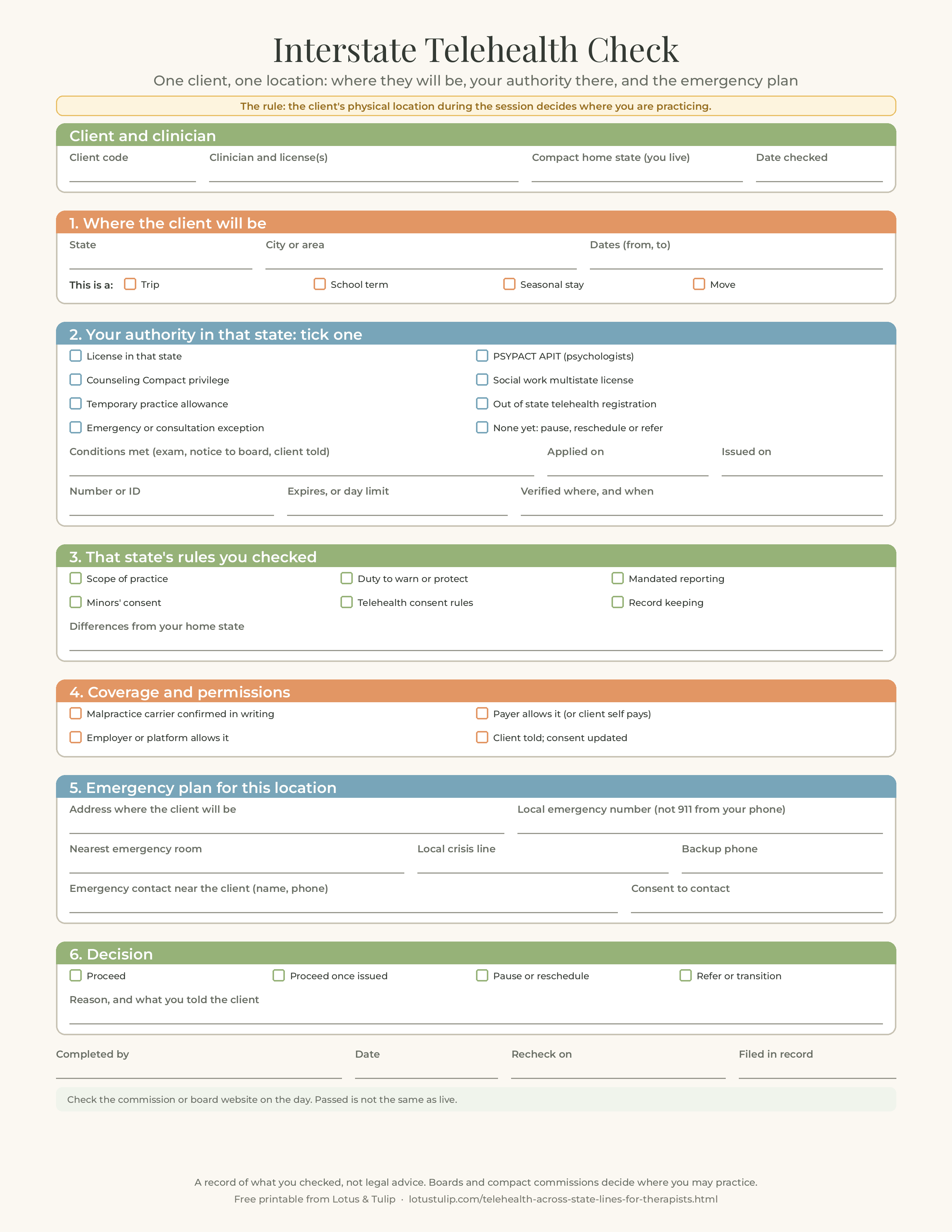
Download the free interstate telehealth checklist (PDF, 3 pages)
Rather type than handwrite? The free PDF above is for printing. Therapy Progress Notes and Intake Templates comes as a fillable PDF you type straight into (604 fields in Adobe Acrobat Reader), plus the printable version: SOAP, DAP and BIRP notes, intake, treatment plan and safety plan, 20 pages. Holiday 20% off: about $7.36, was $9 (EUR 8) · instant digital download
Buy on EtsyPrefer single images? Page 1: blank interstate check (PNG) · Page 2: filled fictional example (PNG) · Page 3: session checklist and location log (PNG)
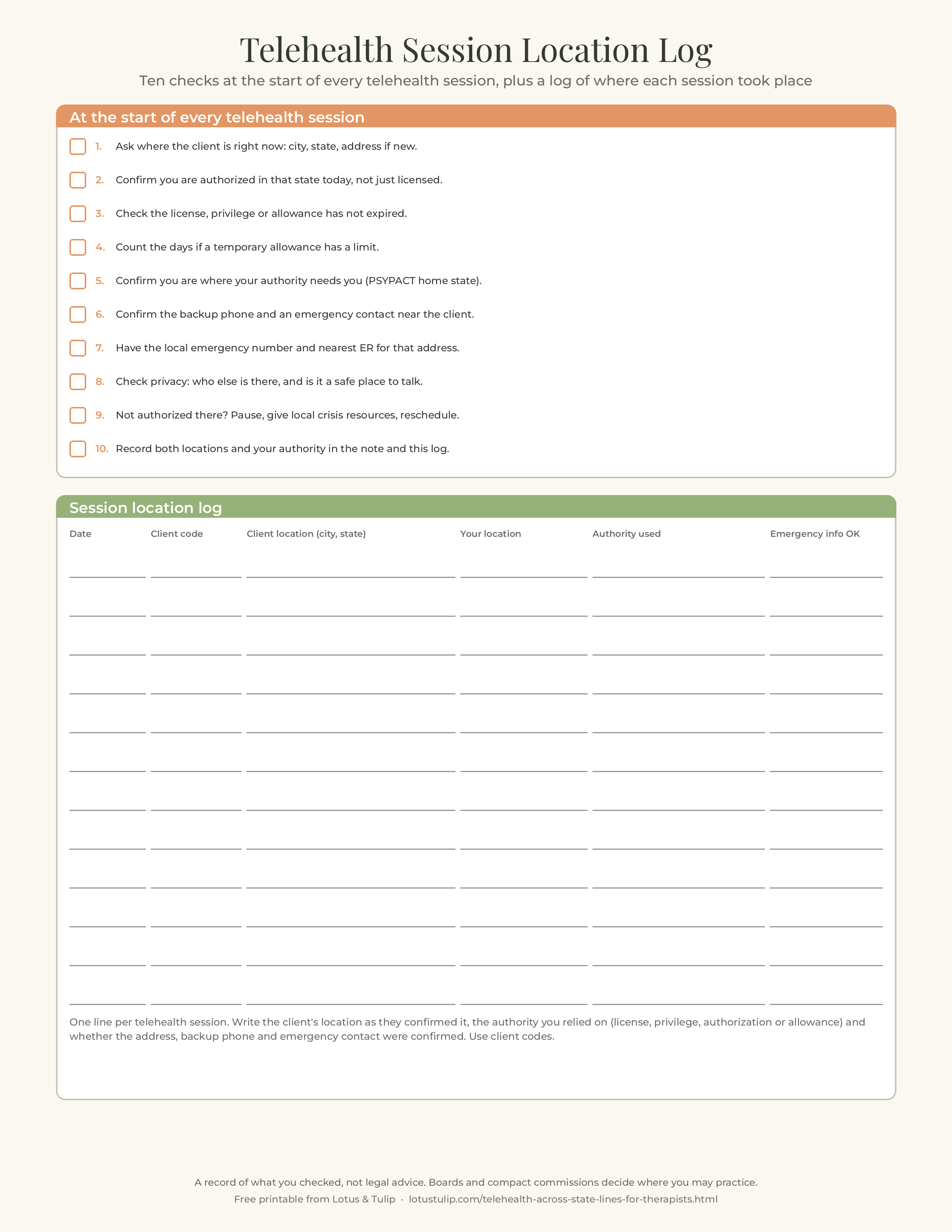
Free to print and use in your own practice. Please link to this page rather than re-uploading the file. This checklist organizes what you checked; it does not tell you whether you may practice in any state and it is not legal advice. Licensing boards and compact commissions decide that, and their rules change. File completed checks with your practice or client records, and use client codes on the log.
Related resources
- Family therapy informed consent form: who the client is, secrets policy, minors and custody, records and court, with a free printable
- HIPAA breach notification for therapists: the four factor risk assessment, 60 day deadlines and a free incident log
- Clinical supervision agreement for therapists: template, board rules and a supervision log
- Telehealth progress note template and examples
- Informed consent for therapy template
- Duty to warn for therapists, by state
- Safety plan worksheet, free printable
- HIPAA risk assessment for therapists
- Business associate agreements for therapists
- Notice of privacy practices for therapists
- Parental consent form for therapy of a minor
- Therapy termination letter template
- Closing a therapy private practice
Sources: Psychology Interjurisdictional Compact (PSYPACT), FAQ, Application FAQs and map (psypact.gov), and the compact text as enacted in Kansas, K.S.A. 74-5352 (Articles II to VII); Louisiana State Board of Examiners of Psychologists, PSYPACT implementation notice, and Louisiana HB 486 of 2026 (Act 302); Alaska HB 110 of 2026 (Chapter 28, SLA 2026); Counseling Compact Commission, home page, member map and FAQ for counselors (counselingcompact.gov), checked November 10, 2026; Social Work Licensure Compact, home page and FAQ, "Social Work Compact Enacted in 35 States" (July 2026) and data system announcement (May 21, 2026) (swcompact.org); AAMFT, "Understanding Licensure Portability" (Access MFTs); California Board of Behavioral Sciences, Temporary Practice Allowance for Out-of-State Licensees (bbs.ca.gov); Florida Statutes section 456.47 (2026 Florida Statutes, Florida Senate); Arizona Revised Statutes section 36-3606 (Arizona Legislature); Federal Communications Commission, 988 Suicide and Crisis Lifeline page (georouting for 988 calls and texts); American Counseling Association, 2014 ACA Code of Ethics, standards H.1.b, H.2.a and H.3; National Association of Social Workers, Code of Ethics, standard 1.04(d) and (e).
FAQ
Can a therapist see a client in another state by telehealth?
Only if the therapist is authorized to practice in the state where the client is physically located during the session. That can be a license in that state, a compact privilege or authorization that is operating in both states (PSYPACT for psychologists, the Counseling Compact for professional counselors), or a temporary practice or telehealth registration provision in that state, such as California's 30 day allowance for existing clients or Florida's and Arizona's out of state telehealth registrations. Otherwise the session should be paused, rescheduled or referred.
Does the client's location or residence determine which state's law applies?
For licensure, the client's physical location at the time of the session. PSYPACT defines the receiving state as where the client "is physically located when the telepsychological services are delivered," the Counseling Compact says counselors "must have a license or a privilege to practice in the state where the client is located," and Florida's statute deems the service to occur "at the place where the patient is located." Your own state's rules still apply to your license, so both can matter.
Which states are in PSYPACT in 2026?
PSYPACT's official map is the authoritative list. As of early November 2026 it is in effect in 42 states, the District of Columbia and the Northern Mariana Islands. Iowa (effective July 1, 2027) and Louisiana (effective January 1, 2028) have enacted it but it cannot be used there yet. California, Hawaii, Massachusetts, New Mexico, New York and Oregon have not enacted it. Psychologists use it through an APIT, which requires an ASPPB E.Passport, and must be physically in their declared home state when providing telepsychology.
Is the Counseling Compact live yet?
Partly. As of November 2026 the Counseling Compact Commission lists it as live in 11 states: Arizona, Arkansas, Georgia, Indiana, Louisiana, Minnesota, Missouri, Ohio, Oklahoma, Tennessee and Wyoming. Counselors licensed for independent practice who live in one of those states can apply through CompactConnect for a privilege to practice in the others, paying a $30 administrative fee plus each state's fee. Other member states and the District of Columbia are still completing implementation and cannot issue or accept privileges yet.
Can social workers or MFTs use a compact to practice across state lines?
Not yet for social workers: the Social Work Licensure Compact has been enacted in 35 states but, as of November 2026, multistate licenses are not being issued, and the commission expects its data system to be completed in spring 2027. Marriage and family therapists have no compact; AAMFT is pursuing state portability laws (Access MFTs) for faster licensure by endorsement instead. Both can use any temporary practice provision that covers their license, such as California's allowance.
What should a therapist do in an emergency with a client in another state?
Use the client's location, not yours. Confirm the client's address at the start of every telehealth session, keep a local emergency number and the nearest emergency room for that address, have a backup phone number and an emergency contact near the client, and give the client 988 as well as local crisis resources. Calling 911 from your own phone reaches your local dispatch center, which may have to transfer the call. Document everything you did.