
Therapist practice · Updated 2026-11-09
Informed Consent for Therapy Template: What to Include, with an Example (Free Printable)
Ready-made printable: Therapy Progress Notes and Intake Templates Fillable PDF: includes an informed consent outline to adapt, plus intake, notes and safety plan pages (20 pages)
Holiday 20% off: about $7.36, was $9 (EUR 8) · instant digital download
Try it free first: download a fillable sample (SOAP note and DAP note, PDF, 226 KB). Type into it on screen, then get the full pack. No email needed.

An informed consent for therapy is the first document a new client signs and often the last one a clinician thinks about. It gets copied from a former employer, patched with a new fee, and left alone for years. Then a client asks why their insurer knows their diagnosis, a parent asks to read their teenager's notes, a self pay client disputes a bill, or a session drops in the middle of a crisis, and the consent form turns out to say nothing useful about any of it.
This guide is for counselors, therapists, clinical social workers, marriage and family therapists, psychologists and associates or trainees in the US. It explains what informed consent for therapy is and what the APA, ACA and NASW codes actually require, how the consent differs from the HIPAA Notice of Privacy Practices, the No Surprises Act Good Faith Estimate, a telehealth consent and a release of information, each section of a consent form in plain language, the limits of confidentiality (mandated reporting, harm to self, duty to warn or protect, court orders), fees and cancellations, minors, couples and groups, ending therapy, a step by step process, a full fictional sample consent, six short examples, how to document the consent conversation, words to watch and common mistakes. At the end you can download a free three page printable: a blank informed consent outline, a filled fictional example, and a before you sign checklist with a list of the separate documents that usually go with it.
Jump to the free informed consent for therapy template
This is educational information for licensed clinicians and trainees. It is not legal, ethical, billing or compliance advice, and it does not create any professional relationship. Consent requirements differ by state, license, setting and payer, and they change. Have an attorney who knows mental health law in your state, your professional association's risk management service or your malpractice carrier review your final consent documents. Every client, clinician and practice on this page is fictional.
What informed consent for therapy is
Informed consent is the client's agreement to start therapy after they have been told, in words they can understand, what they are agreeing to. The signed form is evidence of that agreement; it is not the agreement itself. All three of the major US ethics codes for psychotherapists describe consent as something you explain and discuss, not only something you collect:
- The ACA Code of Ethics (2014), standard A.2.a, says counselors "have an obligation to review in writing and verbally with clients the rights and responsibilities of both counselors and clients," and that "informed consent is an ongoing part of the counseling process."
- The APA Ethics Code, standard 10.01(a), says psychologists inform clients "as early as is feasible in the therapeutic relationship about the nature and anticipated course of therapy, fees, involvement of third parties, and limits of confidentiality and provide sufficient opportunity for the client/patient to ask questions and receive answers."
- The NASW Code of Ethics, standard 1.03, asks social workers to use clear and understandable language to inform clients of the purpose of the services, risks related to the services, limits to services because of the requirements of a third party payer, relevant costs, reasonable alternatives, the client's right to refuse or withdraw consent, and the time frame covered by the consent.
State law and licensing board rules sit on top of the ethics codes. Many boards require specific disclosures in writing (often called a professional disclosure statement or client bill of rights), and some prescribe the exact wording for parts of it. That is why no single template can be "compliant" everywhere, and why this page keeps pointing you back to your own board.
Put simply, a good informed consent answers the questions a thoughtful new client would ask if they knew to ask them: who are you, what will we actually do, what could go wrong, what does it cost, who else will know, what happens in an emergency, and how do I stop?
What the ethics codes ask you to cover
| Code | Standard | What it asks you to tell clients |
|---|---|---|
| ACA (counselors) | A.2.b Types of information needed | The purposes, goals, techniques, procedures, limitations, potential risks and benefits of services; your qualifications, credentials, relevant experience and approach; continuation of services if you are incapacitated or die; the role of technology; the implications of diagnosis and the intended use of tests and reports; fees and billing, including procedures for nonpayment; confidentiality and its limits (including how supervisors and treatment teams are involved); information about records; the right to participate in ongoing counseling plans; and the right to refuse any services or modality changes and be told the consequences. |
| ACA | A.2.c, A.2.d, A.2.e | Developmentally and culturally appropriate explanations (with an interpreter if needed); assent from minors and others who cannot give consent; for mandated clients, the required limits of confidentiality and what is shared with whom, before counseling begins. |
| APA (psychologists) | 10.01, 3.10, 4.02, 6.04 | Nature and anticipated course of therapy, fees, involvement of third parties, limits of confidentiality, time for questions (10.01a); for treatments without established techniques, their developing nature, risks, alternatives and the voluntary nature of participation (10.01b); if you are a trainee, that you are in training and supervised, with the supervisor's name (10.01c); consent documented (3.10d); limits of confidentiality at the outset (4.02); fees and billing agreed as early as feasible (6.04). |
| APA | 10.02, 10.03, 3.10(b), 3.10(c) | For couples and families, who the client is and your relationship with each person; for groups, roles, responsibilities and limits of confidentiality; for people who cannot legally consent, an explanation, their assent and permission from a legally authorized person; for court ordered services, that they are mandated and any limits of confidentiality. |
| NASW (social workers) | 1.03 | Purpose of services, risks, limits because of third party payer requirements, relevant costs, reasonable alternatives, the right to refuse or withdraw consent, the time frame the consent covers, and an opportunity to ask questions; the code also addresses consent for services delivered by technology. |
Marriage and family therapists have a parallel informed consent standard in the AAMFT Code of Ethics. If you hold more than one license, write to the strictest of the codes and rules that apply to you.
Informed consent vs Notice of Privacy Practices vs Good Faith Estimate
New practice owners often try to make one document do everything. In the US it usually takes several, because each comes from a different source and has its own rules:
| Document | Where the requirement comes from | What it does |
|---|---|---|
| Informed consent for therapy | Ethics codes, state law and board rules | Explains the service, risks and benefits, fees, confidentiality and its limits, and the client's rights; the client agrees to start. |
| HIPAA Notice of Privacy Practices (NPP) | 45 CFR 164.520, for HIPAA covered providers | Explains how you may use and disclose protected health information and the client's privacy rights. A covered provider with a direct treatment relationship must give it no later than the first service delivery (including electronic), make a good faith effort to get a written acknowledgment of receipt, and post it at the office and on the practice website. |
| Good Faith Estimate (GFE) | No Surprises Act, 45 CFR 149.610 | A written estimate of expected charges for clients who are uninsured or not using insurance. Details in the section below. |
| Practice or financial policies | Your own business rules (state consumer law may apply) | Fees, payment methods, cancellations, late fees, card on file, collections, records request fees. Often folded into the consent. |
| Telehealth consent | Ethics codes, state law, some payers | Risks and logistics of video or phone sessions: location, privacy, technology failure, emergency plan. See the telehealth progress note guide for what to document each session. |
| Release of information (authorization) | HIPAA (45 CFR 164.508), state law, 42 CFR Part 2 where it applies | The client's written permission to share specific information with a specific person for a specific purpose. Signed when needed, not as a blanket form at intake. |
You can hand these over in one intake packet, and many practices do, but keep them as separate, clearly titled documents. A consent that quietly includes the NPP, a waiver of rights and a collections agreement is harder to understand and easier to challenge. Your consent can refer to the NPP ("You will also receive my Notice of Privacy Practices, which explains your privacy rights in more detail"), and the acknowledgment line on the signature page can note that the client received it.
One update to know about: HHS says that as of February 16, 2026, HIPAA covered entities are required to include information about substance use disorder records protected by 42 CFR Part 2 in their Notice of Privacy Practices. If you adopted an NPP template years ago, check it against the current HHS model notices. For the full list of required elements, the Part 2 statement and a filled example, see the notice of privacy practices for therapists guide.
Informed consent sections at a glance
| Section | What to write | Why it matters |
|---|---|---|
| About me | Name, license type, number and state, training status and supervisor if applicable, approach | Clients have a right to know who they are seeing and how to verify the license |
| About therapy | What sessions involve, likely course, benefits, risks, alternatives, no guarantee | The heart of "informed"; ACA A.2.b and NASW 1.03 both ask for risks and alternatives |
| Sessions and scheduling | Length, frequency, how to book and cancel, lateness | Prevents the most common disputes |
| Fees and payment | Fee per service, other charges, payment timing, insurance, nonpayment | APA 6.04 and ACA A.2.b ask for billing arrangements, including nonpayment |
| Good Faith Estimate | Right to a GFE for uninsured or self pay clients | Federal requirement for many providers |
| Confidentiality and its limits | What stays private, the legal exceptions, supervision and consultation, insurance | The section clients remember and challenge most |
| Contact and technology | How to reach you, reply times, email and text risks, social media | ACA A.2.b names the role of technology |
| Telehealth | Pointer to a separate telehealth consent, or a short section | Location, privacy and emergency plans differ online |
| Emergencies | You are not an emergency service; 988, 911, local options | Safety and clear expectations |
| Records | What you keep, how, how long, how to request access | Client rights and your retention duties |
| Minors, couples, families, groups | Who consents, who the client is, what is shared | Confidentiality works differently with more than one person |
| Ending therapy and continuity | How therapy ends, inactivity, referrals, what happens if you cannot continue | APA 10.10 and ACA A.2.b continuity of services |
| Rights and concerns | Right to ask, refuse, withdraw; how to raise concerns; licensing board contact | Respect for autonomy and a path for complaints |
| Signatures | Client (and guardian), clinician, dates, acknowledgments | Documents that the discussion happened |
Each section in detail
1. About me: credentials, training and approach
State your full name, license type (LPC, LCSW, LMFT, psychologist, and so on), license number and the state or states where you are licensed. Tell clients they can verify the license with the board. If you are pre licensed (an associate, resident, intern or trainee), say so clearly, name your supervisor and explain what the supervisor will see. APA 10.01(c) specifically requires trainees to tell clients they are in training and supervised and to give the supervisor's name, and many boards require the same of associates in other professions.
Add two or three plain sentences about your approach: "I mostly use cognitive behavioral therapy and acceptance and commitment therapy. Sessions are a mix of talking through what is happening and practicing skills, with some practice between sessions." Avoid a paragraph of acronyms. A client cannot consent to something they do not understand.
2. About therapy: benefits, risks and alternatives
This is the part most templates skip, and it is the part the ethics codes name directly. Cover:
- What happens: the first few sessions are for assessment and goal setting; you will make a plan together; you will review progress regularly.
- Likely benefits: many people find therapy helps with the concerns they bring, but results differ and cannot be guaranteed.
- Risks: talking about painful experiences can bring up uncomfortable feelings for a while; changes in one area of life can affect relationships; for some approaches, symptoms may feel worse before they improve (for example during exposure work).
- Alternatives: other therapists or approaches, group therapy, medication evaluation, peer support, primary care, or no treatment.
- Newer or less established methods: if you offer something without generally recognized techniques and procedures, APA 10.01(b) asks you to explain its developing nature, the potential risks, alternatives and that participation is voluntary.
3. Sessions and scheduling
Session length (for example 53 minutes), usual frequency, how to book and change appointments, what happens if a client is late (the session usually still ends on time), and how you handle your own vacations and cancellations. If the first one to three sessions are an assessment period after which either of you may decide the fit is not right, say so here.
4. Fees, payment and insurance
- Your fee for each type of service you offer: intake assessment, individual session, couples session, group, phone consultations above a set length, letters and reports, records copies where your state allows a fee, and court related work (deposition, testimony, record review) if you would ever do it.
- When payment is due and how (card on file, cash, health savings card). If you keep a card on file, use a separate, specific credit card authorization form.
- Cancellation and no show policy (see the therapy cancellation policy template): notice required (often 24 or 48 hours), what is charged, and any exceptions such as illness or emergencies. Insurers generally do not pay for missed sessions, so the client would owe the fee, and some insurance contracts and public programs limit or bar charging members for missed appointments; check your contracts.
- Insurance: whether you are in network, that the client is responsible for deductibles, copays and denied claims, and (important for confidentiality) that billing insurance means sharing a diagnosis and service dates and possibly records for audits or reviews.
- Sliding scale or reduced fees, if offered, and how they are reviewed (see the sliding scale fee policy for therapists).
- Nonpayment: what happens to an unpaid balance. APA 6.04(e) says that before using a collection agency or legal measures, psychologists first tell the person that such measures will be taken and give them an opportunity to make prompt payment. Say that in the consent and you have done half the work already.
- Fee changes: how much notice you will give.
5. Good Faith Estimate notice
If you see clients who are uninsured or who choose not to use insurance, include a short notice of their right to a Good Faith Estimate and give the estimate itself as a separate written document. CMS publishes standard notice wording; use the current version. The rules are explained in their own section below.
6. Confidentiality and its limits
Start with the rule, then the exceptions, in plain words: "What you say in therapy is confidential, which means I do not share it without your written permission. There are some exceptions where the law requires or allows me to share information." Then list the exceptions that apply where you practice. The section below on limits of confidentiality covers each one. Also explain the ordinary, non emergency situations where information moves:
- Consultation and supervision (APA 4.06 and ACA A.2.b both expect you to explain how supervisors or teams are involved).
- Insurance billing and audits.
- Your business associates, such as an EHR company, billing service or answering service, who are bound by HIPAA business associate agreements.
- Collection of unpaid fees, limited to the minimum information necessary.
- Releases the client signs for specific people.
7. Contact between sessions and technology
How clients can reach you, how quickly you usually reply, and what you will and will not do between sessions ("I use text only for scheduling. Please do not text about safety concerns; I may not see a message for hours."). Explain the privacy risks of email and text and ask for the client's preference. Add your social media policy: many therapists do not accept friend or follow requests from clients and do not respond to reviews, to protect confidentiality. ACA A.2.b names the role of technology as part of what clients need to know, and APA 4.02(c) asks psychologists who use electronic transmission to tell clients about the risks to privacy and limits of confidentiality.
8. Telehealth
If you offer video or phone sessions, either add a short telehealth section or, better, use a separate telehealth consent: platform, the client's location at each session (licensure usually follows the client's physical location), privacy at both ends, what happens if the connection drops, the emergency plan and an emergency contact, and recording (neither party records without written agreement). The telehealth progress note template covers what to document in each video or phone session.
9. Emergencies
Say clearly that you do not provide emergency or crisis services and are not available around the clock, then say what to do instead: "If you are in crisis or thinking about suicide, call or text 988 (the 988 Suicide and Crisis Lifeline) or chat at 988lifeline.org. In an emergency, call 911 or go to the nearest emergency room." Add any local mobile crisis team, and the plan if you are away (a covering clinician, an on call number, or neither). Keep this consistent with the safety plans you make with clients; the safety plan worksheet is a free printable.
10. Records
Explain what records you keep (assessment, treatment plan, progress notes, billing), how they are stored (an EHR, locked files), how long you keep them and how the client can request a copy or ask for a correction. HHS explains that the HIPAA Privacy Rule does not set a retention period for medical records; state laws generally do, often with longer periods for minors. If you keep separate psychotherapy notes as HIPAA defines them (45 CFR 164.501), you can mention that they are kept apart from the record and have extra protection, but you do not need a lecture on it.
11. Minors, couples, families and groups
Each of these changes who consents and who has a right to information. Cover them only if you offer the service, and use a separate addendum if the section would get long. The section below on minors, couples, families and groups has details.
12. Ending therapy and continuity of care
Explain that the client may end therapy at any time, that you will usually plan the ending together, and when you might end or refer (if therapy is no longer helping, the client needs a different level of care, or there is a conflict of interest). APA 10.10 says psychologists terminate therapy when it is reasonably clear the client no longer needs it, is not likely to benefit or is being harmed, and that before termination they provide pretermination counseling and suggest other providers as appropriate, except where the client's or a payer's actions prevent it. Many practices add an inactivity rule: "If we have not met or been in contact for 60 days, I will consider our work ended and send you a letter. You are welcome to contact me to restart." For the letter itself, see our therapy termination letter template with sample letters.
ACA A.2.b also asks counselors to tell clients about continuation of services if the counselor is incapacitated or dies. A sentence such as "If I become unable to practice suddenly, a colleague I have named will contact you to help with records and referrals" is enough, and it requires you to actually have a professional will. The therapy discharge summary template covers documenting the end of treatment.
13. Rights, concerns and complaints
List the client's rights in a short, warm paragraph: to ask questions at any time, to take part in planning, to refuse a particular technique, to see their records within the law, to a second opinion or referral, and to end therapy. Invite concerns directly ("Please tell me if something is not working for you"), then give the name and contact details of your licensing board. Many states require the board contact in writing.
14. Signatures and acknowledgments
End with a short statement the client signs: they have read the consent, had the chance to ask questions, and agree to begin. Add separate checkboxes for receipt of the NPP and, for self pay clients, the Good Faith Estimate, so each acknowledgment is clear. Include the client's printed name, signature and date; a parent or guardian line where needed; and your signature and credentials. Electronic signatures through your EHR are common; check that your system records the date and the version of the document signed.
Limits of confidentiality: what to say and why
This is the section to get right. Clients often sign without reading it and only find out what it means at the worst possible moment. Write each exception as one plain sentence, then explain it out loud in the first session.
Suspected abuse or neglect of a child
Every US state requires certain people to report suspected child abuse or neglect. The federal Child Welfare Information Gateway's summary of state laws (current through May 2023) found that approximately 46 states, the District of Columbia and several territories list professions that are mandated reporters, while four states require all persons to report instead of listing professions. Counselors, therapists and other mental health professionals are specifically named in most states, and where they are not named, a universal reporting duty or another category usually covers them. Check your state's statute for who must report, what triggers a report ("reasonable suspicion" or "reasonable cause to believe" are common), timelines and where to report.
Suspected abuse of an older or dependent adult
States also have adult protective services laws, but the details vary more: who must report, which adults are covered (often older adults and adults with disabilities) and whether self neglect or financial exploitation is included. Name the duty in general terms in your consent and know your state's specifics.
Serious risk of harm to self
Most consents say the therapist may share information, for example with family, emergency services or a hospital, if they believe the client is at serious and imminent risk of harming themselves. HIPAA permits disclosures to prevent or lessen a serious and imminent threat to the health or safety of a person or the public, consistent with other law and ethical standards. State law shapes what you may do.
Threats to others: duty to warn or protect
The idea comes from Tarasoff v. Regents of the University of California, the 1976 California Supreme Court decision holding that when a therapist determines, or reasonably should determine, that a patient presents a serious danger of violence to another person, the therapist has a duty to use reasonable care to protect the intended victim. States have since gone in different directions. The National Conference of State Legislatures keeps a state by state table of mental health professionals' duty to warn, and it shows the differences clearly: many states make the duty mandatory when a client communicates a serious threat of physical violence against a clearly identified or reasonably identifiable victim; many others make disclosure permissive (you may, but are not required to, warn); and a few have no such statute. States also differ on how the duty is discharged (warning the victim, notifying police, starting a hospitalization) and on which professions it covers.
So do not write "I must warn anyone you threaten" unless that is the law where you practice. Something like "If you tell me you intend to seriously harm a specific person, I may be required or permitted by law to take steps to protect them, such as warning them or contacting law enforcement" is accurate in more places, but have it checked for your state.
Court orders and legal proceedings
Explain that a court order can require you to release records or testify, and that you will tell the client and, where appropriate, assert privilege on their behalf. A subpoena from an attorney is not the same as a court order; in many states you should not release records on an attorney's subpoena alone without the client's authorization or a court order. If you do any custody, disability or forensic work, that needs its own consent.
Mandated or court referred clients
If a court, probation officer, employer or school requires the client to attend, say before you begin what you will report, to whom and how often (for example attendance only, or attendance and participation). ACA A.2.e and APA 3.10(c) both ask for this before services start, and the client can choose to refuse.
Other common limits
- Insurance and payers: diagnosis, dates and sometimes records for authorization or audits.
- Health oversight: licensing board investigations and certain government audits.
- Client initiated complaints or lawsuits: you may use records to defend yourself.
- Substance use disorder records: if you are, or receive records from, a federally assisted program covered by 42 CFR Part 2, those records have extra federal protections.
State law caveat. Reporting duties, duty to warn or protect rules, privilege, minors' rights and records rules are set by each state, and many have exceptions not listed here. The wording on this page is a general starting point as of November 2026, not legal advice for any state. Use your state's statutes, your board's rules and a qualified attorney or your association's risk management service to finalize your consent.
No Surprises Act: the Good Faith Estimate for self pay clients
Since January 1, 2022, the No Surprises Act has required health care providers, including mental health providers, to give a Good Faith Estimate of expected charges to clients who do not have coverage or are not using it (called uninsured or self pay individuals). The HHS rule is at 45 CFR 149.610, and CMS publishes plain language guidance, a decision tree and a standard GFE template. Key points as of November 2026:
- Tell clients it exists. Information about the availability of a GFE must be written in clear language and prominently displayed on your website (and easily searchable), in your office and wherever scheduling or cost questions happen, and provided orally when a client schedules or asks about costs.
- Treat cost questions as a request. The rule says any discussion or inquiry about the potential costs of services counts as a request for a GFE.
- Timelines. If a service is scheduled at least 3 business days ahead, the GFE is due no later than 1 business day after scheduling; if scheduled at least 10 business days ahead, no later than 3 business days after scheduling; if a client simply asks, no later than 3 business days after the request. A GFE is not required when the service is scheduled fewer than 3 business days ahead.
- In writing. On paper or electronically, as the client prefers, in a form they can save and print. You can explain it by phone, but you still have to provide it in writing.
- Recurring services. For ongoing therapy you can issue a single GFE that states the expected scope (timeframe, frequency and total number of sessions), covering no more than 12 months. Issue a new one if the scope changes or therapy continues beyond that.
- Contents. Among other items, the client's name and date of birth, a description of the service, itemized expected charges with service codes and diagnosis codes where applicable, your name, NPI and Tax ID, and the required disclaimers, including the client's right to dispute the bill.
- Disputes. If the bill is at least $400 more than your GFE, the client may be able to use the patient provider dispute resolution process; CMS says the client must start it within 120 calendar days of the initial bill.
- Keep copies. The GFE is part of the client's record, and you must provide a copy of any GFE issued in the last 6 years if the client asks.
In the informed consent itself, a short paragraph is enough: "If you are not using insurance, you have the right to receive a Good Faith Estimate of your expected charges. You will receive one in writing before your first session and whenever the estimate changes." Then give the actual GFE as its own document, using the current CMS template and notice wording rather than a copy from a colleague. For timing, contents, recurring sessions and a filled example, see our Good Faith Estimate template for therapists. The requirement above applies to uninsured and self pay clients. Good Faith Estimates and Advanced Explanations of Benefits for clients using insurance are also in the law, but as of November 2026 CMS is not enforcing them while it completes rulemaking.
Check before you rely on it. Federal rules and CMS guidance on Good Faith Estimates can change, and states may have their own price transparency rules. Verify the current requirements on the CMS No Surprises Act pages before updating your forms. This page is not billing or legal advice.
Minors, couples, families and groups
Clients under 18
Who can consent to a minor's therapy, and what a parent may see, is set by state law and varies a great deal. In most situations a parent or legal guardian consents. Many states let minors consent to some outpatient mental health care themselves from a certain age. California, for example, allows a minor 12 or older to consent to outpatient mental health treatment or counseling if the professional finds the minor mature enough to participate intelligently, and generally requires parent or guardian involvement unless the professional decides it would be inappropriate. Other states set different ages, conditions or limits, and federal rules such as 42 CFR Part 2 can apply to substance use treatment. Our parental consent form for therapy of a minor guide compares several states and includes a free consent and confidentiality agreement.
For divorced or separated parents, ask for the custody order or parenting plan and check who has authority to consent to health care. Many therapists ask for both parents' consent when they share legal custody, even where the law permits one.
Whatever the law, explain to the young person, in words they understand, what you will keep private and what you will share with parents, and get their assent. APA 3.10(b) and ACA A.2.d both ask for this. A common approach: you share general progress and any safety concerns with parents, but not the details of what the young person says, and you will tell the young person before you share anything. Put that agreement in writing and have everyone sign it.
Couples and families
Say who the client is (the couple, the family, or one person with others joining), and state your policy on secrets: will you keep something one partner tells you alone from the other? There is no single right answer, but there must be a clear one, written before therapy starts. APA 10.02 asks psychologists to clarify at the outset which people are clients and their relationship with each. Also state how records will be released: many therapists require all adult participants to authorize release of joint records. Our couples therapy informed consent form guide covers no secrets and limited secrets policies, individual sessions, records access and safety screening, with a free printable addendum.
Groups
Explain that you will keep group information confidential, but you cannot guarantee that other members will. Ask members to agree to keep what others say private, and explain how group notes are kept (APA 10.03; see the group therapy progress notes guide for how to document without naming other members).
How to write an informed consent for therapy, step by step
- Start from your rules, not a template. Collect your licensing board's rules on required disclosures, your ethics code's informed consent standard, your state's reporting and duty to warn laws, its rules for minors and records retention, and any payer contract terms. Note which disclosures your state requires word for word.
- List the services you actually offer. Individual, couples, family, group, telehealth, minors, court related work. Include only sections that apply, and plan separate addenda for services with very different rules.
- Write each section in plain language. Use short sentences, "I" and "you," and real examples. Aim for wording a client could explain back to you. Replace every bracketed placeholder with your actual policy.
- Write the limits of confidentiality for your state. List each exception in one plain sentence, matching your state's actual duties (mandatory or permissive duty to warn, reporting categories), and explain supervision, insurance and business associates.
- Set fees, cancellations and the Good Faith Estimate notice. State every fee and charge, the cancellation policy, nonpayment steps, and a short notice of the right to a GFE for clients not using insurance, using current CMS wording.
- Prepare the separate documents. A current HIPAA Notice of Privacy Practices, a GFE process for self pay clients, a telehealth consent if you offer telehealth, and a release of information form. Keep each as its own titled document.
- Have it reviewed. Ask an attorney who knows mental health law in your state, your association's risk management service or your malpractice carrier to review the full packet before you use it. Many carriers offer a risk management consultation to their insureds.
- Discuss it in the first session. Send the packet before the first appointment, then talk through the key points (confidentiality limits, fees and cancellations, emergencies, how to end), answer questions and sign. For minors, explain it to the young person too.
- Document, store and revisit. Note the consent discussion in your first session note, store the signed version with its date, review consent when anything changes (new service, telehealth, fee change, a minor turning 18) and update the template at least once a year.
Informed consent for therapy example (fictional, full)
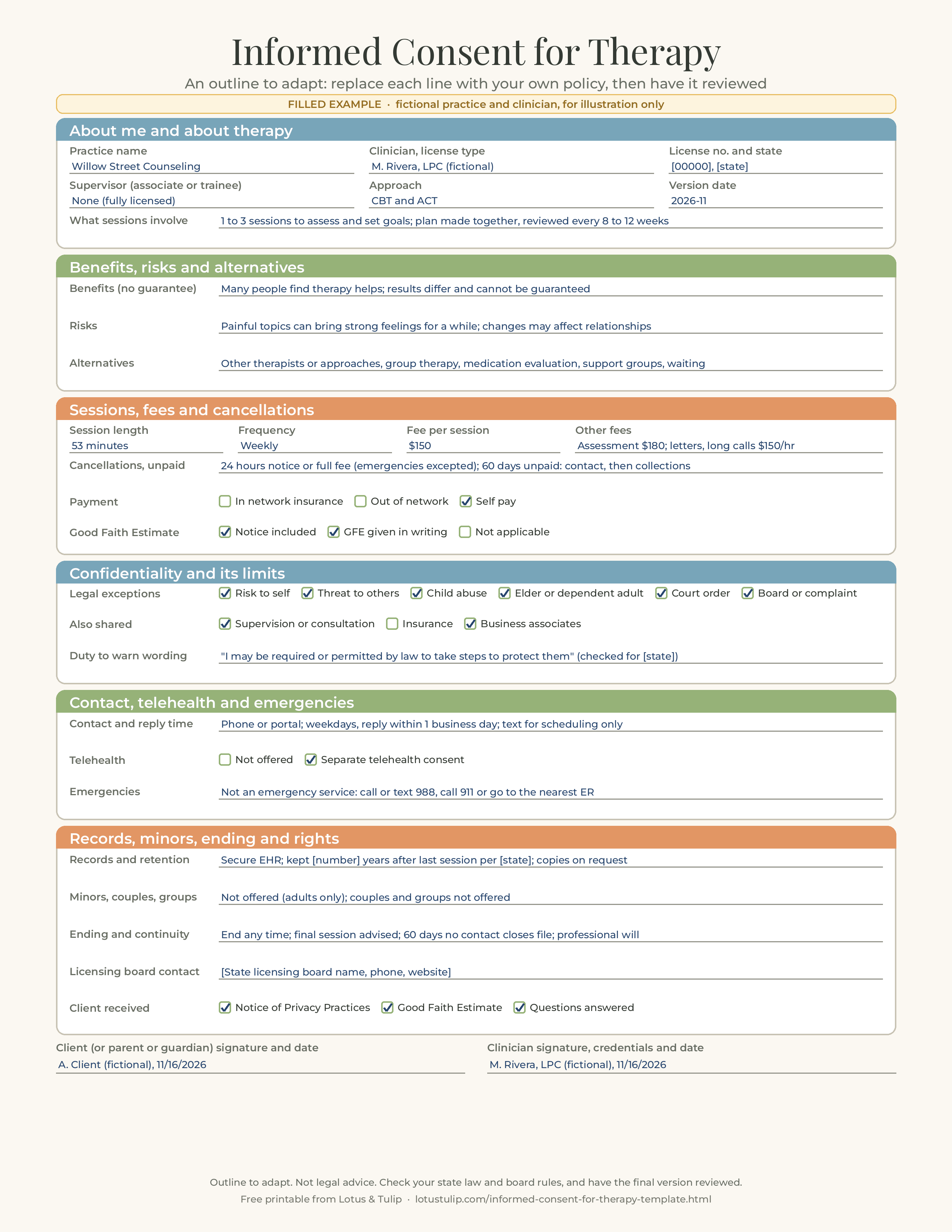
Below is a complete sample informed consent for a fictional solo private practice. It is the narrative version of page 2 of the free printable. Do not copy it as is: it is written for an imaginary practice in an unnamed state, and your state's rules, your services and your policies will be different.
Willow Street Counseling (fictional) · Informed consent for therapy · version 2026-11
About me. I am M. Rivera, a Licensed Professional Counselor (LPC) licensed in [state], license number [00000]. You can check my license on the [state board] website. I have worked with adults with anxiety, depression and life transitions since 2016. I mostly use cognitive behavioral therapy and acceptance and commitment therapy.
About therapy. Our first one to three sessions are for getting to know you, understanding what brings you in and agreeing on goals. We will then make a treatment plan together and review it about every 8 to 12 weeks. Sessions are a mix of talking and practicing skills, with optional practice between sessions. Many people find therapy helps, but I cannot promise specific results. Talking about painful things can bring up strong feelings for a while, and changes you make may affect your relationships. Other options include other therapists or approaches, group therapy, a medication evaluation with a prescriber, support groups, or not starting therapy now. You can ask about any of these at any time.
Sessions. Sessions are 53 minutes, usually weekly. If you arrive late, we will still end on time. I will give you at least two weeks' notice of planned time off.
Fees. The first assessment session is $180. Individual sessions are $150. Phone calls longer than 15 minutes, letters and reports are charged at $150 per hour, prorated. Payment is due at each session by card on file. I am not in network with insurance plans; on request, I can give you a monthly statement (superbill) to submit for possible out of network reimbursement, which is not guaranteed. I will give you at least 30 days' notice of any fee change.
Cancellations. Please cancel at least 24 hours ahead. Late cancellations and missed sessions are charged the full fee, except in emergencies or sudden illness. If a balance is unpaid for 60 days, I will contact you to discuss it and give you a chance to pay before I use a collection service; if I do use one, I will share only your name, contact details and the amount owed.
Good Faith Estimate. Because you are not using insurance for my services, you have the right to receive a Good Faith Estimate of your expected charges. You will receive it in writing before your first session and whenever it changes. You can ask me for a new one at any time.
Confidentiality. What you share in therapy is confidential. I will not share information about you without your written permission, except where the law requires or allows it: if I believe you are at serious and imminent risk of harming yourself; if you tell me you intend to seriously harm a specific person and the law requires or permits me to take steps to protect them; if I suspect abuse or neglect of a child, or of an older or dependent adult, which I am required to report; if a court orders me to release records or testify; and for licensing board investigations or to defend myself if you bring a complaint or lawsuit. When possible, I will talk with you first. I consult with a clinical consultation group without sharing your name or identifying details. My electronic records and billing companies are bound by HIPAA agreements. You will also receive my Notice of Privacy Practices, which explains your privacy rights in more detail.
Contact between sessions. You can reach me by phone at [number] or through the client portal. I check messages on weekdays and usually reply within one business day. I use text only for scheduling. Email and text are not fully secure; I will use them only in the ways you choose on the contact preferences form. I do not accept friend or follow requests from clients on social media, to protect your privacy.
Telehealth. If we meet by video or phone, you will sign a separate telehealth consent that covers your location, privacy, what we do if the connection drops and our emergency plan.
Emergencies. I am not an emergency service and am not available around the clock. If you are in crisis or thinking about suicide, call or text 988 (the 988 Suicide and Crisis Lifeline) or chat at 988lifeline.org. In an emergency, call 911 or go to the nearest emergency room. When I am away, my voicemail will give the name of a covering clinician.
Records. I keep a record of our work, including an assessment, treatment plan and progress notes, in a secure electronic record. I keep records for [number] years after our last session, as required in [state]. You can ask to see or get a copy of your record, and to request a correction.
Ending therapy. You may end therapy at any time. I recommend a final session to review your progress. I may suggest ending or referring you if therapy is not helping or you need a different kind of care, and I will help you find other options. If we have no contact for 60 days, I will send you a letter closing your file; you are welcome to return. If I become unable to practice suddenly, a colleague named in my professional will will contact you about your records and referrals.
Your rights. You may ask questions about any part of your care, take part in planning it, refuse any technique or suggestion, ask for a referral or a second opinion, and end therapy. If you have a concern, please tell me. You can also contact the [state licensing board name, address, phone and website].
Agreement. I have read this consent, had the chance to ask questions, and agree to begin therapy with M. Rivera, LPC. I received the Notice of Privacy Practices [ ] and a Good Faith Estimate [ ].
Client name, signature and date · Clinician signature, credentials and date
What makes this sample useful: it is written to the client, in plain language; risks and alternatives are named; every fee and charge is stated, including what happens to unpaid balances; the confidentiality limits are specific but do not overstate any duty; the Good Faith Estimate and NPP are mentioned and given as separate documents; there is a real plan for emergencies and for the therapist's absence; and the client knows how to end therapy and how to complain. Bracketed items still have to be filled in for a real practice.
Six short informed consent examples
Example 1: an associate under supervision
"I am an Associate Professional Counselor (APC) in [state], license number [00000]. I am working toward full licensure under the supervision of J. Chen, LPC-S (fictional), [license number and contact]. My supervisor is legally responsible for your care, and I discuss our work with her, including your clinical record. You may contact her directly with questions or concerns."
Name the supervisor, state what they see and how to contact them. APA 10.01(c) requires this for trainees; many boards require it for associates in other professions too.
Example 2: couples therapy and secrets
"In couples therapy, the couple is my client. I do not keep secrets that affect our work together. If one of you tells me something privately, by phone, message or in an individual session, that is relevant to the couple, I will encourage you to share it in a joint session and may decline to continue if it cannot be shared. Joint records are released only with written permission from both of you, unless the law requires otherwise."
Example 3: a teenager, with parents
Fictional client "K.L.," 15, with mother and father who share legal custody (custody order on file). "K.L., what you tell me stays between us, with some important exceptions: if I am worried about your safety or someone else's, or if I learn that someone is hurting you, I will need to tell others to keep you safe, and I will tell you first when I can. Your parents will hear from me about how therapy is going in general and about any safety concerns, but not the details of what you say. Parents, you agree not to ask for the details of sessions or records, unless the law gives you that right and I believe it is in K.L.'s interest." Signed by both parents; K.L. signs an assent line.
Check your state's rules on minors' consent and parental access to records before you promise privacy you cannot keep.
Example 4: a group
"I keep what is said in group confidential, with the same legal exceptions as individual therapy. I cannot guarantee that other members will. By joining, you agree to keep what other members say and who attends private. Group notes record your participation without naming other members."
Example 5: a court referred client
Fictional client "J.T.," referred by probation after a DUI. "Your probation officer will receive a monthly letter from me confirming your attendance and whether you are participating. I will not share what you say in sessions unless you sign a separate release or the law requires it. You can choose not to attend; I will explain what I understand the consequences may be, but your probation officer decides them." Release signed for attendance and participation only.
ACA A.2.e and APA 3.10(c) both ask you to set this out before services start.
Example 6: a self pay client on a sliding scale
Fictional client "R.M.," uninsured, booked weekly sessions starting in 12 business days. "Your fee is $90 per session on my sliding scale, reviewed every six months." Good Faith Estimate issued in writing two business days after scheduling: one diagnostic assessment (90791, $180) and up to 25 individual sessions (90837, $90 each) over the next six months, diagnosis code to be confirmed after the assessment, the required dispute rights wording, and the clinician's NPI and Tax ID. A new GFE will be issued if the frequency or fee changes.
The estimate covers a defined period no longer than 12 months, lists the expected service codes and charges, and is issued within the timeframe for a service scheduled at least 10 business days ahead.
Talking through informed consent in the first session
A signed form with no conversation is weak evidence that consent was informed. A five to ten minute talk at the start of the first session is usually enough. A simple script:
"Before we start, I want to make sure you know how this works. You read the consent form; do you have any questions about it? Let me pick out the important parts. What you tell me is private, with a few exceptions: if I am seriously worried about your safety or someone else's, if I learn a child or vulnerable adult is being hurt, or if a court orders it. If any of that comes up, I will talk with you first whenever I can. You can stop therapy any time, and I would like to know if something is not working for you. I am not an emergency service, so if you are in crisis, call or text 988 or call 911. Does that all make sense?"
Then note it in your first session note. A line such as this is enough:
"Informed consent reviewed verbally, including limits of confidentiality, fees and cancellation policy, telehealth procedures and emergency resources (988, 911). Client asked what is shared with insurance; explained that client is self pay and no claims are submitted. Client verbalized understanding and signed consent (version 2026-11); NPP acknowledgment signed; GFE provided."
Revisit consent when something changes: a move to telehealth, a new service such as couples work, a fee change, a new supervisor, a minor turning 18, or a new legal situation such as a court case. ACA A.2.a calls consent "ongoing," and APA 4.02(b) says confidentiality is discussed at the outset "and thereafter as new circumstances may warrant."
Words to watch in an informed consent
| Instead of | Try |
|---|---|
| "Everything you say is completely confidential." | "What you say is confidential, with some legal exceptions, which are listed below." |
| "I am required to warn anyone you threaten." (if your state is permissive) | "I may be required or permitted by law to take steps to protect someone you seriously threaten." |
| "Therapy will help you overcome anxiety." | "Many people find therapy helpful, but I cannot guarantee results." |
| "The undersigned hereby acknowledges and agrees..." | "I have read this, asked my questions and agree to begin." |
| "Client waives all claims against the therapist." | Leave it out. Broad waivers like this may not be enforceable and they damage trust. |
| "Missed sessions will be billed to your insurance." | "Insurance does not pay for missed sessions; you would pay the fee yourself, where your plan contract allows it." |
| "Records are destroyed after treatment." | "I keep records for [number] years after our last session, as required in [state]." |
| "Call me any time." | "I reply within one business day. For emergencies, call or text 988 or call 911." |
Common informed consent mistakes
- Treating it as a form, not a conversation. Signed in the waiting room, never discussed.
- Overpromising confidentiality, or overstating a duty to warn that your state does not impose.
- No risks or alternatives. The ethics codes name both; many templates leave them out.
- Merging the NPP into the consent instead of providing it separately and getting an acknowledgment.
- Forgetting the Good Faith Estimate for self pay clients, or giving only a verbal estimate.
- Vague fees: no mention of letters, long calls, court work, or what happens to unpaid balances.
- Copying an old employer's form, with their name, their state's rules and their services still in it.
- Hiding the supervisor. Associates and trainees who do not name their supervisor.
- No plan for minors with separated parents, such as not checking legal custody before treating.
- No emergency information, or an emergency number that is no longer current.
- Legal language and waivers that clients cannot understand and courts may not enforce.
- Never updating it, or not tracking which version each client signed.
Free printable: informed consent for therapy template, filled example and checklist
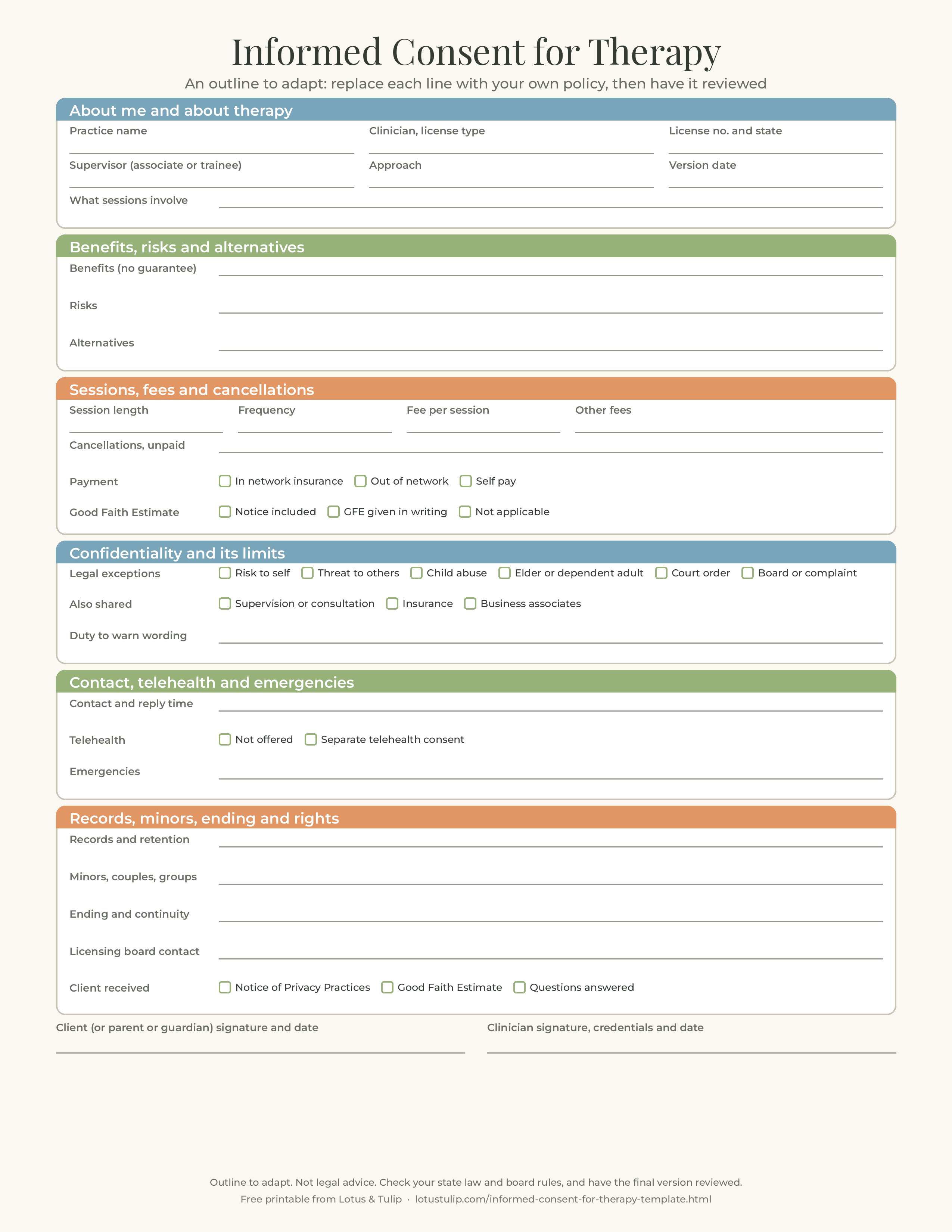
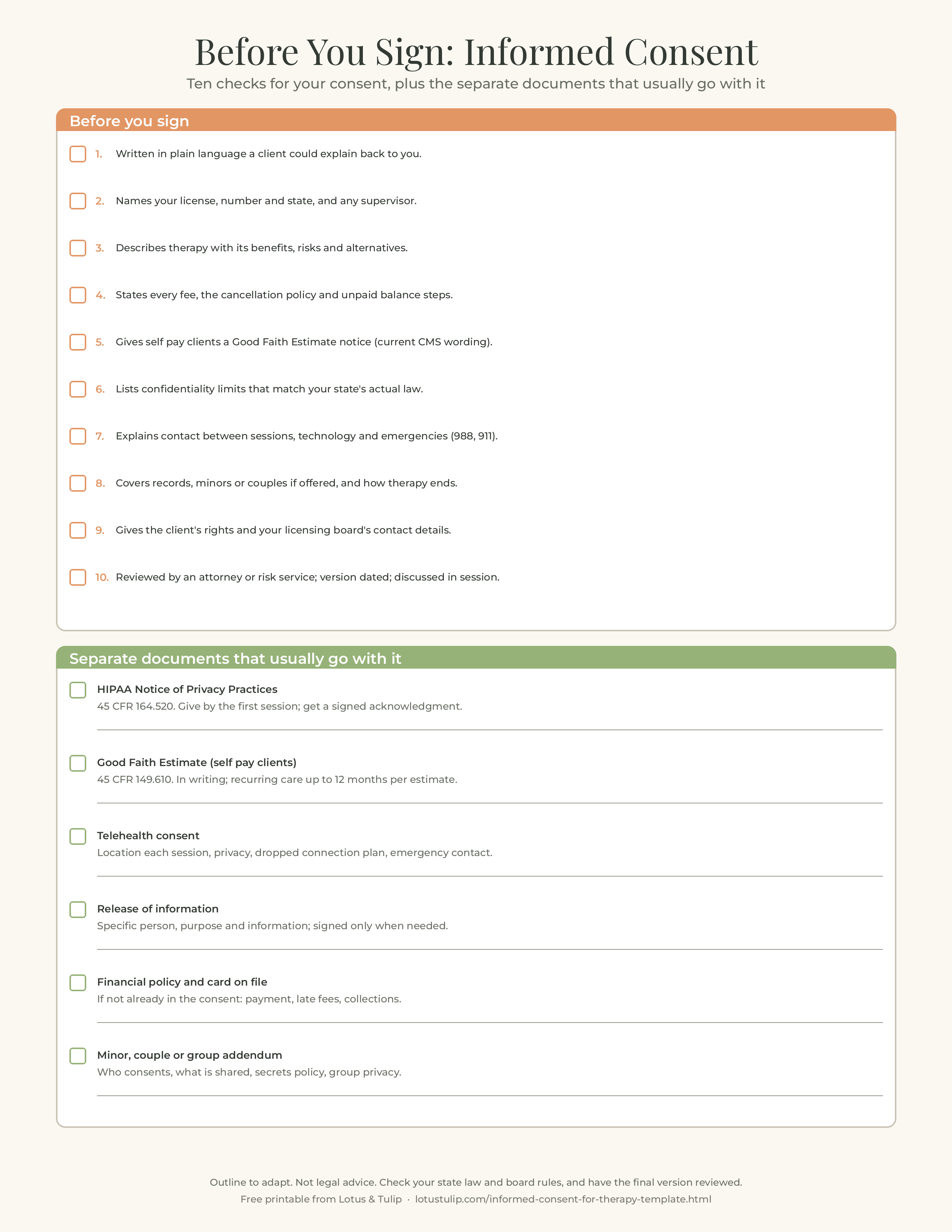
The free printable has three US Letter pages. Page 1 is a blank informed consent outline: practice and clinician details (with supervisor for associates), about therapy and approach, benefits, risks and alternatives, sessions, fees and cancellations with insurance or self pay and a Good Faith Estimate notice, confidentiality and its limits with tick boxes for each exception, contact, telehealth and emergencies, records, minors and ending therapy, rights and the licensing board, and an acknowledgment block with NPP and GFE receipt boxes and signature lines. Page 2 is a filled example for the fictional practice on this page. Page 3 is a ten point before you sign checklist plus a list of the separate documents that usually go with an informed consent.
Download the free informed consent for therapy template (PDF, 3 pages)
Rather type than handwrite? The free PDF above is for printing. Therapy Progress Notes and Intake Templates comes as a fillable PDF you type straight into (604 fields in Adobe Acrobat Reader), plus the printable version: SOAP, DAP and BIRP notes, intake, treatment plan and safety plan, 20 pages. Holiday 20% off: about $7.36, was $9 (EUR 8) · instant digital download
Buy on EtsyPrefer single images? Page 1: blank informed consent outline (PNG) · Page 2: filled informed consent example (PNG) · Page 3: before you sign checklist (PNG)
Free to print and use in your own practice or program. Please link to this page rather than re-uploading the file. The outline is a starting point, not a finished legal document: adapt it to your license, state, services and payers, and have it reviewed before use. Using it does not guarantee compliance with any law, board rule or payer policy.
Related resources
- Family therapy informed consent form: who the client is, secrets policy, minors and custody, records and court, with a free printable
- HIPAA breach notification for therapists: the four factor risk assessment, 60 day deadlines and a free incident log
- Clinical supervision agreement for therapists: template, board rules and a supervision log
- Telehealth across state lines: licensure, compacts and consent wording
- Duty to warn for therapists: Tarasoff, state laws, HIPAA and a free documentation worksheet
- Closing a therapy private practice: checklist, timeline, client letters, records plan and free printable
- HIPAA risk assessment for therapists: security risk analysis, filled example and free worksheet
- Business associate agreement for therapists: which vendors need a BAA, breach duties, filled vendor log and free printable
- Professional will for therapists: clinical executor, records custodian, client notification scripts, filled example and free printable
- Couples therapy informed consent form: no secrets policy, individual sessions, records access, safety screening, filled example and free printable
- Treatment summary template for therapists: how to write a treatment summary letter, transfer records under HIPAA, filled example and free printable
- Notice of privacy practices for therapists: HIPAA 164.520 elements, 2026 Part 2 update, filled example and free printable
- Parental consent form for therapy of a minor: who can consent, custody orders, state minor consent laws, HIPAA, filled example and free printable
- Credit card authorization form for therapists: card on file consent, PCI DSS rules, filled example and free printable
- Sliding scale fee policy for therapists: 2026 poverty guideline tiers, copay waiver rules, filled example and free printable
- Therapy cancellation policy template: late cancellation and no show fees, Medicare and Medicaid rules, filled example and free printable
- Release of information form for therapists: HIPAA authorization elements, psychotherapy notes, Part 2, filled example and free printable
- Superbill template for therapists: every field insurers need, CPT and POS codes, filled example and free printable
- Good Faith Estimate template for therapists: No Surprises Act rules, filled example and free printable
- Psychotherapy notes vs progress notes: what HIPAA says, what goes where and free printable
- Therapy termination letter template: how to end therapy ethically, sample letters and free printable
- What to include in a therapy intake form (checklist)
- Biopsychosocial assessment template: example and free printable
- Telehealth progress note template: examples, checklist and free printable
- Therapy treatment plan template with SMART objectives (free printable)
- Mental status exam template: examples, word bank and free printable
- BIRP notes for therapists: template, 5 examples and free printable
- GIRP notes for therapists: template, 5 examples and free printable
- SOAP vs DAP notes for therapists, with examples
- Group therapy progress notes: template, examples and free printable
- Therapy discharge summary template: example and free printable
- Safety plan worksheet (free printable)
- Therapy progress notes and intake templates
Sources: American Psychological Association, Ethical Principles of Psychologists and Code of Conduct (2002, amended 2010 and 2016), standards 3.10, 4.02, 4.06, 6.04, 10.01, 10.02, 10.03 and 10.10; American Counseling Association, 2014 ACA Code of Ethics, standards A.2.a to A.2.e; National Association of Social Workers, Code of Ethics, standard 1.03; 45 CFR 164.520 (Notice of Privacy Practices), 164.508 (authorizations), 164.501 (psychotherapy notes definition) and 164.530(j) (documentation retention); HHS, Model Notices of Privacy Practices (Part 2 update, February 16, 2026); HHS, HIPAA FAQ on medical record retention; 45 CFR 149.610 (Good Faith Estimates for uninsured or self pay individuals); CMS, No Surprises Act Good Faith Estimate decision tree, requirements slides, implementation status and consumer pages on disputing a bill; Child Welfare Information Gateway, Mandatory Reporting of Child Abuse and Neglect (current through May 2023); National Conference of State Legislatures, Mental Health Professionals' Duty to Warn; Tarasoff v. Regents of the University of California, 17 Cal. 3d 425 (1976); California Family Code section 6924 and Health and Safety Code section 124260; 988 Suicide and Crisis Lifeline. Rules change; check the current versions and your state's laws.
FAQ
What should be included in an informed consent for therapy?
Your name, license and supervisor if you have one; what therapy involves, with benefits, risks and alternatives; session length and scheduling; fees, cancellations, insurance and what happens with unpaid balances; a Good Faith Estimate notice for self pay clients; confidentiality and its legal limits; contact between sessions and technology; telehealth; emergencies with 988 and 911; records; minors, couples or groups if you offer them; how therapy ends; the client's rights and your licensing board's contact; and signatures with dates.
Is the HIPAA Notice of Privacy Practices the same as informed consent?
No. The Notice of Privacy Practices is a separate HIPAA document (45 CFR 164.520) that explains how you use and disclose health information and the client's privacy rights. A covered provider gives it no later than the first service and makes a good faith effort to get a written acknowledgment. Informed consent explains the therapy itself and the client's agreement to start. Most practices give both in the intake packet as separate documents.
Do therapists have to give a Good Faith Estimate?
Under the No Surprises Act, health care providers, including therapists, must give a written Good Faith Estimate to clients who are uninsured or not using insurance, when a service is scheduled at least 3 business days ahead or when the client asks. For ongoing therapy, one estimate can cover up to 12 months. Check the current CMS guidance before relying on any summary.
What are the limits of confidentiality in therapy?
They depend on the state, but usually include suspected abuse or neglect of a child or of an older or dependent adult (mandated reporting), serious and imminent risk of harm to self, a serious threat to an identifiable person (a duty to warn or protect, which is mandatory in some states, permissive in others and absent in a few), court orders, licensing investigations and defending a complaint. Insurance billing and supervision also involve sharing some information.
Can a minor consent to therapy without a parent?
It depends on the state. Many states allow minors to consent to some outpatient mental health care from a certain age; California, for example, allows minors 12 and older who are mature enough to participate intelligently. Other states set different ages and conditions, and rules for parental access to records vary. Check your state's law, and always explain confidentiality to the young person and get their assent.
Does informed consent need to be signed again?
Informed consent is ongoing. Review it when something changes, such as a move to telehealth, a new type of service, a fee change, a new supervisor, or a minor client turning 18, and have the client sign the updated version. Keep track of which version each client signed.
Can I use an informed consent template I find online?
A template is a good starting point, but it has to be adapted to your state's laws, your licensing board's required disclosures, your services and your policies, and it is wise to have the final version reviewed by an attorney or your association's risk management service. Copying a form written for another state or practice is one of the most common consent mistakes.
Is this informed consent for therapy template free?
Yes. The three page printable (a blank informed consent outline, a filled fictional example and a before you sign checklist with a list of the separate intake documents) is free to print and use in your own practice. Please link to this page rather than re-uploading the file, and adapt and review it for your state before use.