
Therapist practice · Updated 2026-11-09
Telehealth Progress Note Template: What to Document, with Examples (Free Printable)
Ready-made printable: Therapy Progress Notes and Intake Templates Fillable PDF: includes SOAP, DAP and BIRP progress note pages, plus intake, notes and safety plan pages (20 pages)
Holiday 20% off: about $7.36, was $9 (EUR 8) · instant digital download
Try it free first: download a fillable sample (SOAP note and DAP note, PDF, 226 KB). Type into it on screen, then get the full pack. No email needed.

A telehealth progress note is an ordinary progress note with a short extra layer on top. The clinical content is the same as for an office visit: what the client brought, what you did, how they responded, any risk and the plan. What changes is the context. You were not in the same room, so the note has to say how you met, where the client was, who else could hear, what you would have done in an emergency and whether the technology held up. Those few lines are the ones most often missing when a telehealth note is audited, and they are the ones you will want most on the day a session goes wrong.
This guide is for counselors, therapists, social workers, psychologists, marriage and family therapists and trainees in the US who see clients by video or phone. It covers what a telehealth therapy note needs beyond a standard note, each telehealth element in plain language, the place of service codes and modifiers that usually go with the note (with an honest payer and state caveat), how to write a telehealth progress note step by step, a full fictional telehealth therapy note example, five short examples (audio only, a dropped connection, a client traveling out of state, a risk concern on video and a teen session with a parent nearby), common mistakes, and privacy at both ends of the call. At the end you can download a free three page printable: a blank telehealth progress note, a filled fictional example, and a before you sign checklist with a telehealth items box.
Jump to the free telehealth progress note template
This is educational information about documentation for licensed clinicians and trainees. It is not clinical, legal, billing or compliance advice. Telehealth rules differ by state, license, payer and setting and they change often; check your licensing board, your payers' current telehealth policies and your agency's procedures. Every client and clinician on this page is fictional.
What makes a telehealth progress note different
Most of a telehealth note is identical to an in person note. You still write in your usual format (SOAP, DAP, BIRP, GIRP or your agency's own), you still tie the session to the treatment plan, you still record risk when it comes up, and you still sign and date it. If you are not sure about the clinical body of the note, start with the guides to SOAP vs DAP notes or BIRP notes; everything there applies on video.
The difference is a block of session details that an office note can usually skip, because in the office the answers are obvious. On telehealth they are not:
- How you met. Live video, audio only, or a mix, and on what platform.
- Where the client was. Their physical location for that session, including the state, not just the address on file.
- Where you were. Your own location, which matters for some payers and settings.
- Who was present or could hear. On both ends.
- Consent. That telehealth consent is on file, and anything you reconfirmed today.
- The emergency plan. An emergency contact, a backup phone number and local emergency resources for where the client is.
- What happened with the technology. Drops, switches to phone, and anything that limited what you could observe.
- Time. Start and stop times, which matter for time based psychotherapy codes in any setting and are easy to blur when a call reconnects.
None of these lines take long to write. Together they show that the session was a real, private, synchronous clinical contact, delivered where you were allowed to deliver it, with a plan for the client's safety.
Telehealth note elements at a glance
| Element | What to write | Why it matters |
|---|---|---|
| Modality | "Synchronous video" or "audio only (telephone)"; note any switch and when | Payers code video and audio only differently; audio only often has extra conditions |
| Platform | The platform or service you used, for example your EHR video, a named video service, or the clinic phone line | Shows you used the platform your practice has set up for clinical work |
| Client location | Physical location at session start, with the state: "at home in Columbus, OH" or "in her parked car outside work, Denver, CO" | Licensure follows the client's location; emergency response depends on it; it drives the place of service code |
| Clinician location | "Clinician in office" or "clinician in home office, private room" | Some payers and settings ask for it; it also documents privacy on your side |
| Others present | "Client alone in a private room" or who else was present and why, on both ends | Confidentiality and who is participating |
| Identity | How identity was verified for a new client, or "established client, recognized by video" | Especially important at intake and for audio only |
| Consent | "Telehealth informed consent signed 9/2/2026, on file"; verbal confirmation today if your policy asks | Many states and payers expect telehealth consent; your policy may require a per session confirmation |
| Emergency plan | Emergency contact confirmed, callback number, local emergency resources for the client's location | You cannot walk a client to the emergency room from a screen |
| Technology | "No technical problems," or what failed, for how long, and how you resumed | Explains gaps in time and limits on observation |
| Time | Start and stop times of the clinical contact, or total minutes | Needed for time based psychotherapy codes and when a session is split by a drop |
Each telehealth element in detail
1. Modality: video or audio only
Write the modality in words, not just as a code: "Session conducted by synchronous, real time video" or "Session conducted by telephone, audio only." If the session started on video and moved to the phone, say when and why: "Video froze repeatedly from 10:21; continued by phone 10:24 to 10:58 at client's agreement." Payers treat the two modalities differently, and the claim needs to match what actually happened.
For audio only sessions, record why video was not used. Under Medicare, the HHS telehealth billing guidance says audio only may be used for a telehealth service to a patient in their home when the practitioner is technically capable of video but the patient is not capable of, or does not consent to, video. A line such as "Audio only: client's phone cannot run video and she has no other device; clinician video available" or "Audio only at client's request; client declined video today" documents that choice. Other payers may have stricter or looser rules, or may not cover audio only at all.
2. Platform
Name the platform in a neutral way: "EHR integrated video," "practice video platform," "clinic phone line." You do not need to describe encryption in every note, but you should be using a platform your practice has vetted. After the federal COVID era flexibility ended (more on that in the privacy section), consumer video apps that are not set up for health care are a poor choice for regular sessions.
3. Client location at the start of the session
This is the single most important telehealth line. Ask at the start of every session, not only at intake, and write the answer: "Client confirmed location at session start: home, Tacoma, WA." Three reasons:
- Licensure. Telehealth.HHS.gov says health professionals must meet the licensure requirements of the state where they are located and be licensed or legally permitted to practice in the state where the patient is located, and that a telehealth appointment occurs in the state where the patient is located at the time of the appointment. A client who logs on from a hotel in another state may be outside where you can practice that day.
- Emergencies. If you need to send help, you need a real address, not the billing address from intake.
- Coding. Whether the client was at home or somewhere else changes the place of service code for many payers (see the coding section).
Some clinicians write a full street address each time; others write "home address on file, confirmed" when the client is at home and a full address only when they are elsewhere. Follow your agency policy. If a client will not say where they are, document that, and think carefully about whether to continue.
4. Clinician location
A short line is enough: "Clinician in private office at the practice" or "Clinician in private home office." It records that your side was private too. Medicare's telehealth FAQ notes that practitioners can provide telehealth from their home and, in many cases, do not need to report a home address on their enrollment if they have a physical practice location; virtual only practitioners have their own enrollment steps. Other payers have their own rules on where you can bill from.
5. Who was present, on both ends
On video you only see what the camera shows. Ask whether anyone else is in the room or within earshot, and write the answer: "Client alone in bedroom with door closed; roommate at work." If someone else joined, say who, for which part of the session and with what consent. The APA's office and technology checklist for telepsychology suggests that everyone present be within view of the camera so the psychologist knows who is participating, and that you confirm nobody will record the session without permission. If you suspect someone is listening, note what you noticed and what you did, for example, moving to yes or no questions or offering a different time.
6. Identity
For an established client you recognize on video, a brief line or nothing beyond your usual note is enough. For a new client, or a phone session with someone whose voice you do not know well, record how you verified identity. HHS guidance on audio only telehealth notes that if the individual is not known to the covered entity, the entity must verify their identity, orally or in writing, and that HIPAA does not mandate a specific method.
7. Consent
Telehealth consent usually happens once, at intake or when a client first moves to telehealth, and then sits in the record. Many states and payers have their own consent requirements, and some ask for consent to be documented in a particular way, so follow yours. In the note, a short reference is enough: "Telehealth informed consent signed 9/2/2026, on file." If your policy asks for a verbal confirmation each session, or if something changed (a new location, a new person present, a switch to audio only), record that too.
A typical telehealth consent covers the risks and limits of telehealth, privacy at both ends, what happens if the connection fails, the emergency plan, recording, and billing. The free printable does not include a consent form; the progress notes and intake set has a telehealth consent outline to adapt with your attorney or professional association.
8. The emergency plan: contact, backup number and local resources
Telehealth.HHS.gov advises that all providers establish and maintain an emergency plan, and calls it especially essential for out of state providers practicing telehealth. The APA checklist asks whether you have a back up plan for technical difficulties and for a crisis, and whether you know local resources such as the emergency room where the patient is. In practice, the note usually records:
- An emergency contact on file and confirmed, with the relationship ("partner, confirmed 10/1/2026").
- A callback number where the client can be reached during this session if video drops.
- Local emergency resources for the client's location: the nearest emergency department, local emergency number and how you would reach them from your location if needed. In the US, the 988 Suicide and Crisis Lifeline can be reached by call or text at 988.
- The backup plan, agreed in advance: "If disconnected, clinician calls client's cell within 2 minutes; if no answer, clinician texts and tries twice more."
Most of this is set up at intake and reviewed when it changes. The session note only needs a line that it is current, plus anything you actually used.
9. Technology problems and limits on observation
Write down what happened, for how long, and how it affected the session: "Video froze about 40 seconds at 2:18 and again at 2:31; audio continued; no clinical content lost." If you could not see parts of the client, or audio lag made it hard to judge speech, say so, because it limits what you can write about mental status. The mental status exam guide has a telehealth section on what video can and cannot show.
10. Time
Record start and stop times of the clinical contact, or total minutes. Psychotherapy codes are time based. The commonly used individual psychotherapy codes are described by approximate time: 90832 for about 30 minutes (16 to 37 minutes), 90834 for about 45 minutes (38 to 52 minutes) and 90837 for about 60 minutes (53 minutes or more). If a session is split by a dropped connection, record both segments and the total time actually spent with the client, and follow your payer's rules for what counts.
Place of service codes and modifiers for telehealth therapy notes
Billing codes are not part of the clinical note itself, but the note has to support them. If the note says the client was at a coffee shop and the claim says home, or the note says audio only and the claim says video, a reviewer will see the mismatch.
Place of service: POS 02 and POS 10
| Code | CMS name | When it applies |
|---|---|---|
| POS 02 | Telehealth Provided Other than in Patient's Home | The patient is not located in their home when receiving the service through telecommunication technology (for example, at work, in a car, at school, at another facility). |
| POS 10 | Telehealth Provided in Patient's Home | The patient is located in their home, which CMS describes as a location other than a hospital or other facility where the patient receives care in a private residence. |
CMS added POS 10 effective January 1, 2022, and its telehealth FAQ says Medicare telehealth services provided to patients in their homes are paid at the non facility rate starting January 1, 2024. Commercial and Medicaid plans may ask for POS 02, POS 10, the POS you would use in person (often 11 for office) or something else. Your client location line is what tells the biller which applies.
Modifiers: 95, 93, GT and FQ
| Modifier | Meaning | Where it is used |
|---|---|---|
| 95 | Synchronous telemedicine service rendered via a real time interactive audio and video telecommunications system (CPT) | Widely used for live video sessions; many commercial and Medicaid plans ask for it. Medicare contractor pages list specific Medicare uses. |
| 93 | Synchronous telemedicine service rendered via telephone or other real time interactive audio only telecommunications system (CPT) | Audio only sessions. HHS telehealth billing guidance says Medicare audio only services to a patient at home use CPT modifier 93 (and/or FQ for FQHCs and RHCs). |
| GT | Via interactive audio and video telecommunication systems (HCPCS) | An older video modifier. Medicare contractors list it as allowed only on institutional claims billed by critical access hospital Method II providers; some other payers may still ask for it. |
| FQ | The service was furnished using audio only communication technology | Medicare: used only by Rural Health Clinics and Federally Qualified Health Centers. |
The CMS telehealth FAQ (updated October 2026) also says two new Medicare telehealth modifiers, BB (services furnished through a telehealth virtual platform owned by an entity the practitioner contracts with or pays for the platform) and BC (telehealth services furnished incident to a physician's or practitioner's professional service), are required beginning January 1, 2027. If you bill Medicare, ask your biller how these apply to you.
Where Medicare telehealth for behavioral health stands
- Home and location. Telehealth.HHS.gov lists as permanent that Medicare patients can receive behavioral and mental health telehealth in their home, with no geographic restrictions on the originating site.
- Audio only. Behavioral and mental health telehealth in Medicare can permanently be delivered using audio only platforms, under the conditions above (practitioner capable of video, patient not capable of or not consenting to video). Document the reason.
- Counselors and MFTs. Marriage and family therapists and mental health counselors can permanently serve as Medicare distant site providers, according to Telehealth.HHS.gov.
- In person visit requirement. The requirement for an in person visit within six months before an initial Medicare mental health telehealth service, and periodically after, is not required through December 31, 2027 under current law. The CMS FAQ explains that clients who began mental health telehealth before January 1, 2028 would be treated as established, with an in person visit needed every 12 months after that date. If this applies to your caseload, start tracking the date and provider of each client's last in person visit now.
Payer and state caveat. Everything in this coding section describes general CMS guidance and common CPT definitions as of November 2026. Medicaid programs, Medicare Advantage plans and commercial insurers set their own telehealth rules, including which POS code and modifier to use, whether audio only is covered, what consent must look like and which providers can bill. States set their own licensure, consent and telehealth practice rules, and they change often. Before you bill a telehealth session, check the current written policy of that payer and your licensing board, and when in doubt ask the payer or a billing professional. This page does not guarantee that any claim will be paid.
How to write a telehealth progress note, step by step
- Check before you connect. Is telehealth consent on file? Are the emergency contact and callback number current? Do you know where this client usually joins from and whether you are allowed to practice there?
- Open with the telehealth check in. In the first minute, confirm the client's location (and state), who is with them or can hear, a number to call if you get disconnected, and, for audio only, why video is not being used. Start your clock.
- Run the session as usual. Clinical work does not change because of the screen. Ask about risk the way you would in the office.
- Note technology events as they happen. Jot the time of any drop or switch to phone so the times in your note are accurate.
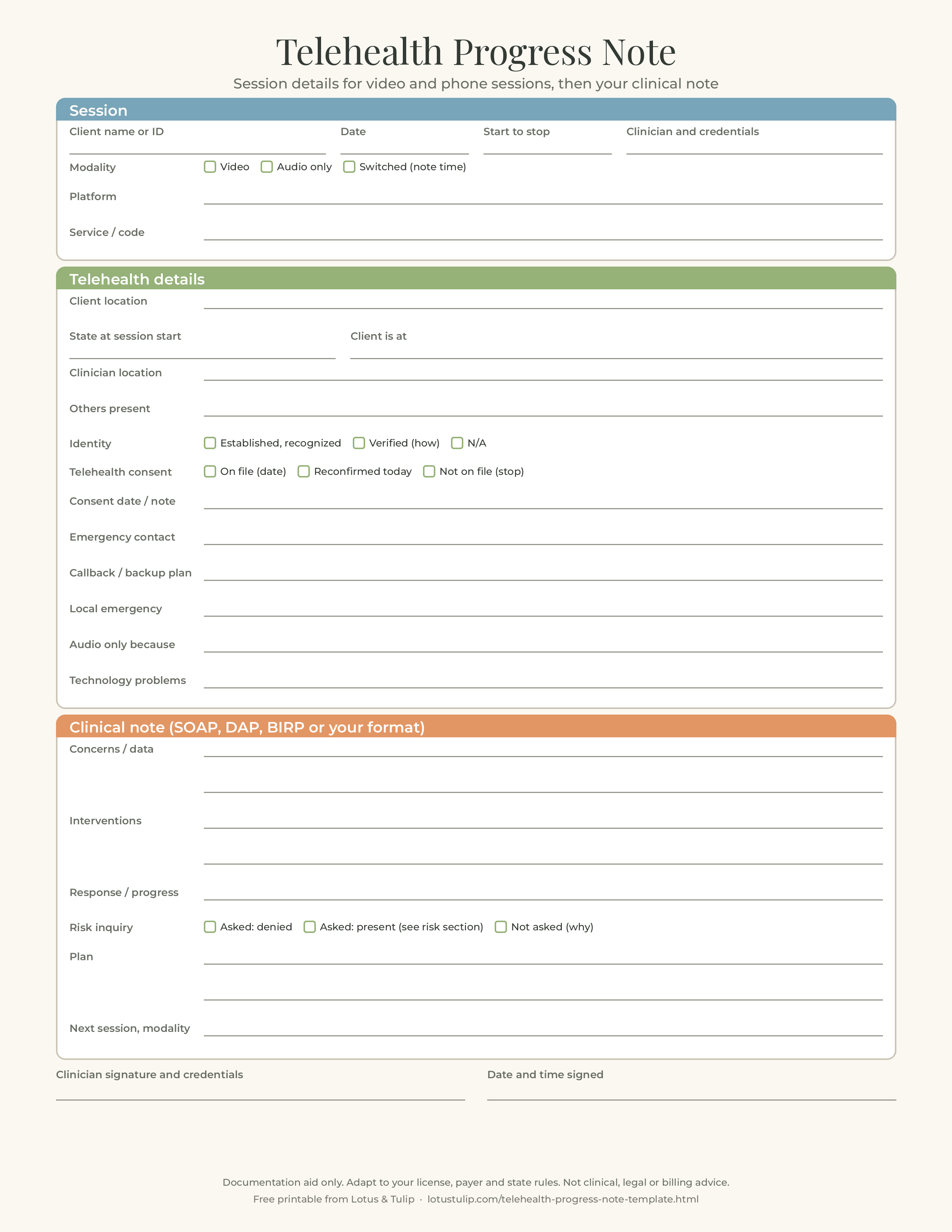
- Write the telehealth session block first. Modality, platform, client location and state, clinician location, others present, identity if needed, consent reference, emergency plan status, technology notes, start and stop times.
- Write the clinical body in your usual format. SOAP, DAP, BIRP or GIRP, linked to a treatment plan goal or objective.
- Record risk and any emergency steps. If you asked about suicidal or homicidal thoughts, write the answer. If you used the emergency plan, record each step and the time.
- Write the plan, including the next modality. "Next session 11/17, video; client will join from home." If you plan an in person visit, note why and when.
- Check the note against the claim, then sign. Modality, location and time in the note should match the POS code, modifier and CPT code on the claim. Sign with credentials and date. Correct errors later with a dated addendum.
Telehealth therapy note example (fictional, SOAP format)
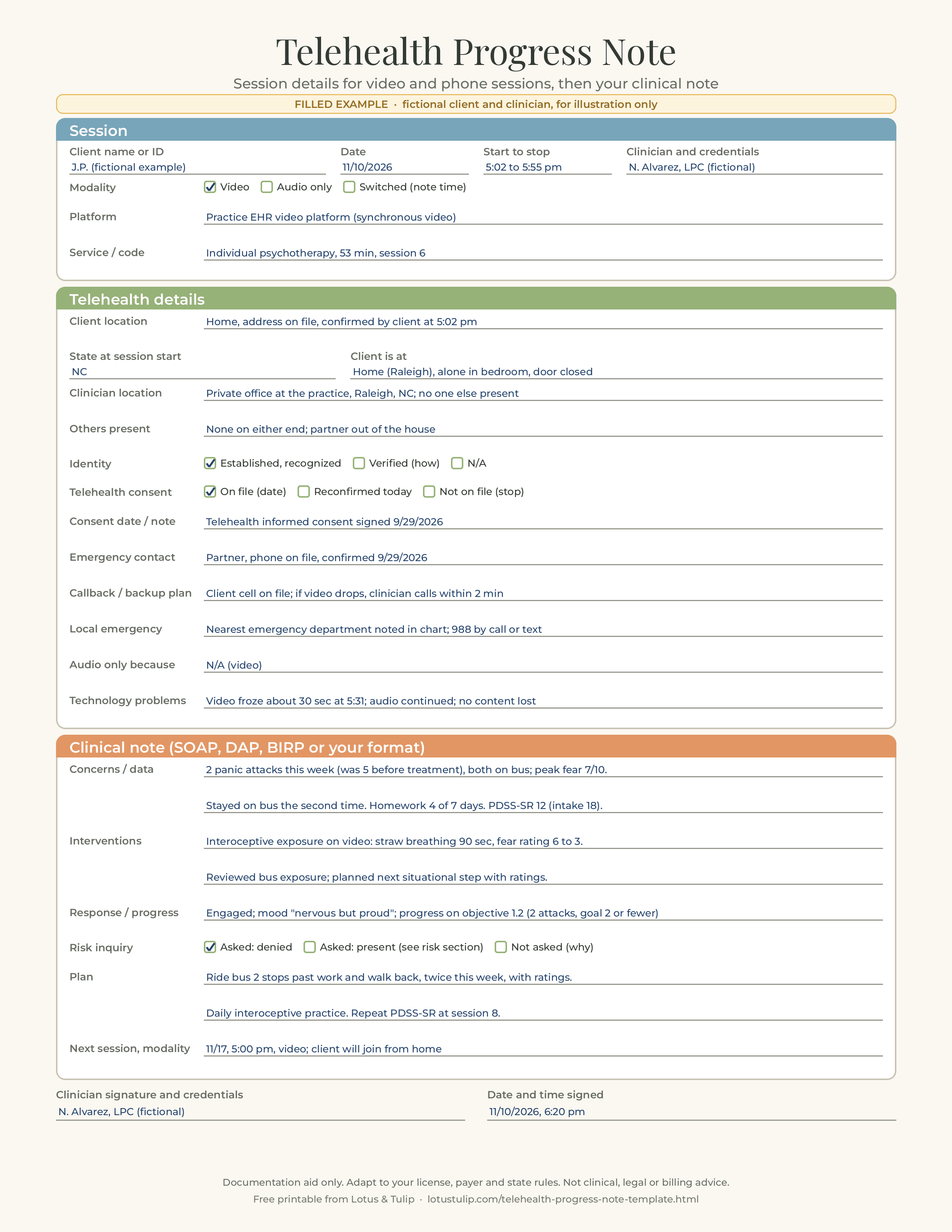
Below is a full telehealth progress note for "J.P.," a fictional 29 year old in individual therapy for panic attacks, seen by video. The clinical body uses SOAP; you can keep the same telehealth block on top of DAP, BIRP or GIRP.
Telehealth progress note · J.P. (fictional) · session 6 · 11/10/2026
- Service: Individual psychotherapy, 53 minutes, 5:02 to 5:55 p.m.
- Modality and platform: Synchronous video through the practice's EHR video platform.
- Client location at session start: Home, Raleigh, NC (address on file, confirmed). Client alone in bedroom with door closed; partner out.
- Clinician location: Private office at the practice, Raleigh, NC; no one else present.
- Consent and emergency plan: Telehealth informed consent signed 9/29/2026, on file. Emergency contact (partner) confirmed 9/29/2026. Callback number confirmed (cell on file). Nearest emergency department noted in chart.
- Technology: Video froze about 30 seconds at 5:31; audio continued; no content lost.
S: Client reports two panic attacks this week, down from five in the week before treatment began, both on the bus to work. Rated peak fear 7/10 (was 9/10 at intake). Says "I stayed on the bus the second time, I didn't get off." Completed the interoceptive exposure homework (spinning in a chair, breathing through a straw) four of seven days. Sleeping about 7 hours. Denies alcohol or other substance use this week.
O: Appeared stated age, casually dressed, visible from the waist up. Cooperative and engaged; looked at the screen consistently. Speech normal rate and volume. Mood "nervous but proud." Affect mildly anxious, full range, congruent; smiled when describing staying on the bus. Thought process linear. Denies suicidal and homicidal ideation on direct inquiry. Panic Disorder Severity Scale self report score 12 (intake 18). Lower body and gait not observable on video.
A: Progress toward Goal 1, objective 1.2 (reduce panic attacks from 5 a week to 2 or fewer for 4 weeks): first week at 2. Client is beginning to tolerate body sensations without escape, which supports continued interoceptive and situational exposure. No risk concerns today.
P: Practiced breathing through a straw for 90 seconds on video with ratings before and after (fear 6 to 3). Planned situational exposure: ride the bus two stops past work and walk back, twice this week, with ratings. Continue interoceptive practice daily. Next session 11/17, 5:00 p.m., video; client will join from home. Will repeat the scale at session 8.
Signed: N. Alvarez, LPC (fictional) · 11/10/2026, 6:20 p.m.
Notice what makes this example useful: the telehealth block takes six short lines and answers every question a reviewer or a covering clinician would ask (how, where, who could hear, what if something went wrong). The client's location includes the state. The technology line explains the one gap. The objective section says what could not be observed. The clinical body is the same SOAP note you would write after an office session, linked to a numbered objective and a measure.
Five short telehealth note examples
Example 1: audio only session
Fictional client "A.W.," 68, established client, depression. Telehealth block: Audio only by telephone, 10:00 to 10:41 a.m. (41 minutes). Client at home, Tucson, AZ, alone. Audio only because client's tablet is broken and she has no other device with video; clinician video available; client agreed to phone. Identity: established client, voice recognized, confirmed date of birth. Telehealth consent on file 3/4/2026, covers phone sessions. Emergency contact (son) current. No technical problems. Clinical note (DAP): D: Mood "a bit better, I'm getting out more." Walked to the mailbox and back daily; attended church once. Denies SI and HI on direct inquiry. Appearance and behavior not observable (audio only); speech normal rate, clear. A: Steady progress on behavioral activation objective 2.1. P: Add a second weekly outing. Son is bringing a replacement tablet; next session 11/18, video if working, phone if not.
The reason for audio only is specific and true, and the note says what could not be observed instead of leaving the mental status lines blank.
Example 2: dropped connection, finished by phone
Fictional client "C.H.," 35, couples conflict, seen individually. Telehealth block: Video through practice platform, client at home, Albany, NY, alone. 7:00 to 7:24 p.m. video; video disconnected at 7:24 and could not reconnect; clinician called client's cell per backup plan; continued audio only by phone 7:27 to 7:52 p.m. Total clinical time 49 minutes. No clinical content lost; client was not in distress when the call dropped. Clinical note: (usual format follows.)
The times show two segments and a gap, the note says how contact was restored, and the total time is what was actually spent with the client. How to bill a session that changed modality partway through is a payer question; the note just needs to tell the truth.
Example 3: client traveling out of state
Fictional client "E.G.," 42, anxiety. Clinician licensed in Oregon only. Telehealth block: At check in at 1:01 p.m., client said she was at a hotel in Boise, ID, for a work trip. Clinician explained she could not confirm she was allowed to provide therapy to a client located in Idaho today. Brief check in only: client denied SI and HI on direct inquiry, said she was "fine, just busy," and confirmed she knows to call or text 988 or go to the nearest emergency department if needed. Session rescheduled to 11/14 when client is home in Portland, OR. Contact ended 1:08 p.m. No psychotherapy provided; no claim submitted for today.
Rules on clients who travel differ by state and profession. Some states have temporary practice or continuity of care provisions and some do not, and compacts cover some professions. This example shows a cautious choice and documents it. Check your own board and the rules where the client is before deciding what you can do.
Example 4: risk concern on video
Fictional client "S.B.," 24. Telehealth block: Video, 3:00 to 4:10 p.m. (70 minutes). Client confirmed at session start: apartment, Austin, TX (address on file), alone. Callback number confirmed. Excerpt: At 3:20 client disclosed thoughts of overdosing on saved medication, with a bottle in the apartment. Asked about intent, plan, timing and preparation using the practice's structured risk questions (results in risk section). Client agreed to put the medication in her car trunk; she left the camera to do so and returned at 3:34, confirming it was done. Collaboratively updated the safety plan and sent it through the secure portal; client opened it during the session. With client's agreement, called her sister (emergency contact) at 3:52 by phone, client on video; sister will come over tonight and stay. Client given 988 by call or text. Consulted supervisor by phone at 4:15. Follow up call to client scheduled for tomorrow 10:00 a.m.; next video session 11/12.
This is where the client location and emergency contact lines earn their place. The note records what the client said, what you asked, each action with a time, who you contacted and the follow up. What to do in a crisis is a clinical decision for your training, setting and supervisor; the template only makes sure the facts are written down.
Example 5: teen session with a parent nearby
Fictional client "M.F.," 15, school refusal. Telehealth block: Video, client at home, Madison, WI. Parent (mother) present for the first 10 minutes to review the week, then left the room; client confirmed door closed and mother downstairs, and agreed to say "pause" if anyone came in. Clinician in office. Parental consent for telehealth and the emergency plan on file. No technical problems. 4:00 to 4:52 p.m. Clinical note: (usual format follows.)
With minors, who is present changes during the session. Write when the parent was in and out, and keep the parent's report and the client's report clearly labeled.
Mental status on video and on the phone
Be honest about what you could observe. On video you usually see the face and upper body; on the phone you see nothing. Common limits:
- Video: gait, lower body movement, fine tremor, hygiene and odor are hard or impossible to judge. Eye contact is unreliable because people look at the screen, not the camera. Audio lag can look like slowed responses, and a frozen picture can look like a flat affect.
- Audio only: appearance, behavior and affect are not observable. Write "not observable, audio only" rather than carrying forward last week's description.
- Signs of intoxication are easier to miss on a screen. If you have a concern, say what you noticed and ask.
The mental status exam template and examples page has a full telehealth MSE example and a word bank you can use for the O or D section.
Privacy at both ends of the call
Under HIPAA, a telehealth note is part of the regular clinical record, the same as an office note. What changes is how you protect the session itself.
- The federal COVID flexibility is over. HHS's Office for Civil Rights announced that its telehealth Notification of Enforcement Discretion expired at 11:59 p.m. on May 11, 2023, with a 90 day transition period that ended at 11:59 p.m. on August 9, 2023. Since then, covered providers are expected to provide telehealth in line with the HIPAA Rules.
- Your setting. OCR's guidance on audio only telehealth says it expects covered providers to provide telehealth in private settings to the extent feasible, and where that is not possible, to use reasonable safeguards such as lowered voices and not using speakerphone.
- Your technology. The same guidance says the HIPAA Security Rule does not apply to audio only sessions over a traditional landline, but does apply to electronic technologies such as VoIP, smartphone apps and anything that records or transcribes a session, which belong in your risk analysis.
- Business associate agreements. OCR says a BAA is not required with a phone carrier that is only a conduit for a call, but is required with a vendor that creates, receives or maintains health information for you, such as an app that stores recordings or transcripts. The APA's telepsychology checklist also asks whether you have a BAA with your technology vendor.
- The client's side. You cannot control the client's room, but you can ask about privacy, help them plan (headphones, a parked car, a closed door, a code word) and note what you discussed.
- AI note tools and recordings. If you use software that records, transcribes or drafts notes, it handles health information, so check your consent, BAA and policy before you turn it on. Do not record sessions without the client's informed consent.
- Is HIPAA your rule? HIPAA applies to covered entities, which include health care providers who transmit health information electronically in connection with standard transactions such as insurance claims. State law, your license board, 42 CFR Part 2 for federally assisted substance use disorder programs, and FERPA for some school records can add rules.
Words to watch in a telehealth note
| Instead of | Try |
|---|---|
| "Telehealth session." | "Synchronous video through practice EHR platform." |
| "Client at home." | "Client at home, Tacoma, WA (address on file, confirmed); alone in a private room." |
| "Phone session" (no reason) | "Audio only: client has no video capable device this week; clinician video available." |
| "Session interrupted." | "Video dropped 2:24; resumed by phone 2:27 per backup plan; total 49 minutes." |
| "Consent obtained." | "Telehealth informed consent signed 9/2/2026, on file." |
| "Emergency plan in place." | "Emergency contact (sister) and callback number confirmed 10/1/2026." |
| "Client appeared fine." | Describe what you saw on screen, and what you could not see. |
| "Unremarkable MSE" (audio only) | "Appearance and behavior not observable, audio only; speech normal rate and volume." |
Common telehealth progress note mistakes
- No client location, or only the address on file. The location at session start, with the state, is the line reviewers look for first.
- Copy and paste telehealth boilerplate. An identical paragraph in every note, including "client alone" on the day the client's partner joined, undermines the whole record. Keep a template, but fill it in fresh.
- Modality in the note does not match the claim. Video in the note and audio only on the claim, or the reverse.
- No reason for audio only. Many payers that allow audio only expect a reason; Medicare's audio only rule is built on one.
- Times that do not add up. A 60 minute claim on a session that dropped for 15 minutes.
- Seeing a client in a state where you cannot practice, without checking, and without documenting what you did.
- No emergency plan on file, or one that has not been checked since intake two years ago.
- Not saying who was present. Especially with couples, families and minors, where people come and go.
- Writing a full MSE you could not have observed. Gait on a head and shoulders video; affect on a phone call.
- Unvetted platforms. Using a consumer app with no BAA for regular sessions.
- Recording without consent, or using AI note tools without a policy and consent.
- Losing the clinical content in the telehealth details. The telehealth block is a few lines. The clinical body still needs to show medical necessity, interventions, response and plan.
A faster way to write good telehealth notes
- Use a fixed opening script. "Before we start: where are you right now, is anyone with you or able to hear, and what number should I call if we get cut off?" Thirty seconds, every session.
- Keep the telehealth block at the top of your template. Fill it in during those first thirty seconds while the client settles.
- Put the emergency plan on one page. Emergency contact, callback number, the client's usual location and nearest emergency department, reviewed at plan reviews and whenever the client moves.
- Write times as they happen. A sticky note with the start time and any drop times beats reconstructing them later.
- Track in person dates if they will matter. If you bill Medicare for mental health telehealth, a column in your session log for the last in person visit date will save work before 2028.
- Read the note against the claim once. Modality, location, time, then sign.
Free printable: telehealth progress note template, filled example and checklist
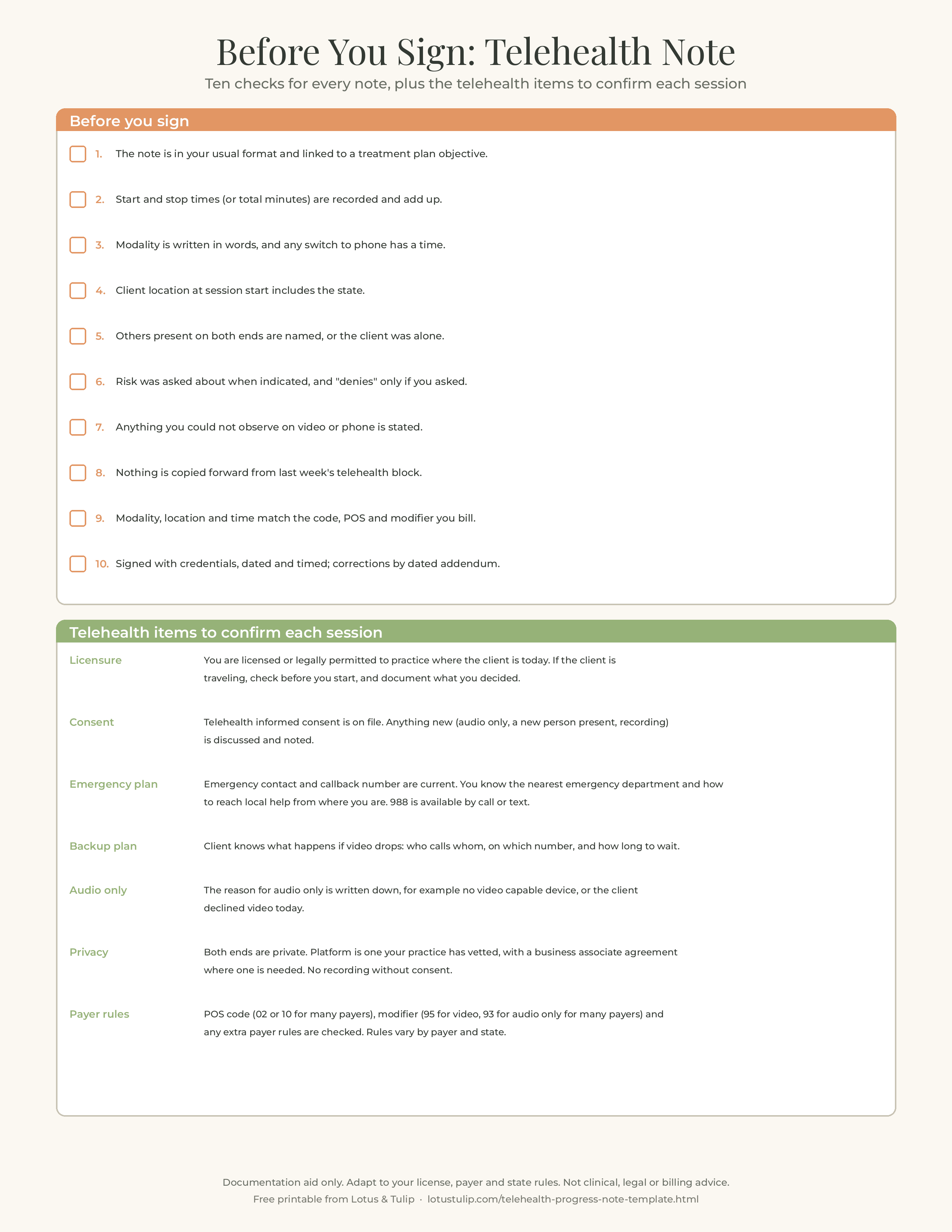
The free printable has three US Letter pages. Page 1 is a blank telehealth progress note: session details with start and stop times, modality (video, audio only, switched) and platform, client location and state at session start, clinician location, who was present on each end, identity, telehealth consent on file, emergency contact, callback number and backup plan lines, local emergency resource, a reason for audio only, technology problems, then a clinical section (presenting concerns, interventions, response, risk inquiry, plan and next session modality) and a signature line. Page 2 is a filled example for the fictional client "J.P." from this page. Page 3 is a ten point before you sign checklist plus a box of telehealth specific items to check each session.
Download the free telehealth progress note template (PDF, 3 pages)
Rather type than handwrite? The free PDF above is for printing. Therapy Progress Notes and Intake Templates comes as a fillable PDF you type straight into (604 fields in Adobe Acrobat Reader), plus the printable version: SOAP, DAP and BIRP notes, intake, treatment plan and safety plan, 20 pages. Holiday 20% off: about $7.36, was $9 (EUR 8) · instant digital download
Buy on EtsyPrefer single images? Page 1: blank telehealth progress note (PNG) · Page 2: filled telehealth note example (PNG) · Page 3: before you sign checklist and telehealth items (PNG)
Free to print and use in your own practice or program. Please link to this page rather than re-uploading the file. The template is a documentation aid: adapt it to your license, setting, payer and state rules, and use your own clinical judgment. Using it does not guarantee that any payer, auditor or board will accept your documentation.
Related resources
- HIPAA breach notification for therapists: the four factor risk assessment, 60 day deadlines and a free incident log
- Clinical supervision agreement for therapists: template, board rules and a supervision log
- Telehealth across state lines for therapists: PSYPACT, Counseling Compact and a location checklist
- Duty to warn for therapists: Tarasoff, state laws, HIPAA and a free documentation worksheet
- Closing a therapy private practice: checklist, timeline, client letters, records plan and free printable
- HIPAA risk assessment for therapists: security risk analysis, filled example and free worksheet
- Business associate agreement for therapists: which vendors need a BAA, breach duties, filled vendor log and free printable
- Professional will for therapists: clinical executor, records custodian, client notification scripts, filled example and free printable
- Couples therapy informed consent form: no secrets policy, individual sessions, records access, safety screening, filled example and free printable
- Treatment summary template for therapists: how to write a treatment summary letter, transfer records under HIPAA, filled example and free printable
- Notice of privacy practices for therapists: HIPAA 164.520 elements, 2026 Part 2 update, filled example and free printable
- Parental consent form for therapy of a minor: who can consent, custody orders, state minor consent laws, HIPAA, filled example and free printable
- Credit card authorization form for therapists: card on file consent, PCI DSS rules, filled example and free printable
- Sliding scale fee policy for therapists: 2026 poverty guideline tiers, copay waiver rules, filled example and free printable
- Therapy cancellation policy template: late cancellation and no show fees, Medicare and Medicaid rules, filled example and free printable
- Release of information form for therapists: HIPAA authorization elements, psychotherapy notes, Part 2, filled example and free printable
- Superbill template for therapists: every field insurers need, CPT and POS codes, filled example and free printable
- Good Faith Estimate template for therapists: No Surprises Act rules, filled example and free printable
- Psychotherapy notes vs progress notes: what HIPAA says, what goes where and free printable
- Therapy termination letter template: how to end therapy ethically, sample letters and free printable
- Informed consent for therapy template: what to include, sample consent and free printable
- Biopsychosocial assessment template: example, 4 Ps formulation and free printable
- Mental status exam template: examples, word bank and free printable
- BIRP notes for therapists: template, 5 examples and free printable
- GIRP notes for therapists: template, 5 examples and free printable
- SOAP vs DAP notes for therapists, with examples
- Group therapy progress notes: template, examples and free printable
- Therapy discharge summary template: example and free printable
- What to include in a therapy intake form (checklist)
- Therapy treatment plan template with SMART objectives (free printable)
- Safety plan worksheet (free printable)
- Therapy progress notes and intake templates
Sources: CMS Place of Service Code Set (POS 02 and 10 descriptions); CMS Telehealth FAQ, updated October 2026; CMS MLN901705 Telehealth and Remote Monitoring; Telehealth.HHS.gov telehealth policy updates, Medicare billing and coding, licensure for behavioral health, and licensure compacts pages; Medicare contractor telehealth modifier tables (Novitas, First Coast); AMA, CPT Appendix T and Modifier 93; HHS OCR, HIPAA and Telehealth, and Guidance on HIPAA and audio only telehealth; APA Guidelines for the Practice of Telepsychology (2024) and APA office and technology checklist for telepsychological services. CPT is a registered trademark of the American Medical Association. Rules change; check the current versions and your payers' policies.
FAQ
What should a telehealth progress note include?
Everything a regular progress note includes (presenting concerns, interventions, response, risk and plan, linked to the treatment plan) plus a short telehealth block: modality and platform, the client's physical location and state at the start of the session, your location, who was present on each end, a reference to telehealth consent on file, the emergency contact and callback number, any technology problems, and start and stop times.
Do I need to document the client's location in every telehealth session?
It is good practice to confirm and document it every session. Licensure generally follows where the client is located at the time of the session, you need a real location if an emergency happens, and the place of service code often depends on whether the client was at home. Your payer or state may make it a firm requirement.
What is the difference between POS 02 and POS 10?
In the CMS place of service code set, POS 10 is telehealth provided in the patient's home (a private residence), and POS 02 is telehealth provided when the patient is not in their home. Non Medicare payers may ask for a different POS code, so check each payer's telehealth policy.
Should I use modifier 95 or GT for telehealth therapy?
Modifier 95 is the CPT modifier for synchronous audio and video telemedicine and is widely used for live video sessions. GT is an older HCPCS modifier that Medicare contractors now list only for critical access hospital Method II institutional claims, though some other payers may still request it. Audio only sessions usually take modifier 93. Use whatever each payer's current policy specifies.
Can therapists do audio only sessions?
Often yes, depending on the payer and state. Medicare allows audio only behavioral health telehealth to a patient at home when the practitioner is able to use video but the patient is not capable of, or does not consent to, video, billed with modifier 93. Document the reason for audio only in the note. Other payers set their own rules.
Does Medicare require an in person visit before telehealth therapy?
Under current law the in person visit requirement for Medicare mental health telehealth is not required through December 31, 2027. CMS has said clients who start mental health telehealth before January 1, 2028 will be treated as established and will then need an in person visit every 12 months. Check for updates, since these dates have been extended several times.
Is a telehealth progress note a psychotherapy note under HIPAA?
No. A telehealth progress note is part of the regular clinical record, the same as an office progress note. HIPAA psychotherapy notes are a narrow, separately kept category, and the definition excludes items such as session start and stop times, the modalities and frequencies of treatment, and summaries of symptoms, the treatment plan and progress.
Is this telehealth progress note template free?
Yes. The three page printable (blank telehealth progress note, filled fictional example, and a before you sign checklist with telehealth items) is free to print and use in your own practice or program. Please link to this page rather than re-uploading the file, and adapt it to your payer, state and setting.