
Therapist practice · Updated 2026-11-10
Business Associate Agreement for Therapists: Which Vendors Need a BAA, What It Must Say, Breach Duties and a Filled Vendor Log (Free Printable)
Ready-made printable: Therapy Progress Notes and Intake Templates Fillable PDF, 20 pages: SOAP, DAP and BIRP notes, intake, treatment plan and safety plan
Holiday 20% off: about $7.36, was $9 (EUR 8) · instant digital download
Try it free first: download a fillable sample (SOAP note and DAP note, PDF, 226 KB). Type into it on screen, then get the full pack. No email needed.

Most therapists never sign a business associate agreement on purpose. They click "I agree" while setting up an electronic health record, accept a video platform's terms on a busy Sunday night, or hand a stack of superbills to a biller they met at a networking lunch. Then a question comes up: a client asks whether their messages are secure, an insurer's credentialing form asks about HIPAA compliance, or a vendor emails to say it has had a "security incident." That is usually when a clinician first wonders which of their vendors actually signed a BAA, what it says, and what happens next.
This guide is for counselors, marriage and family therapists, clinical social workers, psychologists and other licensed clinicians in US private practice, especially solo and small group practices. It explains what a business associate agreement is under HIPAA, how to tell whether your practice needs them at all, which common vendors are business associates (EHR, telehealth, cloud storage and email, billing, answering services, IT support, AI note tools) and which are not (the postal service, an internet service provider, your janitor, your bank, the insurer that pays your claims), what a BAA must contain, how subcontractors fit in, what a business associate must do after a breach and on what timeline, and what to do when a vendor will not sign. It includes sample request emails, a filled vendor inventory for a fictional practice, short scenarios and a free three page printable: a blank BAA vendor checklist, the same page filled for a fictional practice, and a review checklist with a vendor log.
Jump to the free BAA vendor checklist and log
This is educational information for licensed clinicians and trainees in the US. It is not legal advice and does not create any professional relationship. The federal rules quoted here were checked against the current eCFR text of 45 CFR parts 160 and 164 and against HHS guidance pages, including the HHS sample business associate agreement provisions, the HHS business associates FAQ, the HHS guidance on HIPAA and cloud computing and the HHS fact sheet on direct liability of business associates. A business associate agreement is a contract, so state contract law, state privacy laws and your vendors' own terms also matter. Have an attorney who knows health privacy review your agreements. Every practice, clinician, vendor and detail in the examples on this page is fictional.
The short answer
A business associate agreement (BAA) is the written contract HIPAA requires between a covered entity, such as a therapy practice that bills insurance electronically, and a vendor or contractor that creates, receives, maintains or transmits protected health information (PHI) on the practice's behalf. The agreement is how the practice obtains, in the words of the rule, "satisfactory assurance that the business associate will appropriately safeguard the information" (45 CFR 164.502(e)(1)(i)).
- First check whether HIPAA applies to you. A health care provider is a covered entity if it "transmits any health information in electronic form in connection with a transaction covered by" HIPAA, such as electronic claims (45 CFR 160.103). Many practices that bill insurance are covered; some cash only practices are not.
- If you are covered, you need a BAA with every business associate before it handles PHI for you. The satisfactory assurances "must be documented through a written contract or other written agreement or arrangement" that meets 164.504(e) (164.502(e)(2)). The Security Rule says the same for electronic PHI (164.308(b)(1) and (3), 164.314(a)).
- Typical business associates in a therapy practice: your EHR or practice management system, telehealth video platform, cloud storage and business email if PHI is stored there, billing service, clearinghouse acting on your behalf, answering service, appointment reminder or client messaging app, IT support, records storage and shredding companies, AI scribes and transcription, and an accountant or attorney whose work for you involves PHI.
- Typical non business associates: the US Postal Service, private couriers and their electronic equivalents such as an internet service provider that only transmits data (the "conduit" exception), a janitor or electrician whose access to PHI is only incidental, a bank or card processor handling payments, a health plan paying your claims, and another clinician you share information with for treatment.
- A BAA must say what the vendor may do with PHI and require it to safeguard the information, follow the Security Rule, report unauthorized uses and breaches, flow the same terms down to subcontractors, help you meet clients' rights to access, amend and get an accounting, open its books to HHS, and return or destroy PHI at the end if feasible. You must be able to terminate it for a material violation (164.504(e)(2)).
- Breach timeline: a business associate must tell you about a breach of unsecured PHI "without unreasonable delay and in no case later than 60 calendar days after discovery" (164.410(b)). You then have your own duties to notify clients, HHS and sometimes the media. Many practices negotiate a much shorter reporting window in the BAA.
- If a vendor will not sign, do not use it for PHI. Find one that will, or change the workflow so no PHI reaches that vendor.
- Keep a vendor log with each vendor, what PHI it touches, the date the BAA was signed, where the signed copy is kept, its breach reporting window and when you last reviewed it. The free printable below is built for that.
Step zero: does HIPAA apply to your practice?
A business associate relationship only exists "with respect to a covered entity." So before you chase BAAs, confirm whether your practice is a covered entity. HIPAA defines three kinds: health plans, health care clearinghouses, and "a health care provider who transmits any health information in electronic form in connection with a transaction covered by this subchapter" (45 CFR 160.103). For a therapist, the covered transactions that matter most are things like sending claims electronically, checking eligibility electronically, or receiving electronic remittance advice. If you, or a biller or clearinghouse acting for you, do any of these, treat your practice as a covered entity.
A cash only practice that never conducts these transactions electronically may not be a covered entity. That does not mean anything goes. Your ethics code still requires confidentiality and secure records, your state may have its own health privacy and data breach laws that apply whether or not HIPAA does, and insurers, employers or clients may expect HIPAA level protections anyway. Many cash pay clinicians still sign BAAs with their EHR and video vendors because it is the clearest written promise those vendors make about client data. If you are unsure whether you are covered, ask your attorney; it is a one time question that shapes everything else.
Group practices have one more question: who is the covered entity? Usually it is the practice entity (the PLLC, PC or corporation), not each clinician, and the practice signs the BAAs. If you are an independent contractor in someone else's group, ask how the group handles vendors and whether you are expected to use only the group's systems.
What a business associate is, in the rule's own words
The definition in 45 CFR 160.103 has two main parts. A business associate is a person who, on behalf of a covered entity "but other than in the capacity of a member of the workforce," either:
- "creates, receives, maintains, or transmits protected health information for a function or activity regulated by this subchapter, including claims processing or administration, data analysis, processing or administration, utilization review, quality assurance, patient safety activities ..., billing, benefit management, practice management, and repricing"; or
- "provides ... legal, actuarial, accounting, consulting, data aggregation ..., management, administrative, accreditation, or financial services to or for such covered entity ... where the provision of the service involves the disclosure of protected health information."
Three details in that definition matter for therapists.
"Person" includes companies. HHS explains that a person "includes natural persons, as well as organizations such as corporations and other entities." So your solo biller and a large EHR company are both potential business associates.
"Maintains" covers storage alone. A vendor does not have to read your notes to be a business associate. HHS's cloud computing guidance says a cloud service provider that stores PHI is a business associate "even if the CSP processes or stores only encrypted ePHI and lacks an encryption key for the data."
Subcontractors are business associates too. The definition expressly includes "a subcontractor that creates, receives, maintains, or transmits protected health information on behalf of the business associate." Your EHR's hosting company is a business associate of your EHR company, even though you never deal with it.
The definition also excludes members of your workforce, which HIPAA defines as "employees, volunteers, trainees, and other persons whose conduct, in the performance of work for a covered entity or business associate, is under the direct control of such covered entity or business associate, whether or not they are paid." Your employed front desk person, an intern you supervise, or a clinician whose work you directly control is generally workforce, not a business associate. You cover workforce through training, policies and sanctions, not a BAA. Whether a particular contractor is under your "direct control" is a fact question; when in doubt, many practices sign a BAA or a confidentiality agreement anyway, as your attorney advises.
The rules that require the agreement
| Rule | What it says |
|---|---|
| 164.502(e)(1)(i) (Privacy Rule) | A covered entity may disclose PHI to a business associate, and let it create, receive, maintain or transmit PHI on its behalf, "if the covered entity obtains satisfactory assurance that the business associate will appropriately safeguard the information." A covered entity "is not required to obtain such satisfactory assurances from a business associate that is a subcontractor." |
| 164.502(e)(1)(ii) | A business associate may let a subcontractor handle PHI only if it obtains the same satisfactory assurances from the subcontractor. |
| 164.502(e)(2) | The assurances "must be documented through a written contract or other written agreement or arrangement with the business associate that meets the applicable requirements of 164.504(e)." |
| 164.504(e) | The required contents of the contract, the duty to cure or terminate if you know of a pattern of material violations, rules for governmental "other arrangements," and the same rules for business associate to subcontractor contracts. |
| 164.308(b) (Security Rule) | The same assurances for electronic PHI, documented through "a written contract or other arrangement with the business associate that meets the applicable requirements of 164.314(a)." |
| 164.314(a) | The Security Rule contents of the contract: the business associate will comply with the Security Rule, flow it down to subcontractors, and "report to the covered entity any security incident of which it becomes aware, including breaches of unsecured protected health information as required by 164.410." |
| 164.410 (Breach Notification Rule) | The business associate's duty to notify the covered entity of a breach of unsecured PHI, the 60 calendar day outer limit and what the notice must include. |
Business associates are directly liable, but you still need the contract
Since the HITECH Act and HHS's 2013 final rule, business associates are directly liable for certain HIPAA requirements. HHS's fact sheet on direct liability lists them, including failure to comply with the Security Rule, failure to provide breach notification to a covered entity, impermissible uses and disclosures of PHI, failure to enter into business associate agreements with subcontractors, failure to make reasonable efforts to limit PHI to the minimum necessary, and failure to provide a copy of electronic PHI as the BAA specifies to satisfy a client's request. HHS's sample provisions put it plainly: "A business associate is directly liable under the HIPAA Rules and subject to civil and, in some cases, criminal penalties for making uses and disclosures of protected health information that are not authorized by its contract or required by law."
Direct liability does not take the obligation off you. Your practice still violates 164.502(e) and 164.308(b) if it lets a business associate handle PHI without the written agreement. HHS's cloud guidance says so directly: a covered entity that uses a cloud provider to maintain ePHI "without entering into a BAA with the CSP" is "in violation of the HIPAA Rules," and it notes a resolution agreement with a covered entity that stored ePHI of over 3,000 individuals on a cloud based server without one. And under 45 CFR 160.402(c), a covered entity can be liable for violations based on the acts of its agents, "including a workforce member or business associate, acting within the scope of the agency."
Which vendors need a BAA in a therapy practice
The test is always the same: does this vendor create, receive, maintain or transmit PHI on your behalf, or provide a listed service that involves PHI being disclosed to it? If yes, and no exception applies, it is a business associate. The table applies that test to the vendors most therapy practices use. HHS's business associates FAQ gives several of these examples itself, including an "IT contractor or vendor (e.g., EHR vendor, Managed Services Provider)," a "cloud service provider," a "health care app" developer that handles "patient messaging," a health care clearinghouse that translates claims on a provider's behalf, an "independent medical transcriptionist, or the vendor of an app, that provides transcription services," and a "CPA firm whose accounting services to a health care provider involve access to PHI."
| Vendor | Usually a business associate? | Why | What to check |
|---|---|---|---|
| EHR or practice management system | Yes | Stores notes, intake forms, diagnoses, billing and contact details for you; HHS names the EHR vendor as an example | BAA signed or accepted in your account settings; data export at cancellation; who its subcontractors are |
| Telehealth video platform | Yes, when it handles your sessions and any stored data on your behalf | Transmits session audio and video and often stores scheduling, chat and recordings; when the COVID era enforcement discretion ended, HHS pointed providers to "a telehealth technology vendor that will enter into a business associate agreement" | BAA available on your plan; recording, chat and transcription settings; waiting room and link settings |
| Business email and cloud storage (if PHI is stored) | Yes | Stores messages and files, so it "maintains" PHI; it is not a mere conduit | BAA offered on your plan; which services the BAA covers (often not every app in a suite); account security |
| Client portal, online intake or e-signature tool | Yes | Receives and stores intake answers, consent forms and signatures | BAA; where completed forms are stored; retention after you cancel |
| Appointment reminders, texting or client messaging app | Yes, if it handles PHI for you | Names, phone numbers and appointment times linked to a therapy practice are PHI; HHS lists app vendors that handle "patient messaging" | BAA; what the messages say; whether reminders are sent through your EHR (already covered) or a separate tool |
| Billing service or independent biller | Yes | "Billing" and "claims processing" are listed functions in the definition | BAA with the person or company; how they receive superbills and remittances; their own subcontractors |
| Clearinghouse acting for you | Yes, when it processes claims on your behalf | HHS gives a clearinghouse that translates a claim for a provider as an example | BAA (often inside your EHR's terms if the EHR uses the clearinghouse as its subcontractor) |
| Answering service or virtual receptionist | Generally yes | Takes calls and messages from clients on your behalf, which means receiving and transmitting PHI | BAA; how messages are delivered to you (not plain text email if you can avoid it); script for crisis calls |
| IT support, managed services or computer repair | Yes, if their work involves access to systems or devices holding PHI | HHS lists IT contractors and technicians servicing devices that store PHI | BAA before they get remote access; what they can see; how they dispose of old drives |
| AI scribe, note generator or transcription service | Yes | Receives session audio or your clinical content to create documentation for you; HHS lists transcription vendors and apps | BAA; whether audio is kept or deleted; whether the vendor may use your data to train or improve its models (the BAA must permit any such use, and many practices refuse it); client consent to recording under your state law and ethics code |
| Records storage, scanning or shredding company | Generally yes | Maintains or handles PHI for you; HHS's 2013 rule rejected the argument that document storage companies are conduits | BAA; certificate of destruction; chain of custody |
| Accountant or bookkeeper | Yes, if their work involves access to PHI | "Accounting" is a listed service; client names on invoices and ledgers are PHI in a therapy practice | BAA, or change the workflow so they see only de-identified totals |
| Attorney or consultant | Yes, if the service involves PHI | "Legal" and "consulting" are listed services | BAA or BAA terms in the engagement letter |
| Clinical executor or records custodian | Often, depending on the arrangement | Accesses and maintains records and contacts clients on your behalf; see our professional will for therapists guide | BAA or confidentiality agreement as your attorney advises |
| Website builder with contact or booking forms | It depends | If clients send health information through a form that the website company stores for you, it may be maintaining PHI | Keep forms minimal ("name, phone, best time to call"), route intake through your EHR portal, and ask your attorney about anything more |
"Usually" and "generally" in that table are deliberate. Business associate status turns on what the vendor actually does for you. Two practices can use the same product in very different ways: one stores progress notes in a cloud drive, another uses the same drive only for blank handouts. Map what each vendor really touches before you decide.
Who does not need a BAA
HHS's business associates FAQ lists several situations in which "a covered entity is not required to have a BAA in place before PHI may be disclosed to the person." The ones that matter most in a therapy practice are below.
Treatment disclosures to another provider
The definition of business associate excludes "a health care provider, with respect to disclosures by a covered entity to the health care provider concerning the treatment of the individual." HIPAA's definition of treatment includes "consultation between health care providers relating to a patient" and "the referral of a patient for health care from one health care provider to another" (164.501). So you do not need a BAA with the psychiatrist you coordinate medication care with, the therapist you refer a client to, or a colleague you consult about a case. Other rules still apply (minimum necessary for some disclosures, your state's mental health confidentiality law, your ethics code, and any client authorization you need for psychotherapy notes), and our release of information form guide covers when you need written permission.
The conduit exception: the postal service, couriers and internet service providers
HHS has said since 2002 that a covered entity does not need a BAA with "organizations, such as the US Postal Service, certain private couriers and their electronic equivalents that act merely as conduits for protected health information." The reason: "A conduit transports information but does not access it other than on a random or infrequent basis as necessary for the performance of the transportation service or as required by law."
The 2013 final rule made clear how narrow this is: "The conduit exception is a narrow one and is intended to exclude only those entities providing mere courier services, such as the U.S. Postal Service or United Parcel Service and their electronic equivalents, such as internet service providers (ISPs) providing mere data transmission services." It added that "a telecommunications company may have occasional, random access to protected health information when it reviews whether the data transmitted over its network is arriving at its intended destination," and that such access "would not qualify the company as a business associate."
The limit is storage. HHS's current FAQ says: "The conduit exception is limited to entities that only provide transmission services for PHI (whether in electronic or paper form), including any temporary storage of PHI. Entities that access PHI on a regular or frequent basis to perform a service on behalf of a covered entity are not conduits." And its cloud guidance adds that a provider "that maintains ePHI for the purpose of storing it will qualify as a business associate, and not a conduit, even if the CSP does not actually view the information." That is why your email provider, your cloud drive and your video platform's stored recordings are not conduits, while your home broadband company and the mail carrier are.
People whose access is only incidental
No BAA is needed "with a person (e.g., janitorial service, electrician) whose functions or services do not involve the use or disclosure of PHI, provided that access to PHI by such persons would be only incidental, if at all, and that reasonable safeguards are in place." For a therapy office, that covers the cleaning crew, the building maintenance person and the landlord, as long as files are locked, screens are locked and nobody is asked to handle records.
Banks and card processors handling payments
HHS says a BAA is not required "when a financial institution processes consumer-conducted financial transactions by debit, credit, or other payment card, clears checks, initiates or processes electronic funds transfers, or conducts any other activity that directly facilitates or effects the transfer of funds for payment for health care." Your bank and your card processor, doing ordinary payment processing, are not business associates. A payment tool that also stores session notes, sends reminders or keeps client health details is doing more than payments, so look at it again. Our credit card authorization form guide covers card on file agreements with clients.
Health plans paying your claims
"A provider that submits a claim to a health plan and a health plan that assesses and pays the claim are each acting on its own behalf as a covered entity, and not as the 'business associate' of the other." You do not need a BAA with Aetna, a Blue plan or Medicaid to bill them. Joining a network at a discounted rate does not create one either.
Your own workforce
Employees, interns, volunteers and others under your direct control are workforce, not business associates. Cover them with HIPAA training, your policies, signed confidentiality acknowledgments and sanctions for violations.
Gray areas therapists ask about
Free or consumer versions of apps
Many products have a consumer or free tier with no BAA and a business or health care tier with one. The BAA usually applies only to the plan and services it names. If you are using a personal email account, a free video tier or a consumer cloud drive for client information, assume there is no BAA until you find and sign one, and read which services it covers.
"HIPAA compliant" badges
A vendor's website saying "HIPAA compliant" is marketing, not a certification. HHS's cloud guidance says: "OCR does not endorse, certify, or recommend specific technology or products." What protects you is a signed BAA, the vendor's actual safeguards, and your own risk analysis and settings.
Encrypted, "zero knowledge" storage
Encryption is valuable, and it matters for breach notification (see below), but it does not remove business associate status. HHS: "Lacking an encryption key does not exempt a CSP from business associate status and obligations under the HIPAA Rules."
AI note tools
Any tool that receives session audio, transcripts or your clinical notes to produce documentation for you is handling PHI on your behalf. Before you use one, get the BAA, read what it permits the vendor to do with your data (including de-identification and model training), decide how long audio is kept, and update your informed consent so clients know and can say no. HHS's sample provisions specifically suggest the parties "specify whether the business associate is authorized to use protected health information to de-identify the information" and what the vendor may do with de-identified data. That bracketed note is the place to say no to training on your clients' sessions.
Consultation groups and supervision
Consulting another licensed clinician about a client's care is treatment, so no BAA is needed for that disclosure, though most clinicians share only what is needed and avoid identifying details where they can. A paid outside consultant who reviews your records to improve your practice's billing or compliance, on the other hand, is providing a consulting service involving PHI and is likely a business associate. Clinical supervision of a pre licensed clinician working in your practice is usually a workforce matter. Ask your attorney if your arrangement does not fit neatly.
Substance use disorder programs
If your practice is a federally assisted substance use disorder program under 42 CFR part 2, part 2 has its own concept, the "qualified service organization," with its own written agreement requirements (42 CFR 2.11). That is beyond this guide; get specific advice.
What a business associate agreement must contain
The required contents come from 164.504(e)(2) (Privacy Rule) and 164.314(a)(2)(i) (Security Rule). In plain words, the agreement must do the following.
| Required element | Rule | What it means in practice |
|---|---|---|
| Permitted and required uses and disclosures | 164.504(e)(2)(i) | Say what the vendor may do with PHI, either as a list or by reference to the services agreement. It may not authorize anything you could not do yourself, except the vendor's own "proper management and administration" and data aggregation for your health care operations, if the BAA allows them. |
| No other use or disclosure | 164.504(e)(2)(ii)(A) | The vendor will "not use or further disclose the information other than as permitted or required by the contract or as required by law." |
| Safeguards and the Security Rule | 164.504(e)(2)(ii)(B); 164.314(a)(2)(i)(A) | The vendor will "use appropriate safeguards and comply, where applicable, with subpart C" (the Security Rule) for electronic PHI. |
| Reporting | 164.504(e)(2)(ii)(C); 164.314(a)(2)(i)(C) | The vendor will report any use or disclosure not provided for by the contract, "including breaches of unsecured protected health information as required by 164.410," and "any security incident of which it becomes aware." |
| Subcontractors | 164.504(e)(2)(ii)(D); 164.314(a)(2)(i)(B) | The vendor will make sure its subcontractors that handle your PHI "agree to the same restrictions and conditions," through their own compliant agreement. |
| Client access | 164.504(e)(2)(ii)(E) | The vendor will make PHI available so you can meet a client's right of access under 164.524. |
| Amendment | 164.504(e)(2)(ii)(F) | The vendor will make PHI available for amendment and incorporate amendments under 164.526. |
| Accounting of disclosures | 164.504(e)(2)(ii)(G) | The vendor will make available the information you need to give a client an accounting of disclosures under 164.528. |
| Your obligations, if it carries them out | 164.504(e)(2)(ii)(H) | If the vendor does something you are required to do under the Privacy Rule (for example, handling access requests), it must follow the rules that apply to you. |
| Books and records open to HHS | 164.504(e)(2)(ii)(I) | The vendor will make its "internal practices, books, and records" about your PHI available to the Secretary. |
| Return or destroy at the end | 164.504(e)(2)(ii)(J) | At termination, "if feasible, return or destroy all protected health information ... and retain no copies," or if not feasible, extend the protections and limit further use to the reasons return or destruction is infeasible. |
| Your right to terminate | 164.504(e)(2)(iii) | The contract must "authorize termination of the contract by the covered entity, if the covered entity determines that the business associate has violated a material term." |
HHS's sample provisions page summarizes the same list as ten points, and adds that "Contracts between business associates and business associates that are subcontractors are subject to these same requirements."
Using the HHS sample business associate agreement provisions
HHS publishes Sample Business Associate Agreement Provisions (published January 25, 2013) on its website. They are the best free starting point for a small practice, as long as you understand what they are:
- Optional. "This is only sample language and use of these sample provisions is not required for compliance with the HIPAA Rules."
- Adaptable. The language "may be changed to more accurately reflect business arrangements," and the provisions can go into a separate BAA or into your main services agreement.
- Not a complete contract. HHS warns that the provisions "address only concepts and requirements set forth in the HIPAA Privacy, Security, Breach Notification, and Enforcement Rules, and alone may not be sufficient to result in a binding contract under State law," that they "do not include many formalities and substantive provisions that may be required or typically included in a valid contract," and that relying on them "does not replace consultation with a lawyer or negotiations between the parties to the contract."
The sample includes bracketed notes that are especially useful for therapists, because they point to the places where the minimum rules leave decisions to you:
- Breach timing and who notifies. "The parties may wish to add additional specificity regarding the breach notification obligations of the business associate, such as a stricter timeframe for the business associate to report a potential breach to the covered entity and/or whether the business associate will handle breach notifications to individuals, the HHS Office for Civil Rights (OCR), and potentially the media, on behalf of the covered entity."
- Client requests that go straight to the vendor. Notes on how the vendor will handle access, amendment and accounting requests it receives directly, and how quickly it will pass them to you.
- De-identification. Whether the vendor may de-identify your PHI and what it may do with de-identified data.
- Minimum necessary. Whether the vendor follows your minimum necessary policies or specific terms written into the agreement.
- Termination for cause and cure. Whether the vendor gets time to cure a violation before you terminate.
- What happens to PHI at the end. Return, destruction, transfer to another business associate (for example, your next EHR), and destruction by subcontractors.
Large vendors almost never sign your paper. They offer their own BAA, often as a click through in account settings or as an addendum to their terms. That is normal. Your job is to read it against the required elements above, check the points that matter to you, keep a copy, and log it.
Clauses worth checking beyond the minimum
The required elements are a floor. In a therapy practice, these practical points often matter more than anything else in the document. Several are contract terms rather than HIPAA requirements, which is why an attorney's review is worth it.
- Breach and incident reporting window. The federal outer limit for a business associate to report a breach to you is 60 calendar days after discovery. If the vendor is your agent (see below), its discovery may start your own clock too. Many practices ask for notice within a few business days of discovery and a fuller report later.
- Who sends notices to clients. If a breach happens at the vendor, will it pay for or prepare client letters and the HHS report, or is all of that on you?
- Access to your own records. HHS has addressed business associates that block or terminate a covered entity's access to ePHI. Its cloud guidance says a vendor must not impermissibly use ePHI "by blocking or terminating access by the customer to the ePHI." Look for terms that let you export everything in a usable format, including after you stop paying, and for a reasonable period after cancellation.
- Data export at the end. Your state retention period for therapy records is often many years. Your EHR contract may end long before that. Make sure you can get a complete export (notes, intake, scanned documents, billing, audit history if available) and that the vendor's "return or destroy" clause does not destroy records you are still required to keep.
- Use of your data for the vendor's own purposes. Product improvement, analytics, benchmarking and AI training. Anything beyond your services must be permitted in the BAA to be lawful, and you can refuse.
- Subcontractors and location. Who the vendor's key subcontractors are, and whether data is stored outside the United States. HHS says offshore storage is allowed with a BAA but "may increase the risks and vulnerabilities to the information."
- Security commitments. HHS notes that HIPAA does not require a cloud vendor to let you audit it, but "customers may require ... additional assurances of protections for the PHI, such as documentation of safeguards or audits." For a small practice, a summary of the vendor's security program, multi factor authentication and encryption is a reasonable ask.
- Insurance and indemnity. Who pays if the vendor's breach costs you money. This is pure contract law; it is negotiable with small vendors and rarely negotiable with large ones.
- Term, survival and amendment. Whether obligations survive termination (HHS's sample says they should) and how the agreement updates when the rules change.
Subcontractors: the chain behind your vendors
Most of your vendors use vendors. Your EHR runs on a hosting company, sends claims through a clearinghouse and texts reminders through a messaging service. HIPAA handles this as a chain:
- You sign a BAA with your business associate (the EHR).
- The EHR must sign a BAA with each subcontractor that handles your PHI (164.502(e)(1)(ii), 164.504(e)(5), 164.314(a)(2)(iii)). HHS: "A business associate must establish a BAA with its subcontractor before disclosing PHI to the subcontractor for work to be done for a covered entity."
- You do not have to sign directly with the subcontractor. "A covered entity is not required to obtain such satisfactory assurances from a business associate that is a subcontractor" (164.502(e)(1)(i)).
- If the business associate knows of a pattern of material violations by its subcontractor, it must take reasonable steps to cure the breach or end the violation and, if unsuccessful, terminate the arrangement if feasible (164.504(e)(1)(iii)).
Your part is to make sure your BAA requires the flow down (it must), to ask which subcontractors touch your data if it matters to you, and to watch for vendors who quietly route your data through tools that were never in the picture, such as a biller who uploads your superbills to a personal cloud drive.
Breach notification: what a business associate must do, and when
What counts as a breach
HIPAA defines a breach as "the acquisition, access, use, or disclosure of protected health information in a manner not permitted under subpart E of this part which compromises the security or privacy of the protected health information" (164.402). An impermissible use or disclosure "is presumed to be a breach" unless the covered entity or business associate shows "a low probability that the protected health information has been compromised" based on a risk assessment of at least four factors:
- "The nature and extent of the protected health information involved, including the types of identifiers and the likelihood of re-identification";
- "The unauthorized person who used the protected health information or to whom the disclosure was made";
- "Whether the protected health information was actually acquired or viewed"; and
- "The extent to which the risk to the protected health information has been mitigated."
There are three narrow exclusions in the definition: certain unintentional, good faith access by a workforce member or person acting under the authority of the covered entity or business associate; certain inadvertent disclosures between people authorized at the same entity; and a disclosure where there is a good faith belief the unauthorized recipient "would not reasonably have been able to retain such information."
Unsecured PHI and the encryption safe harbor
The notification duties apply to unsecured PHI, meaning PHI "not rendered unusable, unreadable, or indecipherable to unauthorized persons through the use of a technology or methodology specified by the Secretary" in HHS guidance (164.402). HHS's cloud guidance explains the practical effect: if breached ePHI was encrypted consistent with HHS's guidance, "the incident falls within the breach 'safe harbor'"; if it was encrypted below that standard "or the decryption key was also breached," it must be reported as a breach unless an exception applies. This is one reason encrypted laptops and phones matter so much in a small practice.
The business associate's duties (164.410)
- Notify you. "A business associate shall, following the discovery of a breach of unsecured protected health information, notify the covered entity of such breach."
- When it is discovered. As of "the first day on which such breach is known to the business associate or, by exercising reasonable diligence, would have been known," including knowledge of any employee, officer or other agent other than the person committing the breach.
- How fast. "Without unreasonable delay and in no case later than 60 calendar days after discovery of a breach," except for a law enforcement delay under 164.412. Sixty days is an outer limit, not a safe waiting period.
- What it must tell you. "To the extent possible, the identification of each individual whose unsecured protected health information has been, or is reasonably believed by the business associate to have been, accessed, acquired, used, or disclosed during the breach," plus any other available information you need for your client notices, "at the time of the notification ... or promptly thereafter as information becomes available."
- Security incidents too. Separately, the Security Rule BAA terms require the vendor to report "any security incident of which it becomes aware" (164.314(a)(2)(i)(C)). HHS notes that the level of detail and frequency of reports for minor incidents, such as blocked login attempts, can be worked out in the BAA.
Your duties as the covered entity
| Who you notify | When | Rule |
|---|---|---|
| Each affected client | "Without unreasonable delay and in no case later than 60 calendar days after discovery," in plain language, with what happened, what information was involved, steps clients should take, what you are doing, and contact procedures that include "a toll-free telephone number, an e-mail address, Web site, or postal address" | 164.404(b) and (c) |
| HHS, if 500 or more individuals | "Contemporaneously with the notice" to individuals, in the manner specified on the HHS website | 164.408(b) |
| HHS, if fewer than 500 | Keep a log, and "not later than 60 days after the end of each calendar year" report breaches discovered during the preceding calendar year | 164.408(c) |
| Prominent media | If more than 500 residents of a state or jurisdiction are involved, without unreasonable delay and no later than 60 calendar days after discovery | 164.406 |
| Delay at law enforcement's request | As stated in writing, or up to 30 days after an oral statement that is documented | 164.412 |
When does your clock start if the breach happened at the vendor? Under 164.404(a)(2), a breach is treated as discovered by the covered entity when it is known, or by exercising reasonable diligence would have been known, to any workforce member "or agent of the covered entity (determined in accordance with the federal common law of agency)." If your business associate is acting as your agent, its knowledge may be treated as yours, and your 60 days may already be running while the vendor is still investigating. If it is an independent contractor rather than an agent, your clock generally starts when it tells you. Which one a vendor is depends on how much control you have over it, which is a legal question. This is the strongest argument for a short reporting window in the BAA.
Your state may have its own data breach law with different timelines, definitions or a duty to notify the state attorney general. Check it with your attorney and add it to your breach plan.
Your practice also keeps documentation. HIPAA's documentation standard requires covered entities to keep required documentation "for six years from the date of its creation or the date when it last was in effect, whichever is later" (164.530(j)(2)), and to keep documentation sufficient to meet the burden of proof in breach matters (164.530(j)(1)(iv)). Keeping signed BAAs and your breach log at least that long is a sensible default; ask your attorney about longer periods under state law.
When a vendor breaks the agreement
The BAA is not just paperwork you file and forget. Under 164.504(e)(1)(ii), a covered entity is not in compliance "if the covered entity knew of a pattern of activity or practice of the business associate that constituted a material breach or violation of the business associate's obligation under the contract," unless it "took reasonable steps to cure the breach or end the violation, as applicable, and, if such steps were unsuccessful, terminated the contract or arrangement, if feasible."
In practice: if you learn that your biller keeps emailing unencrypted spreadsheets of client names and diagnoses to a personal address, or your answering service reads full client messages into your general voicemail, you write to them, require the practice to stop, document the response, and move to another vendor if it continues. Write down what you did and when.
What to do if a vendor will not sign a BAA
This happens most with consumer apps, small local services and tools built for other industries. Your options, in order of preference:
- Ask once, in writing, for their BAA. Many vendors have one but do not advertise it, or offer it only on a business or health care plan. A short email (sample below) gets an answer quickly.
- Upgrade to the plan that includes one, and confirm which services within the product are covered.
- Switch vendors. For EHR, telehealth, secure messaging, e-fax and cloud storage, there are many vendors that offer BAAs to small practices.
- Change the workflow so no PHI reaches the vendor. Your graphic designer, a generic scheduling page that collects only a first name and a callback number, or a bookkeeper who sees only de-identified totals may not need a BAA once PHI is taken out. "De-identified" has a specific meaning in HIPAA (164.514), so do not assume a first name and appointment time is de-identified.
- Stop using it for client information. If none of the above works, the vendor cannot be part of your client workflow.
Do not try to solve the problem with a waiver line in your intake paperwork. HHS's guidance consistently treats the business associate agreement as the way a covered entity obtains the required assurances from a vendor working on its behalf. A client's signature on your consent form is not a contract with your vendor.
A note on telehealth after the pandemic
During the COVID-19 public health emergency, HHS's Office for Civil Rights exercised enforcement discretion for good faith telehealth using non public facing tools, including tools without a BAA. That notification expired at 11:59 p.m. on May 11, 2023, and the 90 calendar day transition period ended at 11:59 p.m. on August 9, 2023. HHS's notice said providers could use the transition period to come into compliance "by choosing a telehealth technology vendor that will enter into a business associate agreement and comply with applicable requirements of the HIPAA Rules." If you started telehealth in 2020 on a consumer video app, this is the moment to check what you are using now.
Proposed Security Rule changes: what is and is not in force
On December 27, 2024, HHS issued a proposed rule to strengthen the HIPAA Security Rule, published in the Federal Register on January 6, 2025. Among other things, HHS's fact sheet says the proposal would "require that business associates verify at least once every 12 months for covered entities ... that they have deployed technical safeguards required by the Security Rule," through a written analysis and certification. It is a proposal. HHS's fact sheet states: "While the Department is undertaking this rulemaking, the current Security Rule remains in effect." As of this update, no final rule has been published. Asking your vendors for a short written summary of their safeguards each year is a reasonable habit either way.
How to set up business associate agreements, step by step
- Confirm you are a covered entity. Check whether you or anyone acting for you sends claims, eligibility checks or other covered transactions electronically. If you are not sure, ask your attorney once and write down the answer.
- List every vendor that could touch client information. Go through your bank and card statements for subscriptions, your phone's apps, your browser bookmarks and your email folders. Include people, not just software: biller, answering service, IT help, bookkeeper, records company.
- Decide for each one whether it is a business associate. Ask what PHI it creates, receives, maintains or transmits for you, and whether an exception applies (treatment, conduit, incidental access, payment processing, health plan, workforce).
- Get the BAA. For large vendors, find the BAA in account settings or their trust or legal pages and accept or request it on the right plan. For small vendors, send them the HHS sample provisions adapted by your attorney, or ask for theirs.
- Read each BAA against the required elements and the practical points: breach reporting window, who notifies clients, data export, no blocking access, use of data for the vendor's own purposes, subcontractors and location, and return or destroy at the end.
- Fix what you can't sign. Upgrade, switch vendors, remove PHI from the workflow, or stop using the tool for clients.
- Record everything in a vendor log: vendor, service, PHI involved, BAA status and date, where the signed copy is kept, reporting window, contact for incidents, and next review date. The free printable below is built for this.
- Write a one page breach plan: who you call first (your attorney, your malpractice or cyber insurer), how you will assess the four risk factors, your 60 day outer limits, your annual HHS log for small breaches, and your state law. Keep the vendor incident contacts on it.
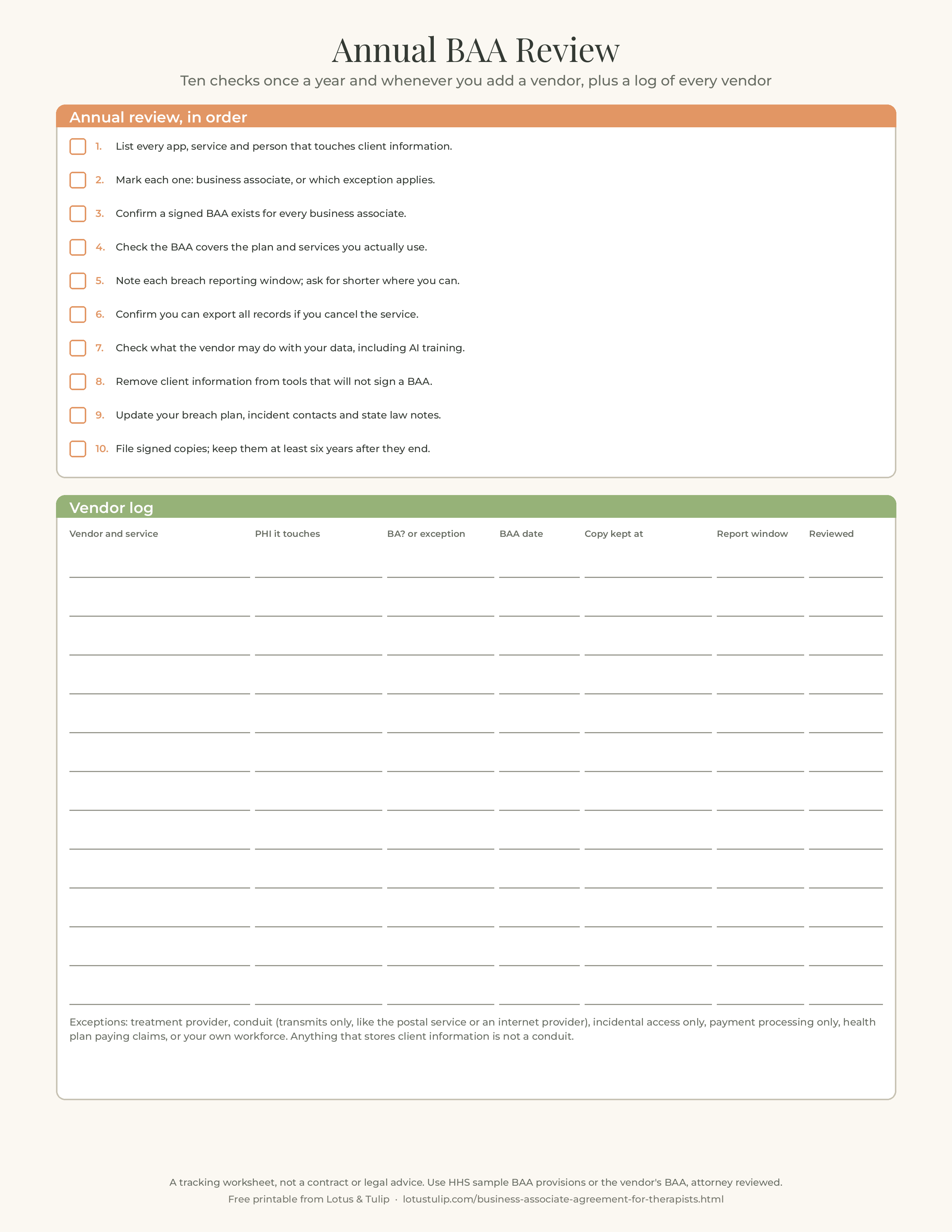
- Review every year and whenever you add a vendor. Check for new tools staff started using, changed plans, new subcontractors, and BAAs that were replaced by updated terms.
Filled example: a fictional practice's BAA inventory
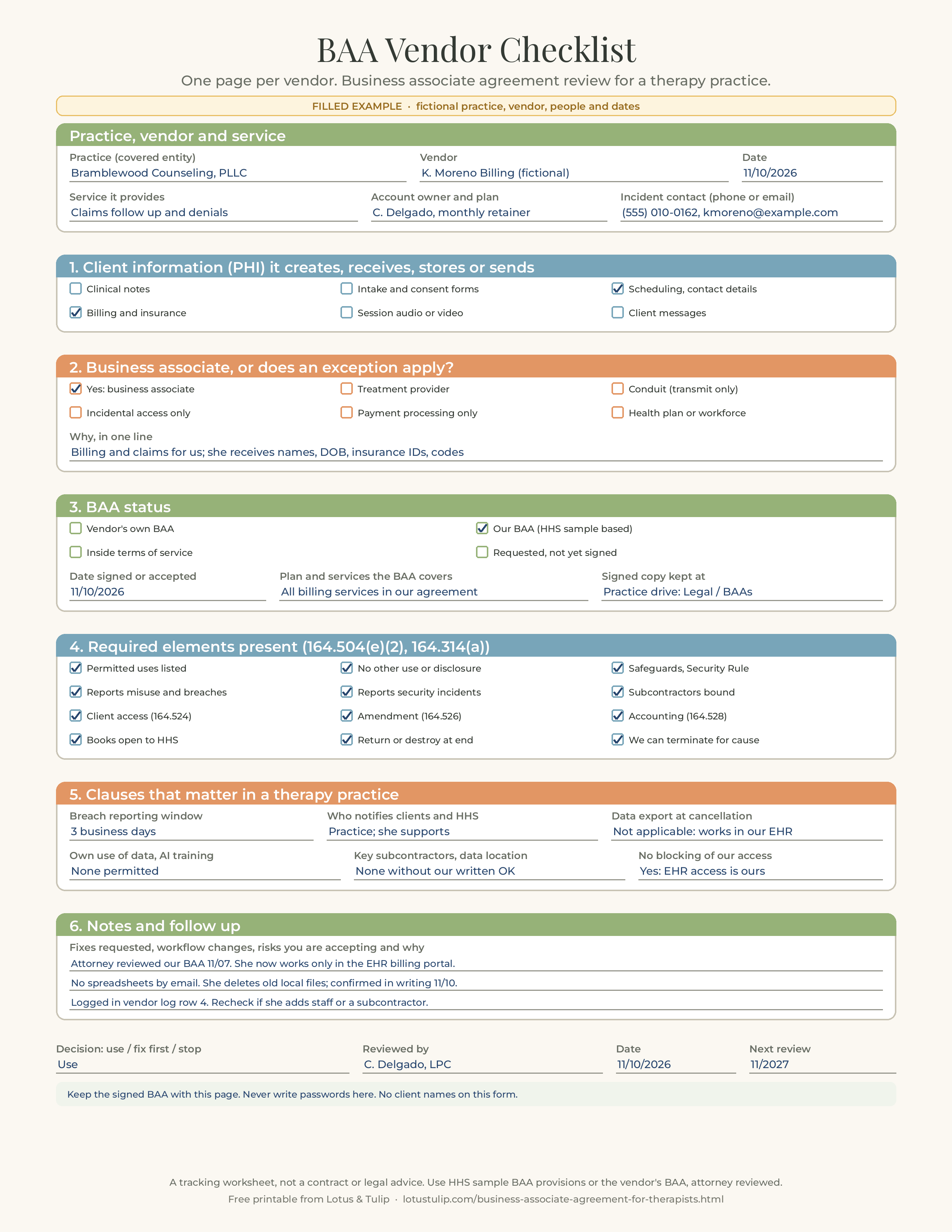
Bramblewood Counseling, PLLC (fictional) is a two clinician practice owned by C. Delgado, LPC (fictional), with one part time employed office manager. It bills four commercial plans electronically through its EHR, so it treats itself as a covered entity. In November 2026, C. Delgado sat down with the practice's card statements and phone and built this inventory. Every vendor name is invented.
| Vendor (fictional) | Service | PHI involved | Business associate? | BAA status | Breach reporting in BAA |
|---|---|---|---|---|---|
| Harborline EHR | Notes, scheduling, billing, client portal, reminders | Everything clinical and billing | Yes | Accepted in account settings 03/14/2024; PDF saved; reviewed 11/10/2026 | Within 5 business days of discovery |
| Clearwell Video | Telehealth sessions | Session audio and video, client names in waiting room | Yes | Signed on professional plan 08/02/2023; recording and chat turned off | Within 10 days |
| Northfield Workspace | Business email and cloud drive | Client emails, scanned records requests | Yes | BAA accepted in admin console 01/09/2025; covers email and drive only, not the vendor's chat tool | Per vendor BAA (no faster than law); noted as a risk |
| K. Moreno Billing (sole proprietor) | Claims follow up and denials | Names, DOB, insurance IDs, diagnosis and service codes | Yes | Practice's own BAA from HHS sample provisions, attorney reviewed, signed 11/10/2026 | Within 3 business days |
| Bluebird Answering | After hours call answering | Caller names, numbers, reason for call | Yes | Requested 11/10/2026; vendor sent its BAA 11/11/2026; signed | Within 5 business days |
| Ridgeway IT | Laptop setup and remote support | Possible access to devices with PHI | Yes | Signed 06/20/2025 | Within 48 hours |
| SecureShred Co. | On site shredding | Paper records and intake forms | Yes | Signed 02/01/2026; certificates of destruction kept | Within 5 business days |
| Ledgerwise Accounting | Bookkeeping and taxes | None after workflow change | No (PHI removed) | Not needed: receives monthly totals only, no client names | Not applicable |
| City Bank and card processor | Payments | Card transactions | No (payment processing) | Not needed | Not applicable |
| Home internet provider | Internet connection | Transmits only | No (conduit) | Not needed | Not applicable |
| Free notes app on personal phone | Used once for a session reminder | A client first name and time | Would be | No BAA available; deleted, office manager retrained, reminders now through EHR only | Not applicable |
Two decisions in this example are worth copying. The practice took PHI out of the bookkeeper's workflow instead of adding another BAA, and it found and removed a consumer app nobody had thought of as a vendor. It also wrote down one honest risk: its email vendor's BAA allows the federal maximum for breach reporting, so the practice keeps as little PHI in email as it can and moves records requests into the EHR portal.
Sample email asking a vendor for a BAA
"Subject: Business associate agreement request. Hello, I run Bramblewood Counseling, PLLC, a mental health practice that is a HIPAA covered entity. We would like to use [service] for [what you will use it for], which will involve [type of client information]. Before we do, we need a signed business associate agreement under 45 CFR 164.502(e) and 164.504(e). Could you send your standard BAA, tell me which plan it applies to and which services it covers, and confirm how quickly you report security incidents and breaches to customers? If you do not offer a BAA, please let me know so we can plan around it. Thank you, C. Delgado, LPC, Bramblewood Counseling."
Sample email to a small vendor, attaching your BAA
"Subject: BAA for billing services. Hi K., as we discussed, because you will be handling claims and client insurance information for Bramblewood Counseling, HIPAA requires a business associate agreement between us. I have attached ours, which is based on HHS's sample provisions and was reviewed by our attorney. It covers how you may use the information, safeguards, reporting any incident to us within three business days, what happens with any subcontractors, and returning or destroying records when our arrangement ends. Please read it, ask me anything that is unclear, and sign and return it before we send any client information. Thank you, C. Delgado."
Sample log entry after a vendor incident
"11/18/2026. Bluebird Answering called at 10:15 to report that on 11/16 a new operator sent one after hours message (client first name, callback number, 'wants to reschedule') to the wrong practice's email. Bluebird has asked the other practice to delete it and received written confirmation 11/17. Written report requested and received 11/18. Risk assessment (164.402 four factors) started 11/18 with attorney; see breach log. Next review of Bluebird BAA moved up to 12/2026."
Three short scenarios
1. The video platform from 2020. A psychologist started telehealth in 2020 on a free consumer video app and never switched. While renewing her malpractice policy, she reads a question about telehealth security, checks, and finds the app offers no BAA on the free tier. She moves to her EHR's built in video, which is covered by the BAA she already accepted, updates her telehealth consent with the new platform name, and logs the change. She asks her attorney whether past sessions raise any issue she needs to address.
2. The biller with a personal inbox. A group practice learns that its independent biller has been emailing claim spreadsheets from a personal email account. The practice has a signed BAA requiring appropriate safeguards. It writes to the biller, requires the spreadsheets to move to the EHR's billing portal, asks the biller to delete the copies in the personal account and confirm in writing, and documents a risk assessment with its attorney. When the biller does it again a month later, the practice ends the contract, as 164.504(e)(1)(ii) contemplates, and finds a billing company with a BAA and portal access.
3. The vendor breach notice. A solo counselor receives an email from her online intake form vendor: a misconfigured storage bucket exposed some customers' completed forms for several days. The vendor's notice arrives 40 days after it discovered the problem, and it cannot yet say whether her clients' forms were affected. Her BAA has no shorter reporting window. She calls her attorney and her insurer the same day, asks the vendor in writing for the list of affected individuals and the facts she needs for client notices (164.410(c)), starts her own four factor risk assessment, and asks her attorney whether the vendor was acting as her agent, which would affect when her 60 day clock started. At her next renewal, she moves intake to a vendor whose BAA requires notice within five business days.
Common BAA mistakes in therapy practices
- Assuming "HIPAA compliant" on a website means a BAA is in place.
- Using the free or consumer tier of a product whose BAA only covers paid business plans.
- Never accepting the BAA that sits in the EHR or email admin settings, so it was never actually signed.
- Forgetting people: the biller, the answering service, the IT helper, the shredding company.
- Thinking email or cloud storage is a "conduit." Anything that stores PHI is not.
- Letting an AI scribe or transcription tool use session data for model training without noticing the clause.
- No plan for getting records out of an EHR at cancellation, despite a state retention period measured in years.
- Treating the 60 day federal outer limit as the vendor's normal reporting time, with no shorter window negotiated.
- Keeping no vendor log, so nobody knows which BAAs exist, where the copies are, or who to call after an incident.
- Filing the BAA and ignoring a vendor's repeated violations, instead of requiring a fix and ending the arrangement if needed.
Free printable: BAA vendor checklist, filled example and vendor log
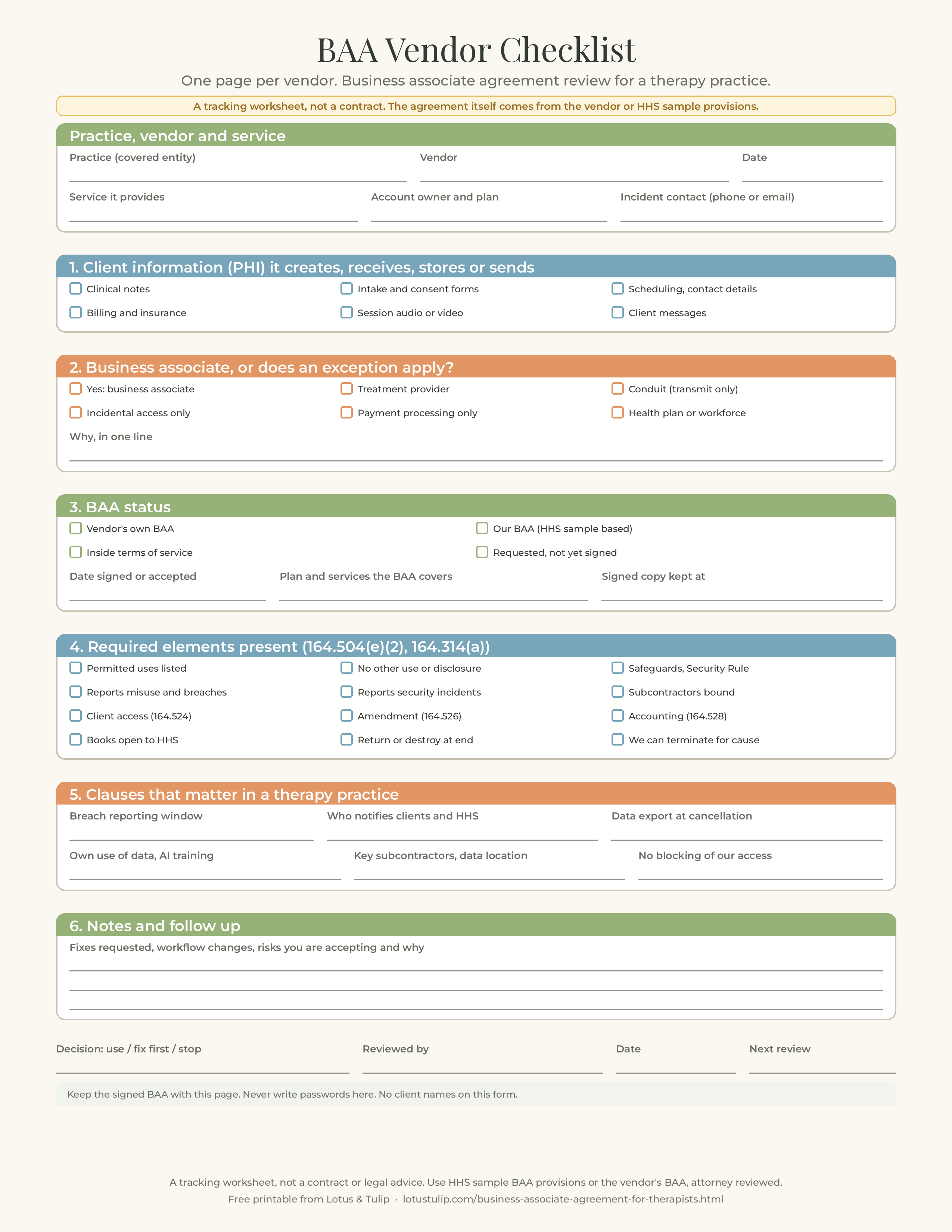
The free printable has three US Letter pages. Page 1 is a blank BAA vendor checklist worksheet for one vendor: practice, vendor, service, account owner and plan; tick boxes for the PHI the vendor touches (clinical notes, intake and consent forms, scheduling and contact details, billing and insurance, session audio or video, messages); whether it is a business associate or an exception applies (treatment, conduit, incidental access, payment processing, health plan, workforce); BAA status (vendor's BAA, practice's BAA from HHS sample provisions, inside the terms of service), date signed and where the signed copy is kept; tick boxes for the required elements under 164.504(e)(2) and 164.314(a); the practical clauses (reporting window, who notifies clients, data export, no blocking access, use of data for the vendor's own purposes, subcontractors and location, return or destroy); incident contact; decision and review date; and a signature line for the person who reviewed it. Page 2 is the same page filled for the fictional Bramblewood Counseling biller. Page 3 is a ten point annual review checklist and a twelve row vendor log.
Download the free BAA vendor checklist and log (PDF, 3 pages)
Rather type than handwrite? The free PDF above is for printing. Therapy Progress Notes and Intake Templates comes as a fillable PDF you type straight into (604 fields in Adobe Acrobat Reader), plus the printable version: SOAP, DAP and BIRP notes, intake, treatment plan and safety plan, 20 pages. Holiday 20% off: about $7.36, was $9 (EUR 8) · instant digital download
Buy on EtsyPrefer single images? Page 1: blank BAA vendor checklist (PNG) · Page 2: filled fictional example (PNG) · Page 3: review checklist and vendor log (PNG)
Free to print and use in your own practice. Please link to this page rather than re-uploading the file. This worksheet helps you track and review business associate agreements; it is not a business associate agreement, not a contract and not legal advice. For the agreement itself, start from the HHS sample business associate agreement provisions or your vendor's BAA, and have an attorney review it.
Related resources
- HIPAA breach notification for therapists: the four factor risk assessment, 60 day deadlines and a free incident log
- Telehealth across state lines for therapists
- Closing a therapy private practice: checklist, timeline, client letters, records plan and free printable
- HIPAA risk assessment for therapists: security risk analysis, filled example and free worksheet
- Notice of privacy practices for therapists, with a filled example
- Professional will for therapists: clinical executor, records custodian and a free printable
- Release of information form for therapists
- Treatment summary template and the HIPAA right of access
- Telehealth progress note template
- Informed consent for therapy template
- Psychotherapy notes vs progress notes
- Credit card authorization form for therapists
- Superbill template for therapists
Sources: 45 CFR 160.103 (definitions of business associate, covered entity, protected health information, subcontractor and workforce), 160.402(c), 164.308(b), 164.314(a), 164.402, 164.404, 164.406, 164.408, 164.410, 164.412, 164.501 (treatment), 164.502(a)(3) and (e), 164.504(e) and 164.530(j), eCFR text current as of November 2026; 42 CFR 2.11 (qualified service organization); HHS, Sample Business Associate Agreement Provisions (published January 25, 2013); HHS, Business Associates Frequently Asked Questions; HHS FAQ 245 on conduits; HHS, Guidance on HIPAA and Cloud Computing; HHS, Direct Liability of Business Associates; HHS final rule, 78 FR 5566 (January 25, 2013), preamble discussion of the conduit exception; HHS, Notice of Expiration of Certain Notifications of Enforcement Discretion, 88 FR 22380 (April 13, 2023); HHS, HIPAA Security Rule NPRM fact sheet (December 27, 2024) and 90 FR 898 (January 6, 2025). Rules and guidance change; check the current versions.
FAQ
What is a business associate agreement for therapists?
It is the written contract HIPAA requires between a therapy practice that is a covered entity and a vendor or contractor that creates, receives, maintains or transmits protected health information on the practice's behalf, such as an EHR, telehealth platform, billing service or answering service. It sets out what the vendor may do with client information and requires it to safeguard the information, report breaches and security incidents, bind its subcontractors, and return or destroy the information at the end (45 CFR 164.502(e) and 164.504(e)).
Do I need a BAA with my telehealth platform?
If your practice is a HIPAA covered entity and the platform handles your sessions or stores any client information on your behalf, yes. The COVID-19 enforcement discretion that allowed non public facing tools without a BAA ended on May 11, 2023, with a transition period that ended on August 9, 2023. HHS told providers to choose a telehealth vendor that will enter into a business associate agreement.
Do I need a BAA with my email provider or internet service provider?
An internet service provider that only transmits data is a conduit and does not need a BAA. An email or cloud storage provider that stores client information for you is not a conduit, because HHS limits the conduit exception to transmission with only temporary storage. If you keep client information in email or a cloud drive, you need a BAA on a plan and service it covers.
How long does a business associate have to report a breach?
Without unreasonable delay and no later than 60 calendar days after discovering a breach of unsecured protected health information (45 CFR 164.410(b)). The BAA can require faster notice, and many practices ask for a few business days, because the practice has its own duty to notify clients within 60 days of its discovery.
Is this BAA checklist a business associate agreement?
No. The free three page printable is a vendor checklist, a filled fictional example and a vendor log to help you track and review your agreements. It is not a contract. Use your vendor's BAA or the HHS sample business associate agreement provisions for the agreement itself, and have an attorney review it.