
Therapist practice · Updated 2026-11-10
Duty to Warn for Therapists: Tarasoff, State Laws, HIPAA and How to Document a Duty to Protect Decision (Free Printable)
Ready-made printable: Therapy Progress Notes and Intake Templates Fillable PDF, 20 pages: SOAP, DAP and BIRP notes, intake, treatment plan and safety plan
Holiday 20% off: about $7.36, was $9 (EUR 8) · instant digital download
Try it free first: download a fillable sample (SOAP note and DAP note, PDF, 226 KB). Type into it on screen, then get the full pack. No email needed.

Few moments in practice feel as heavy as the one where a client says something about hurting another person and you have to decide, often within the hour, whether confidentiality still holds. You know the word Tarasoff from graduate school. What you may not have at hand is the answer to the questions that actually decide what you do next. Does your state require you to act, only allow you to act, or neither? If you act, who are you allowed to tell: the person at risk, the police, a hospital, a state agency? What does HIPAA permit? What do the APA, ACA and NASW codes expect? And what, exactly, should be in the chart afterward, so that anyone reading it later can see that you made a careful, reasonable decision?
This guide is written for licensed counselors, marriage and family therapists, clinical social workers, psychologists and supervised associates in US practice. It explains where the duty came from (Tarasoff, 1976), how state laws differ, with examples taken from the official statute texts of California, Washington, Florida, Texas and New York, how to use the NCSL state by state chart without being misled by its age, what 45 CFR 164.512(j) allows, what the ethics codes say in their own words, a structured way to think through a threat, a ten step documentation process, sample chart wording, a fully worked fictional example and a free three page printable: a blank threat assessment and duty to warn or protect worksheet, the same worksheet filled in for a fictional practice, and a checklist with a contact and disclosure log.
Jump to the free duty to warn worksheet and log
This is educational information for licensed clinicians and trainees in the US. It is not legal advice and does not create any professional relationship. In a live situation, follow your state law, your licensing board's rules and your employer's policy, consult a colleague or supervisor, and call your malpractice carrier's risk management line or a health care attorney if you can do so without delaying protective action. If someone is in immediate danger, call 911. Statute text was checked on the official legislature websites of California, Washington, Florida and Texas, and New York's Mental Hygiene Law 9.46 against FindLaw's current text and the New York State NICS appeals office FAQ; federal rules were checked against the eCFR text in effect in November 2026; ethics code language was checked against the APA Ethics Code (2002, amended 2010 and 2016), the 2014 ACA Code of Ethics and the NASW Code of Ethics as published by each association.
The short answer
- The duty comes from Tarasoff, but its shape comes from your state. In 1976 the California Supreme Court held that when a therapist determines, or should determine under professional standards, that a patient "presents a serious danger of violence to another," the therapist "incurs an obligation to use reasonable care to protect the intended victim." Most states then wrote their own versions, and they differ a great deal.
- States fall into rough groups. Some impose a mandatory duty to warn or protect once a defined threshold is met (California, Washington). Some permit but do not require disclosure (Texas, where disclosure is allowed only to medical, mental health or law enforcement personnel, not to the victim). Some are hybrids (Florida allows a warning to the victim and, since 2019, requires disclosure to law enforcement). Some have a reporting duty to a public agency rather than to the person at risk (New York's MHL 9.46). And in a few, courts have declined to recognize a Tarasoff duty at all.
- The threshold is usually narrow. Typical statutes require a communicated, serious threat of physical violence against a reasonably identifiable victim. Vague anger, fantasies without intent, and threats with no identifiable target often fall outside the statutory duty, though they still call for clinical action and good notes.
- The statute usually tells you how to discharge the duty. In California, "reasonable efforts to communicate the threat to the victim or victims and to a law enforcement agency." In Washington, the same pair. Other states add hospitalization or commitment as alternatives.
- HIPAA permits, it does not require. 45 CFR 164.512(j) lets a covered provider disclose, in good faith and "consistent with applicable law and standards of ethical conduct," information necessary "to prevent or lessen a serious and imminent threat," to people "reasonably able to prevent or lessen the threat, including the target of the threat." State law still decides whether you must, may or may not.
- Document as you go. The chart should show the exact words, your assessment, the law you applied, who you consulted, every option you considered, what you did and why, who you told and exactly what you told them, and the follow up. A free worksheet for exactly this is below.
Where the duty came from: Tarasoff v. Regents of the University of California
The facts are well known but worth stating precisely, because the details shape the rule. According to the 1976 opinion, in August 1969 Prosenjit Poddar, a voluntary outpatient at Cowell Memorial Hospital at the University of California, Berkeley, told his psychologist, Dr. Lawrence Moore, that he intended to kill a young woman who was readily identifiable as Tatiana Tarasoff when she returned from a summer in Brazil. Dr. Moore, with two psychiatrist colleagues concurring, decided Poddar should be committed for observation and asked the campus police for help. Officers detained Poddar briefly but released him when he appeared rational and promised to stay away from her. The director of the department of psychiatry then directed that no further action be taken to detain him. No one warned Tatiana or her family. On October 27, 1969, Poddar killed her.
Her parents sued. The California Supreme Court first ruled in 1974 and then, after granting a rehearing, issued the opinion that is cited today: Tarasoff v. Regents of University of California (1976) 17 Cal.3d 425. The key passage reads:
"When a therapist determines, or pursuant to the standards of his profession should determine, that his patient presents a serious danger of violence to another, he incurs an obligation to use reasonable care to protect the intended victim against such danger. The discharge of this duty may require the therapist to take one or more of various steps, depending upon the nature of the case. Thus it may call for him to warn the intended victim or others likely to apprise the victim of the danger, to notify the police, or to take whatever other steps are reasonably necessary under the circumstances."
And the line every clinician remembers: "The protective privilege ends where the public peril begins."
Three details from the opinion matter for practice today.
- It is a duty to protect, and warning is one way to meet it. The court listed warning the victim, warning others likely to tell the victim, notifying police, or "whatever other steps are reasonably necessary." That is why many statutes and articles now say "duty to protect" or "duty to warn or protect."
- The standard is professional reasonableness, not perfect prediction. The court acknowledged that predicting violence is difficult and said "the therapist need only exercise that reasonable degree of skill, knowledge, and care ordinarily possessed and exercised by members of [that professional specialty] under similar circumstances," adding that "proof, aided by hindsight, that he or she judged wrongly is insufficient to establish negligence." Good documentation is how you show that reasonable process.
- Discretion is part of the duty. The court warned that a therapist "should not be encouraged routinely to reveal such threats," and that any disclosure should be made "discreetly, and in a fashion that would preserve the privacy of his patient to the fullest extent compatible with the prevention of the threatened danger." Minimum necessary, in other words, long before HIPAA used the phrase.
The opinion was not unanimous. Justice Clark's dissent argued that a duty to warn would deter people from seeking treatment and lead to more involuntary commitment, arguments that still shape how some states have written their laws.
California today: Civil Code 43.92
California later narrowed and codified the rule. Civil Code section 43.92(a), as amended effective January 1, 2013, says there is no monetary liability and no cause of action against a psychotherapist (as defined in Evidence Code section 1010) "in failing to protect from a patient's threatened violent behavior or failing to predict and protect from a patient's violent behavior except if the patient has communicated to the psychotherapist a serious threat of physical violence against a reasonably identifiable victim or victims." Subdivision (b) adds that a psychotherapist "discharges his or her duty to protect by making reasonable efforts to communicate the threat to the victim or victims and to a law enforcement agency."
The 2013 amendment (SB 1134) changed the name of the duty "from a duty to warn and protect to a duty to protect," and the statute says expressly that this was not intended as a substantive change: courts are to interpret it consistently with the section as it read before January 1, 2013. California's Evidence Code section 1024 separately removes the psychotherapist privilege when the therapist "has reasonable cause to believe that the patient is in such mental or emotional condition as to be dangerous to himself or to the person or property of another and that disclosure of the communication is necessary to prevent the threatened danger."
Mandatory, permissive, hybrid, reporting, or no duty: how state laws differ
After Tarasoff, nearly every state responded, by statute, by case law or both. The National Conference of State Legislatures summarizes the result: "Most states have laws that either require or permit mental health professionals to disclose information about patients who may become violent." The differences that matter in practice are these:
- Is there a duty at all, or only permission? A mandatory state can hold you liable for failing to act once the threshold is met. A permissive state lets you disclose without breaching confidentiality, but does not require it.
- What triggers it? Most statutes require a threat that was actually communicated, that is serious, that involves physical violence, and that points at a victim who is identified or reasonably identifiable. Some add imminence, or that the client has the apparent intent and ability to carry it out. Some cover threats communicated by a family member, not only the client.
- Who can you tell? The victim, law enforcement, a hospital or crisis team, a public agency, or some combination. In some states the victim is not on the list.
- How do you discharge the duty? Many statutes list the acceptable actions. If you take one of them, the duty is met and you are protected from liability for the disclosure.
- Which professions are covered? Statutes are often written for "psychotherapists," "mental health professionals" or a specific license, and the definitions differ.
Five verified state examples
The table below quotes or closely paraphrases the official statute text as it reads in November 2026. It is not a complete survey, and it is not a substitute for reading your own state's law, but it shows how different the rules really are.
| State and law | Type | What triggers it | Who you may or must tell, or what you must do |
|---|---|---|---|
| California Civil Code 43.92; Evidence Code 1024 | Mandatory duty to protect (liability statute) | "a serious threat of physical violence against a reasonably identifiable victim or victims," communicated to the psychotherapist | Duty discharged by "reasonable efforts to communicate the threat to the victim or victims and to a law enforcement agency." |
| Washington RCW 71.05.120(3) | Mandatory duty to warn or take reasonable precautions | "the patient has communicated an actual threat of physical violence against a reasonably identifiable victim or victims" | "discharged if reasonable efforts are made to communicate the threat to the victim or victims and to law enforcement personnel." |
| Florida section 491.0147 (clinical social workers, marriage and family therapists, mental health counselors) | Hybrid: permissive warning to the victim, mandatory disclosure to law enforcement (amended 2019, ch. 2019-134) | "a specific threat to cause serious bodily injury or death to an identified or readily available person," plus the licensee's clinical judgment that the client "has the apparent intent and ability to imminently or immediately carry out such threat" | Privilege "may be waived" to communicate the threat to the potential victim (1)(c); privilege "must be waived" and the licensee "shall disclose" to the extent necessary to communicate the threat to a law enforcement agency (2). Disclosures under either may not be the basis of legal action or liability. |
| Texas Health and Safety Code 611.004(a)(2), 611.002(b-1), 611.004(a-1) | Permissive; no common law duty to warn (Thapar v. Zezulka, Tex. 1999) | The professional "determines that there is a probability of imminent physical injury by the patient to the patient or others" | A professional "may disclose" only "to medical, mental health, or law enforcement personnel." The victim is not listed. 611.002(b-1) says no exception "may be construed to create an independent duty or requirement to disclose." Since 2021, (a-1) bars civil, criminal or administrative actions for a disclosure made under (a)(2). |
| New York Mental Hygiene Law 9.46 | Mandatory report to a public official, not to the person at risk | A treating mental health professional "determines, in the exercise of reasonable professional judgment, that such person is likely to engage in conduct that would result in serious harm to self or others" | Must "report, as soon as practicable, to the director of community services, or the director's designee," who reports names and non-clinical identifying information to the Division of Criminal Justice Services for firearms license purposes if the director agrees. Good faith decisions to disclose or not are protected from liability. |
A few things jump out. Florida's chapter 491 licensees and Texas professionals face almost opposite rules about the victim: Florida lets you warn the victim and requires a call to law enforcement once its threshold is met; Texas does not list the victim among the people you may tell at all. In Thapar v. Zezulka, 994 S.W.2d 635 (Tex. 1999), the Texas Supreme Court said that a disclosure to the threatened family "would have violated the confidentiality statute because no exception in the statute provides for disclosure to third parties threatened by the patient," and that the law enforcement exception "permits these disclosures but does not require them," so it declined "to impose a common law duty on mental-health professionals to warn third parties of their patient's threats." New York's 9.46 is a different animal altogether: it applies to threats of serious harm to self as well as others, it sends the report to a county official rather than the victim, and its purpose is firearms licensing review. It sits alongside, and does not replace, any other protective steps you take. Note that 9.46 also says nothing requires a professional "to take any action which, in the exercise of reasonable professional judgment, would endanger such mental health professional or increase the danger to a potential victim or victims."
At the other end of the spectrum, in Gregory v. Kilbride (2002) the North Carolina Court of Appeals declined to recognize a Tarasoff duty to warn in that case; North Carolina decisions have instead looked at a duty of reasonable care or control in certain settings, such as patients under involuntary commitment. The point for everyone else is simple: the rule you learned in school may not be the rule where you practice.
Using the NCSL state chart, carefully
The most useful single starting point is NCSL's page Mental Health Professionals' Duty to Warn. It has a map and a chart that lists, for each state, the relevant statutes, whether NCSL classifies the duty as mandatory, permissive or none, which professions it applies to, a summary and leading cases. It is genuinely helpful for finding the right statute number fast.
Use it as a map, not a final answer. The page itself says "Updated March 16, 2022," and several rows describe older versions of the law. When we checked in November 2026, the chart still described Florida's section 491.0147 in its permissive pre 2019 form (the current text requires disclosure to law enforcement) and Texas's section 611.004 as it read in 2005 (the current text adds "mental health" personnel and, since 2021, immunity for (a)(2) disclosures). Even official FAQs can lag: New York's NICS appeals office FAQ still describes MHL 9.46 as covering four professions, while the current statute text lists more, including licensed mental health counselors, licensed clinical marriage and family therapists and licensed master social workers. So: find the statute number on NCSL, then read the current text on your state legislature's website, then check your licensing board's rules and any guidance it publishes. Do this now, while things are calm, and keep a copy with your policies.
Which law applies when you practice by telehealth or across state lines?
Licensing boards generally treat a telehealth session as taking place where the client is physically located, which is why most clinicians must be licensed (or covered by a compact privilege) in the client's state. For duty to warn purposes, the cautious approach is to know the rule in the state where the client is located during sessions and the state where you are licensed and located, and if they differ, to consult before you need to act. Ask every telehealth client for their physical location at the start of each session and record it; you will need that address if you ever have to send help, and it tells you which state's law you are likely working under. Interstate compacts such as PSYPACT and the Counseling Compact deal with authority to practice; they do not make one state's confidentiality or duty to protect rules apply everywhere.
Who counts as a covered professional
Read the definitions. California's 43.92 applies to a "psychotherapist as defined in Section 1010 of the Evidence Code," a long list that includes psychologists, LCSWs, LMFTs, LPCCs and certain associates and trainees. Washington's 71.05.120 sits in the state's involuntary treatment chapter and says that the section does not relieve "a person" of the duty to warn; ask your board or an attorney how it applies to your setting. Florida's 491.0147 covers people licensed or certified under chapter 491, which is clinical social work, marriage and family therapy and mental health counseling; Florida psychologists are licensed under chapter 490, which has its own confidentiality section. Texas uses the broad term "professional" in chapter 611, which includes anyone licensed or certified by the state to diagnose, evaluate or treat a mental or emotional condition. If you supervise associates, interns or trainees, make sure your written policy tells them exactly when to call you, because in a crisis the duty usually runs through the licensed clinician responsible for the case.
What HIPAA allows: 45 CFR 164.512(j)
If your practice is a HIPAA covered entity (you bill insurance electronically, or use a vendor that does), the federal Privacy Rule is the second layer. The relevant permission is in 45 CFR 164.512(j), "Uses and disclosures to avert a serious threat to health or safety." Paragraph (j)(1) says a covered entity "may, consistent with applicable law and standards of ethical conduct, use or disclose protected health information, if the covered entity, in good faith, believes the use or disclosure":
"(A) Is necessary to prevent or lessen a serious and imminent threat to the health or safety of a person or the public; and (B) Is to a person or persons reasonably able to prevent or lessen the threat, including the target of the threat"
How that plays out for a therapist:
- It is a permission, not a mandate. HIPAA itself never requires you to warn anyone. Whether you must act comes from state law and your ethics code.
- State law can narrow it. The words "consistent with applicable law" matter. Where a state confidentiality law is more protective of the client, as in Texas, where the victim is not among the permitted recipients, you follow the state law, even though HIPAA would allow a disclosure to "the target of the threat."
- Good faith is presumed. Under (j)(4), a covered entity "is presumed to have acted in good faith" with regard to its belief "if the belief is based upon the covered entity's actual knowledge or in reliance on a credible representation by a person with apparent knowledge or authority." Your note should therefore say what you actually knew and who told you what.
- Psychotherapy notes are covered too. Normally psychotherapy notes need a specific authorization, but 45 CFR 164.508(a)(2)(ii) lists a disclosure "permitted by ... 164.512(j)(1)(i)" as an exception. In practice you rarely need to share notes at all; you share the threat.
- Minimum necessary applies. The minimum necessary standard in 164.502(b) applies to a permissive 164.512(j) disclosure. Share what the recipient needs to prevent the harm: who is at risk, the nature of the threat, relevant means and timing, and how to reach you. Leave out diagnosis, history and session content that does not serve that purpose. (Disclosures that are required by law fall under 164.512(a) and are limited instead to what that law requires.)
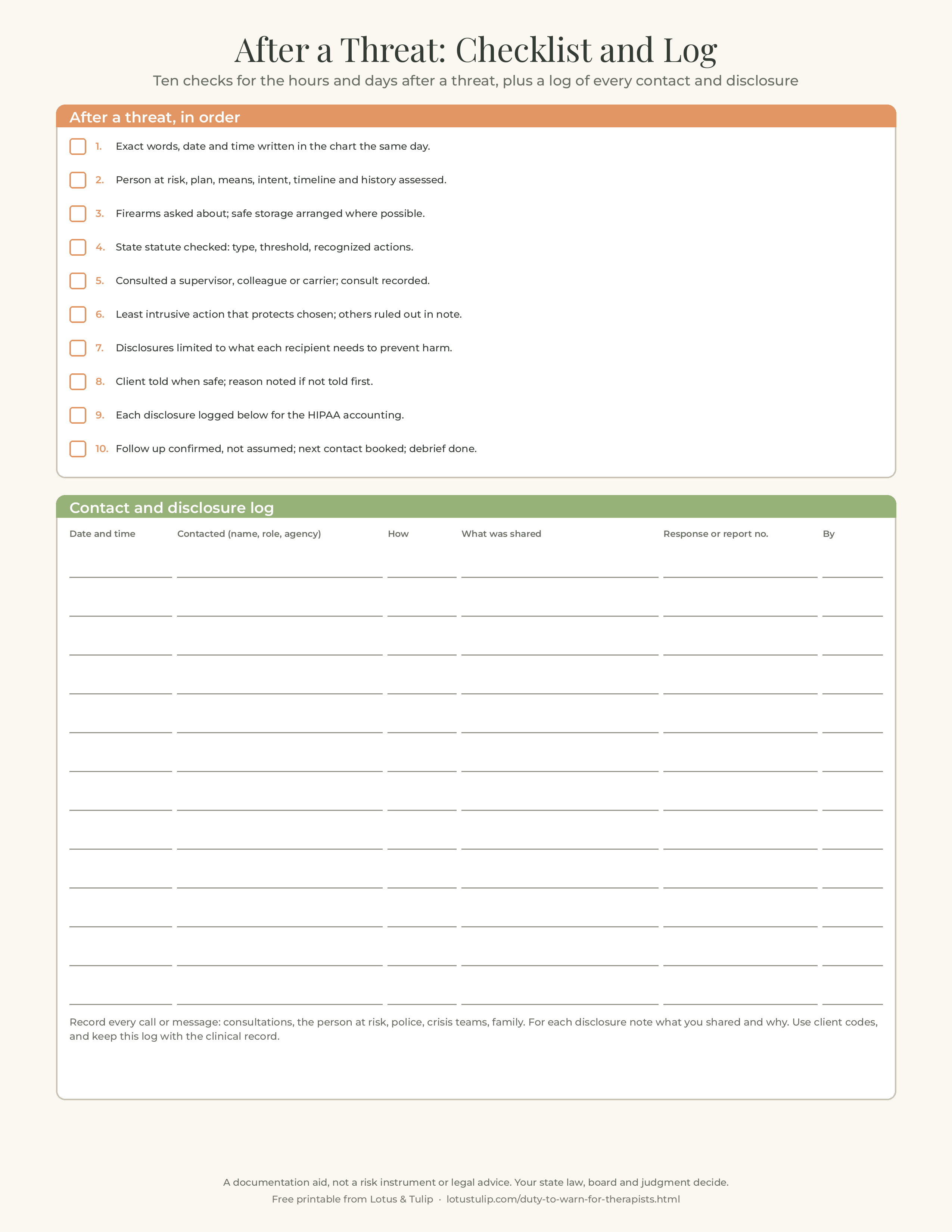
- Log it for the accounting of disclosures. Clients have a right to an accounting of certain disclosures made in the past six years (45 CFR 164.528). Disclosures under 164.512(j) are not in the list of exceptions, so record the date, the recipient, a brief description of what you shared and a brief statement of the purpose. The log on page 3 of the free printable has columns for exactly this.
- A narrower rule for admissions of past crimes. Paragraph (j)(1)(ii) also allows disclosure to law enforcement of a statement admitting participation in a violent crime, but (j)(2) says it may not be used when the information was learned "in the course of treatment to affect the propensity to commit the criminal conduct ... or counseling or therapy." For most therapists, (j)(1)(i), the serious and imminent threat permission, is the one that matters.
Two related notes. If you work in a federally assisted substance use disorder program, 42 CFR Part 2 adds its own confidentiality rules on top of HIPAA; check them before disclosing. And HHS's Office for Civil Rights maintains guidance titled "HIPAA Privacy Rule and Sharing Information Related to Mental Health," linked from its mental and behavioral health page, which walks through the 164.512(j) permission in plain language.
What the ethics codes say
The codes do not tell you what your state requires, but they do tell you how to handle confidentiality, consultation and disclosure. Here is the language, quoted from each association's current published code.
| Code and standard | What it says | What it means here |
|---|---|---|
| APA 4.02 Discussing the Limits of Confidentiality | Psychologists discuss "the relevant limits of confidentiality" and, "Unless it is not feasible or is contraindicated, the discussion of confidentiality occurs at the outset of the relationship and thereafter as new circumstances may warrant." | Your informed consent should name the danger to others exception, in words that match your state's law. |
| APA 4.05(b) Disclosures | "Psychologists disclose confidential information without the consent of the individual only as mandated by law, or where permitted by law for a valid purpose such as to (1) provide needed professional services; (2) obtain appropriate professional consultations; (3) protect the client/patient, psychologist, or others from harm." | Disclosure to protect others is ethical where the law mandates or permits it, and only then. |
| APA 4.06 Consultations | When consulting, psychologists do not disclose identifying information unless they have consent "or the disclosure cannot be avoided," and "disclose information only to the extent necessary to achieve the purposes of the consultation." | Consult without the client's name whenever you can. |
| ACA B.1.d Explanation of Limitations | "At initiation and throughout the counseling process, counselors inform clients of the limitations of confidentiality and seek to identify situations in which confidentiality must be breached." | Revisit limits when a client's risk changes, not only at intake. |
| ACA B.2.a Serious and Foreseeable Harm and Legal Requirements | "The general requirement that counselors keep information confidential does not apply when disclosure is required to protect clients or identified others from serious and foreseeable harm or when legal requirements demand that confidential information must be revealed. Counselors consult with other professionals when in doubt as to the validity of an exception." | Consultation is built into the standard. Document it. |
| ACA B.2.e Minimal Disclosure | "To the extent possible, clients are informed before confidential information is disclosed and are involved in the disclosure decision-making process. When circumstances require the disclosure of confidential information, only essential information is revealed." | Tell the client first when it is safe, and share only what is essential. |
| NASW 1.07(c) Privacy and Confidentiality | "The general expectation that social workers will keep information confidential does not apply when disclosure is necessary to prevent serious, foreseeable, and imminent harm to a client or others. In all instances, social workers should disclose the least amount of confidential information necessary to achieve the desired purpose." | The NASW test adds "imminent" and stresses the least amount necessary. |
| NASW 1.07(d) | "If social workers plan to disclose confidential information, they should (when feasible and to the extent possible) inform clients about the disclosure and the potential consequences prior to disclosing the information." | Same principle as ACA B.2.e: tell the client, when feasible. |
| NASW 1.07(e) | Social workers "should review with clients circumstances where confidential information may be requested and where disclosure of confidential information may be legally required." The code adds that this discussion "should occur as soon as possible" in the relationship and as needed throughout it. | Limits of confidentiality belong in the first session and again when risk comes up. |
Marriage and family therapists should read the AAMFT Code of Ethics as revised effective January 1, 2026, which addresses confidentiality and its legal exceptions in its own wording, together with their state board rules. If an ethics code and your state law seem to point in different directions, APA 1.02 and the parallel provisions in other codes ask you to clarify the conflict, make known your commitment to the code and take reasonable steps to resolve it; in a live safety situation, that usually means consulting immediately and documenting the reasoning.
Thinking through a threat: a structured approach
No form can predict violence, and no checklist replaces clinical judgment or training in violence risk assessment. What a structure does is make sure you ask the questions that both the law and good practice care about, and that your note shows you asked them. The worksheet in the free printable follows this order.
1. Capture the statement exactly
Write the client's words in quotation marks as close to verbatim as you can, with the date and time. "I'm going to make him pay" and "I'm going to shoot him when he walks out of work on Friday" lead to very different decisions, and a paraphrase hides that difference. If someone other than the client told you (a partner in a couples session, a parent, a family member on the phone), record who, how and when; some state statutes treat a threat reported by a family member differently from one made by the client.
2. Identify the target
Is there a named person, or one who is reasonably identifiable from what was said (a former partner, "my supervisor," "the guy in apartment 4")? Most statutory duties depend on an identified or reasonably identifiable victim. A threat against a group or a place (a workplace, a school) may fall outside the warning statute but still calls for protective action and may be reportable to law enforcement under HIPAA and your state's permissive rules.
3. Assess seriousness and imminence
The factors clinicians commonly document include:
- Plan: how specific, how detailed, how far developed.
- Means: access to firearms or other weapons, and whether the client has taken steps to get them. Ask directly about firearms.
- Intent: stated intent, and how the client talks about consequences.
- Timeline: a date, an event, a trigger ("when she gets out of the hospital").
- History: past violence, past threats that were or were not acted on, protective orders, arrests.
- Current state: intoxication or substance use, psychosis or command hallucinations, agitation, recent loss (job, relationship, custody), humiliation or grievance.
- Protective factors: engagement in treatment, willingness to follow a safety plan, willingness to give up access to weapons, relationships and responsibilities that matter to the client.
- Risk to self: homicidal and suicidal risk often travel together; assess both every time.
If you use a structured professional judgment tool in your setting and are trained in it, record the tool and the result. If you are not trained in a tool, do not borrow one under pressure; describe your clinical reasoning instead.
4. Check the law before you decide
Write down which state's law applies, the statute section, whether it is mandatory or permissive, what the threshold is and whether you believe it is met, and the actions the statute recognizes. If you prepared a one page summary of your state's rule in advance (strongly recommended), this takes two minutes. If you did not, a call to your malpractice carrier's risk management line is often the fastest route to a reliable answer.
5. Consult
ACA B.2.a builds consultation into the standard, and every risk management source recommends it. Consult a supervisor, a trusted colleague or your carrier, without the client's name if possible (APA 4.06). Record who you consulted, when, what you shared and what they advised. Consultation is not a reason to delay protective action when the danger is imminent; call 911 first if you must, and consult right after.
6. Choose the least intrusive action that will actually protect
Warning is not the only option, and in some states it is not an allowed one. The options, roughly from least to most intrusive, are:
- Continue and intensify treatment: more frequent sessions, a same day or next day follow up, a documented plan for the next contact.
- A safety plan that addresses the threat, built with the client, with specific coping steps and people to call.
- Means safety: with the client's agreement, arranging for firearms or other weapons to be stored away from the client, and confirming that it happened.
- Involving family or other supports, with the client's consent.
- Voluntary hospitalization or a crisis evaluation.
- Initiating an involuntary evaluation through your state's process (a mobile crisis team, a designated crisis responder, or emergency services).
- Warning the identified victim, where your state law requires or permits it.
- Notifying law enforcement, where your state law requires or permits it.
- Reporting to a designated agency, where your state requires it (New York's MHL 9.46 is an example).
Some states also have extreme risk protection order laws, under which certain people can ask a court to temporarily remove firearms; Florida's section 491.0147(2) mentions a "risk protection order" as one of the actions law enforcement may take after receiving a therapist's report. Check whether your state has such a law and who may petition.
Whatever you choose, the note should show the options you considered, the one you chose and why, and why you did not choose the others.
Telling the client
ACA B.2.e and NASW 1.07(d) both ask you to inform the client before a disclosure "to the extent possible" or "when feasible." Often, telling the client is also good clinical practice: many clients who make threats are frightened by their own feelings, and an honest conversation about what you must do can open the door to a voluntary plan.
A workable sequence, when it is safe:
- Name what you heard and why it concerns you, in plain language.
- Remind the client of the limit of confidentiality you discussed at intake.
- Explain what you are required or permitted to do, and what you plan to do.
- Invite the client into the plan: Will they agree to a safety plan, to store a weapon elsewhere, to a crisis evaluation, to call the person themselves with you present?
- Record the client's response, in their words where possible.
Do not tell the client first if doing so would increase the danger to the victim or to you, for example where the client might act before help arrives. New York's 9.46 explicitly does not require any action that would endanger the professional or "increase the danger to a potential victim or victims." Note the reason you did not tell the client in advance, and tell them afterward if and when it becomes safe.
Informed consent: set this up before you need it
The best time to talk about the duty to warn is the first session, not the crisis. APA 4.02, ACA B.1.d and NASW 1.07(e) all expect it. Generic language ("I may break confidentiality if you are a danger to yourself or others") is better than nothing, but language that matches your state's actual rule is better still. A sample, to adapt with your attorney or board's guidance:
"What you share in therapy is confidential, with a few exceptions required or allowed by law. If you tell me about a serious threat of physical violence against a person who can be identified, [state] law [requires / allows] me to take steps to protect that person, which may include [warning the person, contacting law enforcement, or arranging a crisis evaluation or hospitalization]. If I believe you are at serious risk of harming yourself, I may also need to act to keep you safe. Whenever it is safe and possible, I will talk with you first and share only what is needed."
Adapt the bracketed parts to your state. In Texas, for example, you would not promise or threaten to warn the victim, because the statute does not list the victim as a permitted recipient; in Florida, for a chapter 491 licensee, you would mention law enforcement. Revisit the conversation whenever risk comes up in treatment, and note that you did.
Documentation: what belongs in the chart
When a duty to warn or protect question comes up, your note is the record of a professional judgment made under pressure. It should allow someone reading it months later (a board investigator, a court, a new clinician) to follow your reasoning. Write it as soon as possible, ideally the same day, and add a late entry, clearly labeled with the actual time written, if you have to finish it later. Never alter an earlier entry.
Include:
- The trigger: date, time, setting (in person, telehealth with the client's location), who made the statement and the words used, in quotation marks.
- Your assessment: the target and whether they are identifiable, plan, means (including firearms), intent, timeline, history, current state, protective factors and risk to self.
- The law and policy you applied: state, statute, mandatory or permissive, threshold met or not and why, and any employer or agency policy.
- Consultation: who, when, what you shared, what they advised.
- Options considered: each one, with a short reason for choosing or rejecting it.
- Actions taken: what you did, in time order.
- Disclosures: to whom (name, role, agency, phone), when, how (phone, in person), exactly what you shared and what they said or did. This doubles as your HIPAA accounting record.
- The client: whether and when you told them, what you said, how they responded.
- Follow up: the next contact, who will check on what, and when you will reassess.
Keep these entries in the clinical record, not in psychotherapy notes. They document a disclosure and a risk decision, and they need to be available to the people who may later have a legitimate need to review your care. See psychotherapy notes vs progress notes for the difference.
Sample note wording (fictional)
The wording below is invented and matches the filled example later in this guide. It shows the level of detail, not a script to copy.
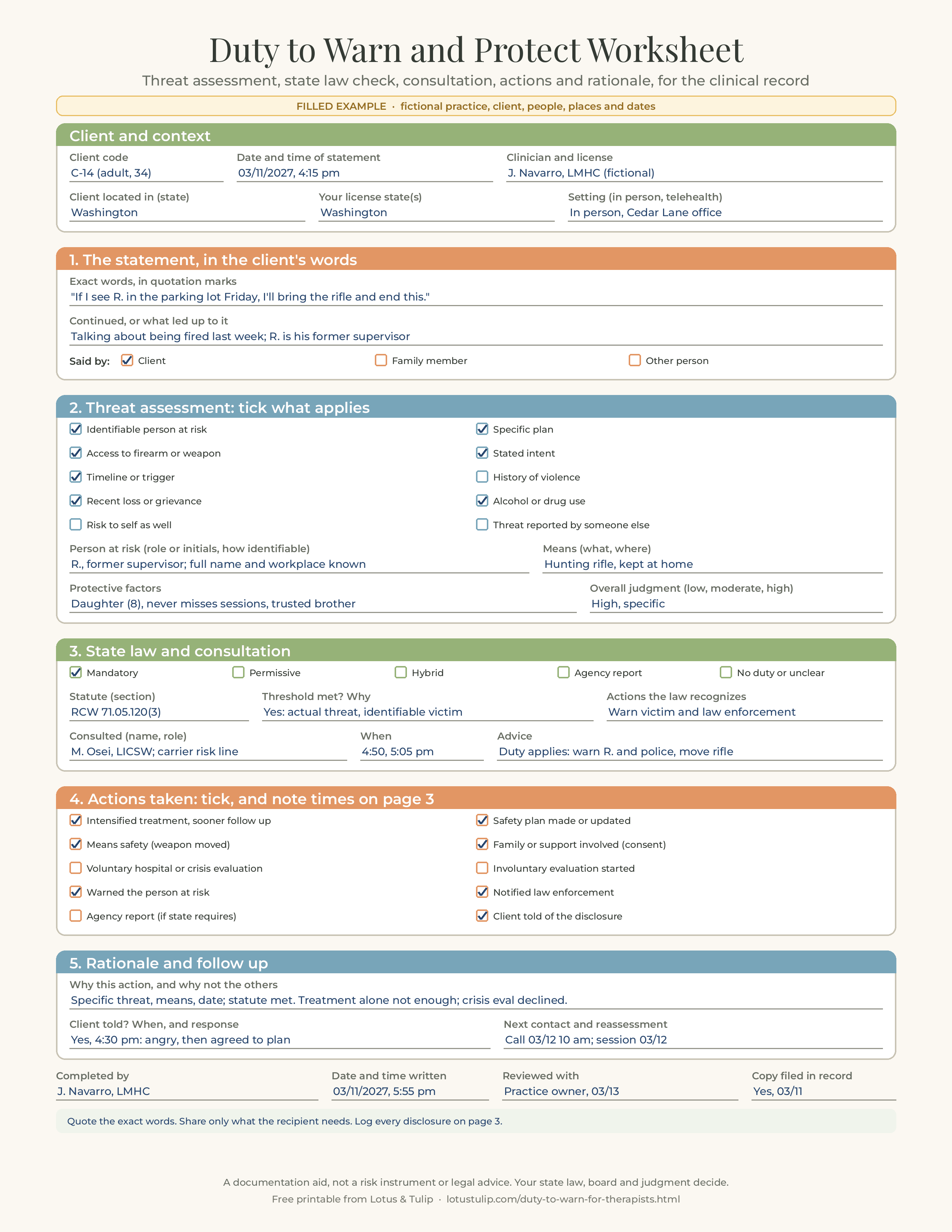
Risk note, 03/11/2027, 4:40 pm (written 5:55 pm). Client C-14, 34, seen in person. At 4:15 pm, discussing being fired last week, client said: "If I see R. in the parking lot Friday, I'll bring the rifle and end this." R. is client's former supervisor, full name and workplace known to client and to me. Client reports owning a hunting rifle kept at home, drinking more since the firing (about 6 beers most nights), poor sleep, no prior violence toward others, one past protective order petition against him (2019, dismissed). Denies current suicidal thoughts; denies plan to harm self. Protective factors: 8 year old daughter he sees on weekends, has kept every appointment, brother he trusts.
Washington law applies (client and practice in WA). RCW 71.05.120(3): duty to warn or take reasonable precautions where the patient has communicated an actual threat of physical violence against a reasonably identifiable victim; discharged by reasonable efforts to communicate the threat to the victim and to law enforcement. Threshold met: specific threat, identifiable victim, means, date.
Consulted M. Osei, LICSW (peer consultation, no client name given) at 4:50 pm by phone and the malpractice carrier's risk line at 5:05 pm. Both agreed the statutory duty applies and advised warning R. and police, plus means safety and crisis evaluation offer.
Discussed with client at 4:30 pm before he left: told him what he said worries me, reminded him of the limits of confidentiality reviewed at intake, and that I am required to let R. and police know. Client was angry, then tearful; said "I wouldn't really." Agreed to his brother taking the rifle tonight and to a safety plan; declined crisis evaluation. Brother called from session at 4:35 pm, agreed to pick up rifle by 7 pm and text me a confirmation (client signed release for brother, 4:36 pm).
Disclosures: 5:15 pm, police non-emergency line for R.'s city, Officer T. Lee, report #2027-0311-882: shared client's name, the statement, the rifle, Friday parking lot, R.'s name and workplace, my contact details; no diagnosis or history. 5:30 pm, reached R. by phone at work: shared that a person known to her made a threat of physical violence against her involving a firearm and the workplace parking lot on Friday, that police have been informed and their report number; did not share client's diagnosis or treatment details. R. said she would tell building security. Accounting of disclosures entries made.
Plan: brother to confirm rifle moved by 7 pm; phone check in with client tomorrow 10 am; session moved up to Thursday 03/12; reassess risk at each contact; review with practice owner Friday. J. Navarro, LMHC.
Addendum, 03/11/2027, 6:50 pm. Brother texted 6:48 pm: rifle now at his home. J. Navarro, LMHC.
What to say when you call the person at risk or the police
Prepare the call before you dial. Keep it short, factual and limited to what the person needs to stay safe.
- Identify yourself: name, license, practice, a call back number.
- State the purpose: "I am calling because of a safety concern involving you" (to the victim) or "I am a licensed mental health professional reporting a threat of violence" (to police).
- Share the threat: who is at risk, what was threatened, any weapon and any time or place. To police, also the client's identity and location if known.
- Do not share: diagnosis, treatment history, unrelated session content or your opinion of the client beyond what the risk requires.
- Close the loop: ask what the person will do (report number, safety steps), give your number, and write it all down immediately.
If the danger is immediate, call 911 first and give the location of the client and the person at risk. If you cannot reach the victim after reasonable efforts, document every attempt (times, numbers, messages left) and make sure law enforcement has the information.
How to handle a duty to warn or protect situation, step by step
- Prepare before it happens. Look up your state's statute (start with the NCSL chart, then read the current text on your legislature's site), write a one page summary of the threshold, the permitted or required recipients and the recognized actions, update your informed consent to match, and save your carrier's risk line number and local police non-emergency numbers.
- Write down the exact words. As soon as a threat comes up, record the statement in quotation marks with the date and time, who said it and the setting, including the client's location for telehealth.
- Assess the threat. Identify the target, then assess plan, means (ask about firearms), intent, timeline, history of violence, current state and substance use, protective factors and risk to self.
- Apply your state's law. Note the statute, whether it is mandatory or permissive, whether the threshold is met and why, and which actions discharge the duty.
- Consult. Call a supervisor, a colleague or your carrier's risk line, sharing as little identifying information as possible, and record who you spoke to, when and what they advised; if danger is immediate, call 911 first.
- Choose the least intrusive action that will protect. Consider intensified treatment, a safety plan, means safety, voluntary hospitalization, a crisis or involuntary evaluation, warning the victim, notifying police and any required agency report, and record why you chose or rejected each one.
- Tell the client when it is safe. Explain what you heard, the limit of confidentiality, what you must or may do and invite them into a voluntary plan; if telling them first would increase danger, note why and tell them later.
- Make the disclosures, minimum necessary. Call law enforcement and, where your state allows or requires it, the person at risk; share only the threat details they need, and write down the name, agency, time, report number and their response.
- Write the full note the same day. Record the assessment, the law, the consultation, the options, the actions, the disclosures and the client's response, and add each disclosure to your accounting of disclosures log.
- Follow up and review. Confirm safety steps actually happened (for example, that a firearm was moved), schedule the next contact, reassess at each session, debrief with a supervisor or colleague, and update your policy if the situation exposed a gap.
Filled example: a fictional practice works through a threat
Everything in this example is invented: the practice, the people, the dates, the report number. It matches page 2 of the free printable and the sample note above.
The practice. Cedar Lane Counseling, PLLC is a two clinician group practice in Washington State. J. Navarro, LMHC, has seen client C-14, a 34 year old man, weekly for four months for depression and anger after a divorce. The practice's informed consent includes Washington specific language about the duty to warn, and J. Navarro keeps a one page summary of RCW 71.05.120(3) in the practice's policy binder.
The statement. On Wednesday, March 11, 2027, at 4:15 pm, while talking about being fired the previous week, C-14 says: "If I see R. in the parking lot Friday, I'll bring the rifle and end this." R. is his former supervisor. J. Navarro writes the words down during the session.
Assessment. J. Navarro asks follow up questions and records the answers: R. is identifiable (full name and workplace known); the client owns a hunting rifle kept at home; the timeline is specific (Friday, the parking lot); he has been drinking more since the firing; there is no history of violence toward others, but a 2019 protective order petition against him was filed and dismissed; he denies suicidal thoughts. Protective factors: his daughter, steady attendance, a brother he trusts. J. Navarro judges the threat serious and specific.
The law. Both the client and the practice are in Washington. Under RCW 71.05.120(3), the duty applies where "the patient has communicated an actual threat of physical violence against a reasonably identifiable victim or victims," and it is discharged by reasonable efforts to communicate the threat to the victim and to law enforcement. J. Navarro concludes the threshold is met.
Telling the client. Before the session ends, at 4:30 pm, J. Navarro tells C-14 what worries her and that she is required to let R. and the police know. He is angry, then tearful, and says he would not really do it. He agrees to a safety plan and to his brother taking the rifle that evening, and signs a release so J. Navarro can speak with his brother. He declines a crisis evaluation. J. Navarro judges that telling him first does not increase the danger, because the rifle is at home, the threat is for Friday and his brother will be with him.
Consultation. At 4:50 pm J. Navarro calls a peer consultant, M. Osei, LICSW, without using the client's name, and at 5:05 pm the malpractice carrier's risk management line. Both agree the statutory duty applies and support the plan: warn R. and police, confirm the rifle is moved, see the client again within two days.
Disclosures. At 5:15 pm J. Navarro calls the police non-emergency line for the city where R. works and lives, reaches Officer T. Lee and receives report number 2027-0311-882. At 5:30 pm she reaches R. at work, tells her that a person known to her made a threat of physical violence involving a firearm and the workplace parking lot on Friday, that police have a report, and gives the report number. She does not share the client's diagnosis or treatment details. R. says she will tell building security.
Follow up. J. Navarro writes the full note at 5:55 pm, with a time stamp showing when it was written, and adds both disclosures to the accounting log. The brother texts at 6:48 pm that the rifle is at his home, and she adds a dated addendum. She calls the client at 10 am the next day, moves his session up to Thursday and reviews the case with the practice owner on Friday. All of this goes on the worksheet and the log.
What makes this a defensible record is not that the outcome was good. It is that the note shows a specific statement, a real assessment, the actual statute, consultation, options weighed, the least intrusive effective steps, disclosures limited to what was needed, the client involved where it was safe, and follow up that was checked rather than assumed.
Five short scenarios
1. Angry but vague. A client says, "Sometimes I want to strangle my brother-in-law." There is no plan, no history of violence, no means discussion, and the client laughs it off and talks about how much he loves his sister. Most statutes would not be triggered by this alone, but it is still a risk conversation. Ask the follow up questions, note the answers and your reasoning ("statement of anger without plan, intent or means; no history; threshold under [statute] not met"), and revisit next session.
2. A threat with no identifiable victim. A client says he "could see himself doing something" at a crowded event, with no person named. A victim specific warning statute may not apply, but that does not end your responsibility. Assess thoroughly, consult, consider a crisis evaluation or hospitalization, and consider whether law enforcement should be notified under your state's permissive rules and HIPAA 164.512(j), which allows disclosure to people "reasonably able to prevent or lessen the threat."
3. Texas. A client in Texas makes a specific threat against a former partner. Under Health and Safety Code 611.004(a)(2), the professional may disclose to medical, mental health or law enforcement personnel when there is a probability of imminent physical injury, and since 2021 such disclosures are protected by (a-1). The former partner is not a listed recipient, and Thapar found no duty to warn. A Texas clinician in this situation would typically consider law enforcement, a crisis team or hospital, and intensive clinical steps, and would consult before contacting the former partner directly.
4. A family member reports the threat. In a family session, a mother says her adult son told her he plans to hurt his ex. The son is your client but did not say it to you. Some statutes are written around threats the patient "communicated" to the therapist; others include threats reported by a knowledgeable person. Assess with the client present if possible, check your statute's wording, consult and document who said what.
5. Telehealth across state lines. Your client, usually in Oregon, joins a session from a relative's home in Washington and makes a specific threat against someone there. Record the client's current location, consider both states' rules, call emergency services local to the client's location if the danger is immediate, and consult quickly about which state's law governs the rest.
Common mistakes
- Relying on what you learned in school. The Tarasoff rule taught in many programs is California's. Your state may be stricter, looser or entirely different.
- Trusting a summary chart as the final word. NCSL's chart is a great index but some rows describe older versions of the law. Read the current statute.
- Promising absolute confidentiality. Or the opposite: promising a warning your state does not permit. Match your consent form to your state.
- Paraphrasing the threat. "Client made threatening statements" tells no one anything. Quote it.
- Not asking about firearms. Means is one of the most practical things you can change. Ask, and if possible arrange safe storage.
- Warning without assessing, or assessing without acting. Both are errors. The note should show you did both, in order.
- Telling more than necessary. The person at risk needs the threat, not the diagnosis. Minimum necessary protects the client and the treatment.
- Skipping consultation, or not writing it down. ACA B.2.a expects it. A consult that is not documented is hard to prove.
- Writing the note days later, or editing old notes. Write the same day. If you must add later, add a dated late entry. Never change what was already written.
- Forgetting the accounting log and the follow up. A 164.512(j) disclosure belongs in your accounting of disclosures, and a plan that is never checked (was the rifle actually moved?) is not a plan.
Free printable: duty to warn and protect worksheet, filled example and log
The free printable has three US Letter pages. Page 1 is a blank threat assessment and duty to warn or protect worksheet: client code, date and time of the statement, clinician and license, and the state(s) involved (client location and your license); the statement in the client's words and who reported it; a threat assessment section with tick boxes for an identifiable victim, a specific plan, access to firearms or other means, stated intent, a timeline or trigger, a history of violence, recent loss or grievance, substance use, risk to self and protective factors; a state law check (statute, type of law, threshold met or not, recognized actions); a consultation box; ten action tick boxes from intensified treatment and safety planning to warning the victim, notifying police and a required agency report; the rationale for the decision; and a sign off line. Page 2 is the same worksheet filled in for the fictional Cedar Lane Counseling, PLLC. Page 3 is a ten point checklist for the hours and days after a threat and a twelve row contact and disclosure log, with columns for date and time, who was contacted, how, what was shared, their response and who made the contact, so it can double as your record for the HIPAA accounting of disclosures.
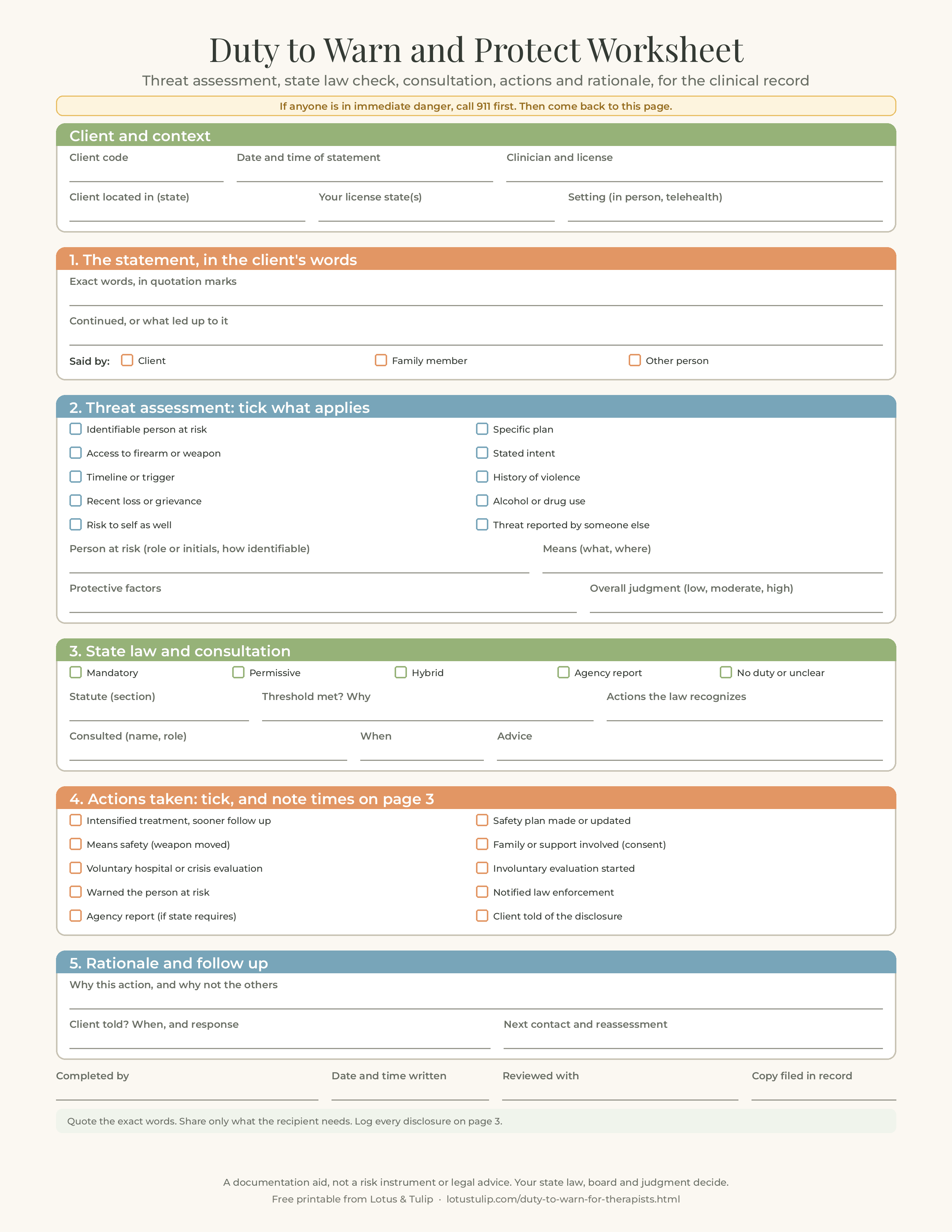
Download the free duty to warn worksheet (PDF, 3 pages)
Rather type than handwrite? The free PDF above is for printing. Therapy Progress Notes and Intake Templates comes as a fillable PDF you type straight into (604 fields in Adobe Acrobat Reader), plus the printable version: SOAP, DAP and BIRP notes, intake, treatment plan and safety plan, 20 pages. Holiday 20% off: about $7.36, was $9 (EUR 8) · instant digital download
Buy on EtsyPrefer single images? Page 1: blank worksheet (PNG) · Page 2: filled fictional example (PNG) · Page 3: checklist and disclosure log (PNG)
Free to print and use in your own practice. Please link to this page rather than re-uploading the file. This worksheet organizes your documentation; it is not a validated risk assessment instrument and it is not legal advice. Your state law, your licensing board, your employer's policy and your clinical judgment decide what you must do. File the completed worksheet in the clinical record, and use client codes on page 3 if the log is kept separately.
Related resources
- Clinical supervision agreement for therapists: template, board rules and a supervision log
- Telehealth across state lines: which state's rules apply
- Safety plan worksheet, free printable
- Informed consent for therapy template, including limits of confidentiality
- Psychotherapy notes vs progress notes
- Notice of privacy practices for therapists
- Release of information form for therapists
- Couples therapy informed consent form
- Mental status exam template and examples
- Telehealth progress note template
- HIPAA risk assessment for therapists
- Closing a therapy private practice
Sources: Tarasoff v. Regents of University of California (1976) 17 Cal.3d 425; Thapar v. Zezulka, 994 S.W.2d 635 (Tex. 1999); Gregory v. Kilbride (N.C. Ct. App. 2002); California Civil Code section 43.92 and Evidence Code sections 1010 and 1024 (California Legislative Information); Revised Code of Washington 71.05.120 (Washington State Legislature); Florida Statutes section 491.0147 (2026 Florida Statutes, Online Sunshine); Texas Health and Safety Code sections 611.002 and 611.004 (Texas Constitution and Statutes); New York Mental Hygiene Law section 9.46 (current text, and the New York State NICS appeals office SAFE Act FAQ); National Conference of State Legislatures, Mental Health Professionals' Duty to Warn (updated March 16, 2022); 45 CFR 164.502(b), 164.508(a)(2), 164.512(a) and (j), and 164.528, eCFR text in effect in November 2026; HHS Office for Civil Rights, Information Related to Mental and Behavioral Health; American Psychological Association, Ethical Principles of Psychologists and Code of Conduct (2002, amended 2010 and 2016), standards 1.02, 4.02, 4.05 and 4.06; American Counseling Association, 2014 ACA Code of Ethics, standards B.1.d, B.2.a and B.2.e; National Association of Social Workers, Code of Ethics, standard 1.07(c), (d) and (e).
FAQ
What is the duty to warn for therapists?
It is a legal duty, created by the California Supreme Court in Tarasoff v. Regents (1976) and later adopted in different forms by most states, to take reasonable steps to protect a person when a client poses a serious danger of violence to them. Depending on the state, the steps may include warning the person, notifying law enforcement, or arranging hospitalization. Many states now call it a duty to protect, and some states only permit disclosure rather than require it.
Is duty to warn mandatory in every state?
No. Some states impose a mandatory duty once a defined threshold is met (for example California under Civil Code 43.92 and Washington under RCW 71.05.120). Others only permit disclosure (Texas allows disclosure to medical, mental health or law enforcement personnel but not to the victim, and its Supreme Court rejected a common law duty to warn in Thapar v. Zezulka). Florida's chapter 491 licensees may warn the victim and must notify law enforcement once its threshold is met. New York requires a report to the county director of community services. A few states have no recognized duty. Read your own state's current statute.
What triggers the duty to warn?
Most statutes require that the client communicated a serious threat of physical violence against an identified or reasonably identifiable victim. Some add imminence or that the client appears to have the intent and ability to carry it out, and some include threats reported by family members. Vague anger without a plan or an identifiable target usually does not trigger the statutory duty on its own, though it still calls for assessment and documentation.
Does HIPAA allow a therapist to warn someone?
Yes, within limits. 45 CFR 164.512(j) permits a covered provider, consistent with applicable law and ethical standards, to disclose information it believes in good faith is necessary to prevent or lessen a serious and imminent threat, to people reasonably able to prevent or lessen it, including the target. HIPAA does not require the disclosure, and a more protective state law still controls who you may tell. Share only the minimum necessary and log the disclosure for the accounting of disclosures.
How should a therapist document a duty to warn decision?
Record the client's exact words with the date and time, your assessment of the target, plan, means, intent, timeline, history and protective factors, the state law you applied and whether its threshold was met, who you consulted and what they advised, the options you considered and why you chose one, every disclosure (who, when, how, what was shared, their response), whether and how you told the client, and the follow up plan. Write it the same day and use dated addenda for later information.
Should I tell my client before I warn someone?
When it is safe and feasible, yes. The ACA Code (B.2.e) and the NASW Code (1.07(d)) both ask you to inform clients before a disclosure where possible, and doing so often opens the door to a voluntary safety plan. Do not tell the client first if it would increase the danger to the person at risk or to you; document why, and tell the client later if it becomes safe.