
School counselors · Updated 2026-11-11
ASCA Mindsets and Behaviors Pre and Post Survey Questions: An Item Bank for All 36 Standards (Free Printable)
Ready-made printable: Complete Small Group Counseling Bundle Holiday 20% off: about $29.44, was $37 (EUR 32) · instant digital download
Buy on Etsy
Most school counselors can write a good lesson faster than they can write the four questions that measure it. The lesson takes an evening. The pre and post items get written at 7:40 the next morning, and they show it: "Did you like today's lesson?", "I am a good friend," "I know what empathy is." Every student agrees on the pre-test, every student agrees on the post-test, the bar graph shows 3.8 next to 3.9, and nobody, including you, learns anything from it. If you apply for RAMP, those same items are scored by a reviewer, because the fifth edition rubric checks that every learning objective has at least one assessment item and that the results are calculated the way ASCA asks.
This guide is a working item bank. It is organized the way ASCA organizes its standards: the six Mindset Standards (M 1 to M 6) and the thirty Behavior Standards in three groups, Learning Strategies (B-LS 1 to 10), Self-Management Skills (B-SMS 1 to 10) and Social Skills (B-SS 1 to 10). For each standard you get the exact standard wording from ASCA's current PDF, two Likert attitude items you can rate on a 1 to 4 scale, and one or two knowledge items with a short answer key. All of them are starting points written for this page, not ASCA items, and every one of them should be edited to match the learning objective you actually teach.
Around the bank, the guide covers what ASCA's fifth edition templates and RAMP rubric actually say about pre and post items (and what they do not say); why the plans use behavior standards and where mindset items still belong; the difference between Likert and knowledge items and when to use each; rules for writing items students can read and answer honestly, with weak and strong versions side by side; choosing a scale; versions for K to 2, grades 3 to 5, middle and high school; how many items to use; how to give the survey; how to score it, with the exact formulas; the two graphs; how the items move into your classroom lesson plan, your small-group plan and your achievement gap plan; a ten step process; a worked fictional example with real arithmetic; six scenarios; common mistakes; and a free three page printable: a blank pre and post survey builder, the same builder filled in for the example, and a scoring sheet that turns tallies into the averages and percentages ASCA's data organizer asks for.
Jump to the free survey builder, filled example and scoring sheet
This is educational information for school counselors in the US, not legal advice or official ASCA guidance. Your district, your state's school counseling framework and your evaluation system may set their own rules for student surveys. The ASCA documents quoted here were downloaded from schoolcounselor.org and checked on November 10 and 11, 2026 (the Student Standards PDF was downloaded again on November 11, 2026 and its text matched the copy checked the day before): "ASCA Student Standards: Mindsets and Behaviors for Student Success" (2021 standards, PDF marked "Updated 10/2025"), ASCA's sample learning objectives spreadsheet, the fifth edition Lesson Plan and Data Report, Small-Group Plan and Data Report and Achievement Gap Plan and Data Report templates and ASCA's completed examples (all marked "8/25"), the "RAMP Scoring Rubric, Fifth Edition," "The ASCA National Model: A Framework for School Counseling Programs, Fifth Edition," "Changes in the ASCA National Model Fifth Edition," the ASCA Ethical Standards for School Counselors (2022) and, for comparison, the fourth edition RAMP rubric. The items in the bank are our own. Anything we could not confirm in ASCA's documents is marked as such below.
The short answer
- What ASCA asks for: one or two pre and post items for each learning objective. The achievement gap plan template says "One or two per learning objective," "The attainment of each learning objective is measured by a pre-/post-assessment statement," and "Likert-scale or knowledge-based items are recommended." The lesson plan and small-group templates say to write "one-two assessment items" per learning objective.
- What RAMP scores: that "Each learning objective aligns with at least one pre-/post-assessment item" (item 2.11; items 5.5 and 6.6 say "assessment item"), that the data "calculates average student responses for Likert items or percent correct for knowledge-based items" (2.22, 5.9, 6.12), and that "Results provided for each assessment item in plan" (2.23, 5.10, 6.13).
- Standards on the plan: behavior standards. RAMP items 2.9, 5.3 and 6.4 ask for behavior standards from the ASCA Student Standards, and the fifth edition defines ASCA Student Standards data by "the behavior standards." Mindset items still have a place in needs assessments and program-wide surveys.
- Two item types: Likert items ("I ask an adult for help when I am stuck," rated 1 = Strongly Disagree to 4 = Strongly Agree), reported as an average, and knowledge items ("Name two adults at school you could ask for help"), reported as percent correct. Every ASCA fifth edition example we checked uses that four point Likert scale; we did not find a rule that requires it.
- How many: ASCA's Student Standards PDF says "No more than three to five questions or prompts are needed for any one measure." For a single lesson, two to four items is plenty.
- How to write them: start from ASCA's own stems, "I believe…, I know… and I can…", then make each item one idea, first person, about a concrete situation, at the students' reading level, with nothing that every student would agree with on day one.
- How to score them: Likert: add the ratings and divide by the number of students who answered. Knowledge: count the correct answers, divide by the number of students who answered, multiply by 100. Same students, same items, same order before and after.
- What to show: pre and post side by side for each item, Likert items and knowledge items on separate bar graphs (as in all three ASCA fifth edition examples), with the scale defined on the Y-axis.
What ASCA actually says about pre and post items
There is no single ASCA document called "pre and post survey guidelines." The rules are spread across five places, and it helps to see them together before you write anything.
1. The ASCA Student Standards PDF
The standards document lists ten steps for implementing the standards. Step 5 is "Create pre-/post-assessment," explained as "School counselors create a pre-/post-assessment based on the student learning objectives and selected student standard." Step 7 is "Administer pre-assessment," "to determine the baseline knowledge and skills of targeted students," and step 9 is "Administer post-assessment," "assessing the students' acquisition of the knowledge and skills." Step 10 is "Reflect on areas for improvement."
The section "Collecting ASCA Student Standards Data" is the closest thing ASCA has to item writing advice, and it is worth quoting in full where it matters:
- "School counselors go beyond asking if participants enjoyed the activity or if they believed it was beneficial. Rather, school counselors ask questions around the key ASCA Student Standards data concepts: knowledge, attitudes and skills."
- "Brainstorming statements that begin with stems such as I believe…, I know… and I can… guide question development. Once several of those statements have been written, they can be reworded into prompts that become data measures for multiple standards."
- "Simple, meaningful questions can be most helpful in creating a data story. Measurement is less time-consuming when the standards measures are easy-to-administer, easy-to-score and easy-to-analyze."
- "No more than three to five questions or prompts are needed for any one measure. Forcing that limitation maintains the concentrated focus of both the intervention and the measure."
2. The fifth edition definition of ASCA Student Standards data
The fifth edition framework names three data categories. The middle one is "ASCA Student Standards Data," defined as "The knowledge and skills students need for life-readiness as defined by the behavior standards from the ASCA Student Standards and measured through pre-/post-assessments," which "Measures attainment of the ASCA Student Standards." ASCA's changes document says this is the same thing the fourth edition called "Mindsets & Behaviors data." So if an older colleague talks about "M and B data" or "perception data," they mean your pre and post results.
3. The three fifth edition templates
Each template that carries pre and post items has its own short directions. We checked the blank templates and ASCA's completed examples:
| Template | What it says about items |
|---|---|
| Achievement Gap Plan and Data Report | Learning objectives: "Include one or two objectives per standard." Items: "One or two per learning objective," "The attainment of each learning objective is measured by a pre-/post-assessment statement," "Administer pre-assessment before any strategies are delivered," and "Likert-scale or knowledge-based items are recommended." The blank template has two objective rows, each with two item lines. |
| Lesson Plan and Data Report (classroom) | "Include one or two objectives that align with the selected behavior standard," begin each with "Students will…," and "Write one-two assessment items per learning objective. Administer pre-/post-assessments aligned with the learning objectives for: 1. each lesson or 2. the beginning of the first and end of the last lesson of the unit." |
| Small-Group Plan and Data Report | One behavior standard per session, "Limit of one objective aligned with the selected standard per session," "Write one-two assessment items aligned with each learning objective," and "Administer pre-assessment for entire small group before or during session one." |
All three data organizers use the same instruction for the results: calculate "the average student response for each Likert-scale item, or percent correct for each knowledge-based item."
4. The RAMP Scoring Rubric, Fifth Edition
| What is checked | Gap plan (Section 2) | Lesson (Section 5) | Small group (Section 6) |
|---|---|---|---|
| Behavior standard(s) chosen well | 2.9 "informed by the goal, contributing factors and student/education partner perspectives" | 5.3 "Limit of one behavior standard" | 6.4 "Limit of one behavior standard … for each session plan" |
| Objectives align with the standard | 2.10 | 5.4 | 6.5 |
| Each objective has an item | 2.11 "at least one pre-/post-assessment item" | 5.5 "at least one assessment item" | 6.6 "at least one assessment item" |
| Results calculated correctly | 2.22 | 5.9 | 6.12 |
| A result for every item | 2.23 | 5.10 | 6.13 |
| Graph | 2.15 to 2.18 (side by side, aggregate, subtitle, axis labels, "if Likert-scale used, defines the scale," a data point on each bar) | 5.8 | 6.10 |
Item 2.17 adds that pre and post data must be "represented side by side and accurately depicts aggregate data, not individual student data." Notice what the rubric does not score: the wording quality of your items. A reviewer checks alignment and arithmetic, not whether the item was a good question. That is your job, and it is the part that decides whether the data tells you anything.
5. What we could not find
We did not find, in any of the ASCA documents listed above: a required number of Likert points (every fifth edition example uses 1 = Strongly Disagree to 4 = Strongly Agree); a rule about whether Likert and knowledge items must both appear (the examples mix them); a rule for open-ended items; how to handle students who miss the pre or post; whether items must be piloted; a reading level requirement; or a published item bank. ASCA's sample learning objectives spreadsheet lists objectives, not items.
Mindsets or behaviors: which standard goes on the plan?
ASCA's Student Standards PDF describes the six mindsets as standards "related to students' psycho-social attitudes or beliefs about themselves in relation to academic work," introduced with "School counselors encourage the following mindsets for all students." The thirty behaviors are "visible, outward signs that a student is engaged as well as putting forth effort to learn," and they are introduced with "School counselors provide culturally sustaining instruction, appraisal and advisement, and counseling to help all students demonstrate." ASCA's step 3 says counselors "choose a specific behavior standard from the ASCA Student Standards that best aligns with the data and the potential contributing factors."
ASCA's November 2025 newsletter article on the fifth edition Manage component ("Manage: Approaching the Work and Using Templates") puts it most directly: ASCA Student Standards data is "a change in name only, with the focus of data collection on the behavior standards of the ASCA Student Standards. The mindsets are best understood as byproducts of students attaining the behavior standards."
For a fifth edition lesson plan, small-group plan or gap plan, that settles it: name a behavior standard, write objectives that align with it, and write items that measure the objectives. This was different in the fourth edition, whose classroom and group action plan and results reports used "Mindsets & Behaviors" throughout, and many older plans named M 2 or M 4 directly. (Our delivery plan guide covers converting those rows.)
The mindsets do not disappear. Attitude items written from a mindset are useful in three places:
- Needs assessments and program surveys. A short annual student survey of belonging (M 2), attitude toward school work (M 3) and confidence (M 4) tells you where to aim lessons. Our needs assessment guide shows how.
- As a second item under a behavior objective, when the attitude is part of what the lesson teaches. A B-SMS 5 perseverance lesson can carry "I believe I can get better at hard work if I keep practicing" (an M 4 style item) next to a knowledge item, as long as the objective is about perseverance and the item clearly measures it.
- In reflections and reports to your advisory council, where "students feel more confident" is part of the story.
What we would not do in a RAMP submission is make a mindset item the only item for an objective, or list a mindset as the plan's standard. Item 5.3 asks for one behavior standard, and items 5.5 and 6.6 ask that each objective have an assessment item. A pure belief item measured against a skill objective is the easiest alignment for a reviewer to question.
Likert items and knowledge items: what each one measures
ASCA groups what students gain into "knowledge, attitudes and skills." Pre and post items reach those three in two formats.
| Likert (attitude or self-rated skill) item | Knowledge item | |
|---|---|---|
| What it looks like | A first person statement the student rates: "When I feel angry, I can use a calm down tool before I act." | A question with a right answer: "Name two calm down tools you can use when you feel angry." |
| Stems | "I believe…", "I can…", "I feel…", "When…, I…" | "I know…" reworded as a question: name, list, which, what should, explain |
| Scoring | Average rating (for example 2.3 on a 1 to 4 scale) | Percent of students correct (for example 41 percent) |
| Strength | Fast, works for young students, catches attitude and confidence | Harder to fake, shows learning directly, graphs clearly |
| Weakness | Students rate themselves high before you teach anything; social desirability | Needs an answer key; reading and writing load; tests recall, not use |
| Best for | Attitudes, confidence, self-reported habits, K to 2 with faces | Strategies, steps, vocabulary, resources, "what would you do" scenarios |
Skills are the hard one. "I can use a planner" is a self-rating of a skill; "Look at this planner entry, what is missing?" checks the skill. When an objective says "Students will demonstrate" or "will use," try to include at least one item where the student does a small piece of the skill on paper: sorts examples, picks the best response in a scenario, fixes a weak example. That is still a knowledge item for scoring purposes (percent correct), and it is much closer to the behavior the standard names.
One detail from ASCA's own small-group example is worth noticing. Its session 2 item reads "I can name three adults I can go to for help at WPHS," which looks like a Likert statement, but the data organizer reports it as a percentage (11 percent before, 89 percent after). If you want percent correct, ask the student to actually write the names: "Write the names or jobs of three adults at school you can go to for help." Then the item has an answer key, and a reviewer can see why it is a percentage.
How to write a Likert item students answer honestly
A Likert item fails in one of two ways: students cannot tell what it means, or every student agrees with it before you teach anything. Both give you flat data. These rules prevent most of it.
- One idea per item. "I listen and take turns in a group" is two items. A student who listens but interrupts does not know how to answer.
- First person, present tense. "I…" or "When…, I…". Not "Students should…" and not "Kids my age…".
- A concrete situation. "When a test question is hard, I keep trying" is easier to rate honestly than "I am a hard worker." The situation also makes the item point at what you taught.
- Measure the objective, not the topic. If the objective is "Students will use a three step plan to calm down," the item is about using the plan, not about anger in general.
- Leave room to grow. Avoid items almost every student will rate 4 on the pre: "I care about my friends," "I want to do well in school." Those are fine values and poor measures.
- No negatives. "I do not give up easily" confuses young readers, and a negatively worded item has to be reverse scored before you average it. Write it positively.
- No absolute words. "Always" and "never" push answers to the ends. "Usually" is also hard on a four point agree scale. Let the scale carry the frequency.
- Plain words at the students' reading level. Read the item aloud to yourself in the voice of your lowest reader. Swap "utilize" for "use," "peers" for "classmates," "strategies" for "tools" or "ways."
- Nothing personal you do not need. Skills, not home life, feelings about family, mental health history or private behavior. That keeps you clear of survey consent rules (see below) and keeps answers honest.
- The same item, word for word, before and after. If you fix an item after the pre, you have two different items and no comparison.
Weak and strong, side by side
| Weak item | Problem | Stronger item |
|---|---|---|
| I liked today's lesson. | Satisfaction, which ASCA says to go beyond | I can name one thing to do when I feel left out at recess. (rate) |
| I am a good friend. | Everyone agrees on the pre | When a classmate is sitting alone, I invite them to join in. |
| I listen and take turns. | Two ideas | When someone is talking in a group, I wait until they finish before I talk. |
| I never give up. | Absolute word | When my math work is hard, I keep trying for at least five minutes before I ask for help. |
| I don't get distracted in class. | Negative wording | I can get back to my work after something distracts me. |
| I understand empathy. | Vocabulary, not the skill | I can tell how a classmate feels by looking at their face and body. |
| I manage my time effectively. | Vague, adult words | I write down my homework before I leave school. |
| I feel sad a lot at home. | Personal and outside the lesson; may need consent | When I feel sad at school, I know an adult I can talk to. |
| Students should respect differences. | Not first person, not ratable | I treat classmates with respect when their ideas are different from mine. |
| I know how to set a SMART goal and track it weekly. | Two ideas, jargon | I have a goal for this grading period that I can explain to an adult. |
Choosing a scale
Every fifth edition ASCA example we checked (the lesson plan, the small-group plan and the gap plan) graphs Likert items as "Average Likert Scale Response (1=Strongly Disagree - 4=Strongly Agree)" (the examples spell it "Strongrly," a typo you do not need to copy). A four point scale has no neutral middle, so students have to lean one way. We did not find an ASCA rule requiring four points, five points or any particular labels, but the graph item in the rubric asks that the Y-axis label "defines the scale," so whatever you choose, write it on the graph.
| Scale | Labels | Good for |
|---|---|---|
| 4 point agree | 1 Strongly disagree, 2 Disagree, 3 Agree, 4 Strongly agree | Grades 3 to 12; matches ASCA's examples |
| 4 point frequency | 1 Not yet, 2 Sometimes, 3 Often, 4 Almost always | Habit items ("I write down my homework…") |
| 3 faces | 1 No / not yet, 2 Sometimes, 3 Yes | K to 2, read aloud; graph as "1 = No, 3 = Yes" |
| 4 point confidence | 1 Not sure at all, 2 A little sure, 3 Pretty sure, 4 Very sure | "How sure are you that you can…" items |
Two practical rules. Use one scale for every Likert item on the same survey, so averages can sit on one graph. And never compare averages from different scales: a 2.5 on a three point scale and a 2.5 on a four point scale are not the same result.
How to write a knowledge item with a clear answer key
A knowledge item is only as good as its key. Write the key at the same time as the item, before the pre-test, and decide what counts as correct.
- Name or list: "Name two adults at school you could ask for help with schoolwork." Key: any two school adults by name or job. Decide now whether "my mom" counts (it does not, for this item).
- Which is best (multiple choice): "Your friend says something unkind about a new student. What is the best thing to do? A. Laugh along. B. Say 'That's not kind' and invite the new student over. C. Walk away and say nothing." Three options are enough for elementary students; four for older students. Keep the wrong options plausible.
- Fix the example: "Look at this planner entry: 'Math: page 42.' What is missing?" Key: the due date (and, if you taught it, which problems).
- Scenario, short answer: "Jordan has a science project due in two weeks and has not started. Write the first step Jordan should take." Key: break it into parts, make a plan or schedule, or ask the teacher what is required; any one counts.
- Sort: "Circle the things that are in your control: the weather, my effort, what my friend thinks, my homework plan." Key: effort and homework plan, both circled, nothing else.
Score knowledge items as correct or not correct. Partial credit is tempting, but ASCA's data organizer asks for "percent correct," and a yes or no rule is easier to apply the same way on the pre and the post. If an item asks for two things, say in the key that both are needed, as our small-group plan example does ("a student counts as correct only with two acceptable answers").
Open "describe" items are the hardest to score. ASCA's gap plan example uses "Describe what makes it hard for you to learn in math" and reports it as a percentage (35 percent to 90 percent) without saying what made an answer correct. We did not find ASCA guidance on scoring open items. If you use one, write a one line rule in your notes ("correct = names at least one specific barrier, such as 'I don't know my facts' or 'I miss class on Mondays'") so the post is scored the same way as the pre.
Versions for K to 2, grades 3 to 5, middle and high school
The same objective needs different wording at different ages. ASCA's Ethical Standards ask counselors to "Consider the student's developmental age, language skills, home language and competence level when determining an assessment's appropriateness" (A.14.d).
| Band | What changes | Example for B-SS 3 (positive relationships with adults) |
|---|---|---|
| K to 2 | Read every item aloud, two or three items, three faces, a practice item first ("I like ice cream"), pictures for multiple choice, answers by circling | "When I need help, I can tell my teacher." (faces) and "Circle the grown-ups at school who can help you." (pictures of a teacher, the nurse, the counselor, a stranger at the fence) |
| 3 to 5 | Read aloud is still wise; four point scale with words; short written answers; three option multiple choice | "When I am stuck on my work, I ask an adult at school for help." and "Name two adults at school you could ask for help with schoolwork." |
| 6 to 8 | Students read on their own; scenarios work well; avoid items that sound babyish | "I know which adult at school to go to for help with a class, a friend problem or a schedule problem." and a scenario: "You are failing a class and the teacher seems busy. Who else could you talk to? Name two." |
| 9 to 12 | Real school systems and real deadlines; short answer and best choice items; privacy matters more | "I have at least one adult at school who knows my goals after high school." and "Name two people at school who can help with a college or career application." |
For English learners, give the items in the student's home language where you can, read them aloud, and keep the vocabulary in the items the same as the vocabulary in the lesson. For students with IEPs or 504 plans, use the accommodations in their plans (read aloud, extended time, scribe). A changed accommodation between pre and post is a change in the measure; keep them the same.
The item bank: pre and post items for all 36 ASCA Student Standards
How to use the bank. Find the standard you chose for your lesson, group or gap plan. Copy one Likert item and one knowledge item that fit your objective, then edit them until they measure exactly what you will teach. The standard wording in each row is copied from ASCA's PDF ("ASCA Student Standards: Mindsets and Behaviors for Student Success," marked "Updated 10/2025"). The items are written for grades 3 to 8 unless a row says otherwise; use the band table above to adjust. "L" is a Likert item (rate 1 = Strongly Disagree to 4 = Strongly Agree), "K" is a knowledge item, followed by its key in brackets.
ASCA's sample learning objectives spreadsheet is a good partner to this bank. The version we checked has just over 900 sample objectives, each tagged by grade band and standard, for example "Students will appraise goal progress and goal achievement" (B-LS 7) and "Students will clarify what is and is not within one's personal control" (B-SMS 7). Pick an objective there or write your own, then pick items here.
Mindset Standards (M 1 to M 6)
ASCA: "School counselors encourage the following mindsets for all students." Use these attitude items in needs assessments, annual program surveys, or as a second item under a behavior objective (see above). They are not a substitute for a behavior standard on a fifth edition plan.
| Standard (ASCA wording) | Likert items | Knowledge or reflection item |
|---|---|---|
| M 1. Belief in development of whole self, including a healthy balance of mental, social/emotional and physical well-being | L: I believe taking care of my body (sleep, food, movement) helps me do better at school. L: I believe my feelings are as important to take care of as my grades. | K: Name one thing you can do to take care of your body and one thing you can do to take care of your feelings. [one of each] |
| M 2. Sense of acceptance, respect, support and inclusion for self and others in the school environment | L: I feel like I belong at this school. L: I believe every student at this school deserves to feel welcome, including students who are different from me. | K: Name one thing you could do this week to help a new or left out student feel welcome. [any specific inclusive action] |
| M 3. Positive attitude toward work and learning | L: I believe what I learn in school will help me later. L: When I start a new assignment, I expect to learn something from it. | K: Name one thing you learned this year that you use outside of school. [any real example] |
| M 4. Self-confidence in ability to succeed | L: I believe I can get better at hard things if I keep practicing. L: I can do well in my classes this year. | K: Name one thing you used to find hard that you can do now. [any specific example] |
| M 5. Belief in using abilities to their fullest to achieve high-quality results and outcomes | L: I try to do my best work, not just finish. L: I believe my effort makes a difference in how well I do. | K: What is one thing you can do to turn "finished" work into your best work? [check, revise, ask for feedback, add detail] |
| M 6. Understanding that postsecondary education and lifelong learning are necessary for long-term success | L: I believe I will need to keep learning after high school to reach my goals. L: I know at least one kind of training or school I could go to after high school. (grades 6 to 12) | K: Name two kinds of learning people can do after high school. [any two: college, community college, apprenticeship, trade or technical school, military training, certificate programs, on the job training] |
Behavior Standards: Learning Strategies (B-LS 1 to B-LS 10)
ASCA defines Learning Strategies as "Processes and tactics students employ to aid in the cognitive work of thinking, remembering or learning."
| Standard (ASCA wording) | Likert items | Knowledge items [key] |
|---|---|---|
| B-LS 1. Critical thinking skills to make informed decisions | L: Before I make a big choice, I think about what could happen next. L: I can tell the difference between a fact and an opinion. | K: "A video says a new energy drink will make you smarter." Name one question you should ask before you believe it. [who made it, what proof, who benefits, what do other sources say] |
| B-LS 2. Creative approach to learning, tasks and problem solving | L: When my first idea does not work, I try a different way. L: I can think of more than one way to solve a problem. | K: Your group's paper tower keeps falling over. List two different things you could try. [any two distinct strategies] |
| B-LS 3. Time-management, organizational and study skills | L: I write down my homework before I leave school. L: I know how to study for a test, not just read my notes once. | K: Look at this planner entry: "Math: page 42." What is missing? [due date] K: Name two ways to study for a test. [any two: quiz yourself, flash cards, practice problems, teach someone, space it over several days, make a study guide] |
| B-LS 4. Self-motivation and self-direction for learning | L: I set a goal for my schoolwork each week. L: I can get started on my work without an adult reminding me. | K: Name one thing you can do to get yourself started on work you do not feel like doing. [break into a small first step, set a timer, start with the easiest part, reward after] |
| B-LS 5. Media and technology skills to enhance learning | L: I can find my grades and missing assignments online by myself. (grades 4 to 12) L: I check whether a website is trustworthy before I use it for school. | K: Name two clues that a website may not be a good source for a school project. [no author, no date, selling something, no sources, very old, spelling errors or extreme claims] |
| B-LS 6. High-quality standards for tasks and activities | L: Before I turn in my work, I check it. L: I use the rubric or checklist to make my work better. | K: Name two things to check before you turn in a writing assignment. [any two: directions followed, name and date, spelling and punctuation, every part answered, rubric items] |
| B-LS 7. Long- and short-term academic, career and social/emotional goals | L: I have a goal for this grading period that I can explain to an adult. L: I check my progress toward my goal. | K: Which goal is easier to track? A. "Do better in reading." B. "Read 20 minutes every school night this month." [B] K: Name the first step toward your goal. [a specific, doable action] |
| B-LS 8. Engagement in challenging coursework | L: I ask questions in class when I do not understand. L: I believe taking a harder class can be worth it, even if my grade might be lower at first. (grades 6 to 12) | K: Name two things you can do in class when the work feels too hard. [ask a question, reread, use notes, ask a partner, try an example, go to help sessions] |
| B-LS 9. Decision-making informed by gathering evidence, getting others' perspectives and recognizing personal bias | L: Before I decide something important, I ask someone I trust what they think. L: I can notice when I have made up my mind before I know the facts. | K: Before you choose an elective, name one fact you would check, one person you would ask, and one way your own opinion might not be fair. [one of each] (grades 6 to 12) K: Which choice uses evidence? A. "My friend picked it, so I will too." B. "I read the course description and asked a student who took it." C. "I'll pick the first one on the list." [B] |
| B-LS 10. Participation in enrichment and extracurricular activities | L: I know about clubs or activities at school that fit my interests. L: I would feel comfortable going to a club or team meeting for the first time. | K: Name two clubs, teams or activities at this school that match something you like. [any two that exist at the school] |
Behavior Standards: Self-Management Skills (B-SMS 1 to B-SMS 10)
ASCA defines Self-Management Skills as "Continued focus on a goal despite obstacles and avoidance of distractions or temptations to prioritize higher pursuits over lower pleasures."
| Standard (ASCA wording) | Likert items | Knowledge items [key] |
|---|---|---|
| B-SMS 1. Responsibility for self and actions | L: When I make a mistake, I admit it instead of blaming someone else. L: I turn in my assignments on time. | K: You forgot your homework. Which response takes responsibility? A. "My little brother lost it." B. "I forgot it. Can I bring it tomorrow?" C. Say nothing. [B] |
| B-SMS 2. Self-discipline and self-control | L: When I feel angry, I can stop before I say or do something I regret. L: I can wait my turn even when I really want to go first. | K: Name two things you can do to stop and calm down before you react. [any two: deep breaths, count, walk away, squeeze hands, ask for a break, self talk] |
| B-SMS 3. Independent work | L: I can work on my own for 15 minutes without needing help. (adjust the time to the grade) L: When I get stuck, I try something on my own before I ask for help. | K: Name two things you can try on your own when you are stuck. [reread directions, look at an example, check notes, skip and come back, use a word wall or anchor chart] |
| B-SMS 4. Delayed gratification for long-term rewards | L: I can finish my work before I do something fun. L: I can save something now (time, money, a treat) for something better later. | K: Jada wants to play a game, but her project is due tomorrow. What is a plan that gets both done? [work first, then play; set a time; any order that finishes the project first] |
| B-SMS 5. Perseverance to achieve long- and short-term goals | L: When my work gets hard, I keep trying. L: When I do badly on something, I make a plan to do better next time. | K: Name two things you can say to yourself when you want to give up. [any helpful self talk: "I can try one more time," "Mistakes help me learn," "I can't do it yet"] |
| B-SMS 6. Ability to identify and overcome barriers | L: I can name what gets in the way of my schoolwork. L: When something gets in the way, I can think of a way around it. | K: Name one thing that makes it hard for you to do your homework and one way around it. [one barrier and one matching solution] |
| B-SMS 7. Effective coping skills | L: When I feel worried, I know what to do to calm down. L: I can use a breathing tool to calm my body. | K: Name two healthy ways to cope with a strong feeling. [any two healthy strategies] K: Circle the things in your control: the weather, my effort, what others think, my words. [my effort, my words] |
| B-SMS 8. Balance of school, home and community activities | L: I have enough time for homework, sleep and things I enjoy. L: I can tell when I have said yes to too many things. (grades 6 to 12) | K: You have practice, homework and a family event on the same night. Name the first thing you would do to plan the evening. [list and prioritize, check deadlines, talk to a parent or coach, make a schedule] |
| B-SMS 9. Personal safety skills | L: I know which adults to tell if I feel unsafe. L: I know what to do if someone online asks me for personal information. | K: Name two trusted adults you could tell if you or a friend felt unsafe. [two trusted adults] K: Which is safe to share online with someone you only know online? A. Your address. B. Your favorite color. C. Your school's name. [B] |
| B-SMS 10. Ability to manage transitions and adapt to change | L: I know what to expect at my new school next year. (transition grades) L: When plans change, I can adjust without getting upset for long. | K: Name two things you can do to get ready for a new school or a new class. [visit or tour, learn the schedule, meet a teacher or counselor, practice the route or locker, find a club] |
Behavior Standards: Social Skills (B-SS 1 to B-SS 10)
ASCA defines Social Skills as "Acceptable behaviors that improve social interactions, such as those among peers or between students and adults."
| Standard (ASCA wording) | Likert items | Knowledge items [key] |
|---|---|---|
| B-SS 1. Effective oral and written communication skills and listening skills | L: When someone is talking to me, I look at them and listen until they finish. L: I can explain my idea so others understand it. | K: Name two things a good listener does. [any two: eyes on the speaker, waits, nods, asks a question, says back what they heard] |
| B-SS 2. Positive, respectful and supportive relationships with students who are similar to and different from them | L: I treat classmates with respect when their ideas are different from mine. L: When a classmate is sitting alone, I invite them to join in. | K: Name one way to disagree with a friend respectfully. [an "I" statement, calm voice, listen first, "I see it differently because…"] |
| B-SS 3. Positive relationships with adults to support success | L: When I am stuck on my work, I ask an adult at school for help. L: I know how to ask a teacher for help in a polite way. | K: Name two adults at school you could ask for help with schoolwork. [two school adults by name or job] |
| B-SS 4. Empathy | L: I can tell how a classmate feels by looking at their face and body. L: When a classmate is upset, I think about how I would feel. | K: Your classmate's eyes are down and they are not talking at lunch. Name one feeling they might have and one kind thing you could do. [a plausible feeling and a kind action] |
| B-SS 5. Ethical decision-making and social responsibility | L: I do the right thing even when no one is watching. L: When I see someone being treated unfairly, I do something about it (tell an adult, speak up, help the person). | K: A friend shows you answers to tomorrow's quiz. Name the best thing to do. [say no, do not use them, tell the teacher or an adult] |
| B-SS 6. Effective collaboration and cooperation skills | L: In a group, I do my share of the work. L: I can help my group agree on a plan. | K: Your group cannot agree on a topic. Name two fair ways to decide. [vote, take turns choosing, combine ideas, list pros and cons, ask everyone to share first] |
| B-SS 7. Leadership and teamwork skills to work effectively in diverse groups | L: I can lead a group without being bossy. L: I make sure everyone in my group gets a turn to share. | K: List three skills a good team leader needs. [any three: listening, communication, planning, sharing jobs, encouraging, problem solving, fairness] |
| B-SS 8. Advocacy skills for self and others and ability to assert self, when necessary | L: I can tell an adult what I need to do well in class. L: When something is not fair to me, I can say so calmly. | K: Which is an assertive way to ask for help? A. Stay quiet and hope the teacher notices. B. "I don't get step 2. Can you show me another example?" C. "This is stupid." [B] |
| B-SS 9. Social maturity and behaviors appropriate to the situation and environment | L: I can change how I act depending on where I am (class, lunch, a field trip). L: I know when a joke would hurt someone and I don't make it. | K: Name one way your behavior should be different at an assembly than at recess. [any accurate difference: voice level, staying seated, listening] |
| B-SS 10. Cultural awareness, sensitivity and responsiveness | L: I am interested in learning about classmates' traditions and backgrounds. L: I can ask about someone's culture in a respectful way. | K: Name one respectful question you could ask a classmate about a tradition that is new to you. [any open, respectful question] |
Two cautions about the bank. First, these are starting points, not validated instruments. ASCA's Ethical Standards ask counselors to "Use only valid and reliable research-based tests and assessments that are culturally sensitive, in the student's preferred language and free of bias" (A.14.a). A short pre and post survey written for your own lesson is program evaluation, not a test, and it should never be used to label, place or diagnose a student. Second, ASCA's own examples sometimes quote older or paraphrased standard wording (the small-group example lists SMS 10 as "Ability to manage transitions and ability to adapt to changing situations and responsibilities," and the lesson example lists B-SS 2 as "Create positive and supportive relationships with other students"). Copy the current wording from the PDF, as in the tables above, so the plan and the standard match.
How many items: one lesson, a small group, a gap plan
ASCA's limit is simple: "No more than three to five questions or prompts are needed for any one measure." Inside that limit, the templates ask for one or two items per objective.
| Plan | Standards and objectives | Items that work |
|---|---|---|
| Classroom lesson (RAMP Section 5) | One behavior standard, one or two objectives | Two to four items, often one Likert and one knowledge item per objective |
| Unit of lessons | One behavior standard for the unit, one or two objectives | The same two to four items, pre before the first lesson and post after the last |
| Small group (RAMP Section 6) | One behavior standard and one objective per session, four or more sessions (a standard may repeat) | One item per session is enough; ASCA's six session example has six items. Give them all on one pre survey "before or during session one" and one post survey at the end |
| Achievement gap plan (RAMP Section 2) | One or more behavior standards, "one or two objectives per standard" | One or two items per objective; ASCA's example has two standards, four objectives and four items |
A small group with eight sessions and eight items is longer than ASCA's three to five guideline. That is a real tension in the templates, and we did not find ASCA text that resolves it. Our practical answer: if two sessions share an objective, they can share an item, and you can keep the survey to five or six items that students can finish in five minutes.
How to give the pre and post survey
- Timing. Gap plan: "Administer pre-assessment before any strategies are delivered." Small group: "before or during session one." Lesson: at the start of the lesson, or before the first lesson of a unit. The post goes at the end of the lesson, the last lesson of the unit or the last group session.
- Same survey. Same items, same order, same scale, same read aloud script, same accommodations.
- Explain it. "This is not a test and it is not graded. It helps me see if my lesson works. Answer how it really is for you."
- Read it aloud in elementary grades, and for any student who needs it. A child who cannot read the item is measuring reading, not the standard.
- Use a code, not a name, if you can still match pre to post (class and seat number, a group number, or the last four digits of the student ID on a cover strip you tear off). Keep any list that links codes to names with your records, not with the surveys.
- Collect only what you need. No names on anything you graph, share or upload. RAMP's general rules ask that uploads contain no identifiable student information.
Consent, notice and survey law
ASCA's Ethical Standards ask school counselors to "Adhere to the Protection of Pupil Rights Amendment when using universal screeners, surveys or needs assessments by informing parents/guardians prior to their use in accordance with school district policies and local, state and federal law" (B.1.e). The federal PPRA (20 U.S.C. 1232h(b)) requires prior written consent before a student is required, in a covered federally funded program, to take a survey that reveals information in eight protected areas, including "mental or psychological problems of the student or the student's family." Several states add their own rules. In Texas, Education Code section 26.009 (as amended by SB 12) requires a parent's signed written consent before a district employee conducts a "psychological or psychiatric examination or test," and the definition reaches any method that elicits an "attitude, habit, trait, opinion, belief, feeling," including one "presented or characterized as a survey, check-in, or screening or is embedded in an academic lesson." A Likert attitude survey is very likely covered there, even inside a classroom lesson (see our Texas SB 12 guide).
Items about skills ("I can name two ways to study for a test") rarely raise these issues. Items about feelings at home, mental health, private behavior or family relationships can. Keep your items about the skill you taught, mention the pre and post survey in the parent letter for groups, and ask your district what notice or consent it requires for classroom surveys. This is not legal advice; your district's policy decides.
How to score a pre and post survey
ASCA's data organizer asks for one number per item: "Calculate the average student response or percent correct for each item."
Likert items: the average
Average = (sum of all ratings for the item) / (number of students who rated the item). Example: 22 students rate an item on a 1 to 4 scale. Four choose 1, nine choose 2, seven choose 3 and two choose 4. Sum = (4 x 1) + (9 x 2) + (7 x 3) + (2 x 4) = 4 + 18 + 21 + 8 = 51. Average = 51 / 22 = 2.32, reported as 2.3.
Knowledge items: percent correct
Percent correct = (number of students correct) / (number of students who answered) x 100. Example: 9 of 22 students name two adults correctly on the pre. 9 / 22 x 100 = 40.9 percent, reported as 41 percent (ASCA's examples report whole percentages) or 40.9 percent; pick one and use it for every item.
Rules that keep the numbers honest
- Matched students only. Score the students who completed both the pre and the post, and report the number. A student who missed the pre should not count in the post. We did not find an ASCA rule on this, but item 2.14 (and 5.7, 6.9) asks you to explain any change in the number of students from beginning to end, and matched data is the clean way to do it.
- One number per item. Do not average a Likert item with a knowledge item, and do not average several Likert items into one "survey score" for the data organizer; item 2.23 (5.10, 6.13) asks for results "for each assessment item."
- Blank answers. A blank Likert rating is left out of that item's average (and the count). A blank knowledge item counts as not correct. Write the rule down so you apply it the same way twice.
- Reverse scored items. If you kept a negatively worded item, flip it before averaging: on a 1 to 4 scale, new = 5 minus the rating. Better to rewrite the item.
- No percent change for items. The rubric asks for percent change on achievement data (2.26, 6.16), not on pre and post items. Report the pre and post numbers side by side.
- Look at the spread too. An average of 3.6 on the pre means the item had little room to grow. Note it in your reflection and rewrite the item next time.
The graphs
All three ASCA fifth edition examples graph Likert items and knowledge items separately: one bar chart with "Average Likert Scale Response" and the scale on the Y-axis, and one with percent correct (the small-group example labels it "Percent of Students Who Answered Correctly"). The fourth edition rubric said it outright: "If both Likert-scale items and knowledge-based questions are asked in the pre/post assessment, create one graph for Likert-scale results and one graph for knowledge-based results." The fifth edition templates list what every graph needs: the primary title "ASCA Student Standards Data Results," a subtitle with specific details about the students, a Y-axis label that defines the scale for Likert items, an X-axis label, pre and post side by side, and a data point on each bar. Use the item wording (or a short version of it) as the X-axis category so a reader can see what was measured. For a full walk through of all four graph types, see our school counseling data graphs guide.
How the items fit your lesson plan, small-group plan and gap plan
The item bank is meant to feed the three fifth edition plans that carry ASCA Student Standards data. Each one has its own guide on this site:
- Classroom Lesson Plan and Data Report. One behavior standard (RAMP 5.3), one or two objectives, one or two items each (5.5), results per item (5.9, 5.10), a Likert graph and a knowledge graph. The worked example there, a grade 4 B-LS 3 lesson, uses two Likert and two knowledge items built exactly the way this guide describes.
- Small-Group Plan and Data Report. One standard and one objective per session (6.4, 6.5), at least one item per objective (6.6), pre "before or during session one," and per item results (6.12, 6.13) next to the group's achievement data.
- Achievement Gap Plan and Data Report. Behavior standards informed by the goal, contributing factors and student perspectives (2.9), one or two objectives per standard, "One or two per learning objective" items (2.11), and the optional data organizer, which RAMP requires (2.22, 2.23).
- ASCA Student Standards Delivery Plan. The yearly map. Each row names a behavior standard; keeping a small item set for each standard on your plan means every lesson starts with its measure ready.
- Small group pre and post assessment. Our broader guide to giving, scoring and presenting pre and post data for groups, including teacher rating versions.
The order matters. Start from the data (your data priorities and achievement data), choose the behavior standard, write the objective, and only then pick items from the bank. Items chosen first and objectives written to fit them are the most common way plans drift out of alignment.
How to write ASCA Student Standards pre and post items, step by step
- Start from the data and the standard. Check your data priorities, achievement data and needs assessment, then choose one behavior standard from ASCA's current PDF and copy its exact wording.
- Write one or two objectives. Begin each with "Students will…" and make it something you can see or check by the end of the lesson or group. ASCA's sample objectives spreadsheet is a good source.
- Brainstorm with ASCA's stems. For each objective, write three or four "I believe…", "I know…" and "I can…" statements about what students should come away with.
- Pick from the item bank. Find your standard in the bank on this page and copy the Likert and knowledge items closest to your objectives.
- Edit to match the objective. Change the situation, the words and the details until each item measures what you will actually teach. One or two items per objective, three to five in total.
- Write the answer key and the scale. Decide what counts as correct for each knowledge item and which scale every Likert item uses, before anyone takes the pre.
- Check readability and privacy. Read each item aloud as your youngest or newest English learner would hear it, remove anything about home life or mental health you do not need, and confirm your district's notice or consent rules.
- Try it out. Read the items to a teacher, or to two or three students outside the lesson, and fix anything they misread. Do this before the pre, never between the pre and the post.
- Give the pre and the post the same way. Same items, order, scale, script and accommodations, with codes that let you match each student's pre and post.
- Score, graph and reflect. Average each Likert item, compute percent correct for each knowledge item using matched students, make one Likert graph and one knowledge graph, and note which items to rewrite next time.
A worked example (fictional): the "Ask for Help" lesson at Maple Hollow Elementary
Maple Hollow Elementary is a fictional K to 5 school, and J. Rivera is its fictional school counselor; the people and numbers here are invented to show the method. It is the same fictional school used in our guides to the lesson plan, the small-group plan and the achievement gap plan.
Why this lesson
In the September 2028 teacher needs assessment, all three grade 3 teachers ranked "asks for help when stuck" as their top concern. Students sat with blank pages during independent work rather than raise a hand. Rivera added a single Tier 1 lesson for every grade 3 class in November. It is not her RAMP Section 5 submission (that is the grade 4 "Plan It, Pack It" lesson), but she measures every Tier 1 lesson the same way.
Standard and objectives
Standard: B-SS 3. Positive relationships with adults to support success (copied from the PDF). Objectives:
- Students will name two adults at school they can ask for help with schoolwork.
- Students will ask for help using a three part help request: what I tried, where I am stuck, what I need.
From the bank to the draft
She copied two items from the B-SS 3 row and one knowledge item from B-SS 8 (an assertive way to ask for help), then edited them:
| # | Objective | Type | Draft item | Answer key or scale |
|---|---|---|---|---|
| 1 | 1 | L | When I am stuck on my work, I ask an adult at school for help. | 1 = Strongly disagree to 4 = Strongly agree |
| 2 | 1 | K | Name two adults at school you could ask for help with schoolwork. | Correct = two school adults by name or job (teacher, aide, librarian, counselor, specialist teacher, principal). Family members do not count for this item. |
| 3 | 2 | L | I know how to ask a teacher for help in a polite way. | 1 to 4, same scale |
| 4 | 2 | K | Which is the best way to ask for help? A. "I don't get it." B. "I tried the first two problems. I'm stuck on number 3. Can you show me another example?" C. Wait until the teacher notices. | Correct = B |
The tryout (Tuesday, November 7, 2028)
Rivera read the four items to the English learner teacher and one grade 3 teacher. Two changes came out of ten minutes:
- Item 3: "polite" was a word several of the grade's English learners did not know, and the item measured manners more than the skill. New item 3: "I know what to say when I ask a teacher for help."
- Item 4: option A was too obviously wrong, so almost anyone could guess B. New option A: "Can you help me?" (a real request, but missing what I tried and where I am stuck). The key stayed B.
She also wrote the rule for blanks (a blank knowledge item is not correct; a blank rating is left out of that item) and decided to read every item aloud in English and Spanish, as she does for all grade 3 surveys.
Giving it (Tuesday, November 14 and Thursday, November 16, 2028)
Three grade 3 classes, 68 students enrolled. Students wrote their class letter and seat number on the survey instead of their names. One student was absent on the lesson day and one left for a speech session before the post, so 66 students completed both. Rivera scored only those 66.
The results
| Item | Type | Pre | Post | Working |
|---|---|---|---|---|
| 1. When I am stuck on my work, I ask an adult at school for help. | L | 2.3 | 3.2 | Pre ratings: 14 ones, 25 twos, 20 threes, 7 fours = 152; 152 / 66 = 2.30. Post: 2, 9, 29, 26 = 211; 211 / 66 = 3.20 |
| 2. Name two adults at school you could ask for help with schoolwork. | K | 40.9% | 87.9% | 27 of 66 correct before, 58 of 66 after |
| 3. I know what to say when I ask a teacher for help. | L | 2.1 | 3.1 | Pre: 19, 27, 16, 4 = 137; 137 / 66 = 2.08. Post: 3, 10, 30, 23 = 205; 205 / 66 = 3.11 |
| 4. Which is the best way to ask for help? (multiple choice) | K | 31.8% | 83.3% | 21 of 66 correct before, 55 of 66 after |
Graphs: a Likert graph (primary title "ASCA Student Standards Data Results," subtitle "Ask for Help lesson, all grade 3, 66 students who completed pre and post, November 2028," Y-axis "Average response (1 = Strongly Disagree, 4 = Strongly Agree)," X-axis items 1 and 3, pre and post side by side, a data label on each bar) and a knowledge graph (Y-axis "Percent of students who answered correctly," items 2 and 4).
What she learned
- On item 2, most wrong pre answers named family members or "my friend." After the lesson, most students named their teacher and the counselor; only a few named the librarian or specialist teachers, so next year the lesson will include a "who helps with what" photo page.
- Seven students rated item 1 a 4 before the lesson. That is room to grow for most of the grade, but she will watch whether item 1 has a ceiling with stronger classes.
- The teachers kept the help request card on desks for two weeks. That is not ASCA Student Standards data, and she did not graph it, but it went into her notes for the spring advisory council.
Her own item bank
Rivera keeps one document with every item set she has used, filed by standard: B-LS 3 (the "Plan It, Pack It" items and the Cool and Ready session 3, 4 and 6 items), B-SMS 7 (Cool and Ready sessions 1, 2 and 5), B-LS 4 and B-SMS 5 (the achievement gap plan's items) and now B-SS 3. Each entry has the objective, the items, the answer key, the scale, the date used and one line on how the item performed. Next August, when the delivery plan is drafted, most rows will start with a measure that has already been tried.
Six real world scenarios
- "Every student strongly agreed on the pre." Your items had no room to grow. Rewrite them around a concrete situation ("When a classmate is sitting alone at lunch, I invite them to join me") and add a knowledge item, which is much harder to answer well by guessing.
- "My principal wants one overall score for the survey." You can show an overall average in a staff slide if you like, but keep the per item results for the plan; RAMP items 2.23, 5.10 and 6.13 ask for results for each item, and a combined score hides which part of the lesson worked.
- "Half my group missed the post because of state testing." Give the post at the next session or within a few days, with the same script. Report only matched students and explain the change in numbers, as items 2.14, 5.7 and 6.9 expect.
- "My kindergarten students can't read." Read every item aloud, use three faces and a practice item, keep it to two or three items, and use picture choices for knowledge items. Define the three point scale on the graph.
- "My district says no surveys about feelings without consent." Keep items on skills and knowledge ("Name two calm down tools"), follow the district's notice or consent process for anything attitudinal, and in Texas assume a Likert attitude survey needs signed consent.
- "I changed an item halfway through the group." Then it is two items, and neither has a pre and post comparison. Report the original item as written, note the change in your reflection, and use the new wording next time.
Common mistakes
- Satisfaction items ("I liked the group") that ASCA explicitly asks counselors to go beyond.
- Items written before the objective, so the objective is bent to fit the items.
- Two ideas in one item ("I listen and take turns").
- Items every student agrees with on the pre, leaving no room to grow.
- Knowledge items without a written answer key, scored more generously on the post than on the pre.
- Different items, order or scale on the pre and the post.
- Averaging Likert and knowledge items together, or reporting one survey score instead of one result per item.
- Counting students who took only the pre or only the post.
- A Likert graph with no scale on the Y-axis, or Likert and percent results on one chart.
- Personal items about home life or mental health that add consent issues and nothing to the measure.
Free printable: pre and post survey builder, filled example and scoring sheet
The free printable has three US Letter pages. Page 1 is a blank pre and post survey builder: the plan it belongs to (classroom lesson, unit, small group or achievement gap plan), title, grade and dates; the behavior standard with space for its full ASCA wording; one or two learning objectives; a stem brainstorm box (I believe, I know, I can); an item table with five rows (ASCA's three to five limit) for the item number, the objective it measures, the type (Likert or knowledge), the exact wording and the answer key or scale; the Likert scale you will use; administration notes (read aloud, languages, accommodations, codes instead of names, the rule for blanks); and an eight point item check. Page 2 is the same builder filled in for the fictional "Ask for Help" lesson above, with the tryout changes. Page 3 is a scoring sheet: a Likert tally grid (how many students chose 1, 2, 3 and 4, before and after, for up to four items) with the sum and average worked out, a knowledge tally (correct out of matched students, percent), a results box in the order of ASCA's data organizer, a graph check, and a RAMP checklist keyed to items 2.11, 2.22, 2.23, 5.5, 5.9, 5.10, 6.6, 6.12 and 6.13.
The printable is a drafting and scoring tool. It does not replace ASCA's fifth edition templates, which the RAMP rubric says must be used in their original form.
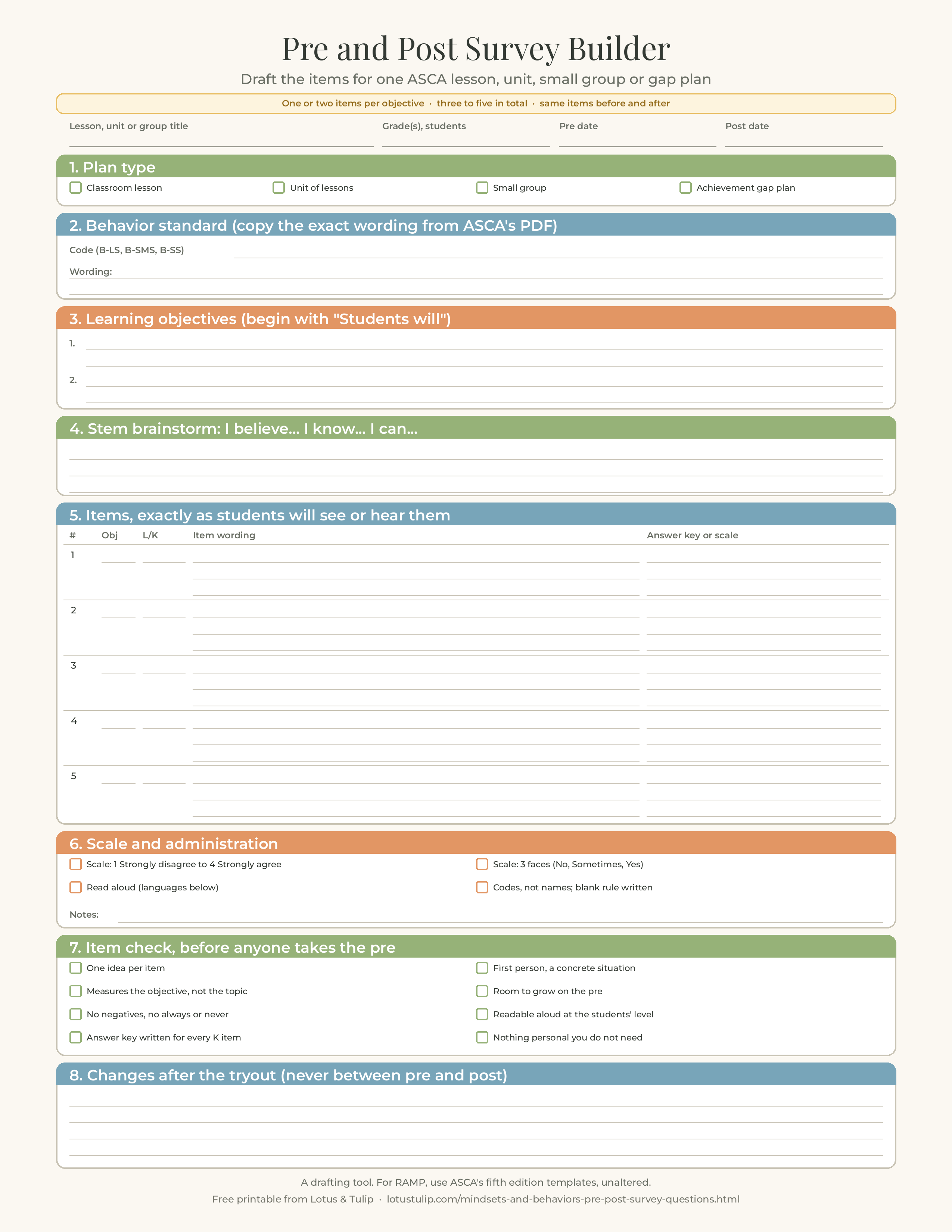
Download the free survey builder, example and scoring sheet (PDF, 3 pages)
Or download single pages: Page 1: blank survey builder (PNG) · Page 2: filled fictional example (PNG) · Page 3: scoring sheet (PNG)
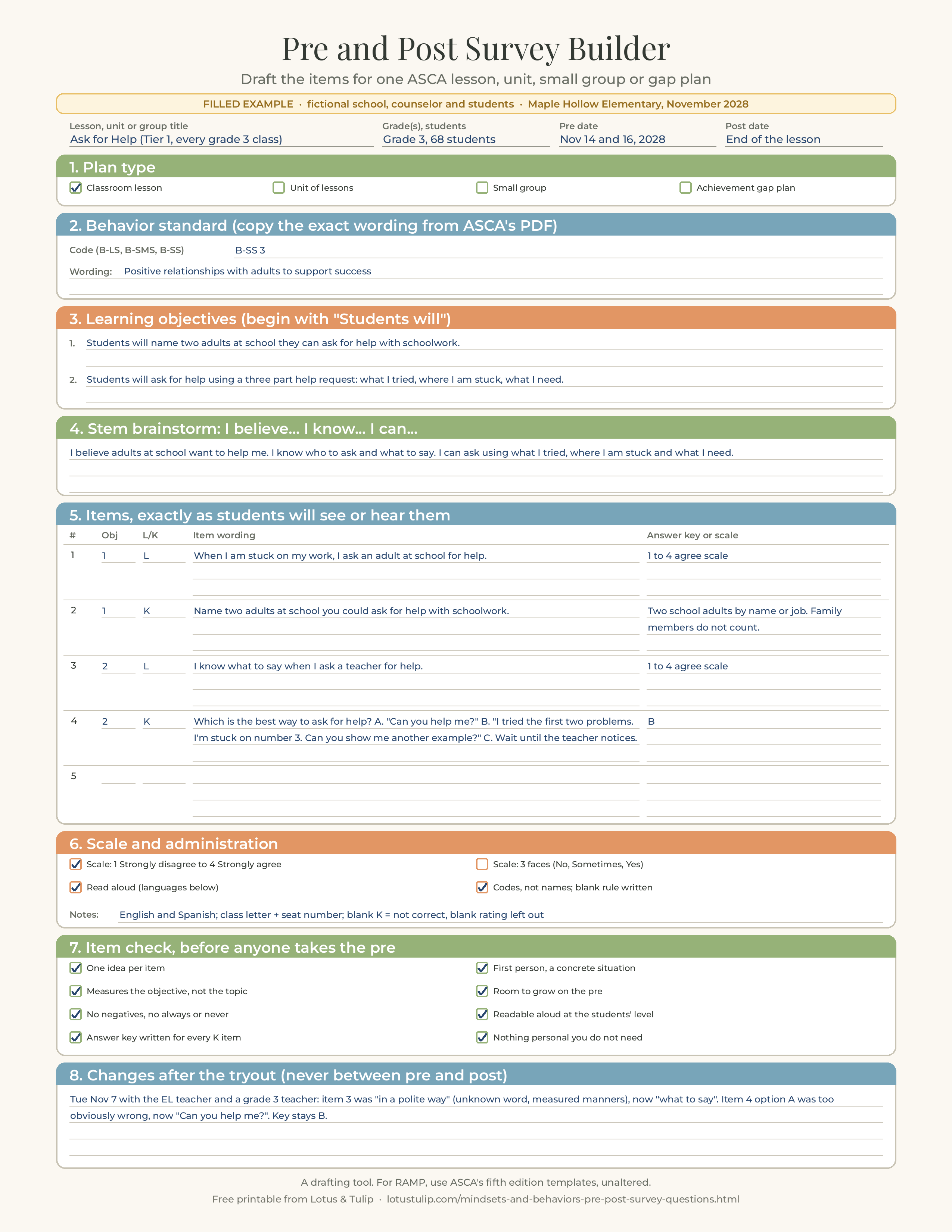
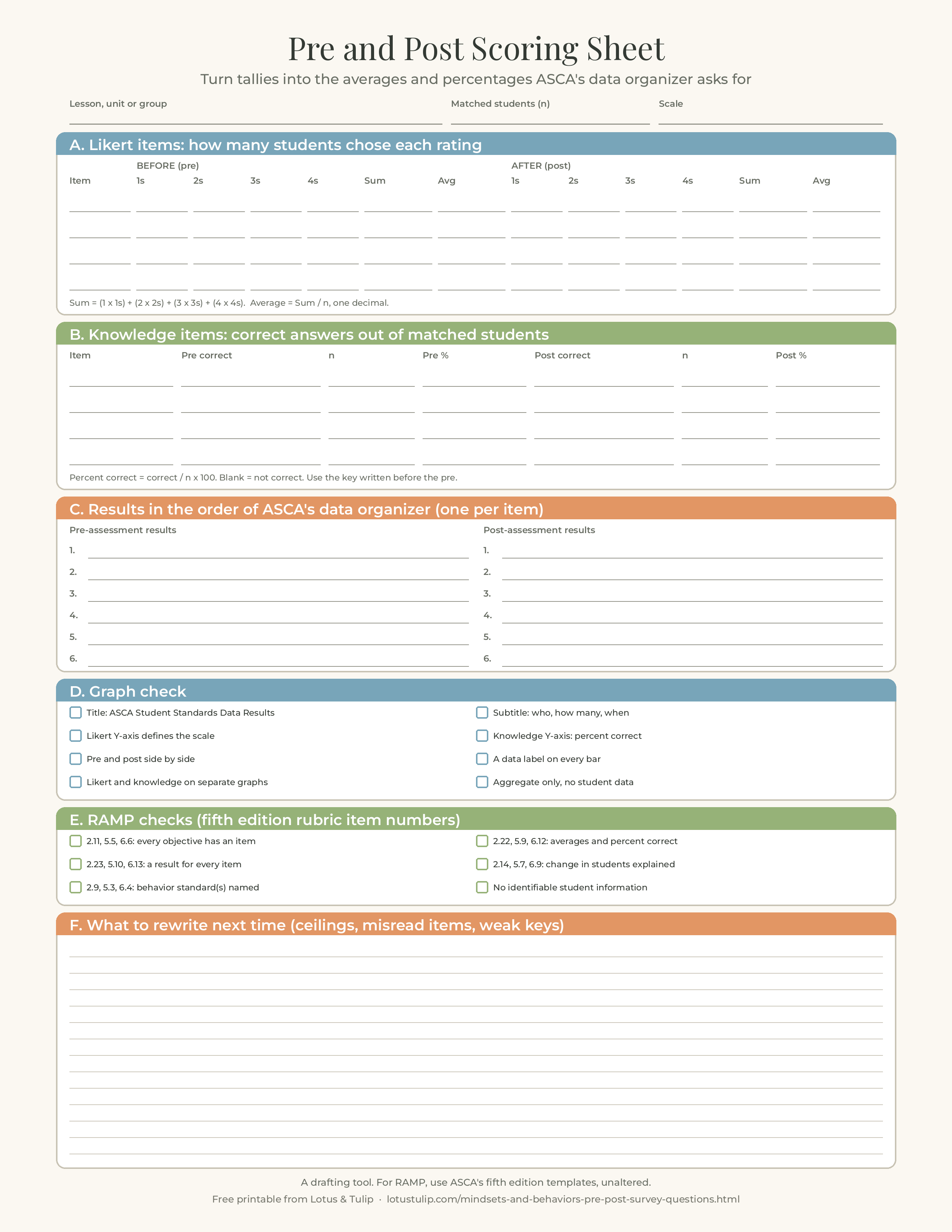
Free to print and use in your own school. Please link to this page rather than re-uploading the file. This is a planning tool. It does not replace ASCA's official templates, your district's survey and consent policies or legal advice. Keep student names off any copy you share or upload.
Related resources
- School counseling data graphs: how to graph pre and post, achievement and attendance results for ASCA data reports, with a free graph planner
- All school counselor small group curriculums
- Classroom lesson plan: the ASCA lesson plan and data report, filled example and free planner
- Small-group action plan: the ASCA small-group plan and data report, filled example and free planner
- Closing the gap action plan: the ASCA achievement gap plan, filled example and free planner
- ASCA Student Standards delivery plan: filled example and free planner
- School counseling data priorities: worksheet, filled example and selection sheet
- Small group counseling pre and post assessment
- School counselor needs assessment
- Texas SB 12 and school counselor parental consent
- School counselor advisory council agenda, minutes and a filled example
Sources: American School Counselor Association (2021), ASCA Student Standards: Mindsets and Behaviors for Student Success (PDF marked "Updated 10/2025"), including the standards, category and subcategory definitions, the ten implementation steps and "Collecting ASCA Student Standards Data," from the ASCA Student Standards page; American School Counselor Association, sample ASCA Student Standards learning objectives spreadsheet; American School Counselor Association, Achievement Gap Plan and Data Report, Lesson Plan and Data Report and Small-Group Plan and Data Report templates and completed examples, ASCA National Model Fifth Edition (8/25); American School Counselor Association, RAMP Scoring Rubric, Fifth Edition, Sections 2, 5 and 6; American School Counselor Association (2025), The ASCA National Model: A Framework for School Counseling Programs, Fifth Edition (data categories); American School Counselor Association, Changes in the ASCA National Model Fifth Edition (use of data); American School Counselor Association, "Manage: Approaching the Work and Using Templates," ASCA newsletter, November 2025; American School Counselor Association (2022), ASCA Ethical Standards for School Counselors, A.14.a, A.14.d and B.1.e; Protection of Pupil Rights Amendment, 20 U.S.C. 1232h(b); Texas Education Code section 26.009; American School Counselor Association, RAMP Rubric, Fourth Edition, Section 8, for comparison. Checked November 10 and 11, 2026. The item bank is original to Lotus & Tulip and is not an ASCA publication.
FAQ
How many pre and post questions does ASCA recommend?
One or two per learning objective, according to the fifth edition lesson plan, small-group plan and achievement gap plan templates, and "No more than three to five questions or prompts" for any one measure, according to the ASCA Student Standards PDF. For a single classroom lesson with two objectives, two to four items is typical.
What is the difference between a Likert item and a knowledge-based item?
A Likert item is a first person statement students rate, such as "When I am stuck on my work, I ask an adult at school for help," on a scale like 1 = Strongly Disagree to 4 = Strongly Agree; it is reported as an average. A knowledge-based item has a right answer, such as "Name two adults at school you could ask for help with schoolwork," and is reported as percent correct. RAMP items 2.22, 5.9 and 6.12 check that results are calculated that way.
Can I use a mindset standard on my lesson plan?
Not as the plan's standard in the fifth edition. RAMP items 2.9, 5.3 and 6.4 ask for behavior standards, and the fifth edition defines ASCA Student Standards data by the behavior standards. Mindset items such as "I feel like I belong at this school" still work in needs assessments, program surveys and as a second item under a behavior objective when the lesson teaches that attitude.
Does ASCA require a four point Likert scale?
We did not find a requirement. Every fifth edition ASCA example we checked uses 1 = Strongly Disagree to 4 = Strongly Agree, and the rubric asks that the graph's Y-axis label define the scale. Use one scale for all Likert items on a survey, keep it the same before and after, and consider three faces for K to 2.
How do I score a pre and post survey?
For each Likert item, add the ratings and divide by the number of students who answered. For each knowledge item, divide the number correct by the number who answered and multiply by 100. Use only students who completed both the pre and the post, report one result per item, and graph Likert and knowledge results on separate bar charts with pre and post side by side.
Do I need parent consent for a pre and post survey?
It depends on your district and state. ASCA's Ethical Standards ask counselors to follow the Protection of Pupil Rights Amendment by informing parents before surveys, in line with district policy and law. PPRA requires prior written consent for required surveys in covered federally funded programs that reveal protected information such as mental or psychological problems. Texas requires signed consent for methods that elicit attitudes or feelings, including surveys embedded in a lesson. Items about skills raise fewer issues than items about feelings or home life.