
School counselors · Updated 2026-11-10
ASCA Student Standards Delivery Plan: How to Map a Year of Lessons and Groups to the Mindsets and Behaviors (Filled Example, Free Planner)
Ready-made printable: Complete Small Group Counseling Bundle Holiday 20% off: about $29.44, was $37 (EUR 32) · instant digital download
Buy on Etsy
Most school counselors already know what they will teach this year. The kindergarten classes will hear about feelings and calm bodies. Grade 5 will talk about middle school in the spring. There will be a worry group in the fall because there always is. What is often missing is the one page that shows all of it at once: which lessons reach which grades, which standard each one teaches, which students get more than the classroom lesson, and when it all starts.
That page is the ASCA Student Standards delivery plan. In the fifth edition of the ASCA National Model (2025) it replaced the fourth edition's "Classroom and Group Mindsets and Behaviors Action Plan" and absorbed the old annual calendar. It is a spreadsheet in which every Tier 1 lesson and every Tier 2 group gets one row, one behavior standard from the ASCA Student Standards, a tier, the participants, a start month and, where it fits, a family or partner program that supports the lesson. It is also Section 1 of the fifth edition RAMP application, worth 9 points, and it is one of the documents you share at the annual administrator conference and the fall advisory council meeting.
This guide is for elementary, middle and high school counselors in the United States. It covers what the delivery plan is and what it replaced; the 36 ASCA Student Standards (6 mindsets and 30 behaviors) with their codes; why the template asks for behavior standards only; what ASCA's fifth edition template and example actually contain, column by column; the nine RAMP Section 1 items and how they differ from the fourth edition; when to build the plan; how to choose standards from data using ASCA's own ten implementation steps; how to plan Tier 1 coverage for every grade and at least two Tier 2 groups; how to write titles, participants and start months that a reviewer can read; family and partner programs; learning objectives and short pre and post items; sample plans for elementary, middle and high school; how the plan connects to lesson plans, small group plans, the achievement gap plan, the advisory council and the administrator conference; a ten step process; a fully worked fictional example; six scenarios; common mistakes; and a free three page printable: a blank planner, the same planner filled in for a fictional elementary school, and a delivery and revision log with a standards quick reference.
Jump to the free delivery plan planner, filled example and log
This is educational information for school counselors in the US, not legal or employment advice. Your district, your state's school counseling framework and your evaluation system may set their own expectations for lesson planning and curriculum. The ASCA documents quoted here were downloaded from schoolcounselor.org and checked on November 10, 2026: the ASCA Student Standards: Mindsets and Behaviors for Student Success PDF (2021 standards, document marked "Updated 10/2025"), ASCA's sample learning objectives spreadsheet, the fifth edition ASCA Student Standards Delivery Plan template (Excel, marked 8/25) and ASCA's completed example, the fifth edition Lesson Plan and Data Report and Small-Group Plan and Data Report examples, "Changes in the ASCA National Model Fifth Edition," the fifth edition Phased Implementation Plan, the "RAMP Scoring Rubric, Fifth Edition" (revision notes through February 2026), the fourth edition RAMP rubric for comparison, and the fifth edition "RAMP Application Timeline." Anything we could not confirm in those documents is marked as such below.
The short answer
- It is a one spreadsheet overview of your direct instruction for the year. ASCA's template states its purpose: "This plan provides an overview of how the behavior standards from the ASCA Student Standards are delivered by the school counselor directly to students to enhance life-readiness skills."
- One row per lesson or group, one behavior standard per row. The template's instruction is "Choose only one standard per lesson or session," picked from three drop-down columns: Learning Strategies, Self-Management Skills and Social Skills.
- Each row also has a title, a tier, participants and a start month, plus an optional column for programs and events for families, students and partners that support a Tier 1 lesson.
- Tier 1 means every student in a grade; Tier 2 means students with an identified need. ASCA's implementation notes define Tier 2 as a lesson for one student group "in response to identified need or teacher request" or small groups of "four-eight sessions and three-12 students."
- For RAMP it is Section 1, worth 9 points. Reviewers look for Tier 1 lessons for each grade level, grade levels in the participant column, at least one family or partner program, at least two Tier 2 small groups, one behavior standard per lesson and per group session, titles that convey purpose and a start month on every row. You upload it in Excel format.
- Finalize it in August or September. ASCA's fifth edition RAMP timeline lists "ASCA Student Standards Delivery Plan finalized for school year" in August to September of the data collection year, and the template itself says "This plan may be updated throughout the year."
- Build it from data, not from last year's habits. Start with your data priorities, your achievement gap goal and your needs assessment, then pick the standard that best fits each need.
- It is the hub of the year. You share it at the annual administrator conference and the first semester advisory council meeting, your lesson plans and small group plans come from its rows, and its Summary tab counts your standards and tiers for you.
What the delivery plan is, and what it replaced
If you trained under the fourth edition of the ASCA National Model (2019), you knew this document as the "Classroom and Group Mindsets and Behaviors Action Plan," sometimes shortened to the curriculum action plan, the classroom and group action plan or the core curriculum action plan. Before that, many counselors kept a separate annual calendar. ASCA's "Changes in the ASCA National Model Fifth Edition" document lists the fifth edition replacement as the ASCA Student Standards Delivery Plan and describes it in five points:
- "Combines previous version with annual calendar"
- "Drop-down boxes for behavior standards by category"
- "Identifies Tiers 1 and 2"
- "Includes space for programs for families/partners that support the Tier 1 activity and standard (if applicable)"
- "Uses checkboxes instead of requiring an X"
The same document says the separate annual calendar template is gone: "Previous template was combined into the ASCA Student Standards delivery plan. No template is provided. Use any format that fits your school's needs." There is also no weekly calendar template. You can still keep a calendar, and most counselors do, but the delivery plan with its start month column is now the official place where the year's instruction is mapped.
A note on that last bullet. The Changes document says the delivery plan "uses checkboxes instead of requiring an X." The fifth edition template we downloaded on November 10, 2026 uses drop-down cells for the standard, the tier and the start month rather than visible checkboxes. Either way, you no longer mark a grid of X's, which was the fourth edition habit.
What the delivery plan is not:
- It is not a lesson plan. It lists the lesson; the Lesson Plan and Data Report holds the objectives, steps and assessment.
- It is not a small group plan. It lists the group; the Small-Group Plan and Data Report holds the session plans, the baseline data and the results.
- It is not a data report. There are no results on it. Results go on the lesson, small group and achievement gap data reports.
- It is not a list of everything you do. Individual counseling, consultation, referrals, 504 or IEP meetings, crisis response and indirect services do not go on it. It is about direct instruction and group counseling tied to standards.
- It is not a contract. The template says it "may be updated throughout the year." A new need in November is a reason to add a row, not a failure of the plan.
The ASCA Student Standards in one place
The ASCA Student Standards: Mindsets and Behaviors for Student Success are ASCA's K to 12 "College-, Career- and Life-Readiness Standards for Every Student." ASCA's Changes document confirms the fifth edition uses the 2021 version without changes. The PDF we downloaded on November 10, 2026 is marked "Updated 10/2025," and its citation guide reads: American School Counselor Association (2021), ASCA Student Standards: Mindsets and Behaviors for Student Success. In ASCA's words, the standards "describe the knowledge, attitudes and skills students need to achieve academic success, college and career readiness and social/emotional development," and "Each of the following standards can be applied to the academic, career and social/emotional domains."
There are 36 standards in two categories. ASCA's overview: "The 36 ASCA Student Standards are broad standards that identify and describe the knowledge, attitudes and skills students should be able to demonstrate as a result of a school counseling program."
Category 1: Mindset Standards (6)
ASCA introduces them with "School counselors encourage the following mindsets for all students."
- M 1. Belief in development of whole self, including a healthy balance of mental, social/emotional and physical well-being
- M 2. Sense of acceptance, respect, support and inclusion for self and others in the school environment
- M 3. Positive attitude toward work and learning
- M 4. Self-confidence in ability to succeed
- M 5. Belief in using abilities to their fullest to achieve high-quality results and outcomes
- M 6. Understanding that postsecondary education and lifelong learning are necessary for long-term success
Category 2: Behavior Standards (30)
ASCA introduces them with "School counselors provide culturally sustaining instruction, appraisal and advisement, and counseling to help all students demonstrate:" and groups them into three subcategories of ten.
| Learning Strategies (B-LS) | Self-Management Skills (B-SMS) | Social Skills (B-SS) |
|---|---|---|
| B-LS 1. Critical thinking skills to make informed decisions | B-SMS 1. Responsibility for self and actions | B-SS 1. Effective oral and written communication skills and listening skills |
| B-LS 2. Creative approach to learning, tasks and problem solving | B-SMS 2. Self-discipline and self-control | B-SS 2. Positive, respectful and supportive relationships with students who are similar to and different from them |
| B-LS 3. Time-management, organizational and study skills | B-SMS 3. Independent work | B-SS 3. Positive relationships with adults to support success |
| B-LS 4. Self-motivation and self-direction for learning | B-SMS 4. Delayed gratification for long-term rewards | B-SS 4. Empathy |
| B-LS 5. Media and technology skills to enhance learning | B-SMS 5. Perseverance to achieve long- and short-term goals | B-SS 5. Ethical decision-making and social responsibility |
| B-LS 6. High-quality standards for tasks and activities | B-SMS 6. Ability to identify and overcome barriers | B-SS 6. Effective collaboration and cooperation skills |
| B-LS 7. Long- and short-term academic, career and social/emotional goals | B-SMS 7. Effective coping skills | B-SS 7. Leadership and teamwork skills to work effectively in diverse groups |
| B-LS 8. Engagement in challenging coursework | B-SMS 8. Balance of school, home and community activities | B-SS 8. Advocacy skills for self and others and ability to assert self, when necessary |
| B-LS 9. Decision-making informed by gathering evidence, getting others' perspectives and recognizing personal bias | B-SMS 9. Personal safety skills | B-SS 9. Social maturity and behaviors appropriate to the situation and environment |
| B-LS 10. Participation in enrichment and extracurricular activities | B-SMS 10. Ability to manage transitions and adapt to change | B-SS 10. Cultural awareness, sensitivity and responsiveness |
ASCA's definitions of the three subcategories, from the same PDF: learning strategies are "Processes and tactics students employ to aid in the cognitive work of thinking, remembering or learning"; self-management skills are "Continued focus on a goal despite obstacles and avoidance of distractions or temptations to prioritize higher pursuits over lower pleasures"; and social skills are "Acceptable behaviors that improve social interactions, such as those among peers or between students and adults." The standards are organized on the framework of noncognitive factors from the University of Chicago Consortium on Chicago School Research's 2012 literature review "Teaching Adolescents to Become Learners."
A small detail worth knowing: the wording inside ASCA's delivery plan spreadsheet differs slightly from the PDF in a few places. The drop-down reads "B-LS 4. Self-motivation and self-direction to learning" where the PDF says "for learning," "B-SS 2. Positive, respectful and supportive relationships with other students who are similar to and different from them" where the PDF has no "other," and "B-SS 3. Positive relationships with adults that support success" where the PDF says "to support success." The codes are the same. Use the drop-down in the template and do not retype the wording.
The three domains
ASCA says all 36 standards "can be applied to any of the three school counseling domains of academic, career and social/emotional development," and that "The school counselor selects a domain and standard based on the needs of the school, classroom, small group or individual." The domain is not a column on the delivery plan, but it helps you check balance: a plan that is all social/emotional, with nothing on study skills or careers, may not match your school's priorities.
Why the delivery plan uses behavior standards, not mindsets
This confuses a lot of counselors, so it is worth being precise. The ASCA Student Standards have 36 standards, but the fifth edition delivery plan template's drop-down menus list only the 30 behavior standards, in three columns: Learning Strategies, Self-Management Skills and Social Skills. The template's purpose statement says the plan shows "how the behavior standards from the ASCA Student Standards are delivered," and RAMP Section 1 item 1.2 asks that each Tier 1 lesson be "connected to one behavior standard." The fifth edition Lesson Plan and Data Report and Small-Group Plan and Data Report examples also ask for one "Behavior Standard from ASCA Student Standards."
That does not make the mindsets unimportant. ASCA describes them as the attitudes "school counselors encourage" in all students, and they show up naturally in pre and post items that start with "I believe" or "I can." The practical reading is: the mindsets describe what your whole program hopes students come to believe, and the behaviors are what you plan, teach and measure lesson by lesson. ASCA does not publish a sentence that says "never use a mindset on the delivery plan," but the template gives you no place to select one, and the RAMP rubric scores behavior standards. If you are building a fifth edition plan, choose a behavior standard for every row.
This is a practical change from the fourth edition, whose "Classroom and Group Mindsets and Behaviors Action Plan" named both kinds of standard in its title, and where many counselors listed mindset standards such as M 2 or M 4 on their plans. If you are converting an old plan, each mindset row needs a behavior standard instead. Ask what students will actually do differently: a self-confidence lesson often becomes B-SMS 5 (perseverance), B-SS 8 (advocacy for self) or B-LS 7 (goals), depending on what you teach.
ASCA's fifth edition template, tab by tab and column by column
The template is an Excel workbook (an .xltx template file) on ASCA's Templates and Tools page, marked "ASCA National Model Fifth Edition 8/25." ASCA also posts a completed example in its fifth edition examples download. The version we opened on November 10, 2026 has these visible tabs:
- Overview. The purpose and implementation notes, quoted below.
- Example. A filled sample for a fictional "Wonderful Middle School."
- Delivery Plan. The sheet you fill in.
- Summary. Automatic totals.
- ASCA Student Standards. A reference tab.
There is also a tab named "DO NOT DELETE-Lookup Table" and a hidden list of all behavior standards that feeds the drop-downs. Do not delete or rename them, and remember the RAMP rubric's general rule: "Only completed fifth edition ASCA templates in their original form may be used in the fifth edition RAMP application. These templates should not be altered. Using the wrong templates or altering templates may lead to rubric not being met."
The implementation notes
The Overview tab defines the two tiers this way:
- "Tier 1 - Lessons and/or sessions are... 1. Developmental and/or preventative 2. Delivered to each and every student at a grade level in classroom, large group, small group or individual settings"
- "Tier 2 - Lessons and/or sessions are... 1. Delivered to one student group in response to identified need or teacher request OR 2. Delivered to students with the identified need in small groups (four-eight sessions and three-12 students)"
And for the last column: "Programs for families, students and/or partners that support the Tier 1 activity and standard. Includes events sponsored by the school counseling program such as career fairs, college night, etc. for families/education partners that support the tier 1 activity and standard (if applicable)." The Overview ends: "This plan may be updated throughout the year."
Two things in those notes are easy to miss. First, Tier 1 is defined by who receives it (each and every student at a grade level), not by the setting. A senior credit check delivered one on one to every senior is Tier 1. Second, Tier 2 includes a single lesson delivered to "one student group in response to identified need or teacher request." When one teacher asks for a lesson on calm tools for her class because several students panic before timed math, that lesson is Tier 2, not Tier 1, because it responds to an identified need in one group rather than reaching every student in the grade.
The columns on the Delivery Plan sheet
| Column | What the template says | How to fill it |
|---|---|---|
| School Name, Date Created, Revision Date | Header cells | Use the revision date every time you add or change a row, so your administrator and council see the current version. |
| Learning Strategies / Self-Management Skills / Social Skills | "ASCA Student Standards ... Choose only one standard per lesson or session" | Pick one standard from one of the three drop-downs. Leave the other two cells in that row empty. |
| Title of lesson or group session | "1 - List each only once. 2 - Include brief explantion of unique titles." (ASCA's spelling) | A title that tells a stranger what the lesson is about. If your school's group has a cute name, add a few words: "Calm and Brave: worry small group." |
| Delivery Tier 1 or Tier 2 | Drop-down | Tier 1 for every student in a grade; Tier 2 for an identified group or a teacher request. |
| Participants | Free text | Grade levels for Tier 1 ("All grade 3"); for Tier 2, the group and how they were identified ("Grade 7 students identified as having high levels of worry and stress" is ASCA's own example). |
| Start | Drop-down of months numbered from (1) Jul to (12) Jun | The month the lesson or group begins. The numbers let the sheet sort by school year order. |
| Programs/events for families, students and/or partners | "that support the Tier 1 activity and standard (if applicable)" | A family night, career day or similar event tied to a specific Tier 1 row, with its month. |
In the version we downloaded, the Delivery Plan sheet has drop-down rows from row 9 to row 71, room for roughly 60 lessons and groups. That is a practical reason to think about how you list multi-lesson units, which we cover below.
The Summary tab
The Summary tab counts what you entered: "This summary tab calculates the total number of learning strategies, self-management skills and social skills, as well as the total number of Tier 1 and Tier 2 activities captured in the delivery plan. This can be helpful for reporting information data to leadership during the annual administrator conference, advisory council meetings, etc." Use it. Five numbers (three subcategories and two tiers) are an easy way to open a conversation with your principal or council about balance.
What ASCA's own example shows
ASCA's completed example is for a fictional "Wonderful Middle School," dated June 20, 2025. A few of its rows, paraphrased:
- B-LS 10 (participation in enrichment and extracurricular activities), "Exploring opportunities to get involved at the middle school," Tier 1, all grade 6, October.
- B-LS 7 (goals), an eighth grade career exploration lesson, Tier 1, all grade 8, November, with a family and partner program: a Career Day in March.
- B-LS 3 (time management, organizational and study skills), an academic success small group, Tier 2, "Grade 6 students who failed one course in first quarter," November.
- B-SMS 10 (ability to manage transitions), a getting ready for high school lesson, Tier 1, all grade 8, March, with a high school visit and orientation in April.
- B-SMS 7 (effective coping skills), "Stress Less Squad," a Tier 2 small group for "Grade 7 students identified as having high levels of worry and stress," November.
Notice what the example does: every Tier 1 row names a whole grade, every Tier 2 row names who is in the group and why, each small group appears once as a single row with one standard, and the family programs are tied to the lesson they support (a career lesson and a career day, a transition lesson and a high school visit). It is short. It does not try to list every individual conversation the counselors will have.
What RAMP Section 1 scores (fifth edition)
Section 1 of the "RAMP Scoring Rubric, Fifth Edition" is "ASCA STUDENT STANDARDS DELIVERY PLAN - 9 Points." Its description: "This section requires evidence of how the behavior standards from the ASCA Student Standards are delivered by the school counselor directly to students to enhance life-readiness skills." The upload is a "Completed ASCA Student Standards Delivery Plan (Excel format)." The general instructions repeat the format rule: "Upload the ASCA Student Standards Delivery Plan Template and Use-of-Time 5-Day Calculator Template as Excel documents and all others as a PDF," and "Sections without the correct completed document uploaded are unable to be scored."
The nine items, quoted from the rubric:
| Item | Rubric wording | What it means in practice |
|---|---|---|
| 1.1 | "Specific Tier 1 lessons identified for each grade level in the school" | Every grade you serve has at least one Tier 1 row. A K to 5 school needs kindergarten through grade 5. |
| 1.2 | "Each Tier 1 lesson (classroom, large group, small group or individual setting) is connected to one behavior standard." | One behavior standard per Tier 1 row, never two. |
| 1.3 | "Each Tier 1 lesson specifies grade level(s) in the participant column" | "All grade 4," not "Mrs. Lee's class" or "students." |
| 1.4 | "At least one Tier 1 lesson has a program/event provided for families, students and/or education partners." | At least one row has something in the last column. |
| 1.5 | "Each reported program/event for families, students and/or education partners supports the Tier 1 activity and standard to which it is attached." | The event must fit its row. A career night next to a career lesson fits; a holiday concert next to a coping lesson does not. |
| 1.6 | "At least two Tier 2 small groups for students are included." | Two or more small groups, not just Tier 2 lessons. |
| 1.7 | "Each Tier 2 small group session is connected to one behavior standard. The same standard can be repeated for multiple/all sessions." | One standard per group session; repeating the same one across a group is fine. |
| 1.8 | "Each title for a lesson/session conveys purpose/focus. Include a brief explanation for unique titles that don't convey purpose/focus." | "Stress Less Squad" works because ASCA's example adds what it is about. |
| 1.9 | "Indicate a start month for each Tier 1 lesson and Tier 2 small group session." | No blank start cells. |
For context, the rubric's seven sections total 82 points: Section 1, 9; Section 2 (achievement gap plan and data report), 26; Section 3 (advisory council), 11; Section 4 (annual administrator conference), 6; Section 5 (lesson plan and data report), 11; Section 6 (small-group plan and data report), 16; and Section 7 (reflections and signature page), 3. The rubric's revision notes list an initial release in August 2025 and edits in September 2025 and February 2026; none of the listed revisions concern Section 1. ASCA's Apply for RAMP page did not publish a fifth edition passing score that we could find on November 10, 2026, so we do not state one here. Fifth edition applications are due through the fifth edition portal "no later than Oct. 1, 2027, at 11:59 p.m. ET," per the rubric.
How Section 1 changed from the fourth edition
In the fourth edition rubric, the equivalent section was "3. Classroom and Group Mindsets and Behaviors Action Plan - 5 points." It asked that the template be completed, that specific classroom lessons be identified for each grade level, that small groups be available, and that each lesson and each small group session be "connected to one primary standard and appears only one time on the action plan," with the title and topic stated and grade levels specified. Two of its five points were 250 word reflections on what students did in a classroom lesson and in a small group activity.
The fifth edition section is worth more (9 points instead of 5), drops the reflections, and adds three things: an explicit Tier 1 and Tier 2 split, at least two Tier 2 small groups, and at least one family or partner program that supports a Tier 1 lesson. It also says "behavior standard" where the fourth edition said "primary standard," and it requires a start month for each row.
When to build it, and where it fits in the year
ASCA's fifth edition "RAMP Application Timeline" suggests this order for the data collection year, which is a sensible order even if you never apply for RAMP:
| When (ASCA's suggestion) | What |
|---|---|
| July to August | School data priorities; achievement gap plan and data report |
| August to September | Advisory council meeting dates and agendas; annual administrator conference; "ASCA Student Standards Delivery Plan finalized for school year" |
| September to October | Lesson plan finalized (one Tier 1 lesson or one lesson from a unit of three); small group finalized (at least four sessions) |
| October to December | First semester advisory council meeting; lesson and small group delivery |
| January to March | Lesson and small group delivery; data reports |
| April to May | Second semester advisory council meeting; data reports completed and analyzed, graphs; signature page |
ASCA's fifth edition Phased Implementation Plan puts the delivery plan even earlier, in "Phase 1, Start Here": after reading the National Model, the Student Standards and the Ethical Standards and completing a program assessment, a standards and competencies checklist and a use-of-time calculator, counselors "Develop: ASCA Student Standards delivery plan, Annual calendar, Weekly calendars, Lesson plans, Small group plans." Data priorities and achievement gap plans come in Phase 2. In other words, a counselor new to the model can start with a delivery plan before the data pieces are polished, and a counselor with an established program builds it right after the data priorities each summer.
The delivery plan is also the evidence for the first Manage benchmark on ASCA's School Counseling Program Assessment ("The ASCA Student Standards delivery plan identifies specific standards delivered in Tier 1 and 2 settings"). Our program assessment guide covers that benchmark and the other 24, with a free worksheet.
Where the delivery plan shows up later in the year:
- The annual administrator conference. ASCA's Changes document says the fifth edition conference includes the delivery plan and achievement gap plan "in discussion." Our annual administrator conference guide covers how to present it.
- The first semester advisory council. RAMP item 3.6 requires the first semester agenda to include, at a minimum, an "ASCA Student Standards Delivery Plan overview," and item 3.8 asks for a summary of feedback on at least two of the data priorities, delivery plan and gap plan overviews. See our advisory council agenda guide.
- Lesson plans and small group plans. The lesson you submit for RAMP Section 5 and the group for Section 6 should be rows on your delivery plan, with the same behavior standard. Section 5.3 sets a "Limit of one behavior standard" for the lesson plan, and 6.4 sets a limit of one per session plan, "A standard may be repeated in multiple sessions."
- The achievement gap plan. Lessons and groups that are part of your gap plan's direct strategies belong on the delivery plan too. Note that RAMP Section 6 says the small group submitted there "cannot be the same small group included in the Achievement Gap Plan, if one was included."
ASCA's ten steps: from data to a standard to a lesson
The Student Standards PDF includes a ten step process for implementing the standards. It is the best short guide to choosing what goes on each row, so here it is, quoted and condensed:
- "Identify need in achievement data." A specific challenge in the school's achievement data, "e.g., standardized test scores, grades, credits earned."
- "Consider contributing-factors data." "Attendance, discipline and systemic barriers," plus "student and partner perspectives."
- "Select student standard." "School counselors choose a specific behavior standard from the ASCA Student Standards that best aligns with the data and the potential contributing factors."
- "Write learning objectives aligned with the student standard." Measurable objectives that identify "the specific knowledge and/or skills students need."
- "Create pre-/post-assessment." Based on the objectives and the selected standard.
- "Select or develop strategies." Activities or interventions that help students reach the objectives.
- "Administer pre-assessment." To find the baseline.
- "Deliver strategies."
- "Administer post-assessment."
- "Reflect on areas for improvement." "What might be improved when next delivered."
The delivery plan is where steps 1 to 3 become visible for the whole year. Steps 4 to 10 happen in each lesson plan and small group plan. Notice that step 3 says "behavior standard," which matches the template.
ASCA also says the standards should be used with care: implementation "requires careful and thoughtful implementation to prevent reinforcing the status quo, such as gaps in achievement, opportunity and attainment, as well as disproportionate rates of discipline and suspension." In plain terms, if your data show that one group of students is being disciplined or failing courses at a higher rate, a Tier 2 group for those students is only part of the answer. The delivery plan shows your direct services; your achievement gap plan and indirect work (advocacy, collaboration, policy) carry the systemic part.
Choosing standards from your data
For each need, ask three questions in this order.
- What does the data show, and for whom? All of grade 6, or the 14 grade 6 students who failed a course in the first quarter? The first is a Tier 1 lesson; the second is a Tier 2 group.
- What would students do differently if this went well? Write it as a behavior: "use a planner every day," "use a calm down tool before a test," "ask an adult for help," "include someone new at lunch."
- Which behavior standard names that behavior best? Use the list above. If two fit, choose the one your assessment will actually measure.
A starting map for common counseling topics. These are suggestions based on the standards' wording, not ASCA assignments; your lesson's objectives decide the best fit.
| Topic or need | Common best fit | Also consider |
|---|---|---|
| Worry, stress, anxiety skills | B-SMS 7 (effective coping skills) | B-SMS 2 (self-discipline and self-control) |
| Test anxiety | B-SMS 7 | B-LS 3 (study skills) |
| Anger and self regulation | B-SMS 2 | B-SMS 7 |
| Friendship and peer relationships | B-SS 2 | B-SS 9 (social maturity) |
| Bullying prevention, upstanders | B-SS 8 (advocacy for self and others) | B-SS 5 (ethical decision-making), B-SS 4 (empathy) |
| Organization, homework, study habits | B-LS 3 | B-SMS 3 (independent work) |
| Goal setting, academic planning | B-LS 7 | B-SMS 5 (perseverance) |
| Growth mindset, persistence | B-SMS 5 | B-SMS 6 (identify and overcome barriers) |
| Attendance | B-SMS 1 (responsibility) or B-SMS 6 | B-SS 3 (relationships with adults) |
| Transitions (new school, middle school, high school) | B-SMS 10 | B-SS 3 |
| Changing families, divorce | B-SMS 10 | B-SMS 7 |
| Grief and loss | B-SMS 7 | B-SS 3 |
| Body safety, online safety | B-SMS 9 (personal safety skills) | B-LS 5 (media and technology) |
| Career exploration | B-LS 7 or B-LS 9 | B-LS 1 (critical thinking) |
| Course selection, college planning | B-LS 9 (decision-making informed by evidence) | B-LS 8 (challenging coursework) |
| Extracurricular involvement | B-LS 10 | B-SMS 8 (balance) |
| Communication, listening, I statements | B-SS 1 | B-SS 6 (collaboration) |
| Self esteem and confidence | B-SS 8 or B-SMS 5 | B-LS 7 |
| Leadership, teamwork | B-SS 7 | B-SS 6 |
| Inclusion, cultural awareness | B-SS 10 | B-SS 2 |
ASCA's own sample learning objectives can help. The Student Standards page links a spreadsheet of sample grade level learning objectives. The version we downloaded on November 10, 2026 has 910 objectives, each tagged with grade bands (K-2, 3-5, 6-8, 9-12) and a standard, most submitted by ASCA and some by named counselors. For example, under B-LS 3: "Students will ask and answer one or more questions in a class," and under B-LS 7: "Students will appraise goal progress and goal achievement." Filtering it by your standard and grade band is a quick way to see what a lesson on that standard can measure.
Tier 1: a lesson for every grade, and a sequence that makes sense
RAMP item 1.1 asks for "Specific Tier 1 lessons identified for each grade level in the school." That is a floor, not a target. ASCA does not set a required number of lessons per grade, and we did not find a fifth edition document that does. How many lessons you plan depends on your ratio, your schedule and what your administrator agrees at the conference. Some realistic patterns:
- Elementary, one counselor for 400 to 500 students: a lesson a month in each class is common, often more in upper grades. That is 8 to 10 lessons per grade per year.
- Middle school: often a few lessons per grade per semester through advisory or core classes, with heavier Tier 2 work.
- High school: Tier 1 is often advisement delivered to every student in a grade (course planning, credit checks, postsecondary planning), plus a few classroom lessons per grade. ASCA's Tier 1 definition explicitly includes individual settings.
Units and the "list each only once" rule
The template asks you to list each lesson "only once." Say you teach a three lesson unit on coping skills in every grade 2 class. You can list the unit as one row ("Big feelings, calm tools: three lesson unit," B-SMS 7, Tier 1, all grade 2, November) or list each lesson separately if each has its own standard. ASCA's documents do not say which you must do. The rubric's Section 5 does refer to "one Lesson Plan and Data Report from a unit," so units are a recognized idea (our classroom lesson plan and data report guide covers how to document one). With roughly 60 rows available and a full elementary schedule, listing units as single rows is the practical choice, as long as each unit sticks to one behavior standard. If a unit's lessons teach different standards, give each a row.
Checking your sequence
- Front load relationships and help seeking. September lessons on who helps at school, how to see the counselor and classroom agreements make every later lesson easier.
- Match the school calendar. Coping lessons before testing season, transition lessons in the spring for exiting grades, organization lessons early in the year, career lessons when the school runs its career day.
- Check balance. Look at the Summary tab. A plan that is 80 percent self-management may be right for a school worried about behavior, but if math is a school priority, ask whether a learning strategies lesson belongs in the upper grades.
- Do not repeat the same standard in the same grade every month unless that is the point. Spiral instead: the same standard in different grades, with skills that build.
Tier 2: at least two small groups, and lessons on request
RAMP item 1.6 needs "At least two Tier 2 small groups." ASCA's implementation notes define them as "four-eight sessions and three-12 students." The same range appears in the Small-Group Plan and Data Report example ("a minimum of four sessions with three-12 students") and in RAMP Section 6.
On the delivery plan, each group is usually one row: the title, one behavior standard, Tier 2, the participants (who is in it and how they were identified) and the start month. ASCA's example lists each group that way. Item 1.7 says each Tier 2 small group session is connected to one behavior standard and "The same standard can be repeated for multiple/all sessions." If your group's sessions use different standards (an attendance group that teaches communication in session 1 and goal setting in session 6, for example), the session by session standards go on your Small-Group Plan and Data Report, where item 6.4 limits each session plan to one behavior standard. On the delivery plan, choose the standard that names the group's main focus. ASCA does not spell out how to show multiple session standards on a single delivery plan row, so if you plan to apply for RAMP and your group uses several, it is worth asking a RAMP mentor or your state association how reviewers read it.
Good Tier 2 participant descriptions name the criteria, not the students:
- "Grade 3 and 4 students referred by teachers or families for worry, with consent"
- "Grade 6 students who failed one course in first quarter" (ASCA's example)
- "Grade 9 students with two or more course failures at the first grading period"
- "Students new to the school this year, grades 2 to 5"
Never put student names, initials or ID numbers on the plan. RAMP's FERPA note says "No identifiable student information should be included," and the plan is shared with your council, which includes parents and community members.
Tier 2 also covers a lesson delivered to "one student group in response to identified need or teacher request." A single class lesson requested by a teacher, a lesson for one team of students after an incident, or a lesson for the grade 8 students who have not yet chosen a high school pathway are Tier 2 rows. They do not count toward the two small groups.
Titles, participants and start months a reviewer can read
Titles
Item 1.8 asks that each title "conveys purpose/focus." A reader who has never been in your school should know from the title what students will learn.
| Weak title | Better title |
|---|---|
| Lesson 3 | Feelings words and calm body tools (three lesson unit) |
| Lunch Bunch | New at Maple Hollow: lunch group for new students (four sessions) |
| Stress Less Squad | Stress Less Squad: small group on managing stress and worry (ASCA's example adds this explanation) |
| Career stuff | Career clusters: choosing at least one cluster to explore |
| Anti bullying | Speak up: bullying, upstanders and getting help |
| Junior meetings | Junior postsecondary planning conferences (individual, every junior) |
Participants
For Tier 1, write the grade: "All grade 4," "All grades 9 to 12," "All kindergarten." Item 1.3 checks for grade levels. For Tier 2, write the group and the criterion, as above. For a teacher request, "One grade 3 class (teacher request)" is enough; no teacher name is needed.
Start months
The drop-down uses school year numbering: (1) Jul, (2) Aug, (3) Sept, (4) Oct, (5) Nov, (6) Dec, (7) Jan, (8) Feb, (9) Mar, (10) Apr, (11) May, (12) Jun. (In the template we downloaded, April appears as "(10 Apr" with a missing parenthesis; it is ASCA's typo, not yours.) Item 1.9 requires a start month on every row. Choose the month the lesson or group begins; if a unit runs across two months, use the first.
Family and partner programs that actually support the lesson
Item 1.4 asks for at least one Tier 1 lesson with "a program/event provided for families, students and/or education partners," and item 1.5 asks that each one "supports the Tier 1 activity and standard to which it is attached." ASCA's template mentions "career fairs, college night, etc." The key word is supports. Examples that fit:
- Kindergarten morning routines lesson (B-SMS 1): a family coffee on morning routines and why every school day counts.
- Grade 4 organization unit (B-LS 3): a family night on homework routines and reading the planner.
- Grade 5 transition lesson (B-SMS 10): a family night with the middle school counselor, or a middle school visit.
- Grade 8 career lesson (B-LS 7): a career day (ASCA's own example).
- Grade 8 high school readiness lesson (B-SMS 10): a high school visit and orientation (ASCA's own example).
- Grade 11 postsecondary planning (B-LS 9): a college and career night or a financial aid night for families.
- Online safety lesson (B-SMS 9): a family workshop on device settings and online safety, with the school resource officer or technology staff.
Examples that do not fit: a school wide picnic attached to a coping lesson, a book fair attached to a friendship lesson, or a schoolwide assembly that is not about the lesson's skill. Put the month of the event in the cell, since the start column refers to the lesson, not the event.
Learning objectives and short pre and post items
The delivery plan does not hold objectives, but it is easier to fill when you already know what each row will measure. The fifth edition lesson plan example asks for "one or two objectives that align with the selected behavior standard," each beginning with "Students will," and "one-two assessment items per learning objective." The Student Standards PDF adds two practical tips about measures: "No more than three to five questions or prompts are needed for any one measure," and brainstorming "statements that begin with stems such as I believe..., I know... and I can..." helps you write items about attitudes, knowledge and skills.
An example for a grade 2 unit on B-SMS 7:
- Objective 1: Students will name two calm body tools they can use at school.
- Objective 2: Students will choose a calm tool for a worried situation.
- Items: "I know two ways to calm my body." (knowledge) "I can use a calm tool when I feel worried at school." (skill) "I believe calming down helps me learn." (attitude) Read aloud with faces for younger students.
Our pre and post assessment guide and lesson plan template guide go deeper on writing these.
Sample plan outlines for elementary, middle and high school
These outlines show the shape of a plan, not a recommended curriculum. Every row would still need your data, your titles and your months.
Elementary (K to 5)
| Grade | Fall | Winter | Spring |
|---|---|---|---|
| K | B-SMS 1 school routines; B-SS 3 who helps me | B-SMS 7 feelings and calm body | B-SS 2 being a good friend |
| 1 | B-SMS 1 routines | B-SS 1 listening and using words | B-SMS 2 self-control |
| 2 | B-SS 3 asking for help | B-SMS 7 big feelings | B-SS 4 empathy |
| 3 | B-SS 6 working together | B-SMS 7 calm tools before tests; B-SMS 5 trying again | B-SS 8 speak up; B-LS 7 goals |
| 4 | B-LS 3 organizing my work; B-SS 2 friendship repair | B-SMS 9 online safety | B-LS 7 goals and interests |
| 5 | B-SS 7 leadership; B-SS 8 speak up | B-LS 9 careers and decisions | B-SMS 10 getting ready for middle school |
| Tier 2 | Worry group (B-SMS 7); friendship group (B-SS 2); new student group (B-SMS 10) | Attendance group (B-SMS 6) | Test anxiety group (B-SMS 7) |
Middle school (6 to 8)
| Grade | Fall | Winter | Spring |
|---|---|---|---|
| 6 | B-SMS 10 middle school transition; B-LS 10 getting involved | B-SS 8 advocating for yourself | B-LS 9 career interests |
| 7 | B-LS 7 goal setting | B-SMS 9 online safety and digital footprint | B-LS 1 career clusters |
| 8 | B-LS 7 career exploration (family: career day) | B-SMS 6 resilience | B-SMS 10 getting ready for high school (family: high school visit) |
| Tier 2 | Study skills group for students failing a course (B-LS 3) | Stress and worry group (B-SMS 7) | Friendship group (B-SS 2) |
High school (9 to 12)
| Grade | Fall | Winter | Spring |
|---|---|---|---|
| 9 | B-SMS 10 high school transition; B-LS 3 study habits | B-LS 7 four year plan | B-LS 9 course selection |
| 10 | B-LS 9 career interest inventory | B-LS 8 challenging coursework options | B-LS 9 course selection |
| 11 | B-LS 9 postsecondary planning conferences (individual, all juniors) | B-LS 5 researching options online | B-LS 7 senior year plan (family: college and career night) |
| 12 | B-LS 9 applications and credit checks (individual, all seniors) | B-SMS 4 financial aid and long term choices | B-SMS 10 life after high school |
| Tier 2 | Grade 9 students with course failures (B-LS 3) | Stress management group (B-SMS 7) | Students without a postsecondary plan (B-LS 7) |
Sharing it, using it and updating it
At the annual administrator conference, bring the Summary tab numbers, the grade by grade overview and the Tier 2 groups with their start months. The conversation you want is about time: lessons need class time, groups need a protected slot, and both depend on how many non-counseling duties you carry.
At the first semester advisory council meeting, give the overview in a few minutes and ask for feedback members can actually give: "Which of these would families most want to hear about at a family night?" "Is there a need we are missing?" Record their feedback in the minutes; RAMP item 3.8 asks for a summary of discussion and feedback.
With teachers, share each grade's rows before the school year gets busy, so classroom lesson dates go on teachers' calendars early. A one page grade level version is often more useful than the full spreadsheet.
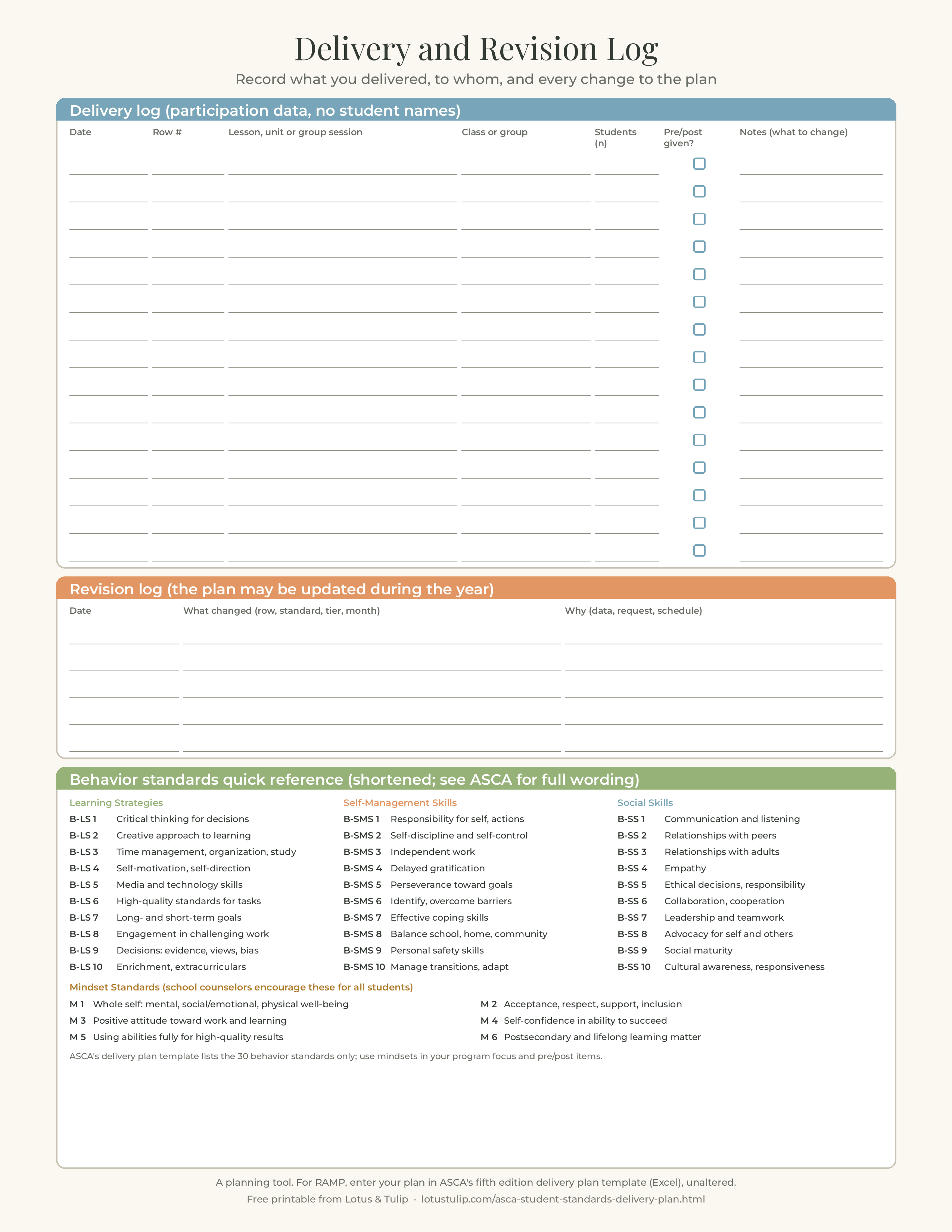
During the year, keep a delivery log: date, row, class or group, number of students. That is your participation data, one of the three kinds of data in the fifth edition (participation, ASCA Student Standards data and achievement data). The free log sheet on this page is built for it.
When something changes, add or change the row, update the revision date and note why. A new group added in January because of midyear data is evidence that the plan is working, not a flaw.
How to build an ASCA Student Standards delivery plan, step by step
- Gather your data first. Pull your school counseling data priorities, your achievement gap goal, last year's lesson and group data, and your needs assessment results or teacher requests.
- Download ASCA's current fifth edition template. Get the delivery plan template (Excel) from ASCA's Templates and Tools page and read its Overview and Example tabs before you type anything.
- List the needs you will address with direct instruction. For each, decide whether it is a whole grade need (Tier 1) or a need for identified students (Tier 2).
- Choose one behavior standard for each lesson, unit or group. Use ASCA's step 3: the behavior standard that best aligns with the data and contributing factors. Use the drop-down, not your own wording.
- Plan Tier 1 coverage for every grade. Make sure each grade in your building has at least one Tier 1 row, then build a sequence that fits the school calendar.
- Add at least two Tier 2 small groups. Four to eight sessions, three to 12 students, with participants described by criteria, not names. Add Tier 2 lessons for teacher requests as they come.
- Write titles, participants and start months. Titles that convey purpose, grade levels for Tier 1, criteria for Tier 2, and a start month on every row.
- Attach at least one family or partner program to a Tier 1 lesson. Make sure it supports that lesson's skill and standard.
- Check the Summary tab and the RAMP items. Look at the balance across learning strategies, self-management and social skills, and run through items 1.1 to 1.9 with the checklist on the free planner.
- Share it, deliver it, log it and revise it. Bring it to the administrator conference and the fall advisory council, log every delivery, and update the revision date whenever you change a row.
A worked example (fictional): the Maple Hollow Elementary delivery plan
Maple Hollow Elementary is a fictional public elementary school with kindergarten to grade 5 and three classroom teachers per grade. J. Rivera is the only school counselor. Our other school counselor guides follow the same school through the 2027 to 2028 school year, including the needs assessment, the "Calm and Brave" worry group, the attendance group, the advisory council and the annual administrator conference. This example shows the delivery plan behind all of them. Every name, number and date is invented for illustration.
Starting from data
Over the summer J. Rivera drafted the school counseling data priorities from the school improvement plan: attendance in kindergarten and grade 1, where 23 of 142 students had missed 10 percent or more of school days in 2026 to 2027, and math in grades 3 to 5, where 61 of 214 students had scored below the spring benchmark. Her achievement gap plan focused on attendance, with the goal that by the end of April 2028, at least 13 of the kindergarten and grade 1 students who had missed 10 percent or more of school days by October 1, 2027 would be below 10 percent for the year to date. Its direct strategies included short arrival check ins and a classroom lesson on morning routines. Math would be supported through Tier 1 lessons on calm tools before tests and a spring test anxiety group, not a second gap plan. (A note for RAMP applicants: under item 2.5 of the fifth edition RAMP rubric, the achievement gap goal must be achievement data, such as grades or benchmark results, with attendance tracked as a contributing factor. Our closing the gap action plan guide shows how Maple Hollow rebuilt its plan that way for 2028 to 2029.)
From last year she also had the nurse's log pattern (visits clustering before grade 3 and 4 math quizzes), last spring's office referrals (highest in grade 5, mostly conflict at recess) and two years of teacher requests for friendship and worry groups.
The draft: Friday, August 13, 2027
She opened a fresh copy of ASCA's fifth edition template and planned the year in units. Kindergarten to grade 2 would get a lesson a month in each class, in three units of three lessons, so nine lessons per grade. Grades 3 to 5 would get about two lessons a month, eighteen per grade, in five units. Each unit stuck to one behavior standard and became one row, with the number of lessons in its title. That kept the plan to 30 rows: 24 Tier 1 units and 6 Tier 2 rows.
She tied the kindergarten and grade 1 morning routines units to the gap plan and attached a family coffee on morning routines and why every school day counts (Thursday, September 23) to both rows. She attached a family night on homework routines (Tuesday, October 12) to the grade 4 organization unit, a career day (Friday, March 10) to the grade 5 careers unit, and a grade 5 family night with the middle school counselor (Thursday, May 11) to the grade 5 transition unit. That gave her four programs on five rows, each clearly supporting its lesson.
The revision: Tuesday, September 14, 2027
The teacher needs assessment closed on Friday, September 10, with 16 of 18 teachers responding. Worry and stress, test worry and friendship were the top topics. Two changes followed, and she updated the revision date:
- She added a Tier 2 lesson, "Calm tools before timed math," for one grade 3 class, because that teacher asked for it and noted several students with stomachaches before timed math. It is Tier 2 because it responds to a teacher request for one class.
- She widened the friendship group from grade 2 only to grades 1 and 2, because grade 1 teachers marked friendship as a top need.
The full plan
| # | Standard | Title | Tier | Participants | Start | Family or partner program |
|---|---|---|---|---|---|---|
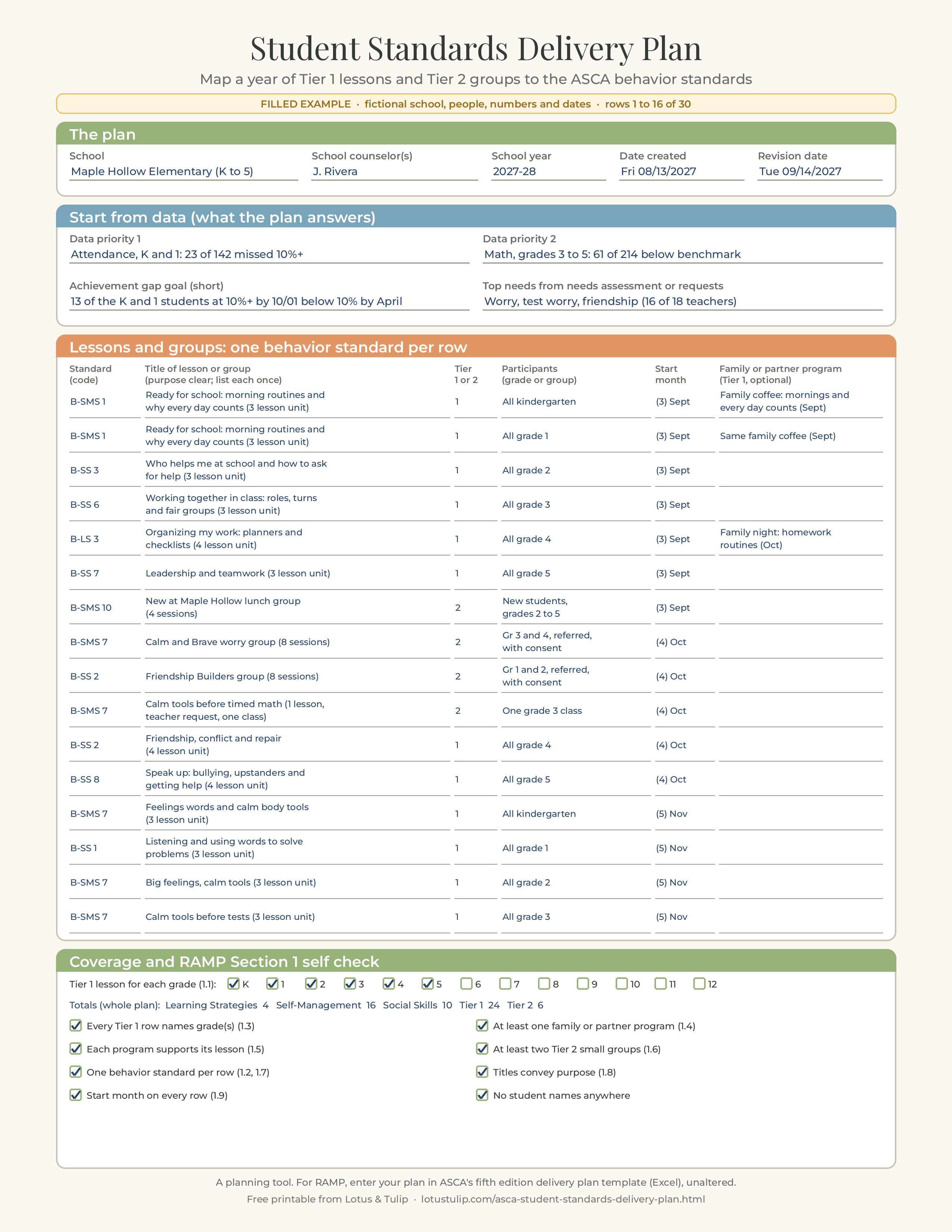
| 1 | B-SMS 1 | Ready for school: morning routines and why every day counts (3 lesson unit) | 1 | All kindergarten | (3) Sept | Family coffee: morning routines and why every day counts (Sept 23) |
| 2 | B-SMS 1 | Ready for school: morning routines and why every day counts (3 lesson unit) | 1 | All grade 1 | (3) Sept | Same family coffee (Sept 23) |
| 3 | B-SS 3 | Who helps me at school and how to ask for help (3 lesson unit) | 1 | All grade 2 | (3) Sept | |
| 4 | B-SS 6 | Working together in class: roles, turns and fair groups (3 lesson unit) | 1 | All grade 3 | (3) Sept | |
| 5 | B-LS 3 | Organizing my work: planners and checklists (4 lesson unit) | 1 | All grade 4 | (3) Sept | Family night: homework routines (Oct 12) |
| 6 | B-SS 7 | Leadership and teamwork (3 lesson unit) | 1 | All grade 5 | (3) Sept | |
| 7 | B-SMS 10 | New at Maple Hollow: lunch group for new students (4 sessions) | 2 | Students new to the school, grades 2 to 5 | (3) Sept | |
| 8 | B-SMS 7 | Calm and Brave: worry small group (8 sessions) | 2 | Grade 3 and 4 students referred for worry, with consent | (4) Oct | |
| 9 | B-SS 2 | Friendship Builders: friendship skills small group (8 sessions) | 2 | Grade 1 and 2 students referred for friendship skills, with consent | (4) Oct | |
| 10 | B-SMS 7 | Calm tools before timed math (1 lesson, teacher request) | 2 | One grade 3 class | (4) Oct | |
| 11 | B-SS 2 | Friendship, conflict and repair (4 lesson unit) | 1 | All grade 4 | (4) Oct | |
| 12 | B-SS 8 | Speak up: bullying, upstanders and getting help (4 lesson unit) | 1 | All grade 5 | (4) Oct | |
| 13 | B-SMS 7 | Feelings words and calm body tools (3 lesson unit) | 1 | All kindergarten | (5) Nov | |
| 14 | B-SS 1 | Listening and using words to solve problems (3 lesson unit) | 1 | All grade 1 | (5) Nov | |
| 15 | B-SMS 7 | Big feelings, calm tools (3 lesson unit) | 1 | All grade 2 | (5) Nov | |
| 16 | B-SMS 7 | Calm tools before tests (3 lesson unit) | 1 | All grade 3 | (5) Nov | |
| 17 | B-SMS 7 | Calm tools before tests (3 lesson unit) | 1 | All grade 4 | (5) Nov | |
| 18 | B-SMS 5 | Practice, mistakes and trying again (4 lesson unit) | 1 | All grade 3 | (7) Jan | |
| 19 | B-SMS 9 | Staying safe online and asking for help (3 lesson unit) | 1 | All grade 4 | (7) Jan | |
| 20 | B-LS 9 | Careers: interests, evidence and choices (4 lesson unit) | 1 | All grade 5 | (7) Jan | Career day (Mar 10) |
| 21 | B-SMS 6 | Here and Ready: attendance small group (8 sessions) | 2 | Grade 4 and 5 students missing 10 to 20 percent of days, with consent | (7) Jan | |
| 22 | B-SS 2 | Being a good friend: take turns, share, include (3 lesson unit) | 1 | All kindergarten | (8) Feb | |
| 23 | B-SMS 2 | Self-control: stop, breathe, choose (3 lesson unit) | 1 | All grade 1 | (8) Feb | |
| 24 | B-SS 4 | Empathy: noticing how others feel (3 lesson unit) | 1 | All grade 2 | (8) Feb | |
| 25 | B-SS 8 | Speak up: bullying, upstanders and getting help (4 lesson unit) | 1 | All grade 3 | (8) Feb | |
| 26 | B-SMS 9 | Body safety and trusted adults (3 lesson unit) | 1 | All grade 5 | (8) Feb | |
| 27 | B-SMS 7 | Cool and Ready: test anxiety small group (6 sessions) | 2 | Grade 3 to 5 students referred for test worry, with consent | (8) Feb | |
| 28 | B-LS 7 | My goals and interests (4 lesson unit) | 1 | All grade 4 | (9) Mar | |
| 29 | B-LS 7 | Setting a goal and tracking it (4 lesson unit) | 1 | All grade 3 | (10) Apr | |
| 30 | B-SMS 10 | Getting ready for middle school (4 lesson unit) | 1 | All grade 5 | (10) Apr | Grade 5 family night with the middle school counselor (May 11) |
Checking the lesson counts: kindergarten, grade 1 and grade 2 each have three units of three lessons, nine per grade. Grade 3 has 3 + 3 + 4 + 4 + 4 = 18, grade 4 has 4 + 4 + 3 + 3 + 4 = 18, and grade 5 has 3 + 4 + 4 + 3 + 4 = 18.
Her RAMP self check
- 1.1: Every grade from kindergarten to grade 5 has Tier 1 rows.
- 1.2 and 1.7: One behavior standard per row, chosen from the drop-downs.
- 1.3: Every Tier 1 row says "All kindergarten" or "All grade" plus a number.
- 1.4 and 1.5: Four programs on five Tier 1 rows, each matching its lesson's skill.
- 1.6: Five Tier 2 small groups (rows 7, 8, 9, 21 and 27), all between four and eight sessions. Row 10 is a Tier 2 lesson, not a group, and she did not count it.
- 1.8: Every group name has a few words explaining it.
- 1.9: Every row has a start month.
What the Summary tab told her
The Summary tab showed 4 learning strategies rows, 16 self-management rows and 10 social skills rows, with 24 Tier 1 and 6 Tier 2. B-SMS 7 alone appeared on seven rows. She thought about it honestly. The data supported a lot of coping work: the worry referrals, the nurse's log and the test worry pattern were real. But math in grades 3 to 5 was a school priority, and only four rows were learning strategies. She kept the plan for the fall and wrote a note for the January check in with her principal: consider swapping the grade 3 "trying again" unit (B-SMS 5) for a study strategies unit (B-LS 3) if midyear math benchmarks have not moved. That note became one of her talking points at the conference, and later a question for the advisory council.
How it was used
- Thursday, August 26, 2027: at the annual administrator conference, she shared the draft and the Summary numbers. The principal agreed to cut her lunch duty from five days to two so the Tier 2 groups had a protected time slot.
- Tuesday, September 14, 2027: revision after the needs assessment.
- Tuesday, October 19, 2027: at the fall advisory council meeting, she gave a five minute overview of the plan. A parent member suggested inviting families of new students to the morning routines coffee too, and the librarian offered to host part of the grade 4 online safety unit.
- All year: she logged every delivery on the log sheet (date, row number, class or group, students present) and used it for her participation data.
- Calm and Brave (row 8) became her RAMP small group submission, with the same B-SMS 7 standard on its Small-Group Plan and Data Report, and the grade 3 "Calm tools before tests" unit (row 16) became her lesson plan submission. The attendance work in kindergarten and grade 1 stayed in the gap plan, so the group she submitted in Section 6 was not part of the gap plan.
Page 2 of the free printable shows the first 16 rows of this plan as she sketched them on paper before entering them in ASCA's template.
Six real world scenarios
1. "My principal says I can only get into classrooms twice a year." Then plan two strong Tier 1 lessons per grade and make sure every grade has at least one. Use the conference to show the data that a third lesson would address, and consider large group delivery (a grade level assembly lesson is still Tier 1 if every student in the grade receives it).
2. "I am at a high school with 450 students per counselor." Use individual Tier 1 advisement, such as junior and senior planning conferences, which ASCA's Tier 1 definition explicitly allows in individual settings. List them as one row per grade with B-LS 9 or B-LS 7, and keep your two small groups focused on your gap data, such as course failures.
3. "A teacher asked for a lesson after a hard week in her class." Add a Tier 2 row: one class, teacher request, one behavior standard, the month. Update the revision date. Do not add it as Tier 1 unless you then deliver it to every class in that grade.
4. "My group's sessions each teach a different standard." Pick the standard that names the group's main purpose for the delivery plan row and give each session its own standard on the Small-Group Plan and Data Report, one per session. If you are applying for RAMP, check how reviewers read this with a mentor, since ASCA's documents do not spell it out.
5. "I am split between two schools." Each school needs its own plan with its own grades. If one building gets only Tier 2 work from you, talk with your administrators about who delivers Tier 1 there, since item 1.1 asks for Tier 1 lessons for each grade level in the school.
6. "I inherited a fourth edition action plan full of mindset standards." Keep the lessons, change the standards. For each mindset row, decide what students practice or do and pick the behavior standard that names it. Then download the fifth edition template and enter the rows there; a modified fourth edition file will not meet the original form rule.
Common mistakes
- Two standards in one row. The template says "Choose only one standard per lesson or session."
- Mindset standards on the plan. The fifth edition template lists behavior standards only.
- A grade with no Tier 1 row. Item 1.1 asks for each grade level in the school. Check kindergarten and your top grade especially.
- Class names instead of grades. "Ms. Lee's class" does not specify a grade level. Use "All grade 3," or for a teacher request, "One grade 3 class (teacher request)" as Tier 2.
- Only one small group. Item 1.6 asks for at least two Tier 2 small groups. A Tier 2 lesson does not count as a group.
- Groups that are too short or too large. ASCA's notes say four to eight sessions and three to 12 students.
- Cute titles with no explanation. Add a few words: what the group or lesson is about.
- A family event that does not fit. Item 1.5 asks that it support the lesson and standard it is attached to.
- Retyping or altering the template. Use ASCA's current fifth edition Excel template in its original form and upload it as Excel, not PDF.
- Student names or identifying details. Describe Tier 2 participants by criteria only.
Free printable: delivery plan planner, filled example and delivery log
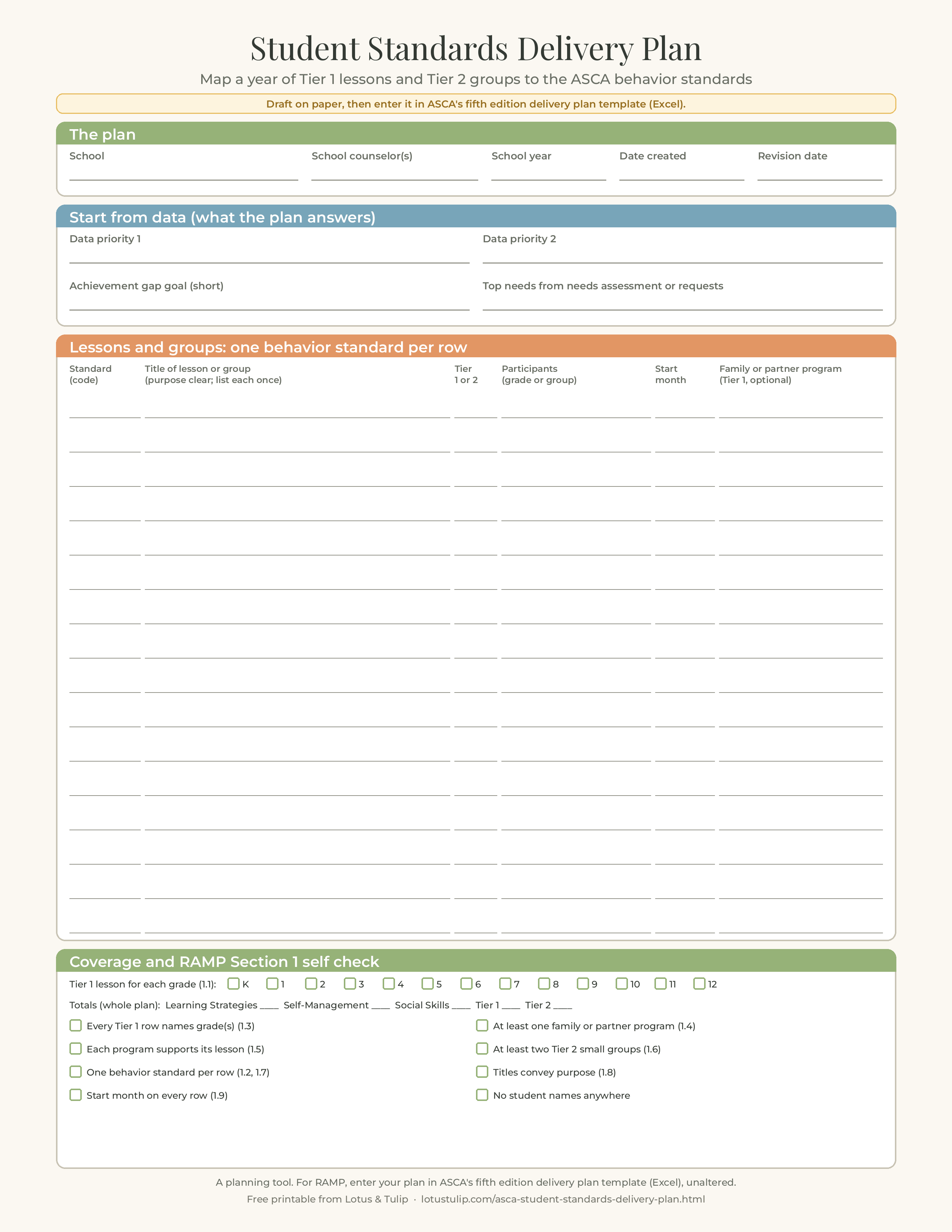
The free printable has three US Letter pages. Page 1 is a blank planner: the plan details (school, school counselors, school year, date created and revision date); a "start from data" box for two data priorities, a short achievement gap goal and the top needs from your needs assessment or teacher requests; sixteen lesson and group rows, each with a standard code, a title, the tier, participants, a start month and an optional family or partner program; and a coverage and RAMP Section 1 self check with grade boxes from kindergarten to grade 12, a totals line for the three subcategories and two tiers, and eight checks keyed to items 1.1 to 1.9. Page 2 is the same planner filled in with the first 16 of the 30 rows of the fictional Maple Hollow Elementary plan described above. Page 3 is a delivery and revision log: fifteen delivery rows (date, row number, lesson or session, class or group, number of students, pre and post given, notes), five revision rows (date, what changed, why), and a quick reference to all 30 behavior standards and the 6 mindset standards in shortened wording.
The printable is a drafting and tracking tool. It does not replace ASCA's fifth edition ASCA Student Standards Delivery Plan template, which the RAMP rubric says must be used in its original form and uploaded in Excel format. Sketch the year on paper, then enter it in ASCA's template.
Download the free planner, example and log (PDF, 3 pages)
Or download single pages: Page 1: blank planner (PNG) · Page 2: filled fictional example (PNG) · Page 3: delivery and revision log (PNG)
Free to print and use in your own school. Please link to this page rather than re-uploading the file. This is a planning tool. It does not replace ASCA's official templates, your district's curriculum requirements or policies, or legal advice. The standards wording on page 3 is shortened; use ASCA's full wording in your documents.
The delivery plan is Section 1 of the fifth edition RAMP application (9 points). To see how it fits with the other six sections, their uploads and file formats, use the RAMP application checklist.
Related resources
- School counseling program assessment: all 25 ASCA fifth edition benchmarks, filled example and free worksheet
- RAMP application checklist: every fifth edition rubric item, upload and deadline, with a free checklist and data year planner
- ASCA classroom lesson plan and data report: RAMP Section 5, filled example and free planner
- ASCA small-group plan and data report: RAMP Section 6, filled example and free planner
- Closing the gap action plan: ASCA achievement gap plan and data report, filled example and free planner
- School counselor use-of-time calculator: 5-day log, percentages and a filled example
- All school counselor small group curriculums
- School counselor annual administrator conference: what to bring, sample agenda and a free planner
- School counselor advisory council agenda, minutes and a filled example
- School counselor needs assessment for small groups
- Small group counseling lesson plan template and planning map
- Small group counseling pre and post assessment
- Small group counseling progress notes and attendance tracker
- Small group counseling for attendance: 8 session plan, activities and data log
- Full year elementary small group counseling: plan the year
Sources: American School Counselor Association (2021), ASCA Student Standards: Mindsets and Behaviors for Student Success (PDF marked "Updated 10/2025"), including the overview, category and subcategory definitions, domains, the ten implementation steps and the notes on collecting ASCA Student Standards data, from the ASCA Student Standards web page; American School Counselor Association, sample ASCA Student Standards learning objectives spreadsheet (910 objectives as downloaded); American School Counselor Association, ASCA Student Standards Delivery Plan template and completed example, ASCA National Model Fifth Edition (8/25), Overview, Example, Delivery Plan and Summary tabs, from the ASCA Templates and Tools page; American School Counselor Association, Lesson Plan and Data Report and Small-Group Plan and Data Report examples, fifth edition; American School Counselor Association, Changes in the ASCA National Model Fifth Edition (Define: ASCA Student Standards; Manage: Use of Data, ASCA Student Standards Delivery Plan, Calendars, Annual Administrator Conference); American School Counselor Association, ASCA National Model Fifth Edition Phased Implementation Plan (Phases 1 to 4); American School Counselor Association, RAMP Scoring Rubric, Fifth Edition (August 2025, revised September 2025 and February 2026), general instructions and Sections 1 to 7; American School Counselor Association, RAMP Rubric, Fourth Edition, Section 3, for comparison; American School Counselor Association, RAMP Application Timeline, Fifth Edition, and the Apply for RAMP web page. All checked November 10, 2026.
FAQ
What is the ASCA Student Standards delivery plan?
It is the fifth edition ASCA National Model template, an Excel spreadsheet, that gives an overview of how a school counselor delivers the behavior standards from the ASCA Student Standards directly to students during the year. Each row is one Tier 1 lesson or Tier 2 lesson or group, with one behavior standard, a title, the tier, participants, a start month and, if applicable, a family or partner program that supports a Tier 1 lesson.
What replaced the classroom and group mindsets and behaviors action plan?
In the fifth edition of the ASCA National Model (2025), the ASCA Student Standards delivery plan replaced the fourth edition's Classroom and Group Mindsets and Behaviors Action Plan and also absorbed the annual calendar. ASCA's Changes document says it adds drop-down boxes for behavior standards by category, identifies Tiers 1 and 2, and includes space for family and partner programs.
Can I use mindset standards on the delivery plan?
The fifth edition template's drop-downs list only the 30 behavior standards, and the RAMP rubric asks for one behavior standard per Tier 1 lesson and per Tier 2 group session. The six mindset standards still describe what the program encourages in all students and work well in pre and post items, but choose a behavior standard for each delivery plan row.
How many points is the delivery plan worth for RAMP?
In the fifth edition RAMP Scoring Rubric, Section 1, the ASCA Student Standards Delivery Plan, is worth 9 points, out of 82 points across the seven sections. The plan is uploaded in Excel format, using ASCA's fifth edition template in its original form.
How many small groups do I need on the delivery plan?
At least two Tier 2 small groups, according to RAMP item 1.6. ASCA's implementation notes describe Tier 2 small groups as four to eight sessions with three to 12 students. A single Tier 2 lesson delivered to one class at a teacher's request is also Tier 2, but it does not count as a small group.
When should the delivery plan be finished?
ASCA's fifth edition RAMP Application Timeline suggests finalizing the ASCA Student Standards Delivery Plan in August to September of the school year, after the data priorities and achievement gap plan. The template says the plan may be updated throughout the year, so add rows and update the revision date when needs change.