
Kids and teens · Updated 2026-11-07
Self Care Activities for Teens (with Free Printable)
Ready-made printable: Mindfulness Worksheets for Kids and Teens Holiday 20% off: about $9.20, was $12 (EUR 10) · instant digital download
Buy on Etsy
Self care activities for teens are short, practical rounds that help middle and high school students notice what drains and refills them, protect the basics (sleep, movement, food), handle feelings without hiding from them, stay connected to people, manage screens and school load, keep some fun and meaning in the week, and know when self care is not enough. This guide gives school counselors, therapists, teachers and parents activities you can run tomorrow: an energy drain and refill audit, a recharge versus avoidance sort, a minimum day plan for hard days, a phone sunset experiment, a school week load map and a weekly self care plan. Each one comes with timing, setup, debrief and adaptations, plus a free three page printable.
Teen self care is different from an adult self care plan. A twelve year old who stays up gaming until two, a fifteen year old who calls an entire weekend of scrolling "self care," and a seventeen year old juggling a job, AP classes and a little brother all need skills that fit adolescent days: bells, bedtimes set by other people, group chats, practice schedules and very little control over the calendar. This page sits next to our self care plan template (adult and general six area plan), stress management worksheets for teens (stress triggers and calm skills), mindfulness activities for teens, sleep hygiene worksheet, self compassion activities for teens and coping skills worksheets for teens. Those pages go deep on neighboring skills. This one is about the teen self care loop itself: audit, protect the basics, sort recharge from avoidance, plan a realistic week, set a hard day floor, watch the warning signs, and ask for help.
We credit the sources these activities lean on, without claiming any affiliation or endorsement: the American Academy of Sleep Medicine consensus on teen sleep (endorsed by the American Academy of Pediatrics), the US Physical Activity Guidelines for Americans, the US Surgeon General's 2023 advisory on social media and youth mental health, the AAP Family Media Plan, CDC Youth Risk Behavior Survey data, and the ASCA Student Standards and CASEL framework for self management neighbors. The printable is an original Lotus and Tulip layout, not a copy of any of their materials.
This guide is educational. It is not therapy, not medical advice and not a diagnosis. Self care does not treat depression, anxiety, an eating disorder, substance use or any other condition. If a self care conversation turns up thoughts of ending a life, a plan to hurt someone, self harm, abuse, or a medical emergency, stop the activity and get help now: in the US, call or text 988 (Suicide and Crisis Lifeline), text HOME to 741741 (Crisis Text Line), or call 911. Our safety plan worksheet is a better first tool in that moment.
Jump to the free self care printable (PDF) · Activities · How to use self care activities for teens, step by step · Worked examples · Comparisons
What teen self care is (and is not)
For this page, self care means the small, repeatable things a teen does on purpose to keep body, mind and relationships working well enough to handle school and life. It is maintenance, not a treat. A useful teen self care plan covers six domains, names a few realistic actions in each, includes a "minimum day" for bad days, and has a clear line for when to bring in an adult. Teens practice the plan for one week at a time and adjust what did not fit.
It is not:
- Bubble baths and face masks only. Pampering can be part of it, and that is fine. But most of what keeps a teen steady is boring: going to bed at a similar time, eating something before school, moving, texting back the friend who checks in, and starting the essay before Sunday night. If a plan is all treats and no basics, it will not hold up in a hard week.
- Avoidance with a nice label. Skipping class to "protect my peace," ghosting every friend, or six hours of scrolling to "decompress" can feel like rest in the moment and make the next day harder. Real self care usually leaves you a bit more able to face the thing, not further from it. The recharge versus avoidance sort below makes that line visible.
- Selfishness. Teens sometimes hear "self care" as permission to drop every responsibility, or the opposite, as something only selfish people do. Taking care of yourself so you can show up for school, family and friends is not selfish. Dropping all commitments without a plan is a different thing.
- A fix for a bad situation. No amount of journaling solves an unsafe home, bullying, a learning need nobody has noticed, or food insecurity. When the problem is the environment, adults need to change the environment. Self care is not a way to make a teen carry a load that should not be theirs.
- A treatment. Sleep, movement and connection support mental health, but self care does not treat depression, anxiety, an eating disorder, self harm or substance use. If struggles are lasting, getting worse or interfering with daily life, a school or clinical evaluation may be the right next step. See depression activities for teens and anxiety activities for teens as neighboring skill pages, not cures.
Why teens need teen shaped self care
Teen bodies run on a different clock. During puberty, many teens naturally feel sleepy later at night, while school still starts early. That is one reason the American Academy of Pediatrics has called for middle and high schools to start no earlier than 8:30 a.m. A teen self care plan has to work with that clock instead of pretending a 9 p.m. bedtime is realistic for every sixteen year old.
Teens control less of their day. Adults can often move a meeting. Teens cannot move first period, the bus, practice or a family schedule. Good teen self care focuses on the pockets they do control: the last hour before bed, the walk between classes, lunch, the phone, and how they ask for help.
The phone is in every domain. Sleep, mood, friendships, school focus and fun all run through one device. That makes digital habits a domain of their own, not a footnote.
Many teens are struggling. In the CDC's 2023 Youth Risk Behavior Survey, 40 percent of US high school students reported persistent feelings of sadness or hopelessness during the past year. Self care will not solve that alone, and it should never be offered as the only answer. It can be one layer next to real support, and it gives teens a shared language for noticing when they are running low.
"Self care" is already a trend word. Teens see it on feeds attached to products, routines that take two hours and aesthetic morning videos. Naming the gap between that version and a realistic one is part of the work.
The six domains of teen self care
Use these six domains as the backbone of the plan. Teens do not need something in every domain every day. They need to notice which domains are empty and pick one or two small actions to refill them.
- Body: sleep, movement, food. The American Academy of Sleep Medicine recommends 8 to 10 hours of sleep per 24 hours for teens 13 to 18 (and 9 to 12 hours for ages 6 to 12), a recommendation the AAP endorsed. The Physical Activity Guidelines for Americans recommend 60 minutes or more of moderate to vigorous activity daily for ages 6 to 17. Teens do not have to hit those numbers perfectly; they are a target, not a test. Food here means regular meals and water, not dieting. Weight loss and food rules are not self care goals on this page.
- Emotional. Naming feelings, letting them move through (a cry, a walk, a journal page, a song), and having two or three go to calm skills. Pair with coping skills worksheets for teens when the coping menu is thin.
- Social. At least one person a teen can be real with, time with friends that does not happen only through a screen, and the skill of saying "I need a break" without disappearing. Isolation often sneaks in under the label of rest.
- Digital and screen. When and where the phone sleeps, notifications, which apps refill and which drain, and how long a "quick check" really lasts. The goal is choice, not zero screens.
- School and time. Seeing the week's load in one place, breaking big tasks into first steps, asking for extensions early, and protecting at least one unscheduled block. Many teen meltdowns are time problems wearing an emotion costume.
- Fun and meaning. Something that is just enjoyable, plus something that feels like it matters: a hobby, faith or culture, music, volunteering, caring for a pet, a creative project. Teens who only have "work" and "recover" in their week often feel flat even when they sleep enough.
Self care activities teens will actually do
Each activity below lists time, group size, setup and debrief. Run one or two per session, not all of them at once. The first three build awareness, the middle ones build specific habits, and the last ones turn everything into a realistic weekly plan.
1. Energy drain and refill audit
Time: 12 minutes. Group: individual or small group. Setup: the six domains written across a page, two columns under each: drains and refills.
Students think back over the last three days and list what drained them and what refilled them in each domain. Examples: "group chat drama at midnight" (drain, social and digital), "shooting hoops alone for 20 minutes" (refill, body and fun). Then they rate each domain from 0 (empty) to 5 (full). Debrief: which domain is lowest? Which refill costs the least time? Teaching point: self care starts with noticing, not with buying anything.
2. Recharge versus avoidance sort
Time: 12 minutes. Group: pairs or small groups. Setup: fictional cards such as "nap after practice," "skip school because of a quiz," "watch one episode, then start homework," "leave every group chat for a month without telling anyone," "go for a walk after a fight," "scroll until 3 a.m."
Groups sort each card into recharge, avoidance, or "depends." The key question: after this, am I more able or less able to face what is waiting? Debrief: the same action can be either. A nap can recharge; a nap every time the essay comes up is avoidance. Pair with stress management worksheets for teens when avoidance is driven by a specific stressor.
3. Self care myth check
Time: 10 minutes. Group: whole class. Read aloud lines like "Self care means doing whatever you want," "Self care costs money," "If I take care of myself I am selfish," "Self care will fix my depression," and "Sleep is optional if I am busy." Students stand on one side of the room for myth, the other for true, and the middle for "partly." Debrief each one in a sentence. Teaching point: self care is maintenance, it can be free, it is not selfish, and it is not a treatment.
4. Sleep window plan
Time: 15 minutes. Group: individual. Students write their real school wake up time, count back 8 to 10 hours, and see what bedtime that implies. Most will notice a gap. Then they pick one 15 minute step toward the window (screens off 15 minutes earlier, charging the phone outside the bedroom, a set "last task" before bed). Debrief: small shifts kept for a week beat a dramatic plan that lasts one night. Pair with sleep hygiene worksheet for a full sleep routine page. If a teen sleeps far too much or too little for weeks, or snores loudly and wakes exhausted, that is a question for a doctor, not just a worksheet.
5. Phone sunset experiment
Time: 10 minutes to set up, one week to run. Group: individual with class debrief. Each student picks a "sunset" time for the phone, a place where it sleeps, and one app they mute after a set hour. They log for seven days what happened to falling asleep, morning mood and group chat stress. Debrief: what changed, what was hard, what would they keep? The AAP Family Media Plan is a good family follow up. Teaching point: this is an experiment, not a punishment; teens decide what to keep.
6. Movement menu (no gym required)
Time: 10 minutes. Group: small groups. Groups brainstorm 15 ways to move that cost nothing and fit a teen day: walking the long way to class, dancing to three songs, stretching before bed, shooting hoops, walking the dog, biking to a friend's place. Each student circles three. Debrief: movement counts even when it is not a sport. Avoid anything about burning calories or changing body size; the goal is energy and mood, not weight.
7. Minimum day plan
Time: 12 minutes. Group: individual. On hard days, a full self care plan collapses. A minimum day plan is the floor: the three to five smallest things that keep a teen going when everything feels heavy. Example: drink water, eat one real meal, shower or wash face, text one person, get to bed by a set time. Debrief: the floor is not failure. It is the plan that still works on the worst day. Add a line: "If I am on minimum day for more than a few days in a row, I tell ____."
8. School week load map
Time: 15 minutes. Group: individual or pairs. Students map the coming week: classes, tests, due dates, practice, work, family duties. They shade the heaviest day and plan one first step for the biggest task two days before it is due. They also mark one protected block with nothing scheduled. Debrief: seeing the week often lowers stress more than any calm skill, because the problem was invisible. Pair with goal setting worksheet for students when the next need is longer range planning.
9. Connection check and ask for help script
Time: 12 minutes. Group: pairs. Students list three people they can be real with (a friend, a family member, a counselor, a coach, a teacher) and one thing each person is good for (fun, listening, practical help). Then they practice a short script: "I have not been doing great. Can we talk for ten minutes?" Debrief: asking for help is a self care skill, not a weakness. Teens who list zero people need a quiet follow up from an adult, not a spotlight.
10. Fun and meaning list
Time: 10 minutes. Group: individual. Two columns: "just fun" and "feels like it matters." Students list five in each, then circle one from each column to do this week. Debrief: if both columns are hard to fill, that is useful information, and sometimes an early sign that mood needs attention.
11. Weekly self care plan
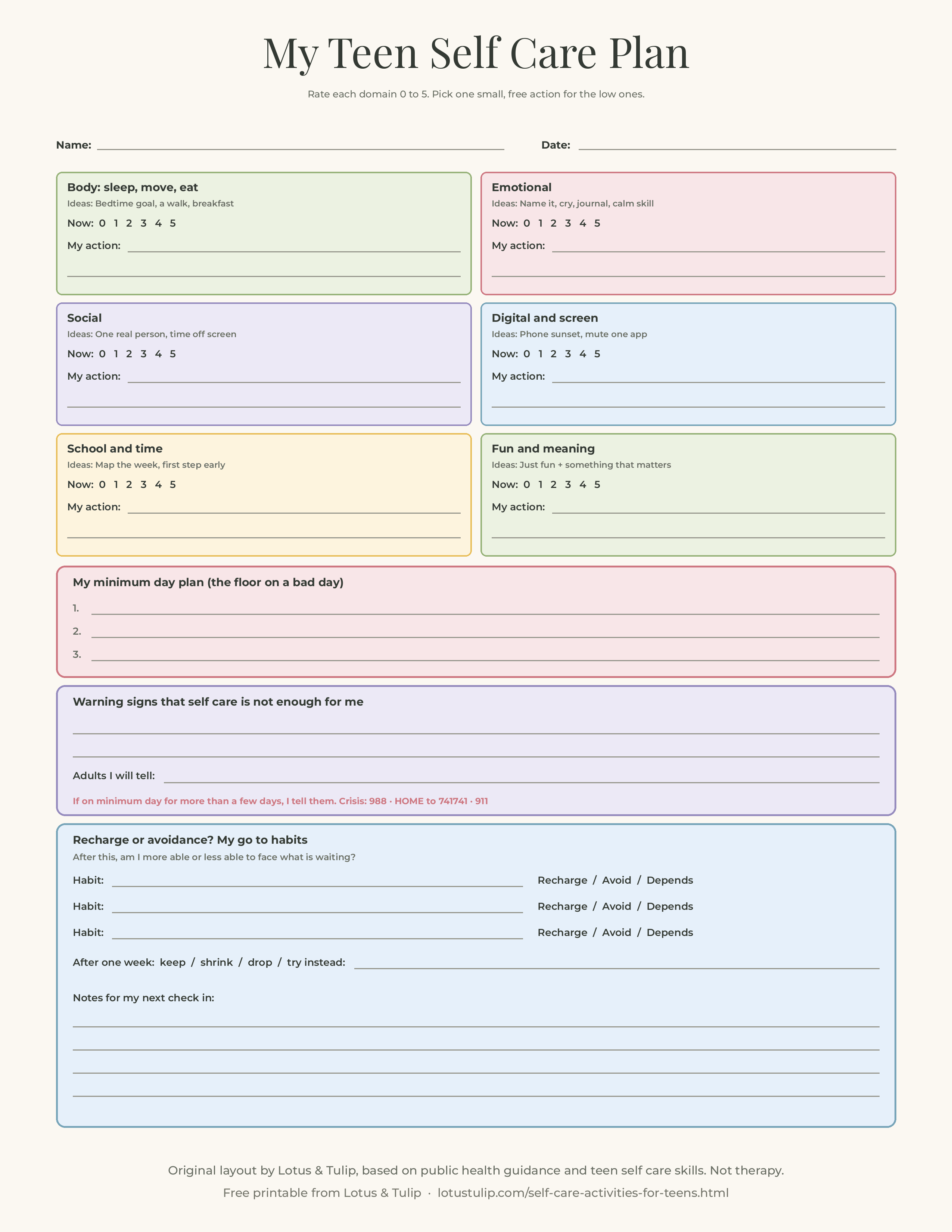
Time: 15 minutes. Group: individual. Using the free printable plan page, teens choose one small action per domain (or skip domains that are already fine), write their minimum day plan, name two warning signs that self care is not enough, and list who they will tell. Debrief: tiny and specific beats a perfect plan. "Phone charges in the kitchen on school nights" beats "use my phone less."
How to run these activities in a group or session
Set norms first. Pass is always allowed, practice on made up scenes before real ones, no comparing whose life is harder, and no shaming anyone for their phone, food or sleep. Model a realistic adult plan yourself ("My minimum day is coffee, a short walk and bed by eleven") so teens see that self care is ordinary. Keep personal sharing optional. End every session with one carry over: one sleep step, one phone change, one person to text, or one fun thing.
Suggested six session sequence. Session 1: energy drain and refill audit plus myth check. Session 2: recharge versus avoidance sort. Session 3: sleep window plan and phone sunset setup. Session 4: movement menu and school week load map. Session 5: connection check, ask for help script, fun and meaning list. Session 6: phone sunset debrief, minimum day plan, weekly self care plan and check in review.
Classroom version. In a single advisory or health lesson, run the myth check (10 minutes), the drain and refill audit (12 minutes) and the minimum day plan (12 minutes), then send the printable home. That covers awareness, one concrete tool and a take home plan in under 40 minutes.
Adaptations
- Middle school (about 12 to 14): more structure, sentence frames and picture choices; scenes about bedtime battles, gaming, siblings, homework and group chats. Remember that ages 12 and under fall in the 9 to 12 hour sleep range.
- High school (about 14 to 18): add jobs, driving, college pressure, dating and caring for younger siblings. Let students design their own plans with less scaffolding.
- Individual sessions: build the plan around one real week and review it the next session. Adjust instead of judging what did not happen.
- Teens with heavy home responsibilities: many teens care for siblings or work to help the family. Do not frame self care as "say no to family." Find pockets inside the real load, and flag to the team if the load itself is too much.
- Autistic and neurodivergent teens: offer concrete checklists, visual schedules and clear rules. Sensory needs (quiet, deep pressure, a predictable routine) are self care, not quirks. ADHD teens often do better with timers and external reminders than with willpower plans.
- Teens with eating concerns: keep the food domain about regular meals and energy, never about calories, weight or "clean" eating. If you notice signs of a possible eating disorder, follow school or clinical referral steps.
- Teens with limited money or privacy: make sure every example on the board is free and doable in a shared room or a busy apartment.
- English learners and virtual groups: provide frames and icons for each domain; use shared docs and breakouts online.
How to use self care activities for teens, step by step
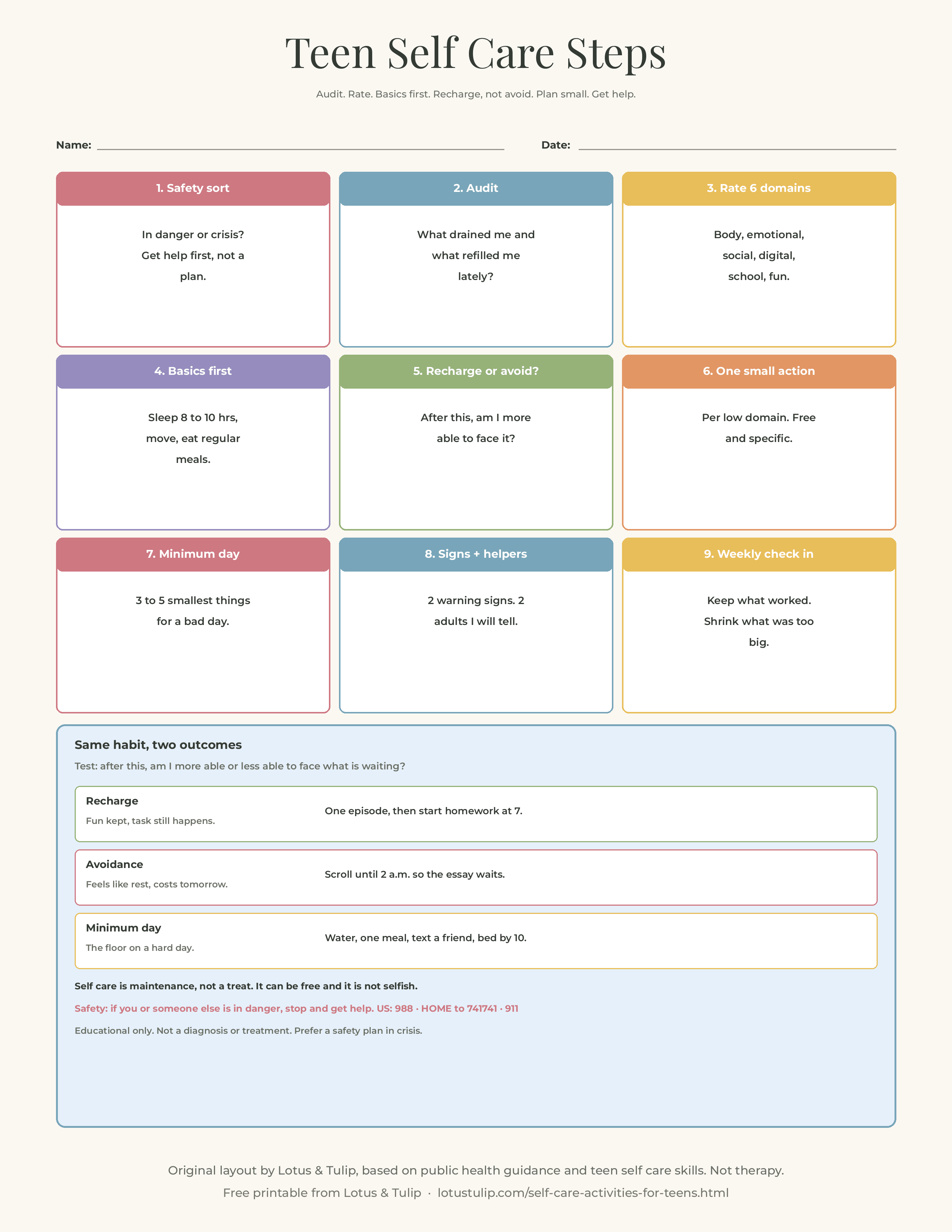
- Safety sort. Before planning, check that this is a self care question and not a crisis. Thoughts of ending a life, self harm, a plan to hurt someone, abuse or a medical emergency come first: 988, HOME to 741741, or 911 when needed, plus a safety plan and a trusted adult. Do not offer a self care plan as a substitute for crisis help.
- Audit drains and refills. Look back over the last few days. What drained energy and what refilled it in each of the six domains?
- Rate the six domains. Body, emotional, social, digital, school and time, fun and meaning: rate each from 0 (empty) to 5 (full). Circle the lowest one or two.
- Protect the basics first. Check sleep, movement and food. Pick one small step toward 8 to 10 hours of sleep, some daily movement and regular meals before adding anything fancy.
- Sort recharge from avoidance. For each favorite "self care" habit, ask: after this, am I more able or less able to face what is waiting? Keep the recharge habits; put a limit on the avoidance ones.
- Pick one action per low domain. Small, specific and free: "phone charges in the kitchen," "walk the dog after school," "text Sam on Friday," "start the essay Tuesday for 20 minutes."
- Write a minimum day plan. The three to five smallest things that keep you going on a bad day, plus the name of who you tell if you are on minimum day for several days in a row.
- Name warning signs and helpers. Write two signs that self care is not enough for you right now, and two adults you will tell if they show up.
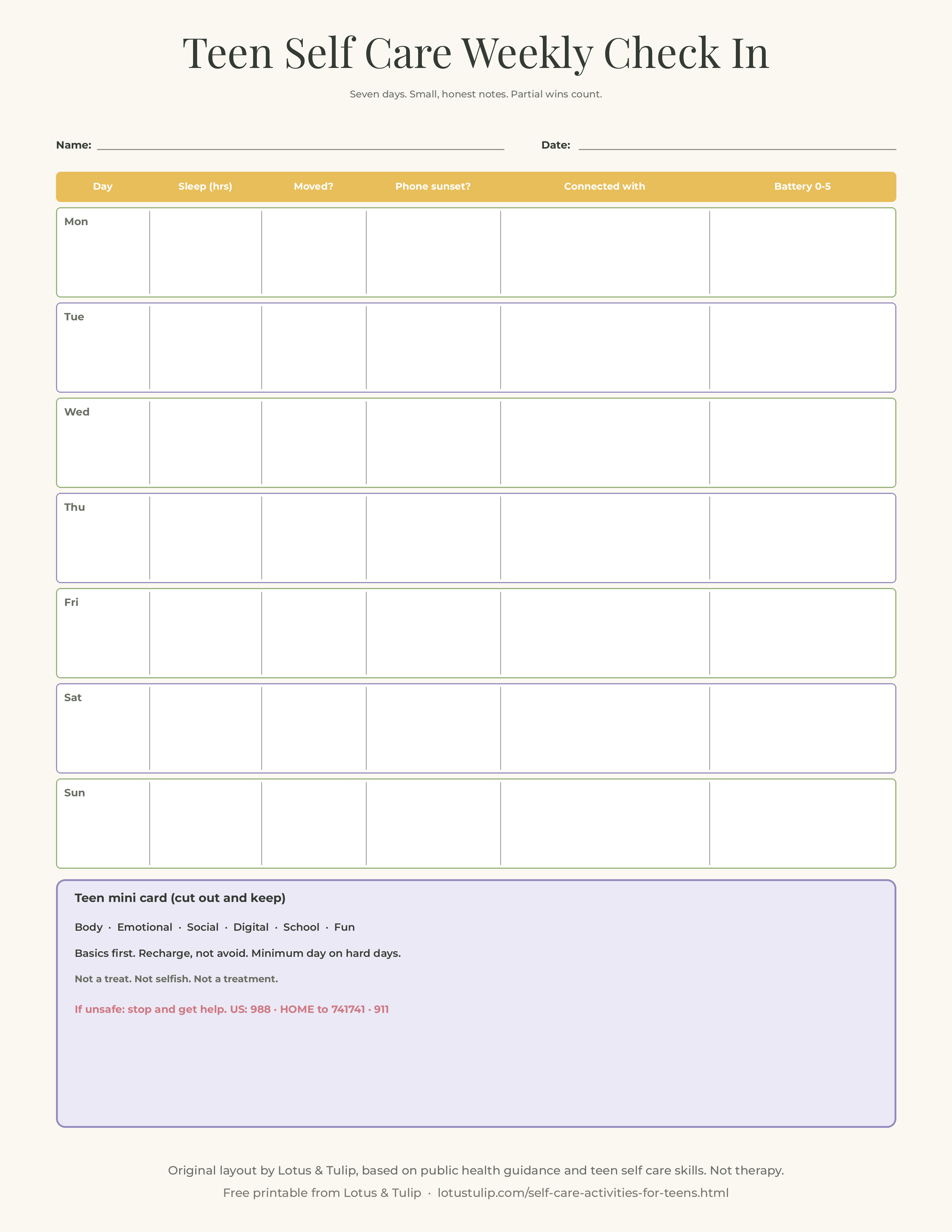
- Check in weekly and adjust. Use the weekly check in log. Keep what worked, shrink what was too big, and celebrate partial wins. Bridge to stress management, mindfulness, sleep, self compassion or coping skills pages when one domain needs deeper work.
Plan for a normal week first. A plan built in a calm moment is the one that still exists on the hard day.
Warning signs that self care is not enough
Self care helps with ordinary stress and low energy. It is not the right tool when a teen is showing signs of something bigger. Bring in a parent, school counselor, doctor or therapist when you see:
- Sadness, irritability, worry or numbness most days for two weeks or more.
- Big changes in sleep (sleeping most of the day, or barely sleeping for many nights) or in eating, including skipping meals, bingeing, or rigid food rules.
- Pulling away from almost all friends and activities they used to enjoy.
- Grades dropping sharply, frequent absences, or refusing to go to school.
- Using alcohol, vaping or other substances to cope.
- Self harm, talk of being a burden, hopelessness about the future, or giving away belongings.
- Living on the minimum day plan for more than a few days in a row with no improvement.
Any talk of suicide or self harm is a same day conversation with a trusted adult, and a reason to use 988, text HOME to 741741, or call 911 if there is immediate danger.
School counselor, therapist, teacher and parent tips
School counselors. Self care activities fit advisory lessons, small groups, wellness weeks and short individual check ins, and sit near ASCA and CASEL self management language about managing stress, balancing responsibilities and seeking help. Use the drain and refill audit as a quick screener conversation, keep personal sharing optional, and follow district protocols when a teen lists zero support people or warning signs appear. Avoid wellness assemblies that turn self care into a product list.
Therapists. Build the plan around the teen's real week and review it each session. Watch for perfectionist teens who turn self care into another chore list, and for teens whose "self care" is mostly avoidance of a feared situation (that may call for gradual exposure work instead). Coordinate with caregivers on sleep and phone agreements so the teen is not fighting the household alone. This printable is a skill aid, not a treatment plan.
Teachers. Talk about load during the week, not only before finals. Post a weekly load map, give advance notice of big due dates, and let students know how to ask for an extension before the night it is due. A two minute "how full is your battery" check at the start of class can open the door for students who need a counselor.
Parents and caregivers. Model it more than you lecture it. Charge your own phone outside the bedroom, take a walk after a hard day, and say out loud when you are on a minimum day. Make sleep and phone agreements together instead of announcing them, and expect to adjust. Notice warning signs early and ask the school counselor or pediatrician for help.
Worked fictional examples
The midnight group chat (fictional). Dani, 14, was tired and snappy every morning. The drain and refill audit showed the digital domain at 1 out of 5: a busy group chat kept going until after midnight. Dani picked a phone sunset at 10:15 on school nights with the phone charging in the hallway, and told two friends in advance so it did not look like ignoring them. After a week Dani reported falling asleep faster and fewer morning fights. Carry over: one change, explained to friends, kept for one week.
"Self care" that was avoidance (fictional). Marcus, 16, called every Sunday "my reset day": games and videos all day. In the recharge versus avoidance sort he noticed he felt worse by Sunday night because a project was waiting. His plan kept two hours of gaming as recharge and added 30 minutes of the project before noon. Carry over: keep the fun, put a limit on the avoidance part.
The overloaded junior (fictional). Priya, 17, worked three evenings a week, played in the band and had two AP classes. Her school week load map showed Thursday with a test, a shift and a rehearsal. She emailed one teacher for a test date change on Monday instead of Thursday morning, and protected Saturday morning as unscheduled. Carry over: most of her stress was a time problem, and seeing the week made it smaller.
Minimum day plan in use (fictional). Theo, 13, had a rough few weeks after his grandmother died. His full plan felt impossible, so he used his minimum day: water, breakfast, one show with his dad, bed by 9:30. When he noticed he had been on minimum day for over a week, he told his school counselor, as his plan said. The counselor connected the family to grief support. Carry over: the minimum day plan did its job by including "who I tell."
Counselor small group note (fictional). In a six session eighth grade group, a counselor ran one or two activities per session on made up cards. The phone sunset experiment was the most popular; most students kept at least one part. Two students listed no support people in the connection check, and the counselor followed up privately with each. Nobody was required to share real home situations.
Teen self care activities vs self care plan template, stress, mindfulness, sleep, self compassion and coping skills
| Self care activities for teens (this page) | Self care plan template | Stress management teens | Mindfulness teens | Sleep hygiene | Self compassion teens | Coping skills teens | |
|---|---|---|---|---|---|---|---|
| Main job | Six domain teen audit, recharge vs avoidance, basics first, minimum day, warning signs | General six area plan for adults and mixed ages | Stress triggers, stress signals and calm skills | Attention and present moment practice | Sleep routines and bedroom habits | Kindness toward yourself after a miss | Broad coping menu for hard feelings |
| Best early use | Low energy, scrolling as "rest," overloaded weeks, no routine, early slide in habits | Adult clients, staff wellness, general planning | When a specific stressor is driving the struggle | When attention and calm need practice | When sleep is the main problem | When a harsh inner critic is the problem | When a teen needs more ways to cope in the moment |
| Output | Teen self care plan, minimum day, weekly check in | Self care check in, plan and tracker | Stress plan | Mindfulness plan | Sleep routine | Self compassion plan | Coping menu |
| Link | This page | Self care plan template | Stress management teens | Mindfulness teens | Sleep hygiene | Self compassion teens | Coping skills teens |
These tools work together. Teen self care is the maintenance layer across the whole week. When one piece becomes the whole problem (a specific stressor, attention, sleep, a harsh critic or a thin coping menu), go to the matching page.
What helps vs common myths
What often helps: small steps kept for a week, plans built around the teen's real schedule, the basics before extras, phone agreements made together with family, adults who model ordinary self care, and a clear line for when to bring in help.
- Myth: "Self care means doing whatever feels good right now." Some of the most useful self care (going to bed, starting the essay) does not feel great in the moment. The test is how you feel later.
- Myth: "Self care costs money." Sleep, walks, water, a text to a friend and a phone in the kitchen are free.
- Myth: "Teens are just lazy about sleep." Shifts in sleep timing during adolescence are a real biological change, and early school start times make it harder. Plans should work with that, not shame it.
- Myth: "Less screen time is always the answer." Some screen time is connection, learning or genuine fun. The question is which uses refill and which drain, and when.
- Myth: "If a teen just did more self care, they would not be depressed." Self care can support mental health but does not treat depression or anxiety. Lasting struggles need real support.
- Myth: "Research proves these exact activities work." No study has tested this printable or this activity set. The basics (sleep, activity, connection, healthy screen habits) are backed by major health guidelines; the activities are a practical way to apply them.
Common mistakes
- Turning self care into a shopping list of products, apps or expensive routines.
- Making the plan too big. Ten new habits in a week usually means zero by Friday.
- Treating avoidance as rest without ever naming the difference.
- Lecturing about phones instead of running an experiment the teen helps design.
- Framing food as weight control. On this page, food means regular meals and energy.
- Blaming teens for problems adults need to fix, like an unsafe home, bullying or an impossible workload.
- Using self care as the answer to warning signs that call for a counselor, doctor or therapist.
- Treating the worksheet as therapy. Paper supports practice. It does not replace professional help when problems are serious or lasting.
When not to use this worksheet
Good uses: ordinary stress and low energy, a semester or season change, after a busy stretch like finals or a sports season, wellness lessons and advisory, small groups, and individual sessions where routines have slipped.
Use something else first when:
- There is danger, self harm, abuse or acute crisis. Safety and adult help come first: 988, HOME to 741741, 911, and a safety plan.
- Warning signs are present. Lasting sadness, big sleep or eating changes, substance use or school refusal call for a counselor, doctor or therapist. See depression activities for teens as a neighboring page, not a cure.
- The teen is flooded right now. Calm the body first with coping skills worksheets for teens or mindfulness activities for teens, then plan later.
- Sleep is the whole problem. Use the sleep hygiene worksheet, and see a doctor for lasting sleep trouble.
- The environment is the problem. If a teen is unsafe, unfed or overloaded by circumstances, adults need to act on the situation, not hand over a plan.
What the research says (honestly)
Sleep. The American Academy of Sleep Medicine's 2016 consensus statement (Paruthi and colleagues) recommends that teenagers 13 to 18 sleep 8 to 10 hours per 24 hours on a regular basis, and children 6 to 12 sleep 9 to 12 hours. The American Academy of Pediatrics endorsed these recommendations. The statement links regularly sleeping less than recommended with attention, behavior and learning problems and, in teens, with higher risk of self harm and suicidal thoughts. Separately, the AAP's 2014 policy statement recommended that middle and high schools start no earlier than 8:30 a.m. Lotus and Tulip is not affiliated with either organization.
Physical activity. The Physical Activity Guidelines for Americans (2nd edition, US Department of Health and Human Services, 2018) recommend that children and adolescents ages 6 to 17 do 60 minutes or more of moderate to vigorous physical activity daily, including muscle and bone strengthening activity on at least 3 days a week. Most teens do not meet this; the guideline is a target, and some movement is better than none.
Social media. The US Surgeon General's 2023 advisory, Social Media and Youth Mental Health, reported that up to 95 percent of youth ages 13 to 17 use a social media platform and more than a third say they use it "almost constantly." It noted that adolescents who spend more than 3 hours a day on social media face double the risk of poor mental health outcomes such as symptoms of depression and anxiety, while also stating that social media can offer benefits like connection and that more research is needed. That is why this page treats digital habits as a domain to manage, not a thing to ban. The AAP Family Media Plan is a free tool families can use to set screen agreements together.
How many teens are struggling. In the CDC's 2023 Youth Risk Behavior Survey, 40 percent of US high school students reported persistent feelings of sadness or hopelessness during the past year, down from 42 percent in 2021 but up from 30 percent in 2013. Those numbers are a reason to take teen wellbeing seriously, and also a reason not to offer self care as the only response.
School frameworks. ASCA Student Standards include self management behaviors such as managing stress, balancing school and life responsibilities and seeking help. CASEL's self management competency includes managing stress and using planning and organizational skills. Lotus and Tulip is not affiliated with ASCA or CASEL.
Honest limits. No study tests this three page printable or this activity set. "Self care" is a broad everyday term, not a single tested intervention. Treat this as a practical skill aid built on widely accepted health guidance, not a treatment for any condition.
Free self care printable for teens (PDF)
The free self care printable has three pages in US Letter size:
- Page 1: Teen Self Care Steps. Nine step card matching the HowTo above: safety sort, audit drains and refills, rate the six domains, protect the basics, recharge vs avoidance, one action per low domain, minimum day plan, warning signs and helpers, weekly check in. Includes a recharge versus avoidance example.
- Page 2: My Teen Self Care Plan. Rate and plan each of the six domains, write a minimum day plan, two warning signs and two adults to tell.
- Page 3: Weekly Check In + teen mini card. Seven days of sleep, movement, phone sunset, connection and battery level, plus a cut out reminder card.
Download the free self care printable for teens (PDF, 3 pages, US Letter)
Prefer single images? Page 1: Teen Self Care Steps (PNG) · Page 2: My Teen Self Care Plan (PNG) · Page 3: Weekly Check In (PNG)
Free to print for your own use and for use with your own clients, students or groups. This is an original layout by Lotus & Tulip, drawing on widely discussed self care ideas and public health guidance on sleep, physical activity and screen use. It is not affiliated with any author, organization or curriculum named on this page, does not diagnose or treat any condition, and is not a substitute for therapy or medical care. Please link to this page rather than re-uploading the file.
Related resources
- Self care plan template: adult and general six area plan, check in and tracker.
- Stress management worksheets for teens: triggers, signals and calm skills.
- Mindfulness activities for teens: attention and present moment practice.
- Sleep hygiene worksheet: a full sleep routine page.
- Self compassion activities for teens: kindness toward yourself after a miss.
- Coping skills worksheets for teens: a broad coping menu.
- Depression activities for teens: neighboring mood support skills.
- Goal setting worksheet for students: longer range planning.
- Safety plan worksheet: when the moment is about staying safe.
Sources
- Paruthi, S., Brooks, L. J., D'Ambrosio, C., et al. (2016). Recommended amount of sleep for pediatric populations: a consensus statement of the American Academy of Sleep Medicine. Journal of Clinical Sleep Medicine, 12(6), 785 to 786. Endorsed by the American Academy of Pediatrics.
- American Academy of Pediatrics (2014). School start times for adolescents (policy statement). Pediatrics, 134(3), 642 to 649.
- US Department of Health and Human Services (2018). Physical Activity Guidelines for Americans, 2nd edition.
- Office of the US Surgeon General (2023). Social Media and Youth Mental Health: The US Surgeon General's Advisory.
- American Academy of Pediatrics. Family Media Plan (HealthyChildren.org).
- Centers for Disease Control and Prevention. Youth Risk Behavior Survey Data Summary and Trends Report: 2013 to 2023.
- American School Counselor Association. ASCA Student Standards: Mindsets and Behaviors for Student Success (self management related behaviors).
- CASEL. The CASEL 5 framework, self management competency.
Self care activities for teens: FAQ
What are self care activities for teens?
They are short practice rounds that help teens notice what drains and refills them, protect sleep, movement and food, handle feelings, stay connected, manage screens and school load, keep fun and meaning in the week, and know when to ask for help. They work in classrooms, small groups and individual sessions.
How much sleep do teens need?
The American Academy of Sleep Medicine recommends 8 to 10 hours per 24 hours for teens 13 to 18, and 9 to 12 hours for children 6 to 12. The American Academy of Pediatrics endorsed this. Use it as a target and move toward it in small steps, such as a phone sunset 15 minutes earlier.
How is this different from the self care plan template?
The self care plan template is the general and adult neighbor. This page is built for adolescents: teen sleep timing, phones, school load, a recharge versus avoidance sort, a minimum day plan and warning signs to share with an adult.
Is scrolling or gaming self care?
Sometimes. Ask: after this, am I more able or less able to face what is waiting? An episode or a game with friends can recharge. Hours of scrolling to avoid homework or sleep usually drains. The goal is choice, not zero screens.
What is a good first self care activity for a teen group?
The energy drain and refill audit or the self care myth check. Both are low risk, quick, and show teens that self care is ordinary maintenance rather than a product or a luxury.
Can school counselors use this printable in groups?
Yes. It fits advisory lessons, wellness weeks, small groups and individual check ins, and sits near ASCA and CASEL self management language. Keep personal sharing optional and follow district protocols when warning signs appear.
When is self care not enough?
When sadness, worry or numbness lasts most days for two weeks or more, sleep or eating changes a lot, a teen pulls away from almost everything, uses substances to cope, or talks about self harm or suicide. Bring in a trusted adult, school counselor or doctor. In a crisis in the US, call or text 988, text HOME to 741741, or call 911, and use a safety plan.