
Kids and teens · Updated 2026-11-07
Self Compassion Activities for Teens (with Free Printable)
Ready-made printable: Self Esteem Worksheets for Kids and Teens Holiday 20% off: about $9.20, was $12 (EUR 10) · instant digital download
Buy on Etsy
Self compassion activities for teens are short practice rounds that help middle and high school students notice a harsh inner critic after a miss, meet that moment with self kindness, remember common humanity, hold painful feelings with mindful balance, choose one kind action that still takes responsibility, and know when to stop for safety. This guide gives school counselors, therapists, teachers and parents activities you can run tomorrow: a critic noticing drill, a friend to self letter, a common humanity map, a kind action after a miss, and a self pity versus self compassion sort. Each one comes with timing, setup, debrief and adaptations, plus a free three page printable.
Teen self compassion work is different from a general adult worksheet and from self esteem booster pages. A thirteen year old replaying a failed tryout, a sixteen year old who calls themselves "useless" after one bad grade, and a fifteen year old who confuses toxic positivity with real kindness all need these skills in adolescent scenes. This page sits next to our self compassion worksheet (adult and general Neff style break), self esteem activities for teens (evidence of worth and strengths), positive self talk worksheet (thought flips), gratitude activities for teens, mindfulness activities for teens, depression activities for teens, perfectionism worksheet for teens, resilience activities for teens and coping skills worksheets for teens. Those pages go deep on neighboring skills. This one is about the self compassion loop itself: notice the critic, self kindness, common humanity, mindfulness of suffering, kind action with responsibility, and log what helped.
We credit the people whose ideas these activities draw on, without claiming any affiliation or endorsement: Kristin Neff, whose self compassion construct names self kindness, common humanity and mindfulness of suffering; Christopher Germer and Kristin Neff's Mindful Self Compassion (MSC) program neighbors; Madeleine Ferrari and colleagues' 2019 meta analysis of self compassion interventions (neighbor research, mostly adult samples, not a test of this printable); and the ASCA Student Standards and CASEL framework for self awareness and self management neighbors. The printable is an original Lotus and Tulip layout, not a copy of any of their materials.
This guide is educational. It is not therapy, not medical advice and not a diagnosis. Self compassion practice does not cure depression or anxiety. If a self compassion conversation turns up thoughts of ending a life, a plan to hurt someone, abuse, or a medical emergency, stop the activity and get help now: in the US, call or text 988 (Suicide and Crisis Lifeline), text HOME to 741741 (Crisis Text Line), or call 911. Our safety plan worksheet is a better first tool in that moment.
Jump to the free self compassion printable (PDF) · Activities · How to use self compassion activities for teens, step by step · Worked examples · Comparisons
What teen self compassion practice is (and is not)
For this page, self compassion means five teachable moves built around Neff's three components: noticing the harsh inner critic after a miss or moment of suffering, offering self kindness (warm, honest language you would give a friend), remembering common humanity (other teens struggle too; you are not uniquely broken), holding the feeling with mindfulness (clear enough to see it, balanced enough not to drown), and choosing one kind action that still owns the repair. Teens practice on low stakes scenes first, then carry one move into a real moment that week.
It is not:
- Self esteem or "I am the best." Self esteem often rises and falls with grades, looks, likes and wins. Self compassion is how you treat yourself when the win does not show up. Pair with self esteem activities for teens when the need is evidence of worth; stay here when the need is kindness during struggle.
- Toxic positivity. "Just stay positive" skips the pain. Self compassion names the hard thing first, then adds kindness. Skipping the name is not mindfulness.
- Self pity or wallowing. Self pity often shrinks the world to "only I suffer" and stalls action. Common humanity widens the view. Kind action keeps responsibility in the room.
- Letting yourself off the hook. Self kindness is not skipping the apology, the retake or the repair. It is dropping the shame pile on so you can do the next right step. Pair with perfectionism worksheet for teens when the critic is a perfection trap.
- A diagnosis or cure. Struggling with a harsh critic does not mean a teen has depression, anxiety or a personality disorder, and practicing these skills does not treat any condition. If low mood, hopelessness or panic is lasting and interfering, a clinical or school evaluation may be the right next step. See depression activities for teens as a neighboring skill page, not a treatment.
Why teens need teen shaped self compassion practice
The critic gets louder in adolescence. Grades, tryouts, friendships, dating, feeds and identity questions raise the stakes. Many teens talk to themselves in ways they would never talk to a friend. Naming that gap is often the first useful step.
Self esteem alone is shaky fuel. When worth rides on a score or a like count, one miss can crash the day. Self compassion does not replace healthy self esteem work. It covers the moments when performance based worth fails.
Shame and isolation amplify each other. After a public miss, teens often feel uniquely broken. Common humanity practice is not "everyone has it worse." It is "other people know this feeling too," which lowers the sense of being alone in the mess.
Mindfulness of suffering is specific. General mindfulness pages help with attention and calm. Here the mindfulness piece is narrower: notice the pain without suppressing it and without over identifying with "I am the failure." Pair with mindfulness activities for teens when broader attention skills need work first.
Self compassion activities teens will actually do
Each activity below lists time, group size, setup and debrief. Run one or two per session, not all of them at once. The first three build noticing and Neff's three components, the middle ones build kind action and myth sorting, and the last ones build repair after a miss and a weekly plan.
1. Harsh inner critic catch
Time: 10 minutes. Group: individual or small group. Setup: fictional miss cards (failed quiz, dropped ball, awkward joke, unread message spiral), never real student screenshots.
Students write the critic line they hear in their head after a miss (exact words), then rate heat 0 to 10. They label: Is this a coach (push to improve), a bully (shame pile on), or a protector that got too loud? Debrief: noticing the critic is not agreeing with it. Teaching point: you cannot practice self kindness toward a voice you have not named.
2. Friend to self letter
Time: 15 minutes. Group: individual. Students pick a recent miss and write what they would say to a close friend in the same spot (two or three sentences). Then they rewrite the letter addressed to themselves, keeping the same warmth and honesty. Optional share of one kind line only. Debrief: where did the tone change when the recipient became you? Link to Neff's self kindness: warm and understanding rather than harsh judgment.
3. Common humanity map
Time: 12 minutes. Group: pairs or small groups. On a page, draw three rings: Me now, Other teens who know this feeling, Adults who have lived a version of this. Students list two names or roles for each ring (no need for real personal secrets). Debrief: isolation says "only I fail like this." Common humanity says "imperfection is shared." This is not minimizing. Pair with resilience activities for teens when the next need is a bounce forward step.
4. Mindful suffering pause (name, locate, soften)
Time: 10 minutes. Group: whole class or individual. Guide a short pause: name the feeling in one word, locate it in the body (chest, stomach, jaw), soften the story for 30 seconds without fixing it. Then return to the room. Debrief: mindfulness here is balanced awareness of suffering, not emptying the mind. Suppressing and drowning are both exits. Pair with mindfulness activities for teens for longer attention practice.
Why it works: Neff's model treats mindfulness as the component that lets kindness and common humanity show up. Without noticing the pain, compassion has nowhere to land.
5. Kind action after a miss (responsibility kept)
Time: 15 minutes. Group: small groups. Present a fictional miss (forgot a friend's birthday, snapped at a sibling, half finished a project). Groups sort responses into: pile on ("I am trash"), excuse ("Not my fault, done"), and kind action with responsibility ("I apologize, I reschedule, I ask for a retake"). Debrief: self compassion is not a hall pass. It is fuel for the next right step.
6. Self pity versus self compassion sort
Time: 12 minutes. Group: pairs. Cards with lines: "Nobody has it as bad as me," "This is hard and other people know this too," "I will never change," "I can be kind and still try again." Sort into self pity, harsh critic, or self compassion. Debrief: self pity isolates and stalls. Self compassion connects and moves.
7. Toxic positivity intercept
Time: 10 minutes. Group: pairs. Rewrite three "just stay positive" lines into self compassionate lines that name the hard thing first. Example: "You will be fine" becomes "This is really disappointing. Plenty of teens feel this after a tryout. What is one kind next step?" Debrief: positivity that skips pain often makes teens feel unseen. Link to positive self talk worksheet when the need is a thought flip after the feeling is named.
8. Comparison trap and feed pause
Time: 15 minutes. Group: small groups. Setup: fictional feed highlights (wins, parties, body edits), never real student accounts. Groups answer: What does the critic say after scrolling? What would common humanity add? What is a 10 minute feed pause plan? Debrief: comparison is a common humanity enemy. Pair with self esteem activities for teens when the focus is building evidence of worth offline.
9. Repair to self and repair to other
Time: 15 minutes. Group: pairs. After a miss that hurt someone else, teens often either spiral in shame or skip the apology. Practice a two part repair: one kind line to self ("I messed up and I can still make this right"), then a short repair to the other person that names impact. Debrief: self kindness that never reaches the other person is incomplete when harm was done.
10. Weekly self compassion plan
Time: 10 minutes. Group: individual. Using the free printable plan page, teens pick one likely miss this week, one critic line to watch for, one kindness phrase, one common humanity reminder, and one kind action. Debrief: tiny and specific beats vague "be nicer to myself."
How to run these activities in a group or session
Set norms first. What is said here stays here (with the usual safety exception), pass is always allowed, practice on made up scenes first, and critique the move, never the person. Model a harsh critic line yourself ("I am so stupid for that") so kinder moves are easier to see. Keep personal sharing optional. End with one carry over: catch one critic line, send one friend to self message, or take one kind action after a miss.
Suggested six session sequence. Session 1: harsh inner critic catch. Session 2: friend to self letter and mindful suffering pause. Session 3: common humanity map. Session 4: kind action after a miss and self pity sort. Session 5: toxic positivity intercept and feed pause. Session 6: repair to self and other, weekly plan, practice log review.
Adaptations
- Middle school: more structure, sentence frames, shorter rounds, scenes about quizzes, sports, siblings and group chats.
- High school: add jobs, dating respect, college pressure and denser social comparison. Let students write their own critic lines and kindness phrases.
- Individual sessions: rehearse a real friend to self letter and one kind action two or three times.
- Autistic and neurodivergent teens: offer concrete scripts and clear rules. Many already use precise self talk; the skill is swapping bully tone for coach tone without forced soft language.
- Anxious, depressed or perfectionist teens: start smaller, watch for shame spikes, and stop if the exercise increases hopelessness. Pair with depression activities for teens, perfectionism worksheet for teens or coping skills worksheets for teens as needed. Safety first if risk appears.
- English learners / flooding / virtual: provide frames; calm the body before letter writing; use breakouts and shared docs online.
How to use self compassion activities for teens, step by step
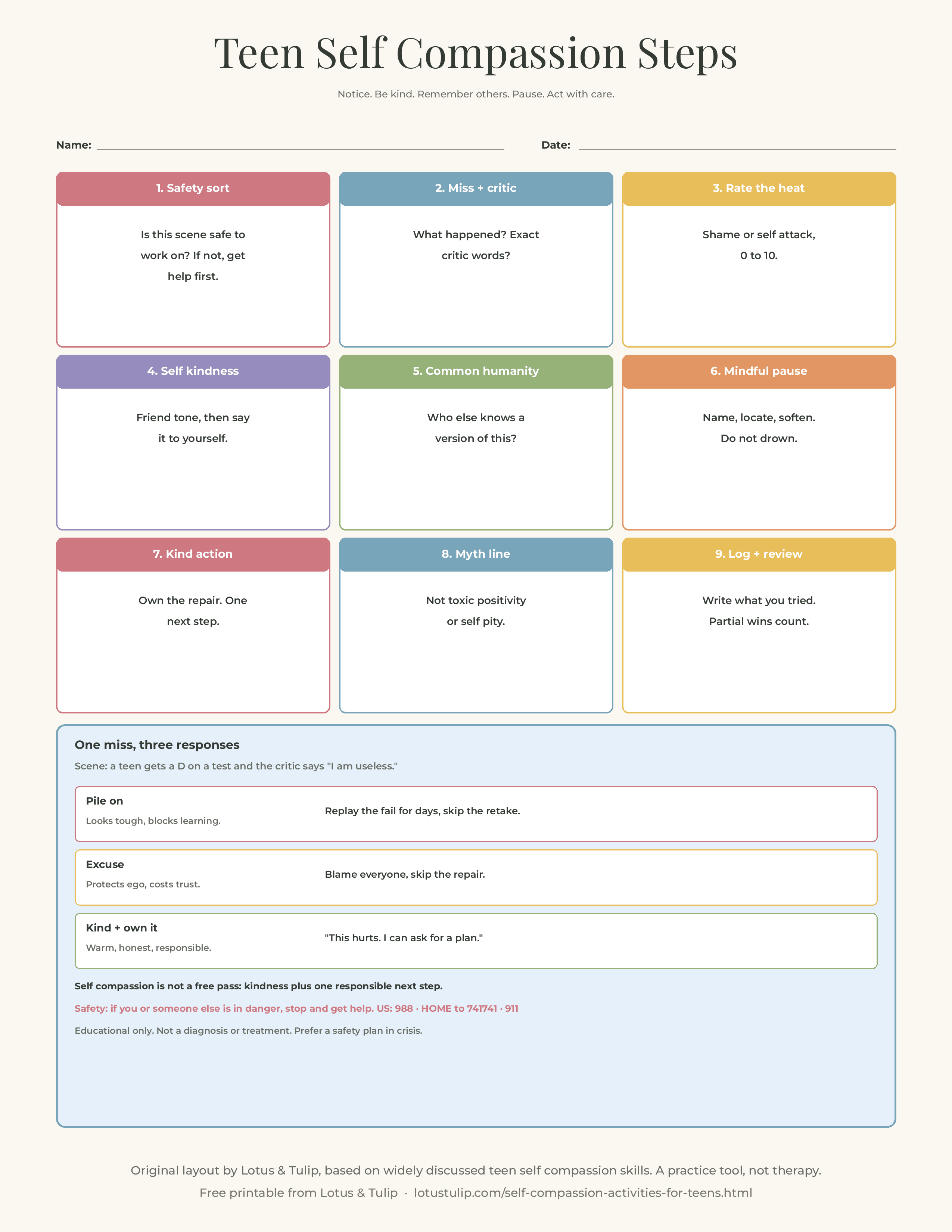
- Safety sort. Before practice, check that the scene is safe to work on. Thoughts of ending a life, a plan to hurt someone, abuse or a medical emergency come first: 988, HOME to 741741, or 911 when needed, plus a safety plan and a trusted adult. Do not coach a teen to "be nicer to themselves" as a substitute for crisis help.
- Name the miss and the critic. What happened, and what exact words does the inner critic use? Write them down. One scene at a time.
- Rate the heat. On a 0 to 10 scale, how hot is the shame or self attack right now? If it is near the top and the teen is flooded, regulate first with coping skills, then return.
- Self kindness line. Write what you would say to a friend in the same spot. Then say or write that line to yourself. Warm and honest beats fake cheer.
- Common humanity reminder. Name two other people or groups who know a version of this struggle. You are not uniquely broken.
- Mindful pause. Name the feeling, locate it in the body, soften the story for a short pause without fixing yet.
- Kind action with responsibility. Pick one next step that owns the repair: apologize, ask for a retake, rest, ask for help, or change a habit. Self compassion is not a free pass.
- Draw the myth line. Sort: toxic positivity, self pity, harsh critic, or self compassion. Stay with the self compassion move.
- Log and review. Record what you tried and what happened on the practice log. Celebrate partial wins. Bridge to self esteem, positive self talk, mindfulness, resilience or adult self compassion pages when one skill needs deeper work.
Practice on low stakes scenes first. Self compassion used under stress is the kind rehearsed when calm.
School counselor, therapist, teacher and parent tips
School counselors. Self compassion activities fit classroom lessons, small groups and short individual meetings, and sit near ASCA self awareness and self management language about accurate self perception and coping. Keep personal sharing optional, follow district crisis protocols, and avoid scenarios that mirror a known public humiliation in the room.
Therapists. Rehearse the real friend to self letter and the kind action. Notice when a "harsh critic" is trauma, depression, OCD style doubt, or a family pattern where mistakes were punished. Do not shame a teen for protecting themselves in an unsafe home. This printable is a skill aid, not a treatment plan.
Teachers. Use critic catch after tests, friend to self language before retakes, and toxic positivity intercept when peer pep talks skip the pain.
Parents and caregivers. Model more than you lecture. Soften your own self talk out loud after a miss, repair when you snap, and skip forced "just be confident" lines that skip the feeling.
Worked fictional examples
Failed tryout (fictional). Maya, 14, made the team last year and got cut this year. Her critic said "Everyone knows you peaked." In the friend to self letter she wrote what she would tell her best friend: "This hurts. Cuts happen to a lot of athletes. You can be kind to yourself and still decide whether to try again or pick another activity." Carry over: name the hurt, then one kind next step.
Grade spiral (fictional). Jordan, 16, got a D on a chem test and called themselves "useless" for two days. In kind action after a miss, Jordan sorted pile on versus responsibility. The chosen move was email the teacher for a retake plan and study with a friend for 30 minutes. Carry over: self kindness plus a concrete repair.
Feed comparison (fictional). Alex, 15, scrolled weekend party posts after staying home. The common humanity map listed other teens who feel left out and adults who remember lonely weekends. Alex set a 10 minute feed pause. Carry over: comparison is not proof of being uniquely unwanted.
Snapped at a sibling (fictional). Riley, 17, yelled, then drowned in shame. Repair to self and other looked like: "I lost it and I can still make this right," then a short apology that named the impact. Carry over: self compassion includes the other person when harm was done.
Counselor small group note (fictional). In a six session ninth grade group, a counselor ran one or two activities per session on made up cards. By session five, students chose private practice targets on the log. Nobody was required to share real grade crises. One quiet student lived in the observer role for two weeks, then led a round of toxic positivity intercept.
Self compassion teens vs adult self compassion, self esteem, positive self talk, mindfulness, gratitude, depression, perfectionism, resilience and coping
| Self compassion teens (this page) | Adult self compassion | Self esteem teens | Positive self talk | Mindfulness teens | Gratitude teens | Depression teens | Perfectionism teens | Resilience teens | Coping teens | |
|---|---|---|---|---|---|---|---|---|---|---|
| Main job | Critic notice, self kindness, common humanity, mindful suffering, kind action with responsibility | General Neff style break for adults and mixed ages | Strengths and evidence of worth | Thought flips and kinder scripts | Attention and present moment skills | Noticing good and thanks | Mood, activation, support map | All or nothing standards | Bounce forward after setbacks | Broad coping menu |
| Best early use | Harsh self talk after a miss, shame spirals, toxic positivity, isolation after failure | Adult clients and general practice | When worth evidence is the gap | When wording of thoughts is the gap | When attention and calm need work | When noticing good is the focus | When low mood is central | When standards never allow a miss | When adaptive next steps after hard events matter | When many coping tools are needed |
| Output | Self compassion plan and practice log | Self compassion break pages | Self esteem plan | Thought flip pages | Mindfulness plan | Gratitude plan | Depression support plan | Perfectionism plan | Resilience plan | Coping menu |
| Link | This page | Self compassion worksheet | Self esteem teens | Positive self talk | Mindfulness teens | Gratitude teens | Depression teens | Perfectionism teens | Resilience teens | Coping teens |
These tools work together. Self compassion is the kindness during struggle layer. When worth evidence, thought flips, broader mindfulness, gratitude, mood support, perfection traps, bounce forward steps or a full coping menu become the whole problem, go to the matching page.
What helps vs common myths
What often helps: short practice rounds, made up scenarios before personal ones, clear kindness phrases teens can adapt into their own voice, adults who model soft self talk after a miss, a specific carry over each week, and permission to feel pain without drowning in it.
- Myth: "Self compassion means letting yourself off the hook." Kindness and responsibility can travel together. Excusing harm is not the skill.
- Myth: "If I am kind to myself I will get soft and fail." Harsh shame often blocks learning. Warm honesty makes the next try more likely.
- Myth: "Self compassion is the same as self esteem." Self esteem tracks how you evaluate yourself. Self compassion tracks how you treat yourself when the evaluation hurts.
- Myth: "Just stay positive." Skipping the pain is toxic positivity, not mindfulness of suffering.
- Myth: "Self pity is the same as self compassion." Self pity isolates. Common humanity connects. Kind action moves.
- Myth: "Research proves these exact activities work." No study has tested this printable. The ideas sit near Neff's construct, MSC program neighbors, Ferrari et al. intervention research (mostly adult samples) and school SEL frameworks; that is not a proven effect for one worksheet.
Common mistakes
- Spotlighting students with personal shame stories before trust is built.
- Using real grades, cuts or screenshots from students in the room as practice material.
- Teaching self compassion as fake cheer instead of naming the hard thing first.
- Praising teens for endless self attack as "high standards" until they crash.
- Skipping responsibility so "be kind" becomes "skip the apology."
- Stacking every skill in one session. One or two activities with a carry over beats ten in an hour.
- Treating the worksheet as therapy. Paper supports practice. It does not replace a clinician or school support when problems are serious or lasting.
When not to use this worksheet
Good uses: everyday misses with grades, sports, friends and family; harsh inner critic after a public fail; teens stuck in toxic positivity or self pity; group or class lessons; rehearsing a specific kindness phrase and kind action.
Use something else first when:
- There is danger, abuse or acute crisis. Safety and adult help come first: 988, HOME to 741741, 911, and a safety plan.
- The main issue is lasting depression or hopelessness. Use clinical support and see depression activities for teens as a neighboring page, not a cure.
- The teen is flooded. Calm the body first with coping skills worksheets for teens or mindfulness activities for teens.
- Perfectionism is the whole trap. Use perfectionism worksheet for teens alongside critic catch.
- The exercise is increasing shame or risk. Stop, validate, and switch tools.
What the research says (honestly)
Neff's three components. Kristin Neff defines self compassion as self kindness (warmth and understanding toward yourself in pain or failure rather than harsh judgment), common humanity (seeing struggle as part of the shared human experience rather than isolating proof you are uniquely flawed), and mindfulness (holding painful thoughts and feelings in balanced awareness rather than suppressing them or over identifying with them). Lotus and Tulip is not affiliated with Neff. The teaching neighbor is that self compassion is more than one soft pep talk.
MSC program neighbors. Christopher Germer and Kristin Neff's Mindful Self Compassion program teaches structured practices for adults. Youth adaptations and classroom friendly versions exist in the wider field. This printable is not an MSC manual, not youth MSC certified material, and not endorsed by those authors.
Intervention meta analysis neighbor. Ferrari, Hunt, Harrysunker, Abbott, Beath and Einstein (2019) meta analyzed randomized trials of self compassion interventions and reported moderate average improvements on outcomes such as depression, anxiety and stress compared with controls, with important limits: samples were mostly adults (average age in the mid thirties in secondary summaries), publication bias may be present, and no result tests this three page printable or proves a cure. Treat it as neighbor research, not a guarantee for your teen group.
School frameworks. ASCA Student Standards include self awareness and self management behaviors related to accurate self perception and coping. CASEL's self awareness and self management competencies include recognizing emotions and using coping skills. Lotus and Tulip is not affiliated with ASCA or CASEL.
Honest limits. No study tests this three page printable or this activity set. Treat it as a skill practice aid built on widely discussed self compassion ideas, not a standalone randomized controlled trial, and not a treatment for depression or anxiety.
Free self compassion printable for teens (PDF)
The free self compassion printable has three pages in US Letter size:
- Page 1: Teen Self Compassion Steps. Nine step card matching the HowTo above: safety sort, name the miss and critic, rate the heat, self kindness line, common humanity reminder, mindful pause, kind action with responsibility, myth line, log and review.
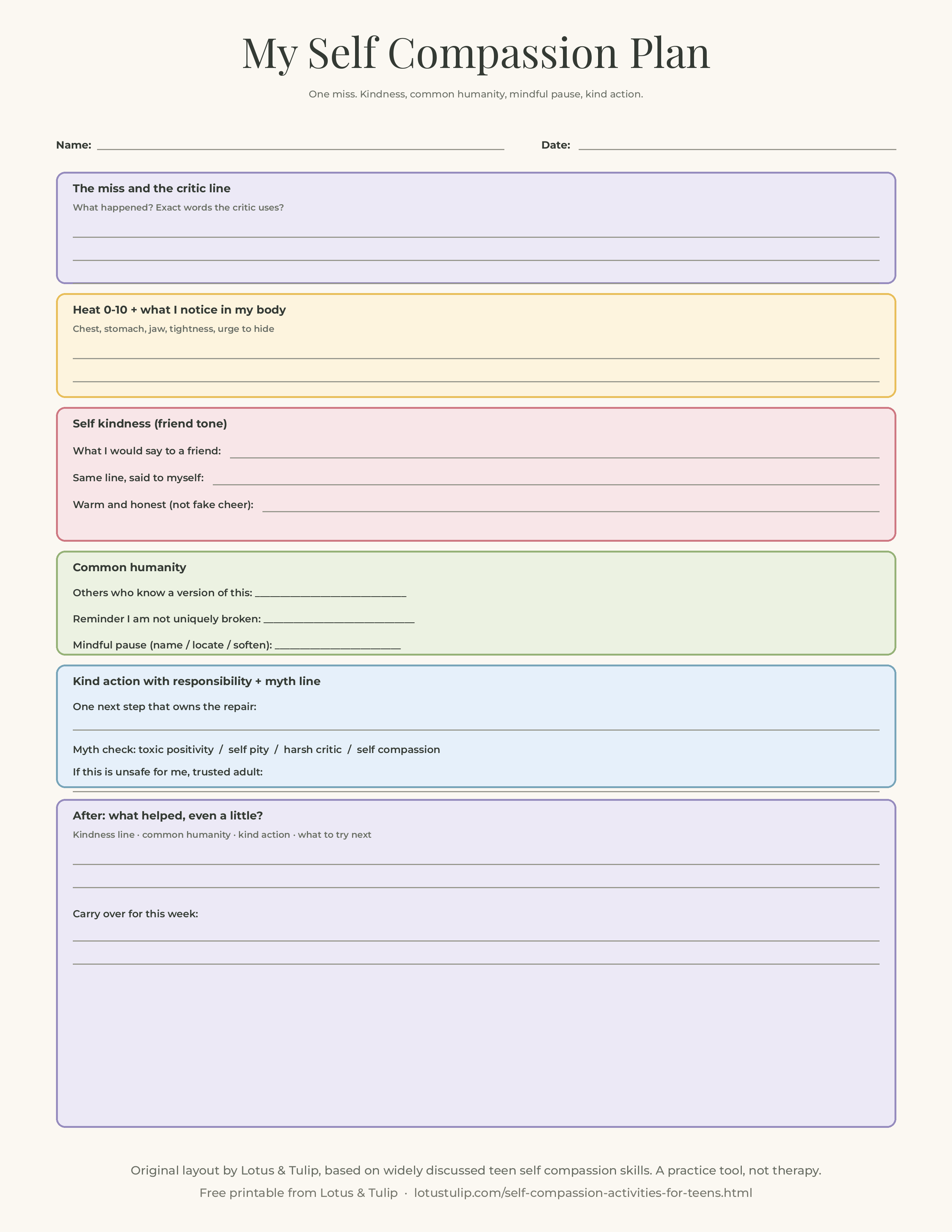
- Page 2: My Self Compassion Plan. Fill in the miss, critic line, kindness phrase, common humanity reminder, mindful pause notes, kind action, and myth check.
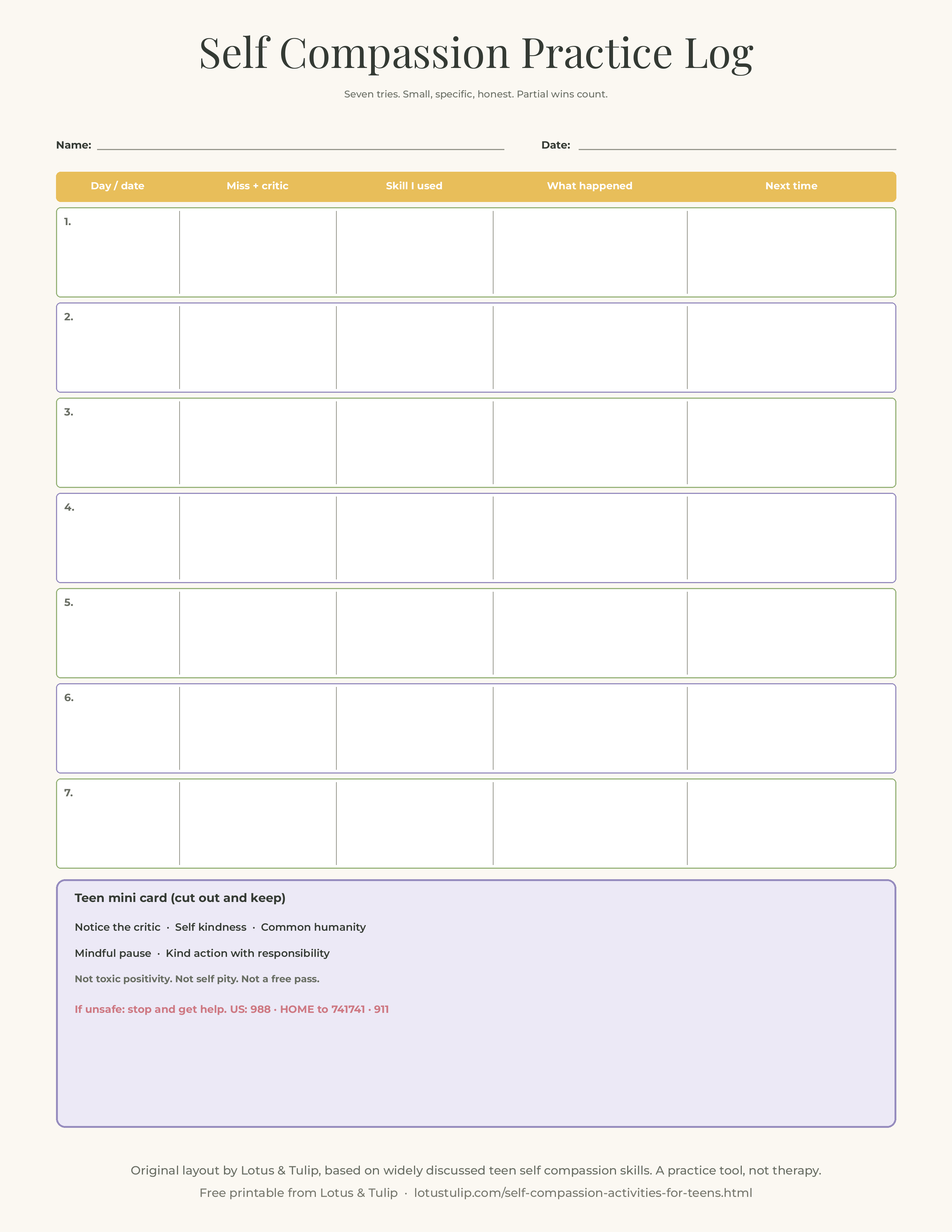
- Page 3: Practice Log + teen mini card. Seven rows to track what you tried and how it went, plus a cut out reminder card.
Download the free self compassion printable for teens (PDF, 3 pages, US Letter)
Prefer single images? Page 1: Teen Self Compassion Steps (PNG) · Page 2: My Self Compassion Plan (PNG) · Page 3: Practice Log (PNG)
Free self esteem starter pack: For the self worth side, the free self esteem worksheets starter pack adds inner critic and inner coach, believable affirmations, a strengths finder, thinking traps about me, a brave steps ladder and a support and safety page from our paid self esteem set.
Free to print for your own use and for use with your own clients, students or groups. This is an original layout by Lotus & Tulip, drawing on widely discussed self compassion ideas (self kindness, common humanity, mindfulness of suffering, and school SEL neighbors). It is not affiliated with any author, organization or curriculum named on this page, does not diagnose or treat any condition, and is not a substitute for therapy. Please link to this page rather than re-uploading the file.
Related resources
- Self compassion worksheet: adult and general Neff style break pages.
- Self esteem activities for teens: strengths and evidence of worth.
- Positive self talk worksheet: thought flips and kinder scripts.
- Mindfulness activities for teens: broader attention and present moment practice.
- Gratitude activities for teens: noticing good without skipping pain.
- Depression activities for teens: neighboring mood support skills.
- Perfectionism worksheet for teens: when standards never allow a miss.
- Resilience activities for teens: bounce forward after hard events.
- Coping skills worksheets for teens: broad coping menu.
- Safety plan worksheet: when the moment is about staying safe.
Sources
- Neff, K. D. (2003). Self-compassion: An alternative conceptualization of a healthy attitude toward oneself. Self and Identity, 2(2), 85 to 101.
- Neff, K. D. The three components of self compassion: self kindness, common humanity and mindfulness (overview across Neff's published work and self-compassion.org educational materials). Lotus and Tulip is not affiliated.
- Germer, C. K., and Neff, K. D. Mindful Self Compassion (MSC) program neighbors (adult structured practices; not this printable).
- Ferrari, M., Hunt, C., Harrysunker, A., Abbott, M. J., Beath, A. P., and Einstein, D. A. (2019). Self-Compassion Interventions and Psychosocial Outcomes: a Meta-Analysis of RCTs. Mindfulness, 10, 1455 to 1473.
- American School Counselor Association. ASCA Student Standards: Mindsets and Behaviors for Student Success (self awareness / self management related behaviors).
- CASEL. The CASEL 5 framework, self awareness and self management competencies.
Self compassion activities for teens: FAQ
What are self compassion activities for teens?
They are short practice rounds that teach noticing a harsh inner critic, offering self kindness, remembering common humanity, holding suffering with mindful balance, choosing a kind action that still takes responsibility, and sorting myths like toxic positivity and self pity. They work in classrooms, small groups and individual sessions.
How is teen self compassion different from the adult self compassion worksheet?
This page focuses on adolescent scenes (grades, tryouts, feeds, friendship misses), critic catch language teens actually use, kind action with responsibility, and classroom friendly activities. The self compassion worksheet is the adult and general neighbor with a classic break style layout.
Is self compassion the same as self esteem?
No. Self esteem is how you evaluate your worth. Self compassion is how you treat yourself when you struggle. They can support each other. Use self esteem activities for teens when worth evidence is the gap.
Does self compassion mean letting myself off the hook?
No. You can be kind to yourself and still apologize, retake a test, or change a habit. Kindness without responsibility is an excuse. Responsibility without kindness is a shame pile on.
What is a good first self compassion activity for a teen group?
Harsh inner critic catch or the friend to self letter. Both are low risk on made up scenes and make the tone gap between friend talk and self talk obvious.
Can school counselors use this printable in groups?
Yes. It fits classroom lessons, small groups and individual meetings, and sits near ASCA and CASEL self awareness language. Keep personal sharing optional and follow district crisis protocols when risk appears.
When should I not use self compassion practice?
Not as the first step when a teen is in acute crisis, being abused, or showing lasting hopelessness that needs clinical care. Safety and adult help come first: in the US call or text 988, text HOME to 741741, or call 911. Prefer a safety plan in that moment.