
Kids and teens · Updated 2026-11-07
Mindfulness Activities for Teens (with Free Printable)
Ready-made printable: Mindfulness Worksheets for Kids and Teens Holiday 20% off: about $9.20, was $12 (EUR 10) · instant digital download
Buy on Etsy
Mindfulness activities for teens are short, optional practice tools that help middle and high school students notice body cues, breath, senses, and thoughts without treating every sensation as an emergency, pause for one song or one hallway walk, practice phone-aware attention, choose a tiny plan that fits real teen life, log what actually helped, and know when to stop for safety. Teen mindfulness work is not a longer version of mindfulness activities for kids. Grades, dating, sports, group chats, jobs, and college talk raise the stakes. So does honesty that mindfulness is noticing and returning, not emptying the mind, not a religious requirement for every family, and not a cure-all for anxiety, depression, trauma, or crisis.
This Lotus and Tulip page is a teen-focused mindfulness activities guide with an original free three page US Letter printable. It targets searches families and helpers actually use: mindfulness activities for teens, mindfulness exercises for teenagers, mindfulness worksheets for high school, teen mindfulness counseling activities, and short mindfulness practices for adolescents. It is distinct from our mindfulness activities for kids (younger playful language and shorter notice games), from the product page mindfulness worksheets for kids and teens (paid pack with scripts and trackers), from body scan meditation script (guided scan as the whole page), from stress management worksheets for teens (workload, sleep, and screens as the main load), from coping skills worksheets for teens (broad skill menu), from emotional regulation activities for teens (cool body then choose), from anxiety activities for teens (name, fork, face loop), and from DBT What and How skills worksheet (Observe, Describe, Participate, Nonjudgmentally, One-mindfully, Effectively as the DBT set). Those neighbors help. This page centers adolescent mindfulness: what it is and is not, body cues, short practices teens will actually try, school and home tips, honest research including MYRIAD 2022 caveats, and a free practice plan.
We credit research lineages associated with Jon Kabat-Zinn and MBSR as a neighbor for secular mindfulness training language, Hofmann and colleagues mindfulness meta-analyses as neighbors for adult and clinical mindfulness evidence maps, Dunning and colleagues youth mindfulness meta-analyses as neighbors for adolescent effect size summaries, and the MYRIAD 2022 school mindfulness trial as an important honesty check that universal school mindfulness was not superior to teaching as usual on primary mental health outcomes in that large UK study. We credit those lineages with clear non-affiliation. We are not affiliated with those authors, any mindfulness center, any scale publisher, or any branded school mindfulness curriculum. This printable is an original educational layout, not a copy of any copyrighted worksheet and not a diagnosis or treatment.
This guide is educational. It is not therapy, not medical advice, and not a diagnosis. If thoughts of ending your life, plans to harm yourself or someone else, or a medical emergency show up, stop the worksheet and get help now: in the US, call or text 988, text HOME to 741741, or call 911. Our safety plan worksheet is a better first tool in that moment. Nearby tools: mindfulness for kids, body scan, breathing exercises, 5 4 3 2 1 grounding, coping for teens, stress for teens, emotion regulation for teens, anxiety for teens, and DBT What and How.
Jump to the free mindfulness activities printable (PDF) · How to use mindfulness activities for teens, step by step · Worked examples · Comparisons
What mindfulness is and is not for teens
Mindfulness (educational working definition for this page) means paying attention on purpose to what is happening now (body, breath, senses, thoughts, urges) with a little more curiosity and a little less automatic judgment, then returning when the mind wanders. Wandering is normal. Returning is the practice.
Mindfulness is not:
- Emptying the mind. Thoughts keep showing up. The skill is noticing and returning, not achieving blankness.
- A religious requirement. Many teens and families use secular pause and notice skills without adopting a spiritual tradition. Respect family beliefs. Never force a practice that conflicts with a student's values.
- A cure-all. Short practices can help some teens with stress, attention, and emotional awareness. They do not remit clinical anxiety, depression, PTSD, ADHD, or substance use by themselves. Prefer clinical care when problems are severe or lasting.
- Forced calm in class. Optional practice beats public performance. Never use mindfulness as punishment or as a way to silence valid anger about unfair systems.
Teen mindfulness response skills include:
- Safety sort first when crisis risk, self-harm talk, or acute danger is present.
- Body cue notice without treating every sensation as proof of catastrophe.
- Choose a short practice teens will actually try: breath, senses, walking, one-song pause, phone-aware pause, or a short body scan cross-link.
- Return after distraction without self-insult.
- Pick a tiny plan for the next day that fits homework, sports, and phones.
- Log what helped and bridge to stress, coping, anxiety, emotion regulation, or DBT neighbors when needed.
- Knowing when not to force practice: optional skill work, never forced public meditation.
Body cues, attention, and why teens need teen-shaped practice
Body cues for teens often include tight jaw, shallow breath, restless legs, hot face, stomach flutter, heavy limbs, and brain fog after scrolling. Teaching "notice, name, do not instantly obey" reduces the habit of treating every cue as an emergency or as proof that something is wrong with you. Pair with emotion regulation for teens when the body is too hot to think, and with anxiety for teens when worry loops dominate.
Attention in teen life. Phones, notifications, group chats, and homework tabs train rapid switching. Mindfulness here is not a lecture against phones. It is a short pause that makes one choice more intentional: keep scrolling, or take a one-song break; keep refreshing grades, or take three breath cycles and return to one task.
Why not only the kids page? Younger pages use playful "notice it" games. Teens need language that respects autonomy, digital life, sports pressure, and the right to opt out. This page stays teen-specific for ages about 12 to 18.
How to use mindfulness activities for teens, step by step
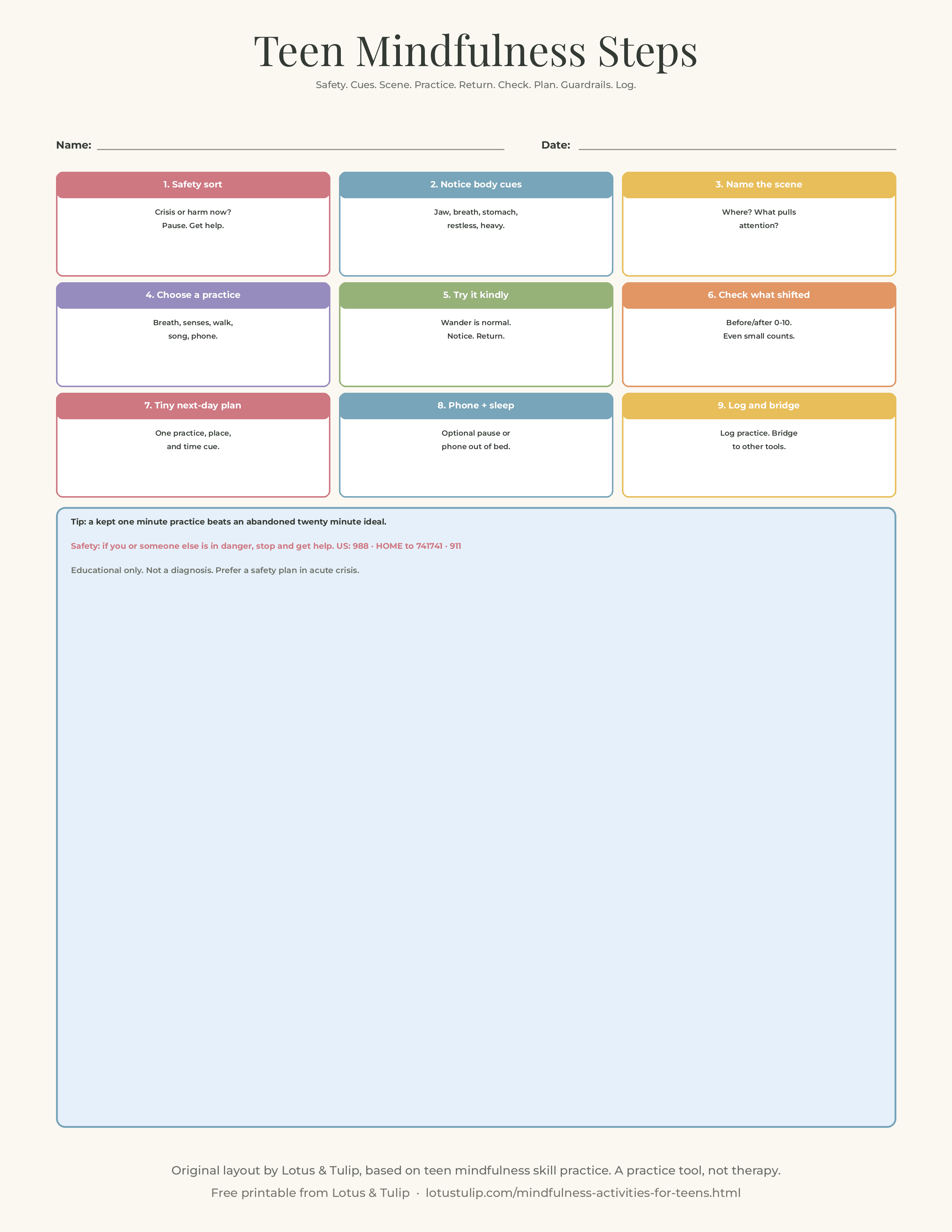
- Safety sort. If acute crisis, self-harm plans, or imminent harm, pause. Use crisis pathways first: 988, HOME to 741741, or 911 when needed. Prefer a safety plan in that moment. Do not force public mindfulness talk.
- Notice body cues. Jaw, breath, stomach, restless energy, heavy limbs. Write two cues on the free plan page without judging them as "weak" or "dramatic."
- Name the scene. Where are you (hallway, bus, bed, class)? What is pulling attention (grades, chat, argument, boredom)? Keep it specific.
- Choose one short practice. Pick breath, senses, walking, one-song pause, phone-aware pause, or a short body scan. Prefer one to three minutes over a twenty minute sit nobody will keep.
- Try it once, kindly. Do the practice. When the mind wanders, notice and return. Wandering is data, not failure.
- Check what shifted. Rate tension or urge intensity 0 to 10 before and after if that helps. Note what changed even a little (breath deeper, urge quieter, still the same). Same is allowed.
- Pick a tiny next-day plan. One practice, one place, one time cue (after lunch, before homework, after practice). Pair with stress for teens when workload and sleep are the fuel.
- Guardrails for phones and sleep. Optional: one phone-aware pause before bed, or charge the phone outside the bed. Pair with sleep hygiene when sleep is the main fuel.
- Log and bridge. Record practice on the log page. Bridge to safety plan, coping skills for teens, emotion regulation for teens, anxiety for teens, body scan, DBT What and How, or mindfulness for kids when a younger sibling needs the kids page.
Practice on lower-stakes days first when possible, then rely on a familiar short practice when spikes hit. Skill grows with reps and with adults who coach without shaming.
Short practices teens will actually try
Breath cycle (about 60 to 90 seconds). Feel the breath at the nose or belly for a few cycles. If breath work makes someone dizzy or has a medical limit, keep it gentle or switch to senses. Cross-link to breathing exercises.
Senses pause (about 60 seconds). Name a few things you can see, hear, feel, smell, or taste. This is a cousin of 5 4 3 2 1 grounding, kept short for hallway or bus use.
Walking mindfulness (one hallway or one block). Feel feet, notice pace, notice sounds. Useful between classes when sitting still feels impossible.
One-song pause. Play one song. For that song only, notice breath, body, or lyrics without switching apps. Then decide the next action on purpose.
Phone-aware pause. Before unlocking, ask: what am I hoping to feel? After two minutes, notice whether the feed delivered that or just more noise. This is awareness, not a phone ban.
Short body scan. For a fuller guided scan, use body scan meditation script. On this page, a teen version can be: feet, legs, stomach, chest, hands, jaw, forehead, then one breath. Keep it optional and stop if it increases distress.
DBT neighbor. When the job is Observe, Describe, Participate plus How skills, prefer DBT What and How skills rather than stretching this page into a full DBT module.
School counselor, therapist, and parent tips
School counselor tips. Short meetings favor: safety sort, two body cues, name the scene, one short practice, one tiny next-day plan, sleep or phone ask. Groups can practice optional breath or senses skills with low-stakes prompts. Never force public meditation or sharing of trauma. Follow district crisis protocols if risk appears. Remember MYRIAD-style honesty: universal school mindfulness is not a guaranteed upgrade over teaching as usual for every outcome.
Therapist tips. Stay in the client's language. Separate stress load, anxiety loops, trauma activation, and dissociation risk out loud without diagnosing from a printable. Protect before perform. If sitting still increases flashbacks or numbness, switch to movement, senses, or stop. Measure function: slightly shorter spiral time, earlier asks for help, sleep slightly better, less all-or-nothing "I failed mindfulness."
Parent tips. Offer, do not force. Model a one-song pause yourself. Do not turn the worksheet into a new weapon ("meditate or else"). Validate stress about grades and friends. Ask the school what support exists on hard days.
Worked fictional examples
Teen example, pre-test spiral (fictional): Maya, age 15, feels a tight jaw and shallow breath the night before a history test, rated 7. Safety sort: no crisis. Scene: bed, phone in hand, refreshing the study group chat. Practice: one-song pause with attention on breath, then phone charged outside the room. Tiny plan: three breath cycles before opening the test packet. Log on the free mindfulness plan page.
Teen example, hallway reset (fictional): Luis, age 14, leaves a loud lunch table with restless legs, rated 6. Safety sort: no self-harm. Scene: hallway between periods. Practice: walking mindfulness for one hallway length, noticing feet and sounds. Bridge to emotion regulation for teens if anger is still hot, and to friendship for teens for daytime repair later.
Teen example, scroll trap (fictional): Priya, age 16, loses an hour to short videos before homework, then feels heavy and self-critical. Cue: heavy limbs, rated 5. Safety sort: no plan to die, but mood dips. Practice: phone-aware pause before the next unlock for two days. Tiny plan: homework first for twenty minutes, then a chosen break. Bridge to stress for teens and depression activities for teens if low mood and withdrawal grow.
School counselor note (fictional): In a twelve minute meeting, a counselor helps a student fill body cues, scene, one short practice, a tiny next-day plan, and a sleep or phone ask. Optional practice, never forced public sharing. Follow district crisis protocols if risk appears. For multi-session groups, pair with a stress curriculum rather than stacking every worksheet in one period.
Teen mindfulness vs kids mindfulness, body scan, stress teens, coping teens, emotion regulation, anxiety teens, DBT What and How
| Teen mindfulness (this page) | Kids mindfulness | Body scan | Stress teens | Coping teens | Emotion regulation teens | Anxiety teens | DBT What and How | |
|---|---|---|---|---|---|---|---|---|
| Main job | Notice, short practice, return, tiny plan, log | Younger notice games | Guided scan focus | Workload, sleep, screens | Broad skill menu | Cool body then choose | Name, fork, face loop | Observe/Describe/Participate + How skills |
| Best early use | When teens want optional short attention skills | Younger kids with adult coaching | When a scan is the lesson | When load is the scene | When building a menu | When flooding blocks thinking | When anxiety loops dominate | When teaching DBT mindfulness set |
| Output | Cues, practice, plan, log | Menu and week tracker | Scan script practice | Stress plan | Coping menu and plan | Regulation plan | Anxiety plan | What/How practice log |
| Cross link | This page | Kids mindfulness | Body scan | Stress teens | Coping teens | ER teens | Anxiety teens | DBT What and How |
These tools cooperate. Teen mindfulness builds short notice and return skills. Kids mindfulness keeps younger language. Body scan goes deep on one practice. Stress teens cover load. Coping teens stock the menu. Emotion regulation cools the body. Anxiety teens run the worry loop. DBT What and How teaches the formal DBT set. Teach one tool clearly before stacking four on day one.
What helps vs common myths
What often helps: optional short practices, noticing without self-insult, returning after distraction, tiny plans that fit real schedules, phone-aware pauses, sleep guardrails, adult coaching without shame, and skill printables used as practice aids.
Myths to drop:
- "You must empty your mind." Minds think. Returning is the skill.
- "If it is hard, you are bad at mindfulness." Hard days are practice days. Difficulty is not a character flaw.
- "Longer sits are always better." A kept one minute practice beats an abandoned twenty minute ideal.
- "Mindfulness fixes everything." It is one tool. Therapy, school support, medical care, and safety plans matter when problems are severe.
- "Everyone must close their eyes in class." Eyes open, walking, or opting out are valid. Forced public practice backfires.
- "Research proves school mindfulness always wins." Some youth studies find small average benefits. MYRIAD 2022 found universal school mindfulness was not superior to teaching as usual on primary mental health outcomes in that large trial. Honesty protects trust.
Common mistakes
- Forcing calm before living so practice becomes a new avoidance ritual.
- Using mindfulness to silence valid anger about unfair treatment instead of problem-solving and support.
- Pushing long sits on teens who need movement or senses first.
- Ignoring trauma or dissociation risk when stillness increases distress.
- Ignoring sleep and phones while only talking about "being present."
- Using the kids page language with older teens who feel talked down to.
- Using it in acute crisis instead of safety first.
- Treating the worksheet as therapy. Paper supports practice. It does not replace a clinician, school policy, or crisis care when problems are severe or lasting.
When not to use this worksheet
Good early uses: a teen who can name cues and a scene, mild to moderate stress with adult support available, homework between counseling sessions, school counseling check-ins, and building a notice-return-plan sequence.
Prefer another tool first when:
- Acute safety risk or medical emergency: stabilize and get help (988, HOME to 741741, 911). Prefer a safety plan.
- When younger language fits better: use mindfulness activities for kids.
- When the teen is too flooded to engage: co-regulate first, then return to plan work. See emotion regulation for teens.
- When anxiety loops or avoidance are the whole load: prefer anxiety activities for teens.
- When teaching the formal DBT mindfulness set: prefer DBT What and How.
- When stillness increases trauma distress or dissociation: stop, switch to grounding or movement, and prefer clinician-led care.
What the research says (honestly)
Mindfulness activities and worksheets are a skill practice aid, not a standalone RCT treatment. Do not claim this free printable remits anxiety disorders, depression, PTSD, ADHD, substance use, or any diagnosis.
Kabat-Zinn / MBSR lineage neighbor. Secular mindfulness training associated with Jon Kabat-Zinn and MBSR popularized attention and nonjudgmental awareness practices in health and stress contexts. Credit with clear non-affiliation. This page is not an MBSR course and does not reproduce copyrighted MBSR materials.
Hofmann et al. mindfulness meta neighbor. Meta-analytic work associated with Hofmann and colleagues has summarized mindfulness-based interventions for anxiety and mood symptoms in mostly adult samples, with important caveats about study quality, heterogeneity, and what transfers to adolescents. Credit with clear non-affiliation. Not proof that this three page sheet remits clinical anxiety or depression.
Dunning et al. youth mindfulness meta neighbor. Meta-analytic work associated with Dunning and colleagues has summarized mindfulness training in children and adolescents, often finding small average effects on some outcomes with substantial heterogeneity and method caveats. Credit with clear non-affiliation.
MYRIAD 2022 honesty check. The large UK MYRIAD trial of universal school-based mindfulness training reported that the mindfulness curriculum was not superior to teaching as usual on primary mental health and well-being outcomes, with important implementation and subgroup caveats discussed in the literature. Credit with clear non-affiliation. This is why we refuse "school mindfulness always works" marketing language.
Honest limits. These reviews and trials are not technique-only RCTs of this printable. Adult support, sleep, school policy, and clinical care when indicated matter. No study tests this three page Lotus and Tulip printable alone.
Free mindfulness activities printable for teens (PDF)
The free mindfulness activities printable has three pages in US Letter size:
- Page 1: Teen Mindfulness Steps / Menu. Sequence matching the HowTo: safety sort, notice body cues, name the scene, choose a short practice, try it kindly, check what shifted, tiny next-day plan, phone and sleep guardrails, log and bridge, plus safety reminders.
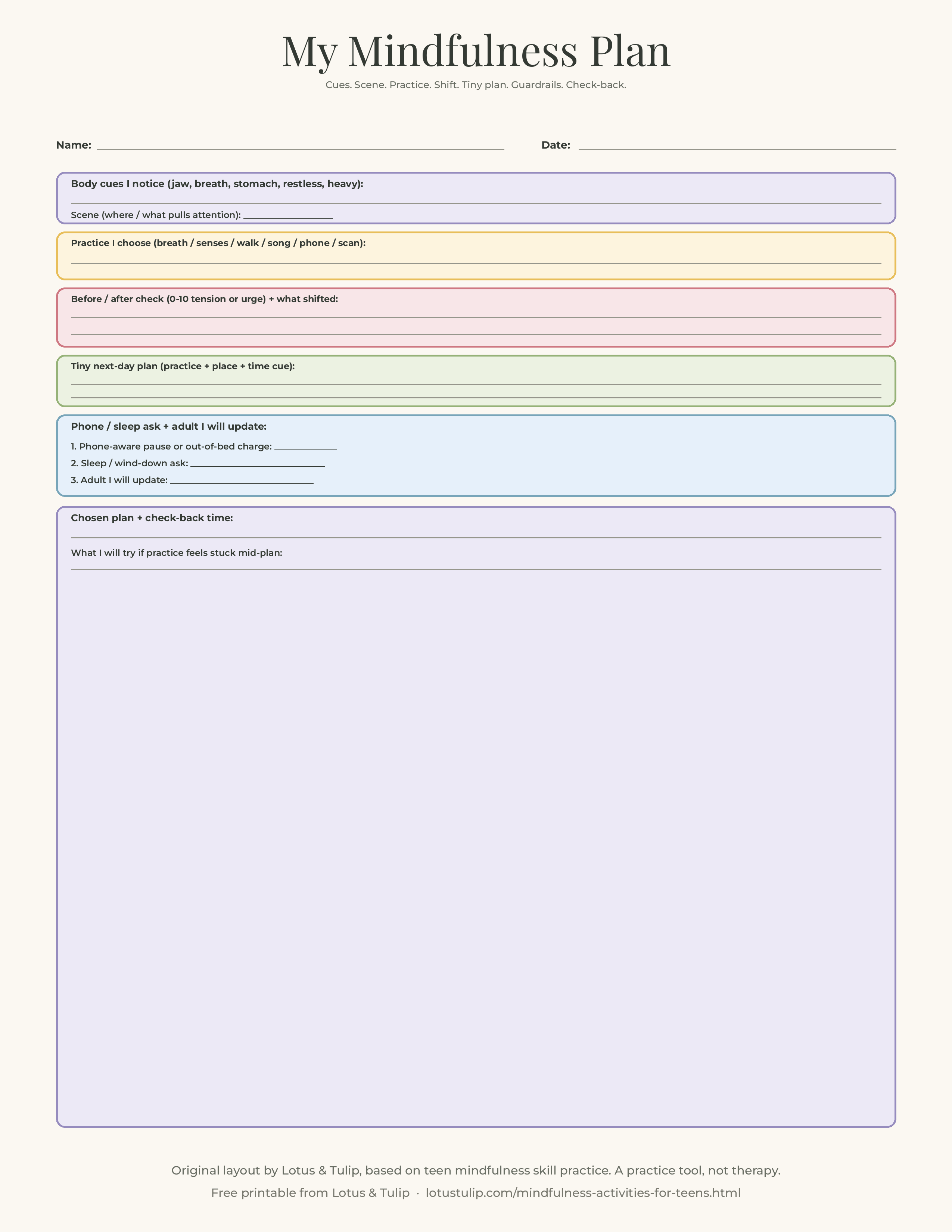
- Page 2: My Mindfulness Plan. Fill in cues, scene, chosen practice, before/after note, tiny plan, phone or sleep ask, and check-back.
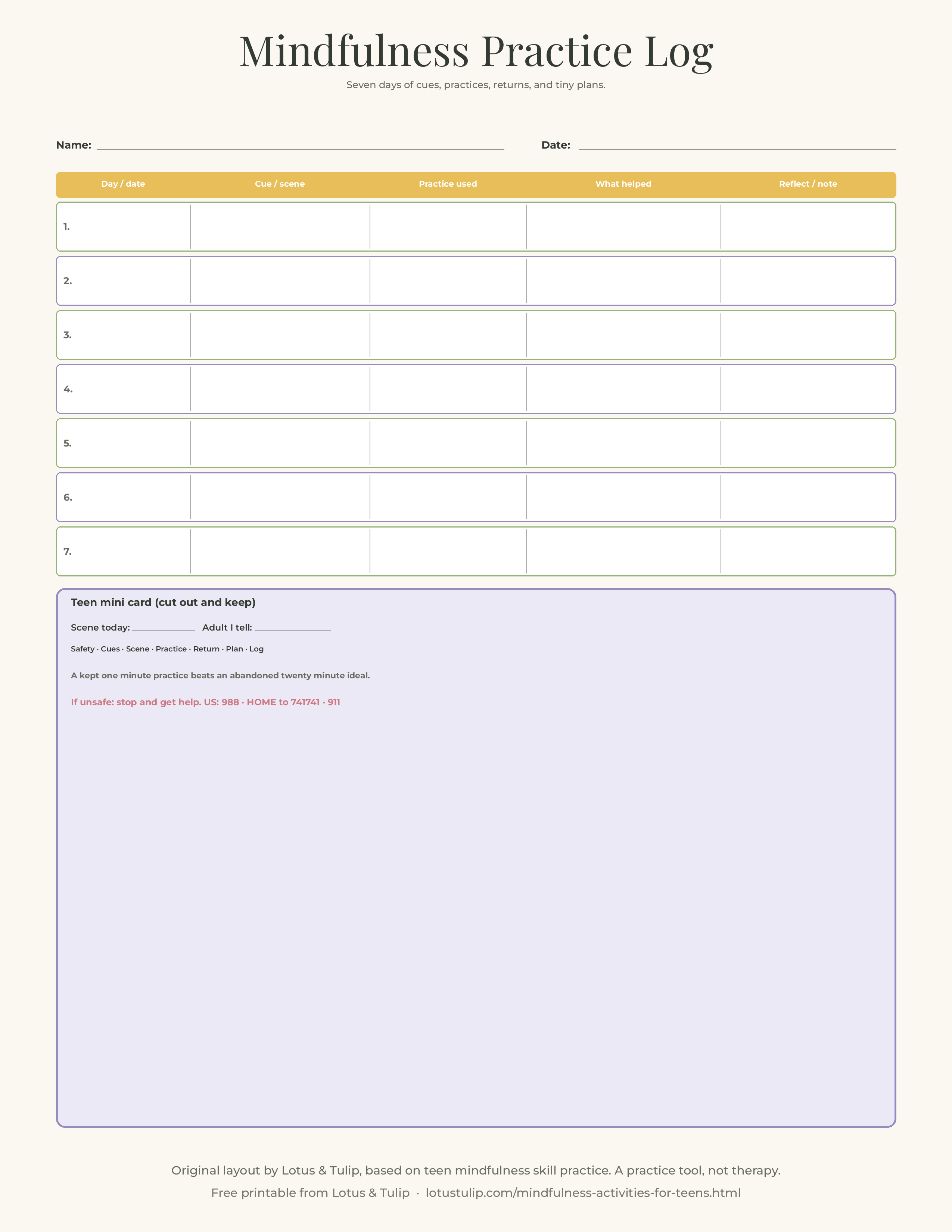
- Page 3: Practice Log + teen mini card. Seven day rows plus a cut out reminder for safety, cues, scene, practice, return, plan, log.
Download the free mindfulness activities printable for teens (PDF, 3 pages, US Letter)
Prefer single images? Page 1: Teen Mindfulness Steps (PNG) · Page 2: My Mindfulness Plan (PNG) · Page 3: Practice Log (PNG)
Free to print for your own use and for use with your own clients, students, or groups. This is an original layout by Lotus & Tulip, based on teen mindfulness skill practice associated with MBSR-neighbor language, youth mindfulness meta neighbors, and MYRIAD 2022 honesty caveats, with clear non-affiliation. It is not affiliated with those authors, any mindfulness center, any scale publisher, or any specific treatment or curriculum package, and is not a substitute for therapy. Please link to this page rather than re-uploading the file.
Related resources
- Mindfulness worksheets for adults: a practice log, everyday anchors and a free 2 page PDF
- Mindfulness activities for kids: younger notice games and week tracker.
- Mindfulness worksheets for kids and teens: paid pack with scripts and trackers.
- Body scan meditation script: guided scan practice.
- Breathing exercises for kids: breath technique neighbors.
- 5 4 3 2 1 grounding worksheet: senses grounding cousin.
- Stress management worksheets for teens: workload, sleep, screens.
- Coping skills worksheets for teens: broad coping menu.
- Emotional regulation activities for teens: cool body then choose.
- Anxiety activities for teens: name, fork, face loop.
- DBT What and How skills worksheet: formal DBT mindfulness set.
- Safety plan worksheet: when the moment is about staying safe and alive.
Sources
- Kabat-Zinn and MBSR-neighbor traditions on secular mindfulness training language. Educational credit with clear non-affiliation. Not a claim that this printable is an MBSR course or remits clinical disorders.
- Hofmann and colleagues mindfulness meta-analytic traditions summarizing mindfulness-based interventions for anxiety and mood symptoms (mostly adult samples), with quality and heterogeneity caveats. Educational credit with clear non-affiliation.
- Dunning and colleagues youth mindfulness meta-analytic traditions summarizing mindfulness training in children and adolescents, often small average effects with heterogeneity. Educational credit with clear non-affiliation.
- MYRIAD 2022 universal school mindfulness trial: not superior to teaching as usual on primary mental health outcomes in that large UK study, with implementation caveats. Educational credit with clear non-affiliation.
- Honest caveat: teen mindfulness drills are a skill practice aid. Reviews and trials are not the same as RCTs of this Lotus and Tulip printable. Adult support and clinical care when indicated matter.
Mindfulness activities for teens: FAQ
What are mindfulness activities for teens?
They are short, optional practice tools for noticing body cues and attention, trying breath, senses, walking, one-song, or phone-aware pauses, returning after distraction, picking a tiny plan, and logging what helps. They are educational skill aids, not therapy.
Is this the same as the kids mindfulness page?
No. The kids page uses younger playful notice games. This teens page centers adolescent life with phones, hallway resets, one-song pauses, autonomy, and honest research caveats including MYRIAD 2022.
Do teens have to empty their minds?
No. Wandering is normal. The skill is noticing and returning without self-insult. Blank-mind goals often backfire.
Can school counselors use it with teens?
Yes, often in short meetings with safety sort, cues, scene, one short practice, and one tiny plan. Keep practice optional and school safe. Follow crisis protocols when risk appears. Do not use the page as a diagnosis or as forced public meditation.
Is school mindfulness proven to beat teaching as usual?
Not always. MYRIAD 2022 found universal school mindfulness was not superior to teaching as usual on primary mental health outcomes in that large trial. Some other youth studies find small average benefits with caveats. Stay honest with families.
When should I not use this worksheet?
Do not use it as the first move in acute safety risk, medical emergency, trauma-triggered stillness distress, or when the teen is too flooded to engage. Stabilize and get help when needed: 988, HOME to 741741, or 911. Prefer a safety plan in crisis.
Is this affiliated with Kabat-Zinn, MBSR, Hofmann, Dunning, or MYRIAD?
No. This is an original Lotus and Tulip educational layout. We credit research lineages with clear non-affiliation and do not reproduce copyrighted manuals or curricula.