
Kids and teens · Updated 2026-11-07
Resilience Activities for Teens (with Free Printable)
Ready-made printable: Self Esteem Worksheets for Kids and Teens Holiday 20% off: about $9.20, was $12 (EUR 10) · instant digital download
Buy on Etsy
Resilience activities for teens are short, optional practice tools that help middle and high school students name a real setback without toughness theater, map what happened and what is still in reach, notice protective factors (support, skills, meaning, routines), pick one adaptive next step linked to values, practice a small bounce-forward move, log what actually helped, and know when to stop for safety. Teen resilience work is not a longer version of grit slogans. Grades, friendships, sports cuts, jobs, family stress, social feeds, and identity questions raise the stakes. So does honesty that resilience is adaptive coping and learning after hard events, not never feeling, not bouncing back instantly, not ignoring injustice, and not a cure for trauma or PTSD.
This Lotus and Tulip page is a teen-focused resilience activities guide with an original free three page US Letter printable. It targets searches families and helpers actually use: resilience activities for teens, building resilience in teenagers, resilience worksheets for high school, teen bounce back activities, and protective factors for adolescents. It is distinct from our coping skills worksheets for teens (broad coping menu), from stress management worksheets for teens (load and recovery habits), from self-esteem activities for teens (strengths and evidence of worth), from growth mindset worksheet (effort and learning language), from emotional regulation activities for teens (naming and shifting intensity), from anxiety activities for teens (worry fork and gentle facing), from depression activities for teens (activation and low mood neighbor), from flexible thinking worksheet (unhooking rigid thoughts), from circle of control worksheet (can vs cannot control), from problem solving worksheet for kids (younger solve steps), from positive self talk worksheet (thought flip practice), from gratitude activities for teens (noticing good and optional thanks), and from mindfulness activities for teens (notice and return attention). Those neighbors help. This page centers adolescent resilience: what it is and is not, bounce-forward framing, protective factors, a setback map, values-linked next steps, school and home tips, honest research including Masten ordinary magic, Southwick and Charney factor neighbors, and Ungar socio-ecological neighbors with caveats, and a free practice plan.
We credit research lineages associated with Ann Masten (including ordinary magic and resilience in development neighbors) as neighbors for competence under adversity and everyday protective processes, Steven Southwick and Dennis Charney resilience factor neighbors as neighbors for skills and supports often discussed in resilience education, and Michael Ungar socio-ecological resilience neighbors as neighbors for how culture, resources, and relationships shape what "bouncing forward" can look like. We also credit ASCA and school SEL neighbors for counselor-friendly language about student supports, without claiming any official endorsement. We credit those lineages with clear non-affiliation. We are not affiliated with those authors, any branded resilience curriculum, any scale publisher, or any school district program. This printable is an original educational layout, not a copy of any copyrighted worksheet and not a diagnosis or treatment.
This guide is educational. It is not therapy, not medical advice, and not a diagnosis. If thoughts of ending your life, plans to harm yourself or someone else, or a medical emergency show up, stop the worksheet and get help now: in the US, call or text 988, text HOME to 741741, or call 911. Our safety plan worksheet is a better first tool in that moment. Nearby tools: coping for teens, stress for teens, self esteem for teens, growth mindset, emotional regulation for teens, circle of control, flexible thinking, anxiety for teens, depression for teens, and problem solving for kids.
Jump to the free resilience activities printable (PDF) · How to use resilience activities for teens, step by step · Worked examples · Comparisons
What resilience is and is not for teens
Resilience (educational working definition for this page) means adapting after a setback in a way that protects safety, relationships, learning, and values over time. It can look like asking for help, adjusting a plan, grieving honestly while taking one next step, or changing an unfair system when that is possible. Resilience is not a personality badge you either have or lack.
Resilience is not:
- Toughness theater. You do not have to smile, "man up," or pretend nothing hurts. Hiding pain is not the same as adapting.
- Never feeling. Anger, sadness, fear, and disappointment can coexist with a next step. Feeling is part of information, not failure.
- Bouncing back instantly. Recovery can be uneven. Some days move forward. Some days hold steady. Instant bounce is a myth that shames real teens.
- Ignoring injustice. Naming unfair treatment, discrimination, bullying, or unsafe systems can be resilience. Silencing teens so adults stay comfortable is not.
- A cure for trauma or PTSD. Trauma-informed care, clinical treatment when indicated, and safety come first. A three page practice sheet does not remediate PTSD, complex trauma, or any diagnosis.
Teen resilience response skills include:
- Safety sort first when crisis risk, self-harm talk, or acute danger is present.
- Honest setback mapping (what happened, what it cost, what is still in reach) without rewriting history.
- Protective factor scan: support people, usable skills, meaning or values, and routines that stabilize.
- Bounce-forward / adaptive coping: one small move that fits the real constraint, not a heroic fantasy plan.
- Values-linked next step so the move serves who the teen wants to be, not only adult pressure.
- Logging what helped and bridging to coping, stress, self esteem, ER, circle of control, flexible thinking, or clinical neighbors when needed.
- Knowing when not to push: after acute trauma activation, or when the exercise feels like blaming the teen for systemic harm, pause and prefer safety and support.
Why teens need teen-shaped resilience (bounce-forward, not bounce-back slogans)
Teen life raises the stakes. A failed test, a cut from a team, a friendship rupture, a public social post, a job loss, or family conflict can feel like identity collapse. Adult slogans like "just bounce back" often erase context. Teen-shaped resilience respects privacy, developmental load, and the difference between personal coping and fixing unfair systems.
Bounce-forward framing. Bounce-back language suggests returning to the exact prior state. Bounce-forward means adapting with what you learned, even if the old path is closed. That framing fits cuts, moves, breakups, and school changes without pretending nothing changed.
Protective factors in plain language. Support (trusted adults and peers), skills (calm, problem solve, ask), meaning (values and purpose), and routines (sleep, meals, movement, school anchors) often show up in resilience education neighbors. Teens can strengthen what is available without pretending every factor is equally present.
Why not only coping or stress pages? Coping menus list tools. Stress pages organize load. Resilience centers the setback story, protective factors, and a values-linked adaptive step. Keep those neighbors linked; teach one tool clearly before stacking four.
How to use resilience activities for teens, step by step
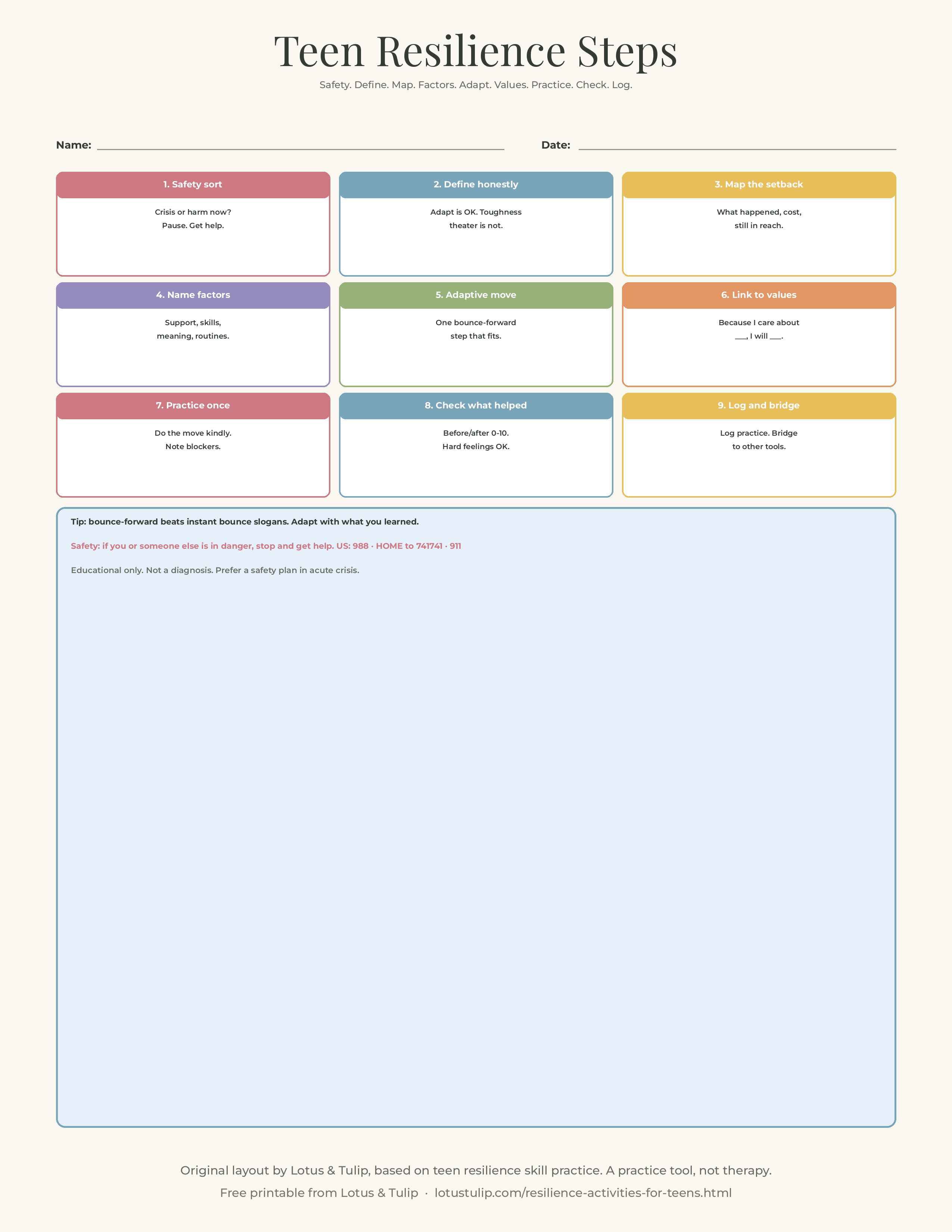
- Safety sort. If acute crisis, self-harm plans, or imminent harm, pause. Use crisis pathways first: 988, HOME to 741741, or 911 when needed. Prefer a safety plan in that moment. Do not force resilience talk in crisis.
- Define resilience honestly. Agree out loud: adapting after a setback is allowed. Toughness theater, never feeling, instant bounce, and ignoring injustice are out.
- Map the setback. Write what happened, what it cost (mood, sleep, grades, friendships), and what is still partly in reach. Keep it concrete. Skip rewriting history to make adults feel better.
- Name protective factors present. Support, skills, meaning or values, routines. Circle what is already available, even if thin. Honesty beats fake abundance.
- Choose one adaptive bounce-forward move. One small action that fits the real constraint (ask for help, adjust a plan, rest then retry, set a boundary, report unfair harm through a safe channel). Prefer two to ten minutes over a heroic weekend overhaul.
- Link the next step to values. Ask: which value does this serve (fairness, learning, friendship, health, honesty)? Values keep the move from becoming people-pleasing theater.
- Practice the skill once, kindly. Do the move. If it fails, note what blocked it without self-attack. Pair with flexible thinking when rigid "I am ruined" thoughts stick, or circle of control when control confusion is loud.
- Check what helped. Rate distress or stuckness 0 to 10 before and after if that helps. Note what changed even a little. Same is allowed. Hard feelings can stay.
- Log and bridge. Record practice on the log page. Bridge to safety plan, coping for teens, stress for teens, self esteem for teens, ER for teens, growth mindset, anxiety for teens, or depression for teens when those are the main load.
Practice on lower-stakes setbacks first when possible. Skill grows with reps and with adults who coach without shaming or demanding instant bounce.
Protective factors and setback map tools teens will actually try
Setback map (about three to five minutes). Columns: what happened, what it cost, what I still partly control, what needs adult or system help. Keeps the story honest without collapsing into "I am the problem."
Protective factor scan. Four boxes: support, skills, meaning, routines. Mark present / thin / missing. Plan one micro-strengthen (text one supportive person, use one calm skill, name one value, protect one sleep cue).
Values-linked next step. One sentence: "Because I care about ___, my next step is ___." Useful when adults push performance and the teen needs an internal compass.
Adaptive coping menu (pick one). Ask for help, break the task, move the body briefly, write the worry then act, set a boundary, repair a relationship, report harm safely, or rest with a timed return. Cousin of coping for teens, aimed at setback adaptation rather than a full menu dump.
Bounce-forward check. Ask: am I trying to erase the event, or adapt with what I learned? Erasure pressure often backfires. Adaptation respects reality.
Neighbor bridges. When the job is calm skills under load, prefer stress for teens or ER for teens. When the job is strengths and worth, prefer self esteem for teens. When the job is effort language after failure, prefer growth mindset. When control confusion dominates, prefer circle of control.
School counselor, therapist, and parent tips
School counselor tips. Short meetings favor: safety sort, honest definition, one setback map line, one protective factor, one values-linked next step. Groups can use optional setback maps with low-stakes prompts (missed shot, awkward lunch). Never force public sharing of trauma, abuse, or family secrets. Follow district crisis protocols if risk appears. Pair with ASCA-aligned school support language without claiming this page is an official ASCA product.
Therapist tips. Stay in the client's language. Separate trauma activation, depression, anxiety, and injustice out loud without diagnosing from a printable. If "be resilient" increases shame ("I should be stronger"), stop and switch to validation, safety, or trauma-informed pacing. Measure function: slightly clearer setback story, one adaptive ask kept, less all-or-nothing "I am broken forever."
Parent tips. Offer, do not force. Model adaptive coping yourself (name a setback and one next step). Do not turn the worksheet into a new weapon ("be resilient or else"). Do not use resilience talk to silence valid anger about unfair treatment. Validate hard days. Ask the school what support exists when safety or mood is the real issue.
Worked fictional examples
Teen example, cut from the team (fictional): Maya, age 15, is cut from varsity, distress rated 8. Safety sort: no crisis. Setback map: lost team identity and afternoon structure. Protective factors: coach still offers open gym, two friends on JV, sleep routine thin. Values-linked step: because she cares about growth and friendship, she will ask coach one clarifying question and join one open gym this week. Log on the free resilience plan page.
Teen example, failed exam after studying (fictional): Leo, age 16, studied hard and still scored low, stuckness rated 7. Practice: setback map plus circle of control neighbor (study method partly changeable; grading curve not). Bounce-forward move: one tutoring ask and one new review method for twenty minutes. Bridge to growth mindset for effort language without denying disappointment.
Teen example, unfair group chat pile-on (fictional): Riley, age 14, is mocked in a chat and told to "get over it." Safety sort: no plan to die, but mood dips and sleep drops. Counselor pauses toughness slogans, validates anger, maps the setback, names support (trusted adult, one friend), and plans a values-linked step (block, document, report through school channel). Bridge to bullying for teens and self esteem for teens if worth talk is loud. Ignoring injustice is not the goal.
School counselor note (fictional): In a twelve minute meeting, a counselor helps a student fill one setback line, one protective factor, one values-linked next step, and a privacy ask (journal vs share). Optional practice, never forced public trauma talk. Follow district crisis protocols if risk appears. For multi-session groups, pair with coping cards or stress menus rather than stacking every worksheet in one period.
Teen resilience vs coping teens, stress teens, self esteem teens, growth mindset, ER teens, circle of control, flexible thinking
| Teen resilience (this page) | Coping teens | Stress teens | Self esteem teens | Growth mindset | ER teens | Circle of control | Flexible thinking | |
|---|---|---|---|---|---|---|---|---|
| Main job | Setback map, protective factors, bounce-forward, values next step, log | Broad coping menu | Load and recovery habits | Strengths and worth evidence | Effort and learning language | Name and shift intensity | Can vs cannot control | Unhook rigid thoughts |
| Best early use | When teens face a clear setback and need adaptive next steps | When they need many calm tools | When chronic load is the scene | When worth and comparison dominate | When "I can't" after failure dominates | When intensity is the load | When control confusion is loud | When stuck either/or thoughts stick |
| Output | Map, factors, values step, log | Coping plan | Stress plan | Strengths plan | Not-yet plan | Regulation plan | Control circles | Thought flexibility practice |
| Cross link | This page | Coping teens | Stress teens | Self esteem teens | Growth mindset | ER teens | Circle of control | Flexible thinking |
These tools cooperate. Teen resilience builds setback adaptation and bounce-forward steps. Coping covers the menu. Stress organizes load. Self esteem covers worth. Growth mindset trains effort talk. ER trains intensity shifts. Circle of control sorts influence. Flexible thinking softens rigid conclusions. Teach one tool clearly before stacking four on day one.
What helps vs common myths
What often helps: honest setback maps, protective factor scans, values-linked tiny steps, adaptive coping that fits real constraints, adult coaching without shame, naming injustice when it is present, and skill printables used as practice aids.
Myths to drop:
- "Resilient teens never cry." Feeling and adapting can coexist. Toughness theater is not the goal.
- "If you were resilient, you would be over it already." Instant bounce is a myth. Uneven recovery is common.
- "Resilience means ignoring unfair treatment." Naming and addressing injustice can be adaptive. Silence is not always strength.
- "Resilience worksheets cure trauma." They are optional practice aids. Trauma care, safety plans, and clinical support matter when indicated.
- "One personality type has resilience." Protective processes and resources matter. Context shapes what is possible.
- "Research proves every teen resilience drill always works." Effects are often small and context dependent. Honesty protects trust.
Common mistakes
- Demanding toughness theater so the teen hides pain to please adults.
- Blaming the teen for systemic harm instead of pairing coping with advocacy and support.
- Pushing instant bounce after loss, trauma, or public humiliation.
- Skipping safety sort when crisis risk is present.
- Vague slogans ("be strong") instead of a concrete setback map and next step.
- Stacking every neighbor worksheet on day one without teaching one tool clearly.
- Using it in acute crisis instead of safety first.
- Treating the worksheet as therapy. Paper supports practice. It does not replace a clinician, school policy, or crisis care when problems are severe or lasting.
When not to use this worksheet
Good early uses: a teen who can name a concrete setback, mild to moderate disappointment with adult support available, homework between counseling sessions, school counseling check-ins, groups with low-stakes prompts and opt-out, and building a map-factors-values-step sequence.
Prefer another tool first when:
- Acute safety risk or medical emergency: stabilize and get help (988, HOME to 741741, 911). Prefer a safety plan.
- When trauma activation or PTSD symptoms dominate: prefer trauma-informed clinical care. Do not claim this printable treats PTSD.
- When chronic overload is the whole scene: prefer stress management for teens.
- When low mood and withdrawal dominate: prefer depression activities for teens.
- When panic and avoidance dominate: prefer anxiety activities for teens.
- When the exercise increases shame or feels like blaming the victim: stop, validate, and switch tools.
What the research says (honestly)
Resilience activities and worksheets are a skill practice aid, not a standalone RCT treatment. Do not claim this free printable remits trauma, PTSD, depression, anxiety disorders, or any diagnosis.
Masten ordinary magic neighbor. Developmental resilience work associated with Ann Masten (including ordinary magic neighbors) emphasizes everyday protective processes and competence under adversity rather than rare heroic traits. Credit with clear non-affiliation. This page is not a copy of any Masten protocol and does not claim those research effect sizes for this three page sheet.
Southwick and Charney resilience factor neighbors. Educational and clinical writing associated with Steven Southwick and Dennis Charney often discusses skills and supports linked with resilience (for example social support, cognitive flexibility, meaning, and physical health habits) as neighbors for factor lists used in teaching. Credit with clear non-affiliation. Factor lists are not proof that this printable remits clinical disorders.
Ungar socio-ecological resilience neighbor. Work associated with Michael Ungar highlights how culture, resources, and relationships shape resilience processes, which is a useful neighbor for not blaming teens for missing supports. Credit with clear non-affiliation.
ASCA / school SEL neighbors. School counseling and SEL frameworks often discuss student supports, protective factors, and skill teaching in educational language. Credit as neighbors with clear non-affiliation. This page is not an official ASCA product and is not a district curriculum.
Honest limits. Effects of brief skill sheets are often small. Context matters. Resilience talk can backfire if used to deny injustice or demand instant bounce after trauma. Adult support, sleep, school policy, and clinical care when indicated matter. No study tests this three page Lotus and Tulip printable alone.
Free resilience activities printable for teens (PDF)
The free resilience activities printable has three pages in US Letter size:
- Page 1: Teen Resilience Steps. Sequence matching the HowTo: safety sort, honest definition, map the setback, name protective factors, choose adaptive bounce-forward move, link to values, practice once, check what helped, log and bridge, plus safety reminders.
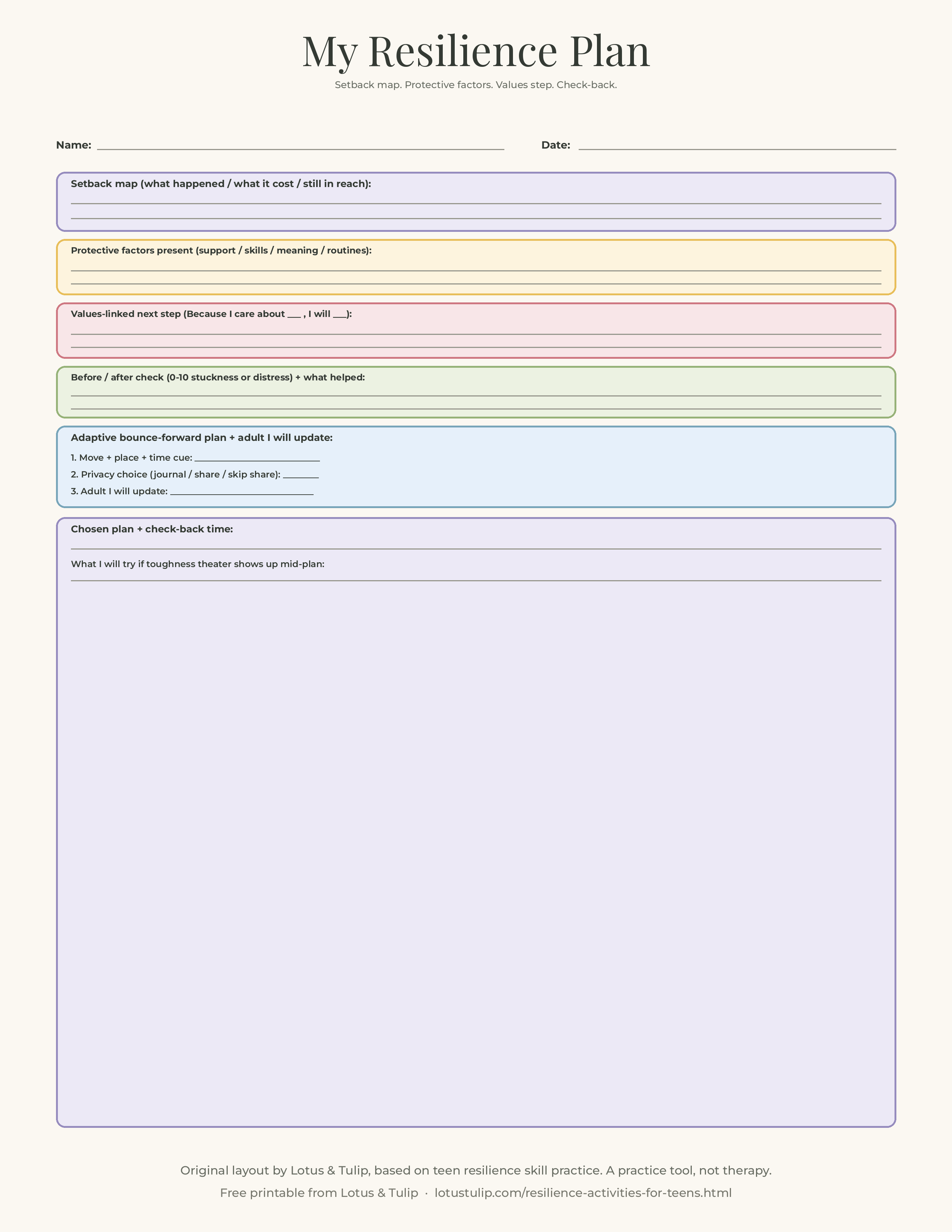
- Page 2: My Resilience Plan. Fill in setback map, protective factors, values-linked next step, before/after note, and check-back.
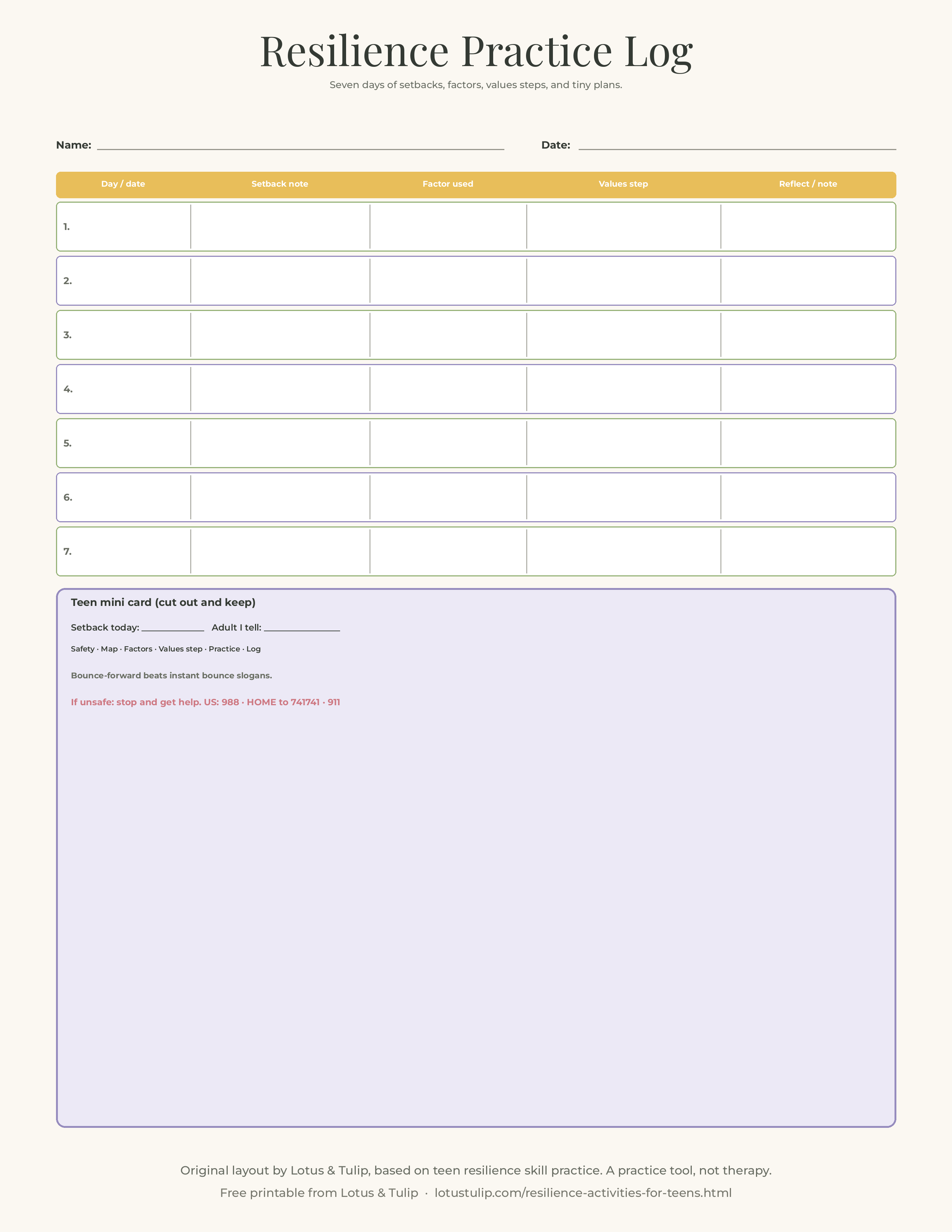
- Page 3: Practice Log + teen mini card. Seven day rows plus a cut out reminder for safety, map, factors, values step, practice, log.
Download the free resilience activities printable for teens (PDF, 3 pages, US Letter)
Prefer single images? Page 1: Teen Resilience Steps (PNG) · Page 2: My Resilience Plan (PNG) · Page 3: Practice Log (PNG)
Free to print for your own use and for use with your own clients, students, or groups. This is an original layout by Lotus & Tulip, based on teen resilience skill practice associated with Masten ordinary magic neighbors, Southwick and Charney resilience factor neighbors, Ungar socio-ecological neighbors, and ASCA / school SEL neighbors, with clear non-affiliation. It is not affiliated with those authors, any scale publisher, or any specific treatment or curriculum package, and is not a substitute for therapy. Please link to this page rather than re-uploading the file.
Related resources
- Resilience activities for kids: bounce back plan and resilience builder for ages 4 to 12.
- Coping skills worksheets for teens: broad coping menu.
- Stress management worksheets for teens: load and recovery habits.
- Self esteem activities for teens: strengths and worth evidence.
- Growth mindset worksheet: effort and learning language.
- Emotional regulation activities for teens: name and shift intensity.
- Circle of control worksheet: can vs cannot control.
- Flexible thinking worksheet: unhook rigid thoughts.
- Anxiety activities for teens: worry fork and gentle facing.
- Depression activities for teens: low mood, activate, connect.
- Gratitude activities for teens: noticing good and optional thanks.
- Mindfulness activities for teens: notice and return attention.
- Safety plan worksheet: when the moment is about staying safe and alive.
Sources
- Masten ordinary magic / developmental resilience traditions as neighbors for competence under adversity and everyday protective processes. Educational credit with clear non-affiliation. Not a claim that this printable remits clinical disorders.
- Southwick and Charney resilience factor neighbors for skills and supports often discussed in resilience education. Educational credit with clear non-affiliation.
- Ungar socio-ecological resilience neighbors for culture, resources, and relationship context. Educational credit with clear non-affiliation.
- ASCA and school SEL neighbors for counselor-friendly student support language. Educational credit with clear non-affiliation. Not an official ASCA product.
- Honest caveat: teen resilience drills are a skill practice aid. Reviews and trials are not the same as RCTs of this Lotus and Tulip printable. Forced toughness after trauma or injustice can backfire. Adult support and clinical care when indicated matter.
Resilience activities for teens: FAQ
What are resilience activities for teens?
They are short, optional practice tools for naming a setback honestly, mapping costs and remaining influence, noticing protective factors, picking one values-linked bounce-forward step, practicing it, and logging what helps. They are educational skill aids, not therapy.
Is resilience the same as never feeling upset?
No. Feeling and adapting can coexist. Toughness theater and never feeling are myths. Instant bounce is also a myth.
Does resilience mean ignoring unfair treatment?
No. Naming injustice and seeking safe support or advocacy can be adaptive. Silencing teens so adults stay comfortable is not the goal of this page.
Can school counselors use it with teens?
Yes, often in short meetings with safety sort, one setback map line, one protective factor, and one values-linked next step. Keep practice optional and school safe. Follow crisis protocols when risk appears. Do not use the page as a diagnosis or as forced public trauma sharing.
Is resilience proven to cure teen trauma or PTSD?
No. Resilience education neighbors discuss protective processes with caveats. This printable does not cure trauma, PTSD, depression, or anxiety. Prefer clinical care when problems are severe or lasting.
When should I not use this worksheet?
Do not use it as the first move in acute safety risk, medical emergency, acute trauma activation when toughness talk feels like blame, or when the exercise increases shame. Stabilize and get help when needed: 988, HOME to 741741, or 911. Prefer a safety plan in crisis.
Is this affiliated with Masten, Southwick, Charney, Ungar, or ASCA?
No. This is an original Lotus and Tulip educational layout. We credit research and school counseling lineages with clear non-affiliation and do not reproduce copyrighted manuals or claim official endorsement.