
Kids and teens · Updated 2026-11-07
Study Skills Activities for Teens (with Free Printable)
Ready-made printable: Study Skills and Test Anxiety Group Bundle for School Counselors Holiday 20% off: about $17.48, was $22 (EUR 19) · instant digital download
Buy on Etsy
Study skills activities for teens are short, practical rounds that help middle and high school students map their week, break big tasks into first steps, use higher utility study techniques such as retrieval practice and spaced practice, park distractions, run short focus rounds, build if-then study plans, review mistakes with an error log, and talk about growth versus fixed study habits without pretending that one trick fixes everything. This guide gives school counselors, therapists, teachers and parents activities you can run tomorrow: a week load map, task break-down, spaced retrieval cards, two-column notes practice, teach-back, a distraction audit with phone park, Pomodoro-style focus rounds, if-then study plans, a test prep timeline versus night-before cram, an error log, growth versus fixed study talk and a study environment setup. Each one comes with timing, setup, debrief and adaptations, plus a free three page printable.
Teen study skills are different from adult productivity tips and different from tutoring for content. A thirteen year old facing six subjects and a phone that never sleeps, a fifteen year old who highlights every page the night before a test, and a seventeen year old juggling a job, AP classes and caregiving all need habits that fit adolescent days: bells, group chats, practice schedules and limited control over the calendar. This page sits next to our test anxiety worksheet (worry about tests), executive functioning worksheets for kids (planning and organization building blocks), goal setting worksheet for students (longer range goals), problem solving activities for teens, impulse control activities for teens, flexible thinking worksheet, stress management worksheets for teens, anxiety activities for teens and growth mindset worksheet. Those pages go deep on neighboring skills. This one is about the study skills loop itself: map the load, break tasks, retrieve and space practice, protect focus, review errors and adjust.
We credit the sources these activities lean on, without claiming any affiliation or endorsement: Dunlosky and colleagues' 2013 review of learning techniques in Psychological Science in the Public Interest (practice testing and distributed practice rated high utility; rereading and highlighting rated low), spaced practice and retrieval practice research neighbors, Zimmerman's self-regulated learning framework as a planning and reflection neighbor, and the ASCA Student Standards and CASEL self-management framework for academic development and learning strategies neighbors. The printable is an original Lotus and Tulip layout, not a copy of any of their materials.
This guide is educational. It is not therapy, not medical advice and not a diagnosis. Study skills do not treat ADHD, a learning disability, anxiety or depression. If a study skills conversation turns up thoughts of ending a life, a plan to hurt someone, self harm, abuse, or a medical emergency, stop the activity and get help now: in the US, call or text 988 (Suicide and Crisis Lifeline), text HOME to 741741 (Crisis Text Line), or call 911. Our safety plan worksheet is a better first tool in that moment. If a teen's struggle looks like a possible learning disability or ADHD, prefer a school or clinical evaluation rather than another study tip sheet.
Jump to the free study skills printable (PDF) · Activities · How to use study skills activities for teens, step by step · Worked examples · Comparisons
What study skills are (and are not)
For this page, study skills means the habits a teen uses on purpose to learn and remember school material: planning the week, breaking tasks into first steps, practicing retrieval, spacing study across days, managing attention and phones, checking mistakes and adjusting. They are skills you can practice, not a personality trait. A useful teen study skills plan names the week's load, picks one or two high utility techniques, sets a phone park rule, includes short focus rounds and has a clear line for when to bring in an adult or ask for accommodations.
It is not:
- Tutoring for content. Study skills help a teen practice and organize learning. They do not replace teaching algebra, writing or history. If the gap is missing instruction, the teen needs teaching, not only a planner.
- A cure for ADHD or a learning disability. Better study habits can help many students, including students with ADHD or LD who already have supports. They do not diagnose or treat those conditions. Evaluation, accommodations and clinical care come first when those are the real questions. See executive functioning worksheets for kids as a neighboring skill page, not a treatment.
- Cramming theater. Highlighting every line, rereading the chapter three times the night before and calling it "studying" often looks busy and builds weak lasting recall. Dunlosky and colleagues rated practice testing and distributed practice as high utility, and rereading and highlighting as low utility for many learning goals. This page pushes teens toward retrieve and space, not toward looking busy.
- One trick that fixes everything. No single app, color of sticky note or "study playlist" replaces mapping the week, sleeping enough and practicing retrieval. Teens who chase one magic method often avoid the harder habits.
- A treatment for anxiety or depression. Test worry belongs next to the test anxiety worksheet. Heavy stress or low mood belongs next to stress management or anxiety activities for teens. Study skills sit beside those tools; they do not replace them.
Why teens need teen shaped study skills
Teens juggle many subjects at once. Adults often deep work on one project. Teens rotate through math, language, science, history and electives in one day. Study skills have to work across subjects, not only for one favorite class.
The phone is always in the room. Notifications, group chats and short videos compete with every study block. A distraction audit and a phone park are not optional extras for most teens; they are part of the skill.
School rewards last-minute urgency. Many teens learn that a panic night "works" because the quiz is tomorrow. Spaced practice feels slower at first and pays off later. Naming that tradeoff out loud helps teens try the better habit for one week.
Self regulated learning is a skill stack. Zimmerman's self-regulated learning neighbor frames learning as forethought (plan), performance (use strategies) and self reflection (review). Teens who only "sit with the book" skip the plan and the review. This page builds all three.
Academic development is a counselor lane too. ASCA Student Standards include learning strategies and academic development behaviors. CASEL's self-management competency includes planning and organizational skills. Study skills activities fit small groups, advisory and short individual check-ins, not only tutoring labs.
Study skills activities teens will actually do
Each activity below lists time, group size, setup and debrief. Run one or two per session, not all of them at once. The first few build awareness and planning, the middle ones build high utility techniques and focus, and the last ones turn practice into review and mindset.
1. Week load map
Time: 15 minutes. Group: individual or pairs. Setup: a blank week grid (Mon to Sun) with space for tests, due dates, practice, work and family duties.
Students fill every known commitment for the coming week, shade the heaviest day and mark one protected study block that is not the night before the biggest test. Debrief: which day is overloaded? What can move earlier? Teaching point: seeing the week often lowers panic more than any "study tip," because the load was invisible. Pair with goal setting worksheet for students when the next need is longer range goals.
2. Task break-down (tiny first step)
Time: 12 minutes. Group: individual. Students pick one big task (essay, project, chapter test) and write the smallest first step that takes ten minutes or less: open the doc, list three headings, do five practice problems, make five retrieval cards. Debrief: if the first step still feels huge, break it again. Teaching point: starting is a skill; finishing is later.
3. Spaced retrieval cards
Time: 15 minutes to make, then short sessions across days. Group: individual or pairs. Students turn one topic into 8 to 12 cards with a question on one side and a short answer on the other (or use a simple digital quiz). Practice: cover the answer, say or write it, then check. Schedule the same deck on two or three different days, not all in one night. Debrief: how did day two feel compared with day one? Teaching point: retrieval practice and spaced practice are the high utility pair from Dunlosky and colleagues' review. Pair with test anxiety worksheet if worry, not skill, is blocking practice.
4. Cornell or two-column notes practice
Time: 15 minutes. Group: individual. Students take a short reading or a short lecture clip and practice a two-column layout: cues or questions on the left, notes on the right, a three sentence summary at the bottom. Then they cover the notes column and answer from the cue column only. Debrief: notes that support retrieval beat notes that only look neat. Teaching point: the cue column is for later self testing, not decoration.
5. Teach-back
Time: 12 minutes. Group: pairs. Partner A explains a concept in two minutes with no notes. Partner B asks one clarifying question. Then they switch. Debrief: where did the explanation stall? That stall is the next study target. Teaching point: if you cannot teach it briefly, you do not know it yet for a test.
6. Distraction audit and phone park
Time: 12 minutes to set up, one week to run. Group: individual with class debrief. Students list what usually breaks a study block (notifications, tabs, people, noise, hunger). They pick one phone park rule (kitchen counter, backpack outside the room, Do Not Disturb for 25 minutes) and one environment fix (clear desk, water, one tab). Log for seven days. Debrief: what changed in focus rating? Teaching point: willpower is a weak plan; a phone park is a stronger one. Pair with impulse control activities for teens when the urge to check is the main barrier.
7. Pomodoro-style focus rounds
Time: 30 minutes (one or two rounds). Group: individual or silent group. Set a 25 minute work timer and a 5 minute break. During work: only the chosen task and no phone. During break: stand, water, stretch, no deep scroll. After two rounds, stop and write what got done. Debrief: did the timer help start? Was 25 minutes too long or too short? Teaching point: short rounds beat vague "I'll study tonight" plans. Adapt to 15 and 3 for middle school or for teens who are building stamina.
8. If-then study plans
Time: 10 minutes. Group: individual. Students write three if-then plans: "If I finish dinner, then I start my 25 minute math round." "If I want to check my phone, then I put it in the kitchen and start one retrieval card." "If I miss a planned block, then I do a ten minute make-up before bed." Debrief: vague intentions lose to specific if-then links. Teaching point: this is implementation planning, not perfection.
9. Test prep timeline versus night-before cram
Time: 15 minutes. Group: pairs or small groups. Give a fictional test date five days out. Groups build two timelines: a spaced plan (short retrieval each day) and a night-before cram. Compare predicted stress, sleep and likely recall. Debrief: which plan leaves room for sleep? Teaching point: cram can feel productive and still leave weak memory and high anxiety. Pair with stress management worksheets for teens when the body stress response is the main problem.
10. Error log and mistake review
Time: 12 minutes. Group: individual. After a quiz, homework check or practice test, students log: what I missed, why (guess, rushed, did not practice, misread, other), next fix (one concrete action). Debrief: mistakes are data, not a character judgment. Teaching point: reviewing errors is higher utility than rereading the parts you already know. Pair with growth mindset worksheet when fixed talk ("I'm just bad at this") blocks review.
11. Growth versus fixed study talk
Time: 10 minutes. Group: whole class or small group. Sort lines such as "I am not a math person," "I have not learned this yet," "Highlighting more will fix it," "I can change my method," "If I need help I am dumb." Debrief: study skills are methods you can change, not a fixed identity. Teaching point: growth talk without a method is empty; pair it with retrieve, space and error logs.
12. Study environment setup
Time: 10 minutes. Group: individual. Students sketch or list their real study spot and fix three things: lighting or seat, tools ready before the timer, phone park place. Optional photo or quick sketch for homework. Debrief: environment design beats hoping you will "focus harder." Teaching point: a messy bed with a phone in hand is a nap plan, not a study plan.
How to run these activities in a group or session
Set norms first. Pass is always allowed, practice on made up subjects before real grades, no ranking whose GPA is higher, and no shaming anyone for ADHD, accommodations or needing more time. Model one adult study habit yourself ("I put my phone in another room for two focus rounds") so teens see the habit as ordinary. Keep personal grade sharing optional. End every session with one carry over: one protected block, one retrieval deck, one phone park or one error log line.
Suggested six session sequence. Session 1: week load map plus task break-down. Session 2: spaced retrieval cards and two-column notes. Session 3: distraction audit, phone park and study environment setup. Session 4: focus rounds and if-then plans. Session 5: test prep timeline versus cram and teach-back. Session 6: error log, growth versus fixed study talk, weekly plan and check in review.
Classroom version. In a single advisory or study hall lesson, run the week load map (15 minutes), one focus round demo (25 minutes) and the phone park setup (10 minutes), then send the printable home. That covers planning, one concrete technique and a take home plan in under 50 minutes.
Adaptations
- Middle school (about 12 to 14): shorter focus rounds (15 and 3), more sentence frames, fewer cards per deck, subjects named with examples ("science chapter quiz on Friday").
- High school (about 14 to 18): add jobs, sports, college apps and multi-step projects. Let students design their own spaced schedules with less scaffolding.
- ADHD and executive function supports: external timers, visible phone park, written if-then plans, body doubling (study near someone quietly), and clear first steps. Do not frame ADHD as laziness. Prefer evaluation and accommodations when attention or organization problems are long lasting. Pair with executive functioning worksheets for kids.
- Anxious teens: start with tiny retrieval wins, shorten first focus rounds and keep test worry linked to the test anxiety worksheet. Do not force public teach-backs if panic is high.
- English learners: allow first-language notes in the cue column, model teach-back with simple sentence frames and keep retrieval questions concrete.
- Virtual groups: shared week maps in a doc, breakout teach-backs, camera-optional focus rounds and a posted phone park reminder in chat.
How to use study skills activities for teens, step by step
- Safety sort. Before planning study, check that this is a study skills question and not a crisis. Thoughts of ending a life, self harm, a plan to hurt someone, abuse or a medical emergency come first: 988, HOME to 741741, or 911 when needed, plus a safety plan and a trusted adult. Do not offer a study plan as a substitute for crisis help.
- Map the week. Write tests, due dates, practice, work and family duties. Shade the heaviest day and protect one study block that is not only the night before.
- Break big tasks. Pick the biggest task and write a ten minute first step. If it still feels huge, break it again.
- Choose retrieve and space. Turn the topic into questions you can answer without looking. Practice the same set across more than one day. Prefer practice testing over rereading alone.
- Set phone park and study spot. Decide where the phone goes and what tools are ready before the timer starts.
- Write if-then plans. Link a real trigger to a real action: after dinner, then one focus round; if I want my phone, then park it and start one card.
- Run focus rounds. Use short timed work and short breaks. Stop after the planned rounds and write what got done.
- Log errors after practice or quizzes. What I missed, why, next fix. Mistakes are data for the next session.
- Check in weekly and adjust. Keep what worked, shrink what was too big, and bridge to test anxiety, executive functioning, goal setting, problem solving, flexible thinking, growth mindset, stress or anxiety pages when one neighbor skill needs deeper work.
Plan for a normal week first. A plan built in a calm moment is the one that still exists during finals week.
School counselor, therapist, teacher and parent tips
School counselors. Study skills activities fit advisory lessons, academic small groups, study halls and short individual check-ins, and sit near ASCA academic development and learning strategies language and CASEL self-management language about planning and organization. Use the week load map as a quick screener conversation, keep grade sharing optional, and follow district protocols when a teen shows crisis signs or when a possible LD or ADHD evaluation is needed. Avoid one-off "study tips" assemblies with no follow up practice.
Therapists. Build the plan around the teen's real week and review it each session. Watch for perfectionist teens who turn study skills into another shame list, and for teens whose "I just need better study skills" story is covering untreated anxiety, depression or attention needs. Coordinate with school on accommodations when appropriate. This printable is a skill aid, not a treatment plan.
Teachers. Give advance notice of tests, offer practice questions that reward retrieval, and make space for spaced review in class. A two minute "what is your first step tonight" check can open the door for students who need a counselor. Do not punish students who use accommodations.
Parents and caregivers. Help with environment and phone park more than with hovering over every problem set. Ask "what is your first ten minute step" instead of "have you studied yet." Protect sleep before a test. If struggles are long lasting across subjects, ask the school about evaluation and supports rather than only buying another planner.
Worked fictional examples
The night-before highlighter (fictional). Jay, 15, spent three hours highlighting a chapter the night before every quiz and still blanked on short answers. In spaced retrieval cards he made twelve question cards and practiced for fifteen minutes on Monday, Wednesday and Thursday before Friday's quiz. He slept more the night before. Carry over: retrieve across days beat one long highlight session.
The invisible week (fictional). Nora, 13, felt "always behind." Her week load map showed a science quiz, a band concert and a sibling babysitting night stacked on Thursday. She moved her science retrieval to Tuesday and Wednesday and protected a short Tuesday block. Carry over: the problem was the calendar, not only "laziness."
Phone park experiment (fictional). Eli, 17, started homework with his phone face up. The distraction audit showed group chat as the main break. He parked the phone in the kitchen for two 25 minute rounds. Focus rating rose from 2 to 4 by the end of the week. Carry over: one environment rule beat a vague "I will focus more" promise.
Error log after a math quiz (fictional). Sam, 16, missed four algebra items. The error log showed three were rushed sign errors and one was a method never practiced. Next fix: five practice problems of that method on two different days, not rereading the notes page. Carry over: mistakes pointed to practice, not to "I am bad at math."
Counselor small group note (fictional). In a six session ninth grade study skills group, a counselor ran one or two activities per session on made up subjects. The phone park and retrieval cards were the most used take homes. Two students disclosed heavy test panic; the counselor linked them to the test anxiety tools and followed school protocol. Nobody was required to share real grades aloud.
Study skills activities vs test anxiety, executive functioning, goal setting, problem solving, flexible thinking, growth mindset, stress and anxiety
| Study skills activities for teens (this page) | Test anxiety worksheet | Executive functioning kids | Goal setting students | Problem solving teens | Flexible thinking | Growth mindset | Stress teens | Anxiety teens | |
|---|---|---|---|---|---|---|---|---|---|
| Main job | Map, break, retrieve, space, phone park, focus rounds, error log | Worry about tests and calm skills around testing | Planning, organization and follow through building blocks | Longer range goals and steps | Cool, define, size, options, try | Shift stuck thoughts and plans | Beliefs about ability and effort | Stress triggers and calm skills | Anxiety cues, naming, facing |
| Best early use | Cramming, weak recall, phone during homework, no week plan | When worry is the main block on test day | When planning and starting are the main gaps | When the need is longer goals | When a concrete problem needs a plan | When rigid thinking blocks options | When fixed identity talk blocks practice | When stress load is the main issue | When anxiety is broader than tests |
| Output | Study skills plan, practice log, mini card | Test anxiety plan | EF skill pages | Goal plan | Problem solving plan | Flexible thinking practice | Mindset practice | Stress plan | Anxiety plan |
| Link | This page | Test anxiety | EF kids | Goal setting | Problem solving teens | Flexible thinking | Growth mindset | Stress teens | Anxiety teens |
These tools work together. Study skills are the learning habits layer. When the main problem is test worry, planning capacity, longer goals, a stuck problem, rigid thinking, fixed identity talk, stress load or broader anxiety, go to the matching page.
What helps vs common myths
What often helps: week maps, tiny first steps, retrieval practice spaced across days, phone park rules, short focus rounds, error logs and adults who protect sleep before tests.
- Myth: "Rereading and highlighting are enough if I do them long enough." They are common and often low utility for lasting recall compared with practice testing and spaced practice.
- Myth: "Cramming works because I pass sometimes." Passing a short quiz after a panic night is not the same as remembering weeks later. Spaced practice usually wins for lasting learning.
- Myth: "If I need study skills I am not smart." Strong students use methods. Methods are learnable.
- Myth: "Study skills will fix ADHD or a learning disability." Habits can help; they do not replace evaluation, accommodations or clinical care.
- Myth: "Multitasking with my phone is fine if I am used to it." Task switching usually costs focus. A phone park is a fair experiment.
- Myth: "Research proves these exact activities work." No study has tested this printable or this activity set. The high utility techniques (practice testing, distributed practice) are supported by the Dunlosky et al. 2013 review and related work; the activities are a practical way to apply them.
Common mistakes
- Buying another planner without changing retrieve, space or phone habits.
- Making the plan too big. Ten new habits in a week usually means zero by Friday.
- Only studying what already feels easy and skipping the error log.
- Treating study skills as a moral lecture about laziness instead of methods and environment.
- Ignoring sleep the night before a test while adding more cram time.
- Using study tips as the answer to crisis signs that call for a counselor, doctor or therapist.
- Claiming study skills treat ADHD or LD. They do not.
- Treating the worksheet as therapy. Paper supports practice. It does not replace professional help when problems are serious or lasting.
When not to use this worksheet
Good uses: ordinary study habit gaps, advisory and study hall lessons, academic small groups, before a busy test week, and individual sessions where planning and practice methods have slipped.
Use something else first when:
- There is danger, self harm, abuse or acute crisis. Safety and adult help come first: 988, HOME to 741741, 911, and a safety plan.
- Test worry is the whole problem. Use the test anxiety worksheet and calm skills, then return to study methods.
- A learning disability or ADHD evaluation is the real next step. Prefer school psychology or clinical evaluation and accommodations. Do not claim study skills treat ADHD or LD.
- Anxiety or mood problems are lasting and broad. See anxiety activities for teens or other clinical supports; study skills alone are not enough.
- The teen is flooded right now. Calm the body first with stress management or coping tools, then plan study later.
What the research says (honestly)
Learning techniques utility. Dunlosky, Rawson, Marsh, Nathan and Willingham (2013) reviewed ten learning techniques in Psychological Science in the Public Interest. Practice testing and distributed practice (spaced practice) received high utility ratings because benefits showed across ages, materials and tasks in many studies. Elaborative interrogation, self explanation and interleaved practice received moderate utility ratings. Summarization, highlighting, keyword mnemonics, imagery for text and rereading received low utility ratings for many learning goals, in part because students use them heavily while gains are often limited. Lotus and Tulip is not affiliated with the authors or the Association for Psychological Science.
Self regulated learning neighbor. Zimmerman's self-regulated learning framework describes cycles of forethought (goals and plans), performance (strategies and monitoring) and self reflection (evaluation and adjustment). The activities on this page map onto that cycle: week maps and if-then plans (forethought), retrieval, focus rounds and phone park (performance), error logs and weekly check in (reflection). This page is a practical neighbor, not a full Zimmerman curriculum.
School frameworks. ASCA Student Standards include learning strategies and academic development behaviors related to applying skills to achieve school success. CASEL's self-management competency includes planning and organizational skills. Lotus and Tulip is not affiliated with ASCA or CASEL.
Honest limits. No study tests this three page printable or this activity set. Study skills are a broad everyday term, not a single tested intervention. Treat this as a practical skill aid built on well known learning science neighbors, not a treatment for ADHD, a learning disability, anxiety or any other condition.
Free study skills printable for teens (PDF)
The free study skills printable has three pages in US Letter size:
- Page 1: Teen Study Skills Steps. Nine step card matching the HowTo above: safety sort, map the week, break tasks, retrieve, space, phone park, focus rounds, error log, check in. Includes a high utility versus low utility study habits example.
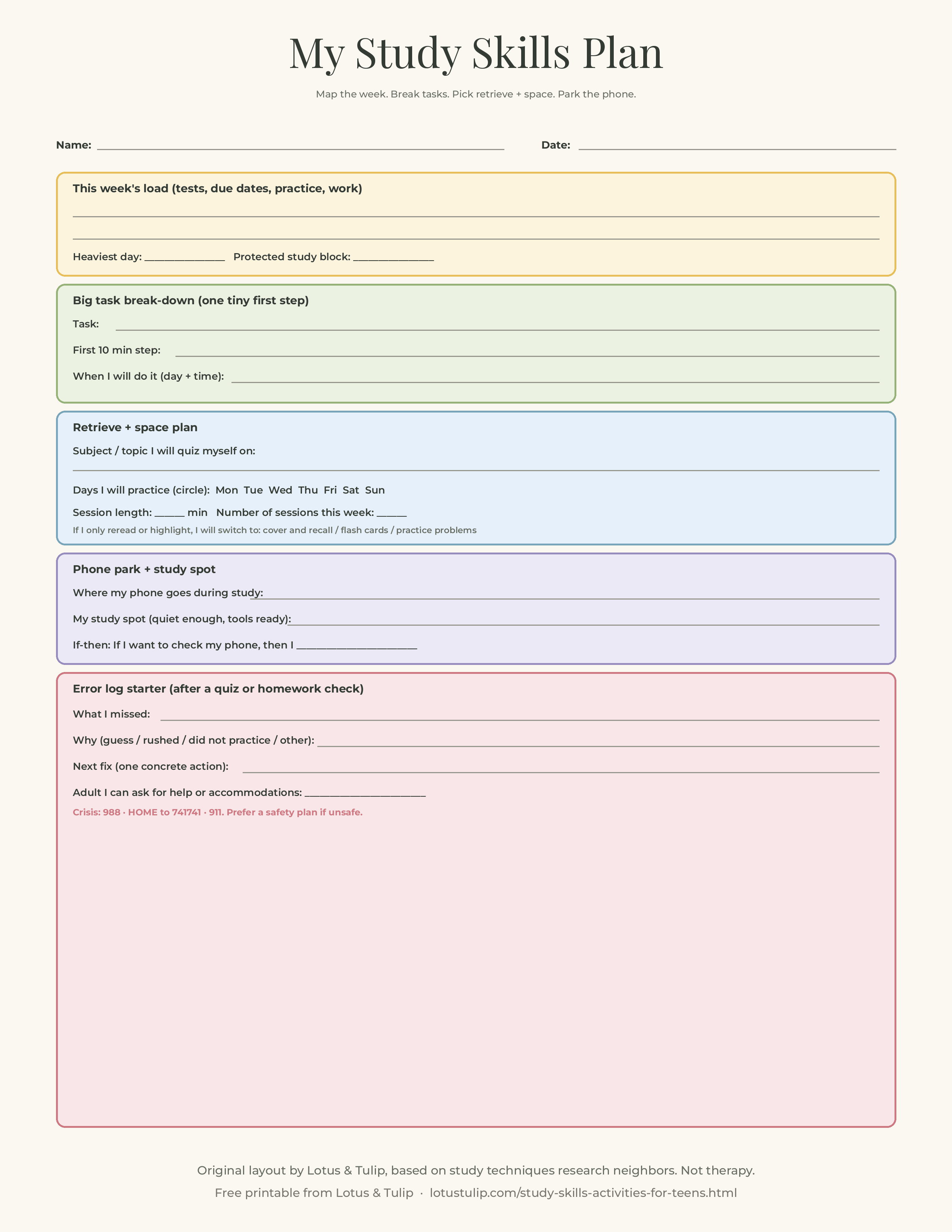
- Page 2: My Study Skills Plan. Week load, task break-down, retrieve and space plan, phone park and study spot, if-then line, error log starter.
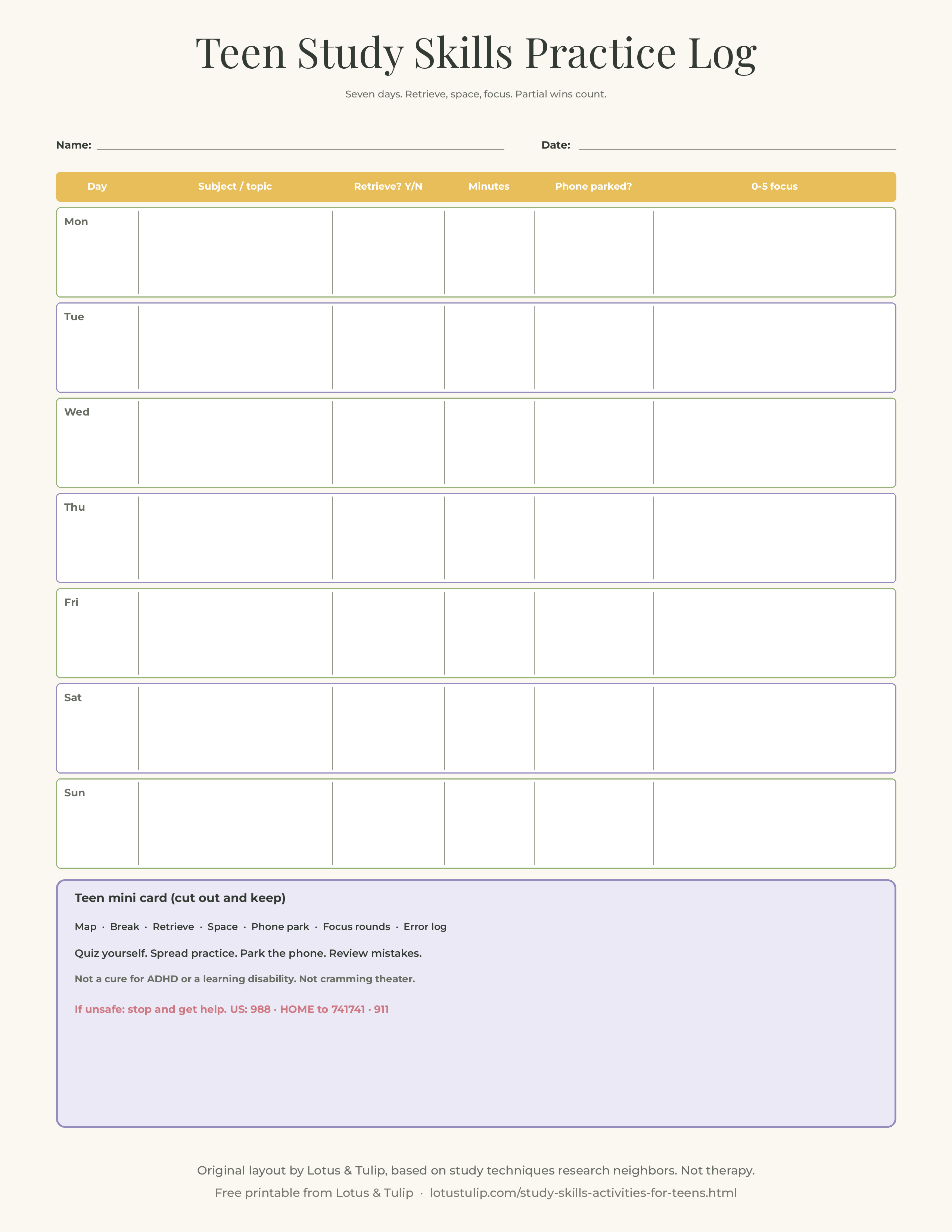
- Page 3: Practice Log + teen mini card. Seven days of subject, retrieve, minutes, phone parked and focus rating, plus a cut out reminder card.
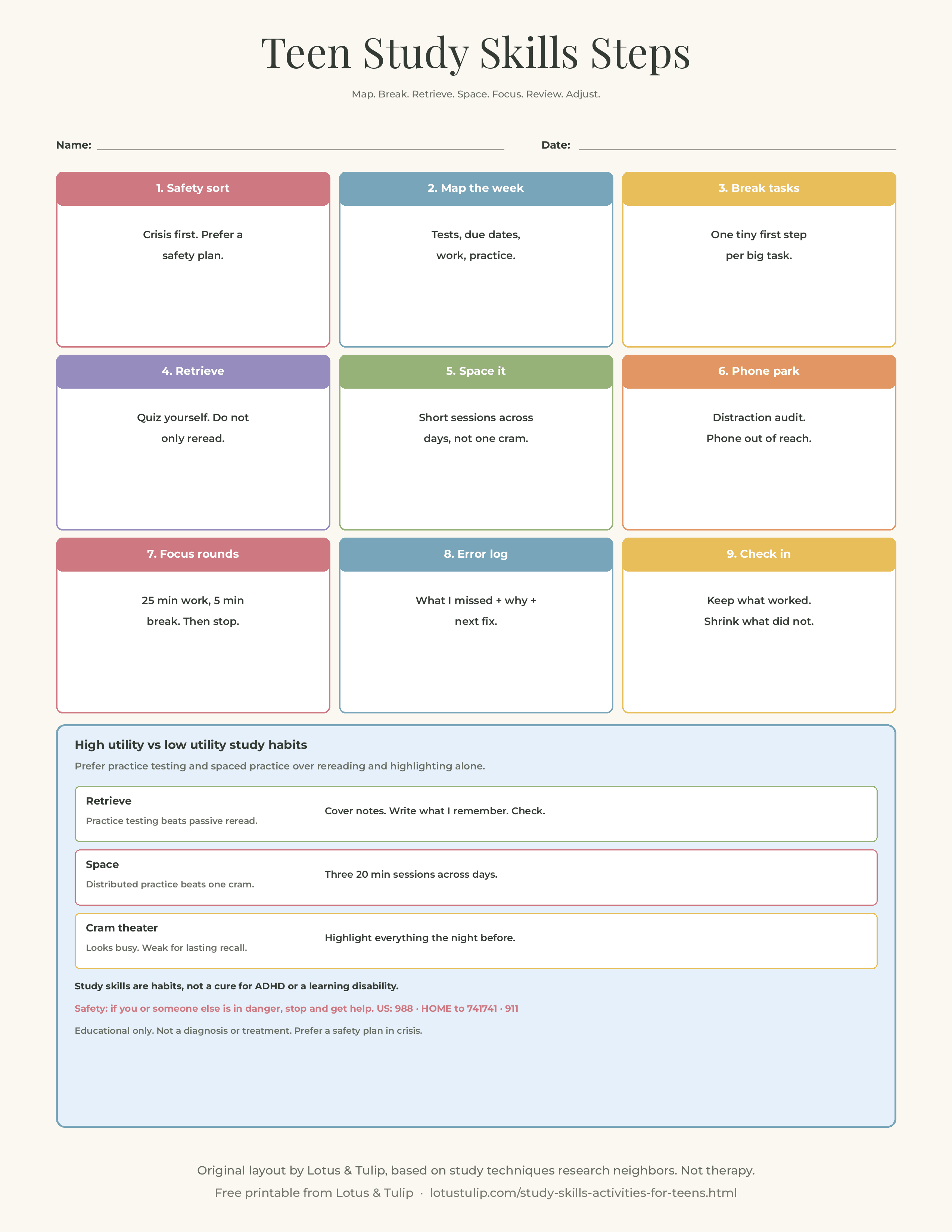
Download the free study skills printable for teens (PDF, 3 pages, US Letter)
Prefer single images? Page 1: Teen Study Skills Steps (PNG) · Page 2: My Study Skills Plan (PNG) · Page 3: Practice Log (PNG)
Free ADHD starter pack: For students with ADHD, the free ADHD worksheets starter pack adds break it down, a time estimation log and getting unstuck, plus three more real pages from our paid ADHD set (8 pages, client use license, no email).
Free to print for your own use and for use with your own clients, students or groups. This is an original layout by Lotus & Tulip, drawing on widely discussed study techniques research neighbors (including Dunlosky et al. 2013) and school learning strategies frameworks. It is not affiliated with any author, organization or curriculum named on this page, does not diagnose or treat any condition, and is not a substitute for therapy, tutoring or medical care. Please link to this page rather than re-uploading the file.
Related resources
- Test anxiety worksheet: worry and calm skills around tests.
- Executive functioning worksheets for kids: planning and organization building blocks.
- Goal setting worksheet for students: longer range planning.
- Problem solving activities for teens: cool, define, options, try.
- Impulse control activities for teens: pause skills next to phone park.
- Flexible thinking worksheet: shifting stuck plans.
- Growth mindset worksheet: beliefs about ability and effort.
- Stress management worksheets for teens: stress triggers and calm skills.
- Anxiety activities for teens: broader anxiety skills.
- Safety plan worksheet: when the moment is about staying safe.
Sources
- Dunlosky, J., Rawson, K. A., Marsh, E. J., Nathan, M. J., & Willingham, D. T. (2013). Improving students' learning with effective learning techniques: Promising directions from cognitive and educational psychology. Psychological Science in the Public Interest, 14(1), 4 to 58.
- Zimmerman, B. J. Self-regulated learning framework (forethought, performance, self reflection) as a planning and reflection neighbor.
- American School Counselor Association. ASCA Student Standards: Mindsets and Behaviors for Student Success (learning strategies and academic development related behaviors).
- CASEL. The CASEL 5 framework, self management competency (planning and organizational skills).
Study skills activities for teens: FAQ
What are study skills activities for teens?
They are short practice rounds that help teens map the week, break tasks, use retrieval and spaced practice, park phones, run focus rounds, review mistakes and adjust. They work in classrooms, small groups and individual sessions.
What study techniques work best according to research?
Dunlosky and colleagues (2013) rated practice testing and distributed (spaced) practice as high utility for many learners and tasks. Rereading and highlighting were rated low utility for many learning goals. This page turns those ideas into activities; it is not a copy of their paper.
How is this different from the test anxiety worksheet?
The test anxiety worksheet focuses on worry about tests. This page focuses on learning habits: planning, retrieval, spacing, focus and error review. Many teens need both.
Do study skills treat ADHD or a learning disability?
No. Study habits can help many students, including students who already have supports, but they do not diagnose or treat ADHD or LD. Prefer school or clinical evaluation and accommodations when those are the real questions.
What is a good first study skills activity for a teen group?
The week load map or spaced retrieval cards. Both are concrete, low shame and show teens that methods matter more than looking busy.
Can school counselors use this printable in groups?
Yes. It fits advisory lessons, academic small groups, study halls and individual check-ins, and sits near ASCA learning strategies and CASEL self-management language. Keep grade sharing optional and follow district protocols when crisis signs or evaluation needs appear.
When are study skills not enough?
When there is crisis or self harm risk, when test panic is the whole problem, when a possible LD or ADHD evaluation is needed, or when anxiety or mood problems are lasting and broad. Bring in a trusted adult, school counselor or doctor. In a crisis in the US, call or text 988, text HOME to 741741, or call 911, and use a safety plan.