
Kids and teens · Updated 2026-11-07
Impulse Control Activities for Teens (with Free Printable)
Ready-made printable: Executive Function Group Curriculum Holiday 20% off: about $11.04, was $14 (EUR 12) · instant digital download
Buy on EtsyTry it free first: download session 1 free (group at a glance, lesson plan and student page, PDF, 69 KB). Run it with your group, then get all 8 sessions. No email needed.

Impulse control activities for teens are short, optional practice tools that help middle and high school students notice an urge before acting, pause with a STOP step, THINK through options and the size of the problem, CHOOSE a values-linked next move, ACT with one tiny step, CHECK what helped, log practice, and know when to stop for safety. Teen impulse control work is not the same as our younger impulse control worksheets for kids and not only anger cool-downs, emotion naming, or coping lists. Grades, group chats, driving, dating, jobs, gaming streaks, and school hierarchies raise the stakes. So does honesty that self-control is a practice skill, not a personality badge, not never feeling urges, not toughness theater, and not a cure for ADHD or any diagnosis.
This Lotus and Tulip page is a teen-focused impulse control activities guide with an original free three page US Letter printable. It targets searches families and helpers actually use: impulse control activities for teens, self control worksheets for teenagers, stop and think for teens, and teaching teens impulse control. It is distinct from our impulse control worksheets for kids (younger stop-and-think practice), from anger management activities for teens (cue, number, cool-down, repair), from emotional regulation activities for teens (name, rate, ride, choose), from flexible thinking worksheet (stuck thought to other options), from coping skills worksheets for teens (menu of coping moves), from executive functioning worksheets for kids (broader EF checklist and planners), from size of the problem worksheet (match reaction size to problem size), and from urge surfing worksheet (ride the wave of an urge without acting). Those neighbors help. This page centers adolescent impulse control: what it is and is not, STOP / THINK / CHOOSE / ACT / CHECK, cue spotting, school and home tips, honest research including Diamond executive function inhibitory control neighbors, Mischel delay of gratification / marshmallow neighbors with honest limits, Duckworth grit and self-control neighbors, and school SEL / ASCA neighbors with caveats, and a free practice plan.
We credit research and skills lineages associated with Adele Diamond (executive function, including inhibitory control) as neighbors for pause-before-act skills taught in many educational contexts. We credit Walter Mischel delay of gratification research (including the marshmallow studies and later follow-ups) as neighbors for waiting and choosing later rewards, with honest limits about replication, context, and socioeconomic confounds. We credit Angela Duckworth grit and self-control neighbors for sustained effort and self-regulation language used in schools, without claiming grit as a cure-all. We also credit ASCA and school SEL neighbors for counselor-friendly language about student self-management and safety, without claiming any official endorsement. We credit those lineages with clear non-affiliation. We are not affiliated with those authors, any branded EF or grit curriculum, any scale publisher, or any school district program. This printable is an original educational layout, not a copy of any copyrighted worksheet and not a diagnosis or treatment. It does not claim to treat ADHD.
This guide is educational. It is not therapy, not medical advice, and not a diagnosis. If thoughts of ending your life, plans to harm yourself or someone else, or a medical emergency show up, stop the worksheet and get help now: in the US, call or text 988, text HOME to 741741, or call 911. Our safety plan worksheet is a better first tool in that moment. Nearby tools: impulse control for kids, anger for teens, emotional regulation for teens, flexible thinking, coping skills for teens, executive functioning for kids, size of the problem, and urge surfing.
Jump to the free impulse control activities printable (PDF) · How to use impulse control activities for teens, step by step · Worked examples · Comparisons
What impulse control is and is not for teens
Impulse control (educational working definition for this page) means noticing an urge, pausing long enough to see options, and choosing a next step that fits values, safety, and the size of the problem more often than the first rush. It is a practiced sequence (STOP, THINK, CHOOSE, ACT, CHECK), not a personality trait you either have or lack.
Impulse control is not:
- Never feeling urges. Urges are normal. The skill is the pause and the choice, not erasing desire, anger, FOMO, or craving.
- Toughness theater. White-knuckling every feeling, shaming yourself for slips, or pretending you never mess up is not the goal. Skill grows with reps and repair.
- Obedience on demand. Adults can coach. Controlling every choice without teaching the sequence is compliance training, not self-control practice.
- A cure for ADHD or any diagnosis. ADHD and related attention or hyperactivity patterns may need clinical assessment, accommodations, and care. A three page practice sheet does not diagnose or treat ADHD, ODD, or any disorder.
- A replacement for safety. When there is acute danger, self-harm risk, substance overdose risk, or violence, the priority is safety planning and trusted adult help, not a polished STOP script.
Teen impulse control response skills include:
- Safety sort first when crisis risk, self-harm talk, acute danger, or aggression that could harm someone is present.
- Honest definition: pause and choose are allowed. Never feeling urges, toughness theater, and ADHD-cure claims are out.
- Cue spotting: body signals, sticky thoughts, triggers, place, and timing.
- STOP / THINK / CHOOSE / ACT / CHECK as a repeatable loop matched to real teen scenes (texts, gaming, driving, conflict, spending).
- Size of the problem awareness so the reaction matches the stakes, not only the heat of the moment.
- Logging what helped and bridging to anger, ER, flexible thinking, coping, EF, size-of-problem, or urge surfing neighbors when needed.
- Knowing when not to push: after acute trauma activation, during medical emergency, or when the exercise feels like blaming the teen for a brain-based ADHD pattern without support, pause and prefer safety and appropriate care.
Why teens need teen-shaped impulse control (not only kids worksheets)
Teen life raises the stakes. Instant replies, public group chats, cars, jobs, dating pressure, late-night gaming, and graded deadlines collide. Kids worksheets that use cartoon stop signs can feel babyish. Adult grit lectures that ignore sleep debt and peer status can miss the mark. Teen-shaped impulse control respects privacy, developmental load, and the difference between a practice script and a safety plan.
STOP, THINK, CHOOSE, ACT, CHECK. STOP buys seconds (feet on floor, one breath, name the urge). THINK lists two or three options and a rough size of the problem. CHOOSE picks a values-linked option, not only the loudest urge. ACT is one tiny step. CHECK rates urge strength before and after and notes what helped even a little.
Scenes in plain language. Texts and snaps, gaming quit points, driving and rides, spending and lending, conflict blurt, substance or vape offers, homework avoidance spirals. Teens can strengthen what is available without pretending every scene is equally easy at home or school.
Why not only anger, ER, or coping pages? Anger pages train cool-down and repair. ER pages train name-rate-ride-choose. Coping pages train a menu of moves. Impulse control centers the pause-before-act loop and cue spotting for many urge types, not only anger. Keep those neighbors linked; teach one tool clearly before stacking four.
How to use impulse control activities for teens, step by step
- Safety sort. If acute crisis, self-harm plans, imminent harm, substance emergency, or violence risk, pause. Use crisis pathways first: 988, HOME to 741741, or 911 when needed. Prefer a safety plan in that moment. Do not force impulse drills in crisis.
- Define impulse control honestly. Agree out loud: noticing an urge, pausing, and choosing a values-linked next step are allowed. Never feeling urges, toughness theater, and ADHD-cure claims are out.
- Spot the urge cue. Name body signals, sticky thoughts, trigger, place, and timing. Keep it concrete. Skip vague "I have no self-control" without naming one scene.
- STOP. Practice a five to ten second pause: feet on floor, one slow breath, name the urge out loud or on paper. Prefer two to ten minutes of practice over a heroic white-knuckle day.
- THINK. List two or three options. Rough size of the problem (1 small to 5 huge). Who else is affected? Pair with size of the problem when reaction size is the stuck point.
- CHOOSE. Pick a values-linked option, not only the first rush. Values can be safety, respect, grades, friendship, health, or honesty. Tiny is fine.
- ACT. One tiny next step only (close the app, walk away, draft a delayed reply, ask for a break). Skip heroics that collapse under pressure.
- CHECK what helped. Rate urge strength 0 to 10 before and after if that helps. Note what changed even a little. Same is allowed. Hard feelings can stay.
- Log and bridge. Record practice on the log page. Bridge to safety plan, anger for teens, emotional regulation for teens, flexible thinking, coping skills for teens, urge surfing, or executive functioning for kids when those are the main load.
Practice on lower-stakes urges first when possible. Skill grows with reps and with adults who coach without shaming or demanding perfect control.
STOP / THINK / CHOOSE activities teens will actually try
Cue map (about three to five minutes). Boxes: body, thought, trigger, place, time. Mark the loudest cue for one real scene this week. Plan one STOP move for that cue.
STOP drill. Five to ten seconds. Feet, breath, name ("This is an urge to reply hot / keep gaming / spend / blurt"). Not a lecture. Just a pause.
THINK menu. Two or three options plus size of the problem. Example: send now / draft and wait 10 minutes / ask a friend / walk away. Cousin of size of the problem and flexible thinking.
CHOOSE + ACT scripts (examples, rewrite in your words). "I will close the chat for ten minutes." "I will set a one-level quit point in the game." "I will say I need a minute before I answer." "I will put the card away and wait until tomorrow." Pair with urge surfing when riding the wave without acting is the main skill.
CHECK and repair. If you acted on the urge anyway, note what the cue was and what a smaller STOP could be next time. Repair when needed (apology, cleanup, redo). Shame spirals are not practice.
Neighbor bridges. When the job is anger cool-down and repair, prefer anger for teens. When the job is naming and riding feelings, prefer emotional regulation for teens. When the job is a coping menu, prefer coping skills for teens. When the job is EF planners, prefer executive functioning for kids or the paid EF group curriculum.
School counselor, therapist, and parent tips
School counselor tips. Short meetings favor: safety sort, honest definition, one cue line, STOP practice, one CHOOSE/ACT. Groups can use optional role-plays with low-stakes prompts (late reply urge, game quit point, hallway blurt). Never force public sharing of substance use details, self-harm, or family violence. Follow district crisis protocols if risk appears. Pair with ASCA-aligned school support language without claiming this page is an official ASCA product. Do not use the sheet to diagnose ADHD.
Therapist tips. Stay in the client's language. Separate impulsivity, trauma responses, sleep debt, substance cues, and ADHD patterns out loud without diagnosing from a printable. If "just stop and think" increases shame for a teen with ADHD ("I already know that and still can't"), stop and switch to validation, accommodations talk, or clinical care pathways. Measure function: slightly clearer cue map, one delayed reply kept, less freeze-or-explode extremes.
Parent tips. Offer, do not force. Model your own pause out loud without humiliation. Do not turn the worksheet into a new weapon ("if you had impulse control you would..."). Do not use self-control talk to silence valid anger about unfair treatment. Validate that some family rules are non-negotiable for safety while still allowing practice and repair. Ask the school what supports exist when ADHD evaluation or 504/IEP needs are the real issue.
Worked fictional examples
Teen example, hot reply in a group chat (fictional): Maya, age 15, wants to send a cutting reply after a screenshot spreads, urge strength rated 8. Safety sort: no crisis, but reputation and friendship risk. Cue: tight chest, "I'll show them." STOP: phone face down, ten seconds, name the urge. THINK: send now / draft and wait / text a trusted friend first. CHOOSE: draft and wait ten minutes. ACT: type offline, then sleep on it. Log on the free impulse control plan page. Bridge to anger for teens if cool-down and repair are the next need.
Teen example, gaming quit point (fictional): Leo, age 16, keeps "one more match" past midnight before a test, stuckness rated 7. Safety sort: no crisis. Cue: time blindness + FOMO. STOP: alarm at quit time. THINK: one more / quit now / quit after this round and set tomorrow's start time. CHOOSE: finish the current round only. ACT: log off, put charger in another room. Bridge to executive functioning style planners when routines are the load.
Teen example, urge to punch a locker after detention (fictional): Jordan, age 14, fists clenched, urge strength rated 9. Safety sort: aggression risk to property and others nearby. STOP: walk to a quieter spot with counselor agreement, feet and breath. THINK: hit locker / leave / ask for a break / size of problem vs reaction. CHOOSE: leave and cool down. ACT: water, walk, then talk. Prefer adult support if escalation continues. Bridge to anger for teens and emotional regulation for teens.
School counselor note (fictional): In a twelve minute meeting, a counselor helps a student fill one cue line, practice a STOP, draft one CHOOSE/ACT, and a privacy ask (journal vs share). Optional practice, never forced public substance or self-harm detail. Follow district crisis protocols if risk appears. For multi-session groups, pair with anger or EF curricula rather than stacking every worksheet in one period. Do not frame the printable as an ADHD assessment.
Teen impulse control vs kids impulse control, anger teens, ER teens, flexible thinking, coping teens, EF kids, size of problem, urge surfing
| Teen impulse control (this page) | Kids impulse control | Anger teens | ER teens | Flexible thinking | Coping teens | EF kids | Size of problem | Urge surfing | |
|---|---|---|---|---|---|---|---|---|---|
| Main job | Cue, STOP/THINK/CHOOSE/ACT/CHECK, log, safety | Younger stop-and-think practice | Cue, number, cool-down, repair | Name, rate, ride, choose | Stuck thought to other options | Menu of coping moves | Broader EF checklist and planners | Match reaction size to problem size | Ride the urge wave without acting |
| Best early use | When teens need a pause-before-act loop across many urge types | When younger kids need simpler stop-think | When anger is the main heat | When naming and riding feelings is the load | When black-and-white thoughts dominate | When a coping menu helps | When planning and organization dominate | When overreactions vs problem size are stuck | When riding the urge is the skill |
| Output | Cue map, STOP plan, choose/act, log | Kids impulse plan | Anger plan | ER plan | Options list | Coping plan | EF planner | Size match plan | Urge surf plan |
| Cross link | This page | Kids impulse control | Anger teens | ER teens | Flexible thinking | Coping teens | EF kids | Size of the problem | Urge surfing |
These tools cooperate. Teen impulse control builds the pause-before-act loop. Kids impulse control simplifies for younger ages. Anger trains cool-down and repair. ER trains name and ride. Flexible thinking opens options. Coping offers a menu. EF planners organize. Size of the problem matches reaction scale. Urge surfing rides the wave. Teach one tool clearly before stacking four on day one.
What helps vs common myths
What often helps: honest cue maps, short STOP drills, THINK options with size awareness, values-linked CHOOSE, tiny ACT steps, adult coaching without shame, safety planning when risk is high, and skill printables used as practice aids.
Myths to drop:
- "If you had self-control you would never feel urges." Urges are normal. The skill is the pause and the choice.
- "Tough kids just white-knuckle it." White-knuckling without a sequence often fails under stress. Practice beats theater.
- "A STOP script always keeps you safe." Sometimes the moment is crisis-level. Then safety planning and adults matter more than a polished pause.
- "Impulse control worksheets cure ADHD." They are optional practice aids. Assessment, accommodations, and clinical care matter when ADHD or related patterns are present. This page does not treat ADHD.
- "The marshmallow test proves your whole future." Delay of gratification research is a neighbor with real limits: context, trust, and resources matter. Do not use one candy task as destiny.
- "Research proves every teen impulse drill always works." Effects are often small and context dependent. Honesty protects trust.
Common mistakes
- Skipping safety sort when self-harm, violence, or substance emergency risk is present.
- Shaming slips instead of cue review and a smaller next STOP.
- Vague slogans ("just think first") instead of a cue map and a concrete STOP/THINK/CHOOSE.
- Using kids-only materials that feel babyish and get rejected.
- Claiming the sheet treats ADHD or replaces evaluation and supports.
- Stacking every neighbor worksheet on day one without teaching one tool clearly.
- Using it in acute crisis instead of safety first.
- Treating the worksheet as therapy. Paper supports practice. It does not replace a clinician, school policy, or crisis care when problems are severe or lasting.
When not to use this worksheet
Good early uses: a teen who can name a concrete urge scene, mild to moderate impulsivity with adult support available, homework between counseling sessions, school counseling check-ins, groups with low-stakes prompts and opt-out, and building a STOP/THINK/CHOOSE/ACT/CHECK sequence.
Prefer another tool first when:
- Acute safety risk or medical emergency: stabilize and get help (988, HOME to 741741, 911). Prefer a safety plan.
- When ADHD evaluation or clinical care is the real next step: prefer appropriate assessment and supports. Do not claim this printable treats ADHD.
- When anger cool-down and repair are the whole stuck point: prefer anger management activities for teens.
- When naming and riding feelings is the load: prefer emotional regulation activities for teens.
- When riding the urge wave is the main skill: prefer urge surfing worksheet.
- When the exercise increases shame: stop, validate, and switch tools.
What the research says (honestly)
Impulse control activities and worksheets are a skill practice aid, not a standalone RCT treatment. Do not claim this free printable remits ADHD, ODD, substance use disorders, trauma, anxiety disorders, depression, or any diagnosis.
Diamond executive function / inhibitory control neighbor. Adele Diamond's work on executive functions, including inhibitory control, is a neighbor for educational pause-before-act skills. Credit with clear non-affiliation. This page is not a copy of any EF curriculum and does not claim those research effect sizes for this three page sheet.
Mischel delay of gratification / marshmallow neighbors with honest limits. Walter Mischel's delay of gratification research, including marshmallow-style tasks and later follow-ups, is a neighbor for waiting and choosing later rewards. Honest limits matter: later work has raised questions about how strongly early delay predicts later outcomes once socioeconomic and trust factors are considered, and replication and context caveats apply. Credit with clear non-affiliation. Do not use a candy task as destiny for a teen.
Duckworth grit / self-control neighbors. Angela Duckworth's grit and self-control neighbors discuss sustained effort and self-regulation language used in many schools. Credit with clear non-affiliation. Grit is not a cure-all, and critics note overclaim risks. This printable does not claim grit scores or treat any disorder.
ASCA / school SEL neighbors. School counseling and SEL frameworks often discuss student self-management, responsible decision making, and safety in educational language. Credit as neighbors with clear non-affiliation. This page is not an official ASCA product and is not a district curriculum.
Honest limits. Effects of brief skill sheets are often small. Context matters. Impulse talk can backfire if used to shame teens with ADHD patterns, or to demand white-knuckling when sleep, trauma, or substance cues dominate. Adult support, school policy, accommodations when indicated, and clinical care when indicated matter. No study tests this three page Lotus and Tulip printable alone.
Free impulse control activities printable for teens (PDF)
The free impulse control activities printable has three pages in US Letter size:
- Page 1: Teen Impulse Control Steps. Sequence matching the HowTo: safety sort, honest definition, spot the urge cue, STOP, THINK, CHOOSE, ACT, CHECK, log and bridge, plus safety reminders.
- Page 2: My Impulse Control Plan. Fill in urge cue, STOP plan, THINK options, CHOOSE + ACT, before/after check, and check-back.
- Page 3: Practice Log + teen mini card. Seven day rows plus a cut out reminder for STOP, THINK, CHOOSE, ACT, CHECK, log.
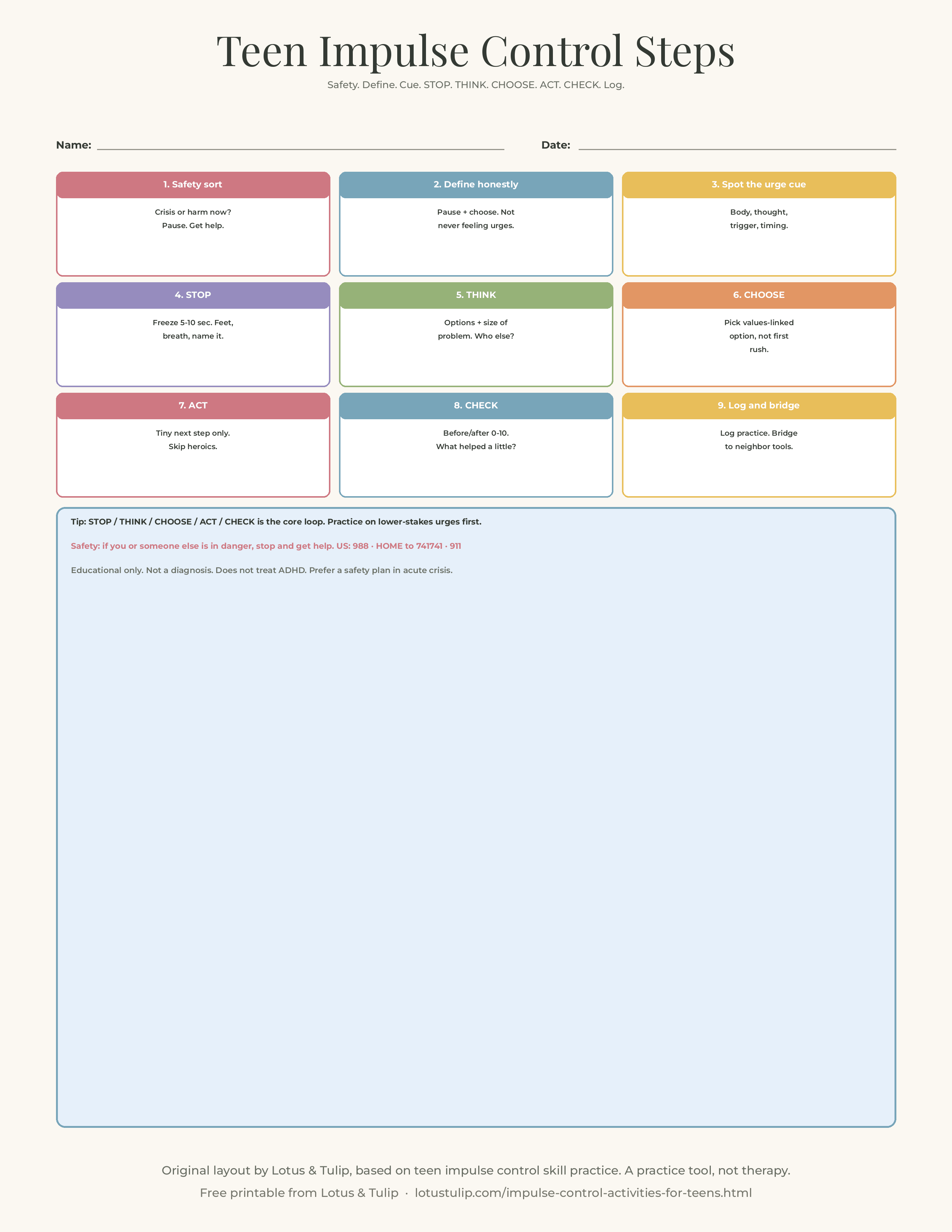
Download the free impulse control activities printable for teens (PDF, 3 pages, US Letter)
Prefer single images? Page 1: Teen Impulse Control Steps (PNG) · Page 2: My Impulse Control Plan (PNG) · Page 3: Practice Log (PNG)
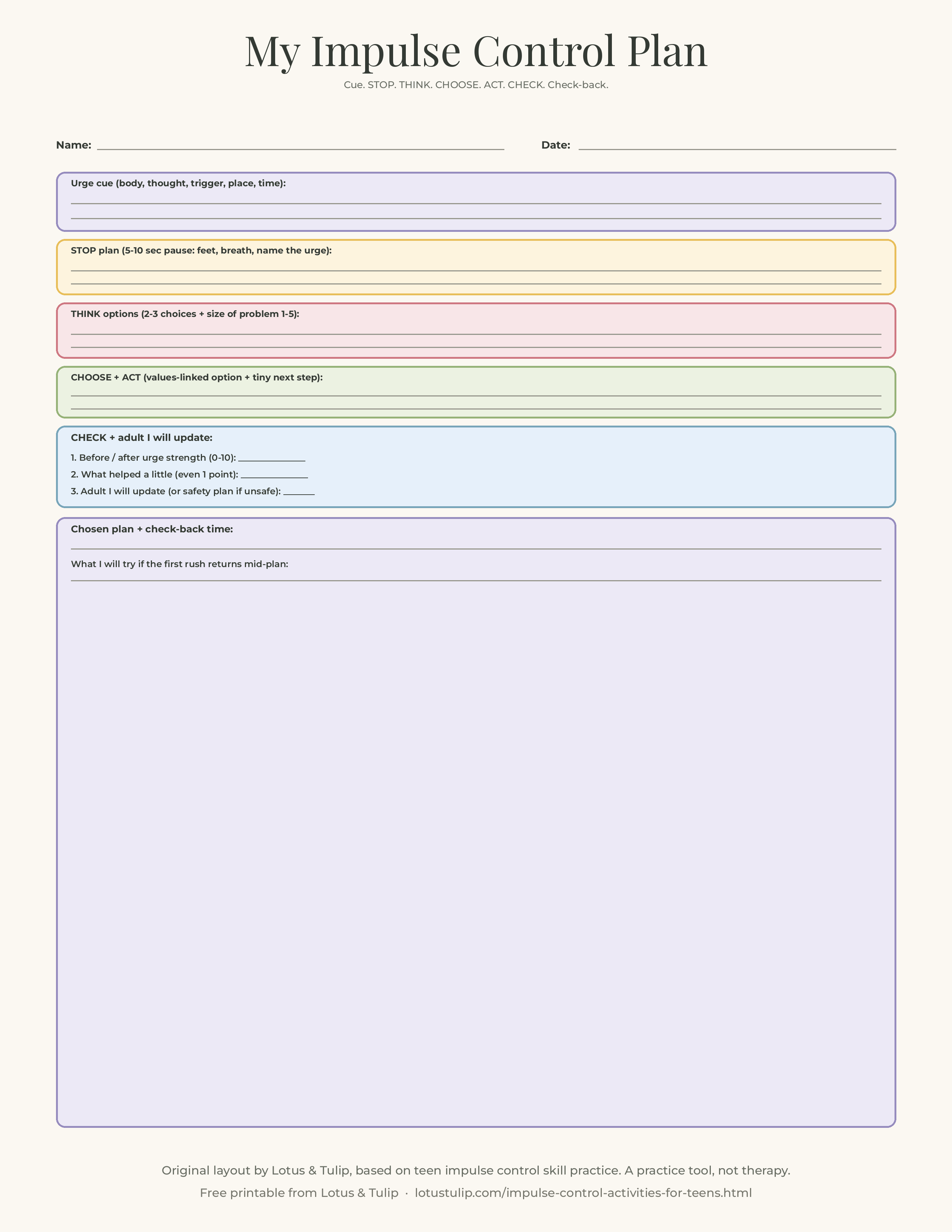
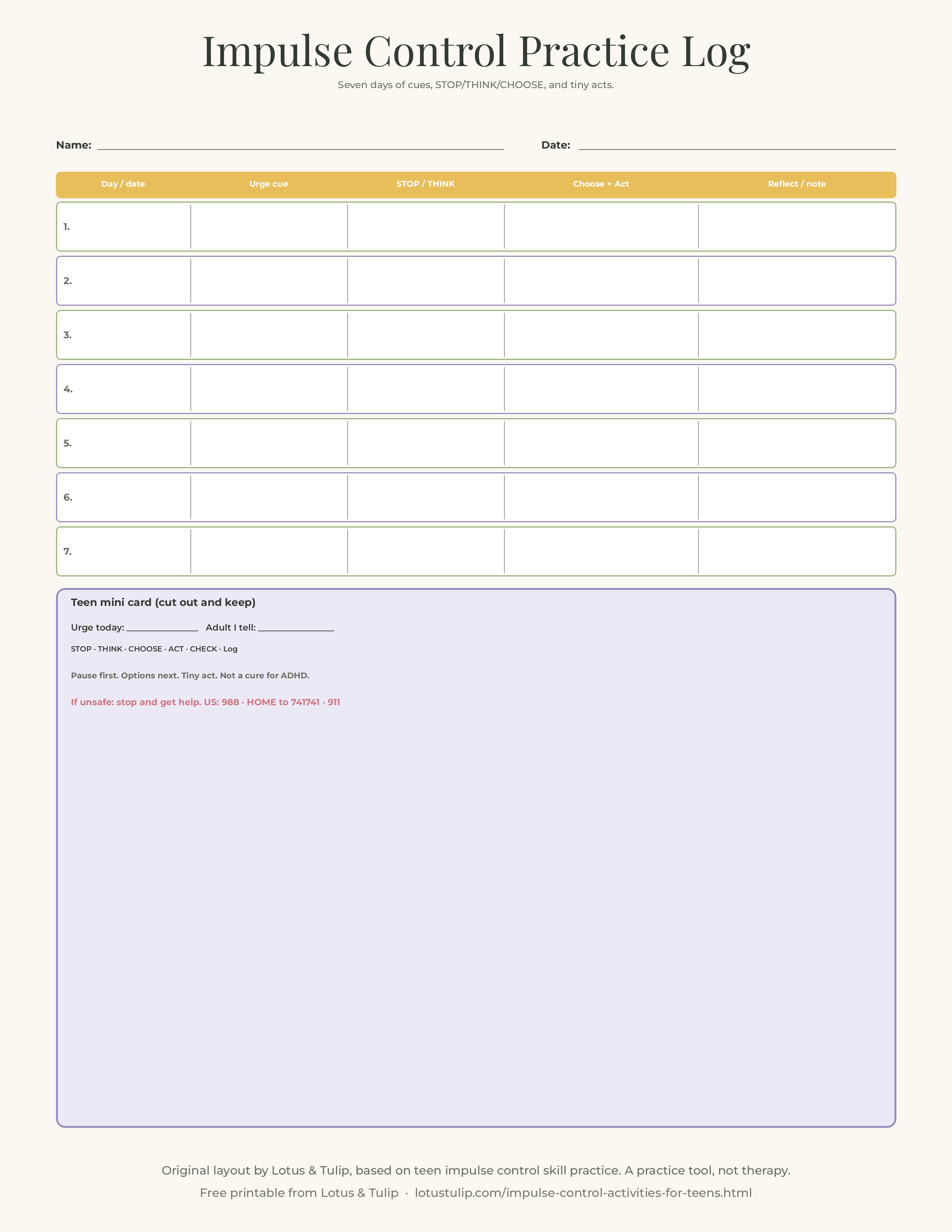
Free ADHD starter pack: Working with a teen who has ADHD? The free ADHD worksheets starter pack includes the impulse pause, getting unstuck and a strengths and support plan, plus three more real pages from our paid ADHD set (8 pages, client use license, no email).
Free to print for your own use and for use with your own clients, students, or groups. This is an original layout by Lotus & Tulip, based on teen impulse control skill practice associated with Diamond executive function inhibitory control neighbors, Mischel delay of gratification neighbors with honest limits, Duckworth grit and self-control neighbors, and ASCA / school SEL neighbors, with clear non-affiliation. It is not affiliated with those authors, any scale publisher, or any specific treatment or curriculum package, does not treat ADHD, and is not a substitute for therapy. Please link to this page rather than re-uploading the file.
Related resources
- Impulse control worksheets for kids: younger stop-and-think practice.
- Anger management activities for teens: cue, number, cool-down, repair.
- Emotional regulation activities for teens: name, rate, ride, choose.
- Flexible thinking worksheet: stuck thought to other options.
- Coping skills worksheets for teens: menu of coping moves.
- Executive functioning worksheets for kids: broader EF checklist and planners.
- Size of the problem worksheet: match reaction size to problem size.
- Urge surfing worksheet: ride the urge wave without acting.
- Peer pressure worksheets for teens: refusal under social push.
- Stress management worksheets for teens: teen stress skills neighbor.
- Boundaries activities for teens: types, soft/firm/hard, scripts.
- Safety plan worksheet: when the moment is about staying safe and alive.
Sources
- Diamond executive function and inhibitory control traditions as neighbors for educational pause-before-act skills. Educational credit with clear non-affiliation. Not a claim that this printable remits clinical disorders or treats ADHD.
- Mischel delay of gratification / marshmallow research neighbors for waiting and choosing later rewards, with honest limits about context, trust, socioeconomic factors, and replication caveats. Educational credit with clear non-affiliation.
- Duckworth grit and self-control neighbors for sustained effort and self-regulation language. Educational credit with clear non-affiliation. Not a cure-all.
- ASCA and school SEL neighbors for counselor-friendly student self-management and safety language. Educational credit with clear non-affiliation. Not an official ASCA product.
- Honest caveat: teen impulse control drills are a skill practice aid. Reviews and trials are not the same as RCTs of this Lotus and Tulip printable. Shame-based use and ADHD-cure claims can backfire. Adult support, accommodations when indicated, and clinical care when indicated matter.
Impulse control activities for teens: FAQ
What are impulse control activities for teens?
They are short, optional practice tools for spotting urge cues, pausing with STOP, THINKING through options, CHOOSING a values-linked next step, ACTing with one tiny move, CHECKing what helped, and logging practice. They are educational skill aids, not therapy.
Is impulse control the same as never feeling urges?
No. Urges are normal. The skill is noticing, pausing, and choosing more often than the first rush. Toughness theater and never-feel rules are not the goals of this page.
Does this printable treat ADHD?
No. This page does not diagnose or treat ADHD or any disorder. Teens who may need ADHD evaluation deserve appropriate assessment, accommodations, and clinical care. A three page practice sheet is not that care.
Can school counselors use it with teens?
Yes, often in short meetings with safety sort, one cue line, STOP practice, and one CHOOSE/ACT. Keep practice optional and school safe. Follow crisis protocols when risk appears. Do not use the page as a diagnosis or as forced public sharing of substance use or self-harm.
What does the marshmallow research really mean for teens?
Delay of gratification research is a neighbor for waiting skills, with honest limits. Later work and critiques stress context, trust, and resources. Do not treat a candy task as destiny. This printable does not claim marshmallow effect sizes.
When should I not use this worksheet?
Do not use it as the first move in acute safety risk, medical emergency, when ADHD evaluation is the real next step and the sheet is being sold as a cure, or when the exercise increases shame. Stabilize and get help when needed: 988, HOME to 741741, or 911. Prefer a safety plan in crisis.
Is this affiliated with Diamond, Mischel, Duckworth, or ASCA?
No. This is an original Lotus and Tulip educational layout. We credit research and school counseling lineages with clear non-affiliation and do not reproduce copyrighted manuals or claim official endorsement.