
Kids and teens · Updated 2026-11-07
Communication Skills Activities for Teens (with Free Printable)
Ready-made printable: Social Skills Small Group Curriculum for School Counselors, Grades 2 to 5 Holiday 20% off: about $11.04, was $14 (EUR 12) · instant digital download
Buy on Etsy
Communication skills activities for teens are short, structured practice rounds that help middle and high school students listen so the other person feels heard, say what they need without shrinking or attacking, notice what their face, voice and posture are saying, read and write tone in texts and group chats, and repair after a conversation goes wrong. This guide gives school counselors, therapists and teachers a set of activities you can run tomorrow: an active listening relay, an I-statement rebuild, a passive, aggressive and assertive sort, a nonverbal mismatch game, a text tone lab, and a repair script workshop. Each one comes with timing, setup, debrief questions and adaptations, plus a free three page printable.
Teen communication work is different from a kids social skills lesson. A twelve year old in a group chat at 11 p.m., a sixteen year old asking a manager for a schedule change, and a fifteen year old trying to tell a parent "I need you to stop reading my messages" all need the same core moves, but the scenes are higher stakes and the audience is less forgiving of anything that feels babyish. This page sits next to our social skills activities for teens (cues, joining, perspective), I statements worksheet, assertiveness worksheet, DEAR MAN worksheet, conflict resolution activities for teens and boundaries activities for teens. Those pages go deep on one tool. This one is about the everyday communication loop that ties them together: listen, check, say it, watch the signal, and repair.
We credit the people whose ideas these activities draw on, without claiming any affiliation or endorsement: Carl Rogers and Richard Farson, who described active listening in 1957; Thomas Gordon, who popularized the "I-message" in Parent Effectiveness Training (1970); Marshall Rosenberg's Nonviolent Communication (observations, feelings, needs, requests); Marsha Linehan's DBT interpersonal effectiveness skills such as DEAR MAN and GIVE; and the ASCA Student Standards and CASEL framework, which both name communication and listening as core student skills. The printable is an original Lotus and Tulip layout, not a copy of any of their materials.
This guide is educational. It is not therapy, not medical advice and not a diagnosis. If a conversation turns up thoughts of ending a life, a plan to hurt someone, abuse, or a medical emergency, stop the activity and get help now: in the US, call or text 988 (Suicide and Crisis Lifeline), text HOME to 741741 (Crisis Text Line), or call 911. Our safety plan worksheet is a better first tool in that moment.
Jump to the free communication skills printable (PDF) · Activities · How to run communication skills activities for teens, step by step · Worked examples · Comparisons
What communication skills practice is (and is not)
For this page, communication skills means five teachable moves: listening and reflecting back, speaking up with a clear and fair message, choosing a style (passive, aggressive, passive aggressive or assertive) on purpose rather than by reflex, matching body language and tone to the words, and repairing when a message lands badly. Teens practice them in low stakes rounds first, then carry one move into a real conversation that week.
It is not:
- A politeness script. The goal is being understood and understanding others, not sounding pleasant while swallowing every need.
- Eye contact training. Steady eye contact is one cultural norm among many, and many autistic and anxious teens listen better when they are not forced to hold a gaze. Teach "show you are listening" with options, not one required behavior.
- A way to win arguments. Assertive communication raises the odds of a fair conversation. It does not guarantee the other person agrees or changes.
- A fix for an unsafe relationship. Better wording does not make an abusive, controlling or threatening situation safe. That is a safety and adult help situation first.
- A diagnosis. Struggling with these skills does not mean a teen has autism, ADHD, social anxiety or a language disorder, and practicing them does not treat any condition. If you suspect a language or pragmatic communication difficulty, a speech language pathologist is the right professional to assess it.
Why teens need teen shaped communication practice
The scenes are different. Teens negotiate with teachers about grades, with coaches about playing time, with parents about curfew and privacy, with managers about shifts, and with friends across three group chats at once. A lot of their communication is written, fast and public. A kids worksheet with smiling cartoon faces will not survive contact with a ninth grade group.
The audience matters more. Adolescents are intensely aware of how peers see them. Role plays that put one student on the spot in front of the whole class can shut a group down for weeks. The activities below use pairs, triads, written drafts and "rate the message" formats so nobody has to perform a personal story to practice the skill.
Written tone is its own skill. Tone is harder to read in text than people think. In a well known set of studies, Justin Kruger, Nicholas Epley and colleagues (2005) found that people who sent emails overestimated how well readers would pick up their intended tone, such as sarcasm or seriousness. Gunraj and colleagues (2016) found that one word text replies ending in a period were rated as less sincere than the same replies without one, by college student participants. Neither study was about teens specifically, and neither means a period is rude. They are useful as a discussion starter: what you meant and what they read can be different, so check.
Communication skills activities teens will actually do
Each activity below lists time, group size, setup and debrief. Run one or two per session, not all of them at once. The first three build listening, the middle three build speaking, and the last four build tone, nonverbal reading and repair.
1. Listening relay (active listening)
Time: 12 to 15 minutes. Group: triads. Setup: a stack of low stakes prompt cards ("the most overrated food," "a skill you want to learn," "the worst way to wake up").
Roles rotate: a speaker, a listener and an observer. The speaker talks for 60 to 90 seconds. The listener is not allowed to add their own story, give advice or ask more than one question. When the speaker finishes, the listener reflects back in one or two sentences: "So what I heard is..." The speaker rates the reflection: got it, partly, or missed it. The observer tracks one thing only, such as interrupting or jumping to advice. Rotate so everyone has each role.
Debrief: Which role was hardest? What did the listener do that made you feel heard? What pulls us toward advice instead of listening? Most groups notice quickly that the urge to fix or one up is strong, and that a good reflection is short.
Teaching point: Rogers and Farson framed active listening as listening for both the content and the feeling behind it, and showing that you got it. With teens, keep it practical: "Content plus feeling, then check."
2. The reflection ladder
Time: 10 minutes. Group: whole class or individual session. Setup: write one teen statement on the board, for example "I am so done with this group project, nobody else is doing anything."
Build four responses together, from least to most helpful: a dismissive reply ("It is just one project"), an advice reply ("Just tell the teacher"), a content reflection ("So you are doing most of the work"), and a content plus feeling reflection ("Sounds like you are frustrated and kind of stuck carrying it"). Ask students which response would make them keep talking. Then give a new statement and have pairs write their own ladder.
Why it works: Teens can see the difference between replies on paper before they have to produce one live, which lowers the social risk.
3. Ask a curious question
Time: 8 minutes. Group: pairs. Partners take turns sharing something small. The listener may respond only with an open question ("What happened next?" "What was the best part?") for three rounds before saying anything about themselves. Debrief on the difference between open and closed questions, and between curiosity and interrogation.
4. I-statement rebuild
Time: 15 minutes. Group: pairs or individual. Setup: a list of blaming "you" statements, such as "You always ignore me," "You never let me do anything," "You literally ruined the whole thing."
Students rebuild each statement using a frame: I feel ___ when ___ because ___. Could we / Would you ___? For example: "I feel left out when plans get made in a chat I am not in, because it seems like I am not wanted. Could you add me next time, or tell me if something is going on?" Then they read the original and the rebuild aloud and rate which one they would rather receive.
Teaching point: The "when" part should describe what happened, not a judgment. "When you are disrespectful" is still a you-statement wearing a disguise. "When you looked at your phone while I was talking" is an observation. This is the same observation versus evaluation idea that Rosenberg's Nonviolent Communication teaches. For a deeper version with a builder page and practice cards, use our I statements worksheet.
Adaptation: Some teens find the formula robotic. Let them keep the parts but use their own voice: "Honestly it stung when I saw the photos. Can you loop me in next time?" still has a feeling, an event and a request.
5. Passive, aggressive, assertive sort
Time: 15 to 20 minutes. Group: small groups. Setup: cards with one scenario and three or four possible responses each.
Example scenario: a friend keeps borrowing your charger and not returning it. Responses: "It is fine, I do not really need it" (passive). "Are you serious? Get your own charger, you are so annoying" (aggressive). "Wow, must be nice to have a charger" (passive aggressive). "Hey, I need my charger back by lunch. If you need one a lot, I can send you the link to the one I have" (assertive). Groups sort the cards, then explain how each response might land and what it might cost the speaker later.
Debrief: Passive often protects the moment and costs you later. Aggressive gets attention and often costs the relationship. Passive aggressive feels safe and confuses everyone. Assertive is clear about what you need while still respecting the other person. Ask: Is assertive always the right choice? The honest answer is no. With someone who is threatening or unsafe, getting away and getting help comes first. Pair with our assertiveness worksheet for a full sort and rights page.
6. The ask: DEAR MAN for real requests
Time: 20 minutes. Group: individual, pairs, or a DBT informed skills group. DBT's DEAR MAN skill (Describe, Express, Assert, Reinforce, stay Mindful, Appear confident, Negotiate) gives teens a structure for a request that matters: asking a teacher for an extension, asking a parent for a later curfew, asking a coach about playing time. Students draft the request in writing, then practice it with a partner who plays a mildly resistant adult. Use our DEAR MAN worksheet for the full structure, and the GIVE and FAST worksheet when keeping the relationship or self respect is the main goal.
7. Nonverbal mismatch game
Time: 10 minutes. Group: whole group, volunteers only. A volunteer says a neutral sentence ("I am fine," "Sure, that works," "Great job") while showing a different feeling with face, voice or posture: arms crossed, flat tone, eye roll, big sigh. The group guesses what the speaker actually feels and names the cue that gave it away.
Debrief: When words and body disagree, listeners tend to notice. That is where the much quoted "7 percent words, 38 percent tone, 55 percent body language" claim comes from, and it is a good myth to correct with teens. Albert Mehrabian's 1960s experiments looked at single words spoken with mismatched tone and facial expression, and only about feelings and attitudes. Mehrabian himself has said the ratio does not apply to communication in general. Words matter a lot. The real lesson is narrower: when your tone and your words disagree, people may trust the tone.
Adaptation: For students who find facial expressions hard to read, use the game as a "what cues could I check?" list rather than a test, and teach a backup move: ask. "You said fine, but you seem quiet. Are we good?" is a perfectly skilled response.
8. Text tone lab
Time: 15 minutes. Group: pairs or small groups. Setup: printed fake messages (never real screenshots of students). Examples: "ok." / "ok" / "ok!!" / "k". "we need to talk". "lol sure". "why would you even post that". A single thumbs up.
Groups rate each message on how it might feel to receive, from friendly to cold, and write what the sender might have meant versus what a reader might assume. Then they rewrite two messages so the intended tone is clear. Finish with three texting rules the group agrees on, for example: "If it matters, say the feeling in words, not just punctuation." "If I am angry, I draft it, wait ten minutes, then decide." "If it is getting heated, move it to a call or in person."
Debrief: Different friend groups, ages and families read the same message differently. A period from a parent may mean nothing; from a friend it may read as annoyed. The skill is not one correct style. It is knowing the gap exists and closing it with a quick check.
9. Group chat pause and exit
Time: 10 minutes. Group: small group. Present a fictional group chat that is turning on one member: jokes about a photo, a screenshot being passed around. Students write three possible replies: one that adds to the pile on, one that stays silent, and one that redirects or exits ("Not into this, I am out," or a private message to the person being targeted). Discuss the risks and costs of each. Link to bullying activities for teens when the pattern is repeated and involves a power imbalance.
10. Repair script workshop
Time: 15 minutes. Group: pairs or individual. Teens rarely get taught what to do after a conversation goes badly, so they either avoid the person or over apologize. Teach a three part repair: name what you did ("I snapped at you in front of everyone"), own the impact without excuses ("That was embarrassing for you"), and offer a next step ("Next time I will tell you privately. Are we okay?"). Students write a repair for a fictional scene, then for a real one they choose to keep private. The point of repair is to reconnect, not to make the other person respond a certain way.
Note: Researcher John Gottman uses the term "repair attempts" for moves that de-escalate tension during conflict, in his work with adult couples. That research is not about teens, but the idea that small repair moves matter is a helpful frame for any relationship.
11. Talk to adults practice
Time: 15 minutes. Group: individual or small group. Many teens freeze when asking an adult for something. Students choose a real ask (extra help, a missed assignment, a schedule change at work), draft a short email or opener, and rehearse it once with a partner. Good structure: greeting, one sentence context, the specific ask, a thank you. Review tone: clear and polite, not apologetic for existing and not demanding.
12. Two minute disagree well debate
Time: 15 minutes. Group: pairs. Pick a silly, low stakes topic (cereal is soup, best fast food fries). Before a student can give their own argument, they must summarize the other person's point to that person's satisfaction. This rule, sometimes called "steelmanning," slows debates down and makes listening visible.
How to run these activities in a group or session
Set norms first. In a group, agree on three or four norms before any role play: what is said here stays here (with the usual safety exception), pass is always allowed, we practice on made up scenes first, and we critique the message, never the person.
Model before you ask. Run a bad example yourself first, with humor. A counselor who demonstrates a terrible listening reply ("Wow, that reminds me of my own weekend...") lowers the stakes for everyone.
Use made up scenarios, then personal choice. Start every skill with fictional scenes. Only after the skill is familiar, invite students to apply it to a real situation, privately on paper. Never require a student to share a real family conflict in front of peers.
Keep rounds short. Sixty to ninety second rounds with quick rotation work better than long role plays with an audience. Teens get more reps and less spotlight.
End with one carry over. Each session should close with one specific move to try this week: "Reflect back once before I reply," "Use one I-statement with a sibling," "Wait ten minutes before a heated text." Check in on it next time.
Suggested six session sequence. Session 1: listening relay and reflection ladder. Session 2: curious questions and nonverbal mismatch. Session 3: passive, aggressive, assertive sort. Session 4: I-statement rebuild and DEAR MAN requests. Session 5: text tone lab and group chat exit. Session 6: repair workshop and talk to adults practice, with a review of each student's practice log.
Adaptations
- Middle school (grades 6 to 8): use more structure, sentence frames on cards, and shorter rounds. Scenarios about lunch tables, group chats, siblings and teachers work well.
- High school (grades 9 to 12): add scenes about jobs, dating respect, college or work emails, coaches, and parents' rules. Let students write their own scenarios.
- Individual sessions: the counselor or therapist plays the other person. Rehearse a real upcoming conversation two or three times, adjusting one thing each round.
- Autistic and neurodivergent teens: do not treat a different communication style as wrong. Teach skills as options and translation tools, offer alternatives to eye contact, use written scripts and explicit rules, and focus on what the student wants to be able to do. Respect that many autistic people communicate directly and prefer others do the same.
- Anxious or quiet teens: let them practice in writing first, observe a round before joining, and use the observer role. Pair with social anxiety worksheets for teens if fear of judgment is the main barrier.
- English learners: provide sentence frames in English and, if possible, let students first discuss the concept in their stronger language. Remember that politeness norms, directness and eye contact vary across cultures.
- Teens with big anger: practice calming the body before any speaking skill. A teen at a heat of 8 out of 10 cannot use an I-statement. Pair with anger management activities for teens.
- Virtual sessions: use breakout rooms for triads, the chat box for the text tone lab, and shared documents for rewrites.
How to run communication skills activities for teens, step by step
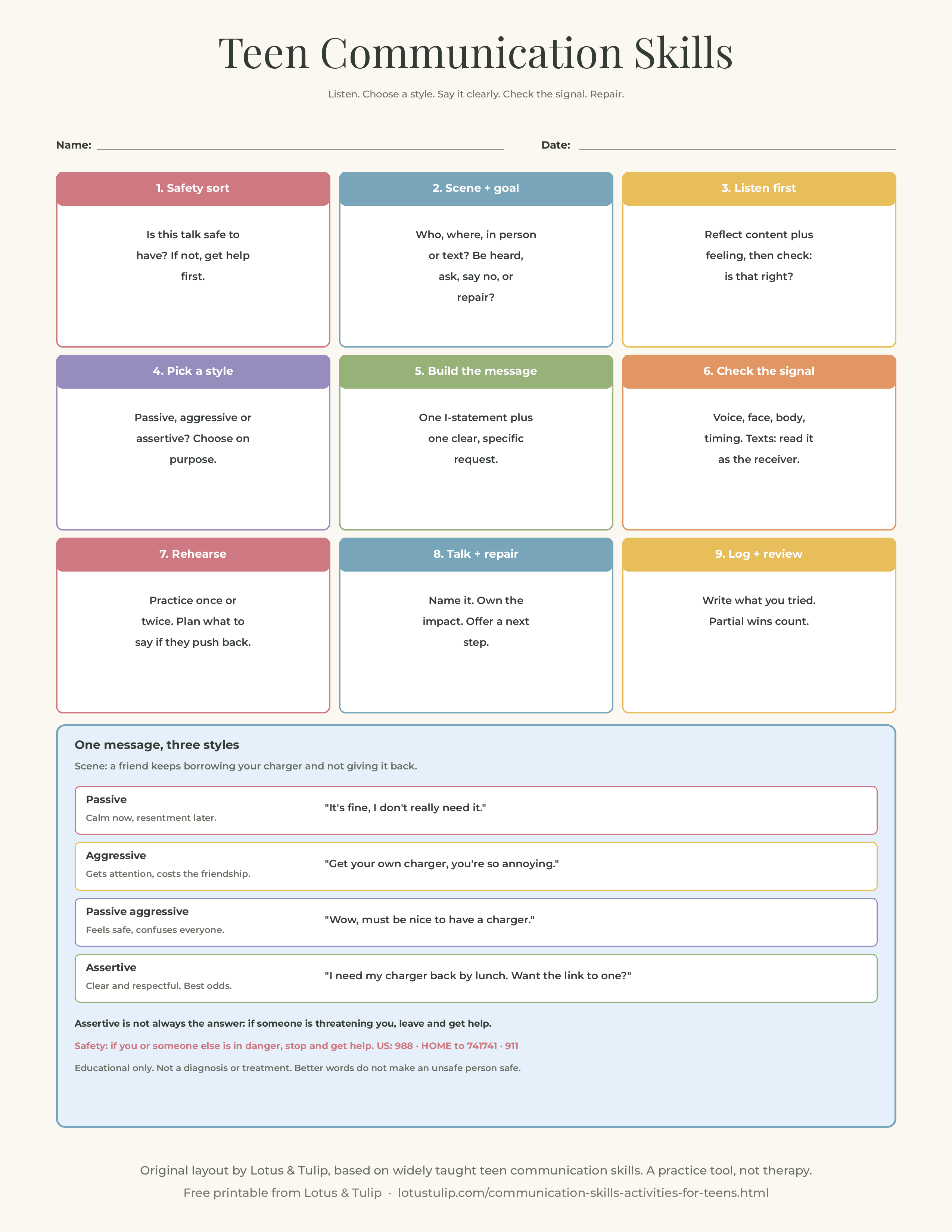
- Safety sort. Before practice, check that the conversation the teen is preparing for is safe to have. Threats, abuse, self harm or a controlling relationship come first: 988, HOME to 741741, or 911 when needed, plus a safety plan and a trusted adult. Do not coach a teen to "communicate better" with someone who is hurting them.
- Pick one scene and one goal. Who is the conversation with, in person or by text, and what does the teen want from it: to be heard, to ask for something, to say no, or to repair? One scene at a time.
- Listen first. Practice a reflection for what the other person might say: content plus feeling, then check. "So you are worried that... Is that right?"
- Choose a style on purpose. Name the passive, aggressive and passive aggressive versions of the message, then build the assertive one. Check whether assertive is actually safe in this scene.
- Build the message. Write an I-statement or a short request: I feel, when, because, could we. Keep the "when" part an observation, not a judgment. Use DEAR MAN for bigger asks.
- Check the signal. Plan voice, face, posture and timing so they match the words. For texts, read the draft as the receiver would, add the feeling in words if tone matters, and wait before sending if heated.
- Rehearse once or twice. Practice with a partner, counselor or mirror. Change one thing per round. Plan what to say if the other person pushes back.
- Have the conversation, then repair if needed. Use the skill in the real scene. If it goes badly, use a three part repair: name it, own the impact, offer a next step.
- Log and review. Record what you tried and what happened on the practice log. Celebrate partial wins. Bridge to conflict resolution, boundaries or assertiveness pages when one skill needs deeper work.
Practice on low stakes scenes first. Skills used under stress are the ones rehearsed when calm.
School counselor, therapist, teacher and parent tips
School counselors. Communication activities fit classroom lessons, small groups and short individual meetings. The ASCA Student Standards include a social skills behavior standard for effective oral and written communication and listening skills (B-SS 1), and another for advocacy and the ability to assert self when necessary (B-SS 8), which makes these activities easy to document in your program planning. Keep personal sharing optional, follow district crisis and reporting protocols, and avoid scenarios that mirror a known conflict between students in the room.
Therapists. In individual work, rehearse the real conversation the client is avoiding. Notice when "communication problems" are actually a safety problem, a family system pattern, or a symptom of depression, anxiety or trauma, and work at that level too. A teen who cannot assert with a parent may be accurately reading that it is not safe to.
Teachers. Use the listening relay before discussions, the disagree well rule during debates, and the talk to adults practice before conferences or internships. Five minutes of listening practice before a class discussion often improves the discussion itself.
Parents and caregivers. Model the skills more than you teach them. Reflect before you correct ("Sounds like the coach really frustrated you"), use I-statements yourself, and repair out loud when you snap. Teens notice when the adult asking for respectful communication does not use it.
Worked fictional examples
Group chat misread (fictional). Jordan, 14, texted a friend a long message about a fight with their mom and got back "ok." Jordan spent the evening convinced the friend was annoyed. In a counseling session, Jordan practiced the text tone lab idea: what the friend might have meant (busy, did not know what to say, at practice) versus what Jordan assumed. Jordan sent a check text: "Hey, was that a bad time? No pressure, I just wanted to vent." The friend replied that they had been at dinner. Carry over: check before assuming.
Asking a teacher for help (fictional). Maya, 16, missed a lab and was afraid to ask for a makeup. She drafted: "Hi Ms. Lopez, I missed Tuesday's lab because I was sick. Could I make it up during lunch this week or next? Thank you." She rehearsed saying it in person once with her counselor, worked on a steady voice, and asked after class. The teacher said yes. Carry over: short, specific, polite asks.
Passive to assertive at home (fictional). Eli, 15, kept saying "whatever" when his older brother used his gaming console without asking, then exploded a week later. In the passive, aggressive, assertive sort he saw both his patterns. He wrote: "I get really annoyed when you use my console without asking, because then my saves get messed up. Can you text me first?" He practiced the tone so it did not sound like a lecture. His brother still grumbled, but started asking most of the time. Carry over: speak up early and calmly instead of storing it up.
Repair after a public snap (fictional). Priya, 17, snapped at a teammate at practice. She used the three part repair the next morning: "I was harsh with you yesterday in front of everyone. That was not fair to you. Next time I will talk to you after practice instead." The teammate said thanks and it was fine. Carry over: repair quickly and specifically.
Counselor small group note (fictional). In a six session group for eighth graders, a counselor ran one or two activities per session, always starting with made up scenes. By session four, students were choosing their own real practice targets on the log, privately. Nobody was required to share family conflicts. One student who never spoke in the first two sessions chose the observer role, then the written rebuilds, and eventually led a round of the text tone lab.
Communication skills vs social skills, assertiveness, I-statements, conflict resolution and boundaries
| Communication skills (this page) | Social skills teens | Assertiveness | I-statements | Conflict resolution teens | Boundaries teens | |
|---|---|---|---|---|---|---|
| Main job | Listen, choose a style, build a message, match tone and body, repair | Cues, joining, perspective, digital norms | Stand up for needs without aggression | One clear feeling plus request sentence | Cool down, both sides, options, agreement | Decide and hold limits |
| Best early use | Everyday conversations, texts and asks that keep going wrong | Joining and reading peer scenes | When a teen freezes or gives in | When blame language starts fights | When an ongoing dispute needs solving | When people keep crossing lines |
| Output | Communication plan and practice log | Social skill plan | Assertive script | I-statement | Conflict plan | Boundary plan |
| Link | This page | Social skills teens | Assertiveness | I-statements | Conflict teens | Boundaries teens |
These tools work together. Communication skills are the everyday base. When one move becomes the whole problem, go deeper with the matching page.
What helps vs common myths
What often helps: short practice rounds, made up scenarios before personal ones, clear sentence frames that teens can adapt into their own voice, adults who model the skills, a specific carry over each week, and permission to repair rather than be perfect.
- Myth: "93 percent of communication is nonverbal." This comes from a narrow reading of Mehrabian's studies on single words and mismatched feelings. Words matter. Tone matters most when it contradicts the words.
- Myth: "Good communicators always make eye contact." Eye contact norms vary by culture and person. Many people listen better without it.
- Myth: "Assertive means saying exactly what you think, always." Assertive means clear and respectful. It includes judging timing, and it does not override safety.
- Myth: "If I use an I-statement, they have to listen." I-statements raise the odds of a calmer conversation. They do not control the other person's response.
- Myth: "Teens just need to put their phones down." A lot of teen relationships happen in writing. Teach written tone as a real skill rather than dismissing it.
- Myth: "Research proves these exact activities work." No study has tested this specific set of activities or this printable. The underlying skills are widely taught in SEL, counseling and DBT informed programs; that is different from a proven effect for one worksheet.
Common mistakes
- Spotlighting students in front of the class with personal role plays before trust is built.
- Using real screenshots or real conflicts between students in the room as practice material.
- Teaching one "correct" style (eye contact, a certain tone) instead of options.
- Practicing only when calm and never planning what to do when the other person pushes back.
- Coaching assertiveness in unsafe situations where the right move is to leave and get help.
- Stacking every skill in one session. One or two activities, done well, with a carry over, beats ten in an hour.
- Treating the worksheet as therapy. Paper supports practice. It does not replace a clinician, a speech language evaluation or school support when problems are serious or lasting.
When not to use this worksheet
Good uses: everyday friction with friends, family, teachers and coworkers; teens who want to speak up more or blow up less; group or class lessons; rehearsing a specific upcoming conversation.
Use something else first when:
- There is danger, abuse or a controlling relationship. Safety and adult help come first: 988, HOME to 741741, 911, and a safety plan.
- There is a suspected language or pragmatic communication difficulty. Refer for a speech language evaluation through the school or a provider.
- The main issue is bullying with a power imbalance. Use bullying activities for teens and school reporting procedures. Better wording is not the fix for being targeted.
- The teen is flooded. Calm the body first with emotional regulation activities for teens.
- The exercise is increasing shame. Stop, validate, and switch tools.
What the research says (honestly)
Active listening. Carl Rogers and Richard Farson's 1957 paper "Active Listening" described listening for total meaning, responding to feelings and showing understanding. Active listening has since become a standard part of counseling training and many school programs. Studies of active listening in conversations show mixed but often positive effects on how understood people feel; it is a widely used skill, not a guaranteed outcome.
I-messages. Thomas Gordon introduced "I-messages" in Parent Effectiveness Training (1970) as an alternative to blaming "you-messages." The idea appears in many school and family programs. Research on I-messages exists but is limited, and wording alone does not determine how a message is received.
Interpersonal effectiveness. DEAR MAN, GIVE and FAST come from Marsha Linehan's dialectical behavior therapy skills, and were adapted for adolescents by Jill Rathus and Alec Miller. DBT has a research base for specific clinical populations; using one skill sheet in a classroom is not the same as receiving DBT.
School frameworks. The ASCA Student Standards list effective oral and written communication and listening skills (B-SS 1) and assertiveness and advocacy (B-SS 8) among behavior standards. CASEL's framework includes communicating effectively and resolving conflicts constructively within its relationship skills competency. Lotus and Tulip is not affiliated with ASCA or CASEL.
Written tone. Kruger, Epley, Parker and Ng (2005, Journal of Personality and Social Psychology) found email senders overestimated how clearly readers would perceive their tone. Gunraj and colleagues (2016, Computers in Human Behavior) found one word text replies ending in a period were rated less sincere by undergraduate participants. Both studies used adults and short experimental tasks.
Nonverbal cues. Mehrabian's 1967 studies examined single words and inconsistent emotional cues. The popular 7, 38, 55 ratio does not describe communication in general, as Mehrabian has noted.
Honest limits. No study tests this three page Lotus and Tulip printable or this specific set of activities. Treat it as a well organized practice aid built on widely used skills.
Free communication skills printable for teens (PDF)
The free communication skills printable has three pages in US Letter size:
- Page 1: Teen Communication Skills Steps. Nine step card matching the HowTo above: safety sort, scene and goal, listen first, choose a style, build the message, check the signal, rehearse, talk and repair, log and review.
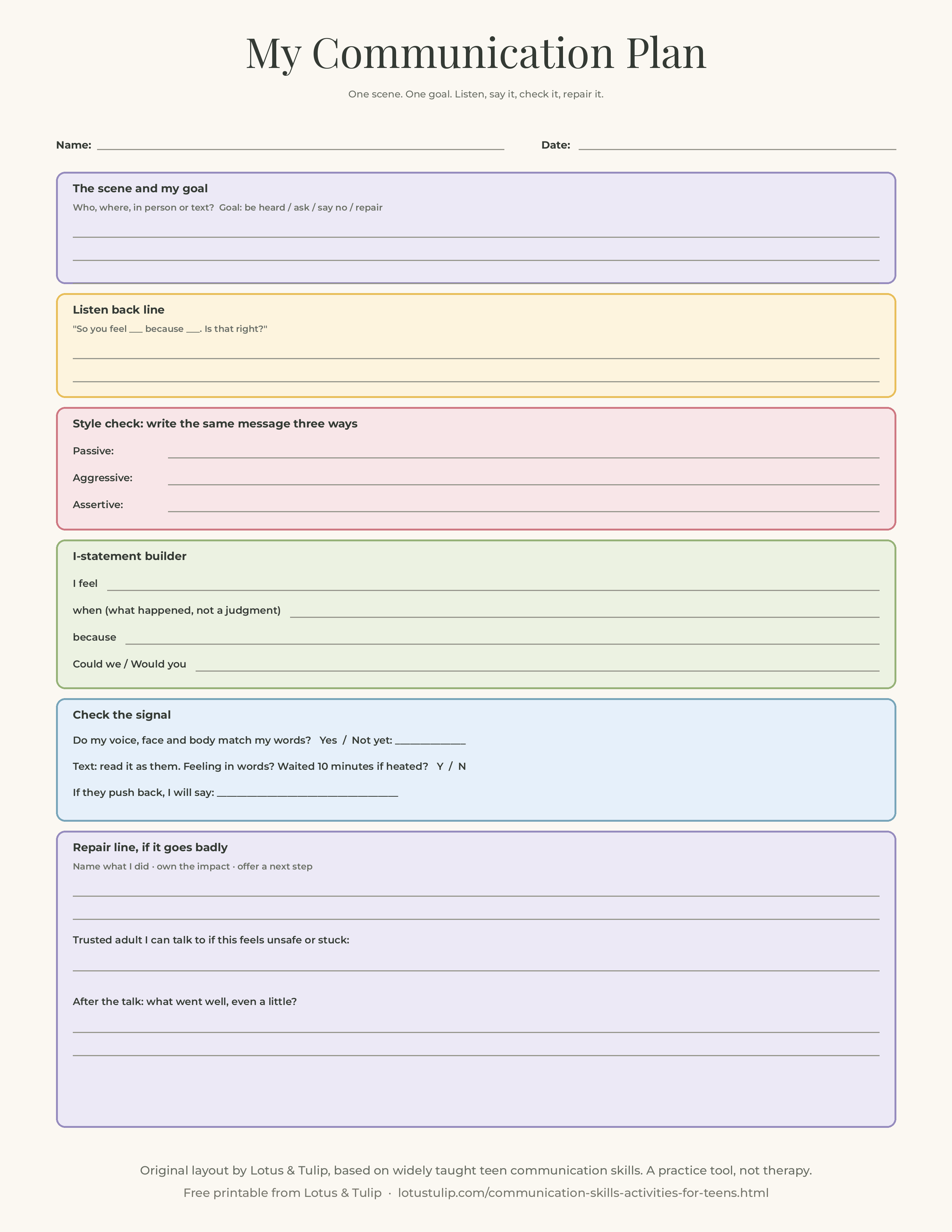
- Page 2: My Communication Plan. Fill in the scene and goal, a listen back line, the passive, aggressive and assertive versions, an I-statement builder, a body and tone check, a text check, and a repair line.
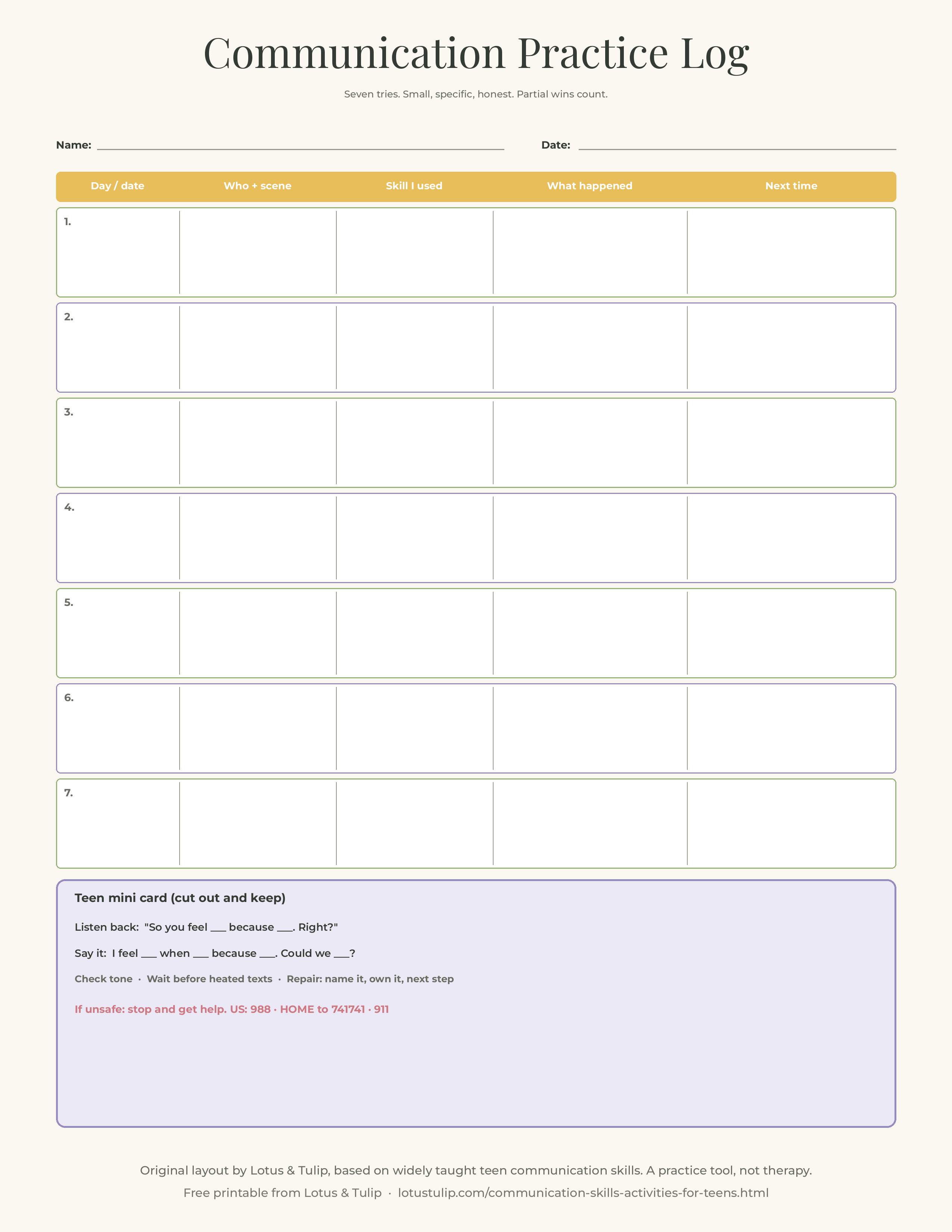
- Page 3: Practice Log + teen mini card. Seven rows to track what you tried and how it went, plus a cut out reminder card.
Download the free communication skills printable for teens (PDF, 3 pages, US Letter)
Prefer single images? Page 1: Teen Communication Skills Steps (PNG) · Page 2: My Communication Plan (PNG) · Page 3: Practice Log (PNG)
Free to print for your own use and for use with your own clients, students or groups. This is an original layout by Lotus & Tulip, drawing on widely taught communication skills (active listening, I-messages, assertive communication and DBT interpersonal effectiveness). It is not affiliated with any author, organization or curriculum named on this page, does not diagnose or treat any condition, and is not a substitute for therapy. Please link to this page rather than re-uploading the file.
Related resources
- Social skills activities for teens: cues, joining, perspective and digital norms.
- I statements worksheet: builder page, examples and practice cards.
- Assertiveness worksheet: passive, aggressive and assertive sort with personal rights.
- DEAR MAN worksheet: DBT structure for asking for what you need.
- GIVE and FAST worksheet: keeping relationships and self respect.
- Conflict resolution activities for teens: cool down, both sides, options and repair.
- Boundaries activities for teens: deciding and holding limits.
- Friendship activities for teens: healthy friendship signals and repair.
- Bullying activities for teens: when the problem is a power imbalance.
- Anger management activities for teens: calm the body before you talk.
- Safety plan worksheet: when the moment is about staying safe.
Sources
- Rogers, C. R., and Farson, R. E. (1957). Active Listening. Industrial Relations Center, University of Chicago.
- Gordon, T. (1970). Parent Effectiveness Training. New York: Wyden.
- Rosenberg, M. B. Nonviolent Communication: A Language of Life. PuddleDancer Press.
- Linehan, M. M. (2015). DBT Skills Training Manual, 2nd ed. Guilford Press. Rathus, J. H., and Miller, A. L. (2015). DBT Skills Manual for Adolescents. Guilford Press.
- American School Counselor Association. ASCA Student Standards: Mindsets and Behaviors for Student Success (B-SS 1, B-SS 8).
- CASEL. The CASEL 5 framework, relationship skills competency.
- Kruger, J., Epley, N., Parker, J., and Ng, Z. W. (2005). Egocentrism over e-mail: Can we communicate as well as we think? Journal of Personality and Social Psychology, 89(6), 925 to 936.
- Gunraj, D. N., Drumm-Hewitt, A. M., Dashow, E. M., Upadhyay, S. S. N., and Klin, C. M. (2016). Texting insincerely: The role of the period in text messaging. Computers in Human Behavior, 55, 1067 to 1075.
- Mehrabian, A., and Wiener, M. (1967). Decoding of inconsistent communications. Journal of Personality and Social Psychology, 6(1), 109 to 114.
Communication skills activities for teens: FAQ
What are communication skills activities for teens?
They are short practice rounds that teach listening and reflecting back, speaking up with I-statements and clear requests, choosing an assertive style instead of passive or aggressive, matching tone and body language to words, reading and writing tone in texts, and repairing after conflict. They work in classrooms, small groups and individual sessions.
What is a good first communication activity for a teen group?
The listening relay. In triads, one student speaks for about a minute on a low stakes topic, one listens and reflects back without advice, and one observes. It is quick, low risk, and makes the difference between hearing and listening obvious.
How do I teach the difference between passive, aggressive and assertive?
Use a sort activity. Give a scenario with three or four possible responses, have small groups sort them, and discuss what each response costs the speaker and the relationship. Add passive aggressive as a fourth category; teens recognize it immediately.
Is it true that most communication is nonverbal?
Not in general. The famous 7, 38, 55 figures come from Albert Mehrabian's experiments on single words spoken with mismatched tone and expressions about feelings. Mehrabian has said they do not apply to all communication. Words matter; tone matters most when it contradicts them.
How can I teach texting and online communication skills?
Use a text tone lab with made up messages. Have teens rate how messages might feel to receive, compare what the sender meant with what a reader might assume, rewrite unclear ones, and agree on rules such as waiting before sending a heated reply and moving serious conversations to a call or in person.
How do I adapt these activities for autistic or anxious teens?
Offer skills as options, not one correct way. Skip forced eye contact, provide written scripts and clear rules, let students practice in writing or observe first, and focus on what the student wants to be able to do. If you suspect a language or pragmatic communication difficulty, refer for a speech language evaluation.
Can school counselors use this printable in groups?
Yes. It fits classroom lessons, small groups and individual meetings, and aligns with the ASCA standards on communication and listening (B-SS 1) and advocacy (B-SS 8). Keep personal sharing optional and follow district crisis protocols when risk appears.
When should I not use communication skills practice?
Not as the first step when a teen is in danger, being abused, or in a controlling relationship, when bullying with a power imbalance is the issue, or when a teen is too flooded to think. Safety and adult help come first: in the US call or text 988, text HOME to 741741, or call 911.