
Kids and teens · Updated 2026-11-07
Growth Mindset Activities for Teens (with Free Printable)
Ready-made printable: Growth Mindset Group Curriculum Holiday 20% off: about $11.04, was $14 (EUR 12) · instant digital download
Buy on EtsyTry it free first: download session 1 free (group at a glance, lesson plan and student page, PDF, 71 KB). Run it with your group, then get all 8 sessions. No email needed.

Growth mindset activities for teens are short, practical rounds that help middle and high school students notice fixed thoughts, swap in a strategy, treat mistakes as information, praise effort plus strategy (not empty slogans), plan the next try, and keep going when comparison or a setback hits hard. This guide is for school counselors, therapists, teachers and parents who work with teens about ages 12 to 18. It gives twelve activities you can run tomorrow: a fixed versus growth sort with strategies attached, a Yet / Not yet rewrite, a mistake autopsy, effort plus strategy praise practice, a process journal, a setback map, peer teach-back after struggle, a challenge ladder, a comparison trap audit, a values-linked practice plan, a digital highlight reel reality check, and a stuck strategy menu. Each comes with timing, setup, debrief and adaptations, plus a free three page printable.
This page is distinct from our growth mindset worksheet, which teaches the honest fixed versus growth idea for kids and teens with Change Your Words and a Not Yet Plan. Here the focus is teen-shaped practice: grades and identity, social media comparison, effort versus strategy, and how to run activities in groups or sessions without turning mindset into toxic positivity. It sits next to self esteem activities for teens, perfectionism worksheet for teens, flexible thinking worksheet, study skills activities for teens, resilience activities for teens, positive self talk worksheet and goal setting worksheet for students. Those pages go deep on neighboring skills. This one is about the growth mindset loop itself: notice the fixed thought, pick a strategy, try again, review, and ask for help when stuck.
We credit the sources these activities lean on, without claiming any affiliation or endorsement: Carol Dweck's mindset research and her public warnings about "false growth mindset," the Blackwell, Trzesniewski and Dweck (2007) adolescent transition study, the Yeager and colleagues (2019) national ninth grade experiment in Nature, the Sisk and colleagues (2018) meta-analyses in Psychological Science (small and heterogeneous effects), and ASCA and CASEL neighbors on learning strategies and self management. The printable is an original Lotus and Tulip layout, not a copy of any of their materials.
This guide is educational. It is not therapy and not a diagnosis. Growth mindset practice does not cure ADHD, a learning disability, depression or anxiety, and it does not erase unfair barriers. If a conversation turns up thoughts of ending a life, self harm, a plan to hurt someone, abuse or a medical emergency, stop the activity and get help now: in the US, call or text 988 (Suicide and Crisis Lifeline), text HOME to 741741 (Crisis Text Line), or call 911. Our safety plan worksheet is a better first tool in that moment.
Jump to the free growth mindset printable (PDF) · Activities · How to use growth mindset activities for teens, step by step · Worked examples · Comparisons
What growth mindset is (and is not) for teens
For this page, a growth mindset means believing that abilities can develop through useful strategies, practice, feedback and help from others, not that talent is fixed forever. A fixed mindset treats ability as a permanent label: "I am bad at math," "I am just not a writer," "If I fail this quiz I am dumb." Carol Dweck popularized the terms in her 2006 book Mindset: The New Psychology of Success, based on decades of work on how people explain success and failure. For teens, the useful version is not a poster slogan. It is a habit: when stuck, name the thought, pick a next strategy, and try again without pretending barriers do not exist.
It is not:
- Slogans only. "Mistakes are proof you are trying" on a wall does little if adults still punish honest struggle or praise "being smart" after easy wins. Posters are not the intervention.
- Ignoring barriers. Telling a teen to "think growth" does not fix a missing accommodation, an unfair grading practice, racism, poverty, or a class that moves too fast. Mindset work sits next to real supports, not instead of them.
- Blaming teens for systemic limits. A growth mindset is not a reason to say a teen failed because they "did not believe hard enough." Adults still own teaching quality, access and fairness.
- A cure for ADHD, a learning disability or depression. Strategy coaching can help a teen keep trying, but it does not treat those conditions. Prefer evaluation and clinical or school supports when those are the main issue. See neighboring pages such as study skills activities for teens and depression activities for teens.
- Toxic positivity. "Just be positive" erases real disappointment. Growth mindset allows frustration, then asks what strategy comes next.
- False growth mindset. Dweck has warned for years that claiming the label while only praising empty effort, or using "fixed mindset" as a new insult for kids, misses the point. Effort without strategy, and labels without help, are not growth mindset.
Why teens need teen-shaped growth mindset practice
Grades and identity collide. In middle and high school, a single test can feel like a verdict on who you are. Teens who treat a C as proof they are "not a science person" need practice that separates identity labels from strategy choices.
Social media comparison is constant. Highlight reels make other teens look effortlessly skilled. A growth mindset activity that names comparison traps helps teens ask "what did they practice that I do not see?" instead of "I am behind forever."
Effort without strategy burns out. Many teens already work hard. Dweck's own correction is that growth mindset is not only trying harder at the same broken method. Teens need a menu of next strategies: ask a peer, change the practice type, break the task, get feedback, rest then return.
Praise still shapes the story. Adults who say "you are so smart" after easy success can quietly teach teens to avoid hard tasks that threaten the smart label. Process praise that names strategy, focus and help-seeking fits better, especially when learning is incomplete.
Effects in research are real and modest. Large studies and meta-analyses (summarized in the research section below) find small average effects that are larger for some students in some contexts. That is a reason to teach honestly, not to oversell posters.
Growth mindset activities teens will actually do
Each activity lists time, group size, setup and debrief. Run one or two per session. Early activities build noticing and language; middle ones build strategy and practice; later ones tackle comparison, values and digital traps.
1. Fixed versus growth sort (with strategies attached)
Time: 15 minutes. Group: small groups. Setup: cards with thoughts such as "I am bad at writing," "I cannot do this yet," "If I ask for help I look dumb," "I will try a different practice set," "She is just naturally good at this," "I need a new strategy for this chapter."
Groups sort cards into fixed-leaning and growth-leaning piles, then add one concrete strategy to every fixed-leaning card (for example, "I am bad at writing" becomes "I will outline first, then draft, then get one peer edit"). Debrief: fixed thoughts are common; the move is the strategy, not pretending the thought never showed up. Teaching point: a growth response always names a next action, not only a nicer sentence.
2. Yet / Not yet rewrite
Time: 10 minutes. Group: individual, then pairs. Students rewrite three personal "I can't" lines into "I can't ___ yet, so my next step is ___." Pair with the free printable's Not yet style plan. Debrief: "yet" without a next step is still a slogan. Teaching point: Dweck has described "Not Yet" grading as framing a point on a learning curve; teens should own the next step, not wait for a magic grade label.
3. Mistake autopsy with next strategy
Time: 15 minutes. Group: individual. After a quiz, draft or practice set, students fill: What went wrong (specific)? What did I try? What strategy will I try next? Who can I ask? Keep blame language out ("I am stupid") and keep process language in ("I skipped the worked example"). Debrief: mistakes are data. Teaching point: an autopsy without a next strategy is rumination; pair with study skills activities for teens when the missing piece is retrieval practice or spacing.
4. Effort plus strategy praise practice
Time: 15 minutes. Group: pairs. Give weak praise lines ("You are so smart," "Great effort!" when nothing was learned) and strong process lines ("You changed your approach after the first try," "You asked a clarifying question"). Pairs rewrite three weak lines. Adults practice too. Debrief: which lines would make you take on a harder task next time? Teaching point: Dweck warns against praising effort when learning is not happening; add "what have you tried, and what can you try next?"
5. Process journal (one week)
Time: 5 minutes a day for five school days. Group: individual. Each day: one hard task, one strategy used, one result (even partial), one ask-for-help moment or reason they did not ask. Debrief at week's end: which strategies showed up more than once? Teaching point: teens see that progress is often uneven, not a straight line. Pair with resilience activities for teens when the theme is bouncing back after a rough week.
6. Setback map
Time: 20 minutes. Group: individual or pairs. Draw the setback in the center (failed tryout, low grade, friendship rupture). Branch to: what I felt, what I told myself, what I did next, what support I used or avoided, what I want to try next time. Debrief: setbacks are expected; maps make the next move visible. Teaching point: if the setback is crisis-level (self harm, abuse, danger), stop and use a safety plan instead.
7. Peer teach-back after struggle
Time: 20 minutes. Group: pairs. After working a hard problem or skill, each teen teaches their partner one thing that confused them and one move that helped. No polishing into "I got it easily." Debrief: teaching after struggle deepens learning and normalizes not knowing at first. Teaching point: teach-back is a high utility learning habit; it is growth mindset in action, not a personality change.
8. Challenge ladder
Time: 15 minutes. Group: individual. List a skill goal, then five rungs from easy practice to a stretch challenge. Climb one rung this week. Debrief: which rung is honest for you now? Teaching point: growth mindset is not leaping to the top rung to prove toughness; it is choosing a stretch that is hard enough to learn from. Perfectionistic teens may need the perfectionism worksheet for teens first so "hard enough" does not become "impossible."
9. Comparison trap audit
Time: 15 minutes. Group: individual, optional share. List three people or posts you compare yourself to. For each: what skill are you comparing? What practice of theirs is invisible to you? What is one strategy you can use this week instead of scrolling and shrinking? Debrief: comparison often hides hours of practice. Teaching point: self esteem and growth mindset both suffer when teens treat highlight reels as baselines. Link to self esteem activities for teens when worth is the main wound.
10. Values-linked practice plan
Time: 15 minutes. Group: individual. Name one value (curiosity, fairness, mastery, helping others, creativity). Name one practice that serves that value this week. Name the fixed thought that will show up and the strategy swap. Debrief: values give teens a reason to struggle that is bigger than a grade. Teaching point: pair with goal setting worksheet for students when they need SMART shape around the practice plan.
11. Digital highlight reel reality check
Time: 15 minutes. Group: small groups. Discuss: what do we see online (final drafts, wins, edits)? What do we not see (failed takes, tutoring, retakes)? Write a one sentence reality check teens can keep: "I am comparing my behind the scenes to someone else's highlight reel." Debrief: when does scrolling leave you more stuck? Teaching point: a growth mindset includes choosing when to put the phone down and practice. This is not a full digital wellness curriculum; keep it short and practical.
12. Stuck strategy menu
Time: 10 minutes. Group: whole class or group. Co-create a posted menu: break the task, switch practice type, ask a peer, ask an adult, look at a worked example, take a short reset, change the environment, review errors. When stuck, teens pick one menu item before quitting. Debrief: quitting forever and quitting the current method are different. Teaching point: this is Dweck's "new strategies and input from others" correction made concrete for teens.
How to run these activities in a group or session
Set norms first. Pass is always allowed. Nobody is labeled "fixed mindset kid." Struggle stories from adults are welcome. Celebrate strategy changes, not only wins. End each session with one carry over: one rewrite, one autopsy, or one ladder rung.
Suggested six session sequence. Session 1: fixed versus growth sort with strategies and Yet / Not yet rewrite. Session 2: mistake autopsy and effort plus strategy praise practice. Session 3: process journal launch and stuck strategy menu. Session 4: setback map and challenge ladder. Session 5: comparison trap audit and digital highlight reel check. Session 6: values-linked practice plan, peer teach-back, and review of the practice log.
Classroom version. In one advisory lesson, run a short fixed versus growth sort (10 minutes), teach Yet / Not yet with a next step (10 minutes), and have each teen write one stuck strategy for a current class (10 minutes). Send the printable home.
Adaptations
- Middle school (about 11 to 14): shorter cards, more examples from sports and hobbies, concrete strategy menus, less abstract talk about identity.
- High school (about 14 to 18): add college and job examples, comparison audits, values plans, and honest talk about when grades matter without equating grades with worth.
- ADHD: keep steps visible, use short timed rounds, pair mindset talk with real study and planning scaffolds. Do not claim mindset treats ADHD. Prefer evaluation and accommodations when attention or executive function is the main barrier. See study skills and executive function neighbors.
- Anxious teens: start with tiny ladder rungs, allow written responses, and separate "hard enough to learn" from "panic-level hard." Link to anxiety activities for teens when worry is broader than school tasks.
- Perfectionism: emphasize "good enough next step" and unfinished drafts as practice. Use the perfectionism worksheet for teens alongside so growth talk does not become another impossible standard.
- Virtual groups: shared card sorts on a board, chat based rewrites, private messages for personal setback maps.
How to use growth mindset activities for teens, step by step
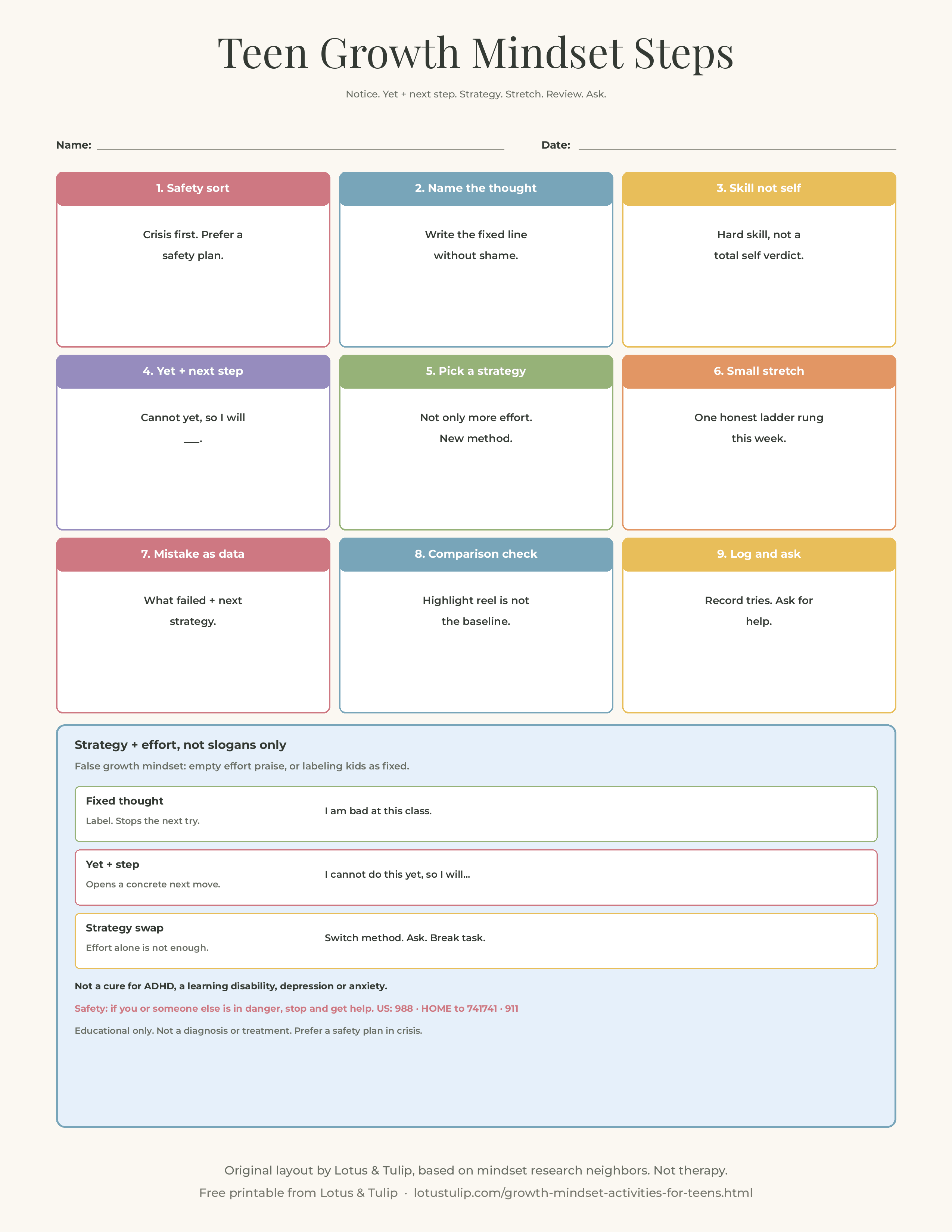
- Safety sort. Check that this is a learning or motivation question and not a crisis. Thoughts of ending a life, self harm, a plan to hurt someone, abuse or a medical emergency come first: 988, HOME to 741741, or 911 when needed, plus a safety plan.
- Name the fixed thought. Write the exact line ("I am bad at this," "If I fail I am dumb") without shaming it.
- Separate identity from skill. A hard subject is a skill domain, not a total self verdict.
- Add yet plus a next step. "I cannot do this yet, so I will ___."
- Pick a strategy, not only more effort. Choose from a stuck strategy menu: break it, switch practice, ask, review examples, reset.
- Try a small stretch. Climb one honest rung on a challenge ladder.
- Review the mistake as data. Autopsy what happened and name the next strategy.
- Watch comparison traps. Reality-check highlight reels and return to your own practice plan.
- Log and ask for help. Record what you tried, what helped, and who you can ask. Repeat.
Practice on small school and hobby struggles first. The same loop helps with bigger academic and personal goals later.
School counselor, therapist, teacher and parent tips
School counselors. Growth mindset fits advisory lessons, academic development small groups and individual planning. Keep Dweck's false growth mindset warning in the room: no labeling kids as fixed, no empty effort praise. Measure small changes such as more questions asked and more revisions turned in.
Therapists. Use the rewrite, autopsy and setback map when teens freeze after failure. Watch for depression, anxiety or ADHD as the main driver and treat those directly. Mindset language is a skill aid, not a stand-alone treatment.
Teachers. Model your own strategy changes out loud ("My first approach flopped, so I tried a worked example"). Grade and feedback systems that allow revision teach growth better than posters. Respond warmly when a teen asks for help after struggle.
Parents and caregivers. Praise process and strategy at home. Avoid "you are the smart one" as the family identity. When a teen is stuck, ask what they have tried and what they could try next. Support evaluation if school struggles look like a possible learning disability or ADHD rather than only "attitude."
Worked fictional examples
The math label (fictional). Jayden, 13, said "I am not a math person" after every quiz. In the fixed versus growth sort he attached a strategy: outline the problem, try one worked example, then ask a partner one question. After two weeks his language shifted to "I am not done learning this chapter yet." Carry over: the strategy attachment mattered more than the slogan.
The empty effort praise (fictional). A counselor noticed adults saying "Great effort!" while a teen kept using the same failed study method. In praise practice the group rewrote the line to "You put in time; let's change the method to retrieval practice." Carry over: effort plus strategy, not effort alone.
The highlight reel spiral (fictional). Amira, 16, scrolled college acceptance posts and decided she was "behind forever." The comparison trap audit asked what practice she could not see. She logged one values-linked practice plan: 25 minutes of essay outlining three days that week. Carry over: less scrolling, one concrete rung.
The perfectionism freeze (fictional). Mateo, 15, would not turn in drafts because anything less than perfect felt like proof he was not smart. The challenge ladder set "submit a rough outline" as rung two. He used the perfectionism worksheet alongside. Carry over: unfinished work became practice, not a character failure.
Counselor small group note (fictional). In a six session ninth grade growth mindset group, the counselor banned the phrase "fixed mindset kid." Students practiced strategy menus and logged three real tries. One student shared hopeless talk that went beyond school; the counselor followed up privately with school protocol and a safety check.
Growth mindset activities for teens vs growth mindset worksheet, self esteem, perfectionism, flexible thinking, study skills, resilience, positive self talk and goal setting
| Growth mindset teens (this page) | Growth mindset worksheet | Self esteem teens | Perfectionism teens | Flexible thinking | Study skills teens | Resilience teens | Positive self talk | Goal setting students | |
|---|---|---|---|---|---|---|---|---|---|
| Main job | Teen activities: notice fixed thought, strategy swap, try, review, comparison check | Teach fixed vs growth honestly with Change Your Words / Not Yet Plan | Worth and strengths | All-or-nothing standards | Shift rigid thoughts | Learning habits | Bounce back after hard events | Flip harsh inner lines | SMART goals and plans |
| Best early use | Teens stuck on labels, setbacks, comparison, empty effort | Introducing the idea to kids and teens | When worth is the wound | When perfect blocks trying | When thoughts are rigid | When methods are the gap | After setbacks and stress | When self talk is harsh | When goals need structure |
| Output | Growth mindset plan, practice log, mini card | Change Your Words pages | Self esteem practice | Perfectionism plan | Flexible thinking sheets | Study skills plan | Resilience plan | Thought flip cards | Goal builder |
| Link | This page | Growth mindset worksheet | Self esteem teens | Perfectionism teens | Flexible thinking | Study skills teens | Resilience teens | Positive self talk | Goal setting |
These tools work together. This page is the teen activity layer for growth mindset. When the main need is the basic teaching page, worth, perfectionism, flexible thoughts, study methods, bouncing back, self talk lines or goal structure, go to the matching page.
What helps vs common myths
What often helps: naming fixed thoughts without shame, yet plus a next step, strategy menus, process praise, revision opportunities, small challenge ladders, honest talk about barriers and supports, and adults who model their own strategy changes.
Common myths: "Growth mindset means anyone can do anything with enough grit." (Abilities can grow, and limits, access and disabilities still matter.) "Just praise effort." (Effort without strategy is a common false growth mindset trap.) "Some kids have a fixed mindset and that explains them." (Labels are not a teaching plan.) "Posters are enough." (Practice and feedback systems matter more.)
Common mistakes
- Slogan without strategy. "Yet" with no next step is wallpaper.
- Praising effort when learning is stuck. Ask what they tried and what they will try next.
- Blaming the teen for systemic problems. Mindset does not replace accommodations, fair teaching or evaluation.
- Using "fixed mindset" as an insult. That is the opposite of helpful.
- Skipping crisis checks. Hopeless talk about school can hide self harm risk; know when to switch to a safety plan.
- Overselling research. Effects are often small and context dependent; teach useful habits without miracle claims.
When growth mindset activities are not the right tool
- Crisis or safety concerns. Thoughts of ending a life, self harm, a plan to hurt someone or abuse come first. Use 988, HOME to 741741 or 911, a safety plan and your reporting protocol.
- Suspected learning disability or ADHD. Prefer school or clinical evaluation and accommodations. Strategy coaching can sit alongside; it does not replace assessment.
- Depression or anxiety as the main driver. Treat those directly with appropriate care. Mindset activities are not a cure. See depression activities for teens and anxiety activities for teens.
- When the environment is the problem. If teaching, grading or access is unfair, fix the adult system. Do not tell teens to mindset their way through a broken setup alone.
What the research says (honestly)
The core idea. Carol Dweck's program of research, summarized for a general audience in Mindset (2006), distinguishes a belief that abilities can develop (growth) from a belief that they are fixed. In a 2015 Education Week essay, Dweck revisited how the idea is used in schools and warned about "false growth mindset," including equating growth mindset with effort alone and praising effort when a student is not learning.
Adolescent transition evidence. Blackwell, Trzesniewski and Dweck (2007) in Child Development followed 373 seventh graders. Students who believed intelligence could grow had rising math grades over two years; those with a fixed view had flatter grades. A second, smaller workshop experiment that taught that the brain can grow with learning was linked to better math grade trajectories than a study skills control in that sample. Treat that as early support for the idea, not proof that any single printable works the same way.
National ninth grade experiment. Yeager and colleagues (2019) published a pre-registered, nationally representative study in Nature with more than 12,000 ninth graders in 65 US public high schools. A short online growth mindset program (under an hour total) raised core course GPA among lower achieving students by about 0.10 grade points and reduced the share of those students with a D or F average. Effects were larger where peer norms supported challenge, and there was no significant grade effect for higher achieving students in that study. Lotus and Tulip is not affiliated with the authors or the journal.
Meta-analysis honesty. Sisk, Burgoyne, Sun, Butler and Macnamara (2018) in Psychological Science reported that the overall link between mindset and achievement was weak, and that mindset interventions had a small average effect on achievement (about d = 0.08), with larger effects in some subgroups such as students from lower income families and academically at risk students. Later meta-analyses have continued to debate size and robustness. The honest classroom takeaway: useful for some students in some contexts, not a miracle, and not a reason to ignore instruction quality or supports.
School counseling and SEL neighbors. ASCA Mindsets and Behaviors include learning strategies and self management behaviors that sit near strategy use, persistence and asking for help. CASEL's self management and self awareness areas are neighboring frames. Lotus and Tulip is not affiliated with ASCA or CASEL.
Honest limits. No study tests this three page printable or this exact activity set. Treat this as a practical skill practice aid built on well known research neighbors, not a standalone randomized curriculum and not a treatment for any condition.
Free growth mindset printable for teens (PDF)
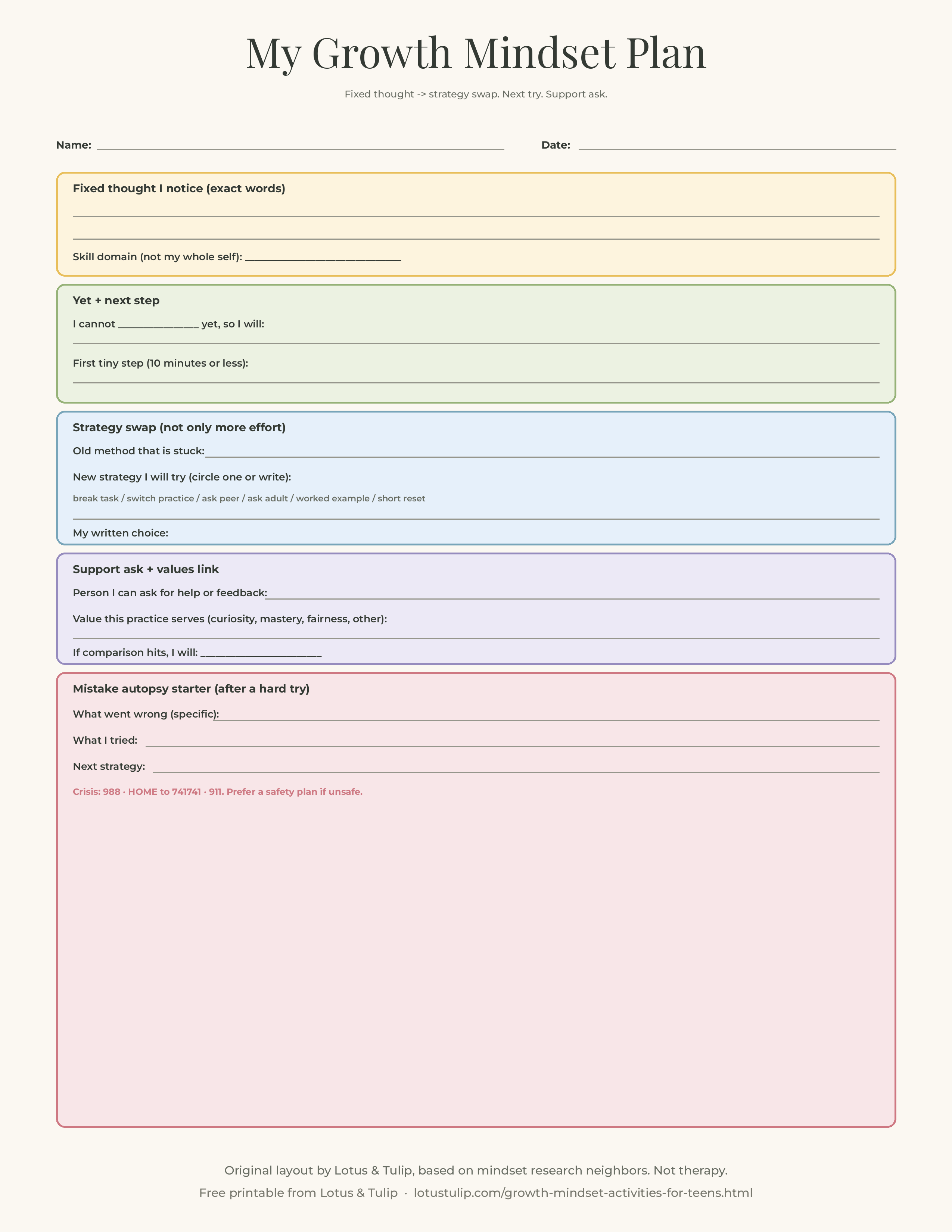
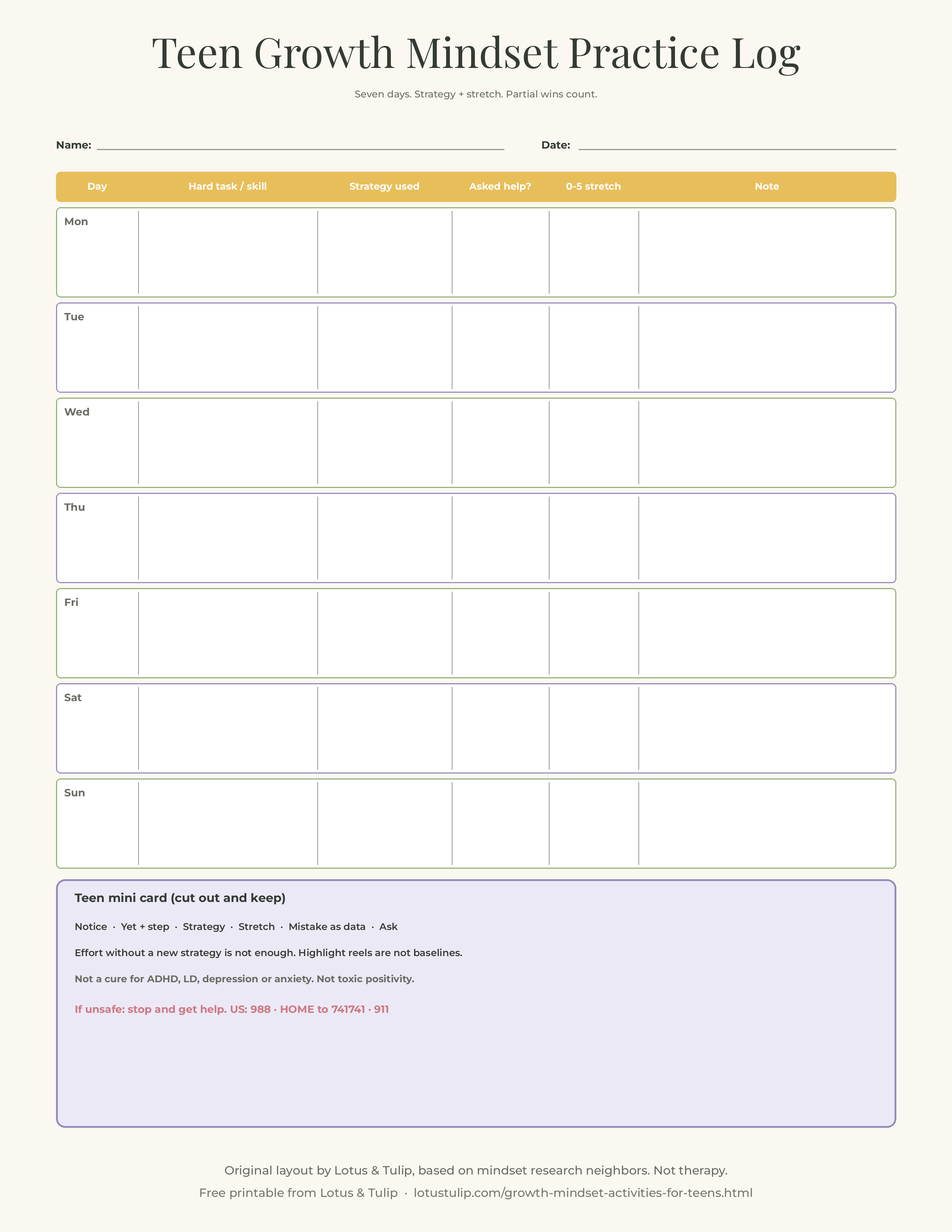
The free growth mindset printable has three pages in US Letter size:
- Page 1: Teen Growth Mindset Steps. Nine strategy-plus-effort framed steps matching the HowTo above: safety sort, name the fixed thought, separate identity from skill, yet plus next step, pick a strategy, small stretch, mistake as data, comparison check, log and ask for help.
- Page 2: My Growth Mindset Plan. Fixed thought to strategy swap, next try, support ask, and a short values-linked practice line.
- Page 3: Practice Log + teen mini card. Seven days of strategy practice with a 0 to 5 stretch rating, plus a cut out reminder card.
Download the free growth mindset printable for teens (PDF, 3 pages, US Letter)
Prefer single images? Page 1: Teen Growth Mindset Steps (PNG) · Page 2: My Growth Mindset Plan (PNG) · Page 3: Practice Log (PNG)
Free to print for your own use and for use with your own clients, students or groups. This is an original layout by Lotus & Tulip, drawing on widely cited mindset research (Dweck; Blackwell et al.; Yeager et al.; Sisk et al.) and school counseling neighbors. It is not affiliated with any author, agency, organization or curriculum named on this page, does not diagnose or treat any condition, and is not a substitute for therapy, evaluation or medical care. Please link to this page rather than re-uploading the file.
Related resources
- Growth mindset worksheet: honest fixed versus growth teaching page with Change Your Words and Not Yet Plan.
- Self esteem activities for teens: worth and strengths next to mindset.
- Perfectionism worksheet for teens: when perfect blocks trying.
- Flexible thinking worksheet: shifting rigid thoughts.
- Study skills activities for teens: methods that make strategy real.
- Resilience activities for teens: bouncing back after hard events.
- Positive self talk worksheet: flipping harsh inner lines.
- Goal setting worksheet for students: structure for practice plans.
- Safety plan worksheet: when the moment is about staying safe.
Sources
- Dweck, C. S. (2006). Mindset: The New Psychology of Success. Random House.
- Dweck, C. S. (2015, September 22). Carol Dweck Revisits the 'Growth Mindset'. Education Week.
- Blackwell, L. S., Trzesniewski, K. H., and Dweck, C. S. (2007). Implicit theories of intelligence predict achievement across an adolescent transition: a longitudinal study and an intervention. Child Development, 78(1), 246 to 263.
- Yeager, D. S., et al. (2019). A national experiment reveals where a growth mindset improves achievement. Nature, 573, 364 to 369.
- Sisk, V. F., Burgoyne, A. P., Sun, J., Butler, J. L., and Macnamara, B. N. (2018). To what extent and under which circumstances are growth mind-sets important to academic achievement? Two meta-analyses. Psychological Science, 29(4), 549 to 571.
- American School Counselor Association. ASCA Mindsets and Behaviors for Student Success (learning strategies and self management neighbors).
- Collaborative for Academic, Social, and Emotional Learning (CASEL). Self management and self awareness competencies (neighboring frames).
Growth mindset activities for teens: FAQ
What are growth mindset activities for teens?
They are short practice rounds that help teens notice fixed thoughts, add a yet plus next step, pick a real strategy, try a small stretch, review mistakes as data, and check comparison traps. They fit classrooms, small groups and individual sessions.
How is this different from a growth mindset worksheet?
Our growth mindset worksheet teaches the honest fixed versus growth idea with Change Your Words and a Not Yet Plan. This page is a teen activities guide (ages about 12 to 18) with group-ready rounds, adaptations and a teen printable plan and log.
Is growth mindset the same as trying harder?
No. Carol Dweck has warned that equating growth mindset with effort alone is a common false growth mindset. Teens also need new strategies and help from others when stuck.
Do growth mindset interventions really work?
Research finds real but often small and uneven effects. Yeager and colleagues (2019) found benefits for lower achieving ninth graders in a large US study. Sisk and colleagues (2018) reported a small average intervention effect. Teach useful habits without miracle claims.
Can growth mindset fix ADHD or a learning disability?
No. Strategy practice can sit alongside supports, but it does not treat ADHD or a learning disability. Prefer evaluation and accommodations when those are suspected.
How do I praise teens without creating a fixed smart label?
Praise process that leads to learning: strategies, focus, practice, asking for help and revision. When a teen is stuck, appreciate the work so far and ask what they have tried and what they can try next.
When are growth mindset activities not enough?
When there is crisis or self harm risk, a suspected untreated learning disability or ADHD, depression or anxiety as the main driver, or an unfair environment that adults need to fix. In a crisis in the US, call or text 988, text HOME to 741741, or call 911, and use a safety plan.