
School counselors · Updated 2026-11-08
Full Year Elementary Small Group Counseling (with Free Printable)
Ready-made printable: Full Year Elementary Small Group Counseling Bundle Holiday 20% off: about $45.08, was $56 (EUR 49) · instant digital download
Buy on Etsy
Full year elementary small group counseling is a plan, not a pile of kits and not a promise that you will run ten groups at once. It is how a US elementary school counselor (or the school social worker or school psychologist who shares similar work) decides which short Tier 2 groups to run between September and May, in what order, for which students, and when a group is the wrong tool. A good year plan starts with needs data, screening and permission. It keeps groups small, usually about four to six students, and short, often about eight sessions. It sequences themes across fall, winter and spring without treating every hard month as a reason to invent a new group. It also names what you will not run this year, because one counselor serving hundreds of students cannot do everything well.
You will get a plain language model of what a year of elementary small groups is and is not, eight planning ideas that keep the year honest, a practical year-planning map with example sequences (not a proprietary calendar), a way to choose which group to run next, a nine step HowTo, adaptations for K-2 versus grades 2 to 5, multilingual students, ADHD or autistic students, high-need buildings and the one-counselor-for-600-plus reality, tips for counselors, teachers and caregivers, mistakes, myths, three fictional examples, when-not guidance, verified research notes, eight FAQs and a free three page US Letter printable: Full Year Group Planning Steps, My Year of Small Groups and a Group Progress Log with nine pocket cards.
This page is the year-planning guide for elementary Tier 2 groups. It sits beside, and is not a substitute for, our school counselor small group curriculums hub (a catalog of ready groups, not a year plan), small group counseling curriculum for anxiety (how to run an elementary worry group, not how to plan the year), K-2 coping skills group activities, self esteem small group activities, divorce small group activities, middle school stress group activities (grades 6 to 8, a different building), icebreaker activities for counseling groups, counseling games for kids and the product page for a full year elementary small group counseling bundle. Those pages help you run or find a single group. This page helps you decide what belongs on the year calendar at all.
We draw on published research and public professional guidance without claiming any affiliation or endorsement, including the American School Counselor Association position statement The School Counselor and Multitiered System of Supports (revised 2021), the ASCA position statement The School Counselor and Group Counseling, the ASCA Student Standards: Mindsets and Behaviors for Student Success (2021), ASCA student-to-school-counselor ratio figures calculated from U.S. Department of Education National Center for Education Statistics data, the CASEL SEL Framework (2020), and the Durlak and Taylor school-based SEL meta-analyses (as context for classroom-wide programs, not as an effect size for a counselor pull-out group or for any curriculum bundle). Full citations are below. This page is not an ASCA or CASEL program, is not a certified protocol, and does not reproduce any paid lesson. The printable is an original Lotus and Tulip layout, not a preview dump of any paid curriculum.
This guide is educational. A year of elementary small groups does not diagnose students, does not treat an anxiety disorder, an anger disorder, ADHD, autism, trauma, grief or family crisis, and does not replace counseling, medical care, special education evaluation or a safety response. The ideas are skill-practice planning aids for counselors, not a standalone trial and not a manualized protocol. They are not affiliated with ASCA, CASEL or any named classroom program. If a child is thinking about suicide or self-harm, or says they do not want to be alive, call or text 988 (Suicide and Crisis Lifeline) or text HOME to 741741 (Crisis Text Line). For immediate danger, call 911. Pause the group plan and use a written safety plan when it fits. If a child describes abuse, neglect or feeling unsafe at home, follow your mandated reporting procedure. A group is not the right tool for a child who is in crisis.
What a year of elementary small groups is (and is not)
Most elementary counselors already know the shape of the year before the first referral form arrives. August and early September are for schedules, classroom lessons and watching how the building actually behaves. October often brings the first clear clusters: the grade 2 students who melt down at clean-up, the grade 4 lunch table that has become a daily complaint, the child who visits the nurse every Monday. Winter can raise worry, irritability and friendship drama after the honeymoon period ends. Spring can raise test stress, family changes that have been private all year, and the question of who still needs support before summer. A year of small groups is how you answer those patterns with a few short, planned series instead of a new activity every week and a waiting list that never moves.
In plain words, a year of elementary small group counseling helps you:
- Use data before you pick a theme. Teacher referrals, attendance, office discipline, nurse visits, last year's notes and, if your school uses one, a universal screener can show clusters. A hunch is not nothing, but it should not be the whole plan.
- Run a few short skill groups well. Four to six students, about eight sessions, one clear theme and a predictable session shape beat five overlapping groups that start and stall.
- Sequence the year instead of reacting to every hard week. Foundational skills often belong early. Targeted themes such as worry or anger often belong once you have seen the building. Family-change or grief groups belong when there is a real cluster, not because the calendar says it is time.
- Protect time that teachers and families can count on. A Tuesday 10:15 group that actually meets teaches more than a beautifully written curriculum that is constantly cancelled for testing, assemblies or "just this once" coverage.
- Know when a group is the wrong tool. Crisis, suspected abuse, trauma processing, a child who does not want to join and problems that need evaluation or outside therapy do not belong on a skills-group calendar.
- Leave room for the unexpected. A good year plan has two or three committed groups and one flexible slot, because March will invent a need that August could not see.
A year of elementary small groups is not:
- A mandate to run every group you own. Owning ten curricula does not mean ten groups this year. Most elementary counselors can run a handful of strong series, not a festival.
- A universal classroom SEL program. Classroom lessons and schoolwide routines are Tier 1. A pull-out group of four to six students is a different job. The large SEL studies cited later describe classroom-wide programs, not this format.
- Therapy, a diagnosis or a treatment plan. You are practicing skills with a screened group. You are not deciding that a child "has anxiety" or "has anger issues" in a permission letter, and you are not replacing outside counseling when that is needed.
- A trauma processing group or a crisis response. Children may mention hard things. You listen, you protect privacy, and you move safety concerns to individual support and your reporting path. You do not schedule a year of groups as the building's only answer to harm.
- A substitute for schoolwide culture work. A bullying-prevention group does not replace a recess plan, adult supervision or a response when a child is being targeted. A friendship group does not replace teaching the whole class how lunch line works.
- A certified protocol or an ASCA or CASEL affiliated program. You can map goals to professional language if that helps you write a lesson plan. Do not tell families the year of groups is an official ASCA or CASEL curriculum.
Core ideas that keep a year of groups honest
1. Needs data before a favorite theme
It is tempting to start with the group you enjoyed last year, or the one you just printed. Start instead with what the building is showing you. Count teacher referrals by theme and grade. Look at office referrals, bus notes, nurse visits and attendance patterns. Ask two or three trusted teachers what they see at recess and at the end of the day, not only what they wrote on a form. If your school uses a universal screener for social, emotional or behavioral risk, treat it as one source among others, not as a diagnosis and not as automatic group placement. ASCA's MTSS position statement (revised 2021) describes school counselors analyzing academic, career and social/emotional data to identify students who need support, then aligning small-group counseling as a Tier 2 direct service. That is a planning stance, not a claim that any one printable bundle has been tested in a trial.
2. Screening is part of planning, not a courtesy
ASCA's group counseling position statement says school counselors have a responsibility to screen potential group members and obtain informed consent. Screening is how you keep a skills group from becoming a mixed crisis room. Talk briefly with each child and, when you can, a caregiver or teacher. A child who is in crisis, describes abuse, talks about wanting to die or disappear, or seems to be processing trauma needs individual support and your reporting path first. A child who cannot stay safe in a small room, or who regularly targets another invited student, may need a different plan. Screening also helps you match grade bands. Kindergarten and grade 5 can share a building without sharing a group.
3. Permission should be plain and honest
ASCA's same statement says informed consent should include the group's purpose and goals, limits to confidentiality and information regarding voluntary participation, and that best practice includes informing parents or guardians and following school and district policy. Write the letter in everyday words: this is a short skills group on (for example) naming feelings and picking a calming tool, or practicing friend skills at lunch and recess. Say how many sessions you expect, when you will meet, and that a friend's story stays in the room except when someone is getting hurt or is not safe. Avoid clinical labels unless a caregiver already uses them with you. If your district requires a signed slip, send it early enough that you are not still waiting in week three.
4. Small and short beats large and endless
Four to six students is a workable elementary group. Fewer than four can feel like individual counseling with an audience. More than six makes it hard to notice the quiet child and hard to practice anything but taking turns talking. Many counselors plan about eight sessions of 20 to 30 minutes for younger students and closer to 30 to 40 minutes for grades 3 to 5. Eight is not magic, and it is not a research-proven dose for this page. It is long enough to teach a few skills and short enough to finish before the season changes. If you only have six weeks, keep fewer goals and repeat the same skills. An open-ended group that "will just keep going" often becomes venting, coverage and no closing conversation with families.
5. Sequence the year on purpose
Fall is often the right time for foundational groups once screening and permission are done: social skills for grades 2 to 5, or a picture-friendly K-2 feelings and coping group. Winter is often when worry, anger and friendship strain show up more clearly. Spring can hold self-esteem, growth mindset or a needs-driven family-change or grief group if referrals support it. Testing weeks, holidays and field day are not moral failures in the calendar. They are reasons to avoid starting a new eight session series on the Monday of state testing. Leave a flexible slot. The plan is a map, not a contract with September-you that March-you is not allowed to revise.
6. Fidelity to the session shape, flexibility about pace
Fidelity here does not mean reading a script word for word. It means keeping the same beginning, one teaching point, one practice and a closing round, so students know what kind of room they have entered. Flexibility means repeating a skill that did not land, skipping a craft that would eat the block, or pausing a child out of group when safety appears. What it does not mean is abandoning the theme every time a student brings a new story, or turning a social skills group into an unplanned family-change group because two children mentioned a weekend at dad's house.
7. Progress checks are simple on purpose
You do not need a published instrument to notice whether a group is doing its job. A short pre and post skill check ("I can name a feeling," "I can try a calm tool," "I can use a friend sentence"), a two sentence teacher note after session 4 and session 8, and your own attendance and participation notes are enough for most elementary series. ASCA writing on small group planning often distinguishes process data (who attended, how many sessions), perception data (what students say they know or believe) and outcome data (what changed in the building, such as fewer recess referrals). Use that language if it helps you talk with an administrator; the fifth edition of the ASCA National Model (2025) renames them participation, ASCA Student Standards and achievement data (our pre and post assessment guide walks through writing, scoring and reporting a group survey). Do not pretend a six item "I can" check is a standardized test or a diagnosis.
8. Caseload reality is part of ethics, not an excuse to skip groups
ASCA has recommended a student-to-school-counselor ratio of 250 to 1 since 1965. Using U.S. Department of Education National Center for Education Statistics data, ASCA reported a national average of 376 to 1 for 2023-2024 and 372 to 1 for 2024-2025, still well above that recommendation. In the states that report elementary and middle school counselors separately (ASCA notes this is 35 states, so it is a range and not a complete national elementary figure), estimated elementary and middle school ratios recently fell around 571 to 1 through 694 to 1 for 2024-2025, and around 581 to 1 through 702 to 1 for 2023-2024. That is the "one counselor for 600 plus students" reality many elementary counselors already live. It does not mean groups are impossible. It means you should plan three to five strong series, protect those slots, and say no to a tenth group that would make the first four sloppy. ASCA's MTSS statement also notes that the school counselor should be part of the leadership team but should not be the sole leader of MTSS in the building. You are not the entire intervention system.
Counselors who write goals against professional frameworks can map year planning (without any affiliation) to ASCA Student Standards such as M 1 (belief in development of the whole self, including a healthy balance of mental, social/emotional and physical well-being), B-SMS 2 (self-discipline and self-control), B-SMS 7 (effective coping skills) and B-SS 2 (positive, respectful and supportive relationships with students who are similar to and different from them). CASEL describes self-awareness as understanding one's own emotions, thoughts and values and how they influence behavior, including identifying one's emotions; self-management as managing emotions, thoughts and behaviors effectively, including identifying and using stress-management strategies; and related competencies of social awareness, relationship skills and responsible decision-making. Use those wordings if they help you write a lesson plan or a results report. Do not tell families the year of groups is an ASCA or CASEL program.
A practical year-planning map (example sequences, not a proprietary calendar)
Think of the school year in three group seasons, plus a short setup window. The dates will flex with your district calendar. The point is to stop treating every week as an emergency and to stop launching a new group whenever a teacher stops you in the hallway.
| Season | What this window is good for | What to avoid |
|---|---|---|
| Setup (first 2 to 4 weeks) | Classroom lessons, watching the building, collecting referrals, screening, sending permission letters, choosing no more than two groups to start | Launching an eight session series in week 1, before you have seen the students or heard from families |
| Fall groups (often October to December) | Foundational themes after permission returns: social skills for grades 2 to 5, or a K-2 feelings and coping group. A friendship group if last spring already showed a clear cluster | Starting the day before a long break. Mixing kindergarten with grade 5 because the schedule is easier that way |
| Winter groups (often January to early March) | Targeted themes that showed up after the honeymoon: worry, anger and self regulation, or friendship repair. A second foundational group if fall only covered one grade band | Opening four new groups in January because you feel behind. Using winter as a catch-all for every leftover referral |
| Spring groups (often March to May) | Self esteem or growth mindset if those match the data, or a needs-driven divorce and separation or grief and loss group if you have a real cluster and enough weeks left to close well | Starting an eight session series the week state testing begins. Scheduling grief or family-change work only because "it is spring" and not because students need it |
| Close and carry forward (last 2 to 3 weeks) | Finish open series, send families a short note about skills practiced, check in with teachers, write next year's first two candidates while the year is still fresh | Quietly dropping a group with no closing session and no word to caregivers |
Here is a simple capacity check before you fill the map. Suppose each group is eight weekly sessions, you protect two group blocks a week, and you do not run groups during the first three weeks, the last two weeks, testing weeks or major holiday weeks. In many elementary calendars that leaves you something like two concurrent series in fall and two later in the year, or one ongoing pair of blocks that complete about four series. Some counselors with more protected time can do more. Many cannot. If the map only works when nothing is ever cancelled, it is not a map. It is a wish.
The public names below are themes a counselor might schedule. They are not a required menu, not a claim that you must run all of them, and not a copy of any paid session title or worksheet.
- Social skills (grades 2 to 5). A common fall starter when referrals cluster around joining a game, taking turns, reading a social cue or repairing after a small conflict. See also our broader notes in nearby social skills pages when you need classroom or individual practice rather than a pull-out group.
- K-2 feelings and coping, picture friendly and low writing. A strong early-year choice for kindergarten through grade 2 when young students need feeling names, body clues and a calming tool. Our K-2 coping skills group activities page is the how-to for that series.
- Friendship, often grades 3 to 5. Useful when the problem is a small cluster of students who struggle to keep a friend, not when the whole grade needs a lesson on kindness. A girls friendship group is one possible match, not the only friendship plan.
- Worry or anxiety skills (often grades 2 to 5). A winter candidate when avoidance, stomachaches or "what if" thinking is the center of the referrals. Use our elementary anxiety small group guide rather than stretching a general coping group to do that job.
- Anger and self regulation (often grades 2 to 5). A fit when the main pattern is quick escalation, not when every big feeling is being labeled "anger issues."
- Bullying prevention and upstander skills (often grades 3 to 5). A group can practice what to do when you see harm. It cannot replace adult action if a child is being targeted. If the building has an active bullying problem, start with supervision, reporting paths and support for the targeted student.
- Self esteem and confidence (often grades 2 to 5). Often a later-year group, after students have some skill successes to point to. Empty praise is not the plan. See self esteem small group activities.
- Growth mindset (often grades 2 to 5). Helpful when students shut down after mistakes or treat struggle as proof they are "bad at school." It is a neighbor to self esteem, not the same group.
- Divorce and separation / changing families (often grades 2 to 5). Run this when you have a screened cluster and caregiver consent that fits your district rules, not as a default spring theme. See divorce small group activities.
- Grief and loss (often grades 2 to 5). Likewise needs-driven. A grief group is not a place to process a fresh traumatic death in week 1 of a skills series, and it is not a substitute for family or community support after a major loss.
Example sequence A: a K-5 counselor with a wide referral mix
Setup weeks are for watching and permission. Fall: a Social Skills group for grades 2 to 5, plus a Feelings Garden style K-2 coping group if you have a second protected block. Winter: a Calm and Brave style worry group if nurse visits and avoidance showed up in the fall data. Spring: a Shine Bright style self-esteem group or a Cool Down Crew style anger group, whichever the mid-year notes support, not both if you only have one block left. The other themes stay on the shelf unless a clear cluster appears.
Example sequence B: a building where recess and friendships dominate the data
Fall: Social Skills for the mixed-grade students who cannot join or leave a game without a blow-up. Winter: a Kind Circle style friendship group for a screened grades 3 to 5 cluster, and a short classroom lesson (Tier 1) for the whole grade rather than pulling twenty students. If office referrals show targeting, not only clumsy friendship, add adult supervision and support for the targeted students first. A Stand Strong style upstander group can be a later support, not the first and only response.
Example sequence C: a year with several family changes and one possible loss cluster
Keep fall foundational, because children in changing families still need ordinary school skills and a predictable adult. If winter referrals support it, plan a Changing Families group with careful consent and neutrality. A Remembering Together style grief group belongs only if there is a screened group of students whose shared need is grief and loss skills, not a single recently bereaved child who needs individual support. Do not combine divorce and grief into one "hard feelings" group to save a time slot. The stories are too easy to mix, and privacy is harder to protect.
None of these sequences is a research-tested calendar. They are planning examples so you can see the difference between a year map and a shopping list.
How to choose which group to run next
Choosing the next group is easier when you ask the same questions every time, instead of choosing by mood, by whichever PDF is on top of the printer, or by the loudest hallway complaint.
- What is the cluster? Three or more students with the same kind of need, in a grade band that can share a room, is a group-shaped problem. One student in crisis is not. Twenty students who all talk during carpet time may be a classroom lesson.
- Is this Tier 1, Tier 2 or something more intensive? If most students in a class would benefit, teach it to the class. If a small set needs extra practice, consider a group. If a student needs crisis response, a safety plan, a suspected-abuse report, a special education evaluation or outside therapy, do that instead of or before group. ASCA's MTSS position statement describes Tier 1 as classroom instruction and schoolwide programming, Tier 2 as including small-group and individual counseling plus consultation, and Tier 3, typically, as indirect support through consultation, collaboration and facilitation of referrals. Use that as a sorting question, not as a rigid label you print on a child.
- Can these students be in a room together? Do not place a child who is actively targeting another invited student in the same friendship group "so they can work it out." Do not place a child in acute distress next to a skills group that cannot hold that story.
- Do you have enough weeks to finish? If you have four weeks until testing or the last day of school, run a shorter review, a classroom lesson or individual check-ins. Do not start an eight session series you cannot close.
- Is there a better neighboring group? Everyday coping for kindergarten is not the same as an elementary worry group. Self esteem is not the same as growth mindset. Divorce support is not the same as grief. Match the center of the problem, not the nearest title.
- What will you stop doing to make room? If you add a winter worry group, something else on your calendar has to shrink. Name it. Otherwise the new group will be paid for with cancelled sessions.
A quick sort many counselors find useful: list every current referral on a page with three columns, Theme, Grade, Group / individual / classroom / refer out. If a theme has only one name, it is probably not next winter's group. If a theme has eight names across kindergarten through grade 5, split by grade band or teach part of it as a classroom lesson. If several names include safety language, those students come off the group list first.
How to plan a full year of elementary small groups, step by step
- Gather needs data before you pick a group. Review teacher referrals, attendance, office and bus notes, nurse visits, last year's group lists and any universal screener your school already uses. Look for clusters by theme and grade, not for a reason to launch every curriculum you own. Classroom patterns may belong in a Tier 1 lesson instead of a pull-out group.
- Screen for safety and fit. Talk briefly with each possible member and, when you can, a teacher or caregiver. A child who is in crisis, describes abuse, talks about wanting to die or disappear, or seems to be processing trauma needs individual support and your reporting path first, not a skills group. Use 988, HOME to 741741, 911 and your school's procedures when safety is in question. See the safety plan worksheet.
- Collect parent or guardian permission. Send a short letter that names the theme in plain words, the likely number of sessions, the meeting time and the privacy limit: a friend's story stays in the room unless someone is getting hurt or is not safe. Include a consent slip if your district requires one. Follow school and district policy. Do not use clinical labels in the letter unless a caregiver already uses them with you.
- Keep the group small and matched. Plan for about four to six students who share a grade band and a similar need. Avoid mixing kindergarten with upper elementary, and think twice before grouping students who regularly trigger one another. Choose a session length the youngest member can actually use, often 20 to 30 minutes in K-2 and closer to 30 to 40 minutes in grades 3 to 5.
- Sequence groups across fall, winter and spring. Put foundational skills early once permission is back, targeted themes such as worry or anger where the mid-year data supports them, and family-change or grief groups only when there is a screened cluster and enough weeks to close well. Leave one flexible slot. Do not start a new eight session series on a testing week.
- Protect the time and tell teachers what you are practicing. Put the group on a calendar teachers can see, avoid pulling students from their only choice time or a loved special, and send two sentences about the skill (for example, feeling names and one calm tool) so the classroom can prompt the same language. A hidden group is a cancelled group.
- Run each series with a predictable structure. Use a short check-in, a review of last time, one teaching point, one practice and a closing round. Session 1 is a good time for agreements and a simple opener; our icebreaker activities for counseling groups and counseling games for kids pages can help you open without turning the whole series into games. Repeat the same tools often enough that they become familiar.
- Check progress and adjust without abandoning the plan. Use a brief pre and post skill check, mid-group teacher notes and your own attendance notes. Repeat a skill that did not land. Move a child to individual support if the group is the wrong fit. Do not change the theme every week to match the loudest story in the room.
- Know when to pause, and close the year with a follow-up plan. If safety, suspected abuse or a sharp change appears, pause group work for that child and follow your procedures. For students who complete a series, name a specific skill you saw, send families one home idea and note who may need a later group, individual counseling or a community referral. Write next year's first two candidates while the data is still in front of you.
Adaptations
- Kindergarten through grade 2. Plan closer to 20 or 25 minutes, use pictures and movement, and let drawing or pointing count as participation. A year plan for this band often starts with feeling names and calming tools rather than a long friendship curriculum. See K-2 coping skills group activities. Do not hand these students a stack of writing pages and call it a group.
- Grades 2 to 5. Many of the targeted themes on this page (social skills, worry, anger, self esteem, growth mindset, changing families, grief) fit this band better than they fit kindergarten. Grade 2 can still need pictures and shorter blocks. Grades 4 and 5 can handle a bit more talk, but they still need practice, not a lecture.
- Multilingual students and students with limited language. Lead with photos, sentence frames and demonstration. Learn the words families already use at home when you can, and send the permission letter and family note in the home language if your school can support that. Do not treat silence as refusal or as proof the child does not belong in group.
- Students with ADHD. Keep the same session shape every week, show a visual agenda, build in movement and keep tools physical. These are supports, not ADHD treatment, and they do not replace evaluation or a 504 or IEP conversation. In a year plan, avoid stacking a student into three successive groups because they are "always on the referral list." Ask what skill is actually missing.
- Autistic students. Preview the plan with pictures, allow pointing or drawing instead of spoken sharing, watch for sensory overload in a small room, and be literal about agreements. Do not force eye contact or "calm face" language that may not fit. Again, these are supports, not autism treatment. Some autistic students do better with individual skill practice than with a social group that depends on fast conversation.
- High-need or crisis-heavy buildings. Your year plan should have more screening time, more individual follow-up and fewer simultaneous groups, not more groups. If many referrals are safety related, groups cannot be the main service. Build in consultation with administrators and a clear path to 988, HOME to 741741, 911 and mandated reporting.
- One counselor for 600 or more students. Choose three to five series and name them on a one page map you can show your principal. Protect two recurring blocks if you can. Use classroom lessons for whole-grade needs. Refer out when the work is long-term therapy or family treatment, which is also what ASCA's group counseling statement asks counselors to do. A thinner, finished year is better than a dozen half-started groups.
- Itinerant or split-campus counselors. Plan groups on the days you are actually in that building every week. A group that meets "when I can get there" will not hold. If you have only one standing day, run one series at a time and keep the other campus on classroom lessons and individual check-ins until the first series closes.
- A classroom lesson rather than a pull-out. Social skills, feeling names, upstander language and simple calm tools often belong in the classroom first. Skip personal disclosure. Use fictional examples only. A whole class lesson is not the same as a Tier 2 group, and it should not be counted as one on your year map just to look busier.
- Telehealth or virtual groups. A virtual elementary group is usually a poor fit. Young students need an adult in the room, materials they can touch and help staying with the activity. If distance services are the only option, prefer a short individual session with a caregiver present and a plan for reaching an on-site adult if safety comes up.
- Middle school students. This page is for elementary planning. For grades 6 to 8, use a different year map and a different developmental voice. Our middle school stress group activities page is one starting point, and the middle school small group counseling bundle is a separate set of groups.
Tips for counselors, teachers and caregivers
For school counselors
- Write the year map on one page you can revise, not in a document so long that you never look at it again. The free printable's second page is built for that.
- Schedule screening and permission as real calendar work in September, the same way you schedule the groups themselves.
- Tell your administrator which two blocks you are protecting and why, using the referral clusters rather than "I would like to try this kit."
- Do not pull kindergarteners from their only choice time or from a special they love. The year plan fails if students start hiding from group.
- After each series, write two sentences: what improved a little, and who still needs something else. That note is how next fall gets easier.
- Keep a short "not this year" list. It prevents guilt from turning into a seventh group you cannot run well.
For teachers
- Refer based on what you see (tears at transitions, daily recess conflict, frequent nurse visits, shutdown during writing) rather than a guess about diagnosis.
- A cluster of similar notes from one grade is more useful than one frustrated paragraph about "the whole class."
- When a child is already in a group, prompt the same short language the counselor is practicing, instead of asking the child to perform the skill for the class.
- Share one observation after a few weeks ("The calm tool helped after recess, the long talk did not") so the counselor can adjust.
- Protect the group time you agreed to. Sending the child to group only when it is convenient teaches everyone that the work is optional.
For parents and caregivers
- A permission letter for a skills group is not a diagnosis. Ask what the group will practice and how many meetings it will have.
- Students do not have to share private family details in order to belong. If the group theme is family change or grief, you should know that before you say yes.
- Practice the week's one skill when everyone is reasonably calm, not only after a blow-up. Two minutes after a snack teaches more than a speech at bedtime.
- If your child talks about wanting to die, not wanting to be here, hurting themselves, or being hurt by someone, take it seriously the same day. Call or text 988, text HOME to 741741, call 911 if there is immediate danger, and tell the school counselor.
Common mistakes
- Starting groups before you have data, screening or permission. The first three weeks of school are for watching and asking, not for filling every slot so the calendar looks full.
- Trying to run every theme you own. Ten curricula can support a program across years. They are not a to-do list for one counselor in one year.
- Mixing grade bands to make the numbers work. A kindergartner and a fifth grader can share a counselor. They rarely share a useful group.
- Using a group as the building's bullying or crisis plan. Adult supervision, reporting and individual safety work come first.
- Changing the theme every session because a student brought a new story. Listen, protect privacy, and keep the practiced skill. Move big or unsafe stories out of the circle.
- Skipping teacher and family follow-up. A skill fades quickly if no one outside the group knows what to prompt.
- Counting a cancelled series as a finished group. If you stopped at session 3, say so in your notes and decide whether to restart, shorten or choose a different support.
- Putting a child in group after group because they are frequently referred. Sometimes the next right step is individual counseling, a classroom support, an evaluation conversation or a community referral.
Myths about a year of elementary small groups
- Myth: a full year plan means running groups from the first Monday to the last Friday. Setup, screening, testing weeks and closing are part of a serious plan.
- Myth: more groups mean a better counseling program. Finished groups with a clear skill, a progress check and a family note beat a large number of half-meetings.
- Myth: if I own a curriculum, I should use it this year. A shelf is a resource. The year map is a decision.
- Myth: small groups replace classroom SEL or a calm recess plan. They do not. Universal teaching and schoolwide routines still do most of the daily work. The large SEL studies described later are about those classroom programs.
- Myth: every child with a hard feeling needs a pull-out group. Some need a classroom lesson, some need individual time, some need evaluation or outside care, and some need the adults around them to change a setting that is too hard.
- Myth: a year of groups will treat anxiety, ADHD, autism, trauma or grief. It will not. It is skill practice and support, with a clear door out when something else is going on.
- Myth: if I plan the year in August, I cannot change it. You should change it when the data change. What you should not do is invent a new group every week with no map at all.
Three fictional examples
These examples are invented to show how a year plan can work in a real building. They are not real students or real counselors.
Maya, a K-5 counselor with about 640 students
Maya is the only counselor in a K-5 building. In August she wanted to run "a little of everything." After two weeks of classroom lessons and referral notes, the clusters were clearer: many kindergarten and first grade notes about tears and hitting at clean-up, and a grades 2 to 4 cluster about joining games and repairing after small conflicts. She protected Tuesday and Thursday at 10:15. After screening and permission, fall held a K-2 coping group and a grades 2 to 5 social skills group. She did not open friendship, worry, anger, self esteem, growth mindset, bullying, divorce and grief groups just because she had materials for them. In January, nurse visits and teacher notes pointed to worry in grades 3 and 4, so winter became a worry group in one block while the other block offered individual check-ins and a short classroom lesson on asking for help. In April she ran a self-esteem group for students who could name a skill they had practiced but still talked about themselves as "the bad kid." Her mid-year note to her principal was one page: four series planned, three completed, one winter slot used for worry, and a short list of students who needed individual support or a community referral instead. The year was not glamorous. It was finished.
Leo's grade 4 cluster, and why the next group was not "more social skills"
Leo's teacher kept sending social skills referrals for the same four students after a fall social skills group had already ended. Maya (in this invented building) did not automatically rerun the same series. She sat in recess twice and read the office notes. Two of the students were clumsy with joining games and could use a shorter booster. One was being left out after asking to play, and the tone from peers looked more like targeting than like a skill gap. One had started saying he was stupid whenever he missed a basket, which sounded more like self esteem or growth mindset than like "how to take turns." The year plan changed in a small way: two students got a short review, one student got individual support plus adult recess help rather than another friendship group with the same peers, and two other students (not all from Leo's original foursome) joined a later self-esteem group because that matched the center of the problem. Choosing the next group meant looking again, not repeating the title that was already on the printer.
Jordan, and a changing families group that had to pause
In March, Maya screened a Changing Families group for grades 2 to 5 after several families had separated during the year. Permission letters described a skills group about feelings, kid jobs and two homes, not therapy and not a place to pick a side. In session 3, while the group was working on who can help, Jordan said home did not feel safe and that a grown-up hurt them when they cried. Maya paused that activity, thanked Jordan for telling, and met privately as soon as the others began a short drawing task. She followed the school's mandated reporting procedure the same day, planned individual support, and did not ask Jordan to repeat the story in the group. A written safety plan was used as it fit procedure, along with 988, text HOME to 741741 and 911 for immediate danger. Jordan did not return to the skills group that week. Individual support and reporting came first. The other students continued the next week without discussing Jordan's story. (This example is fictional. It is not legal advice. Follow your state law and district reporting path.)
How this page compares to nearby Lotus and Tulip guides
| Page | Best for | Format |
|---|---|---|
| This page | School counselors planning a year of elementary Tier 2 small groups | Year map, screening and sequencing how-to, not one group's lesson list |
| ASCA Student Standards delivery plan | Putting every Tier 1 lesson and Tier 2 group of the year on ASCA's fifth edition delivery plan, one behavior standard per row | Delivery plan how-to (the 36 standards, template columns, RAMP Section 1, sample plans) with a free planner, filled example and delivery log |
| Small group counseling referral form | Collecting and sorting referrals before you form groups | Referral how-to (teacher, parent, self and data pathways, behavior items, FERPA, screening, closing the loop) with a free referral form, filled example and referral log |
| Small group counseling pre and post assessment | Measuring whether a group worked and reporting it | Data how-to (ASCA National Model fifth edition data types, item writing by age, scoring, one page report) with a free survey, filled example and results summary sheet |
| Small group counseling permission slip and parent letter | Getting parent permission and student assent before session 1 | Consent how-to (ASCA, FERPA, opt in vs opt out, state examples) with a free letter, filled example and permission log |
| School counselor small group curriculums | Browsing ready group curricula by topic and grade band | Category hub and catalog, not a year-planning guide |
| Full year elementary small group counseling bundle | Buying ten elementary curricula in one download | Product page, not a counselor how-to |
| Small group counseling curriculum for anxiety | Running an elementary worry and anxiety group | One theme, not a full year map |
| K-2 coping skills group activities | Kindergarten through grade 2 feelings and coping groups | Activities and an eight session how-to |
| Self esteem small group activities | Elementary self esteem and confidence groups | Activities and a group how-to |
| Divorce small group activities | Changing families groups for elementary students | Activities and a group how-to |
| Middle school stress group activities | Grades 6 to 8 | Older students, workload, sleep and screens |
| Icebreaker activities for counseling groups | Opening session 1 without making the whole series into games | Openers, not a year plan |
| Counseling games for kids | Play based counseling activities | Games, not an annual group calendar |
When not to use this year plan, and when not to run a group
- A child is in crisis. Thoughts of suicide or self-harm, even in a young child ("I want to die," "I do not want to be here," "I wish I would not wake up"), call for 988, HOME to 741741, 911 if there is immediate danger, your school's crisis procedure and a written safety plan, not a seat in next week's skill group.
- Suspected abuse, neglect or a child who is not safe at home. Report as required the same day and plan individual support first. Do not ask the child to retell the story in group. This page is not legal advice; follow your state law and district procedure.
- Trauma processing. A year of skill groups does not walk children through traumatic memories. Stabilization and a trauma-informed referral come first.
- Severe or worsening symptoms that need referral. Ongoing panic, selective mutism that is getting worse, frequent aggression that injures others, sudden major behavior change, or signs that a developmental evaluation is needed should not be treated as ordinary group planning alone.
- The child does not want to join. Invite and explain, but do not force. Offer a short individual check-in instead. A coerced group teaches that counseling is something done to you.
- You do not have enough weeks or a protected time slot. A series you cannot finish is not kinder than waiting. Use classroom lessons, individual check-ins or a shorter booster instead.
- The need is really schoolwide. Recess chaos, a grade-wide friendship pattern or a missing calm-down routine often belongs in Tier 1, with adults, before you pull six students out of class.
Free 3 page full year elementary small group counseling printable (US Letter)
Download the free printable and use it to plan the year, choose the next group and keep a simple record of what you ran.
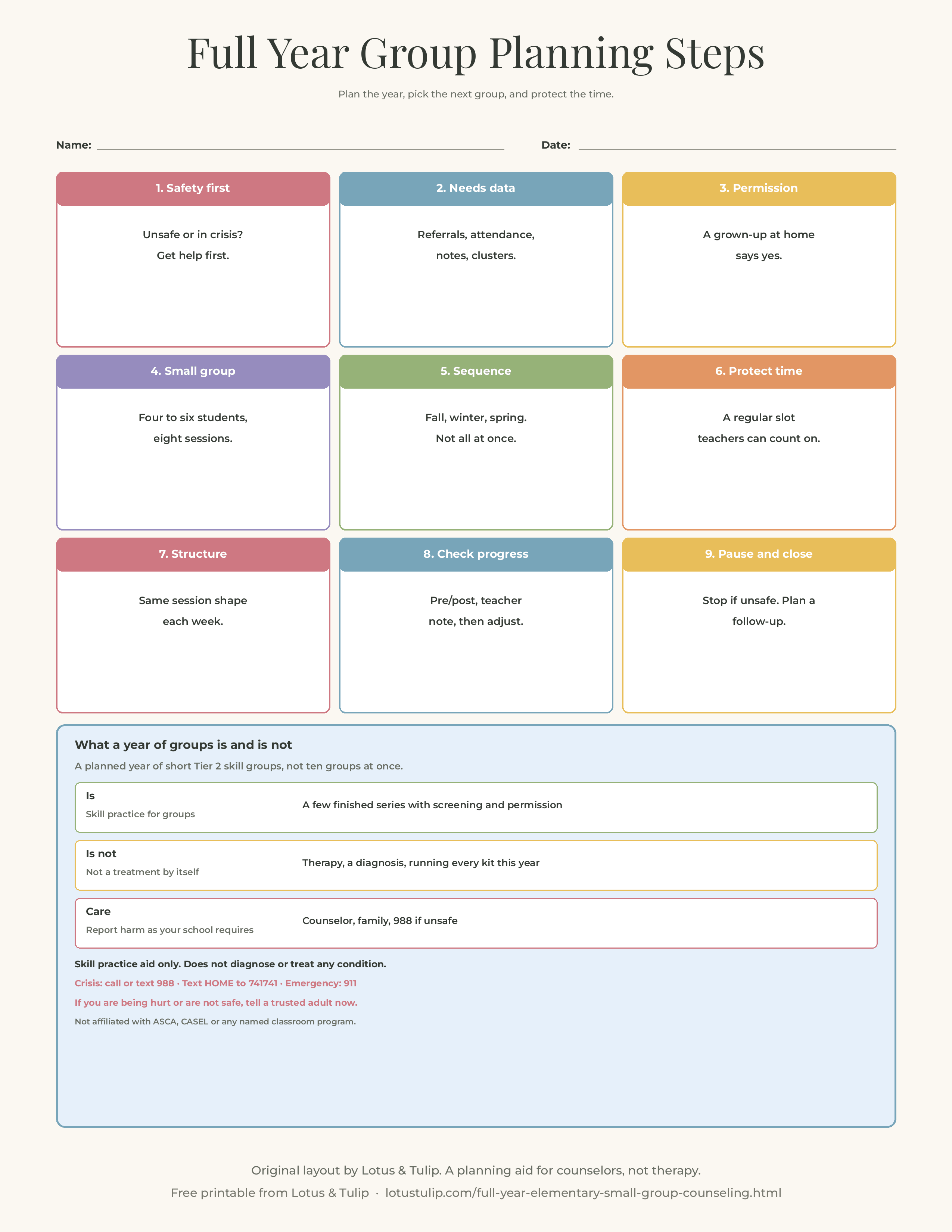
- Page 1: Full Year Group Planning Steps. Nine steps that match the HowTo, what a year of groups is and is not, and crisis resources including 988, the Crisis Text Line and 911.
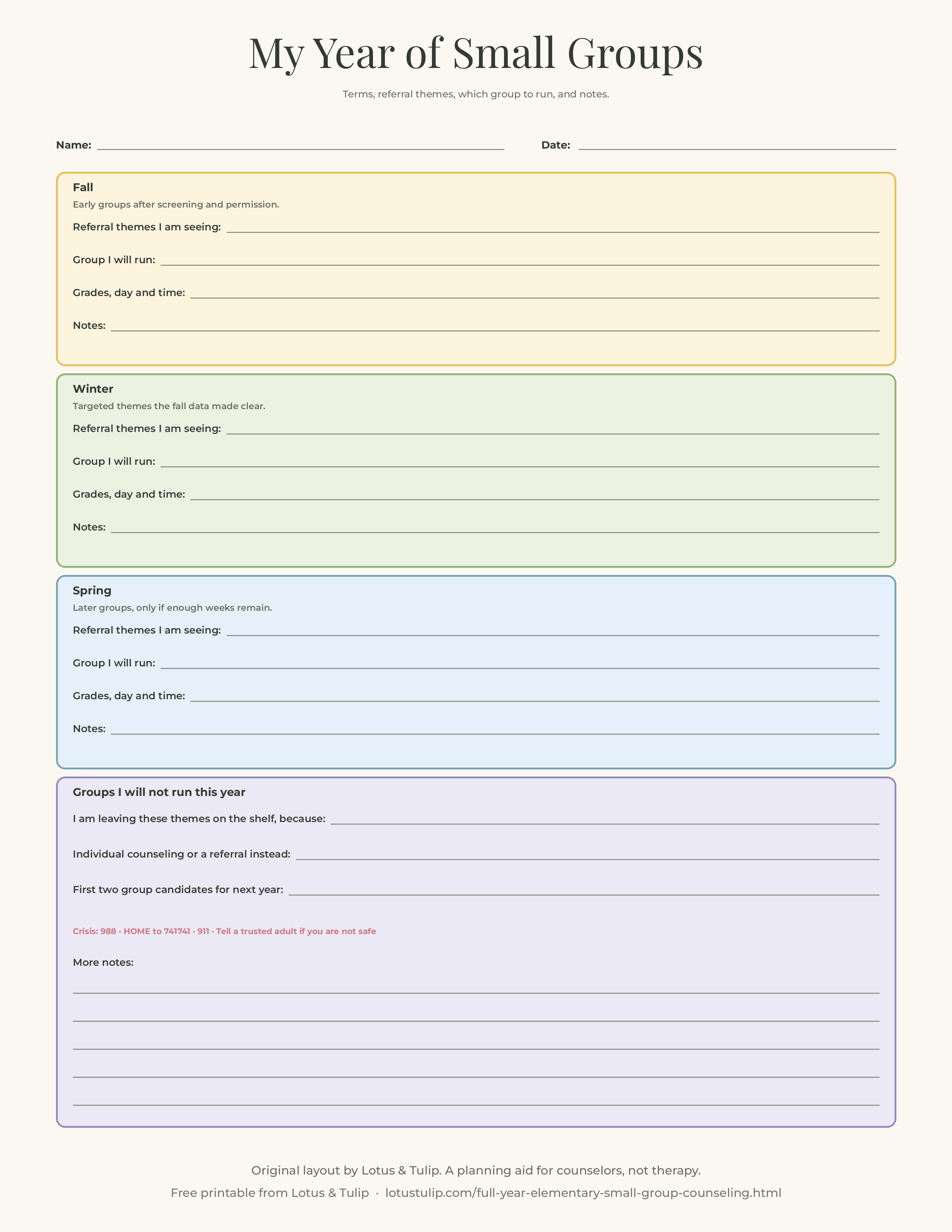
- Page 2: My Year of Small Groups. Space for fall, winter and spring: referral themes, which group you will run, grades, a meeting time and notes, plus a line for groups you will not run this year.
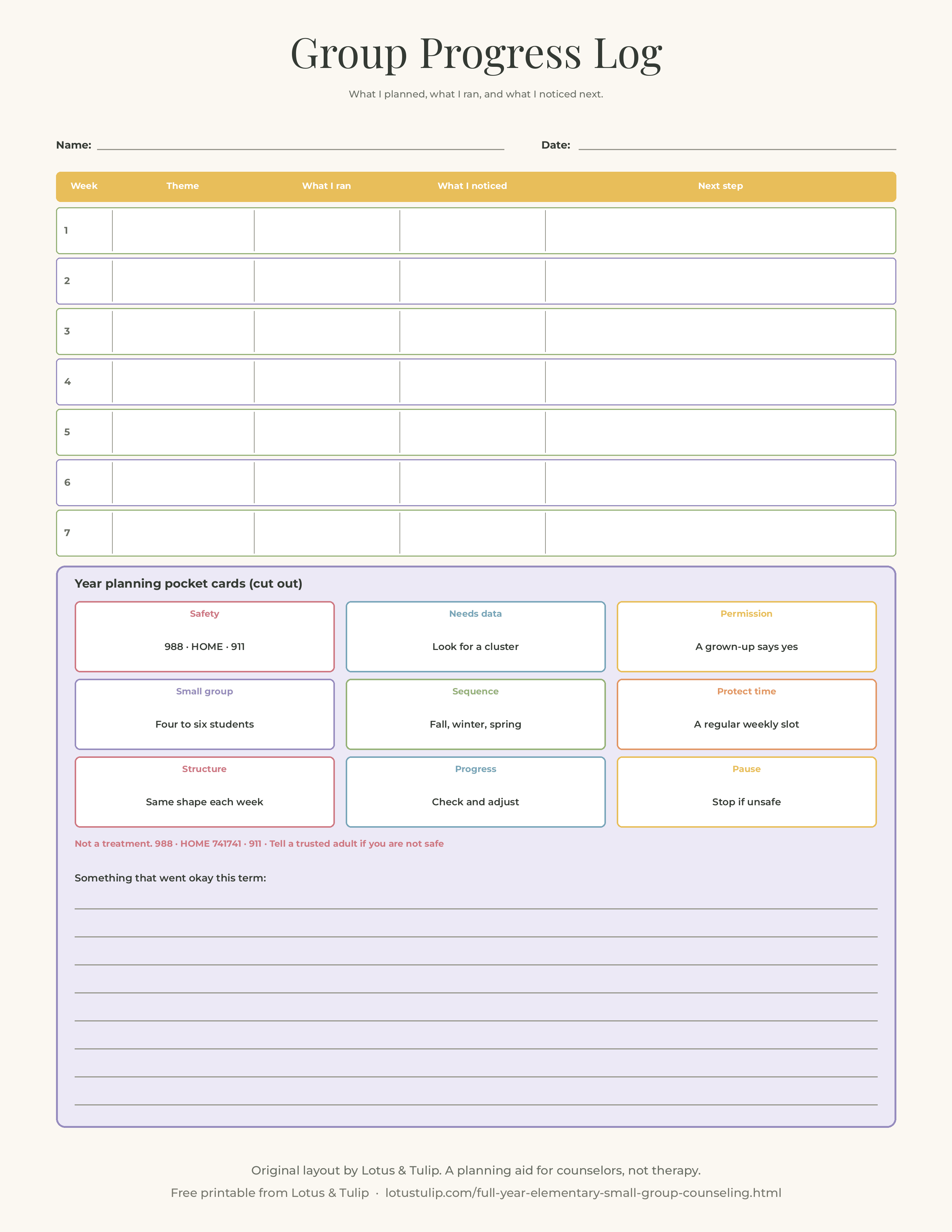
- Page 3: Group Progress Log. Seven rows for the group or week, the theme, what you ran, what you noticed and a next step, plus nine pocket cards you can keep with your planner.
Download free PDF · Page 1 PNG · Page 2 PNG · Page 3 PNG
Research notes (verified, with caveats)
- American School Counselor Association. The School Counselor and Multitiered System of Supports (adopted 2008, revised 2014, 2018, 2021). Wording verified from the official schoolcounselor.org position statement includes this alignment: Tier 1 interventions in the form of classroom instruction and schoolwide programming and initiatives; Tier 2 interventions including small-group and individual counseling, consultation and collaboration with school personnel, families and community stakeholders; and Tier 3 indirect student support services through consultation, collaboration and facilitation of referrals (citing Goodman-Scott et al., 2020). In Tier 2, the statement describes targeted group counseling and individualized interventions such as check in, check out. It also states that the school counselor engages as part of the leadership team in MTSS but should not be the sole leader of MTSS in the building. No ASCA affiliation. This describes how school counseling work can align with MTSS. It is not an effect size for any curriculum bundle.
- American School Counselor Association. The School Counselor and Group Counseling (adopted 1989; revised through later reviews, including a 2026 review on the official page). The statement calls group counseling a vital direct service and says groups should help students overcome issues impeding achievement or success, help them identify problems, causes, alternatives and possible consequences, and be planned, goal-focused, evidence-based and short-term. It says school counselors have a responsibility to screen potential group members and obtain informed consent, including the group's purpose and goals, limits to confidentiality and information regarding voluntary participation, and that best practices include informing parents or guardians and following school and district policy. When students need long-term counseling or family therapy, school counselors make referrals to community resources. No ASCA affiliation. "Evidence-based" here is ASCA's practice language. It does not mean the printable on this page, or any paid kit named here, has been tested in a randomized trial.
- American School Counselor Association. ASCA Student Standards: Mindsets and Behaviors for Student Success (2021). Wording verified from the official schoolcounselor.org PDF includes M 1, Belief in development of whole self, including a healthy balance of mental, social/emotional and physical well-being; B-SMS 2, Self-discipline and self-control; B-SMS 7, Effective coping skills; and B-SS 2, Positive, respectful and supportive relationships with students who are similar to and different from them. No ASCA affiliation.
- American School Counselor Association. Student-to-school-counselor ratios, calculated from U.S. Department of Education National Center for Education Statistics data. ASCA has recommended a 250 to 1 ratio since 1965. ASCA reported a national average of 376 to 1 for 2023-2024 (press release dated December 9, 2024) and 372 to 1 for 2024-2025 on its School Counselor Roles and Ratios page. In the 35 states that report elementary and middle school counselors separately, ASCA estimated elementary and middle school ranges of about 581 to 1 through 702 to 1 for 2023-2024 and about 571 to 1 through 694 to 1 for 2024-2025. Those ranges are not a complete national elementary figure, because not every state reports that split. They are included here because they match the caseload many elementary counselors describe. High ratios are a planning constraint. They are not a reason to skip groups or a claim that smaller ratios were measured as an outcome of this year plan.
- CASEL. CASEL's SEL Framework (2020). Self-awareness is described as the abilities to understand one's own emotions, thoughts and values and how they influence behavior across contexts, including identifying one's emotions. Self-management is described as the abilities to manage one's emotions, thoughts and behaviors effectively in different situations and to achieve goals and aspirations, including managing one's emotions and identifying and using stress-management strategies. The framework also names social awareness, relationship skills and responsible decision-making. No CASEL affiliation. These are definitions you can map a group theme to. They are not evidence that a year of pull-out groups produces a known effect size.
- Durlak JA, Weissberg RP, Dymnicki AB, Taylor RD, Schellinger KB. The impact of enhancing students' social and emotional learning: a meta-analysis of school-based universal interventions. Child Development. 2011;82(1):405-432. Across 213 universal school-based SEL programs and 270,034 kindergarten through high school students, participants showed improved social and emotional skills, attitudes, behavior and academic performance, including an 11 percentile point gain in achievement compared with controls. The authors also reported that four recommended skill-development practices (often summarized as sequenced, active, focused and explicit) and the presence of implementation problems moderated outcomes. That describes classroom-wide programs offered to all students in participating classes or schools, not a 20 to 40 minute counselor group of four to six students, and not a year-long sequence of pull-out groups.
- Taylor RD, Oberle E, Durlak JA, Weissberg RP. Promoting positive youth development through school-based social and emotional learning interventions: a meta-analysis of follow-up effects. Child Development. 2017;88(4):1156-1171. Across 82 universal school-based SEL interventions and 97,406 kindergarten to high school students (mean age 11.09 years; 38 interventions outside the United States), follow-up from 6 months to 18 years showed that participants fared significantly better than controls in social-emotional skills, attitudes and indicators of well-being. Benefits were similar regardless of students' race, socioeconomic background or school location. Postintervention social-emotional skill development was the strongest predictor of well-being at follow-up. This is evidence about universal programs over time, not about this pull-out year plan.
Classroom programs such as Second Step and other named SEL curricula teach related skills at a universal (Tier 1) level. This page is not affiliated with those programs and does not reproduce their lessons. A counselor group of four to six students is a different job than a classroom curriculum, and a year map is a different job than a single eight session series.
The planning ideas on this page are original practice suggestions drawn from themes these sources share: use data, screen, get permission, keep groups short and planned, treat small groups as targeted Tier 2 support rather than as the whole counseling program, and do not claim a treatment effect you have not measured. They have not been tested as a package in a randomized trial, they are not a manualized protocol, and they are not a treatment claim for any bundle of curricula.
Full year elementary small group counseling: FAQ
What is full year elementary small group counseling?
It is a plan for running a few short Tier 2 skill groups across the school year, usually with about four to six elementary students per group and about eight sessions per series. It includes screening, permission, a sequence across fall, winter and spring, progress checks and a clear list of when a group is the wrong tool. It is not a promise to run ten groups, and it is not a classroom SEL curriculum.
How many small groups can one elementary counselor realistically run in a year?
Many counselors with large caseloads can finish about three to five strong series if they protect regular time blocks and do not start groups during setup, testing or the last days of school. ASCA recommends 250 students per counselor, while recent national averages have been about 372 to 376 students per counselor, and estimated elementary and middle school ranges in reporting states have been much higher. Fit the number to your protected time, not to the number of curricula on your shelf.
What size and length should each elementary group be?
Four to six students is a workable size. Many counselors plan about eight sessions. Younger students often do better with 20 to 30 minutes. Grades 3 to 5 can often use 30 to 40 minutes. If you have fewer weeks, keep fewer goals and repeat the same skills. These are practice guidelines, not a proven dose from a trial of this page.
How do I decide which group to run first?
Look for a cluster of students who share a theme and a grade band, after you have ruled out crisis, suspected abuse and needs that belong in a classroom lesson or an individual referral. Foundational skills such as K-2 feelings and coping or grades 2 to 5 social skills are common early-year choices once permission is back. Worry, anger, friendship, self esteem, growth mindset, changing families and grief belong where the data support them, not where the calendar looks empty.
Do I need parent or guardian permission for a school counseling group?
Follow your school and district policy. ASCA's group counseling position statement says school counselors should screen members and obtain informed consent, including purpose, goals, limits to confidentiality and the fact that participation is voluntary, and that best practice includes informing parents or guardians. A plain language letter is kinder than a clinical label. If your district requires a signed slip, send it before you start counting sessions.
Does research show that a year of counselor small groups works?
There is good evidence that universal school SEL programs can help students in general, and ASCA describes planned, short-term, screened small groups as a core Tier 2 practice. There is not a single gold standard trial that proves this year-planning method, or any particular curriculum bundle, produces a known effect size. Treat the year plan as organized skill practice and support, not as a cure and not as a treatment claim.
What should I do if a child shares something unsafe in group?
Calmly pause the activity, thank the child and talk with them privately right away. Follow your school's crisis or mandated reporting procedure. If a child talks about suicide or self-harm, call or text 988, text HOME to 741741 and call 911 if there is immediate danger. If a child describes abuse or feeling unsafe at home, report as required. Use a written safety plan when it fits. Do not ask the child to repeat the story to the group, and do not keep them in a skills series as if nothing happened.
Is the free printable a copy of the paid full year bundle?
No. The free three page set is an original companion with year planning steps, a year planner and a progress log. The paid full year bundle is ten elementary group curricula in one download. The printable is not a preview of that PDF.