
Kids and teens · Updated 2026-11-07
Self Advocacy Activities for Students (with Free Printable)
Ready-made printable: Middle School Self Esteem Group Curriculum Holiday 20% off: about $11.04, was $14 (EUR 12) · instant digital download
Buy on EtsyTry it free first: download session 1 free (group at a glance, lesson plan and student page, PDF, 76 KB). Run it with your group, then get all 8 sessions. No email needed.

Self advocacy activities for students are short, practical rounds that help middle and high school students understand how they learn, know what supports they have, decide what to ask for, pick a good time and place to ask, use a simple script, practice with low stakes first, follow up when the answer is "not yet," and take a real role in their own IEP, 504 or student conference. This guide gives school counselors, special education teachers, school psychologists, therapists, teachers and parents twelve activities you can run tomorrow: a strengths and needs inventory, an "about me as a learner" one pager, an accommodations versus modifications sort, a know your plan scavenger hunt, a four part ask script, a teacher email draft, a role play ladder, a timing and place check, a "what if they say no" plan, student led meeting practice, a disclosure decisions talk and a high school to college rehearsal. Each comes with timing, setup, debrief and adaptations, plus a free three page printable.
Self advocacy matters for every student, not only students with an IEP or a 504 plan. A twelve year old who cannot see the board from the back row, a fifteen year old with ADHD whose extended time never seems to happen, a sixteen year old English learner who nods along while lost, and a seventeen year old about to leave the IEP system for college all need the same core skill: know what helps, say it clearly, and keep going when the first ask does not work. This page sits next to our assertiveness worksheet (assertive versus passive or aggressive communication in general), communication skills activities for teens, boundaries activities for teens, DEAR MAN worksheet, I statements worksheet, study skills activities for teens, executive functioning worksheets for kids and social anxiety worksheets for teens. Those pages go deep on neighboring skills. This one is about the self advocacy loop itself: know me, know my supports, plan the ask, ask, follow up and reflect.
We credit the sources these activities lean on, without claiming any affiliation or endorsement: the conceptual framework of self advocacy by Test, Fowler, Wood, Brewer and Eddy (2005) in Remedial and Special Education, the direct observation study of IEP meetings by Martin and colleagues (2006) in Exceptional Children, self determination research by Shogren, Wehmeyer and colleagues (2015) in the Journal of Special Education, the US Individuals with Disabilities Education Act (IDEA) regulations on transition planning, the US Department of Education Office for Civil Rights guide for students preparing for postsecondary education, and the ASCA Mindsets and Behaviors social skills standard on advocacy. The printable is an original Lotus and Tulip layout, not a copy of any of their materials.
This guide is educational. It is not legal advice, not therapy and not a diagnosis. It does not replace a student's IEP team, 504 team or a special education advocate. If a self advocacy conversation turns up thoughts of ending a life, self harm, a plan to hurt someone, abuse or a medical emergency, stop the activity and get help now: in the US, call or text 988 (Suicide and Crisis Lifeline), text HOME to 741741 (Crisis Text Line), or call 911. Our safety plan worksheet is a better first tool in that moment. If a student discloses abuse or that an adult is hurting them, that is not a self advocacy practice moment; follow your mandated reporting duties.
Jump to the free self advocacy printable (PDF) · Activities · How to use self advocacy activities for students, step by step · Worked examples · Comparisons
What self advocacy is (and is not)
For this page, self advocacy means a student understanding their own strengths and needs, knowing what supports and rights they have, and communicating clearly and respectfully to get what they need to learn and take part. Test and colleagues (2005) describe four parts: knowledge of self, knowledge of rights, communication and leadership. The activities below follow that order. A useful student self advocacy plan names one strength, one thing that is hard, one support that helps, one person to ask, one script and one follow up step.
It is not:
- Demanding or arguing. Self advocacy is clear and respectful. It is closer to assertive communication than to winning a fight. A student who shouts "you have to give me extra time" in front of the class is likely to get a worse result than one who asks after class with a short script. See the assertiveness worksheet for the passive, aggressive and assertive contrast.
- Only for students with disabilities. Self advocacy skills are central in special education transition planning, and they also help any student who needs to ask for clarification, a seat change, extra practice or a deadline conversation.
- Making the student do the adults' job. Teaching a teen to ask for an accommodation does not shift responsibility for a legally required IEP or 504 service onto the teen. Schools still have to implement the plan. Self advocacy adds the student's voice; it does not remove adult duties.
- Forcing disclosure. Students get to choose what they share about a diagnosis, and with whom. A good self advocacy lesson teaches students to describe what helps ("I learn better with written directions") without requiring them to name a label in front of peers.
- Legal advice or a substitute for an advocate. This page explains general ideas in plain language. When a family is in a dispute about services, they should look to their state parent training and information center, the school's procedural safeguards notice or a qualified advocate or attorney.
- A treatment. Self advocacy practice does not treat anxiety, depression, ADHD or a learning disability. Students whose fear of speaking up is intense may need support for social anxiety first or alongside.
Why students need explicit self advocacy teaching
Attending a meeting is not the same as participating. Martin and colleagues (2006) observed 109 middle and high school IEP meetings. Special education teachers talked in 51 percent of the observed intervals, family members in 15 percent, and students in only 3 percent. Students rarely showed leadership behavior. The authors concluded that students need to be taught meeting participation skills on purpose. Hoping a teen will "pick it up" by sitting in the room usually does not work.
The rules change after high school. In K to 12, schools have a duty to identify and evaluate students who may have a disability and to provide services. The US Department of Education Office for Civil Rights explains that at the postsecondary level the student generally has to identify themselves to the college's disability services office, provide documentation and request accommodations. A college is not required to find the student. That shift catches many students off guard in their first semester.
IDEA builds the student's voice into transition planning. Under the IDEA regulations, the IEP in effect when a student turns 16 (or younger if the state or team decides) must include measurable postsecondary goals and transition services, and the school must invite the student to IEP meetings where transition is discussed. In states where rights transfer to the student at the age of majority, the IEP must note, at least one year before, that the student has been told about that transfer. Students who have practiced self advocacy are better prepared for that handover.
Self determination is linked to later outcomes. Shogren and colleagues (2015) followed 779 students with disabilities and found that higher self determination at the end of high school predicted better employment and community access one year after school. That is a correlational follow up, not proof that any single worksheet causes better outcomes, but it supports building these skills during the school years.
Counselors already have this in their standards. ASCA Mindsets and Behaviors include a social skills behavior on demonstrating advocacy skills and the ability to assert self when necessary, and on creating relationships with adults that support success. Self advocacy activities fit classroom lessons, small groups and individual planning, not only special education settings.
Self advocacy activities students will actually do
Each activity lists time, group size, setup and debrief. Run one or two per session. The first four build knowledge of self and knowledge of supports, the middle ones build communication, and the last ones build leadership and transition readiness.
1. Strengths and needs inventory
Time: 15 minutes. Group: individual, then pairs. Setup: two columns titled "What I am good at" and "What is hard for me," plus a third column "What helps."
Students list at least three strengths (school and non school), three things that are hard, and anything that has helped in the past: sitting near the front, written steps, a quiet place to test, breaks, a checklist, a calculator, extra time, a check in with an adult. Pairs share one strength each, not the hard column, unless they choose to. Debrief: you cannot ask for what helps until you can name it. Teaching point: strengths come first so the hard column does not become a shame list. Pair with self esteem activities for teens if a student cannot name any strength.
2. "About me as a learner" one pager
Time: 20 minutes. Group: individual. Students turn the inventory into a short page they could hand to a new teacher: "I learn best when... It is hard for me when... It helps me if... You can help by... The best way to reach me is..." Keep it to five sentences and plain words. Debrief: would a substitute teacher understand this in one minute? Teaching point: a one pager is a tool students can bring to a new class, a meeting or a job. Students choose whether to name a diagnosis; describing what helps is enough.
3. Accommodations versus modifications sort
Time: 15 minutes. Group: small groups. Setup: cards with supports such as extended time, audio version of a text, preferential seating, fewer answer choices, shortened assignment with a different standard, use of a calculator, breaks, a different grading rubric, copies of class notes.
Groups sort the cards into "changes how I learn or show what I know" (accommodation) and "changes what I am expected to learn or show" (modification). Some cards are debatable, which is the point. Debrief: why does the difference matter for diplomas, college and work? Teaching point: students who know the words can ask more precisely. Keep this general and check local policy before telling a student what their own plan allows.
4. Know your plan scavenger hunt
Time: 20 minutes. Group: individual with a case manager or counselor. For students with an IEP or 504 plan, sit together with a student friendly copy and find: my goals, my accommodations, who my case manager is, when my next meeting is, and one support I am not using yet. For students without a plan, the hunt covers school supports anyone can use: tutoring hours, the counselor's office, the library, teacher office hours, the online grade portal. Debrief: what surprised you? Teaching point: many students have never read their own plan. Keep the copy private and handle it under school confidentiality rules.
5. The four part ask script
Time: 15 minutes. Group: whole class, then pairs. Teach a simple frame: Greet ("Hi Ms. Lopez, do you have a minute?"), Name the need ("I have a hard time copying notes from the board fast enough"), Ask ("Could I get a copy of the slides after class?"), Confirm and thank ("So I can check the class page on Fridays? Thank you."). Pairs write two scripts for made up situations, then one for a real situation if they want. Debrief: which part was hardest to say? Teaching point: short and specific beats long and apologetic. Students who need more structure can borrow the DEAR MAN frame for higher stakes asks.
6. Teacher email draft
Time: 15 minutes. Group: individual. Students draft a short email with a clear subject line ("Question about Friday's quiz, period 3"), a greeting, one or two sentences about the need, a specific ask, and a thank you with their name and class period. Review with a partner for tone: polite, clear, not overly casual, no all caps. Debrief: email is often easier for anxious students and leaves a written record. Teaching point: an email can be sent after school and does not require a perfect speech in the moment. Do not send real emails during the activity unless the student chooses to and an adult is present to support.
7. Role play ladder
Time: 20 minutes. Group: pairs or triads. Build a ladder from easy to harder asks: asking a friend to repeat a homework page number, asking a teacher to repeat directions, asking for a seat change, asking for extra time on a project, asking for an accommodation that was missed, speaking up in a meeting with several adults. Students practice from the bottom rung up, switching roles as student, adult and observer. Observers note one thing that worked (eye contact, clear ask, calm voice). Debrief: which rung is next for you in real life? Teaching point: confidence grows from small real wins, not from one huge leap. For students with strong social fear, keep rungs very small and pair with social anxiety worksheets for teens.
8. Timing and place check
Time: 10 minutes. Group: small groups. Give scenarios and ask, "Is this a good time and place to ask?" Examples: in the middle of a test in front of everyone, right after class when the teacher is free, by email the night before a test, during office hours, while the teacher is breaking up a hallway argument, at a planned check in with the case manager. Debrief: the same ask can land very differently depending on timing. Teaching point: plan when and where, not only what. Most asks go better ahead of time than in the moment of need.
9. "What if they say no or not yet" plan
Time: 15 minutes. Group: individual or pairs. Students plan three responses: ask a clarifying question ("What could work instead?"), restate the need calmly once, and name the next person to talk to (counselor, case manager, parent or guardian). Write a simple escalation path for your school. Debrief: a no is information, not the end. Teaching point: following up through the right person is still self advocacy. If an IEP or 504 accommodation is not being implemented, the student and family should bring it to the case manager or 504 coordinator; that is an adult team issue to solve.
10. Student led meeting practice
Time: 25 minutes, across one or two sessions. Group: individual or small group. Students practice the parts of a meeting they could lead: introducing everyone, stating the purpose, sharing strengths and interests, reviewing progress on a goal in their own words, saying what helps, asking a question and closing. Start with one part (for example, sharing strengths) and add more over time. Use a fictional student first, then the student's own meeting if they want. Debrief: what part do you want to lead at your next meeting? Teaching point: Martin and colleagues found students talked only 3 percent of the time in teacher directed meetings; practice is how that number goes up. Coordinate with the case manager so the meeting plan matches.
11. Disclosure decisions talk
Time: 15 minutes. Group: individual, or small group with clear privacy norms. Explore four questions: who needs to know (a teacher, a coach, a boss, a friend), what to share (a need, a strategy, a label, or nothing), when (before a problem, at the start of a course, never) and why (to get a support, to explain behavior, to build trust). Debrief: there is no single right answer, and the choice belongs to the student, with parents and the team as support. Teaching point: describing a need is often enough; naming a diagnosis is a choice, not a requirement in most everyday situations.
12. High school to college or work rehearsal
Time: 20 minutes. Group: juniors and seniors, individual or small group. Compare high school and after high school in a simple table: who identifies the need, who asks for supports, what documentation is needed, who talks to instructors. Then rehearse a short first visit to a college disability services office or a conversation with a new supervisor. Debrief: what do you need to gather before graduation (recent evaluation, plan copy, a list of what helps)? Teaching point: the OCR guide for students preparing for postsecondary education makes clear that students usually have to identify themselves and request accommodations in college. Practice now so the first ask is not in the middle of a hard semester.
How to run these activities in a group or session
Set norms first. Pass is always allowed. Nobody has to share a diagnosis or an IEP or 504 status. Practice on made up situations before real ones. No laughing at anyone's needs. Teachers and counselors model a request of their own ("I asked my principal for a quieter room for testing") so asking for help looks normal. End each session with one carry over: one real ask, one email draft or one meeting part to practice.
Suggested six session sequence. Session 1: strengths and needs inventory and the learner one pager. Session 2: accommodations versus modifications sort and know your plan (or know your school supports). Session 3: the four part ask script and the teacher email draft. Session 4: the role play ladder and timing and place check. Session 5: "what if they say no" and disclosure decisions. Session 6: student led meeting practice, transition rehearsal for older students, and review of the practice log.
Classroom version. In one advisory lesson, run a short strengths and needs inventory (10 minutes), teach the four part ask script with two quick role plays (20 minutes) and have each student write one real ask they could make this week (10 minutes). Send the printable home. That covers knowing yourself, communicating and one real carry over in under 45 minutes.
Adaptations
- Middle school (about 11 to 14): focus on everyday asks (repeat directions, seat change, help with a locker or schedule), shorter scripts, sentence frames and more role play. Keep the meeting practice to one part, such as sharing strengths.
- High school (about 14 to 18): add transition goals, student led meetings, email to multiple teachers, jobs and college planning, and the disclosure talk.
- Students with an IEP or 504 plan: coordinate with the case manager, use a student friendly summary of the plan, and plan meeting roles ahead of time. Do not expect the student to enforce their own plan alone.
- Autistic students and students with communication differences: offer written scripts, visual cue cards, email or typed options, and practice with predictable steps. Respect different eye contact and communication styles; the goal is clear communication, not looking a certain way. Pair with a social story template for a new situation such as a first meeting.
- Anxious students: start with email and very low rungs on the ladder, let them rehearse with a trusted adult, and celebrate partial wins. Link to anxiety activities for teens when worry is broader than school asks.
- English learners: allow first language drafts, offer bilingual sentence frames, and practice asking for clarification ("Can you say that another way?") as a core skill.
- Virtual groups: shared script templates, chat based role plays, and private messages for the real ask planning.
How to use self advocacy activities for students, step by step
- Safety sort. Check that this is a self advocacy question and not a crisis. Thoughts of ending a life, self harm, a plan to hurt someone, abuse or a medical emergency come first: 988, HOME to 741741, or 911 when needed, plus a safety plan, a trusted adult and mandated reporting where it applies.
- Know me. Name strengths, what is hard and what has helped. Write a short "about me as a learner" summary in plain words.
- Know my supports. Read a student friendly version of the IEP or 504 plan if there is one, or list the school supports anyone can use. Know who the case manager, counselor or go to adult is.
- Pick the ask. Choose one specific need and one specific request. "I need help" becomes "Could I get the directions in writing?"
- Pick the time, place and way. After class, office hours, email or a planned check in usually beats the middle of a test or a busy hallway.
- Use a script. Greet, name the need, ask, confirm and thank. Write it down if that helps.
- Practice first. Role play with a peer or adult, starting with easier asks and moving up the ladder.
- Ask and follow up. Make the real ask. If the answer is no or not yet, ask what could work instead and bring in the next person on the escalation path.
- Reflect and grow. Log who you asked, what you asked for, the result and your confidence. Plan the next ask, and work toward leading part of your own meeting.
Practice on small asks first. The skills a student builds asking for a repeated direction are the same ones they will use in an IEP meeting, a college disability services office or a first job.
School counselor, special education, therapist, teacher and parent tips
School counselors. Self advocacy fits advisory lessons, transition and postsecondary planning, small groups and individual planning, and sits near the ASCA social skills standard on advocacy. Use the learner one pager in schedule changes and new school transitions. Keep diagnosis talk private and follow district protocols for crisis and reporting.
Special education teachers and case managers. Build student participation into each IEP meeting a little more every year: first the student shares strengths, then progress on one goal, then leads the introductions and a section. Share a student friendly summary of the plan. Prepare general education teachers so a student's ask is welcomed, not treated as a challenge.
Therapists. Use the ask script and role play ladder for school, work and medical settings. Watch for students whose fear of speaking up is part of social anxiety, trauma or depression and treat that directly. Coordinate with the school with consent when supports are not being implemented.
Teachers. Tell students how and when they can ask for help (after class, a sticky note on your desk, email, office hours). Respond to a respectful ask with thanks, even if the answer is "let me check." A student who gets a cold response after their first ask may not try again for months.
Parents and caregivers. Let your teen speak first in meetings and with teachers when they can, and back them up instead of taking over. Practice a script at home. Before graduation, help your teen gather documents such as a recent evaluation and plan copy. For disputes about services, look to your state parent training and information center and your procedural safeguards notice.
Worked fictional examples
The front row ask (fictional). Mia, 12, could not read the board from the back and was copying notes wrong. In the four part ask script activity she wrote: "Hi Mr. Grant, do you have a minute? I can't see the board well from the back. Could I sit closer? Thanks." She practiced twice and asked after class on Tuesday. Carry over: one small ask fixed a problem she had lived with for weeks.
The missing extended time (fictional). Andre, 15, has extended time in his 504 plan but kept getting quizzes back half finished. He was embarrassed to bring it up. In the "what if they say no" activity he planned to email the teacher, then talk to his 504 coordinator if nothing changed. The teacher replied that she had missed the note and set up a plan. Carry over: the email gave Andre a calm way to ask, and the follow up path meant he was not alone.
First time leading part of a meeting (fictional). Rosa, 16, had attended her IEP meetings for years without talking. After two student led meeting practice sessions she opened her meeting, introduced everyone and shared three strengths and one transition goal. Her case manager noticed she also asked a question at the end. Carry over: small, planned roles made speaking up possible.
College rehearsal (fictional). Jordan, 17, assumed his supports would follow him to college automatically. In the high school to college rehearsal he learned he would need to contact the disability services office himself and bring documentation. He made a list and asked his school psychologist about getting his evaluation updated before graduation. Carry over: knowing the rules early turned a possible first semester crisis into a checklist.
Counselor small group note (fictional). In a six session ninth grade self advocacy group, a counselor used made up situations for the first three sessions. By session five, every student had made at least one real ask and logged it. No one was asked to share a diagnosis. One student shared worries that went beyond school; the counselor followed up privately and used school protocol.
Self advocacy activities vs assertiveness, communication skills, boundaries, DEAR MAN, study skills and social anxiety
| Self advocacy activities (this page) | Assertiveness worksheet | Communication skills teens | Boundaries teens | DEAR MAN | Study skills teens | Social anxiety teens | |
|---|---|---|---|---|---|---|---|
| Main job | Know me, know my supports, plan and make an ask, follow up, lead my meeting | Assertive vs passive or aggressive communication | Listening, speaking and repair skills | Limits with peers, family and online | Structured DBT request script | Learning habits and practice | Fear of judgment and gentle facing |
| Best early use | Missed supports, new teachers, IEP or 504 meetings, transition to college or work | When the style of speaking up is the main issue | When everyday conversation is the main gap | When others push past limits | For higher stakes asks | When study methods are the main gap | When fear blocks asking at all |
| Output | Self advocacy plan, practice log, mini card | Assertive statements | Communication practice | Boundaries plan | DEAR MAN script | Study skills plan | Social anxiety practice |
| Link | This page | Assertiveness | Communication teens | Boundaries teens | DEAR MAN | Study skills teens | Social anxiety teens |
These tools work together. Self advocacy is the "know what I need and ask for it" layer. When the main problem is speaking style, everyday conversation, limits with others, a high stakes script, study methods or fear of judgment, go to the matching page.
What helps vs common myths
What often helps: naming strengths before needs, student friendly plan summaries, short written scripts, email as an option, practice from easy to hard asks, clear escalation paths, adults who respond warmly to the first ask, and growing student roles in meetings year by year.
Common myths: "If they need something, they will ask." (Many students do not know what to ask for or fear the response.) "Self advocacy means arguing with teachers." (It means clear, respectful requests.) "Students with an IEP do not need to advocate because the plan covers it." (Plans still need the student's voice, and the rules change after high school.) "Asking for help is a sign of weakness." (Knowing what helps you is a strength that adults use every day at work.)
Common mistakes
- Starting with the hardest ask. Begin with small, likely wins before a meeting with six adults.
- Making the student enforce the plan alone. Self advocacy supports the plan; adults still implement it.
- Requiring disclosure in a group. Let students describe needs without naming a label.
- Only teaching scripts, never real asks. Role play matters, and so does a supported real try with a log.
- Forgetting the adult side. Prepare teachers to respond well, or the first real ask may be the last.
- Waiting until senior year. Transition planning starts by 16 under IDEA; self advocacy practice can start in middle school.
When self advocacy activities are not the right tool
- Crisis or safety concerns. Thoughts of ending a life, self harm, a plan to hurt someone or abuse come first. Use 988, HOME to 741741 or 911, a safety plan and your reporting protocol.
- A legal or services dispute. If the family believes the school is not providing required services, the right next steps are the IEP or 504 team, the procedural safeguards notice, the state parent training and information center, or a qualified advocate or attorney. A student worksheet is not the fix.
- Intense fear of speaking up. If a student freezes or panics at any ask, work on social anxiety or anxiety skills first or alongside.
- A possible unidentified disability. If struggles look like a possible learning disability, ADHD or other need, the school's evaluation process comes before asking a student to advocate for supports they do not yet have.
What the research says (honestly)
A framework for self advocacy. Test, Fowler, Wood, Brewer and Eddy (2005) reviewed the literature and proposed a conceptual framework of self advocacy for students with disabilities with four components: knowledge of self, knowledge of rights, communication and leadership. Knowledge of self and rights are described as the foundation, communication as how the student shares that knowledge, and leadership as moving from advocating for oneself to advocating for others and taking part in groups. The activities on this page follow that order. Lotus and Tulip is not affiliated with the authors or the journal.
Students talk very little in typical IEP meetings. Martin, Van Dycke, Greene, Gardner, Christensen, Woods and Lovett (2006) observed 109 middle and high school IEP meetings using 10 second interval sampling. Special education teachers talked 51 percent of the time, family members 15 percent, general educators and administrators 9 percent, support staff 6 percent and students 3 percent. Students seldom showed leadership behaviors and scored lower on meeting knowledge questions. The authors argued students need to be taught meeting participation skills.
Self determination and postschool outcomes. Shogren, Wehmeyer, Palmer, Rifenbark and Little (2015) followed 779 students with disabilities who had taken part in group randomized studies of self determination interventions. Self determination status at the end of high school predicted employment and community access one year after school. The relationships were complex (for example, no direct link was found to independent living or life satisfaction), so this is support for teaching these skills, not a promise about any one student or activity.
US law and guidance in plain words. The IDEA regulations (34 CFR 300.320 and 300.321) require transition goals and services in the IEP in effect when the student turns 16 (or younger if appropriate) and require that the student be invited to IEP meetings that consider transition. The regulations also describe notice about the transfer of rights at the age of majority in states that transfer rights. The US Department of Education Office for Civil Rights guide "Students with Disabilities Preparing for Postsecondary Education: Know Your Rights and Responsibilities" explains that postsecondary students generally must identify themselves and request academic adjustments. This page is a plain language summary, not legal advice; check current regulations and your state's rules.
School counseling standards. The ASCA Mindsets and Behaviors for Student Success include a social skills behavior: demonstrate advocacy skills and ability to assert self, when necessary. Lotus and Tulip is not affiliated with ASCA.
Honest limits. No study tests this three page printable or this activity set. Self advocacy programs in research vary widely. Treat this as a practical skill aid built on a well known framework and guidance, not a tested curriculum and not a treatment for any condition.
Free self advocacy printable for students (PDF)
The free self advocacy printable has three pages in US Letter size:
- Page 1: Student Self Advocacy Steps. Nine step card matching the HowTo above: safety sort, know me, know my supports, pick the ask, pick time and place, use a script, practice, ask and follow up, reflect. Includes a four part ask script example.
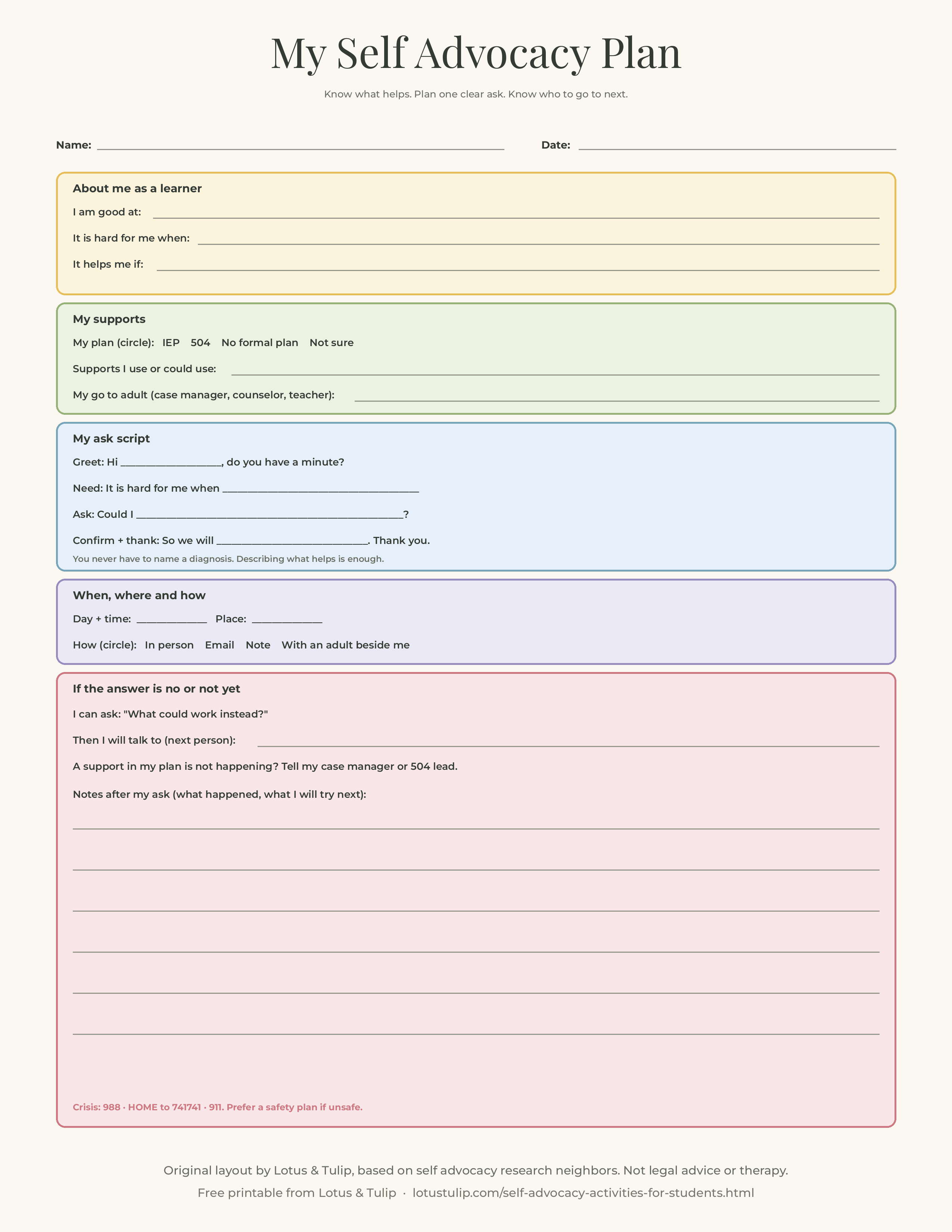
- Page 2: My Self Advocacy Plan. About me as a learner, my supports, my ask script, when and where, and what I will do if the answer is no or not yet.
- Page 3: Ask Practice Log + student mini card. Seven asks with who, what, how, result and a 0 to 5 confidence rating, plus a cut out reminder card.
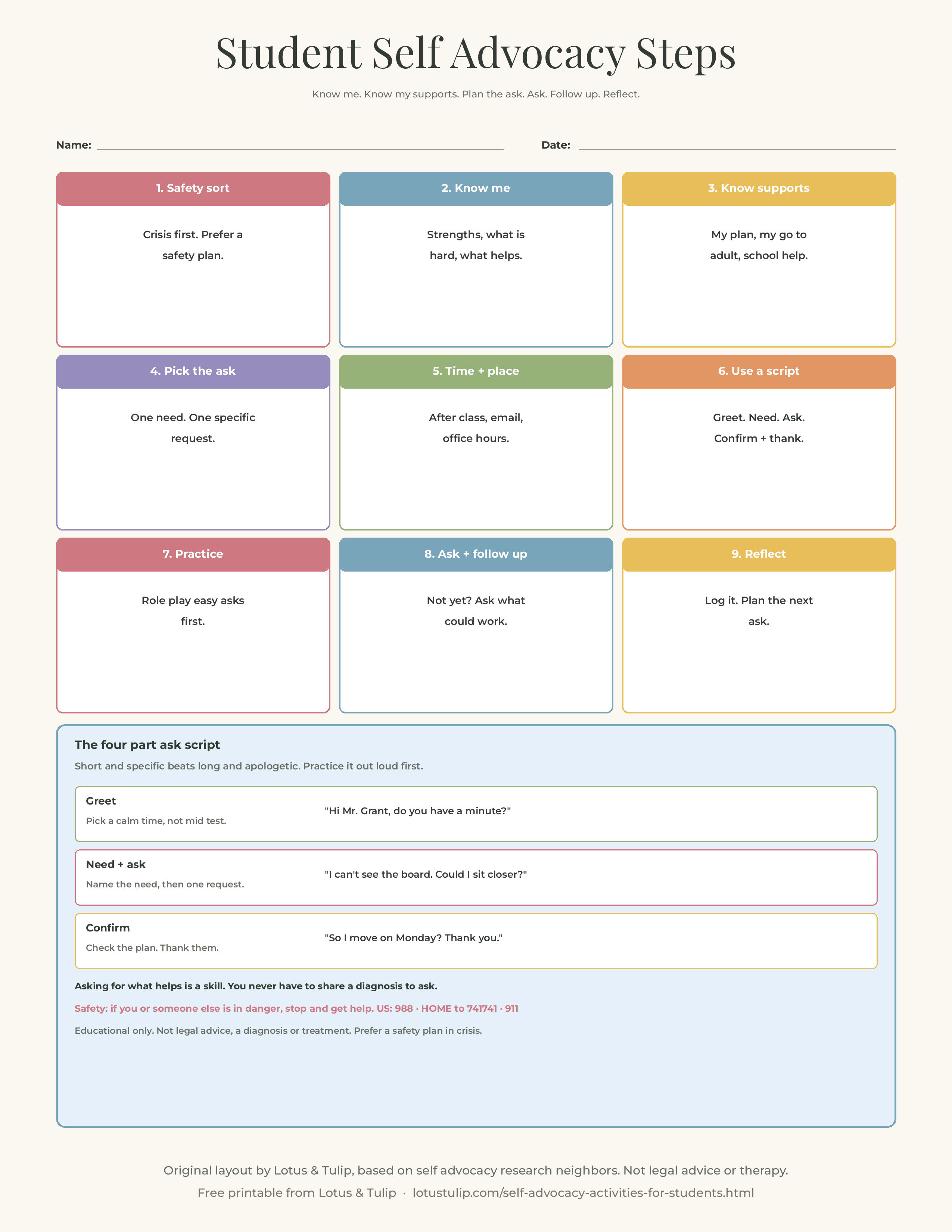
Download the free self advocacy printable for students (PDF, 3 pages, US Letter)
Prefer single images? Page 1: Student Self Advocacy Steps (PNG) · Page 2: My Self Advocacy Plan (PNG) · Page 3: Ask Practice Log (PNG)
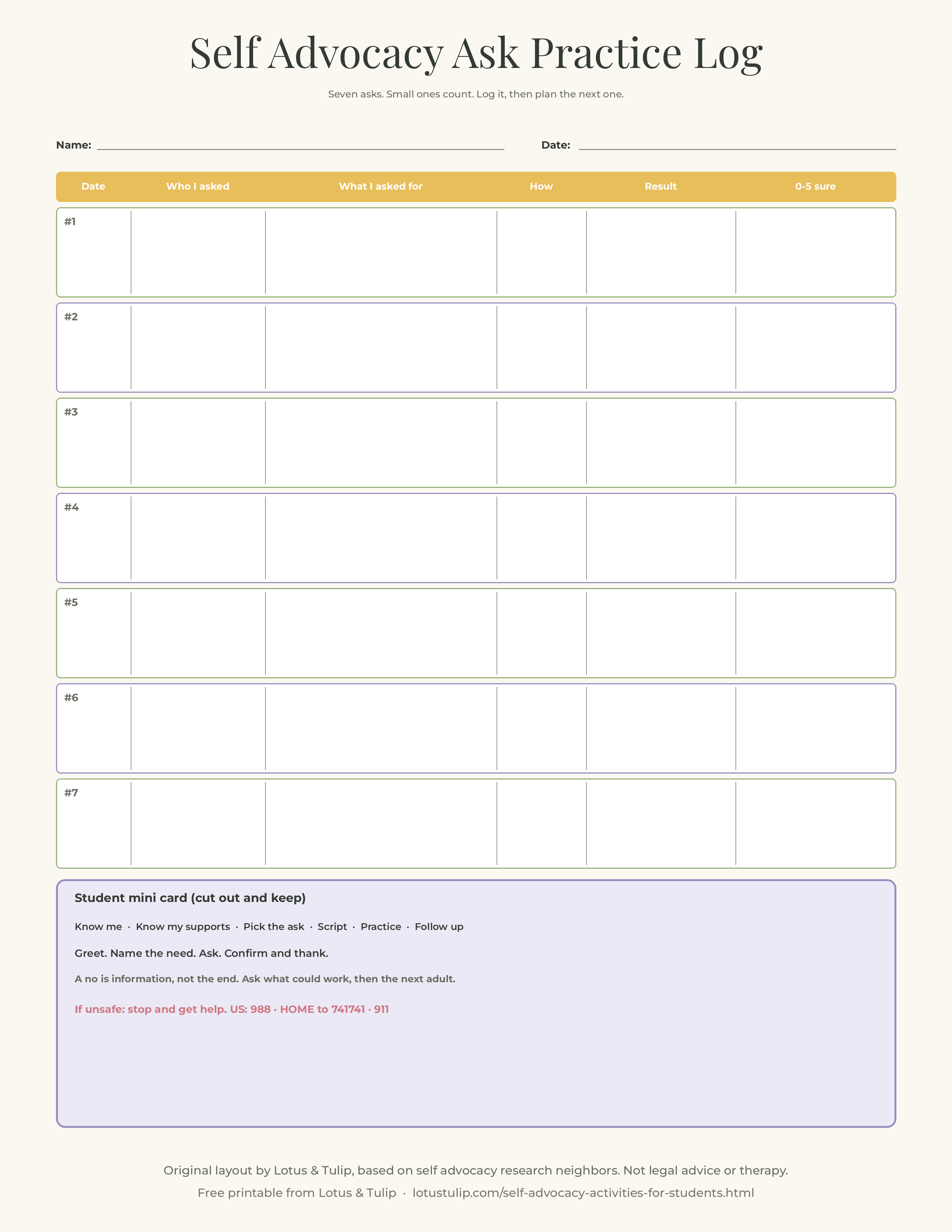
Free to print for your own use and for use with your own clients, students or groups. This is an original layout by Lotus & Tulip, drawing on a widely cited self advocacy framework (Test et al. 2005), IEP participation research and US guidance. It is not affiliated with any author, agency, organization or curriculum named on this page, is not legal advice, does not diagnose or treat any condition, and is not a substitute for an IEP or 504 team, therapy or medical care. Please link to this page rather than re-uploading the file.
Related resources
- Assertiveness worksheet: assertive versus passive or aggressive communication.
- Communication skills activities for teens: listening, speaking and repair.
- DEAR MAN worksheet: a structured script for higher stakes asks.
- I statements worksheet: naming needs without blame.
- Boundaries activities for teens: limits with peers, family and online.
- Study skills activities for teens: learning habits next to supports.
- Social anxiety worksheets for teens: when fear blocks asking.
- Goal setting worksheet for students: goals for meetings and transition.
- Safety plan worksheet: when the moment is about staying safe.
Sources
- Test, D. W., Fowler, C. H., Wood, W. M., Brewer, D. M., & Eddy, S. (2005). A conceptual framework of self-advocacy for students with disabilities. Remedial and Special Education, 26(1), 43 to 54.
- Martin, J. E., Van Dycke, J. L., Greene, B. A., Gardner, J. E., Christensen, W. R., Woods, L. L., & Lovett, D. L. (2006). Direct observation of teacher-directed IEP meetings: Establishing the need for student IEP meeting instruction. Exceptional Children, 72(2), 187 to 200.
- Shogren, K. A., Wehmeyer, M. L., Palmer, S. B., Rifenbark, G. G., & Little, T. D. (2015). Relationships between self-determination and postschool outcomes for youth with disabilities. The Journal of Special Education, 48(4), 256 to 267.
- Individuals with Disabilities Education Act regulations, 34 CFR 300.320 (definition of IEP, transition services) and 34 CFR 300.321 (IEP team, student invitation).
- US Department of Education, Office for Civil Rights. Students with Disabilities Preparing for Postsecondary Education: Know Your Rights and Responsibilities.
- American School Counselor Association. ASCA Mindsets and Behaviors for Student Success (social skills: advocacy skills and ability to assert self, when necessary).
Self advocacy activities for students: FAQ
What are self advocacy activities for students?
They are short practice rounds that help students know their strengths and needs, understand their supports, plan a clear ask, practice it, make it, follow up and reflect. They fit classrooms, small groups, special education settings and individual sessions.
What are the four parts of self advocacy?
Test and colleagues (2005) describe knowledge of self, knowledge of rights, communication and leadership. Students first understand themselves and their supports, then learn to communicate that, and over time take leadership roles such as leading part of their own IEP meeting.
How do I teach a student to ask for an accommodation?
Use a simple four part script: greet, name the need, ask for a specific support, then confirm and thank. Practice in role play first, pick a good time and place (after class, email or office hours) and plan what to do if the answer is no or not yet.
Is self advocacy only for students with an IEP or 504 plan?
No. It is central for students in special education and transition planning, and every student benefits from knowing how to ask for clarification, help or a change. The activities on this page work with or without a formal plan.
How can students take part in their IEP meetings?
Start small: introduce team members, share strengths, or describe progress on one goal in their own words. Add roles each year. Research by Martin and colleagues (2006) found students talked only about 3 percent of the time in typical meetings, so planned practice matters.
What changes about accommodations after high school?
According to the US Department of Education Office for Civil Rights, college students generally have to identify themselves to the disability services office, provide documentation and request accommodations. Colleges are not required to find students the way K to 12 schools must. Practicing self advocacy before graduation helps.
When are self advocacy activities not enough?
When there is crisis or self harm risk, abuse, a services dispute that needs the IEP or 504 team or an advocate, or fear so strong that a student cannot ask at all. In a crisis in the US, call or text 988, text HOME to 741741, or call 911, and use a safety plan.