
Kids and teens · Updated 2026-11-08
Girls Friendship Group Activities for Upper Elementary (with Free Printable)
Ready-made printable: Girls Friendship Group Curriculum Holiday 20% off: about $11.04, was $14 (EUR 12) · instant digital download
Buy on EtsyTry it free first: download session 1 free (group at a glance, lesson plan and student page, PDF, 72 KB). Run it with your group, then get all 8 sessions. No email needed.

Girls friendship group activities give upper elementary students a safe, structured place to talk about what a good friend looks and feels like, to name the quiet kinds of mean (leaving someone out, rumors, the silent treatment, group chat pile-ons), to cool down before replying, to check the facts before assuming the worst, to speak up with calm I-statements, to stand with a classmate who is being left out, and to repair after a friendship goes wrong. A good girls friendship group does not label anyone a "mean girl," does not try to force a broken friendship back together, and does not replace a bullying investigation. It is a practice space for friendship skills.
This guide is written for US elementary school counselors, and for the school social workers and school psychologists who run similar Tier 2 groups, who want to run an eight session friendship group for about grades 3 to 5, with four to six students and sessions of about 30 to 40 minutes. You will find a plain language explanation of what this kind of group can and cannot do, a careful note on why many counselors run it as a girls group and when they should not, how to tell rude, mean and bullying apart, twelve activities you can run (with time, group size, materials, steps and a debrief), an eight session starter plan, why January is a good launch window, a nine step HowTo, adaptations, tips for counselors, teachers and families, common mistakes, myths, three fictional examples, guidance on when not to use a group, verified research notes, eight FAQs and a free three page US Letter printable: Friendship Group Steps, My Friendship Plan and a Friendship Moments Log with nine pocket cards.
This page is the counselor small group how-to for upper elementary friendship drama and relational aggression. It sits beside, and does not replace, our social skills small group activities (joining, listening and repair for grades 2 to 5, any gender), friendship worksheets for kids (individual pages, not an eight session group), friendship activities for teens, bullying worksheets for kids, conflict resolution worksheet, I statements worksheet, self esteem small group activities, anger management small group activities and icebreaker activities for counseling groups. A comparison table further down shows which page fits which job. The matching product page is Girls Friendship Group Curriculum: Kind Circle.
We draw on published research and public guidance without claiming any affiliation or endorsement, including the CDC and US Department of Education uniform definition of bullying (Gladden and colleagues, 2014), Crick and Grotpeter (1995) on relational aggression, the Card, Stucky, Sawalani and Little (2008) meta-analysis on gender differences in indirect aggression, the Friend to Friend randomized trial (Leff and colleagues, 2015), National Center for Education Statistics bullying data, the CASEL SEL Framework and the ASCA Student Standards. Full citations and caveats are below. The printable is an original Lotus and Tulip layout, not a copy of any published program or paid curriculum.
This guide is educational. A friendship group does not diagnose a student, does not treat anxiety, depression or any other condition, and does not replace your school's bullying, harassment or Title IX procedures, individual counseling or outside therapy. The activities are skill practice aids for counselors, not a standalone trial and not a manualized protocol. They are not affiliated with ASCA, CASEL, the CDC, Friend to Friend or any named program. If a student is thinking about suicide or self-harm, call or text 988 (Suicide and Crisis Lifeline) or text HOME to 741741 (Crisis Text Line). For immediate danger, call 911. If a student describes abuse or neglect, or threatens to seriously hurt someone, stop the activity, follow your school's threat assessment and mandated reporting procedures, and use a written safety plan where it fits.
What a girls friendship group is (and is not)
Most upper elementary counselors know the pattern. A fourth grade teacher stops you in the hallway: three girls who were inseparable in September are now in a cold war. One has been left off a sleepover list and everyone knows it. Another sits alone at lunch because "they said I can't sit there." Notes are passing, a group chat started at home is now spilling into class, and a parent has emailed twice. Nobody hit anybody. Nobody swore. And yet a ten year old is crying in your office for the third time this month.
A girls friendship group is a short, structured series of sessions where four to six of these students practice the skills that healthy friendships need, with a caring adult, away from the audience of the whole class. In plain words, a good friendship group helps students:
- Know what a healthy friendship feels like. Students compare friend behaviors that feel safe and warm with behaviors that feel controlling, confusing or unkind, and they practice noticing their own gut feeling about a friendship.
- Name the quiet kinds of mean. Leaving someone out on purpose, spreading rumors, giving the silent treatment, "you can't be my friend if..." threats and mean group chat messages are real behaviors with real names. Naming them makes them easier to discuss and to report.
- Tell rude, mean and bullying apart. Not every hurt is bullying, and not every conflict is drama. Students learn the difference so they can choose a fitting response, and so adults hear the serious reports clearly.
- Cool down before they reply. A hot reply in the moment, at recess or in a chat, often turns a hurt into a war. Students practice a pause and a calming tool first.
- Check the facts. Many friendship fights start with a guess: "she rolled her eyes at me," "they were whispering about me." Students practice separating what happened from what they assume, and thinking of more than one reason.
- Speak up calmly. I-statements give a student a way to say "that hurt" without attacking or disappearing.
- Stand with someone safely. Students learn small, safe ways to support a classmate who is being left out, and the difference between tattling and reporting.
- Repair. Students practice a real apology that owns the behavior, and they learn that repair does not require becoming best friends again.
What a group like this is not matters just as much, because friendship groups are easy to misuse:
- Not a punishment group for "mean girls." Labels stick. A student who excluded a peer last month may be the excluded one next month. Describe behaviors, not identities, and never call it the "mean girl group" in front of students, staff or families.
- Not a mediation between two students in an active conflict. If two girls are in an open feud, putting both in the same group as a fix often turns sessions into a stage for the fight. Handle the conflict separately first, or place them in different groups.
- Not a bullying investigation. When the behavior meets your school's definition of bullying or harassment, follow that procedure. The group can teach skills alongside it. It cannot replace it.
- Not a way to force a friendship back together. Adults cannot assign friends. The group can teach kindness, fairness and repair. It cannot guarantee a lunch table, a sleepover invitation or a best friend.
- Not therapy for anxiety, depression or trauma. Friendship trouble sometimes sits on top of a bigger problem. A group is a supplement at most, and students who need more should be referred.
- Not a promise that drama will stop. Friendships at this age shift often. A group can make the shifts kinder and shorter. It will not freeze them.
- Not a pile of standalone worksheets. Worksheets help students remember a skill. The group adds peers, role play, coaching and eight weeks of repetition. Use our friendship worksheets for kids as companions, not as the whole intervention.
Why a "girls" friendship group, and when not to run one that way
Counselors search for girls friendship group activities for a practical reason: referrals for exclusion, rumors and friendship triangles in grades 3 to 5 often arrive as clusters of girls who share a class, a team or a lunch table, and families and teachers often describe the problem as "girl drama." Running a group for those students lets you talk about the exact dynamics they are living in.
It is worth being honest about the research, though. In 1995, Nicki Crick and Jennifer Grotpeter described relational aggression, harming others through damage to relationships, such as exclusion and rumors, in a peer nomination study of 491 third to sixth grade students. In that sample, girls were significantly more relationally aggressive than boys, and relationally aggressive children reported more loneliness, depression and isolation. That paper is a big reason the topic is often framed around girls. But a later meta-analysis of 148 studies by Card, Stucky, Sawalani and Little (2008) found only trivial gender differences in indirect aggression, while boys were clearly higher in direct aggression. In other words, boys use exclusion and rumors too. The difference is that girls' aggression is more likely to be indirect than direct, not that girls are "meaner."
What that means for your planning:
- A girls group is a reasonable choice when your referrals are a cluster of girls dealing with the same friendship web, when students feel safer talking about friendships with peers of the same gender, or when families have asked for it.
- A mixed friendship group is a better choice when your referrals include boys with the same exclusion and rumor patterns, when the conflict crosses gender lines, or when calling it a girls group would leave out a student who needs it. The activities on this page work for any friendship group; swap "she" for "they" in the scenarios.
- Be inclusive and follow your district's policy on gender identity in group placement. A student who identifies as a girl belongs in a girls group if that is how your groups are formed. If you are unsure, talk with the student and your administrator, not the group.
- Never present the topic as "how girls are." Present it as "how friendships can go wrong, and what you can do about it." Students should leave without the message that their gender makes them catty.
Rude, mean or bullying: getting the words right
Few things help a friendship group more than shared words. When every hurt gets called bullying, the word loses meaning, students who are truly being bullied get less attention, and a ten year old who said something careless gets treated like a villain. When nothing gets called bullying, real patterns are missed. Teach three words and use them consistently:
- Rude is usually an accident or carelessness: bumping into someone, cutting in line without thinking, talking about your party in front of someone who was not invited. It still deserves an "oops, sorry," but it is not a plan to hurt.
- Mean is saying or doing something to hurt someone on purpose, once or now and then: an insult in a heated moment, an eye roll meant to sting, "you can't play" said in anger.
- Bullying is more serious. The CDC and the US Department of Education uniform definition describes bullying as "any unwanted aggressive behavior(s) by another youth or group of youths who are not siblings or current dating partners that involves an observed or perceived power imbalance and is repeated multiple times or is highly likely to be repeated." In kid words: on purpose, again and again (or likely to keep happening), and one side has more power, such as popularity, numbers or control of the group.
The same uniform definition lists relational bullying as a type: behavior designed to harm a young person's reputation and relationships, including keeping them from interacting with peers, ignoring them, spreading false or harmful rumors and posting embarrassing images without permission. That is exactly the territory a girls friendship group covers. When a student's story sounds like that pattern, the right response is your school's bullying procedure plus support, not only a lesson.
A data point helps teachers and families take the quiet forms seriously. In the 2022 School Crime Supplement, reported by the National Center for Education Statistics, the most common type of bullying reported by students ages 12 to 18 during the 2021 to 2022 school year was being the subject of rumors (13 percent), followed by being made fun of, called names or insulted (12 percent). That survey covers middle and high school ages, not elementary students, so treat it as a signal that rumor-based harm is common, not as an elementary prevalence figure.
Online behavior belongs in the conversation even at this age. Many third to fifth graders have tablets, game chats or a family phone, and a fight that starts in a group chat at night arrives at school in the morning. You do not need to know every app. Ask, "Where do your friendships happen when you are not at school?" and include those places in role plays.
Core ideas that keep a friendship group honest
Settle on a few core ideas before you plan activities. They will guide what you say when a student announces "she's just jealous," when a parent asks whether you will make the other girls include her daughter, and when a teacher wants the drama over by winter break.
1. Healthy friendships have a feel
Students in grades 3 to 5 can describe how a friendship feels long before they can explain why. Use that. A healthy friendship usually feels safe, fun, fair and steady most of the time. A friendship that keeps you guessing, makes you scared to say no, or swings between "best friend" and "not your friend" by the day is worth a second look. Students practice a simple gut check: "How do I feel before, during and after time with this friend?"
2. Name behaviors, not people
Every activity talks about what someone did, not who someone is. "Leaving someone out on purpose" is a behavior a student can stop. "Mean girl" is a label a student will carry. This also protects you: if the group becomes a place to complain about a named classmate, it stops being a skills group. Make the rule in session one: we talk about what happened, and we do not use the names of kids who are not here.
3. Feelings first, replies second
Exclusion and rumors hurt. Students often react with tears, a cutting comeback, a revenge plan or a dramatic group chat message. The group does not tell them their feelings are wrong. It teaches them to notice the feeling, cool their body down and choose a reply when they can think. Our anger management small group activities go deeper on cool down tools if a student's main struggle is explosive reactions.
4. Facts before guesses
Upper elementary students are building the ability to consider other people's intentions. Many friendship fights start with a guess that feels like a fact. Teaching students to list what they actually saw and heard, and then come up with at least three possible reasons, lowers the temperature. It does not mean the other person meant well. It means the student checks before acting.
5. Kind is not the same as close
Students can be required to be kind and fair. They cannot be required to be close. "You do not have to be best friends with everyone. You do have to treat everyone with respect" is a sentence worth posting on the wall. It protects students who feel pressured to stay in an unhealthy friendship, and it protects students who are told they must like everyone equally.
6. Speaking up is a skill, not a personality
Some students swallow every hurt to keep the peace. Others say everything as loudly as possible. Both can learn the middle path: a calm, clear I-statement said in a steady voice, ideally in private. Our I statements worksheet has extra builders if you want more written practice.
7. Standing with someone should be safe
Upstander lessons can go wrong if they ask a ten year old to confront a whole group. Teach small, safe moves first: walking over to stand near the student who was left out, inviting them into another game, refusing to pass a rumor on, and telling an adult. Telling an adult about someone being hurt is reporting, not tattling.
8. Repair is possible, reunion is optional
A real apology names what you did, owns it without excuses, says how you will make it right and what you will do differently next time. Students practice giving and receiving apologies. They also learn that accepting an apology does not mean the friendship has to go back to how it was.
9. Practice in the group, then one small step outside
The counseling office is the rehearsal. Lunch, recess, the bus and the group chat are the stage. Every session ends with one small, specific step for the week, like "Tomorrow at lunch I will ask Ava if she wants to sit with us," or "If someone forwards me a mean message, I will not reply and I will show my mom." Check it the next week without shaming a student who did not manage it.
Twelve girls friendship group activities
Each activity lists time, group size, materials, steps and a debrief question. Times assume a 30 to 40 minute block with four to six students in about grades 3 to 5. Activities 1 to 8 map onto the eight session plan below; 9 to 12 are swaps, warm ups and extensions. Keep every session predictable: a short check-in, a review of last week's step, one teaching point, one activity, a closing round and a small take-home step.
1. Agreements and the "no names" rule
Time: 15 minutes. Group size: 4 to 6. Materials: chart paper, markers, printable page 1, a pass card for each student.
Steps: Open by saying what the group is: "This is a group for practicing friendship skills: how to tell if a friendship is healthy, what to do when someone is unkind, how to speak up and how to fix things. Everyone here is still learning, and so are adults." Ask what would help everyone feel safe enough to be honest. Write four to six agreements in their words. Make sure three appear: we do not use the names of kids who are not here (say "a friend" or "someone in my class"), what others share stays here, and anyone can pass. Add your adult limit in plain words: "If someone is being hurt, might hurt themselves or might hurt someone else, I have to get help, because safety comes first." Explain that the no names rule also protects them: nothing they say here can become new drama.
Debrief: "Why do you think the no names rule matters in a friendship group?" Teaching point: this group is about what we can do, not about who is to blame.
2. Friendship ingredients
Time: 20 minutes. Group size: 4 to 6. Materials: a large drawing of a mixing bowl, sticky notes in two colors, page 2 of the printable.
Steps: Ask students what goes into a good friendship. On one color, they write what they look for in a friend (keeps secrets that are safe to keep, is fun, listens, sticks up for me). On the other color, they write what they bring (I am funny, I share, I invite people). Place both in the bowl. Then ask which ingredients make a friendship go sour (bossing, gossip, ignoring, "you can only be friends with me"). Students fill in the first two lines of the friendship check on page 2. Notice students who can list what they look for but cannot name one thing they bring; that is useful information for later sessions.
Debrief: "Which ingredient matters most to you? Which one do you bring that you are proud of?" Teaching point: friendships work best when both people put something in.
3. Healthy or hurtful: the friendship sort
Time: 20 minutes. Group size: 4 to 6. Materials: about 16 short behavior cards, three signs (Healthy, Hurtful, It depends).
Steps: Write behaviors on cards: "invites you to sit with her," "says you can only come to her party if you stop talking to Maya," "tells you the truth kindly," "gives you the silent treatment until you say sorry," "saves you a seat," "laughs when someone else teases you," "says sorry and means it," "wants you to tell her everyone's secrets," "plays with other people too," "shares a screenshot of your message." Students sort them into Healthy, Hurtful and It depends, and explain their choices. The It depends pile leads to the best conversation. Wanting to play with your best friend at recess every day is not wrong; getting angry when she plays with someone else might be. End with the gut check: how does your body feel around a friend who does the hurtful things?
Debrief: "What is one sign a friendship might need a second look?" Teaching point: healthy friendships leave room for other friends and for saying no.
4. Name it: rude, mean or bullying
Time: 20 minutes. Group size: 4 to 6. Materials: three signs (Rude, Mean, Bullying), scenario cards, a short definition chart in kid words.
Steps: Teach the three words using the definitions above: rude is usually an accident or carelessness, mean is hurting someone on purpose once or now and then, and bullying is on purpose, again and again, with one side holding more power. Read scenarios and have students stand by the sign they choose: "A girl talks about her sleepover in front of someone who was not invited" (often rude), "a classmate calls you a baby when you lose a game" (mean), "every day for two weeks the same group moves tables when one girl sits down" (likely bullying). Include one online scenario. Let disagreement happen and ask what extra information would help decide. Close with what to do for each: rude gets an "oops," mean gets a calm I-statement or space, bullying gets reported to an adult.
Debrief: "Why does it matter which word we use?" Teaching point: the right word helps you choose the right response and helps adults take serious reports seriously.
5. The cool down before the reply
Time: 20 minutes. Group size: 4 to 6. Materials: a feelings thermometer drawn on chart paper (1 to 5), cool down cards (slow breathing, count backward from 20, get a drink of water, walk to a safe adult, squeeze a stress ball), scenario cards.
Steps: Ask students where they feel hurt or anger in their bodies when they are left out or when they hear a rumor about themselves (hot face, tight throat, stomach ache, tears). Mark the thermometer: at a 4 or 5, our replies usually make things worse. Teach two or three calming tools and practice them for real, not just name them. Then run scenarios with a pause built in: a student hears a rumor, rates her feeling, chooses a cool down, and only then chooses a reply. Include a group chat scenario where the cool down is "put the device down and do not reply tonight."
Debrief: "What reply would you have sent at a 5? What about after a cool down?" Teaching point: the pause is not giving in. It is how you stay in charge of what you say.
6. Friendship detective: facts first, three reasons
Time: 20 minutes. Group size: 4 to 6. Materials: magnifying glass props or paper cutouts, a two column chart (What I saw and heard / What I guessed), short scenario stories.
Steps: Read a story: "Two girls were whispering and looked at Lily, then laughed." Students separate the facts (they whispered, they looked, they laughed) from the guess (they were laughing at Lily). Then they brainstorm at least three possible reasons: they were laughing about something else, they were planning a surprise, or yes, they might have been laughing at her. Teach a check-it-out question said calmly and in private: "Hey, I noticed you looked at me and laughed. Was that about me?" Make it clear that detective thinking is not about deciding the other person is innocent. It is about checking before reacting, and getting an adult if the facts show a pattern.
Debrief: "When has a guess turned out wrong for you? When was it right?" Teaching point: facts first protects you from fighting over something that did not happen, and helps you report clearly when something did.
7. Speak up with I-statements
Time: 20 minutes. Group size: 4 to 6. Materials: a large sentence frame ("I feel ... when ... I need ..."), feeling word cards, scenario cards, three voice cards (too quiet, steady, too loud).
Steps: Show three ways to respond when a friend says "you can't sit here": say nothing and walk away hurt (too quiet), yell "you're so mean, I'm telling everyone" (too loud), or say calmly, "I feel left out when you say I can't sit here. I'd like to sit together, or I'll find another spot" (steady). Students build their own I-statements for real-feeling situations: being left out of a game, a friend sharing a secret, a friend who only talks to you when no one else is around. Coach tone, face and body, not just words. Include one scenario that should go to an adult instead, such as repeated exclusion by a group or a threat.
Debrief: "What makes an I-statement hard to say? Where would you say it so it is easier?" Teaching point: a steady voice and a private moment make speaking up work better.
8. Repair: the real apology
Time: 20 minutes. Group size: 4 to 6. Materials: a four part apology card (Name what I did, Own it without "but," Make it right, Do it differently next time), short stories, sentence strips.
Steps: Compare a fake apology ("Sorry you got upset") with a real one ("I'm sorry I told everyone about your sleepover. That was not mine to tell. I'll tell them I shouldn't have said it, and next time I'll keep it private"). Students rewrite fake apologies into real ones, then practice saying them in pairs. Then practice the other side: how to receive an apology, including "Thanks for saying that. I need a little time" as a valid answer. Make clear that no one is required to accept an apology from someone who keeps hurting them, and that repeated harm is a reason to talk to an adult.
Debrief: "Which part of a real apology is hardest? Why does 'but' ruin an apology?" Teaching point: repair is about owning your part. It does not mean the friendship has to look the same as before.
9. The group chat rewind
Time: 20 minutes. Group size: 4 to 6. Materials: a paper "phone" template, sticky notes, a fictional group chat printed on paper (never real screenshots of students).
Steps: Show a short fictional chat where a friend group starts joking about a classmate who is not in the chat, and it slowly gets meaner. Pause at each message and ask: what could someone send here to change the direction? Students write replacement messages on sticky notes ("Let's not talk about her when she's not here," "I'm going to log off," or simply not sending a laughing emoji). Discuss screenshots: sharing someone's private message is a choice with consequences. End with the family rule of thumb: if a chat makes you feel sick to your stomach, put the device down and show a trusted adult.
Debrief: "What is the easiest way to not join in online?" Teaching point: online friendship rules are the same as offline ones, just faster and harder to take back.
10. Stand with: safe upstander moves
Time: 20 minutes. Group size: 4 to 6. Materials: move cards (walk over and stand nearby, invite to another game, change the subject, do not pass the rumor on, tell an adult), a tattling vs reporting chart.
Steps: Explain that an upstander is someone who sees unkindness and does something safe to help. Most effective moves are small and quiet. Act out scenarios where a classmate is left out at recess, laughed at in the lunch line or the target of a rumor, and have students pick a move that fits and feels safe. Then teach the difference between tattling (trying to get someone in trouble about something small) and reporting (getting help because someone is being hurt or might be). The free tattling vs telling worksheet has a 12 scenario sort for this step. Practice what to say to an adult: who, what, where and when, with facts.
Debrief: "Which move could you really do this week?" Teaching point: you do not have to be a superhero. One small safe move can change how the day feels for someone.
11. The friendship web
Time: 15 minutes. Group size: 4 to 6. Materials: a ball of yarn.
Steps: Students sit in a circle. The first student holds the end of the yarn, says one thing that makes a friend a good friend, and tosses the ball to someone across the circle while holding on. The next student says one thing they appreciate about how the group has worked together, and so on until a web forms. Then gently pull one strand: everyone feels it. Talk about how one rumor or one exclusion pulls on the whole group, and one kind act steadies it. This works as a session one opener or an end of group reflection. Keep compliments about actions, not looks.
Debrief: "What did you notice when one strand moved?" Teaching point: friendship groups are connected, so small choices travel.
12. My friendship plan and celebration
Time: 30 minutes. Group size: 4 to 6. Materials: printable page 2 (My Friendship Plan), pocket cards from page 3, certificates, a small celebration if your school allows it.
Steps: Students complete their plan: what they look for and bring, a cool down they will use, a reason check they can remember, an I-statement, a safe upstander move, what they will do if someone is mean, one kind step for next week and their helpers at school and at home. Each student teaches one skill back to the group as if the others were younger students. Celebrate specific growth ("On Tuesday you told me you put your tablet down instead of replying"). Hand out pocket cards and certificates. Schedule a check-in four to six weeks later.
Debrief: "Which skill will you keep using? Who will you show your plan to?" Teaching point: the group ends, but the skills and the helpers stay.
An eight session starter plan (skills practice, not a certified protocol)
This table is an original starter plan built around common friendship group themes: healthy friendships, naming kinds of mean, cooling down, checking facts, speaking up, standing with others and repair. It is not the paid kit, not its session titles and not a certified or manualized protocol. Each session runs about 30 to 40 minutes for four to six students and follows the same shape: check-in, review of last week's step, one teaching point, one activity, closing round and a small take-home step.
| Session | Focus | Activity | Take-home |
|---|---|---|---|
| 1 | Welcome and agreements | Agreements, no names rule, pre check, friendship web | Notice one moment a friend made your day better |
| 2 | What a good friend looks like | Friendship ingredients | Do one thing from your "what I bring" list |
| 3 | Healthy or hurtful | Friendship sort and gut check | Notice how you feel before, during and after time with a friend |
| 4 | Rude, mean or bullying | Name it sort | Name one moment this week with the right word (no names) |
| 5 | Cool down first | Thermometer, cool down practice, group chat pause | Use one cool down before a reply |
| 6 | Facts first and speaking up | Friendship detective; I-statements | Use one check-it-out question or one I-statement |
| 7 | Stand with someone | Upstander moves; tattling vs reporting | Try one small safe upstander move |
| 8 | Repair and celebrate | Real apology, friendship plan, post check, certificate | Show your plan to one adult at home or school |
Use a short pre and post check in sessions 1 and 8, rated with faces or a 1 to 4 scale. Four statements are enough, for example: "I can tell when a friendship is healthy," "I know the difference between rude, mean and bullying," "I can calm down before I reply," and "I know how to say sorry and mean it." Add teacher ratings from the referral form at the start and again two to four weeks after the group ends. Report changes honestly. Small shifts are normal and worth celebrating.
If your window is short, a six session version can merge sessions 2 and 3 and sessions 6 and 7. Do not drop the cool down or repair sessions; they carry a lot of the skill building. If you have more time, add the group chat rewind as its own session and a booster session a month after the group ends.
Why January is a good time to launch a friendship group
Many counselors plan a second round of small groups for the second semester, and a friendship group is a strong candidate for that slot. A few practical reasons:
- Fall friendship patterns are visible by then. By December, teachers can usually tell you which conflicts were a passing bump and which are a pattern. Referrals made in December tend to be more accurate than referrals made in September.
- Winter break reshuffles friendships. Some students come back from break to find that a group of friends spent time together without them, or that a group chat kept going. The first weeks of January are when that surfaces.
- February brings social pressure points. Classroom valentine exchanges, birthday parties and new seating charts are common in late winter, and each one can become an inclusion moment. A group that starts in mid January reaches the repair and upstander sessions around that time.
- Spring leaves room for a booster. A group that ends in March leaves time for a check-in before the end of the year and before the transition to a new grade or school.
A simple timeline: send teacher referral forms in the first week of December, screen and send family permission letters before winter break, start session one in the second or third week of January, and plan the follow-up check-in for late April. If you missed that window, a friendship group still works in any month.
How to run a girls friendship group, step by step
- Screen referrals for safety and fit. Read teacher referrals and talk briefly with each student and, where possible, their family. A student who describes ongoing bullying, harassment, threats, abuse, self-harm or thoughts of suicide needs your school's reporting and safety procedures and individual support first, not a group. Check whether the referral is really about friendship skills or about anxiety, grief, a family change or a learning difference that needs a different plan.
- Decide on group makeup carefully. Four to six students is the usual size. Avoid placing students who are in an active conflict with each other in the same group, and avoid filling the group only with students whose behavior is the most hurtful. Research with adolescents (Dishion, McCord and Poulin, 1999) found that grouping high risk youth together can sometimes increase problem behavior. Mix students who tend to be left out with steadier peer models and students who are learning to stop excluding. Decide whether a girls group or a mixed friendship group fits your referrals, and follow your district policy on gender identity in placement.
- Get permission and set expectations. Follow your district policy on consent for small group counseling. Send a warm family letter that describes the group as a friendship skills group, not a punishment or a mean girl group, lists the number of sessions and times, and explains confidentiality and its limits. Tell teachers which class times students will miss and how you will share one practice step each week.
- Set agreements on day one. Build agreements in the students' words, including the no names rule, confidentiality and its limits, the right to pass and how to take a break. Post them every session and come back to them when needed.
- Teach healthy friendship and shared words. Use friendship ingredients, the healthy or hurtful sort and the rude, mean or bullying sort so the group has a common language before you get to harder skills.
- Practice cool down, facts first and I-statements. Run the cool down practice, friendship detective and I-statement role plays when students are calm, so the skills are ready when a rumor or an exclusion happens. End each session with one specific step for the week.
- Practice upstander moves and repair. Teach small safe moves, the difference between tattling and reporting, and the four parts of a real apology. Remind students that accepting an apology does not require restarting a friendship, and that repeated harm goes to an adult.
- Measure and keep adults in the loop. Use the same short student check and teacher ratings at the start and the end. Share each student's practice step with their teacher and family so adults can prompt it in the moment, privately, without calling the student out.
- Close well and know when to pause. Pause a student's participation and move to individual support if disclosures, threats, self-harm talk or a bullying report make the group unsafe or unhelpful. In the final session, celebrate growth, give certificates, send home the friendship plan and schedule a check-in four to six weeks later. Refer out when needs go beyond what a group can offer.
Adaptations
Grade 3 versus grade 5
Third graders need shorter teaching points, more movement and more pictures. Use puppets or drawn characters for the rude, mean or bullying sort and keep scenarios concrete (recess, the bus, the lunch table). Fifth graders can handle longer role plays, group chat scenarios and an honest talk about popularity and power. With fifth graders, the friendship web and the real apology tend to land well, and students often like being asked to design scenarios for a younger group.
Mixed gender friendship groups
Every activity on this page works with boys and girls together. Change names and pronouns in scenarios, include examples from sports teams and video game chats, and avoid any framing that suggests one gender is the problem. The research notes below explain why exclusion and rumors are not only a girls' issue.
Students with disabilities and language differences
For students with IEPs or 504 plans, check goals and supports before the group starts. Use visuals for every key word, allow drawing or pointing on printable pages, pre-teach scenario vocabulary, and give extra processing time in role plays. For multilingual learners, allow first language words on plans, use picture cues for feelings and keep sentence frames short. Students with social communication differences may need direct teaching of what a check-it-out question sounds like and when to use it; pair the group with our social skills small group activities if joining and turn-taking are the bigger need.
A whole class version
When exclusion is widespread in a class, a pull-out group is not enough. Several activities scale up: the rude, mean or bullying sort, the group chat rewind and safe upstander moves work as classroom lessons. Keep personal plans and repair practice in the small group, where students can speak more freely.
Individual sessions
If a student is not ready for a group, or if your caseload makes a group impossible, use the friendship plan and moments log one to one. Work through the gut check, the detective chart and an I-statement for her real situation, and check the log each week.
Tips for school counselors, teachers and families
For counselors
- Keep the no names rule even when it is tempting to dig into a specific feud. If a student needs to talk about a named classmate, offer a private conversation after group.
- Write one sentence after each session for each student: the skill practiced and the step chosen. It makes progress notes and family updates quick.
- Watch for a student who never shares a hurt and always says friendships are "fine." Quiet can mean steady, or it can mean she is the one being left out and is ashamed to say so.
- Coordinate with your bullying prevention lead so the group's words (rude, mean, bullying, reporting) match the school's.
For teachers
- Prompt the week's step privately and briefly: "Remember your cool down before lunch." Never announce group membership or skills in front of the class.
- Look at seating, partner choices and line order. Small structures, like assigned rotating partners, reduce daily chances for exclusion.
- Report patterns, not only incidents. "Every day this week the same three girls moved when she sat down" is more useful than "there was drama again."
For families
- Listen first. A child who says "nobody likes me" usually needs to be heard before she needs advice.
- Ask about the step from group: "What is the plan if someone says you can't sit with them?"
- Know where online friendships happen in your home, and set a simple rule: if a message makes you feel sick, show an adult.
- Resist the urge to call the other child's parent in anger. Contact the school counselor or teacher with facts first.
Common mistakes
- Calling it the mean girl group. Labels harm students, upset families and make kids defensive. Call it a friendship group.
- Grouping the students in an active feud together. The sessions become the next round of the fight. Separate them or handle the conflict first.
- Treating every hurt as bullying. It overloads your reporting system and teaches students that every bump is a crisis. Use rude, mean and bullying carefully.
- Treating real bullying as drama. The opposite mistake is worse. If there is a power imbalance and a repeated pattern, follow the bullying procedure.
- Forcing apologies or reunions. A forced apology teaches students to say words without meaning them. A forced reunion can trap a student in a hurtful friendship.
- Making upstanders into heroes. Asking a ten year old to confront a group can put her at risk. Teach small, safe moves and reporting first.
- Skipping the online piece. Fights that start in group chats or games at night show up at school. Leave room to talk about them.
- Not planning for disclosures. Friendship groups often surface bullying, harassment, threats, self-harm talk or problems at home. Know your procedures before session one.
- Ending without a follow-up. Without a check-in after the group ends, skills fade quickly. Put the follow-up on your calendar on the day you schedule session one.
Myths about girls friendship groups
Myth: Girls are just meaner. Research does not support that. Card and colleagues (2008) found only trivial gender differences in indirect aggression across 148 studies, while boys were higher in direct aggression. Girls are not meaner; the kind of aggression that shows up can differ.
Myth: It's just drama, they will grow out of it. Some conflict is a normal part of growing up. Repeated exclusion and rumors are not harmless, though. Crick and Grotpeter (1995) found relationally aggressive children were more rejected and reported more loneliness, depression and isolation, and being the target of exclusion hurts too. Take patterns seriously.
Myth: A group will make the girls be friends again. The group teaches kindness, fairness and repair. Friendship is still a choice.
Myth: The students who exclude others don't belong in a friendship group. Often they do, as long as they are not paired with the student they are targeting and the group is not filled only with students who exclude. Many students who exclude are also anxious about being excluded.
Myth: Worksheets alone fix friendship problems. A worksheet helps a student remember a step. Change usually comes from practice, peers, consistent adults and, when needed, a schoolwide response.
Myth: If the counselor runs a group, the school does not need to do anything else. When exclusion is common across a grade, the fix includes supervision at recess and lunch, clear expectations, classroom lessons and adults who respond consistently.
Three fictional examples
These examples are fictional composites written to show how the ideas fit together. They are not real students.
Example 1: Nora, grade 4, the friendship that kept changing the rules
Nora's teacher referred her because she cried often at lunch. In the healthy or hurtful sort, Nora placed "says you can only come to her party if you stop talking to someone" in the It depends pile, then stopped and moved it to Hurtful. "That's what my best friend does," she said, without naming anyone. Her gut check described a stomach ache every Sunday night. Over the next sessions she practiced an I-statement ("I feel stuck when you tell me who I can talk to. I want to be your friend and play with other people too") and a backup plan: two other classmates she liked. By session eight she had not ended the friendship, but she had widened her circle, and her teacher noticed she sat with different classmates on different days. Her friendship plan listed her mom and the counselor as helpers.
Example 2: Jasmine, grade 5, the reply she did not send
Jasmine was referred after a group chat argument spilled into a shouting match at recess. In the cool down session she rated her anger at the time as a 5 and admitted she had sent the first insult. In the group chat rewind, she wrote a replacement message: "I'm logging off. Let's talk tomorrow." Two weeks later she reported that a new argument had started in the chat, she had put her tablet down, and she had talked to the other girl at school the next day with a check-it-out question. They did not become close again, but the fight ended. Her practice log showed three moments where she used a cool down, and one where she didn't and repaired afterward with a real apology.
Example 3: Sofia, grade 4, a pause for safety
Sofia joined the group after weeks of being left out by a group of classmates. In session four, during the rude, mean or bullying sort, she said quietly, "It's bullying. They made a chat called 'Everyone but Sofia' and they post pictures of me. Last night someone said I should just disappear, and sometimes I think they're right." The counselor calmly paused the activity, thanked Sofia for telling her and moved the group to a short drawing task with a colleague's help. She spoke with Sofia privately right away, without pressing for details in front of peers, and told her she needed to get help to keep her safe. She followed her school's suicide risk and safety procedures, contacted Sofia's family, documented the online harassment under the school's bullying procedure, involved an administrator and created a written safety plan with Sofia about who to tell and where to go if she felt unsafe or had thoughts of being gone. Sofia moved to individual support and returned to a later group when she was ready. The chat was treated as a bullying and safety issue, not as a friendship skill Sofia had failed to learn. This example is general information, not legal advice. Bullying, cyberbullying and reporting rules vary by state and district; follow your local policies. If a student is in immediate danger, call 911. If a student is thinking about suicide or self-harm, call or text 988 or text HOME to 741741.
How this page compares to nearby Lotus and Tulip guides
| Page | Best for | Format |
|---|---|---|
| This page | Counselors running an eight session friendship group for upper elementary students dealing with exclusion, rumors and friendship drama | Small group activities, session plan, HowTo, safety notes |
| Small group counseling permission slip and parent letter | Getting parent permission and student assent before session 1 | Consent how-to (ASCA, FERPA, opt in vs opt out, state examples) with a free letter, filled example and permission log |
| Social skills small group activities | Students who need joining, listening and turn-taking practice, grades 2 to 5 | Elementary social skills group how-to |
| Friendship worksheets for kids | Friendship reflection with one student or a class | Worksheets, not an eight session group |
| Friendship activities for teens | Ages about 12 to 18 | Teen activities |
| Bullying worksheets for kids | Students who have been bullied or who witness bullying | Worksheets on bullying roles and responses |
| Conflict resolution worksheet | Solving a two person conflict after it starts | Single worksheet |
| I statements worksheet | Building I feel, when, I need sentences | Single skill worksheet |
| Self esteem small group activities | Students whose main struggle is low confidence | Elementary group how-to |
| Anger management small group activities | Students whose peer trouble is mostly explosive reactions | Elementary anger group how-to |
| Girls Friendship Group Curriculum (paid) | Counselors who want ready lesson plans, student pages and forms for grades 3 to 5 | 25 page PDF, eight sessions |
| Middle School Friendship Group Curriculum (paid) | Grades 6 to 8, group chat conflict and peer pressure | Eight session PDF kit |
When not to use these activities
- Crisis. If a student is in active crisis, highly distressed or at risk of harming themselves or others, focus on immediate safety and crisis procedures. Use 988, HOME to 741741 and 911 as needed.
- Bullying or harassment that needs a formal response. When a pattern meets your school's definition of bullying or harassment, follow the procedure first. A group can support the student later.
- Suspected abuse or neglect. If friendship trouble seems linked to harm at home, follow mandated reporting procedures first. A group is not the place for disclosure or processing.
- Two students in an active, heated conflict. Do not use the group as a mediation. Handle the conflict separately.
- Severe symptoms needing referral. Ongoing depression, anxiety that stops a student from attending school, self-harm or eating concerns call for evaluation and more intensive support.
- A student who does not want to join. Forcing a student into a friendship group can add shame. Offer individual support or a later group, and keep the door open.
- When the problem is the whole grade. If exclusion is widespread, pair any group with classroom lessons, supervision and a schoolwide response.
Free 3 page girls friendship group printable (US Letter)
Download the free printable and use it in a friendship group, a one to one session or alongside a classroom lesson on kindness and inclusion. It is written in gender neutral language, so it also works for mixed friendship groups.
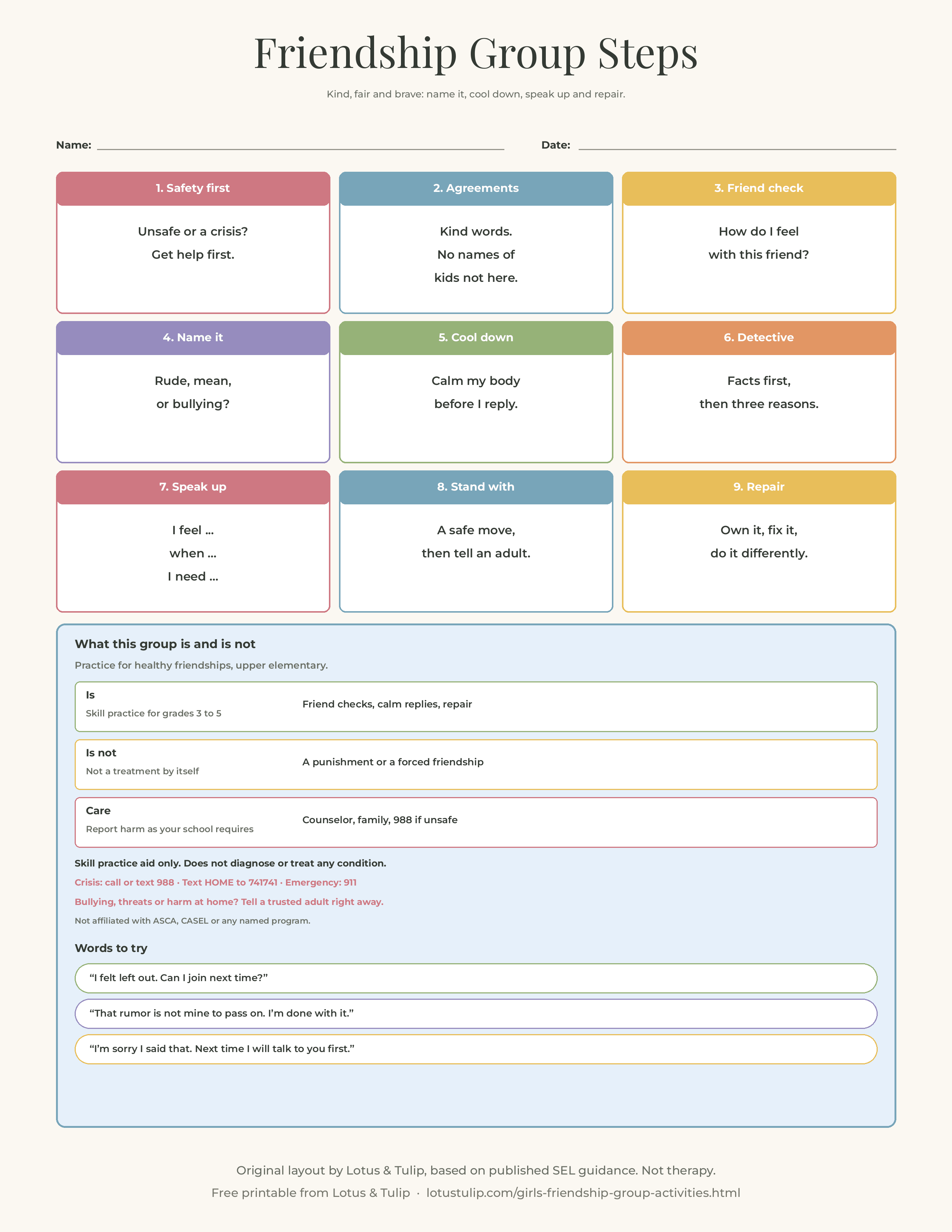
- Page 1: Friendship Group Steps. Nine student steps (safety first, agreements, friend check, name it, cool down, detective, speak up, stand with and repair), what this group is and is not, three "words to try" scripts, and crisis resources including 988, the Crisis Text Line and 911.
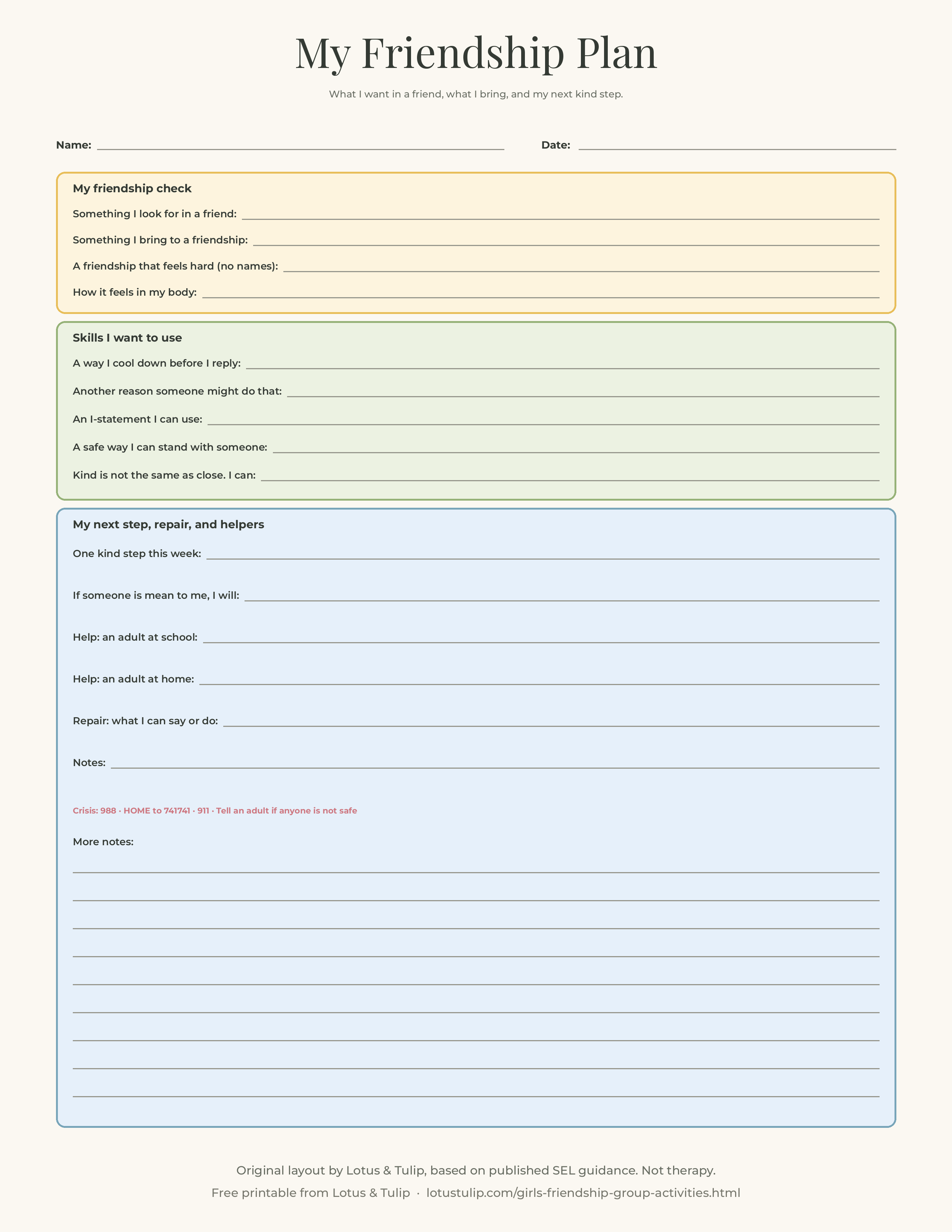
- Page 2: My Friendship Plan. Space for what a student looks for and brings to a friendship, a friendship that feels hard (no names), a cool down, a reason check, an I-statement, a safe upstander move, one kind step, what to do if someone is mean, helpers at school and home and a repair line.
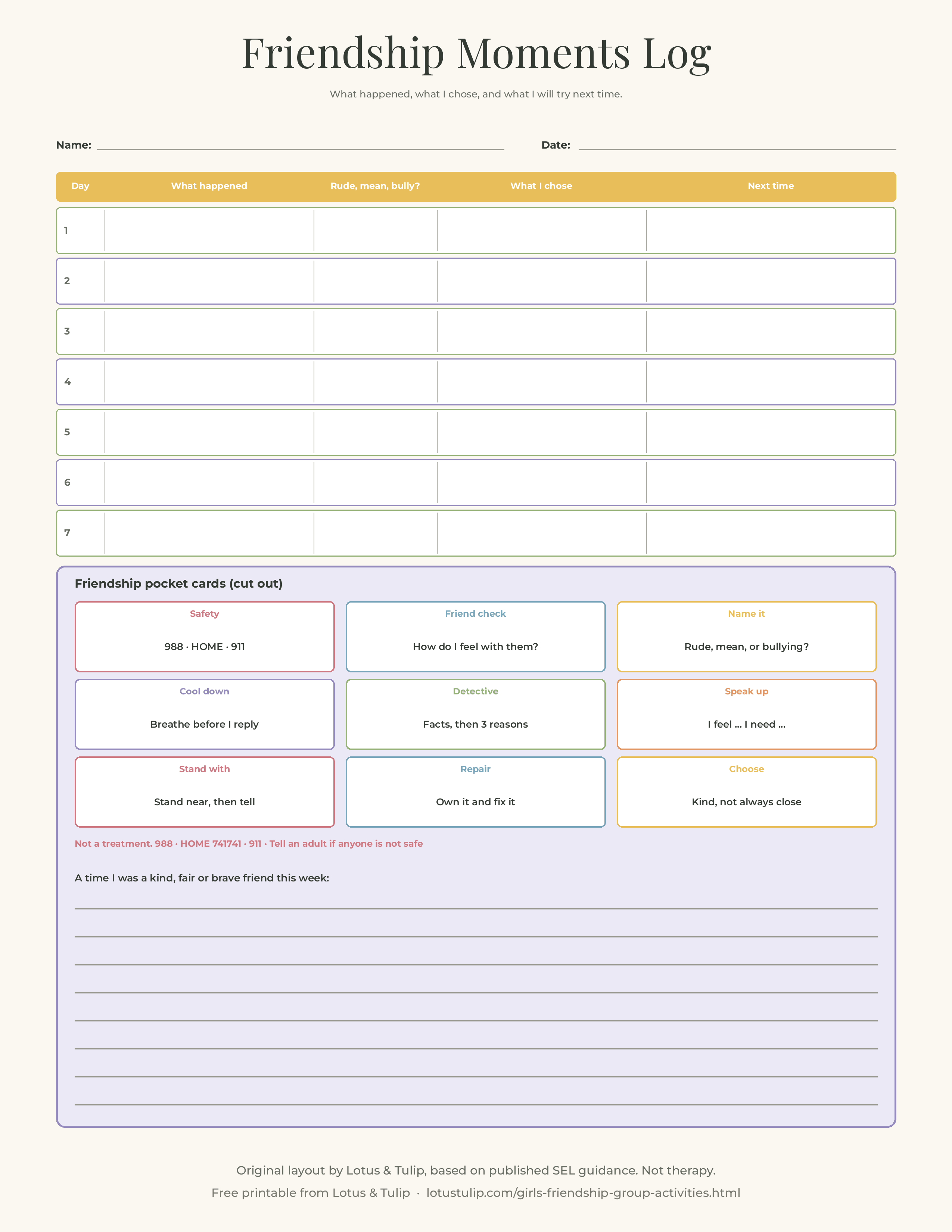
- Page 3: Friendship Moments Log. Seven rows for what happened, whether it was rude, mean or bullying, what the student chose and what to try next time, plus nine pocket cards to cut out.
Download free PDF · Page 1 PNG · Page 2 PNG · Page 3 PNG
Research notes (verified, with caveats)
- Gladden RM, Vivolo-Kantor AM, Hamburger ME, Lumpkin CD. Bullying Surveillance Among Youths: Uniform Definitions for Public Health and Recommended Data Elements, Version 1.0. Centers for Disease Control and Prevention and US Department of Education, 2014. Defines bullying as "any unwanted aggressive behavior(s) by another youth or group of youths who are not siblings or current dating partners that involves an observed or perceived power imbalance and is repeated multiple times or is highly likely to be repeated," and describes relational bullying as behavior designed to harm a young person's reputation and relationships, including isolating or ignoring them and spreading false or harmful rumors. The definition is for research and surveillance, not a legal standard; your state and district definitions apply at school.
- Crick NR, Grotpeter JK. Relational aggression, gender, and social-psychological adjustment. Child Development. 1995;66(3):710-722. A peer nomination study of 491 third through sixth grade students. Girls were significantly more relationally aggressive than boys, and relationally aggressive children were more rejected and reported more loneliness, depression and isolation. Caveat: one sample from one region in the early 1990s, and later research (next item) found smaller gender differences.
- Card NA, Stucky BD, Sawalani GM, Little TD. Direct and indirect aggression during childhood and adolescence: a meta-analytic review of gender differences, intercorrelations, and relations to maladjustment. Child Development. 2008;79(5):1185-1229. A meta-analysis of 148 studies. Boys were higher in direct aggression, gender differences in indirect aggression were trivial, the two forms were strongly correlated (r = .76), and indirect aggression was related to internalizing problems. This is why we describe exclusion and rumors as a friendship issue, not a girls issue.
- Leff SS, Paskewich BS, Waasdorp TE, Waanders C, Bevans KB, Jawad AF. Friend to Friend: a randomized trial for urban African American relationally aggressive girls. Psychology of Violence. 2015;5(4):433-443. In six urban low income elementary schools, 144 relationally aggressive girls in grades 3 to 5 were randomized to the Friend to Friend small group program or an attention control group. Girls in Friend to Friend showed lower teacher-reported relational aggression and more social problem solving knowledge after the program, maintained at one year follow-up; there was no significant effect on peer-reported relational aggression. Caveat: this is evidence for that specific, trained, counselor-led program in that setting, not for this page or our paid kit. We are not affiliated with Friend to Friend or the Children's Hospital of Philadelphia.
- National Center for Education Statistics. Condition of Education, Student Bullying indicator, and Digest of Education Statistics 2023, table 230.45, based on the 2022 School Crime Supplement to the National Crime Victimization Survey. In the 2021 to 2022 school year, the most common types of bullying reported by students ages 12 to 18 were being the subject of rumors (13 percent) and being made fun of, called names or insulted (12 percent); 4 percent reported being excluded from activities on purpose. Caveat: ages 12 to 18, not elementary students.
- Dishion TJ, McCord J, Poulin F. When interventions harm: peer groups and problem behavior. American Psychologist. 1999;54(9):755-764. Describes how grouping high risk adolescents together can sometimes increase problem behavior. Caveat: focused on adolescents; used here only to support careful group composition.
- Collaborative for Academic, Social, and Emotional Learning (CASEL). The CASEL Framework describes relationship skills as "the abilities to establish and maintain healthy and supportive relationships and to effectively navigate settings with diverse individuals and groups," with examples that include resolving conflicts constructively, resisting negative social pressure and standing up for the rights of others. No affiliation with CASEL.
- American School Counselor Association. ASCA Student Standards: Mindsets and Behaviors for Student Success. Relevant standards include M 2 "Sense of acceptance, respect, support and inclusion for self and others in the school environment," B-SS 2 "Positive, respectful and supportive relationships with students who are similar to and different from them," B-SS 8 "Advocacy skills for self and others and ability to assert self, when necessary," and B-SS 9 "Social maturity and behaviors appropriate to the situation and environment." No affiliation with ASCA.
Our paid curriculum is a skill practice aid built around healthy friendships, kinds of mean, cooling down, checking facts, I-statements, upstander moves and repair. It has not been tested in its own randomized trial and is not a manualized protocol.
Girls friendship group activities: FAQ
What are girls friendship group activities?
They are structured activities a school counselor runs with about four to six upper elementary students who are dealing with friendship problems such as exclusion, rumors, the silent treatment and group chat conflict. They teach students what healthy friendships feel like, how to tell rude, mean and bullying apart, how to cool down, check facts, speak up with I-statements, stand with others safely and repair with a real apology.
What grades is a girls friendship group for?
This guide is written for about grades 3 to 5. Third graders need shorter teaching points and more pictures. Students in grades 6 to 8 are usually better served by a middle school friendship group that covers group chats and peer pressure in more depth.
How many sessions should a friendship group have?
Many counselors run six to eight weekly sessions of about 30 to 40 minutes. Eight sessions leave time for agreements, healthy friendships, naming kinds of mean, cooling down, checking facts, speaking up, upstander moves and repair, followed by a check-in four to six weeks after the group ends.
Should a friendship group be only for girls?
It depends on your referrals. A girls group makes sense when your referrals are a cluster of girls in the same friendship web. A meta-analysis by Card and colleagues (2008) found only trivial gender differences in indirect aggression, so boys use exclusion and rumors too. If boys are involved in the same patterns, a mixed friendship group is a better fit. Follow your district policy on gender identity in group placement.
Should I put the girls who are fighting in the same group?
Usually not while the conflict is active. Putting two sides of a feud in one group often turns sessions into a stage for the fight. Handle the conflict separately, or place them in different groups, and mix students who are left out with steadier peer models.
What is the difference between rude, mean and bullying?
Rude is usually careless or accidental. Mean is hurting someone on purpose once or now and then. Bullying, as defined by the CDC and the US Department of Education, is unwanted aggressive behavior that involves an observed or perceived power imbalance and is repeated or highly likely to be repeated. Bullying should go to your school's bullying procedure, not only to a group.
What should I do if a student shares something unsafe in group?
Calmly pause the activity, thank the student and talk with them privately right away. Follow your bullying, threat assessment and mandated reporting procedures as required. If a student is thinking about suicide or self-harm, call or text 988 or text HOME to 741741, and call 911 if there is immediate danger. A written safety plan can help once the student is supported individually.
Is the free printable a copy of the paid curriculum?
No. The free three page set is an original companion with student steps, a personal friendship plan and a moments log with pocket cards. The paid Girls Friendship Group Curriculum is a 25 page PDF with eight lesson plans, eight student pages and all the group forms. The printable is not a preview of that PDF and is not material from any named program.