
Therapist worksheets · CBT · Updated 2026-11-05
CBT Triangle Worksheet: Thoughts, Feelings, Behaviors Explained, with a Free Printable
Ready-made printable: CBT Worksheets for Therapists Fillable PDF, 20 pages: thought record, exposure ladder, activity logs, coping cards and 0 to 10 rating scales
Holiday 20% off: about $11.04, was $14 (EUR 12) · instant digital download
Try it free first: download a fillable sample (thought record and evidence for and against, PDF, 105 KB). Type into it on screen, then get the full pack. No email needed.

The CBT triangle, also called the cognitive triangle or the thoughts feelings behaviors worksheet, is the simplest picture of how Cognitive Behavioral Therapy works. Three corners sit on the page: thoughts, feelings, and behaviors. Arrows run both ways between every pair. Change one corner, and the others often shift. That is the whole idea, drawn so a client, a teen, or a parent can see it in one glance.
This guide covers what each corner means, where the model comes from in Beck's cognitive therapy, how the triangle differs from Ellis's ABC model and from a full thought record, how to fill a CBT triangle worksheet step by step, a worked adult example and a kid and teen version, common mistakes, tips for therapists and school counselors, and what the research honestly shows. You also get a free three page US Letter printable: a CBT Triangle Map, a Triangle Practice Log, and a kids and teens version called What I Thought, How I Felt, What I Did.
This guide is educational. It is not therapy and not a diagnosis. If thoughts of ending your life show up while you work through a triangle, put the worksheet down and get help now: in the US, call or text 988, text HOME to 741741, or call 911 in an emergency. Our safety plan worksheet is a better first tool in that moment.
Jump to the free CBT triangle worksheet (PDF) · How to fill a CBT triangle, step by step · Worked examples · Kids and teens version
What the CBT triangle is
Draw a triangle. Put Thoughts at the top, Feelings at one base corner, and Behaviors at the other. Connect every corner with a two way arrow. That drawing is the CBT triangle. It says three things at once:
- Thoughts shape feelings and actions. "They are ignoring me on purpose" tends to produce hurt or anger, and then withdrawal, a sharp reply, or endless checking.
- Feelings shape thoughts and actions. When anxiety is already high, the mind scans for threat and the body wants to escape. The same email can look catastrophic when you are already wound up.
- Behaviors shape thoughts and feelings. Avoiding the party "proves" you cannot handle it. Calling a friend after a hard day often softens both the mood and the story you tell yourself. Acting differently is often the fastest way to interrupt a stuck loop.
The situation sits outside or above the triangle. The triangle is not the event itself. It is your reaction system once something has happened: a text, a grade, a silence in a meeting, a body sensation, a memory. The same situation can feed three very different triangles for three different people, or for the same person on two different days.
Clinicians also call this the cognitive model in its most compact form. Aaron T. Beck's cognitive therapy starts from the claim that a person's interpretation of a situation, more than the situation alone, drives emotional and behavioral reactions. The triangle is how that claim looks on a whiteboard in the first or second session.
A brief history: Beck's cognitive model for clinicians and parents
Aaron Beck developed cognitive therapy in the 1960s and 1970s, first for depression. In Cognitive Therapy of Depression (Beck, Rush, Shaw, and Emery, 1979), the model is spelled out in clinical detail: automatic thoughts, intermediate beliefs, and deeper core beliefs, all shaping how a person feels and acts. Judith S. Beck's later manuals for therapists keep the same structure and teach it with diagrams clients can use between sessions.
The three corner picture is the teaching version of that model. It does not replace a full case conceptualization. It gives a shared language. A parent can say "which corner are we in?" A school counselor can sketch it in two minutes. A therapist can fill it with the client's own words from intake, which is how Christine A. Padesky and Kathleen A. Mooney recommended presenting the cognitive model in a 1990 clinical tip in the International Cognitive Therapy Newsletter.
Padesky and Mooney also expanded the picture into a five part model: thoughts, moods (feelings), behavior, biology or physical reactions, all sitting inside the client's environment. Clinicians sometimes call that drawing the "hot cross bun" because the crossed lines look like the bun. It is the main diagram in Mind Over Mood by Dennis Greenberger and Christine Padesky (1995; 2nd edition 2016). When body sensations or the setting matter a lot (panic, trauma cues, sleep loss, a chaotic classroom), move from the three corner triangle to the five part model. The free printable on this page stays with the classic triangle and leaves a line for body cues so you can bridge upward when needed.
One more distinction that helps searchers: Beck also described a cognitive triad in depression (negative views of self, world, and future). That triad is about the content of depressed thinking. The CBT triangle is about the process that links any thought to feelings and actions. You can use both with the same client: the triangle to map Tuesday night, the triad to name the theme that keeps showing up in the thought corner.
CBT triangle vs Ellis ABC vs a full thought record
People searching "thoughts feelings behaviors worksheet" often land next to an ABC model worksheet or a CBT thought record. The tools are cousins, not copies. Use this table to choose.
| CBT triangle (T-F-B) | Ellis ABC / ABCDE | Beck style thought record | |
|---|---|---|---|
| Main job | Teach the loop; show that any corner can be an entry point | Find and dispute rigid evaluative beliefs (musts, awfulizing, global rating) | Test whether an automatic thought is accurate and write a balanced alternative |
| Typical question | "How did that thought affect what you felt and did? Which corner is easiest to change first?" | "Even if the worst is true, why must it not happen? Is it truly awful?" | "What is the evidence for and against this thought? What is a more balanced view?" |
| Best early use | Session 1 or 2 psychoeducation; kids and parents; quick catch of a loop | When the problem is a demand or "I can't stand it," not just a factual misread | When the client can already catch thoughts and is ready to gather evidence |
| Depth | Surface loop in one situation | Evaluative beliefs under the surface thoughts | Automatic thoughts, with a path toward intermediate and core beliefs |
| Style | Collaborative drawing and Socratic questions | Active disputing, sometimes playful debate | Collaborative empiricism and guided discovery |
In practice they stack. Start with the triangle so the person sees the loop. If the thought looks like a prediction or an interpretation that might be wrong, move to a thought record. If the thought is "Even if it is true, it would be unbearable and I must not fail," move to an ABCDE worksheet. Distorted thinking patterns such as catastrophizing, mind reading, and should statements sit next to the thought corner; use the cognitive distortions worksheet to name them. For kinder replacement language once a thought softens, see the positive self talk worksheet. When the question is whether the emotion fits the facts in a DBT frame, use Check the Facts instead of arguing someone out of a feeling.
How to fill a CBT triangle worksheet, step by step
- Pick one recent, specific situation. Middling intensity works best for learning. Not the worst week of your life, and not a trauma memory you are not ready to open. "Tuesday at 4 p.m., after the email from my manager" is better than "work stress."
- Write the situation in camera facts. Who, what, where, when. Leave out the interpretation. "Sam left my message on read for three hours" rather than "Sam snubbed me."
- Catch the thought in exact words. What went through your mind, in words or images? If you only have a feeling ("I felt rejected"), ask what the rejected part was telling you. Write the hot thought, not a cleaned up summary.
- Name the feelings and rate them 0 to 10. One word each: anxious, sad, angry, ashamed, relieved. Rating makes later change visible. Add body cues if they matter: tight chest, hot face, heavy limbs.
- List what you did, avoided, or felt pulled to do. Behaviors include silence, scrolling, snapping, leaving early, and the thing you did not do. Urges count even if you did not act on them.
- Draw the arrows with your own phrases. Ask how the thought fed the feeling, how the feeling fed the action, and how the action fed the next thought. Let the person add the arrows. The point is the loop, not a perfect diagram.
- Ask which corner is easiest to change first. Thoughts, feelings, or behaviors. There is no single right answer. Some people reframe a thought. Some change one small action. Some use a body skill first so thinking becomes possible again.
- Choose one small experiment. A more balanced thought to try, a behavior to do for ten minutes, or a coping move that interrupts the loop. Write it as a test, not a vow: "I will send the draft by 3 p.m. and notice what happens to the anxiety rating."
- Review what changed. After the experiment, rate the feelings again and note any new thought. Keep the rows short. A week of triangle logs beats one perfect page.
Padesky and Mooney's advice still holds: present the model with the client's own material, ask whether it fits, and treat it as a hypothesis, not a verdict. The first job is "learning if this model is true for you."
A worked adult example (fictional)
Maya, 34, fills a CBT triangle after a quiet Tuesday afternoon.
- Situation: At 2:10 p.m., my coworker Alex walked past my desk without saying hi, then closed the office door for a call.
- Thoughts: "Alex is mad at me. I must have messed up the shared deck. They are going to freeze me out."
- Feelings: Anxiety 7/10, shame 5/10. Tight stomach, warm face.
- Behaviors: Reread the shared deck for 20 minutes, avoided the kitchen, sent a long apologetic Slack message about a tiny typo, cancelled the evening walk.
- Loop: The threat thought fed anxiety; anxiety fed checking and apologizing; checking and apologizing fed the next thought, "See, I always mess things up."
- Easiest corner first: Behavior. Maya decides to wait until tomorrow to ask Alex one calm question, and to take the evening walk tonight even if the anxiety is still a 5.
- After the experiment: Anxiety 4/10. New thought: "Alex might just have been late for a call. I can ask once without a long apology."
Notice that Maya did not start by arguing herself into believing Alex liked her. She interrupted the behavior that was feeding the shame story. The thought corner can come next, with a thought record, once the loop is less loud.
CBT triangle for kids and teens
Kids and teens often learn the triangle faster than adults, as long as the language stays concrete. Call it "What I thought, how I felt, what I did." Keep one situation per page. Draw faces for feelings if writing is hard.
For younger kids (about 6 to 10):
- Use short prompts: What happened? What did my brain say? How did my body and feelings feel? What did I do?
- Offer feeling faces or a feelings thermometer so the feeling corner has a number.
- Replace "cognitive distortion" with "tricky thought." Pair with the worry worksheet for kids when the thought corner is full of what ifs.
- End with one helpful thought they can try, written in their words, not yours.
- For big reactions to small problems, the size of the problem worksheet sits well beside the triangle.
For teens:
- Use their examples: group chats, grades, sports benches, friendships, parents' rules, social media silence.
- Ask which corner feels most in their control today. Many teens start with behavior (text less, leave the group chat for an hour, go to practice anyway) before they trust a reframe.
- Do not lecture. Let them draw the arrows. "Where does that thought get you?" often lands better than "Is that thought true?"
- Link to test stress and perfectionism with the test anxiety worksheet and growth mindset worksheet when "I must get an A or I'm stupid" shows up in the thought corner.
Respect privacy. A completed triangle can reveal risk, bullying, or home stress. Follow your school's or clinic's safety protocol. Never post a student's filled worksheet on a wall.
Tips for therapists and school counselors
- Teach with a neutral example first. Two people get the same text with no emoji. One thinks "they are mad," feels anxious, and apologizes. The other thinks "they are busy," feels fine, and waits. Same situation, different triangles.
- Fill the first triangle together. Homework compliance rises when clients have seen their own words on the page once.
- Separate thoughts from feelings on the spot. If a client says "I feel like a failure," that is a thought wearing a feeling costume. Ask "and what emotion goes with that thought?"
- Do not argue someone out of a feeling. Validate the feeling, then examine the thought or change the behavior. "You shouldn't feel that way" is itself an unhelpful demand.
- Offer more than one entry point. Classic CBT often starts with thoughts. Behavioral activation often starts with actions. Body based clients may need a calm skill before either. The triangle protects all three doors.
- Bridge to the five part model when needed. Add biology and environment for panic, pain, sleep loss, or a chaotic setting. Greenberger and Padesky's Mind Over Mood is a clear client facing reference.
- In schools, keep it skills based. Use the triangle as a classroom or small group lesson about thoughts and feelings, not as an assessment. Follow district policy if a worksheet reveals risk.
- Track change over time. A week of triangle rows plus a mood tracker often shows the same two or three thoughts driving most of the distress.
Common mistakes with CBT triangle worksheets
- Treating a feeling as a thought. "I feel abandoned" belongs in Feelings if abandoned is the emotion word you mean. If you mean "they have left me," that is a thought. Split them.
- Skipping the behavior corner. Avoidance, checking, reassurance seeking, and scrolling are often the glue that holds the loop. If you only reframe thoughts and keep doing the same behaviors, little changes.
- Writing a vague situation. "School" or "anxiety" is not a situation. Pick one moment.
- Arguing someone out of a feeling. The triangle is not a debate club. Feelings make sense given the thought, even when the thought is off.
- Forcing a positive thought. "Everything is fine" will not stick. A useful new thought is believable and specific: "I do not know why Alex walked past. I can ask once tomorrow."
- Using the triangle on active crisis. If someone is unsafe, protect first. Use crisis supports, then return to skills work.
- Treating the diagram as treatment. The triangle is a teaching and practice tool inside a broader plan. Persistent depression, anxiety, OCD, or trauma symptoms deserve care from a licensed clinician.
What the research says (honestly)
The CBT triangle itself is a teaching tool. It has not been tested as a standalone treatment in randomized trials. The therapy built on the model it teaches, Cognitive Behavioral Therapy, has a large evidence base, with real limits.
CBT overall. Hofmann, Asnaani, Vonk, Sawyer, and Fang (2012) reviewed a representative sample of 106 meta analyses of CBT across many problem areas in Cognitive Therapy and Research. They reported the strongest support for CBT of anxiety disorders, somatoform disorders, bulimia, anger control problems, and general stress. They also noted that more randomized controlled evidence was still needed in several areas, and that meta analytic work on specific subgroups such as ethnic minorities and low income samples was largely missing outside of child and older adult literatures. In plain terms: CBT has a very strong evidence base on average, and the map is uneven.
Thought and behavior change together. Modern CBT rarely changes thoughts alone. Behavioral experiments, exposure, and activation are core methods, which matches the triangle's claim that behavior is not a side note. Studies usually test whole treatment packages, not one worksheet.
Kids and teens. CBT adapted for youth has substantial support for anxiety and related problems, again as a package. School friendly tools such as the triangle are common psychoeducation pieces inside those packages, not proven cures on their own.
Honest caveat. No trial has tested this free printable on its own. Use it as a practice aid, ideally alongside a clinician or a structured program. If symptoms are severe, frequent, or tied to safety concerns, get professional care rather than relying on a diagram.
Free CBT triangle worksheet (PDF)
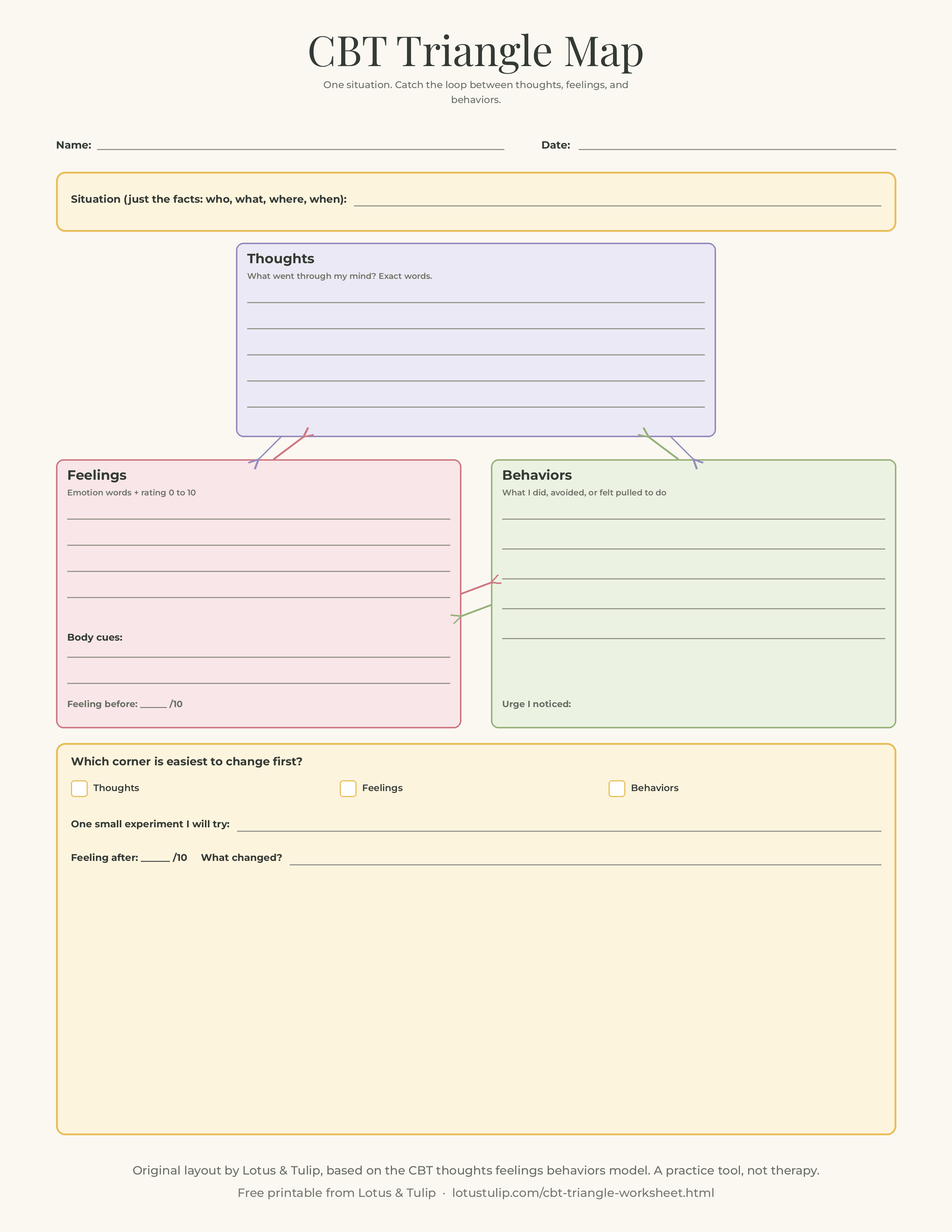
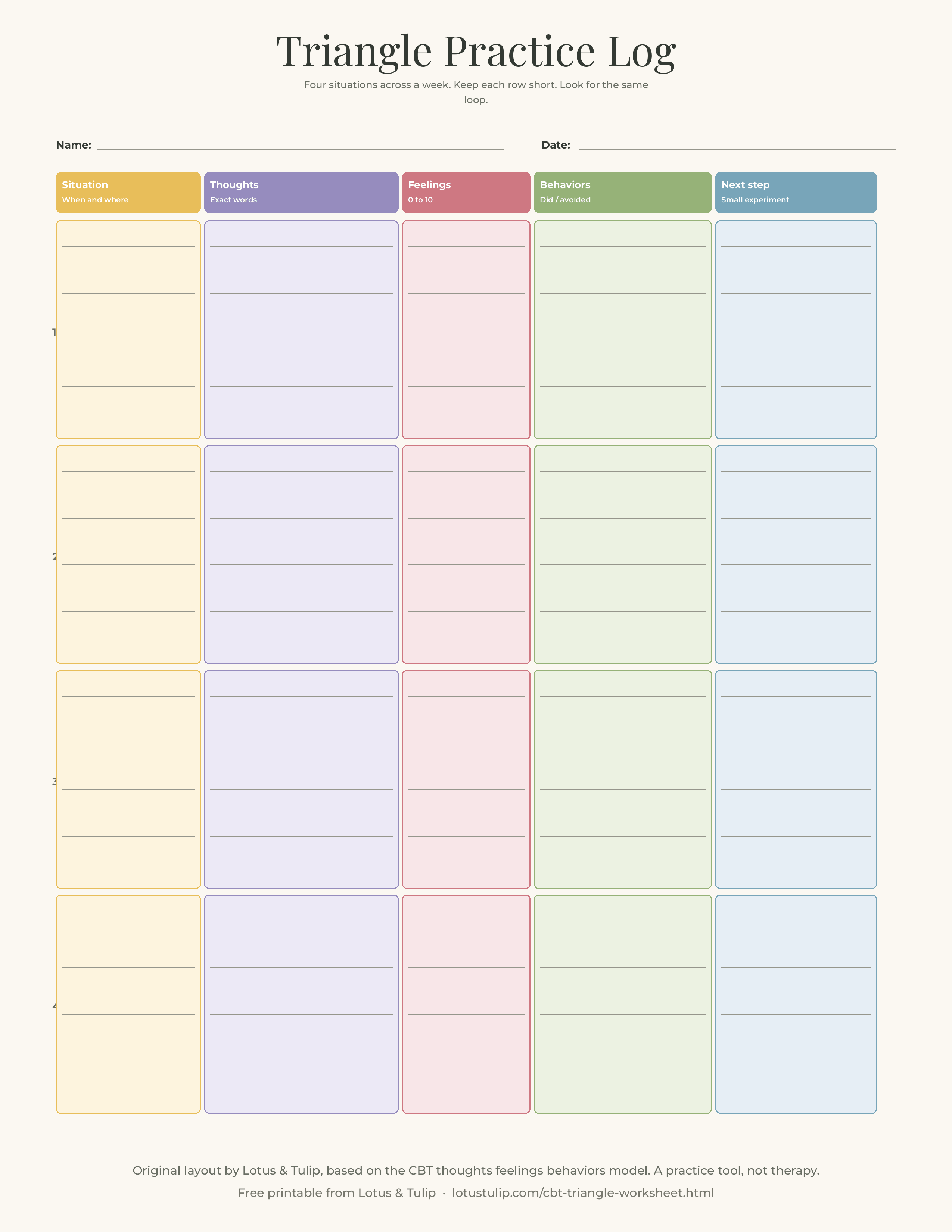
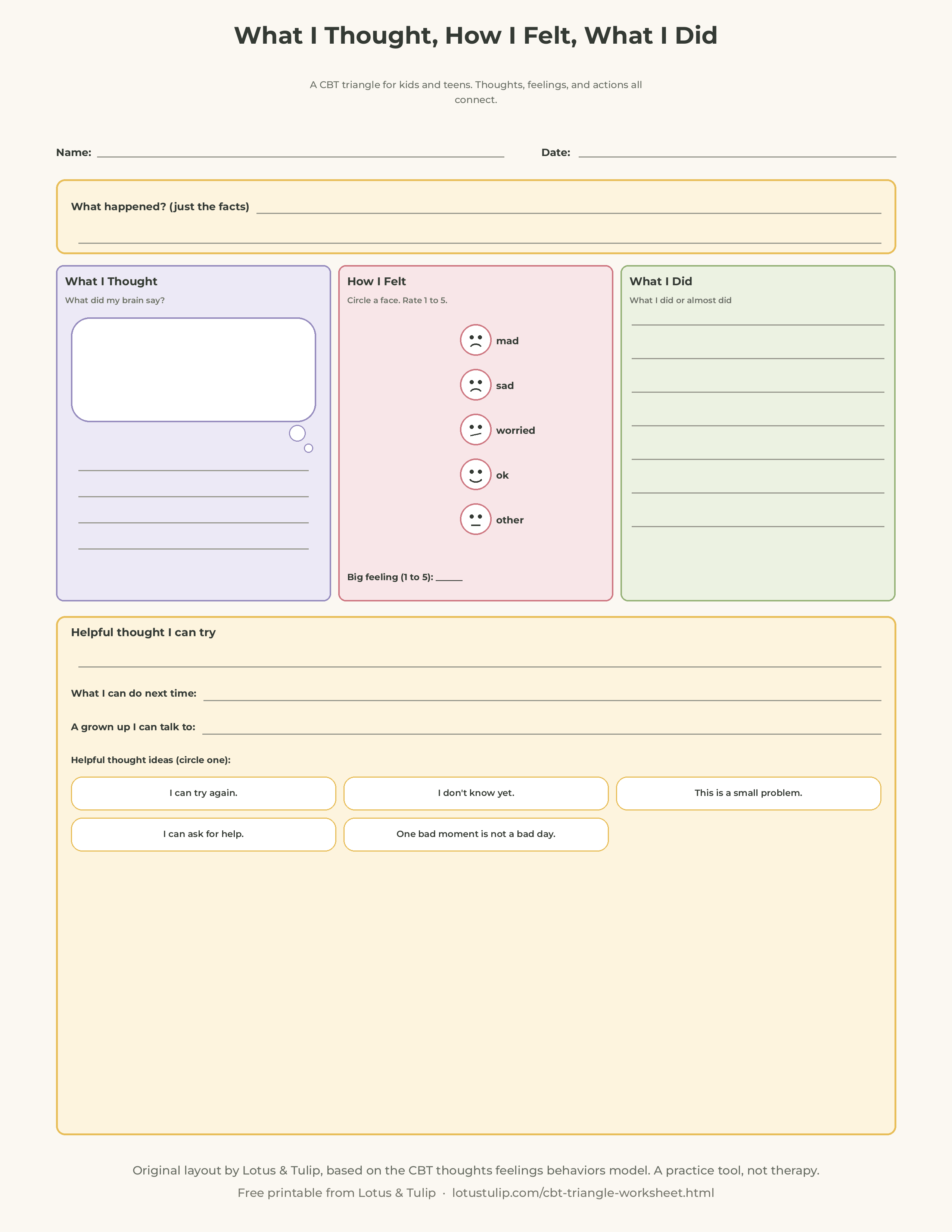
The free CBT triangle worksheet has three pages in US Letter size:
- Page 1: CBT Triangle Map. One situation with Thoughts, Feelings (0 to 10), and Behaviors boxes, two way arrows, a body cues line, and the prompt "Which corner is easiest to change first?"
- Page 2: Triangle Practice Log. Four rows for situations across a week, with short thought, feeling, behavior, and next step columns.
- Page 3: Kids and teens version, What I Thought, How I Felt, What I Did. Simple language, optional feeling faces, a helpful thought I can try line, and a next time plan.
Download the free CBT triangle worksheet (PDF, 3 pages, US Letter)
Prefer single images? Page 1: CBT Triangle Map (PNG) · Page 2: Triangle Practice Log (PNG) · Page 3: CBT Triangle for Kids (PNG)
Free CBT starter pack: Want more pages for the same session? The free CBT worksheets starter pack adds a 7 column thought record, plus five more real worksheets from our CBT set (8 pages, client use license, no email).
Free to print for your own use and for use with your own clients, students, or groups. This is an original layout by Lotus & Tulip, based on the cognitive model described in Beck style CBT and common clinical teaching of the thoughts feelings behaviors triangle. It is not affiliated with the Beck Institute, Padesky, or Greenberger and Padesky, and is not a substitute for therapy. Please link to this page rather than re-uploading the file.
Related resources
- CBT worksheets for kids: the think, feel, do triangle for ages 5 to 12, with a free printable.
- ABC model worksheet: Ellis ABC and ABCDE disputing, when the problem is a must or "I can't stand it."
- CBT thought record: Beck style evidence for and against, with a free printable.
- Cognitive distortions worksheet: naming thinking traps in the thought corner.
- Core beliefs worksheet: the downward arrow when the same thought keeps returning.
- Positive self talk worksheet: coping statements that sound believable.
- Check the Facts worksheet: the DBT way to test whether an emotion fits.
- Behavioral activation worksheet: when the behavior corner needs scheduling, not just insight.
- Mood tracker printable: track whether triangle experiments move the weekly numbers.
Sources
- Beck, A. T., Rush, A. J., Shaw, B. F., and Emery, G. (1979). Cognitive Therapy of Depression. Guilford Press. Classic statement of the cognitive model and thought recording.
- Beck, J. S. Cognitive Behavior Therapy: Basics and Beyond. Guilford Press. Therapist manual for teaching the cognitive model and structuring sessions.
- Padesky, C. A., and Mooney, K. A. (1990). Presenting the cognitive model to clients. International Cognitive Therapy Newsletter, 6, 13 to 14. Clinical tip on presenting thoughts, moods, behavior, biology, and environment with the client's own material.
- Greenberger, D., and Padesky, C. A. (2016). Mind Over Mood (2nd ed.). Guilford Press. Client facing five part model and thought records.
- Hofmann, S. G., Asnaani, A., Vonk, I. J. J., Sawyer, A. T., and Fang, A. (2012). The efficacy of cognitive behavioral therapy: A review of meta-analyses. Cognitive Therapy and Research, 36, 427 to 440. Review of 106 meta analyses; strongest support noted for anxiety disorders, somatoform disorders, bulimia, anger control, and general stress; authors note limits in RCT coverage and subgroup research.
- Ellis, A. (1962). Reason and Emotion in Psychotherapy. Lyle Stuart. Source of the ABC model contrasted on this page.
- Honest caveat: no study tests this three page Lotus and Tulip printable alone. The research above concerns CBT delivered as treatments or programs, and standard clinical teaching of the cognitive model.
CBT triangle worksheet: FAQ
What is the CBT triangle?
The CBT triangle, or cognitive triangle, is a simple diagram with thoughts, feelings, and behaviors at the three corners and arrows running both ways between them. It teaches that each corner affects the others, so changing one corner can shift the loop. It is a teaching tool from Beck style cognitive therapy, not a full treatment by itself.
How do thoughts, feelings, and behaviors connect?
A thought shapes how you feel and what you do. A feeling shapes what you notice and how you act. A behavior feeds the next thought and feeling. For example, the thought "I will fail" raises anxiety, anxiety leads to avoidance, and avoidance "proves" you cannot handle the task. The triangle makes that loop visible so you can interrupt it.
What is the difference between the CBT triangle and the ABC model?
The CBT triangle maps thoughts, feelings, and behaviors in one situation and shows that any corner can be an entry point for change. Ellis's ABC model focuses on Activating event, Beliefs, and Consequences, and ABCDE adds disputing of rigid evaluative beliefs such as musts. Use the triangle to teach the loop; use ABCDE when the stuck point is a demand or "I can't stand it." See our ABC model worksheet for the full REBT version.
Is a CBT triangle the same as a thought record?
No. A triangle is a quick map of the loop. A Beck style thought record goes further: it rates belief in the automatic thought, gathers evidence for and against, and writes a balanced alternative. Many people start with triangles and move to thought records once they can catch thoughts reliably.
Can kids use a CBT triangle worksheet?
Yes. Use simple labels such as What I thought, How I felt, and What I did, keep one situation per page, and offer feeling faces or a feelings thermometer. End with one helpful thought the child chooses. The free printable includes a kids and teens page. Follow school or clinic safety rules if a worksheet reveals risk.
Which corner should I change first?
Whichever is most workable today. Some people reframe a thought. Some change one small behavior. Some calm the body first so thinking becomes possible. The triangle's point is that you have more than one door into the loop. Pick a small experiment and rate the feelings again afterward.
Does the CBT triangle work on its own?
The triangle is a teaching and practice tool, not a standalone therapy. CBT as a full treatment has strong meta analytic support for many problems, with uneven coverage across conditions and populations. Use the worksheet as homework inside a broader plan, and seek a licensed clinician for persistent or severe symptoms.