
Therapist worksheets · CBT and REBT · Updated 2026-11-05
ABC Model Worksheet: Ellis's ABC and ABCDE Method Explained, with Examples and a Free Printable
Ready-made printable: CBT Worksheets for Therapists Fillable PDF, 20 pages: thought record, exposure ladder, activity logs, coping cards and 0 to 10 rating scales
Holiday 20% off: about $11.04, was $14 (EUR 12) · instant digital download
Try it free first: download a fillable sample (thought record and evidence for and against, PDF, 105 KB). Type into it on screen, then get the full pack. No email needed.

The ABC model is one of the simplest and most useful ideas in cognitive behavioral therapy. Something happens (A), you hold a belief about it (B), and that belief drives how you feel and act (C). Albert Ellis built this model into Rational Emotive Behavior Therapy (REBT), and he later added two more steps: D for disputing the unhelpful belief and E for the effective new belief that replaces it. An ABC model worksheet, or ABCDE worksheet, walks a person through those steps on paper so the pattern becomes visible and changeable.
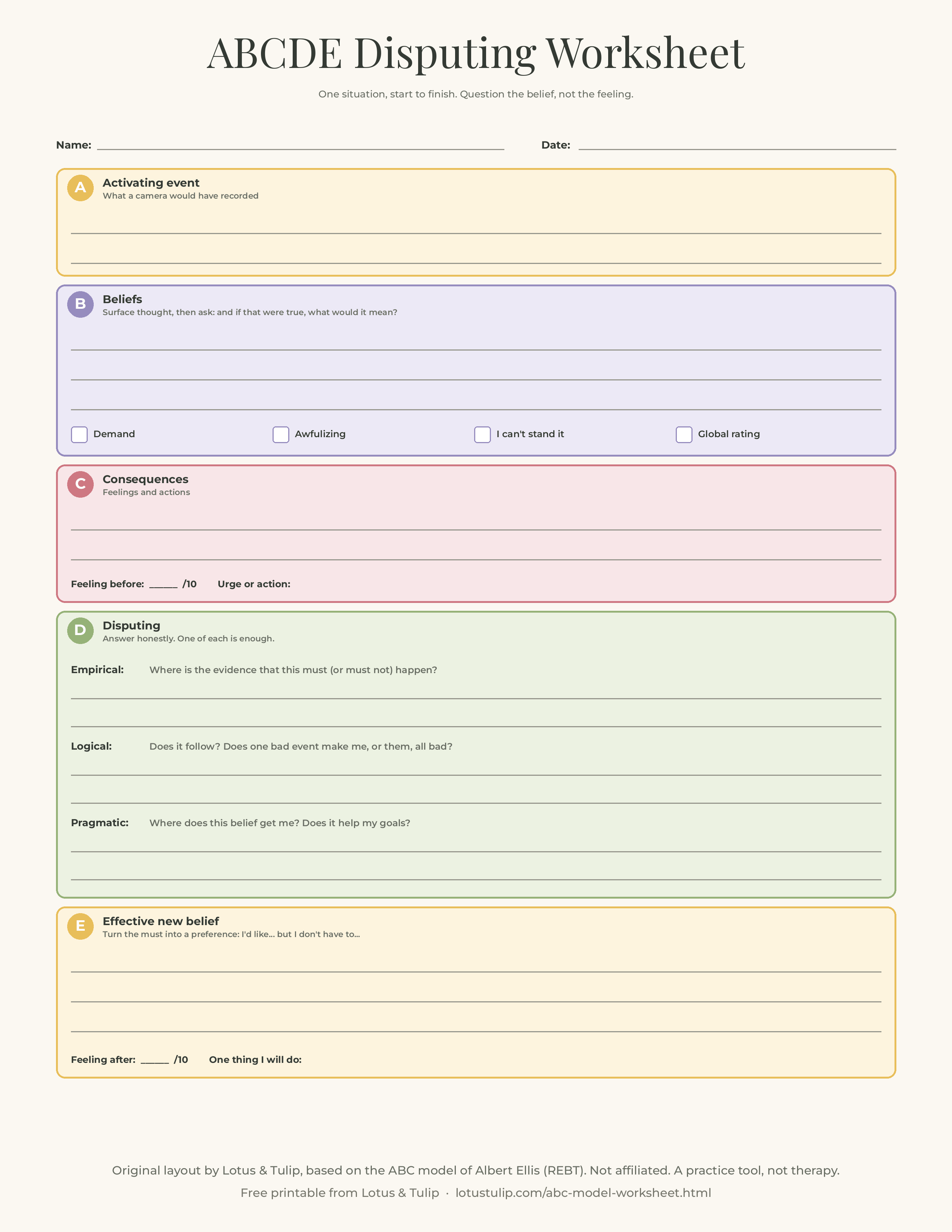
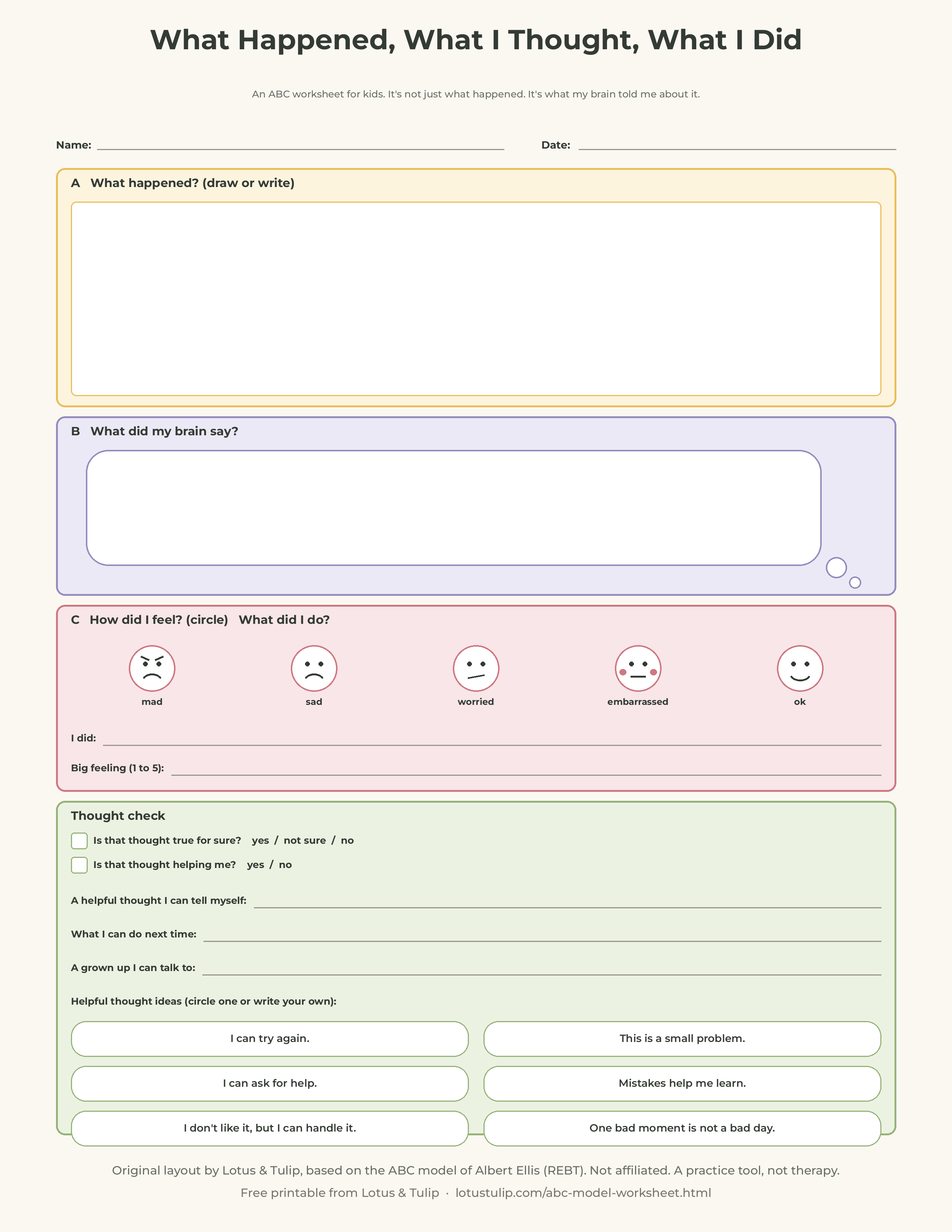
This guide covers what each letter means, the four kinds of irrational beliefs REBT targets, how REBT disputing differs from a Beck style CBT thought record, a full set of disputing questions, a worked example, a kid and teen friendly version, tips for therapists and school counselors, the mistakes that make the worksheet fall flat, and what the research honestly shows. You also get a free three page US Letter printable: an ABC Thought Log, an ABCDE Disputing Worksheet, and a kids version called What Happened, What I Thought, What I Did.
This guide is educational. It is not therapy and not a diagnosis. If a belief like "I am worthless" comes with thoughts of ending your life, put the worksheet down and get help now: in the US, call or text 988, text HOME to 741741, or call 911 in an emergency. Our safety plan worksheet is a better first tool in that moment.
Jump to the free ABC model worksheet (PDF) · How to fill an ABCDE worksheet, step by step · Worked example · Kids and teens version
What the ABC model is
Ellis's central claim was that events alone do not make us upset in the way we usually think. Our beliefs about events play a large role. He often credited the Stoic philosopher Epictetus, who wrote that people are disturbed not by things but by the views they take of them. Ellis turned that old idea into a practical tool.
- A: Activating event. What happened, described as a camera would record it. "My manager moved my project review to Friday without explaining why." A can also be an internal event, such as a memory, a body sensation, or a thought you had earlier.
- B: Beliefs. What you told yourself about A. REBT is especially interested in evaluative beliefs, the rigid "musts" and "shoulds" beneath the surface thoughts. "She must respect my time. It is awful that she did this. I can't stand being treated like this."
- C: Consequences. The emotional and behavioral result. Anger, anxiety, shame, or low mood; snapping at someone, avoiding a task, drinking, scrolling, ruminating at 2 a.m.
Most people naturally explain their feelings as A causes C: "She made me furious." The ABC model inserts B in the middle: "She changed the meeting, I told myself she must not do that and that it proves she disrespects me, and then I felt furious." That small shift matters, because you often cannot change A, but you can examine and change B.
One clarification for anyone searching "ABC worksheet": behavior analysts also use an ABC chart, where the letters stand for Antecedent, Behavior, Consequence. That is a different tool used to track what happens before and after a behavior, often in schools and ABA settings. This page is about Ellis's cognitive ABC, where B means Beliefs.
The ABCDE extension: Disputing and Effective new beliefs
Ellis described using the ABCs with clients from the start of his approach in 1955. In a later chapter, "Expanding the ABCs of Rational-Emotive Therapy," he wrote that when his institute's clinic printed homework forms in the late 1960s, D and E were added to the original three letters.
- D: Disputing. Actively questioning the unhelpful belief. Ellis described disputing as detecting irrational beliefs, discriminating them from rational ones, and debating them. You ask whether the belief is true, whether it is logical, and whether it helps you.
- E: Effective new belief. A flexible, realistic replacement belief, plus the healthier feeling and more useful action that follow from it. "I would strongly prefer that she explain changes, but she does not have to. This is annoying, not awful. I can stand it and I can ask her about it calmly."
Some worksheets add an F for new Feelings, or split E into new belief, new emotion, and new behavior. Those are reasonable variations. Our free printable keeps the classic five letters and adds a short "new feeling and action" line under E.
The four kinds of irrational beliefs REBT targets
In REBT, "irrational" does not mean stupid. It means a belief that is rigid, not consistent with reality, illogical, and likely to block your goals. REBT writers such as Windy Dryden and Raymond DiGiuseppe commonly describe one core irrational belief and three that tend to flow from it. Each has a healthier, rational alternative.
| Irrational belief | What it sounds like | Rational alternative |
|---|---|---|
| Demands (musts, shoulds, have tos) | "I must do well." "People must treat me fairly." "Life must be easy." | Flexible preference: "I really want to do well, but I don't have to." |
| Awfulizing | "It is awful, terrible, the worst thing that could happen." | Anti awfulizing: "It is bad, maybe very bad, but not the end of the world." |
| Low frustration tolerance (LFT) | "I can't stand it." "This is unbearable." | High frustration tolerance: "This is hard to tolerate, and I can stand it. It is worth tolerating for my goals." |
| Global rating (self, other, or life downing) | "I failed, so I am a failure." "He lied, so he is a terrible person." "Life is rotten." | Acceptance: "I am a complex, fallible human who did one thing badly." Ellis called this unconditional self acceptance, with matching acceptance of others and of life. |
Ellis also grouped demands into three "major musts": demands about yourself ("I must perform well and win approval or I am worthless"), about other people ("You must treat me kindly and fairly or you are rotten"), and about life conditions ("Life must give me what I want, easily, or it is unbearable"). Naming which must is active often makes disputing faster.
A related REBT idea is the difference between healthy and unhealthy negative emotions. REBT does not aim for calm about everything. Concern is a healthy alternative to anxiety, sadness to depression, remorse to guilt, disappointment to shame, and firm annoyance to rage. If your E line says "I feel fine about being treated badly," that is usually not realistic. "I feel disappointed and I can act on it" is.
These beliefs overlap with the cognitive distortions described in Beck style CBT. "Should statements" is close to demands, "catastrophizing" is close to awfulizing, and "labeling" is close to global rating. REBT puts the demands at the center and treats the others as derived from them.
REBT ABCDE vs Beck CBT thought records
Albert Ellis and Aaron Beck developed their approaches around the same era, and both target thinking, but they emphasize different layers. Beck's cognitive therapy, set out in Cognitive Therapy of Depression (Beck, Rush, Shaw, and Emery, 1979), popularized the daily record of dysfunctional thoughts, the ancestor of today's CBT thought record.
| REBT ABCDE worksheet | Beck style thought record | |
|---|---|---|
| Main target | Rigid evaluative beliefs: musts, awfulizing, "I can't stand it," global rating | Automatic thoughts and the predictions or interpretations inside them |
| Typical question | "Even if the worst is true, why must it not happen? Is it truly awful?" | "What is the evidence for and against this thought? What is a more balanced view?" |
| Stance on the facts | Often assumes the worst case for argument's sake, then disputes the demand about it | Tests whether the interpretation is accurate |
| Style | Active, direct, sometimes playful debate | Collaborative empiricism and guided discovery |
| Deeper level | Unconditional self, other, and life acceptance | Intermediate beliefs and core beliefs |
In practice the tools blend well. If a client's thought is "Everyone at the party thought I was boring," a thought record checks the evidence. If the evidence holds up, or the client says "Even if they did, it would be unbearable," an ABCDE worksheet targets the demand for approval underneath. Many clinicians use both, choosing whichever the client responds to.
The ABC log is also related to, but different from, DBT's Check the Facts skill, which asks whether an emotion and its intensity fit the facts, and ACT's cognitive defusion, which aims to change your relationship to a thought rather than dispute its content. A person who gets stuck arguing with the same thought every day may do better with defusion.
Disputing questions that actually work
REBT writers commonly group disputes into three kinds. Use one or two of each rather than rushing through all of them.
Empirical (reality) disputes
- Where is the evidence that this must happen, or must not happen?
- Is there a law of the universe that says I must succeed or be approved of?
- If it is truly unbearable, how have I stood it so far?
Logical disputes
- Does it follow that because I want this, it must happen?
- If I failed at one task, does that logically make me a total failure as a person?
- Is it "awful," meaning more than 100 percent bad, or is it bad on a scale where worse things exist?
Pragmatic (functional) disputes
- Where does holding this belief get me? Does it help me reach my goals?
- How do I feel and act when I believe it? Is that what I want?
- What would I tell a friend who believed this about themselves?
A good dispute is a real question, not a slogan. If the honest answer is "I'm not sure," write that down and keep going. The point is to loosen a rigid belief, not to win an argument with yourself. For gentle phrasing of the new belief, pair this step with the positive self talk worksheet, which shows how to write coping statements that sound true rather than forced, and the self compassion worksheet when the belief is harsh self judgment.
How to fill an ABCDE worksheet, step by step
- Start with C, not A. Most people notice the feeling first. Write the emotion, its strength from 0 to 10, and what you did or felt pulled to do. Starting with C makes the next steps easier.
- Write A as a camera would see it. Describe the event in neutral facts: who, what, where, when. Leave out your interpretation. "Text left on read for 3 hours" rather than "she ignored me on purpose."
- Find the surface thoughts at B. What went through your mind? Write the exact words, even if they seem silly. "She's annoyed with me. I ruined it."
- Dig to the evaluative belief. Ask "and if that were true, what would it mean?" until you hit a must, an awful, an "I can't stand it," or a global rating. "She must not be upset with me. If she is, it means I'm unlovable."
- Circle the type of irrational belief. Demand, awfulizing, low frustration tolerance, or global rating. Most beliefs include a demand plus one other.
- Dispute it at D. Ask at least one empirical, one logical, and one pragmatic question. Write your honest answers, not the answers you think you should give.
- Write the effective new belief at E. Turn the demand into a preference and add the matching rational belief: "I'd like her to reply quickly, but she doesn't have to. A slow reply is uncomfortable, not awful. Whatever it means, I am still a worthwhile person."
- Name the new feeling and action. Rate the emotion again from 0 to 10. Expect a healthy negative emotion, such as concern instead of panic. Write one thing you will do differently.
- Practice the new belief in action. REBT has always paired disputing with homework: rehearse the new belief, then act on it in a real situation, and log what happened on a fresh ABC row.
Many people complete steps 1 to 5 for a week before adding D and E. Simply catching the B link is valuable, and it gives you real material to dispute later. If the same belief appears again and again, it may be a core belief worth working on with the core beliefs worksheet and its downward arrow technique.
A worked example (fictional)
Jordan, 29, works in marketing and fills an ABCDE worksheet after a hard Tuesday.
- C (Consequences): Anxiety 8/10, shame 6/10. Left the office early, skipped the gym, reread the email twelve times.
- A (Activating event): In a team meeting, my manager said my campaign report "needs a lot more work" in front of four coworkers.
- B (Beliefs): Surface thoughts: "Everyone saw how bad I am at this. She thinks I'm incompetent." Evaluative beliefs: "I must not make mistakes in front of others (demand). It's terrible that they saw it (awfulizing). I can't stand looking stupid (LFT). This proves I'm a failure (global rating)."
- D (Disputing): Empirical: Where is the law that says I must never make visible mistakes? Everyone on the team has had work sent back. Logical: Does one weak report make me a failure as a whole person? No, it makes my report weak. Pragmatic: Believing I must be perfect made me avoid the gym and reread the email instead of fixing the report. That belief is costing me.
- E (Effective new belief): "I strongly prefer to do good work in front of others, but I don't have to be flawless. Being criticized in public is unpleasant, not awful, and I can stand it. I'm a fallible person who wrote one report that needs work."
- New feeling and action: Concern 4/10, disappointment 3/10. I'll ask my manager for two specific changes tomorrow and go to the gym tonight.
Notice that Jordan did not pretend the feedback was fine, and did not argue that the manager was wrong. REBT often works with the event as given and challenges the demands about it. That is one of the clearest differences from a classic thought record, which would spend more time on whether "she thinks I'm incompetent" is accurate.
ABC model for kids and teens
Rational Emotive Education (REE) is the school based, teaching form of REBT. Psychologist Ann Vernon, a long time REBT trainer, wrote the Thinking, Feeling, Behaving curriculum for children and adolescents, and similar lessons appear in many school counseling programs. The core message translates well: "It's not just what happened. It's what you tell yourself about what happened."
For younger kids (about 6 to 10):
- Rename the letters: A is What happened, B is What I thought (or what my brain said), C is How I felt and what I did.
- Use drawing and thought bubbles instead of long writing.
- Teach "helpful thoughts" vs "unhelpful thoughts" rather than "irrational beliefs." "My brain said 'nobody likes me'" is easier to examine than "global rating."
- Pair with a feeling scale such as the feelings thermometer so C has a number.
- Replace disputing with two kid friendly questions: "Is that thought true for sure?" and "Is that thought helping me?" Then "What could I tell myself instead?"
- For big reactions to small problems, the size of the problem worksheet is a natural partner, since it targets awfulizing in kid language.
For teens:
- Use the full ABCDE, but with teen examples: group chats, grades, sports, friendships, parents' rules.
- Teens often respond to the pragmatic dispute more than the logical one: "Where does that thought get you?"
- Avoid lecturing. Let the teen find their own musts. Asking "What's the 'should' hiding in there?" works better than telling them.
- Link to test anxiety and perfectionism work, since "I must get an A or I'm stupid" is a classic demand plus global rating. See the test anxiety worksheet and growth mindset worksheet.
Respect privacy. A teen may share what happened but not what they believe about themselves. Never post a student's completed belief worksheet on a wall.
Tips for therapists and school counselors
- Teach the model with a neutral example first. The classic: two people are stuck in the same traffic jam (same A). One thinks "I must not be late, this is unbearable" and fumes; the other thinks "I'd prefer to be on time, but this is out of my hands" and puts on a podcast. Same A, different B, different C.
- Do the first row together in session. Homework compliance rises when clients have seen a completed row in their own words.
- Look for the must. If a client's B line has no should, must, or have to, ask "and what's the demand underneath?" The emotion often only makes sense once the demand is named.
- Don't dispute feelings. Dispute beliefs. "You shouldn't feel sad" is itself a demand.
- Validate before disputing. REBT can be direct, but jumping to debate before a client feels heard tends to backfire, especially with trauma histories or teens.
- Use rational emotive imagery for stuck beliefs. Ellis described having clients imagine the activating event vividly, let the unhealthy emotion rise, then work to shift it to the healthy alternative using the new belief.
- In schools, keep it skills based. Use ABC as a classroom or small group lesson about thoughts and feelings, not as an assessment. Follow district policy if a worksheet reveals risk.
- Track change over time. A week of ABC rows plus a mood tracker often shows the same two or three beliefs driving most of the distress.
Common mistakes with ABC and ABCDE worksheets
- Putting an interpretation in A. "My friend snubbed me" is already a belief. A should be "My friend walked past without saying hi."
- Writing a feeling in B. "I felt rejected" belongs in C. B is what you told yourself.
- Stopping at surface thoughts. "She's mad at me" is an inference. The disturbance usually lives in the evaluation: "and that would be awful, and it would mean I'm unlikable."
- Writing a fake E. "Everything is great and I love criticism" will not stick. A good E is believable, flexible, and still allows healthy negative feelings.
- Using disputing to blame yourself. "I'm so irrational, what's wrong with me" is another global rating. The belief is unhelpful, not you.
- Skipping action. Ellis was clear that insight without practice rarely changes much. Do something consistent with the new belief.
- Disputing real danger. If A is abuse, harassment, or a genuine safety risk, the job is protection and support, not talking yourself into tolerating it.
- Treating it as a cure. The worksheet is a practice tool inside a broader plan. Persistent depression, anxiety, or trauma symptoms deserve care from a licensed clinician.
What the research says (honestly)
REBT is one of the oldest forms of cognitive behavioral therapy, and it has a real evidence base, with important limits.
REBT overall. A 2018 systematic review and meta-analysis in the Journal of Clinical Psychology (David, Cotet, Matu, Mogoase, and Stefan) covered 50 years of REBT research and identified 84 articles. Comparing REBT with other conditions, it found a medium effect on outcomes (d = 0.58) and on irrational beliefs (d = 0.70) at posttest. Randomized trials showed larger effects than nonrandomized studies (d about 0.69 vs 0.39). The authors also reported high heterogeneity between studies and called for better designed trials. In plain terms: REBT appears to help on average, and changing irrational beliefs is linked with improvement, but study quality varies.
Kids and teens. A 2007 meta-analysis of Rational Emotive Education (Trip, Vernon, and McMahon, Journal of Evidence-Based Psychotherapies) pooled 26 published studies. It found strong effects on reducing irrational beliefs and dysfunctional behaviors, and moderate effects on negative emotions, with larger effects in children and adolescents than in young adults. The authors themselves noted methodological shortcomings in the REE literature and asked for higher quality studies.
CBT more broadly. Beck style cognitive therapy and CBT have an even larger body of trials for depression and anxiety. Thought records and ABC style logs are standard components, though studies usually test whole treatment packages, not one worksheet.
Honest caveat. No trial has tested this free printable on its own. The research above refers to REBT, REE, and CBT delivered as treatments or structured programs. Use the worksheet as a practice aid, ideally alongside a clinician.
Free ABC model worksheet (PDF)
The free ABC model worksheet has three pages in US Letter size:
- Page 1: ABC Thought Log. Four rows for Activating event, Beliefs, and Consequences, with emotion ratings and a reminder of the four irrational belief types.
- Page 2: ABCDE Disputing Worksheet. One full situation from A to E, with checkboxes for demand, awfulizing, low frustration tolerance, and global rating, empirical, logical, and pragmatic disputing prompts, an effective new belief box, and a before and after rating.
- Page 3: Kids version, What Happened, What I Thought, What I Did. A drawing box, thought bubble, feelings faces, two kid friendly questions, a helpful thought line, and a short list of helpful thought starters.
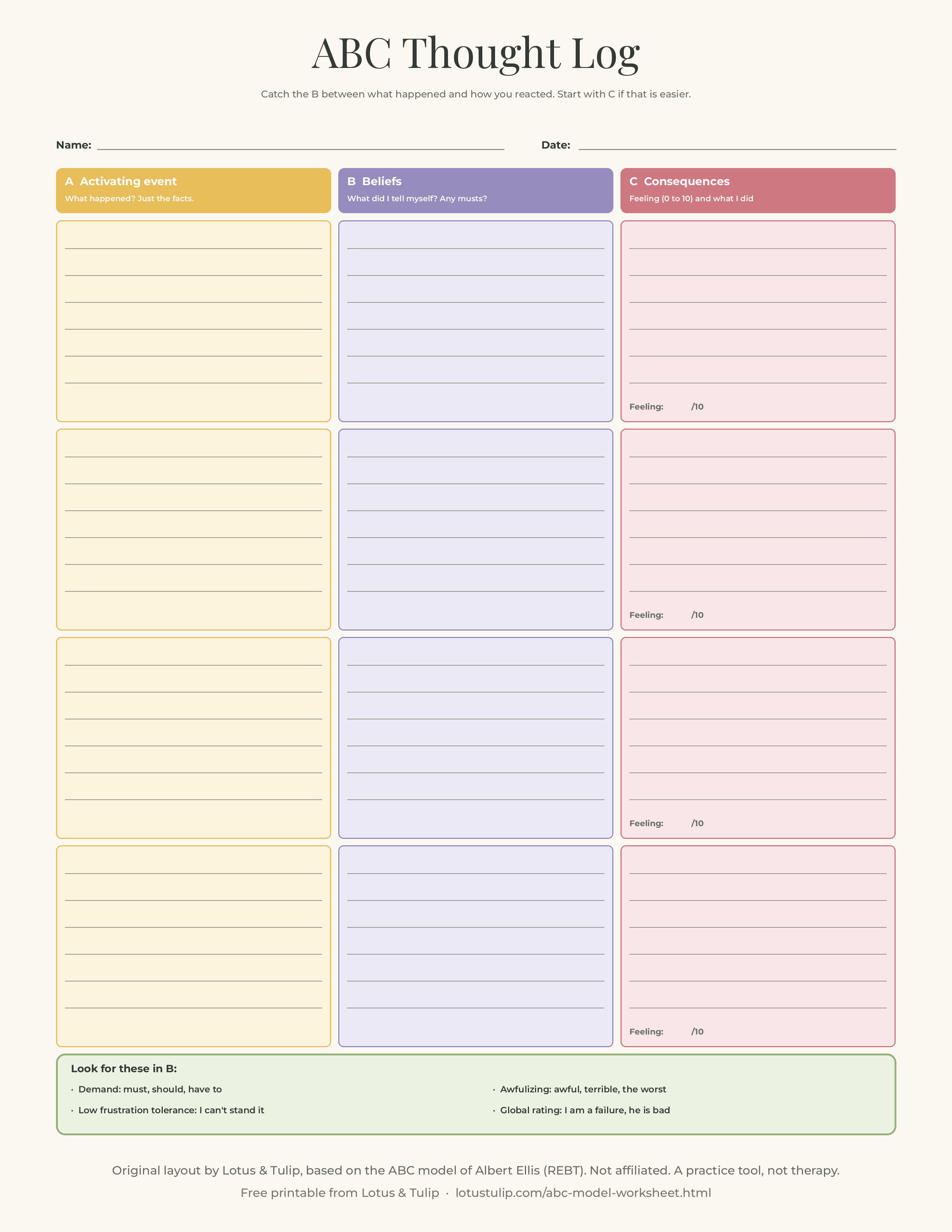
Download the free ABC model worksheet (PDF, 3 pages, US Letter)
Prefer single images? Page 1: ABC Thought Log (PNG) · Page 2: ABCDE Disputing Worksheet (PNG) · Page 3: ABC Worksheet for Kids (PNG)
Free CBT starter pack: Want more pages for the same session? The free CBT worksheets starter pack adds a 7 column thought record, plus five more real worksheets from our CBT set (8 pages, client use license, no email).
Free to print for your own use and for use with your own clients, students, or groups. This is an original layout by Lotus & Tulip, based on the ABC and ABCDE model described by Albert Ellis. It is not affiliated with the Albert Ellis Institute and is not a substitute for therapy. Please link to this page rather than re-uploading the file.
Related resources
- CBT thought record: Beck style evidence for and against, with a free printable.
- Cognitive distortions worksheet: should statements, catastrophizing, labeling, and more.
- Core beliefs worksheet: the downward arrow for beliefs that keep coming back.
- Positive self talk worksheet: coping statements that sound believable.
- Check the Facts worksheet: the DBT way to test whether an emotion fits.
- Cognitive defusion worksheet: the ACT alternative when disputing turns into rumination.
- Self compassion worksheet: a kinder voice for global self rating.
- Worry worksheet for kids: worry detective questions for children.
Sources
- Ellis, A. (1962). Reason and Emotion in Psychotherapy. Lyle Stuart. Classic statement of the ABC model and irrational beliefs.
- Ellis, A. (1985). Expanding the ABCs of rational-emotive therapy. In M. J. Mahoney and A. Freeman (Eds.), Cognition and Psychotherapy. Plenum. Describes the ABCs from 1955 and the addition of D and E to clinic homework forms in the late 1960s.
- Albert Ellis Institute. Emotional Disturbance and Its Treatment in a Nutshell (ABCs). albertellis.org. Examples of rational preferences and cognitive, emotive, and behavioral disputing.
- Dryden, W., and Neenan, M. (2004). The Rational Emotive Behavioural Approach to Therapeutic Change, and related works by Dryden and DiGiuseppe describing demands, awfulizing, frustration intolerance, and depreciation, and healthy vs unhealthy negative emotions.
- Beck, A. T., Rush, A. J., Shaw, B. F., and Emery, G. (1979). Cognitive Therapy of Depression. Guilford Press. Source of the daily record of dysfunctional thoughts.
- David, D., Cotet, C., Matu, S., Mogoase, C., and Stefan, S. (2018). 50 years of rational-emotive and cognitive-behavioral therapy: A systematic review and meta-analysis. Journal of Clinical Psychology, 74(3), 304 to 318. 84 articles; d = 0.58 on outcomes and d = 0.70 on irrational beliefs at posttest; high heterogeneity.
- Trip, S., Vernon, A., and McMahon, J. (2007). Effectiveness of rational-emotive education: A quantitative meta-analytical study. Journal of Evidence-Based Psychotherapies, 7(1). 26 studies; larger effects for children and adolescents; authors note methodological limits.
- Vernon, A. Thinking, Feeling, Behaving: An Emotional Education Curriculum for Children and Adolescents. Research Press.
- Honest caveat: no study tests this three page Lotus and Tulip printable alone. The research above concerns REBT, REE, and CBT delivered as treatments or programs.
ABC model worksheet: FAQ
What is the ABC model in CBT?
The ABC model says that an Activating event (A) leads to emotional and behavioral Consequences (C) largely through your Beliefs (B) about the event. It was developed by Albert Ellis as the foundation of Rational Emotive Behavior Therapy and is used widely across CBT to show how thoughts link events and feelings.
What does ABCDE stand for?
A is the Activating event, B is Beliefs about it, C is the emotional and behavioral Consequences, D is Disputing the unhelpful belief, and E is the Effective new belief, along with the healthier feeling and action that follow. Some versions add F for new Feelings.
What is the difference between an ABC worksheet and a thought record?
Both link events, thoughts, and feelings. A Beck style thought record mainly tests whether an automatic thought is accurate by weighing evidence. An REBT ABCDE worksheet focuses on rigid evaluative beliefs such as musts, awfulizing, and global self rating, and often disputes them even if the worst case is true. Many clinicians use both.
What are the four irrational beliefs in REBT?
REBT commonly describes demands (musts and shoulds) as the core irrational belief, with three derived beliefs: awfulizing, low frustration tolerance ("I can't stand it"), and global rating or depreciation of yourself, others, or life. Each has a rational alternative: flexible preferences, anti awfulizing, high frustration tolerance, and unconditional acceptance.
What are good disputing questions?
Use empirical questions (Where is the evidence this must happen?), logical questions (Does it follow that because I want it, it must happen? Does one failure make me a failure?), and pragmatic questions (Where does this belief get me? Does it help my goals?). Write honest answers rather than the answers you think you should give.
Can kids use the ABC model?
Yes, with simpler words. Rational Emotive Education adapts REBT for schools. For younger kids, rename the letters What happened, What I thought, and How I felt and what I did, use drawings and thought bubbles, and replace disputing with two questions: Is that thought true for sure? Is it helping me? The free printable includes a kids version.
Is the ABC model the same as an ABC behavior chart?
No. In behavior analysis, ABC stands for Antecedent, Behavior, Consequence and is used to track what happens around a behavior. Ellis's ABC model is cognitive: B stands for Beliefs, and the goal is to change the beliefs that drive emotional and behavioral consequences.